Tuesday, March 24, 2026

World Nuclear News


Data centre to be built near planned Polish nuclear power plant


Renewable energy developer WBS Power has announced plans for a 3.2 GW data centre campus in the municipality of Choczewo in northern Poland's Pomerania region. It says the nuclear power plant planned to be built nearby will help provide a stable power supply.
 
Visualisation of the Baltic Data Centre Campus in Choczewo (Image: WBS Power)

Preparations for the project - named the Baltic Data Centre Campus - have taken several months, the company said, and included the development of the investment concept, the selection of an optimal location and the securing of suitable plot for the development. "The chosen site allows the project to scale flexibly across different technological configurations while ensuring access to sufficient power sources," it added.

WBS Power is now moving into the next phase of the project. The campus will be built in four phases, each with a planned capacity of 800 MW. Each phase will include: dedicated energy infrastructure for AI workloads; integration with renewable energy sources and battery energy storage systems; solutions meeting the highest ESG, energy efficiency and energy security standards; and platforms designed to support cooperation with global hyperscalers and cloud providers.

Preparatory work for all four phases is expected to be completed by the end of 2027, with the first data centre planned to become operational around 2028–2029.

The company said it has already secured grid connection conditions for the full 3.2 GW capacity.

"This will be the largest project of its kind in Poland and one of the largest in Europe," said WBS Power CEO Maciej Marcjanik. "The rapid development of AI is driving demand for hyperscale data centres supported by advanced infrastructure and reliable access to large volumes of power. The integration of renewable energy and energy storage with digital infrastructure will be a key pillar of competitiveness for next-generation hyperscale projects."

The company said power supplied to the Baltic Data Centre Campus "will come from conventional sources complemented by renewable energy and, in the longer term, also nuclear power".

In November 2022, the then Polish government selected Westinghouse AP1000 reactor technology for the construction of the country's first nuclear power plant at the Lubiatowo-Kopalino site in Choczewo municipality. The aim is for Poland's first AP1000 reactor to enter commercial operation in 2033.

"The digital revolution requires infrastructure on an entirely new scale," said WBS Power CFO Hubert Bojdo. "We selected the location for the Baltic Data Centre Campus very carefully, ensuring access to large power capacities, a diversified energy mix already in place today, and the long-term prospect of stable supply supported by future nuclear generation."

Nucleareurope releases action plan to stimulate EU nuclear investments


Brussels-based nuclear trade body Nucleareurope has published an action plan for nuclear which outlines how key European Union policies can make a decisive contribution to its deployment across the EU.
 
(Image: Pixabay)

"For more than 70 years, nuclear has delivered stable, clean power across Europe," Nucleareurope says. "Today, with electrification accelerating, data centres multiplying, industries racing to decarbonise and global pressures intensifying, its value is clearer than ever. In this context, nuclear brings concrete and measurable benefits to all EU countries, regardless of whether these countries have nuclear facilities or not. It provides firm, dispatchable clean power that stabilises the grid and complements renewables. It strengthens Europe's energy sovereignty by reducing dependence on imported fossil fuels. It supports industrial decarbonisation with decarbonised electricity, heat and hydrogen. And it anchors a world-leading European value chain that supports 900,000 skilled jobs."

In the latest Communication on the European Commission's eighth Nuclear Illustrative Programme (PINC), published in June last year, the European Commission assessed that lifetime extensions and new large-scale reactors planned by member states will need investment of EUR241 billion (USD279 billion) by 2050 - with more needed for small modular reactors and advanced modular reactors. It says that installed nuclear capacity is projected to increase from 98 GW in 2025 to 109 GW by 2050.

"Unleashing the power of nuclear will require a technology neutral, long-term policy framework," Nucleareurope says. "Furthermore, a series of concrete policy steps at EU level are needed to further support these investments, reduce time delays and cost overruns."

The trade body has now published an action plan aimed at creating the right policy environment to maximise the contribution of nuclear.

The plan centres around five main policy groupings: a long-term policy vision to stimulate net-zero with nuclear; an equitable financial framework to stimulate investments in nuclear; an accelerated regulatory framework to speed up nuclear deployment; investing in the entire fuel cycle to ensure security of supply; and a policy framework sustaining a supply chain based in Europe.

"We need to decarbonise our economy, secure our energy supplies, protect our industrial competitiveness and keep our energy affordable," said Xavier Ursat, Nucleareurope President. "As an industry we are committed to helping Europe overcome these challenges. Nuclear is key in this respect. It is a homegrown technology that will ensure energy sovereignty. Its low emissions make it the ideal partner in decarbonising our economy. It is also affordable and available 24/7."

"As highlighted under the latest Nuclear Illustrative Programme, significant investments will be required over the next two decades in order to ramp up the deployment of nuclear projects," added Nucleareurope Director General Emmanuel Brutin. "Our action plan outlines how EU policies can really help stimulate these investments, bringing significant benefits to the entire EU."

Uzbekistan and Russia mark SMR construction progress
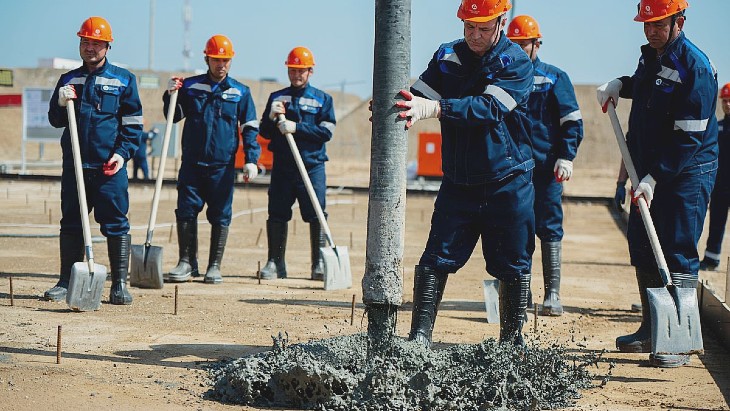

Russia and Uzbekistan have signed a roadmap for nuclear cooperation, as initial concrete was poured as part of preparations for the construction of the first small modular reactor at Uzbekistan’s first nuclear power plant.
 
(Image: Rosatom)

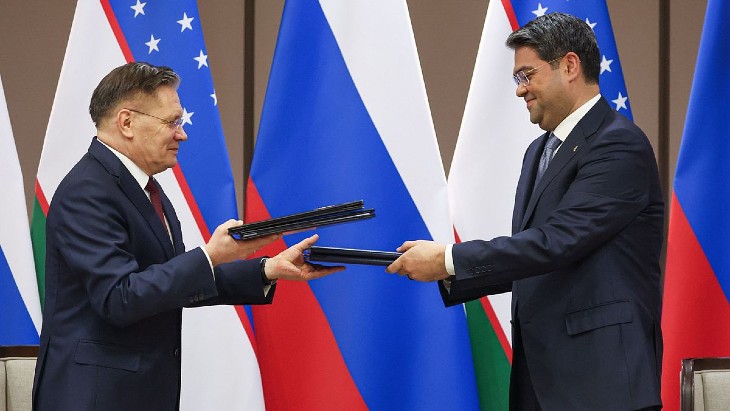
The roadmap, signed by Rosatom Director General Alexey Likhachev and Uzatom Director Azim Akhmedkhadzhaev, "covers all key areas of cooperation on the nuclear power plant construction project, including personnel training, public awareness of modern nuclear technologies, and the creation of a future 'nuclear city' at the plant".

A supplemental agreement to the contract for the new nuclear power plant covers the decision to change its contents to two gigawatt-scale VVER-1000 units and two 55 MWe RITM-200N small modular reactors (SMRs). The original plan had been for the plant to feature six of the SMRs - the new design will mean a capacity of more than 2,100 MWe, compared with the previous 330 MWe.

(Image: Rosatom)

The two countries' presidents spoke on the phone on Tuesday, noting the signing of the roadmap and the progress being made for the first SMR unit at the site, in the Jizzakh region.

Rosatom said that, following the receipt of the necessary permissions to use the site for the two SMRs, concrete work had begun at the site, saying that "approximately 900 cubic metres will be poured during the concrete foundation work for the reactor building, due for completion in April". It said that this foundation will then be levelled and waterproofed before "the pouring of the first concrete for the reactor building's foundation slab".
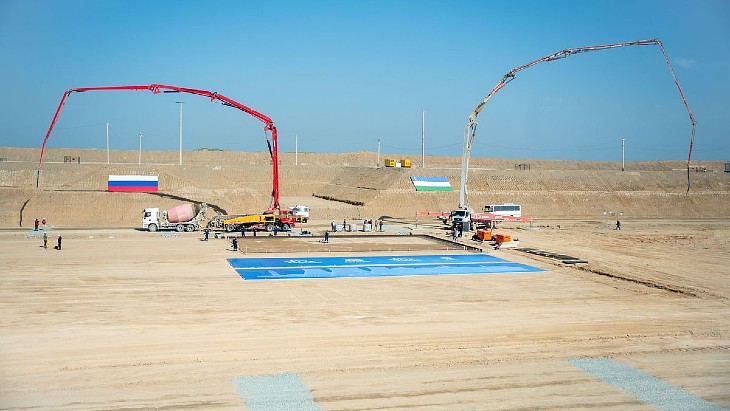

(Image: Rosatom)

Alexey Likhachev, Rosatom Director General, said: "The signing of the roadmap and agreement for the construction of the integrated nuclear power plant, and the subsequent commencement of concrete work at the site, mark Uzbekistan's emergence as a leader in global nuclear energy. The country is launching a unique project that will contribute to socioeconomic growth and strengthen its technological sovereignty for decades to come."

Once it is fully operational, the plant will generate approximately 17.2 billion kWh per year, about 14% of Uzbekistan's total energy requirements.

Background

A contract signed in May 2024, during a visit to the country by Russian President Vladimir Putin, was for the construction of a 330 MW capacity nuclear power plant featuring six units of the RITM-200N water-cooled small modular reactor, which is adapted from nuclear-powered icebreakers' technology, with thermal power of 190 MW or 55 MWe and with an intended service life of 60 years. The first unit was scheduled to go critical in late 2029 with units commissioned one by one.

It was the first export order for Russia's SMR. The first land-based version is currently being built in Yakut in Russia, with the launch of the first unit scheduled to take place in 2027.
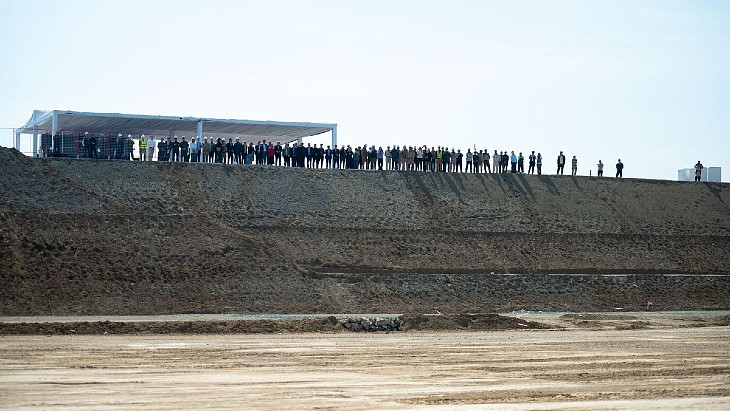

A ceremony was held at the site, where a giant pit has been prepared (Image: Rosatom)

An agreement signed at the end of September 2025 during World Atomic Week in Moscow multiplied the capacity of what had previously been proposed, with the plant plan switched to feature two large units - VVER-1000s with an output each of 1 GW - plus two 55 MW RITM-200N SMRs.

Excavation work began in October for the pit for the first of the SMRs at the site. About 1.5 million cubic metres of soil were excavated during the digging of a pit 13 metres deep for the RITM-200N, with engineering surveys and design and preparatory works also taking place.

Vietnam, Russia sign agreement on new nuclear plant
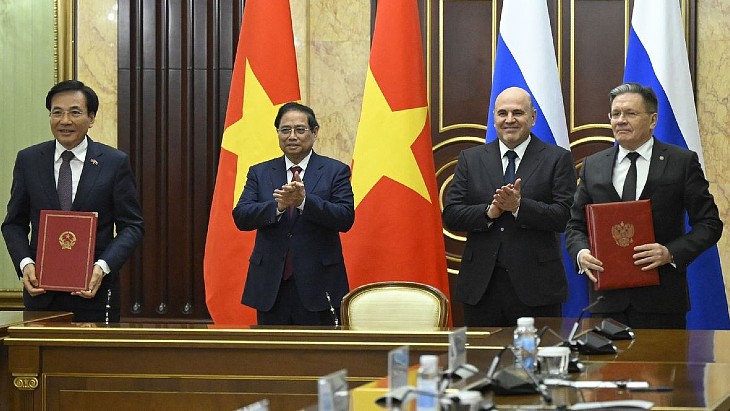

An intergovernmental agreement has been signed on cooperation in the construction of the Ninh Thuan 1 Nuclear Power Plant in Vietnam, to feature two VVER‑1200 reactors, with the new Leningrad units as the reference project.
 
(Image: Rosatom)

The signing of the agreement took place on Monday during the official visit of Vietnam's Prime Minister Pham Minh Chinh to Moscow. It was signed by Rosatom Director General Alexey Likhachev and Tran Van Son, Minister and Head of the Office of the Government of the Socialist Republic of Vietnam, in the presence of the Vietnamese Prime Minister and his Russian counterpart, Mikhail Mishustin.

Mishustin said that "creation of the nuclear plant will give a strong impetus to development of cooperation in adjacent areas - high technologies, fundamental and applied research".

Rosatom said the intergovernmental agreement "regulates the conditions and key areas of cooperation between the parties in implementing the project for the construction of the nuclear power plant ... Leningrad NPP‑2 (power units No 1 and No 2) has been selected as the reference project. The document establishes the necessary legal framework for the construction of the plant and will shape the direction of Russian‑Vietnamese cooperation in the nuclear field for decades to come".

Likhachev said: "For us, this is not merely an agreement to build two nuclear power units. We see it as the foundation for a long‑term industrial partnership that will strengthen Vietnam's energy independence and open up new opportunities for economic growth."

Background

A previous project, in the central province of Ninh Thuan, was approved in principle by the government in 2009 and was going to feature Russian VVER-1200 reactors - but project work was halted in 2016 because of "economic conditions". Considerable work was done at the site before the project's indefinite postponement, including relocating two villages with much upgrading of facilities and infrastructure.

The Vietnamese government has since revived its nuclear energy ambitions - citing energy security, development and net zero targets - and has been exploring the possibilities of small modular reactors. The National Assembly approved the government's proposal to restart the Ninh Thuan nuclear power project at its 8th working session in November 2024.

Vietnam's proposed Ninh Thuan nuclear power project consists of two plants, with each plant comprising two reactors. The Ninh Thuan 1 plant is located in Phuoc Dinh commune, Thuan Nam district. The Ninh Thuan 2 plant is located in Vinh Hai commune, Ninh Hai district.

In February last year, Vietnam's prime minister set a target to complete the construction of two nuclear power plants in Ninh Thuan province by the end of 2030.

Russia and Vietnam have existing nuclear technology links, notably with the development of plans for a Centre for Nuclear Science and Technology in Vietnam, which includes a Russian‑designed research reactor. The existing Dalat research reactor uses Russian‑supplied fuel and provides Vietnam with medical isotopes.

Upgraded turbine monitoring system at Temelin 2
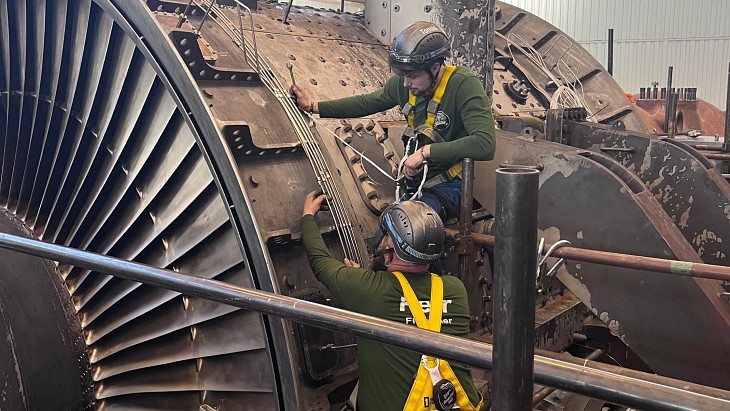

A new monitoring system installed by Doosan Škoda Power at Temelin's unit 2 can measure the rotation time of the blades to the billionth of a second, ČEZ has said.
 
(Image: CEZ)

Petr Měšťan, Director of the Temelín Nuclear Power Plant, said it was a modernisation of the monitoring system which had been used for ten years: "Thanks to the special sensors, we can monitor whether the vibration of the blades of the last impellers is within the required limits even during operation."

Bohdan Zronek, member of the ČEZ board of directors and director of the nuclear energy division, said: "Although Temelín is a relatively young power plant, new technologies are always emerging. And if it makes sense for us from the point of view of efficiency and safety, we use them to the maximum extent. This applies to turbine diagnostics and a number of other devices."

ČEZ says the sensors measure the rotation time of each blade, which is over a metre long - acceleration or delay in the passage of the blade then signals its vibration. The work, costing "tens of millions" of Czech Koruna (CZK10 million is USD474,000), is taking place during the current, planned shutdown of the unit.

Investment projects at Temelin - which has two VVER-1000 units which came into operation in 2000 and 2002 - will reach CZK3.8 billion (USD182 million) this year and include continued modernisation of the control system and completion of the switch to a longer fuel cycle, the company said in an announcement in January. The plan is for the plant's units to operate for 60 or more years.

The Czech Republic gets about one-third of its electricity from nuclear generation - it also has four VVER-440 units at Dukovany, which began operating between 1985 and 1987. A CZK407 billion (USD18.6 billion) contract was signed with Korea Hydro & Nuclear Power last year for two of its APR1000 reactors near the existing Dukovany units. The aim is to start construction in 2029. There are also developing plans for small modular reactors in the country.

Application submitted for Swedish SMR plant
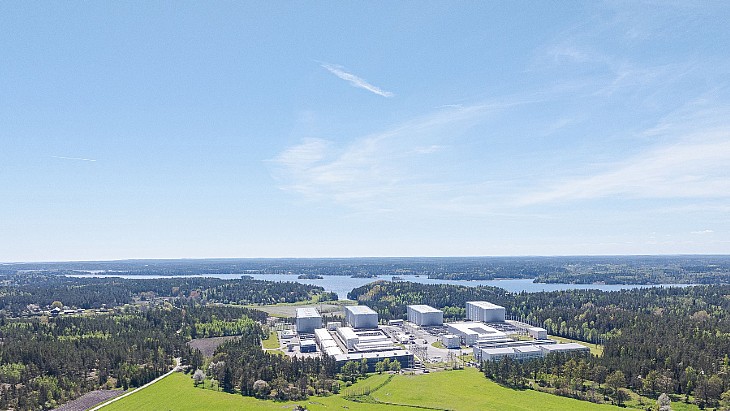

Kärnfull Next has submitted an application to build a power plant based on small modular reactors in the municipality of Valdemarsvik in Östergötland county in southeastern Sweden. It is the first application under the country’s new Act on Government Approval of Nuclear Facilities.
 
A visualisation of a four-unit SMR campus at the property in Målma, outside of Valdemarsvik (Image: Kärnfull Next)

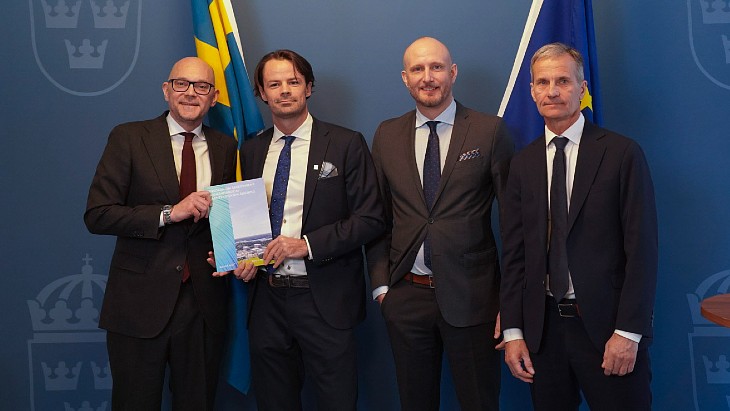
The application - submitted by project company ReFirm Målma AB - covers a planned small modular reactor (SMR) campus in Valdemarsvik, and was formally submitted to Johan Britz, Minister for Employment and acting Minister for Climate and the Environment.

The SMR campus in Valdemarsvik is initially planned to host between four and six small light water reactors, adding between 10-15 TWh of electricity generation per year. In February 2025, Kärnfull Next announced it had secured land rights for the Valdemarsvik project. The property includes areas that were identified as suitable for nuclear power in studies going back as far as the 1970s.

"This is a clear step from concept to formal permitting," said Kärnfull Next CEO Christian Sjölander. "Sweden needs new dispatchable, fossil-free power – particularly in the south – and this application shows that real projects are now moving forward."

The Valdemarsvik project would be part of Kärnfull Next's ReFirm South SMR programme, aiming to expand carbon-free and dispatchable energy production across southern Sweden.

(Image: Kärnfull Next)

The company has been conducting site selection and feasibility studies in several municipalities in Sweden since 2022. By establishing multiple SMR parks as part of the same programme, Kärnfull Next expects to achieve economies of scale in terms of technology selection, construction partners, power purchase agreements and financing partners.

Kärnfull Next said it plans to submit additional applications for other ReFirm sites later this year.

Last month, the Swedish government announced several proposed measures to make it easier to establish new nuclear power in the country. ​The new legislation introduces an early-stage government approval process designed to improve predictability and accelerate the deployment of new nuclear capacity.

In March 2022, Kärnfull Next signed a memorandum of understanding with GE Hitachi Nuclear Energy on the deployment of its BWRX-300 in Sweden. The company signed a memorandum of understanding with South Korean construction firm Samsung C&T in December 2024 to advance the deployment of SMRs in Sweden.

Earlier this month, Swedish nuclear technical services provider Studsvik announced its acquisition of Kärnfull Next, expanding its role from supporting the world's existing nuclear fleet to also developing new nuclear projects.

In October 2022, Sweden's incoming centre-right coalition government adopted a positive stance towards nuclear energy. In November 2023, it unveiled a roadmap which envisages the construction of new nuclear generating capacity equivalent to at least two large-scale reactors by 2035, with the equivalent capacity of up to 10 new large-scale reactors (which may include small modular reactors) coming online by 2045. A new act on state aid entered into force on 1 August 2025, since when interested companies have been able to apply for the aid.

The Swedish government received the first such application in December to support proposals for either five GE Vernova Hitachi BWRX-300 reactors or three Rolls-Royce SMRs to provide about 1,500 MW capacity at Ringhals on the Värö Peninsula. The application came from Videberg Kraft AB, a project company owned by Vattenfall AB and backed by a series of industrial firms via the Industrikraft i Sverige AB consortium.

Equinor Expands Brazil Renewables With 230 MW Wind Acquisition


Equinor has acquired the ready-to-build 230 MW Esquina do Vento onshore wind complex in Brazil from Vestas, marking a further expansion of its renewable footprint in one of its core international markets.

The project, located in Rio Grande do Norte, will feature 51 Vestas turbines and is expected to generate around 1 TWh annually - enough to power roughly 520,000 Brazilian households. Construction is scheduled to begin in the second quarter of 2026, with commercial operations targeted for 2028.

The asset will be developed and operated by Rio Energy, Equinor’s wholly owned Brazilian renewables subsidiary.

The acquisition reinforces Equinor’s push to build integrated, multi-technology power portfolios that combine renewable generation, energy trading, and operational capabilities. The company expects the project to deliver double-digit returns, underlining the commercial viability of its Brazil strategy.

By pairing wind assets with solar generation and leveraging its trading arm, Danske Commodities, Equinor aims to optimize power output, reduce intermittency risks, and improve grid utilization. Electricity from the project will be traded in Brazil’s domestic power market, strengthening the company’s end-to-end value chain.

The addition of Esquina do Vento will expand Equinor’s operational and equity-based renewable capacity in Brazil, which currently stands at around 600 MW.

Key assets include:

  • The fully owned Serra da Babilônia wind (223 MW) and solar (140 MW) complexes in Bahia
  • Stakes in the Apodi solar project (162 MW) and the Mendubim solar complex (531 MW), operated by Scatec

With the new project, Equinor’s onshore renewables platform—anchored by Rio Energy—continues to scale as a central pillar of its broader energy transition strategy.

Brazil has emerged as a major growth market for renewable energy developers due to its strong wind and solar resources, expanding electricity demand, and increasingly liberalized power markets.

Equinor’s move reflects a broader trend among oil and gas majors diversifying into integrated power businesses, particularly in high-growth emerging markets. By combining renewables with trading capabilities, companies are seeking to capture additional value beyond generation alone.

The use of long-term service agreements with OEMs like Vestas - here through a 30-year operations and maintenance contract - also highlights a shift toward risk-managed project structures that support predictable returns.

Equinor’s continued investment in Brazil signals confidence in the country’s renewable sector and its role as a long-term growth engine. With a pipeline of additional onshore opportunities under development, the company appears poised to further expand its integrated power model in Latin America.

As global energy companies recalibrate portfolios toward lower-carbon assets, Brazil’s scale, resource base, and market structure are positioning it as a strategic battleground for renewable investment.

By Charles Kennedy for Oilprice.com


Equinor Begins Drilling at Brazil’s Massive Raia Gas Project

Equinor has kicked off drilling at the Raia project, one of the largest natural gas developments advancing offshore Brazil, as the Norwegian energy major pushes deeper into the country’s pre-salt basin and broader gas market.

The campaign began on March 24 with the Valaris DS-17 drillship and will cover six wells in the Raia area, roughly 200 kilometers offshore in the Campos Basin at water depths of about 2,900 meters. The start of drilling marks a major execution milestone for a project Equinor has described as its largest currently under development.

Raia is operated by Equinor, which holds 35%, alongside Repsol Sinopec Brasil with 35% and Petrobras with 30%. The partners are targeting first production in 2028.

The scale of the project is substantial. Raia holds more than 1 billion barrels of oil equivalent in recoverable gas and condensate reserves. Once online, it is expected to export as much as 16 million cubic meters of natural gas per day, a volume that could account for about 15% of Brazilian gas demand by 2028. That would make it a strategically important supply source for Brazil at a time when the country is seeking to strengthen domestic gas availability and industrial competitiveness.

The development will rely on a floating production, storage and offloading vessel (FPSO) tied back to subsea wells. Gas from the field will be sent through a 200-kilometer pipeline to Cabiúnas in Macaé, Rio de Janeiro state, where it can enter Brazil’s onshore gas system. The FPSO is also expected to handle roughly 126,000 barrels per day of oil and condensate.

For Equinor, Raia is more than another offshore project. It is the company’s largest international investment to date, with a total estimated cost of around $9 billion, and deepens its position in one of its core overseas markets. Brazil already plays a central role in Equinor’s portfolio through oil, gas, and increasingly power-related assets. Raia now adds a large-scale gas pillar with long-life production and expected cash flow visibility.

The company is also emphasizing emissions performance. Equinor said the Raia FPSO is expected to rank among the most carbon-efficient globally, with average CO2 intensity of around 6 kilograms per barrel of oil equivalent, well below the current industry average cited by the company of 17 kilograms per barrel. That message is likely aimed at investors increasingly focused on lower-carbon upstream supply rather than just production growth.

Raia also builds on operational experience in Brazilian deepwater. Equinor pointed to the partners’ previous work on the Bacalhau field, where the DS-17 drillship also participated. That continuity may help reduce execution risk as the industry continues to grapple with rising offshore project complexity, tight supplier capacity, and pressure to bring large gas resources to market more efficiently.

Beyond output and emissions, the project carries broader economic weight. Equinor estimates Raia could support up to 50,000 direct and indirect jobs over its 30-year life cycle, underscoring the project’s industrial significance in Brazil as offshore developments remain a major source of employment, investment, and infrastructure buildout.

In practical terms, the start of drilling signals that Raia has moved decisively from planning into heavy execution. With wells, FPSO integration, and commissioning now advancing in parallel, Equinor and its partners are positioning the project as a cornerstone of Brazil’s future gas supply.

By Charles Kennedy for Oilprice.com


White House Dismisses Insider Trading Claims in Oil Market

Some trading entities profited millions of U.S. dollars from trades in oil futures contracts on Monday, just 15 minutes before U.S. President Donald Trump posted about “very good and productive conversations” with Iran, which sparked a relief rally and made market observers question the suspiciously well-timed oil trades. 

Oil futures plunged by 10% on Monday morning ET after President Trump said he would postpone expected strikes on Iran’s power plants and energy infrastructure for five days, pending negotiations that would continue this week.   

Iran later denied any direct or indirect contact has been made, but the oil market appeared to hang on President Trump’s Truth Social posts and oil prices slumped on Monday. 

But reporters and analysts at Bloomberg and the Financial Times have noticed unusual trading activity just 15 minutes before President Trump’s post that sent prices crashing. The notional value of massive blocks of West Texas Intermediate and Brent futures contracts traded in just one minute, 15 minutes before the post, is estimated at about $580 million, per FT calculations based on Bloomberg data.  

It was not clear if one or more entities engaged in these trades or if it was pure coincidence or something more akin to insider trading. 

Analysts tell FT that the timing of the large trades looks suspicious. 

“It’s hard to prove causality,” one market strategist at a U.S. broker told FT.

“But you have to wonder who would have been relatively aggressive at selling futures at that point, 15 minutes before Trump’s post.” 

A portfolio manager noted that “It’s an unusually large trade for a day with no event risk,” no Fed announcements, or important oil-market data coming out. 

“Somebody just got a lot richer,” the manager told FT. 

The White House flatly dismissed any notion of insider trading. 

“The White House does not tolerate any administration official illegally profiteering off of insider knowledge, and any implication that officials are engaged in such activity without evidence is baseless and irresponsible reporting,” White House spokesperson Kush Desai told FT.   

By Michael Kern for Oilprice.com 

Chinese Publication Claims U.S. Has Two Months of Rare Earths Left

The U.S. has already launched hundreds of missiles and precision-guided weapons in the escalating conflict with Iran, an air campaign that has consumed billions of dollars in advanced military hardware in just weeks. But a new warning circulating in Chinese and Western media suggests the materials needed to keep producing those weapons may be running dangerously low.

Reports from the South China Morning Post and Reuters indicate Washington could have only weeks or months of certain rare-earth inventories available for defense manufacturing if supply disruptions deepen.

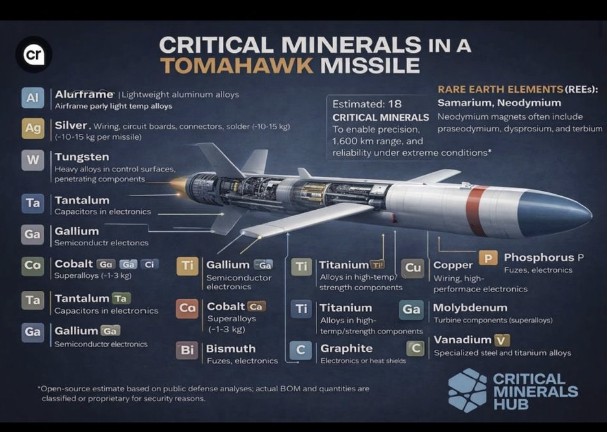
Rare earth elements are embedded throughout modern military systems—from missile guidance and drone propulsion to radar systems and fighter aircraft electronics.


Tomahawk

“You can’t fight a twenty-first-century war with twentieth-century supply chains,” said Lipi Sternheim, CEO of REalloys. “Modern weapons rely on materials that are difficult to source, difficult to process, and difficult to replace once inventories begin to tighten.”

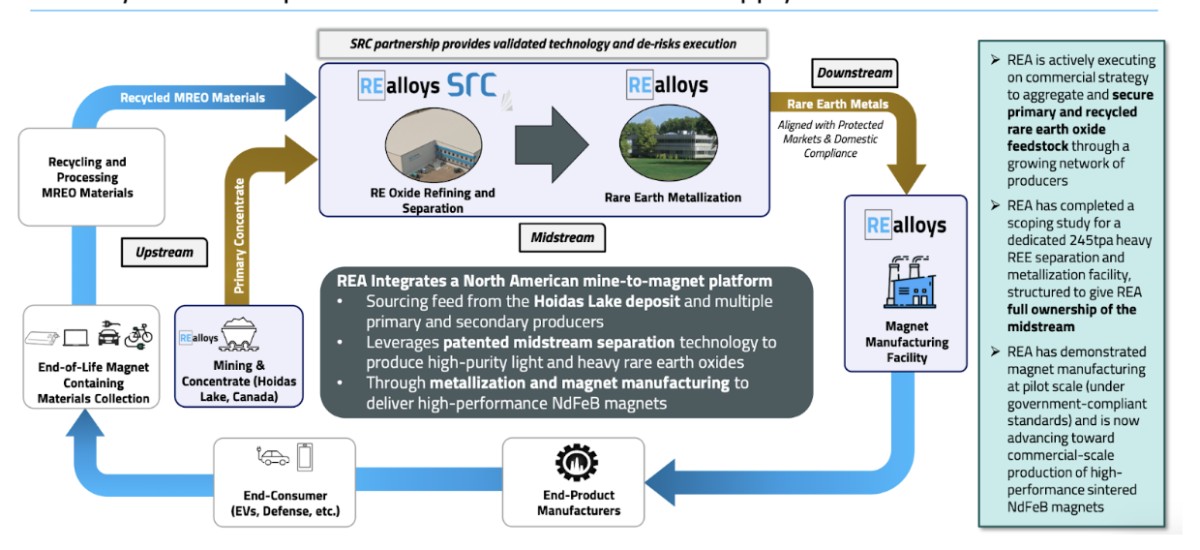
REalloys (NASDAQ: ALOY) is one of the few companies rebuilding the rare-earth metals stage of the supply chain in North America, converting rare-earth oxides into the metals and alloys used by magnet manufacturers and defense suppliers.

And it’s the 11th hour for American defense and the entire defense industry, even if it wasn’t in the middle of a war with Iran that reportedly cost $5.6 billion just in the first two days.

That vulnerability isn’t new. For decades, the United States allowed much of its rare-earth processing and metallization capacity to migrate overseas, leaving China to dominate the stages of the supply chain that convert raw materials into the metals and magnets used in advanced technology. Today, much of the rare-earth material used in Western defense systems still traces through Chinese processing facilities. The Pentagon is now racing to reverse that dependence ahead of a 2027 deadline that will prohibit U.S. weapons systems from using magnets made with Chinese-origin rare earths.

REalloys’ flagship facility in Euclid, Ohio, is already ahead of the deadline.

REBUILDING AMERICA’S RARE EARTH METALS CAPACITY

Mountain Pass in California produces rare-earth concentrate that is separated domestically into NdPr oxide. That is an important step in rebuilding North American capability - but oxide itself is not the material defense contractors actually use.

Before it can enter manufacturing, oxide must first be chemically reduced into pure rare-earth metal. That metal is then blended into precise alloys used to produce high-performance permanent magnets.

For decades, that conversion—from oxide to metal—has taken place almost entirely in China. Even when rare-earth ore was mined in the United States and separated into oxide domestically, the metallurgical step that turns that chemistry into usable industrial metal was still performed overseas.

That is the break in the supply chain.

REalloys is positioned to help close it.

REalloys systems

At its Euclid facility, the company converts rare-earth oxides into finished metals and magnet-grade alloys through high-temperature reduction and refining processes. Those materials are the feedstock required by magnet manufacturers and advanced industrial users.

It is also one of the most technically difficult stages of the entire rare-earth value chain. Metallization requires tightly controlled reduction reactions, high-temperature furnaces, and continuous process control capable of maintaining stable yields and purity levels across multiple rare-earth elements.

“Metallization is the least developed part of the value chain outside China,” said REAlloys co-founder Tim Johnston. “It requires deep operating expertise and process control systems capable of managing complex variables in continuous production. Even with capital and strong execution, replicating that capability typically takes three to seven years or more, with significant technical and qualification risk.”

The Euclid facility is already operating, converting rare-earth oxides into metals and alloys inside North America rather than sending those materials overseas for processing.

Upstream, REalloys owns the Hoidas Lake rare-earth project in Saskatchewan, anchoring primary resource exposure inside Canada.

In Greenland, the company has signed a long-term non-binding letter of intent covering roughly 15% of future production from the Tanbreez rare-earth project, one of the largest deposits of heavy and medium rare earths outside China.

Additional supply agreements extend to Kazakhstan, where the company is working with AltynGroup on access to material from the Kokbulak project and surrounding concessions. In Brazil, an alliance tied to the Araxá rare-earth project adds another potential non-Chinese source of feedstock.

“We’ve already solved the hardest part—proving that rare-earth metallization and alloying can be done domestically to the specifications real customers require,” Johnston said.

REalloys (NASDAQ: ALOY) isn’t stopping at metallization, either.

The company is also developing a large-scale permanent magnet manufacturing facility in the United States, designed to start with roughly 3,000 tons of neodymium-iron-boron (NdFeB) magnet production annually and expand to as much as 18,000 tons per year.

At full capacity, that level of output could supply magnets for roughly 1.5 to 2 million electric vehicles annually, thousands of wind turbines, and large volumes of industrial motors, robotics systems, and medical devices. Defense systems—from missile guidance units to radar and avionics—also rely heavily on high-performance rare-earth magnets.

That dependency runs across the entire contractor base. Lockheed Martin (NYSE: LMT), whose F-35 program requires hundreds of pounds of rare earth materials per airframe for flight controls, radar, and electronic warfare suites, has moved to dual-source critical mineral inputs as the 2027 deadline closes in. RTX Corporation (NYSE: RTX) faces the same pressure through its Raytheon unit, where AMRAAM and Tomahawk production depends on dysprosium and terbium magnets capable of holding performance under combat heat and vibration. At the smaller end of the contractor spectrum, Kratos Defense & Security Solutions (NASDAQ: KTOS) has built its high-volume drone and unmanned systems business around domestic supplier agreements that lock in proven rare earth alloys—a model that only works if the metallization layer it depends on actually exists inside the United States.

The facility is designed to integrate multiple stages of the rare-earth value chain, including metallization, alloying, powder production, and final magnet manufacturing.

If completed at the projected scale, it would represent one of the largest NdFeB magnet production sites outside Asia and a significant step toward rebuilding a fully integrated rare-earth supply chain in North America.

With Euclid converting oxide into metal inside the United States, the rare-earth supply chain begins to close a loop that has been broken for decades—just as Washington prepares to bar Chinese-origin rare earths from U.S. defense systems in 2027.

By. Michael Kern for Oilprice.com


Battery metal curbs sting Chinese miners who spent big in Africa

Construction of Bikita Minerals’ spodumene plant in 2023. Credit: Bikita Minerals

African export restrictions on crucial battery metals are dealing a blow to Chinese companies that have spent billions of dollars developing mines there to dominate supplies.

For more than a decade, Chinese miners have plowed money into Africa to secure feedstocks for their refineries and factories back home amid expectation of surging demand for minerals used in electric vehicles and energy storage systems. While other parts of the world pushed back against Chinese efforts to gain a foothold, African nations still largely welcome those investments.

But things are becoming more difficult. The Democratic Republic of Congo began cobalt export curbs in February 2025 to reduce a glut and capture more value from its output, while Zimbabwe last month banned shipments of lithium concentrates to encourage local processing. The moves quickly raised prices, which are currently at or near multiyear highs.

That’s creating a predicament for Chinese miners, which for now cannot reap the full benefit of their assets there. In top cobalt supplier Congo, No. 1 producer CMOC Group Ltd. is now digging up far more of the metal than it can export. In Zimbabwe, producers need to make major additional investments in refining capacity to sidestep the ban. For the manufacturers they supply, the export curbs are driving up prices for key energy transition metals.

“These policy moves are a big deal,” said Christopher Edyegu, an analyst at Africa Risk Consulting. “The mining landscape in Africa is changing drastically and the broader trend towards resource sovereignty or resource nationalism is more likely to increase than fade, particularly given the geopolitical competition for critical resources.”

Chinese firms led by Sinomine Resource Group Co. and Zhejiang Huayou Cobalt Co. announced investments of about $2.8 billion for lithium projects in Zimbabwe since 2020, according to critical minerals consultancy Project Blue. CMOC alone has pumped about $9 billion into a pair of Congolese copper-cobalt mines since 2016 and recently unveiled a $1.1 billion expansion project.

That helped Congo more than double cobalt output in just three years, while Zimbabwe has become the world’s fourth-biggest lithium producer. It has also drawn the attention of Washington, which wants to cut dependence on Beijing for critical minerals.

Although Congo’s full ban was replaced with strict quotas in October, exports didn’t resume until recently due to delays in implementing new procedures, and are still far below normal. The curbs caused benchmark prices to jump more than 160% and cobalt hydroxide – the main product shipped from Congo – to more than quadruple, according to Fastmarkets Ltd.

Miners in Congo extract cobalt as a byproduct of copper, a metal the nation is eager to boost output of. While investors are now diverting financial resources toward favoring copper production, operational complications associated with sharply reducing cobalt output mean many continue to churn out more than required for export quotas, according to trading house Darton Commodities.

The supply disruptions are a headache for chemical refiners, battery makers and the auto sector in China, whose cobalt imports from Congo more than halved last year, according to BloombergNEF. CMOC has been especially impacted by the quotas as it can export only about a quarter of what it produced in 2024.

“These policy changes represent a significant disruption to the battery material value chain,” said Martin Jackson, head of battery materials markets at consultancy CRU Group.

In Zimbabwe, export controls – which were initially scheduled for 2027 – also risk derailing investments that Chinese companies are making in the country’s lithium sector. Zimbabwe wants miners to build plants that will turn lithium concentrate into a higher-value sulfate product, which Huayou, Sinomine and Sichuan Yahua Industrial Group Co. are already doing. Still, the prospect of an overall drop in production has helped drive lithium prices toward the highest since 2023.

“The choice will be to invest or mine elsewhere, or refine the concentrate produced in Zimbabwe,” CRU’s Jackson said. However, there’s “currently a huge mismatch” because the planned sulfate facilities will only be able to process about a third of expected concentrate production, he said.

Sinomine and Chengxin Lithium Group Co. Ltd. have been in talks with officials about the procedure for resuming exports, they said soon after the ban was imposed.

Sinomine, Huayou, CMOC, Sichuan Yahua, Chengxin didn’t respond to requests for comment.

China’s embassy in Zimbabwe on March 19 reminded Chinese firms to strengthen risk prevention and compliance, and said investors shall consider risks to avoid losses resulting from local policy changes.

Zimbabwean President Emmerson Mnangagwa on Monday said the country will ensure “that our finite resources are processed and value added at source for the benefit of our people,” and that investors “have a duty to ensure durable and mutually beneficial collaboration.”

Other metals have also come into focus. Guinea, the top source of bauxite for China’s aluminum industry, plans to control the amount of ore supplied to the market and protect the African country against a slump in prices. It hopes to compel more producers to upgrade the raw bauxite into alumina locally, but — as in Congo and Zimbabwe — some in the industry warn that abrupt shifts in policy could deter further investments.

“Export bans alone will not be sufficient to attract investments that strengthen African local processing,” ARC’s Edyegu said. Governments should also offer incentives, such as tax benefits and better infrastructure, he said.

(By Annie Lee and William Clowes)