Showing posts sorted by relevance for query MICROPLASTIC. Sort by date Show all posts

Saturday, August 19, 2023


How microplastics are making their way into our farmland

How microplastics are making their way into our farmland
In Canada and around the world, biosolids are widely used to improve agricultural farmland
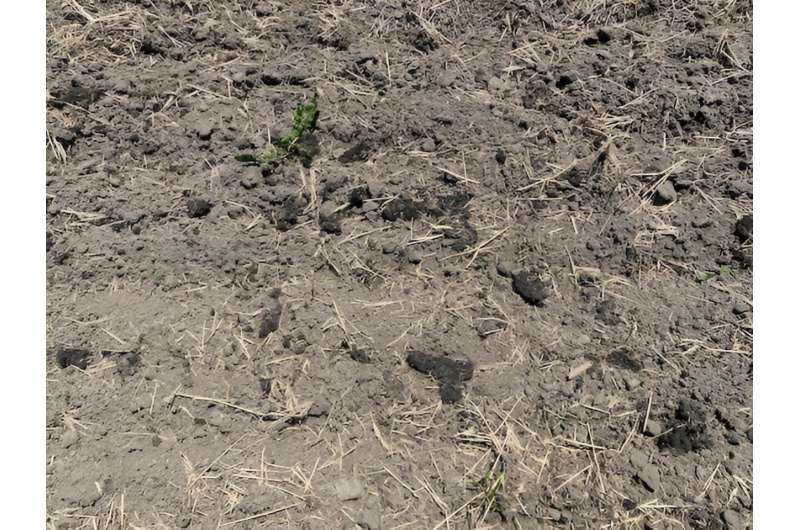
 soil. Biosolids being sprayed on an agricultural field. 
Credit: Branaavan Sivarajah, Author provided

Microplastic pollution is a global environmental problem that is ubiquitous in all environments, including airwater and soils.

Microplastics are readily found in treated  sludge—also known as municipal biosolids—that eventually make their way to our agricultural soils.

Our recent investigation of microplastic levels in Canadian municipal biosolids found that a single gram of biosolids contains hundreds of . This is a much greater concentration of microplastics than is typically found in air, water or .

Given that hundreds of thousands of tons of biosolids are produced every year in Canada, we need to pay close attention to the potential impacts such high levels of microplastics might have on the environment and find ways to reduce microplastic levels in Canada's wastewater stream.

Municipal biosolids

Municipal biosolids are produced at  by settling and stabilizing the solid fraction of the municipal wastewater inflow.

In Canada and around the world, municipal biosolids are used to improve agricultural farmland soil. This is because they are rich in nutrients needed for , such as phosphorus and nitrogen.

How microplastics are making their way into our farmland
Biosolids applied to an agricultural field. Credit: Branaavan Sivarajah, Author provided

Municipal biosolid applications are carefully regulated in Canada for , nutrients and pathogens. However, guidelines for emerging contaminants, such as microplastics, are not currently available.

While current wastewater treatment plants are not explicitly designed to remove microplastics, they are nevertheless efficient at removing nearly 90 percent of microplastic contaminants. The removed microplastics are often concentrated in the settled sludge and eventually end up in the biosolids.

Microplastics in municipal biosolids

Previous studies have shown that municipal biosolid waste is an important pathway for microplastics to enter the broader terrestrial ecosystems, including agricultural fields.

In collaboration with scientists from Environment and Climate Change Canada and Agriculture and Agri-Food Canada, we conducted the first pan-Canadian assessment of microplastics in municipal biosolids. We analyzed biosolid samples from 22 Canadian wastewater treatment plants across nine provinces and two biosolid-based fertilizer products.

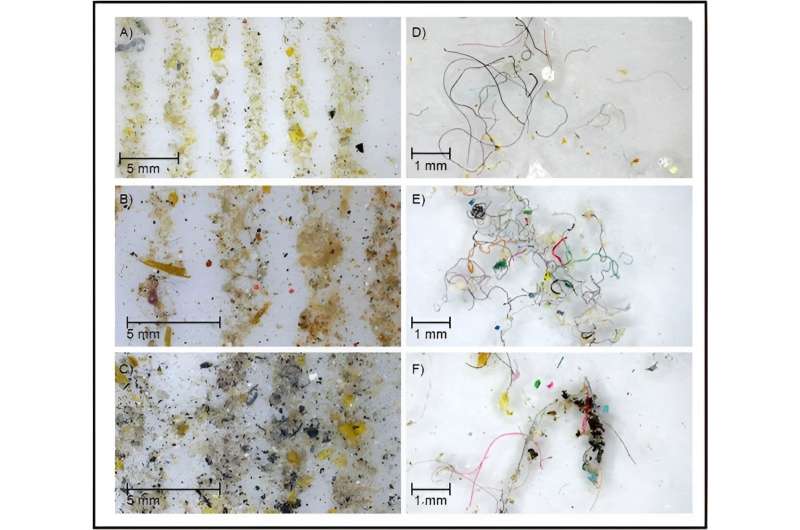
We found hundreds of microplastic particles in every gram of biosolids. The most common type of microplastic particles we observed were microfibres, followed by small fragments. We found small amounts of glitter and foam pieces too.

Microplastic concentrations in municipal biosolids are substantially higher than other environmental networks in Canada like watersoil and river sediments. This provides further evidence that microplastics are concentrated in biosolids produced at wastewater treatment plants.
How microplastics are making their way into our farmland
Microplastics in municipal biosolids. A-C: Processed biosolid samples; D-F: Assortment of microplastic particles in biosolids. Credit: Jesse Vermaire, Author provided

Reducing microplastics

Wastewater treatment plants are well-equipped to remove large plastics like bottle caps and  from municipal wastewater. However, microplastic particles are so small they can't be caught by current treatment infrastructure, so they end up concentrating in wastewater sludge.

As wastewater streams concentrate microplastics, they also offer an opportunity to reduce the plastic pollution that is entering the environment. While researchers across Canada are working to find insights on the short- and long-term ecological consequences of  on soil ecosystems, one solution is already clear.

Microplastics can be reduced at sources via systematic reductions in the use of single-use plastics, washing clothing with synthetic fiber less frequently and removing microfibres using washing machine filters. These approaches will help minimize the amount of microplastics that get into the wastewater stream and, ultimately, into the broader terrestrial and aquatic environments.

Building new technologies at our wastewater treatment plants to remove microplastics through physical or chemical means should also be explored.

We need to better understand the impact of high concentrations of microplastic on agro-ecosystems where biosolids are applied, including its impacts on soil-dwelling organisms like earthworms and insects. We also need to start building national guidelines for  levels in biosolids and agricultural soils.

More information: Branaavan Sivarajah et al, How many microplastic particles are present in Canadian biosolids?, Journal of Environmental Quality (2023). DOI: 10.1002/jeq2.20497

Journal information: Journal of Environmental Quality 

This article is republished from The Conversation under a Creative Commons license. Read the original article.The Conversation


Microplastic pollution: New device uses wood dust to trap up to 99.9% of microplastics in water
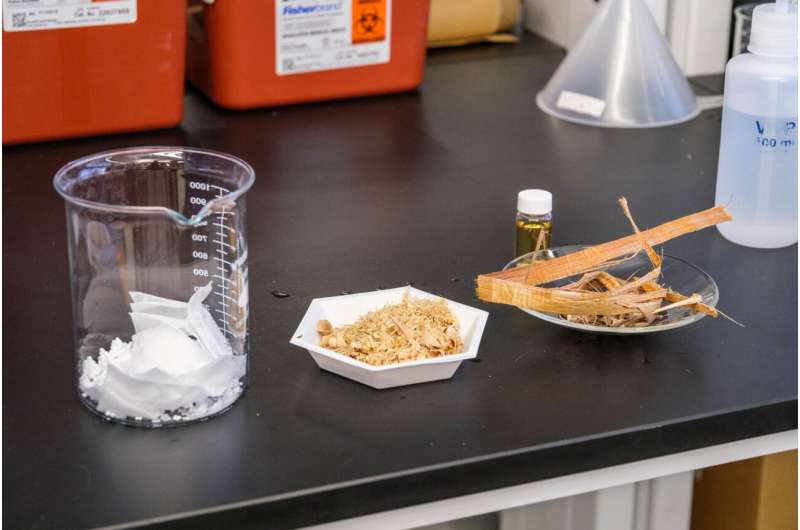
Microplastic pollution: Plants could be the answer
Different types of wood waste can be used to create the water filter. 
Credit: UBC Forestry/Jillian van der Geest

Could plants be the answer to the looming threat of microplastic pollution? Scientists at UBC's BioProducts Institute found that if you add tannins—natural plant compounds that make your mouth pucker if you bite into an unripe fruit—to a layer of wood dust, you can create a filter that traps virtually all microplastic particles present in water.

While the experiment remains a lab set-up at this stage, the team is convinced that the solution can be scaled up easily and inexpensively once they find the right industry partner.

Microplastics are tiny pieces of  debris resulting from the breakdown of consumer products and industrial waste. Keeping them out of  is a huge challenge, says Dr. Orlando Rojas, the institute's scientific director and the Canada Excellence Research Chair in Forest Bioproducts.

He noted one study which found that virtually all tap water is contaminated by microplastics, and other research which states that more than 10 billion tons of mismanaged plastic waste will be dispersed in the environment by 2025.

"Most solutions proposed so far are costly or difficult to scale up. We're proposing a solution that could potentially be scaled down for home use or scaled up for municipal treatment systems. Our filter, unlike plastic filters, does not contribute to further pollution as it uses renewable and biodegradable materials: tannic acids from plants, bark, wood and leaves, and wood sawdust—a forestry byproduct that is both widely available and renewable."

Captures a wide variety of plastics

For their study, the team analyzed microparticles released from popular tea bags made of polypropylene. They found that their method (they're calling it "bioCap") trapped from 95.2 percent to as much as 99.9 percent of plastic particles in a column of water, depending on plastic type. When tested in mouse models, the process was proved to prevent the accumulation of microplastics in the organs.

Dr. Rojas, a professor in the departments of wood science, chemical and biological engineering, and chemistry at UBC, adds that it's difficult to capture all the different kinds of microplastics in a solution, as they come in different sizes, shapes and electrical charges.

"There are microfibers from clothing, microbeads from cleansers and soaps, and foams and pellets from utensils, containers and packaging. By taking advantage of the different molecular interactions around tannic acids, our bioCap solution was able to remove virtually all of these different  types."

Collaborating on sustainable solutions

The UBC method was developed in collaboration with Dr. Junling Guo, a professor at the Center of Biomass Materials and Nanointerfaces at Sichuan University in China. Marina Mehling, a Ph.D. student at UBC's department of chemical and , and Dr. Tianyu Guo, a postdoctoral researcher at the BioProducts Institute, also contributed to the work.

"Microplastics pose a growing threat to  and human health, demanding innovative solutions. We're thrilled that the BioProducts Institute's multidisciplinary collaboration has brought us closer to a sustainable approach to combat the challenges posed by these plastic particles," said Dr. Rojas.

More information: Yu Wang et al, Flowthrough Capture of Microplastics through Polyphenol‐Mediated Interfacial Interactions on Wood Sawdust, Advanced Materials (2023). DOI: 10.1002/adma.202301531

Journal information: Advanced Materials 

How microplastics are making their way into our farmland

Monday, May 27, 2024


Study maps human uptake of microplastics across 109 countries

Study maps human uptake of microplastics across 109 countries
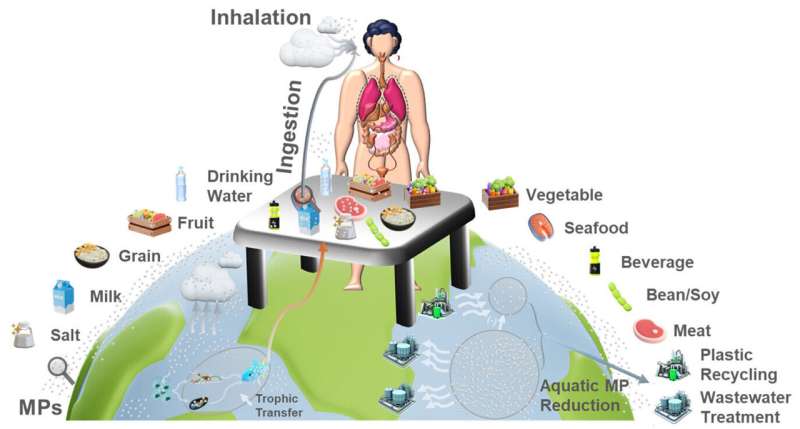
Dietary and airborne MP uptake pathway overview and uptake reduction by water quality
 control aided by aquatic plastic debris removal in 109 major developing and industrialized
 countries.
 Credit: Environmental Science & Technology (2024). DOI: 10.1021/acs.est.4c00010


Southeast Asian countries such as Indonesia, Malaysia and the Philippines top the global per capita list of dietary uptakes of microplastics, while China, Mongolia and the United Kingdom top the list of countries that breathe the most microplastics, according to a new study by Cornell researchers mapping microplastic uptake across 109 countries.

The study, published April 24 in the journal Environmental Science & Technology, builds on existing data models estimating how much  humans unwittingly eat and inhale as a result of untreated plastic debris degrading and dispersing into the environment.

To more comprehensively estimate , the Cornell study accounts for each country's eating habits, food processing technologies, age demographics and breathing rates—all factors that contribute to differences in how residents of each country consume microplastics.

"The uptake of microplastics at the country level is a critical indicator of plastic pollution and public health risks," said Fengqi You, the Roxanne E. and Michael J. Zak Professor in Energy Systems Engineering, who co-authored the study with doctoral student Xiang Zhao. "Comprehensive global mapping supports local pollution mitigation efforts through enhanced water quality control and effective waste recycling."

The study assesses dietary uptake by compiling data on microplastic concentrations in subcategories of major food groups such as fruits, vegetables, proteins, grains, dairy, drinks, sugars, salt and spices. The models also use data detailing how much of those foods are consumed in different countries. For instance, table salt consumption, per capita, is about equal in Indonesia and the U.S., but the microplastic concentration in Indonesian table salt is around 100 times higher.

Overall, the study found that Indonesians eat about 15 grams of microplastics per month—more than any other country—with the majority of plastic particles coming from aquatic sources such as seafood. That is a 59-fold increase in daily microplastic consumption from 1990 to 2018, the date range used for the models. U.S. dietary intake of microplastics is estimated to be about 2.4 grams per month, while the lowest is Paraguay at 0.85 grams.

Study maps human uptake of microplastics across 109 countries
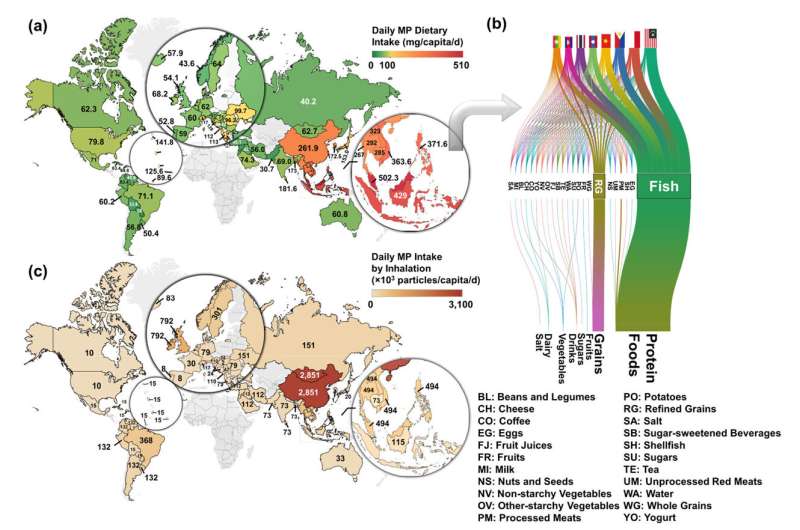
Per capita daily MP dietary and inhalation uptake rates at the country level in 109
 industrialized and developing countries within Asia, Europe, Africa, and North and 
South America, focusing on the world’s major coastlines that are affected by plastic 
pollution. 
Credit: Environmental Science & Technology (2024). DOI: 10.1021/acs.est.4c00010


Data on airborne microplastic concentration, age demographics and human respiration rates were used to calculate microplastics being inhaled. Residents of China and Mongolia topped the list, breathing in more than 2.8 million particles per month. U.S. residents inhale about 300,000 particles per month. Only residents in the Mediterranean and nearby regions breathed less, with countries like Spain, Portugal and Hungary breathing about 60,000 to 240,000 particles per month.

"Industrialization in developing economies, particularly in East and South Asia, has led to increased consumption of plastic materials, waste generation and human microplastic uptake. Conversely, industrialized countries are experiencing a reverse trend, supported by greater economic resources to reduce and remove free plastic debris," said You, who is a senior faculty fellow at the Cornell Atkinson Center for Sustainability.

You added that the study can inform reduction strategies for microplastic uptake that are tailored to local economies and industrial contexts, but that such efforts require , such as technology support from developed countries to advance waste reduction strategies.

According to the study, a 90% reduction in aquatic plastic debris could lead to substantial decreases in microplastic exposure, potentially by up to 51% in developed countries and 49% in highly industrializing regions.

The study was published on the heels of an April 23–29 meeting of an international committee negotiating the U.N. Plastics Treaty, a legally binding agreement that would establish global rules around  production and disposal. The agreement is expected to be finalized later this year, with a focus on international collaboration to reduce microplastics in marine environments.

"Cleaning the global surface water system is a marathon influenced by local industrial and socioeconomic settings," Zhao said. "However, our global map that pinpoints aquatic microplastic hotspots can initiate this journey, and our study highlights that addressing microplastic uptake requires a multifaceted approach, including sustainable packaging solutions, enforcing stringent waste management regulations and advancing water treatment technologies."

More information: Xiang Zhao et al, Microplastic Human Dietary Uptake from 1990 to 2018 Grew across 109 Major Developing and Industrialized Countries but Can Be Halved by Plastic Debris Removal, Environmental Science & Technology (2024). DOI: 10.1021/acs.est.4c00010

Journal information: Environmental Science & Technology 

Provided by Cornell University Every breath you take: Following the journey of inhaled plastic particle pollution

Monday, May 19, 2025


New scientific articles highlight potential link between microplastics in ultra-processed foods and brain health


Groundbreaking collection of four articles in Brain Medicine examines alarming "spoonful" of microplastics in human brains, with possible links to depression and dementia


Genomic Press

The calamity of a plastic spoon in your brain 

image: 

This cover image depicts a human brain with colorful microplastic particles scattered across its surface, juxtaposed with a white plastic spoon as a visual representation. Research has revealed that the human brain contains approximately "a spoon's worth" of microplastics and nanoplastics, with particularly high concentrations (3-5 times greater) in individuals with dementia. The multicolored particles shown on the brain surface represent the variety of plastic types detected, with polyethylene being predominant. The image illustrates the concerning 50% increase in microplastic concentration observed between 2016 and 2024, highlighting the rapid infiltration of these synthetic materials into our most protected organ.

view more 

Credit: Genomic Press


NEW YORK, New York, USA, 20 May 2025 – A groundbreaking collection of four papers published in the May issue of Brain Medicine synthesizes mounting evidence that microplastics from ultra-processed foods may be accumulating in human brains and potentially contributing to the rising global rates of depression, dementia, and other mental health disorders. The papers provide the most comprehensive analysis to date of how these tiny plastic particles might be affecting brain health through multiple interconnected biological pathways.

The Plastic Spoon in Your Brain

The striking cover of Brain Medicine's May 2025 issue depicts a human brain stippled with colorful microplastic particles alongside a plastic spoon – a visual that powerfully captures the main finding that human brains contain approximately "a spoonful" of microplastic material. This alarming concept is examined in depth across all four articles in this special collection, including a peer-reviewed commentary previously published online titled "Human microplastic removal: what does the evidence tell us?" (https://doi.org/10.61373/bm025c.0020) that now appears in the May issue alongside three new papers being released today.

The featured peer-reviewed viewpoint article by Dr. Nicholas Fabiano from the University of Ottawa, Dr. Brandon Luu from the University of Toronto, Dr. David Puder from Loma Linda University School of Medicine, and Dr. Wolfgang Marx from Deakin University's Food & Mood Centre, titled "Microplastics and mental health: The role of ultra-processed foods" (https://doi.org/10.61373/bm025v.0068), builds upon their earlier commentary on microplastic accumulation in human tissue, "Human microplastic removal: what does the evidence tell us?" (https://doi.org/10.61373/bm025c.0020). This new viewpoint paper synthesizes emerging evidence to propose a novel hypothesis connecting ultra-processed food consumption, microplastic exposure, and mental health outcomes.

"We're seeing converging evidence that should concern us all," explains Dr. Fabiano. "Ultra-processed foods now comprise more than 50% of energy intake in countries like the United States, and these foods contain significantly higher concentrations of microplastics than whole foods. Recent findings show these particles can cross the blood-brain barrier and accumulate in alarming quantities."

The Mental Health Connection

The researchers cite substantial evidence linking ultra-processed food consumption with adverse mental health outcomes. A recent umbrella review published in The BMJ found that people who consumed ultra-processed foods had a 22% higher risk of depression, 48% higher risk of anxiety, and 41% higher risk of poor sleep outcomes.

What makes their hypothesis particularly compelling is the novel suggestion that microplastics—tiny plastic particles less than 5mm in size—may be a missing link in this relationship. The researchers point to disturbing data showing that foods like chicken nuggets contain 30 times more microplastics per gram than chicken breasts, highlighting the impact of industrial processing.

The hypothesis gains further credibility from recent findings published in Nature Medicine that demonstrated alarming microplastic concentrations in the human brain—approximately "a spoon's worth" according to the researchers—with levels three to five times higher in those with documented dementia diagnoses.

Shared Mechanisms of Harm

"This hypothesis is particularly compelling because we see remarkable overlap in biological mechanisms," notes Dr. Marx. "Ultra-processed foods have been linked to adverse mental health through inflammation, oxidative stress, epigenetics, mitochondrial dysfunction, and disruptions to neurotransmitter systems. Microplastics appear to operate through remarkably similar pathways."

The viewpoint article raises an intriguing question: Could the microplastic content of ultra-processed foods be partially responsible for their observed negative mental health effects? To study this relationship more systematically, the authors propose the development of a Dietary Microplastic Index (DMI) to quantify exposure through food consumption.

Possible Removal Pathways

Complementing the viewpoint article is a peer-reviewed Brevia research paper titled "Therapeutic apheresis: A promising method to remove microplastics?" (https://doi.org/10.61373/bm025l.0056) by Dr. Stefan Bornstein and colleagues. This paper, also published in the May issue, examines preliminary evidence that extracorporeal therapeutic apheresis—a technique that filters blood outside the body—may have the potential to remove microplastic particles from human circulation.

"While we need to reduce our exposure to microplastics through better food choices and packaging alternatives, we also need research into how to remove these particles from the human body," notes Dr. Bornstein. "Our early findings suggest that apheresis might offer one possible pathway for microplastic removal, though much more research is needed."

A Call to Action

The issue is further contextualized by a powerful guest editorial by Dr. Ma-Li Wong titled "Una cuchara de plástico en tu cerebro: The calamity of a plastic spoon in your brain" (https://doi.org/10.61373/bm025g.0062), which frames the collection of papers as not just a scientific warning but a paradigm shift in how we must think about environmental contaminants and brain health.

"What emerges from this work is not a warning. It is a reckoning," writes Dr. Wong. "The boundary between internal and external has failed. If microplastics cross the blood-brain barrier, what else do we think remains sacred?"

The authors of all four papers emphasize that while more primary research is needed, their analyses add another dimension to the growing case for reducing ultra-processed food consumption and developing better methods to detect and potentially remove microplastics from the human body.

"As the levels of ultra-processed foods, microplastics, and adverse mental health outcomes simultaneously rise, it is imperative that we further investigate this potential association," concludes Dr. Fabiano. "After all, you are what you eat."

The articles on microplastics and brain health from the May 2025 issue of Brain Medicine will be available on 20 May 2025 via Open Access at the following URLs:

  1. "Human microplastic removal: what does the evidence tell us?" by Fabiano, Luu, and Puder (https://doi.org/10.61373/bm025c.0020)
  2. "Microplastics and mental health: The role of ultra-processed foods" by Fabiano, Luu, Puder, and Marx (https://doi.org/10.61373/bm025v.0068)
  3. "Therapeutic apheresis: A promising method to remove microplastics?" by Bornstein et al. (https://doi.org/10.61373/bm025l.0056)
  4. "Una cuchara de plástico en tu cerebro: The calamity of a plastic spoon in your brain" by Wong (https://doi.org/10.61373/bm025g.0062)

About Brain Medicine: Brain Medicine (ISSN: 2997-2639, online and 2997-2647, print) is a high-quality medical research journal published by Genomic Press, New York. Brain Medicine is a new home for the cross-disciplinary pathway from innovation in fundamental neuroscience to translational initiatives in brain medicine. The journal's scope includes the underlying science, causes, outcomes, treatments, and societal impact of brain disorders, across all clinical disciplines and their interface.

Visit the Genomic Press Virtual Library: https://issues.genomicpress.com/bookcase/gtvov/

Our full website is at: https://genomicpress.kglmeridian.com/

Friday, May 23, 2025


New scientific articles highlight potential link between microplastics in ultra-processed foods and brain health


Groundbreaking collection of four articles in Brain Medicine examines alarming "spoonful" of microplastics in human brains, with possible links to depression and dementia


Genomic Press

The calamity of a plastic spoon in your brain 

image: 

This cover image depicts a human brain with colorful microplastic particles scattered across its surface, juxtaposed with a white plastic spoon as a visual representation. Research has revealed that the human brain contains approximately "a spoon's worth" of microplastics and nanoplastics, with particularly high concentrations (3-5 times greater) in individuals with dementia. The multicolored particles shown on the brain surface represent the variety of plastic types detected, with polyethylene being predominant. The image illustrates the concerning 50% increase in microplastic concentration observed between 2016 and 2024, highlighting the rapid infiltration of these synthetic materials into our most protected organ.

view more 

Credit: Genomic Press


NEW YORK, New York, USA, 20 May 2025 – A groundbreaking collection of four papers published in the May issue of Brain Medicine synthesizes mounting evidence that microplastics from ultra-processed foods may be accumulating in human brains and potentially contributing to the rising global rates of depression, dementia, and other mental health disorders. The papers provide the most comprehensive analysis to date of how these tiny plastic particles might be affecting brain health through multiple interconnected biological pathways.

The Plastic Spoon in Your Brain

The striking cover of Brain Medicine's May 2025 issue depicts a human brain stippled with colorful microplastic particles alongside a plastic spoon – a visual that powerfully captures the main finding that human brains contain approximately "a spoonful" of microplastic material. This alarming concept is examined in depth across all four articles in this special collection, including a peer-reviewed commentary previously published online titled "Human microplastic removal: what does the evidence tell us?" (https://doi.org/10.61373/bm025c.0020) that now appears in the May issue alongside three new papers being released today.

The featured peer-reviewed viewpoint article by Dr. Nicholas Fabiano from the University of Ottawa, Dr. Brandon Luu from the University of Toronto, Dr. David Puder from Loma Linda University School of Medicine, and Dr. Wolfgang Marx from Deakin University's Food & Mood Centre, titled "Microplastics and mental health: The role of ultra-processed foods" (https://doi.org/10.61373/bm025v.0068), builds upon their earlier commentary on microplastic accumulation in human tissue, "Human microplastic removal: what does the evidence tell us?" (https://doi.org/10.61373/bm025c.0020). This new viewpoint paper synthesizes emerging evidence to propose a novel hypothesis connecting ultra-processed food consumption, microplastic exposure, and mental health outcomes.

"We're seeing converging evidence that should concern us all," explains Dr. Fabiano. "Ultra-processed foods now comprise more than 50% of energy intake in countries like the United States, and these foods contain significantly higher concentrations of microplastics than whole foods. Recent findings show these particles can cross the blood-brain barrier and accumulate in alarming quantities."

The Mental Health Connection

The researchers cite substantial evidence linking ultra-processed food consumption with adverse mental health outcomes. A recent umbrella review published in The BMJ found that people who consumed ultra-processed foods had a 22% higher risk of depression, 48% higher risk of anxiety, and 41% higher risk of poor sleep outcomes.

What makes their hypothesis particularly compelling is the novel suggestion that microplastics—tiny plastic particles less than 5mm in size—may be a missing link in this relationship. The researchers point to disturbing data showing that foods like chicken nuggets contain 30 times more microplastics per gram than chicken breasts, highlighting the impact of industrial processing.

The hypothesis gains further credibility from recent findings published in Nature Medicine that demonstrated alarming microplastic concentrations in the human brain—approximately "a spoon's worth" according to the researchers—with levels three to five times higher in those with documented dementia diagnoses.

Shared Mechanisms of Harm

"This hypothesis is particularly compelling because we see remarkable overlap in biological mechanisms," notes Dr. Marx. "Ultra-processed foods have been linked to adverse mental health through inflammation, oxidative stress, epigenetics, mitochondrial dysfunction, and disruptions to neurotransmitter systems. Microplastics appear to operate through remarkably similar pathways."

The viewpoint article raises an intriguing question: Could the microplastic content of ultra-processed foods be partially responsible for their observed negative mental health effects? To study this relationship more systematically, the authors propose the development of a Dietary Microplastic Index (DMI) to quantify exposure through food consumption.

Possible Removal Pathways

Complementing the viewpoint article is a peer-reviewed Brevia research paper titled "Therapeutic apheresis: A promising method to remove microplastics?" (https://doi.org/10.61373/bm025l.0056) by Dr. Stefan Bornstein and colleagues. This paper, also published in the May issue, examines preliminary evidence that extracorporeal therapeutic apheresis—a technique that filters blood outside the body—may have the potential to remove microplastic particles from human circulation.

"While we need to reduce our exposure to microplastics through better food choices and packaging alternatives, we also need research into how to remove these particles from the human body," notes Dr. Bornstein. "Our early findings suggest that apheresis might offer one possible pathway for microplastic removal, though much more research is needed."

A Call to Action

The issue is further contextualized by a powerful guest editorial by Dr. Ma-Li Wong titled "Una cuchara de plástico en tu cerebro: The calamity of a plastic spoon in your brain" (https://doi.org/10.61373/bm025g.0062), which frames the collection of papers as not just a scientific warning but a paradigm shift in how we must think about environmental contaminants and brain health.

"What emerges from this work is not a warning. It is a reckoning," writes Dr. Wong. "The boundary between internal and external has failed. If microplastics cross the blood-brain barrier, what else do we think remains sacred?"

The authors of all four papers emphasize that while more primary research is needed, their analyses add another dimension to the growing case for reducing ultra-processed food consumption and developing better methods to detect and potentially remove microplastics from the human body.

"As the levels of ultra-processed foods, microplastics, and adverse mental health outcomes simultaneously rise, it is imperative that we further investigate this potential association," concludes Dr. Fabiano. "After all, you are what you eat."

The articles on microplastics and brain health from the May 2025 issue of Brain Medicine will be available on 20 May 2025 via Open Access at the following URLs:

  1. "Human microplastic removal: what does the evidence tell us?" by Fabiano, Luu, and Puder (https://doi.org/10.61373/bm025c.0020)
  2. "Microplastics and mental health: The role of ultra-processed foods" by Fabiano, Luu, Puder, and Marx (https://doi.org/10.61373/bm025v.0068)
  3. "Therapeutic apheresis: A promising method to remove microplastics?" by Bornstein et al. (https://doi.org/10.61373/bm025l.0056)
  4. "Una cuchara de plástico en tu cerebro: The calamity of a plastic spoon in your brain" by Wong (https://doi.org/10.61373/bm025g.0062)

About Brain Medicine: Brain Medicine (ISSN: 2997-2639, online and 2997-2647, print) is a high-quality medical research journal published by Genomic Press, New York. Brain Medicine is a new home for the cross-disciplinary pathway from innovation in fundamental neuroscience to translational initiatives in brain medicine. The journal's scope includes the underlying science, causes, outcomes, treatments, and societal impact of brain disorders, across all clinical disciplines and their interface.

Visit the Genomic Press Virtual Library: https://issues.genomicpress.com/bookcase/gtvov/

Our full website is at: https://genomicpress.kglmeridian.com/