Israeli Opposition Emerges as Hapag-Lloyd Signs Deal to Acquire Zim
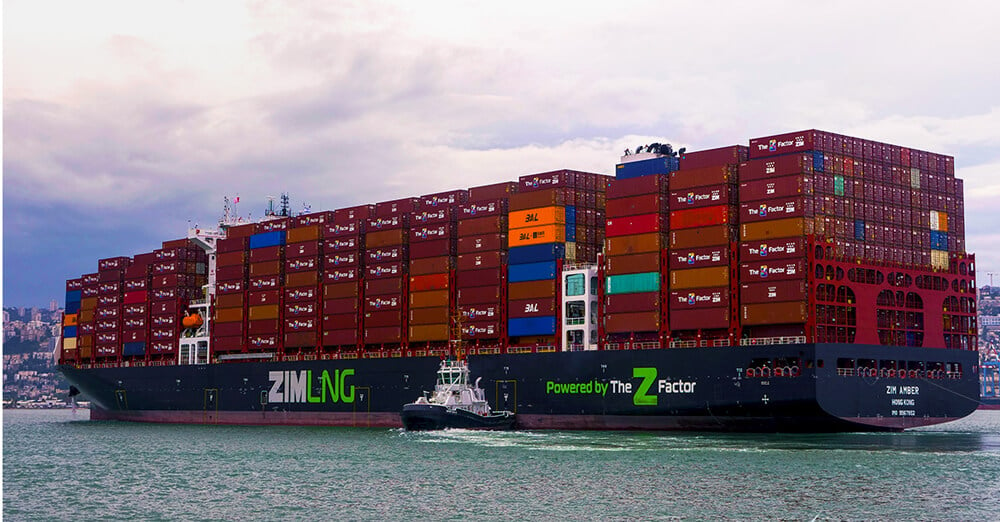
Hapag-Lloyd officially signed the agreement to acquire Zim and sell its domestic operations to FIMI, an Israeli private equity company, while extolling the benefits of consolidation for customers and shareholders. However, with Zim viewed as a national asset, opposing voices quickly emerged to the deal, including from the workers committee representing the approximately 1,000 Zim employees in Israel.
The board of Zim and leaders of Hapag-Lloyd hailed the deal, citing the benefits from a “significantly strengthened network.” Hapag, which is already the fifth largest container carrier, agreed to pay approximately $4.2 billion, which Zim’s board highlighted as a 58 percent premium on the current share price and a 126 percent premium to the share price from last August before news of a potential sale emerged.
Hapag said it would grow to a capacity of over 3.8 million TEU and well over 400 vessels by assuming the international services and chartered fleet from Zim of approximately 99 vessels. Many of the ships, including Zim’s new LNG-fueled vessels, are under long-term charters from Seaspan. Hapag said the transaction was estimated to “generate several hundred million US dollars of annual synergies” while strengthening global operations. It predicts that the combined operations would transport more than 18 million TEU annually.
“ZIM is an excellent partner for Hapag-Lloyd,” said Rolf Habben Jansen, CEO of Hapag-Lloyd. “Customers will benefit from a significantly strengthened network on the Transpacific, Intra Asia, Atlantic, Latin America, and East Mediterranean.”
Zim’s board said the decision reflects a “comprehensive evaluation of all available options to ensure the best possible outcome for the company's investors. We believe that it represents the most prudent and beneficial transaction for all ZIM stakeholders that further advances the tremendous value creation track record that we have established since our IPO,” said Yair Seroussi, Chairman of ZIM's Board of Directors.
To deal with Israel’s “Golden Share” and the requirements to have Israeli-owned ships and a chairman of the company, Hapag has agreed to a carve-out with FIMI, the country’s largest and leading private equity fund with more than $11 billion in assets under management. FIMI acquires the brand and 16 company-owned ships and takes full responsibility for the Golden Share and its requirements.
"FIMI recognizes and believes in the strategic importance for the State of Israel of a strong independent Israeli shipping company,” said Ishay Davidi, Founder and CEO of the FIMI Funds. “We will create a stable Israeli company, the new ZIM, and view Hapag-Lloyd as a significant strategic partner for its ongoing operations.” He said the new company would integrate significant transatlantic capabilities, alongside additional shipping routes to Europe, Africa, the Mediterranean Sea, and the Black Sea, supported by advanced global maritime transport capabilities, and have access to the Hapag-Maersk Gemini network.
Founded in 1945, Zim, although reorganized several times, has been viewed as a national asset vital to national security and the country’s economy. It helped to move immigrants into Israel, provided passenger shipping, and grew for cargo shipping into the 10th largest container carrier.
The head of the workers’ committee, Oren Caspi, emerged from a meeting with the company on Sunday, immediately announcing a warning strike. The committee had been a vocal opponent of the sale, and Caspi told the media outlet Globes the board was “ignoring and evading us for two weeks.” He said talks had broken down with the company, and the headquarters employees would strike.
Caspi contends FIMI would retain only 120 employees, and Hapag had only committed to opening an R&D center that would take some of Zim’s technology employees. He said more than 800 people could be laid off. He says they were told the acquirers were not willing to commit to employing workers beyond one year, while the workers’ committee was demanding the board secure commitments to protect workers’ rights and jobs.
The Histadrut (General Federation of Labor in Israel) also told Globes it was backing the workers’ committee. "ZIM is not just another company in Israel. It is a strategic asset of the State of Israel, representing a critical link in national security, in the stability of supply, and in the ability to maintain trade by sea even in emergencies. Any harm to the stability of the company or to its employees means harm to the national interest of the State of Israel.”
The Mayor of Haifa, Yona Yahav, echoed a similar sentiment, saying Zim would no longer be part of the Israeli economy while citing the significance to the economy and security of Israel. Yahav called the deal “problematic,” saying it could harm national security and lead to the dismissal of workers.
The Administration of Shipping and Ports Director Zadok Redker called the deal an “existential threat,” speaking to the news outlet CTech. They are forecasting that the transaction could “have far-reaching consequences for Israel’s maritime sector if completed.”
They are saying the new Zim “would effectively become a small, local shipping company without global deployment or critical mass.” They point to the expected significant downturn in liner shipping, saying the new company would be significantly smaller and weaker, while noting that if it could not sustain operations, it would require billions in investments and seven to ten years to reestablish the company.
The sale of Zim requires regulatory approval, review by Israel under the Special State Share, and approval from the shareholders. Hapag-Lloyd said the deal is expected to close by late 2026, and until then, the companies would operate independently as competitors.
Hapag-Lloyd Buys Out ZIM
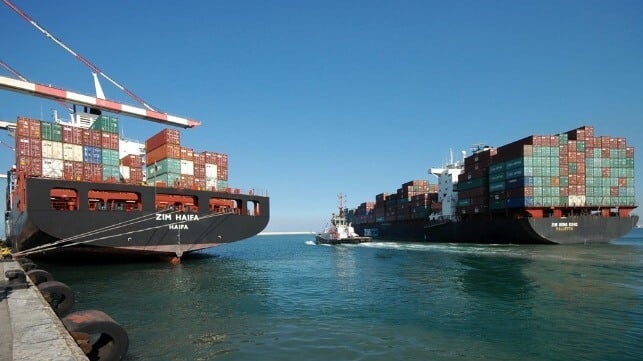
Number-five container line Hapag-Lloyd has agreed to buy 10th-ranked carrier ZIM, Israel’s de facto national shipping line. A heads of agreement has been reached by the two parties, and ZIM’s board approved the deal on Sunday night. Israeli business publication Calcalist reports that the transaction value exceeds $4 billion.
ZIM, publicly listed since 2021, is headquartered in Haifa. The deal entails Hapag-Lloyds’s purchase of all issued shares, and then the delisting of the company from the New York Stock Exchange.
Hapag-Lloyd has a partner in the deal, the Israeli private equity firm FIMI. Whereas international aspects of the ZIM business will be taken on by Hapag-Lloyd, Calcalist reports that the German liner will sell a subset of the firm’s operations to FIMI, thereby retaining sealift and sovereign shipping capacity in Israeli hands.
FIMI’s new company will reportedly be called “Zim Israel” and will hold all of ZIM’s owned hulls, along with key operations centers and personnel within Israel. The chartered-in fleet will be transferred to Hapag, along with international ZIM routes that do not intersect directly with Israeli commerce.
ZIM is a strategic Israeli asset, with a specific role in keeping Israel stocked to fight wars. For this purpose, the Israeli government has held a golden share in the company, and has mandated both that ZIM must be operationally controlled from Israel and must maintain a minimum number of ships on the Israeli register.
ZIM has since 2021 upgraded its fleet through a combination of owned vessels and chartered-in tonnage. It operates 70 regular liner services, and had a record turnover of $8.43 billion in 2024 after struggling in the previous decade. Turnover for the full year 2025 is likely to be down, impacted by lower freight rates. In the third quarter, EBITDA was down 61 percent, and TEU volume carried decreased 5 percent. Revenues were off 36 percent. Inevitably, Houthi attacks targeting Israeli shipping in the Red Sea and elsewhere have had an impact, with trade in particular through Eilat being badly affected.
By comparison, Hapag-Lloyd turned over $22 billion in 2024, and is heading for a similar figure in 2025, with an 8% increase in volumes shipped. It operates 305 ships and 130 regular liner services, and Alphaliner rates it as the fifth largest global shipping company.
While the deal has been presented as sealed (but not signed), the complexity of the proposed transaction and ZIM’s strategic role in Israel’s national security may still present obstacles to completion. Moreover, the agreement has been negotiated within a very well secured Deal Room, such that unions and employees have been caught by surprise – and have not necessarily been brought along with the process. However, the very purpose of the takeover may have been to embrace a strategy for dealing with Houthi attacks and boycotts, while also protecting Israeli strategic interests.
The proposed arrangement has been in the works for a while, and the initial proposal was controversial in Israeli political and national-security circles. Beyond geopolitics, its existence is a matter of identity: ZIM’s history predates the modern state of Israel, and the company provided sealift capacity during the events leading up to the nation’s creation. Critics note that Hapag-Lloyd’s major shareholders include investment vehicles controlled by the Qatari and Saudi governments, which have not always seen eye-to-eye with Israel. As of September, Qatar Holdings retained 12.3% and Saudi Arabia’s Public Investment Fund 10.3% of Hapag-Lloyd shares, a consequence of Hapag’s acquisition of UASC in 2017.
The deal follows the rejection of an earlier buyout offer from long-time ZIM CEO and president Eli Glickman, backed by Israeli shipowner Rami Ungar, who controls ro/ro company Ray Shipping. ZIM’s board turned down the Glickman-Ungar proposal in November, claiming that it undervalued the company.

No comments:
Post a Comment