Trump boasts of a booming economy. He’s dead wrong. A year into Trump 2.0, the affordability crisis is worse than ever.
By C.J. Polychroniou ,
PublishedFebruary 27, 2026
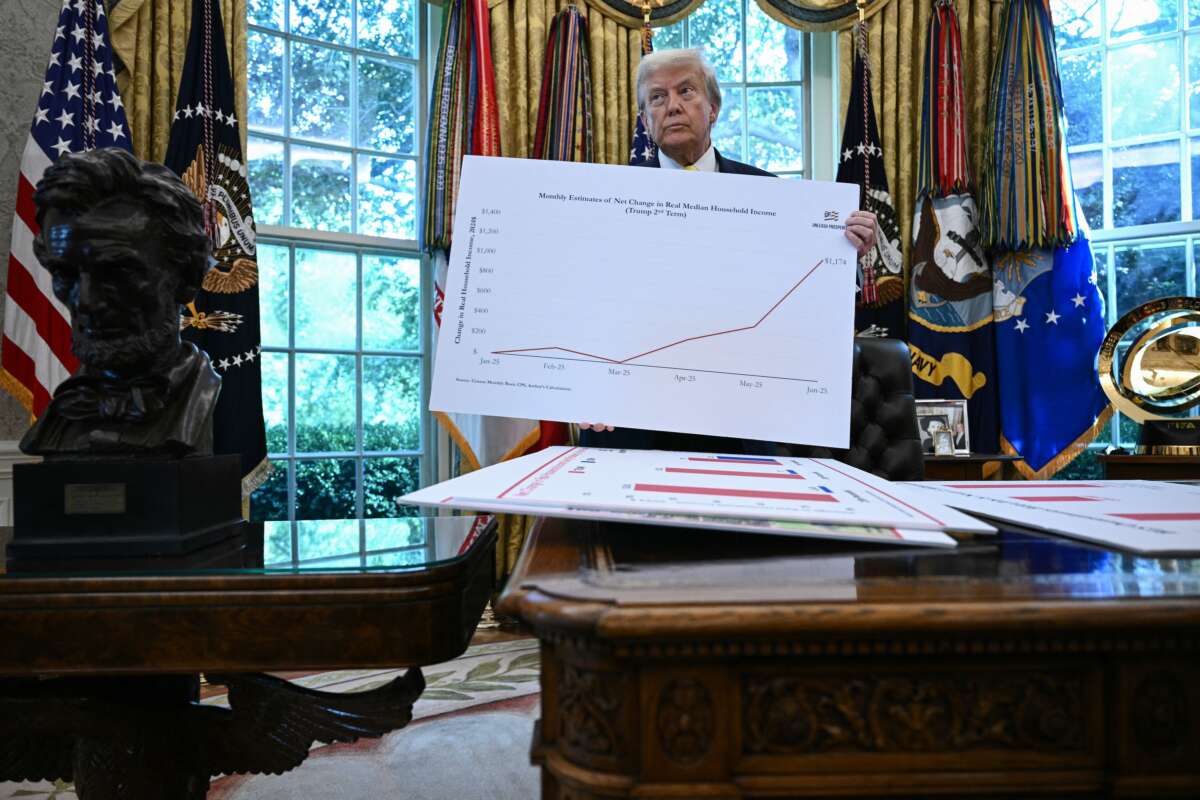
Donald Trump holds up a chart as he speaks about the economy in the Oval Office of the White House on August 7, 2025, in Washington, D.C.BRENDAN SMIALOWSKI / AFP via Getty Images
President Donald Trump is boasting about the economy one year into his term. He claims that inflation has been defeated, growth is unprecedented, incomes are rising, and his tariffs are generating hundreds of billions for the U.S. economy. This is all hogwash, according to progressive economist Gerald Epstein, a leading global authority on macroeconomic policy and finance.
In the exclusive interview for Truthout that follows, Epstein explains how, in reality, Trump’s policies have created an affordability crisis, and the growing deficit and humongous public debt are now bringing the country close to a tipping point.
C. J. Polychroniou: The state of the U.S. economy in Donald Trump’s first year of his second presidency has evolved in various ways. Trump, of course, has boasted on multiple occasions that the economy is “booming” and that the U.S. is the “hottest country anywhere in the world,” but there is plenty of data to suggest that the reality is quite different. There is apparently an affordability crisis and consumer confidence has dropped to its lowest point in 12 years. Help us make sense of what’s going on with the economy under Trump 2.0. What exactly is the affordability crisis all about and how has it evolved since Trump’s return to the White House?
Gerald Epstein: Typical of Trump, he is boasting about the performance of the U.S. economy in the most hyperbolic terms. He even declared that his economy is “the greatest ever in history” in a recent interview on Fox Business Network. He points to the stock market and allegedly low inflation to back his claim. Is that the true state of the U.S. economy?
Donald Trump routinely barks that he inherited a terrible economy from Joe Biden and that he has turned it around: Now we have fast economic growth, low inflation, low consumer goods prices, high stock prices, and his great economy is going to get so good that it will be the best the world has ever seen. But basic economic data demonstrate that Trump’s boasts are simply wrong.
The best way to characterize the Trump economy compared to the economy the Biden administration left him, is this: Trump’s economy is mostly a continuation of Biden’s, but with a big tilt to the top, and with a big chance that it will soon run off the rails.
“Trump’s tariffs are not helping with the affordability crisis.”
The overall inflation rate is about the same now (2.7 percent at the end of 2025) as it was when Biden left office (2.9 percent); the unemployment rate (4.3 percent in January 2026) is slightly higher than it was when Biden left office (4.1 percent). The rate of growth is similar, as well as the rate of growth of average real wages (wages minus inflation).
Some things are much worse, and these are directly connected to Trump administration policies and, ironically, run directly counter to Trump’s self-stated objectives. Trump’s tariffs have raised the cost of many U.S. goods, as well as the cost of food, and lowered the profits of medium-sized and small businesses, which, unlike big firms, have much less flexibility and fewer resources to adjust. Trump’s immigration dragnet has harmed economic activity in key sectors such as housing construction and services. Tax changes have greatly increased health care costs and pharmaceutical companies have raised prices on hundreds of medicines, all of which affect millions of people as these increased costs reduce their standards of living. And the trade deficit in goods has reached a new height.
Though first dissing “affordability” as a sham issue, Trump has now embraced it and tried to dominate it, claiming that he will get prices down across the board. But as numerous polls have shown, most people are not buying what Trump is selling. For example, a Wall Street Journal poll from September 2025 finds that the share of people who say they have a good chance of improving their standard of living fell to 25 percent, a record low in survey dating to 1987, and nearly 70 percent of people believe that the “American Dream” — if you work hard you will get ahead — is dead, the highest level in the 15-year history of the polls.
However, in addition to the direct damage Trump has done with tariffs, immigration outrages, and tax changes, we must look at the deeper, indirect and longer-term impacts of his policies.
Trump’s corporate giveaways and tax cuts, along with massive expenditures on the military and ICE [Immigration and Customs Enforcement], are creating unprecedented increases in the federal budget deficit and debt. This outcome could very well increase financial instability in the not-too-distant future. The increases in the national debt, unmatched by true investment in our economy, reduce our country’s net wealth.
In fact, the Trump administration has been a wealth destruction machine. This might seem surprising given the run up in the stock market, but that is small potatoes compared to the overall destruction across the board:“Department of Government Efficiency” (DOGE) destruction of basic research at universities and in the government, dismantling research projects and teams, some of which were producing breakthrough discoveries that could enhance future human well-being and productivity growth.DOGE firing of government workers with decades of experience — human wealth that will not easily be able to find similarly socially useful positions elsewhere.The tearing up of the rule of law, along with important infrastructure for wealth creation and sustainability.Secretary Robert F. Kennedy Jr.’s near destruction of the country’s health infrastructure, undermining the public’s health.The fossil fuel destruction of our climate.
So, has Trump solved our affordability problem? Far from it. If you think it is bad now, just you wait.
Studies have found out that it is not foreign countries but U.S. consumers who are footing the bill for tariffs. If this is so, it would be logical to conclude that tariffs impact the purchasing power of low-income households, which in turn fuels the affordability crisis and may, subsequently, explain the sharp collapse in consumer confidence. Yet, there are those economists who claim that the affordability crisis has nothing to do with tariffs. Can you shed some light on the connection between Trump’s tariffs and the affordability crisis?
At least one thing is clear: Trump’s tariffs are not helping with the affordability crisis. Importantly, this fact stands in contrast to what Trump, his tariff cheerleaders Peter Navarro and Commerce Secretary Howard Lutnick, among others, have claimed. They have repeatedly told us that the tariffs would generate free revenue financed by foreign countries that Trump and company could toss back to the American people like so much candy. This is false, since, as you point out, it is the American consumers (and to some extent businesses) who are paying the tariffs in the first place. They claimed that these tariffs would “bring back” high-paying manufacturing jobs — another boost to affordability for Americans. This, too, is false. Manufacturing employment has actually fallen by 83,000 jobs since Trump came into office. Finally, Trump claimed that tariff threats would force foreign governments and companies to lower prices on goods they sell to the United States. But there is no evidence that this is occurring.
“Manufacturing employment has actually fallen by 83,000 jobs since Trump came into office.”
One “bright spot” on the affordability spectrum has been the decline in gasoline prices. But this is not due to tariffs, but rather to the relentless obsession of the Trump administration with fossil fuels and, by ignoring climate change, his attempt to transform the entire human race into fossils themselves.
The U.S. dollar also appears to be collapsing under Trump. Why is that happening, and what risks does a weak dollar pose to the U.S. economy?
I think “collapsing” is way too strong, but it is true that the U.S. dollar is falling relative to the currencies of some crucial trading partners, including Europe. Over the past year, the dollar has fallen relative to the euro. And, oddly enough, this has occurred despite the fact that there has been a huge increase in foreign investments into the booming U.S. stock market. All else equal, more inflows of financial capital into the U.S. should have increased the value of the dollar. Why is the dollar getting weaker? It almost certainly has to do with the erratic international policies of the Trump administration, including the kidnapping of foreign leaders, the random bombing of fishing boats, the erratic missile attacks in disparate places around the world from Nigeria to Iran, and the threats of invasion of our former allies — from Denmark to Canada. This is all joined by roving bands of out-of-control paramilitary forces on the streets of major American cities.
The U.S. dollar used to be a “safe haven” in the global financial world. When the world got tough, the tough bought the dollar. Now they ditch the dollar and buy gold and silver, whose prices have been mostly skyrocketing of late.
What risks does the apparent fraying of the dollar’s safe haven role and international role more generally have for the people of the United States? This question invites intense disagreement among economists who argue under the rubric of whether the U.S. dollar has created an “exorbitant privilege” for the United States.
When the world eagerly wants to hold dollars, it is easier for the United States to borrow from the rest of the world at a relatively cheap rate. This allows the U.S. government to shower favors on some Americans by cutting their taxes and to build bombs and aircraft carriers for others, all on money borrowed cheaply from foreigners: an exorbitant privilege indeed. Other economists claim this privilege is relatively small and we shouldn’t make too big a deal about it.
The issue is highly relevant. The United States government has been borrowing billions of dollars for decades now. The Congressional Budget Office recently told us that, with the reckless spending and tax giveaway policies of the Trump administration, the annual federal deficit will grow from $1.9 trillion in 2026 to $3.1 trillion in 2036, and the federal debt held by the public will rise from 101 percent of GDP this year to 120 percent in 2036, surpassing its previous high of 106 percent in 1946, just after World War II.
If foreigners lose more confidence in the dollar and U.S. treasury debt, the interest rates we have to pay on all this debt will go up and, if the rate gets higher than the growth rate of our economy, our debt payments relative to the size of our economy could grow, and grow and grow.
Is the U.S. likely to suffer a Venezuela-style collapse? Probably not. But as foreign investors and speculators get nervous, a shock like an international crisis, or big spike in oil prices, could be a weighty straw on a fragile camel.
Is a weak dollar good or bad for low-income households?
Generally, a weak dollar has two effects. It makes imports more expensive, so in that sense, acts like a tariff: not good for low-income households. On the other hand, it can make our exports more competitive and expand these exports. Will this benefit low-income households? Only, for the most part, if they work in export industries and they have the bargaining power to insist on getting some of the spoils accruing to the bosses from their improved export position. Usually, workers in low-income households do not have such bargaining power, as the neoliberal project of the last 35 years or so has decimated private unions.
Is the dollar doomed?
No. The most likely outcome is that it will continue to lose some of its luster, and like the rest of the U.S. economy under the Trump orgies of slash-and-burn economic policy, it will become just one among many internationally used currencies, rather than the coin of the global realm.
This article is licensed under Creative Commons (CC BY-NC-ND 4.0), and you are free to share and republish under the terms of the license.
President Donald Trump is boasting about the economy one year into his term. He claims that inflation has been defeated, growth is unprecedented, incomes are rising, and his tariffs are generating hundreds of billions for the U.S. economy. This is all hogwash, according to progressive economist Gerald Epstein, a leading global authority on macroeconomic policy and finance.
In the exclusive interview for Truthout that follows, Epstein explains how, in reality, Trump’s policies have created an affordability crisis, and the growing deficit and humongous public debt are now bringing the country close to a tipping point.
C. J. Polychroniou: The state of the U.S. economy in Donald Trump’s first year of his second presidency has evolved in various ways. Trump, of course, has boasted on multiple occasions that the economy is “booming” and that the U.S. is the “hottest country anywhere in the world,” but there is plenty of data to suggest that the reality is quite different. There is apparently an affordability crisis and consumer confidence has dropped to its lowest point in 12 years. Help us make sense of what’s going on with the economy under Trump 2.0. What exactly is the affordability crisis all about and how has it evolved since Trump’s return to the White House?
Gerald Epstein: Typical of Trump, he is boasting about the performance of the U.S. economy in the most hyperbolic terms. He even declared that his economy is “the greatest ever in history” in a recent interview on Fox Business Network. He points to the stock market and allegedly low inflation to back his claim. Is that the true state of the U.S. economy?
Donald Trump routinely barks that he inherited a terrible economy from Joe Biden and that he has turned it around: Now we have fast economic growth, low inflation, low consumer goods prices, high stock prices, and his great economy is going to get so good that it will be the best the world has ever seen. But basic economic data demonstrate that Trump’s boasts are simply wrong.
The best way to characterize the Trump economy compared to the economy the Biden administration left him, is this: Trump’s economy is mostly a continuation of Biden’s, but with a big tilt to the top, and with a big chance that it will soon run off the rails.
“Trump’s tariffs are not helping with the affordability crisis.”
The overall inflation rate is about the same now (2.7 percent at the end of 2025) as it was when Biden left office (2.9 percent); the unemployment rate (4.3 percent in January 2026) is slightly higher than it was when Biden left office (4.1 percent). The rate of growth is similar, as well as the rate of growth of average real wages (wages minus inflation).
Some things are much worse, and these are directly connected to Trump administration policies and, ironically, run directly counter to Trump’s self-stated objectives. Trump’s tariffs have raised the cost of many U.S. goods, as well as the cost of food, and lowered the profits of medium-sized and small businesses, which, unlike big firms, have much less flexibility and fewer resources to adjust. Trump’s immigration dragnet has harmed economic activity in key sectors such as housing construction and services. Tax changes have greatly increased health care costs and pharmaceutical companies have raised prices on hundreds of medicines, all of which affect millions of people as these increased costs reduce their standards of living. And the trade deficit in goods has reached a new height.
Though first dissing “affordability” as a sham issue, Trump has now embraced it and tried to dominate it, claiming that he will get prices down across the board. But as numerous polls have shown, most people are not buying what Trump is selling. For example, a Wall Street Journal poll from September 2025 finds that the share of people who say they have a good chance of improving their standard of living fell to 25 percent, a record low in survey dating to 1987, and nearly 70 percent of people believe that the “American Dream” — if you work hard you will get ahead — is dead, the highest level in the 15-year history of the polls.
However, in addition to the direct damage Trump has done with tariffs, immigration outrages, and tax changes, we must look at the deeper, indirect and longer-term impacts of his policies.
Trump’s corporate giveaways and tax cuts, along with massive expenditures on the military and ICE [Immigration and Customs Enforcement], are creating unprecedented increases in the federal budget deficit and debt. This outcome could very well increase financial instability in the not-too-distant future. The increases in the national debt, unmatched by true investment in our economy, reduce our country’s net wealth.
In fact, the Trump administration has been a wealth destruction machine. This might seem surprising given the run up in the stock market, but that is small potatoes compared to the overall destruction across the board:“Department of Government Efficiency” (DOGE) destruction of basic research at universities and in the government, dismantling research projects and teams, some of which were producing breakthrough discoveries that could enhance future human well-being and productivity growth.DOGE firing of government workers with decades of experience — human wealth that will not easily be able to find similarly socially useful positions elsewhere.The tearing up of the rule of law, along with important infrastructure for wealth creation and sustainability.Secretary Robert F. Kennedy Jr.’s near destruction of the country’s health infrastructure, undermining the public’s health.The fossil fuel destruction of our climate.
So, has Trump solved our affordability problem? Far from it. If you think it is bad now, just you wait.
Studies have found out that it is not foreign countries but U.S. consumers who are footing the bill for tariffs. If this is so, it would be logical to conclude that tariffs impact the purchasing power of low-income households, which in turn fuels the affordability crisis and may, subsequently, explain the sharp collapse in consumer confidence. Yet, there are those economists who claim that the affordability crisis has nothing to do with tariffs. Can you shed some light on the connection between Trump’s tariffs and the affordability crisis?
At least one thing is clear: Trump’s tariffs are not helping with the affordability crisis. Importantly, this fact stands in contrast to what Trump, his tariff cheerleaders Peter Navarro and Commerce Secretary Howard Lutnick, among others, have claimed. They have repeatedly told us that the tariffs would generate free revenue financed by foreign countries that Trump and company could toss back to the American people like so much candy. This is false, since, as you point out, it is the American consumers (and to some extent businesses) who are paying the tariffs in the first place. They claimed that these tariffs would “bring back” high-paying manufacturing jobs — another boost to affordability for Americans. This, too, is false. Manufacturing employment has actually fallen by 83,000 jobs since Trump came into office. Finally, Trump claimed that tariff threats would force foreign governments and companies to lower prices on goods they sell to the United States. But there is no evidence that this is occurring.
“Manufacturing employment has actually fallen by 83,000 jobs since Trump came into office.”
One “bright spot” on the affordability spectrum has been the decline in gasoline prices. But this is not due to tariffs, but rather to the relentless obsession of the Trump administration with fossil fuels and, by ignoring climate change, his attempt to transform the entire human race into fossils themselves.
The U.S. dollar also appears to be collapsing under Trump. Why is that happening, and what risks does a weak dollar pose to the U.S. economy?
I think “collapsing” is way too strong, but it is true that the U.S. dollar is falling relative to the currencies of some crucial trading partners, including Europe. Over the past year, the dollar has fallen relative to the euro. And, oddly enough, this has occurred despite the fact that there has been a huge increase in foreign investments into the booming U.S. stock market. All else equal, more inflows of financial capital into the U.S. should have increased the value of the dollar. Why is the dollar getting weaker? It almost certainly has to do with the erratic international policies of the Trump administration, including the kidnapping of foreign leaders, the random bombing of fishing boats, the erratic missile attacks in disparate places around the world from Nigeria to Iran, and the threats of invasion of our former allies — from Denmark to Canada. This is all joined by roving bands of out-of-control paramilitary forces on the streets of major American cities.
The U.S. dollar used to be a “safe haven” in the global financial world. When the world got tough, the tough bought the dollar. Now they ditch the dollar and buy gold and silver, whose prices have been mostly skyrocketing of late.
What risks does the apparent fraying of the dollar’s safe haven role and international role more generally have for the people of the United States? This question invites intense disagreement among economists who argue under the rubric of whether the U.S. dollar has created an “exorbitant privilege” for the United States.
When the world eagerly wants to hold dollars, it is easier for the United States to borrow from the rest of the world at a relatively cheap rate. This allows the U.S. government to shower favors on some Americans by cutting their taxes and to build bombs and aircraft carriers for others, all on money borrowed cheaply from foreigners: an exorbitant privilege indeed. Other economists claim this privilege is relatively small and we shouldn’t make too big a deal about it.
The issue is highly relevant. The United States government has been borrowing billions of dollars for decades now. The Congressional Budget Office recently told us that, with the reckless spending and tax giveaway policies of the Trump administration, the annual federal deficit will grow from $1.9 trillion in 2026 to $3.1 trillion in 2036, and the federal debt held by the public will rise from 101 percent of GDP this year to 120 percent in 2036, surpassing its previous high of 106 percent in 1946, just after World War II.
If foreigners lose more confidence in the dollar and U.S. treasury debt, the interest rates we have to pay on all this debt will go up and, if the rate gets higher than the growth rate of our economy, our debt payments relative to the size of our economy could grow, and grow and grow.
Is the U.S. likely to suffer a Venezuela-style collapse? Probably not. But as foreign investors and speculators get nervous, a shock like an international crisis, or big spike in oil prices, could be a weighty straw on a fragile camel.
Is a weak dollar good or bad for low-income households?
Generally, a weak dollar has two effects. It makes imports more expensive, so in that sense, acts like a tariff: not good for low-income households. On the other hand, it can make our exports more competitive and expand these exports. Will this benefit low-income households? Only, for the most part, if they work in export industries and they have the bargaining power to insist on getting some of the spoils accruing to the bosses from their improved export position. Usually, workers in low-income households do not have such bargaining power, as the neoliberal project of the last 35 years or so has decimated private unions.
Is the dollar doomed?
No. The most likely outcome is that it will continue to lose some of its luster, and like the rest of the U.S. economy under the Trump orgies of slash-and-burn economic policy, it will become just one among many internationally used currencies, rather than the coin of the global realm.
This article is licensed under Creative Commons (CC BY-NC-ND 4.0), and you are free to share and republish under the terms of the license.

C.J. Polychroniou
C.J. Polychroniou is a political scientist/political economist, author and journalist who has taught and worked in numerous universities and research centers in Europe and the United States. Currently, his main research interests are in U.S. politics and the political economy of the United States, European economic integration, globalization, climate change and environmental economics, and the deconstruction of neoliberalism’s politico-economic project. He is a columnist for Global Policy Journal and a regular contributor to Truthout. He has published scores of books, including Marxist Perspectives on Imperialism: A Theoretical Analysis; Perspectives and Issues in International Political Economy (ed.); and Socialism: Crisis and Renewal (ed.), and over 1,000 articles which have appeared in a variety of journals, magazines, newspapers and popular news websites. Many of his publications have been translated into a multitude of languages, including Arabic, Chinese, Croatian, Dutch, French, German, Greek, Italian, Japanese, Portuguese, Russian, Spanish and Turkish. His latest books are Climate Crisis and the Global Green New Deal: The Political Economy of Saving the Planet (with Noam Chomsky and Robert Pollin as primary authors, 2020); The Precipice: Neoliberalism, the Pandemic, and the Urgent Need for Radical Change (an anthology of interviews with Noam Chomsky, 2021); Economics and the Left: Interviews with Progressive Economists (2021); Illegitimate Authority: Facing the Challenges of Our Time (an anthology of interviews with Noam Chomsky, 2023); and A Livable Future Is Possible: Confronting the Threats to Our Survival (an anthology of interviews with Noam Chomsky, 2024).

No comments:
Post a Comment