Nurses in New York, California, and Hawaii claimed big contract victories after showing their power on the picket line.
By Sonali Kolhatkar ,
February 27, 2026
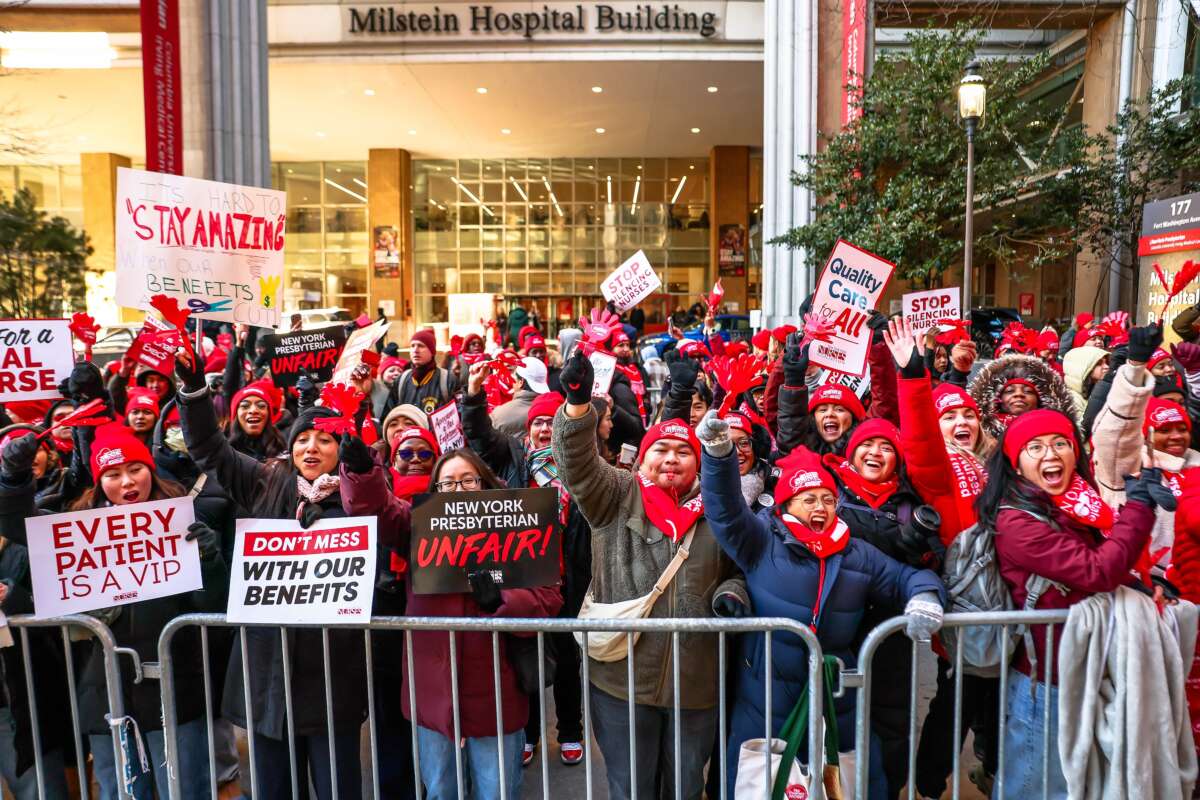 Nurses from New York-Presbyterian/Columbia University Irving Medical Center strike outside the hospital on January 12, 2026, in New York City.Michael M. Santiago / Getty Images
Historic nurses’ strikes on both coasts of the United States took place simultaneously within the first two months of 2026, demonstrating the power of collective bargaining and solidarity in a common struggle against monied interests.
New York City’s largest nurses strike ever, numbering at about 15,000 striking nurses at its peak, culminated in agreements for workers at three private hospitals in the city after a one-month work stoppage that began on January 12 and ended on February 13. About 4,200 nurses at a fourth hospital ended their strike on February 21, after six weeks on the picket line.
At the same time, more than 30,000 nurses and other health care workers in California and Hawaii, employed by nonprofit health care provider Kaiser Permanente, ended their month-long work stoppage on February 24.
Members of the New York State Nurses Association (NYSNA), affiliated with National Nurses United, AFL-CIO, went out on a strike to protect their health insurance and pension benefits. Dania Muñoz, a nurse practitioner at Mount Sinai Hospital in New York City, explained that the private hospitals she and others were taking on are “some of the top paid hospital systems in the country.”
Muñoz was perplexed by the hospitals’ initial attempt to pull back on paying for health insurance premiums for their nursing staff. “They just said it was too expensive,” she explained, and yet, “they’re the ones that talk to health insurance companies and set rates.”
Related Story
Minneapolis Health Care Workers Are Organizing to Defend Their Patients From ICE
Organizing and rights trainings have helped health care workers protect their colleagues and their patients. By Marianne Dhenin , Truthout January 24, 2026
“Health care for health care workers … is definitely one of the biggest things that we were fighting for and that we were able to secure,” said Muñoz. According to NYSNA, “nurses at all four hospitals maintained their health and pension benefits, and won increased wages, protections against workplace violence, and safeguards against artificial intelligence.” This win came in spite of the fact that New York Gov. Kathy Hochul signed an executive order making it easier for hospitals to hire scab replacements for striking nurses — an order the nurses denounced by marching to Hochul’s office.
“Nurses at all four hospitals maintained their health and pension benefits, and won increased wages, protections against workplace violence, and safeguards against artificial intelligence.”
Lucky Longoria is a pediatric nurse at a Kaiser facility in Downey, California, and a member of United Nurses Associations of California/Union of Health Care Professionals (UNAC/UHCP). According to her union, the unfair labor practice strike, sparked by Kaiser walking away from the bargaining table, was the largest open-ended work stoppage of health care professionals in U.S. history. Longoria said she and her fellow health care professionals were on the picket line in part because “they were going to roll back our benefits.”
Like New York City nurses, West Coast Kaiser health professionals were striking over poor staffing and wages that have not kept up with inflation. Longoria explained that, in response to worker demands for a 25 percent pay raise over four years, unionized nurses have been offered a 21.5 percent increase from Kaiser, assurance that they will preserve their benefits, and a commitment to address union demands for better staff-to-patient ratios.
On its surface, New York City’s private, for-profit hospitals appear starkly different from Kaiser Permanente, a nominally nonprofit health care provider and HMO. But Kaiser’s business model is similar to for-profit health care providers. The corporation has been piling up billions of dollars in reserve and overpaying top executives — such as the company’s CEO, who makes nearly $13 million annually — while skimping on worker pay and staffing, and subsequently, patient care.
Kaiser, according to Longoria, has changed “focus away from patient care” by relying on underpaid and overworked staff, and moved its “focus towards investments.” According to an analysis by UNAC/UHCP of Kaiser’s financial disclosures, the nonprofit provider is sitting on $66 billion in unrestricted reserves, even as the company has continued increasing patient premiums and kept salaries flat. “Why not invest in your people? Why not invest in your patients?” asked Longoria.
In New York City, Muñoz had similar questions of the private hospitals she and others took on. “These hospital executives are paid millions of dollars and yet they say that they cannot afford health care or things that nurses are fighting for,” she said.
Immigrants are disproportionately represented in the health care field. It’s no surprise that nurses on both coasts made immigration-related demands at a time when the federal government has made the targeting of immigrants a centerpiece of its political agenda. As New York City’s Muñoz explained, “we wanted to make sure that our hospitals would say that ICE is not welcome in our facilities unless they had a judicial warrant.”
Health professionals were striking over poor staffing and wages that have not kept up with inflation.
While the NYSNA was unable to win the immigrant protections they asked for, Muñoz was heartened by the fact that her city’s new mayor, Zohran Mamdani, signed an executive order preventing federal agents from entering public hospitals. “We’re hoping that the private sector hospitals will follow suit and will also be part of that,” she said.
Meanwhile, UNAC/UHCP, as part of their review of Kaiser’s financial holdings, found that Kaiser Permanente Group Trust has investments in GEO Group and CoreCivic, the nation’s largest private prison corporations with major government contracts to detain immigrants.
According to Longoria, “we feel deprioritized when we hear that… they’re invested in prisons and detention centers, especially being health care providers and knowing the way that we feel about communities being terrorized by ICE.” She added, “the people who end up in detention centers are our patients.” While UNAC/UHCP has not explicitly called on Kaiser to divest from the private prison industry, it has backed recently-introduced legislation demanding greater transparency from Kaiser about its holdings.
While nurses on both coasts used their collective might to protect existing benefits and win new concessions on wages and staffing, the cost of picketing was steep. “This has been one of the coldest winters in New York for many years,” said Muñoz. “Nurses were outside … whether it was raining, whether it was snowing, whether it was cold or warm outside, we were out in all kinds of weather.”
Even on the West Coast, generally blessed with milder weather, picketing was painful. According to Longoria, “The hardest thing about being on the picket line is having a loss of control when it comes to the patient care that’s ongoing, even though we have to step away from the bedside.”
As a pediatric nurse, Longoria is used to caring for young patients with chronic conditions who might spend weeks or even months at the hospital. “They’re not just patients, they become family,” she said. “We don’t leave the job when we clock out; we took the worry with us and the worry was with us on the [picket] line.”
Still, “the camaraderie that we developed, that we nurtured,” said Longoria, was “miraculous.” She recalled experiencing joy, “while simultaneously feeling a little bit of a despair, a little bit of disappointment and a whole lot of fatigue.”
While health care workers on opposite sides of the nation were represented by two distinct unions, rank-and-file members found inspiration in each other’s respective efforts to prioritize patient care over profits. Longoria, who frequently posted about her picket line experiences on social media, showed her solidarity with New York City nurses in a joyful video montage of Southern California nurses tossing an apple — to represent the Big Apple — to one another while holding signs of encouragement and chanting, “from the West Coast to the East Coast, we stand with New York.” “We felt connected,” said Longoria.
Beth Loudin, a registered nurse with New York-Presbyterian, echoed the sentiment. “Although there was no formal coordination,” she said, “nurses in New York were really energized by the solidarity striking nurses showed on social media and tried to send it back.”
Union activity has surged in the United States in recent years. In 2025, nearly half a million peoplewho weren’t unionized, joined unions, bringing the total number of unionized people to 16.5 million. While this is not a large percentage of the population, according to the Economic Policy Institute, more than 50 million workers wanted to join a union but couldn’t. At a time of ongoing economic insecurity, there is a strong desire among workers to join forces and take on corporate employers.
Unionized nurses understand the stakes are high. “A lot of people think that this fight wasn’t political, but it was so political,” said Muñoz. “We’re talking about health care, we’re talking about fair pay, we’re talking about benefits and we’re talking about access to care, not just for our nurses … about access to health care in general. And once you start to disenfranchise a group of people, where does it stop?”
This article is licensed under Creative Commons (CC BY-NC-ND 4.0), and you are free to share and republish under the terms of the license.

Sonali Kolhatkar
Sonali Kolhatkar is a monthly contributor to Truthout. She is an award winning multimedia journalist and author. She is the host and executive producer of Rising Up With Sonali, a nationally syndicated weekly television and radio program airing on Pacifica stations and Free Speech TV. She was most recently Senior Editor at YES! Media covering race, economy, and democracy, and is currently Senior Correspondent for the Economy for All Project at the Independent Media Institute, and a monthly columnist for OtherWords, a project of the Institute for Policy Studies. Her writings have been published in LA Times, Salon, The Nation, In These Times, Truthdig, and more. Her books include Talking About Abolition: A Police-Free World is Possible (Seven Stories, 2025), Rising Up: The Power of Narrative in Pursuing Racial Justice (City Lights, 2023), and Bleeding Afghanistan: Washington, Warlords, and the Propaganda of Silence (Seven Stories, 2006). Her first novel, Queen of Aarohi will publish in 2027 by Red Hen Press. Her website is www.SonaliKolhatkar.com.

No comments:
Post a Comment