It’s possible that I shall make an ass of myself. But in that case one can always get out of it with a little dialectic. I have, of course, so worded my proposition as to be right either way (K.Marx, Letter to F.Engels on the Indian Mutiny)
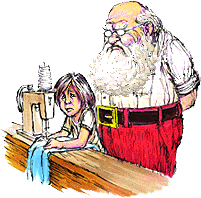
Of course while Ms. Claus gets exploited so do the elves,after all they represent a classic icon for child labour don't they. Santa's Sweatshop. Producing all those sweatshop toys for girls and boys, in the developed world. But you can now shop sweatfree.
At the American Apparel store on New York's Fifth Avenue this week, there was a Christmas shopping buzz as customers rifled through brightly coloured racks of t-shirts, underpants and bras. Helpful little cards advised on suitable presents: a pair of baby rib briefs, for example, for your "favourite boy". The boss of the underwear chain is getting a rather more substantial Christmas gift. Dov Charney, who founded American Apparel in 1997, will receive $200m in shares under a $383m takeover announced yesterday by a financial buyer, Endeavour Acquisition Corporation. Although eye-watering, Charney's windfall is hardly unusual in present business climate of daily multi-billion pound private equity buyouts. But this is no ordinary takeover. Ever since its inception, American Apparel has trumpeted its small-scale values. All the manufacturing is done in a factory in downtown Los Angeles where production line staff typically earn between $12 and $18 an hour - not a fortune, but well above the industry average and a good deal more than the people who stitch Gap underpants together in Indonesia. American Apparel trumpets its vertically integrated, sweatshop-free business model at every opportunity. Charney, who sports a handlebar moustache and once appeared bare-bottomed in an advertisement, has a strong sense of counter-intuitive cool and likes to upset Californian politicians by campaigning for free immigration. Yesterday's deal, however, is intended to transform American Apparel into a global player. The new owner, Endeavour, intends to open 800 stores, half of which will be outside America, to add to the existing chain of 145. American Apparel appears to be joining a long list of once ideological "ethical" names which have succumbed to the multinational shilling. Body Shop's founder Anita Roddick found a takeover by L'Oreal impossible to resist - just as Pret a Manger opted for a partial sale to McDonalds, the organic chocolate maker Green & Black's was gobbled by Cadbury Schweppes, and ice-cream king Ben & Jerry's was bought by Unilever
The National Christmas Tree Association's Web site claims that real tree sales outnumber sales for artificial trees 32.8 million to 9.3 million. But artificial trees are used year after year, and studies commissioned by the artificial tree industry show that 57 percent of all Americans actually own fake trees.
Further, the NCTA claims that plastic trees are made in Chinese sweatshops, harbor cancer-causing and poisonous chemicals, and can go up in flames at the strike of a match.
Real trees, it says, are renewable, recyclable and biodegradable. Nurseries proudly tell customers that one evergreen tree produces enough daily oxygen for 18 people.
As in previous years, the FairWear anti-sweatshop campaign took its Christmas sweat-free carols to town, visiting this year fashion retailer Rich, one of far too many who have so far refused to sign up to the Homeworkers Code of Practice ...
After a quick rehearsal in the Mall, the 'choir' made its way into the up-market shopping mall that has replaced the old Post Office in Melbourne's landmark GPO building and lined up in front of the fashion display for a rendering of modified version of three well-known carols - Jingle Bells (Sweatshop workers all deserve/their Christmas bonus pay - HEY!), God Rest Ye Weary Laborers (O tidings of justice and rights/ human rights, O tidings of justice and rights!), and the classic Twelve Days of Sweat Shopping (On the eleventh day of shopping, my true love bought for me,/ tax breaks for sweatshops, workers without unions, sexual/harassment, cancer-causing fumes, twelve-hour days,/six cents an hour,/RAM-PANT COR-PORATE GREED!/pre-sweated pants, slave labour shoes, toys made by kids,/all gifts made in sweatshops right here). The performance was then repeated on the steps outside, much to the fascination of the crowds waiting to view the Myer windows... After the performance, members of the 'choir' handed out useful wallet-sized cards listing companies certified to use the NoSweatshop label on their Australian Made clothing. Visit the website for details:
Away in a sweatshop where no one can see The immigrant seamstresses work constantly. Conditions are awful, the pay is absurd The boss he will fire them if they say a word. Away in a fact'ry, an ocean away Young girls making shoes for a dollar a day. But please don't complain about worker exploitation Cause this factory's in a Most Favored Nation. Away in the Congress, the Senators fat Count up their PAC dollars, pass NAFTA and GATT. They couldn't care less about workers in need These corporate whores traded their conscience for greed!
Slaving in a Sweatshop Wonderland to the tune of Walking in a Winter Wonderland
Door bell rings, are you listening? On your brow, sweat is glistening. You're working tonight; it just isn't right, Slaving in a sweatshop wonderland. Gone away are the good jobs Here today are the sweatshops They want you to sew Seven days in a row Slaving in a sweatshop wonderland. In Toronto, Woolworth has used sweatshops And they've paid the lowest rates in town. Ask about a union, they'll say no ma'am. Homeworkers do the job for the poorest pay around. Later on, they'll conspire How to raise prices higher The plans that they've made Won't make us better paid Slaving in a sweatshop wonderland. Door bell rings, are you listening? On your brow, sweat is glistening. You're working tonight; it just isn't right,
And this little missive from the Right makes the point too..
When Santa Claus comes to town this week, he'd better watch out -- because the federal government may be making a list of his crimes (and checking it twice), the Libertarian Party warned today.
"Hark the federal agents sing, Santa is guilty of nearly everything," said Libertarian Party press secretary George Getz. "The feds know when Santa's been bad or good -- and he's been bad, for goodness sakes."
Does Santa belong in the slammer? Instead of stuffing stockings, should he be making license plates?
Yes, said Getz, if he's held to the same standards as a typical American. For example:
* Every December 25, the illegal immigrant known as Santa Claus crosses the border into the United States without a passport. He carries concealed contraband, which he sneaks into the country in order to avoid inspection by the U.S. Customs Service. And just what's in all those brightly colored packages tied up with ribbons, anyway? The Drug Czar and Homeland Security want to know.
* Look at how this international fugitive gets around: Santa flies in a custom-built sleigh that hasn't been approved by the FAA. He never files a flight plan. He has no pilot's license. In the dark of night, he rides the skies with just a tiny bioluminescent red light to guide him -- a clear violation of traffic safety regulations.
* Pulling Santa's sleigh: Eight tiny reindeer, a federally protected species being put to hard labor. None of these reindeer have their required shots, and Santa's never bothered to get these genetically- engineered animals registered and licensed. It's no wonder: He keeps them penned outside his workplace in a clear violation of zoning laws.
* But Crooked Claus the Conniving Capitalist harms more than just animals -- he's hurting hard-working American laborers, too. Isn't Santa's Workshop really Santa's Sweatshop, where his non-union employees don't make minimum wage and get no holiday pay? Add the fact that OSHA has never inspected the place, and you have a Third-World elf-exploitation operation that only Kathy Lee Gifford could love.
* No wonder Santa is able to maintain his monopoly over the toy distribution industry: He's cornered the Christmas gift market. Santa dares to give away his products for free in a sinister attempt to crush all competition -- just like Microsoft's Internet Explorer. Antitrust Lawsuit Memo to the feds: Is Santa Claus the Bill Gates of Christmas?
The bottom line, said Getz: "It might be tough sledding for Jolly St. Nick this Christmas if the government decides to prosecute him.
"We're just surprised it hasn't already happened. After all, Santa Claus is everything that politicians aren't: He's popular, reliable, and gives us something for nothing every December 25th -- instead of taking our money every April 15th." See Sweatshop
Fashion activist Aja Barber is encouraging us to change our buying behaviour
By Fiona Pepper, ABC News
File image. Photo: David Cliff / NurPhoto via AFP
It was during the darkest days of the pandemic that Aja Barber had her revelation about fast fashion.
"A lot of us were sitting in our houses looking around going, 'Holy crap, I have a lot of stuff' and yet there were weeks where I wore the same two outfits," Barber told ABC RN's Big Ideas.
Yet beyond having an overflowing wardrobe, Barber began questioning how the price of clothing had gone down within her lifetime, while everything else was going up. The conclusions made her uncomfortable.
"There was always a feeling of, 'But why are we okay with people in other countries making terrible wages?'. That feeling was always there and I couldn't fight it," she said.
Currently the average Australian purchases 56 items of clothing each year and sends 23 kilograms to landfill.
Globally, the garment and textile industry employs approximately 75 million people worldwide. The Clean Clothes Campaign estimated less than 1 percent of what you pay for a typical garment goes to the workers who made it.
Now Barber, the author of Consumed: The Need for Collective Change wants to demystify the structural inequality embedded in the global fashion industry, and show consumers how they can change that. 'I was part of the problem'
Barber was quick to admit that she was part of the problem from a young age.
"When I think about my own path to being a fast-fashion shopper, I was so ripe for the taking because I grew up being made fun of for my clothing," she said.
"[I was] never being invited to subsequently sit at that lunch table with that group of snobs that were mean to me, thinking that maybe if I just had a T-shirt from the Gap, they'd be nice to me.
"And that's how it starts."
In her 20s, Barber read about the highly covetable leather Birkin bag and she set her sights on owning this expensive piece.
That is, even though she admitted she thought the bags were ugly.
"But I wanted one because of what it said about me. I'm a young black woman in a very white world, going into white business places and I want people to treat me well. That's why I wanted the bag, not because it was pretty," she said.
Barber bought the bag and this was just one example she said of her long-standing relationship with fashion and this belief that it could fix her feelings of inadequacy.
Now she wanted to remind everyone of what was lurking behind our desire to own the next big thing.
"Maybe you don't even need that dress; maybe you need a hug," she said.
Barber said we have grown accustomed to downplaying the scale of the fast-fashion problem, in order to continue justifying the purchase of sweatshop-made clothing.
"In devaluing the system, we're entirely able to look away from the harm of the system," Barber said.
By framing the issue as trivial, Barber said we were also devaluing the labour that goes into making garments, and the entire labour force propping up the clothing industry.
The 2022 Ethical Fashion Report found that just 10 percent of companies surveyed could evidence paying workers living wages at any of their final-stage factories.
"We have to value it because it is having a deep and profound impact on not just our planet, not just our fellow sisters, but our psyche as well," Barber said. Countering all the old excuses
A common argument that Barber came up against was that cheap clothing was accessible to everyone.
Her counter argument was simple: "Is it really accessible when it can only exist if we exploit other women?"
"We're so indoctrinated into consumerism, we really squeeze and manipulate rhetoric to fit our particular situation, so we feel good about buying sweatshop clothing," Barber said.
She also pointed out that the target audience for cheap clothing was usually the middle class.
"When I try and talk to people with platforms that sell sweatshop clothing, I'm like, 'So you're a rich woman, why are you selling sweatshop clothes?'," she said.
Their common response was that it was what their audience and followers could afford.
"And I'm like, your audience is just like you, your readership is just as middle class as you are. Do not even pretend like they need you to sell them shite that they don't need."
Additionally, she said we need to change our mindset around ethical shopping.
If Australians bought ethically made clothing at the rates they currently buy fast fashion, the cost would likely be prohibitive.
But if we reduce the amount we buy and wear those items longer, then ethically made clothing will be cost-effective.
Another common justification for buying cheap clothing was that the sweatshop workers were better off working than not.
But Barber argued this was straight up colonialism.
"This is the idea that all of these systems can only exist, if a corporation from a foreign entity exploits everyone," she said.
And she pointed out that there were brands that do pay fair wages. And these companies could challenge others to do better. Social media and excess consumption
In 2017, environmental charity Hubbub, found that one in six young people did not feel they could repeat an outfit once it had been seen on social media.
Barber said this message was starting to become normalised.
"I grew up wearing second-hand [clothes]. I did not tell my little snot-nose peers because that would have been another thing for them to make fun of me for," Barber said.
"I think there's still stigma there. That's a hurdle that we're going to have to get through culturally in our society."
She also wanted consumers to slow down and rediscover their individual style.
"Fast fashion has gotten us so away from knowing our personal style, knowing what we really like because you're having a lot of stuff pushed at you," she said.
"And once we get back to that, it really narrows down what you're purchasing … It's a lot more considered, which means it's probably going to stay in your wardrobe for a lot longer."
Yet Barber admitted, while encouraging people to buy ethically, second hand or educating young people were all important steps forward, she said individuals could not be expected to fix the problem.
"We need legislation, we cannot group hug our way out of this."
For example, Barber suggested the introduction of an extended responsibility tax being placed on all fast fashion garments would mean that companies would have to pay for the end of the life of every product manufactured.
Additionally, imposing financial penalties around non-compliance of Modern Slavery Acts.
And as an individual, Barber said: "If you already have clothing you can wear, then you don't need new things."
And the next new item of clothing you do buy, "has to be from a company that pays everyone fair wages, that's it".
Labor organizers in Southern California are pushing President-elect Joe Biden to pick a progressive, hometown hero for Labor Secretary, arguing that the state's top labor official — an anti-sweatshop campaigner dubbed the "bane of the deadbeat employer" — is supremely qualified to protect workers' rights during the pandemic.
Julie Su has served in statewide office since 2011, when former Gov. Jerry Brown picked her to lead the state's enforcement of labor laws. Before that, at the age of 26, she represented dozens of undocumented Thai workers who were effectively enslaved at a garment factory outside Los Angeles, a landmark case that prompted federal and state efforts to combat human trafficking; that work was cited by the MacArthur Foundation, which awarded her its "genius" award in 2001.
As labor commissioner, Su turned the state's under-resourced team of worker advocates into "what could be the most aggressive and effective state labor law enforcement division in the country," according to a 2013 report from In These Times, a progressive magazine.
Under Su's reign, California sought the largest-ever judgment against an employer in state history, assessing almost $12 million in citations against a construction company. "[E]mployers who steal from workers will end up paying for it," she said at the time.
In 2019, Gov. Gavin Newsom promoted her to Secretary of Labor, a role that has seen her oversee worker safety and unemployment checks amid a pandemic and recession — experience her advocates believe has well prepared her to do the same on a larger scale.
"Workers, especially workers of color, are hurting across the country," Marissa Nuncio, director of the Garment Worker Center in Los Angeles, told Business Insider. "They need and deserve someone with a demonstrated record of leadership and expertise in fighting for working individuals and families, and Julie's record is exemplary."
Julie Su received a 2001 "genius" grant from the MacAuthur Foundation for her efforts to protect undocumented immigrant workers.
Carlos Chavez/Los Angeles Times via Getty Images
As Bloomberg Law reported last week, Su's odds for a cabinet pick have been aided by a split in union support among contenders who are better known on the national stage, such as US Sen. Bernie Sanders and Rep. Andy Levin. "I think she's very, very viable," Los Angeles County Federation of Labor President Ron Herrera, a supporter, told Bloomberg. "She's really been a warrior for us."
But, the outlet noted, a lack of public support from organized labor has also been one factor hindering Su's candidacy.
A letter sent to the president-elect on Sunday aims to address that gap.
"It is a critical time for women's leadership and we need a strong woman as US Secretary of Labor, especially a woman of color who understand what it's like to grow up in an immigrant household," states the letter signed by Dolores Huerta, the famed farm worker organizer, and the leaders of groups such as the Koreatown Immigrant Workers Alliance, the Pilipino Workers Center of Southern California, and the Los Angeles Alliance for a New Economy.
"She fully enforced the rights of farm workers, janitors, and domestic workers," the letter says. "In short, Su has been at the forefront of some of the most innovative policies and enforcement strategies in our state's history.
A senior staffer at a national labor organization, requesting anonymity to speak freely, said a Su cabinet post would be seen as a big win for the labor movement.
"Thinking about Julie Su as Secretary of Labor is almost a physical sense of relief," the source told Business Insider. She's spent years leading enforcement in the world's fifth-largest economy and before that fought for workers' rights as an activist exposing labor conditions in the garment industry.
"She is widely respected as a labor rights and civil rights attorney, so she truly 'speaks the language' of workers' issues," the source said, noting she is also fluent in both Spanish and Mandarin.
Su "will walk in that door fully capable, ready to work, and without any serious shadows of past transactional relationships or controversies," they added.
You know its serious when its reported in Business Week. And while this is about American companies in China lets not forget that we have our own sweatshop companies here in Canada investing in Nicaragua and Haiti. Like Gilden Active Wear. They too use third party codes of conduct.
For more than a decade, major American retailers and name brands have answered accusations that they exploit "sweatshop" labor with elaborate codes of conduct and on-site monitoring. But in China many factories have just gotten better at concealing abuses. Internal industry documents reviewed by BusinessWeek reveal that numerous Chinese factories keep double sets of books to fool auditors and distribute scripts for employees to recite if they are questioned. And a new breed of Chinese consultant has sprung up to assist companies like Beifa in evading audits. "Tutoring and helping factories deal with audits has become an industry in China," says Tang, 34, who recently left Beifa of his own volition to start a Web site for workers.
Some American companies now concede that the cheating is far more pervasive than they had imagined. "We've come to realize that, while monitoring is crucial to measuring the performance of our suppliers, it doesn't per se lead to sustainable improvements," says Hannah Jones, Nike Inc.'s (NKE ) vice-president for corporate responsibility. "We still have the same core problems."
This raises disturbing questions. Guarantees by multi-nationals that offshore suppliers are meeting widely accepted codes of conduct have been important to maintaining political support in the U.S. for growing trade ties with China, especially in the wake of protests by unions and antiglobalization activists. "For many retailers, audits are a way of covering themselves," says Auret van Heerden, chief executive of the Fair Labor Assn., a coalition of 20 apparel and sporting goods makers and retailers, including Nike, Adidas Group, Eddie Bauer, and Nordstrom (JWN ). But can corporations successfully impose Western labor standards on a nation that lacks real unions and a meaningful rule of law?
As part of its fashion show in Milan, Tod's had artisans in white coats showing off its trademark leatherwork - Copyright AFP MIGUEL MEDINA
Alexandria SAGE
Artisans in white coats greeted guests at the Tod’s fashion show in Milan Friday, crafting the Made in Italy leather and needlework items for which the company — and country — is renowned.
But despite that display of handcraft, there has been little mention at Milan Fashion Week of some of the industry’s forgotten workers — whom prosecutors found were working in sweatshop conditions at subcontractors for many Italian luxury brands, including Tod’s.
With the glamorous catwalks, celebrities and excess of finery on display, the possibility of the recent investigations uncovering labour abuses being on anyone’s mind appeared slim.
After the show, Tod’s founder and chairman Diego Della Valle told AFP the company’s decision to highlight its artisanal heritage was in no way linked to the recent investigations.
“No controversy — I think we’ll do good things together with the courts and trade associations. I think we’re on the right track,” Della Valle said.
On Tuesday, Tod’s submitted to a Milan court a list of measures it was undertaking to reinforce its supply chain, including the creation of a platform to better trace supplier activity and expanded audits.
“I think that by working together like this, everyone will be involved in finding a solution,” he said, adding that Italy’s laws needed revising “to protect people and artisans”.
– ‘Product first’ –
Many international guests at the show had not heard mention of the accusations of migrant labour exploitation levelled last year at over a dozen of luxury’s biggest names, including Gucci, Loro Piana, Prada, Dolce & Gabbana and Ferragamo.
Allegations include around-the-clock working hours and substandard pay, breaches of safety measures and makeshift sleeping areas inside small workshops.
Asked whether it would matter to the luxury consumer, the vice president and fashion director at Nordstrom, Rickie De Sole, suggested the answer might be yes and no.
“I think the integrity of Made in Italy is incredibly important and I think that at the end of the day, to the customer, it’s product first, right?” she told AFP.
Influential fashion critic and journalist Suzy Menkes, sitting in the front row, cautioned that she hadn’t followed the cases in Italy but said “people do care when there are specific things that have come to light”.
“But I don’t think it’s any different from food and various other things, where one hopes that the bigger the company is, that the more they’re serious about it.”
A Hong Kong content creator dressed head to toe in Tod’s, 26-year-old Stephanie Hui, said people were “desensitised” to stories of sweatshop conditions in the fashion industry, with consumers feeling powerless to effect change.
“It takes a lot of people to band together to like really make a change. It’s not really in our control, but definitely I think if consumers stop spending as much they’ll kind of give the brands a wake-up call,” she said.
– ‘Want to be seen’ –
Fashion industry insiders say that controlling every link in the supply chain is more complicated the bigger the company.
Stefano Aimone, CEO and creative director of Agnona, told AFP in an interview this that it depends on the company’s scale.
“When you’re smaller, you have more control and can really check and know all your employees and consultants by name. When you’re dealing with 400, they’re just numbers, and it’s unthinkable to control everything,” he said.
“Something will slip through regardless, because even if you have contracts with such-and-such subcontractor, you don’t know what they then do in turn,” said Aimone.
Asked whether fashion customers paid attention, Aimone said that despite some headlines, it remained “a B (business) to B (business) issue”.
“The end customer doesn’t know.”
And even if supply chains were better known, the customer might not care, said Iuliana Stetco, 21, a fashion marketing student in Milan.
“They want to be seen, they want to be seen wearing a certain type of brand, a certain label, and so as a result they don’t care much.”
Tuesday, May 10, 2022
Freed Taiwan activist recounts 'fascist circus' of Chinese court
Lee Ming-che spent more than four years in a Chinese prison under national security laws, saying authorities there operated 'a total slavery sweatshop'
(AFP/Sam Yeh) Sam YehMore Amber WANG Tue, May 10, 2022
A Taiwanese democracy activist, jailed in China for five years, on Tuesday described the court proceedings as a "fascist circus" and said he was told he might be released if he admitted to bei Lee said he bought books and supplies and donated money to some Chinese political prisoners and their families, as well as visiting them on the mainland.
"My actions are very normal in Taiwan or any democratic society... I didn't expect China would view my humanitarian acts as grossly as subverting state power," he said.
He was sent to Chishan Prison in Hunan province where Lee said he initially had to work 11 to 12 hours daily all year round, except for a four-day lunar new year break.
Food often smelt "rotten" when it cooled and he was initially without hot water during Hunan's bitter winters.
"Chishan is like a big factory... It's a total slavery sweatshop," Lee said, adding the prison produces gloves, shoes, bags and backpacks.
China's prisons have long deployed forced labour programmes for inmates, something that has received increased international scrutiny following the construction of a vast detention system in western Xinjiang province.
Lee was accompanied Tuesday by his wife Lee Ching-yu who campaigned hard for her husband's release.
Lee said he believed that campaign kept public focus on his case and helped improve his treatment.
Asked if he had anything to say to the Chinese government, Lee replied with a pro-independence slogan in Taiwan: "Taiwan, China, one country on each side".
China claims self-ruled democratic Taiwan as its own and vows to seize it one day, by force if necessary.
Beijing has ramped up pressure on Taiwan since President Tsai Ing-wen came to power on the island in 2016, as she views Taiwan as an "already independent" sovereign nation and not part of Chinese territory.
aw/jta/aha/reb
Wednesday, December 08, 2021
'I'm Asking You To Help': Amazon Employee Describes 'Sheer Brutality' of Work to Senators
"Amazon's high-tech sweatshop caused me to develop plantar fasciitis... I take what little time I have to run to the bathroom just to cry."
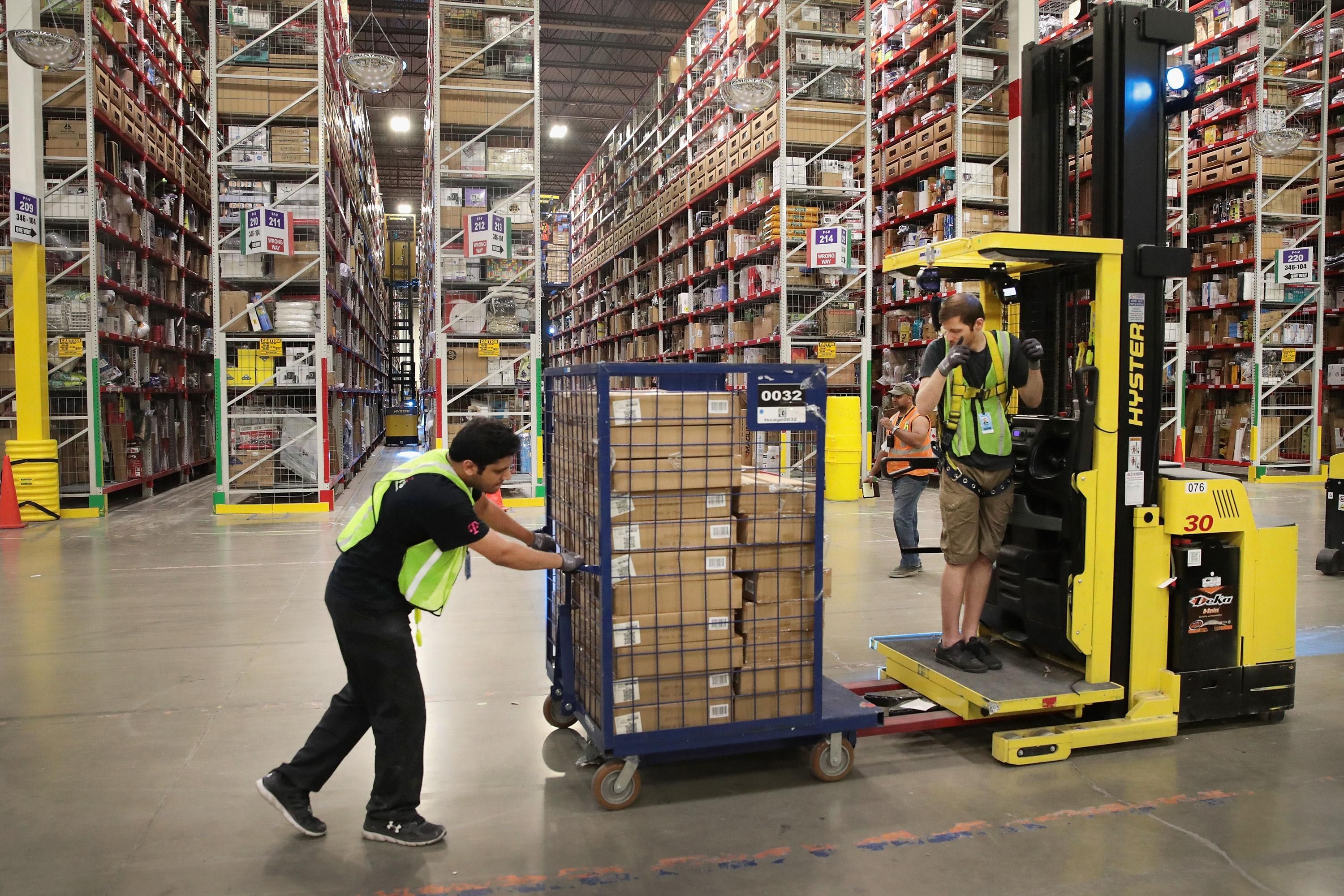
Workers pack and ship customer orders at the 750,000-square-foot Amazon fulfillment center on August 1, 2017 in Romeoville, Illinois.
"I'm looking to you to stand up to corporations like Amazon and protect us."
"We are living in a country where machines are getting better treatment than people."
That was Courtenay Brown's message to U.S. senators during a subcommittee hearing on Tuesday. The Newark, New Jersey resident and Navy veteran has worked at an Amazon fulfillment center for more than three years.
Brown—also a leader at United for Respect, a movement of Amazon and Walmart workers fighting for better labor conditions—said in her "powerful" and "compelling" testimony that she wanted to "raise the alarm about Amazon's business model, its threat to working people, and its threat to our economy."
As a process guide at an Amazon facility in Avenel, New Jersey, Brown sorts groceries for delivery, work she described as "physically and mentally exhausting," before noting that "on top of that, we are monitored every single second as we scan items."
According to Brown:
So pausing even to wipe the sweat off our forehead can lead to a write-up as managers monitor our locations and times we spend doing work. If we fall behind in any way during our 12-hour shift, we risk being disciplined. We are pushed to our limit to the point where we can’t even take regular bathroom breaks. Often we literally have to run to and from the bathroom in under two minutes so we don't get in trouble. The constant pressure and surveillance is one reason why Amazon has twice the level of injuries and turnover compared to similar employers.
Taking aim at Amazon's founder and former CEO—who competes with Telsa's Elon Musk for the title of the world's richest person—Brown detailed her difficulties with the e-commerce giant's bereavement policy in the wake of her mother's death, explaining that she had to take "a month of unpaid time off, while Jeff Bezos made $75 billion last year thanks to me and my coworkers."
"Amazon's multibillion-dollar wealth is made possible by offering one- and two-day delivery," she said, "and the corporation has achieved this speed and scale through sheer brutality—watching, timing, and punishing associates like me and my coworkers for not working fast enough and not allowing associates to take time off to adequately recover, rest, and prevent burnout."
"We are living in a country where machines are getting better treatment than people," she asserted. "The machines at my facility undergo routine maintenance checks to ensure they don't burn out. Meanwhile, research has shown that workplace injury rates are higher at Amazon facilities with more robotic and automated technology."
"Amazon's high-tech sweatshop caused me to develop plantar fasciitis—a debilitating pain in my heel—because I'm having to stand up for long periods of time at work with little to no rest. The burning sensation around my heels is so painful that I take what little time I have to run to the bathroom just to cry," Brown continued, noting that one time she begged doctors to keep her at the emergency room longer because she had to return to work.
The Amazon worker accused the company of setting up facilities "in Black and Brown communities desperate for work" and pointed out that Bezos recently told shareholders he plans to use more automated control of warehouse workers—or what she called "dehumanizing tactics designed to break our bodies."
Warning members of the Senate Finance Committee's panel on fiscal responsibility and economic growth that "Amazon has built an empire on our backs, and now other employers, like Walmart, are racing to copy" its model, Brown implored them to take action.
"I'm asking you to help me put an end to inhumane, exploitative processes that leave America's workers injured, exhausted, and mentally battered each day," she said.
Brown's testimony came during a wide-ranging hearing entitled "Promoting Competition, Growth, and Privacy Protection in the Technology Sector." The subcommittee's chair, Sen. Elizabeth Warren (D-Mass.), asked Brown how the Covid-19 pandemic has impacted logistical operations.
Brown also shared her experience working under Amazon's surveillance with The Washington Post last week.
"They basically can see everything you do, and it's all to their benefit," the 31-year-old said. "They don't value you as a human being. It's demeaning."
In an emailed statement to the Post, Amazon spokesperson Kelly Nantel framed the employee monitoring as beneficial to not only the company but also its workers.
"Like any business, we use technology to maintain a level of security within our operations to help keep our employees, buildings, and inventory safe—it would be irresponsible if we didn't do so," Nantel said. "It's also important to note that while the technology helps keep our employees safe, it also allows them to be more efficient in their jobs."
The newspaper noted that some workers don't agree with Nantel's framing—such as Chris Smalls, a former employee at an Amazon facility in Staten Island who is leading a unionization effort there.
"It's one of the big reasons people want to unionize," Smalls said of the monitoring policies. "Who wants to be surveilled all day? It's not prison. It's work."
Staten Island isn't the only place where Amazon employees are fighting for a union. A regional director for the National Labor Relations Board determined last week that following allegations of unlawful interference by the company in an unsuccessful April union election, workers at a warehouse in Bessemer, Alabama will get to vote again.
The Alabama decision came on Cyber Monday, the biggest online shopping day of the year, and followed a Black Friday that saw Amazon workers walk out of facilities around the world to demand better working conditions.
Amazon's treatment of its workers and opposition to unionization efforts have fueled demands for the Senate to pass the House-approved Protecting the Right to Organize (PRO) Act.
Our work is licensed under Creative Commons (CC BY-NC-ND 3.0). Feel free to republish and share widely.
Monday, September 06, 2021
'The Box' gets inside Mexican sweatshop at Venice film festival
Issued on: 06/09/2021 -
'How do you put a camera inside a real maquiladora?' said Vigas.
'It's nearly impossible.'
Filippo MONTEFORTE AFP
Venice (AFP)
Getting access to a "maquiladora", one of the hundreds of factories that line Mexico's border with the United States, was the biggest challenge of shooting Lorenzo Vigas' latest film at Venice, the director said Monday.
"The Box" is in competition for the top prize at the Venice Film Festival, to be announced on Saturday.
It was shot in Chihuahua, the site of hundreds of foreign-owned factories assembling cheap goods and apparel for the United States just across the border, and one of Mexico's most violence-plagued states.
The cheap labour that fuels the maquiladoras has made Mexico a major exporter, but at the cost of its poor and uneducated workers, many of whom work in sweatshop conditions for rock-bottom wages.
"How do you put a camera inside a real maquiladora? It's nearly impossible," the Venezuelan director, who lives in Mexico, told journalists Monday.
"They're very jealous of not exposing their production line," said Vigas, who in 2015 became the first Latin American to win Venice's prestigious Golden Lion with his first feature, "From Afar".
"They're very jealous of not exposing the condition of their workers -- so how do you shoot a film?"
The production team spent nearly a year trying to find a maquiladora that would allow the crew to shoot inside, before finally getting the green light from a company that was ready to close for bankruptcy.
"We didn't get any roadmap from people who had done this before -- because nobody was allowed before to do this," said one of the film's producers, Jorge Hernandez Aldana. - Missing women -
The film tells the story of a 13-year-old boy (first-time actor Hatzín Navarrete), who travels halfway across Mexico to recover the remains of his father, whose body has been found in a mass grave.
On the way, he hooks up with a man, played by Hernan Mendoza, who supplies workers for the maquiladoras. He signs up poor people in remote villages with a pitch that they must protect Mexican jobs from Chinese competition.
When we finally see inside the jeans assembly factory where the workers are taken, in the middle of a bleak, unforgiving desert, we immediately wish they could turn back -- it's loud, hot, and the pace is non-stop.
Besides its central theme of replacing absent fathers, "The Box" touches on the brutal reality of thousands of women there -- many of them maquiladora workers. Since the 1990s hundreds have been abducted, either vanishing entirely or their bodies turning up discarded or buried in the desert.
Tarantino regular Tim Roth stars in another film in competition, 'Sundown', by Mexico's Michel Franco
Filippo MONTEFORTE AFP
"More than 20,000 women in the north of Mexico have disappeared," said Vigas. "Nobody knows why."
More than 73,000 people in Mexico are missing, the government said in 2020, a quarter of them female.
Another Latin American film in competition is "Sundown" from Mexico's Michel Franco. His "New Order" with its searing indictment of the gap between rich and poor in Mexico, won Venice's Silver Lion last year.
"Sundown" stars Tim Roth as a man escaping his obligations at a time of family crisis to hang out on an Acapulco beach.
But, just as in Vigas's film, an undercurrent of social tension pervades the quiet drama, keeping the viewer on edge -- and even a tranquil beach holiday in Mexico is not enough to keep violence at bay.
Apple probes supplier after workers at Wistron plant in India rampage
An Apple logo hangs above the entrance to the Apple store on 5th Avenue in the Manhattan borough of New York City
By Sankalp Phartiyal and Chandini Monnappa
NEW DELHI/BENGALURU (Reuters) - Apple Inc said on Monday it is investigating whether a Taiwan contractor, Wistron Corp, flouted supplier guidelines at an iPhone manufacturing facility in India, after some workers ransacked the plant in a protest over unpaid wages.
Thousands of contract workers gathered on the grounds of the Wistron site on the outskirts of India's tech hub of Bengaluru on Saturday demanding unpaid wages and better working hours.
As police arrived, the crowd turned violent and video from the scene showed people armed with rods and sticks smashing equipment and vandalizing cars, causing what the company estimated at $60 million in damage.
"We have teams on the ground and have immediately launched a detailed investigation at Wistron's Narasapura facility," Apple said in an email, adding it was dedicated to ensuring everyone in its supply chain was treated with dignity and respect.
Apple said it was sending staff and auditors to the site and was cooperating with police in their investigation.
Wistron, one of Apple's top global suppliers, said in a regulatory filing in Taiwan it "always abides by the law, and fully supports and is cooperating with relevant authorities".
Wistron has been making iPhones in India for nearly four years and its operation has been seen as a success story for Prime Minister Narendra Modi's government that is looking to boost manufacturing. "The incident hurts the 'Make in India' label," said independent brand consultant Harish Bijoor, referring to the government promotion campaign slogan. "Such events are small scars left on India as a manufacturing facility."
Apple, under the leadership of Tim Cook, has been looking to not only step up its marketing and presence in India - one of the biggest smartphone markets in the world - but also expand its sourcing footprint in the South Asian nation.
A minister for the state of Karnataka, where the factory is located, said the government was talking to all parties and that the labour department was investigating any underpayment of wages and non-clearance of other dues.
The unrest comes as Modi's government is under pressure from protesting farmers opposed to reforms in the agricultural sector, which they say threaten their livelihoods.
MILLIONS IN DAMAGES
Videos taken by employees in the Wistron factory showed men, many wearing masks due to the coronavirus outbreak, destroying security cameras, windows and other equipment.
The crowd smashed four cars, two golf carts, stole laptops and smartphones and destroyed other office equipment, according to a police report filed by Wistron and reviewed by Reuters.
In the complaint, Wistron accused more than 5,000 contract workers and some 2,000 unknown people of destruction of property. It put the losses at 4.38 billion rupees ($60 million).
Police have arrested 149 people over the violence, a senior officer said, while a search was on to identify and arrest more perpetrators as the investigation continues. Trade union leader M.D. Harigovind said the violence was a direct result of the "brutal exploitation of workers and sweatshop like conditions".
Wistron, whose workers are not unionized, did not respond to questions seeking comment on the allegations, but said in a statement earlier it was "deeply shocked" by the violence it blamed on "unknown persons ... with unclear intentions".
(Reporting by Sankalp Phartiyal in New Delhi, Ben Blanchard in Taipei and Chandini Monnappa in Bengaluru; Writing by Nivedita Bhattacharjee; Editing by Euan Rocha, Arun Koyyur and Stephen Coates)
Originally published as SABOTAGE, THE CONSCIOUS WITHDRAWAL OF THE WORKERS' INDUSTRIAL EFFICIENCY, in October, 1916, by the IWW publishing bureau, in Cleveland
Apple supplier Wistron puts India plant damage at up to $7 million
Mon, December 14, 2020,
Men wearing protective face masks walk past broken windows of a facility run by Wistron Corp in Narsapura
TAIPEI (Reuters) - The ransacking of an iPhone manufacturing facility in India caused up to T$200 million ($7.12 million) in damage though production facilities were not as badly hit as reported, its Taiwan-based operator Wistron Corp said on Tuesday.
Thousands of contract workers gathered on the grounds of the Wistron site on the outskirts of India's tech hub of Bengaluru on Saturday demanding unpaid wages and better working hours. As police arrived, the crowd turned violent and video from the scene showed people armed with rods and sticks smashing equipment and vandalising cars. In a police report seen by Reuters, Wistron estimated damages worth $60 million.
However, in a statement to the Taiwan Stock Exchange on Tuesday, the company said major production facilities and warehouses had not suffered as serious damage as reported by local media, and that it was initially estimating losses at T$100-200 million.
The company is doing its utmost to get the plant back up and running, it said. Wistron shares fell around 2.5% in early Asia trade, underperforming Taiwan's broader stock market.
"The company has cooperated with the relevant authorities and the police investigation and continues to negotiate with the insurance company," Wistron added, without elaborating.
Apple Inc said on Monday it was investigating whether Wistron had flouted supplier guidelines. Apple said it was sending staff and auditors to the site and was cooperating with police in their investigation. Wistron is one of Apple's top global suppliers.
It has been making iPhones in India for nearly four years and its operation has been seen as a success story for Prime Minister Narendra Modi's government that is looking to boost manufacturing.
($1 = 28.1040 Taiwan dollars)
(Reporting by Ben Blanchard; Additional reporting by Twinnie Siu in Hong Kong; Editing by Ana Nicolaci da Costa)
Apple Probes iPhone Supplier After Worker Protests Over Wages, Working Hours Turn Violent In India Shivdeep Dhaliwal Sun, December 13, 2020
An Apple Inc (NASDAQ: AAPL) supplier’s factory has been attacked by workers in India who claim they were brutally exploited, the Wall Street Journal reported Sunday.
What Happened: Taiwan-based Wistron Corporation, whose factory near Bengaluru is often showcased by Indian authorities as an example of homegrown manufacturing, saw violence including arson by workers angry over wages and working hours, according to the Journal.
M.D. Harigovind, an official from an Indian union, attributed the agitation to “the brutal exploitation of workers and sweatshop-like conditions.”
Wistron said it was “deeply shocked” by the unrest with a spokesperson reportedly saying “we follow the law and are supporting the authorities with their investigation.”
An Apple spokesperson said the tech giant is “dedicated to ensuring everyone in our supply chain is treated with dignity and respect,” the Journal reported. The Cupertino-based company told the Economic Times that it is probing the allegations against Wistron.
Why It Matters: Last month, Apple put another Taiwanese supplier, Pegatron Corporation, on probation after it discovered cases of labor violations.
In mainland China, Apple employees have alleged that the Tim Cook-led company is complicit in the violation of the country’s labor laws.
85% of electricity in South Africa comes from coal, and early comments from the new environment minister suggest this will not change fast on his watch. Credit: jbdodane.
At the close of a year in which Africa’s underlying economic problems continue to worsen, the Johannesburg G20 summit on November 22-23 utterly failed in its mandate to cut the continent’s foreign debt and assure that appropriate climate-finance grants will be available. Nevertheless, even while the world economy’s value chains suffer disfigurement thanks to Donald Trump’s whimsical tariffs, ambitions for Africa’s long-overdue industrialization are regularly articulated based either on copying an East Asian sweatshop-based strategy replete with Special Economic Zones, given the continent’s large, young, desperate workforce; or on adding value to local raw materials.
In both cases, hope is sometimes expressed that, as U.S., British and European Union (EU) aid shrinks and trade barriers rise, the Brazil-Russia-India-China-South Africa (BRICS) economies will come to the rescue, especially because a benign sponsor – Beijing – is standing by, quite capable of reversing current trends.
Writing in early December, Tricontinental research institute leader Vijay Prashad recalled how, “At the 2015 Forum on China-Africa Cooperation (FOCAC) in Johannesburg, South Africa, the Chinese government and fifty African governments discussed the problem of economic development and industrialization. Since 1945, the question of African industrialization has been on the table but has not advanced due to the neocolonial structure that has prevented any serious structural transformation.”
True, colonial-era and immediate post-colonial African dependency relations persisted thanks to Western economies’ power over the continent’s exports, over global commodity markets and over nascent value chains through the fragmentation and extension of corporate production systems. Only a few sites of durable capital accumulation emerged in Africa via productive forces associated with manufacturing.
Prashad explains: “The most industrialized countries on the African continent are South Africa, Morocco, and Egypt, but the entire continent accounts for less than 2% of world manufacturing value added and only about 1% of global trade in manufactures. That is why it was so significant for FOCAC to put industrial policy at the heart of its agenda; its 2015 Johannesburg Declaration affirmed that ‘industrialization is an imperative to ensure Africa’s independent and sustainable development’.”
These are fine aspirations – and they are also expressed regularly in African elite meetings with Western imperial powers, such as in Angola last month when 76 leaders of the EU and African Union met for a major summit aiming to “Strengthen continental and regional economic integration and accelerate Africa’s industrial development.” Yada yada.
In practice, such sentiments tend to be overwhelmed by the capitalist mode of production’s laws of motion; today, especially by the unregulated, increasingly desperate drive for profit and commodity access by Chinese firms. A new book makes that case (with free download here): The Material Geographies of the Belt and Road Initiative, edited by Elia Apostolopoulou, Han Cheng, Jonathan Silver and Alan Wiig.
(For dialectical curiosity, here’s a completely different approach, from a neoliberal podcaster arguing that China’s ‘curse of overproduction’ is not capitalism’s fault but is due to “government’s heavy intervention, weak market mechanisms, and lack of legal frameworks perpetuate inefficiencies, with local governments chasing GDP through subsidies and projects.”)
In a more critical – but nationalistic (and non-solidaristic) – spirit, one of Prashad’s leading allies here in Johannesburg, Irvin Jim of the National Union of Metalworkers of South Africa (NUMSA), made a heartfelt appeal last month against “the dumping of cars from India and China” whose automakers have increased their market share here by a factor of 25 since 2018.
Hence, insists Jim, “it is about time that we must increase tariffs.” His grievances about massive job losses caused by imports – to be discussed in detail in the next essay – suggest Prashad is not yet attuned to deindustrialization damage done by the Chinese state and its capitalists in recent years. Moreover, at a time the West has shrunk its own (inflation-adjusted) aid-debt-investment packages, the FOCAC commitments made in 2015 – amounting to about $22 per African citizen – were chopped nearly in half by 2024.
Relentless Western abuse of Africa
Of course, Washington should mainly be blamed for the continent’s most current wave of social misery and economic degradation, which in the second half of 2025 contributed to Gen Z social uprisings in Kenya, Tunisia, Morocco, Madagascar, Zambia and Tanzania. The mix of Western economic attacks on Africa and greedy resource grabbing should not disguise how imperial interest at the White House and State Department is waning: Trump last week recalled 15 career-professional U.S. ambassadors from African countries, to be replaced by America-First political hacks.
Exceptions to that disinterest in Africa may arise, such as the Lobito Corridor extraction route for $2 trillion worth of minerals to be spirited out from the eastern Democratic Republic of Congo (DRC) via an Angolan port. In a ‘peace deal’ earlier this month brokered by Trump between corruption-accused DRC leader Felix Tshisekedi and Rwandan dictator Paul Kagame – one immediately violated – the U.S. president announced he would soon be “sending some of our biggest and greatest companies over to the two countries… we’re going to take out some of the rare earth and take out some of the assets and pay… and everybody’s going to make a lot of money.”
Already in February, Trump and his ex-South African sidekick Elon Musk had wiped out most U.S. emergency food, medical and climate-related aid to Africa, with a special cut for all South African contracts. Washington’s $64 billion US Agency for International Development was shuttered by Musk, fed “into the wood chipper,” leaving many millions of lives at risk (although some AIDS medicines spending was later revived).
Then came Trump’s devastating tariffs – in February, April and again in August – followed by the September demise of the Africa Growth and Opportunity Act (AGOA) which since 2000 had given dozens of African countries duty-free access to U.S. markets. Notwithstanding a deeper context of dependency relations associated with AGOA – for as political economist Rick Rowden points out, “gains were largely due to African exports of petroleum and other minerals, not manufactured goods” – these latter trade-curtailing processes were exceptionally damaging, wiping out 87% of auto exports from South Africa in the first half of 2025.
The World Bank concluded of 2025’s tariff chaos, “industry-level impacts may be significant in global value chain–linked activities, notably, textiles and apparel as well as footwear (Eswatini, Kenya, Lesotho, Madagascar, and Mauritius) and automotive and components (South Africa)… Loss of the AGOA would sharply reduce exports to the United States. On average, exports would decline by 39% if a nation were suspended from AGOA benefits.”
(A House of Representatives bill may gain support to resume AGOA in 2026 but without the main industrial beneficiary, South Africa, due to Trump’s irrational hostility. Exports of autos, steel, aluminium and many agricultural products to U.S. have collapsed.)
Moreover, other Western sources of demand for African products will also soon decline, according to the World Bank, thanks to Europe’s “new regulatory measures, such as the Carbon Border Adjustment Mechanism and the EU Deforestation Regulation, [which] impose stringent compliance requirements on exporters of cement, metals, and agricultural products” starting in early 2026. The Bank admits both that a “global shift toward ‘friendshoring’ in strategic industries, risks marginalizing African suppliers” – thus undermining its export-led ‘growth’ mantra.
On the class-struggle front, the Bank continues, “The growth of the labor share in national income registered a negative contribution in 2000–19: it declined at an annual rate of 0.1%. This decline reflects the adoption of more capital-intensive technologies, increased participation in global value chains, reduced (relative) bargaining power of workers, and greater market power of large firms in concentrated product markets.”
Too much is being produced, mainly by China
Still, the overarching crisis affecting the world economy, not just Africa’s, can be termed the ‘overaccumulation of capital,’ which Karl Marx had in Das Kapital identified as the core internal problem capitalism faces, due to the tendency to overproduce relative to market size. From that process, we can understand geopolitical tensions much better.
As world-systems sociologist Ho-fung Hung recently suggested, “Today’s intensifying U.S.-China rivalry resembles more the inter-imperial rivalry a century ago driven by the overaccumulation of rising capitalist power – that is China – than the Cold War between the U.S. and the Soviet Union.”
At the end of 2025, it is abundantly evident that far too much productive capacity exists in China, given limits to the fractured world economy’s ability to mop up the surpluses through various forms of consumption and debt – now at saturation level in many countries.
The excess capacity is experienced in various ways, as capital flows away from durable fixed investment in many settings, and often into extreme financial bubbling due to higher speculative profits. When the crash comes, if the state is sufficiently strong, such credit flows can be reversed, as Evergrande’s 2021-22 collapse in China illustrates (following which the state’s managers of overaccumulated capital self-destructively redirected bank loans to manufacturing again).
Nervousness about the durability of the financialization that inevitably follows overproduction is reflected in the soaring gold price, up from $250/oz 25 years ago to an insane $4500/oz today. There is also new evidence, in many national economies, of fresh swathes of deindustrialization, high levels of unemployment and under-employment, and falling profit rates.
Mostly though, excess capacity is the core signal, as some crucial sectoral examples show:
global steel output of nearly 1.9 billion tonnes in 2024 contrasted to 2.47 billion tonnes of capacity (i.e., 76% capacity utilization), with a rise of another 10% excess capacity estimated in 2025, to 680 megatonnes;
in chemicals, Bloomberg News reported earlier this month, “A wave of new Chinese petrochemical plants is raising fears of a deluge of exports that will put pressure on other producing nations that are already struggling with oversupply” due to “seven massive petrochemical hubs… creating a global glut that could swell even further if more planned plants come online” at a time, in 2025, polyethylene output rose 18%;
China’s annual vehicle production capacity – carrying either internal combustion engine or electric motors – was 55.5 million vehicles/year capacity in 2024, but was only half utilized (just 27.5 million vehicles were produced that year), while in 2025, Chinese output was expected to reach 35 million (still a low capacity utilization), displacing other economy’s sales and leaving the world with increased idle capacity, as global vehicle sales languish at 90 million;
also in China, “The root cause of the cement sector’s current difficulties lies in the long-standing problem of overcapacity, which has now been amplified by weaker market demand” since 2021 “due to declining property investment and a slowdown in infrastructure construction,” according to the China Building Materials Federation, and
solar photovoltaic panels generated nearly 600 GW of new power in 2024 – mostly emanating from China – but there was, at that point, more than 1,000 GW of annual manufacturing capacity, and to store the power, lithium-ion batteries were produced at the scale of 2.5 TWh in 2023, but by 2024 there was 3 TWh of capacity and projections of 9 TWh by 2030, at a time demand was expected to rise only to 5 TWh.
(Renewable energy offers a curious form of capitalist ‘excess capacity’ – since this description obviously deserves scare quotes: for the sake of ecological sanity, it is a misnomer. So much more capacity is urgently needed for installation in every corner of the earth, but at an affordable price. And it’s becoming obvious that even mass production in China apparently cannot drive prices down to the point where capitalism can save itself from the climate catastrophe, given this disjuncture.)
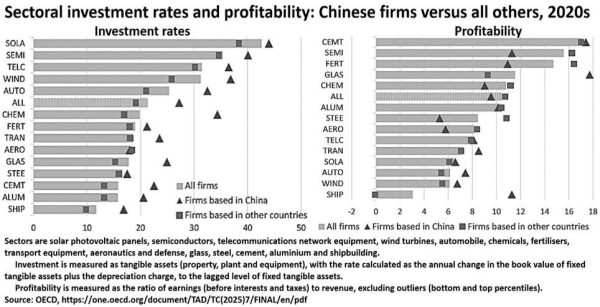
As a result of core sectoral overinvestment, financial bubbling and trade turmoil, world capitalism is currently suffering the worst case of overaccumulation in recorded economic history. In a recent report by the Organization for Economic Cooperation and Development (OECD), the extent of recent overproduction emanating from China is illustrated by comparing investment rates of its firms (and also multinational corporate subsidiaries there) to sites elsewhere. China’s economy takes obvious leadership in ‘new economy’ sectors, amidst an overall investment boom that followed Beijing’s recent redirection of bank lending into manufacturing.
However, whether this investment can be justified by sustained profitability remains to be seen, for as the OECD shows, China’s rates are generally lower overall than in other countries, and especially in several (mainly old-economy) sectors including semiconductors, fertilizers, chemicals, aluminium, steel, and aeronautics and defense.
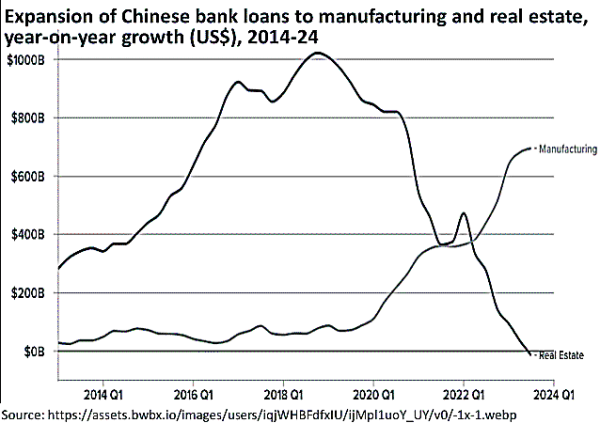
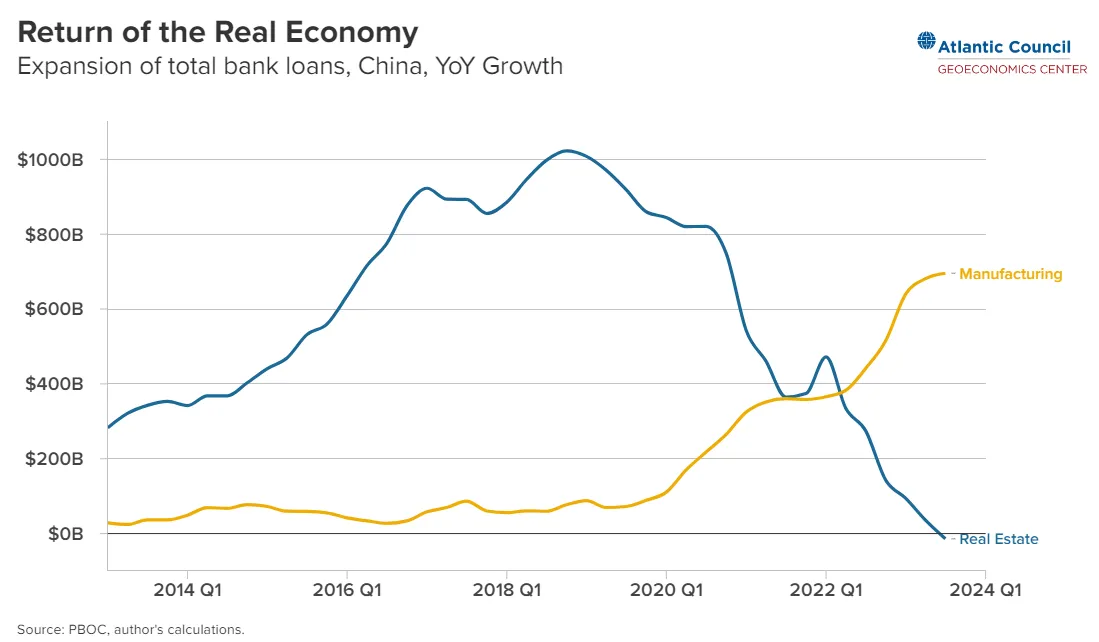
One reason for the overproduction of those goods, is the Chinese state’s ambition and ability to redirect credit flows (often at below-market rates), as can be seen in the year-on-year growth in Beijing’s (centrally-directed) lending to its own firms. This is a revealing case in which public policy amplifies capitalism’s underlying contradictions (the classic ‘pro-cyclical’ bias of neoliberalism). So after the early-2019 year-on-year increases in lending to China’s bubbly real estate sector hit $1 trillion, at the peak of the economy’s chaotic property speculation, then, contributing to the bubble’s burst, loans fell rapidly in 2021, down to no year-on-year growth by early 2024.
In contrast, year-on-year growth in Chinese manufacturing finance rose from steady levels of just $60-90 billion in the 2016-20 period; and suddenly by late 2023 there were $700 billion worth of new manufacturing loans (compared to the year before).
These trends appear to have continued, if the People’s Bank of China statistics are accurate; in September its staff reported that “outstanding medium and long-term loans to the manufacturing sector registered a year-on-year increase of 15.9%. Specifically, outstanding loans to the high-tech manufacturing sector increased by 13.4% year on year.”
But it is vital to keep the systemic features in mind, because in this process of serving capitalist global value chains, “China has made large transfers in value through trade and investment to the imperialist bloc,” according to Marxist economist Michael Roberts.
This is obvious enough, but so too have peripheral countries like the DRC made large transfers in value to Chinese capitalism through, first, Congolese workers’ depletion of non-renewable resources that are inadequately compensated (either through royalties or various forms of profit reinvestment), thus depriving current and future generations of natural wealth; second, through massive greenhouse gas emissions whose cost we consider below; and third, through local pollution which in many cases can be extreme. All these features contribute to China’s role as a subimperial power.
Can Chinese-led industrialization save Africa?
How does China address its excessive local investment and untenable trade surpluses? One obvious strategy implemented since the early 2010s is when firms attempt so-called ‘going out’ from their immediate sites of overaccumulation, along the Belt and Road Initiative. This has included the establishment of much stronger connections to African markets, which should in turn permit more African exports.
This process coincides, insists Ho-fung Hung, with “the increasing competition between Chinese capital and U.S. capital worldwide after China started to aggressively export its overaccumulated capital to the rest of the world in the wake of the global financial crisis of 2008.”
In contrast, on the optimistic end of the spectrum, Prashad argues, “China’s industrial capacity would be put at the service of Africa’s need for industrialization through the creation of joint ventures, industrial parks, a cooperation fund, and mechanisms for technology and science transfer. Africa-China trade has increased from $10 billion in 2000 to $282 billion in 2023. In 2024, the Chinese government upgraded its relationship with African states to ‘strategic partnerships’, enabling greater cooperation. We now have a test case for whether South-South cooperation can engender sovereign industrialization that breaks with the old patterns of plunder and dependency.”
But on the pessimistic end, there are too many instances of adverse impacts from Chinese capitalism in Africa: deindustrialization through swamping local markets with surpluses (as NUMSA complains), especially as the displacement of Trump’s tariffs; broken promises on Special Economic Zone investments; brazen but unpunished corruption; excessive lending and then sudden cuts in credit lines; and heinous corporate behavior especially in the extractive industries, including extreme ecological damage. Each needs elaboration, in the pages below.
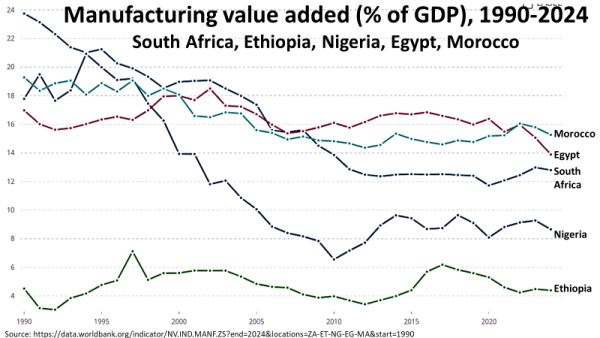
And one test case deserves more consideration: the rapid deindustrialization of South Africa underway in recent months thanks to the ‘dumping’ (i.e. sale at below the cost of production) of Chinese overaccumulated capital, according not only to the government in Pretoria – which in recent months punished imported Chinese steel, tyres, washing machines, and nuts and bolts with new tariffs – but also to NUMSA (which wants the same for cars), although it is ordinarily very pro-China. In South Africa, the manufacturing/GDP ratio was 24% in 1990 and has now sunk to 13%.
Formidable Chinese product competition means the African economies mentioned by Prashad as the continent’s lead industrial production sites, plus the largest in population (Nigeria), have not improved their manufacturing/GDP ratios since that 2015 FOCAC industrialization hype. Most such ratios, like South Africa’s, had already collapsed in the first round of 1990s-era trade liberalization.
The optimal test case that many pointed to during the mid-2010s as Africa’s cutting-edge industrialization site, was Ethiopia, thanks to the sudden emergence of (largely sweatshop) manufacturers mainly in Addis Ababa, whose products benefited from the new train line to the port of Djibouti, built with the assistance of Beijing. As a result of the influx of Chinese firms’ local production of clothing, textiles, footwear and other light-industrial output, Ethiopia’s manufacturing/GDP rose rapidly from 3.4% at the low point in 2012, to 6.2% in 2017.
However, that ratio subsequently fell to 4.3% in the period 2021-24. As the International Monetary Fund explained, “The share of manufactured goods such as textiles, leather and meat product in total exports had grown to 13.5% in Fiscal Year 2018/19, from a small base, but declined sharply thereafter to around 4% in the first nine months of FY2024/25, due to the pandemic, conflict, suspension from AGOA, and foreign exchange shortages that limited availability of intermediate imports.”
Those hard currency shortages led to a major financial crisis in late 2023, when the Addis Ababa regime declared bankruptcy on foreign loans, just days before the country officially joined the BRICS network. As a result of the default, Ethiopia was initially not permitted to become a formal member of the BRICS New Development Bank, for potential hard-currency credit infusions (nearly 80% of that bank’s lending is in the dollar or euro), although it is scheduled to join, at some stage.
Then in mid-2024, a $2.56 billion International Monetary Fund package imposed all the classical Washington Consensus remedies on Ethiopians, including a 50% currency depreciation which was meant to spur manufacturing exports. Indeed a revival of sweatshop exports oriented to Chinese consumer markets apparently began in 2025, and Beijing began talks to potentially convert $5.4 billion of its dollar-denominated loans to Ethiopia into yuan by late 2025, on which a lower interest rate would be paid. Ethiopia was indebted to China for $7.4 billion of its $28 billion foreign debt in late 2023 (with $15.3 billion owed to international financial institutions).
But in Ethiopia, and across Africa more generally, foreign exchange reserves have shrunk due to the vicissitudes of Global North states and multilaterals. For all recipients, aid was cut in 2024 by 9%, and in 2025 by up to 17%. The peak year for Overseas Development Aid to Africa was 2020 at $73 billion, but especially since Russia invaded Ukraine in 2022, European capitals and London have replaced a great deal of aid for Africa with higher military budgets.
Will Beijing step in? In aggregate, Chinese aid, investment and loans to Africa have also fallen since mid-2010s peaks, which also affected states’ foreign exchange reserves. China’s own new public and publicly-guaranteed loans to Africa collapsed from $32 billion in the peak year of 2016, to $1 billion in 2022. The year-end 2025 African foreign debt of $1.3 trillion includes $182 billion in Beijing’s known public and publicly-guaranteed loans.
China had taken a decision in 2021, AidData researchers remind, to fund 128 rescue loan operations in 22 low-income countries facing debt distress, costing $240 billion. These included five African states – Angola, Sudan, South Sudan, Tanzania and Kenya – among which low-income borrowers were “typically offered a debt restructuring that involves a grace period or final repayment date extension but no new money, while middle-income countries tend to receive new money – via balance of payments (BOP) support – to avoid or delay default… These operations include many so-called ‘rollovers,’ in which the same short-term loans are extended again and again to refinance maturing debts.”
The 2024 FOCAC did, however, denominate more financial flows in the Chinese currency, which could facilitate trade, alleviate forex shortages, and also lower transactions costs. Yet devils are in the details, for against all the logic argued above, according to the Centre for Global Development (which is generally neoliberal and welcomes Chinese lending):
“Between 2015 and 2021, commercial creditors contributed about a third of all Chinese lending commitments over that period. These commercial lenders overtook policy banks between 2018 and 2021 … [and] are market-oriented, with loans that are more expensive and with shorter maturity than state-owned counterparts. Their need for risk mitigation, usually through Sinosure, raises the financing costs even higher. Over the next five years, a continuation of this trend where Chinese commercial lenders become an ever-larger segment of lending to Africa at non-concessional rates will only heightens the risks of debt distress.”
So the overall trends suggest that China’s extreme overaccumulation of manufacturing this year, as Trump’s tariffs cause chaos at a time of Belt & Road Initiative burn-out, there is no reason to expect FOCAC to, as Prashad hopes, “engender sovereign industrialization that breaks with the old patterns of plunder and dependency.” Africans should prepare for the opposite.
FOCAC’s declining pledges, 2006-24
FOCAC cycle
Nominal pledge (US$bn)
Inflation-adjusted pledge (2024 US$bn)
Annualized (2024 US$bn/yr)
African population (bn)
Per capita (2024 US$/person/yr)
2006
5.0
7.78
2.59
0.952
2.72
2009
10.0
14.62
4.87
1.028
4.74
2012
20.0
27.33
9.11
1.10
8.28
2015
60.0
79.41
26.47
1.220
21.69
2018
60.0
74.95
24.98
1.310
19.07
2021
40.0
46.31
15.44
1.394
11.08
2024
50.7
50.70
16.90
1.495
11.31
Source: http://www.focac.org/eng/
Also adversely affecting Africa’s hard currency revenues, most energy and mineral commodity markets crashed after their May 2022 peaks (with notable exceptions like gold and, recently, platinum). As a result, across the continent, there is less foreign exchange available to repay debt, especially when exacerbated by the higher interest rates imposed by the U.S. Federal Reserve from 2022-24.
In 2025, Trump’s new tariffs on African exports to the U.S. represented an overall 10% levy in April, followed by higher amounts for many countries in August (e.g. South Africa at 30%). Annual remittances, generally paid by African migrant workers living in countries abroad to their family back home, rose in this period from $66 billion up to $110 billion in 2024, but are not expected to rise further due to rising Western xenophobia.
Are Chinese firms looting Africa?
In this desperate context, Ethiopia’s sweatshop experience could not be termed genuinely ‘sovereign industrialization,’ no doubt Prashad would agree. Nor should any African – or sympathetic observer – tolerate the Chinese-led extractive industry plunder of many economies, resulting not only in extreme ecological damage in general terms, but in a series of specific scandals and social resistance.
As noted above, there are usually three categories to consider, of ecological reparations due to non-renewable resource depletion, greenhouse gas emissions and other forms of localised pollution. Michael Roberts acknowledges, in a helpful essay on environmentalism, “a continual battle by capital to control and lower rising raw material prices as natural resources are depleted and not renewed, adding another factor to the tendency of the rate of profit to fall.”
And in a 2021 co-authored analysis of the ‘Economics of Modern Imperialism’, Roberts argues,
“Colonialism and modern imperialism do not exclude each other. Colonialism is the appropriation of natural resources, military occupation, the direct state control of colonies and the stealing by the imperialist countries of commodities not produced capitalistically. But colonialism contains in itself the germs of modern imperialism. This is the appropriation by capitals in the imperialist countries of the surplus value produced by capitals in the colonies through the trade of the commodities with high technological content produced in the imperialist countries for the capitalistically produced raw materials or industrial goods produced with lower technological content in the dominated countries. The result is unequal exchange, the appropriation of international surplus value through international trade.”
Roberts concludes that the Chinese economy therefore retains a relatively low – and now fast-falling – share of global value chain profits due to unequal exchange processes. The distribution, marketing, financing and research and development departments of Western corporate headquarters squeeze out monies that could otherwise be paid to both Chinese and Congolese laborers and to communities now underpaid for their work in extraction of raw materials, in super-exploitative production systems, and in goods transport.
There are some on the left who object to a critique based in part upon imperial-subimperial collaboration in the looting of Africa. Last year, Prashad’s colleagues at Tricontinental offered a different view of the DRC, based on competition between the Chinese on the one hand; and on the other, Western firms like Swiss-headquartered, London-listed Glencore (whose largest share of its $70 billion capitalization is actually registered on the Johannesburg Stock Exchange) and Canada’s Ivanhoe. Tricontinental authors claim that “Chinese interests therefore lie in keeping mineral and metal processing within the DRC and building an industrial base for the country.”
This counter-intuitive conclusion is based on how, in Tricontinental’s interpretation, “The entry of the Chinese state and private Chinese companies into Africa over the past two decades has provided competition against the Global North countries and their mining companies. This was the first time that these multinational corporations faced direct competition, a shift that provided the space for the Congolese government to amend the mining code in 2018 on more beneficial terms.”
Admitting that, in the process, Chinese firms gained “control of fifteen of the DRC’s seventeen mining complexes,” Tricontinental authors turn to this justification: “In the extractivism debate, the Global North, its eyes set on furthering its own agenda, has fixated on China’s role in the region as the world’s leading consumer of cobalt, nearly 80% of which it uses in its rechargeable battery industry. What is often left out of the discussion, however, is that, as the largest manufacturing country in the world, China uses Congolese minerals and metals to produce goods that are consumed across the globe, including in the DRC and the Global North.”
Indeed this subimperial location within global value chains makes China subject to an unequal ecological exchange critique. For behind the general need for resource extraction and (limited) processing of minerals that goes on in Africa, are scandalous conditions. Without sinking into Sinophobia, it is useful to recall some of the highest-profile cases, because Beijing simply fails to respond to the obvious need to curtail Belt and Road abuse by Chinese firms:
in the DRC in November, Congo Dongfang International Mining leaked toxic pollution into the Lubumbashi River near the country’s second largest city, while nearby at Kalando, informal miners (75% of whom across the DRC sell their wares to Chinese buyers) suffered at least 50 deaths in a mountainside collapse that compelled the government to ban artisanal copper and cobalt mineral processing, in the wake of non-payment of billions of dollars’ worth of royalties to the government by Zhejiang Huayou Cobalt, Ningxia Orient, JiuJiang JinXin and Jiujiang Tanbre smelters – all within Apple’s supply chain – which in turn resulted in a major lawsuit by the Kinshasa regime and by a U.S. public interest agency against the California corporation, and similar non-payment accusations were made by Kinshasa officials against China Molybdenum’s super-exploitative Tenke Fungurume cobalt mine;
in Zambia’s copperbelt in February, negligence by Sino-Metals Leach and NFC Africa Mining caused a slime-dam break – of 1.5 million tonnes of cyanide- and arsenic-laced sludge – into the Kafue River, resulting in an $80 billion lawsuit by some of the 700,000 affected residents adjacent to Zambia’s main internal waterway and second-largest urban region;
in the Central African Republic’s mines, there was slave-like human trafficking of Nigerians – who went unpaid for a year in 2024-25 – by Rado Central Coal Mining Company;
in Ghana, Shaanxi Mining extracted gold in a manner that amplified the ‘galamsey’ artisanal mining crisis;
in Zimbabwe, there are countless complaints against Chinese mines, for looting $13 billion of Marange diamonds by the military-owned parastatal Anjin (as even President Robert Mugabe alleged in 2016), for the murder of a dozen Mutare artisanal gold miners in 2020 by Zhondin Investments, for mass displacement and pollution at the Hwange coal mine by Beifa Investments, for illegal mining in national parks by Afrochine Energy and Zimbabwe Zhongxin Coal Mining Group, and for Sinomine Resource Group’s failure to respect beneficiation requirements at the continent’s largest lithium mine, in Bikita, in addition to other Chinese lithium miners at Kamaviti, where as a result, Centre for Natural Resource Governance director Farai Maguwu alleged in late December, “Zim is the biggest donor to China, and not the other way round”;
In addition to often-extreme human rights violations, these represent obvious forms of unequal ecological exchange, in which African economies lose net wealth, even if Chinese purchases of raw materials raise levels of foreign exchange and national income, creating (low-paid) jobs and providing a modicum of royalties, taxes and infrastructure.
Typically outweighing such benefits, though, damage is not limited to local pollution and displacement, or to permanent depletion of non-renewable resources that leave both current and future generations impoverished. For example, instead of burning coal, gas and oil, their hydrocarbons should be left underground and only later, if needed, exploited for non-combustible purposes (lubricants, synthetic materials, pharmaceutical products, etc).
On top of this damage, the extraction and processing of minerals also entail an enormous ‘social cost of carbon’ caused by CO2 and methane emissions in mines and smelters. This should be priced (by taxation not carbon trading) in the region of $1584/tonne of CO2 (according to a recent National Bureau of Economic Research study), rendering a great deal of the pollution-intensive extractive+processing activity as uneconomic.
The latter damage will create new ‘polluter-pays’ climate debtors out of low-income African economies, if the International Court of Justice’s July 2025 advisory opinion on liabilities for socio-ecological reparations is to be taken seriously. Following the court’s finding against states which do not limit their firms’ emissions, much more climate-debt litigation is inevitable. In late 2024, Beijing and many other high-polluting countries’ governments had opposed any liability judgement because, as the imperialist and subimperial powers together insisted, the Paris Climate Agreement “does not involve or provide a basis for any liability or compensation.”
The best opportunity for a Chinese climate debt payment to Africa arose in September 2021 when Xi Jinping announced, “China will step up support for other developing countries in developing green and low-carbon energy, and will not build new coal-fired power projects abroad.”
However, not only is renewable energy still a for-profit commodity, unaffordable for the vast majority. In addition, in Zimbabwe, residents of the wretched coal-mining town of Hwange (near Victoria Falls) know that Xi’s was just one more broken climate promise, what with several Chinese coal-fired power plants under construction there.
In sum, unless the Chinese state suddenly begins regulating its firms’ emissions and abuse of African resources and people, and finds creative ways to pay a wide range of ecological reparations, it appears extremely unlikely that a genuine industrialization initiative will emanate from Chinese investors.
But having set the context of blame for Africa’s recent bout of underdevelopment both in Chinese overproduction and Trump’s tariffs – among the main new factors that amplify existing problems of commodity export dependency, excessive debt, structural adjustment policies and climate damage – the next essay will have to assess various strategies emerging among some leading African activists, ranging from nationalistic dirty growth to internationalist degrowth en route to eco-socialism.
Patrick Bond is a political economist, political ecologist and scholar of social mobilisation. From 2020-21 he was Professor at the Western Cape School of Government and from 2015-2019 was a Distinguished Professor of Political Economy at the University of the Witwatersrand School of Governance. From 2004 through mid-2016, he was Senior Professor at the University of KwaZulu-Natal School of Built Environment and Development Studies and was also Director of the Centre for Civil Society. He has held visiting posts at a dozen universities and presented lectures at more than 100 others.