It’s possible that I shall make an ass of myself. But in that case one can always get out of it with a little dialectic. I have, of course, so worded my proposition as to be right either way (K.Marx, Letter to F.Engels on the Indian Mutiny)
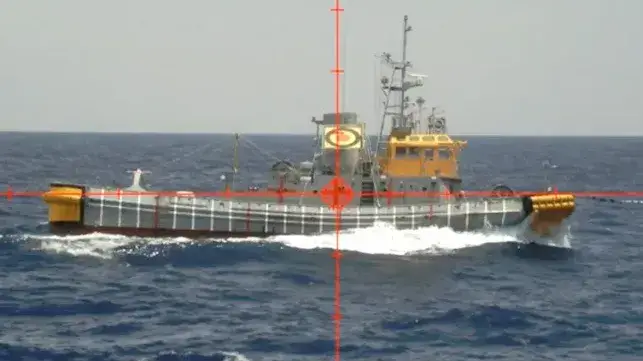
Japan's navy has persisted in the pursuit of a usable, durable electromagnetic railgun, continuing a hunt that the U.S. Navy has (for public purposes) abandoned. Its Acquisition Technology & Logistics Agency (ATLA) has recently conducted what it believes to be the first successful test firing of a railgun at a target vessel in the world, and has released images of the trial shots.
The weapon is mounted on the bow of the test vessel JS Asuka, operating out of Yokosuka. Tests appear to have been conducted against targets on a small workboat at a position off the coast. ATLA did not provide further details of the results.
Conceptually, railguns offer tantalizing benefits for the warfighter. Compared to a conventional cannon, the rounds are smaller, cheaper, and are made of inert pieces of metal. This means that the ship's magazines can fit in more rounds per cubic foot, and they are impossible to detonate in the event of a casualty.
Unlike lasers and microwave systems - which get lumped together with railguns as "directed energy weapons" - railgun rounds are physical objects with a ballistic trajectory, unaffected by smoke or rain. Since they go up and come down again, they can be fired at warships or shore targets out of sight, beyond the curvature of the horizon - which lasers by definition cannot do. Technologists hope that these rounds could also be swift and accurate enough to counter hypersonic missile threats in an air-defense role.
In practice, getting a railgun to work aboard a vessel has proven to be a difficult assignment. Ejecting a piece of tungsten from the gun at 4,500 knots generates tremendous heat and force, which tends to burn out the barrel at a rapid pace. The guns also take a huge amount of power to operated - hence the prioritization of use on ships, where it is easier to arrange for the sheer mass of the power supply.
Friday, May 23, 2025
Japan shows off futuristic ‘railgun’ at defence expo
Instead of using gunpowder to shoot an artillery shell, railgun technology uses electromagnetic energy to fire off a projectile along a set of rails at ultra-high velocity - Copyright Japan Maritime Self-Defense Force/AFP Handout
As Japan’s biggest defence exhibition kicked off this week, visitors got a close-up look at a model of its futuristic “railgun” that its makers hope will be able to shoot down hypersonic missiles.
Instead of gunpowder, railgun technology uses electromagnetic energy to fire a projectile along a set of rails at ultra-high velocity.
The round will then in theory destroy the target, which could be an enemy ship, drone or incoming ballistic missile, solely with its vast kinetic energy.
Other countries, including the United States, China, France and Germany, are also developing the technology, but Japan’s navy last year claimed a world first by test-firing a railgun on a ship.
“A railgun is a gun of the future that fires bullets with electrical energy, unlike conventional artillery,” an official from the Acquisition, Technology and Logistics Agency (ATLA) within Japan’s Ministry of Defence told AFP.
“It is expected that threats that can only be dealt with by railguns will emerge in the future,” said the official, who did not want to be named.
The three-day DSEI Japan Conference defence fair, which began on Wednesday, comes as Japan adopts a more assertive defence policy and looks to sell more military equipment to other countries.
In particular, Japan’s Mitsubishi Heavy Industries (MHI) and Germany’s Thyssen Krupp Marine Systems (TKMS) are competing for a major contract to supply the Australian navy with new warships.
Winning the multi-billion-dollar Project Sea 3000 contract to supply Australia with Mogami-class frigates would be Japan’s largest postwar military export order, according to Japanese media.
Friday, April 18, 2025
Japan releases image of Railgun installed on naval vessel
Published on 18/04/2025 By Yoshihiro Inaba
Naval News
JMSDF picture showing the Railgun aboard the test ship JS Asuka.
On April 18, 2025, the Japan Maritime Self-Defense Force (JMSDF) released an image of its state-of-the-art railgun currently undergoing testing aboard the test ship JS Asuka.
Latest status of rail gun development
In the Japanese MoD, railgun development is conducted by the Ground Systems Research Center (GSRC), a division of the Acquisition, Technology & Logistics Agency (ATLA). ATLA began full-scale development of the railgun in 2016. Under the name “Research on Electromagnetic Acceleration Systems,” the research was conducted from FY 2016 through FY 2022. The target in this research was a muzzle velocity of 2000 meters per second and a barrel life of 120 rounds. In other words, the goal was to achieve stable firing up to 120 rounds at a constant muzzle velocity.
In the case of a conventional firearm, damage to the barrel caused by the pressure generated by the explosion of gunpowder would be a problem, but this does not occur in the case of a railgun. On the other hand, damage caused by heat from the high current flowing through the rail and wear from contact between the armature and the rail is a problem. As the surface of the rail is eroded by this, it leads to performance degradation, such as a reduction in muzzle velocity. Therefore, copper was initially used as the material for the barrel rail, but was changed to a different blend of metals and other materials throughout the research. As a result, it was confirmed that no significant damage occurred to the barrel rail even after 120 rounds were fired.
ATLA achieved the first ship-board firing test of a railgun in October 2023. Based on the results of the research to date, the project is now moving on to “Research on Future Railgun,” which will be conducted from FY2022 to FY2026. While previous research has focused on firing projectiles from the railgun, the current research aims to advance this research into a “gun system” equipped with a series of mechanisms for actual operation. It includes:
Continuous firing of projectile
Fire control system
Stability of projectile after launch
For example, while research thus far had focused on single-shot firings, efforts are now underway to establish continuous firing capabilities. This is because, in actual operational scenarios, railguns would need to continuously intercept incoming missiles or deliver multiple rounds against enemy vessels or ground targets.
Flight stability of the projectile is also being pursued. Even with a railgun, unless the projectile remains stable after leaving the muzzle—just like conventional artillery—it cannot accurately hit its target. Moreover, even if a hypersonic muzzle velocity is achieved, the projectile would rapidly decelerate due to air resistance if flight stability is poor. Enhancing projectile stability and reducing air resistance would not only extend the effective range but also improve overall lethality.
Furthermore, realizing a complete gun system involves more than simply preparing the launcher and projectiles. A fire control system is essential to control the launcher, acquire targets based on external sensor data, predict flight paths and impact points, and ensure precise hits on the target. Research is therefore being conducted on a dedicated fire control system tailored to the railgun, which has characteristics—such as muzzle velocity—distinct from conventional artillery.
In addition, one of the greatest challenges for fielding railguns is securing a reliable power source. Given that the projectile is launched by a massive electric current, sufficient power supply and energy storage systems are critical, especially for continuous firing. While large-scale generators and storage units would suffice for securing power alone, they are not feasible on space-constrained platforms such as naval vessels or mobile land vehicles. As a result, current research efforts also focus on miniaturizing power supply systems alongside the launcher itself.
ATLA’s Railgun Test from Ship at Sea
Engaging Enemy Vessels from Coastal Positions to the Open Sea
Now, if railguns were to actually be deployed by the Self-Defense Forces, what operational uses are envisioned?
According to ATLA documents, railguns are expected to be employed as naval or land-based artillery systems. In the naval role, they would likely be used to intercept incoming anti-ship missiles—especially hypersonic cruise missiles, which are considered difficult to counter due to their high speeds. By leveraging the railgun’s high velocity and extended range, a layered air defense network could be established in conjunction with shipborne surface-to-air missiles.
For land-based systems, counter-battery fire against enemy artillery units located deep behind the front lines—similar to the role of traditional howitzers—is naturally envisioned. Thanks to the railgun’s advantages of reduced time-to-target and greater range, it would be possible to conduct out-ranging strikes against enemy artillery units. Moreover, ATLA documents also illustrate the concept of using railguns as coastal artillery, engaging enemy vessels operating in the open sea. The expectation is that hypersonic projectiles would penetrate enemy warships and destroy critical compartments.
Regarding projectiles, research will not be limited to armor-piercing rounds but will also extend to technologies for airburst munitions—rounds that detonate mid-air to disperse lethal fragments—optimized for anti-air warfare scenarios. Having transitioned into the development of a full-fledged “gun system,” railguns are now poised for broader operational studies and steady technological maturation as a future defense asset.
Japanese, French and German cooperation in railgun technology
Japan’s ATLA and the French-German Research Institute of Saint-Louis (ISL) signed last year a Terms of Reference (TOR) with the objective “to explore the possibilitiy of collaboration for research, development, test and evaluation of Railgun technologies”.
Naval News learned recently from an ISL representative that the cooperation is going well and that Railgun engineers have been exchanged: ATLA engineers are at ISL in France and ISL engineers have been sent to Japan.
Yoshihiro Inaba is a Freelance Writer based in Shizuoka, Japan. He is one of the few young military writers in Japan and is currently a student studying international law (especially self-defense and use of force) at a Japanese graduate school. He is particularly familiar with Japan's Ground, Maritime and Air Self-Defense Forces.
Tuesday, January 07, 2025
Desert nectar: Agave genome study sheds light on drought tolerance
A recent study has illuminated the intricate genetic mechanisms behind crassulacean acid metabolism (CAM) photosynthesis in Agave hybrid NO.11648. This research is a landmark in understanding how plants adapt to extreme water scarcity, offering fresh insights into the genomic blueprint of CAM—a photosynthetic pathway critical for plant survival in arid climates. The findings could revolutionize agricultural practices in drought-prone regions, providing a scientific foundation for developing more resilient crops.
Crassulacean acid metabolism (CAM) photosynthesis, a unique metabolic strategy, enables plants to conserve water by capturing carbon dioxide during the night. This adaptation is a lifeline for species in arid environments, yet its genetic underpinnings remain enigmatic. Despite its ecological importance, gaps in understanding the molecular controls of CAM pose challenges to designing water-efficient crops for a warming world. Exploring the genomes of CAM plants, particularly the drought-resilient Agave genus, is essential to unlocking the genetic secrets of this extraordinary adaptation.
On December 19, 2023, researchers from the Zhanjiang Key Laboratory of Tropical Crop Genetic Improvement achieved a major milestone in CAM research. Published (DOI: 10.1093/hr/uhad269) in Horticulture Research, their study provides a chromosome-level genome assembly of Agave hybrid NO.11648, uncovering key genes and regulatory pathways that govern CAM photosynthesis.
The researchers employed cutting-edge techniques, including high-throughput chromosome conformation capture and next-generation sequencing, to achieve a highly detailed assembly of the Agave genome. The resulting genome spans 4.87 Gb, organized into 30 pseudo-chromosomes with an N50 of 186.42 Mb. This comprehensive analysis revealed a genome abundant in repetitive sequences, particularly I-type repeats, and identified 58,841 protein-coding genes. Among the findings was a lineage-specific whole-genome duplication event post-dating the divergence from the Asparagoideae subfamily. The study also highlighted a duplication within the phosphoenolpyruvate carboxylase kinase (PEPCK) gene family, identifying three PEPCK genes—PEPCK3, PEPCK5, and PEPCK12—as central to CAM regulation. Furthermore, the researchers identified transcription factors linked to circadian rhythms, MAPK signaling, and hormone signal transduction pathways that modulate PEPCK3 expression, shedding light on the complexity of CAM's genetic control.
Dr. Wenzhao Zhou, the corresponding author and a renowned authority in tropical crop genetics, emphasized the significance of this discovery: "Our chromosome-level genome assembly of Agave hybrid NO.11648 represents a monumental step in plant science. By decoding the genetic architecture of CAM photosynthesis, we not only enhance our understanding of plant resilience but also provide invaluable genomic resources for breeding crops that thrive under challenging environmental conditions. This work lays a solid foundation for sustainable agriculture in the face of climate change."
The implications of this research extend far beyond Agave. Understanding CAM photosynthesis at a genomic level opens the door to developing drought-resistant crops capable of optimizing water use. These insights could transform agricultural practices, enabling crops to thrive in water-scarce regions and contributing to global food security. As the world grapples with climate change and diminishing water resources, this study serves as a beacon for innovation in plant genomics and sustainable farming.
This study was sponsored by the Earmarked fund for the China Agriculture Research System (grant No. CARS-19), the National Natural Science Foundation of China (grant No. 31801679), Guangdong Provincial Team of Technical System Innovation for Sugarcane Sisal Hemp Industry (grant No. 2023KJ104-03), Guangdong Basic and Applied Basic Research Foundation (grant Nos 2021A1515012421 and 2022A1515011841), Hainan Provincial Natural Science Foundation of China (321QN300 and 323MS099), and Central Public-interest Scientific Institution Basal Research Fund for Chinese Academy of Tropical Agricultural Sciences (grant Nos. 1630062019016, 1630062020015, 1630062022002, and 1630062021015).
Horticulture Research is an open access journal of Nanjing Agricultural University and ranked number one in the Horticulture category of the Journal Citation Reports ™ from Clarivate, 2022. The journal is committed to publishing original research articles, reviews, perspectives, comments, correspondence articles and letters to the editor related to all major horticultural plants and disciplines, including biotechnology, breeding, cellular and molecular biology, evolution, genetics, inter-species interactions, physiology, and the origination and domestication of crops.
What if the U.S. placed a tax on robots? The concept has been publicly discussed by policy analysts, scholars, and Bill Gates (who favors the notion). Because robots can replace jobs, the idea goes, a stiff tax on them would give firms incentive to help retain workers, while also compensating for a dropoff in payroll taxes when robots are used. Thus far, South Korea has reduced incentives for firms to deploy robots; European Union policymakers, on the other hand, considered a robot tax but did not enact it.
Now a study by MIT economists scrutinizes the existing evidence and suggests the optimal policy in this situation would indeed include a tax on robots, but only a modest one. The same applies to taxes on foreign trade that would also reduce U.S. jobs, the research finds.
“Our finding suggests that taxes on either robots or imported goods should be pretty small,” says Arnaud Costinot, an MIT economist, and co-author of a published paper detailing the findings. “Although robots have an effect on income inequality … they still lead to optimal taxes that are modest.”
Specifically, the study finds that a tax on robots should range from 1 percent to 3.7 percent of their value, while trade taxes would be from 0.03 percent to 0.11 percent, given current U.S. income taxes.
“We came in to this not knowing what would happen,” says Iván Werning, an MIT economist and the other co-author of the study. “We had all the potential ingredients for this to be a big tax, so that by stopping technology or trade you would have less inequality, but … for now, we find a tax in the one-digit range, and for trade, even smaller taxes.”
A key to the study is that the scholars did not start with an a priori idea about whether or not taxes on robots and trade were merited. Rather, they applied a “sufficient statistic” approach, examining empirical evidence on the subject.
For instance, one study by MIT economist Daron Acemoglu and Boston University economist Pascual Restrepo found that in the U.S. from 1990 to 2007, adding one robot per 1,000 workers reduced the employment-to-population ratio by about 0.2 percent; each robot added in manufacturing replaced about 3.3 workers, while the increase in workplace robots lowered wages about 0.4 percent.
In conducting their policy analysis, Costinot and Werning drew upon that empirical study and others. They built a model to evaluate a few different scenarios, and included levers like income taxes as other means of addressing income inequality.
“We do have these other tools, though they’re not perfect, for dealing with inequality,” Werning says. “We think it’s incorrect to discuss this taxes on robots and trade as if they are our only tools for redistribution.”
Still more specifically, the scholars used wage distribution data across all five income quintiles in the U.S. — the top 20 percent, the next 20 percent, and so on — to evaluate the need for robot and trade taxes. Where empirical data indicates technology and trade have changed that wage distribution, the magnitude of that change helped produce the robot and trade tax estimates Costinot and Werning suggest. This has the benefit of simplicity; the overall wage numbers help the economists avoid making a model with too many assumptions about, say, the exact role automation might play in a workplace.
“I think where we are methodologically breaking ground, we’re able to make that connection between wages and taxes without making super-particular assumptions about technology and about the way production works,” Werning says. “It’s all encoded in that distributional effect. We’re asking a lot from that empirical work. But we’re not making assumptions we cannot test about the rest of the economy.”
Costinot adds: “If you are at peace with some high-level assumptions about the way markets operate, we can tell you that the only objects of interest driving the optimal policy on robots or Chinese goods should be these responses of wages across quantiles of the income distribution, which, luckily for us, people have tried to estimate.”
Beyond robots, an approach for climate and more
Apart from its bottom-line tax numbers, the study contains some additional conclusions about technology and income trends. Perhaps counterintuitively, the research concludes that after many more robots are added to the economy, the impact that each additional robot has on wages may actually decline. At a future point, robot taxes could then be reduced even further.
“You could have a situation where we deeply care about redistribution, we have more robots, we have more trade, but taxes are actually going down,” Costinot says. If the economy is relatively saturated with robots, he adds, “That marginal robot you are getting in the economy matters less and less for inequality.”
The study’s approach could also be applied to subjects besides automation and trade. There is increasing empirical work on, for instance, the impact of climate change on income inequality, as well as similar studies about how migration, education, and other things affect wages. Given the increasing empirical data in those fields, the kind of modeling Costinot and Werning perform in this paper could be applied to determine, say, the right level for carbon taxes, if the goal is to sustain a reasonable income distribution.
“There are a lot of other applications,” Werning says. “There is a similar logic to those issues, where this methodology would carry through.” That suggests several other future avenues of research related to the current paper.
In the meantime, for people who have envisioned a steep tax on robots, however, they are “qualitatively right, but quantitatively off,” Werning concludes.
###
Written by Peter Dizikes, MIT News
Additional background
Paper: “Robots, Trade, and Luddism: A Sufficient Statistic Approach to Optimal Technology Regulation”
VIDEO: YOU CAN SEE THIS ROBOTIC ARM IS PUSHING A TOOL. IT’S ONE OF FOUR TASKS PRINCETON RESEARCHERS GAVE THE SIMULATED ARM. THEY ALSO ASKED IT TO LIFT THE TOOL; USE IT TO SWEEP A CYLINDER ALONG A TABLE; AND HAMMER – OR TRY TO HAMMER -- A PEG INTO A HOLE. IN A NEW APPROACH TO ROBOT TOOL MANIPULATION, THEY FOUND THAT HUMAN-LANGUAGE DESCRIPTIONS OF TOOLS COULD HELP THE ROBOT LEARN TO USE THE TOOLS FASTER, AND BOOST ITS PERFORMANCE ON A TEST SET OF UNFAMILIAR TOOLS. THE RESEARCH IS PART OF AN EFFORT TO IMPROVE ROBOTS’ ABILITY TO FUNCTION IN NOVEL SITUATIONS THAT DIFFER FROM THEIR TRAINING ENVIRONMENTS.view more
CREDIT: ALLEN Z. REN ET AL./AARON NATHANS
Exploring a new way to teach robots, Princeton researchers have found that human-language descriptions of tools can accelerate the learning of a simulated robotic arm lifting and using a variety of tools.
The results build on evidence that providing richer information during artificial intelligence (AI) training can make autonomous robots more adaptive to new situations, improving their safety and effectiveness.
Adding descriptions of a tool’s form and function to the training process for the robot improved the robot’s ability to manipulate newly encountered tools that were not in the original training set. A team of mechanical engineers and computer scientists presented the new method, Accelerated Learning of Tool Manipulation with LAnguage, or ATLA, at the Conference on Robot Learning on Dec. 14.
Robotic arms have great potential to help with repetitive or challenging tasks, but training robots to manipulate tools effectively is difficult: Tools have a wide variety of shapes, and a robot’s dexterity and vision are no match for a human’s.
The team obtained tool descriptions by querying GPT-3, a large language model released by OpenAI in 2020 that uses a form of AI called deep learning to generate text in response to a prompt. After experimenting with various prompts, they settled on using “Describe the [feature] of [tool] in a detailed and scientific response,” where the feature was the shape or purpose of the tool.
“Because these language models have been trained on the internet, in some sense you can think of this as a different way of retrieving that information,” more efficiently and comprehensively than using crowdsourcing or scraping specific websites for tool descriptions, said Karthik Narasimhan, an assistant professor of computer science and coauthor of the study. Narasimhan is a lead faculty member in Princeton’s natural language processing (NLP) group, and contributed to the original GPT language model as a visiting research scientist at OpenAI.
This work is the first collaboration between Narasimhan’s and Majumdar’s research groups. Majumdar focuses on developing AI-based policies to help robots — including flying and walking robots — generalize their functions to new settings, and he was curious about the potential of recent “massive progress in natural language processing” to benefit robot learning, he said.
For their simulated robot learning experiments, the team selected a training set of 27 tools, ranging from an axe to a squeegee. They gave the robotic arm four different tasks: push the tool, lift the tool, use it to sweep a cylinder along a table, or hammer a peg into a hole. The researchers developed a suite of policies using machine learning training approaches with and without language information, and then compared the policies’ performance on a separate test set of nine tools with paired descriptions.
This approach is known as meta-learning, since the robot improves its ability to learn with each successive task. It’s not only learning to use each tool, but also “trying to learn to understand the descriptions of each of these hundred different tools, so when it sees the 101st tool it’s faster in learning to use the new tool,” said Narasimhan. “We’re doing two things: We’re teaching the robot how to use the tools, but we’re also teaching it English.”
The researchers measured the success of the robot in pushing, lifting, sweeping and hammering with the nine test tools, comparing the results achieved with the policies that used language in the machine learning process to those that did not use language information. In most cases, the language information offered significant advantages for the robot’s ability to use new tools.
One task that showed notable differences between the policies was using a crowbar to sweep a cylinder, or bottle, along a table, said Allen Z. Ren, a Ph.D. student in Majumdar’s group and lead author of the research paper.
“With the language training, it learns to grasp at the long end of the crowbar and use the curved surface to better constrain the movement of the bottle,” said Ren. “Without the language, it grasped the crowbar close to the curved surface and it was harder to control.”
The research was supported in part by the Toyota Research Institute (TRI), and is part of a larger TRI-funded project in Majumdar’s research group aimed at improving robots’ ability to function in novel situations that differ from their training environments.
“The broad goal is to get robotic systems — specifically, ones that are trained using machine learning — to generalize to new environments,” said Majumdar. Other TRI-supported work by his group has addressed failure prediction for vision-based robot control, and used an “adversarial environment generation” approach to help robot policies function better in conditions outside their initial training.
The article, Leveraging language for accelerated learning of tool manipulation, was presented Dec. 14 at the Conference on Robot Learning. Besides Majumdar, Narasimhan and Ren, coauthors include Bharat Govil, Princeton Class of 2022, and Tsung-Yen Yang, who completed a Ph.D. in electrical engineering at Princeton this year and is now a machine learning scientist at Meta Platforms Inc.
In addition to TRI, support for the research was provided by the U.S. National Science Foundation, the Office of Naval Research, and the School of Engineering and Applied Science at Princeton University through the generosity of William Addy ’82.
METHOD OF RESEARCH
Computational simulation/modeling
SUBJECT OF RESEARCH
Not applicable
ARTICLE TITLE
Leveraging Language for Accelerated Learning of Tool Manipulation
Sunday, June 14, 2020
Regina police union defends budget, controversial tweet as calls to defund service grow BY MICKEY DJURIC GLOBAL NEWS Updated June 11, 2020 WATCH: Emerging from the anti-racism protests is a growing political movement to reduce funding to police forces, including the VPD. Rumina Daya reports.
On Tuesday, a communications officer with the union tweeted the Regina Police Service would lose its cultural unit — which works with Indigenous communities — should the service face budget cuts.
Do you support the “de-funding” of Police in Regina? If you do, this amazing work by our members will be one of the first to go. Choose wisely. https://t.co/G2PYD5La4a — Regina Police Assoc. (@QueenCityPolice) June 9, 2020
Residents were quick to criticize the union, with some questioning the tone of the tweet.
“The cultural unit should be the last thing that should be cut,” pointed out residents. Others felt the tweet was threatening.
But Tuesday’s tweet came a day after similar comments were made by Regina police Chief Evan Bray, whose responsibility it is to find budget cuts.
During a press conference, Bray told reporters social programs within the service would be the first to go should cuts be made to the city’s $96-million police budget.
“If we have to reduce our budget…we have to focus on core responsibilities like 911 response, serious crimes and investigations,” Bray said. “Some of our ancillary programs [that] deal with at-risk youth, mental health, dealing with those in schools — those programs would be looked at if we’re looking to tighten the purse strings. We’d have to focus more on delivering our core responsibilities.”
Regina’s police budget represents about 20 per cent of the city’s 2020 budget, which has been the same proportion for 30 years, Bray said.
Yet the department is still understaffed, said Casey Ward, president of the Regina Police Association, which represents 410 officers and 200 civilians.
“By underfunding or defunding the police, a couple things could happen: job losses for our members, or it could mean members don’t have safe members out there. With the city growing, it puts officers where they’re being burnt out physically and mentally,” Ward said.
This would be a challenge as many officers are already “struggling mentally” as a result from dealing with gun and gang violence and the rise of meth in the community. Regina currently has the second-highest crime severity index in Canada behind Lethbridge, Atla.
“We have a very busy police service, and our officers have trouble keeping their head above water,” said Bray.
In one day, the Regina Police Service receives 19 calls for domestic disputes, more than two calls a day for overdoses, and numerous firearm calls, Bray said.
“Our resources are in a state where they haven’t kept pace with growth of the city. Our challenges are really tough with current resources we have.”
A counter-petition has since popped up to keep funding the Regina Police Service. Within a day, the petition received 500 signatures.
But calls to transfer money to health care, education or housing are issues that are dealt with provincially says the police chief.
As for the petition asking to defund the Regina Police Service, Ward says his members are more concerned about the divide it’s creating on social media and in the community.
“Our members cherish our relationship with the community, and it seems people are trying to drive that wedge between us,” said Ward, who is fielding members’ questions to “why people on social media are trying to pin us against each other.”
“That’s not what policing is about,” Ward said. “There’s no ‘us’ versus ‘them’. There’s ‘us’ as a whole.”
VIDEO Black female Toronto police officer reflects on challenges service is facing Black female Toronto police officer reflects on challenges service is facing
FOR MORE ON REGINA AND ITS HISTORICAL SIGNIFICANCE AS THE HQ OF THE RCMP WHEN THEY WERE PUTTING DOWN THE PRAIRIE UPRISINGS OF THE CREE AND METIS ORGANIZED BY LOUIS RIEL
Why You'll Never Understand Mezcal Like You Understand Scotch
ONE IS A PSYCHOTROPIC HALLUCINOGEN THE OTHER IS JUST ALCOHOL
There's more to the agave spirit than smoke and worm salt. JEFF GORDINIERMAY 17, 2018
LAURA MURRAY
In the folklore of my family, there is one night that remains legendary. We had traveled to Cancún, the gabachos-in-big-sombreros Mexican resort city that was built on the concept of a never-ending spring break, to celebrate New Year’s Eve with the proper measure of ridiculousness. I don’t remember much about it, but my siblings do. They remember gazing out at a dance floor in a nightclub after midnight and seeing me, then in my early 20s, writhing around in a manner that was perhaps meant to summon the spirit of Quetzalcoatl, the Mesoamerican deity usually depicted as a feathered serpent. My brother and sister could find me in the crowd because I had managed to climb on top of a giant amplifier, which meant that my euphoric contortions were on full display for everyone in the club.
Beverage director Yana Volfson of New York’s Atla and Cosme. Laura Murray
This Walpurgisnacht of wild abandon was later attributed to a lone culprit: mezcal. I had downed a lot of cheap mezcal that night, although I had no idea what it was. In those days, American tourists still liked to cling to the myth that the “worm” floating around in the bottle would make them hallucinate. (You can’t blame the locals for perpetuating this prank.) By now, of course, U.S. drinkers have graduated from such callow delusions, and this infinitely complex agave spirit, whether stirred into cocktails or sipped on its own, has been treated with the reverence it deserves for more than a decade. In fact, there are so many compelling bottles on store shelves that it’s hard to keep track, and it’s a telling indicator of popular thirst that George Clooney and his billionaire Casamigos comrades have announced their own plans to move into the mezcal marketplace.
If I’m being honest, though, I still can’t pretend to have a grasp on what mezcal is all about. It’s the sort of spirit that has a habit of eluding anyone who tries to pin it down. Which is why I met up with Yana Volfson, the beverage director at Mexican chef Enrique Olvera’s two outposts in New York, Atla and Cosme, for an afternoon agave tutorial. Joining Volfson at Atla was Jorsand DÃaz, the head bartender and self-described “mezcal nerd” at both restaurants. And the first thing the two of them stressed to me was that mezcal mastery is even more slippery than an amateur may realize.
It’s a telling indicator of popular thirst that George Clooney and his billionaire Casamigos comrades have announced their own plans to move into the mezcal marketplace.
“We strive so hard for that idea of consistency,” Volfson said. “There’s really no such thing.” Surrender to flux—from bottle to bottle, day to day, she advised. “Mezcal can taste one way one day and taste different the next day. Just like no two chiles are ever going to taste the same.”
“The more passion that I have, the more questions I have,” DÃaz added.
But where to begin, if mezcal qualifies as such a moving target? It helps to start off by forgoing stereotypes. Perhaps you’re prone to bluffing your way through a bar order by asking for something “smoky,” which is like saying “funky” in a natural-wine bar or “hoppy” in a craft brewery. Stop. Smoke is not always the most pronounced element in mezcal, nor must it be viewed as the chief virtue. Pairings with El Jolgorio and Rey Campero mezcals. Laura Murray
Wait. Maybe mezcal can make you hallucinate after all. I suppose the trick is to open your mind first. “Walk through one door,” Volfson told me, “and then I’ll open up another door for you.” This article appears in the May ’18 issue of Esquire. Alexi Lubomirski