Not Tiger, Not Wolf: Australian Thylacine Skull Reveals Far Different Hunting Style

Flinders University Professor Vera Weisbecker and thylacine snout - with models of a wolf, fox and crocodile upper jaws. CREDIT: T Bawden (Flinders University)
Key Takeaways:
- Flinders-led work in Nature Communications says thylacine skulls were not wolf-like despite the “dog-head” name: an oversized cranium with a long, slender, mace-tipped snout suited high-speed snapping at bandicoot-scale prey, not pinning sheep.
- The mix of a grey-wolf-sized skull on a much lighter body has no living mammalian analogue; researchers liken the strike to crocodile and predatory-fish jaws rather than canid crushing.
- Genomic parallels with wolves in skull-growth regulators coexist with adult dissimilarity; the authors frame livestock-predator myths as part of why the species was hunted out and urge protection of remaining unique Australian mammals.
A new study led by Flinders University has flipped the historic narrative about Australia’s thylacine, finding the native apex predator known as the ‘Tasmanian tiger’ was significantly different from the wolves and wild dogs it was likened to before being hunted to extinction.
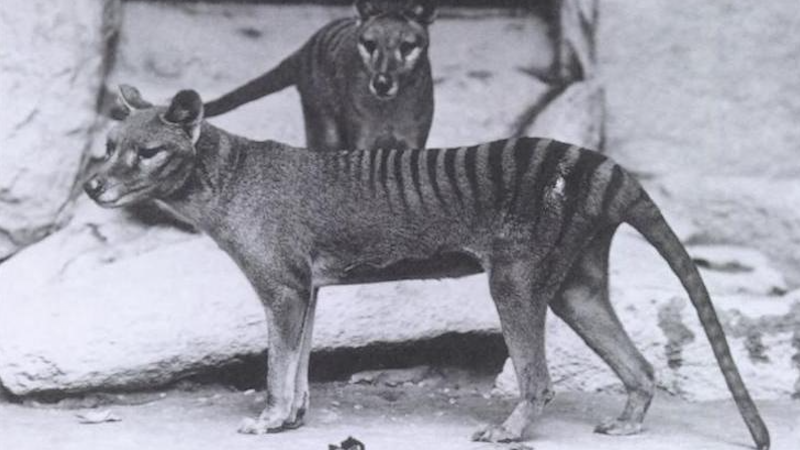
In-depth investigations on historic thylacine (Thylacinus cynocephalus) skull specimens indicate their jaws were probably unsuited to holding down large animals like sheep – instead their long, deep jaw would have been able to subdue relatively small prey with powerful snapping bites.
“Our latest findings on their feeding adaptations counter the myths that drove the thylacine to extinction,” says study lead Professor Vera Weisbecker, from the College of Science and Engineering at Flinders University.
“Thylacines were often compared to Northern Hemisphere predators such as wolves, jackals and foxes from the dog family Canidae. This resemblance gave them their species name ‘cynocephalus’, meaning ‘dog-head.’
“But thylacines were in fact more closely related to kangaroos than to dogs. They were marsupials, whose ancestors separated from the other mammals long before the dinosaurs went extinct.”
In a major re-interpretation of the thylacine’s biting behaviour, published in Nature Communications, the research team from Flinders University and The University of Melbourne found that thylacine skulls sported a unique combination of features which did not match any known adaptations of living carnivorous mammals.
The strange combination of an oversized skull, long and tall upper jaw and mace-like widened snout sparked the researchers’ curiosity and revealed the thylacine had a bite unlike any other living meat-eating mammal.
Co-author Dr Douglass Rovinsky says: “Even though the average thylacine may have weighed only half as much as the average wolf, its vastly oversized skull is about as large as a grey wolf’s skull.
“But while it was big, it wasn’t really shaped like the skull of a big predator. Instead, the thylacine’s snout was long and slender, almost delicate – not robust like the snout of a grey wolf. It very much looks like the snout of a fox or jackal, which can be much smaller than thylacines.”
Researchers say this strange combination allowed thylacines to use high-impact snapping to catch small-to-medium prey such as the rabbit-sized bandicoots.
“The longer a jaw is, the faster its tip moves when an animal bites. This increases the impact of the strike. We think that the thylacine’s huge skull size allowed it to withstand these bite forces,” says Professor Weisbecker.
Strangely, while the thylacine may have been the last living mammal to sport a ‘big head, lethal snap’ adaptation, the trait combination is common outside of mammals.
“Many crocodiles and predatory fishes have long, fast-snapping jaws used to catch agile prey like fish. Their jaws are often much longer, and frequently sport tall and widened tips,” she adds.
The findings are an intriguing addition to a previous study by University of Melbourne School of BioSciences co-authors Professor Andrew Pask and Dr Axel Newton which revealed similarities between Tasmanian tiger and wolf DNA regions that regulate gene expression responsible for skull formation.
“These genomic similarities might explain our previous finding that regions of thylacine and wolf skulls show similar growth patterns, even though they are quite dissimilar as adults,” they say.
“Together, these findings point to exciting new opportunities in combining evolutionary biology, anatomy and genomics to explain how unique shapes like the thylacines’ skull evolve.”
Professor Weisbecker notes that the team’s findings highlight the tragedy of the thylacine’s recent extinction.
“Thylacines were hunted because of myths that they were ferocious predators of livestock, when there was little evidence for this. Their extinction is a story of ignorance and lack of respect for Australia’s unique wildlife and its Indigenous custodians.
“As a country at the global forefront of mammal extinctions, we need to do all we can to safeguard equally irreplaceable surviving species.”
