It’s possible that I shall make an ass of myself. But in that case one can always get out of it with a little dialectic. I have, of course, so worded my proposition as to be right either way (K.Marx, Letter to F.Engels on the Indian Mutiny)
Farage is expected to attend the World Economic Forum at Davos for the first time, as he tries to portray himself as a statesman and increase his standing on the world stage.
Nigel Farage has made a career out of bashing what he sees as ‘global elites’ and ‘globalists’, and yet this year the self-proclaimed anti-establishment figurehead will himself be attending Davos.
Farage is expected to attend the World Economic Forum at Davos for the first time, as he tries to portray himself as a statesman and increase his standing on the world stage.
According to Reform’s Deputy Leader Richard Tice, Farage is hoping to meet US President Donald Trump so that he can express his worries over the US threatening tariffs against the UK and other European nations as part of efforts to annex Greenland.
Tice told the BBC: “Let’s hope they have an opportunity to have some words; both will have very busy schedules for sure, but in a sense that’s where real friendship can come in, to say: ‘Look, we understand what you’re trying to achieve; this is the wrong way to go about it.”
The Guardian reports that Farage has in the past taken particular aim at the World Economic Forum ‘epitomising what he sees as the elite capture of politics by a class intent on obliterating nation states in the name of “globalism”.
It adds: “Farage’s rhetoric on such subjects has in the past prompted criticism from groups including the Board of Deputies of British Jews, who said his discussion of supposed plots by bankers to create a global government at times veered into territory associated with antisemitic conspiracy theories.” Basit Mahmood is editor of Left Foot Forward
Trump tells Norway's PM he has no obligation to 'think purely of peace' after Nobel snub
Trump has boasted about ending eight wars, styling himself as "the president of peace" and therefore deserving of the Nobel honour but those claims have been exaggerated.
US President Donald Trump told Norway's prime minister he no longer needed to think "purely of peace" after failing to win the Nobel Peace Prize, in a message published on Monday.
"Considering your Country decided not to give me the Nobel Peace Prize for having stopped 8 Wars PLUS, I no longer feel an obligation to think purely of Peace," Trump said in a message to Norwegian Prime Minister Jonas Gahr Støre.
It is unclear why Trump decided to send a message to Støre as the peace prize is decided by the Norwegian Nobel Committee and not the government.
In a written comment, Støre underlined that the Nobel Peace Prize was not awarded by the Norwegian government.
"I have clearly explained, including to president Trump what is well known, the prize is awarded by an independent Nobel Committee," Store said.
US President Donald Trump speaks at a dedication ceremony in Florida, 16 January, 2026 AP Photo
Machado was awarded the 2025 Nobel Peace Prize for her leadership of Venezuela's opposition movement amid a crackdown by President Nicolás Maduro, most notably in the much-maligned 2023 presidential election.
Machado's gesture to Trump followed a series of developments in Venezuela after a blitz US military raid captured Maduro and his wife and brought them to New York to stand trial on drug trafficking charges two weeks ago.
During the visit, Machado gave Trump her Nobel medal "as a recognition for his unique commitment to our freedom," she told reporters outside the US Capitol.
Trump confirmed on social media that Machado had left the medal for him to keep and said it was an honour to meet her.
The Prime Minister of Norway Jonas Gahr Støre speaks in London, 4 December, 2025 AP Photo
"She is a wonderful woman who has been through so much. María presented me with her Nobel Peace Prize for the work I have done," Trump said in his post. "Such a wonderful gesture of mutual respect. Thank you María."
Ahead of Machado's visit to Washington, the Norwegian Nobel Institute, organisers of the Nobel Prize, said in a statement that a Peace Prize cannot be withdrawn, transferred or shared once it has been announced.
The Nobel Foundation's statutes and Alfred Nobel's will — which dictate the merits awardees should have — state that the title of the winner belongs personally to the individual and cannot be legally shared or reassigned to another person.
The medal or the associated diploma can be physically given, sold or auctioned, but this does not confer the award's title on anyone else
Related
Ending eight wars?
Trump has often boasted about ending eight wars, styling himself as "the president of peace" and therefore deserving of the Nobel honour but those claims have been exaggerated.
The latest conflict he claims to have ended was two years of fighting between Israel and Hamas in Gaza.
The other seven are Israel and Iran, Pakistan and India, Rwanda and the Democratic Republic of Congo, Thailand and Cambodia, Armenia and Azerbaijan, Egypt and Ethiopia and Serbia and Kosovo.
But some of those conflicts lasted just days and one, Egypt-Ethiopia, had no fighting to end but rather involved long-standing issues of water sharing from the Nile River.
A view of the rostrum where the Nobel Committee announce the winner of the Nobel Peace Prize in Oslo, 10 October, 2025 AP Photo
Ethiopia formally inaugurated the Grand Ethiopian Renaissance Dam (GERD) last year. It sees the dam as a boon to its economy but Egypt opposed its construction, arguing that it would reduce the country's share of Nile River waters.
Trump recently told Fox News that one of the ongoing conflicts that has continued despite his claiming to have stopped it, a simmering border dispute between Thailand and Cambodia, should actually count more than once.
"I did put out eight wars, eight and a quarter, because, you know, Thailand and Cambodia started going at it again," he told Sean Hannity last week.
Considerations on the Morality of Donald Trump
by Kim Petersen / January 19th, 2026
In an interview with the New York Times, when asked if there were any checks on his powers on the world stage, Trump replied: “Yeah, there is one thing. My own morality. My own mind. It’s the only thing that can stop me.”
A voice jumps in to ask: “Not international law?”
“I don’t need international law,” said Trump. “I’m not looking to hurt people.”
Trump’s own morality.
Morality is a set of principles that distinguishes between right and wrong that guide one’s behavior accordingly.
Trump identifies as non-denominational Christian; therefore, the ten commandments should apply to Trump. In this case, the prohibition against taking human life is applicable and particularly worth examining because it is generally considered a universal principle that is also encoded in international law.
The list of lives erased at Trump’s behest is long. The recent US attack launched against Venezuela took 100 lives. That was on the heels of several snuff videos of small boats that Trump alleges were narco traffickers.1 There were no interceptions, no presumption of innocence, just killing. As of 31 December 2025, CBC cited the number of crew members killed at 115.
On 22 June 2025, the US attacked three nuclear facilities in Iran. The number of casualties is unclear.
Clear is that the US sneak attack on Iran was an intrusion into the Iran-Israel war to aid the sneak-attacking Israel belligerent. Israel has been engaged in warring against its neighbors Lebanon, Syria, and was wreaking a genocide in Palestine, with devastating destruction in Gaza. This genocide has been abetted by Trump’s US (of course, with Democrats on side with Israel).
Sovereignty
The sneak attacks speak to the pusillanimity at the core of the Trump and Netanyahu governments.
As well, the US attacks demonstrate a disregard for US adherence to international law as per the UN Charter to which the US is a signatory, thus it is legally binding under the US Constitution. Article 2(1) of the UN Charter recognizes the sovereign equality of states, regardless of size or power. Further, Article 2(7) prohibits outside intervention in domestic matters, such as the protests recently in Iran where Trump threatened intervention, even though protests were also ongoing in the US for the killing of a critic of the Trump administration by ICE operatives.
By launching attacks abroad without Congressional approval, Trump is criticized for failing to abide by the US Constitution which he pledged to uphold in his oath of office.
Lying
Lying is considered an abnegation of morality. Ethics Officer Tim C. Mazur reasoned,
Lies are morally wrong, then, for two reasons. First, lying corrupts the most important quality of my being human: my ability to make free, rational choices. Each lie I tell contradicts the part of me that gives me moral worth. Second, my lies rob others of their freedom to choose rationally.
The big lies are insidious. For example, the Trump administration kidnapped Venezuela’s president Nicolás Maduro and his wife, Cilia Flores, on the accusation of running a cocaine narco-trafficking operation to the US. The Trump administration has focused on Tren de Aragua (TDA), a cartel that took root in prisons, and is allegedly linked to Maduro. US attorney general Pam Bondi called TDA “a highly structured terrorist organization” and “a foreign arm of the Venezuelan government.”
El País downplayed Bondi’s assertion, citing the opinion of experts that “Tren de Aragua in no way poses a national security issue for Washington, as Donald Trump claims.” Moreover, on 7 April 2025, the US National Intelligence Council issued a memo that stated,
While Venezuela’s permissive environment enables TDA to operate, the Maduro regime probably does not have a policy of cooperating with TDA and is not directing TDA movement to and operations in the United States.
More than two hundred people have died based on, at best, erroneous assessment of intelligence, or worse, outright disinformation.
After the attack on Venezuela, Trump said: “We’re going to take back the oil that frankly we should’ve taken back a long time ago.” And “we’re going to have our very large United States oil companies, the biggest anywhere in the world, go in, spend billions of dollars, fix the badly broken infrastructure, the oil infrastructure, and start making money for the country.”
Not mentioned concerning the theft of Venezuelan oil is why the oil infrastructure is “badly broken.”
However, this is readily understandable when one considers the dire effect of economic sanctions that the US has imposed on Venezuela. One research report estimated that the sanctions had caused more than 40,000 estimated deaths in Venezuela from 2017 to 2018. A 2025 Lancet paper laid bare the perniciousness of economic sanctions for which 564,258 deaths worldwide per year were attributed for the period from 2012 to 2021.
Trump is a known braggart, and oftentimes his lies take the form of boasting. To wit his claim that he’d end the warring between Russia and Ukraine in 24 hours: “They’re dying, Russians and Ukrainians. I want them to stop dying. And I’ll have that done — I’ll have that done in 24 hours.”
Even more unseemly is that the Russia-Ukraine conflict is only partially that. It is a NATO-Ukraine proxy war against Russia. So while Trump is bragging that he’ll bring a quick end to the Ukraine-Russia war, he is deeply involved in it — attested to by US secretary-of-state Marco Rubio: “And frankly, it’s a proxy war between nuclear powers – the United States, helping Ukraine, and Russia.”
Trump’s duplicity in the proxy war came to the forefront when a drone attack was launched from Ukraine targeting a residence used by president Vladimir Putin in the Novgorod region, this while Putin was in telephone discussions with Donald Trump (about which Trump lied) on ending the war in Ukraine. A downed Ukrainian drone provided decoded navigation data information, according to Russia, that proves it contained the precise coordinates of the intended target — Putin’s residence — including data on the flight path of the drone.
Former US Marine intelligence officer Scott Ritter was unambiguous as to the meaning:
American digital “fingerprints” were all over this guidance component, something the Russians knew when their head of military intelligence handed one of these intact components over to the US military attaches in Moscow.
Russia knows the truth.
And the truth is that the United States under Donald Trump still seeks the strategic defeat of Russia.
Rudenness
Are manners not necessarily attached to morality, facilitating social interaction and guiding us to live a virtuous life?2
Social etiquette befuddles Trump who addresses many people in a decidedly rude manner. In fact, he dehumanizes and humiliates people. The examples are myriad: he referred to DPRK president Kim Jong-un as “little rocket man”; he called Canada a 51st state, Canadians “mean and nasty,” and has driven his closest trading partner, Canada, to renewed relations with China, a nation Trump calls a “threat to the world”; he considered his former appointee as US ambassador to the UN, Nikki Haley, to be a “birdbrain”; former president Joe Biden is demeaned as either “Sleepy Joe,” Crooked Joe,” or even “sleepy son of a bi**h”; of his director of National Intelligence Tulsi Gabbard relaying the intelligence community’s assessment of Iran not pursuing nuclear weapons, Trump said, “I don’t care what she said” he called one female reporter “piggy”; and the list of people derided by Trump is much, much longer — indicating a penchant for crudely dealing with people he disagrees with.
What are Tariffs and Who Pays
Trump not only uses sanctions to inflict harm on other nations to achieve political aims, he also is imposing tariffs on other nations, friend and foe alike, as a cornerstone of his economic agenda and in support of his imperialist ambitions.
Trump envisions the US as a tariff nation. He frames a tariff as a tax on another country. He hopes to create a surfeit of cash to pay off the staggering US debt (now approximately $38.45 trillion) and create manufacturing jobs in the US.
But the question is who will pay the tariff. Trump maintains it is the exporting nation.
The Institute on Taxation and Economic Policy calls Trump’s claim erroneous and that American consumers will bear much of the cost through higher prices.
Indeed, Trump’s claim that tariffs are borne by exporters is widely held to be false.3
Noted Columbia University economist Jeffrey Sachs predicts the Trump tariff policy will fail.
What is in the Offing?
There is other sordid information that might have strong negative implications for Trump and his morality that is is still seeping out.
The release of the Epstein files may well speak to the morality of Donald Trump. The release of the files is staunchly opposed by Trump, but dribs and drabs have emerged. Epstein is notorious for having been charged with sex trafficking of minors and conspiracy to commit sex trafficking of minors. Children and adolescents who become entangled in sex trafficking sometimes come from backgrounds with traumatic experiences; young age and a history of trauma can be a recipe for exploitation of vulnerable youth.
Epstein operated frequent flights with high profile guests to his private island, Little Saint James, in the US Virgin Islands. There is much documented and video evidence of alleged sex trafficking of minors to the island and Epstein abodes elsewhere. Trump’s relationship with Epstein and his world puts him in an unwanted spotlight.
Trump posted on Truth Social in January 2024, “I was never on Epstein’s Plane, or at his ‘stupid’ Island.” However, documents released by Trump’s own Justice Department –including flight logs and emails — indicate that Trump had been a passenger on Epstein’s private jet “far more often” than realized.
As of 16 January 2026, Will Gottsegen wrote, “Less than 1 percent of [the Epstein files] have been released. A CNN poll reveals that two-thirds of Americans believe the Trump government is holding back certain information.
How do Americans feel about the morality that guides Trump, and do they even care? Time will tell; the US November midterm elections are in the offing.
Through the 1600s, the English established colonies along the North American coast. Of course, these colonies shared much in common: shared language, shared appreciation for English citizenship and rights, and a shared commitment to Protestant Christianity (though, with different denominational and traditional commitments). But, it is worth considering just how different these colonies were.
One work that is absolutely worth considering is David Hackett Fischer’s Albion’s Seed. Fischer explains that, from 1629 to 1775, the territory that would become the present-day United States was settled by four major waves of English immigrants.
The first was that of the Puritans from 1629-1640. They came from the east of England to Massachusetts and broader New England.
The second major wave was that of the Cavaliers and their indentured servants from 1642 to 1675. They came from the south of England to settle in Virginia and the Chesapeake.
Then, from 1675-1725, a wave of Quakers came from the North Midlands of England and Wales to the Delaware Valley, including Pennsylvania.
From 1718-1775, a wave of “Scots-Irish” or “Ulster Scots” from the borders of North Britain and North Ireland came to the Appalachian mountains and the backcountry.
Now, Fischer’s book is a massive work with far more than I can convey, but he considers these four major waves and describes their unique characteristics. Of course, he explains that they were similar: English, Protestant, and committed to British liberties and laws, but they were distinct in the denominations, society, history, culture, daily habits, and, most significantly, their considerations of power, order, and freedom. These realities are significant because they will shape the United States for generations, and, arguably, to this day.
Now, of course, we could focus on the environments, religious commitments, and other characteristics that set the colonial regions apart from each other. The environments, including the climate and the soil of the places where the colonists landed, and agendas of the colonists who came shaped the colonies to look very differently from the ways that their towns were organized to the way that they shaped their economy. Fischer goes further than that describing the difference in the ways that the people in certain regions prepared their food, raised their children, built their houses, and used their time. However, I want to consider a particular difference between the colonial regions that Fischer points out was unique between the colonial regions. That is, their visions of liberty.
David Hackett Fischer emphasizes the vision of liberty held by the New England colonies. Rather than fierce independence in the southern colonies, New England held to what Fischer calls “ordered liberty.” New Englanders believed that in order to be a “free” community, the group could place limits on individual freedom in order to ensure the good of the whole. They also believed that liberty meant that the community should provide for those who were on the margins and that a provision of necessities was essential for everyone to experience liberty.
Let us note that the Puritans did not believe in what we think of as “religious freedom” or “tolerance.” They came to the New World to exercise what they believed was right and imposed that on the people in their communities.
Now, this takes us a long way down the road, but it is vital to see. It is no coincidence that ideas like Progressivism, as Murray Rothbard has shown, have their roots in New England and the areas where descendants of those colonists spread. New England had long been the center of support for those who wanted stronger centralization in the government.
Indeed, they lost their religious zeal, but they did not lose their zeal for placing limitations on others for what they viewed as the general good. In the late 1800s and early 1900s, brought to theological liberalism by Darwinism, they were all the more committed to their willingness to force others into their mold, moved by the “Social Gospel” and “Social Darwinism.” Now they are ready to tell you what size soft drinks you can buy at the convenience store and whether or not you’re allowed to use a straw.
Fischer described the Virginian visions as the desire to rule, but not to be ruled. In other words, they had a local vision of rule. This was, in their view, pictured in the paternalistic plantation system. A man’s manor was his domain and they were opposed to outside interference.
It is easy for us to look back at these men and conclude that they were hierarchical and patriarchal. I think they would wonder what the issue was. They would have agreed with those characterizations, believing that they could bring out the best in the people for whom they were responsible. Of course, many of the Cavaliers in Virginia abused their place and their power. But that was not the case across the board as we can see demonstrated in many of those in the Southern colonies.
Pennsylvania, because of the Quaker leadership which led to religious liberty and economic opportunity, was characterized by diverse settlement. Because of that, Fischer explains that the Quaker colonies developed a vision of liberty he called the “reciprocal” or the “golden rule” vision. Because the Quakers wanted and needed toleration of their own beliefs and practices, they granted that to others.
I grew up on the edges of Appalachia in Walker County, Alabama. My people were Borderlanders. Because of their long and troubled history on the border between England and Scotland, they distrusted authority, including the state and established churches, though many of them were connected to the Presbyterian church in some way. They were always willing to move farther west in order to avoid the exertion of authority on them. One historian described them as “always on guard, fiercely protective of family, loyal toward friends, and ruthless toward enemies.” Fischer called their vision of liberty as “natural freedom” which he described as heavy on individual autonomy and fiercely resistant to outside authority.
Now, here is one reason why this matters. When Thomas Jefferson wrote the Declaration of Independence, he was not “bringing forth a new nation conceived in liberty and dedicated to the proposition that all men are created equal,” at least not in the sense that Lincoln meant it at Gettysburg.
This was not one nation; it was multiple. With different agendas, priorities, aims, and especially, as we have seen, different visions for what it meant to be free. Regional tensions did not arise because of slavery, did not develop simply because of westward expansion, nor did they appear in the 1850s. Rather, the colonies were different from the go. This shaped the colonies as they became states. Southerners did not want the New England vision imposed on them. The same was true in the other direction. The same was true for the Middle Colonies and those who settled in the backcountry. This kind of arrangement necessitated a federal approach. No central power could fully satisfy all of the regions.
About the author: Larsen Plyler received his PhD in history from Mississippi State in 2019. He has taught at the high school, college, and graduate school level. He also serves as a Bible teacher in Franklin County, Alabama. He is married to Lydia and together they have four children.
MISES The Mises Institute, founded in 1982, teaches the scholarship of Austrian economics, freedom, and peace. The liberal intellectual tradition of Ludwig von Mises (1881-1973) and Murray N. Rothbard (1926-1995) guides us. Accordingly, the Mises Institute seeks a profound and radical shift in the intellectual climate: away from statism and toward a private property order. The Mises Institute encourages critical historical research, and stands against political correctness.
At the moment, Minneapolis is the frontline of the resistance.
President Donald Trump is at war with Governor Tim Walz of Minnesota, whom he hates as a political rival, and at war with liberal Minneapolis, the state’s largest city. Trump has now sent 3,000 agents of Immigration and Customs Enforcement (ICE) into Minneapolis, 1,000 more than there were before ICE murdered activist Renée Nicole Good. There are now more ICE agents in Minneapolis than there are police in the metropolitan area. The majority of the inhabitants see this as an occupation that is bringing fear and more violence into their city.
ICE agents, masked, wearing bulletproof vests, and carrying firearms and chemical sprays, appear at schools, hospitals, churches, and businesses, and without arrest warrants, grab brown and black people, both immigrants and U.S. citizens, put them into cars and take them away. Some are later released; some are shipped to far away cities to make it difficult for friends and families to find and help them. Because of ICE patrols, Minneapolis and other nearby districts have closed their schools for the next few weeks, offering virtual learning instead.
President Trump and Kristi Noem, head of the Department of Homeland Security, claim that ICE agents enjoy “absolute immunity.” But a federal judge, Kate M. Menendez issued a temporary injunction forbidding ice agents from retaliating against people “engaging in peaceful and unobstructive protest activity,” and from using “crowd dispersal tools” in retaliation for protected speech and from stopping and detaining people in cars unless they were forcibly blocking ICE. Judges in California, Illinois and Washington, D.C. have issued similar rulings in suits brought by immigrant rights organizations.
Both ordinary people and the city’s and state’s politicians, like Governor Tim Walz and mayor Jacob Frey consider what is happening to be an illegal, violent occupation. And there is resistance. Wherever ICE agents appear, members of activist networks blow their whistles to alert their neighbors and many come into the street to shout at the ICE agents to get out. Others have used their cars to block the streets and impede ICE. Some activists have thrown snowballs at ice agents, others have slashed ICE agents’ cars’ tires, and some have fired fireworks at the agents. The confrontations often become chaotic and highly emotional as local residents filled with fear and anger take courage to challenge the armed masked men who have come into their communities.
While on the one hand the militant resistance is admirable, on the other there is fear that it may provide Trump with the excuse to invoke the Insurrection Act which allows the president to send federal troops into any city or state. The Act can be invoked “to address an insurrection, domestic violence, unlawful combination, or conspiracy, in any state, which results in the deprivation of constitutionally secured rights, and where the state is unable, fails, or refuses to protect said rights.” The people of Minneapolis would argue that it is Trump who is creating the violence and depriving people of their rights.
Trump’s Justice Department has opened a criminal investigation into the actions of Governor Walz and Mayor Frey, accusing them of interfering with ICE. Frey told ICE to “get the fuck out of Minneapolis.”
Trump hates Walz because he was the Democratic vice-presidential candidate on the ticket that opposed him and vice-president J.D. Vance in 2024. And he hates Minneapolis where a large majority vote Democratic. And he hates brown immigrants because he’s a racist.
The people of Minneapolis are standing up to Trump and around the country people are hoping they continue their impressive bottom-up peaceful protests and that they—and we—will win.
Dan La Botz was a founding member of Teamsters for a Democratic Union (TDU). He is the author of Rank-and-File Rebellion: Teamsters for a Democratic Union (1991). He is also a co-editor of New Politics and editor of Mexican Labor News and Analysis.
Ice: The new face of the United States’ deportation machine
There is a long history of displacement and deportations in the US, and Ice is the latest expression of this racist regime, writes Camilla Royle
SOCIALST WORKER
UK Sunday 18 January 2026
People at Federal Plaza in New York City protesting against Ice and mass deportation in the second presidency of Donald Trump, September 2025 (Picture: SWinxy)
Donald Trump has waged war on Minneapolis as people resist mass deportations and protest the state murder of Renee Good.
His use of federal agents to try to sweep people off the streets of United States’ cities is an escalation of state violence against migrants.
But, as Adam Goodman’s book The Deportation Machine shows, driving out immigrants has long been part of the way the US state manages the capitalist system.
There is a popular idea that the US is a “nation of migrants”.
But there are contradictions.
While US capitalism needs migrant labour, it has always relied on anti-migrant racism to divide working class people.
And the first Europeans who moved to the US were not simply migrants, but settler colonialists who wiped out Indigenous people.
It is this tradition that Republican and Democrat administrations stand in when they seek to forcibly remove people from the country and shut the borders.
In the 1880s and 1890s, the federal government gave itself the authority to admit or exclude people through a series of acts of Congress and Supreme Court decisions.
As well as formal deportation, Goodman explains how removing people from the US has often involved both self-deportation and voluntary deportation.
But there is nothing “voluntary” about coercing people into agreeing to leave.
Goodman estimates that some 90 percent of expulsions of people throughout US history have been through voluntary deportation, largely hidden from the legal system.
In 1931, William N Doak was appointed to oversee the Bureau of Immigration—one of the precursors to today’s Ice. He set out to remove 100,000 “evaders of our alien laws”.
Agents searched “homes, churches, picket lines, public spaces, bars, dance halls and pool halls, sometimes without a warrant”.
The spectacular brutality of the raids was intended to work alongside the self-deportation drives by scaring people into leaving cities like Los Angeles on their own accord.
The deportation machine has targeted different groups throughout history, from Chinese labourers in the late 19th century to Minnesota’s Somali community today.
But the history of deportation in the US has largely been, according to Goodman, “the history of removing Mexicans”. They make up nine out of ten deportees.
An article in Life magazine in 1951 referred to an “invasion force” of Mexican migrants. It spread fear that the Mexican agricultural worker would never be unemployed.
This was “because he can weed a 1,000 foot furrow without once straightening up and he willingly works with the short-handled hoe”, which “tortures American spines”.
Some workers bought into the lie that migrants would undermine wages and conditions.
Biological racism was also used to define who was American and who was deportable.
Migrants were portrayed as economically inactive and a potential burden on the state.
They were seen as potential carriers of infectious diseases, as political subversives and as a sexual threat to women and girls.
This highlights a contradiction in the way the US controls migration.
The labour of migrant workers has been indispensable to bosses for over 100 years.
At times the state has tolerated unauthorised migration as a source of cheap labour, especially if migrants can be kept in a state of fear and precarity.
But in times of crisis the state can revert to cracking down on migration.
In the 1990s, Democrat Bill Clinton launched a campaign to “regain control” of the border with Mexico.
The total number of deportations reached an all-time high of over 1.86 million in the year 2000.
Goodman explains how since then there has actually been a steady decline in the numbers of people removed.
But for the first time the number of formal removals began to overtake so-called voluntary departures.
This was backed up by militarised borders. A rapidly expanding network of privately run detention facilities has incarcerated people whose only “crime” is crossing a border and separated them from family, friends and legal support.
Between 1986 and 2016, the number of Border Patrol officers increased from 3,700 to over 23,000.
It has more officers licensed to carry weapons than any other branch of the federal government except the military.
Ice was established in 2003, replacing several existing agencies. While the Border Patrol polices the borders, Ice investigates and removes people from within US territory.
As author Amy Kaplan argues, this fuels the idea that the US is in constant danger from migrants both within and outside its borders.
Despite the dangers they face, migrants in the US have organised for decades to defend their rights.
In the 1970s, trade unions became more sympathetic to organising undocumented migrants.
Factory bosses exploited migrant workers by exposing them to dangerous working conditions, which in turn harmed all workers.
Trade unionists from the ILGWU garment workers’ union saw directly how anti-migrant raids were damaging their ability to organise.
At one point, a raid removed 17 of the 20 strikers on their picket line.
In 2006, there were mass marches in over 160 cities and a day without migrants on 1 May. Over one million people took action. The movement was key to preventing the Senate passing a draconian anti-migrant bill.
The movement in Minneapolis today can deepen as students walk out of schools and universities and workers from all backgrounds organise to resist Ice.
It is this working class power that can throw a spanner in the works of the deportation machine.
Counter-protesters in Minneapolis drown out far-right influencer
ORNING STAR, UK
Jake Lang, center in the vest, who organized the March Against Minnesota Fraud, clashes with pro-immigration counterprotesters near Minneapolis City Hall, January 17, 2026, in Minneapolis
HUNDREDS of counter-protesters drowned out a far-right activist’s attempt to hold a small rally in support of the Trump administration’s latest immigration crackdown in Minneapolis on Saturday.
Far-right influencer Jake Lang organised an anti-Islam, anti-Somali and pro-Ice demonstration, saying on social media beforehand that he intended to “burn a Koran” on the steps of City Hall. But it was not clear if he carried out that plan.
This came as the governor’s office announced that National Guard troops were mobilised and ready to assist law enforcement though not yet deployed to city streets.
There have been protests every day since the Department of Homeland Security ramped up immigration enforcement in the Twin Cities of Minneapolis and St Paul by bringing in more than 2,000 federal officers.
Only a small number of people showed up for Mr Lang’s demonstration, while hundreds of counter-protesters converged at the site, yelling over his attempts to speak and chasing the pro-Ice group away.
They forced at least one person to take off a shirt they deemed objectionable.
Mr Lang was eventually forced to leave the scene in some discomfort. He was previously charged with assaulting an officer with a baseball bat, civil disorder and other crimes before receiving clemency as part of President Donald Trump’s sweeping act of clemency for January 6 defendants last year. He recently announced that he is running for the US Senate in Florida.
In Minneapolis, snowballs and water balloons were also thrown before an armoured police van and heavily equipped city police arrived.
“We’re out here to show Nazis and Ice and DHS and Maga you are not welcome in Minneapolis,” protester Luke Rimington said. “Stay out of our city, stay out of our state. Go home.”
The Minneapolis immigration clampdown saw Renee Good, a US citizen and mother of three, shot dead by an Ice officer, Jonathan Ross, during a January 7 confrontation
Pardoned January 6 rioter pelted with snowballs and water balloons at rally
One of the men Donald Trump pardoned for taking part in the January 6 insurrection sparked fury from protesters after holding a rally in support of ICE officers.
Jake Lang gathered a small group of supporters in Minneapolis, Minnesota, playing the song ‘Ice Ice Baby’ and talking about how immigrants were ‘replacing’ white people.
He advertised the rally as a ‘Crusader March’ on ‘Little Somalia’, which was labelled as racist and Islamophobic. He also vowed to burn a copy of the Quran.
Lang posted on social media before the rally: ‘America is a CHRISTIAN COUNTRY; we will not allow Somali Daycare Pirates to overtake Minneapolis.’
The scene quickly descended into chaos, as protesters marching against immigration raids in Minneapolis clashed with Lang’s group.
Emotions are running high in Minnesota after an ICE agent fatally shot US citizen Renee Good as she was sitting in her car earlier this month.
His march was called a ‘Crusader March’ (Picture: Reuters)
Snowballs rained down on the Conservative influencer (Picture: Reuters)
Lang and his group had water balloons and snowballs thrown at them by anti-immigration protesters, and quickly left the scene.
He posted on social media afterwards, claiming he had been ‘stabbed by a crazy white commie leftist rioter’. It’s unclear if his claims are true.
These protests have become common on the streets of Minneapolis since a federal agent shot Good on January 7.
Agents have pulled people from cars and homes and been confronted by angry bystanders demanding that officers pack up and leave.
Minneapolis mayor Jacob Frey described the situation as not ‘sustainable’ and has urged ICE to leave.
On Friday, Trump threatened to invoke the Insurrection Act, which would allow him to deploy troops as protests against Immigration and Customs Enforcement operations continue in Minneapolis.
Lang had water balloons and snowballs thrown at him (Picture: Reuters)
Lang led chants with his small group before others began protesting (Picture: Reuters)
Trump has repeatedly threatened to invoke the rarely used federal law to deploy the US military or federalise the National Guard for domestic law enforcement, over the objections of state governors.
‘If the corrupt politicians of Minnesota don’t obey the law and stop the professional agitators and insurrectionists from attacking the Patriots of I.C.E., who are only trying to do their job, I will institute the INSURRECTION ACT, which many Presidents have done before me, and quickly put an end to the travesty that is taking place in that once great State,’ he wrote on social media.
Minnesota attorney general Keith Ellison responded by saying he would challenge any deployment in court.
He is already suing to try to stop the surge by the Department of Homeland Security, which says it has made more than 2,000 arrests in the state since early December.
.
Saturday, January 17, 2026
Syrian activist Sarah Mardini acquitted of migrant trafficking in Greece
Sarah Mardini, a 30-year-old Syrian who sought refuge in Germany in 2015, was present at the court - Copyright AFP Yamil LAGE
A Greek court Thursday acquitted Syrian competitive swimmer and activist Sarah Mardini, whose rescue of her sister inspired a hit Netflix film, and 23 others of migrant trafficking.
The verdict came almost a month after the start of their trial at a court on Lesbos, ending a legal ordeal for the activists since 2018.
They had been charged in the Greek island with “forming a criminal organisation” and “illegally facilitating the entry of third-country nationals into Greece”.
“All defendants are acquitted of the charges” because their aim was “not to commit criminal acts but to provide humanitarian aid”, presiding judge Vassilis Papathanassiou told the court.
Prosecutor Dimitris Smyrnis had earlier recommended their acquittal, emphasising that “no independent basis establishing the criminal liability of the defendants has been demonstrated”.
Mardini, a 30-year-old Syrian who sought refuge in Germany in 2015, was present at the court along with her Irish-German co-defendant Sean Binder, AFP said.
The 2022 Netflix film “The Swimmers” is inspired by the story of Mardini and her sister Yusra, who was one of 10 athletes who competed in the Rio Olympics for a Refugee Team.
Their family made the perilous journey across the Aegean Sea in 2015, and the sisters saved other people from drowning along the way.
This is the second time Greece has brought criminal charges against the volunteers.
In 2023, they were acquitted in another case involving offences related to their humanitarian work, including “espionage”.
In 2018, Mardini was part of a group of volunteer activists with the NGO ERCI trying to help migrants reach the island of Lesbos from Turkey.
She was arrested at the time and spent three months in prison in Greece.
Greek court clears group of humanitarian workers of migrant smuggling charges
After more than seven years of legal limbo, a Greek court has acquitted 24 defendants for charges related to smuggling migrants into Greece.
Two dozen humanitarian workers on trial for participating in search and rescue operations on the island of Lesvos accused of smuggling migrants were acquitted by a Greek court on Thursday evening.
After more than seven years of legal limbo, the Lesvos Court of Appeal cleared the defendants of charges, which included membership of a criminal organisation, facilitating the entry of third-country nationals into Greece and money laundering, for a period from 2016 to 2021.
The group faced up to 20 years in prison if convicted.
Presiding judge Vassilis Papathanassiou told the court that the defendants would be acquitted because their intention was "not to commit criminal acts but to provide humanitarian aid", according to Greek media reports.
Prior to the verdict, the prosecutor told the court that the charges ultimately lacked evidence, recommending the defendants' acquittal. Greek media reported that he underlined a lack of evidence to prove the existence of a hierarchical structure which would constitute a criminal organisation.
One aspect of the prosecution's arguments initially centred around the defendants' use of WhatsApp — a popular encrypted messaging service owned by Meta — to communicate about migrant boat arrivals, which was presented as evidence of a criminal conspiracy.
Yet, this was also dismissed by the judge who ruled that "a communication group on the internet cannot be regarded as a criminal organisation."
Euronews has contacted Greek authorities for comment, but not received a response at time of publication.
Once a tourist hotspot, Lesvos became the primary entry point for individuals and small boats seeking to reach Europe in 2015, the year that marked the peak of the continent’s migration crisis.
While Greek authorities said the protracted case was a matter of national border security, rights groups labelled it “baseless” from the outset and were supportive of the defendants.
"There was huge applause in the room after the verdict was handed, defendants were falling in each others' arms," Wies de Graeve, Amnesty International's Belgium executive director who was on site inside the Lesvos courtroom, told Euronews.
De Graeve qualified the outcome as “bittersweet", describing the “heartbreaking" testimonies shared by defendants on the stand, displaying "the trial’s psychological, financial and emotional implications on their lives.”
'Huge relief not to spend next 20 years in a cell'
Seán Binder, a German-Irish citizen who travelled to Lesvos in 2017 — in his early 20s at the time — was among those acquitted.
He worked as a search and rescue volunteer with the now-defunct Emergency Rescue Centre International (ERCI), a registered Greek humanitarian NGO.
"It is a huge relief that I will not spend the next 20 years in a prison cell, but at the same time, it is troubling that this should ever have been a possibility", said Binder.
"Today, it was made clear, as it should always have been, that providing life-saving humanitarian assistance is an obligation, not a crime", he added.
Speaking to Euronews in December, Binder explained that he had spent "most of his time on 'spotting shifts', looking out at the Turkish mainland a few (nautical) miles away, where smugglers push people into boats and send them over to seek asylum in Europe."
“The boats don’t want to be caught, so there aren’t any bright lights. Instead, we would be on the lookout for distress calls, screaming and shouting. I communicated with the coast guard weekly and would inform the port authority when we went out to sea," Binder recalled at the time.
Binder's work came to a halt when he was arrested alongside Sarah Mardini, whose story of swimming across a stretch of the Mediterranean was fictionalised in a 2018 Netflix film.
In 2023, the pair and a group of defendants were acquitted of misdemeanour crimes which included alleged forgery, illegally listening to radio frequencies and espionage. Outstanding misdemeanour charges for 16 other defendants were dropped the following year.
Aid workers slam Europe's migration enforcement
Humanitarian groups say this trial has deterred the work of humanitarian and rescue organisations on the Aegean islands, where the scale of such operations has been dramatically reduced.
They also argue it epitomises broader European pushback against individuals and organisations assisting migrants and asylum seekers: an estimated 124 others faced similar judicial proceedings in Europe in 2024 alone, according to Brussels-based NGO PICUM.
Reacting to the verdict, Eve Geddie, Amnesty’s Director of International European Institutions Office urged the EU to “introduce stronger safeguards against the criminalization of humanitarian assistance under EU law."
In recent years, European migration policy has shifted as the 27-member bloc's leaders increasingly embraced firmer views and explored new ways to curb arrivals.
Greece and its islands have recently experienced a fresh uptick in migrant boat arrivals, with more than 1,000 migrants arriving on Crete and nearby Gavdos mostly from North Africa, according to Greek authorities.
Smugglers operating from Libya increasingly favour Crete and Gavdos as destinations due to improved weather conditions and proximity to the North African coast, Greek officials said.
Greece recorded 39,495 illegal border crossings by the end of October 2025, an 18% decrease from 48,415 arrivals in the same period in 2024, according to official figures.
Renee Good’s Extrajudicial Killing Escalated the Normalization of State Terror
What happens next will determine whether Good’s killing sets a precedent for more state violence.
A federal agent grabs a protester outside the Bishop Henry Whipple Federal Building in Saint Paul, Minnesota, on January 8, 2026, following the ICE-perpetrated killing of Renee Nicole Good in Minneapolis on January 7.
Octavio JONES / AFP via Getty Images
The extrajudicial killing of Renee Nicole Good marks a profound and irreversible escalation against communities committed to justice. A red line has been crossed.
While Immigration and Customs Enforcement (ICE) has previously killed immigrants with impunity, including Silverio Villegas González in Chicago, this incident is distinct because it involves the first public extrajudicial killing of a volunteer monitoring ICE’s terror against her neighbors.
In the United States, death, deportation, forced disappearance, and state kidnappings against migrants have been normalized. This killing causes significant concern because it’s a warning to anyone bearing witness to state terror that they too could be killed if they stand in solidarity with targeted communities. That’s the mark of a pending escalation of state repression that necessitates the full participation from the majority to act as bystanders that will either fully support or look the other way as state terror escalates.
This is the hallmark of how mass forms of state violence move from planning phases to full execution. In such instances, everyday acts of resistance like this from neighbors like Renee Good are key to challenging the ongoing state repression and preventing its escalation, especially when the U.S. has deported and forced out over 2 million immigrants in 2025 alone.
In a publicly released video, Good’s last words toward an ICE officer were, “That’s fine, dude, I’m not mad at you.” Her partner later captured the asymmetry of the violence, writing: “We had whistles. They had guns.”
The officer’s composure as he shot her and walked away revealed his absolute confidence in institutional protection. His actions aren’t an anomaly but the natural progression of what civil rights advocates and community organizers have been monitoring — the implementation of National Security Presidential Memorandum-7 (NSPM-7) against neighbors and community rapid responders. Following Good’s killing, U.S. Homeland Security Secretary Kristi Noem immediately labeled Good a domestic terrorist, citing NSPM-7 policies.
The NSPM-7 targets individuals, groups, and networks that the federal government identifies as engaging in resisting government authority and considers such violence as “organized political violence,” “domestic terrorism,” and “anti-fascist movements” that resist so-called “foundational American values of supporting law enforcement, ICE, and border patrol” as a threat to U.S. national security.
Vice President JD Vance echoed this narrative, calling Good’s death “a tragedy of her own making” and asserting without evidence that she was part of a “broader left-wing network.” This swift deployment of thememorandum’s “domestic terrorism” framework to retroactively justify the extrajudicial killing of a community rapid responder by a federal agent represents the worst-case scenario long feared by frontline responders.
Renee Nicole Good’s killing now threatens to become the blueprint for how NSPM-7 will be enforced against community members and rapid responders.
Renee Nicole Good’s killing now threatens to become the blueprint for how NSPM-7 will be enforced against community members and rapid responders. A lack of accountability for her death would signal that the extrajudicial killing of community responders can be retroactively justified under NSPM-7, granting federal agents effective immunity while vastly expanding the state’s license to kill.
What Is NSPM-7?
NSPM–7 is the most sweeping reconsolidation of the national security and domestic “war on terror” apparatus that has occurred since 9/11, redefining its targets so expansively that no one is excluded. It was issued by the White House in September 2025 and operationalized through the Department of Justice, the FBI, Joint Terrorism Task Forces, and other federal executive branch agencies that target anyone under the banner of domestic terrorism.
In practice, NSPM-7 targets three spheres.
First, it targets individual community membersthat resist fascism or the government’s abuses of power. Its loose framework allows anyone to be labeled as a domestic terrorist. Whether the government’s labeling sticks will be contingent upon public condemnation, the strength of legal and community defense against such witch hunts, and prosecutorial discretion.
Second, NSPM-7 targets movement organizations, broader civil society groups, and movement infrastructure that the government views as resisting state violence. Groups targeted under NSPM-7 could face federal prosecutions, loss of funding from institutions, frozen bank accounts and assets, deplatforming, regulatory and lawfare attacks, funding cuts, and targeting of institutional leaders.
Third, NSPM-7 targets the resources and funding of both communities and movements resisting state violence and terror. Bail funds, legal defense projects, mutual aid networks, progressive philanthropy, impact investors, banking institutions, and even individual donors can be subjected to surveillance and financial scrutiny.
What makes NSPM-7 uniquely dangerous is not only its breadth and overreach, but also the speed and coherence of its implementation across federal agencies. In December 2025, Attorney General Pam Bondi issued a directive ordering full implementation within 14 days. The memo mandates retroactive review of at least five years of activity, and potentially sweeps any form of protest, mutual aid, rapid response, legal observation, and online speech critical of state repression into a single dragnet. Prosecutors are instructed to deploy an expansive suite of charges, including obstruction, conspiracy, RICO, material support for terrorism, and seditious conspiracy, and to deploy harsh sentencing guidelines that include terrorism sentencing enhancements.
From the “War on Terror” to the War on Our Neighbors
Renee Nicole Good’s killing must be understood within this broader reality of immigration enforcement terror, where ICE has shot people, had people die while in its custody, and routinely used force against communities, with 2025 constituting ICE’s deadliest year in two decades.
The “war on terror” taught us a clear lesson about how state violence is institutionalized and legitimized through law, policy, and advocacy by government officials, long before the consequences are clear to the wider public. ICE itself was created out of the post-9/11 war on terror infrastructure, shaped by a racist and dehumanizing national security logic that normalized extraordinary force in the name of national security. The modern immigration policy apparatus of the United States is heavily dominated by this framework.
The murder of Renee Nicole Good is a warning. It reveals how quickly policies written in bureaucratic language can become lethal when combined with impunity.
This violence did not arise in a vacuum. In places like Minnesota, it follows years of federal law enforcement and surveillance with the state serving as a testing ground that helped pave the road for today’s policies. After the extrajudicial killing of George Floyd, protests were depicted as riots, and then-Attorney General William Barr publicly stated that “extremist elements” associated with the uprisings, including those he linked to “antifa,” were being investigated under domestic terrorism frameworks, with Joint Terrorism Task Forces deployed for that purpose.
Surveillance programs such as Operation Safety Net monitored and surveilled protesters and organizers in Minnesota for years after the killing of George Floyd. These policies were also deployed after the implementation of counterterrorism programs, such as Countering Violent Extremism programs against Somali Muslim communities. Minnesota also includes a long-standing history of targeting the state’s Indigenous communities — repression that provoked the founding of American Indian Movement during 1968 in Minneapolis. These deep histories of anti-Black, anti-Indigenous, anti-immigrant, and anti-Muslim targeting (particularly of Somali communities) is key, given that it points to the importance of supporting local communities and their long-standing resistance to state repression. Naming this context also matters, because once repression is normalized through policy, it spreads by turning immigration enforcement into a routine form of state terror embedded in everyday life.
Investing in Local Communities
The front line of resistance will always be held by local communities and movements. Real solidarity means following their leadership and investing in their long-term power. Minnesota has a deep infrastructure of local groups, worker centers, and unions that continue to build collective power, making solidarity with local leadership essential in this moment. Minnesota is also home to powerful Black Muslim–led organizing that has successfully resisted the war on terror and defeated state surveillance programs like “Countering Violent Extremism,” which treat every aspect of a community’s life through the lens of potential national security threats, deputizing community members to monitor and report on one another, deeming racial and religious identities as grounds for suspicion. Local communities have also built power through worker centers like Awood, winning victories that benefit communities nationwide. As Somali, immigrant, and refugee communities in Minnesota face intensifying attacks, investing in local leadership as a site of power-building is not optional — it is essential.
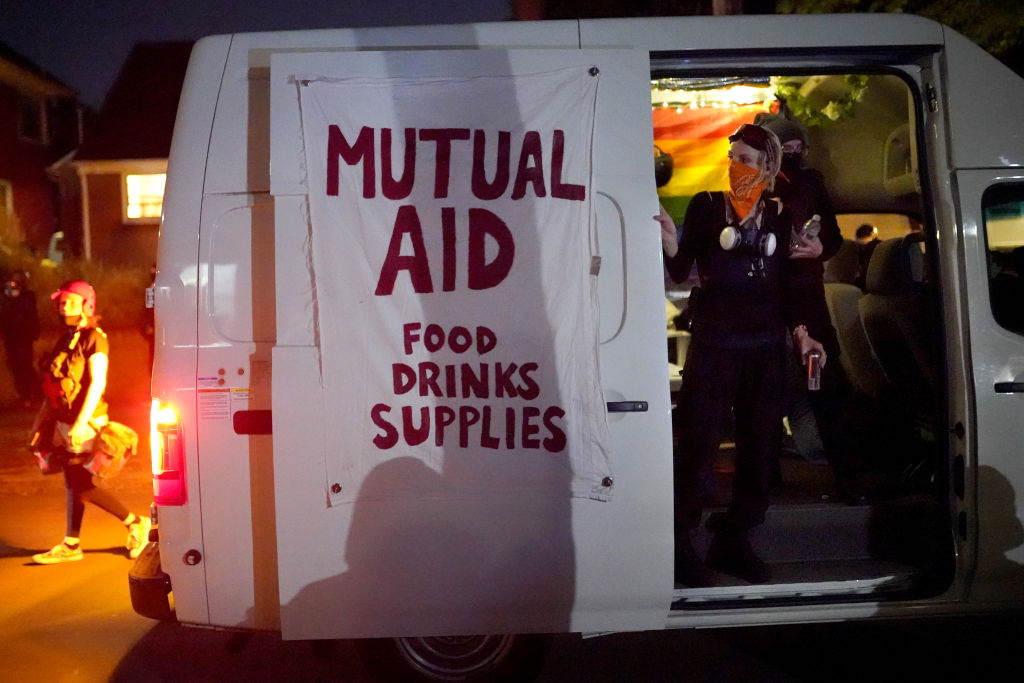
Therefore, investing in local leadership includes supporting calls from local organizations. For example, local organizers in Minnesota have called for a statewide day of mourning and action (a day of “no work, no school, no shopping”) on January 23, backed by labor unions and community organizations. Practicing real solidarity means supporting these calls and observing boycotts to ensure communities are not isolated and undermined, and to demand that they receive long-term investment. As one Minnesota rideshare driver stated at a press conference announcing the boycott, the community is facing “a tsunami of hate from our own federal government,” and they are committed to overcoming it together. In addition to heeding local calls for boycotts, investing in the ecosystem of local organizations, amplifying frontline narratives, and supporting community groups engaged in critical mutual aid and community defense work is crucial.
Local and State Municipal Resistance Is Key
As federal overreach accelerates, governors, mayors, city councils, and state legislatures must act as a front line of defense. Municipal and state governments should immediately end collaboration with ICE and other federal enforcement agencies through binding rulemaking, executive orders, and policies that prohibit data sharing and joint operations. These policies include ending participation in the 287(g) program that deputizes local police and accelerates the militarization of law enforcement, and withdrawing cities and localities from Joint Terrorism Task Forces.
Breaking isolation and fear through hosting “know your rights” trainings, shared meals, safety networks, and collective care is a material intervention against fascism.
States must also fully use litigation to challenge federal overreach, even when courts appear hostile or captured by MAGA-aligned judges. Lawsuits are not only a legal strategy; they are a narrative strategy, and a method to contest the hijacking of the law itself and to bring the demands of the streets into the courts. At the minimum, state and local governments have a responsibility to pursue the fullest extent of the law in response. As examples, both Minnesota and Illinois have sued the federal government, challenging ICE, the Department of Homeland Security, and Customs and Border Protection for unconstitutional enforcement practices, arguing that the deployment of heavily armed, often unidentified federal agents into neighborhoods violates constitutional protections and state and local authority. These lawsuits are key in demonstrating that local governments won’t capitulate and will resist federal overreach.
States and cities must also expose the cost of these operations and practice real public transparency and accountability.
The work of exposing the financial and human cost of federal law enforcement, ICE, and National Guard deployments to occupy cities is vital for documenting the human and financial cost of state terror. For example, Operation Midway Blitz alone cost taxpayers in Illinois more than $59 million, including approximately $34 million spent on ICE operations. From Minnesota and across the country, fear of ICE is reshaping daily life as families opt out of schools, immigrant economic corridors collapse, essential workers vanish, and community stability breaks down.
The murder of Renee Nicole Good is a warning. It reveals how quickly policies written in bureaucratic language and directives such as NSPM-7 can become lethal when combined with impunity and unchecked force. Across the country, in the wake of her killing, there is an uptick in reports of ICE and federal law enforcement officers violently shooting and targeting community members. Trump is threatening to escalate the situation further by threatening to invoke the Insurrection Act in order to deploy the military against Minneapolis. Justice for Renee Good requires more than mourning; it demands accountability, organizing, and refusal. The front line of community defense has always been neighbors. Breaking isolation and fear through hosting “know your rights” trainings, shared meals, safety networks, and collective care is a material intervention against fascism. Fascism succeeds when the masses of people are transformed into its enforcing arm. Preventing that transformation is one of the most critical fronts of resistance.
Press freedom is under attack
As Trump cracks down on political speech, independent media is increasingly necessary.
Truthout produces reporting you won’t see in the mainstream: journalism from the frontlines of global conflict, interviews with grassroots movement leaders, high-quality legal analysis and more.
Our work is possible thanks to reader support. Help Truthout catalyze change and social justice — make a tax-deductible monthly or one-time donation today.
This article is licensed under Creative Commons (CC BY-NC-ND 4.0), and you are free to share and republish under the terms of the license.

Darakshan Raja Darakshan Raja is the founding executive director of Muslims for Just Futures, a grassroots organization that builds power in Muslim communities through community organizing, advocacy, and movement building.