Showing posts sorted by date for query HOLODOMOR. Sort by relevance Show all posts

Tuesday, January 13, 2026


Russian imperialism: A historical approach


Russia

First published at Europe Solidaire Sans Frontières.

[ESSF editor’s note: We reproduce here a portion of the second chapter of Zbigniew M. Kowalewski’s work, Révolutions ukrainiennes, 1917-1919 & 20141, which presents the historical characteristics of Russian imperialism. We have not reproduced its original footnotes. This fundamental book was released in Paris in September 2025. It is the product of several decades of research by the author on the missed encounter between the Russian and Ukrainian revolutions of the early twentieth century, as well as on the upheaval of 2014.2]

Today, in a war decisive on a global scale, the Ukrainian nation is struggling to preserve its independence, won only 30 years ago, after centuries of domination and relentless Russification. These were intended to make Ukraine a variation of the “trinitarian” Russian nation (Russia, Ukraine and Belarus), imagined during the Tsarist era and claimed by Vladimir Putin. The Russian ruling class is thus fighting for the revival of a Russian imperialism in full decline which, without control over Ukraine, would risk disappearing from the historical stage.3

In 1937, at a reception organised to mark the 20th anniversary of the October Revolution, Joseph Stalin raised a toast “to the destruction of all enemies—them and their families, down to the last one!” As Georgi Dimitrov4, an eyewitness, noted in his diary at the time, whilst raising this toast, Stalin added that the tsars had “accomplished a good thing: they had assembled an immense State, extending to Kamchatka”,5 and “we, the Bolsheviks, have consolidated and strengthened it as a single and indivisible State”. Consequently, “whoever seeks to detach a part or a nationality from it is an enemy, a sworn enemy of the State and the peoples of the USSR. And we shall destroy such an enemy, even if he is an old Bolshevik; we shall destroy all his kin, his family. We shall exterminate without mercy anyone who cries out, by his actions and his thoughts (yes, and his thoughts), against the unity of the socialist State. We shall exterminate all these enemies to the end, themselves and their lineage!”

At all times, Russian imperialism has rested upon the idea of “gathering the Russian lands” and building “Russia one and indivisible”. Throughout the historical phases of its development, since the Tsardom of Russia (1547–1721), this imperialism has always been — and remains — as singular as the social formation of Russia itself. In elaborating his theory of “modern capitalist imperialism”, Vladimir Lenin emphasised its relative weakness, whilst “military-feudal imperialism” was stronger there. Describing the latter as feudal was an excessive simplification. From the mid-sixteenth century, undoubtedly, in the era of Ivan the Terrible,6 the Russian social formation essentially combined two different pre-capitalist modes of exploitation. The first, feudal, rested upon the extortion of surplus labour from peasants, in the form of rent, by landowners. The second, tributary, probably modelled on that of the Ottoman Empire, levied a tax on peasants for the benefit of the state bureaucracy. It was the latter that dominated in this combination of modes of exploitation.

In the Soviet Union, the Stalinist dogma of the unilinear development of humanity, with its five stages, held sway. The tributary mode of exploitation had no place there, all the more so as it could be associated (superficially, but not without reason) with the domination of the Stalinist bureaucracy. Certain Soviet historians, without clearly transgressing this schema, skilfully circumvented it by speaking of a “State” or “Oriental” feudalism, distinct from “private” “Western” feudalism. From the mid-seventeenth century, and almost until the abolition of serfdom in 1861, the third form of exploitation — the most terrible for the peasantry — into which Russian serfdom had actually degenerated, was slavery, including the trafficking of human beings.

A minimal surplus product

None of these modes of exploitation represented (contrary to the discursive habits claiming to be Marxist) a mode of production, because they did not manage to subordinate the productive forces either formally (without reorganising the production process) or really (by reorganising the production process). They therefore did not systematically guarantee their sustainable development.

However, it was on the basis of these modes of exploitation that the Russian State was formed in its singularity. From 1565 to 1572, Ivan the Terrible unleashed the very first Great Terror in Russia, the oprichnina,7 before drowning in it himself. As Ruslan Skrynnikov, one of the leading specialists on this tsar’s reign, observed, “certain of its practices contained, as if in embryo, all the subsequent development of the absolutist noble and bureaucratic monarchy”. Indeed, it carried within it the germ of all Russian despotic regimes, up to those of the twentieth and twenty-first centuries.

Another contemporary historian, Leonid Milov, formulated highly illuminating theses on the particularities of “the history of Russia as a society with a minimal total surplus product”. Evoking the natural and climatic conditions of agricultural production, he showed that central Russia depended on a very brief agricultural season, due to the climate — from early May to late September (in Western Europe, this generally ran from early March to late November) — and the predominance of lands poor in humus.

These two factors resulted in “low fertility, and therefore, a low volume of the society’s total surplus product, this until the mechanisation of this type of activity”, which “produced, in this region, for centuries, the conditions for the existence of a relatively primitive agricultural society”. Consequently, “in order to obtain a minimal result, it was necessary to concentrate labour, as much as possible, within a relatively short period of time. The individual peasant farm could not achieve the indispensable degree of concentration of efforts during the objectively determined agricultural work seasons”, such that its fragility “was compensated, throughout almost the entire thousand-year history of the Russian State, by the very great role of the peasant commune”.

Unity of opposites

Peasants’ surplus labour could only be extorted — to a large extent or even entirely — at the expense of the labour necessary for their own reproduction, that is, by methods of absolute exploitation (rather than by relative exploitation, based on increasing labour productivity). This was not possible without imposing upon them the harshest serfdom regime, all the more so as, given the general conditions of production, a strong communal organisation of labour was indispensable. The necessity of “optimising the size of the total surplus product” — of increasing it in the interest of state apparatuses and the ruling class — was pressing, but “on the path of this ’optimisation’, that is, of the objective necessity of intensifying peasant exploitation, stood this same peasant commune, bastion of local cohesion and vector of peasant resistance”.

From this was born “a sort of unity of opposites: what counterbalanced the inevitable existence of the commune was the most brutal and severe variant of personal dependence of each member of this organism”. The impossibility of overcoming this contradiction without a considerable development of productive forces, which pre-capitalist relations of exploitation did not permit, had a major consequence for the State. Its role was thus to “create a monolithic and powerful ruling class, capable of eradicating or neutralising the defence mechanisms of the agrarian commune in the process of daily exploitation of the peasantry”. Milov summarises this process thus:

The inevitability of the commune’s existence, conditioned by its productive and social functions, ultimately gave life to mechanisms of extreme severity and brutality for extracting an optimum surplus product. Hence the emergence of a serfdom regime, which managed to neutralise the commune as a fulcrum of peasant resistance. In turn, this serfdom regime became possible only due to the development of the most despotic forms of state power—the Russian autocratic regime.

It was this autocratic regime that managed to weld together the ruling class.

Where does the periphery begin?

At the same time, however, “the extremely extensive character of agricultural production and the objective impossibility of intensifying it meant that the principal historical domain of the Russian State could not support an increase in population density. Hence the constant necessity, over centuries, for the population to migrate towards new territories in search of more fertile arable lands, more favourable climatic conditions for agriculture, etc.” Moreover, “migratory processes went hand in hand with the strengthening of an absolutist State, capable of controlling and defending vast zones of the country”, and hence, with the constitution of considerable armed forces, although “the extremely small size of the total surplus product objectively created very unfavourable conditions for the formation of the so-called superstructure above the base structures”.

This secular colonial, military and state expansion towards the south, south-east and east progressively encompassed vast zones, increasingly extensive “allogene” peripheral territories and increasingly distant neighbouring countries, victims of conquest. This expansion was accompanied by several hundred years of struggle by the Tsardom of Russia, then the Russian Empire (1721–1917), for access to ice-free maritime ports, in the west and east. Hence the legitimate questions, to which it is so difficult to respond correctly: “When did Russian colonisation begin—with the occupation of Kazan, an ethnically foreign city, or of Novgorod, ethnically close?” The Republic of Novgorod fell to the Moscow army in 1478,8 and the Khanate of Kazan in 1552.9

“Where are the borders of the Russian metropole situated, where do the Russian colonies begin, and how can they be distinguished?” For these lines of demarcation have changed so many times...

Russia’s borders expanded with such rapidity, both before the rise of tsarism and during the tsarist era, that the very distinction between “external” and “internal” was fluid and indeterminate.

Military-colonial conquests

The historical formation of Russia was shaped by the process of military-colonial conquest of the countryside and the Russian peasantry; by peasant wars, in fact anti-colonial, provoked by this process; by internal and external colonisation; by colonial conquests, pillage and oppression of other peoples. As Alexander Etkind rightly states, “both at its distant frontiers and in its dark depths, the Russian empire was an immense colonial system”.10 Contrary to Russian mythology, the conquest of a domain as considerable as Siberia did not “extend Muscovite territory to the Chinese border”. It transformed Siberia into a typical colony. Yet it is common to perceive Siberia as an inseparable part of Russia, just as, later, Poland, Lithuania, Finland, Ukraine, the Caucasus, Bukhara and Tuva — among others.

Certain Russian historians have made their theoretical contribution to the construction of this dominant and timeless “Russian vision”, as can be observed today, by speaking of Russia’s “self-colonisation”. The lands it successively seized would not have become its colonies, since it would have “colonised itself”, being without borders (and would remain so in an asserted or concealed manner, from the point of view of its dominant ideology). After taking the Ukraine of the left bank of the Dnieper in the seventeenth century, Russia’s participation in the partition of the Polish-Lithuanian Commonwealth11 in the final decades of the eighteenth century enabled it to seize the greater part of right-bank Ukraine — that is, in total, 80% of Ukrainian lands. This fundamental strategic gain enabled it to reach deep into Europe, henceforth determining the scope and Eurasian character of its empire. “We have found no other means to guarantee our borders ... than to extend them,” wrote Catherine II to Voltaire on 12 September 1772, to justify this new annexation. Putin says nothing different today.

Whilst the Russian nobility was a ruling order, land never became entirely the private property of nobles, which would have been contrary to the primordial interests of the imperial State. In its construction, no social class played as important a role as the State itself — its apparatuses and its bureaucratic personnel. This construction did not consist solely in the development of a colossal army, at the cost of twenty-five years of peasant military service, immense military and civilian infrastructures, financed by the forced labour of hundreds of thousands of other peasants dependent on the State as well as on landowners, but also of entire brigades of master craftsmen sent to truly forced labour in different parts of the country. Moreover, as Milov states, “the state machine was compelled to advance the process of social division of labour, and above all the separation of industry and agriculture”, against the dominant modes of exploitation that hindered this process.

Industrial serfdom

Consequently, “the State’s participation in creating industry in the country contributed to producing a gigantic leap in the development of productive forces, although the borrowing of ’Western technologies’ by archaic society in the seventeenth and eighteenth centuries generated monstrous social effects: a mass of workers appeared, attached forever to factories and workplaces (the ’perpetually subjected’), which stimulated society’s slide towards slavery”. The enormous Russian military-industrial complex, whose core consisted of Ural metallurgy, was not established on the basis of the development of capitalist relations, but within the framework of feudal and tributary relations.

It is true that commercial capital flourished, but within the framework of pre-capitalist relations of production which it helped to reinforce, thereby hindering the very development of capitalism — “merchant capital developed, not in depth, not by transforming production, but on the surface, extending the radius of its operations” by moving “from the centre towards the periphery, following the peasants who were dispersing and, in search of new lands and tax exemptions, penetrating new territories”. Founded on extra-economic coercion, pre-capitalist modes of exploitation dominated the capitalist mode of production in Russia, until the revolution of 1917, not only in agriculture, but also in industry, long after the reform of 1861.

When Russian social democracy constituted itself as a party, the labour of approximately 30% of industrial workers was still dominated by serfdom, and not by wage labour, something that this social democracy, including Iskra,12 associating industry (that is, the productive forces, and not the relations of production) with capitalism, failed to see. “Even at the beginning of the twentieth century, more than half of the industrial enterprises of the main industrial core (the steel industry) were not capitalist in the strict sense of the term,” affirms Mikhail Voeikov. The pre-capitalist methods of extracting surplus product from the labour of direct producers that still prevailed “did not allow national capital to effect the necessary accumulation”, which is why “foreign capital was so powerful”. When capital managed to dominate the Russian economy, it was almost immediately big capital, which rapidly contributed to developing processes of monopolisation.

A multiplicity of revolutions

In Russia, “capitalist imperialism of the modern type” was emerging, but it was “wrapped” — wrote Lenin, just before the revolution of 1917 — in “a particularly tight network of pre-capitalist relations”, so dense that “what, in general, predominates in Russia is military and feudal imperialism”. The foundation of this imperialism was “the monopoly of military force, the immensity of territory or particular facilities for pillaging the allogenes, China, etc.”, that is, the non-Russian peoples within Russia itself and the peoples of neighbouring countries. At the same time, Lenin observed further, these particularities “partially supplement, partially replace the monopoly of contemporary, modern financial capital”. Almost all the exegetes of Lenin’s writings on imperialism fail to mention this theoretical proposition, which is nevertheless capital for the study of Russian formation.

The collapse of this interweaving of Russian “military and feudal” imperialism with capitalist imperialism was not the work of a single revolution, but of several revolutions converging and diverging, forming alliances and violently clashing.13 The Russian Revolution was one of them. At the centre of the empire, it was a workers’ and peasants’ revolution; in the colonial periphery, it relied on Russian and Russified urban minorities and settler colonies. It therefore had a colonial character, as did the Russian soviet power it established. This is what the Bolshevik Georgi Safarov demonstrated well in his formerly classic work on the “colonial revolution” in Turkestan:14

Membership in the industrial proletariat of the Tsarist colony was a national privilege of the Russians. This is why, here too, the dictatorship of the proletariat took on, from the very first moments, a typically colonising appearance [emphasised in the original].

However, among the oppressed peoples, the Russian revolution also triggered national revolutions. The most territorially extensive, the most violent, the most dynamic and the most unpredictable of these was the Ukrainian revolution.15 Its eruption, and even more so its powerful momentum, were unexpected. Since 1775 and the annihilation of the Zaporozhian Sich,16 the bastion of the free Cossacks, by the Russian army, it was the first time that the Ukrainian people had claimed their independence. They did not seem called to fight for it, still less capable of conquering it, since they were a peasant people, without national landowners or capitalists, with a thin layer of petty bourgeois, intellectuals and workers, speaking a historically persecuted language, whilst their cities were Russian or Russified, as were two-thirds of their urban working class. Yet the Central Rada17 of Kyiv, composed mainly of representatives of Ukrainian left-wing parties and delegates from Ukrainian soldiers’ and peasants’ movements, would erect itself de facto, within a few months, as a state power. It would proclaim Ukrainian independence only when, after the Bolsheviks seized power in Russia, it found itself at war with them...

The transformations of Russian imperialism

The central leadership of the Bolshevik Party, led by Stalin, opposed aspirations for independence with a linguistic and cultural nationalisation of the non-Russian republics. Unexpectedly for its Moscow promoters, Ukrainisation transformed itself into a prolongation of the Ukrainian national revolution, which it revived and remarkably revitalised. It lasted almost ten years, until 1932. Extermination by famine (Holodomor)18 and the crushing of Ukrainisation through terror were simultaneously a constitutive act of the Stalinist bureaucracy, breaking with the Thermidorian19 bureaucracy that had reigned until then (and would soon be exterminated by it) and an act of renaissance of Russian imperialism—this time, military-bureaucratic.

The latter was strengthened through the unification of Ukrainian (and Belarusian) lands following the partition of Poland by Hitler and Stalin, and the annexation of the Baltic States, carried out in 1939 and confirmed in 1944, during the victorious war against German imperialism. The gigantic pillaging of the industrial potential of the Soviet occupation zone of Germany, as well as domination over the Eastern European states, whose political submission was maintained by the permanent threat of military intervention, consolidated the bureaucratic renaissance of Russian imperialism. As early as 1946, Jean van Heijenoort20 was the first Marxist to describe this renaissance with great theoretical rigour.

The sudden collapse of the USSR, totally unexpected, in 1991, revealed the nature of this State, created on the basis of Stalin’s Great Terror. What Ukraine had not managed to achieve during the collapse of the Russian Empire, it was able to obtain during the collapse of the Soviet Union: it detached itself from it, as did thirteen other of the largest non-Russian nations. By declaring its national independence, it dealt a decisive blow to Russian military-bureaucratic imperialism.

Restored on the ruins of the USSR, Russian capitalism remains today dependent on the same extra-economic monopoly on which past modes of exploitation depended and, like them, it is distorted by this dependence. The Russian State protects capitalist private property, but at the same time, it restricts it, because private property is subject to its domination, just as the fusion of its apparatus with big capital reduces and distorts competition between them. It is thus, subjected to the weight of this monopoly, that oligarchic state capitalism and military-oligarchic imperialism have taken shape today in Russia.21

The imperative of reconquest

However, this monopoly has undergone considerable degradation, although extremely uneven. Russia has retained its “monopoly of military force”, insofar as, after the collapse of the USSR, it remained the world’s leading nuclear power, endowed with an enormous army. In contrast, its monopoly of “the immensity of territory or particular facilities for pillaging” other peoples has profoundly declined. As Zbigniew Brzezinski22 observed, after the collapse of the USSR, Russia retreated spectacularly "to the limits from which it had emerged in a now distant past.

In the Caucasus, it stopped at the borders of the early nineteenth century, in Central Asia, at those fixed in the middle of the same century, and—more painfully still—in the west, it returned to the dimensions attained at the end of Ivan the Terrible’s reign, in 1584“. Worst of all,”without Ukraine, Russia ceases to be an empire in Eurasia. And even if it strove to recover such a status, its centre of gravity would then be displaced, and this essentially Asian empire would be doomed to weakness“. Brzezinski was right when he wrote that”for Moscow, on the other hand, re-establishing control over Ukraine—a country of [forty] million inhabitants, endowed with numerous resources and access to the Black Sea—means securing the means to once again become a powerful imperial state, extending across Europe and Asia".

This is why Russian imperialism has launched itself into the reconquest of Ukraine, where its very destiny is at stake.

Zbigniew Marcin Kowalewski is a Polish Marxist historian, former leader of Solidarność in Łódź, and former editor of Inprekor, a Fourth International magazine published clandestinely in Poland from 1981 to 1990. He has published extensively on Ukrainian history and the national question.23

  • 1

    Révolutions ukrainiennes, 1917-1919 & 2014 (Ukrainian Revolutions, 1917-1919 & 2014) was published by Éditions Syllepse in Paris in September 2025.

  • 2

    On Ukrainian independence and Russian imperialism, see Zbigniew Kowalewski, “Russia’s Imperial Identity: From Tsars to Putin”, Europe Solidaire Sans Frontières. Available at: https://www.europe-solidaire.org/spip.php?article33683

  • 3

    On debates about Russian imperialism today, see Michael Pröbsting, “Russian Imperialism and Its Monopolies”, LINKS, January 2022. Available at: https://links.org.au/russian-imperialism-and-its-monopolies

  • 4

    Georgi Dimitrov (1882–1949) was a Bulgarian communist leader who headed the Communist International from 1934 to 1943. He became famous for his defiant defence at the 1933 Reichstag Fire Trial in Nazi Germany.

  • 5

    The Kamchatka Peninsula is located in Russia’s Far East, extending into the Pacific Ocean. Its conquest in the late seventeenth century marked the eastern extent of Russian imperial expansion across Siberia.

  • 6

    Ivan IV (1530–1584), known as Ivan the Terrible, was the first Tsar of Russia. His reign was marked by centralisation of power, territorial expansion, and brutal repression, including the creation of the Oprichnina secret police.

  • 7

    The Oprichnina (1565–1572) was a state policy implemented by Ivan the Terrible that created a separate territory and personal guard under the Tsar’s direct control. The Oprichniki terrorised the nobility (boyars) and anyone suspected of opposition, establishing patterns of state terror that would recur in Russian history.

  • 8

    The Novgorod Republic was a medieval Russian state centred on the city of Novgorod. Its conquest by Ivan III of Moscow in 1478 was a crucial step in the formation of the centralised Russian state.

  • 9

    The Khanate of Kazan was a Tatar state that emerged from the dissolution of the Golden Horde. Its conquest by Ivan the Terrible in 1552 marked the beginning of Russian expansion into Muslim territories and the incorporation of significant non-Russian populations into the empire.

  • 10

    See Ilya Matveev, “The ’two logics’ of imperialism”, Green Left, October 2024. Available at: https://www.greenleft.org.au/2024/1416/world/two-logics-imperialism 

  • 11

    The Polish-Lithuanian Commonwealth (Rzeczpospolita, 1569–1795) was a bi-confederate state formed by the Kingdom of Poland and the Grand Duchy of Lithuania. It was partitioned in three stages (1772, 1793, 1795) by Russia, Prussia and Austria, erasing it from the map until 1918.

  • 12

    Iskra (The Spark) was a political newspaper founded by Lenin in 1900, which served as the organisational basis for the Russian Social Democratic Labour Party. It played a central role in building the Marxist movement in Russia.

  • 13

    On the complex interplay of revolutions in 1917, see Marko Bojcun, “How the Ukrainian Working Class Was Born”, Europe Solidaire Sans Frontières, March 2022. Available at: https://europe-solidaire.org/spip.php?article61817

  • 14

    Turkestan was the Russian imperial designation for Central Asia. Georgi Safarov’s 1921 book Kolonial’naia revoliutsiia: Opyt Turkestana (Colonial Revolution: The Experience of Turkestan) was a critical analysis of Bolshevik policy in Central Asia.

  • 15

    On the Ukrainian revolution, see “The progressive legacy of the Ukrainian People’s Republic (1917-1921)”, Europe Solidaire Sans Frontières, January 2024. Available at: https://europe-solidaire.org/spip.php?article71163

  • 16

    The Zaporozhian Sich was the political and military centre of the Zaporozhian Cossacks, located on islands in the Dnieper River. It was destroyed by Catherine II’s forces in 1775, ending Cossack autonomy and symbolising the suppression of Ukrainian self-governance.

  • 17

    The Central Rada (Tsentralna Rada) was the Ukrainian revolutionary parliament that emerged in March 1917. Initially seeking autonomy within a democratic Russia, it proclaimed Ukrainian independence in January 1918 following the Bolshevik seizure of power.

  • 18

    The Holodomor (1932–1933) was a man-made famine in Soviet Ukraine that killed millions of Ukrainians. It resulted from Stalin’s forced collectivisation policies and deliberate grain requisitions. Ukraine and many other countries recognise it as a genocide against the Ukrainian people.

  • 19

    The term “Thermidorian” refers to the period of conservative reaction following the radical phase of a revolution, named after the Thermidorian Reaction of 1794 which ended the radical phase of the French Revolution. In Soviet context, it describes the bureaucratic degeneration of the revolution under Stalin.

  • 20

    Jean van Heijenoort (1912–1986) was a French-American mathematician and Marxist theorist. He served as Leon Trotsky’s secretary from 1932 to 1939 and later became a distinguished logician and historian of mathematical logic.

  • 21

    On the contemporary form of Russian imperialism, see Ilya Budraitskis, “III / The war in Ukraine and Russian capital: From military-economic to full military imperialism”, LINKS, June 2024. Available at: https://links.org.au/war-ukraine-and-russian-capital-military-economic-full-military-imperialism

  • 22

    Zbigniew Brzezinski (1928–2017) was a Polish-American political scientist who served as US National Security Advisor under President Jimmy Carter (1977–1981). His 1997 book The Grand Chessboard analysed post-Soviet geopolitics and Ukraine’s strategic importance.

  • 23

    See Zbigniew Kowalewski, “How Ukraine won its independence, in Soviet times, and the lessons for today”, Europe Solidaire Sans Frontières, March 2022. Available at: http://www.europe-solidaire.org/spip.php?article61479

Monday, November 03, 2025

Conservative judge slams SCOTUS for ignoring Trump’s 'vicious attacks on federal courts'

Alex Henderson,
 AlterNet
November 2, 2025 

FILE PHOTO: WASHINGTON, DC - MARCH 04: U.S. President Donald Trump greets Chief Justice of the United States John G. Roberts, Jr as he arrives to deliver an address to a joint session of Congress at the U.S. Capitol on March 04, 2025 in Washington, DC. Win McNamee/Pool via REUTERS/File Photo

Like attorney George Conway, retired federal Judge J. Michael Luttig is a prominent figure in the conservative legal movement who became a blistering critic of President Donald Trump and considers him a dangerous threat to U.S. democracy.

Luttig rooted for Democratic presidential nominee Kamala Harris in 2024, as did Conway. Now, nine and one-half months into Trump's second presidency, Luttig is still sounding the alarm.

During a Sunday morning, November 2 appearance on MSNBC, Luttig argued that because the U.S. Supreme Court is failing to discourage Trump's attacks on democracy and the rule of law, it's up to the lower federal courts to fight back.

Noting recent anti-Trump pleas from U.S. Circuit Court Judge Susan Graber and others, Luttig told host Ali Velshi, "These pleas would never have to occur if the Supreme Court of the United States had reassured America that it sits in order to prevent this kind of tyranny in the United States of America. But as you know, the Supreme Court has done anything but reassure America. That's why, for the first time to my knowledge — in all of American history — the federal judges and also the state judges now have no choice but to speak directly to the American people through their opinions, I must add, rather than speak only to the Supreme Court of the United States."

Luttig continued, "There has never been a time in our history like this, Ali, for the federal judiciary. Never before has the federal judiciary and even individual judges — individual judges of the federal courts — been savagely attacked by the president of the United States of America. His aim is clear: It's to delegitimize the federal courts in the eyes of the American people and to intimidate the federal courts into ruling in his favor."

The conservative jurist was also highly critical of U.S. Attorney General Pam Bondi.

Luttig told Velshi, "But as I said…. the lower federal courts of the United States — by which I mean the federal district courts and the U.S. courts of appeals — will not be intimidated by this president and his attorney general. They will, to the person and to the court, honor their oath to support and defend the Constitution of the United States against all enemies, foreign and domestic."

When Velshi asked Luttig if he had a message for Chief Justice John Roberts and others on the High Court, he responded, "The Supreme Court and the chief justice of the United States have no higher obligation to the country or to the Constitution than to condemn the vicious attacks on the federal courts and even on individual judges of those courts."


'Political poison': Wall Street Journal editors issue searing rebuke of the 'new right'

Robert Davis
November 2, 2025 
RAW STORY


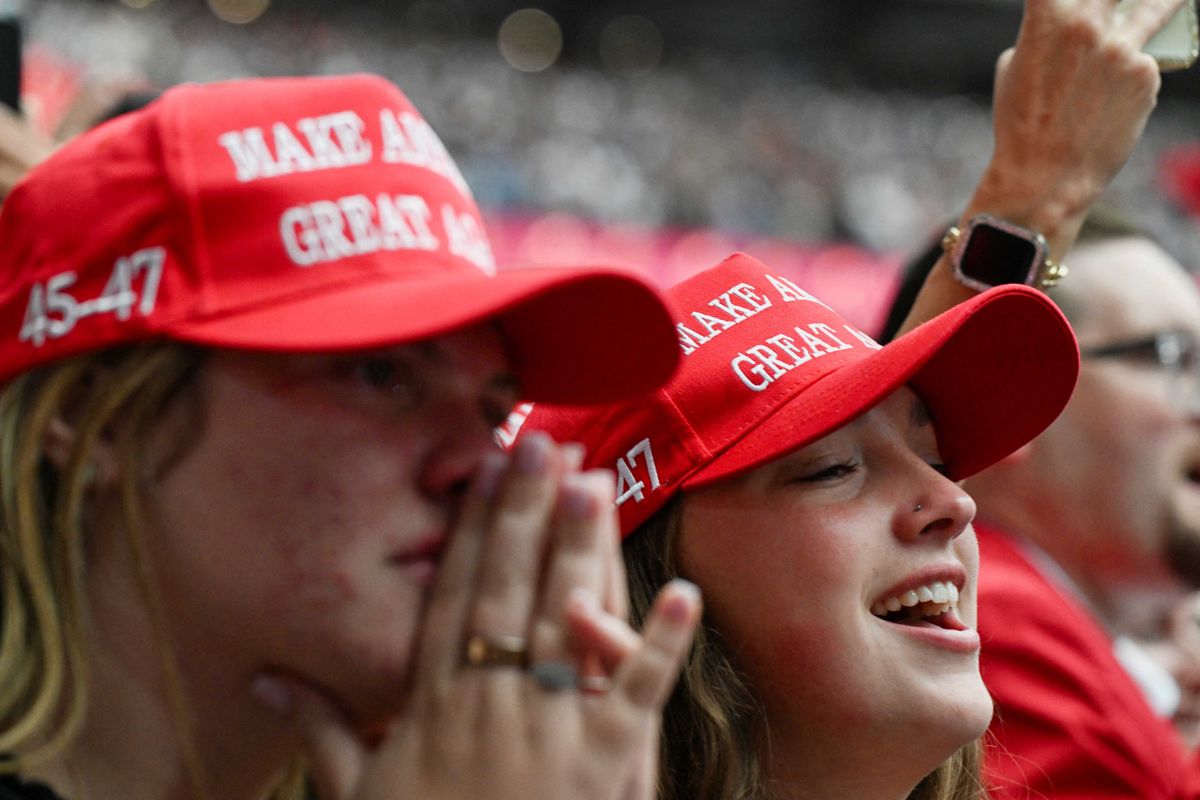
Supporters wearing MAGA hats listen as U.S. President Donald Trump speaks onstage during a memorial service for slain conservative commentator Charlie Kirk at State Farm Stadium, in Glendale, Arizona, U.S., September 21, 2025. REUTERS/Caitlin O'Hara

The Wall Street Journal's conservative editorial board issued a searing rebuke of the "political poison" metastasizing on the "new right" after one of MAGA's biggest media voices interviewed an avowed antisemite.

Last week, Tucker Carlson interviewed Nick Fuentes on Carlson's popular show on X. Throughout the interview, Fuentes made salacious and antisemitic comments about popular right-wing Jewish commentators like Josh Hammer, Mark Levin, and Ben Shapiro. He also claimed to be a fan of Joseph Stalin, who is known for murdering millions of his people and creating the mass starvation event in Ukraine known as the Holodomor.

After the interview, Heritage Foundation President Kevin Roberts defended Carlson for interviewing Fuentes. Roberts posted a video on X claiming that "cancelling Nick Fuentes is not the answer," and the Republican voters expect them to instead focus on defeating Democrats at the ballot box.

The Wall Street Journal's editors argued in a new editorial on Sunday that Roberts' response to Carlson's interview is an example of "political poison" frowning on the "new right."

"An old political poison is growing on the new right, led by podcasters and internet opportunists who are preoccupied with the Jews," the editorial board argued. "It is spreading wider and faster than we thought."

"If conservatives—and Republicans—don’t call out this poison in their own ranks before it corrupts more young minds, the right and America are entering dangerous territory," the editorial continued.

Read the entire editorial by clicking here.


'It's brazen': Conservative columnist blasts 'dark deeds' behind Trump's 'self-dealing'

Robert Davis
November 2, 2025
 RAW STORY


Conservative New York Times columnist David French penned a blistering takedown of the "dark deeds" behind President Donald Trump's brazen "self-dealing" during his second stint in the White House.

In a new column, French blasted Trump for accepting a $400 million plane from a foreign government, pardoning a cryptocurrency billionaire with links to Trump's businesses, and openly calling for his political foes to be prosecuted. French argued that the efforts of GOP leaders like Speaker Mike Johnson (R-LA) to defend the president's actions show how Trump has created a new political paradigm.

"If there is no cover-up, then there must not have been a crime," French wrote.

"If there is a word that describes the second Trump administration, it’s brazen," French continued. "While I certainly hold open the possibility that dark deeds are being done in secret, one thing that is remarkable is how open and obvious he is with his self-dealing."

French also described some of the statements made in defense of Trump's self-dealing as "remarkable." For instance, he pointed to Johnson's claim that Trump is being "transparent" about his actions as president.

"That’s a remarkable statement, and it’s assuredly not a real defense of Trump’s conduct," French wrote. "It’s as if Johnson is arguing that a bank robbery is only a crime if the assailant wears a mask. But if the robber walks in and smiles for the security cameras? Well, that’s out in the open. He’s not trying to conceal anything."

"Whether it’s by instinct or intention, Trump seems to have stumbled onto two key truths about his partisan supporters: They are desperate to rationalize, excuse and justify anything that he does, and they do not know much of anything about the law," he continued.

Read the entire column by clicking here.

Monday, September 01, 2025

INTERVIEW

Leftist Vermont Rep Tanya Vyhovsky Toured Ukraine. Here’s What She Learned.


A Ukrainian American DSA politician shares eyewitness thoughts on efforts to build solidarity with the Ukrainian left.
August 28, 2025

Children sit on the pavement outside a residential building after a Russian ballistic missile struck a bank building in the city center on August 28, 2025, in Kyiv, Ukraine.
Pierre Crom / Getty Images


Did you know that Truthout is a nonprofit and independently funded by readers like you? If you value what we do, please support our work with a donation.

Wednesday night, Russia staged its largest attack on Ukraine since President Donald Trump started the so-called peace process. Moscow launched 598 drones and 31 missiles on targets in Ukraine. Most of them were shot down, but many others still evaded Ukraine’s air defense systems, hitting over 20 locations in the capital, Kyiv, and severely damaging a building next to the European Union mission.

That came on the heels of a Russian missile strike on a U.S.-run factory in the country. Thus, despite the recent two summits that Trump called to reach a peace deal, Russia is in fact escalating its war on Ukraine.

In Alaska, Trump met with Russian President Vladimir Putin, who has an arrest warrant on his head from the International Criminal Court. In Washington, he met with Ukrainian President Volodymyr Zelenskyy along with several European heads of state. Trump has promised to orchestrate another meeting between Putin and Zelenskyy, something that now seems highly unlikely, as Ukraine opposes the imperialist conditions Russia expects from any settlement — annexation of land and a veto for Moscow on any security guarantees against future Russian attacks

Trump wanted to cut a deal with Putin for the partition of Ukraine. He hoped that would ensure U.S. corporations opportunities to plunder Ukraine’s mineral reserves and profit from the neoliberal reconstruction of the country. Likely above all he wanted a settlement so that he could turn Washington’s attention to its main imperial rival, China.

Trump and Putin planned to bully Zelenskyy into accepting “land swaps,” essentially agreeing to Russia’s illegal conquest of a whole swathe of Ukraine in return for peace. But the Ukrainian President is legally barred by the country’s constitution from surrendering sovereign land.

Related Story

“Sappers” Are Working to Demine Ukrainian Fields at Great Personal Risk
Humanitarian volunteers are doing perilous work to remove land mines that Russian soldiers left behind in 2022. By Theia Chatelle , Truthout July 15, 2025


Moreover, 70 percent of Ukrainians oppose any such land for peace deal. They know such a compromise would likely doom people under occupation to brutal oppression and that Putin will at best pause his war only to start it again to achieve his stated goal of subordinating Ukraine in Russia’s imperialist sphere of influence.

During this charade of a peace process, Putin actually escalated the war with increased missile strikes and drone attacks with the aim of annexing more land. In the midst of Putin’s escalation, Vermont State Senator Tanya Vyhovsky was in Ukraine on a speaking tour to build solidarity with the country’s progressive movement.

Vyhovsky is a Ukrainian American, clinical social worker, and a member of Vermont’s Progressive Party and the Democratic Socialists of America. In this exclusive interview, which has been lightly edited for clarity and concision, she speaks with Truthout about conditions in Ukraine, its progressive forces, and why the U.S. left should rally to support the country’s struggle for self-determination.

Ashley Smith: You were in Ukraine on a speaking tour to build solidarity with the Ukrainian resistance to Russia’s invasion and occupation of the country. What were conditions like?

Tanya Vyhovsky: I met with the broad progressive movement, including unions, political parties, leftist NGOs, and student unions. It was a powerful experience to connect to the people fighting for real leftist social change in Ukraine amid a full-scale invasion.

The war’s impact really depends on where you are in the country. In the capital, Kyiv, I saw many buildings that had been bombed — apartment buildings, factories, and small businesses. These were generally outside of the city center. But it’s not as bad as in other cities. The indirect impact of the war, though, is everywhere.

For example, you can’t visit the parliament, the Rada, because it is protected by razor wire and military patrols in order to keep the government safe and functioning. All the cities’ fountains have been turned off to save money. All the statues are sandbagged and wrapped, and in certain districts, the lower windows are sandbags. So, at first glance, Kyiv may not seem like a war zone, but if you look just beneath the surface, you see the signs of the war.

In Kryvyi Rih, which is closer to the front line, the war is in your face. The Russian forces bombed one of the city’s parks in April. There is a memorial there for the 19 people, including nine children, who were killed when the Russian military targeted the park with cluster munitions. I couldn’t stay in the city’s hotels because they have been bombed by Russia. Schools have been relocated to bomb shelters.

Dnipro was functioning much as usual, except that the windows all have sandbags and there are above-ground bomb shelters on nearly every corner. Three hours after I left the city, they suffered multiple ballistic missile attacks.

In Lviv, it feels for the most part like there isn’t a war. The statues are netted, people casually mention a church statue whose head fell off during a bombing, and there were occasional air raid sirens. But the curfew is very loosely adhered to. When I was there, there hadn’t been a Russian attack in six weeks. But the day after I left, there was a massive missile attack that killed people. So, despite differences, everywhere I felt like I was in a country under siege.

I spoke to many soldiers about what it’s been like for the past nearly four years. People say they’re tired but not broken and that they are not willing to give up. The vast majority of Ukrainians — from citizens to soldiers — oppose Trump’s attempt to cut a deal with Putin for the partition of their country. If that deal were struck, many service members told me there would have been a revolt among the troops.

While I was not able to go to cities on the front, I did speak to a lot of people particularly in Lviv that had been internally displaced from Zaporizhzhia, Kharkiv, and Kherson. They’ve had to try and rebuild their lives in Lviv and other cities where they’ve found refuge. They described the horrors of living under constant bombardment, especially for their kids, and felt like they had no choice but to flee.

These internally displaced people have put a strain on housing and the cost of living in the cities where they resettled. But everyone I spoke with said it was the duty of all Ukrainians to ensure that internally displaced people are welcomed, cared for, and protected.

While you were in Ukraine, President Trump held his two summits, first in Alaska and then in Washington. What were the various responses to these summits from Ukrainians?

While I was there, I watched all the coverage of Trump’s summit in Alaska with Putin. Because of my travel dates, I was only able to watch parts of Zelenskyy’s summit in D.C. Frankly, neither I nor any Ukrainian I spoke with think that Putin or Trump are looking for peace. The plan they’re putting forward is unacceptable on its face.

A lot of Ukrainians did not watch the summit and did not expect it to yield any results. Russia is making demands that Ukraine can in no way agree to. It is demanding that Ukraine give up sovereignty and accept occupation. Trump has positioned the U.S. as a middleman but with clear sympathies with Russia. The Ukrainians rightfully demand sovereignty and the return of all their land. So, with such diametrically opposed positions, it’s hard for Ukrainians to take this so-called peace process seriously.

Ukrainians often asked my advice on what Ukraine should do. That’s a question that I have no right to answer. Here in the U.S., I don’t face air raids, fighting on the front, and occupation. Only Ukrainians can decide what to do. But I can say, based on Ukraine’s history and the geopolitical situation in Eastern Europe and globally, that if Ukraine accepts a “deal” that includes occupation and further annexation of land, it will not end this war and lead to lasting peace.

Such a deal will simply pause Russian aggression until Putin has time to regroup and come back for more Ukrainian land. This is, of course, what happened after Russia’s first invasion in 2014. Putin took Crimea and sections of Donbas, bided his time, cut a deal, and then launched the war again in 2022.

Any deal will banish people in annexed areas to brutal Russian oppression. Currently, Ukrainians suffer terrible oppression under occupation. They certainly have not found peace and safety. The stories from Crimea are horrific. I really worry that an occupation will lead to full-scale genocide as it has in Palestine after 75 years of occupation.

Finally, I worry about the implications for democracy and sovereignty if Putin’s aggression is rewarded.

People in the U.S. know little about Ukraine’s progressive forces. What kinds of groups did you meet with? What were their main struggles, and how do they combine those with support for the liberation struggle?

There is a surprisingly vibrant and diverse progressive movement. I met with the federated unions, which are run by the state, as well as with the independent trade unions, which are much more politically active. I talked with members of the student unions (both federated and independent). I visited NGOs that are doing a variety of different work supporting civil society, supporting the armed forces, and supporting veterans.

I also met with a new grassroots political party, as well as with leaders of the feminist movement, young LGBTQ activists, and small groups of volunteers making food and mats for the military. They are all organizing around their issues and demands. They all voiced demands for better working conditions, higher wages, fair taxation, and expanded rights and access to reproductive health care, as well as for a more representative government. These are the same challenges we as working people face in the United States.

But, astonishingly, Ukraine is not as neoliberalized as the U.S.

Ukrainians have universal health care, strong public schools, and affordable if not always free university education. They are actually concerned that the West will condition its support for Ukraine with a pledge to enact a neoliberal reconstruction of the country with the usual requirements of privatization, deregulation, and austerity.

The Ukrainian left was critical of the status quo and critical of the government. But they know that their fight for expanded democratic rights and better social programs, wages and benefits cannot be separated from the struggle to defend the country. In fact, they contend that the more those issues are addressed, the more united the country will be in fighting to preserve its independence.

Recently, Zelensky passed a bill that undermined the independence of the government’s anti-corruption agency. But after popular protest, he reversed course. Various forces you met with played a major role in organizing the protests. What is the significance of these protests?

I met with many of the leaders and participants in these protests. While they are of course thankful that this catastrophic law was halted, they all feel that these anti-corruption agencies need to be strengthened, not just returned to the status quo.

We should recognize that these protests occurred under martial law. They were illegal. But unlike in Russia, where they would have been met with brutal repression, they were allowed to happen, and they scored a victory. That shows the vibrancy of Ukraine’s democratic freedoms even amid this war, something that Russian conquest — as we know from the occupied territories — would eradicate.

People are very critical of Zelensky and his neoliberal policies. But there was also a recognition that the war is a major obstacle to addressing these issues. At this point, they said, there is also no major left party that has representatives in parliament or grassroots power to advance their demands. But people are trying to build such a party to ensure that their country does not become a carbon copy of the United States. They want social and economic justice for all in a free and sovereign Ukraine.

As a Vermont State Senator, you are one of DSA’s prominent elected officials. While the left has uniformly supported Palestine’s struggle for self-determination, it has not extended the same solidarity to Ukraine’s struggle. Why?

I think the answer to this is complicated and the result of a flawed way of approaching the question of Ukraine and its struggle for self-determination. Some on the left believe that anything the United States is involved in must be bad and therefore because the U.S. has supported Ukraine they should oppose such support.

This is a form of American exceptionalism in reverse — the idea that everything the U.S. supports must be reactionary. This leads some on the left to oppose not just the U.S. but also Ukraine’s struggle for self-determination and, in some cases, even to support Russian imperialism. Others simply know little about the history of Ukraine’s resistance, including left-wing resistance to Russian imperialism. So, there is not the same kind of knee-jerk sympathy with Ukraine as there rightly is with Palestine.

There are also those who oppose all funding of any war. They hold the naive belief that if Ukraine just stops fighting it will bring about peace. That’s obviously not the case. If Ukrainians didn’t resist, Russia would simply conquer the country and impose dictatorial colonial rule. The truth is that if Russia stops fighting, there will be peace, but if Ukraine stops, there will be no Ukraine.

Finally, there is a subset of the left that mistakenly thinks that Russia is not an imperialist power but a progressive force standing up to the U.S. In reality, Putin heads a neoliberal, capitalist dictatorship. So, people on the left have various justifications for not supporting Ukraine’s struggle against occupation, genocide, and imperialism, but they are all wrong.

In your meetings with Ukraine’s progressive forces, what message did they want conveyed to the U.S. left? What do they want us to advocate here?

The Ukrainian left wants the U.S. left to know that they exist, that they are strong and united, and that they cannot fight for leftist values and ideals under Russian occupation. They told me so many stories from the long history of Ukraine’s struggle for freedom and justice all the way up to today. They implored me to ask the U.S. leftists to open their minds and hearts to their fight for collective liberation in Ukraine.

We should actually follow the example of the Ukrainian left that just organized a demonstration against Israel’s manufactured famine in Gaza at the memorial of the Holodomor, the famine Stalin imposed on Ukraine. The international left should follow the words of the chant, “from Ukraine to Palestine, occupation is crime.”

Finally, with Trump collaborating with Putin on plans to partition the country so he can turn his attention to Washington’s imperial rivalry with China, what can people here in the U.S. do to materially support Ukraine’s people?

There are many opportunities for people to provide desperately needed material support. They can donate to the Ukraine Solidarity Network’s fund drive to support the Ukrainian Nurses Union, Be Like We Are, to purchase essential life-saving equipment to treat their patients.

But the list is really endless. People can donate to campaigns that make freeze-dried emergency food for soldiers at the front and tarps to protect soldiers. The independent unions need money to rebuild houses and provide more care to wounded veterans. The teachers need help to renovate their bomb shelter schools, and the feminists need funding for comprehensive reproductive rights education.

There really isn’t any part of civil society or the military in Ukraine that would not benefit from material support. But, most importantly of all, all people of conscience must stand with Ukraine and support its struggle for self-determination. Their struggle is our struggle — one for peace, justice, and equality.


This article is licensed under Creative Commons (CC BY-NC-ND 4.0), and you are free to share and republish under the terms of the license.

Ashley Smith  is a socialist writer and activist in Burlington, Vermont. He has written in numerous publications including Truthout, The International Socialist Review, Socialist Worker, ZNet, Jacobin, New Politics, and many other online and print publications. He is currently working on a book for Haymarket Books entitled Socialism and Anti-Imperialism.