It’s possible that I shall make an ass of myself. But in that case one can always get out of it with a little dialectic. I have, of course, so worded my proposition as to be right either way (K.Marx, Letter to F.Engels on the Indian Mutiny)
Want to get away from everyone? Like, literally. Everyone.
There may be no better place on Earth than Point Nemo.
Hidden deep in the South Pacific, Point Nemo is the planet's "oceanic pole of inaccessibility"—the spot in the ocean farther from land than anywhere else. It sits roughly 1,670 miles from the nearest landmass in every direction.
As a recent Instagram post from Atlas Obscura puts it: "In the middle of the South Pacific is a place so remote that astronauts aboard the International Space Station can sometimes be closer than people on land."
That's not hyperbole.
When the ISS passes directly overhead at roughly 250 miles above Earth, its astronauts are dramatically closer than Point Nemo's nearest land, 1,670 miles away.
And there isn't even anything there.
"No beacon or anchored marker. Just vast expanses of open ocean," Atlas Obscura explains. The location wasn't even calculated until 1992, when Croatian-Canadian survey engineer Hrvoje Lukatela used computer software to pinpoint it. He named it after Captain Nemo from Jules Verne's Twenty Thousand Leagues Under the Sea. Its isolation has given Point Nemo another nickname: the Spacecraft Cemetery.
Nearly 300 decommissioned spacecraft have been deliberately brought down in the broader region, including Russia's Mir space station, because falling debris is extraordinarily unlikely to hit anyone.
Then things get creepy. In H.P. Lovecraft's 1928 The Call of Cthulhu, the sunken nightmare city of R'lyeh sits at coordinates only about 205 miles from Point Nemo. Lovecraft chose them more than 60 years before Point Nemo was actually identified.
And then came the Bloop.
In 1997, NOAA hydrophones thousands of miles apart picked up an incredibly loud, ultra-low-frequency noise in the South Pacific. Speculation naturally ran wild—especially among Lovecraft fans—but NOAA eventually determined the culprit was an icequake, created as Antarctic ice cracked and broke apart.
People do occasionally venture there.
Explorer Chris Brown documented an expedition from Chile across Point Nemo toward French Polynesia, where his team jumped into the ocean for what they called the "most remote swim ever recorded."
Imagine that for a moment.
You're floating in open water, more than 1,600 miles from land. The nearest humans might be in space. And somewhere beneath you is a graveyard of fallen spacecraft.
Comforting.
Welcome to Point Nemo, one of the strangest and creepiest places on Earth.
This story was originally published by Surfer on Oct 7, 2026, where it first appeared in the News section.
Sunday, September 20, 2026
Locked in Arctic ice, the floating lab studying climate and wildlife
A floating laboratory has begun drifting through Arctic sea ice on a mission set to last until late 2027, carrying scientists into one of the most isolated places on Earth. Built in France, the Tara Polar Station is carrying a crew of 12 to study biodiversity and the effects of climate change, as well as a dog to alert them to polar bears – and no one knows exactly where the ice will take them.
Named Tara Polaris I, the mission will carry the igloo-shaped station through the central Arctic Ocean, where it is now drifting with the sea ice.
Part boat, part research station, the Tara Polar Station was built in Cherbourg and set out from its home port of Lorient on 19 July on its first expedition to the North Pole. It is the second vessel operated by the private Tara Ocean Foundation.
Its journey north took it first to Rotterdam in the Netherlands to take on HVO fuel, a hydrotreated vegetable oil dubbed "renewable diesel", before continuing to Tromso and Kirkenes in Norway on its way towards the transpolar current, which carries sea ice across the Arctic Ocean.
The vessel then travelled along the Northeast Passage, a sea route along Russia's Arctic coast that gradually opens up during summer. In early September, it met Chinese icebreaker Xuelong 2, which cleared a path through the final few dozen kilometres.
The Tara Polar Station then became trapped in the ice and began drifting with it. At last report, those aboard were in the same time zone as Japan.
The first crew of 12 – eight men and four women – will live together on the ice until replacements arrive by plane in April. Their Arctic winter will include five months of polar night, while the mission as a whole is expected to last between 400 and 500 days.
Life aboard will be a closed world, Romain Troublé, director-general of the Tara Ocean Foundation, told RFI.
“Each of them can retreat to their cabin, to be isolated within the isolation. I think it's important to have a little private space,” Troublé said.
The Tara Polar Station can comfortably accommodate almost 20 people inside its 26-metre oval hull, which is 20 millimetres thick and designed to rise under pressure from the sea ice.
The vessel has a raised wheelhouse and can travel at 15 kilometres an hour, or eight knots, but is now drifting with its engines switched off.
A Finnish Lapphund named Orkki is also part of life on board, with the job of raising the alarm if polar bears approach.
“We have a captain, a first mate, a chief engineer, a cook, a doctor and an onboard correspondent,” Troublé added.
“The other six are engineers and scientists – specialists in ice, biology and genomics – who will work for all the laboratories involved in the project, a bit like on the International Space Station.”
Scientists aboard the Tara Polar Station are trying to understand what lives in the central Arctic Ocean and how climate change is affecting it. The region is warming three to four times faster than the rest of the planet.
Leading the scientific team is Canadian polar oceanographer Marcel Babin, a former research director with France's National Centre for Scientific Research (CNRS) at the Takuvik International Research Laboratory.
Takuvik is jointly overseen by the CNRS, Laval University in Quebec and Sorbonne University, while around 30 research centres from 12 countries are involved in the expedition.
Much of what the scientists have come to study lies directly beneath their feet. A central well runs through the lower, wet part of the station's hull, giving them direct access to the water beneath the sea ice and allowing them to observe species there.
The project has a touch of Jules Verne. The station was designed specifically for this kind of research, and this is the first time it has been placed in the ice for an entire winter.
French European Space Agency astronaut Thomas Pesquet is a patron and inaugurated the station alongside French fashion designer Agnès b, a founder of the Tara Ocean Foundation.
Pesquet would have happily joined the expedition himself, Troublé said.
“There are similarities with space. This experience of doing science remotely is interesting for us. A lot of what the European Space Agency does is important to us,” Troublé said.
The Tara Polaris I mission also coincides with the 20th anniversary of the Tara Arctic expedition, when a schooner spent 507 days drifting through Arctic sea ice between September 2006 and January 2008.
For all the planning that has gone into the expedition, once the Tara Polar Station is locked in the ice, its crew will have to deal with whatever the Arctic throws at them.
“We're ready for anything, but not everything we've planned for will happen, and anything we haven't planned for can happen,” Troublé said. “It's a way of thinking. You have to take surprises as they come.”
The hull itself is solid and the team is well prepared. Troublé is more concerned about the station's weak point – its rudder.
“The crew has just locked it in place, and it wasn't easy,” he said. “It's the part of the boat that will need their attention when the ice moves.”
But the greater worry is not necessarily the ice or the vessel. It is what Troublé called “the plain, stupid accident of everyday domestic life”.
The risks are the same as the crew face anywhere else, he explained, “except that out there, it's more complicated to go and rescue them”.
The expedition is also intended to look beyond this one journey.
Tara Ocean and its research partners want to document the North Pole and assess the health of the central Arctic Ocean, while Troublé hopes the foundation can eventually return to the sea ice every two years over the next two decades.
Polar night will begin in the coming weeks, leaving the Tara Polar Station to continue its drift through five months of Arctic darkness.
During the first months of next year, it is expected to move closer to the centre of the Arctic Ocean and the North Pole before eventually drifting back towards northern Europe, somewhere around Greenland, Svalbard or Iceland.
Along the way, researchers hope to learn more about Arctic biodiversity, species found only in the region and the processes taking place in the sea ice. They also want to understand what its disappearance could mean for fisheries and other processes important to people further south.
The findings could ultimately reach far beyond the expedition itself. Protecting the Arctic and deciding how it should be governed are also part of the project, including through the Arctic Council forum, with Troublé hoping its scientific data can help inform future political decisions on protecting polar regions.
But for all the research plans, there is one thing no one aboard can know: exactly where or when the ice will release the station.
“We don't know – it's a journey,” Troublé said. “We've put the boat in the ice, and we'll see where it comes out of the ice, and when.”
That uncertainty offers “a certain poetry in today's world, where everything is planned”.
This article was adapted from the original version in French by Igor Gauquelin.
Wednesday, April 15, 2026
VIDEO
Lost 19th Century Film By Méliès Discovered At The Library Of Congress
Photographic portrait of Georges Méliès at 34, in 1895. Photo Credit: Wikipedia Commons, retouched
The reels of film were old and battered and no one knew what was on them.
They were from before World War I and had been shuttled around from basements to barns to garages and had just been dropped off at the Library. There were about 10 of them and they were rusted. Some were misshapen. The nitrate film stock had crumbled to bits on some; other strips were stuck together.
The librarians peeled them apart and gently looked them over, frame by frame.
And there, on one film, was a black star painted onto a pedestal in the center of the screen. The action was of a magician and a robot battling it out in slapstick fashion. It took a bit, but then the gasp of realization: They were looking at “Gugusse and the Automaton,” a long-lost film by the iconic French filmmaker George Méliès at his Star Film company.
The 45-second film, made around 1897, was the first appearance on film of what might be called a robot, which had endeared it to generations of science fiction fans, even if they knew it only by reputation. It had not been seen by anyone in likely more than a century. The find, made last September but now being announced publicly, is a small but important addition to the legacy of world cinema and one of its founders.Gugusse et l’Automate English language title: Gugusse and the automaton
“This story is one that you see movies or television shows written about,” says Jason Evans Groth, curator of the Library’s moving image section.
“This is one of the collections that makes you realize why you do this,” said Courtney Holschuh, the archive technician who unraveled the film. (Here’s how they did it.)
Equally delighted was Bill McFarland, the donor who had driven the box of films from his home in Grand Rapids, Michigan, to the Library’s National Audio-Visual Conservation Center in Culpeper, Virginia, to have the cache evaluated.
His great-grandfather, William Delisle Frisbee, had been a potato farmer and schoolteacher in western Pennsylvania by day, but by night he was a traveling showman. He drove his horse and buggy from town to town to dazzle the locals with a projector and some of the world’s first moving pictures.
He set up shop in a local schoolroom, church, lodge or civic auditorium and showed magic lantern slides and short films with music from a newfangled phonograph. It was shocking.
“They must have been thrilled,” McFarland said. “They must have been out of their minds to see this motion picture and to hear the Edison phonograph.”
A Méliès film would have been an unforgettable experience to almost anyone in the 19th century.
A prominent French stage magician, he turned to filmmaking as soon as he saw the Lumière brothers’ world-first motion pictures in Paris in 1895. That a camera could rapidly project a series of still images on film and thus make them appear to move – “motion pictures” – was seen as a magic trick unto itself.
Méliès built his own camera and a glass studio (like a greenhouse) in Paris. He filmed ordinary scenes at first, but after accidentally discovering that a jump cut appeared on film as an astonishing transformation, he pioneered other tricks such as double exposure, black screens and forced perspective. All of these became staples of cinema. On screen, he could make a man appear to take off his head and flip it in the air, or a woman disappear, reappear and double.
He was also a devotee of the science fiction work of Jules Verne and H.G. Wells, and his films often featured surreal, fantastical sets and manic action. An image from his most famous film, “A Trip to the Moon” – that of a rocket landing in the eye of the man on the moon – became the image representing early cinema. It now plays at the Museum of Modern Art in New York. His 1896 short, “Le Manoir du Diable,” is considered to be the world’s first horror film.
More than a century later, his lasting impact was exemplified in Martin Scorsese’s 2011 film “Hugo,” about a boy and an automaton in 1931 Paris. An elderly Méliès – by then, as in real life, a toy-shop owner largely forgotten by the world – appears as the boy’s soft-spoken savior.
“Gugusse,” for its part, is a one-shot, one-reel short filmed in front of a painted screen made to look like a workshop in which clocks and automatons were being made. For centuries, inventors and engineers had made wind-up automatons – contraptions full of gears and levers with a shell that looked like a person – that could, as the gears unwound, do all sorts of things, even writing and drawing.
In “Gugusse,” the magician (Méliès), winds up an automaton dressed like the famous clown Pierrot, which is standing on a pedestal. Once wound up, the clown begins to beat the magician with his walking stick. The magician retaliates by getting a huge sledgehammer and bashing the automaton over the head, with each blow seeming to shrink it in half, until it is just a small doll. The magician then smashes it into the floor.
Méliès made more than 500 films but never progressed beyond his early technical achievements. The film world passed him by. In World War I, the negatives for most of his films were melted down for silver and celluloid, and he burned more himself after the war.
But because his work had once been so popular – and because of widespread pirating – duplicate copies remained, and today about 300 of his films are known to exist. The Library has about 60. The “Gugusse” print McFarland gave to the Library is a duplicate at least three times removed from the original.
Library technicians spent more than a week scanning and stabilizing it onto a digital format, so that it can now be seen by anyone online – in 4K, no less.
The cache of Frisbee’s exhibition films also contained another well-known Méliès film from 1900, “The Fat and Lean Wrestling Match,” as well as fragments of an early Thomas Edison film, “The Burning Stable.” They survived due to McFarland and his family preserving them for a century, if often in haphazard circumstances.
After Frisbee died in 1937, two small trunks of his old projectors and films, along with some of his diaries and papers, went to his daughter (McFarland’s grandmother), who passed them along to her son (McFarland’s dad), who passed them along to him.
McFarland didn’t know what was on the reels – they could no longer be safely run through a projector – and after years of searching for a home for them, a lab technician in Michigan suggested he contact the Library.
“The moment we set our eyes on this box of film, we knew it was something special,” said George Willeman, the Library’s nitrate film vault leader.
McFarland, relieved to have finally found a home for his family’s treasure chest, found it all fascinating, the films and the diaries of his wandering showman of a great-grandfather.
“He talks about full houses, and rowdy houses, and canceled shows, and he went all the way to the Pennsylvania-Maryland line, and I think into Ohio as well,” he said. “He made as much as $20 bucks a night, I see in his records, and sometimes he made $1.35 for the night, you know?”
It was, this deep dive into the old boxes and trunks in the attic, a magic trick known to researchers, historians and librarians – documents from another time drawing you back into a world gone by.
The Library of Congress is the largest library in the world, with millions of books, films and video, audio recordings, photographs, newspapers, maps and manuscripts in its collections. The Library is the main research arm of the U.S. Congress and the home of the U.S. Copyright Office.
Inside the fireproof vault housing US movie history
The highly combustible nitrate film used from the dawn of cinema in the 1890s until the early 1950s has a permanent home in a vault run by the Library of Congress - Copyright AFP/File Ina FASSBENDER
Matthew PENNINGTON
Once upon a time in the golden days of Hollywood, the movies were bigger, the stars brighter and the celluloid they were filmed on was, well, explosive.
Which is why the US Library of Congress maintains a special, fireproof vault in Virginia, near Washington, DC.
There, the highly combustible nitrate film used from the dawn of cinema in the 1890s until the early 1950s has a permanent home, rarely accessed by the public but toured by AFP.
Lost movies on the volatile but durable medium are still being discovered and preserved in the facility. And thanks to digitization, the lost treasures can also be safely viewed for the first time in decades.
Some 145,000 film reels are stored in strictly fireproof conditions in a vast, chilly vault at the library’s National Audio-Visual Conservation Center in Culpeper, Virginia.
It is crammed with cinematic treasures that rekindle warm memories of an era when movies ruled.
The vault’s leader, George Willeman, reeled off the names of classics with negatives there: “Casablanca,” Frank Capra-directed films like “Mr. Smith Goes to Washington,” and the grand-daddy of all action movies, “The Great Train Robbery” from 1903.
Down a spartan corridor so long it seemed to recede into the distance, he unlocked a series of cell-like steel doors.
Inside each of the 124 cells — there’s one dedicated just to the Disney archive — were floor-to-ceiling cubby holes.
Each one held film canisters containing negatives and prints, all arranged meticulously: packed tight to prevent canisters from opening, but far enough apart to prevent any fire from spreading.
Since being set up in 2007 in a former US Federal Reserve building in the foothills of the Blue Ridge Mountains, the vault has maintained a perfect no-fire record.
– Film nerds’ delight –
Nitrate film is just part of the center’s collection of more than six million items of moving images and recorded sound. They also have supporting scripts, posters and photos.
Willeman, who sports a button badge with the invocation to “Experience Nitrate,” said the Library of Congress began preserving the medium when in the 1960s, “it was discovered that so much film was being lost” due to fires and defunct companies throwing negatives away.
With the American Film Institute, the library began collecting and copying nitrate film, including the holdings of big Hollywood studios – RKO, Warner Brothers, Universal, Columbia and Walt Disney.
They also tapped the personal collections of film icons like movie impresario and silent era star Mary Pickford and motion pictures inventor Thomas Edison, whose early studio produced hundreds of films.
“We’re 50 some years in, and it (the collection) just keeps growing,” Willeman said.
With the arrival of digital media, the mission has expanded beyond preservation for purists and cinema historians — who say movies just look better on nitrate footage — to putting old films online.
“Now we can make them available for everybody, which to me, being the film nerd I’ve been since, like, third grade, is just amazing.”
Nitrate film made by early artisans often preserves better than the later safety film, said Courtney Holschuh, nitrate archive technician.
At a workstation with no light bulbs or exposed batteries — either of which could ignite dust or gas from vintage film — Holschuh recounted how last September she carefully peeled apart a cache of 10 vintage reels donated by a retired schoolteacher.
There were 42 different titles on the reels — only 26 of which have been identified. They included a lost film, “Gugusse and the Automaton,” by French cinema pioneer Georges Melies.
“So much of our early film history is still out there for us to see and to experience,” Willeman said.
Friday, February 06, 2026
Windows into the past: Genetic analysis of Deep Maniot Greeks reveals a unique genetic time capsule in the Balkans
Team member Anargyros Mariolis, Director of Areopolis Health Center, has built deep bonds within the Deep Maniot community, through years of dedicated medical and social service. Photograph by A. Mariolis, with permission.
MORE IMAGES AVAILABLE VIA THE LINK IN THE NOTES SECTION
A new genetic study has revealed that the people of Deep Mani, who inhabit one of the remotest regions of mainland Greece, represent one of the most genetically distinctive populations in Europe, shaped by more than a millennium of isolation. The findings, published today (4 February) in Communications Biology, reveal that manylineages can be traced back to the Bronze Age, Iron Age and Roman period of Greece.
Set among rugged mountains, dramatic coastlines, and distinct stone tower houses, the Mani Peninsula of the Peloponnese, Greece, has long captivated travellers, historians, and writers, most famously, Jules Verne and Sir Patrick Leigh Fermor. Now, an international research group has found that the Deep Maniots living at the very southernmost tip of the peninsula form a rare genetic “island” within mainland Greece – predating the major population movements that reshaped the ancestry of mainland Greeks and other populations in the Balkans after the fall of Rome.
The research team, comprising scientists from the University of Oxford, Tel Aviv University, the National and Kapodistrian University of Athens, the Areopolis Health Centre, the European University Cyprus, and FamilyTreeDNA, found that Deep Maniots largely descend from local Greek-speaking groups living in the region before the Medieval era. In contrast to many other mainland Greek populations, they show little evidence of absorbing later incoming groups, such as the Slavs, whose arrival transformed the genetic and linguistic landscape of much of southeastern Europe.
The findings revealed that most paternal lineages trace back to Bronze Age, Iron Age, and Roman-era Greece. Their geographic and temporal dispersal lineages closely mirror the distribution of Deep Mani’s characteristic and globally unique megalithic residential and religious structures, supporting the hypothesis that present-day Deep Maniots may descend from the same communities that built and inhabited this landscape more than 1,400 years ago.
"Our results show that historical isolation left a clear genetic signature,” said lead author, Associate Researcher Dr Leonidas-Romanos Davranoglou (Oxford University Museum of Natural History, University of Oxford, Tel Aviv University, and National and Kapodistrian University of Athens). “Deep Maniots preserve a snapshot of the genetic landscape of southern Greece before the demographic upheavals of the early Middle Ages and likely descend from the same people who constructed the unique type of megalithic buildings that are found exclusively in Deep Mani.”
He added: “Our study demonstrates how geography, social organisation, and historical circumstances can preserve ancient genetic patterns in certain regions long after they have become altered elsewhere.”
Maternal lineages, however, were found to be more diverse, reflecting sporadic contacts with populations from the eastern Mediterranean, the Caucasus, western Europe, and even North Africa. Senior author Professor Alexandros Heraclides (European University Cyprus) said: “These patterns are consistent with a strongly patriarchal society, in which male lineages remained locally rooted, while a small number of women from outside communities were integrated. Our study is the first to recover the untold histories of Deep Maniot women, whose origins were largely obscured by male-centred oral traditions.”
The study also revealed that over 50% of present-day Deep Maniot men descend from a single male ancestor who lived in the 7th century CE. Such an extreme pattern points to a period when the local population was reduced to very few families, likely because of plague, warfare, and regional instability.
In addition, the research team used state-of-the-art tools from molecular biology that allowed them to date the origins of the founders of certain Deep Maniot clans and understand the relationships between them. As the study’s results indicate, the founders of some of the present-day clans lived in the 14th and 15th centuries, suggesting that Deep Maniot clans may trace their origin to that period.
“Many oral traditions of shared descent, some dating back hundreds of years, are now verified through genetics,” said Athanasios Kofinakos, co-author and research advisor on Deep Mani genealogical and historical matters. “Deep Mani’s geographical isolation and limited economic resources galvanised the warlike character of the locals. In such a harsh environment, family alliances became paramount for individual and collective survival.”
The team included researchers from FamilyTreeDNA, who curate the most extensive human phylogenetic trees. By carrying out high-resolution analyses of paternal (Y-chromosome) and maternal (mitochondrial DNA) lineages, the researchers compared Deep Maniot genomes with more than one million modern individuals from around the world, as well as with thousands of ancient DNA samples. The analysis found almost no matches to other populations, showing how isolated and distinctive Deep Maniots are from a genetic perspective.
The inhabitants of Deep Mani have long intrigued historians and archaeologists. While much of the Balkans experienced repeated waves of migration during Late Antiquity, historical sources describe Deep Mani as unusually resistant to outside control. Even the Eastern Roman Emperor Constantine VII Porphyrogenitus (905–959 CE) remarked on the Deep Maniots’ unusual origins, noting that they “are not of the lineage of the Slavs, but of the Romans of old who were called Hellenes.”* He further recorded that Deep Maniots continued worshipping the Olympian gods well into the 9th century,* which is an extraordinary oddity since the Empire had been fully Christianised many centuries earlier.
Together, these historical observations have long suggested that the inhabitants of Deep Mani followed a demographic and cultural trajectory distinct from much of the Greek-speaking world. The new genetic findings provide strong biological evidence supporting this view.
As many villages in Deep Mani are inhabited by a single clan, the research team worked closely with the community to ensure volunteers originated across multiple villages and clans, so that a representative range was included in the study. This approach was made possible by long-standing relationships of trust built over years of local medical and community service by co-author Dr Anargyros Mariolis, MD, Director of the Areopolis Health Centre.
Dr Mariolis said: "The community was engaged in every stage of the research – from planning our sampling strategy and helping their fellow Deep Maniots interpret the results of our research. This study gives a voice to the stories of our ancestors. As a Deep Maniot myself, I wish my forefathers could have witnessed many of their oral histories being verified through genetics. It is a moment of immense pride and connection to our history."
Looking ahead, the brother of Anargyros, co-author Prof. Theodoros Mariolis-Sapsakos, MD, (National and Kapodistrian University of Athens), said: “The team aims to re-engage with the community to explore whether further genetic analysis on the Deep Maniot population may also be relevant for clinical and public-health research, ensuring that scientific insights continue to benefit the people who made the study possible.”
* Constantine Porphyrogenitus, De administrando imperio , ed. G. Moravcsik, trans. English by R. j. H. Jenkins, Washington 1967.
Notes for editors:
For media enquiries and interview requests, contact Dr Leonidas-Romanos Davranoglou leonidas-romanos.davranoglou@oum.ox.ac.uk and Caroline Wood: caroline.wood@admin.ox.ac.uk
The study ‘Uniparental analysis of Deep Maniot Greeks reveals genetic continuity from the pre-Medieval era’ will be published in Communications Biology at 10 AM GMT / 5 AM ET Wednesday 4 February at https://doi.org/10.1038/s42003-026-09597-9. To view a copy of the paper before this under embargo, contact Caroline Wood: caroline.wood@admin.ox.ac.uk
Oxford University has been placed number 1 in the Times Higher Education World University Rankings for the tenth year running, and number 3 in the QS World Rankings 2024. At the heart of this success are the twin-pillars of our ground-breaking research and innovation and our distinctive educational offer.
Oxford is world-famous for research and teaching excellence and home to some of the most talented people from across the globe. Our work helps the lives of millions, solving real-world problems through a huge network of partnerships and collaborations. The breadth and interdisciplinary nature of our research alongside our personalised approach to teaching sparks imaginative and inventive insights and solutions.
Through its research commercialisation arm, Oxford University Innovation, Oxford is the highest university patent filer in the UK and is ranked first in the UK for university spinouts, having created more than 300 new companies since 1988. Over a third of these companies have been created in the past five years. The university is a catalyst for prosperity in Oxfordshire and the United Kingdom, contributing around £16.9 billion to the UK economy in 2021/22, and supports more than 90,400 full time jobs.
Uniparental analysis of Deep Maniot Greeks reveals genetic continuity from the pre-Medieval era
Article Publication Date
4-Feb-2026
The collective memory of Deep Maniot culture is preserved through oral histories, lament songs, and family traditions that are carefully maintained by older generations. Shown here is the renowned Deep Maniot sculptor and painter Michalis Kassis (with lead author Dr Leonidas-Romanos Davranoglou), whose first-hand knowledge of Maniot oral history, genealogy, and settlement patterns provided invaluable cultural context that helped shape the study’s design.
Photo by Vinia Tsopelas, with permission.
Interior of the church of Agios Georgios, which was built using a synthesis of classical, Roman, and Byzantine architectural elements and materials. Like this church, the genomes of present-day Deep Maniots are mosaics that preserve layers of ancestry tracing back to all these historical periods, revealing continuity across millennia in both material culture and genetic ancestry.
Photo by Leonidas-Romanos Davranoglou.
'
A Roman mosaic in Cape Matapan (also known as Cape Tainaro), thought to have been the floor of a bath. In the early Roman period, Deep Mani was a bustling centre of economic activity and attracted people from across the Empire.
Photo by Leonidas-Romanos Davranoglou.
The Deep Maniot landscape is dotted with tower houses, such as those in the village of Vatheia, shown here. These towers served both as fortified structures and as living spaces, each belonging to a particular clan. The new study was able to trace the origins of certain clan founders to the 14th century. Photograph by Leonidas-Romanos Davranoglou.
Monday, November 17, 2025
Suez Canal Upbeat About Traffic Rebound as CMA CGM Boxships Make Transit
The Suez Canal Authority (SCA) is optimistic that transits are gradually returning to normal after the canal witnessed the passage of three mega ships operated by CMA CGM in a span of one week.
Just a day after the UN Security Council overwhelmingly voted to renew sanctions against the Yemeni Houthis’ who have been waging attacks on commercial vessels forcing them to avoid the Red Sea, SCA now believes the situation is easing and mega ships are making transits through the canal.
On November 15, the Suez Canal celebrated an operational milestone after the newly delivered CMA CGM ship Helium made its maiden transit through the waterway. Delivered by South Korean shipbuilder HD Hyundai Samho last month, the 335 meters with a gross tonnage of 130,000 tonnes is part of new series of 12 container vessels fitted with dual-fuel engines that can operate on methanol that are being built by CMA CGM, the world’s third-largest container shipping company. The ship transited the canal as part of the northbound convoy en route from Singapore and calling at Egypt’s Alexandria port.
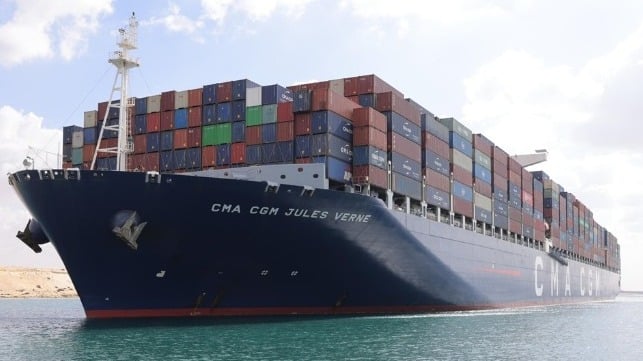
Another CMA CGM boxship, Jules Verne, also transited the waterway as part of the northbound convoy en route from Singapore to Lebanon after safely passing through the Red Sea and the Bab El-Mandab Strait, a development the comes after the Houthis promised to stop attacks on ships following the ceasefire between Israel and Hamas.
Built in 2013, the voyage by the 396 meters ship with a gross tonnage of 176,000 tonnes is the first transit from the south through Bab El-Mandab, and its third transit through the canal. SCA is highlighting that Jules Verne is resuming transits after its last two southbound voyages this year in June and September, with the transit being inspired by incentives introduced in June.
Back then, SCA introduced an incentive scheme that introduced a 15 percent toll discount for container ships with a net tonnage exceeding 130,000 tonnes to encourage shipping lines to resume transits through the waterway.
The passage of Helium and Jules Verne came just a week after another CMA CGM container ship, the Benjamin Franklin, became the largest container ship to transit the canal in the past two years. The 399 meters ship with tonnage of 177,000 tonnes and a capacity of 17,859 containers, transited the waterway as part of the north convoy travelling from the United Kingdom to Malaysia, before safely passing through the Bab el-Mandeb Strait.
“The restoration of calmness once more to the Red Sea region will impose a new reality on the shipping community; that is the necessity of serious consideration by the shipping lines of amending navigation schedules so as to return to transiting through Bab el-Mandab and the Suez Canal once more,” said Admiral Ossama Rabiee SCA Chairman.
SCA is buoyant the gradual return of transits on Suez Canal, which before the onset of the Houthis attacks was one of the world’s busiest waterways with about 12 percent of the world trade volume passing through it, will result in improved revenues. The authority is forecasting to generate $4.2 billion in 2025, up from $3.9 billion last year. The canal achieved its highest-ever annual revenue in 2023, reaching $10.2 billion.
To achieve the revenue targets, SCA is hoping the calmness currently being witnessed in the Red Sea is sustained. As part of measures to further cripple the Yemeni Houthis, the Security Council agreed to renew sanctions on the militant group for another year until November 14, 2026. The resolution to renew the sanctions garnered 13 votes in favor with Russia and China abstaining.
Morocco's Nador West Med Port to Start Up Ahead of Schedule
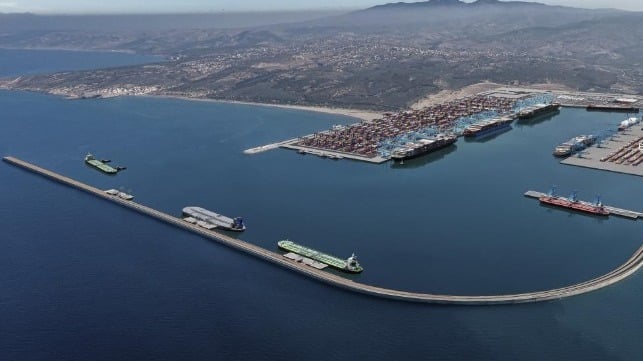
Morocco’s much awaited transshipment hub, Nador West Med Port, could be opened earlier than expected. In a budget presentation in Morocco’s parliament last week, Equipment and Water Minister Nizar Baraka revealed that the port is fully ready. The minister added that the port complex could begin operations by end of 2026, almost a year earlier than the scheduled opening time in 2027.
The government has now shifted focus to building port access roads and improving connectivity to other regions in Morocco. According to the Minister, the plan is to establish connections to major towns in northern Morocco including Fès, Taourirt and Oujda.
Terminal operators are also readying for the port’s opening. Last month, Morocco’s Marsa Maroc and CMA Terminals (a subsidiary of CMA CGM) finalized a joint partnership for the concession of the West Terminal at the Port of Nador West Med. MSC Group - through its subsidiary Terminal Investment Limited (TIL) - has also signed an agreement with Marsa Maroc for the concession of the second container terminal at Nador West.
With Nador West Med modeled on the success of Tanger Med port, it is expected to further disrupt container shipping market in the Mediterranean region. In its first phase, Nador Port will have capacity to handle 1.8 million TEU per year, which will rise to around 5.5 million TEU in the subsequent phases. This places the port in direct competition with established European transshipment ports such as Algeciras (which handled 4.7 million TEU in 2024) and Valencia (5.5 million TEU in 2024).
In fact, there have been concerns in Spain that emerging hubs such as Nador West Med could exacerbate the decline of Port of Algeciras. The argument is that strict environmental regulations in Europe create competitive disadvantages for Spanish ports compared to their Moroccan neighbors in the Mediterranean.
Spain’s State Ports agency has in the past urged for regulatory balance in Europe, warning of a possible decrease in shipping traffic in favor of Morocco. The Port Authority of the Bay of Algeciras estimates that its port could lose almost 60 percent of its transshipment volume to Tanger Med under a scenario of strict environmental regulations.