IT'S AN ALFRED HITCHCOCK MYSTERY
Utah man found in freezer exonerated wife of death with note
TOOELE, Utah (AP) — A Utah man whose body was found in a freezer exonerated his wife by leaving a typed, notarized note saying she bore no responsibility in his death.
The note left by Paul Edward Mathers cleared the late Jeanne Souron-Mathers, although questions remain, authorities said.
“I want it known that Jeanne is in NO way responsible for my death,” Mathers wrote in the letter notarized Dec. 2, 2008.
“I am fully aware that with my heart conditio(n) the Lortabs/Hydrocodine will eventually stop my heart,” Mathers’ wrote. “It will not be deliberate as I am not ready to leave my wife, Jeanne Marie. Jeanne has foiled my actual suicide attempts.”
A maintenance worker found the deceased 75-year-old woman in her Tooele home Nov. 22. The state medical examiner ruled she died of natural causes.
As police searched for clues about her death, they discovered Mathers’ body in a freezer.
Mathers had terminal cancer. Police were unable to conclude if his illness was the ultimate cause of death. Investigators believe he died sometime between Feb. 4, 2009, and March 8, 2009.
Mathers’ head was wrapped in a garbage bag that was secured with duct tape around his neck. Authorities could not determine if the bag was placed there before or after his death.
Whether anyone else was involved in putting Mathers’ body in the freezer also remains unanswered.
Many of those with direct knowledge of what happened have died, while other challenges in collecting information and evidence have left police resigned to end the investigation without a definitive conclusion, Tooele Police Sgt. Jeremy Hansen said.
“We are never going to have final answers,” Hansen said.
Saturday, March 07, 2020

Heavy police raids leave east Jerusalem neighborhood on edge

FILE - In this June 28, 2019 file photo, Israeli police arrest a Palestinian during clashes the Palestinian neighborhood of Issawiya in East Jerusalem, a day after a Palestinian was shot and killed by police during a protest in the same neighborhood. Nearly every day for the last nine months Israeli police have stormed into Issawiya in a campaign they say is needed to maintain law and order. Rights groups say that in addition to searching houses and issuing fines, they have detained hundreds of people — some as young as 10, on suspicion of stone-throwing. The operations frequently ignite clashes, with local youths throwing rocks and firebombs. Residents and human rights groups say the provocative raids have created an atmosphere of terror, with parents afraid to let their children play outside. (AP Photo/Mahmoud Illean)
JERUSALEM (AP) — Murad Mahmoud’s 14-year-old son has been detained by Israeli police in his east Jerusalem neighborhood three times in the last two years. His 10-year-old has been interrogated by police in combat gear. These days, he keeps all six of his children inside most of the time, fearing even worse.
“I won’t even let them go to the corner store,” he says. “I’m not just afraid they’ll be arrested, I’m afraid they’ll lose an eye or get shot in the head.”
Nearly every day for the last nine months Israeli police have stormed into the Palestinian neighborhood of Issawiya in east Jerusalem in a campaign they say is needed to maintain law and order. Rights groups say that in addition to searching houses and issuing fines, they have detained hundreds of people — some as young as 10 — on suspicion of stone-throwing.
The operations frequently ignite clashes, with local youths throwing rocks and firebombs, which police say justifies their heightened presence.
But residents and human rights groups say the raids themselves seem intended to provoke confrontations and have created an atmosphere of terror, with parents afraid to let their children play outside. Last month, a 9-year-old boy was shot in the face by police, losing an eye in an incident authorities say they are still investigating.
It’s unclear what prompted the crackdown, but many residents feel police are making an example out of Issawiya so that Israel can cement its control over east Jerusalem, which it seized in the 1967 war and later annexed.
East Jerusalem Palestinians have Israeli residency, but few have accepted citizenship, either because they don’t recognize Israeli control or because of the long and complicated application process. That has left many feeling vulnerable.
“From May of last year until today, every day they occupy Issawiya all over again,” said Amin Barakat, an optometrist and a member of the neighborhood council.
Issawiya tumbles down a hillside behind Israel’s Hebrew University, just a few miles (kilometers) from the city-center. But like other Arab neighborhoods in east Jerusalem it is overcrowded and poorly served, a legacy of decades of Israeli policies favoring Jewish areas of the city, including east Jerusalem settlements. Under President Donald Trump’s Mideast initiative, which strongly favors Israel and was rejected by the Palestinians, Issawiya would remain part of Israel’s capital.
The narrow streets wind past walls covered in graffiti supporting Hamas and other armed groups, and residents take pride in their Palestinian identity. But many work in Jewish communities. They say the graffiti is the work of local teenagers, and there’s no evidence any factions have an organized presence in the neighborhood.
The intensive raids began last May, but the situation escalated the following month, when a 20-year-old was shot and killed by police, who said he approached to within a few meters (yards) and launched fireworks at them.
The police say they treat Issawiya like any other Jerusalem neighborhood.
“There’s no use of unnecessary force,” Israeli police spokesman Micky Rosenfeld said. “There’s no unnecessary patrols that are taking place. Everything is carefully calculated based on what is taking place inside Issawiya.”
He said forces have responded to stone-throwing on nearby roads, including a major highway, but he was unable to name any specific act of violence outside of the clashes with police inside Issawiya.
Residents angrily reject any suggestion they pose a threat to others.
“For 19 years I’ve been working with Jews,” said Mahmoud, a construction manager. “They welcome me into their homes. ... I have more than a hundred Jewish clients. I only have problems here in my home.”
Rights groups say the raids go far beyond the targeting of individual suspects and amount to collective punishment of the neighborhood’s 20,000 residents.
Ir Amim, an Israeli group that advocates for equal rights in Jerusalem and has closely followed developments in Issawiya, said the operations are “unprecedented in scope and scale,” amounting to a “violent disruption of daily life.”
In addition to sweeping arrest raids, police have set up flying checkpoints that strangle traffic and issued arbitrary fines for minor violations of local ordinances, it said.
“It’s inexplicable and unjustifiable that an entire neighborhood would be targeted” because of individual offenses, said Amy Cohen, a spokeswoman for the group.
Mohammed Abu al-Hummus, the head of Issawiya’s local council, says around 750 people have been detained in the last nine months, with most released after a day or two and many placed under house arrest for days or weeks. He says only around 30 people have been formally charged.
Rosenfeld, the police spokesman, said fewer people have been detained and more have been indicted, but did not provide figures.
Rights groups and residents acknowledge that young people respond to the police operations by throwing stones and firebombs. But they say police provoke the violence and many fear the effects it will have on the next generation.
“It’s a long-lasting trauma for them,” said Tal Hassin, a lawyer with the Association for Civil Rights in Israel. “If you talk with kids, especially the boys, they are big heroes, But it’s only a facade. They don’t sleep at night, they have nightmares.”
Her group has sent formal complaints to the police chief and the attorney general presenting evidence of a campaign of collective punishment and routine violations of Israeli laws governing the treatment of minors. It has not received a response.
Barakat, the optometrist, has seen the effects on his own son, a shy, soft-spoken 15-year-old whose friend was recently arrested. He says his son rarely sleeps longer than three hours at a time and sometimes screams out at night.
“When he sees what happens in the streets he feels anxious. He’s nervous at home, at school — and not just him, the whole generation,” he said.
“He goes to bed at nine. He gets up three hours later and wants water, or he gets up and wants to watch a football game. He’s not even interested in the game, he just wants to sit with his mom and dad.”

FILE - In this June 28, 2019 file photo, Palestinians clash with Israeli police in Jerusalem's Palestinian neighborhood of Issawiya, a day after a Palestinian was shot and killed by police during a protest in the same neighborhood. Nearly every day for the last nine months Israeli police have stormed into Issawiya in a campaign they say is needed to maintain law and order. Rights groups say that in addition to searching houses and issuing fines, they have detained hundreds of people — some as young as 10, on suspicion of stone-throwing. The operations frequently ignite clashes, with local youths throwing rocks and firebombs. Residents and human rights groups say the provocative raids have created an atmosphere of terror, with parents afraid to let their children play outside. (AP Photo/Mahmoud Illean)

FILE - In this June 28, 2019 file photo, Palestinians burn an Israeli flag during clashes with Israeli police in East Jerusalem's Palestinian neighborhood of Issawiya, a day after a Palestinian was shot and killed by police during a protest in the same neighborhood. Nearly every day for the last nine months Israeli police have stormed into Issawiya in a campaign they say is needed to maintain law and order. Rights groups say that in addition to searching houses and issuing fines, they have detained hundreds of people — some as young as 10, on suspicion of stone-throwing. The operations frequently ignite clashes, with local youths throwing rocks and firebombs. Residents and human rights groups say the provocative raids have created an atmosphere of terror, with parents afraid to let their children play outside. (AP Photo/Mahmoud Illean)

FILE - In this Feb. 20, 2020 file photo, Malik Eissa, a nine-year-old Palestinian boy rests in Hadassa hospital in Jerusalem. Malik, who was shot in the face by Israeli police in the tense east Jerusalem Palestinian neighborhood of Issawiya, will not regain vision in his left eye despite surgery. For the last nine months, Israeli police have raided Issawiya nearly every day. They've searched houses, issued fines and detained youths as young as 10 on suspicion of stone-throwing. The operations frequently ignite clashes, with local youths throwing rocks and firebombs, which police say justifies their heightened presence. (AP Photo/Mahmoud Illean, File)

FILE - In this June 28, 2019 file photo, Palestinians clash with Israeli police in the Palestinian neighborhood of Issawiya in East Jerusalem, a day after a Palestinian was shot and killed by police during a protest in the same neighborhood. Nearly every day for the last nine months Israeli police have stormed into Palestinian neighborhood of Issawiya in east Jerusalem in a campaign they say is needed to maintain law and order. Rights groups say that in addition to searching houses and issuing fines, they have detained hundreds of people — some as young as 10, on suspicion of stone-throwing. (AP Photo/Mahmoud Illean, )

This Monday, Feb. 24 2020 photo, shows a general view of the Palestinian neighborhood of Issawiya in East Jerusalem. Nearly every day for the last nine months Israeli police have stormed into Issawiya in a campaign they say is needed to maintain law and order. Rights groups say that in addition to searching houses and issuing fines, they have detained hundreds of people — some as young as 10, on suspicion of stone-throwing. The operations frequently ignite clashes, with local youths throwing rocks and firebombs, which police say justifies their heightened presence. Residents and human rights groups say the provocative raids have created an atmosphere of terror, with parents afraid to let their children play outside. (AP Photo/Mahmoud Illean)
FILE - In this June 28, 2019 file photo, Israeli police arrest a Palestinian during clashes the Palestinian neighborhood of Issawiya in East Jerusalem, a day after a Palestinian was shot and killed by police during a protest in the same neighborhood. Nearly every day for the last nine months Israeli police have stormed into Issawiya in a campaign they say is needed to maintain law and order. Rights groups say that in addition to searching houses and issuing fines, they have detained hundreds of people — some as young as 10, on suspicion of stone-throwing. The operations frequently ignite clashes, with local youths throwing rocks and firebombs. Residents and human rights groups say the provocative raids have created an atmosphere of terror, with parents afraid to let their children play outside. (AP Photo/Mahmoud Illean)
JERUSALEM (AP) — Murad Mahmoud’s 14-year-old son has been detained by Israeli police in his east Jerusalem neighborhood three times in the last two years. His 10-year-old has been interrogated by police in combat gear. These days, he keeps all six of his children inside most of the time, fearing even worse.
“I won’t even let them go to the corner store,” he says. “I’m not just afraid they’ll be arrested, I’m afraid they’ll lose an eye or get shot in the head.”
Nearly every day for the last nine months Israeli police have stormed into the Palestinian neighborhood of Issawiya in east Jerusalem in a campaign they say is needed to maintain law and order. Rights groups say that in addition to searching houses and issuing fines, they have detained hundreds of people — some as young as 10 — on suspicion of stone-throwing.
The operations frequently ignite clashes, with local youths throwing rocks and firebombs, which police say justifies their heightened presence.
But residents and human rights groups say the raids themselves seem intended to provoke confrontations and have created an atmosphere of terror, with parents afraid to let their children play outside. Last month, a 9-year-old boy was shot in the face by police, losing an eye in an incident authorities say they are still investigating.
It’s unclear what prompted the crackdown, but many residents feel police are making an example out of Issawiya so that Israel can cement its control over east Jerusalem, which it seized in the 1967 war and later annexed.
East Jerusalem Palestinians have Israeli residency, but few have accepted citizenship, either because they don’t recognize Israeli control or because of the long and complicated application process. That has left many feeling vulnerable.
“From May of last year until today, every day they occupy Issawiya all over again,” said Amin Barakat, an optometrist and a member of the neighborhood council.
Issawiya tumbles down a hillside behind Israel’s Hebrew University, just a few miles (kilometers) from the city-center. But like other Arab neighborhoods in east Jerusalem it is overcrowded and poorly served, a legacy of decades of Israeli policies favoring Jewish areas of the city, including east Jerusalem settlements. Under President Donald Trump’s Mideast initiative, which strongly favors Israel and was rejected by the Palestinians, Issawiya would remain part of Israel’s capital.
The narrow streets wind past walls covered in graffiti supporting Hamas and other armed groups, and residents take pride in their Palestinian identity. But many work in Jewish communities. They say the graffiti is the work of local teenagers, and there’s no evidence any factions have an organized presence in the neighborhood.
The intensive raids began last May, but the situation escalated the following month, when a 20-year-old was shot and killed by police, who said he approached to within a few meters (yards) and launched fireworks at them.
The police say they treat Issawiya like any other Jerusalem neighborhood.
“There’s no use of unnecessary force,” Israeli police spokesman Micky Rosenfeld said. “There’s no unnecessary patrols that are taking place. Everything is carefully calculated based on what is taking place inside Issawiya.”
He said forces have responded to stone-throwing on nearby roads, including a major highway, but he was unable to name any specific act of violence outside of the clashes with police inside Issawiya.
Residents angrily reject any suggestion they pose a threat to others.
“For 19 years I’ve been working with Jews,” said Mahmoud, a construction manager. “They welcome me into their homes. ... I have more than a hundred Jewish clients. I only have problems here in my home.”
Rights groups say the raids go far beyond the targeting of individual suspects and amount to collective punishment of the neighborhood’s 20,000 residents.
Ir Amim, an Israeli group that advocates for equal rights in Jerusalem and has closely followed developments in Issawiya, said the operations are “unprecedented in scope and scale,” amounting to a “violent disruption of daily life.”
In addition to sweeping arrest raids, police have set up flying checkpoints that strangle traffic and issued arbitrary fines for minor violations of local ordinances, it said.
“It’s inexplicable and unjustifiable that an entire neighborhood would be targeted” because of individual offenses, said Amy Cohen, a spokeswoman for the group.
Mohammed Abu al-Hummus, the head of Issawiya’s local council, says around 750 people have been detained in the last nine months, with most released after a day or two and many placed under house arrest for days or weeks. He says only around 30 people have been formally charged.
Rosenfeld, the police spokesman, said fewer people have been detained and more have been indicted, but did not provide figures.
Rights groups and residents acknowledge that young people respond to the police operations by throwing stones and firebombs. But they say police provoke the violence and many fear the effects it will have on the next generation.
“It’s a long-lasting trauma for them,” said Tal Hassin, a lawyer with the Association for Civil Rights in Israel. “If you talk with kids, especially the boys, they are big heroes, But it’s only a facade. They don’t sleep at night, they have nightmares.”
Her group has sent formal complaints to the police chief and the attorney general presenting evidence of a campaign of collective punishment and routine violations of Israeli laws governing the treatment of minors. It has not received a response.
Barakat, the optometrist, has seen the effects on his own son, a shy, soft-spoken 15-year-old whose friend was recently arrested. He says his son rarely sleeps longer than three hours at a time and sometimes screams out at night.
“When he sees what happens in the streets he feels anxious. He’s nervous at home, at school — and not just him, the whole generation,” he said.
“He goes to bed at nine. He gets up three hours later and wants water, or he gets up and wants to watch a football game. He’s not even interested in the game, he just wants to sit with his mom and dad.”
FILE - In this June 28, 2019 file photo, Palestinians clash with Israeli police in Jerusalem's Palestinian neighborhood of Issawiya, a day after a Palestinian was shot and killed by police during a protest in the same neighborhood. Nearly every day for the last nine months Israeli police have stormed into Issawiya in a campaign they say is needed to maintain law and order. Rights groups say that in addition to searching houses and issuing fines, they have detained hundreds of people — some as young as 10, on suspicion of stone-throwing. The operations frequently ignite clashes, with local youths throwing rocks and firebombs. Residents and human rights groups say the provocative raids have created an atmosphere of terror, with parents afraid to let their children play outside. (AP Photo/Mahmoud Illean)
FILE - In this June 28, 2019 file photo, Palestinians burn an Israeli flag during clashes with Israeli police in East Jerusalem's Palestinian neighborhood of Issawiya, a day after a Palestinian was shot and killed by police during a protest in the same neighborhood. Nearly every day for the last nine months Israeli police have stormed into Issawiya in a campaign they say is needed to maintain law and order. Rights groups say that in addition to searching houses and issuing fines, they have detained hundreds of people — some as young as 10, on suspicion of stone-throwing. The operations frequently ignite clashes, with local youths throwing rocks and firebombs. Residents and human rights groups say the provocative raids have created an atmosphere of terror, with parents afraid to let their children play outside. (AP Photo/Mahmoud Illean)
FILE - In this Feb. 20, 2020 file photo, Malik Eissa, a nine-year-old Palestinian boy rests in Hadassa hospital in Jerusalem. Malik, who was shot in the face by Israeli police in the tense east Jerusalem Palestinian neighborhood of Issawiya, will not regain vision in his left eye despite surgery. For the last nine months, Israeli police have raided Issawiya nearly every day. They've searched houses, issued fines and detained youths as young as 10 on suspicion of stone-throwing. The operations frequently ignite clashes, with local youths throwing rocks and firebombs, which police say justifies their heightened presence. (AP Photo/Mahmoud Illean, File)
FILE - In this June 28, 2019 file photo, Palestinians clash with Israeli police in the Palestinian neighborhood of Issawiya in East Jerusalem, a day after a Palestinian was shot and killed by police during a protest in the same neighborhood. Nearly every day for the last nine months Israeli police have stormed into Palestinian neighborhood of Issawiya in east Jerusalem in a campaign they say is needed to maintain law and order. Rights groups say that in addition to searching houses and issuing fines, they have detained hundreds of people — some as young as 10, on suspicion of stone-throwing. (AP Photo/Mahmoud Illean, )
This Monday, Feb. 24 2020 photo, shows a general view of the Palestinian neighborhood of Issawiya in East Jerusalem. Nearly every day for the last nine months Israeli police have stormed into Issawiya in a campaign they say is needed to maintain law and order. Rights groups say that in addition to searching houses and issuing fines, they have detained hundreds of people — some as young as 10, on suspicion of stone-throwing. The operations frequently ignite clashes, with local youths throwing rocks and firebombs, which police say justifies their heightened presence. Residents and human rights groups say the provocative raids have created an atmosphere of terror, with parents afraid to let their children play outside. (AP Photo/Mahmoud Illean)
Burger King breaks the mold with new advertising campaign
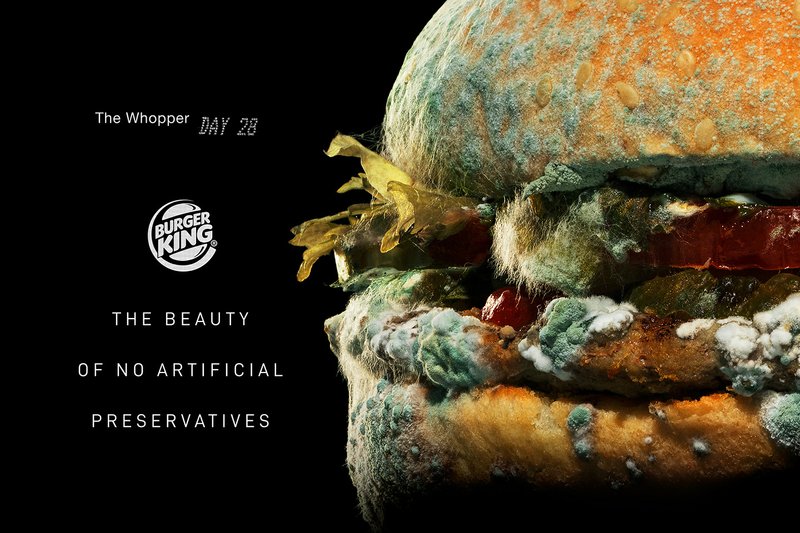
This undated image provided by Burger King shows an advertising campaign image with the Whopper hamburger. The burger chain is showing its Whopper covered in mold in print and TV ads running in Europe and the U.S. The message: Burger King is removing artificial preservatives from the Whopper. (Burger King via AP)
Burger King is breaking the mold in its new advertising campaign.
The burger chain is portraying its Whopper covered in mold in print and TV ads running in Europe and the U.S. The message: Burger King is removing artificial preservatives from its signature burger.
The company, already known for irreverent ad campaigns, turned it up a notch, including a time-lapse of a decaying burger on Twitter. That imagery goes beyond the print ads that show a 28-day-old burger — a week beyond.
Early reaction to the campaign Wednesday was a mix of applause for the shift away from preservatives, to disgust.
The restaurant, based in Miami, Florida, says it has removed artificial preservatives from the Whopper in several European countries — including France, Sweden and Spain — and around 400 of its 7,346 U.S. restaurants. It plans to remove preservatives from Whoppers served in all of its restaurants this year.
The Whopper is topped with onions, lettuce, tomato, mayonnaise and pickles, all of which will contain no artificial preservatives.
By the end of this year, Burger King said all food items — including sandwiches, sides and desserts — will be free from artificial colors, artificial flavors and artificial preservatives in the U.S. and select European countries, including Germany and the United Kingdom.
McDonald’s announced in 2018 that it was removing artificial colors, flavors and preservatives from seven of its burgers.
This undated image provided by Burger King shows an advertising campaign image with the Whopper hamburger. The burger chain is showing its Whopper covered in mold in print and TV ads running in Europe and the U.S. The message: Burger King is removing artificial preservatives from the Whopper. (Burger King via AP)
Burger King is breaking the mold in its new advertising campaign.
The burger chain is portraying its Whopper covered in mold in print and TV ads running in Europe and the U.S. The message: Burger King is removing artificial preservatives from its signature burger.
The company, already known for irreverent ad campaigns, turned it up a notch, including a time-lapse of a decaying burger on Twitter. That imagery goes beyond the print ads that show a 28-day-old burger — a week beyond.
Early reaction to the campaign Wednesday was a mix of applause for the shift away from preservatives, to disgust.
The restaurant, based in Miami, Florida, says it has removed artificial preservatives from the Whopper in several European countries — including France, Sweden and Spain — and around 400 of its 7,346 U.S. restaurants. It plans to remove preservatives from Whoppers served in all of its restaurants this year.
The Whopper is topped with onions, lettuce, tomato, mayonnaise and pickles, all of which will contain no artificial preservatives.
By the end of this year, Burger King said all food items — including sandwiches, sides and desserts — will be free from artificial colors, artificial flavors and artificial preservatives in the U.S. and select European countries, including Germany and the United Kingdom.
McDonald’s announced in 2018 that it was removing artificial colors, flavors and preservatives from seven of its burgers.



Catherine Amidu, 17, right, laughs with her best neighborhood friend, Aisha, at her home in Machinga, Malawi on Sunday, Feb, 9, 2020. People with albinism in several African countries live in fear of being abducted and killed in the mistaken belief that their body parts carry special powers and can be sold for thousands of dollars. The teenager survived an attempt on her life in 2017. (AP Photo/Thoko Chikondi)
Agency ordered to pay fees in ‘IM GOD’ license plate case
FRANKFORT, Ky. (AP) — The Kentucky Transportation Cabinet has to pay more than $150,000 in legal fees for a man who won a lawsuit allowing him to put “IM GOD” on his license plate.
A judge ruled this week that the state agency must pay $150,715.50 in attorneys’ fees and an additional $491.24 for court costs, news outlets reported.
The ruling came in a case filed by Ben Hart, a self-identified atheist, who set out to get the Kentucky plate in 2016. The transportation department denied the request on the basis it violated anti-discrimination guidelines.
A federal judge ruled in November that “vanity plates” are private speech protected by the First Amendment and that the state had violated Hart’s rights by denying him the plate.
Lawyers for the state cabinet fought the costs, calling them excessive.
The fees will go to a team of lawyers, including some with the American Civil Liberties Union of Kentucky and the Freedom From Religion Foundation, both of which helped Hart challenge the state’s decision.
FRANKFORT, Ky. (AP) — The Kentucky Transportation Cabinet has to pay more than $150,000 in legal fees for a man who won a lawsuit allowing him to put “IM GOD” on his license plate.
A judge ruled this week that the state agency must pay $150,715.50 in attorneys’ fees and an additional $491.24 for court costs, news outlets reported.
The ruling came in a case filed by Ben Hart, a self-identified atheist, who set out to get the Kentucky plate in 2016. The transportation department denied the request on the basis it violated anti-discrimination guidelines.
A federal judge ruled in November that “vanity plates” are private speech protected by the First Amendment and that the state had violated Hart’s rights by denying him the plate.
Lawyers for the state cabinet fought the costs, calling them excessive.
The fees will go to a team of lawyers, including some with the American Civil Liberties Union of Kentucky and the Freedom From Religion Foundation, both of which helped Hart challenge the state’s decision.
Now this: Tornado clobbers African American North Nashville
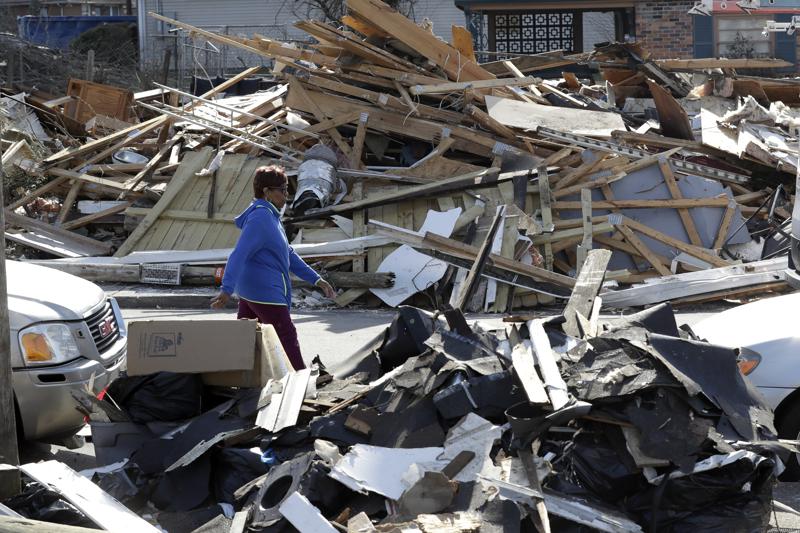
A woman walks down a street lined with debris Friday, March 6, 2020, in Nashville, Tenn. Residents and businesses face a huge cleanup effort after tornadoes hit the state Tuesday. (AP Photo/Mark Humphrey)
NASHVILLE, Tenn. (AP) — On a frigid Friday morning in North Nashville, Ishvicka Howell stood in her driveway and peered down the street at several utility trucks.
“When I saw those blinking lights, it was like Christmas,” she said.
Howell has been without electricity since a tornado tore through her neighborhood shortly after midnight on Tuesday.
“No power. No heat. We pioneering it,” Howell said. “Grilling it and boiling water on the grill. We’re in survival mode.”
The tornado that struck Nashville wrecked several neighborhoods as it hopped across the city, smashing in trendy Germantown and Five Points, where two people died.
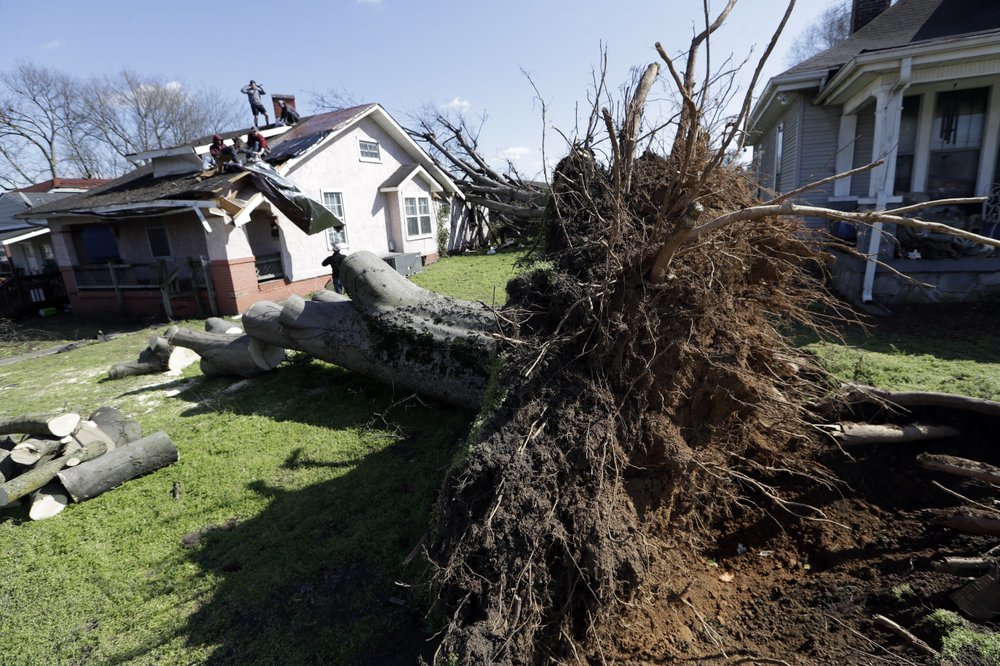
Workers repair a roof damaged by a tree uprooted by a tornado Friday, March 6, 2020, in Nashville, Tenn. Residents and businesses face a huge cleanup effort after tornadoes hit the state Tuesday. (AP Photo/Mark Humphrey)
But North Nashville’s historically African American neighborhoods were already suffering from decades of redlining and neglect, isolated from more affluent neighborhoods by the interstates that cut through the heart of the city. More recently, they have begun to feel the pressure of gentrification as new residents and short-term renters search out affordable areas near downtown.
And now this. The killer storm devastated whole blocks, tearing off roofs, blowing down walls, uprooting huge trees and toppling electrical poles. While many parts of North Nashville had little storm damage, most residents were still without electricity Friday. No lights. No heat. And no way to store or cook food.
Some are wondering if North Nashville can recover from this latest hit or if its African American families will be permanently displaced.
“We are worried because we know developers are going to come in,” said Cornelius A. Hill, pastor of Ephesian Primitive Baptist Church.
But Hill said he was encouraged by the outpouring of aid. His church, too, is without power. But outside in the parking lot, donations of all sorts have been pouring in to be donated to grateful residents. It was a scene repeated on nearly every corner of the storm-damaged blocks on Friday. Volunteers manned folding tables with free water, batteries, diapers, trash bags, and hot food like barbecue, hot dogs and pizza.
Meanwhile, hundreds of volunteers toting rakes and chainsaws were taking advantage of the daylight. They covered roofs with tarps, sliced away at downed and damaged trees, and piled debris at curbside for public works trucks to cart away.
“This is a historic part of Nashville. Some of these homes have been here 40 or 50 years,” said Jonathan Williamson with the community group Friends and Fam. “It’s beautiful to see everyone come out and work together to get things fixed.”
North Nashville is home to several historically black colleges and universities. Fisk University and Meharry Medical College were largely unscathed from the storm. But Tennessee State University suffered the near total destruction of its agricultural research center. The loss is estimated at between $30 and $50 million.
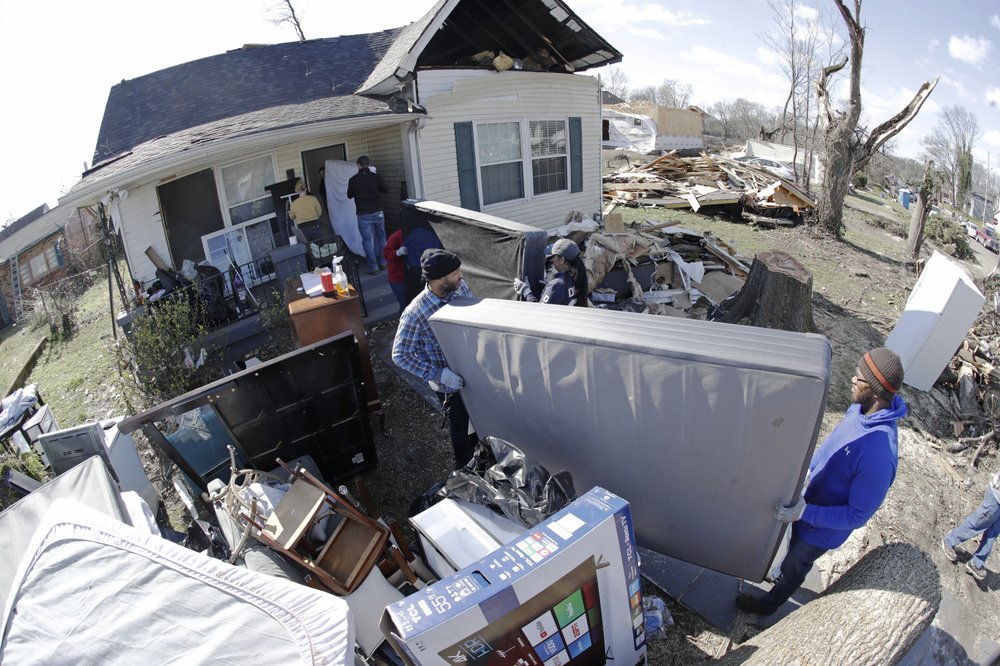
A group of volunteers moves items salvaged from a damaged home Friday, March 6, 2020, in Nashville, Tenn. Residents and businesses face a huge cleanup effort after tornadoes hit the state Tuesday. (AP Photo/Mark Humphrey
College of Agriculture Dean Chandra Reddy said the school has never been funded on par with the University of Tennessee. It’s only in the past few years that the state government has started matching federal funding, and the school has been working hard to build up the program.
“This tornado is a double whammy for us. We were barely putting something up there, and then this comes and wipes it out,” said Reddy.
Reddy said he is encouraged that Gov. Bill Lee, who supports rural development, visited Tuesday morning. He is hoping the state government will come through to help the program quickly rebuild and grow.
“If we want to produce top-class research, we need good facilities and good faculty,” Reddy said. “Those don’t come cheap.”
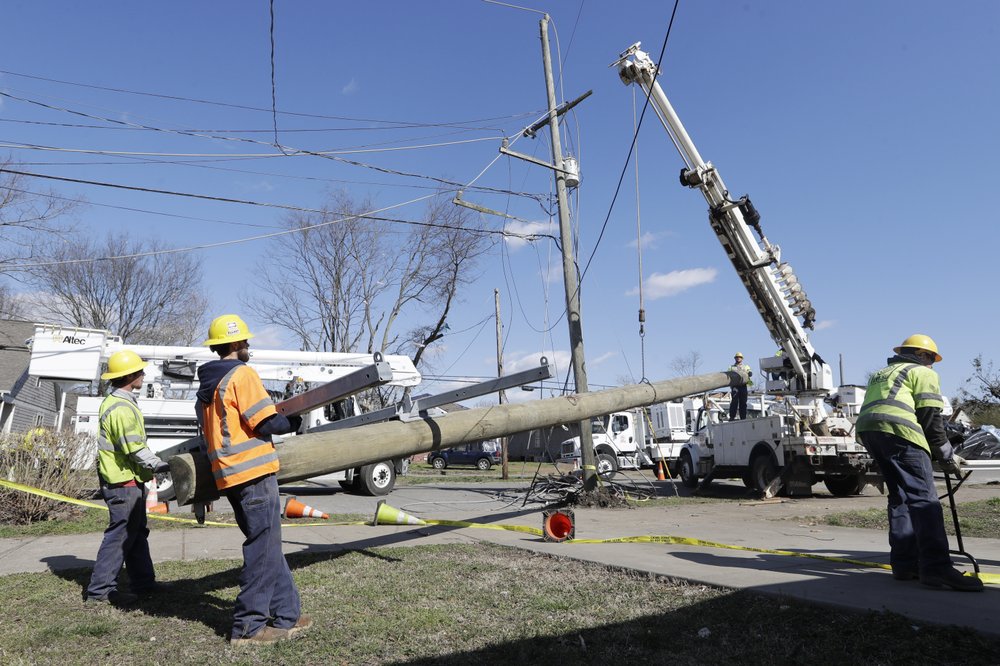
Electrical workers install a new power line poll Friday, March 6, 2020, in Nashville, Tenn. Residents and businesses face a huge cleanup effort after tornadoes hit the state Tuesday. (AP Photo/Mark Humphrey)
Over at the corner of 16th Ave. North and Knowles Street, one of the most heavily damaged residential blocks, new city councilman Brandon Taylor stopped to talk with Robert Sherrill of the nonprofit Impact Youth Outreach. Taylor said city leaders already are discussing ways to help residents rebuild.
“We’re trying to build a plan to make sure the community comes out of this whole,” he said.
Sherrill grew up on 16th Ave. North and has already seen how much it has changed through gentrification. He worries that any help won’t come soon enough.
“We know there are people already knocking on doors,” he said. “If they say they’re going to put you up in the Omni for a week and give you $100,000 cash, and you’re staying in a house with no walls, you might accept that.”
Paige Jack, with the group Friends and Fam, was handing out food nearby and was more optimistic. She thinks the volunteers from other parts of the city and beyond will leave feeling more connected to North Nashville.
“It’s made people much more appreciative of our community,” she said.
The National Weather Service has said at least six tornadoes hit middle Tennessee during the series of storms that killed 24 people and caused massive damage. Eighteen were killed in Putnam County, where President Donald Trump visited on Friday to offer his condolences. Trump flew in and out of Nashville but did not stop in the city.
A woman walks down a street lined with debris Friday, March 6, 2020, in Nashville, Tenn. Residents and businesses face a huge cleanup effort after tornadoes hit the state Tuesday. (AP Photo/Mark Humphrey)
NASHVILLE, Tenn. (AP) — On a frigid Friday morning in North Nashville, Ishvicka Howell stood in her driveway and peered down the street at several utility trucks.
“When I saw those blinking lights, it was like Christmas,” she said.
Howell has been without electricity since a tornado tore through her neighborhood shortly after midnight on Tuesday.
“No power. No heat. We pioneering it,” Howell said. “Grilling it and boiling water on the grill. We’re in survival mode.”
The tornado that struck Nashville wrecked several neighborhoods as it hopped across the city, smashing in trendy Germantown and Five Points, where two people died.
Workers repair a roof damaged by a tree uprooted by a tornado Friday, March 6, 2020, in Nashville, Tenn. Residents and businesses face a huge cleanup effort after tornadoes hit the state Tuesday. (AP Photo/Mark Humphrey)
But North Nashville’s historically African American neighborhoods were already suffering from decades of redlining and neglect, isolated from more affluent neighborhoods by the interstates that cut through the heart of the city. More recently, they have begun to feel the pressure of gentrification as new residents and short-term renters search out affordable areas near downtown.
And now this. The killer storm devastated whole blocks, tearing off roofs, blowing down walls, uprooting huge trees and toppling electrical poles. While many parts of North Nashville had little storm damage, most residents were still without electricity Friday. No lights. No heat. And no way to store or cook food.
Some are wondering if North Nashville can recover from this latest hit or if its African American families will be permanently displaced.
“We are worried because we know developers are going to come in,” said Cornelius A. Hill, pastor of Ephesian Primitive Baptist Church.
But Hill said he was encouraged by the outpouring of aid. His church, too, is without power. But outside in the parking lot, donations of all sorts have been pouring in to be donated to grateful residents. It was a scene repeated on nearly every corner of the storm-damaged blocks on Friday. Volunteers manned folding tables with free water, batteries, diapers, trash bags, and hot food like barbecue, hot dogs and pizza.
Meanwhile, hundreds of volunteers toting rakes and chainsaws were taking advantage of the daylight. They covered roofs with tarps, sliced away at downed and damaged trees, and piled debris at curbside for public works trucks to cart away.
“This is a historic part of Nashville. Some of these homes have been here 40 or 50 years,” said Jonathan Williamson with the community group Friends and Fam. “It’s beautiful to see everyone come out and work together to get things fixed.”
North Nashville is home to several historically black colleges and universities. Fisk University and Meharry Medical College were largely unscathed from the storm. But Tennessee State University suffered the near total destruction of its agricultural research center. The loss is estimated at between $30 and $50 million.
A group of volunteers moves items salvaged from a damaged home Friday, March 6, 2020, in Nashville, Tenn. Residents and businesses face a huge cleanup effort after tornadoes hit the state Tuesday. (AP Photo/Mark Humphrey
College of Agriculture Dean Chandra Reddy said the school has never been funded on par with the University of Tennessee. It’s only in the past few years that the state government has started matching federal funding, and the school has been working hard to build up the program.
“This tornado is a double whammy for us. We were barely putting something up there, and then this comes and wipes it out,” said Reddy.
Reddy said he is encouraged that Gov. Bill Lee, who supports rural development, visited Tuesday morning. He is hoping the state government will come through to help the program quickly rebuild and grow.
“If we want to produce top-class research, we need good facilities and good faculty,” Reddy said. “Those don’t come cheap.”
Electrical workers install a new power line poll Friday, March 6, 2020, in Nashville, Tenn. Residents and businesses face a huge cleanup effort after tornadoes hit the state Tuesday. (AP Photo/Mark Humphrey)
Over at the corner of 16th Ave. North and Knowles Street, one of the most heavily damaged residential blocks, new city councilman Brandon Taylor stopped to talk with Robert Sherrill of the nonprofit Impact Youth Outreach. Taylor said city leaders already are discussing ways to help residents rebuild.
“We’re trying to build a plan to make sure the community comes out of this whole,” he said.
Sherrill grew up on 16th Ave. North and has already seen how much it has changed through gentrification. He worries that any help won’t come soon enough.
“We know there are people already knocking on doors,” he said. “If they say they’re going to put you up in the Omni for a week and give you $100,000 cash, and you’re staying in a house with no walls, you might accept that.”
Paige Jack, with the group Friends and Fam, was handing out food nearby and was more optimistic. She thinks the volunteers from other parts of the city and beyond will leave feeling more connected to North Nashville.
“It’s made people much more appreciative of our community,” she said.
The National Weather Service has said at least six tornadoes hit middle Tennessee during the series of storms that killed 24 people and caused massive damage. Eighteen were killed in Putnam County, where President Donald Trump visited on Friday to offer his condolences. Trump flew in and out of Nashville but did not stop in the city.
Officials vote to keep Wright architecture school open

File - This Sept. 25, 2016, file photo, shows Taliesin in Spring Green, Wisconsin that famed architect Frank Lloyd Wright designed and lived in. The architecture school that architect Frank Lloyd Wright started nearly 90 years ago is closing. School officials announced Tuesday, Jan. 28, 2020, that the School of Architecture at Taliesin, which encompasses Wright properties in Wisconsin and Arizona, will shutter in June. (AP Photo/Beth J. Harpaz, File)
MADISON, Wis. (AP) — The school that architect Frank Lloyd Wright started nearly 90 years ago may stay open after all.
The board of the School of Architecture at Taliesin announced in January that the school would close in June because the board and the Frank Lloyd Wright Foundation, the school’s biggest financial supporter, had failed to come up with a way to keep the school open. The foundation said then that the school lacked a sustainable business model.
The Wisconsin State Journal reports the board voted Thursday to keep the school open in light of new funding.
The decision to remain open is still subject to approval by the Frank Lloyd Wright Foundation. The foundation issued a statement on Friday saying it has little information about the new funding sources.
The school has campuses in Wisconsin and Arizona.
Board Chairman Dan Schweiker said new supporters have come forward. Qingyun Ma, former dean of the University of Southern California’s architecture school and now affiliated with two Chinese universities, has committed to sending six new students in August and up to 12 new students in 2021 to the School of Architecture at Taliesin, moves that will generate significant tuition revenue, Schweiker said.
Until Wright’s death in 1959 at age 91, Taliesin West in Scottsdale, Arizona, was the famed architect’s winter home and laboratory. The original Taliesin, Wright’s primary home in Spring Green, Wisconsin, was named after a 6th century Welsh bard whose name means “shining brow.”


File - This Sept. 25, 2016, file photo, shows Taliesin in Spring Green, Wisconsin that famed architect Frank Lloyd Wright designed and lived in. The architecture school that architect Frank Lloyd Wright started nearly 90 years ago is closing. School officials announced Tuesday, Jan. 28, 2020, that the School of Architecture at Taliesin, which encompasses Wright properties in Wisconsin and Arizona, will shutter in June. (AP Photo/Beth J. Harpaz, File)
MADISON, Wis. (AP) — The school that architect Frank Lloyd Wright started nearly 90 years ago may stay open after all.
The board of the School of Architecture at Taliesin announced in January that the school would close in June because the board and the Frank Lloyd Wright Foundation, the school’s biggest financial supporter, had failed to come up with a way to keep the school open. The foundation said then that the school lacked a sustainable business model.
The Wisconsin State Journal reports the board voted Thursday to keep the school open in light of new funding.
The decision to remain open is still subject to approval by the Frank Lloyd Wright Foundation. The foundation issued a statement on Friday saying it has little information about the new funding sources.
The school has campuses in Wisconsin and Arizona.
Board Chairman Dan Schweiker said new supporters have come forward. Qingyun Ma, former dean of the University of Southern California’s architecture school and now affiliated with two Chinese universities, has committed to sending six new students in August and up to 12 new students in 2021 to the School of Architecture at Taliesin, moves that will generate significant tuition revenue, Schweiker said.
Until Wright’s death in 1959 at age 91, Taliesin West in Scottsdale, Arizona, was the famed architect’s winter home and laboratory. The original Taliesin, Wright’s primary home in Spring Green, Wisconsin, was named after a 6th century Welsh bard whose name means “shining brow.”
In this photo taken Nov. 23, 2018, is Frank Lloyd Wright's Taliesin West in Scottsdale, Ariz. The architecture school that architect Frank Lloyd Wright started nearly 90 years ago is closing. School officials announced Tuesday, Jan. 28, 2020, that the School of Architecture at Taliesin, which encompasses Wright properties in Wisconsin and Arizona, will shutter in June. (AP Photo/Frank Eltman)
File - This Sept. 24, 2017, file photo, shows the drafting room at Taliesin West in Scottsdale, Ariz., the winter home of architect Frank Lloyd Wright and the architecture school he founded. The architecture school that architect Frank Lloyd Wright started nearly 90 years ago is closing. School officials announced Tuesday, Jan. 28, 2020, that the School of Architecture at Taliesin, which encompasses Wright properties in Wisconsin and Arizona, will shutter in June. (AP Photo/Anita Snow, File)
File - In this Feb. 22, 2014, file photo, students in the Frank Lloyd Wright School of Architecture, from left; Carl Kohut, Garth Lindquist, Soham Shah and Connor Bingham work on restoring the "Lotus Shelter" that was built in 1963 by Valley architect Kamal Amin, at Taliesin West in Scottsdale, Ariz. The architecture school that architect Frank Lloyd Wright started nearly 90 years ago is closing. School officials announced Tuesday, Jan. 28, 2020, that the School of Architecture at Taliesin, which encompasses Wright properties in Wisconsin and Arizona, will shutter in June. (David Wallace/The Arizona Republic via AP, File)
Mormon students protest BYU stance on same-sex behavior
1 of 6
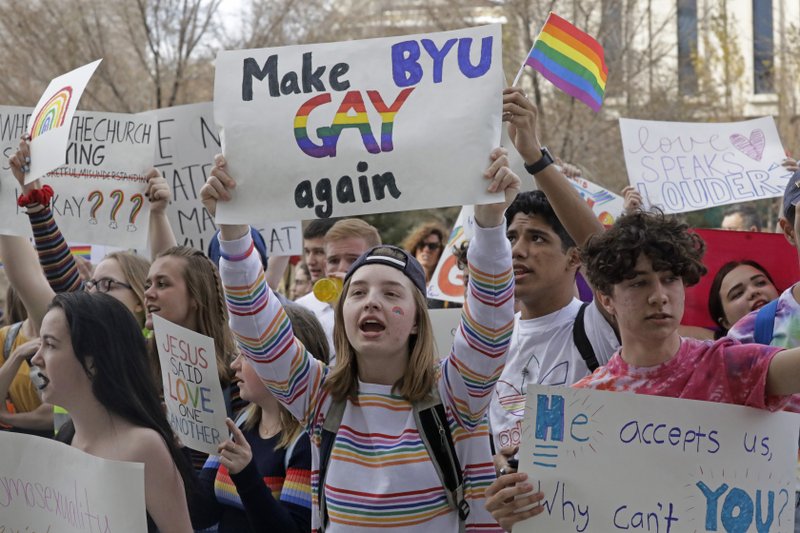
Brigham Young University student Kate Lunnen joins several hundred students protesting near The Church of Jesus Christ of Latter Day Saints church headquarters Friday, March 6, 2020, in Salt Lake City, to show their displeasure with a letter this week that clarified that "same-sex romantic behavior" is not allowed on campus. (AP Photo/Rick Bowmer)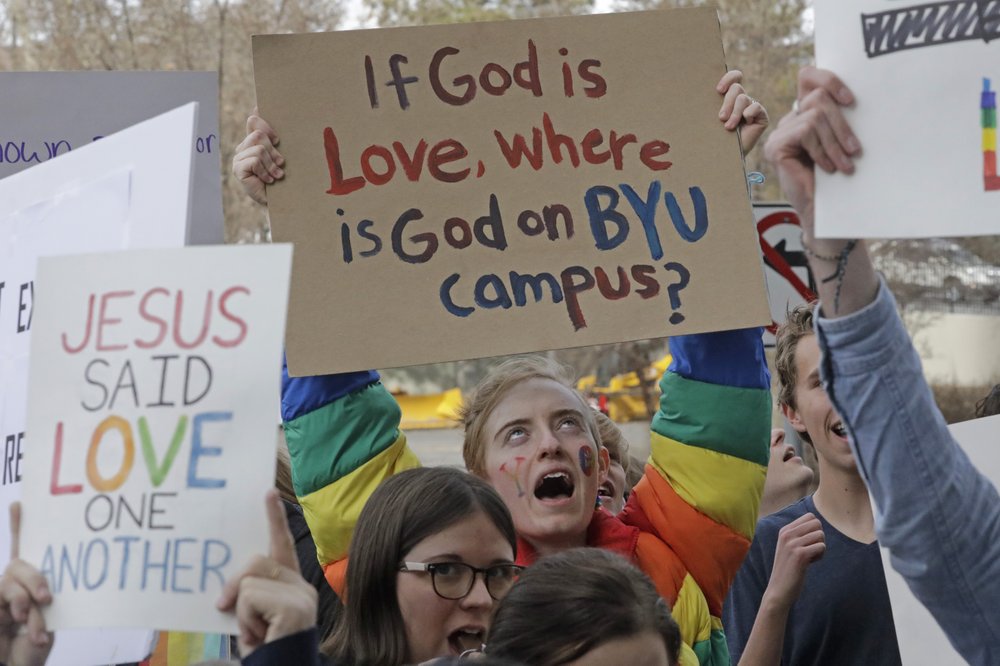
A protester joins several hundred students gathered near The Church of Jesus Christ of Latter Day Saints church headquarters Friday, March 6, 2020, in Salt Lake City, to show their displeasure with a letter this week that clarified that "same-sex romantic behavior" is not allowed on campus. (AP Photo/Rick Bowmer)
SALT LAKE CITY (AP) — After Brigham Young University two weeks ago dropped a section from its strict code of conduct that had prohibited all expressions of homosexual behavior, bisexual music major Caroline McKenzie felt newfound hope that she could stop hiding and be herself. She even went on a date with another woman.
That optimism was pierced this week when administrators at the university owned by The Church of Jesus Christ of Latter Day Saints clarified in a letter posted online Wednesday that “same-sex romantic behavior” was still not allowed on campus. The letter said the recent revision to what is known as the “honor code” didn’t change the “moral standards” of the church or the faith’s opposition to same-sex marriage.
McKenzie said it made her feel whiplash and that her religion was telling her she was dirty for who she is and unwanted by God. She’s reassessing whether she wants to finish her studies at BYU even though she loves her professors and the education she’s receiving.
“It’s psychologically damaging,” said McKenzie, 23, of Kaysville, Utah. “It has been a roller coaster the last couple of weeks. This last Wednesday pretty much destroyed me. It felt like I was drowning again.”
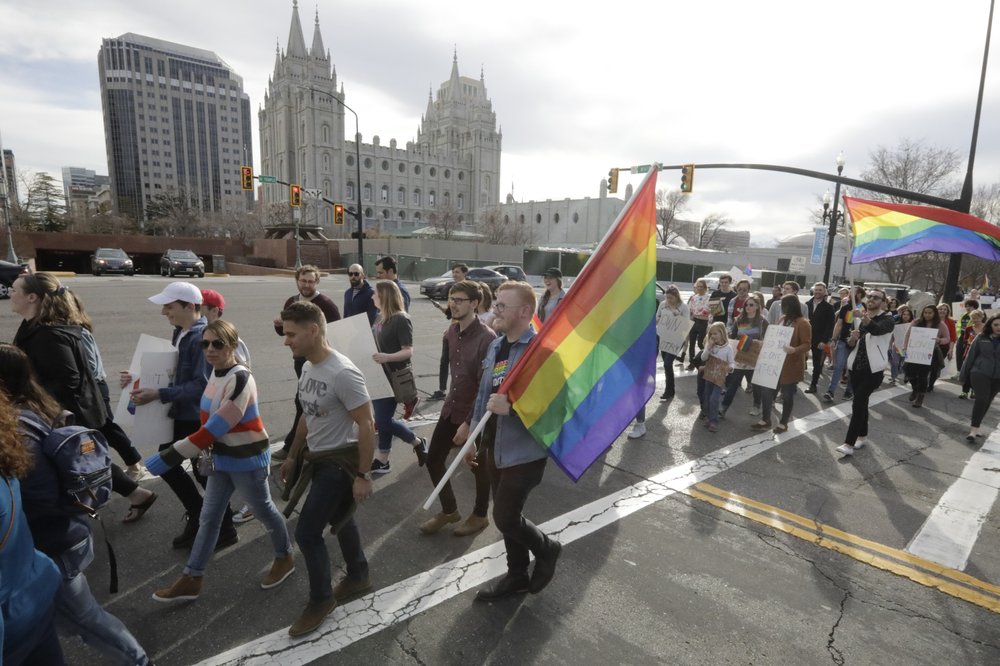
She was one of several hundred people who protested Friday afternoon outside church headquarters in Salt Lake City to cap off a week of fury and heartbreak for LGBTQ students and their straight allies. They sang hymns and chanted “have no fear, God loves queers” as they held rainbow flags. They held signs that read “Love one another,” “Jesus loves everyone” and “Bigotry wrapped in prayer is still bigotry.”
McKenzie held a sign that said, “My family doesn’t want me, now my school? BYU is home.” It referenced a lack of support from her family after she came out last summer.
As they chanted loudly, “We’re here, we’re queer, we’re done living in fear,” many stared up at windows in the church headquarters.
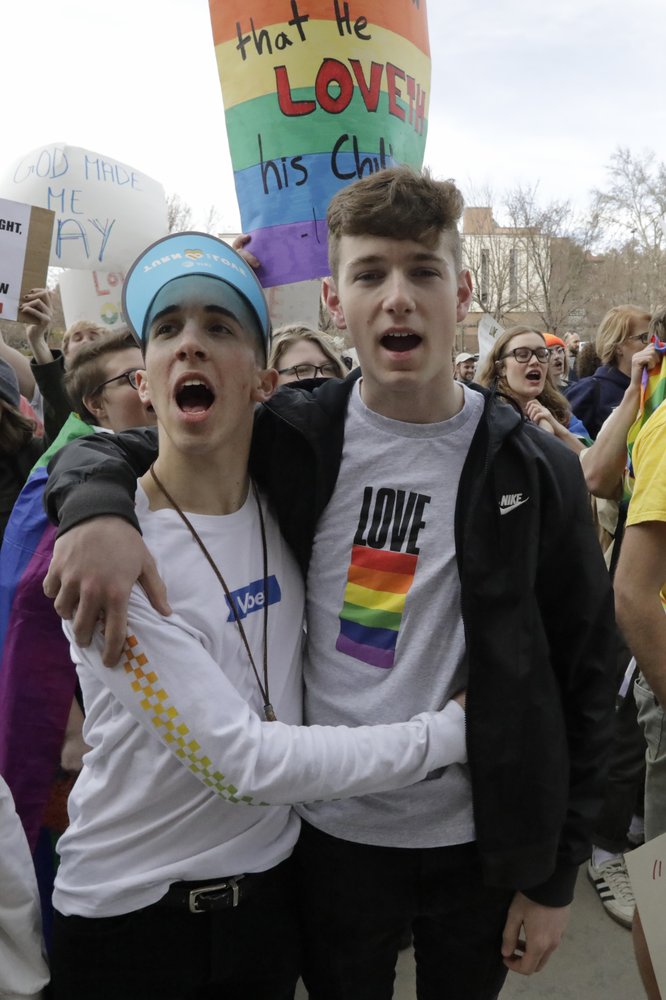
Joey Pierson, left, and Luke Larsen, right, join several hundred Brigham Young University students protesting near The Church of Jesus Christ of Latter Day Saints church headquarters Friday, March 6, 2020, in Salt Lake City, to show their displeasure with a letter this week that clarified that "same-sex romantic behavior" is not allowed on campus. (AP Photo/Rick Bowmer)
The Utah-based religion of 16-million members worldwide has tried in the last decade to create a more welcoming environment for LGBTQ members, while adhering to its doctrinal opposition of gay marriage. The faith, widely known as the Mormon church, teaches that while being gay is not a sin, engaging in same-sex relationships is against God’s commandments.
Church spokesman Doug Andersen said in a statement Friday: “The teachings of the church and the policies of our universities are consistent with eternal principles, and seek to encourage and strengthen relationships that lead to eternal covenants made with God. The church and its leaders continue to teach that though there may be disagreement on an issue or policy, we should treat one other with love, respect and kindness.”
Students who attend BYU in Provo, south of Salt Lake City, agree to adhere to the code of conduct known as the “honor code”, and nearly all are members of the church. Punishments for violations range from discipline to suspension and expulsion. The code bans other things that are common at other colleges, including drinking, beards and piercings.
The letter posted this week and an accompanying Q&A posted online don’t provide details about what same-sex romantic behaviors are and aren’t allowed. But it seems to shut the door on the idea that gay and lesbian couples will be allowed to kiss and hold hands on campus like their heterosexual classmates.
“Same-sex romantic behavior cannot lead to eternal marriage and is therefore not compatible with the principles included in the honor code,” wrote Paul V. Johnson, commissioner of the church education system.
Church members Joey Pierson and Luke Larsen held hands as they chanted and sang along Friday at the rally. The young couple that identify as gay are still in high school, but came out to support fellow gay Latter-day Saints who attend BYU.
“I’m tired of feeling so suppressed and not feeling the love that God wants us to feel,” said Pierson, 18. “It’s time to show what God’s love looks like and that his God is unconditional and infinite and reaches everyone, not just straight people and not just celibate gay people.”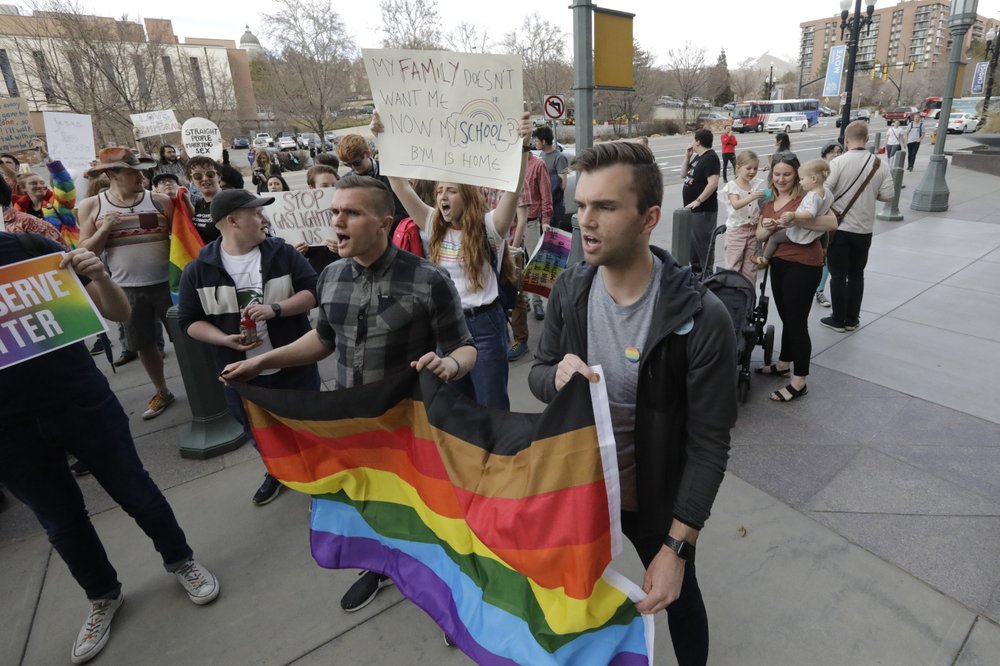
Ryan Jenks, left, and Caloway Williams, right, join several hundred Brigham Young University students protesting near The Church of Jesus Christ of Latter Day Saints church headquarters Friday, March 6, 2020, in Salt Lake City, to show their displeasure with a letter this week that clarified that "same-sex romantic behavior" is not allowed on campus. (AP Photo/Rick Bowmer)
Caloway Williams, a BYU senior who is gay, called the letter a slap in the face that he interpreted to meant his faith doesn’t love or accept LGBTQ people. He called it infuriating to hear top leaders speak of their love for everyone and then see policies that don’t match that principle.
“I want them to know it’s not OK what they have done. These are people’s lives they are messing with,” said Williams, 24, of Minot, North Dakota. “We are deserving of love and acceptance, and we are not going away.”
1 of 6
Brigham Young University student Kate Lunnen joins several hundred students protesting near The Church of Jesus Christ of Latter Day Saints church headquarters Friday, March 6, 2020, in Salt Lake City, to show their displeasure with a letter this week that clarified that "same-sex romantic behavior" is not allowed on campus. (AP Photo/Rick Bowmer)
A protester joins several hundred students gathered near The Church of Jesus Christ of Latter Day Saints church headquarters Friday, March 6, 2020, in Salt Lake City, to show their displeasure with a letter this week that clarified that "same-sex romantic behavior" is not allowed on campus. (AP Photo/Rick Bowmer)
SALT LAKE CITY (AP) — After Brigham Young University two weeks ago dropped a section from its strict code of conduct that had prohibited all expressions of homosexual behavior, bisexual music major Caroline McKenzie felt newfound hope that she could stop hiding and be herself. She even went on a date with another woman.
That optimism was pierced this week when administrators at the university owned by The Church of Jesus Christ of Latter Day Saints clarified in a letter posted online Wednesday that “same-sex romantic behavior” was still not allowed on campus. The letter said the recent revision to what is known as the “honor code” didn’t change the “moral standards” of the church or the faith’s opposition to same-sex marriage.
McKenzie said it made her feel whiplash and that her religion was telling her she was dirty for who she is and unwanted by God. She’s reassessing whether she wants to finish her studies at BYU even though she loves her professors and the education she’s receiving.
“It’s psychologically damaging,” said McKenzie, 23, of Kaysville, Utah. “It has been a roller coaster the last couple of weeks. This last Wednesday pretty much destroyed me. It felt like I was drowning again.”
She was one of several hundred people who protested Friday afternoon outside church headquarters in Salt Lake City to cap off a week of fury and heartbreak for LGBTQ students and their straight allies. They sang hymns and chanted “have no fear, God loves queers” as they held rainbow flags. They held signs that read “Love one another,” “Jesus loves everyone” and “Bigotry wrapped in prayer is still bigotry.”
McKenzie held a sign that said, “My family doesn’t want me, now my school? BYU is home.” It referenced a lack of support from her family after she came out last summer.
As they chanted loudly, “We’re here, we’re queer, we’re done living in fear,” many stared up at windows in the church headquarters.
Joey Pierson, left, and Luke Larsen, right, join several hundred Brigham Young University students protesting near The Church of Jesus Christ of Latter Day Saints church headquarters Friday, March 6, 2020, in Salt Lake City, to show their displeasure with a letter this week that clarified that "same-sex romantic behavior" is not allowed on campus. (AP Photo/Rick Bowmer)
The Utah-based religion of 16-million members worldwide has tried in the last decade to create a more welcoming environment for LGBTQ members, while adhering to its doctrinal opposition of gay marriage. The faith, widely known as the Mormon church, teaches that while being gay is not a sin, engaging in same-sex relationships is against God’s commandments.
Church spokesman Doug Andersen said in a statement Friday: “The teachings of the church and the policies of our universities are consistent with eternal principles, and seek to encourage and strengthen relationships that lead to eternal covenants made with God. The church and its leaders continue to teach that though there may be disagreement on an issue or policy, we should treat one other with love, respect and kindness.”
Students who attend BYU in Provo, south of Salt Lake City, agree to adhere to the code of conduct known as the “honor code”, and nearly all are members of the church. Punishments for violations range from discipline to suspension and expulsion. The code bans other things that are common at other colleges, including drinking, beards and piercings.
The letter posted this week and an accompanying Q&A posted online don’t provide details about what same-sex romantic behaviors are and aren’t allowed. But it seems to shut the door on the idea that gay and lesbian couples will be allowed to kiss and hold hands on campus like their heterosexual classmates.
“Same-sex romantic behavior cannot lead to eternal marriage and is therefore not compatible with the principles included in the honor code,” wrote Paul V. Johnson, commissioner of the church education system.
Church members Joey Pierson and Luke Larsen held hands as they chanted and sang along Friday at the rally. The young couple that identify as gay are still in high school, but came out to support fellow gay Latter-day Saints who attend BYU.
“I’m tired of feeling so suppressed and not feeling the love that God wants us to feel,” said Pierson, 18. “It’s time to show what God’s love looks like and that his God is unconditional and infinite and reaches everyone, not just straight people and not just celibate gay people.”
Ryan Jenks, left, and Caloway Williams, right, join several hundred Brigham Young University students protesting near The Church of Jesus Christ of Latter Day Saints church headquarters Friday, March 6, 2020, in Salt Lake City, to show their displeasure with a letter this week that clarified that "same-sex romantic behavior" is not allowed on campus. (AP Photo/Rick Bowmer)
Caloway Williams, a BYU senior who is gay, called the letter a slap in the face that he interpreted to meant his faith doesn’t love or accept LGBTQ people. He called it infuriating to hear top leaders speak of their love for everyone and then see policies that don’t match that principle.
“I want them to know it’s not OK what they have done. These are people’s lives they are messing with,” said Williams, 24, of Minot, North Dakota. “We are deserving of love and acceptance, and we are not going away.”
Subscribe to:
Comments (Atom)