AMERICAN Coronavirus testing requires 'wartime effort' from
federal leadership, former FDA commissioner says
Rebecca Corey Yahoo News Video•April 10, 2020

At multiple White House briefings, President Trump has touted the number of coronavirus tests being performed in the United States, repeatedly making the false claim that the U.S. has performed more tests per capita than any other country. And while the total number of tests being performed on a daily basis has increased, reaching over 2.5 million completed tests by April 10 according to the COVID Tracking Project, that number is far less than the White House had promised in early March — and far fewer than the number needed to safely lift lockdowns across the U.S., according to experts.
“It’s not necessary, but it would be a good thing to have,” Trump said at a press conference on April 9 when asked about having a nationwide testing system. “Do you need it? No. Is it a nice thing to do? Yes. We’re talking about 325 million people, and that’s not going to happen, as you can imagine.”
But many disagree — including Dr. David Kessler, the former commissioner of the Food and Drug Administration and author of Fast Carbs, Slow Carbs: The Simple Truth about Food, Weight, and Disease.
“We underestimated the virus at the beginning. We underestimated the extent of the virus. We can’t underestimate the extent of the testing we need,” Kessler told Yahoo News. He is a member of the team advising presumptive Democratic presidential nominee Joe Biden on the coronavirus pandemic. But Kessler, who has served as FDA commissioner in both Republican and Democratic administrations, insists that this is not a partisan issue.
“The answer is — in the absence of a vaccine and a therapeutic — testing, testing, testing. It’s our only tool against this virus,” Kessler said.
Kessler argues that the level of mobilization of efforts to produce and distribute more tests needs to be on par with a wartime effort, and that one person needs to be responsible for orchestrating that effort — though Kessler says he has yet to see that role adequately filled.
“Right now, we need one person who reports directly to the president who can ensure that all resources — from that swab, that specimen kit, to that big machine sitting somewhere in a laboratory somewhere in the United States — that that entire spectrum of what’s necessary can be mustered with an efficiency that you need to basically scale up in a wartime effort,” Kessler said. “There are a lot of well-intentioned people trying to do pieces of this puzzle, pieces of this effort. But no one really understands, regrettably, what it takes from beginning to end, who is leading this effort, this real expertise.”
“The administration will say they have Admiral Giroir. He’s doing that. But he’s not commandeered the resources as in a wartime effort,” Kessler continued. “When I see all the large laboratory machines running 24/7, where we’re getting all the specimens collected and have enough swabs, then we’re going to be able to open up this country.”
ONE MONTH AFTER ANNOUNCING THE PANDEMIC IN AMERIKA THE TRUMP CORONAVIRUS TASK FORCE FINALLY PRACTICES SOCIAL DISTANCING APRIL 6,2020

WASHINGTON, DC - APRIL 06: (2nd L-R) U.S. Vice President Mike Pence, President Donald Trump, Assistant Secretary for Health Admiral Brett Giroir and Dr. Deborah Birx, coronavirus response coordinator, speak to reporters following a meeting of his coronavirus task force in the Brady Press Briefing Room at the White House on April 06, 2020 in Washington, DC. (Photo by Chip Somodevilla/Getty Images)More
Adm. Brett P. Giroir, a medical doctor and assistant secretary for health at the U.S. Department of Health and Human Services, is a member of Trump’s coronavirus task force and was appointed “testing czar” on March 12, which put him in charge of coordinating testing efforts among public health service agencies. His area of responsibility encompasses the complete set of diagnostic testing activities, including the customer and patient experience, specimen collection, logistics, testing, result return and supply chain.
“A key priority is to ensure that patients, doctors and hospitals can access tests seamlessly and with maximum ease, and Dr. Giroir will lead efforts to execute on that goal,” HHS Secretary Alex Azar said in a statement.
“I have a lot of respect for Admiral Giroir,” Kessler added. “And I think they are trying. But at this point, there has to be a plan to reopen this country, and that requires putting into place the specifics of how we’re going to get literally millions of tests done a week. That’s not been solved. They have increased the testing. I applaud that. But they’re off so far by an order of magnitude. They have to scale up the efforts. And they’re going to have to take a more assertive role faster, bringing to bear the kind of resources, these big machines, running them 24/7, pushing these companies to do what they’ve never done before but they’re willing to do.”
A report released by the U.S. Department of Health and Human Services Office of Inspector General, which surveyed 323 hospitals across 46 states, the District of Columbia and Puerto Rico from March 23 to 27, found that hospitals reported severe shortages of testing supplies and extended waits for test results. Hospitals said that they were unable to keep up with COVID-19 testing demands because they lacked complete kits or the individual components and supplies needed to complete tests.
“I don’t know the inspector general, I don’t know that person,” Giroir said at a White House briefing on April 6 when asked about the report. “I tell you one thing I have a problem with. If there was such a problem that she knew about or he knew about on March 23rd and 24th, why did I find out about the test from them on the news media at 8 o’clock this morning? If there was a problem, I think you’re ethically obliged to tell me where that is so we can interact with it like I do every single day. But that’s a discussion for the future. I think testing is really in a good position right now.”
Earlier that same day, Giroir was asked on the “Today” show about the report and why the U.S. has been lagging behind other countries in testing.
“We are really going hospital to hospital to try to assure that the tests are available and I’m meeting with hospital associations from all the metroplex areas and there’s no question that testing is tight. But there are enough tests out there for people who need the test to get the test,” Giroir said.
Widespread testing is considered by public health experts to be a crucial precursor to lifting lockdowns. By determining which individuals are infected and need to self-isolate, those who are tested and found to be uninfected can return to everyday public activities without forcing the entire population to stay home.
“We’re going to need, obviously, to test anyone who’s symptomatic. But that alone is not going to be enough. We’re going to need very strong surveillance testing in this country,” Kessler said.
Currently, testing is being prioritized for those exhibiting symptoms, with hospitals reporting confusing guidance on who qualifies for testing that varies by state. But the need for more testing is underlined by the number of asymptomatic cases. At a press conference on April 5, Dr. Anthony Fauci, director of the National Institute of Allergy and Infectious Diseases, estimated that between 25 percent and 50 percent of all coronavirus carriers exhibit no symptoms and may be unwittingly spreading the disease. But Fauci conceded that there is no way to know for certain how many “silent carriers” exist until widespread testing is performed.

Anthony Fauci, director of the National Institute of Allergy and Infectious Diseases, attends a Coronavirus Task Force news conference at the White House in Washington, D.C., U.S., on Friday, April 10, 2020. President Donald Trump said he'll introduce on Tuesday a council of doctors and business people who will advise his government on how to reopen the economy following the coronavirus outbreak. Photographer: Kevin Dietsch/UPI/Bloomberg
“I don’t have any scientific data to say that,” Fauci said. “You know when we’ll get the scientific data? When we get those antibody tests out there and we really know what the penetrance is. Then we can answer the questions in a scientifically sound way.”
Fauci has also said that a different kind of test, for the presence of antibodies in the blood, signifying a previous exposure to the virus, is an important step towards being able to lift lockdowns. People who test positive for antibodies are presumed to be protected from re-infection with the virus, although questions remain about the degree and persistence of that immunity.
“As we look forward, as we get to the point of at least considering opening up the country as it were, it’s very important to appreciate and to understand how much that virus has penetrated this society," Fauci told CNN on April 10. “Because it’s very likely that there are a large number of people out there that have been infected, have been asymptomatic and did not know they were infected.
Fauci says antibody tests could be available “within a week or so.”
There are approved tests for the presence of active infection, although the U.S. got off to a slow start and the promise by President Trump on March 6 that “anybody who wants a test gets a test” isn’t close to being fulfilled. A test introduced by Abbott in late March is able to deliver positive or negative results within minutes, and can be performed in a doctor’s office or emergency room without waiting for tests to be sent out to a lab.
But deploying tests has been delayed by a lack of testing supplies, like the swabs needed to collect testing samples. The HHS inspector general report found that many hospitals said they were competing with other providers for limited supplies. National coordination could help ease that problem.
“The new Abbott test is terrific, but it’s not going to be available in enough quantity to test the millions and millions of people that are going to be surveyed to make sure we can open up this country,” Kessler told Yahoo News. “I am sure that Abbott is ready to put an additional assembly line, it wants to make as many machines as it can. But that machine has certain limitations. The parts are custom designed. They come from all around the world.”

Medical workers test patients at a drive-through Covid-19 testing center at Bergen New Bridge Medical Center in Paramus, New Jersey, U.S., on Friday, April 10, 2020. Photographer: Michael Nagle/Bloomberg
Drive-through testing centers have also been touted by the White House, but they exist on only a limited scale. This is partially a consequence of the shortage of personal protective equipment for health care workers who administer those tests, with hospitals reluctant to send their employees into a test line unprotected. Now, with the creation of swab testing that can be self-administered, the risk for health care workers at these locations is lower.
Kessler says the testing availability will be important even as the U.S. eases back into normal life.
“We’re going to be playing whack-a-mole for some time,” Kessler said. “But the real question is, can we act quick enough before those little outbreaks become a major epidemic?”
“We can’t make the same mistake twice.”
Ex-CDC director slams Trump’s ‘mind-boggling’ incompetence — and warns more ‘epic failures’ are coming
Published April 11, 2020 By Matthew Chapman
According to The Washington Post, former Centers for Disease Control and Prevention director Tom Frieden is disgusted with the “mind-boggling” incompetence of President Donald Trump’s administration in managing the public health crisis facing the nation.
“‘It’s mind-boggling, actually, the degree of disorganization,’ said Tom Frieden,” reported Lena H. Sun, William Wan, and Yasmeen Abutaleb. “The federal government has already squandered February and March, he noted, committing “epic failures” on testing kits, ventilator supply, protective equipment for health workers and contradictory public health communication. The next failure is already on its way, Frieden said, because ‘we’re not doing the things we need to be doing in April.'”
The report outlined how the main national efforts to combat the coronavirus pandemic are coming from state-level partnerships — rather than from the White House.
“A collection of governors, former government officials, disease specialists and nonprofits are pursuing a strategy that relies on the three pillars of disease control: Ramp up testing to identify people who are infected. Find everyone they interact with by deploying contact tracing on a scale America has never attempted before. And focus restrictions more narrowly on the infected and their contacts so the rest of society doesn’t have to stay in permanent lockdown,” said the report. “But there is no evidence yet the White House will pursue such a strategy.
“Instead, the president and his top advisers have fixated almost exclusively on plans to reopen the U.S. economy by the end of the month, though they haven’t detailed how they will do so without triggering another outbreak,” said the report. “President Trump has been especially focused on creating a second coronavirus task force aimed at combating the economic ramifications of the virus.”
You can read more here. BEHIND PAYWALL
Far-right terrorist ringleader found to be teenager in Estonia
A group known as Feuerkrieg Division (fire war division) was led by a 13-year-old from Estonia. The teenager shared bomb-making instructions and wanted to set up a terrorist training camp.
Authorities in Estonia captured the leader of a far-right terrorist group called the "Feuerkrieg Division" (FDK), or ''fire war division,'' an online group with members that spread across several countries, Der Spiegel reported on Thursday.
Investigators found the group was headed by a 13-year-old, the German magazinesaid, citing Estonian newspaper Eesti Ekspress. The young man operated online under the name "Commander" and was responsible for the recruitment and admission of new members.
He also shared bomb-making instructions, spoke about planning an attack on London and suggested organizing military training camps in February, to commemorate the "100th birthday" of Adolf Hitler's former political party NSDAP.
Due to the suspect's age, he cannot be prosecuted in Estonia, Der Spiegel reported. Instead, authorities will have to seek other legal measures to protect him from himself and others.
Read more: Germany bans branch of far-right 'Reichsbürger' movement
Members in Germany
Reports suggest FDK operated almost entirely online and idolized right-wing terrorists as "saints," calling on members to follow their example.
As recently as October, the group wrote a series of tenets such as "we are not afraid to die and we kill anyone who gets in our way." FDK announced its dissolution on February 8, though authorities found internal chats indicating they would continue under a new name.
The group was reportedly active worldwide and had, until recently, some 70 members in 15 countries, including Germany.
Read more: German gun clubs fending off the far-right AfD
Online radicalization
Der Spiegel reported that the German branch consisted of six members, going by internal chat names of "Heydrich", "Teuton", "Dekkit", "Napola88", "Wolfskampf" and "Jus-ad-bellum."
"Heydrich" was said to be the head of the German organization and he was arrested in Bavaria in February of this year. Investigators found photos of the 22-year-old man posing with a mask on, a self-made rifle and an edition of Adolf Hitler's "Mein Kampf."
The members of FKD are the latest group of suspected right-wing terrorists allegedly radicalized online that security authorities have long overlooked.
According to the magazine, "Heydrich" had no criminal background and no connection to the regional neo-Nazi scene before his activities with the FKD. Instead, he reportedly underwent self-radicalization on the internet, through right-wing chat groups.
He led a neo-Nazi group linked to bomb plots. He was 13.
The Hitler Youth was the youth organisation of the Nazi Party in Germany. Its origins dated back to 1922 and it received the name Hitler-Jugend, Bund deutscher Arbeiterjugend in July 1926. Wikipedia
By MICHAEL KUNZELMAN and JARI TANNER
4/11/2020
HELSINKI, Finland (AP) — He called himself “Commander” online. He was a leader of an international neo-Nazi group linked to plots to attack a Las Vegas synagogue and detonate a car bomb at a major U.S. news network.
He was 13 years old.
The boy who led Feuerkrieg Division lived in Estonia and apparently cut ties with the group after authorities in that tiny Baltic state confronted him earlier this year, according to police and an Estonian newspaper report.
(ESTONIA LIKE OTHER BALTIC STATES BROKE AWAY FROM RUSSIA WITH THE BREAK UP OF THE USSR, AS A RESULT THEY ALSO COMMITTED TO A FASCIST NATIONALIST REVIVAL, ESTONIA BEING ONE OF THE WORST FOR THIS TENDENCY AS WELL AS BEING EVEN MORE ONLINE THAN FINLAND)
Harrys Puusepp, spokesman for the Estonian Internal Security Service, told The Associated Press on Thursday that the police agency “intervened in early January because of a suspicion of danger” and “suspended this person’s activities in” Feuerkrieg Division.
“As the case dealt with a child under the age of 14, this person cannot be prosecuted under the criminal law and instead other legal methods must be used to eliminate the risk. Cooperation between several authorities, and especially parents, is important to steer a child away from violent extremism,” said Puusepp, who didn’t specify the child’s age or elaborate on the case.
The police spokesman didn’t identify the child as a group leader, but leaked archives of Feuerkrieg Division members’ online chats show “Commander” referred to himself as the founder of the group and alluded to being from Saaremaa, Estonia’s largest island.
A report published Wednesday by the weekly Estonian newspaper Eesti Ekspress said Estonian security officials had investigated a case involving a 13-year-old boy who allegedly was running Feuerkrieg Division operations out of a small town in the country. The newspaper said the group has a “decentralized structure,” and the Estonian teen cannot be considered the organization’s actual leader but was certainly one of its key figures.
The Anti-Defamation League has described Feuerkrieg Division as a group that advocates for a race war and promotes some of the most extreme views of the white supremacist movement. Formed in 2018, it had roughly 30 members who conducted most of their activities over the internet, the ADL said.
Oren Segal, vice president of the ADL’s Center on Extremism, said children aren’t just a target audience for online forums that glorify white supremacy and violence. They also maintain such sites, captivated by their ability to join or influence an international movement from a home computer, he said.
“That young kids are getting that sense of belonging from a hate movement is more common than most people realize and very disturbing. But accessing a world of hate online today is as easy as it was tuning into Saturday morning cartoons on television,” Segal said in a text message.
Feuerkrieg Division members communicated over the Wire online platform. The FBI used confidential sources to infiltrate the group’s encrypted chats, according to federal court records.
An FBI joint terrorism task force in Las Vegas began investigating 24-year-old Conor Climo in April 2019 after learning he was communicating over Wire with Feuerkrieg Division members, a court filing says. Climo told an FBI source about plans to firebomb a synagogue or attack a local ADL office, authorities said. Climo awaits his sentencing after pleading guilty in February to felony possession of an unregistered firearm.
Another man linked to Feuerkrieg Division, U.S. Army soldier Jarrett William Smith, pleaded guilty in February to separate charges that he provided information about explosives to an FBI undercover agent while stationed at Fort Riley, Kansas, last year. An FBI affidavit said Smith, 24, talked about targeting an unidentified news organization with a car bomb. CNN reported that it was the target.
The ADL said Smith was associated with Feuerkrieg Division at the time of his arrest. The group expressed its “consternation” about Smith’s arrest in an expletive-laden post on its public Telegram channel, the ADL reported.
In March, a left-leaning website called Unicorn Riot published eight months of leaked chats by Feuerkrieg Division members. After “Commander” disappeared from the group’s chat room in January, other members discussed whether he had been detained or arrested and speculated that his electronic devices had been compromised, the website said.
The messages don’t indicate that other Feuerkrieg Division members knew the group leader was 13, according to Segal, who said the ADL also independently obtained the group’s chat archives.
Based on a comment the boy posted on Wire, ADL linked “Commander” to the gaming platform Steam. The Steam account lists his location as a village in Estonia and his URL as “HeilHitler8814,” Segal said.
Feuerkrieg Division has been part of a growing wing of the white supremacist movement that embraces “ accelerationism,” a fringe philosophy that promotes mass violence to fuel society’s collapse. The man who recently pleaded guilty to attacking two mosques in Christchurch, New Zealand, and killing 51 people last year devoted a section of his manifesto to the concept of accelerationism.
The Estonian security police’s bureau chief, Alar Ridamae, said parents, friends and teachers can help authorities protect children from internet-fueled extremism.
“Unfortunately, in practice there are cases where parents themselves have bought extremist literature for their children, which contributes to radicalization,” Ridamae said in a statement provided to AP and Estonian media on Thursday.
Estonia, a former Soviet republic that regained its independence in 1991, is among Europe’s most technologically advanced nations. Estonia has paid relatively little attention to homegrown extremism. But the case of the right-wing extremist Anders Breivik, who killed 77 people in a 2011 massacre in Norway, served as a major wake-up call for security officials in the Baltic nation of 1.3 million.
___
Kunzelman reported from Silver Spring, Maryland.
New Trump Ad Suggests a Campaign Strategy Amid Crisis: Xenophobia
Nick Corasaniti, Jeremy W. Peters and Annie Karni The New York Times•April 11, 2020
Biden quietly widens lead over Trump in 2020 race: Reuters/Ipsos poll

President Donald Trump has kicked off his general election advertising campaign with a xenophobic attack ad against Joe Biden, the presumptive Democratic nominee, the opening shot in a messaging war that is expected to be exceptionally ugly.
In a minute-long digital ad released late Thursday that relies heavily on imagery of China and people of Asian descent, the Trump campaign signaled the lines of attack it will use in its attempts to rally the president’s base and define Biden. The ad reprises accusations Trump has made that the former vice president’s family profited from his relationships with Chinese officials and presents selectively edited scenes and statements attempting to portray him as doddering and weak.
For the president and his allies, the approach represents their assessment of the race as it narrows into a one-on-one contest with Biden, the opponent who is least susceptible to their charges that the Democratic Party is too far outside the political mainstream.
The new ad also shows that while the country has changed drastically in recent weeks amid a national health crisis, the president has not. He continues to lead the nation and run his campaign the way he always has: by belittling his adversaries and exploiting racial discord.
While other presidents have used campaigns during periods of national trauma to try to unite the country, political strategists said that Trump was taking the opposite approach.
“They’re just going to run a white grievance campaign,” said Stuart Stevens, who worked on the presidential campaigns of the Republicans Mitt Romney and George W. Bush. “It’s not complicated. He’s losing with everybody but white men over 50,” Stevens added.
“Trump hasn’t changed,” he said. “He hasn’t changed in 30 years.”
Biden amplified that criticism with a statement Friday, saying, “The casual racism and regular xenophobia that we have seen from Trump and this Administration is a national scourge.”

“Donald Trump only knows how to speak to people’s fears, not their better angels,” he added.
Since the coronavirus started spreading in the United States, Trump has tried to steer the conversation over his response toward themes and issues he is most comfortable with like nationalism and border security. Until recently, he had been referring to the coronavirus as the “Chinese virus.”
Now, with unfounded claims that Biden and his family have profited from below-board business deals with the Chinese, Trump is attempting to link his political rival to his chief geopolitical foe at a time when there is rising xenophobia and violence in the United States aimed at Chinese Americans.
“During America’s crisis, Biden protected China’s feelings,” the online ad says, presenting a montage of clips of Biden complimenting and praising the Chinese, including the country’s leader, Xi Jinping, and of a news segment accusing Biden of helping his son Hunter profit off Chinese investments.
The ad also includes an image of a smiling Biden standing alongside an Asian American man — an apparent attempt to suggest that the former president has an inappropriately cozy relationship with China. But the man in the image is a Chinese American, the former governor of Washington, Gary Locke, who also served as President Barack Obama’s commerce secretary and ambassador to China.
The picture, which appears briefly in between clips showing Biden socializing with Chinese officials and stammering through speeches, was taken at a 2013 event in Beijing where Locke and the former vice president appeared together.
The ad’s implication that Biden is soft on China is oddly timed, coming as Trump’s own stance toward China and Xi has been more positive. Trump has been complimenting Xi, and as recently as last week, the president described the two of them as close allies and good friends.
The Trump campaign defended using an image of an Asian American to illustrate Biden’s ties to the Chinese, saying it was selected simply because Hunter Biden accompanied his father on the 2013 trip to China. Trump has repeatedly accused him, without evidence, of using his father’s official visit to further his own business interests.
“The shot with the flags specifically places Biden in Beijing in 2013,” Tim Murtaugh, a Trump campaign spokesman, wrote on Twitter, referring to the picture with Locke. “It’s for a reason. That’s the Hunter Biden trip. Memory Lane for ol’ Joe.”
Murtaugh did not address the fact that Locke is not Chinese, or that the ad presents the image with no context or explanation.
Locke responded by accusing Trump of stoking hatred against Asian Americans. “The Trump team is making it worse,” he said in a written statement. “Asian Americans are Americans. Period.”
In recent weeks, Asian Americans have reported being physically attacked, yelled at and spit upon; organizations have begun to track the incidents. Trump’s rise has only pushed many Asian Americans further into the Democratic Party, though they were once considered a fairly reliable Republican demographic.
Some Democratic strategists said that the tone and nature of the Trump ad should serve as a wake-up call. The coronavirus pandemic and the human and economic suffering it has unleashed does not mean that politics as usual are on hiatus, they said.
“This should tell the Biden campaign and every other entity trying to beat Trump that we have to rethink the playbook,” said Kelly Gibson, a Democratic media strategist who advised the campaigns of Andrew Yang and Julián Castro. “So if Democrats don’t sink to his level, at least a little, we will be at a sizable disadvantage. You can’t beat fear with logic; it has never worked and it will never work.”
The Trump campaign’s approach is a coarser version of the strategy that incumbent presidents typically deploy against their opponents: try to define them early before they get a chance to define themselves.
“What the Trump campaign wants to do is introduce on their terms, or in the case of Joe Biden, reintroduce that opponent to the American people before that opponent gets a chance to introduce himself,” said Ken Goldstein, a professor of politics at the University of San Francisco. “Their whole campaign is going to be about disqualifying Joe Biden.”
Though the ad is among the first to come from the Trump campaign directly since Biden became the presumptive nominee, an undeclared ad war has been raging for months, initially begun during the impeachment of Trump. In previous ads, including two that CNN refused to air citing “demonstrably false claims,” Trump has already attacked the Bidens on similar grounds.
And since late February, Priorities USA, one of the largest Democratic super PACs, has spent $6.5 million on ads attacking Trump in key swing states; an early round featured former supporters of Trump voicing their displeasure with his administration. Priorities USA has since started airing ads starkly criticizing the president’s response to the coronavirus outbreak.
In total, Democratic groups have already spent $15.5 million on general election ads this cycle, according to Advertising Analytics, an ad tracking firm. Many millions more have been spent online as well; Priorities USA alone has spent $19 million on digital attack ads already, and Acronym, another Democratic outside group, has spent $10 million.
But it is unclear how much any of this advertising will matter given Americans’ preoccupation with more pressing concerns. Biden, who lacks the financial wherewithal that Trump and the Republican National Committee have amassed, could stand to benefit in this regard.
“The shorter the race, the more it favors the person with the least amount of money,” said Stevens, who saw firsthand in 2012 how Obama’s financial advantage and the advertising it bought made it difficult for Romney to define himself.
“One of the major advantages of an incumbent president is monetary,” Stevens added. “And that’s being mitigated by this virus.”
This article originally appeared in The New York Times.
© 2020 The New York Times Company
POLITICS OF RACISM AND XENOPHOBIA IN THE TRUMP ERA
Gary Locke Is Mad About That Trump Ad
The president’s latest attack ad makes a reckless claim about the former governor of Washington.
NG HAN GUAN / REUTERS
It was getting late in the afternoon, but Gary Locke hadn’t had time for breakfast or lunch. Too many emails, phone calls, and texts had been coming in from friends, family, former aides. The former Washington governor’s friends were indignant. They wanted to know if he had seen President Donald Trump’s campaign ad featuring him. He had. His reaction? “It’s more anger,” he said. He paused. He’s a pretty mild guy, generally. “It’s anger.”
Locke endorsed Joe Biden for president last summer, but he hadn’t expected to be featured in an attack ad. The Trump campaign probably never expected to feature him either. But there he is, in a brief clip included in a montage of the former vice president meeting with various Chinese officials. Locke is standing between two Chinese flags (and next to an American one). Biden is walking toward him, with his head bowed in a way that makes him look deferential.
It’s a standard theatrical move that Biden often does when he sees old political allies. And Locke is an old Biden ally. But he isn’t Chinese. He’s Chinese American. And though the photo was taken at an event in Beijing, it was taken while Locke was serving in the same administration as Biden—as the American ambassador to China. Before that, he was the first Asian American governor of a state not called Hawaii. A section of the Wing Luke Museum of the Asian Pacific American Experience in Seattle is devoted to him.
In other words: Locke is not a Chinese official, as the Trump campaign made him out to be, apparently because of the way he looks and because he was standing next to a Chinese flag.
“It is racial stereotyping at its worst. Asian Americans—whether you’re second-, third-, or fourth-generation, will always be viewed as foreigners,” Locke told me today. “We don’t say that about second- or third-generation Irish Americans or Polish Americans. No one would even think to include them in a picture when you’re talking about foreign government officials.”
Locke is justifiably bewildered by being thrown into the middle of the campaign. “For a lot of Asian Americans, it’s not surprising, but it is disheartening,” he said.
Locke’s father was part of the Normandy invasion, then was ordered along with the rest of the Fifth Armored Division to the Battle of the Bulge. When Locke watched Band of Brothers, he says, he recognized his father’s story in it. He grew up in a housing project in Seattle, and went on to a long political career that took him through the state legislature, county government, two terms as governor, three years as Barack Obama’s commerce secretary and then two years as Obama’s ambassador to China, from 2011 to 2013. These days, he’s back home, watching the coronavirus crisis unfold in his own state and using his down time in self-isolation to build a second-story deck on his house and finish up some gardening projects. His grown kids are worried he’s going to fall and break his back, like he did 20 years ago, when he was in the middle of budget negotiations with the legislature in Olympia.
One of Locke’s friends has already died of COVID-19. His first campaign treasurer is in the hospital. And now he’s suddenly been pulled into the presidential campaign by an inadvertent cameo—which he said fits into a long history of racism against Asians in America, stretching from the Chinese Exclusion Act, to the internment of Japanese Americans during World War II, to the increase in anti-Asian hate crimes as the president and his allies repeatedly refer to the pandemic as the “Chinese virus.”
In a statement he scrambled to put out this afternoon, Locke said Trump was “fanning hatred.” He said with hate crimes and discrimination on the rise across the country, “the Trump team is making it worse. Asian Americans are Americans. Period.”
In what seems like both an obvious continuation of past behavior and a sign of what’s to come, the Trump campaign responded by insisting that including Locke was intentional, serving a political purpose that would have been recognizable only to the president’s super fans: that it was actually a subliminal nod to the conspiracy theory that Biden helped his son secure a business deal by bringing him on an official trip. (Hunter Biden did fly to China on Air Force Two and has said he did have a few business meetings while there, but aside from a brief handshake that the vice president shared with one of his son’s business partners, no connection between Hunter’s business dealings and his father’s position has ever been shown.) “The shot with the flags specifically places Biden in Beijing in 2013. It’s for a reason. That’s the Hunter Biden trip. Memory Lane for ol’ Joe,” the Trump campaign’s communications director, Tim Murtaugh, tweeted. Later, the Republican National Committee’s rapid-response director defensively tweeted a screenshot of the clip that included only Biden and the Chinese flag, not Locke or the American flag that was onstage too.
Chris Lu, who became friends with Locke when they served together under Obama (Lu was the secretary of the Cabinet and, later, the deputy labor secretary), told me that his assessment of that defense was simple: “It’s bullshit.”
“It’s sort of comical that they think all Chinese people look alike, but more broadly, it’s part of an attack on Asian Americans as others,” Lu said. And it’s part of a pattern, Lu argued. Trump has attacked a Mexican American judge as “Mexican” and concluded that the judge was therefore biased against him, and he has suggested that Colonel Alexander Vindman, the Ukrainian-born former White House national-security official who testified as part of the impeachment hearings, held dual loyalties.
Andrew Yang, the former presidential candidate, whose parents immigrated to America from Taiwan, said on Twitter: “Goddamn this shit is infuriating. Gary Locke is as American as the day is long. Trump rewriting history as if he effectively responded to the virus is utter garbage. We lost 70 days and thousands of lives due to his incompetence and disregard for what was happening overseas.”
The ad as a whole makes a confusing argument: that Biden is soft on China because of his own good relationships with Chinese President Xi Jinping and others, and that this makes him somehow culpable for decisions related to the pandemic. Trump has made overtures to Xi himself, including inviting the leader to Mar-a-Lago and having Ivanka Trump’s daughter perform a song for him in Mandarin; tweeting that they’ll “always be friends”; and taking his word on supposed efforts to contain the coronavirus—all mixed in with his trade-war rattling and posturing on currency manipulation. (The Locke appearance also isn’t the only factual problem with this ad.)
When I asked Murtaugh to explain the ad, he sent me a statement that was a slightly longer version of what he’d tweeted last night. He provided no answers to specific questions, no explanation, and no response to Locke’s concerns about stoking division, xenophobia, and potentially more hate crimes. There was certainly no apology.
“I don’t expect an apology from them,” Locke told me. “It is so characteristic of their view toward people of color.”
The Price of Protecting Rhinos
Conservation has become a war, and park rangers and poachers are the soldiers.
Martin Saavedra
Story by Cathleen O'Grady THE ATLANTIC JANUARY 13, 2020 SCIENCE
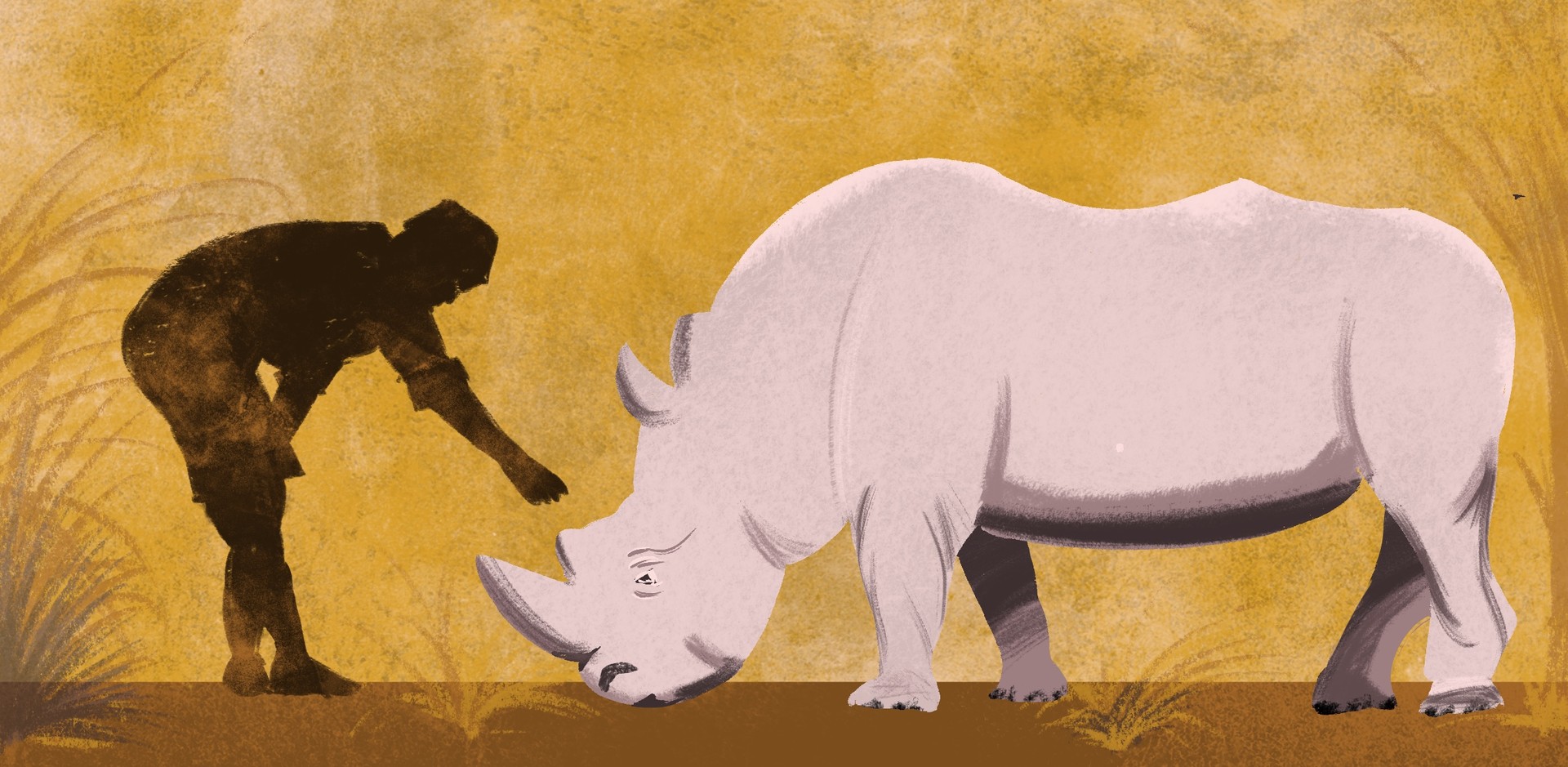
“Hsst!” hisses Charles Myeni. “Leave space!” Silently, the men in his anti-poaching unit spread out as they move through the bush in single file, leaving a few feet between them.
Myeni explains his command to me: If a rhinoceros poacher attacks us and we're all neatly squished together in a line, he whispers, they “can take us all out, one-one-one-one. We're all gonna die.”
Is he serious? His sardonic half smile is difficult to read. He may just be trying to scare me, the city-dwelling white girl tagging along on his morning patrol through South Africa’s Somkhanda Game Reserve. But I still stick as closely as I can to him and his automatic rifle.
The three guns between the six men on patrol should be enough to overpower any poachers, Myeni tells me, since a poaching team usually carries just one rifle. The last would-be rhino poachers apprehended on the reserve, in March of last year, were traveling in a pair: One carried a gun, and one carried an ax to hack off the rhino's horn.
Myeni’s patrol moves swiftly, scouring the ground for tracks. The terrain is treacherous: The tawny, knee-high grass disguises ditches, rocks, and tree roots, while vicious thorn trees throw out branches at face height. The dry air on this bright winter morning is hot in the sun and freezing in the shade. Myeni spots rhino tracks and follows them for a while to check that they are not joined by human footprints, which would be a sign that someone had followed the rhino. But the tracks are old, and no rhino—or human—materializes.
South Africa’s most recent rhino-poaching crisis came out of the blue. In 2007, the country lost just 13 rhinos to poaching; the next year, that number jumped to 83, kicking off a nightmarish escalation. Losses peaked at 1,215 in 2014, and deaths are still high: 2018, with 769 rhinos killed, was the first year that losses had dipped under 1,000 since 2013. South Africa is home to 93 percent of Africa’s estimated 20,000 white rhinos and 39 percent of the remaining 5,000 critically endangered black rhinos, making South Africa’s rhino crisis a global rhino crisis.
Demand for rhino horn has skyrocketed in Vietnam, where powdered horn is touted as both a hangover cure and a cancer treatment. Though it has no proven medicinal benefits—of no more value than human fingernails and hair, or horse hooves, which are made from the same material—it is associated with social status. As regional economies have boomed, its use has increased along with ordinary people’s purchasing power.
Read: The rich men who drink rhino horns
As the crisis continues, the job of protecting rhinos has changed dramatically. The South African military has stationed soldiers in the Kruger National Park. Surveillance technology like drones and light aircraft are used to spot signs of trouble. Rangers are trained by ex-military specialists. In 2012, the government body that oversees South Africa’s national parks appointed Johan Jooste, a retired army general, to oversee anti-poaching efforts.
As threats to species and natural resources escalate worldwide, conservation is looking more and more like war. National militaries play a role in conservation in the Congo, Cameroon, Guatemala, Nepal, and Indonesia. British troops have been sent to Malawi to provide ranger training. The U.S.-based nonprofit Veterans Empowered to Protect African Wildlife (VETPAW) sends veterans to “lead the war” against wildlife crime in Africa.
The conservation war is a human war—with human casualties. Myeni’s wife and children live with the knowledge that he is in constant danger, he says. Respect Mathebula, the first ranger in Kruger National Park to be killed by poachers in more than 50 years, was shot in July 2018. The International Ranger Federation reports that 269 rangers were killed across Africa between 2012 and 2018, the majority of them by poachers.
Meanwhile, Joaquim Chissano, the former president of Mozambique, alleges that 476 Mozambican poachers were killed by South African rangers between 2010 and 2015. South African authorities are cagey about releasing official figures, but research on organized crime estimates that between 150 and 200 poachers were killed in the Kruger National Park alone during the same period. In neighboring Botswana, anti-poaching action has reportedly resulted in dozens of deaths, and the country’s controversial “shoot to kill” policy—which gives rangers powers to shoot poachers dead on sight—has drawn allegations of abuse.
Species are swiftly being wiped out by the illegal wildlife trade, and the urgency of the situation provokes a panicked, violent response among those fighting to keep these species alive. But many conservationists are concerned about what the militarization of conservation means—for people, and for the success of conservation itself.
On a cool, cloudy morning, I set out to meet Thulani Mageba, a ranger at Hluhluwe-iMfolozi Park near South Africa’s east coast. (Mageba requested to go by a pseudonym for fear of retaliation by his employers.) The park is about the size of the city of Dallas, but humans are scarce; as I crawl my way through the park, where speeds are limited to 25 mph, I spot a hyena standing hunchbacked a few feet from the roadside, watching me warily.
The ranger outpost is quiet and feels slightly abandoned, but the two-way radio crackles with reports from rangers throughout the reserve. Mageba’s eyes flick nervously toward the radio each time a message comes through. KwaZulu-Natal, the province that is home to Hluhluwe-iMfolozi, has the densest population of rhinos in South Africa, and the park has been hit hard by poaching.
Mageba didn’t sign up to be a soldier. When he started out as a ranger, a decade before the poaching crisis escalated in South Africa, he had no idea what the job entailed. “I liked to see people wearing the uniform in town during shopping days,” he tells me shyly. He fell in love with rhinos on the job.
His story isn’t unusual, says Dave Cooper, a wildlife vet based at Hluhluwe-iMfolozi: “Those same guys that were employed as game rangers, living in the bush, looking after animals, are suddenly employed as special forces.”
“Law enforcement has always been part of a ranger’s job description,” says Chris Galliers, chairman of the Game Rangers Association of Africa. But the balance of responsibilities has changed, he says: Where conservation work once occupied the bulk of rangers’ time, it is now likely overshadowed by enforcement work.
The rangers who face danger on a daily basis often do so in terrible working conditions. “I have seen rangers cry when talking about the difficulties of their job,” says the conservation researcher Francis Massé. He describes rangers in Mozambican parks living in dilapidated camps with no electricity or running water, being paid slightly above minimum wage, and sometimes living out in the bush for months at a time.
RELATED STORIES

When Conservationists Kill Lots (and Lots) of Animals
How to Impregnate a Rhino
What Trophy Hunting Does to the Elephants It Leaves Behind
Report on South Africa
The situation in South Africa’s relatively well-funded parks is generally better, says Massé, but even there, conditions are far from acceptable. Rangers in Hluhluwe-iMfolozi report low pay, appalling housing, unpaid overtime, inadequate vacation time, and high stress. They describe working for 20 hours at a stretch, falling asleep on patrols, and waking up in the middle of the night to respond to gunshots.
Rangers are also separated from their families for long periods, and staff shortages make them reluctant to take time off even when it is permitted. “We don’t want to leave the reserve,” one ranger told a researcher investigating ranger welfare. “What happens if a rhino dies in your absence?”
Mageba tells me that he hasn’t seen his wife in four months. His family, he says, sometimes feels like he cares more about his work than he cares about them. “But they don’t understand the situation,” he says. “Losing a rhino is very painful.”
For rangers and other conservationists, says Galliers, the reserves themselves can become places of horror. Apart from the personal danger they face, they witness nearly constant violence toward the animals they love. Almost half of a rhino’s face can be bludgeoned off by a blunt ax, says Cooper. Calves or even full-grown rhinos may be killed by panga or ax if an initial gunshot fails to kill them.
And time off at home doesn’t always provide respite. In certain communities, rangers are “seen as the bad guy; they’re seen as murderers, for doing their job,” says Massé. Poachers bring wealth into their communities, he explains, and the rangers’ neighbors are often baffled by or angry at their interference with a much-needed source of income.
“If you think of the military operations in Afghanistan and Iraq,” says Andrew Campbell, CEO of the Game Rangers Association of Africa, “there’s a tour of duty and then there’s a period of being removed from that high intensity.” For rangers, though, there is no such reprieve: “You don’t get pulled out of that context. You just keep going.”
“We worry about 10, 15, 20 years from now,” says Campbell. “We want to keep rangers in the profession that are well supported, well looked after, and that have a sustainable career as rangers”—not, he says, people that burn out, succumbing to mental and physical exhaustion after two or three years.
The difficult conditions take a toll not only on the rangers but also on the quality of their work: Their concentration lapses at crucial moments. Resources and time for more mundane conservation duties are scarce. And the poor pay and constant danger make it tempting to play double agent for the poachers.
By the time I leave Mageba, the clouds have descended into a blanket of brownish gray. I see vultures circling and involuntarily picture the carcass they might have spotted. A helicopter hovers over a different section of the park. Could that be a rhino kill? My time with Mageba has left me twitchy. Suddenly, a police car rounds the bend ahead and tears toward me, a ranger vehicle following close behind. Mageba’s radio must have finally delivered the inevitable bad news.
In hluhluwe-imfolozi, the ever-present tension is mostly hidden from visitors. There are hints of the ongoing crisis—a quick search of the car upon entry; a sign forbidding the use of drones; a poster asking for donations to save the rhinos—but even here, rhino poaching mostly feels like something that is happening elsewhere.
The rhinos themselves are elusive. After seven days, I’ve seen countless elephants, zebras, baboons, and giraffes, and gawped at a cluster of orphaned rhinos kept in pens, but I’ve spotted not a single wild rhino. One afternoon, a series of booming, meaty grunts comes drifting into my room at the very edge of Hilltop Camp, along with a strong smell of cow dung. There’s clearly a gigantic herbivore a few feet away, but it is completely concealed by a dense screen of bushes and trees. Elephant? Or rhino? I spend ages peering into the bush, but I can’t see so much as a monkey.
The camp is surrounded by electric fences, making it safe for tourists to leave their cars and enjoy the picnic areas, swimming pool, and spectacular view from the restaurant terrace. At night, the Milky Way stretches across the sky; a small cluster of lights twinkles in the distance, a reminder that the towns dotting the borders of the park are not that far away.
Ordinary people have been kept out of iMfolozi, the southern section of the park, for roughly 200 years. The legendary Zulu king Shaka, who rose to power in 1819, drove out the inhabitants who lived between the two iMfolozi rivers and restricted hunting. In 1824, British settlers initiated ivory trade in the area, and their game hunting drove such a decline in the white-rhino population that five new reserves—including Hluhluwe and iMfolozi—were designated in 1895 by colonial authorities.
These days, the park is open only to the select few who find employment as conservation or tourism staff, and to the tourists who can afford to pay for the experience. My modest room at Hilltop Camp costs $595 for six nights, more than the monthly take-home pay of 93 percent of South Africans.
Conservation has a long history of removing people from their land in the interest of preserving wildlife. It’s a model that sees human occupation as incompatible with conservation, despite evidence that indigenous people can play a crucial role in protecting biodiversity. For many conservationists, tourism in otherwise human-free preserves is both a useful way to fund conservation and an industry to be protected in its own right. “Africa holds the last caches of this wildlife,” says Jooste, the retired general who oversees anti-poaching for South Africa’s national parks. Tourism helps protect wildlife for its own sake, he adds, and “it’s one of the economic engines of our country.”
In South Africa, the conflicts surrounding conservation divide along racial lines. Poachers are often assumed to be black, though this assumption is not always accurate, and news of their violent end is often celebrated by white South Africans. save a rhino, kill a poacher, reads a bumper sticker I used to see growing up in Johannesburg. the testicles of a rhino poacher can cure aids, says another, mocking both traditional medicine and South Africa’s HIV crisis while delivering its implicit threat.
Read: South Africa confronts a legacy of apartheid
There’s a widespread assumption among both black and white South Africans that conservation is a concern of white people. Meanwhile, black people witness a lucrative tourism industry operating on their ancestral lands, and the majority cannot afford to access it. Hostility and poverty combine to create the perfect storm for poacher recruitment. “[Poachers] know what the risk is, and they’re still willing to take it,” Massé says. “There’s a social and economic context that motivates them to do that.”
The poaching crisis is “an urgent situation,” he says, “but the militarization of conservation is having a lot of concerning impacts, both socially and ecologically.” Those impacts are both chronic and acute: In Eswatini, rangers allegedly killed suspected subsistence poachers hunting for meat. Anti-poaching forces in Tanzania have allegedly raped and tortured local villagers and suspected poachers. Anti-poaching units in Africa and Asia supported by the World Wildlife Fund (WWF) have allegedly committed abuses ranging from assault to murder. Martin Saavedra
Not only are these incidents unconscionable in their own right, but they also intensify local opposition to conservation. Treating local people as enemies poses a risk to the sustainability of conservation, Massé says: “It creates tensions and hostilities, and alienates them.”
Concerns about militarization are not limited to researchers like Massé—conservationists working the field are worried, too. Employees of South Africa’s national parks have written about the long-term human and conservation costs of military tactics. The Game Rangers Association of Africa has expressed concern about foreign soldiers, military veterans, and private security experts jetting in to train rangers without any understanding of the ecological or social context.
“The big question is the sustainability of these operations,” says Galliers. “How long can this last? How long can you keep purchasing and flying a helicopter that costs $1,000 an hour?” Military intervention can only be a short-term strategy; in the long term, what’s needed is support from the communities in and around reserves. Otherwise, Massé says, “conservation’s never going to be successful.”
Somkhanda game reserve is only about a 60-mile drive north of Hluhluwe-iMfolozi, but it’s a different world. The small towns surrounding Hluhluwe seem like bustling cities compared to the scattered traditional homesteads around Somkhanda. None of these households have electricity, and most have no running water. Many people have little reason to speak much English, and after a couple of days I begin to curse my pathetic elementary-school isiZulu.
This tiny reserve is trying to do things differently. It’s neither a huge state-owned park like Hluhluwe-iMfolozi nor a private game ranch. It’s a relatively young reserve, stitched together from the cattle and game farms that were restored to their original owners, the Gumbi clan, through South Africa’s post-apartheid land-restitution process. The Gumbi community-owned reserve, run in partnership with the nonprofit Wildlands Conservation Trust, employs around 100 people, offers training and internships, and runs education programs for local children, trying to cultivate a love for the bush.
When I arrive at Somkhanda, the young ranger guarding the gate shoots me a few stern questions. He hasn’t been told to expect me, and seems on high alert. While I wait for him to phone park headquarters to confirm whether he should allow me in, I eye a large sign outside the reserve gate. somkhanda game reserve, it reads. protected by ipss anti-poaching unit. IPSS, a private security company, offers a range of services around the province, including anti-poaching units and residential armed response. Although they help supply Somkhanda’s anti-poaching unit, the rangers themselves are hired from the reserve’s neighboring communities.
Within a few minutes of entering the park, I've seen giraffes, zebras, warthogs, and even a small herd of African buffalo. As I pass them, one wet-nosed bull watches me balefully, a calf sheltering behind him. On this smaller, cozier reserve, I hope my rhino-spotting luck will improve. But the rhinos tantalize me, continually lurking just out of sight. The rhino tracks Myeni spots on patrol with his anti-poaching unit lead to nothing. During an early-morning drive with the wildlife-monitoring team, we hop out of the truck, breath misting as we squint into the bright sunrise, and follow more rhino tracks—nothing.
Sihle Mathe, a tracker who can read the movements of animals in bent grass and what appears to me as entirely normal-looking dirt, suggests that I join him while he tries to track one of the reserve’s notoriously aggressive black rhinos. He chuckles at my trepidation. If she charges me, I ask, what should I do? Climb a tree, he says nonchalantly, but only if she’s more than 50 meters away. And if she’s closer? “Don’t try that. You’ll die.”
My eagerness to see the rhino begins to override my sense of self-preservation, but when I mention the plan to the reserve manager, Meiring Prinsloo, he shuts it down immediately. No rhino tracking for me—from the vantage point of a tree or otherwise.
Still, the reserve staff is scheduled to dehorn a rhino while I’m here, which surely means a sighting. But the day of the dehorning dawns wild and windy, and, to my dismay, the plan is called off—there’s no chance of darting a rhino successfully if wind is pulling the tranquilizer dart off course.
The young black rhino scheduled for dehorning will go through many throughout her life, all intended to protect her from her own dangerously precious cargo. Since rhino horn is made of keratin, like fingernails and hair, horns grow back quickly. To protect a rhino from the poaching that could target even the tiniest stump, dehorning should ideally happen every year or two.
Dehorning is far from an ideal solution: It’s expensive, anesthetizing rhinos can harm them, and it’s not properly understood what long-term effects dehorning could have on a rhino population. Bigger parks, like Hluhluwe-iMfolozi and the Kruger National Park, have held off on the pricey and difficult venture of dehorning their huge rhino populations, although Kruger has recently started dehorning some of its female rhinos.
There’s limited evidence on how much protection dehorning can offer, so it is just one of Somkhanda’s range of anti-poaching measures. The supportive community is another line of defense: Local people, invested in the reserve and its benefits, are less inclined to harbor poachers, and a strong network of informants tips off the reserve if a syndicate is operating in the area. Informers told reserve staff about the poachers they apprehended last year.
Somkhanda hasn’t lost a rhino since May 2018. It’s not clear whether the reserve’s anti-poaching success stems from the regular dehornings, the supportive community, or some other factor—like the fact that it’s easier to keep tabs on a 30,000-acre reserve than one the size of a major city. But they aren’t relying on these advantages to keep their rhinos safe: Like any other reserve, Somkhanda has an armed anti-poaching unit, surveillance, and aerial patrols.
Prinsloo’s 6-year-old daughter often tags along with him on reserve business. A few days later, on the day of the hastily rearranged dehorning, her tiny silver ballet flats jostle alongside the butt of Prinsloo’s rifle in the passenger footwell of his truck. We join the small crowd that has descended on the reserve for the event: two wildlife vets, a helicopter pilot, a WWF representative, a gaggle of trainee vets from Canada, and a team of assorted staff, volunteers, and spectators.
The weather is mercifully calm, but there are more hitches to come—the rhino in question can’t be found. While the trackers keep looking, the crowd lounges in the sun at the reserve’s main camp. The Canadian trainee vets pass around a bottle of sunscreen and solicit restaurant recommendations for their upcoming trip to Cape Town. Two wilderness guides start a spirited discussion on the best South African snacks, while one braids the other’s hair in an elaborate updo.
Finally, after hours of waiting, the call comes: The trackers have temporarily given up on the rhino they were supposed to find—but they have her younger sister in sight, and the vet is primed with his dart gun in the helicopter, ready to pump her full of opioids and tranquilizers. The decision is quickly made to dehorn this young rhino instead of her elusive big sister.
The sleepy mood disappears abruptly. The crowd of staff and spectators sprints for the trucks, and I leap onto the back of a vehicle that is already moving. After a short, wild ride, we spot the helicopter hovering ahead. On foot, we hurtle through the bush to find the rhino already unconscious, the large dart sticking out of her rump.
She seems strangely fragile. She is 8 feet and 3 inches from nose to tail, and the vets put her at around 1,500 pounds—but she is still a juvenile, and she’s incapacitated, surrounded by a swarm of 20 people. Her skin is hot and leathery, but butter-soft near her mouth. She heaves six great sighs per minute. When her blindfold shifts, I see that her eyes are slightly open, and flickering. It feels like she is watching us, helplessly, while we attack her in a way she cannot possibly understand.
Read: The last male northern white rhino is dead
Dehorned rhinos never recover their characteristic silhouette: Regrown horns are lumpy and misshapen, too thick at the top. This juvenile’s horns are still perfect. In seconds, they are gone. As the vet uses the chainsaw, and then an angle grinder to shave down the remaining stump, a stream of white, fingernail-like shavings flies at me.
While the vet is working, someone shoves the horns into my hands, asking me to pass them along to another staff member. They are smooth and surprisingly small, the weight of dense wood. In this crowd, they have no value; they will be unceremoniously thrown into a backpack. Soon, Prinsloo tells me, they will leave Somkhanda and be taken to be stored indefinitely in an off-site vault. Somewhere along the way, they will become valuable enough to kill for, and die for.
The would-be rhino poachers apprehended at Somkhanda in March were not from the area—one was from Mozambique, and the other was South African but not local, according to Prinsloo. But locals do hunt illegally on the reserve. On my patrol with Myeni and his anti-poaching unit, one of the rangers notices a snare, probably intended to catch bushmeat.
One afternoon, the unit calls in a gruesome discovery: a field of critically endangered white-backed vulture corpses, poisoned by feeding on a baited impala carcass. Fifteen vultures are already dead when we arrive, and although the vets frantically try to save the four survivors, two more die within hours. The goal was probably to harvest their heads for use in local traditional medicine, says the senior ranger Nkosinathi Mbhele. Support from locals is strong, but it’s not absolute.
One afternoon, Mbhele takes me to visit some of the families in the surrounding villages. We spend hours in the truck driving from place to place, and Mbhele fills the time by patiently explaining the intricacies of Zulu land ownership, leadership, and family responsibility. He delves into each subject with depth and clarity, illustrating his points by acting out little sketches in which he plays all the roles.
Our first visit is to Voyi Gumbi. Born in 1956, Gumbi has lived here all his life, and witnessed the return of the land to the community and the creation of the reserve. His homestead—a cluster of traditional huts—is bustling with chickens, goats, and grandchildren.
As Mbhele translates, Gumbi tells me that he is ambivalent about the reserve’s benefits. The rhinos, he says, were there long before he was born, and preserving them is an important part of preserving his cultural heritage. His son Vincent, employed by the reserve as a field ranger, is living his dream. But the reserve’s efforts focus mostly on jobs and education for young people, Gumbi says, and communication from the reserve to the people is not good. He has never been inside; he would love to take a game-watching tour.
Additionally, the reserve has hurt the local cattle. Cows are so beloved and so central a part of Zulu culture that the word Nguni refers to the primary cattle breed raised by Zulus, the group of languages to which isiZulu belongs, and the group of peoples that includes Zulus. Research from Somkhanda reports that some people know their dozens of individual cattle by name. These precious cows—each worth more than a year’s income for the vast majority of South Africans—have been killed by diseases transmitted by buffalo grazing along the reserve’s fence line, and the owners have not been compensated, Gumbi says.
Phowa Dlamini, our second stop, is less ambivalent than Gumbi. She sits comfortably on the ground at her homestead, surrounded by babies of all kinds—her grandchildren, kittens, a cluster of baby goats. She doesn’t see the benefits of the reserve, she says. But Dlamini’s daughter Sanele interjects, pointing out that four people from the homestead have worked at the reserve, including Dlamini’s field ranger son Pumlani.
When Mbhele and I arrive back at the reserve gate, I gasp in recognition. Pumlani, the ranger who had greeted me so sternly when I arrived, bounds up to the car beaming, his deep-set eyes and straight eyebrows almost identical to his sister Sanele’s. Mbhele chuckles at my reaction and calls over one of the other rangers milling about near the gate—Vincent Gumbi, who is the spitting image of his father, Voyi.
Pumlani, Vincent, and their families are among the fortunate few. Though the reserve offers jobs, training, and infrastructure, there are thousands of people surrounding the reserve and only a handful find jobs there. And there is discontent with how the community trust that owns the land distributes the benefits among people.
More than a decade into the rhino-poaching crisis, South Africa is still figuring out how to achieve justice for rhinos and people at the same time. Reserves that serve their local communities may be part of the puzzle, but they’re not a panacea—and they don’t necessarily result in total demilitarization.
A couple of days before I leave Somkhanda, I drop in on the reserve’s annual community soccer tournament. It’s held on Youth Day, a national holiday commemorating the anti-apartheid student protests of 1976, in which hundreds of people were killed by police. The sunny field is pumping with loud music and excited spectators. Two teenagers photobomb my selfies; a section ranger, glowing from his soccer game, tells me how happy he is with his job.
By the time the tournament winds down and I catch a ride with Mbhele back to camp, darkness and chill have settled in. We huddle in the cab of the safari truck and bounce over the rough gravel road. Nothing is visible in the gloom beyond the headlights.
As Mbhele talks about his time working at a gold mine near Johannesburg, I realize that the music playing on the radio is oddly appropriate: It’s a famous anti-apartheid struggle song about migrant laborers in the mines, brought from across southern Africa by train to work “16 hours or more a day / for almost no pay / deep, deep, deep down in the belly of the earth.”
The train-like rhythm of the song grows more urgent as the singer’s spoken lyrics begin to reach a fever pitch. “They think about the loved ones they may never see again,” he says. “They think about their lands and their herds / that were taken away from them / with the gun and the bomb and the tear gas.”
Just as the singer screams in imitation of a train horn—WHAA WHAA—and the drums build to a crescendo, a gigantic animal crashes across the path ahead of us and pauses for a moment. My brain takes a second to resolve the shape of its hindquarters in the headlights. Elephant? No, rhino. The first wild, conscious rhino I have ever seen. The living battleground on which countless lives are being lost and destroyed. In an instant, the rhino is gone.
Cathleen O’Grady is a South African science writer based in Scotland. Her writing has appeared in Hakai, Undark, FiveThirtyEight, and Ars Technica.
The coronavirus pandemic is going to trigger a second healthcare crisis
Dan Greenleaf, Opinion Contributor Apr 4, 2020

Healthcare professionals take a break awaiting patients as they test for COVID-19 at the ProHEALTH testing site in Jericho, New York, March 24. Steve Pfost/Newsday RM via Getty Images

The American healthcare system is straining under the weight of the coronavirus crisis.
Hospitals have had to postpone or stop providing medical attention for all but COVID-19 patients.
But the chronically ill still need treatment. A second healthcare crisis could be on the horizon.
Dan Greenleaf is the president and CEO of LogistiCare, a medical transportation company.
This is an opinion column. The thoughts expressed are those of the author.
As hospitals are inundated with COVID-19 cases, countless other patients are being asked to stay away. If we're not careful, we will have a second health crisis to face as our most chronically ill populations are unable to access the care they need to manage their conditions.
Multiple states are now restricting hospitals to emergency care. Some are shrinking everyday procedures by as much as 50%. But while limitations on elective surgeries get the most attention, the impact on truly vulnerable patients is largely playing out away from the limelight.
This is a call to public health officials and municipal leaders who are in the hot seat of tough decisions in the face of a crisis: We need to keep a lane clear for chronically ill patients.
They include 34 million diabetics and hundreds of thousands of people with chronic kidney disease, who are being asked to postpone visits. Both are uniquely susceptible to infection. Yet, hospitals can handle only their most pressing, emergency needs.
Then come the canceling of joint surgeries for chronic pain. The delays in treatment for lower-risk cancer, cardiac bypass, and congestive heart failure patients. Even organ donor programs are being put on hold, with recent transplant patients foregoing follow up appointments. One Colorado man had his liver transplant surgery aborted after it was deemed elective. Without it, he's thought to have less than two months to live.
Add in the millions of people losing or seeing limited treatment for things like mental health and opioid addiction. Those most reliant on the healthcare system, who need preventative care most, are being pushed to the sidelines.
And this is at a moment when our economy is also taking a turn for the worse and unemployment is rising.
Federal, state, and local health officials are doing the best they can. But I fear that they may be applying unilateral decisions to attack COVID-19 within a healthcare and economic ecosystem that is complex and multivariate.
It may work for the short-term, as physicians postpone only non-urgent matters. And with a medical system preparing to be overwhelmed, few would argue against an all-hands-on-deck, single-minded approach to assembling ourselves to combat COVID-19 effectively.
But we need to look up for a minute at the larger picture or we will pay a big price down the line. Beyond the economic pain inflicted upon frontline primary care practices, there is also the spectre that four to six months out we will face a second healthcare crisis: The build-up and eventual explosion from all those people now going untreated, whose care can only be delayed so long, some of whom are bound to become emergencies or fatalities of their own.

Nurses process a COVID-19 sample at an appointment-only, drive-up clinic in Seattle, Washington, March 17. Karen Ducey/Getty Images
The making of a second crisis
To the healthy, the relatively prosperous, and the socially connected, being barred from the doctor may seem a minor inconvenience. Not so for the perennially sick and isolated.
For them, the term "non-emergency" is a bit of a misnomer. Many might be better described as "chronic emergencies." There's a reason they were receiving continuous treatment in the first place.
Begin with the mentally ill, who struggle during the best of times. Even before the coronavirus hit, most states had nowhere near the beds to handle their needs. Now, with clinics closing and hospitals practicing triage, a good percentage will be left to their own devices — just as a global pandemic and economic pullback delivers spikes of anxiety and paranoia.
Meanwhile, the opioid addicted, who must receive their methadone and suboxone treatment in person, are facing lines as long as five hours. It's only a matter of time before many decide the streets offer a more convenient cure.
Add to this an already short supply of dialysis centers, the elderly who avoid crowded waiting rooms and medical workers without proper protective gear, and the restricting of care for the disabled. Mix it with a shortage of coronavirus tests, forcing these same people to self-diagnose, and so begins a bubble that has no choice but to eventually burst.
How will I get there?
Even if they can get appointments, the most vulnerable will soon find no way of getting there.

To stem COVID-19's spread, hospitals have begun to confine medical transport services and ridesharing operations from delivering patients to their doors. In a sign of things to come, Colorado's Summit County, for example, has suspended ridesharing altogether.
The idea is that relatives and neighbors — who've had less contact with others en masse — will pick up the slack. It sounds prudent in theory. But it's a notion built from a gross misread of those who need care most.
These are people whose conditions often leave them entirely isolated. For the mentally ill or severely addicted, they may be ostracized from any friend at all. Then come patients like the 80-year-old with emphysema, whose social orbit extends little beyond bed, couch, and bathroom.
If crisis strikes, many will be reliant on ambulances. Yet EMS operators I know privately admit they're already at capacity. And that's about to get worse as insurers begin to mandate that coronavirus victims be transported only by emergency vehicle.
The bill for an ambulance ride can mean financial ruin to someone living paycheck-to-paycheck, or who just got laid off. Which means many may choose to avoid getting the care they need, because they simply can't get there.

Telemedicine is no savior
To hear politicians talk, telemedicine will provide the cure. But in reality it's an emerging concept, not a finished product.
Two years ago, a study by Avizia found that four out of five consumers were unaware of telehealth at all, much less using it. That's likely because most US hospitals and private practices are unequipped to handle it. Expecting them to now offer service in a matter of weeks — when all manpower and resources are being hurled elsewhere — is a pipe dream at best.
Telemedicine is simply not a solution for our most vulnerable populations. 40% of the country still uses landlines. In large swaths of rural America, internet service remains at the level of 1990s dial-up, with incessant crashing during peak times.
Worse, telemedicine poses special obstacles for the elderly, the blind, the disabled and others, many of whom rely on a library for internet, or only own flip phones.
All of which leads to a coming crush of vulnerable patients who've missed multiple appointments, and can wait no longer.
The key will be finding creative and strategic ways to extend care to vulnerable patients as the coronavirus ascends to its peak. While formulating crisis policy, public health officials need to be especially mindful about leaving some frictionless pathways open for sick and marginalized patients to connect to care.
If we don't, we'll have inadvertently created a second crisis. And we may find ourselves looking back on the onslaught of today as a calmer, quainter time.