Sunday, April 18, 2021

SUNDAY SERMON

Formerly incarcerated, this Unitarian Universalist minister is dedicated to abolishing prisons

His ministry may have been born in prison, but Jason Lydon wants to see a society where prisons no longer exist. That dream is connected to his theology, he says.
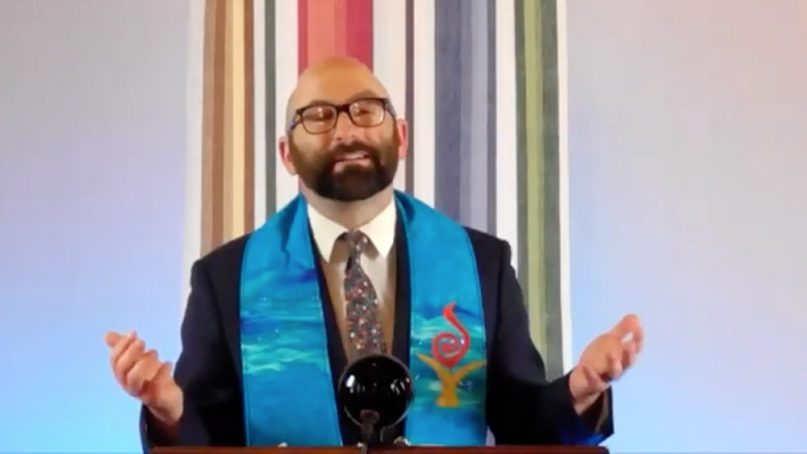
The Rev. Jason Lydon speaks during a virtual Passover service of Second Unitarian Church of Chicago on March 28, 2021. Video screengrab

(RNS) — Jason Lydon realized two things when he was incarcerated: that he wanted to be a Unitarian Universalist minister and that, in a moral and just society, prisons would not exist. Now, 18 years later, he’s accomplished his first goal — and he’s working on the second.

Speaking to Religion News Service over Zoom from his office at the Second Unitarian Church in Chicago, Lydon explained how his theology and his belief in prison abolition are inherently linked, springing from core Unitarian Universalist tenets that every human has worth and dignity, that there is no hell, that there is universal salvation and that humanity is united in a web of connectedness.

“If I don’t believe God would punish people after death and send them to hell, because God is so loving and because punishment is not salvific, then why would I think punishment would be salvific on earth?” said Lydon, who, as a humanist, defines God expansively. “That makes no sense. It’s just theologically inappropriate.”

That understanding can put him — and theologians like Delores S. Williams and James Cone — at odds with theologies that believe punishment can change someone for good. “For those who are thinking about Jesus as their savior,” he challenged, “was it the punishment — the crucifixion of Jesus — that was salvific or was it the resurrection?”
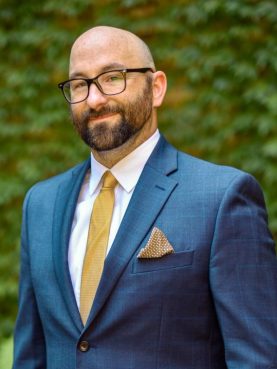
The Rev. Jason Lydon. Photo via Second Unitarian Church of Chicago

The Rev. Jason Lydon. Photo via Second Unitarian Church of Chicago

It was Lydon’s religious education that led him to the action for which he was incarcerated in the first place. “I learned about the harms of capitalism, the violence of white supremacy and the destruction of the prison-industrial complex at church conferences,” he remembered.

In 2002, at 19, he joined a group of activists protesting the Western Hemisphere Institute for Security Cooperation — as Fort Benning’s School of the Americas was renamed in 2001 — where the U.S. Army trained a “who’s who of Latin American despots.” Horrific killings in El Salvador, including the assassinations of six Jesuit priests and Archbishop Oscar Romero and the massacre of over 900 people in El Mozote, were all linked to the institute. Walking onto the base in a planned act of civil disobedience led to the arrests of Lydon and more than 80 others. He was sentenced to six months in federal detention.

He spent 45 days in solitary, three times the amount the U.N. defines as torture. As so many other incarcerated people experience, it was there his faith — and the community that came with it — became a lifeline.

“I found prayer and guidance through my faith community. I got hundreds of letters from Unitarian Universalists around the country, sending me love and care and poems and readings and stories and books,” he remembered.

It was a community that had always felt like home. Lydon was introduced to Unitarian Universalism at 6 when his mother and stepfather, who met in seminary school, took him to a service in Watertown, Massachusetts. At the coffee hour, his mother recounts, he declared, “I’ve always been a Unitarian Universalist, and I didn’t even know it!”

After being released, Lydon kept up with the friends he had made inside, writing letters back and forth. They were able to discuss their sexualities for the first time, and he found many of them were queer, like him. Soon, he gathered so many pen pals he couldn’t respond to them all.

So he enlisted his friends, inviting a group over for dinner but telling them they couldn’t eat until they wrote a letter. And so Black and Pink — which would grow into a major advocacy organization for LGBTQ+ and HIV/AIDS-positive people inside — and its central pen-pal program were born.
Black and Pink logo. Courtesy image

He continued the project while he worked at the Community Church of Boston for seven years, during which time he was also ordained. In 2012, he turned to work for Black and Pink full time. While it is a secular organization, he said, “for me it was always ministry.”

Michael Cox, now director of the Massachusetts chapter, met Lydon when he was newly released from prison and stopped by the Black and Pink offices to chat. Lydon, he said, “has a real fearlessness that can be lost on people because he is soft-spoken. He has such an unwavering vision for abolition.”

In 2019, Lydon stepped down from directing Black and Pink and moved to Chicago, where he lives with his partner, serves at the Second Unitarian Universalist Church and volunteers with the local chapter of Black and Pink — which was active even before he got to the city.

Even as a minister, though, Lydon said abolition is always on his mind. In his message during a 2020 service for the anniversary of the Stonewall riot, he brought up the church’s stained-glass windows, which Orte Foyo-Carbonell made after a Chicago gay bar was raided by the police. “Part of the structure of our building is the story of queer survival against police violence,” Lydon said. “It is literally part of who we are.”

After opening their building for protesters to shelter during the curfew-driven police crackdowns last summer, Second Unitarian has been having difficult conversations about its relationship with police that Lydon thinks every congregation should have: “What are our policies around the police? Why would we ever call the police? How would that ever help anything? How do we understand the role of the police in our neighborhood? What is our responsibility as a faith institution in challenging the violence of police in our city?”
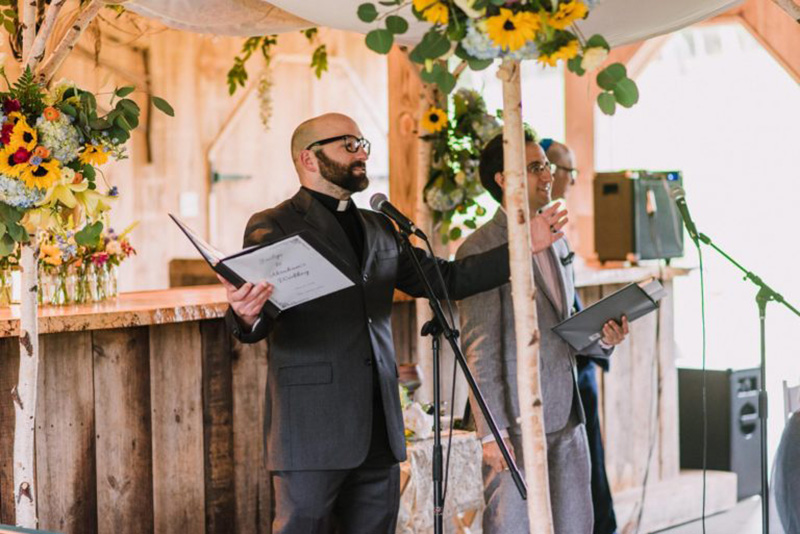
The Rev. Jason Lydon officiates a wedding. Courtesy photo

The Rev. Jason Lydon officiates a wedding. Courtesy photo

Being who he is — a member of the clergy — gives Lydon special access. Because he has a criminal record, he was barred from visiting prisons — that is, until he had his certification and his collar. There have been times, he said, wearing his collar to court meant the judge released the defendant into his custody, so instead of the police transporting someone to another courthouse, or a drug treatment facility, he can.

“Yes, we want to dismantle all of these systems of privilege and power; in the meantime, we can use that moral authority to help achieve greater freedoms for folks. We get to literally help people achieve quicker freedom simply because of the reality of oppression and privileging of clergy,” he explained.

According to Lydon, there are many ways clergy can similarly use that privilege to serve people inside, including opening membership to currently incarcerated people and worshipping with them through visiting, letter-writing and newsletter programs.

“The far majority of people who do religious work inside prisons are from right-wing, conservative, fundamentalist Christians, so another part of what is necessary is introducing religious resources to prisons that are abolitionist,” Lydon said. “Even a somewhat secular organizer can offer and make available more texts, more prayer cards and more resources that people inside want to survive the moment.

“A lot of people turn to religion when they’re in the worst moments of their lives. Many people in prison are experiencing the worst moments of their lives right now.”
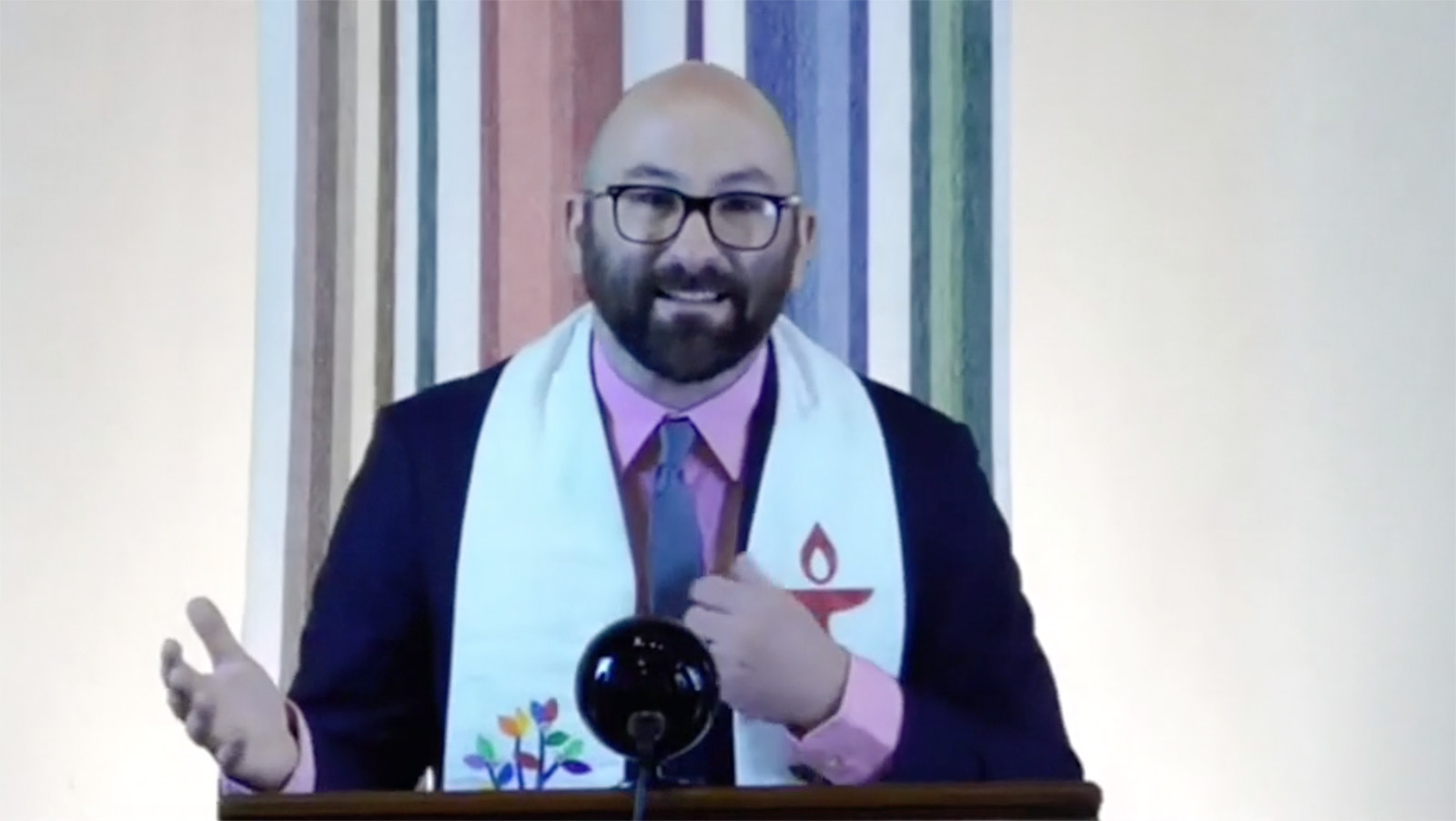
The Rev. Jason Lydon speaks during a virtual service of Second Unitarian Church of Chicago on Jan. 24, 2021. Video screengrab

The Rev. Jason Lydon speaks during a virtual service of Second Unitarian Church of Chicago on Jan. 24, 2021. Video screengrab
GOOD NEWS

African Americans attend church, Bible study more than others, but Black ‘nones’ increasing

Gen Zers are both the most likely to call themselves 'religious but not spiritual' and the least likely to say they are 'spiritual but not religious.'

(RNS) — Black adults attend church and participate in Bible studies more than other U.S. adults, but younger Black Americans are less likely to identify with the Christian faith than older generations, a new Barna Group report shows.

In the midst of the COVID-19 pandemic, half of Black church attenders estimated they attended services weekly, compared to 29% of the general Black population. Boomers tended to be the most engaged in weekly worship compared to younger generations.

The California research firm on Friday (April 16) released a new segment of its “Trends in the Black Church” report that looks at the spiritual practices and identity of Black Americans and African American churchgoers.

Graphic courtesy of Barna

Graphic courtesy of Barna

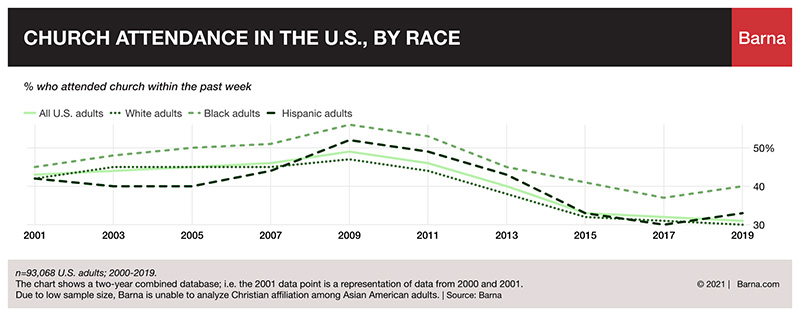
Pre-pandemic, Black adult church attendance appeared to be on the rise, with 40% saying in 2019 they had attended a service in the past week, up from 37% in 2017. U.S. weekly church attendance overall continued its decline to 31% in 2019.


RELATED: Want to understand Black experience? Learn about African American faith, survey finds


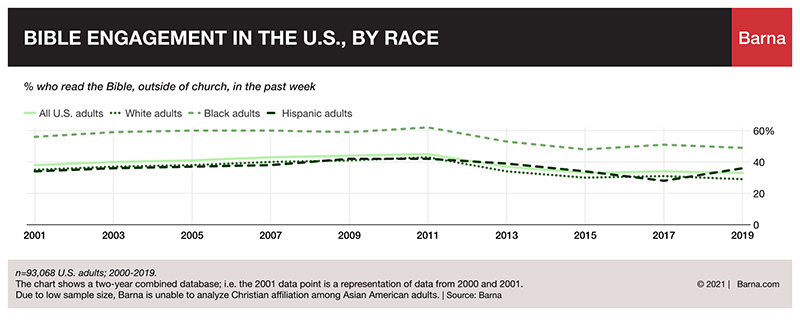
About half of U.S. Black adults (49%) were engaged in Bible reading from 2001 to 2019, more than any other racial/ethnic group and significantly more than U.S. adults as a whole (33%). Bible reading among Black Americans has changed very little over the years, even as other measures of religiosity have dropped, according to the study.

In 2020, half (51%) of Black church attenders said they usually attend a church Bible study, under normal circumstances, at least every other week.

Graphic courtesy of Barna

Graphic courtesy of Barna

In recent years, religious affiliation of African Americans has decreased, and an increasing number self-identify as “nones.”

While 74% of Black adults overall say they are Christian, that percentage has declined sharply from 89% in 2011. Fifteen percent of African Americans say they are agnostic, atheist or of no faith.

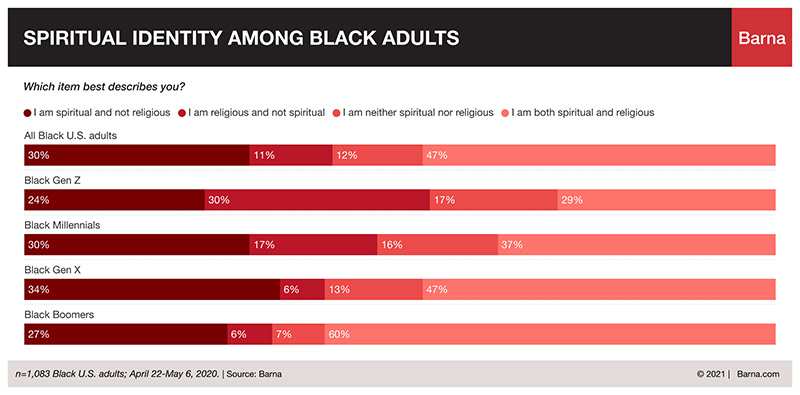
Black Gen Zers (67%) and millennials (65%) have numerically similar connections to Christianity. That makes them less Christian than older Black adults but more linked to that faith than their peers of other races.

But Gen Zers are both the most likely to call themselves “religious but not spiritual” (30%) and the least likely to say they are “spiritual but not religious” (24%).

Graphic courtesy of Barna

Graphic courtesy of Barna

The findings are based in part on an online survey, conducted April 22 to May 6, 2020 of 1,083 U.S. Black adults and an additional 822 Black church attenders. It had a margin of error of plus or minus 2.3 percentage points.

Barna’s report previously looked at perceptions of Black church pastors and the role of Black churches


Planned Parenthood announces new clergy advocacy board members, many from red states

'As a clergyperson who discovered my call to ministry within a Planned Parenthood, it was a no-brainer,' said the Rev. Katey Zeh, who heads the Religious Coalition for Reproductive Choice.

WASHINGTON (RNS) — The Planned Parenthood Federation of America is announcing a new slate of faith leaders for its clergy advocacy board who mostly hail from states controlled by Republicans or in the South, a move officials say follows a “wave of lawmakers” such as Georgia Sen. Raphael Warnock who have worked to “proudly champion reproductive rights as a matter of faith.”

Alexis McGill Johnson, president and CEO of Planned Parenthood Federation of America, celebrated the announcement.

“Access to comprehensive sexual and reproductive health care — including abortion — is supported by people of all faiths,” Johnson said in a statement. “The Clergy Advocacy Board is a crucial part of our mission at Planned Parenthood to promote, protect and expand access to health care for all … Planned Parenthood is proud to have religious leaders of all faiths standing with us in this fight.”

The board has operated at Planned Parenthood for decades, but its newest iteration will feature representatives from states overwhelmingly run by Republicans. New names include the Rev. Emily Harden of West Virginia, the Rev. Tim Kutzmark of California, Rabbi Sarah Smiley of Kansas, the Rev. Katey Zeh of North Carolina, the Rev. Rebecca Todd Peters of North Carolina, the Rev. Elle Dowd of Illinois, the Rev. Elise Saulsberry of Tennessee, the Rev. Latishia James-Portis of Georgia and the Rev. Stephen Griffith of Nebraska.

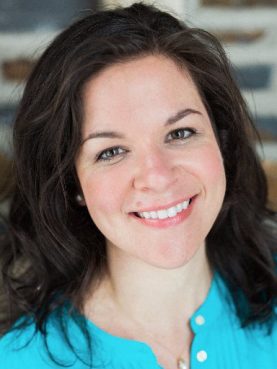
The Rev. Katey Zeh. Photo via Twitter

The Rev. Katey Zeh. Photo via Twitter

For Zeh, who heads the Religious Coalition for Reproductive Choice, serving on the board is a kind of a homecoming.

“As a clergyperson who discovered my call to ministry within a Planned Parenthood, it was a no-brainer,” she told Religion News Service in a phone interview.

Zeh explained she felt called to ministry while volunteering as an “abortion doula” at a Planned Parenthood while in seminary, where she provided support and held the hands of women at a clinic as they underwent abortions.

“There are so few of us who are people of faith who are willing to be bold and audacious about supporting reproductive freedom because of our faith,” she said.


RELATED: Rev. Warnock blasted for being a ’pro-choice pastor,’ but his position isn’t uncommon


Saulsberry, who runs abortion rights advocacy group SisterReach, agreed. She said you “can’t put a price” on the role of faith-based abortion rights activism because “much of the pushback” to abortion “comes from the church.”

“There are folks — let’s just say evangelicals — who have the privilege of leading those conversations (opposing abortion) and inform the pushback against the type of care or advocacy that Planned Parenthood and SisterReach provide,” said Saulsberry, whose group advocates for “the reproductive autonomy of women and teens of color, poor and rural women, LGBTQIA+ people and their families through the framework of Reproductive Justice.”

“As leaders of faith and as clergy, we are to stand and speak out loud — as loud as other clergy — in support of reproductive health, rights and justice.”

The Rev. Elise Saulsberry. Photo via SisterReach

The Rev. Elise Saulsberry. Photo via SisterReach

According to a 2019 Pew Research survey, a strong majority of white evangelical Protestants — 77% — say abortion should be illegal in all or most cases. Evangelical and Catholic organizations are well represented at the March for Life, an annual anti-abortion gathering during which thousands of activists descend on Washington, D.C., to decry abortion and call for legislation to restrict or ban it.

This year’s gathering was virtual and featured a keynote address from former football star and evangelical Christian Tim Tebow, who invoked his faith while recounting how his mother decided to give birth to him despite doctors advising her to have an abortion.

But Zeh, Saulsberry and others represent a less discussed reality: broad support for abortion rights within many religious communities.

For example, the same Pew poll found that majorities of several other major faith groups — 64% of Black Protestants, 60% of white mainline Protestants and 56% of Catholics — took the opposite position of white evangelicals, saying abortion should be legal in all or most cases.

What’s more, PPFA’s announcement comes months after the election of Warnock, a clergyman who preaches at Atlanta’s historic Ebenezer Baptist Church and identifies as a “pro-choice pastor.” His Republican detractors railed against his position on the issue throughout his campaign, including then-U.S. Rep. Doug Collins, who said there is “no such thing as a pro-choice pastor” before declaring “What you have is a lie from the bed of hell.”

Warnock’s Republican opponent in the race, then-Sen. Kelly Loeffler, a Catholic, also criticized him for invoking Scripture during a debate, saying, “I’m not going to be lectured by someone who uses the Bible to justify abortion.”


RELATED: At March for Life, a pivot away from Trump and toward ‘unity’


Their criticism may have been out of step with the Georgia electorate: A 2019 poll conducted by The Atlanta Journal-Constitution showed slim majorities of Protestants and Catholics in Georgia agreed with Warnock that abortion should be legal in all or most cases.

Saulsberry contends Warnock’s subsequent victory was in many ways the result of long-standing abortion rights activism — religious or otherwise.

“It’s a manifestation of what’s been happening all along,” she said. “Women, individuals and even clergy members are more adamant and bold in speaking out about the rights we are advocating for.”

Saulsberry said she wasn’t sure if PPFA’s selection of several clergy from Southern states was on purpose, but said she’s “on board” with the idea if it was. She noted many legislative efforts by conservative lawmakers to restrict abortion access are being passed in Southern states or conservative states, many of which also claim deeply religious populations.

“Georgia, Tennessee and North Carolina — our states lead in some of the most oppressive reproductive rights laws that we’ve seen in a long time,” she said.


COLD WAR 2.0
US Intel Director Haines Warns China Plans to Challenge US’ ‘Presumed Leadership’ in Space

MILITARY & INTELLIGENCE
Get short URL
by 
5330
Subscribe

Although the US formed its Space Force on the pretext that its space-based assets were endangered by Russian and Chinese weapons, critics have denounced the move as a boon to US defense contractors, and pointed to the USSF’s role in heading off Chinese technological competition.

Speaking before the Senate Intelligence Committee on Wednesday, Director of National Intelligence (DNI) Avril Haines told lawmakers “as a general matter, that China is focused on achieving leadership in space, in fact, as compared to the United States and has been working hard on a variety of different efforts in this area to try to contest what has been presumed [to be] our leadership in these areas.”

In its recently published 2021 threat assessment, Haines’ office (ODNI) warns that China is the “top threat” faced by the US in terms of technological competitiveness, and frets that China may soon seek to challenge US dominance of space.

“Beijing is working to match or exceed US capabilities in space to gain the military, economic and prestige benefits that Washington has accrued from space leadership,” the report says. “Counterspace operations will be integral to potential military campaigns by the PLA [People’s Liberation Army] and China has counterspace-weapons capabilities intended to target US and allied satellites.”

According to the ODNI, China's new modular space station is expected to be operational between 2022 and 2024, which will serve as a base for further space exploration on the Moon and beyond. The Tianhe core module is expected to be launched this year. The PLA is also expanding its own network of 138 communication, navigation, and reconnaissance satellites to become broadly comparable to those of the United States, which are considered essential to any Pentagon warfighting effort and thus require defense. These, the report says, will “erode the US military’s information advantage.”

The report also says that China “continues to train its military space elements” to field ground-based and space-based anti-satellite (ASAT) weapons, including missiles intended to shoot down US satellites and lasers intended to blind or damage equipment on them.

In 2007, China tested a direct-ascent ASAT missile, a modified medium-range ballistic missile that deployed a kinetic kill vehicle to destroy a Chinese satellite 534 miles up. Since then, the US has accused China of disguising several other weapons tests as being scientific in nature.

As Sputnik has reported, the US military has tested and developed ground-based, air-fired, and space-based ASAT weapons for decades, making Washington’s objections to the supposed militarization of space laughable. Indeed, since China’s test, the US has tested an ASAT missile of its own, shooting down a US spy satellite with an SM-3 missile fired from a US Navy destroyer in 2008.

However, the US Space Force’s doctrinal documents make clear that the US’ real strategic concern isn’t space being militarized, it’s the risk the US could lose its longstanding dominance of the space domain.

“We can no longer assume that our space superiority is a given,” Space Force Chief of Space Operations Gen. John W. "Jay" Raymond told the House Armed Services Committee's Strategic Forces Subcommittee in February 2020. “If deterrence fails, we must be ready to fight for space superiority."

Beijing has rejected Washington’s claims it seeks to dominate space. Last May, Chinese Defense Ministry spokesperson Ren Guoqiang denounced the US for pursuing an arms race in space, saying it would “negatively affect global strategic stability."

"Separate countries have created space military forces, under the pretext of a threat coming from other countries, but in reality in pursuit of military superiority in space," Ren told reporters at the time. "We call upon these countries to adhere to a reasonable and responsible approach, prevent space from becoming a new battleground, and to jointly protect sustainable peace in space.”


DNI Avril Haines knocks WHO report that

 dismissed theory COVID-19 escaped from 

lab


CIA Director William Burns said U.S. intelligence agencies are still trying to determine the virus's origin


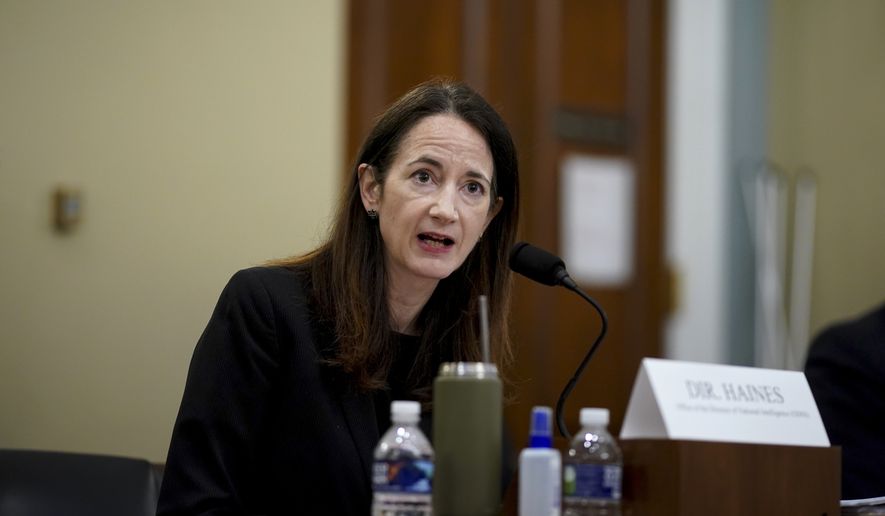
Director Avril Haines of the Office of the Director of National Intelligence (ODNI) testifies during a House Intelligence Committee hearing on Capitol Hill in Washington, Thursday, April 15, 2021. (Al Drago/Pool via AP) more >

By Bill Gertz - The Washington Times - Thursday, April 15, 2021


U.S. intelligence agencies disagree with the findings of a recent joint World Health Organization-Chinese government probe that dismissed the theory that the COVID-19 virus outbreak could have resulted from an accidental escape from a Chinese laboratory, officials told Congress on Thursday.

Avril Haines, director of national intelligence and CIA Director William Burns told the House Intelligence Committee the WHO-China report made public last month is not the view of intelligence agencies studying the origin of the pandemic.

“We do not make the assessment that the WHO report made that it’s … extremely unlikely,” Ms. Haines said, “and that’s not our assessment.”

WHO team of international experts, under tight Chinese government supervision, two months ago visited the Wuhan Institute of Virology — a high security laboratory where scientists studied bat coronaviruses similar to the virus behind COVID-19.

Chinese researchers have boasted of uncovering 2,000 new viruses in the past decade, including many viruses from bats, but the WHO team concluded it is “extremely unlikely” the virus leaked from the lab, citing its safety protocols. Wuhan was the site of the first major cluster of COVID-19 cases.

China’s government and the WHO team said the most likely source for the virus was an infected animal that came in contact with a human, triggering the deadly disease outbreak in December 2019.

China also has spread disinformation that the virus was brought to China by the U.S. Army and that it was secretly developed as U.S. military laboratory. Officials at Thursday’s Capitol Hill hearing said there is no doubt the virus began in China.
FORDISM WITH CHINESE CHARACTERISTICS
A tale of two carmakers: GM and Toyota take different electric roads in China

By Norihiko Shirouzu

© Reuters/SUN YILEI FILE PHOTO: 
Man walks past a Wuling Hong Guang MINI EV at a SAIC-GM-Wuling dealership in Beijing

SHANGHAI (Reuters) -Toyota pioneered the world's most successful hybrid car but when it comes to pure electric vehicles it has some catching up to do, especially in China.

The Hong Guang Mini EV, a tiny, no-frills car made by a General Motors joint venture that costs under $5,000 is a smash hit in the world's biggest car market while Toyota has yet to launch its own small, low-cost electric vehicle in China.

Toyota, the world's biggest carmaker, is set to unveil its solution at the Shanghai auto show on April 19: a new universal platform for electric vehicles (EVs) called e-TNGA that will underpin an array of models from small runarounds to large SUVs.
© Reuters/PIERRE ALBOUY FILE PHOTO: Toyota logo displayed at the 89th Geneva International Motor Show

It will also display its concept electric mid-sized sport-utility vehicle (SUV), based on the e-TNGA platform, which is set to be sold worldwide within a couple of years, two people familiar with Toyota's plans said.

Toyota's executives have long called for a small electric runabout but the fact it is going first with a mid-sized SUV is a sign of the challenges it still faces to produce small, low-cost EVs that are also competitive, comfortable and safe.

With pressure growing on carmakers to slash emissions, Toyota is scrambling to produce EVs that can compete globally with the Mini EV, Tesla's high-end sedans, mid-range models from Volkswagen and Renault and sleek EVs from Chinese startups like and Xpeng
.
© Reuters/SUN YILEI FILE PHOTO: Wuling logo is seen on an electric vehicle at a SAIC-GM-Wuling dealership in Beijing

While Toyota's Prius hybrid became a world bestseller, one of its early efforts to develop a small EV, the eQ, was a flop.


After selling about 100 eQs in 2012, Toyota ditched it due to concerns about the limits of EVs, such as their high price, short range and long charge time.

The eQ, an electric version of Toyota's mini iQ, cost 3.6 million yen ($33,000), roughly the price of its mid-sized Camry.

COST CONTROL

One key issue in developing an affordable, small EV is the need to use electric powertrains that have yet to achieve parity with their gasoline counterparts, the people familiar with Toyota's plans said.

Cramming bulky batteries into a tiny car is another challenge.

Many EVs have high floors because the batteries are stacked underneath, leaving automakers the choice of making cars much higher to give passengers ample room, or keeping them lower and sacrificing comfort, the sources said.
© Reuters/REBECCA COOK FILE PHOTO: Logo of GM atop the company headquarters

Toyota doesn't want to compromise on quality, comfort or performance with its small EV, but it is aware it needs to develop expertise in slashing engineering costs to deliver such a vehicle with a price well under $20,000.

That expertise is precisely what GM leveraged to make the Mini EV, which can cost as little as 28,800 yuan ($4,410).

Its joint venture, SAIC-GM-Wuling (SGMW), is the biggest manufacturer in China of no-frills commercial vans that start at about 30,000 yuan and it tapped that cost-control know-how.

"Wuling basically has simply had to replace gasoline engines in those commercial vans with simple electric powertrains," said Yale Zhang, head of consultancy Automotive Foresight.

Gallery: Things you didn't know about the Chevy Corvette 


He expects sales of the the Mini EV and its upscale Macaron version to hit 500,000 this year.

Zhou Xing, a SGMW vice president in charge of Wuling and Baojun sales and marketing, said it was set to roll out four small EVs by early 2022 under its brands, taking the model range to 10 just as more rivals enter the market.

NATIONAL PRIDE


The Mini EV also cuts corners that would not be allowed in the United States or Europe, underlining the challenge Toyota faces in developing a viable rival that handles easily in a crowded city and is still high in quality and performance.

The Mini EV only has one air bag, for example, with none for passengers or on the sides to protect occupants if it rolls.

The car has an anti-lock braking system but no stability control technology even though its relatively tall, stubby profile makes it prone to tipping over when cornering sharply at speed, two people familiar with its development told Reuters.

"First of all, the product meets all the vehicle safety requirements of China. The Hong Guang Mini EV is basically a commuting tool, helping people go from point A to B in city traffic. It's highly unlikely for them to drive this car at high speeds," said SGMW's Zhou.

The no-frills approach certainly hasn't dented its appeal.

Launched in July, cost-conscious Chinese customers and young, fashionable urbanites are snapping up about 100,000 Mini EVs a quarter, making it one of the top EV sellers in China.

Some younger drivers are buying it and other Wuling cars in part after a video of a Wuling van racing deftly on a twisty mountain road went viral. For many, seeing a basic Chinese van doing tricky manoeuvres tickled their national pride.

"I am proud of what Chinese-made vehicles like Wuling workhorse vans can achieve," said Huang Peixian, 26, a small business owner in the city of Shantou in Guangdong province.

"When I saw the Hong Guang Mini EV, I thought this could be a good car for me," she said. "I'm not just attracted to the car because of its cheap price, it's really fun to drive."

Many drivers personalise their Mini EV's with a new paint job and sleek head and tail lamps. A few are even customising their other cars, such as Audis and BMWs, with Wuling stickers and badges.

Huang went all out, turning the interior of her Mini EV pink and splashing characters from Japanese cartoon series Chibi Maruko-chan on the white exterior.

GREEN CREDIT BOOST


Toyota's electric SUV will be the first car produced by its new zero emissions vehicle design division in Japan, known as ZEV Factory.

To get the low-cost know-how it needs, however, it has turned to Chinese battery and automaker BYD through a joint research and development company they started last year.

The plan is to use BYD's expertise in building small EVs and some key components, including batteries.

But there is still a good chance Toyota will use electric powertrain technology - a combination of the motor, inverter and gears - called e-Axle made by its affiliate BluE Nexus, according to one of the people familiar with Toyota's plans.

The Hong Guang Mini EV also plays an important role for GM and SAIC as it generates green-car credits. Automakers in China need to make enough New Energy Vehicles (NEV) to earn credits to offset their production of combustion engine cars.

The success of the Mini EV means GM and SAIC have the scope to sell credits to rivals or produce more, bigger, luxurious gasoline vehicles without being penalised.

Automotive Foresight's Zhang also said the green-credit system means the Mini EV can be priced very competitively to the point it barely makes a profit.

SGMW's Zhou declined to say whether the Mini EV makes money, or how much it earns from green credits.

"We have seen quite a few companies come to us and buy credits from us. But we don't want to disclose who they are," he said.

The two sources familiar with Toyota's plans said it was not planning to lose money on the retail price of its small EV or leverage green credits to make it more competitive.

A company spokesman declined to comment on whether Toyota had enough Chinese NEV credits, or if it would consider selling them as an integral part of its strategy.

($1 = 108.9200 yen)

($1 = 6.5280 Chinese yuan renminbi)

(Editing by David Clarke)

Space is the final frontier for archaeology

"Humanity has been staring at the moon for the last 200,000 years. It is the common heritage of humanity. No one owns it, and everyone owns it."

By Katie Hunt, CNN
4/17/2021


The boot prints left by Apollo 11 astronaut Neil Armstrong are a tangible legacy of one of humanity's greatest achievements -- putting a man on the moon.

© NASA/Hulton Archive/Getty Images An astronaut's bootprint leaves a mark on the lunar surface July 20, 1969, on the moon.

It's a technological feat easily on par with Egypt's pyramids, the Great Wall or Stonehenge -- but how should the Apollo 11 mission site and others be preserved and protected for future generations?

Right now, the bootprints, rovers and hundreds of other artifacts from the Apollo missions are not protected like heritage sites are on Earth -- something a small but growing number of space archaeologists want to change.

"These seminal imprints, they're not set in stone, they're set in dust. If they're not preserved -- either by having a cover put over them or by declaring a national park around them -- then they will go," said P.J. Capelotti, a professor of anthropology at Penn State Abington.

"These are critical sites for understanding human movement into space, and there's no reason why this can't be demarcated as space parks or have some kind of protective regime put around them," he added.

It's not an abstract concern.


With the prospect of tourists on the moon and more planned crewed and robotic missions this decade, space archaeologists worry that the footprints and other artifacts could easily be damaged or destroyed. There's also the risk that natural space phenomenon such as radiation and extreme temperatures could have already damaged them.

"All we need is a rocket to land nearby and blow dust all over of them. Or lunar vehicle to drive too close to that site and kicks all the dust up and that's it, they're gone," said Alice Gorman, an associate professor in the College of the Humanities, Arts and Social Sciences at Flinders University in Australia.


'Cool stuff up there'


It might be hard to think of the moon as an archaeological site but Gorman, who is also a member of the Space Industry Association of Australian Advisory Council, said that was based on a misperception about archaeology.

"The thing about archaeology, it's not that it has to be old, and it doesn't have to be something you can excavate. The primary aim of archaeology is to look at how humans interact with material objects and environments," she explained.

Many of the objects and traces left on the moon aren't just of scientific and technological value -- they are cultural artifacts. They include family photos left by astronauts and the patch from the Apollo 1 mission, brought by the Apollo 11 astronauts to commemorate the three astronauts who died in a cabin fire during a rehearsal launch in 1967
.
© NASA/Corbis via Getty Images This is a family photo left behind by one of the Apollo 16 astronauts at Descartes Crater on the surface of the moon.


"That patch isn't part of any scientific or technological experiment. It's a memorial. The fact that we take our cultural behavior into space is very interesting," said Beth O'Leary, a professor emerita of anthropology at New Mexico State University.

"There's a lot of cool stuff up there."

Video: See the moon landing as they did 50 years ago (CNN)


The cool stuff includes things clearly worth preserving like the flag planted by Armstrong and Buzz Aldrin but also discarded items such as urine receptacles and wet wipes -- although archaeologists would argue that litter often yields the biggest insights.

Tranquility Base, the spot where humans first set foot on the moon, isn't the only thing of interest to space archaeologists. Vanguard 1, and the upper stage of its launch rocket, are the oldest human-made objects still in space -- part of a cloud of space junk that circles the Earth. It was launched in 1958 and would be a fascinating relic, Gorman said.

More historic missions are on the horizon -- the first settlements on the moon or Mars for example -- but it would be impossible to preserve all these sites as monuments. Gorman said a "reasoned decision-making process" was needed.


Sovereignty vs. protection

On Earth, the United Nations Educational, Scientific and Cultural Organization, known as UNESCO, decides what deserves World Heritage status from nominations sent by countries that claim ownership of the sites.

Different rules apply in space, with the UN's 1967 Outer Space Treaty stating that space "is not subject to national appropriation by claim of sovereignty." However, individual objects on the moon remain the property of the nations that put them there, according to the treaty.

Leadership at NASA is taking the issue seriously, and in 2011 published voluntary guidance to protect the Apollo mission landing sites for scientific investigation and their historic significance. The guidance also catalogs all the items left behind.

The Lunar Xprize sponsored by Google had been launched four years earlier to create an incentive for private enterprises to land a robot on the moon. One of the goals was to take capture images of Apollo mission hardware left on the lunar surface. However, the competition ended without a winner, and the only successful trips to the moon have been government funded and mostly scientific in nature.

The NASA voluntary guidance suggested a 75-meter exclusion zone around the Apollo 11 landing site and advocated controlling the movements of vehicles and landing of spacecraft to prevent scattering dust.

While not legally binding, the guidelines lent weight to the idea that human sites on the moon were of value, and in December 2020 the One Small Step to Protect Human Heritage in Space Act became US law.

It requires companies working with NASA to abide by those guidelines to protect Apollo landing sites -- although there is no way of enforcing them.

"As far as laws go, it's pretty benign. It requires companies that are working with the National Aeronautics and Space Administration on lunar missions to agree to be bound by otherwise unenforceable guidelines intended to protect American landing sites on the moon. That's a pretty small pool of affected entities," said Michelle Hanlon, a space law expert at the University of Mississippi, in an article for The Conversation.

"However, it is also the first law enacted by any nation that recognizes the existence of human heritage in outer space. That's important because it reaffirms our human commitment to protecting our history."

O' Leary said that the focus needed to be on international cooperation.

"If you think about the important sites, there are a lot more than the US: The earliest Russian site, Lunar 2 -- the first human artifact on the moon in 1959, which is really quite early. There's also China's earliest missions, the first Chang'e didn't go very far but it's still there, you know, that's a very important site. Who would have thought in 1969 China would be on the moon?"

One possible model Capelotti suggested could be the treaty that gives Norway sovereignty over Svalbard, where the Global Seed Vault is located, in the Arctic. Under a 101-year-old treaty, citizens of all its signatory countries, including Russia, can settle and conduct business there.

Final frontier


Most archaeologists agree the artifacts should be left on the moon -- any attempt to retrieve them would likely result in damage. Equally, even if they are left undisturbed by future missions, natural space phenomena such as radiation could put some of the artifacts at risk.

"We do have this idea of the moon as a dead rock but that's not true. Because it has no magnetic field and so little atmosphere, the surface is constantly bombarded. ... with cosmic rays and high-energy particles, micro meteorites," Gorman said.

It's unlikely the moon would ever be excavated by archaeologists, not least because NASA says that degrees in archaeology, along with other social sciences, don't qualify under its astronaut recruitment requirements. But Gorman said it would be feasible to fly a small drone equipped with a camera over the Apollo 11 site to reimage it and see what had changed over the past 50 years.

The moon plays a huge role in many different cultures around the world, and any international moves to protect it should take into account cultural and symbolic beliefs about the moon, as well as the tangible objects that have been left there, O'Leary said.

"Humanity has been staring at the moon for the last 200,000 years. It is the common heritage of humanity. No one owns it, and everyone owns it."


Love Your $1,400 Stimulus Check? Andrew Yang Had Bigger Plans.

Has the former presidential candidate's Freedom Dividend idea, once seen as a pie-in-the-sky solution, been vindicated?

by Stephen Silver

When businessman Andrew Yang ran in the Democratic primaries for president in the 2020 cycle, his signature proposal was what he called the “Freedom Dividend,” which would have given a UBI (universal basic income) of $1,000 a month to every adult in the country.

“This is independent of one’s work status or any other factor,” Yang’s campaign website said of the Freedom Dividend proposal. “This would enable all Americans to pay their bills, educate themselves, start businesses, be more creative, stay healthy, relocate for work, spend time with their children, take care of loved ones, and have a real stake in the future.”

The proposal, Yang claimed at the time, “would permanently grow the economy by 12.56 to 13.10 percent—or about $2.5 trillion by 2025—and it would increase the labor force by 4.5 to 4.7 million people.” Yang proposed to pay for the scheme with a Value-Added Tax (VAT), while also giving those currently receiving federal benefits to either keep their current benefits or enroll in Yang’s Freedom Dividend. The proposal also entailed the establishment of a financial transactions tax, while also assuming that the resulting economic growth would pay for some of the cost as well.

Yang argued at the time that the payments wouldn’t be seen as “welfare,” since everyone was getting a check. He also argued against means-testing, for that same reason. It was a proposal coming from a candidate not considered a socialist, or even necessarily a person of the political left.


Andrew Yang wasn’t the only presidential candidate last time who proposed widespread payments. Sen. Cory Booker of New Jersey, when he ran for president in the 2020 cycle, proposed “baby bonds,” which would provide $1,000 savings accounts to every child born in the United States, with the recipients unable to
China Doesn't Agitate The USHigh

Indeed, there are versions of Universal Basic Income that already exist. The Alaska Permanent Fund, since the 1970s, has paid out annual payments of around $1,600 from oil revenues to every resident of that state. Something resembling a UBI was proposed in the 1960s under both the Johnson and Nixon administrations, and it was a frequent demand during the civil rights movement, including by Martin Luther King.

In recent years, Stockton, California, under former mayor Michael Tubbs, experimented with sending $500 a month for two years to families. That experiment has been called a success, although Tubbs was defeated in his reelection bid last year.

Yang’s presidential campaign, while it gained a decent amount of media coverage, didn’t progress very far, and Yang dropped out of the race on the night of the New Hampshire primary, after finishing 7th. Yang was out of the primary race prior to the onset of the pandemic in the United States. But since the end of Yang’s presidential campaign, the Trump and Biden Administrations have each passed stimulus packages that have presented checks directly to Americans.

So the question has been asked: has Andrew Yang’s Freedom Dividend idea, once seen as a pie-in-the-sky solution, been vindicated?

That question was raised in Forbes, around the time of the passage of the CARES Act by Zack Friedman.

“While Yang did not create UBI, he advocated for UBI principally due to job losses stemming from automation,” Friedman writes. “Universal basic income has been supported by everyone from Martin Luther King, Jr. and Bernie Sanders to Mark Zuckerberg and Elon Musk. Yang has said that with the advent of robots, self-driving cars and other technologies, our lives will improve. However, Yang believes that automation will cause one-third of all Americans to lose their job in the next 12 years. As a result of these job losses, Yang says, Americans could struggle to start a family, afford living costs or save for education or retirement.”

More recently, HuffPost looked at the question of whether Yang deserves credit for the embrace of stimulus checks.

“I give him a lot of credit for popularizing the idea, but it’s so old,” journalist Annie Lowrey, a staff writer at The Atlantic who wrote a book calling for UBI, said of Yang, in the HuffPost article “Nobody except for him really is talking about UBI, but it’s giving people a new language to discuss what would have been called welfare.”


“I think our campaign contributed mightily towards the mainstreaming of cash relief,” Yang told HuffPost in the article. “I believe this to be true in part because of the resistance I received.

One big difference, of course, is that none of the three stimulus packages passed since the start of the pandemic has offered every American monthly checks forever. While the new child tax credit will be paid out in monthly payments, the $1,400 checks from the American Rescue Plan were a one-time payment.


As for Andrew Yang, he’s now running for mayor of New York City, and is widely seen as the frontrunner in the crowded race, per The Guardian. And among Yang’s proposals in his mayoral campaign is what he calls “A Basic Income For New York City.” Perhaps due to the realities of budgeting at the city government level, Yang’s proposal is a bit different from the one he proposed when he ran for president.

“A Yang administration will launch the largest basic income program in the country,” Yang’s campaign website says. “Through this program, 500,000 New Yorkers with the greatest need will receive a basic income that will help give them a path forward. Our goal is to end extreme poverty in New York City by putting cash relief directly into the hands of those who desperately need help right now, ensuring that every household has an annual income that is at least above extreme poverty, taking into account the true cost of living in New York City.”


Yang also plans to create what he calls a People’s Bank of New York City.

Stephen Silver, a technology writer for The National Interest, is a journalist, essayist, and film critic, who is also a contributor to The Philadelphia Inquirer, Philly Voice, Philadelphia Weekly, the Jewish Telegraphic Agency, Living Life Fearless, Backstage magazine, Broad Street Review and Splice Today. The co-founder of the Philadelphia Film Critics Circle, Stephen lives in suburban Philadelphia with his wife and two sons. Follow him on Twitter at @StephenSilver

#FREEPALESTINE

Jews Replace Israeli Flag with Palestinian One in al-Quds

TEHRAN (FNA)- Haredi ultra-orthodox Jews replaced the Israeli flag with a Palestinian one in Jerusalem al-Quds in protest against the 1948 creation of Israel.

A video circulated online showing young men from Neturei Karta, an anti-Zionist grouping of Haredi Jews, raising the Palestinian flag in the neighborhood of Mea She'arim on Thursday, presstv reported.

Clashes erupted between the youths and the Israeli forces who stormed the neighborhood to take down the flag.

Israel marks 5 Iyar in the Hebrew calendar (May 14, 1948) when it proclaimed existence. The day falls on April 15 this year.

The Nakba Day (or the Day of Catastrophe) is officially marked by Palestinians every year on May 15. The day marks eviction of Palestinians from their homeland.

Israel’s Channel 12 reported that members of Neturei Karta also burned Israeli flags during a demonstration in Jerusalem al-Quds on Thursday.

Separately, three Palestinians were hit with rubber bullets fired by Israeli forces at anti-settlement protesters in the village of Beit Dajan, east of Nablus City, on Friday.

Israeli troops also attacked a weekly anti-settlement protest in the village of Kafr Qaddum in the occupied West Bank. A Palestinian man was hit with a rubber bullet during the ensuing clashes.

Palestinians want the West Bank as part of a future independent Palestinian state with East Jerusalem al-Quds as its capital.

Palestinian sources said 70,000 worshipers performed Friday prayers at al-Aqsa Mosque, the third holiest site in Islam, in occupied East Jerusalem al-Quds on the first Friday of the holy Muslim fasting month of Ramadan. Israeli troops barred many more from entering al-Quds.

Earlier this week, Palestinians said Israelis broke into four mosque minarets and cut wires to prevent the call for prayers being broadcast on loudspeakers.