Sunday, July 24, 2022


New analysis exposes major flaws in evidence for declaring Rwanda a safe third country

18TH JULY 2022  BY EMILY WILBOURN

The 11th-hour European Court of Human Rights intervention that prevented the first planned removal of asylum seekers from the UK to Rwanda has provided only scant relief to those who may soon find themselves being flown 4,000 miles away to an unknown fate. A fresh attempt to begin removals could occur within weeks, potentially before the courts have ruled on the legality of the scheme. A new report published by Asylos exposes major information gaps and inconsistencies between the government’s assessment that Rwanda is a safe third country of asylum, and the available evidence on the Rwandan asylum system.

Asylos’s report analyses two documents forming part of the evidence base that the government relies on to justify the scheme. These are the country policy and information notes labelled Rwanda, asylum system and Rwanda, assessment. The report points to numerous omissions of relevant country information on a range of key issues, from the functioning of the asylum system to the detention of asylum seekers, refoulement, and harsh living conditions for existing refugees and asylum seekers. 

Selective evidence-gathering

Information found in one source consulted by the Home Office, but not selected for inclusion in the asylum system note, describes a “cumbersome” asylum process that remains “challenging for individuals other than prima facie recognitions”.

The assessment note claims there are not substantial grounds to believe that asylum seekers would be detained. But asylum seekers relocated to Rwanda under a previous deal with Israel were detained. Another source that the Home Office reviewed but did not reflect in the final note mentions a man who “received a UNHCR document stating that he is an asylum seeker. Last year he left the document at the place where he was living, was stopped and arrested and sent to prison for two days”.

Similarly, the assessment note claims that there are not substantial grounds to believe that a person may be at risk of refoulement. However, information found both in sources consulted by the Home Office, and in sources that were available but not consulted, indicate that asylum seekers relocated under the Israel-Rwanda agreement found themselves in a situation of “indirect refoulement”: coerced or forced by circumstance into leaving Rwanda. As one source notes, “testimonies… suggest that the majority, if not all, are being smuggled out of the country by land to Kampala within days of arriving in Kigali. They are not given an opportunity to apply for asylum”.

Missing and contradictory information

There are significant information gaps on the fulfilment of key guarantees in the Memorandum of Understanding agreed between the British and Rwandan governments. In particular, the asylum system note says very little about how potentially large numbers of asylum seekers relocated from the UK will be provided with interpreters and legal counsel at all stages of their claim. Such guarantees would provide essential procedural safeguards, and help to ensure that claims are decided fairly.

Some of the evidence in its own asylum system note undermines the Home Office’s conclusions in the assessment document. For example, the former refers to reports that the Rwandan authorities do not properly consider asylum claims from LGBTQI+ people (paragraph 4.4.2), and are more likely to reject people from the Middle East (4.14.4). Any asylum system that discriminated on the basis of sexuality or country of origin would clearly fall well short of a functioning asylum system which affords adequate access. 

The assessment also concludes that “the right to practical and effective remedy exists” and therefore a person would not be subjected to treatment that would breach Article 3 of the European Court of Human Rights by virtue of shortcomings in the appeals process. But the asylum system note highlights that the Rwandan asylum authorities do not provide reasons for refusing a claim. As the UN Refugee Agency notes, this renders “the right to appeal against a negative decision… difficult or impossible to exercise in practice”. If it is not possible to appeal an incorrect asylum decision, there is a real risk that people could be sent back to countries where they face grave dangers.

Civil society groups have condemned the Rwanda scheme as “inhumane”. Our report raises further concerns about the evidence base used to justify this controversial policy. Whatever new government is formed to replace the Johnson administration will need to restore public faith in its ability to deliver competent and humane governance, including a fair and evidence-based asylum system.

Read Asylos’s full commentary here.


Emily Wilbourn is Programme Manager at Asylos. She has a background in research relating to asylum and refugee issues and previously worked at Amnesty International and Freedom from Torture.
A new wave of migration is coming – and Europe is not ready for it

Britain and the EU responded dismally to the 2015 migrant crisis. The number of ‘irregular entries’ is up by 84% this year – and the ways to deal with the issue now range from limited to bizarre

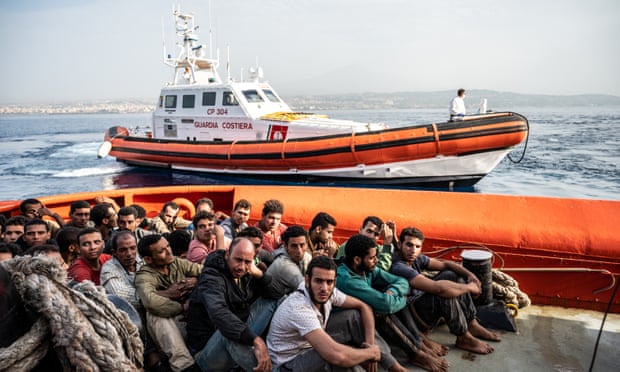
Migrants on board a vessel escorted by an Italian coastguard patrol boat in Catania, Sicily, in June. 
Photograph: Fabrizio Villa/Getty Images


Sun 24 Jul 2022 
Simon Tisdall

In a week when Russia threatened to annex more territory in Ukraine, gas shortages loomed, and inflation and Covid surged across Europe, it seems almost unkind to remind EU and UK leaders of another crisis that is unfolding, largely unremarked, right under their noses. As Claudius laments in Shakespeare’s Hamlet: “When sorrows come, they come not single spies, / But in battalions.”

As if defeating Russian aggression was not enough of a challenge, Europe now also faces rapidly rising new “waves” of undocumented asylum seekers. Given the sociopolitical upheavals that ensued after 1 million refugees, mostly Syrians, arrived on Europe’s shores in 2015, the EU and UK might be expected to be better prepared this time.

Yet plainly they’re not.

Figures published by Frontex, the EU border agency, show “irregular entries” rose to 114,720 in the first half of 2022, 84% up on last year. Many other migrants may have escaped detection. The number attempting entry via the western Balkans rose by nearly 200%. About 60,000 people are expected to cross the Channel in boats this year, double the 2021 total.

Strikingly, these figures do not include millions of Ukrainians who have sought EU asylum since February. Most non-Ukrainian refugees and economic migrants classed as irregular come from Syria, Afghanistan, Iraq, Turkey, Belarus, Bangladesh, Egypt and sub-Saharan Africa.

That’s important for understanding what is driving the new surge. The west’s abandonment of Afghanistan last year is clearly reflected in increased refugee numbers. Continuing strife in Syria, including Idlib; the threat of more Turkish cross-border military incursions into Kurdish areas; and various Middle East and African conflicts, plus the legacy of the Iraq war, continue to fuel instability.

The cumulative human impacts of the climate emergency also shape the overall migration picture. But right now, it’s the threat to food supplies posed by Vladimir Putin’s Black Sea blockade, and resulting shortages, price inflation and instability, that is the big new factor. For Putin, migration, like energy and food, is a weapon of war to aim at Europe’s heart.

A fragile compromise, unveiled in Istanbul on Friday and intended to create safe sea routes for grain from Odesa and two other Ukrainian ports, may ultimately ease pressure on import-dependent developing countries. Yet even if the deal holds, trade will take time to restart, and exports cannot reach prewar levels while the conflict continues.

Recalling Putin’s repeated assurances last winter that he would not invade, Ukrainian officials do not trust him to keep his word now – especially if the fighting on land shifts southwards. The US is sceptical, too. “What we’re focusing on now is holding Russia accountable for implementing this agreement,” the state department said.

Regardless of whether the blockade is lifted, unregulated migration into Europe is forecast to continue rising through 2023. According to the UN refugee agency, the global total of displaced people has risen above 100 million, and that record will be broken if the Ukraine war drags on. “The first wave of indirect war victims is crashing towards Europe and will almost certainly be followed by more, larger waves,” predicted analyst Elisabeth Braw.

Speaking earlier this month, Ylva Johansson, EU commissioner for home affairs, said Europe faced a “huge challenge”. Linked food and energy crises “could lead to countries being unstable, terrorist groups being stronger, organised criminal groups being stronger”, she said. “That means people ... don’t feel safe to stay in their country.”

Are the EU and UK up to the renewed migration challenge? It seems not. The latest iteration of the EU’s floundering 2020 migration pact – a “voluntary solidarity mechanism” – is limited, vaguely worded and lacks unanimity. As has been the case since 2015, Austria, Hungary, Poland and others are basically still refusing to do more to help “frontline” states such as Greece, Italy, Malta, Cyprus and Spain process, pay for and settle asylum seekers.

No one could accuse Priti Patel of generosity towards asylum seekers, wherever they come from

Oxfam said the mechanism allowed countries to shirk their responsibilities, failed to create legal migration routes, and continued to rely instead on border surveillance, detention centres and physical barriers (such as Poland’s newly completed border wall with Belarus). “The result will be overwhelmed reception and asylum systems, overcrowded camps filled with people left in limbo and more pushbacks at Europe’s border,” Oxfam’s Stephanie Pope said.

Critics also say a glaring double standard is evident in the EU’s generous treatment of Ukrainians compared with non-Ukrainians.

No one could accuse Priti Patel, Britain’s beleaguered home secretary, of generosity towards asylum seekers, wherever they come from. Her ponderous, grudgingly bureaucratic Homes for Ukraine scheme has given the lie to Boris Johnson’s claims that the UK leads the world in helping Ukraine.

Patel faced a double whammy last week. The Home Office’s handling of Channel migrant crossings was slammed by an independent inspector as ineffective, inefficient and unacceptable. And her bizarre policy of airlifting unwanted migrants to Rwanda was ripped apart by a parliamentary committee, which found no evidence it acted as a deterrent. “Safe and legal routes need to be established to support those with an asylum claim in coming to the UK,” the committee declared.

As migration surges again, the risk of negative, Europe-wide political fallout grows. A test case is Italy, where far-right politicians, hoping to emulate the success of the AfD (Alternative for Germany), are expected to exploit the issue in September’s snap election.

More immediately, EU and UK governments must act to avoid a repeat of 2015’s humanitarian crisis. According to the Missing Migrants Project, more than 24,000 people have gone missing in the Mediterranean alone since 2014. Last November, 27 people drowned in the Channel on one day.

Current policy isn’t working. The human toll keeps rising. And sorrow mounts on sorrow, to the shame of all.

UK MPs question Rwanda deportation plan: report

London, Jul 18 (EFE).- A group of United Kingdom members of parliament has questioned whether the government’s plan to deport asylum seekers to Rwanda will deter migrants seeking to cross the English Channel irregularly.

Home Secretary Priti Patel has justified the Rwanda plan on the grounds that the prospect of being sent to the African country would disrupt people-smuggling and small-boat Channel crossings by acting as a deterrent.

“The government’s stated purpose of the Migration and Economic Development Program with Rwanda is to deter people from seeking to arrive in the UK by irregular means. It is not clear as yet whether it will have that effect,” the cross-party Home Affairs Committee said in a report on Monday, asking the government to present evidence for assuming this.

“The Home Office must also set out what steps it is taking to ensure that the mental and physical wellbeing of those who are relocated to Rwanda is secured for the long term,” it said.

In this sense, the committee says that “no magical single solution is possible” to deal with irregular immigration across the English Channel with precarious boats and that “detailed, evidence-driven, properly costed and fully tested policy initiatives” are needed.

In 2021, more than 28,500 people arrived by small boat and this is expected to increase to around 60,000 by the end of 2022, according to the report.

Faced with this increase, in mid-April the government of Boris Johnson announced an agreement with Rwanda in which it promised to give £120 million ($143 million) for the development of the African country that, in return, would take in asylum seekers from the United Kingdom.

Despite the “visibility” that boat arrivals have on British shores – including tragedies such as the 27 people who drowned in the channel on Nov. 24 – the report recalls that there are many migrants who enter clandestinely through other routes, such as ferries, planes and trains.

The recent increase in people opting for precarious boat crossings is attributed to the reinforcement of security by the French and British authorities in the north of France, which has displaced the flow that used to opt for vehicles.

“Any policy that closes down small boat immigration by inadvertently creating something even more dangerous would be a pyrrhic victory,” the lawmakers warn.

The report also recommends more cooperation with France and the rest of the European Union, despite of the obstacles of Brexit.

“The provision of safe and legal routes to the UK should be a key part of the government’s strategy to counter the criminal trade, and this has not yet received the attention it deserves,” it said.

“The government risks undermining its own ambitions and the UK’s international standing if it cannot demonstrate that proposed policies such as pushbacks, now abandoned, and offshore processing, such as the Rwanda partnership now being legally challenged, are compatible with international law and conventions.” EFE

csm/tw

Rwanda migrant scheme: No evidence that UK policy deters migrants, say MPs

By Owen Amos
BBC News
  

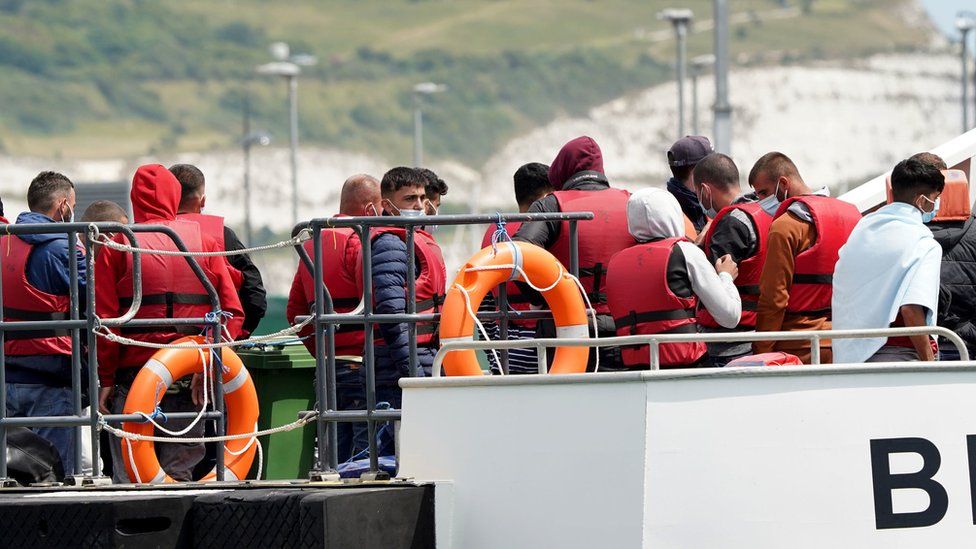
Migrants being brought into Dover last week

There is "no clear evidence" that the UK's plan to send asylum seekers to Rwanda will stop risky Channel crossings, a group of MPs has said.

In April, the UK said some people arriving on small boats from France would be sent to claim asylum in Rwanda - a policy meant to deter the journeys.

But MP Diana Johnson, chair of the home affairs committee, said it "appears to have gone unnoticed" by migrants.

The government said its "world-leading" plan would stop dangerous crossings.

The Rwanda policy was announced in April, with Prime Minister Boris Johnson saying action was needed to stop "vile people smugglers".

However, no migrants have yet been sent to the east African country.

Earlier this year, 47 people were told they would be flown to Rwanda, with a flight booked for 14 June. But after a series of legal challenges, and a ruling from the European Court of Human Rights, the flight was cancelled.

More than 14,000 migrants have crossed the Channel on small boats this year - including 442 on Monday 11 July alone - and the home affairs committee said the Rwanda announcement had not been effective.

"There is no clear evidence that the policy will deter migrant crossings - numbers have significantly increased since it was announced in April," the report said.

However, the committee accepted the increase may be down to traffickers telling migrants to make the journey in case the flights to Rwanda begin.

"One explanation for [the increase in crossings] may be attributed to scaremongering from people traffickers, that because of new regulations coming in across the Channel it will be much harder to access the UK in future, so they had better get on with it," the report says.

The report said the numbers making the "hazardous" journey across the Channel in small boats had "rocketed".

"More than 28,500 people came in small boats last year; an estimated 60,000 or more are expected during 2022," it said.

"Soberingly, at least 166 have died or gone missing as they sought a new home in our country, 27 of them lost at sea on a single terrible day last November."

But the MPs said there was "no magical single solution to dealing with irregular migration".

Instead they called for "detailed, evidence-driven, fully costed and fully tested policy initiatives" that achieve "sustainable incremental change".


The prime-ministerial race and a fresh legal challenge mean the pause button has been pressed on the Rwanda plan espoused by Boris Johnson and launched by Home Secretary Priti Patel.

Aware of its potential popularity with Tory voters, they faced down critics of the controversial deal.

As well as charities and human rights groups, opponents included church leaders and - reportedly - the Prince of Wales.

In its response to the MPs' conclusions, the Home Office says it was never seen as a "silver bullet", employing the committee's own language.

The eleventh-hour grounding of the first flight by the European Court of Human Rights (ECHR) renewed the determination of the plan's supporters.

But will it deter migrants from boarding the boats? The MPs say there is no evidence so far.

A fuller picture will emerge if there are regular Rwanda flights. And that will depend on the new prime minister.

The report noted that French authorities intercepted 6,000 journeys in the first half of 2021 - "nearly three times more than the year before".

But it also noted the "perceived reluctance of the French government to find a solution and work much more co-operatively with UK authorities".

The MPs said: "We recommend that the UK government continue to prioritise close, collaborative working with the French authorities...

"An intelligence-led approach remains the best way to identify the activities of such gangs and prevent their continuing exploitation of vulnerable people."

The report also said:
There were 48,450 asylum applications in 2021, and the total asylum caseload is more than 125,000
In 2020 (the most recent figures) asylum seekers waited an average of 449 days for a decision, rising to 550 days for unaccompanied children
Out-of-date IT, high staff turnover, and not enough workers were behind the delays
By September 2021, 64,000 people were in asylum accommodation, of whom 13,000 were in hotels
In February the Home Office said it was spending £4.7m a day on hotels for asylum seekers and Afghan refugees
Overall, the UK asylum system costs more than £1.5bn a year to administer

In response to the report, the Home Office said there was "no silver bullet" to the "global migration crisis", but that the government must do "everything we can to fix the broken asylum system".

"Our New Plan for Immigration will bring in the biggest package of reforms in decades, allowing us to support those in genuine need while preventing illegal and dangerous journeys into the UK, and breaking the business model of vile people smugglers," a spokeswoman said.

The Home Office also said it was recruiting more decision makers, improving digital technology, offering more remote interviews to reduce waiting times, and improving the interview process to "ensure decisions are right first time".
A triumphant antiabortion 
ANTIWOMAN movement begins to deal with its divisions

Among the areas of disagreement are key questions over how to enforce abortions bans.

By Rachel Roubein and Brittany Shammas
The Washington Post
July 24, 2022 

Antiabortion demonstrators chant and celebrate near the Supreme Court on June 24 after the ruling overturning Roe v. Wade. (Eric Lee for The Washington Post)

Roughly 40 antiabortion leaders projected resolve and unity on a 2.5-hour long webcast to thousands of viewers just days after the nation’s highest court overturned the constitutional right to an abortion last month.

During the virtual event titled “Life Beyond Roe,” they detailed next steps for a movement that had just won its greatest victory in nearly 50 years. One by one, they spoke of flipping Democratic congressional seats, of empowering state legal offices, of avoiding a victory lap and instead doubling down on their long-running crusade to curtail abortion access across the country.

“I believe that for the rest of your life, you’re going to remember exactly where you were and what you were doing when you heard the news on Friday, June 24,” David Bereit, the former CEO of 40 Days for Life, told the audience. “But — this is an important but — we have to recognize that this is not the end.”

Abortion rights groups grasp for a post-Roe strategy

Since these early moments of jubilation over the demise of the 1973 landmark Roe v. Wade decision, however, differences have emerged among advocates over the best way to build on the victory they secured at the Supreme Court as Republican-led states determine how and how far they will go to limit access to abortion, according to interviews with nearly 20 antiabortion leaders and other people involved in the movement.

“There’s always been a 50-year debate over what’s the best way to bring down Roe v. Wade,” said Clarke Forsythe, the senior counsel for Americans United for Life, an antiabortion law firm and advocacy group. “And now there’s a big debate, and everybody’s involved, about what’s the best road forward — or what are the best roads forward — after Dobbs,” he said referring to Dobbs v. Jackson Women’s Health Organization, the case that overturned Roe.

How the groups and their allies in state legislatures decide to move forward will play a key role in shaping a post-Roe landscape in the United States.

Among the areas of disagreement are whether to try to prevent women in antiabortion states from being able to obtain the procedure or abortion pills across state lines, as well as whether to promote bans that include exceptions for rape and incest. There is also tension over whether the best way to enforce a ban is by letting private citizens bring civil cases like in Texas.

A narrow slice of activists take a more extreme stance of imposing criminal penalties on patients who get abortions — but such a position is at odds with the more mainstream antiabortion movement that contends the woman should not be punished.

The looming battles will be waged in state legislatures, as antiabortion groups work with local leaders on passing ambitious plans to ban abortion. Major groups have their own model legislation — or are planning to soon unveil language — that state lawmakers can introduce when legislative sessions resume in a race to influence what a new post-Roe America will look like.

Leading antiabortion advocates downplayed the divisions among various organizations, contending they amount to a healthy debate that can be found within any social movement.

“There’s always tactical disagreements,” said Kristan Hawkins, the president of Students for Life of America. “I think what’s so great about our movement, though, is that there is that unity of what is our end goal, and how are we trying to transform our culture to be one that respects life.”

But the issues they disagree on are consequential and resolving them could be difficult.

“It was easy to unite against Roe v. Wade,” said Louisiana state Rep. Alan Seabaugh, a Republican who offered an amendment nixing a proposal advanced by a Louisiana House panel in May allowing women who have an abortion to be criminally charged. He voted for the original version of the bill in committee, but later apologized for doing so.

“I think this issue has the potential to divide the right,” he said, referring to abortion restrictions in general, “because of the issue of where you put the line. It’s not clean, neat and easy.”

Abortion rights groups aren’t taking any comfort from the divisions within the antiabortion movement and have vowed to fight restrictions through the courts and the ballot box.

“These are all variations of the same thing,” said Fatima Goss Graves, the head of the National Women’s Law Center. “They are bans on abortion and so we will resist them at every turn.”


Civil enforcement and crossing state lines


Some national antiabortion groups — such as the Thomas More Society — and GOP state lawmakers are seeking to advance proposals allowing private citizens to sue people who help or provide a resident of a state that has banned abortion terminate a pregnancy in another state, The Washington Post previously reported. But some groups, like Alliance Defending Freedom, believe doing so could conflict with the right to interstate travel.

Abortion is now banned in these states. See where laws have changed.

The idea of civil enforcement comes from a novel method used in Texas where the state has deputized private citizens with filing lawsuits against anyone who helps a woman obtain an abortion. That mechanism of allowing citizens to sue — which went into effect last September — has received praise from groups like Students for Life of America, who said they “appreciate Texas’s ingenuity.”

One question is to what degree this legal strategy should be used to enforce abortion bans within a state while another is how or whether it should be used to sue people who help or provide abortions to women traveling from states where the procedure is banned

Arizona is one of several Republican-controlled states that is pointing to a century-old law as the rationale to roll back access to abortions. (Video: Julie Yoon, Joshua Carroll/The Washington Post)

President Biden has already directed his cabinet secretaries to fight measures that would prevent patients from accessing abortion pills and traveling out of state. The Supreme Court hasn’t ruled on the merits of allowing private citizens to sue, and it’s not yet clear if the Justice Department will go after states that use the new mechanism.

The Thomas More Society typically focuses on litigation but decided to wade into the legislative arena after the Supreme Court overturned Roe. The conservative legal organization is planning to help legislators craft language using Texas’s mechanism empowering private citizens to sue, which could include prohibiting medication abortion and cracking down on out-of-state abortions. The efforts wouldn’t criminalize the patient.

“I see civil enforcement as important for the entire abortion law because of this issue of public officials not enforcing laws they don’t like,” said Peter Breen, the organization’s vice president and senior counsel. Some antiabortion advocates said they are worried about scenarios where a state’s governor or attorney general is a Democrat and refuses to enforce a ban put in place by a Republican-led legislature.

But Texas’s approach has also received skepticism from groups who contend it’s far too broad.

“We don’t support an open-ended, any Tom, Dick or Harry can use the law,” said Forsythe, of Americans United for Life, which has been behind hundreds of antiabortion bills introduced in state legislatures. “The civil enforcement mechanism should be limited to women injured by abortion or family members involved or affected.”

A post-Roe surge could reshape this Illinois steel mill town

Shortly before the Supreme Court’s ruling, the National Right to Life Committee released a model law, which its top lawyer said he vetted with other major groups. The legislation allows state and local officials — as well as the father or certain family members of the pregnant woman — to sue abortion providers.

According to James Bopp Jr., the NRLC’s general counsel, “we think that it should only be family members” who can sue.

Oklahoma passed a law using Texas’s broad enforcement mechanism earlier this year, while Idaho adopted a more narrow measure more similar to Bopp’s legislation.

Other groups are instead taking a wait-and-see approach. For instance, SBA Pro-Life America — a leading antiabortion organization — is “neutral” on the civil enforcement mechanism as long as the woman isn’t prosecuted.

“[We] generally don’t think it should be taken off the table, especially because in some states you have AGs who have stated they won’t enforce laws passed by the legislative branch,” Mallory Carroll, the group’s spokesperson, wrote in an email.


Becky Gerritson, president of Eagle Forum of Alabama, speaks at an antiabortion rally outside the Capitol in Montgomery, Ala., on May 22, 2019. (Kim Chandler/AP)

Rape and incest exemptions

Among leading national groups, there’s unity around banning abortion even in the cases of pregnancies resulting from rape and incest. Such a position has thrust Republicans in an uncomfortable spotlight in recent weeks, as most bans in effect now include an exception only for life of the mother.

Some organizations — like Americans United for Life — say they’re cognizant that some states may choose to allow abortions in the case of rape and incest to muster enough political support to pass new restrictions. Meanwhile, others are more “doctrinaire” on the question of exceptions, said one consultant who works with an antiabortion organization.

“Other groups have taken the practical approach that we’ll never have consensus in America if we don’t include the rape and incest protections. … Personally, I think that’s the right approach,” said the consultant, who spoke on the condition of anonymity to speak freely.

Abortion foes push to narrow ‘life of mother’ exceptions

Yet several groups are instead pushing to narrow or remove exceptions to save the health or life of the mother, arguing they create loopholes that can be exploited. Matt Sande, legislative director of Pro-Life Wisconsin, contends that a doctor can still intervene during life-or-death situations but that medical providers should also attempt to save the fetus.

“I will not say it’s a slam dunk to pass a total protection statutory abortion ban in Wisconsin,” said Sande. “Among the Republican caucuses, there would be a fight, but it’s a fight worth having.”


Antiabortion demonstrator Coleman Boyd, right, calls out to a colleague while being observed by a clinic escort, left, outside the Jackson Women's Health Organization clinic in Jackson, Miss., on June 28, 2022. Protesters are not allowed to block the entrance to the clinic. The clinic is the only facility that performs abortions in the state
. (Rogelio V. Solis/AP)

Prosecuting providers vs. women

Another division between hard-line and more mainstream groups is over prosecuting the woman. Major antiabortion groups have taken pains in recent weeks to publicly oppose the idea, particularly after the Louisiana proposal to criminally charge patients drew national attention.

“As national and state pro-life organizations, representing tens of millions of pro-life men, women, and children across the country, let us be clear: We state unequivocally that we do not support any measure seeking to criminalize or punish women and we stand firmly opposed to include such penalties in legislation,” more than 70 groups wrote in a May 12 open letter led by the National Right to Life Committee.

Louisiana abortion ban again blocked by judge

But Bradley Pierce, executive director of the Foundation to Abolish Abortion, helped draft the Louisiana measure and said he was disappointed when antiabortion lawmakers backed away from it.

“I think it revealed a lot of hypocrisy in those who said one thing and did something else,” he said, adding that the bill “would have done exactly what they say they believe. That is, treat a person before birth as being worthy of protection.”


By Rachel RoubeinRachel Roubein is a national health-care reporter for The Washington Post and author of The Health 202 newsletter, a daily morning tipsheet focused on health policy and politics. Twitter


By Brittany ShammasBrittany Shammas is a general assignment reporter for The Washington Post. Before joining The Post in 2019, she spent eight years writing for newspapers in Florida, including the Miami New Times and the South Florida Sun Sentinel. Twitter
 
It was long thought these fossils came from an eagle. Turns out they belong to the only known vulture species from Australia

The Conversation
July 21, 2022

The extinct species may have been a relative of the living Griffon Vulture
(pictured). Shutterstock

In 1905, a fragment of a fossil wing bone discovered near the Kalamurina Homestead, South Australia, was described as an extinct eagle and named Taphaetus lacertosus, meaning “powerful grave eagle”.

Now research published by myself and mycolleagues can reveal this species was no eagle at all. It was an “Old World” vulture, which we have renamed Cryptogyps lacertosus, or “powerful hidden vulture”.

This is the first time one of these scavenging raptors has been found to have lived in Australia. Living more than tens of thousands of years ago, we believe Cryptogyps likely died out with ancient Australia’s megafauna. There’s much about the species we’ve yet to find out.


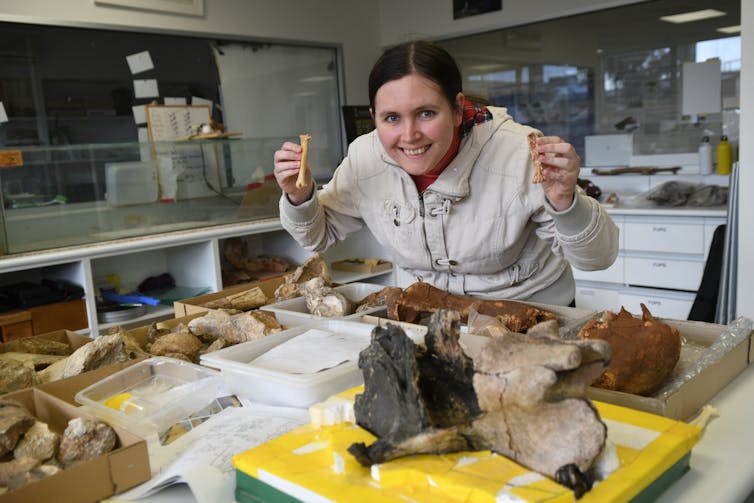
Here’s me at the Flinders University palaeontology lab, holding the fossil vulture tarsus (left) and a tarsus of a living vulture species (right).
Author provided

A puzzling absence


Vultures are birds of prey that feed almost exclusively on decaying flesh. They play a vital role in their ecosystems by speeding up the consumption of carcasses. In this way, they assist in redistributing nutrients, and help limit the spread of diseases.

They can be divided into two groups. “New World” vultures inhabit North and South America and belong to their own distinct family. “Old World” vultures are found in Africa, Europe and Asia, and belong to the same family as eagles and hawks.

Considering they’re so widespread today, it’s surprising vultures long appeared absent from Australia. It’s even stranger when you look at the fossil record across South-East Asia, where vulture fossils have been found as far south as the Indonesian island of Flores. Surely they could have flown a little further?

What’s more, the Australian environment would have been well-suited to support vultures until about 50,000 years ago. Back then, megafaunal marsupials were widespread and abundant across the continent, and would have provided plentiful carcasses for scavengers.

The shape of a scavenger


We aren’t the first to consider there might be vultures in Australia’s fossil record. Other palaeontologists have previously suggested some Australian bird fossils could belong to vultures, and the Kalamurina “eagle” was one such example.

My colleagues and I wanted to find out if this really was the case, and so we began comparing the fossil bones of Cryptogyps to a wide range of living birds of prey, including vultures.


Being scavengers, vultures have a very different musculature and bone structure to eagles. This fact proved to be crucial in confirming Cryptogyps lacertosus was indeed a vulture.


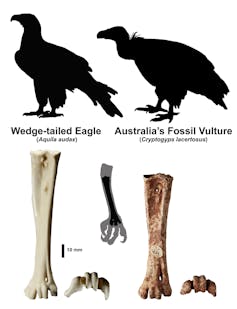
A silhouette size comparison of a Wedge-tailed Eagle (left) and Cryptogyps lacertosus (right), and tarsi comparisons of both below.
Ellen Mather, Wedge-tailed Eagle silhouette derived from photo by Vicki Nunn.


The material used in our research included the original wing bone from the Kalamurina Homestead, two identical wing bone fragments from the Wellington Caves in New South Wales, and two “tarsi” (lower leg bones) – one from Wellington Caves and the other from Leaena’s Breath Cave in Western Australia. All of these bones are thought to belong to Cryptogyps.

Close examination of the bones, and comparison to eagles and vultures from around the world revealed their muscle scars and structure are more vulture-like than eagle-like, especially for the tarsi. This strongly indicates they belonged to a scavenger.


To further test this, we placed the fossils in an evolutionary tree with other birds of prey. Our results confirmed what the comparison suggested: Cryptogyps was indeed a vulture, and potentially a close relative of the Griffon Vulture found across Europe and Asia.
The life and death of a species

Based on the leg bones, we can infer Cryptogyps didn’t actively hunt and grab prey with powerful talons. Rather, it would have scavenged dead animals as vultures do now.


At this point in time, we don’t have enough of the skeleton to know exactly what Cryptogyps lacertosus looked like, or what it ate.

It could have been a social species, gathering in large flocks around the corpses of megafauna such as Diprotodon or Protemnodon. Or perhaps it was a solitary bird, searching and feeding alone, or in pairs. It may have fed on the soft insides of the body, or may have preferred the tougher muscle and skin.

Gaining this information will require more discoveries in the future. What isn’t in question, however, is that like all vultures today Cryptogyps lacertosus would have played an important role in ecosystem health.


Fossils of Cryptogyps are believed to date from the Middle to Late Pleistocene, somewhere between 770,000 and 40,000 years ago. Its extinction was very likely related to the demise of Australia’s megafauna around 60,000–40,000 years ago.

As large-bodied animals died off, the supply of carcasses scavengers need to survive would have dwindled significantly. Starvation would have become common, breeding attempts less successful and eventually the total population would have fallen below the threshold needed to survive.

Other more generalist raptors such as Wedge-tailed Eagles and Black Kites subsequently filled the reduced scavenging niche.


The Wedge-tailed Eagle is the largest bird of prey in Australia today.
Shutterstock

Australia has the sobering distinction of being the only continent to lose its vultures entirely. Sadly, around half of all living vultures today are endangered and under threat of extinction.

And the consequences of this decline have been dire, including increased disease transmission in both animal and human populations, potential impacts on the nutrient cycle, and the restructuring of ecosystems.

Ellen K. Mather, Adjunct associate lecturer, Flinders University

This article is republished from The Conversation under a Creative Commons license. Read the original article.


String theory: NASA Mars rover discovers mystery object
Agence France-Presse
July 22, 2022

A tangled object discovered by NASA's Mars Perseverance rover has intrigued space watchers, leaving some musing tongue-in-cheek about the quality of Italian dining on the Red Planet Handout NASA/JPL-Caltech/AFP


Is it tumbleweed? A piece of fishing line? Spaghetti?

A tangled object discovered by NASA's Mars Perseverance rover has intrigued space watchers, leaving some musing tongue-in-cheek about the quality of Italian dining on the Red Planet.

But the most plausible explanation is more prosaic: it's likely remnants of a component used to lower the robotic explorer to the Martian surface in February 2021.

"We have been discussing where it's from, but there's been speculation that it's a piece of cord from the parachute or from the landing system that lowers the rover to the ground," a spokesman for NASA's Jet Propulsion Laboratory told AFP.

"Note that we don't have confirmation that it's one or the other," he added.

The bundle of debris was first spotted July 12 by the rover's front left hazard avoidance camera -- but when Perseverance returned to the same spot four days later, it was gone.

It was probably carried away by wind, like a piece of a thermal blanket that might have come from the rocket-powered landing system, which was spotted last month.

The accumulating trash left behind by Perseverance is considered a small price to pay for the rover's noble scientific goals of searching for biosignatures of ancient microbial life forms.

And these items may one day become valuable artifacts for future Mars colonists.

"In a hundred years or so Martians will be eagerly collecting up all this stuff and either putting it on display in museums or making it into 'historical jewelry,'" tweeted amateur astronomer Stuart Atkinson.

© 2022 AFP
MYOB
The curious rise of 'dog-parent shaming'

Nicole Karlis,
 Salon
July 24, 2022

Christina Hunger's dog, Stella, plays at Gregory Island Dog Park on April 21, 2021, in North Aurora. - Stacey Wescott/TNS

Five years ago, Jeannie Assimos adopted a mini pinscher from the Humane Society in Pasadena, California.

"He was super shy, not socialized — he had been abused, so, I kept going back and seeing him and he wasn't very friendly," Assimos explained. Still, she decided to take a chance on him. "I brought him home and he hid behind my couch, but I pulled him out and said, 'no, Buddy, we're going to be friends."

From that day forward, Jonny has never left her side. On his Instagram page, Jonny the Min Pin, it's hard to tell how much trauma Jonny endured. To his nearly 10,900 followers, Assimos shares Jonny's adventures at the beach and sometimes hanging out with his "best friend" Santo, who is a pitbull. While the Instagram feed is full of joyful photos, a small but visible number of Assimos' followers are obsessed with shaming her and her dog-parenting skills.

RELATED: Do dogs miss us when we leave?

Just as social media has provided a platform for parents to give each other their unsolicited opinions on how to parent their kids, the same curious trend is happening in the world of so-called dog parenting. Showing pictures of one's child in the online sphere is always a minefield: cultural differences mean that a swathe of people are bound to disagree with one's parenting habits. But curiously, this critical lens extends beyond the human realm, and into pet-rearing.

Assimos first noticed the trend about a year ago when she posted a video of Jonny at the beach, chewing on a stick.

The phenomenon of "mom-shaming" has been known and studied since the era when mommy blogs first emerged. "Dog parent– shaming," however, is a newer phenomenon.

"Then I got this lady DMing [direct messaging] me about how irresponsible I was as a dog mom, and that he could get splinters from this stick and that I was a horrible dog parent basically," she said. "I've had people someone DM me, 'How can you let your dog hang around that pit bull?'"

Additionally, some viewers criticized Assimos for dressing her dog in clothes. "Some thought it was mean," she mused. Assimos, for her part, takes it with a grain of salt: "I think it's par for the course when you put things out there on social media, I am so detached I could care less, and know that I give my rescue dog Jonny an amazing life," Assimos said. "I have encouraged others to adopt this attitude, but some find it difficult."

That random internet strangers would have such strong opinions about pet-rearing, and moreover would be inclined to loudly and furiously share them, suggests something deeper lurking within our collective psyches — some penchant for pedantic criticism and anger directed towards strangers that, somehow, bubbles up from the sociological ether via the catalyst of cute pet pictures and videos.

Assimos has observed other "dog influencers" shut down their account because of such hate. Indeed, such shaming behavior isn't exclusive to influencers on Instagram, but seemingly anyone who shares any tidbit about their dogs online.

The phenomenon of "mom-shaming" has been known and studied since the era when mommy blogs first emerged; the neologism refers to situations in which mothers are shamed on social media by those who criticize their parenting. Yet dog parent–shaming is a newer phenomena.

As blogging evolved in the early 2000s, and parents moved away from getting information from traditional sources, many parents took to sharing their own parenting experiences via blogs and social media. But what was meant to be a space to share the more intimate and personal details about parenting turned into a place for strangers to shame each other. As Danielle Campoamor wrote in Romper in 2018, "at a time when we share so much of our personal lives — including our parenting decisions — online, more and more mothers are finding ourselves defending our decisions from, of all people, other moms." A mother of a three-year-old at the time, Campoamor said she had "experienced call-out culture via the internet more times than I care to count." One time, she was attacked for placing her son on Santa's lap.

So how and why did this type of shaming move from human parenting to the world of pet parenting?

Sarah Hodgson, a pet trainer, behavior consultant, and author of several books including "Modern Dog Parenting," told Salon that when she started her career, dogs were considered to be pets and treated like them (although there were some cultural variations). But about 15 years ago, more scientists began to research the dog's brain. For example, research conducted by Stanley Coren published in 2009 showed that dogs' mental abilities are close to a human child aged 2 to 2.5 years old. That changed the way that many perceive dogs.

"So now it's widely accepted that dogs are like little children, and they stay like toddlers forever, so all of a sudden the parenting just kind of followed that wave," Hodgson said. "And for people like me who have just been obsessed with dogs my entire life — I've always felt that but now, people write about it, science writes about it, and social media has had this explosion."

With this evolution in how we perceive dogs, Hodgson said it's no surprise that dog-parent shaming became prominent.

"It's a very divisive time in our history, everybody likes to know more and be better and be in the right, that's what we do as a species now, which is kind of ridiculous," Hodgson said, adding that dog-parents should take a page from human parents in being a "good enough" parent.

"There's good enough parenting, and there's good enough dog parenting, as long as you're not abusing your dog and you're providing for those five basic needs — eat, drink, sleep, play, bathroom— as long as you're providing for those needs and your dog feels relatively happy, it's all OK."
The patriotic Virgin: How Mary’s been marshaled for religious nationalism and military campaigns

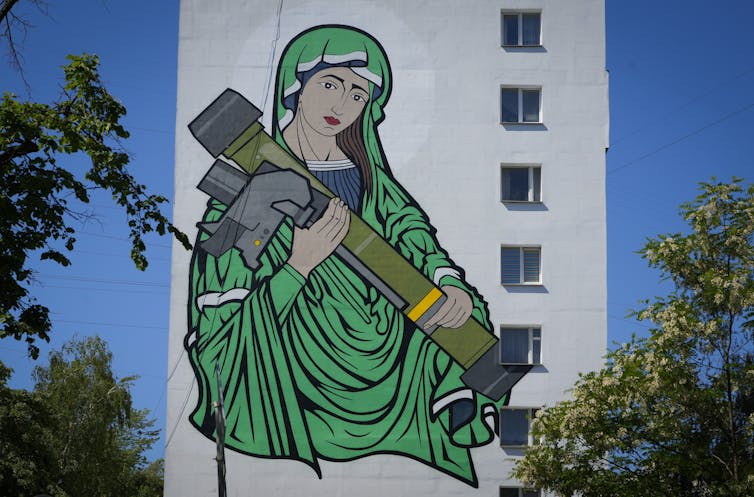
A mural in Kyiv depicts the Virgin Mary cradling a U.S.-made anti-tank weapon, a Javelin, which is considered a symbol of Ukraine’s defense against Russia.
AP Photo/Efrem Lukatsky

By Dorian Llywelyn


Ever since Russia began its invasion of Ukraine on Feb. 24, 2022, analysts picking apart Vladimir Putin’s motives and messaging about the war have looked to religion for some of the answers. Putin’s nationalist vision paints Russia as a defender of traditional Christian values against a liberal, secular West.

Putin’s Russia, however, is only the latest in a centurieslong lineup of nations using religion to bolster their political ambitions. As a Jesuit priest and scholar of Catholicism, I’ve seen in my research on nationalism and religion how patriotic loyalties and religious faith easily borrow one another’s language, symbols and emotions.

Western Christianity, including Catholicism, has often been enlisted to stir up patriotic fervor in support of nationalism. Historically, one typical aspect of the Catholic approach is linking devotion to the Virgin Mary with the interests of the state and military.
The birth of a belief

An Egyptian papyrus fragment from the fourth century is the first clear evidence of Christians’ praying to the Virgin Mary. The brief prayer, which seeks Mary’s protection in times of trouble, is written in the first person plural – using language like “our” and “we” – which suggests a belief that Mary would respond to groups of people as well as individuals.

That conviction appeared to grow in the following centuries. After the Roman Emperor Constantine converted to Christianity in A.D. 312, the new faith developed a close relationship with his empire, including a belief that Mary looked with particular favor on the capital city of Constantinople.

A 10th-century Byzantine mosaic of Constantine the Great offering Constantinople to the Virgin Mary, at the Hagia Sophia in Istanbul.
Photo by PHAS/Universal Images Group via Getty Images


Political and religious leaders asked the Virgin for victory in battle and shelter from plagues. In A.D. 626, Constantinople was besieged by a Persian navy. Christians believed that their prayers to the Virgin destroyed the invading fleet, saving the city and its inhabitants. The Akathist hymn, which has been prayed in both the Orthodox and Eastern Catholic churches ever since, gives Mary the military title “Champion General” in thanks for that victory.

In the Catholic West, military successes such as European victories over the Ottoman Empire were attributed to Mary’s intervention. Her blessing has been sought on imperialist endeavors, including Spain’s conquest of the Americas.

Even today, Mary holds the title of general in the armies of Argentina and Chile, where she is considered a national patroness. The same association between Marian devotion and patriotism can be found in many Latin American countries.
National symbol

Off the battlefield, many Catholic cultures have historically felt they had a special relationship with Mary. In 1638, King Louis XIII formally dedicated France to the Virgin Mary. Popular belief interpreted the subsequent birth of the future Louis XIV as Mary’s miraculous reward, after 23 years of waiting for a male heir.

About two decades later, Polish King Jan II Kazimierz consecrated his country to Mary amid a war. Both acts reflected church and political leaders’ beliefs that their countries had a sacred mission and divine approval for their political ambitions.

When these kinds of beliefs become widespread in a society, many scholars would label them religious nationalism – though there is a long-standing debate about when affection for one’s country becomes “nationalism.” There is widespread consensus, though, that religion is one of the most common elements of nationalism, and many nationalist projects have invoked Mary’s blessing.

Polish territory, for example, was divided between Russia, Prussia and Austria for more than a century. But Polish Catholics continued to address Mary as “Queen of Poland.” Her title asserted the existence of the Polish people as a nation. And it implied that efforts to reestablish Poland as a sovereign country had a heavenly helper.

Similarly, in the 19th century, both Queen Victoria and the Virgin Mary were referred to in different contexts as “Queen of Ireland,” expressing two rival visions of Ireland: part of the Protestant United Kingdom, or a separate and essentially Catholic country.

An illustration of the Virgin de Guadalupe in the Cathedral San Ildefonso in Mexico.
John Elk III/The Image Bank via Getty Images

Many different movements have used the figure of the Virgin to support their agendas. In colonial Mexico, the figure of Our Lady of Guadalupe, one title for Mary, was originally interpreted as being a champion of the “criollos,” native-born inhabitants of Spanish descent. During the 1810-21 War of Mexican Independence, “la Guadalupanafigured on the banners of the “independista” forces. The Spanish army, meanwhile, adopted the “Virgin of Los Remedios,” another title for Mary, as their own patroness. She would later be invoked in support of Indigenous people and mestizos, people with both Indigenous and Spanish ancestry.

Mary is invoked not only by nationalist causes. Sometimes she is inspiration for countercultural or protest movements, from the pro-life cause to Latina feminists. Labor leader Cesar Chavez placed the image of Guadalupe on banners as his organization marched for farmworkers’ rights.

Mary’s future


All these uses draw on the ancient belief in Mary’s power to intervene in times of trouble. However, ideological, political and especially military ambitions and religious sentiment are a volatile mix. As the current war in Ukraine shows, allegiance to one’s nation, especially when it claims Christian inspiration, can inspire both imperialist expansionism and heroic resistance to it.

This makes a better understanding of religious nationalism urgently important, especially for the church. Twentieth- and 21st-century popes have condemned aggressive nationalism but have not defined it clearly.

In cultures that are largely secularized, appeals for Mary’s protection or claims that she has a special relationship with any one nation are now likely to seem archaic, outlandish or sectarian. But what I know of both Marian devotion and national identity has convinced me that ancient patterns often survive and reassert themselves in new times and places.

Even where the practice of Catholicism is in decline, Mary’s cultural significance remains strong. And religion continues to be a regular element of many nationalist agendas.

My guess is that we have not seen the last of the warrior Virgin.

This article is republished from The Conversation, a nonprofit, independent news organization dedicated to unlocking the knowledge of experts for the public good.


ABOUT DORIAN LLYWELYN
Dorian Llywelyn is President of the Institute for Advanced Catholic Studies at USC Dornsife College of Letters, Arts and Sciences. You can read more about the author here.
O WOE IS ME
Trump is met with silence from GOP audience after complaining about being the most 'persecuted' person in American history

Former U.S. President Donald Trump speaks during the Turning Point USA Student Action Summit held at the Tampa Convention Center on July 23, 2022 in Tampa, Florida. Joe Raedle/Getty Images

Trump's statement came at the Turning Point USA Student Action Summit in Florida.
"Certainly, there's been no politician or president treated like I've been treated," he said.

On Friday, the former president spoke at a rally in Arizona where he was met with boos.

Former President Donald Trump says no one in American history has been as persecuted as he has.

"A friend of mine once said that I was the most persecuted person in the history of our country," he said at the Turning Point USA Student Action Summit in Tampa, Florida, on Saturday. "I never thought of it that way. I never had time. I was always fighting these people that were trying to persecute me."

He doubled down: "I didn't have time to think about getting persecuted because I was fighting persecution," continuing to add, "Certainly, there's been no politician or president treated like I've been treated."

His remarks came after an introductory video montage and "God Bless the USA" by Lee Greenwood played. As fire blasted from the stage, Trump entered, tossed out "TRUMP WAS RIGHT" hats, and was greeted by a room full of cheers.
On Friday, the former president also spoke at a rally in Arizona where he was met with boos over his endorsement of Eli Crane, an Arizona GOP congressional candidate.

"But you like me, right?" Trump said before a small giggle.

‘I can’t afford what I used to’: how the cost of living has changed viewing habits

Four people tell how rising living costs have pushed them to cut back on luxuries like streaming services

Netflix lost one million subscribers in the second quarter of 2022. 
Photograph: Denis Balibouse/Reuters

Gemma McSherry and Clea Skopeliti
Sat 23 Jul 2022 
THE GUARDIAN

The UK inflation rate hit a 40-year high of 9.4% this week and economists warned of a potential increase to 12% by October 2022. With the average UK food bill rising by £454 a year, the cost of living crisis has led to many people finding ways to cut back on expenses.

One area includes streaming services. Netflix is continuing to see subscriber numbers fall, with one million subscribers lost in the second quarter of 2022.


We spoke to four people about how the rising cost of living has affected their viewing habits.

‘I haven’t watched it in ages’


Kate, a retired 71-year-old living in Bristol, says she is on a subscription service cancelling spree. “I cancelled Netflix today and will be doing Prime later,” she says.

“It was that crazy thing where you think, I haven’t watched it for ages, what am I paying for? I had a note in my calendar to cancel it recently and then forgot to.”

Kate says she decided to ditch the streaming services partly due to the cost. “I’ve been trying to cut down on weekly spending – it’s not a lot but when you start adding up the odd 10 quid, they do add up. There’s no point if you’re not making any use of the service.”

She adds that she could see herself going back to Netflix in the autumn, “if they bring some interesting shows”, but has mostly been watching series on BBC iPlayer and ITV. “They’ve got some damn good shows on at the moment,” she says.

‘I’ve had to cut back on the things that previously weren’t luxuries’

Jess from Bury St Edmunds has cut back on streaming services to save on living costs.

Jess, 30, from Bury St Edmunds, lives with disabilities that mean she is unable to work. “Because I can sometimes struggle to get out of the house, I enjoy making my home a cosy and fun space,” she says. “But I’ve had to cut back on the things that previously weren’t luxuries but are now – streaming services being one of them.”

Jess has seen her monthly bills increase – “and that’s during summer; I don’t know what’s going to happen in winter”, she says.

For all of the streaming services Jess was using, which included Netflix, Amazon and Disney+ as well as her TV licence, she paid nearly £40 a month.

“I only have Netflix now, as it’s the one I watch the most. I’ve been unable to work for two years and universal credit and personal independence payments are only covering the bare bones of my outgoings. My food shop has gone up, too. I just can’t afford the things I used to.”

‘My pension is not going up’

Ted, 71, has cut back on streaming services as his pension no longer covers his outgoings. Photograph: Ted Cardwell

The cost of living crisis has made 72-year-old Ted Cardwell in Kent look over his monthly outgoings. Cardwell, who is retired, has decided to cancel Netflix and Amazon Prime to save money.

“We’ve also cut down on Sky because, with the cost of living and pensions not going up, it’s crazy,” he says, adding that he would return if they offered a discount rate for pensioners.

“I think a lot of them discount pensioners because they think we don’t use streaming services, but lots of my friends do. I think it’s an untapped market.”

Explaining that he’s recently started looking at what to cut back as his wife is retiring, he says the reason is financial rather than because of worsening services.

“We’re doing pretty well – not using a food bank, things like holidays – we’re not in a bad place at all, but you’ve got to be conscious and cut,” he says. “It’s income over outgoings. The cost of living is going up and my pension is not going up with it.”

‘We decided to rationalise our outgoings’

John has cut back on luxuries due to the rising cost of building materials.
 Photograph: John Tardrew

“My wife and I are extending our home and when we got the quote for building costs, we saw just how much prices have rocketed,” says John, 41, an industrial engineer from Cambridge.

“We decided to boost our savings and reassess our finances. As I have a free Amazon Prime subscription, we decided to save money [on other streaming services].”

John now only joins and leaves services when there is a particular show he wants to watch.

“We dropped Netflix, but recently rejoined for Stranger Things and cancelled again after two months. We joined Disney+ to watch the Star Wars films, but I’m thinking of cancelling it too.”

Finding time to watch things meant that John and his wife were not making the most of their subscriptions, which were costing nearly £50 a month. “We have work and two young kids, so there’s little time to get into a new box set.”