It’s possible that I shall make an ass of myself. But in that case one can always get out of it with a little dialectic. I have, of course, so worded my proposition as to be right either way (K.Marx, Letter to F.Engels on the Indian Mutiny)
Thursday, August 04, 2022
Manchin secures top Democrats' commitment for troubled pipeline project - media
WASHINGTON, Aug 1 (Reuters) - Democratic U.S. Senator Joe Manchin has secured a commitment from President Joe Biden, Senate Majority Leader Chuck Schumer and House of Representatives Speaker Nancy Pelosi to allow the Mountain Valley Pipeline to be completed, his office told a CBS affiliate on Monday.
The commitment to the West Virginia senator from Democrats Biden, Schumer and Pelosi will be used to pass legislation for the state's pipeline to be completed and "streamline the permitting process for all energy infrastructure," the news outlet reported, citing Manchin's office.
The legislation will be voted on by the end of the fiscal year, which is Sept. 30, 2022, according to the statement quoted in the news outlet.
Manchin's office did not immediately respond to a request for comment on Monday. The senator re-tweeted the report.
The pipeline project has faced legal setbacks and is years behind schedule and billions of dollars over budget.
Last week, Manchin, who has often been a roadblock to Biden's policy goals, reached a deal with Schumer on a bill to increase corporate taxes, reduce the national debt, invest in energy technologies and lower the cost of prescription drugs.
The Washington Post reported on Monday that the deal between Manchin and Schumer would also attempt to remove obstacles to the construction of energy projects across the country. (Reporting by Kanishka Singh in Washington and Costas Pitas in Los Angeles; Editing by Chris Reese and Bradley Perrett)
Yellen Says Manchin Bill Won’t Raise Taxes for Families Earning Less Than $400,000 a Year Christopher Condon Tue, August 2, 2022
(Bloomberg) -- Treasury Secretary Janet Yellen waded into the congressional debate over proposed economic and climate legislation, saying it won’t raise taxes for families earning less than $400,000 a year.
“The legislation would either reduce or have no effect on the taxes due or paid by any family with income less than $400,000,” Yellen wrote Tuesday in a letter to House Speaker Nancy Pelosi obtained by Bloomberg News. “In fact, the clean energy tax credits and the expanded premium tax credit will cut taxes for millions of Americans.”
Yellen wrote to Pelosi after an analysis by the Joint Committee on Taxation, an official congressional scorekeeper, found that some middle- and low-income households could pay additional taxes next year under the bill, unveiled last week between West Virginia Senator Joe Manchin and Senate Majority Leader Chuck Schumer.
The $400,000 income threshold is crucial for the White House, as President Joe Biden promised during his election campaign not to raise taxes for households below that line. While Democrats have disputed the estimates, Republicans have used the JCT figures to amplify their opposition to the bill.
In her letter, Yellen didn’t respond directly to the JCT’s analysis on the distributional effects of the bill’s tax changes. Instead, she reviewed each of the legislation’s major components and said the tax changes would only affect “large corporations and investment professionals making $400,000 or more per year.”
QAnon ‘Queen of Canada’ Wants Some American Subjects
Will Sommer
Patrick Doyle/Reuters
A QAnon leader whose followers believe she’s the “Queen of Canada” has now set her sights on the United States, urging her followers to enforce her dangerous “decrees” in America.
For people outside of the pro-Trump QAnon conspiracy theory, Romana Didulo is just another Canadian citizen. But for her supporters, she’s a monarch ordained by Q and the American military to rule over Canada and, ultimately, the world. After being endorsed by other QAnon promoters, Didulo managed to amass a following, and is currently touring Canada in a fleet of RVs to meet with her supporters.
Now, though, Didulo’s ambitions seem to have grown. In July, she started telling her more than 60,000 followers on the messaging app Telegram about the establishment of the “Kingdom of America,” handing out royal “titles” to Americans who promised to promote her reign there and appointing a new United States “commander-in-chief,” a man named David Carlson.
While Didulo’s ideas are ridiculous, they’ve already had a real-world effect on Canada. When Didulo told her fans that she had abolished Canada’s income tax, some stopped paying taxes to the Canadian government. Because Didulo issued a “decree” announcing that her supporters could now pay their utility bills with “IOUs” backed by her bogus government, her supporters have started losing electricity and water in their homes.
“They’re literally in the dark,” said Christine Sarteschi, a Chatham University associate professor of social work and criminology who has studied Didulo’s group.
The Daily Beast couldn’t reach Didulo or Carlson for comment.
More seriously, Didulo’s claims that she operates a parallel government to the real Canadian one have put her followers at odds with law enforcement. Last year, she urged her followers to “shoot to kill” COVID-19 vaccine workers. One of Didulo’s followers was arrested after allegedly threatening to shoot up a school where children were receiving vaccines.
Others have followed Didulo’s orders to deliver bogus cease-and-desist notices to Canadian police demanding that they stop enforcing pandemic mandates.
Like the anti-government sovereign citizens movement, which Didulo has borrowed some tactics from, Didulo’s fans seem to think they’re above the law. One follower in Canada tried to avoid being arrested for outstanding warrants by serving a police officer with one of the cease-and-desist notices, only to be immediately arrested. Didulo herself was briefly detained for a mental health evaluation last year.
Even many QAnon observers are puzzled so far about Didulo’s attempts to extend her “kingdom” into the United States. Still, according to Sarteschi, the purported citizens of the “Kingdom of America” and Carlson, a little-known Didulo devotee, both seem to be under her sway.
“They defer to her as the leader and they ask her permission to do anything,” Sarteschi said. “She’ll post about him and talk about him in speeches, but it sounds like he defers to her all the time.”
Didulo’s followers have already started to contact genuine officials in the country, warning them that her reign is about to begin. One of Didulo’s loyal subjects sent a letter to Florida Attorney General Ashley Moody, later posted on Telegram, asking her to bring the state in line with Didulo and Carlson’s new government.
Didulo’s fake “decrees,” which promise to abolish taxes, debts, and mortgages, are key to her popularity with her fans. Some are odd but harmless, including a measure meant to lower speed limits on some streets to improve the popularity of back-alley rollerblading. But others are sinister and potentially violent. Along with her death penalty for vaccine administrators, Didulo has decreed capital punishment for “offenses” such as the distribution of pro-vaccination podcasts. The self-styled queen has also called for a 30-year prison term for reporters who criticize her.
Now Didulo’s American adherents are set on trying to carry out her orders outside of Canada, starting in the United States.
“They want to replicate that movement in the USA, and they want to use her decrees as law,” Sarteschi said.
The budget reconciliation bill that Sen. Joe Manchin, D-W. Va., agreed to with Senate Majority Leader Chuck Schumer, D-N.Y., could save up to 3,900 lives per year by 2030, thanks to reduced air pollution, according to a new study from the nonpartisan think tank Energy Innovation.
The bill, known as the Inflation Reduction Act (IRA), contains $369 billion in spending to address climate change over 10 years, in addition to other provisions, including closing tax loopholes and holding down the rate of increase in the cost of prescription medication.
Senate Majority Leader Chuck Schumer at a news conference on Capitol Hill on Thursday. (Kent Nishimura/Los Angeles Times via Getty Images)
Researchers from Energy Innovation, which advocates for the reduction of greenhouse gas emissions, modeled the effects of the climate provisions, such as loans for the manufacture and purchase of electric vehicles, tax credits to boost solar-panel and wind-turbine manufacturing and subsidies for state and local governments to reduce their emissions of the greenhouse gases that cause climate change. The budget compromise also includes the first-ever fee for oil and gas drilling operations that leak methane, a potent greenhouse gas.
“The IRA provisions could also generate enormous public health and jobs benefits,” the report states. In addition to preventing between 3,700 and 3,900 premature deaths from air pollution in 2030, Energy Innovation found it would lead to a net increase of up to 1.5 million jobs in 2030 and increase the United States' gross domestic product by 0.84% to 0.88% in 2030.
While the emphasis in media coverage of the clean energy programs has been on combating climate change, switching from coal and gas to wind and solar power, and from internal combustion engines to electric cars and trucks, the legislation would also reduce the presence of conventional air pollutants that are produced by burning fossil fuels.
Using open-source software from the Department of Energy, Energy Innovation modeled the effects of the energy policy components of the bill. The estimate of premature deaths prevented is based on the expected reductions in particulate matter, sulfur dioxide, nitrogen oxides and volatile organic compounds.
A forest killed by carbon dioxide near the dried-out Horseshoe Lake in California on Thursday. (David McNew/Getty Images)
Depending on a variety of factors, including economic growth and how eager consumers are to take advantage of the tax credits, the team played out four different scenarios.
If the bill doesn’t pass, the study projected that U.S. emissions will be 24% below 2005 levels by 2030. Largely thanks to gas, wind and solar energy displacing coal, U.S. emissions have already been reduced to 17% below 2005 levels, and that trend is expected to continue. However, the Intergovernmental Panel on Climate Change has said that emissions must drop much faster to avert catastrophic climate change. President Biden has pledged that the nation will reduce its emissions by 50% from the 2005 baseline by 2030.
If the IRA passes, even with the most pessimistic assumptions about the size of its effect, Energy Innovation projects that emissions will be 37% below levels in 2005 by the end of this decade. Under a moderate scenario, they will drop 39%, and under a high-effectiveness scenario, they will decrease by 41%. That alone is not enough to meet Biden’s target, but climate change experts hope that new federal regulations and state government policies will help at least partially to bridge the gap.
“The scenarios reflect a range of optimism about how effective the policies in the IRA will be and the uptake of different programs. How much will public sector spending leverage private sector spending?” said Robbie Orvis, the report’s lead author, in a press briefing.
Sen. Joe Manchin, D-W. Va., on Capitol Hill on Tuesday. (Sarah Silbiger/Bloomberg via Getty Images)
Although some environmental activist organizations, such as Greenpeace, are criticizing the IRA for including new federal offshore oil and gas drilling and other pro-fossil-fuel development measures — which were needed to win Manchin’s support — Energy Innovation finds the bill would be a huge net positive for the climate.
“For every ton of emissions increases generated by IRA oil and gas provisions, at least 24 tons of emissions are avoided by the other provisions,” the report concludes.
Anand Gopal, executive director of strategy and policy at Energy Innovation, predicted that if the IRA passes, it would catalyze emissions reductions from other countries as well, because the Biden administration would be in a more credible position from which to extract new pledges at the 2022 United Nations Climate Change Conference, more commonly referred to as COP27, in Egypt.
“We think this will change U.S. engagement on climate internationally going into COP27, as well as bilateral engagement,” Gopal said. In particular, he said, collaborative efforts with China, the world’s largest emitter of greenhouse gases, “are more likely to pick up steam.”
Wednesday, August 03, 2022
NO-CAN-DO
'Time is incredibly tight': New report adds clarity to challenge of cutting oilsands' emissions
Gabriel Friedman Tue, August 2, 2022 carbon-capture
During the last decade or so, Canada’s oilsands experienced a nearly unprecedented transformation as production more than doubled.
In the next decade, the oilsands sector will need to not just stall, but reverse its trend of rising greenhouse emissions in order for Canada to meet its 40 per cent climate change reduction commitment by 2030.
In a 42-page report released by the commodity research firm S&P Global on Tuesday, Kevin Birn, the company’s chief analyst of Canadian oil markets, uses a series of charts and data points to demonstrate the gap between the oilsands’ current trajectory of increasing emissions and the reduction it needs to make in the next eight years.
While government and industry have touted carbon capture and storage — technology that can divert CO2 and other greenhouse gases into pipelines so they can be permanently sequestered underground, rather than in the atmosphere — Birn’s report illustrates that the size and scale of investment needed to achieve emissions reductions, as well as the relatively short timeline, create long odds that it can be achieved.
“It is possible but it is incredibly ambitious,” said Birn. “And time is incredibly tight when you think about all the things that have to happen, and we don’t have a permitted project yet.”
As the report makes clear, overall annual greenhouse gas emissions in Canada have remained fairly level for the past 15 years at between 700 and 730 million tonnes. The two largest sources of emissions in 2019 were the oil and gas sector, accounting for 26 per cent, and transportation, accounting for 25 per cent.
In transportation, the federal government has set mandates requiring that all new vehicles sold must be zero-emission by 2030, targets that are already having a drastic impact on the sector.
But conversations about how to reduce greenhouse gas emissions in oil and gas remain hazy.
Discussions about carbon capture, the preferred method for emissions reduction, also remain preliminary: Earlier this year, the federal government released its 2030 emissions reduction plan, which calls for a 42 per cent or 81 million metric ton reduction in the country’s entire oil and gas emissions from 191 million metric tons in 2019 to 110 million metric tons by 2030.
Depending how oilsands’ emissions are accounted for, they represent anywhere from 68 million metric tons to 84 million metric tons per year.
Last week, Brad Corson, chief executive officer of Imperial Oil Ltd., called the plan “very aggressive,” saying it “stretches the capability of what is technically and economically feasible.”
Meanwhile, the Pathways Alliance, an organization of the six largest oilsands producers, have set a collective ambition of cutting 22 million metric tons by 2030, but have not committed to reducing emissions below any baseline level.
It has proposed construction of a new 400-kilometre carbon capture pipeline that would run from Fort McMurray to Cold Lake, Alta., tying into 11 oilsands facilities along the way, before eventually sequestering the carbon in an underground reservoir south of Cold Lake. The project carries an estimated $14-billion price tag, and the organization said it expects the government would shoulder anywhere from two-thirds to three-quarters of the cost.
A spokesman for the Pathways Alliance was not available to comment.
Beyond any potential disagreements between the federal government and industry, carbon storage is controversial and has been opposed by non-profits such as Environmental Defence, which says the vast majority of emissions from oil and gas are released when they are burned as a fuel, which would not be affected by carbon capture that reduces emissions. They argue scarce government funding to mitigate the effects of climate change should be allocated elsewhere.
Birn notes in his report that 86 per cent of the oilsands’ greenhouse emissions come from “stationary combustionary sources,” such as heaters and boilers, which are considered well-suited for carbon-capture technology.
That is why the technology is considered crucial to reversing rising emissions from oilsands production, he said.
Between 2009 and 2020, oilsands production grew from 1.3 million barrels a day to roughly 2.7 million barrels a day and the sector’s emissions grew by 60 per cent, says Birn’s report.
It includes a graph that suggests the oilsands could sit in an attractive spot on the cost curve in the context of cumulative oil production during the next 20 years. Such forecasts are notoriously difficult, of course, and change based on the assumptions used for the carbon tax, total energy needs, the pace of alternative energy growth and various wildcards.
There have already been some investment in carbon capture in Alberta: Shell’s Quest project, completed in 2016, captures an estimated third of the CO2 from an upgrader, or about one million metric tons per year, and carries it through a 65-kilometre pipeline to an underground reservoir.
But Alberta would need more capacity to meet its goals, he notes.
Because capturing carbon dioxide is a cost, oil companies have found ways to monetize the process by using the gas for enhanced oil recovery — that is, pumping it out underground to aid recovery of otherwise hard to reach oil.
Now, increasingly, oil companies will need to sequester greenhouse gases.
“There will have to be straight sequestration,” he said, “(because) of the pace of what’s required to avoid the worst outcomes when it comes to climate change. We have no time to really choose amongst technologies, we need to try them all; we need to deploy them as fast as possible.”
California Venture Capitalist Blake Masters Wins AZ GOP Senate Primary
Roger Sollenberger Wed, August 3, 2022 Rebecca Noble/Reuters
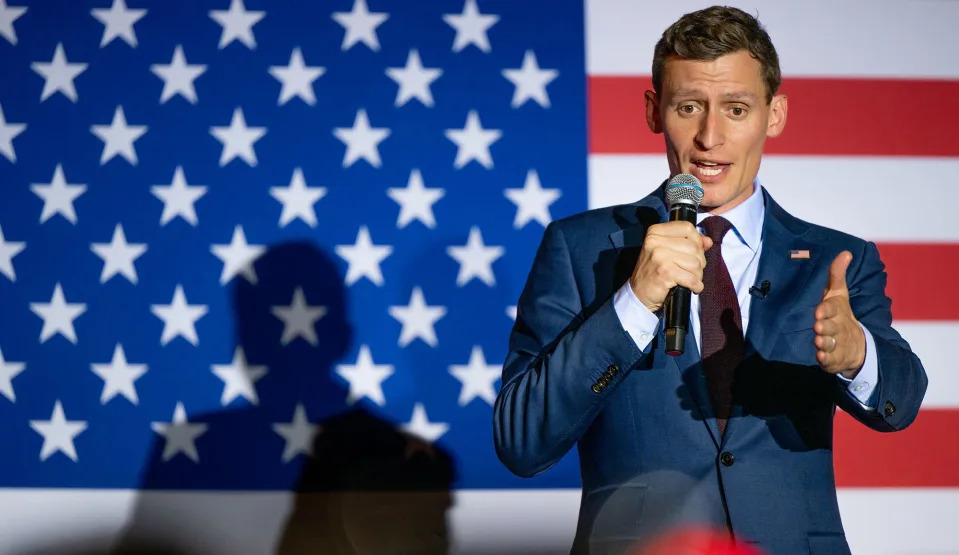
Venture capitalist turned upstart Senate candidate Blake Masters easily won the Arizona Republican primary on Tuesday, racking up another victory for candidates backed by former President Donald Trump and tech billionaire Peter Thiel.
Masters, a 35-year-old Bitcoin hawk with no political experience, rode Trump’s late-game support to a come-from-behind win, after failing for months to woo swing state conservatives with a steady stream of radical and at times dystopian right-wing rhetoric threaded with anti-immigrant and racist tropes.
In the end, Masters outperformed runner-up Arizona energy mogul Jim Lamon. Masters will now face incumbent Sen. Mark Kelly (D-AZ) in the general election.
For months, the Arizona race showed no clear frontrunner, but after escalating his election denialism to score Trump’s endorsement in June, Masters surged. By primary time, he was resting on a double-digit lead.
By contrast, JD Vance—another Trump-Thiel pick—claimed less than one in three Ohio Republicans in May. Missouri attorney general Eric Schmitt, a Senate candidate who received Thiel money and an ambiguous endorsement from Trump, also won his GOP Senate nomination Tuesday night, though Trump was less than clear about who he was actually endorsing in the race.
Masters, who grew up in Arizona, had recently returned to the state after years in the Bay Area, where he worked under Thiel’s wing as COO of Thiel Capital. He entered the race rating relatively low in name recognition, especially compared to Arizona Attorney General turned Trump nemesis Mark Brnovich. But Masters adopted a native advertising approach to publicity, and quickly began accumulating earned media as a polarizing provocateur.
His success, however, came as a surprise to many. At the beginning, Masters’ outsider platform appeared like a strange fit for Arizonans. He leaned heavily on abstract “new right” political theory, anti-immigrant fear bait, longform podcast interviews, and niche, largely untested policy proposals (like a “strategic reserve” of Bitcoin)—an odd match for the swing state’s typical voter profile.
Still, thanks in large part to Trump, the tech investor was able to lock up enough votes to offset, or possibly win over, his stiffest competition: Arizona’s sizable population of suburban moderates and retirees.
While Masters—a thirtysomething Bitcoin millionaire and Silicon Valley transplant who was dogged throughout his campaign by allegations of racism, hypocritical corporate and technocraticcronyism, and veiled anti-semitism—might seem an unlikely flagbearer for that all-important demographic, those voters will only become more critical as the general election approaches. There, Masters must overcome a popular Democratic moderate in Kelly, an effort that may force Masters to soften his rhetoric.
He’ll have to balance that against the Trump brand if he wants to energize the grassroots, because if fundraising is any measure of enthusiasm, Masters has a steep hill to climb. Almost all of his financial firepower has come from a group entirely separate from his campaign—a super PAC mainly fueled by Thiel’s whopping $15 million investment. The bulk of the super PAC’s other high-dollar contributions come from executives in tech and financial sectors, most of them bearing some connection to the crypto world.
But Arizonans have simply not opened their pocketbooks. Exactly four of the super PAC’s fifty-plus donors hail from Arizona, according to FEC data. And of his campaign’s $5 million, more than 90 percent comes from out-of-state, with Californians accounting for about one in every five dollars. In fact, Masters has given more money to his campaign than Arizona citizens have—his $680,000 in personal loans outweigh his total in-state contributions by about $200,000. His latest loan, in July—more than four months after he claimed to resign from Thiel’s company—still lists his employer as Thiel Capital.
But Masters received loads of free airtime from another powerful ally—the most influential media figure in conservative politics, Fox News entertainer Tucker Carlson. The late-night host quickly recognized a fellow traveler in Masters’ nationalist agenda, offering full-throated support and numerous appearances on his program, the most watched show in cable news history. (Brnovich, by contrast, got the support of Carlson’s late-night colleague Sean Hannity.)
But the same nationalist rhetoric that appealed to the Carlson crowd—resounding with the false “Great Replacement” conspiracy theory embraced by white supremacists—attracted more controversial supporters, including Andrew Anglin, founder of the neo-Nazi publication The Daily Stormer.
Ultimately, Masters’ media savvy overcame the substantive support that top immigration officials threw behind his top competitor, Lamon, who received endorsements from former Acting Secretary of Homeland Security Chad Wolf, along with the former Acting Director of Immigration and Customs Enforcement and the former Chief of the Border Patrol.
Masters reaped endorsements from TV officials like Reps. Marjorie Taylor Greene (R-GA), Matt Gaetz (R-FL), and Madison Cawthorn (R-NC), and Sen. Josh Hawley (R-MO).
But despite staking out positions on immigration, guns, abortion, and gay marriage that poll well outside the main, the tech entrepreneur has made a “guarantee” that he will beat Kelly, a former Navy pilot and astronaut, by “five points.”
“‘Oh, I’m an astronaut. Have you heard I’m an astronaut?’” Masters said at an event in April, as reported by Mother Jones. “‘You know, when I’m on the space station and I look at that big blue ball I realize we’re all in it together.’ And it’s like, ‘Shut up, Mark.’”
But Masters will also have to overcome his own baseless theory that Democrats are using immigration policy to stack the electoral deck.
“Obviously, the Democrats, they hope to just change the demographics of our country,” he said in an April podcast interview. “They hope to import an entirely new electorate. Then they call you a racist and a bigot.”
Blake Masters, ultra-MAGA Republican who blamed gun violence on 'Black people,' wins Arizona Senate primary
Andrew Romano ·West Coast Correspondent Wed, August 3, 2022 Republican candidate for Senate Blake Masters speaks to supporters during a campaign event at the Whiskey Roads Restaurant & Bar on July 31, 2022 in Tucson, Arizona. (Brandon Bell/Getty Images)
Blake Masters, an ultra-MAGA candidate endorsed by former President Donald Trump, won the marquee GOP Senate primary in Arizona Tuesday night, setting up a general-election showdown with his more traditional Democratic rival that will test whether the way to win a key swing state in 2022 is by channeling the animosities of the far right — or by trying to appeal to a broader coalition.
With more than 70% of precincts reporting, Masters —a 35-year-old “anti-progressive” venture capitalist propelled to the front of a crowded primary field by at least $15 million in super PAC funding from powerful Silicon Valley billionaire Peter Thiel, his longtime boss and mentor — clinched his party’s U.S. Senate nomination early Wednesday morning, defeating wealthy solar power executive Jim Lamon and state Attorney General Mark Brnovich.
On Election Day, Masters will face off against incumbent Democrat Mark Kelly in a race that will help determine control of the closely divided Senate.
After midnight, a second MAGA candidate, state Rep. Mark Finchem, also won the GOP nomination for Arizona secretary of state. And a third, former Phoenix news anchor Kari Lake, was locked in a close battle for the party's gubernatorial nod with her establishment rival, real estate developer Karrin Taylor Robson.
"We won today seven-out-of-10 Election Day votes,” Lake told her supporters Tuesday night, claiming — erroneously — that "there is no path to victory for my opponent and we won this race. Period.”
Republican gubernatorial candidate for Arizona Kari Lake speaks to supporters during a campaign event at the Whiskey Roads Restaurant & Bar on July 31, 2022 in Tucson, Arizona. (Brandon Bell/Getty Images)
Both Lake and Finchem have parroted Trump’s lie that the 2020 presidential election was stolen from him — and vowed to do whatever it takes to prevent another Trump loss in the future. Masters has also declared that “Trump won in 2020.”
For all three election deniers, these displays of fealty were sufficient to snag Trump’s sought-after support, which he bestowed in person at a July 22 rally in Prescott Valley.
On the same day, Trump’s former Vice President Mike Pence was campaigning across the state for Robson, who has refused to say the 2020 election was rigged. Arizona Gov. Doug Ducey — another prominent Republican who, like Pence, resisted Trump’s efforts to overturn the 2020 result — also endorsed Robson, along with Finchem’s main rival, Beau Lane.
If Lake ultimately joins Finchem and Masters on the winner’s podium, they would cement a Trump sweep in the Grand Canyon State — and combine to form perhaps the most pro-MAGA slate of candidates anywhere in America.
But the problem for Republicans is that Arizona is hardly America’s most pro-MAGA state.
“With the national mood turning so strongly against the Biden administration and Democratic control of Congress, Republican candidates should have a relatively easy time recapturing seats in Arizona this cycle,” says Robert Robb, a longtime columnist for the Arizona Republic and former GOP political consultant. “But these candidates are weak candidates. Whatever this ‘new right’ thing is, I don’t think that it necessarily fits Arizona.”
Mark Finchem, a Republican candidate for Arizona Secretary of State, waves to the crowd as he arrives to speak at a Save America rally Friday, July 22, 2022, in Prescott, Ariz.
(Ross D. Franklin/AP Photo)
From Pennsylvania to Georgia to Nevada, GOP primary voters have repeatedly rankled Republican strategists and delighted their Democratic counterparts this year by nominating candidates who could prove too extreme to be electable — and who risk blowing otherwise very winnable midterm contests because of it.
Arizona is now ground zero for this phenomenon — and Masters is Exhibit A.
His MAGA transformation has been total. Before 2016, Masters was a purist libertarian who persuaded friends to become pro-choice, described the borders between countries as just “line[s] in the sand” and favored “unrestricted” immigration. At 19, he wrote an essay that approvingly quoted Nazi leader Hermann Goering to argue that the “U.S. hasn’t been involved in a just war in over 140 years.” (Responding to a recent Jewish Insider story about that essay, written in opposition to the Iraq War and published on the website of radical libertarian Lew Rockwell, Masters admitted he “went too far.”)
At Stanford Law, Masters took a course on startups taught by Thiel, then a libertarian himself — and a Silicon Valley outlier. Galvanized by Thiel’s contrarian thinking, Masters posted his detailed class notes on Tumblr; David Brooks wrote an entire New York Times column about them. Then Thiel and Masters spun those same notes into a book called “Zero to One.” Masters spent the next eight years serving in top positions at Thiel’s foundation and venture capital firm. In 2016, Thiel backed Trump, and Masters followed him to Trump Tower to help with the transition after the election.
The key lesson of Thiel’s course — “Instead of being slightly better than everybody else in a crowded and established field,” as Brooks put it, “it’s often more valuable to create a new market and totally dominate it” — appears to be the strategy behind Masters’ campaign as well.
“I definitely approach politics with an entrepreneurial lens,” Masters told the Stanford Review last September. “President Trump showed me that new things are possible in politics. You can think of his administration as a start-up of sorts. It was disruptive. … I think sounding different and looking different is how you break through.”
Former President of the United States Donald J. Trump delivers remarks at the America First Agenda Summit hosted by America First Policy Institute in Washington, D.C., United States on July 26, 2022. (Kyle Mazza/Anadolu Agency via Getty Images)
To that end — breaking through by sounding "different" — Masters has cradled a short-barreled rifle in one ad while declaring that it “wasn’t designed for hunting.” “This,” he said “is designed to kill people.”
He has characterized the Democrats who are “running the country” — “Biden, Pelosi, Schumer, Mark Kelly” — as “psychopaths.” He has embraced a national abortion ban. He has touted the Unabomber, Ted Kaczynski, as a "subversive thinker [who is] underrated". He has said he wants to slash legal immigration in half because “we do not need hundreds of thousands of people from India and China to come in every year to take coding jobs.” He has promoted the conspiracy theory that Democrats are plotting to win elections by “importing” immigrants to replace native-born voters. He has called Jan. 6 a "false flag operation," claiming that “one-third of the people outside of the Capitol complex on January 6 were actual FBI agents hanging out." And he has blamed “Black people, frankly” for America’s “gun violence problem.”
The question now is whether this MAGA-centric strategy will work as well in Arizona’s general election as it worked in the GOP primary. So far, general-election polling is scant — but Kelly tends to lead Masters by double-digit margins in the most recent soundings.
The irony, says Robb, is that the thing that has so radicalized Arizona Republicans is the very thing that could doom them in November: the closeness of the state's elections.
One-third of Arizona voters are Latino; one-third are independents. In the Trump Era, those dynamics seem to have pushed the one-time Republican stronghold away from Trumpism, not toward it.
“Arizona rejected Trump and Trumpism — big time,” explains Robb. “From 2008 until 2018 Arizona had not elected a single Democrat to statewide office. In 2018, we elected a Democratic U.S. Senator, two Democratic statewide officers [including Hobbs], and Republicans lost their advantage in the legislature. They now have the thinnest margin that they've had during that entire period. And of course Trump himself barely won in 2016 before losing in 2020.”
“There’s a model of what would make this election a slam dunk for Republicans — which is, you don't run against Trump, but you run independent of Trump,” Robb continues. “But Republicans are not doing that. They're embracing Trump and Trumpism, comprehensively. Biden and his administration should be on the ballot this election cycle. But these candidates are putting Trump on the ballot — and he does not play well in Arizona.”
Trump and Thiel Tag-Team Arizona GOP Primary to Boost Blake Masters Mark Niquette Tue, August 2, 2022
(Bloomberg) -- Former President Donald Trump and billionaire entrepreneur Peter Thiel are aiming for a second Republican primary victory as they work to bolster 2020 election denier Blake Masters in Arizona’s US Senate contest.
Trump’s endorsement and $15 million from Thiel to a super political action committee backing Masters have helped him emerge as the front-runner in polls over solar power company founder Jim Lamon and Attorney General Mark Brnovich in the fractured GOP primary to face Senator Mark Kelly in a November race that will help determine party control of the upper chamber.
“If you want to win a Republican primary, having money and Trump’s endorsement is a great combination,” said pollster Robert Cahaly of the Atlanta-based Trafalgar Group.
A Masters primary win would follow a victory for Trump and Thiel in May helping venture capitalist and author JD Vance win a crowded Republican US Senate primary in Ohio.
Trump publicly endorsed Masters, 35, in June and then held a July 22 rally for him and his other endorsed candidates in Arizona, including gubernatorial aspirant Kari Lake.
Recent polling, including Cahaly’s last survey of the race conducted July 25-27, showed Masters with a lead over Lamon, with Brnovich lagging and retired Air Force General Michael McGuire and former state representative Justin Olson in the single digits.
Masters has touted Trump’s backing, parroted the former president’s false claims that the 2020 election was stolen and voicing his staunch opposition to illegal immigration, a hot-button issue in the border state.
The GOP winner will face Kelly, a former astronaut and businessman who is unopposed for the Democratic nomination and in 2020 won a special election that flipped the seat by defeating appointed incumbent Senator Martha McSally, a Republican.
Trump’s involvement in primaries has clouded Republicans’ prospects to take control of the evenly divided Senate. Vance is mired in a tight race against Democratic US Representative Tim Ryan in Republican-leaning Ohio.
In Pennsylvania, polls show Trump-backed Mehmet Oz trailing Democrat Lieutenant Governor John Fetterman to replace retiring US Senator Pat Toomey, a Republican. Herschel Walker, Trump’s pick for US Senate in Georgia, also trails incumbent Democrat US Senator Raphael Warnock.
Masters, who ran Thiel’s private foundation and venture capital fund until March, has been criticized for past inflammatory comments, including an April 11 podcast interview in which he blamed gun violence on “black people, frankly.” In college writings, he questioned US involvement in World War II. He also has supported the “replacement theory” pushed by white nationalists and supremacists.
Lamon, who contends that there were “irregularities” in the 2020 election, has largely self-financed his campaign with $14 million and has led the GOP field in spending on advertising for the primary, with $12.3 million, according to AdImpact.
He’s promoted himself as “an America First conservative” -- a reference to Trump’s mantra -- and also run an ad with people wearing Trump and Lamon campaign apparel saying the former president “made a mistake” endorsing Masters.
Lamon, who said he sold the DEPCOM Power Inc. company he founded to a unit of Koch Industries Inc. last year to focus on his Senate campaign, also has a website attacking Masters as “fake” that says, “California Big Tech is spending $15 million trying to make Fake Blake Masters seem conservative.”
The Saving Arizona PAC supporting Masters, funded with the $15 million from Thiel and $100,000 each from Bitcoin billionaires Cameron and Tyler Winklevoss, has spent 10 times the amount on advertising for the primary as Masters’s campaign, $10.9 million to $1.9 million, according to AdImpact.
Thiel also contributed $15 million to a super PAC backing Vance in Ohio. Representatives for Thiel and Trump didn’t immediately responded to messages left for comment.
Club For Growth Action, which played a major role helping Representative Ted Budd win North Carolina’s US Senate GOP primary, also spent $1.4 million on ads touting Trump’s endorsement of Masters over Lamon, according to AdImpact. Additionally, the Crypto Freedom PAC spent $2.4 million supporting Masters and attacking Lamon.
Stan Barnes, a former Arizona state senator and GOP political consultant, said the race -- which has been marked by a flood of negative ads -- will be competitive. But Masters had the Trump endorsement and the money to amplify that with primary voters.
“In a confused and ugly primary, the thing that stands out is the Trump endorsement,” Barnes said.
Still, support by Masters and Lamon for Trump’s false election claims could hurt them with independent voters in a general election race against Kelly, said Phoenix-based pollster Paul Bentz.
Arizona has become more of a swing state in recent years, and Kelly, a former astronaut, would be favored against Masters or Lamon because he’s solid with the Democratic base and appeals to swing voters, according to Mike Noble, chief of research for OH Predictive Insights.
“He’s in the best position he could ask for, given how bad the environment is for Democrats right now,” Noble said.
Canadian warships deployed to Arctic for two-month, multinational mission
Tue, August 2, 2022 a
HALIFAX — Two Royal Canadian Navy warships have set sail from Halifax to take part in a multinational mission to the Arctic.
The Arctic patrol ship HMCS Margaret Brooke was joined on Tuesday by HMCS Goose Bay, a Kingston-class coastal defence vessel. They will be joined later this week by HMCS Harry DeWolf, another Arctic patrol ship. The three ships are expected to participate in a two-month, Canadian-led deployment called Operation Nanook. The Canadian Armed Forces says the vessels will work alongside ships from the United States Coast Guard, the Royal Danish Navy and the French navy.
Among other things, the mission calls for community relations in the Far North and for scientific trials and patrols along the Northwest Passage to promote Arctic security.
The mission will be the first operational deployment for the 103-metre HMCS Margaret Brooke, which was delivered to the navy in July 2021. The voyage will also mark the second trip to the Arctic for HMCS Harry DeWolf, the first Arctic offshore patrol ship built at the Halifax Shipyard as part of Canada's national shipbuilding strategy.
"Together, they exemplify our navy’s versatility and capabilities, continuing to push the boundaries of where the (navy) operates," the military said Tuesday in a statement.
"Operation Nanook demonstrates the (navy's) capability to deploy forces in the Arctic, and contributes to maritime domain awareness by conducting presence patrols along the Northwest Passage."
The annual operation to the Arctic, which started in 2007, features up to four deployments throughout the year.
The latest deployment comes less than two months after Canada and Denmark settled a 50-year-old dispute over a tiny Arctic Island. On June 14, Foreign Affairs Minister Mélanie Joly signed a historic deal with Danish Foreign Affairs Minister Jeppe Kofod, which divided ownership of the uninhabited island between Ellesmere Island and Greenland.
At the time, Joly said the agreement ended the "friendliest of all wars," which involved both nations leaving bottles of spirits on the island with little notes for one another while removing each other's flags.
After the signing of the deal, the foreign ministers symbolically exchanged bottles of spirits, with notes attached, to end the "whisky war."
In a pointed reference to Russian President Vladimir Putin's invasion of Ukraine, Joly said the deal with Denmark had been struck "at a very important time in our history because we know that authoritarian leaders believe that they can … draw boundaries by force."
This report by The Canadian Press was first published Aug. 2, 2022.
The Canadian Press
Trump had the chance to kill Al Qaeda's leader but didn't because he didn't recognize the name, report says
Sophia Ankel Tue, August 2, 2022
The Qaeda leader Ayman al-Zawahiri was killed by a US drone strike, Biden announced Monday.
Then-President Trump had the option to kill al-Zawahiri but chose not to, NBC reported in 2020.
Trump wanted to kill Osama bin Laden's son instead because it was the only name he knew, NBC said.
President Donald Trump had the chance to kill the leader of Al Qaeda but didn't because he didn't recognize the terrorist leader's name, NBC News reported in 2020.
But plans for al-Zawahiri's execution could have been carried out far earlier, according to an NBC News report published in February 2020.
Intelligence officials briefed Trump many times about senior terrorist figures the CIA wanted to track down and kill, mentioning al-Zawahiri, NBC News reported.
Two people familiar with the briefings told NBC News that Trump chose not to pursue al-Zawahiri because he didn't recognize his name and instead suggested targeting bin Laden's son, Hamza bin Laden.
"He would say, 'I've never heard of any of these people. What about Hamza bin Laden?'" one unnamed former official told NBC News.
A Pentagon official also told the news outlet: "That was the only name he knew."
The Department of Defense and a spokesperson for Trump did not immediately respond to Insider's requests for comment.
Even though bin Laden's son was widely seen as an emerging figure in the terrorist group, he was not believed to be planning any attacks at the time, NBC News reported. 'The president's preference for a "celebrity" targeted killing'
Trump confirmed in 2019 that the younger bin Laden had been killed in a US counterterrorism operation earlier on in his presidency.
"Despite intelligence assessments showing the greater dangers posed by Zawahiri, as well as his Iran-based lieutenants al-Masri and Saif al-Adil, and the unlikelihood Hamza was in the immediate line of succession, the president thought differently," the former CIA official Douglas London wrote in Just Security in 2020.
He added that Trump's "obsession" with bin Laden's son "is one example of the president's preference for a 'celebrity' targeted killing versus prioritizing options that could prove better for US security."
In his address announcing al-Zawahiri's death, Biden said that after "relentlessly seeking Zawahiri for years under Presidents Bush, Obama, and Trump, our intelligence community located Zawahiri earlier this year."
"This mission was carefully planned, rigorously minimized the risk of harm to other civilians, and one week ago, after being advised that the conditions were optimal, I gave the final approval to go get him, and the mission was a success."
Al-Zawahiri helped Osama bin Laden plot the September 11, 2001, attacks, which directly killed nearly 3,000 people.
Trevor Noah Appalled by Trump’s Ivana Golf Course Burial Tax ‘Scam’
Matt Wilstein Mon, August 1, 2022 Comedy Central
“This is one of the wildest things ever,” Trevor Noah said on Monday night’s Daily Show. And even though the bar couldn’t be higher when it comes to Donald Trump scandals, he wasn’t exaggerating.
The host was talking about the recent death of the former president’s first wife, Ivana Trump. “Well, it turns out The Donald may have managed to turn even that into a scam,” Noah said, explaining that Don Jr., Eric and Ivanka’s mother’s burial at Trump’s New Jersey golf club may have been an elaborate way for the business to avoid paying taxes on the land.
“Wow, wow, wow, wow!” Noah said as the audience groaned. “A lot of people say, ‘I’ll pay taxes over my dead body!’ Trump means it. Just someone else’s body.”
The host said that this just feels like a “step too far” for Trump and that he “wouldn’t even laugh at” the idea if it was a bad joke premise.
“If somebody said to me, ‘Donald Trump’s ex-wife died, he’s probably going to bury her on his golf course to save on taxes,’ I’d be like, ‘That’s not cool, man,’” he added. “But it turns out, Trump was like, ‘Say more… I’m going to send this to my accountant.’”
Later in the segment, correspondent Desi Lydic managed to work an even better joke about the scandal into an unrelated bit. “God, I feel for all of Trump’s wives,” she said. “Even in the afterlife, they still have to deal with his balls coming at them.” Trevor Noah Spots The ‘Serial Killer’ Law Trump’s Now Using To His Advantage Ed Mazza Tue, August 2, 2022
“Wow. Wow, wow, wow, wow,” Noah said. “A lot of people say, ‘I’ll pay taxes over my dead body.’ Trump means it ― for someone else’s body.”
Noah also wondered how this tax break had passed in the first place.
“All this tax break does is incentivize you to be a weirdo,” Noah said. “Who came up with this? It almost feels like the law was written by a serial killer. Just like: ‘There should be a law that if you bury a body in your yard, you don’t have to pay taxes anymore.’”
Trump's Early Plans For Garish Bedminster Mausoleum Were Buried By Local Officials
Mary Papenfuss
Donald Trump’s plans to build a grandiose family mausoleum with 19-foot stone obelisks on the grounds of his Trump National Golf Club in Bedminster, New Jersey, were shot down in 2007 by local officials who found the design garish and out of character with the area.
Now there’s a single grave on the course — for Ivana Trump, the ex-wife of the former president and mother of his three oldest children. Following her July 20 funeral, she was buried not far from the clubhouse and behind the first tee in a bare plot with a spray of flowers and small granite plaque.
The grave appears to come with tax advantages for Trump and his golf course.
New Jersey tax code provides a “cemetery” with a “trifecta of tax avoidance,” with breaks for property, income and sales taxes, Brooke Harrington, a Dartmouth sociology professor and self-described tax researcher, wrote on Twitter. The state requires no minimum number of graves to qualify as a cemetery, she added.
The tax code says any land dedicated to cemetery purposes is exempt from all taxes. Cemetery companies are specifically exempt from paying any real estate taxes or personal property taxes on their lands, as well as business taxes, sales taxes, income taxes and inheritance taxes.
In the New Jersey Law Revision Commission, a “cemetery company” is defined as “a person, corporation, association or other entity that owns or operates a cemetery, reported Business Insider.
Tax documents from the Trump Family Trust, published by ProPublica, show the trust sought in 2014 to designate a property in Hackettstown, New Jersey, about 20 miles from the Bedminster golf course, as a nonprofit cemetery company.
Trump’s early mausoleum idea in 2007 got nowhere.
Bedminster’s then-Mayor Robert Holtaway argued before the city council that the over-the-top structure could attract the wrong kind of people, The New Yorker reported. He compared it to a place “in Austria where a Nazi war criminal was buried” that “became a tourist attraction,” according to the magazine.
Trump suggested the mausoleum could have versatile uses — such as a spot for weddings, and over the years submitted various other plans for cemeteries on his property.
In 2014, The Trump Organization filed plans to build twin graveyards at Bedminster, The Washington Post reported. One would be a 284-plot cemetery offering gravesites for sale. The other would include 10 plots overlooking the first tee for Trump and his family.
“Mr. Trump ... specifically chose this property for his final resting place as it is his favorite property,” his company wrote in the plans.
Trump’s parents and his brother Fred are buried together at All Faiths Cemetery in Queens, New York.
Ivana Trump, the first person buried at Bedminster, died July 14 at age 73 in her Manhattan home after a fall down the stairs. Her death was ruled accidental.