Saturday, January 14, 2023

Lützerath: Protesters, police clash near German coal mine

Police clashed with protesters following a dayslong standoff over the demolition of the western German village. Greta Thunberg joined activists in a major demonstration at the site.

German police clashed with climate activists at the village of Lützerath on Saturday, as the standoff between authorities and activists dragged on for a fourth day.

Police had been working to clear activists from the site to make way for the demolition of the village.

Lisa Neubauer of the Fridays for Future organization told the German Press Agency that police had used pepper spray on activists in isolated incidents.

Police called on demonstrators to leave the area, or face the possibility of officers deploying water cannons and using physical force.

Earlier on Saturday, regional police said that barriers had been broken and urged people to leave the area.

"The police barriers have been broken. To the people in front of Lützerath: get out of this area immediately," police said.

"Some people have entered the mine. Move away from the danger zone immediately!"

Thousands of climate protesters descend on German coal town


VIDEO 02:27 Greta Thunberg joins protesters


Activists and protesters began assembling for a major demonstration at noon, with a standoff between authorities and activists in attendance.

"This is a betrayal of present and future generations... Germany is one of the biggest polluters in the world and needs to be held accountable," Thunberg said on a podium at the protest.


"The coal that is in the ground here will not lower prices immediately. Anyone who thinks like that is simply out of touch with reality," she said.

Around 10,000 protesters participated in the demonstration, according to a police estimate. Protest organizers put the number of participants at 35,000.

In nearby Keyenberg, thousands also protested against plans by RWE to mine the site for coal.


What do we know about the clearance of Lützerath?

Police said most of the western German village has been cleared of activists "above ground," a spokesperson said on Saturday morning. But several are still occupying 15 structures, both underground and in treehouses.

Some 470 people have been removed from the site, with 320 having done so voluntarily, according to the police.

The demolition of the village of Lützerath is part of a compromise deal the German government struck to push the country's planned coal power phase-out up by eight years to 2030.

As part of the deal, RWE was allowed to expand its vast Garzweiler II open-cast mine into Lützerath, which would unearth some 280 million tons of coal.
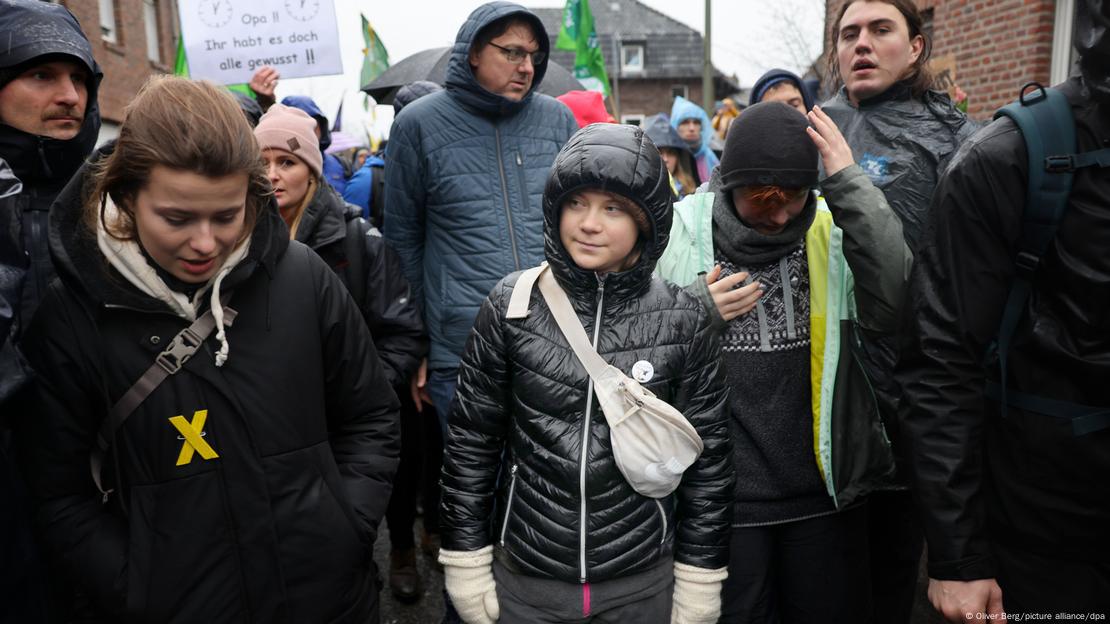
Greta Thunberg urged Germans to support environmental activists in opposing the clearing of the village
 Oliver Berg/picture alliance/dpa

Thunberg blasts German green party

Swedish climate activist Greta Thunberg arrived in Germany on Friday and joined activists on the site. She criticized the German Green Party for its support of Lützerath's demolition.

The Green Party is part of the German federal governing coalition, along with the Social Democrats and the Free Democrats, but it is also in a coalition on the state level in North-Rhine Westphalia, the state where Lützerath is located.

Greens member and German Economy Minister Robert Habeck defended the village's demolition, arguing that the coal underneath is needed to maintain energy security in the current crisis brought on by the Russian war in Ukraine.

Making deals with fossil fuel corporations like RWE "show where their priorities are," Thunberg told dpa in an interview.

"The coal that is in the ground here will not lower prices immediately. Anyone who thinks like that is simply out of touch with reality," Thunberg said in response.

jcg,sdi/sms (AFP, dpa, AP)

Greta Thunberg joins German 

anti-coal protesters

STORY: Climate activist Greta Thunberg and an estimated 6,000 people marched through mud and rain on Saturday to protest against the expansion of an opencast lignite mine near Luetzerath in Germany.

"The carbon is still in the ground. We are still here. Luetzerath is still there. And as long as the carbon is in the ground, this struggle is not over."

Earlier this week, police cleared protesters from buildings in the North Rhine-Westphalia state village after a court decision allowed energy giant RWE to go ahead with the expansion.

Demonstrators had been occupying them for about two years.

RWE and the government had struck a deal to raze the village in exchange for the company’s faster exit from coal as well as saving other villages originally slated for destruction.

"The fact that all of you are here is a sign of hope. This is only a part of a much larger global climate movement, a movement for climate and social justice and racial justice. Luetzerath...What happens in Luetzerath doesn't stay in Luetzerath. Germany as one of the biggest polluters in the world has an enormous responsibility."

On Saturday, only a few people remained camping out in treehouses and an underground tunnel, but thousands turned up to protest against the mine, which activists say symbolizes Berlin's failing climate policy.

Regional police said on Twitter they had used force to stop people from breaking through barriers and nearing the danger zone at the edge of the excavation area.

"You are showing clearly today that the changes will not come from the people in power, from governments, from corporations, from the so-called leaders. No, the real leaders are here. It is the people who are sitting in tree houses and those who have been defending Luetzerath for example for years now."

The state president said on German radio that energy politics were "not always pretty" but that the coal was needed more than ever in light of the energy crisis confronting Europe's biggest economy.

Greta Thunberg decries eviction of German coal camp


01/13/2023January 13, 2023

The climate activist gave her backing to protesters ousted from a nearby huge coal mine that is due for expansion. Germany's reliance on fossil fuels remains a divisive issue amid the energy crisis.

Swedish climate activist Greta Thunberg on Friday denounced the court-approved, police clearance of an anti-coal protest camp in western Germany as "outrageous."

Officers moved in this week to evict hundreds of demonstrators from the abandoned village of Lützerath, which sits next door to a vast lignite mine due for expansion.

The camp has taken center stage in a longstanding row between climate activists and the government over the country's heavy reliance on coal for electricity.

What did Thunberg say?


During a visit to Lützerath, in the western state of North-Rhine Westphalia, the 20-year-old Thunberg said it was "horrible to see what's happening here."

"We expect to show what people power looks like, what democracy looks like. When governments and corporations are acting like this, destroying the environment, putting countless people at risk, the people step up," she added.

The climate activist also referred to "outrageous ... police violence" occurring at the site.

Thunberg met with protesters and also toured the mine's crater, holding up a sign that read, "Keep it in the ground."


Thunberg is expected to join a protest on Saturday in Lützerath's neighboring town of Keyenberg, alongside German climate activist Luisa Neubauer.


Police said they expect 6,000 to 7,000 participants.

On Friday, a court said the planned protest could proceed, but without the use of 10 tractors that the activists had organized.

What happened during the eviction?


After a court order, police began clearing village buildings of protesters on Wednesday and Thursday.

More than 1,000 officers moved in with bulldozers and ordered many activists, perched on roofs and walls, to come down.

Some activists threw stones, bottles and firecrackers, though the demonstrations were largely peaceful.

By Friday evening, police said they had cleared occupying protesters from the last building in the village, which is now the property of energy giant and Garzweiler coal mine operator RWE.

Some protesters have complained of undue force by police, as officers were brought in from across the country and water cannons were placed on standby. Similarly, police and politicians had complained of isolated incidents of violence against law enforcement at the site, particularly last Sunday.
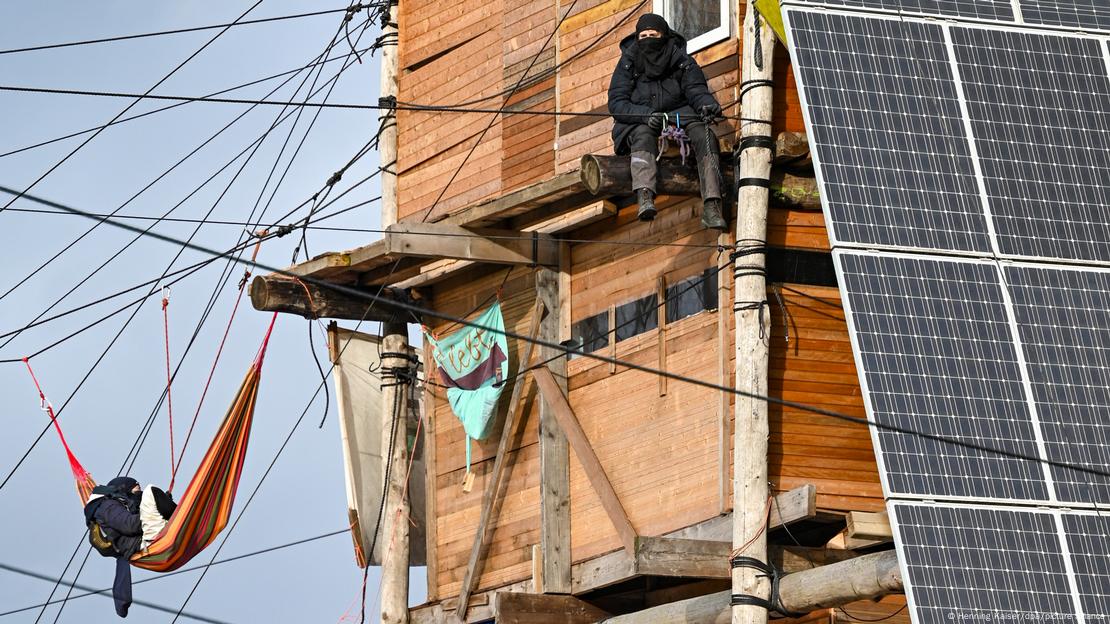
DPA news agency reported that several climate activists have yet to be evicted
Image: Henning Kaiser/dpa/picture alliance

By Friday, two climate activists were holding out in a tunnel about 4 meters (13 feet) under the village and would chain themselves up if any attempt was made to evict them, the spokesperson for Lützerath Lebt (Lützerath Lives) activist group said.

Regional police chief Dirk Weinspach said he would bring in specialized teams to remove them.

Several tree houses still needed to be cleared, officials said.

Also on Friday, activists protested in front of the RWE headquarters in the western city of Essen, with some chaining themselves to the entry gate.

A symbol of Germany's coal dilemma  01:14


What are the plans for Lützerath?

The government last year agreed on a compromise to bring forward a planned coal power phase-out in the nearby mine by eight years, to 2030.

As part of the deal, RWE is allowed to expand its vast Garzweiler II open-cast mine into Lützerath, which will give it access to about 280 million tons of coal.

The need to retain coal mining for electricity production has become a priority during the energy crisis.

As Germany has cut its reliance on Russian gas due to the Ukraine war, it has temporarily extended the life of some coal and nuclear power plants to steer itself through the crisis.

Germany still generates about 30% of its electricity from coal under normal circumstances and in the third quarter of 2022 (the most recent available figures), when gas prices were at their highest and as Germany was also trying to compensate for the nuclear plants it had shut down at the end of 2021, that figure rose to 36.3%.

But environmentalists say the move will increase Germany's greenhouse gas emissions.

The dilemma is not lost on most Germans, 59% of whom are against the expansion of lignite mining areas, while 60% also think the temporary use of coal-fired power plants is the right thing to do.

mm/msh (AFP, AP, dpa, Reuters)


Suspected Russian accounts 'attack' Banksy Ukraine sale


Banksy confirmed he was behind seven murals that appeared on destroyed buildings around Kyiv last year © Genya SAVILOV / AFP

Issued on: 10/01/2023 -

London (AFP) – Thousands of "hostile" web attacks launched from Russian IP addresses have targeted an online auction of prints by British graffiti artist Banksy in aid of Ukraine, the charity Legacy of War Foundation said Tuesday.

The elusive street artist is selling 50 new limited edition screen-prints through the charity to raise funds to support Ukrainian civilians affected by conflict.

To get one of the £5,000 ($6,080) prints, which show a mouse sliding down the side of a box with "FRAGILE" printed on it, supporters have to register online with the charity.

But a message posted on its website said it had "received over 1 million requests (and 3,500 hostile attacks from Russian IP addresses), so we would appreciate your patience at this time".

"We are currently sifting through the registered entries and will notify successful applicants shortly," it added.

Banksy previously said he supported the charity as he had seen one of its teams "sweep in and provide medical attention, heaters, fresh water and a friendly face to some very desperate people in a bombed-out building".

The artist confirmed he was behind seven murals that appeared on destroyed buildings around Kyiv last year.

IMPERIALI$M
UK planned over 40 coup bids, including bid to overthrow Abdel Nasser

By Al Mayadeen English
Source: Declassified UK
14 Jan 20:44

These 'third-world' nationalist forces were identified by the UK as an extension of the 'Soviet threat', as well as an occurrence of Cold War dynamics that needed to be reverted.
In this June 18, 1956 file photo, Egyptian leader Gamal Abdel Nasser waves as he moves through Port Said, Egypt, during a ceremony in which Egypt formally took over control of the Suez Canal from Britain (AP Photo, File)

A recent report published by Declassified UK details a somewhat exhaustive timeline of the UK's involvement in plotting coups across the world, both overt and covert, and in most cases conducted with the collaboration of the CIA to depose or assassinate democratically elected leaders.

The report counts a total of 47 coups put into action in 27 different countries since 1945, but the numbers could her higher.

The point in doing so is obvious: as a former colonial empire, the UK is structurally and historically pre-disposed to impede all signs of democratic and socioeconomic developments across the Global South.

After WWII, the Soviet Union supported the massive wave of anti-colonial wars to gain national independance.

These 'third-world' nationalist forces were identified by the UK as an extension of the Soviet threat, as well as an occurrence of Cold War dynamics that needed to be reverted.

Some of the most prominent coups orchestrated against leaders include the overthrow of democratically elected Prime Minister Mohammad Mosaddegh in Iran in 1953.

They also include the assassination of the former Prime Minister of the Democratic Republic of the Congo Patrice Lumumba who was killed in the most tragic way one could possibly think of.

But the UK did not always succeed in effecting a regime change, as it did in Iran, Egypt, Indonesia, and so many African countries.

For instance, in the 1950s, the British regime tried to draw two consecutive uprisings against the government in Syria - the first in 1956 and the second in 1957 - which were both unsuccessful.

Read more: Kanaani: West failed to effect regime change in Iran

Another covert operation that foiled was one conducted in 1957 against Indonesia's Sukarno, the leader of the Indonesian struggle for independence from the Dutch colonialists who propelled Indonesia out of morbid poverty.

Sukarno was ousted a decade later in what appeared to "one of the 20th century’s worst bloodbaths" with the purge of communists and socialists by the Indonesian military under Suharto - an event which was later revealed to have been backed by the UK in 1965-1966.

Other countries which have been targeted during the 1950s and 1960s include Brazil, British Guiana, Egypt, and several countries in the Gulf region.

One leader took about four decades for the UK to take down, namely Muammar Gaddafi, who nationalized British oil operators as soon as he seized power in 1969.

After several failed attempts to kill the strongman leader, the UK finally managed to rid of him in 2011 with the assistance of NATO.

Other leaders that were targeted for assassination include Yugoslav leader Slobodan Milosevic in 1992, Ugandan President Milton Obote in 1969, and his successor Idi Amin in the late 1970s.

The list also includes countries of the former Soviet Union, namely Estonia, Latvia and Lithuania.

It further includes Italy because the Communist Party "looked as if it might win or influence the next government," the report states.

The most recent coup attempts include failed attempts to depose Syrian President Bashar el-Assad during the Arab Spring, as well as several attempts to depose leaders in Latin American countries, namely lithium-rich Bolivia and oil-rich Venezuela.

Venezuela recently joined the ranks of failed coups after Juan Guaido was ousted and his government dissolved.

The report is relevant to the modern context because the West has recently tried to push for regime change in Iran and Peru.

In the case of Peru, former President Pedro Castillo had charges fabricated against him to justify his impeachment and imprisonment.

All-in-all, the UK's habitus of conducting coups across the Global South is always motivated by strategic interests. These include a wide range of interests but almost always concern the privatization of oil resources.

In the case where no oil is involved, the UK intervenes to simply ward off the presence of progressive ideologies that strengthen the people against the will of the West.
Israel: Tens of thousands protest government in Tel Aviv

Around 80,000 protesters take to the streets despite wet and rainy conditions to protest Prime Minister Benjamin Netanyahu's ultra-right government


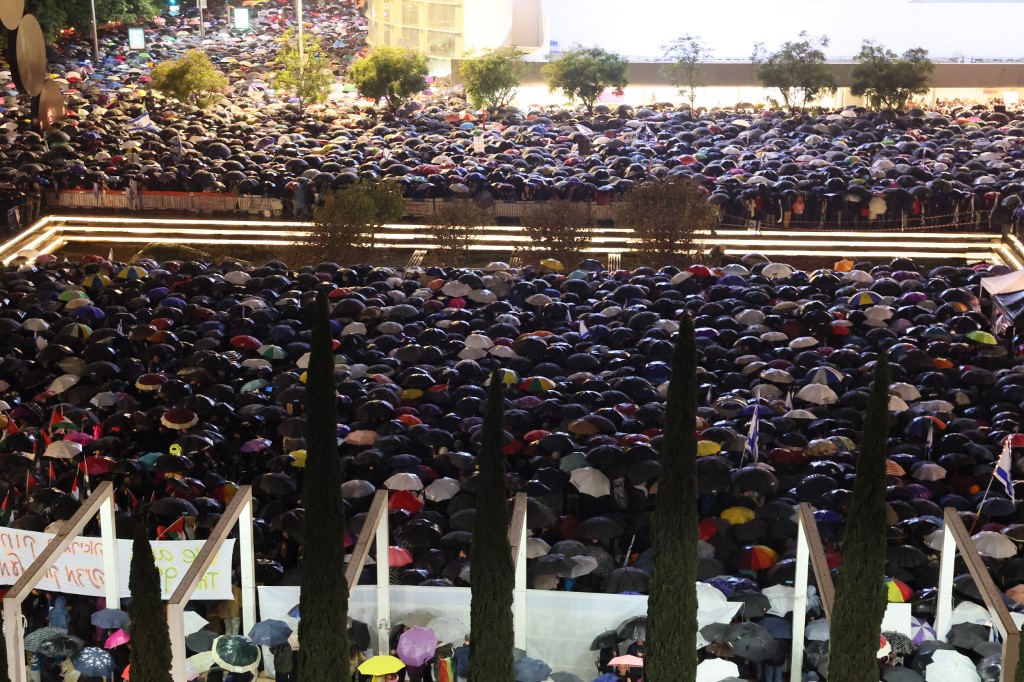
Israeli protesters attend a rally against Prime Minister Benjamin Netanyahu's new hard-right government in the coastal city of Tel Aviv on 14 January (Reuters)

By MEE staff
Published date: 14 January 2023 

Tens of thousands of Israelis took to the streets in central Tel Aviv on Saturday to protest Prime Minister Benjamin Netanyahu's new far-right coalition government.

Police in Tel Aviv said around 80,000 protesters had gathered at and around Habima square. Protests were also taking place in Jerusalem, Haifa and other cities, as centre and left-wing parties, including the Hadash-Taal alliance - a joint list of two Arab-majority political parties - called on Israelis to reject new government policies.

Israel's judicial reforms will 'destroy' legal independence say top officialsRead More »

The demonstrations were organised under the call of "saving democracy", in criticism of some hardline stances the ultra-conservative government has adopted, including planned reforms to the country's justice system.

A main concern of opposition groups is a recently-proposed reform that would allow parliament to override decisions made by the Supreme Court. Analysts have warned that such a programme could potentially allow lawmakers to uphold any annulment of the corruption charges Netanyahu is being tried on.

An open letter published on Thursday by 11 former prosecutors said the reforms threaten to destroy Israel's judiciary.

Retired Supreme Court President Ayala Procaccia addressed those on the streets of Tel Aviv on Saturday, warning that "a country in which judges go out to protest is a country where all lines were crossed", Haaretz reported.

'Fascists in the Knesset'


Itai Niger, a 37-year-old from Tel Aviv, told Middle East Eye that he had attended the protest because he hoped to help send a message against "the regime and fascism".

'This government is really dangerous and has the potential to change things 
for the worse' - Itai Niger, 37, protester

"I can’t stay at home and do nothing anymore," Niger said. "I decided to take part against what is happening now because this government is really dangerous and has the potential to change things for the worse in terms of rights.

In Israel, there is already a big problem of inequality, and there will be more abuse of power and corruption now. If there is a way to stand against that, then I will be there."

"I really, really hope that this marks some kind of awakening in this country," he continued.

In addition to court reforms, opposition protesters rallied against the new government's intentions to pursue a policy of settlement expansion in the occupied West Bank and social reforms that have worried members and supporters of the LGBTQ+ community.

Signs written in Hebrew and Arabic held up by the demonstrators gathered in Habima Square on Saturday reflected the diversity of demands: "The time has come to bring down the dictator"; "government of shame"; "There is no democracy with the occupation "; "Bibi does not want democracy, we do not need fascists in the Knesset"; "Iran is here"; and "You will love the other as yourself".

Rain started early Saturday evening, raising worries that the weather could affect attendance, but opposition leaders called on protesters to come out despite the wet conditions.

"Everyone should take an Israel flag in one hand, an umbrella in the second and come to defend democracy and the law in Israel," former Defence Minister Benny Gantz said on Twitter on Saturday ahead of his arrival at Habima square.

Many did just that, as images show blocks of demonstrators carrying overlapping umbrellas, creating a cover that obscured the people huddled beneath them.

Protesters huddle under umbrellas at rally against Prime Minister Benjamin Netanyahu's new hard-right government in Tel Aviv on 14 January (AFP)

Netanyahu is the first sitting Israeli prime minister indicted while in office. He denies the charges against him of bribery, fraud and breach of trust. He took office late last month following his 1 November election win, heading a coalition that includes a politician who last year admitted tax evasion and a clutch of far-right personalities, including one who once kept a portrait in his home of a man who massacred scores of Palestinian worshippers.

Last week, the new national security minister, Itamar Ben-Gvir, ordered the state's police commissioner to enforce a directive to remove Palestinian flags from public spaces a day after one was waved at a previous anti-government protest in Tel Aviv.

Despite the order, several Palestinian flags were spotted during Saturday's demonstration in the coastal city.

Middle East Eye delivers independent and unrivalled coverage and analysis of the Middle East, North Africa and beyond. To learn more about republishing this content and the associated fees, please fill out this form. More about MEE can be found here.

Thousands of Israelis rally against Netanyahu government


1 of 5
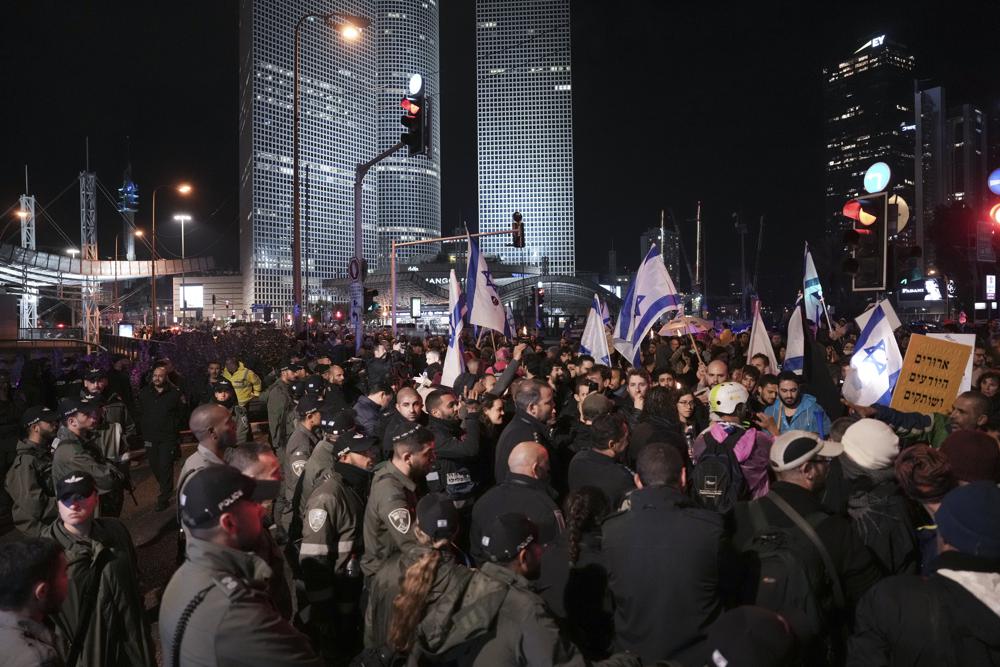
Israeli border police officers prevent protesters from blocking a highway during a rally against the government's plans to overhaul the country's legal system, in Tel Aviv, Israel, Saturday, Jan. 14, 2023. Tens of thousands of Israelis have gathered in central Tel Aviv to protest plans by Prime Minister Benjamin Netanyahu's new government to overhaul the country's legal system and weaken the Supreme Court. (AP Photo/Oded Balilty)

TEL AVIV, Israel (AP) — Tens of thousands of Israelis gathered in central Tel Aviv on Saturday night to protest plans by Prime Minister Benjamin Netanyahu’s new government to overhaul the legal system and weaken the Supreme Court — a step that critics say will destroy the country’s democratic system of checks and balances.

The protest presented an early challenge to Netanyahu and his ultranationalist national security minister, Itamar Ben-Gvir, who has ordered police to take tough action if protesters block roads or display Palestinian flags.

Israeli media, citing police, said the crowd at Tel Aviv’s Habima Square swelled to at least 80,000 people, despite cool, rainy weather. Protesters, many covered by umbrellas, held Israeli flags and signs saying “Criminal Government,” “The End of Democracy” and other slogans.

“They are trying to destroy the checks and balances of the Israeli democracy. This will not work,” said Asaf Steinberg, a protester from the Tel Aviv suburb of Herzliya. “And we will fight until the very last minute to save the Israeli democracy.”

No major unrest was reported, though Israeli media said small crowds scuffled with police as they tried to block a Tel Aviv highway.

Netanyahu, who is on trial for corruption charges, has made overhauling the country’s legal system a centerpiece of his agenda.

In office for just over two weeks, his government, which is comprised by ultra-Orthodox and far-right nationalist parties, has launched proposals to weaken the Supreme Court by giving parliament the power to overturn court decisions with a simple majority vote. It also wants to give parliament control over the appointment of judges and reduce the independence of legal advisers.

Netanyahu’s justice minister says unelected judges have too much power. But opponents to the plans say the proposed changes will rob the judiciary of its independence and undermine Israeli democracy. Israeli opposition leaders, former attorney generals and the president of Israel’s Supreme Court have all spoken out against the plan.

The legal changes could help Netanyahu, who is on trial for corruption, evade conviction, or even make his trial disappear entirely. Since being indicted in 2019, Netanyahu has said the justice system is biased against him.

Police beefed up their presence ahead of the march. Israeli media quoted police as saying officers had been instructed to be “very sensitive” and allow the protest to proceed peacefully. But they also vowed a tough response to any vandalism or violent behavior.

Smaller protests also took place in the cities of Jerusalem and Haifa.

Israelis rally against Netanyahu 'government of shame'

Issued on: 14/01/2023 


The demonstration is the biggest since Netanyahu's new government took power in late December © JACK GUEZ / AFP

Tel Aviv (AFP) – Tens of thousands of people protested in central Tel Aviv Saturday against Prime Minister Benjamin Netanyahu's new hard-right government, which critics say threatens Israeli democracy.

Protesters braved the rain for the rally, brandishing signs with slogans decrying a "government of shame" and urging: "bring down the dictator", AFP correspondents said.

Israeli media reported 80,000 people joined the rally, citing police sources. Police gave no official estimate after reporting 20,000 protesters earlier in the evening.

The demonstration is the biggest since Netanyahu's new government took power in late December in Israel, a country of just over nine million.

"The situation is worrying and scary," said 22-year-old protester Aya Tal, who works in the high-tech industry.

"They want to take away our rights... We must unite."

Other rallies were held in Jerusalem, outside the prime minister's and the president's residences, and in the northern city of Haifa, local media reported.

Already Israel's longest-serving premier, Netanyahu returned to power at the head of a coalition with extreme-right and ultra-Orthodox Jewish parties, some of whose officials now head key ministries.


Opposition parties had called on Israelis to join the demonstration to 'save democracy' © JACK GUEZ / AFP

Protesters called for Netanyahu, who is fighting corruption charges in court, to resign.

"Bibi (Netanyahu) doesn't want a democracy, we don't need fascists in the Knesset," read one sign at the Tel Aviv protest, referring to the Israeli parliament.
'Save democr
acy'

The crowd filled the streets surrounding Tel Aviv's Habima Square and chanted "democracy, democracy", according to an AFP correspondent.

Opposition parties had called on Israelis to join the demonstration -- organised by an anti-corruption group -- to "save democracy" and in protest at a planned judicial overhaul.


Netanyahu's return to power ended an unprecedented period of political gridlock that forced five elections in less than four years and deepened social divisions 
© JACK GUEZ / AFP

Justice Minister Yariv Levin announced on January 4 a controversial plan to hand more powers to lawmakers in appointing judges and overriding Supreme Court decisions.

In Israel, which does not have a constitution, the Supreme Court currently has the authority to repeal laws it considers discriminatory.

Former Supreme Court judge Ayala Procaccia told the crowd the Israeli public "will not accept... the destruction of the basic values of our system."

"We are at a fateful moment for the future of Israel," she said.

The new government has also announced intentions to pursue a policy of settlement expansion in the occupied West Bank and carry out social reforms that have worried members and supporters of the LGBTQ community.

The rally included messages against the Israeli occupation of the Palestinian territories and calls to protect the rights of the LGBTQ community.

"There's no democracy with the occupation," read one sign.

'Fight'

Netanyahu is the first sitting Israeli prime minister indicted while in office. He denies the charges against him of bribery, fraud and breach of trust.

The leader of right-wing party Likud was ousted from office in 2021 after a record 12-year run by a motley coalition of parties, elected on the heels of anti-corruption protests that called for Netanyahu's resignation.

His return to power ended an unprecedented period of political gridlock that forced five elections in less than four years and deepened social divisions.


Netanyahu is the first sitting Israeli prime minister indicted while in office 
© JACK GUEZ / AFP

The leader of centre-left opposition party Labor, Merav Michaeli, was among several politicians at the Tel Aviv rally, as was former foreign minister Tzipi Livni.

Former defence minister Benny Gantz, now in the opposition, shared on Twitter a video of himself at the demonstration.

"We'll fight in the Knesset, we'll fight in the media, we'll fight on the streets", Gantz told protesters.

"We will make sure the democratic foundation of Israel is being preserved," he said. "We fight for the country's future together."

© 2023 AFP

Israelis rally against Netanyahu cabinet
By Al Mayadeen English
Source: Agencies
14 Jan 23

Thousands of Israeli settlers take to the street to denounce the newest Israeli occupation government and call for the ousting of PM Netanyahu.


Israelis protest against Prime Minister Benjamin Netanyahu's coalition and its proposed judicial reforms to reduce powers of the Supreme Court in a main square in "Tel Aviv", occupied Palestine, January 14, 2023 (REUTERS)

Some 20,000 Israelis took to the streets of "Tel Aviv" on Saturday to protest Prime Minister Benjamin Netanyahu's cabinet, which has been criticized various times as being the most far-right government in Israeli history.

Protestors carried signs with slogans condemning the government and calling it a "government of shame", calling for "bring[ing] down the dictator", AFP reported.

The Israeli occupation forces estimated that some 20,000 protesters were on the street, with the organizers claiming there were "several tens of thousands" of protesters.

The demonstration is the biggest since the premier took office, with other rallies taking place in front of his residence in occupied Al-Quds and others in Haifa.

This is Netanyahu's sixth term after he was ousted from power in June last year, ending his 12-year run as prime minister, making him the longest-running premier since the start of the Israeli occupation of Palestine.

With Netanyahu coming back in, his third reign of terror will begin after having served as PM from 1996 to 1999 and from 2009 to 2021. This is his most controversial government to date, expected to lead to a Third Palestinian Intifada.


The demonstrators repeated chants against the new Israeli occupation government and some of its extremist ministers such as Police Minister Itamar Ben-Gvir and Finance Minister Betzalel Smotrich.

Following his November 1 election win, Netanyahu took office late last month at the head of a coalition with extreme-right and Zionist parties, some of whose officials now head key ministries. The new occupation government has announced intentions to pursue a policy of settlement expansion in the occupied West Bank.


Moreover, the protesters called on the corruption-embattled PM to resign from office just a month after he assumed.

"Bibi (Netanyahu) doesn't want a democracy, we don't need fascists in the Knesset," one sign read at a protest in "Tel Aviv".

Meanwhile, opposition parties called on Israelis to join the demonstrations to "save democracy" and protest Netanyahu's planned overhaul of the judiciary authority.

This comes after Israeli occupation Justice Minister Yariv Levin announced earlier in the month a controversial plan to hand more powers to lawmakers in appointing judges and overriding Supreme Court decisions.

Illustrating the increasingly stark division between Israelis, the president of Israeli occupation’s Supreme Court Esther Hayut lashed out on Thursday at the "judicial reform plan" proposed by Netanyahu's cabinet, stressing that it "would crush the justice system."

Hayet begins her speech at a conference of the Israeli Association of Public Law, likely the harshest speech ever delivered by a serving Supreme Court president against a ruling coalition, by noting that "a few days ago, the new justice minister presented a lightning plan for far-reaching changes in the justice system."

"In practice," she charges, "it amounts to an unrestrained attack on the justice system, as though it was an enemy that had to be rushed and defeated."

"With great cynicism, the architects of the plan call it a plan to correct the judicial system.’ And I say, it is a plan to crush the judicial system. It is intended to deliver a fatal blow to the independence and autonomy of the judicial system and silence it" she added.

The rally also included pro-Palestinian slogans, with one sign reading: "There's no democracy with the occupation."

Check out: New Netanyahu Government: Different shades of occupation

Political divisions in "Israel" between the government and the opposition are escalating in light of the exchange of accusations of responsibility for the possible outbreak of an "internal war".

This comes shortly after leaders within the Israeli occupation spoke about the ongoing division in "Israel" exposed by the results of the latest legislative elections.

Israeli occupation President Isaac Herzog said during a speech on the 27th anniversary of the killing of former Israeli occupation Prime Minister Yitzhak Rabin that "the complicated political status quo in Israel poses somewhat of a historic challenge for us."

Meanwhile, former Israeli occupation Security Minister Benny Gantz called on Sunday Israelis to take to the streets in protest of changes to the Israeli judicial system that Netanyahu's cabinet proposed.


My Flag My Identity


The new Israeli government is escalating its terror against Palestinians, the latest of which is the new Police Minister Ben-Gvir banning the raising of the Palestinian flag in public places, claiming that waving the Palestinian flag is an "act of terror". In addition, Ben-Gvir is in charge of the Israeli prison system, and he has plans to make things even worse for Palestinian prisoners, who already endure physical and psychological torture.
Gambian pro-democracy activist killed in 2016 honoured at last

Thousands of people turned out in the Gambian capital on Tuesday for the official funeral of a pro-democracy activist who died in custody in 2016 following a protest against former dictator Yahya Jammeh.


Pallbearers carry the coffin of Solo Sandeng during his funeral in Banjul on January 10, 2023
© MUHAMADOU BITTAYE/AFP or licensors


Story by Africanews • Tuesday


VIDEO
Gambian pro-democracy activist killed in 2016 honoured at last
View on Watch  Duration 2:01


Mourners lined the streets of Banjul as police passed by carrying the flag-draped coffin of Solo Sandeng, in a ceremony that revived memories of Jammeh's brutal rule.

The dictator held sway over the tiny West African state for 22 years until he was defeated in presidential elections in December 2016 by political newcomer Adama Barrow and fled to Equatorial Guinea.

Sandeng died in custody in April 2016 at the age of 57 after organising a protest calling for the return of democracy.

His death was a catalyst for uniting the country's fractured opposition and driving a wave of pro-democracy protests which ultimately led to Jammeh's fall.

Justice Minister Dawda Jallow paid tribute to Sandeng, describing him as "a man who paid the ultimate price in fighting for the cause he genuinely believed in.

"He has left an indelible mark in the political history of this country.

"His legacy will continue to live on in the history of our democratic transition as a nation."

The coffin was placed before a huge Greek-style arch in Banjul that Jammeh built in the 1990s and which has been re-dedicated to the memory of his victims. Sandeng was later entombed at a site in the suburbs of the capital.

His body was exhumed in March 2017. Six members of Jammeh's National Intelligence Agency (NIA) were convicted of his murder in July 2022, with the agency's former director being sentenced to death.

The Gambian authorities have charged Jammeh with murder, rape, torture and corruption.

However, he retains substantial clout back home.

Barrow's government, which won elections in 2016 and again in 2021, has yet to fully implement recommendations made by a truth and reconciliation commission in in 2021.
Egypt unveils ancient royal tomb in Luxor

Issued on: 14/01/2023 


Egyptian archaeologist Mohsen Kamel said the tomb's interior was 'in poor condition' 
© - / Egyptian Ministry of Antiquities/AFP


Cairo (AFP) – Egyptian authorities announced Saturday the discovery of an ancient tomb in Luxor dating back around 3,500 years that archaeologists believe holds the remains of an 18th dynasty royal.

The tomb was unearthed by Egyptian and British researchers on the west bank of the River Nile, where the famous Valley of the Queens and Valley of the Kings lie, said Mostafa Waziri, head of Egypt's Supreme Council of Antiquities.

"The first elements discovered so far inside the tomb seem to indicate that it dates back to the 18th dynasty" of pharaohs Akhenaton and Tutankhamun, Waziri said in a statement.

The 18th dynasty, part of the period of Egyptian history known as the New Kingdom, ended in 1292 BC and is considered among the most prosperous years of Ancient Egypt.

Piers Litherland of the University of Cambridge, head of the British research mission, said the tomb could be of a royal wife or princess of Thutmosid lineage

Egyptian archaeologist Mohsen Kamel said the tomb's interior was "in poor condition".

Parts of it including inscriptions were "destroyed in ancient floods which filled the burial chambers with sand and limestone sediment", Kamel added, according to the antiquities board's statement.

Egypt has unveiled several major archaeological discoveries in recent years, most notably in the Saqqara necropolis south of the capital Cairo.

Critics say the flurry of excavations has prioritised finds shown to grab media attention over hard academic research.

But the discoveries have been a key component of Egypt's attempts to revive its vital tourism industry, the crowning jewel of which is the long-delayed inauguration of the Grand Egyptian Museum at the foot of the pyramids.

The country of 104 million inhabitants suffers a severe economic crisis.

Egypt's tourism industry accounts for 10 percent of GDP and some two million jobs, according to official figures, but has been hammered by political unrest and the Covid pandemic.

© 2023 AFP

Plate tectonics in the twenty-first century

Peer-Reviewed Publication

SCIENCE CHINA PRESS

Schematic cartoons showing the two types of plate divergent-convergent coupling on Earth 

IMAGE: A. THE LITHOSPHERIC BREAKUP-COLLISION COUPLING SYSTEM, IN WHICH COLLISIONAL THICKENING OF THE CONTINENTAL CRUST IS COUPLED WITH LITHOSPHERIC BREAKUP DUE TO ASTHENOSPHERIC UPWELLING FOR ACTIVE RIFTING. B. THE SEAFLOOR SPREADING-LITHOSPHERIC SUBDUCTION COUPLING SYSTEM, IN WHICH THE OCEANIC SLAB IS SUBDUCTED TO DEPTHS OF >80-100 KM FOR THE GRAVITATIONAL PULL, PROVIDING FAR-FIELD STRESSES FOR PASSIVE RIFTING. view more 

CREDIT: ©SCIENCE CHINA PRESS

The emergence of plate tectonics in the late 1960s led to a paradigm shift from fixism to mobilism of global tectonics, providing a unifying context for the previously disparate disciplines of Earth science. Although plate tectonics was originally defined by the kinematics of the Earth’s outer shell (lithosphere) on the underlying asthenosphere, a number of dynamic interpretations for its operation have developed in the past five decades. This has advanced it as a holistic theory of kinematics-dynamics for the motion of large and small plates in both horizontal and vertical directions. Because modern plate boundaries occur as a global network of mobile belts on the spherical Earth, the difficulty was encountered in deciphering the operation of ancient plate tectonics in geological history.

This synthetic study is presented by Prof. Yong-Fei Zheng at University of Science and Technology of China. It focuses on an advanced version of plate tectonics in its basic principles and geological corollaries along active and fossil plate margins. This is achieved by inspection of natural observations and their tectonic interpretations in the fields of geology, geochemistry, geophysics and geodynamics. The available advances are significant and fundamental to our understanding of various phenomena at present and past plate margins, placing general grounds to figure out the spatiotemporal relationships between material movement, energy transfer, dynamic regime and geothermal gradient along plate margins. Therefore, they provide new insights not only into many first-order problems regarding tectonic occurrences in continental regions but also into the origin of hotspot magmatism in relation to the mantle plume hypothesis.

According to the geometric structure, dynamic regime and thermal state of plate margins, Zheng highlights the importance of plate divergent-convergent coupling systems in the operation of plate tectonics on Earth. These coupling systems are categorized into two types. One is the lithospheric breakup-collision due to active rifting, with the push effect of lithospheric breakup on collisional thickening and shallow subduction to smaller depths of <60-80 km. The other is the seafloor spreading-lithospheric subduction due to passive rifting, with the pull effect of subducting oceanic slab on deep subduction to greater depths of >80-100 km. Because plates may be of different sizes since their generation, they may move in different directions to exchange matter and energy not only between lithosphere and asthenosphere but also between the crust and the mantle.

As generalized by Zheng, matter and energy transfers at plate margins proceeds in bottom-up and top-down ways, respectively. They correspond to changes of not only their dynamic regime from extension to compression and from compression to extension but also their thermal state from hot to warm and from cold to warm. In rifting zone, heat is preferentially transferred from the asthenosphere into the crust, resulting in heat loss from the Earth's interior to exterior. In subduction zones, the cold lithosphere sinks into the hotter asthenosphere, leading to cooling of the Earth's interior. Therefore, both rifting and subduction zones are two basic sites for the matter and energy exchanges between the Earth’s spheres. As such, recognition of their geodynamic mechanisms and tectonic effects on the formation and evolution of plate margins is the key to advance plate tectonics.

Although modern plate tectonics is characterized by a global network of mobile belts on the present Earth, its operation on the ancient Earth history can be tested by inspection of plate divergent-convergent coupling systems. This is outlined by Zheng through characterizing two of the fundamental components in plate tectonics. One is the initiation of rifting zones, eventually forming new ocean basins, and the other is the initiation of subduction zones, recycling the crust into the mantle. Subduction initiation and lithospheric rifting are the two key processes for the onset of plate tectonics. Their operation has great bearing on the structure, processes and geodynamics of plate margins. These elements are not only substantial to upgrade plate tectonics into the new version, but also fundamental to explain the onset and operation of plate tectonics in Precambrian time. In this regard, it is critical to not only keep pace with the times but also uphold fundamental principles and break new ground in advancing plate tectonics.

See the article:

Zheng Y.F., 2023. Plate tectonics in the twenty-first century. Science China Earth Sciences, 66(1): 1-40.

https://doi.org/10.1007/s11430-022-1011-9