Sunday, January 15, 2023

Toughest material on earth now a reality
Staff Writer | January 13, 2023 | 
(Reference image from Raw Pixel.)

A group of scientists has measured the highest toughness ever recorded, of any material, while investigating a metallic alloy made of chromium, cobalt, and nickel (CrCoNi).


In a paper published in the journal Science, the researchers explain that not only is the metal extremely ductile and impressively strong, but its strength and ductility also improve as it gets colder. This runs counter to most other materials in existence.

CrCoNi is a subset of a class of metals called high entropy alloys (HEAs).
All the alloys in use today contain a high proportion of one element with lower amounts of additional elements added, but HEAs are made of an equal mix of each constituent element. These balanced atomic recipes appear to bestow some of these materials with an extraordinarily high combination of strength and ductility when stressed, which together make up what is termed “toughness.”

HEAs have been a hot area of research since they were first developed about 20 years ago, but the technology required to push the materials to their limits in extreme tests was not available until recently.

“The toughness of this material near liquid helium temperatures (20 kelvin, -424 Fahrenheit) is as high as 500 megapascals square root meters. In the same units, the toughness of a piece of silicon is one, the aluminum airframe in passenger airplanes is about 35, and the toughness of some of the best steels is around 100. So, 500, it’s a staggering number,” research co-lead Robert Ritchie, a senior faculty scientist at Berkeley Lab, said in a media statement.

Microscopy-generated images showing the path of a fracture and accompanying crystal structure deformation in the CrCoNi alloy at nanometer scale during stress testing at -424 F. 
(Image by Robert Ritchie/Berkeley Lab).

Ritchie and his co-lead Easo George from ORNL began experimenting with CrCoNi and another alloy that also contains manganese and iron (CrMnFeCoNi) nearly a decade ago. They created samples of the alloys then lowered the materials to liquid nitrogen temperatures (around 77 kelvin, or -321 F) and discovered impressive strength and toughness.

Given those results, they immediately wanted to follow up their work with tests at liquid helium temperature ranges, but finding facilities that would enable stress testing samples in such a cold environment, and recruiting team members with the analytical tools and experience needed to analyze what happens in the material at an atomic level took the next 10 years.

The pair explained that many solid substances, including metals, exist in a crystalline form characterized by a repeating 3D atomic pattern, called a unit cell, that makes up a larger structure called a lattice. The material’s strength and toughness, or lack thereof, come from the physical properties of the lattice. No crystal is perfect, so the unit cells in a material will inevitably contain “defects,” a prominent example being dislocations – boundaries where undeformed lattice meets up with deformed lattice.

When force is applied to the material – think, for example, of bending a metal spoon – the shape change is accomplished by the movement of dislocations through the lattice. The easier it is for the dislocations to move, the softer the material is. But if the movement of the dislocations is blocked by obstacles in the form of lattice irregularities, then more force is required to move the atoms within the dislocation, and the material becomes stronger. On the flip side, obstacles usually make the material more brittle – prone to cracking.

Peeking inside CrCoNi

Using neutron diffraction, electron backscatter diffraction, and transmission electron microscopy, Ritchie, George, and their colleagues at Berkeley Lab, the University of Bristol, Rutherford Appleton Laboratory, and the University of New South Wales examined the lattice structures of CrCoNi samples that had been fractured at room temperature and 20 K.

The images and atomic maps generated from these techniques revealed that the alloy’s toughness is due to a trio of dislocation obstacles that come into effect in a particular order when force is applied to the material.

First, moving dislocations cause areas of the crystal to slide away from other areas that are on parallel planes. This movement displaces layers of unit cells so that their pattern no longer matches up in the direction perpendicular to the slipping movement, creating a type of obstacle.

Further force on the metal creates a phenomenon called nanotwinning, wherein areas of the lattice form a mirrored symmetry with a boundary in between. Finally, if forces continue to act on the metal, the energy being put into the system changes the arrangement of the unit cells themselves, with the CrCoNi atoms switching from a face-centred cubic crystal to another arrangement known as hexagonal close packing.

This sequence of atomic interactions ensures that the metal keeps flowing, but also keeps meeting new resistance from obstacles far past the point that most materials snap from the strain.

“So as you are pulling it, the first mechanism starts and then the second one starts, and then the third one starts, and then the fourth,” explained Ritchie. “Now, a lot of people will say, well, we’ve seen nanotwinning in regular materials, we’ve seen slip in regular materials. That’s true. There’s nothing new about that, but it’s the fact they all occur in this magical sequence that gives us these really tremendous properties.”

The team’s new findings, taken with other recent work on HEAs, may force the materials science community to reconsider long-held notions about how physical characteristics give rise to performance.

“It’s amusing because metallurgists say that the structure of a material defines its properties, but the structure of the NiCoCr is the simplest you can imagine – it’s just grains,” said Ritchie. “However, when you deform it, the structure becomes very complicated, and this shift helps explain its exceptional resistance to fracture,” co-author Andrew Minor said.

New products…but not just yet

George foresees the new material being used in situations where environmental extremes could destroy standard metallic alloys, such as in the frigid temperatures of deep space.

He and his team at the Oak Ridge National Laboratory are also investigating how alloys made of more abundant and less expensive elements could be coaxed into having similar properties.

Though the progress is exciting, Ritchie warns that real-world use could still be a ways off, for good reason.

“When you are flying on an airplane, would you like to know that what saves you from falling 40,000 feet is an airframe alloy that was only developed a few months ago? Or would you want the materials to be mature and well-understood? That’s why structural materials can take many years, even decades, to get into real use.”
LITHIUM
Biden backs Nevada lithium mine with $700 million loan offer

Bloomberg News | January 13, 2023 |

The Rhyolite Ridge lithium-boron project in Nevada
(Image courtesy of ioneer.)

A Nevada lithium mine that would be only the second in the US is getting backing from the Biden administration as it seeks to boost the domestic supply of the critical mineral needed to make electric vehicle batteries.


The Energy Department issued a conditional commitment for up to $700 million for Ioneer Ltd.’s Rhyolite Ridge Lithium-Boron Project, a prospective supplier to Ford Motor Co. and Toyota Motor Corp. that could produce enough lithium for 370,000 electric vehicles a year. Project partners include mining and metals processing group Sibanye Stillwater Ltd.

The funding, being made through the department’s Advanced Technology Vehicles Manufacturing Loan Program, comes as the Biden administration seeks to create a domestic battery supply chain amid a broader goal of half of vehicles sold in the US by the end of the decade be emissions-free.

Demand for lithium, which also is used for grid storage and weapons, is projected to exceed current production by 2030. The US relies on international markets for the processing of most raw materials, according to the department.

“Developing a US supply chain for these materials is a national priority as the country works toward energy independence,” the department said in a statement. “A core focus within the strategy is increasing the availability of the critical materials that are essential components of the clean energy technologies necessary for reaching national climate and economic goals.”

While Asia currently dominates the lithium carbonate refining process, the Rhyolite Ridge deposit is one of two known sizeable lithium-boron deposits in the world, the Energy Department said.

Ioneer expects to get US approvals that will allow the company to start building the project next year with the aim to start producing lithium in 2026, according to the company. It still needs to get final approval from the US Interior Department because public lands near the site are home to the endangered wildflower Tiehm’s buckwheat.

The Energy Department said the company has invested $1.2 million on research to preserve the plant and has revised its mining plan to avoid direct impacts on the plant.

(By Ari Natter)


Nevada lithium mine gets conditional $700M government loan

By SCOTT SONNER
yesterday

1 of 3
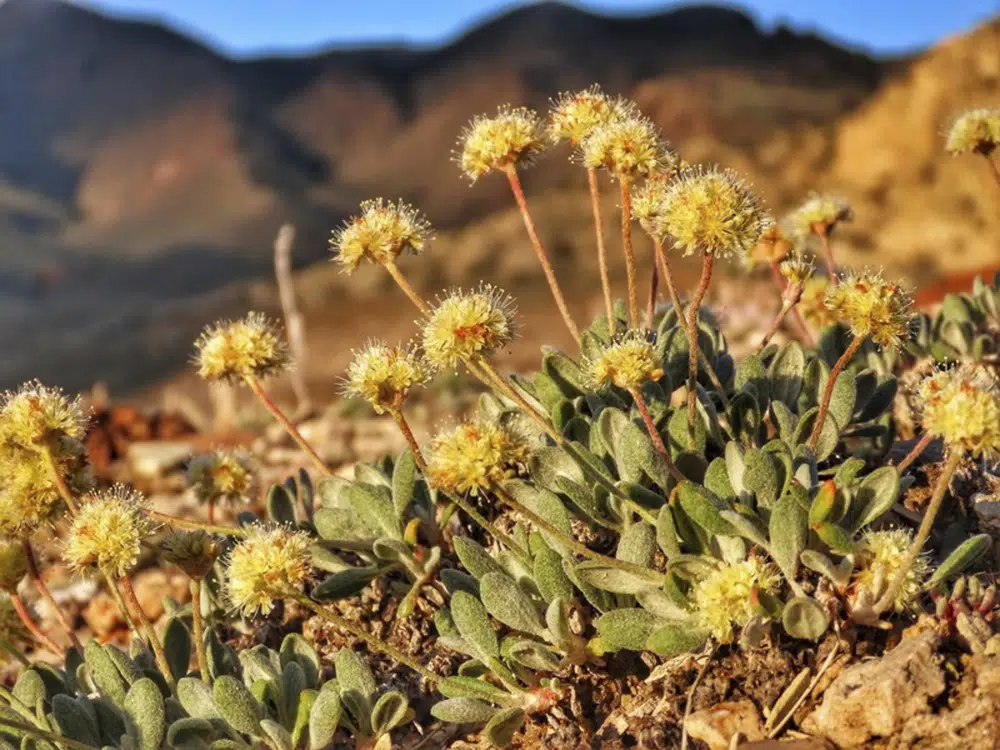
 In this photo provided by the Center for Biological Diversity, Tiehm's buckwheat grows in the high desert in the Silver Peak Range of western Nevada about halfway between Reno and Las Vegas, in June 2019, where a lithium mine is planned. The U.S. Department of Energy on Friday, Jan. 13, 2023, announced a conditional loan of $700 million to an Australian mining company to pursue a proposed lithium project in Nevada. But the project still faces a significant hurdle in developing a mining operations plan that will provide adequate protection for the endangered Nevada wildflower, Tiehm's buckwheat. (Patrick Donnelly/Center for Biological Diversity via AP, File)


RENO, Nev. (AP) — The U.S. Department of Energy announced a conditional loan of $700 million Friday to an Australian mining company to pursue a lithium project still facing environmental hurdles in Nevada as the U.S. seeks domestic supplies for a key component in electric vehicle batteries.

The move ups the ante in what’s already a high-stakes battle over President Joe Biden’s energy agenda and conservationists fighting to protect an endangered wildflower found only at the proposed mine site on a high desert ridge halfway between Reno and Las Vegas.

Ioneer Ltd. has hoped to begin mining at Rhyolite Ridge by 2026 in Esmerelda County. The Energy announcement said the site could produce enough lithium to support production of about 370,000 electric vehicles annually for decades.

The loan would be the latest project to demonstrate the Biden administration’s commitment to strengthen the nation’s battery supply chain, electrify the transportation sector and cut reliance on fossil fuels and foreign supplies of raw materials, the Department of Energy said.

Jigar Shah, director of DOE’s Loans Programs Office, said his office is “excited to further develop an environmentally responsible U.S. supply chain for critical materials.”

“Rhyolite Ridge is a major step towards bolstering domestic lithium production for clean energy technologies,” he said.

James Calaway, executive chairman of Ioneer, said the conditional commitment “highlights the project’s strategic role in strengthening the nation’s critical mineral supply chain in providing a secure, sustainable and reliable domestic source of lithium for the growing vehicle ecosystem.” Bernard Rowe, Ioneer’s managing director, said it came after 23 months “of discussion and due diligence” by Energy and “represents a significant milestone” for the project.

But the project still faces a significant legal and regulatory challenge in developing a mining operations plan that will provide adequate protection for the endangered Nevada wildflower, Tiehm’s buckwheat.

The U.S. Fish and Wildlife Service said in declaring it endangered last year that it is on the brink of extinction and the mining project posed the single biggest threat to its survival.

Conservationists have sued in the past to protect the 6-inch-tall plant with yellow blooms and vowed on Friday to do so again if necessary.

“What this looks like is a fairly transparent effort by the Biden administration to build political and economic momentum for the project in an effort to steamroll the U.S. Fish and Wildlife Service and the Endangered Species Act,” said Patrick Donnelly, Great Basin director for the Center for Biological Diversity.

“Ioneer is going to have to completely overhaul the design of this mine if they expect to pass through permitting,” he said in an email to The Associated Press. “We’ve sued or initiated lawsuits over Tiehm’s buckwheat four times already, and we won’t back down until every buckwheat is saved.”

The Energy Department announcement said the Ioneer project is working to minimize impact on the plant. It said the loan is contingent on completion of an environmental impact statement in accordance with the National Environmental Policy Act (NEPA).

The Biden administration has made a plan for half a million charging stations for electric vehicles a signature piece of its infrastructure goals. That effort, and the growth of electric vehicle companies such as Tesla, will require much more lithium to make batteries.

Although lithium reserves are distributed widely across the globe, the U.S. is home to just one active lithium mine, in Nevada. Worldwide demand for lithium was about 350,000 tons (317,517 metric tons) in 2020, but industry estimates project demand will be up to six times greater by 2030.

Shah said large projects like this go forward step by step.

“We clearly are not committing any capital to the project yet,” Shah said Friday in a telephone interview with AP. “They still have to meet the conditions. But by doing this, it gives their equity investors some comfort that they should continue to invest in the project.”

Sen. Jacky Rosen, D-Nev., is among those backing the project.

“I applaud the Energy Department for providing this loan to help support the mining and processing of Nevada’s critical minerals, help reduce greenhouse gas emissions, and contribute to the creation of jobs in our state,” she said in a statement.

Lithium is fundamental to the battery technology that is most common in electric vehicles and battery electric storage systems. But many engineers are working on alternative battery chemistries because lithium involves rock mining, which means major disturbance to the environment.

Ioneer is a lithium focused company based in New South Wales, Australia and Reno.

Another new lithium mining project in development in the U.S. is proposed for Thacker Pass by Lithium Americas near the Oregon line. That northern Nevada mine would make millions of tons of lithium available, but it too faces legal challenges. Native American tribes have argued that it’s located on sacred lands near where dozens of their ancestors were massacred in 1865.

Arkle Resources finds lithium in Ireland

Cecilia Jamasmie | January 12, 2023 | 

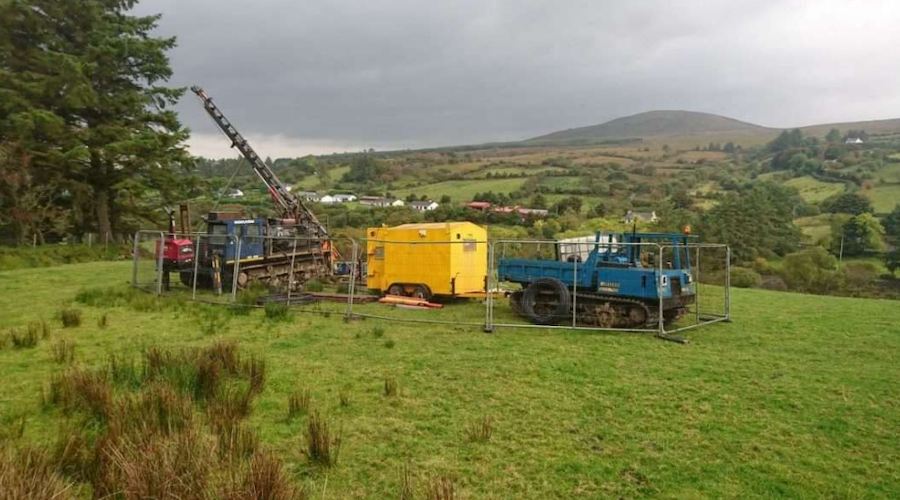
Drilling at the Inishowen gold project in Ireland. (Image courtesy of Ankle Resources.)

Diversified explorer Arkle Resources (AIM: ARK) said on Thursday it had found lithium bearing pegmatites at its Mine River Block gold project in Ireland.


The company, until 2019 known as Connemara Mining, said that of 34 rock chip samples taken from the site late last year, six returned lithium grades of more than 0.02%, with one returning 0.09%.

The six samples that showed elevated lithium were all boulders of pegmatite rock collected around mapped granite bodies.

Geochemical results also showed clear pathfinder elements for lithium – caesium, rubidium and tantalum – which can be used to target a coarse type of igneous rock in future soil surveys, Arkle Resources said.

The company, which has so far focused on gold in Ireland, said its directors believe these results are “compelling” as they suggest the Mine River Block is fertile for lithium caesium tantalum (LCT) pegmatite deposits

“These are exciting results,” chairman John Teeling said in the statement. “We have discovered lithium on our licences. We found the rock type needed, pegmatites, and in the pegmatites found lithium and other indicator minerals. This opens compelling new opportunities for our Mine River Block. Prospecting will resume in the near future.”

Shares in the company jumped as much as 21% to 69p after the announcement, but fell sharply in afternoon trading, changing hands at 56p by 2pm local time — 2.6% lower than at Wednesday’s close. This leaves it with a market capitalization of £2.21 million (about $2.6m).

Arkle Resources has been exploring for gold and zinc in the Wicklow granite for more than two decades, but searching for lithium in hard rocks has only been viable since 2018, the company said.

Lithium prices have softened after an outstanding two-year rally labelled “insane” by Elon Musk and “unreasonable” by China’s electric vehicles maker BYD.

Producers believe the cool-off is momentary and that prices will pick up in the coming months, despite market fears over a possible cooling-off of China’s two-year lithium buying spree.

Rock Tech granted permission for early construction of lithium hydroxide plant in Germany

Staff Writer | January 12, 2023 | 

Site of the lithium hydroxide converter in Guben, Brandenburg. Credit: Rock Tech Lithium Inc.

Rock Tech Lithium (TSXV: RCK) has received permission for an early start to the construction of its Guben lithium converter in Germany. First significant on-site work for this strategic critical mineral project is expected within the upcoming next weeks.


Rock Tech first announced plans to build the lithium converter in Guben, Brandenburg, in October 2021. The facility, designed to produce battery-grade lithium hydroxide, will be situated about 60 km away from Tesla’s plant in Grünheide.

The decision follows an Europe-wide search by Rock Tech for a location to refine the raw material sourced from its Georgia Lake lithium project in Ontario.

“Our goal is to be the first company in the world to create a closed loop for lithium. Guben seems to us to be the ideal location for this, with subsidies also playing an important role,” Rock Tech’s CEO Dirk Harbecke stated at the time of the announcement.

In February 2022, Rock Tech applied with the Brandenburg environmental agency for the first partial permit and an early start of the project. In the course of the application procedure, which involved public participation, no objections were received, and the authorities subsequently granted approval for the first tranche of permits.

The approval for an early start is also an encouraging indicator that permission for construction of the Guben converter will be granted in due course, the company said on Thursday. In November, Rock Tech submitted the second and final tranche of permit applications for this to the authority.

Approval for construction of the Guben converter is expected from summer 2023 onwards, according to the company.

“The production of our battery-grade lithium hydroxide will be an essential part of the battery mineral supply chains in Europe – this is another reason why the approval by the authority is an important step towards implementation and sends a clear signal to the market,” added Klaus Schmitz, Rock Tech’s chief operating officer.

Once completed, the Guben converter will be the first of its kind in Europe, with expected annual production capacity of 24,000 tonnes of battery-grade lithium hydroxide from 2025. Total cost of the project is estimated at 650 million euros.

To date, more than 250,000 working hours and over 45 million euros have been invested by Rock Tech in the planning the design and construction of the Guben converter. With the early start permission, necessary groundwork, as well as the construction of roads, office and storage buildings, can now begin.

Shares of Rock Tech Lithium surged 16.5% as of 12:30 p.m. ET, giving the Vancouver-based company a market capitalization of C$249.3 million ($186.6m).

MINING IS NOT GREEN
CHARTS: Mining stocks gain on tech but remain an afterthought for investors

Frik Els | January 13, 2023 | 

Scoop up some mining stocks. Stock image

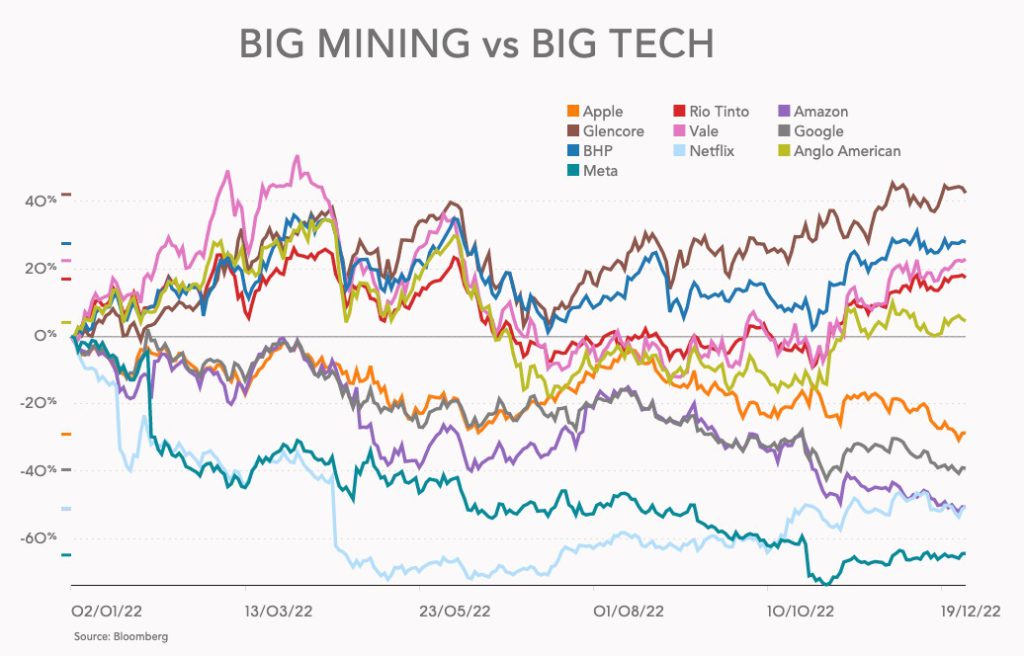
MINING.COM tracks the world’s top 50 biggest mining companies by market value, and at the end of 2022 the ranking had a combined value of $1.39 trillion.


It’s just a shade below the companies’ combined market cap at the end of 2021. That compares to a 9% drop in the Dow Jones Industrial Average and a nearly 20% decline in the S&P500 over the course of the year.

The year started with a big bang and measured from individual stocks’ 52-week highs – almost all hit in March/April – the top 50 has shrunk by more than $1 trillion. It’s a precipitous decline, but compared to other sectors, notably big tech, much of those losses were recouped by the end of the year.

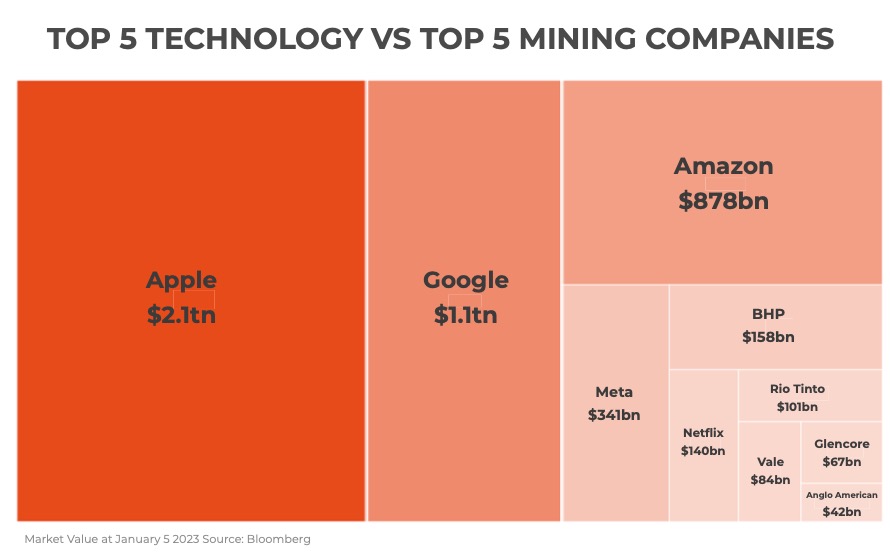
The top 5 most valuable tech firms were worth a collective $4.55 trillion at the start of 2023, down an astonishing $2.9 trillion over the past year. That compares to the combined value of $454 billion for mining’s top tier.


But it’s hard to ignore the fact that at Apple’s market capitalisation alone – even after shedding nearly $750 billion in 2022 — you can buy the world’s 50 most valuable mining companies, the next 50, and have enough left over to snap up three years of global copper mine production and buy 2022’s seaborne iron ore — all of it.

While critical minerals and metals (aren’t they all?) are now a geopolitical talking point and developed economies have finally woken up to the fact that they’ve largely been cut out of global hard commodity supply chains, it is clear from the relative valuations of virtual vs real assets that a massive disconnect still exists.

All the way back in 2019, Bernstein’s Paul Gait wrote a paper following the New York money managers’ conference on decarbonisation and the vast volumes of metals and minerals and massive investment in new projects needed to achieve the world’s climate goals.


Gait had this to say about the affordability of meeting those targets and the relative valuation of the big tech stocks and the mining industry:

“It is, however, important to remember that when we highlight the impact of decarbonisation on copper prices there is absolutely no sense in which this can be taken to imply that we ‘cannot afford’ to deliver a “green economy” (and the resulting transformation of industrial and economic processes).

“The market capitalisation of such entities as Facebook or Netflix imply that there is more than enough money, more than enough capital to deliver whatever economic transformation is required. The fact that our revealed preference (amusing cat videos) is at variance with our stated preference (a sustainable economic future for our children) should not be erroneously taken to infer that there is some financial constraint on the ends we choose to pursue.”
PERU
Glencore evacuates personnel after protesters vandalize Antapaccay mine camp

Valentina Ruiz Leotaud | January 14, 2023 |

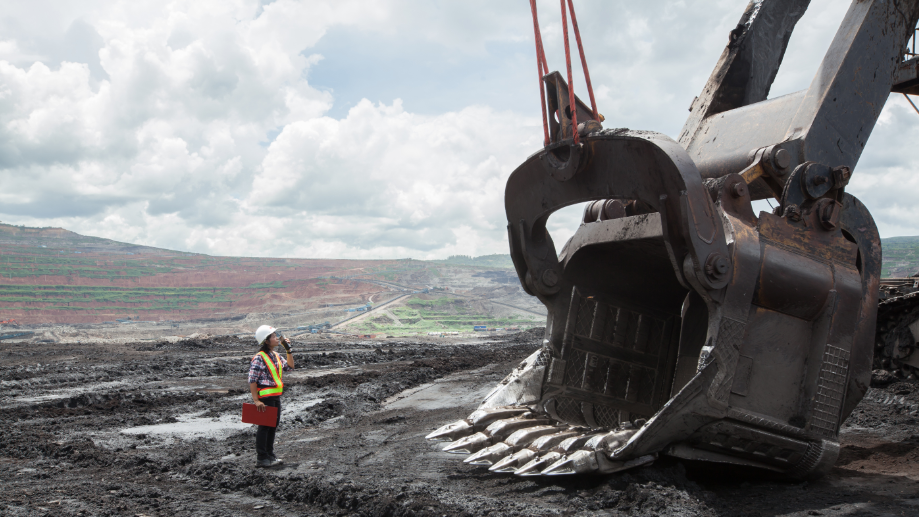
Antapaccay workers. (Reference image by Antapaccay).

The campsite at Glencore’s Antapaccay copper mine in southern Peru was vandalized by a group of people protesting against the country’s new president and demanding a general election.


According to local media, the incident took place on Friday morning when the protesters broke into the site’s water plant and set the facility on fire. The plant provides drinking water to over 6,000 people in nearby communities.

The Peruvian press pointed out that the company reported the incident to the police and asked for increased security measures around Antapaccay but their claims went unheard. Most national police officers have been deployed in the cities of Puno, Juliaca and Cusco as the government attempts to contain protests sprouting in different areas.

Given this response, Glencore issued a communiqué stating that management decided to evacuate most of the 2,400 people that were at the mining camp, among them staff and contract workers. Only essential personnel needed to maintain basic operations going will remain at the site.

Friday’s attack was not the first of its kind.

Glencore reported that on Thursday noon, criminals forced their entry into Antapaccay, burned two vehicles and trashed the accommodations used by overnight workers.

The president of the 11 Indigenous communities in Anttapacay’s area of influence, Flavio Huanqque, told La República newspaper that none of his communities participated in any of the attacks.

These and other demonstrations taking place across the Andean country pose a challenge to new President Dina Boluarte, as she tries to restore calm after the ouster of former President Pedro Castillo late last year.

MMG’s Las Bambas halts mining work on security concerns: TVPeru

Bloomberg News | January 14, 2023 

Las Bambas plant workers. (Image courtesy of MMG).

MMG Ltd’s Las Bambas copper mines halted activities because of unrest at another nearby mining site, according to TVPeru Noticias, citing a union leader.


The decision to stop work at the mine on Friday was made by the company to keep workers safe from violence as roads were blocked and protests continue over last month’s ouster of leftist President Pedro Castillo, said Erick Ramos Luna, union leader at the MMG’s Las Bambas mines.

A representative for MMG declined to comment.

Peru’s Boluarte Rules Out Resigning in National Address

Mining activities in Peru, the world’s second-largest copper producer, have been affected by shortages of materials because of unrest at the mine of Antapaccay, run by Glencore. Workers in Antapaccay threatened to take over the Las Bambas mine, prompting security measures, Ramos added.

“It’s highly likely that overall activities will be halted by next week,” he said.

Las Bambas had halted copper concentrate transportation this week amid broader protests in the Andean regions around the huge Chinese-owned mine.

Glencore’s Antapaccay, which is located along the same route used by Las Bambas to transport copper, was attacked on Tuesday and two cars were burned, the company said in a press release.

At least 40 people have died in political turmoil after the ouster and arrest of Castillo in December.

(Reporting by Fabiola Zerpa).

Saturday, January 14, 2023

Study suggests smallpox originated 2,000 years earlier than thought
By Cara Murez, HealthDay News

Air Force Master Sgt. Ray Anspach immunizes a soldier against smallpox at Walter Reed Army Medical Center on January 14, 2003. Researchers now believe the disease dates back 2,000 years earlier than previously thought. 
File photo by Michael Dukes/U.S. Army | License Photo

While the origins of smallpox has remained a mystery for centuries, researchers now believe that it dates back 2,000 years earlier than previously thought.

Until recently, the earliest genetic evidence of smallpox, the variola virus, was from the 1600s. And in 2020, researchers found evidence of it in the dental remains of Viking skeletons, pushing its existence 1,000 years earlier.

Now, Italian scientists have used a mathematical equation to pinpoint the beginnings of smallpox, and coupled with pox scarring seen on ancient Egyptian mummies, they have pushed the emergence of the virus back 3,800 years.

"Variola virus may be much, much older than we thought," said study first author Dr. Diego Forni, from the Scientific Institute IRCCS Eugenio Medea, in Italy.

"This is important because it confirms the historical hypothesis that smallpox existed in ancient societies. It is also important to consider that there are some aspects in the evolution of viruses that should be accounted for when doing this type of work," Forni said in a news release from the Microbiology Society.

Smallpox was only eradicated recently, relatively speaking, killing at least 300 million people in the 20th century.

In the new study, the researchers found that different strains of smallpox all descended from a single common ancestor. A small fraction of the genetic components found in Viking-age genomes even persisted until the 18th century.

To estimate the origin of the virus, the researchers then accounted for something called the "time-dependent rate phenomenon."

What this means is that the speed of evolution depends on the length of time over which it is being measured. That means viruses appear to change more quickly over a short timeframe and more slowly over a longer timeframe, something well-documented in DNA viruses, according to the study authors.

By using a mathematical equation to account for the time-dependent rate phenomenon, the research team estimated the first emergence of smallpox may harken back to Egyptian times: Ancient mummies, including the Pharaoh Ramses V, who died in 1157 BC, had suspicious scarring.

The findings were published online Monday in the journal Microbial Genomics.

More information

The U.S. Centers for Disease Control and Prevention has more on smallpox.

Copyright © 2022 HealthDay. All rights reserved.

Sweden opens Mainland Europe's first satellite launch spaceport

By Simon Druker

Sweden's Prime Minister Ulf Kristersson (L) watches European Commission President Ursula von der Leyen delivering a speech at the inauguration of the Spaceport Esrange's new satellite launch ramp outside Kiruna, Sweden on Friday. Photo by Jonas Ekstroemer/EPA-EFE

Jan. 13 (UPI) -- Sweden on Friday inaugurated and officially opened Mainland Europe's first space facility for satellite launches.

Prime Minister Ulf Kristersson and Sweden's King Carl XVI Gustaf cut the ribbon in the city of Kiruna, around 25 miles from the new Spaceport Esrange.

The event was timed to coincide with Sweden taking over as the head of the Council of the European Union.

The facility in Northern Sweden gives the EU the ability to launch satellites, something only around 10 countries previously had the ability to do.

"This spaceport offers an independent European gateway to space. It is exactly the infrastructure we need, not only to continue to innovate but also to further explore the final frontier," European Commission President Ursula von der Leyen said during the inauguration.


Spaceport Esrange is operated by the government-owned Swedish Space Corporation, which already operates 10 ground stations strategically located around the world for optimum coverage, plus eight supplementary partner stations.

The corporation expects around 10,000 new satellites will be launched globally over the next few years, with the total number eclipsing 100,000 by 2040. There are around 5,000 operational satellites in orbit today.

The new facility gives Sweden and the rest of the EU better access to that growing world. It will also host testing of Europe's initiative for reusable rocketry, the European Space Agency's Themis program led by ArianeGroup, as well as suborbital test launches of several next generation rockets.

"This new launch complex will help create a foundation for a resilient Europe in Space. New satellite constellations in orbit, responsive launch capabilities and development of reusable rocketry will enable a secure, competitive and sustainable Europe. This will make Europe stronger," SSC CEO Stefan Gardefjord said in a statement.

"This is a giant leap for SSC, for Sweden, for Europe and the rest of the world. Satellites are decisive for many functions of the daily lives of today's modern world, and the need for them will only increase in the years to come with Space playing an even more important role."


A virtual rocket launch from Swedish Spaceport Esrange's new satellite launch ramp Friday, giving the European Union the ability to directly launch satellites from Mainland Europe. Image courtesy of Swedish Space Corporation

The first satellite launch is expected to launch by the end of the year.

"This leading-edge spaceport gives Europe the capabilities to address this growing demand. The benefits of small satellites, that can be launched from here, are immense. We have just heard that it is important to launch these satellites over and over, to have the reusability, to test them," von der Leyen said Friday.

Japan eyes delay of Fukushima plant water release


By MARI YAMAGUCHIJanuary 12, 2023

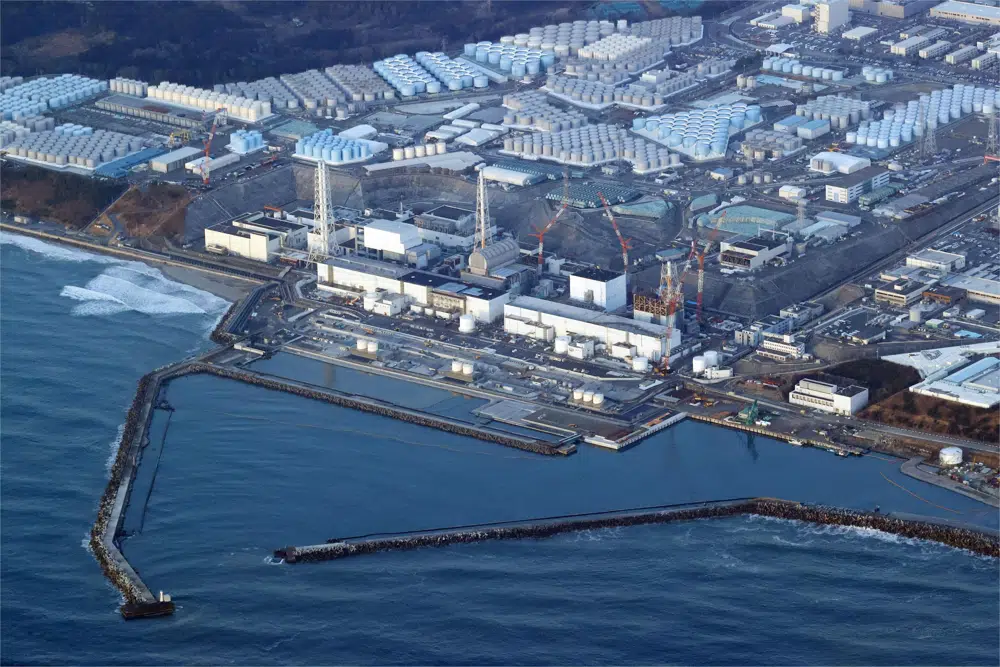
This aerial photo shows the Fukushima Daiichi nuclear power plant in Okuma town, Fukushima prefecture, north of Tokyo, on March 17, 2022. Japan's government has revised the timing of a planned release to the sea of treated but still radioactive wastewater at the Fukushima nuclear power plant to “around spring or summer," indicating a delay from the initial target of this spring, factoring into the progress of a release tunnel and the need to gain public support.
 (Shohei Miyano/Kyodo News via AP, File)

TOKYO (AP) — Japan has revised the timing of a planned release to the sea of treated but still radioactive wastewater at the Fukushima nuclear power plant to “around spring or summer,” indicating a delay from the initial target of this spring, after factoring in the progress of a release tunnel and the need to gain public support.

The government and the plant operator, Tokyo Electric Power Company Holdings, announced in April 2021 a plan to begin releasing the treated wastewater into the sea starting in spring 2023. They say more than 1 million tons of water stored in about 1,000 tanks at the plant are hampering its decommissioning and risk leaking in the event of a major earthquake or tsunami.

Under the current plan, TEPCO will transport the treated water through a pipeline from the tanks to a coastal facility, where it will be diluted with seawater and sent through an undersea tunnel, currently under construction, to an offshore outlet. The company has acknowledged the possibility of rough winter weather and sea conditions delaying the tunnel progress.


Chief Cabinet Secretary Hirokazu Matsuno told reporters Friday the government has adopted a revised action plan, which includes enhanced efforts to ensure safety and measures to financially support the local fishing industry and a new release target of “around spring or summer this year.”

TEPCO President Tomoaki Kobayakawa said that despite the government’s new timing for the wastewater release, his company still aims to have the facility ready by the spring. He also acknowledged a lack of local understanding about the release and pledged to continue efforts to ease safety concerns.

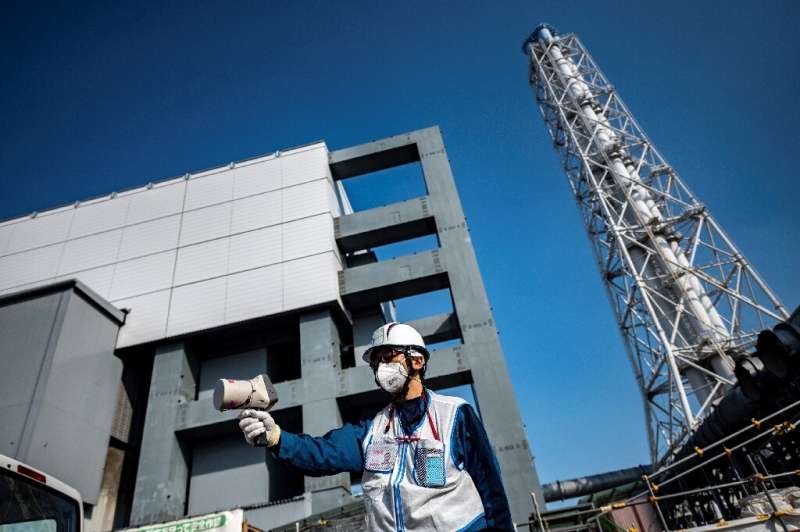
A massive earthquake and tsunami in 2011 destroyed the Fukushima plant’s cooling systems, causing three reactors to melt and release large amounts of radiation. Water used to cool the damaged reactor cores, which remain highly radioactive, has since leaked into the basements of the reactor buildings and has been collected, treated and stored in tanks.

The release plan has been fiercely opposed by fishermen, local residents and Japan’s neighbors, including China and South Korea. Fukushima residents worry the reputation of their agricultural and fishing products will be further damaged.

Most of the radioactivity is removed from the water during treatment, but tritium cannot be removed and low levels of some other radionuclides also remain. The government and TEPCO say the environmental and health impacts will be negligible as the water will be slowly released after further treatment and dilution by large amounts of seawater.

Some scientists say the impact of long-term, low-dose exposure to tritium and other radionuclides on the environment and humans is still unknown and the release plan should be delayed. They say tritium affects humans more when it is consumed in fish.

Japan is cooperating with the International Atomic Energy Agency to increase the safety, transparency and understanding of the water discharge plan. An IAEA team that visited Japan a number of times for talks and plant inspections last year will visit again in January to meet with nuclear regulators and will release a final report before the planned release begins.

Japan to start releasing treated water from Fukushima this year

Japan plans to start releasing more than a million tonnes of treated water from the crippled Fukushima nuclear power plant into
Japan plans to start releasing more than a million tonnes of treated water from
 the crippled Fukushima nuclear power plant into the ocean in 2023.

Japan plans to start releasing more than a million tonnes of treated water from the crippled Fukushima nuclear power plant into the ocean this year, a top government spokesman said Friday.

The plan has been endorsed by the International Atomic Energy Agency (IAEA), but the government will wait for "a comprehensive report" by the UN watchdog before the release, chief cabinet secretary Hirokazu Matsuno told reporters.

Cooling systems at the plant were overwhelmed when a massive undersea earthquake triggered a tsunami in 2011, causing the worst nuclear accident since Chernobyl.

Decommissioning work is under way and expected to take around four decades.

The site produced 100 cubic metres (3,500 cubic feet) of contaminated water each day on average in the April-November period last year—a combination of groundwater, seawater and rainwater that seeps into the area, and water used for cooling.

The water is filtered to remove various radionuclides and moved to storage tanks, with more than 1.3 million cubic metres on site already and space running out.

"We expect the timing of the release would be sometime during this spring or summer," after release facilities are completed and tested, and the IAEA's comprehensive report is released, Matsuno said.

"The government as a whole will make the utmost efforts to ensure safety and take  against bad rumours."

The comments are a reference to persistent concerns raised by neighbouring countries and local fishing communities about the release plan.

Fishermen in the region fear reputational damage from the release, after attempting for years to reestablish trust in their products through strict testing.

Plant operator TEPCO says the treated water meets  for radionuclide levels, except for one element, tritium, which experts say is only harmful to humans in large doses.

It plans to dilute the  to reduce tritium levels and release it offshore over several decades via a one-kilometre-long (0.6-mile) underwater pipe.

The IAEA has said the release meets international standards and "will not cause any harm to the environment".

Regional neighbours including China and South Korea, and groups such as Greenpeace, have criticised the plan.

The March 2011 disaster in northeast Japan left around 18,500 people dead or missing, with most killed by the tsunami.

Tens of thousands of residents around the Fukushima plant were ordered to evacuate their homes, or chose to do so.

Around 12 percent of the Fukushima region was once declared unsafe, but now no-go zones cover around two percent, although populations in many towns remain far lower than before.

© 2023 AFP

PROFS NEED TENURE
Hamline University under fire for art professor’s dismissal

By KATHLEEN FOODY
January 13, 2023

1 of 10
Aram Wedatalla, a Hamline University senior and the president of Muslim Student Association (MSA), speaks during a news conference at CAIR-MN office, Wednesday, Jan. 11, 2023, in Minneapolis. A Hamline University lecturer showed a painting of the Prophet Muhammad and Wedatalla was one of the students in the class when the image was displayed. (Kerem Yücel/Minnesota Public Radio via AP)

CHICAGO (AP) — A Minnesota university’s decision to dismiss a professor for including depictions of the Prophet Muhammad in a world art course has put the small, private school at the center of a debate over how to include controversial material in college courses while respecting students’ personal relationship to the material.

Months after the images were shown in an online class, the chair of Hamline University’s Board of Trustees said Friday that the trustees were reviewing the university’s policies and its responses to both student complaints and faculty concerns about academic freedom. Also Friday, a national civil rights organization for Muslims rebuked accusations that the professor’s behavior was Islamophobic.

The conflict began in October when adjunct professor Erika López Prater included a 14th-century painting depicting the Prophet Muhammad in a lesson on Islamic art, prompting a Muslim student in the class to complain to the university, according to media reports and advocacy groups that have backed either the professor or student.

López Prater was aware that for many Muslims, visual depictions of the Prophet Muhammad violate their faith. A course syllabus she has shown in media interviews noted that students would view images of religious figures, including the Prophet Muhammad. The syllabus also included an offer to work with students uncomfortable with viewing those images.

She also warned the class immediately before showing the depiction of the Prophet Muhammad. Her goal, López Prater said this week, was to teach students about the “rich diversity” of attitudes toward such imagery.

“It’s critically important that we acknowledge the internal diversity within Islam and that we also respect the keen, curious minds that come from that community and other groups and that we don’t only accommodate the safest options available,” she said in a video interview with Muqtedar Khan, a professor of international relations at the University of Delaware. “Institutions of higher learning ... we owe it to our students to challenge them in ways that are sometimes uncomfortable.”

López Prater said she and her department chair began talking in September about her teaching a new course, but after the incident the chair told her that “her services were no longer needed.”

Hamline’s president has said the professor’s contract was not renewed following the fall semester.

Beyond Hamline’s campus in Saint Paul, Minnesota, Muslims disagree about the incident and broader academic use of depictions of the Prophet Muhammad.

Jaylani Hussein, executive director of the Minnesota chapter of the Council on American-Islamic Relations, was among the earliest supporters of Hamline’s response. He said the image’s inclusion in the lesson was disrespectful to Muslim students.

“That’s a big part of why this hurt” the student who complained, he said.

At a news conference organized by the group, the student whose complaint sparked the university’s review said Wednesday that she and other Muslim students feel administrators acted appropriately. Aram Wedatalla told reporters that she had never seen a depiction of the Prophet Muhammad until the October class.

“It just breaks my heart that I have to stand here to tell people that something is Islamophobic and something actually hurts all of us, not only me,” she said.

The national Council on American-Islamic Relations on Friday, though, distanced itself from claims that López Prater’s approach was Islamophobic. CAIR, which describes itself as the largest civil rights organization for Muslims in the U.S., said intent, actions and circumstance all matter.

“Although we strongly discourage showing visual depictions of the Prophet, we recognize that professors who analyze ancient paintings for an academic purpose are not the same as Islamophobes who show such images to cause offense,” the organization said. “Based on what we know up to this point, we see no evidence that Professor Erika López Prater acted with Islamophobic intent or engaged in conduct that meets our definition of Islamophobia.”

Pushback to Hamline’s decision began with an online petition from a University of Michigan Islamic art scholar who said the painting is frequently shown and studied by art historians and grew as media reports detailed the university’s response, including one official’s email to employees describing the incident as Islamophobic.

Critics included Muslim Public Affairs Council and the Middle East Studies Association, which both issued statements praising the professor for her sensitivity and commitment to teaching the variety of attitudes toward depictions of the Prophet Muhammad in Islam’s history. Islamic art experts also have noted that the image was nothing like the cartoons in the satirical French newspaper Charlie Hebdo that led to a deadly 2015 attack.

Those urging Hamline to reinstate López Prater include PEN America, the American Association of University Professors, as well as a former president of the university.

“Generations of Hamline faculty have taught with the belief that adhering to the bright line of academic freedom and supporting students are not mutually exclusive,” Linda Hanson, who was Hamline’s president from 2005-2015, wrote in a letter published late Wednesday by the Minneapolis Star Tribune.

University President Fayneese Miller staunchly defended the school’s response, including a lengthy letter released Wednesday that said Hamline has been “under attack from forces outside our campus.”

“Prioritizing the well-being of our students does not in any way negate or minimize the rights and privileges assured by academic freedom,” Miller wrote. “But the concepts do intersect.”

Students also have rights that administrators must protect, she wrote, before citing the university’s ties to the United Methodist Church.

“To do all the good you can means, in part, minimizing harm,” Miller said. “That is what has informed our decisions thus far and will continue to inform them in the future.”

But a statement released Friday by Board of Trustees Chair Ellen Watters gave more credence to the school’s critics, and promised that trustees “are listening and we are learning.”

“The Hamline University Board of Trustees is actively involved in reviewing the University’s policies and responses to recent student concerns and subsequent faculty concerns about academic freedom,” Watters wrote. “Upholding academic freedom and fostering an inclusive, respectful learning environment for our students are both required to fulfill our Mission.”

The statement did not provide more detail on the board’s process and a school spokesman did not immediately respond to messages seeking information.
Benin's famed Voodoo festival draws back Afro-descendants


Issued on: 10/01/2023 
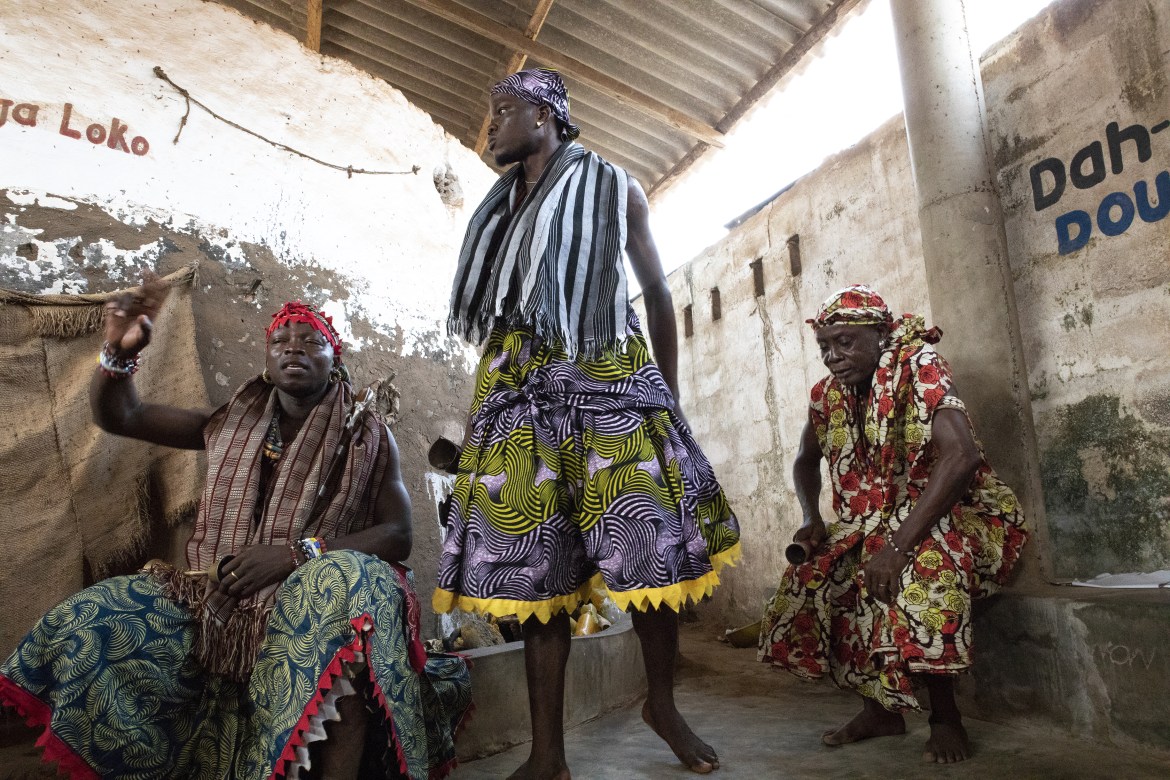
Some of the rituals of Benin's Voodoo followers took place at the Dah-Gbo Zonon convent in Ouidah
 © Yanick Folly / AFP

Ouidah (Benin) (AFP) – Every year in Benin, locals celebrate a festival in tribute to the deities of Voodoo, the indigenous religion worshipping natural spirits and revering their ancestors.

Increasingly, the festival is drawing people of African descent from America, Brazil and the Caribbean seeking to discover the religion and land of their ancestors enslaved and shipped away from the beaches of west Africa.

Voodoo, known locally as Vodoun, originated in the Dahomey kingdom -- present-day Benin and Togo -- and is still widely practised sometimes alongside Christianity in coastal towns like Ouidah, once a trading hub where memorials to the slave trade are dotted around the small beach settlement.

"We come here first to search for our origins and reconnect with Mother Earth," said Louis Pierre Ramassamy, 45, from Guadaloupe who was in Benin for the first time and visiting Ouidah.

He came to discover the Vodoun festival, but his stay goes beyond that.

He said he wants to follow the footsteps of his ancestors, who were taken from Ouidah centuries ago and to rediscover the divinity practised by his maternal grandmother.

Consultations and sacrifices were made for him in a Vodoun convent in Ouidah to help him reconnect, he said.

"If luck does not smile on me this time, I will come back another time. I need this reconnection for my personal development," the tourist told AFP, his camera focused on the movement of voodoo practitioners on Ouidah's imposing Atlantic Ocean beach.

Dozens of followers dressed in white cloth face the ocean each festival to pay hommage in Ouidah to Mami Wata, a goddess of the sea.


The festival included the traditional leader of the Vodoun, majesty Daagbo Hounon Houna II 
(C) © Yanick Folly / AFP

Accompanied by drums and dancing, followers dressed in colourful traditional robes and gowns watched "Zangbeto" rituals -- whirling dancers dressed as guardians of the night.

Nearby is an arch, the "Door of No Return", in memory of those jammed onto slave ships from Ouidah's beach bound for the New World.

"Our ancestors foresaw this return of Afro-descendants. They are eagerly awaited by the ghosts of our ancestors," said Hounnongan Viyeye Noumaze Gbetoton, one of the Vodoun dignitaries in Ouidah.

"When they return, it is to take blessings and recharge their batteries to move forward."

Brazilian Anaica Durand said she had passed this stage.

She managed to reconnect with her family of origin, the family of Almeida from Benin and is delighted with it.

January 10 has now become a moment of great festivity for her to revel in the songs, dances and celebrations around Vodoun.


'True identity'

Like her, Alexandra Bajeux is on her second stay in Ouidah. This year, she came to pay hommage to the Snake deity Dan.

"All the consultations revealed that it was the cult of my ancestors," she smiles, white loincloth tied at the waist.

Ouidah was once a slave trading hub and now a centre for the Voudon religion 
© Yanick Folly / AFP

The 29-year-old Haitian plans to settle in Ouidah to devote herself full-time to this religion.

"Dan is happiness and he is a source of wealth," said the young woman who swears "to have finally found the happiness that she lacked".

"Our major objective is that the indigenous culture never fades away... Sooner or later, all Afro-descendants will return to the fold. This is what our ancestors say," said Hounnongan Viyeye Noumaze Gbetoton.

Francis Ahouissoussi, a Benin sociologist specialising in religious issues, explains this attachment of descendants of African slaves as "a natural need that they must fill".

According to him, many Afro-descendants feel they "are in a permanent quest for their true identity", part of which is addressed for some by the role of Vodoun.

For Brazilian Ana Beatriz Akpedje Almeida it felt like she was connecting the deities she knew from Brazil and others and to her ancestors.

"I think most people from the diaspora can connect with this kind of knowledge," she said. "Voodoo is a perspective about humanity."

US visitor Chastyl told AFP it was also her first time in Benin.

"I have seen so many divinities and a lot of dancing," she said. "I don't have any family here, they are all in the United States, but obviously somewhere, we are from here."

© 2023 AFP


In Pictures

Photos: Benin’s famed Voodoo festival draws back Afro-descendants

The festival is drawing people of African descent to discover the religion and land of their enslaved ancestors.


Voodoo followers attend the festival in Ouidah, Benin. 
[Yanick Folly/AFP]

Published On 12 Jan 2023

Every year in Benin, locals celebrate a festival in tribute to the deities of Voodoo, the Indigenous religion that worships natural spirits and reveres ancestors.

Increasingly, the festival is drawing people of African descent from the US, Brazil and the Caribbean seeking to discover the religion and land of their ancestors who were enslaved and shipped away from the beaches of west Africa.

Voodoo, known locally as Vodoun, originated in the Dahomey kingdom – present-day Benin and Togo – and is still widely practised sometimes alongside Christianity in coastal towns like Ouidah, once a trading hub where memorials to the slave trade are dotted around the small beach settlement.

“We come here first to search for our origins and reconnect with Mother Earth,” said Louis Pierre Ramassamy, 45, from Guadaloupe who was in Benin for the first time and visiting Ouidah.

He came to discover the Vodoun festival, but his stay goes beyond that.

He said he wants to follow in the footsteps of his ancestors taken from Ouidah centuries ago and to rediscover the divinity practised by his maternal grandmother.

Consultations and sacrifices were made for him in a Vodoun convent in Ouidah to help him reconnect, he said.

“If luck does not smile on me this time, I will come back another time. I need this reconnection for my personal development,” said Ramassamy.

Dozens of followers dressed in white face the ocean in Ouidah each festival to pay homage to Mami Wata, a goddess of the sea.

Accompanied by drums and dancing, followers dressed in colourful traditional robes and gowns watched “Zangbeto” rituals – whirling dancers dressed as guardians of the night.

Nearby is an arch, the “Door of No Return”, in memory of those jammed onto slave ships from Ouidah’s beach bound for the New World.

“Our ancestors foresaw this return of Afro-descendants. They are eagerly awaited by the ghosts of our ancestors,” said Hounnongan Viyeye Noumaze Gbetoton, one of the Vodoun dignitaries in Ouidah.

“When they return, it is to take blessings and recharge their batteries to move forward.”

Anaica Durand, a Brazilian national, said she had managed to reconnect with her family of origin, the Almeidas from Benin, and is delighted.

January 10 has now become a moment of great festivity for her to revel in the songs, dances and celebrations around Vodoun.

The traditional leader of the Voodoo cult, His majesty Daagbo Hounon Houna II, left, greets the crowd during the festival. [Yanick Folly/AFP]

Every year in Benin, locals celebrate a festival in tribute to the deities of Voodoo, the Indigenous religion that worships natural spirits and reveres ancestors. [Yanick Folly/AFP]
Voodoo, known locally as Vodoun, originated in the Dahomey kingdom - present-day Benin and Togo. [Yanick Folly/AFP]
Voodoo is still widely practised, sometimes alongside Christianity, in coastal towns like Ouidah, once a trading hub where memorials to the slave trade are dotted around the small beach settlement. [Yanick Folly/AFP]
Voodoo followers pose for a portrait during the festival. [Yanick Folly/AFP]
The festival is drawing people of African descent from the US, Brazil and the Caribbean to discover the religion and land of their enslaved ancestors. [Yanick Folly/AFP]
Advertisement

People drive on a motorcycle past the entrance to the city of Ouidah. [Yanick Folly/AFP]


Why Live & Let Die's Samedi Is James Bond's Only Supernatural Villain

BY PADRAIG COTTER
PUBLISHED FEB 23, 2021

The James Bond series' only real flirtation with the horror genre came with Live And Let Die's Baron Samedi, who is the spy's only supernatural foe.


Live And Let Die's Baron Samedi is James Bond's only supernatural foe - to date, at least. Despite James Bond author Ian Fleming favoring movie stars like David Niven for the role, a relatively unknown Scottish actor named Sean Connery landed the role of the suave spy in 1962's Dr. No. The success of the movie would lead to the creation of one of the longest-running franchises in movie history.

Since Sean Connery departed the role following 1967's You Only Live Twice - though he later returned for two further Bond outings - five other actors have inherited the role. While certain Bond movies are better than others, the series has the uncanny ability to adapt to each new generation and constantly reinvent itself. From the tongue-in-cheek fun of the Roger Moore era to the (relatively) grounded action of Daniel Craig's Bond, the franchise always manages to keep itself fresh.

Daniel Craig is set to exit the series with the upcoming No Time To Die, which will mark his fifth outing. The longest-serving actor in the James Bond role is still Roger Moore, who started with 1973's Live And Let Die and ended his run with 1985's A View To A Kill, his seventh time in the role. Moore's Bond went through a lot, from tossing Blofeld down a chimley to being shot into space, but he also faced the spy's only real supernatural foe in Geoffrey Holder's Baron Samedi in Live And Let Die.


Samedi is the Loa of the Dead and giver of life in Haitian Vodou religion, and in Live And Let Die the character is introduced dancing for tourists at a resort. This Baron is soon revealed to be something of a henchman for Yaphet Kotto's villain though, there's still something a little off about him - and it's not just his eerie laugh. His real nature is revealed in the finale, where Bond has to rescue Jane Seymour's Solitaire from being sacrificed at a voodoo ceremony.

Baron Samedi is seen rising from a grave, and James Bond later shoots him in the head with a magnum. His eyes are looking at the gaping wound in his own skull, and when Bond shoots again he crumbles like a clay figure. Another Samedi soon rises from another grave, and after a fight, Bond tosses him into a coffin loaded with snakes. That seems to be the end for Samedi in Live And Let Die, though he appears in the final shot of the movie - alive and well - sitting on the front of a train Bond and Solitaire are riding on.

While the James Bond franchise has dabbled with everything from space travel to invisible cars, it's very rarely touched on the supernatural or horror in general. Live And Let Die's Baron Samedi is a singular character in the franchise in this case, as the evidence seems to point to him being an otherworldly figure. He's literally introduced as "The man who cannot die," and the finale bears this out. It could be argued he's still a flesh and blood man - maybe Bond really did shoot a very lifelike Baron Samedi figure, or that snakes in the coffin weren't poisonous after all. The franchise never returned to the character so there's no definitive answer, though it's more fun to think he is the literal incarnation of the Voodoo God of Death.

Tourists surge back to Jordan's desert marvel Petra

Issued on: 15/01/2023 - 
Famous for its stunning structures hewn out of the rose-pink cliff faces, Petra is a United Nations World Heritage site © Khalil MAZRAAWI / AFP

Petra (Jordan) (AFP) – Tending to his camels in Petra, Jordan's spectacular archaeological marvel hidden deep in a desert canyon, Hussein Bdoul is all smiles: the tourists are back.

After years in which the Covid pandemic turned the storied "Rose City" into a ghost town, the father of seven is back at work, offering visitors rides on his decorated animals.

"Tourism has returned and the numbers are even greater," said Bdoul, 35, wearing Bedouin garb with a red keffiyeh scarf over his long black hair, reflecting on a resurgence last year.

"At the time of the coronavirus pandemic, we did not see anyone in Petra," said Bdoul -- a disaster for the town where, he said, "90 percent of people work in tourism".

"We hope from God Almighty that people will stay well."

Jordan tourism authorities confirm that Petra is back in business and drew 900,000 visitors last year, close to the record of one million set in 2019.

Jordan as a whole received 4.6 million visitors in 2022 -- almost four times the level from 2020 -- earning the country $5.3 billion.

Jordan tourism authorities confirm that Petra is back in business and drew 900,000 visitors last year © Khalil MAZRAAWI / AFP

Top draw Petra, famous for its stunning temples hewn out of the rose-pink cliff faces, is a United Nations World Heritage site and was chosen as one of the New Seven Wonders of the World in a 2007 online poll.

It was built in 312 BC as the capital of the ancient Arab kingdom of the Nabateans, which fell to the Romans in 106 BC.

The ancient city remained unknown in the West until a Swiss traveller visited it in 1812.
'Sigh of relief'

"This place and the colours are incredible," marvelled French student Alia, 16, taking a break from exploring with her mother to check out a souvenir stand.

Around 1,700 people make a living from Petra as tour guides, trinket sellers or by taking visitors through the site on donkeys, horses, camels or electric buggies.

'Tourism has returned and the numbers are even greater,' says Bdoul, 35, reflecting on a resurgence last year © Khalil MAZRAAWI / AFP

"We breathed a sigh of relief when we saw the return of tourists," said Muhammad Samahin, 16, selling drinks while sitting on woven rugs inside the Moon Cave near the famed Treasury site.

Suleiman Farajat, head of the Petra Development and Tourism Regional Authority, said the post-pandemic tourism comeback had exceeded all expectations.

At the height of the pandemic, "there were days when there were no tourists" in Petra, located 230 kilometres (140 miles) south of the capital Amman.

The recovery was helped by official promotional campaigns in new overseas markets, low-cost airline flights and new hotel rooms, said Farajat.

Petra now has 4,000 rooms, and permits have been granted for three new five-star hotels, so capacity will soon almost double from 2019, he said.

Jordan as a whole received 4.6 million visitors in 2022 © Khalil MAZRAAWI / AFP

"If things continue this way, we may reach, during the next three to four years, the threshold of two million tourists in Petra" every year.

© 2023 AFP