Tuesday, September 19, 2023

HEAR, HEAR!
Xi says China, US 'should and must' achieve peaceful co-existence

Reuters
Mon, September 18, 2023

Xi Jinping attends BRICS Summit in Johannesburg

BEIJING (Reuters) - Chinese President Xi Jinping told two US Flying Tigers veterans who fought for China during World War II that China and the US "should and must" achieve peaceful co-existence, offering further cues for both sides to lower persistent tensions.

In his reply to a letter from former pilot Harry Moyer and pilot gunner Mel McMullen, Xi said the people of China and the United States had shared the same enemy in their fight against Japan and had forged a "profound" friendship, according to Chinese state media on Tuesday.

"Looking to the future, China and the United States, as two major countries, bear more important responsibilities for world peace, stability and development," Xi said.

"They should and must achieve mutual respect, peaceful coexistence, and win-win cooperation."

His call for stable and peaceful ties followed a series of meetings and talks between US and Chinese officials in recent months aimed at reducing tensions and restoring channels of communication including contact between their militaries.

The American Volunteer Group, known as the Flying Tigers, was a fighter group, comprising former US pilots hired by the Republic of China led by Chiang Kai-shek's Kuomintang, to fight against Japan in 1941-42.

The airmen, whose planes were iconic for their shark faces, were widely known in China for their feats of bravery in the face of larger Japanese forces as they took to the skies from rural runways paved by Chinese people by hand.

"Currently, China-US relations face many difficulties and challenges," Chinese Vice President Han Zheng told U.S. Secretary of State Antony Blinken on the sidelines of the United Nations General Assembly on Monday.

"The world needs stable and healthy China-US relations," Han said.

(Reporting by Ryan Woo; Editing by Michael Perry)


China Ousted Foreign Minister Over Affair in US, WSJ Says

Bloomberg News
Tue, September 19, 2023 


(Bloomberg) -- China removed Qin Gang from his job as foreign minister after an investigation concluded he had an affair and fathered a child while serving as ambassador to the US, the Wall Street Journal reported.

Top officials in China were told in August that a Communist Party inquiry into Qin uncovered “lifestyle issues,” the newspaper reported Tuesday, citing people familiar with the situation whom it didn’t describe. That phrase usually means sexual misbehavior of some type in the parlance of Chinese officialdom.

Two of the people said the affair led to the birth of a child in the US. The WSJ added that Qin is assisting a probe into whether the affair compromised national security. China is locked in an ideological battle with the US, its chief economic and geopolitical rival, which has seen Beijing intensify a national security drive.

Foreign Ministry spokeswoman Mao Ning said at a regular press briefing in Beijing on Tuesday that she didn’t have any new information to offer about Qin.

China stripped Qin of his post in July, just seven months after he started the job — the shortest stint in the role in the nation’s history. No explanation was given, and his predecessor, Wang Yi, returned as foreign minister.

The episode raised questions over President Xi Jinping’s decision-making and the stability of the government running the world’s No. 2 economy. Those concerns are being rekindled by the current unexplained absence of Defense Minister Li Shangfu amid media reports he’s being probed for corruption.

The ruling Communist Party’s senior ranks are now being scrutinized for their dealings with foreigners, the insiders told the WSJ, adding that the top brass in China’s military were also in the spotlight.

See: China Defense Chief Mystery Adds to Leadership Turbulence

Few Chinese officials have risen as swiftly through the diplomatic ranks as Qin. His big break came in 2015 when he was given oversight of protocol at the foreign ministry. The next six years saw him organize state visits of top leaders to China.

It was likely in that job that Qin gained access to Xi. He was pictured beside the Chinese leader during a meeting with then President Donald Trump in Beijing in 2017.

Also: Ouster of Xi’s Handpicked Foreign Minister Halts Rising Career

In 2021, Qin was sent to Washington while he was still relatively unknown outside diplomatic circles. He showed a flair for public relations, embracing American culture by attending a baseball game and riding in a Tesla Inc. car with Elon Musk.

He also made moderate remarks on hot topics, arguing Beijing would’ve tried to stop Russia from invading Ukraine if it had known its plans and playing down the risk of a war with Taiwan.

--With assistance from Colum Murphy.

BODY POLITIC ERASURE
Mental health among Afghan women deteriorating across the country, UN report finds
YOU WOULD GO MAD IF YOU WERE ERASED

RAHIM FAIEZ
Tue, September 19, 2023 

 Afghan women wait to receive food rations distributed by a humanitarian aid group, in Kabul, Afghanistan, Tuesday, May 23, 2023. The mental health of Afghan women, who have suffered under harsh measures imposed by the Taliban since taking power two years ago, has deteriorated across the country, according to a joint report from three U.N. agencies released Tuesday, Sept. 19, 2023.
 (AP Photo/Ebrahim Noroozi, File) 


ISLAMABAD (AP) — The mental health of Afghan women, who have suffered under harsh measures imposed by the Taliban since taking power two years ago, has deteriorated across the country, according to a joint report from three U.N. agencies released Tuesday.

Nearly 70% reported that feelings of anxiety, isolation and depression had grown significantly worse between April and June, an increase from 57% in the preceding quarter, according to the report from U.N Women, the International Organization for Migration and the United Nations Assistance Mission in Afghanistan.

Afghan women were interviewed online, in-person and in group consultations as well as via individual telesurveys. In total, 592 Afghan women across 22 of Afghanistan's 34 provinces took part.

The women spoke of suffering from psychological problems including depression, insomnia, loss of hope and motivation, anxiety, fear, aggression, isolation and increasingly isolationist behavior, and thoughts of suicide.

The Taliban, upon taking power in 2021 as U.S. and NATO forces were pulling out of the country following two decades of war, promised a more moderate rule than during their previous period in power in the 1990s. But they have instead imposed harsh measures, many of them targeting women.

They have barred women from most areas of public life and work and banned girls from going to school beyond the sixth grade. They have prohibited Afghan women from working at local and non-governmental organizations. The ban was extended to employees of the United Nations in April.

Opportunities to study continued to shrink as community-based education by international organizations was banned and home-based schooling initiatives were regularly shut down by the de facto authorities — a term use by the U.N. for the Taliban government.

Afghanistan is the only country in the world with restrictions on female education and the rights of Afghan women and children are on the agenda of the United Nations General Assembly in New York.

Taliban spokesmen were not immediately available to comment on the report Tuesday, but in the past Taliban officials have cited Shariah, or Islamic, law to support their policies regarding women and girls.

Last month, Mohammad Sadiq Akif, the spokesman for the Taliban’s Ministry of Vice and Virtue, said that women lose value if men can see their uncovered faces in public.

The report found that 81% of women had not engaged at all with local Taliban authorities on issues important to them between April and June 2023. This finding was consistent with engagement levels in the previous quarter, said the report.

Forty-six percent of women said international recognition of the Taliban government should not happen under any circumstances, while 50% warned that recognition should only occur under specific conditions contingent on improving women’s rights. These include restoring education and employment and forming an inclusive government.

The women expressed concern that recognition would only encourage the Taliban government to continue becoming stricter in their policies and practices against women and girls.

Afghan women specifically urged the international community to continue political and economic sanctions against the Taliban, including by not granting exemptions to a travel ban. They urged an increase in engagement with the Taliban on gender equality and women’s rights, including by engaging community and religious leaders in awareness and advocacy efforts.

The women said they want support for initiatives that provide counseling and psychological services and they want access to international scholarships and safe migration options for women and girls to study and work overseas.

Chandrayaan-3: How important are India's Moon mission findings?

Geeta Pandey - BBC News, Delhi
Mon, September 18, 2023 

A photo of the Vikram lander taken by Pragyaan rover


Last month, India made history when it became the first country to land a lunar mission near the Moon's south pole.

Chandrayaan-3's lander and rover - called Vikram and Pragyaan - spent about 10 days in the region, gathering data and images to be sent back to Earth for analysis.

Earlier this month, scientists put them to bed as the Sun began to set on the Moon - to be able to function, the lander-rover need sunlight to charge their batteries. The country's space research agency Isro said it hoped that they would reawaken "around 22 September" when the next lunar day breaks.

Isro has provided regular updates on their movements and findings and shared images taken by them.

These updates have excited many Indians, but others have been asking about the significance of these discoveries.

The BBC asked Mila Mitra, a former Nasa scientist and co-founder of Stem and Space, a Delhi-based space education company, to pick some of Chandrayaan-3's major findings and explain their significance.

The distance covered - and craters avoided

Hours before the rover was put to bed on 2 September, Isro said Pragyaan "has traversed over 100m [328 feet] and is continuing".

That's quite a long way to travel for the six-wheeled rover, which moves at a speed of 1cm per second.

What is also significant, Ms Mitra says, is that it has been able to stay safe and avoid falling into the craters that dot the Moon's little-explored south pole region.

The rover, she says, has a special wheel mechanism - called rocker bogie - which means that all its wheels don't move together, helping it traverse up and down, but it may not be able to climb out if it falls into a deep crater. So it's important to make it go around the craters or even retrace its steps. And that, Ms Mitra adds, is done by scientists at the command centre who are "watching the Moon through the rover's eyes".

"The rover is not automated and its movements are controlled from the command centre which acts on the basis of the pictures it sends.

"There's a slight delay before they reach the command centre because of the circuitous route they take - Pragyaan sends them over to the lander which sends them on to the orbiter to pass them on to Earth."


Isro released a graphic of the path taken by the lunar rover

So, by the time the command reaches the rover, it's a few steps closer to the threat.

But the fact that it has managed to navigate safely around two craters shows that it's able to communicate really quickly with the command centre, Ms Mitra adds.
Blowing hot and cold

The first set of data collected from the lunar topsoil and up to the depth of 10cm (4 inches) below the surface from a probe onboard the Vikram lander showed a sharp difference in temperatures just above and below the surface.

While the temperature on the surface was nearly 60C, it plummeted sharply below the surface, dropping to -10C at 80mm (around 3 inches) below the ground.

The Moon is known for extreme temperatures - according to Nasa, daytime temperatures near the lunar equator reach a boiling 120C (250F), while night temperatures can plunge to -130C (-208F). And temperatures of -250C (-410F) have been recorded at craters which never receive any sunshine and remain permanently in shadows.

But, Ms Mitra says, this wide variation in temperature is significant because it shows that Moon's soil - called lunar regolith - is a very good insulator.

"This could mean it could be used to build space colonies to keep heat and cold and radiation out. This would make it a natural insulator for habitat," she says.

It could also be an indicator of the presence of water ice below the surface.
A clue into the Moon's evolution

When a laser detector mounted on the rover measured the chemicals present on the lunar surface near the south pole, it found a host of chemicals such as aluminium, calcium, iron, chromium, titanium, manganese, silicon and oxygen.

But the most important of the findings, scientists say, relate to sulphur. The instrument's "first-ever in-situ - in the original space" measurement "unambiguously confirms" the presence of sulphur, Isro said.

Sulphur's presence on the Moon has been known from the 1970s, but scientists say the fact that the rover has measured sulphur on the lunar surface itself - and not inside a mineral or as part of a crystal - makes it "a tremendous accomplishment".

Ms Mitra says the presence of sulphur in the soil is significant on a number of counts.

"Sulphur comes usually from volcanoes so this will add to our knowledge of how the Moon was formed, how it evolved and its geography.

"It also indicates the presence of water ice on the lunar surface and since sulphur is a good fertiliser, it's good news as it can help grow plants if there's habitat on the Moon."
Was it really a Moonquake?

The Vikram lander carries an instrument that measures vibrations emanating from its own studies and experiments as well as those from the rover and its activities.

Isro said while the Instrument for Lunar Seismic Activity (Ilsa) had its ear to the ground, it also recorded "an event, appearing to be a natural one" and was investigating its source.

Isro said the lander recorded an event "appearing to be a natural one"

This event had much larger amplitude which means it was much stronger, Ms Mitra says, adding that there could be several explanations for this.

"It could be some space debris - such as a meteorite or an asteroid - hitting the surface. Or it could be seismic which would make it the first Moonquake recorded since the 1970s. In that case, this could lead to an explanation of what's under the Moon's surface and its geography."
What's lunar plasma?

When Isro posted on X (formerly Twitter) that a probe on the lander had done the "first-ever measurements of the near-surface lunar plasma environment" of the south polar region and found it to be "relatively sparse", many wondered what it meant.

Ms Mitra explains that plasma refers to the presence of charged particles in the atmosphere which could hinder the radio-wave communication that Chandrayaan-3 is using.

"The fact that it's very sparse or thin is good news as it means it will disrupt the radio communication a lot less."
When the lander hopped

The last thing the Vikram lander did before being put to bed in early September was what Isro called a "hop experiment".

The agency said the lander was "commanded to fire its engines, it rose up by about 40cm [16 inches] and landed at a distance of 30-40cm".


On Monday Isro released images of the pre- and post-hop of Vikram lander

This "successful experiment" means the spacecraft could be used in future to bring samples back to the Earth or for human missions, it added.

Now, could this short hop mean a giant leap for India's future space plans?

Ms Mitra says the "hop tested restarting the engine after a lunar landing to make sure it is still operating fine".

It also demonstrated that the craft has the "capacity for lift-off in a lunar soil environment since so far the testing and real lift-off has only been from Earth", she adds.

BBC News India is now on YouTube. Click here to subscribe and watch our documentaries, explainers and features.
India government presents bill to reserve 3rd of parliament seats for women

Updated Tue, September 19, 2023 


A member of media works outside the India's new parliament building before its inauguration in New Delhi

By Rupam Jain

NEW DELHI (Reuters) -The Indian government on Tuesday moved a bill to reserve a third of seats in the lower house of parliament and state assemblies for women, reviving an old proposal expected to boost the standing of Prime Minister Narendra Modi's party among women.

The contentious legislative proposal has been hanging for decades due to opposition from some heartland political parties and needs the approval of both houses of parliament and a majority of state legislatures to become law.

Its revival comes months before general elections are due by May 2024 when Modi seeks a third term. Analysts say the chances of the bill getting passed in parliament have brightened as opposition to it has shrunk over the years.

It is the latest in a series of moves by the government that the ruling nationalist Bharatiya Janata Party (BJP) has projected as "pro-women"

"We want more and more women to join the development process of the country," Modi told a special five-day parliamentary session.

Women make up almost half of India's 950 million registered voters but only 15% of parliament and about 10% of state legislatures, pushing the world's largest democracy to the bottom of global rankings on gender parity in legislatures.

The 33% reservation for women will not apply to the upper houses of parliament and state legislatures.

Opposition lawmakers welcomed the revival of the proposal but pointed out that implementing it could take years as it requires boundaries of constituencies to be redrawn, which in turn can only be done after a population census.

FIGHT FOR GENDER BALANCE

India's once in a decade census was due to be completed in 2021 but was delayed because of the pandemic. Technical and logistical hurdles have set the survey back further.

"That means till 2029 this reservation won't be implemented," Priyanka Chaturvedi, a lawmaker from the opposition Shiv Sena (UBT) party, told reporters, referring to when general elections become due after 2024.

"They (government) have opened the doors but still there is no entry for women," she said.

Law Minister Arjun Ram Meghwal said the 542-seat lower house has 82 women members at present and if the bill is approved the number will rise to at least 181.

Successive governments have sought to address this imbalance since the mid-1990s. But it has been repeatedly blocked by Hindi heartland parties, with some of their lawmakers aggressively disrupting proceedings and snatching and tearing copies of the bill before being physically escorted out of the chambers.

Opponents of the move say reservation for women will only benefit educated and urban women and deprive their disadvantaged rural counterparts from so-called backward castes. They want a quota for women from backward castes within the overall quota for women to ensure what they say will be a true gender balance.

(Reporting by Rupam Jain, Blassy Boben, Shivam Patel; Editing by YP Rajesh, Muralikumar Anantharaman, William Maclean)

Israeli military sentences commander to 10 days in prison over shooting of Palestinian motorist

Associated Press
Tue, September 19, 2023 

JERUSALEM (AP) — Israel on Tuesday sentenced an army commander in the occupied West Bank to 10 days in military prison after an investigation into his shooting last week of a Palestinian motorist who was found to be innocent.

The Israeli military said that security forces stationed at the Israeli settlement of Rimonim, east of Jerusalem, had received reports of gunshots in the area and, sometime later, spotted a Palestinian vehicle fleeing the scene that they believed to be behind the shooting.

The forces opened fire at the Palestinian man's car, the military said, hitting and wounding the driver. The army arrested him and took him to a hospital for treatment before releasing him the next day.

An Israeli military investigation determined the army's shooting was the result of mistaken identity. “This is a serious incident in which the force acted contrary to procedures,” the army said, announcing that the force's commander had been sentenced to 10 days in military prison.

Palestinian media identified the driver as 22-year-old Mazen Samrat from a village near the Palestinian city of Jericho.

Rights groups and other critics have accused Israeli soldiers and police officers of being too quick to pull the trigger, particularly in response to a recent surge in attacks by Palestinians that have killed 31 people so far this year.

They have noted that Israeli military investigations into accusations of crimes committed against Palestinians rarely lead to prosecutions in the West Bank, which Israel captured along with east Jerusalem and the Gaza Strip from Jordan in the 1967 Mideast war.

According to Israeli human rights group Yesh Din, of the 248 investigations into cases of harm inflicted on Palestinians opened by the Israeli military in the West Bank between 2017 and 2021, only 11 indictments were issued. There were over 1,200 complaints of wrongdoing by Israeli forces during that period, meaning that officers prosecuted 0.87% of the time, Yesh Din reported.

Penalties for Israeli soldiers raise a host of thorny political issues in the country, which has compulsory military service for most Jewish men. Right-wing lawmakers responded angrily to the sentencing of the commander on Tuesday. “Wake me up and tell me it’s a bad dream,” Tally Gotliv, a lawmaker with Prime Minister Benjamin Netanyahu’s Likud Party, wrote on X, formerly known as Twitter, adding that the commander was “punished for being a hero.”

The Israeli military said that all army divisions would take a “learning break” to review lessons from the incident in an effort to prevent its recurrence.

Man Shuts Down Pro-Life Protester By Using The Bible

Isaac Serna-Diez

Mon, September 18, 2023 
Man talking to a protestor

Jason Selvig from The Good Liars comedy duo recently interviewed a pro-life protester and posted the resulting interview onto X (formerly known as Twitter), where the clip quickly went viral and caused a debate in the comments.

During the interview, the woman argues that God has a plan for all life before they are even in the womb, meaning that abortion is taking away from God’s plan. Selvig, however, uses another part of the Bible to argue the opposite.

Jason Selvig shut down a pro-life protestor by using the Bible.

The woman at the start of the interview says, “We need to abolish abortion, no exceptions.” Her sign reads and implies that this is the “#1 issue” we as a country are facing, as another sign reads, “Before I formed you in the womb, I knew you,” a quote from Jeremiah 1.

RELATED: Doctor Who Grew Up On Food Stamps Responds To Woman Concerned That Her Tax Dollars Pay For The Program

She proposes her interpretation and uses it to inform her argument on why abortion is immoral, but Selvig does the same thing to argue the opposite about how God doesn’t seem to value life as much as the woman thinks.

“Didn’t he kill all the firstborn sons in Egypt?” Selvig responds, referring to the book of Exodus. Selvig implies that, because God punished the Egyptians by killing all of the firstborn sons in Egypt, the argument that God values every life that is formed isn't a strong one.

After his question, the woman says that she’s “done” with the interview since Selvig’s point directly contradicts hers, and this seems like a common theme for The Good Liars' videos.

They interview conservatives and try to “own” them, and although these videos are mean-spirited, this particular video raises a very good point that many people seem to miss about the debate regarding morality in politics.

The Bible is not a good argument for political reform or legislation.

The “separation of church and state” isn’t written in the Constitution or the Bill of Rights, but instead is written in an 1802 letter by President Thomas Jefferson — one of the Founding Fathers. In this letter, he states that the First Amendment is a means for building “a wall of separation between church and state.”

The First Amendment, though widely understood as the freedom of speech, also states that “Congress shall make no law respecting an establishment of religion.” This is known as the Establishment Clause.

RELATED: ChatGPT-Written Bible Verse On How Jesus Feels About Trans People Sparks Discussion About What The Bible Actually Says About Gender

While I could go on for days about how the Establishment Clause affects US politics, the important thing to note is that using religious beliefs and ideas to influence legislation is a bad idea to begin with.

The Bible is a religious text that could be interpreted in many different ways — Selvig’s conversation with this stranger exemplifies this perfectly.

Using the Bible, or any religious text for that matter, as a means to argue the morality of legislation is not a valid way to enact the change you want. There are dozens of arguments against people who use the Bible to spread hate toward LGBTQ+ groups found within the Bible itself.

Everyone is entitled to believe in what they want to believe in. Pro-choice and anti-abortion protesters will likely disagree with each other until the end of time, but they are both allowed the freedom of speech to speak out about what they believe in.

Proposing an argument for the legislation those people would like to see without using the Bible will provide them with stronger points that will better suit their beliefs.

Isaac Serna-Diez is an Assistant Editor for YourTango who focuses on entertainment and news, social justice, and politics.

This article originally appeared on YourTango

KETTLE CALLING POT BLACK
Alberta premier brands federal minister's net-zero speech at oil conference 'tone-deaf'

Story by Joel Dryden •CBC

Expecting to draw around 5,000 delegates from more than 100 countries around the world, the World Petroleum Congress had barely kicked off Sunday before rifts between Alberta and Ottawa concerning energy policy took centre stage.

The World Petroleum Congress is a five-day conference being held in Calgary for first time since 2000. The theme for this year's conference is "Energy Transition: The Path to Net Zero."

During the opening ceremonies on Sunday, Canadian Minister of Energy and Natural Resources Jonathan Wilkinson told the crowd that, as a global community, in order to reach net-zero emissions by 2050, "meaningful progress" needed to be made by 2030.

"We cannot get to net-zero by 2050 if we begin our journey in 2040," Wilkinson said, according to a copy of his prepared remarks provided by his office on Sunday evening, prior to the speech.

Wilkinson also issued a "call to action" to Canadian oil and gas companies to aggressively take up the challenge of decarbonization.

"A call to action to enhance the long-term competitiveness of the sector while concurrently playing an important role in the global fight against climate change," the remarks read.

Wilkinson then goes on to "acknowledge the net-zero commitments that have been made by many of the largest Canadian energy companies."

But Alberta Premier Danielle Smith, speaking to reporters on Monday, said it was the "wrong place" for Wilkinson to make that speech.

"What he was tone-deaf to is the amount of work that's been done by our industry to align with the carbon-neutral target, and to essentially act as if the industry was winding down, and that is not the case," Smith said.

"That's why I had to counter his message. This is not an industry that's winding down. It's an industry that's transitioning away from emissions."


During the opening kick-off for the World Petroleum Congress on Sunday, Minister of Energy and Natural Resources Jonathan Wilkinson warned against moving slowly when it came to efforts to decarbonize.
(Sean Kilpatrick/The Canadian Press)

When asked by a reporter whether the World Petroleum Congress's international stage was an appropriate place for the federal and provincial government to spar over energy policy, Smith said she didn't like to fight with her federal counterparts.

"But I'm not going to allow them to take swipes at our industry and have it go unanswered, and talking about this industry winding down, being on its last legs, only having 25 million barrels a day of production by 2050, at a time when everybody's here to celebrate production and investment," Smith said.

"And, we're trying to make Canada an investment magnet. I would say that was the wrong place for him to make that speech."

Jim Reiter, Saskatchewan's minister of energy and resources, is also attending the conference. He was also critical of the speech, saying that he thought Wilkinson had been "dismissive" of what industry was doing.

Global News
The 24th World Petroleum Congress is now underway in Calgary
Duration 2:36 View on Watch


"They need to stop doing the virtue signaling and actually do what's best for emissions," Reiter told reporters.


Economics For Everyone, 2nd Edition: A Short Guide To The Economics Of Capitalism


Wilkinson says comments misinterpreted

Speaking to CBC Radio's The Homestretch on Monday afternoon, Wilkinson was asked about the premier's comments.

"I actually think that perhaps the premier has misinterpreted some of the comments. What I said was, we do need to reduce production emissions in order to actually have a competitive industry going forward. That is not different from what Saudi Arabia says," Wilkinson said.

"I met with the Saudi minister of energy this morning, and we both are very focused on getting to a point where we actually have net-zero production emissions on a go-forward basis."

Last week, the head of the International Energy Agency (IEA) said demands for fossil fuels would peak in 2030, citing new projections.

"This age of seemingly relentless growth is set to come to an end this decade, bringing with it significant implications for the global energy sector and the fight against climate change," Fatih Birol wrote in an op-ed in the Financial Times.

Wilkinson told The Homestretch those projections were not a surprise.

"At the end of the day, if you believe that climate change is real, if you believe that you have to actually get to a point where you are net-zero by 2050, as a global community, then you have to assume that some of those combustion applications are going away," Wilkinson said.

"Premier Smith is very focused on production emissions. But we also have to be focused on the consumption of it through cars, and buses, and trains and planes. Those also create emissions. A net-zero world means that you've actually addressed all of those."


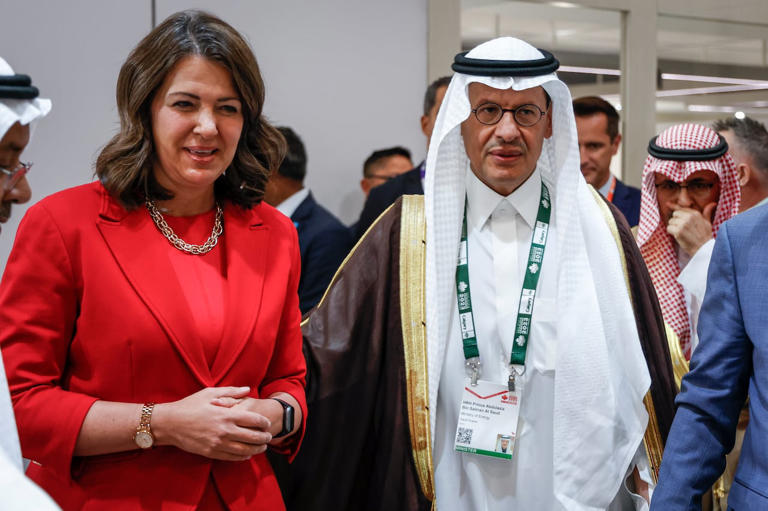
Alberta Premier Danielle Smith, left, tours the Saudi Arabia pavilion with Saudi Arabia's minister of energy, Abdulaziz bin Salman Al-Saud, at the World Petroleum Congress in Calgary on Sept. 18. 
(Jeff McIntosh/The Canadian Press)© Provided by cbc.ca

He added that countries must take action to ensure they're winning the environmental war while creating economic opportunity in a low-carbon world.

Speaking on Monday morning at the World Petroleum Congress about the IEA projection, Saudi Arabia's energy minister, Prince Abdulaziz bin Salman Al-Saud, said such forecasts are not always reliable and said the IEA had "moved from being a forecaster and assessor of the market to one practicing political advocacy."

Smith agreed with Al-Saud's point of view.

"His advice was, you take a measure of prudence so that you don't end up creating disruption and instability in the markets and then you can always increase," Smith said.

"I think that that kind of approach actually is a lot more practical than trying to rely on predictions for what has become ... increasingly, unfortunately, a political activist organization."

Conference runs until Thursday

Speaking about the conference, which runs until Thursday, Warren Mabee, director of the Institute for Energy and Environmental Policy at Queen's University in Kingston, Ont., previously told CBC News he'd be watching to see if those in the energy sector would demonstrate clarity around their climate plans.

"If you look at it from an environmental perspective, it's not moving fast enough. If you look at it from a corporate perspective, there's a real need to continue to service the existing markets," he said last week.

"It is important that energy continues to flow and that people have the energy they need in order to transition their economies. This can't all happen overnight."
Fears of a Second War in Europe as Azerbaijan Launches Military Attack

Allison Quinn
Tue, September 19, 2023 

Reuters


Azerbaijan carried out strikes on the disputed Nagorno-Karabakh region on Tuesday as it announced the launch of an “anti-terror” operation, a move that threatens to trigger another war in the region.

The country’s Defense Ministry said it was using “high-precision weapons” to “incapacitate” Armenian-backed forces and target Armenian military positions in a push to force out “formations of Armenia’s armed forces.”

Footage purportedly filmed in Stepanakert, the capital of Karabakh, which is called Khankendi by Azerbaijan, captured the sounds of loud shelling and artillery fire.

The Gravedigger Who Fears Digging His Own Son’s Grave in Nagorno-Karabakh

“At this moment, the capital Stepanakert and other cities and villages are under intensive fire,” an Armenia-based separatist group warned on social media, calling it a “large-scale military offensive.”

Officials in Baku, the capital of Azerbaijan, said civilians were free to leave the area via humanitarian corridors and insisted that “the civilian population and civilian infrastructure are not targets.”

Azerbaijan and Armenia have feuded for decades over Karabakh, which is internationally recognized as part of Azerbaijan but has a predominantly ethnic Armenian population.

Attack Drones Dominating Tanks as Armenia-Azerbaijan Conflict Showcases the Future of War

A bloody 2020 war between the two former Soviet rivals ended with Azerbaijan recapturing land of historical significance to Armenians. A Russian-brokered ceasefire deal to end that war did little to ease tensions in the region, with the two sides continuing to hurl allegations and periodic reports of shelling.

Armenia has said it does not have any armed forces in Karabakh, and on Tuesday said the “situation on the borders of the Republic of #Armenia is relatively stable.”

Azerbaijan launches military action in Karabakh 'to disarm' Armenians

Reuters
Updated Tue, September 19, 2023 


Gunfire and explosions heard in Stepanakert, Nagorno-Karabakh

BAKU (Reuters) -Azerbaijan launched military action in the Nagorno-Karabakh region, a step that could presage a new war in the volatile area but which Baku said was necessary to restore constitutional order and drive out Armenian military formations.

Karabakh is internationally recognised as Azerbaijani territory but part of it is run by breakaway ethnic Armenian authorities who say the area is their ancestral homeland. It has been at the centre of two wars - the latest in 2020 - since the 1991 fall of the Soviet Union.

It was not clear whether Baku's actions would trigger a full-scale conflict dragging in neighbouring Armenia or be a more limited military operation. But there were already signs of political fallout in Yerevan where Armenian Prime Minister Nikol Pashinyan spoke of calls for a coup against him.

The fighting could alter the geopolitical balance in the South Caucasus region, which is crisscrossed with oil and gas pipelines, and where Russia - distracted by its own war in Ukraine - is seeking to preserve its influence in the face of greater interest from Turkey, which backs Azerbaijan.

Loud and repeated shelling was audible from social media footage filmed in Stepanakert, the capital of Karabakh, called Khankendi by Azerbaijan, on Tuesday.

The Karabakh separatist human rights ombudsman, Gegham Stepanyan, said that two civilians had been killed and 11 people injured as a result of strikes by Azerbaijan's military. Reuters could not immediately verify his assertion.

In a statement announcing its operation, Azerbaijan's defence ministry spoke of its intention to "disarm and secure the withdrawal of formations of Armenia’s armed forces from our territories, (and) neutralise their military infrastructure".

It said it was only targeting legitimate military targets using "high-precision weapons" and not civilians as part of what it called a drive to "restore the constitutional order of the Republic of Azerbaijan".

Civilians were free to leave by humanitarian corridors, it added, including one to Armenia, whose prime minister, Pashinyan, said the offer looked like another attempt by Baku to get ethnic Armenians to leave Karabakh as part of a campaign of what he called "ethnic cleansing", an accusation Baku denies.

Ethnic Armenian forces in Karabakh said Azerbaijani forces were trying to break through their defences after heavy shelling, but that they were holding the line for now.

Armenia, which had been holding peace talks with Azerbaijan, including on questions about Karabakh's future, condemned what it called Baku's "full-scale aggression" against the people of Nagorno-Karabakh and accused Azerbaijan of shelling towns and villages.

"Driven by a sense of impunity, Azerbaijan has openly claimed responsibility for the aggression," Armenia's foreign ministry said in a statement.

Reuters could not immediately verify battlefield assertions from either side.

APPEAL FOR HELP

Armenia, which says its armed forces are not in Karabakh and that the situation on its own border with Azerbaijan is stable, called on members of the U.N. Security Council to help and for Russian peacekeepers on the ground to intervene.

Russia, which brokered a fragile ceasefire after the war in 2020 which saw Azerbaijan recapture swathes of land in and around Karabakh that it had lost in an earlier conflict in the 1990s, called for all sides to stop fighting.

Russia is in touch with both Azerbaijan and Armenia and has urged negotiations to resolve the Karabakh conflict, Kremlin spokesman Dmitry Peskov said on Tuesday, adding that Moscow considered ensuring civilian safety the most important issue.

Armenia has accused Moscow of being too distracted by its own war in Ukraine to protect its own security and has accused Russian peacekeepers in Karabakh of failing to do their job.

Speaking inside Karabakh with artillery rumbling in the background, Ruben Vardanyan, a banker who was a top official in Karabakh's ethnic Armenian administration until February, appealed for Armenia to recognise Karabakh's self-declared independence from Azerbaijan.

He also called on the international community to impose sanctions on Baku.

"A really serious situation has unfolded here," Vardanyan said on Telegram. "Azerbaijan has started a full-scale military operation against 120,000 inhabitants, of which 30,000 are children, pregnant women and old people," he said.

The Armenian government held a security council meeting to discuss the situation as people gathered in the government district in Yerevan, the Armenian capital, to demand the authorities take action.

Baku announced its operation after complaining that six of its citizens had been killed by land mines in two separate incidents, something it blamed on "illegal Armenian armed groups." Armenia said the claims were false.

The escalation occurred a day after badly needed food and medicine was delivered to Karabakh along two roads simultaneously, a step that looked like it could help defuse mounting tension between Azerbaijan and Armenia.

Until the last few days, Baku had imposed sweeping restrictions on the Lachin corridor - the only road linking Armenia with Karabakh - and had blocked aid on the grounds that the route was purportedly being used for arms smuggling.

Yerevan had said that Baku's actions had caused a humanitarian catastrophe, something Azerbaijan denied, and were illegal.

Armenia's foreign ministry had said on Monday that Azerbaijan's diplomatic stance looked like it was preparing the ground for some kind of military action.

(Reporting by ReutersWriting by Andrew OsbornEditing by)
View comments (15)

Azerbaijan strikes targets in Nagorno-Karabakh, launches military operation
Elsa Court
Tue, September 19, 2023 


Azerbaijan has launched a military operation in Nagorno-Karabakh with the claimed "goal of restoring the constitutional order," the Ministry of Defense of Azerbaijan announced on Sept. 19.

Azerbaijan has called it "local anti-terrorist measures." Baku also claimed that Yerevan has been attacking Azerbaijan's soldiers and building additional fortifications in the region.

The news comes after Azerbaijan claimed on Sept. 18 that Armenian forces fired on Azerbaijani outposts on the border between the two countries.

There's no evidence backing these claims at this time.

Armenian Defense Ministry said that the claims do not correspond to reality.

In Stepanakert or Khankendi, the de-facto capital of Nagorno-Karabakh, air raid sounded and there are reports of gunfire and explosions.

Attacks on communications infrastructure have led to a lack of internet and telephone connectivity in the territory, Andranik Shirinyan, Armenia Representative to Freedom House, said on X, formerly known as Twitter.

Nagorno-Karabakh is recognized as Azerbaijan's territory under international law, but its population of 120,000 is predominantly Armenian.

The territory declared independence in 1991 with Yerevan's military support. Until 2020, Armenia de facto controlled Nagorno-Karabakh together with the surrounding regions.

In 2020, Azerbaijan launched a military operation establishing control over parts of Nagorno Karabakh.

In November 2020, Russia brokered an armistice between Armenia and Azerbaijan. Moscow sent forces to patrol the Lachin corridor, the only road connecting Nagorno-Karabakh with Armenia.

In 2022, Yerevan accused Russia of failing its peacekeeping mission when Moscow began withdrawing its troops in 2022 and allowed Azerbaijan blockade Nagorno-Karabakh, preventing basic supplies from reaching the population.

The U.S. and EU have called on Azerbaijan to end the blockade.

In February 2023, he International Court of Justice (ICJ) ruled in favor of Yerevan's appeal to lift the blockade Nagorno-Karabakh.

Baku denied imposing a blockade.

Commenting on the issue, Azerbaijan President Ilham Aliyev said that "Armenians living in the Karabakh must either accept Azerbaijani citizenship or look for another place to live."

We’ve been working hard to bring you independent, locally-sourced news from Ukraine. Consider supporting the Kyiv Independent.


Why Armenia may be the next target for Russian aggression

Team Mighty
Mon, September 18, 2023 

Armenian opposition supporters march with torches during an anti-Russian rally against Russia's policy in the Karabakh conflict and its military action in Ukraine, in Yerevan on November 9, 2022. (Photo by KAREN MINASYAN/AFP via Getty Images)

The small but mighty nation of Armenia is in an interesting geopolitical neighborhood. On its western border is Turkey, a NATO ally but longtime enemy. To its east is another enemy, Azerbaijan, with which Armenia just fought over the disputed Nagorno-Karabakh region, claimed by both countries.

In the north is Georgia which is in a never ending war of words and spies (and sometimes actual wars) with Russia. Both Georgia and Armenia were part of the Soviet Union, but even when Russia invaded Georgia in 2008, support for Russia in Armenia was high.

To Armenia south is Iran, which, for the moment, is friendly to Russia-aligned Armenia. But in late September 2023, Armenia will host the United States for a joint military exercise. The move is far more threatening to Russia, which hosts Russian military forces as part of its Collective Security Treaty Organization (CSTO) membership. The exercises are the latest in a split between Russia and Armenia, which could permanently break their relations – or worse.

Armenia and Russia have retained close relations since the fall of the Soviet Union in 1991. Armenia joined Russia in the Commonwealth of Independent States, and joined the economic military and mutual aid collaboration of the CSTO in 1997. But since Prime Minister Nikol Pashinyan was elected to lead Armenia in 2018, the country has been slowly breaking away from Russia’s sphere of influence.

When fighting between Armenia and Azerbaijan broke out over the Nagorno-Karabakh region once again in 2020, Russian President Vladimir Putin didn’t immediately intervene, cooling relations between the two even more. Pashinyan went further in September 2023.

“Moscow has been unable to deliver and is in the process of winding down its role in the wider South Caucasus region," Pashinyan said. "The Russian Federation cannot meet Armenia's security needs. This example should demonstrate to us that dependence on just one partner in security matters is a strategic mistake."

The Prime Minister’s words come after Armenia announced it sent the first lady of the country to deliver humanitarian aid to Ukraine. It has also begun to further distance itself from the Russia-led CSTO. The military drills are just Armenia’s latest effort at realigning itself with the West.

Kremlin spokesperson Dmitry Peskov told reporters that the drills are “cause for concern” and Moscow will “monitor the situation.”

Armenia now finds itself in a Ukraine-like situation. Tired of dealing with Russian hegemony, which has caused a lot of economic hardships in Armenia, the Armenian government is beginning to look further and further West toward the U.S. and EU.

But Russia has built up a lot of armed forces inside Armenia. Even worse, Russians fleeing the war in Ukraine have moved to Armenia in droves, meaning Moscow has the ability to hide its own people among the refugees there, a potential hidden “fifth column” like the tactic used to seize Crimea.

Enemies on three borders, a country potentially filled with pro-Russian sympathizers and an ever-worsening lack of external will to keep Armenia independent could mean Armenia loses its independence entirely. It could be one more former Soviet republic absorbed by Putin’s dream of rebuilding the USSR.

Blinken likely to get involved in Armenia-Azerbaijan diplomatic engagement -US official

Humeyra Pamuk
Tue, September 19, 2023

U.S. Secretary of State Blinken chairs U.N. Security Council meeting on famine, food insecurity

By Humeyra Pamuk

UNITED NATIONS (Reuters) - The United States is engaging in diplomatic outreach after Azerbaijan launched "anti-terrorist activities" in the Nagorno-Karabakh region on Tuesday, U.S. officials said, adding that the incident was particularly dangerous.

A senior U.S. State Department official said U.S. Secretary of State Antony Blinken was likely to get involved in the next 24 hours in the diplomatic engagement already under way on the tensions between Armenia and Azerbaijan.

Armenia's Prime Minister Nikol Pashinyan and Blinken discussed the situation and stated the need for de-escalation, Interfax reported, citing the Armenian government.

Azerbaijan launched military action in the Nagorno-Karabakh region, a step that could presage a new war in the volatile area but which Baku said was necessary to restore constitutional order and drive out Armenian military formations.

A second senior State Department official said the incident overnight was "particularly egregious and particularly dangerous, so we'll obviously be in touch with all sides."

Karabakh is internationally recognized as Azerbaijani territory but part of it is run by breakaway ethnic Armenian authorities who say the area is their ancestral homeland. It has been at the center of two wars - the latest in 2020 - since the 1991 fall of the Soviet Union.

This week, the International Committee of the Red Cross (ICRC) was able to make simultaneous aid deliveries via the Lachin corridor and a separate road linking Karabakh to the Azerbaijani city of Aghdam.

Despite that, tensions have risen sharply this month, with Armenia and Azerbaijan accusing each other of building up troops.

"It's concerning that this happened overnight, especially because we did see some progress yesterday with shipments moving through the Lachin corridor," the first official said.

Armenia and Azerbaijan have already fought two wars over Karabakh in the three decades since the Soviet Union collapsed. Both had been part of the Soviet Union.

Analysts say successive rounds of talks, mediated variously by the European Union, the United States and Russia, have brought the two sides closer to a permanent peace treaty than they have been for years, but a final settlement remains elusive.

(Reporting by Doina Chiacu and Humeyra Pamuk; Writing by Daphne Psaledakis; Editing by Howard Goller)

Key Democrat chafes at US response to Armenia-Azerbaijan crisis

Lydia McFarlane
Fri, September 15, 2023


Sen. Bob Menendez (D-N.J.) expressed frustration Thursday with the Biden administration’s lack of urgency in addressing what the United States has described as a “rapidly deteriorating humanitarian situation” in Nagorno-Karabakh, a hotly disputed region at the center of rising tensions between Armenia and Azerbaijan.

Menendez, while chairing of a Senate Foreign Relations Committee hearing on the crisis, said he was “amazed” by the responses from Yuri Kim, the acting assistant secretary for the State Department’s Bureau of European and Eurasian Affairs.

“I have been doing this for 31 years. I am amazed sometimes at what the department comes before this committee and says,” he said at the end of the hearing.

The senator’s frustration centered on the administration’s application of Section 907 of the United States Freedom Support Act, which bans direct support to the Azerbaijani government. However, Kim listed various reasons that ban has been waived, mainly to bolster Azerbaijan’s anti-terror efforts and secure its border with Iran.

Menendez argued that the U.S. was only helping the regime of Azerbaijan’s authoritarian President Ilham Aliyev, whom the senator blamed for a blockade that has cut off Karabakh in apparent violation of a 2020 truce between Azerbaijan and Armenia.

“I have repeatedly expressed my deep opposition about waiving Section 907 of the Freedom Support Act, allowing the United States to send assistance to his regime,” he said. “This clearly alters the balance of military power between Azerbaijan and Armenia in Aliyev’s favor. I think Azerbaijan’s actions over the past three years have vindicated my skepticism.”

Earlier this year, Azerbaijani troops began a blockade of the Lachin corridor, which has reportedly led to the starvation of indigenous Armenians in the semi-autonomous Nagorno-Karabakh.

The U.S. State Department released a statement Sept. 10 warning of the “urgent need” for humanitarian supplies in the region, but it avoided assigning direct blame.

“The United States is deeply concerned about the rapidly deteriorating humanitarian situation in Nagorno-Karabakh,” the statement reads. “We note that humanitarian supplies are positioned near both the Lachin and Aghdam routes, and we repeat our call for the immediate and simultaneous opening of both corridors to allow passage of desperately needed humanitarian supplies to the men, women, and children in Nagorno-Karabakh. We also urge leaders against taking any actions that raise tensions or distract from this goal. The use of force to resolve disputes is unacceptable.”

When Menendez asked Kim why Aliyev refused to open to corridor despite numerous promises to do so, Kim responded, “We can have that conversation in a different setting, sir.”

Menendez shook his head before saying, “What would be classified?”

“I’ll give you an unclassified answer: He won’t open the corridor because he is trying to subjugate these people by starvation or by the threat of starvation and subject them to his will,” the senator continued.

In renewing the Section 907 waiver, the Biden administration has argued that targeted U.S. assistance is not undermining broader efforts to broker lasting peace between Armenia and Azerbaijan, who fought a 44-day war over Nagorno-Karabakh in 2020.

Yet the Armenian American community sees the extension of the waiver as a betrayal following Biden’s historic decision in 2021 to recognize, for the first time, the Armenian Genocide.

Menendez has been a consistent opponent of the waiver, and while the waiver is up for renewal, Menendez said he is doubtful the administration will change its stance.

Menendez delivered remarks on the Senate floor Tuesday urging the Biden administration to take immediate action in holding Aliyev accountable for the blockade, which has the characteristics of genocide, according to Article II of the U.N. Genocide Convention.

So far, there is one reported death amid severe food shortages in Nagorno-Karabakh, with many more expected to follow without immediate assistance. Kim noted that with U.S. pressure, one truck has made it through the blockade with humanitarian aid.

“One truck is not mercy,” Menendez said.

That truck was also Russian, which was cause for concern for members of the committee. Moscow mediated the 2020 ceasefire, but Kim said it was proving to be an unreliable broker.

Russia is Armenia’s sole provider of energy and has a military presence in the country. Kim said the crisis offered the U.S. an opportunity to rebalance Armenia’s geopolitical relationships in America’s favor, as Armenians become disillusioned with Russia as an ally amid the Ukraine war.

“[Armenians] are beginning to have second thoughts about having invited Russian troops onto their territory, relying on Russia as their sole source of energy, [and] hosting Russian military installations in their lands,” Kim said.

While Kim repeatedly reassured the committee that the State Department is working hard to reopen the corridor and avoid impending genocide, Menendez was unconvinced.

“I just hope you’ll tell the secretary [of State] on my behalf: I would hate to see this administration stand by and allow ethnic cleansing to take place on their watch and under their eye,” Menendez said.

Azerbaijani forces using Russian-style symbols are massing on the border of Armenia

James Kilner
Fri, September 15, 2023 

The ∀ symbol on military vehicle of the Azerbaijani army, which is moving to the border with Armenia

Azerbaijan’s military is building up its forces near Armenia and has painted its vehicles with “war markings” similar to ones used by the Russian army before it invaded Ukraine.

Open-source intelligence shared with the Telegraph by The Centre for Information Resilience (CIR) appears to back up Armenian claims that Azerbaijan is preparing for war.

Alongside intensified activity at Azerbaijani bases, CIR said that it had also detected an increase in flights between Azerbaijan and a military airfield in Israel, one of its allies, and opposing military manoeuvres by Iran, which is allied to Armenia.

“It is possible these are routine movements but analysis of other open-source data available may further indicate military build-up,” said Kyle Glen, a CIR investigator.

The Azerbaijani military symbols are an inverted “A” and stylised “F” and have been painted mainly on army infantry trucks and armoured personnel carriers.

Azerbaijan has not explained the symbols but the Russian military used “V” and “Z” symbols as battle group identifiers before it invaded Ukraine in February 2022 and, as in Russia, Azerbaijani nationalists have also adopted these military markings as avatars and logos.

For the Armenian government, Azerbaijan’s intentions are clear.

“We are concerned that a new war could start, or at least a large-scale build-up of aggression,” said Vahan Kostanyan, Armenia’s deputy foreign minister.

Azerbaijan has previously denied this. Its foreign ministry did not respond to the Telegraph’s requests for comment.

Armenia claims it is possible that Azerbaijan is preparing for an invasion

The focus of the force build-up is the border area around Nagorno-Karabakh, a mountainous parcel of land roughly the size of Somerset that Azerbaijan and Armenia have disputed and fought over since the breakup of the Soviet Union in 1991.

In a five-week war in 2020, roughly 7,000 people were killed. Azerbaijan defeated Armenia in the war, using Turkish drones for the first time, before the Kremlin stepped in to impose a ceasefire.

But analysts said that with the Kremlin distracted by its invasion of Ukraine and Western influence limited in the South Caucasus, Azerbaijan’s President Ilham Aliyev is now looking to finish his lifetime ambition of driving all ethnic Armenians out of the Nagorno-Karabakh region.

“We’re at a dangerous point and we are only a couple of steps away from a new conflict,” said Thomas de Waal, a senior fellow at the Carnegie Europe think tank.

The war in Ukraine has also ripped up traditional alliances, fracturing the inherently unstable South Caucasus.

Armenia’s most important ally and business partner has been Russia and the Kremlin had been seen as a guarantor of Armenian independence. Under the 2020 peace deal that stopped the war, Russian soldiers were given a peacekeeping role and the Kremlin keeps one of its biggest overseas military bases outside Gyumri, Armenia’s second city.

But Armenia has accused the Kremlin of ignoring Azerbaijani aggression because it didn’t back its invasion of Ukraine and it has shifted its diplomatic focus towards the West. Nikol Pashinyan, the Armenian prime minister, sent his wife to Kyiv this month with humanitarian aid and has hosted American soldiers for a military exercise, infuriating the Kremlin.

Mr de Waal said that Armenia’s diplomatic shift was understandable. “If Russia doesn’t protect you, what is the utility of the relationship?” he said.

If the war in Ukraine has been a disaster for Armenia’s relations with Russia, it has been a major boon for Azerbaijan, which has increased its gas supplies to Europe.

EU leaders have flown to Baku to shake hands with Mr Aliyev and have welcomed Azerbaijani diplomats in Brussels, making it far harder for them to constrain him. Azerbaijan has also rebuilt its damaged links with Russia, buying extra Russian gas to supplement its supplies to the EU.

Another major headache, analysts have said, is that any potential new war around Nagorno-Karabakh could have wider implications and make it more explosive than the 2020 war. As well as Israel, Turkey is an ally of Azerbaijan and Pakistan is an arms supplier. Armenia has developed an alliance with Iran, although it has insisted that this is not a military alliance, and it buys weapons from India.

Azerbaijan’s has painted its vehicles with 'war markings' similar to ones used by the Russian army

Pressure has been building around Nagorno-Karabakh over the past couple of years. There are regular deadly skirmishes along the border, but it is now firmly focused on a single stretch of road 20 miles long called the Lachin Corridor that links mainland Armenia with a mountain plateau.

Since December, Azerbaijan has blocked the Lachin corridor, first using civilian environmental protesters and then installing a blockade that stops even aid convoys from reaching the city of Stepanakert, all overseen by watching and impassive Russian soldiers.

Roughly 120,000 ethnic Armenians live on this mountain plateau, in and around Stepanakert, which is now cut off.

Luisine, who lives in Stepanakert, said that bread, meat and medical supplies are tightly rationed and that people have reverted to a form of mediaeval subsistence existence.

“There hasn’t been bread for three days,” she said by telephone. “When I walk through the streets I hear children begging their mothers for food and their mothers crying because they have no answers.”

Stepanakert’s stores are bare and there is no coffee, tea or tobacco. Farmers carry basic produce to market on foot or by donkey and cart.

When Luisine visited the town’s main market this week, she said that only fresh mulberries and mulberry juice were on sale. “It’s terrifying right now,” she said.

The Armenian government has accused Azerbaijan of “genocide”. Azerbaijan has said that it installed the roadblock to stop arms smuggling and has offered an alternative route to reach the town.

For Anjelika it is clear that another war is imminent. She said that Azerbaijan wants to drive her from her village, a few miles from Stepanakert, and her son has been drafted into the local ethnic Armenian army.

“Things are terrible. Very bad,” she said, insisting that she won’t leave. “There is nothing left, no butter, salt, cereals, vegetables or hygiene products. Nothing.”