Tuesday, September 19, 2023

A DIFFERENT KIND OF VLT
Very Large Telescope surprisingly finds exoplanet lurking in 3-body star system

Tereza Pultarova
SPACE.COM
Mon, September 18, 2023 

An artist's illustration of the gas giant discovered in star system HIP 81208. It looks like a cream-colored orb in the foreground. A bright star is seen glowing in the background.

The Very Large Telescope in Chile has photographed a planet orbiting a star in a multi-star system located some 480 light-years from Earth.

The exoplanet, 15 times more massive than our solar system's largest planet Jupiter, orbits a small star that itself orbits a larger star. Also orbiting the larger star is a brown dwarf, or "failed" star. Brown dwarfs are given such a gloomy moniker because these objects are not massive enough to sustain nuclear fusion in their cores like typical stars do, but are still too large to be called planets.

The system of the two stars and the brown dwarf, collectively called HIP 81208, has been known to astronomers for a long time. But the existence of an exoplanet in orbit of the smaller star came as a surprise to astronomers who recently re-examined images of the system taken earlier by the European Southern Observatory's (ESO) Very Large Telescope in Chile.

The newly discovered exoplanet is also quite massive, nearly large enough to be called a brown dwarf itself.

Related: The 10 most Earth-like exoplanets

The team's discovery marks the first hierarchical quadruple system to be found using direct imaging, ESO said in a statement. Most exoplanets are discovered through the so-called transit method, which involves observing subtle dips in a star's brightness caused by a planet passing in front of its disk from the point of the observer.


A diagram showing the quadruple-body star system.

Astronomers thought HIP 81208 was a system consisting of a massive central star (A, the central bright spot), a brown dwarf (B) circling around it, and a low-mass star (C) orbiting further away. However, a new study has revealed a never-before-seen hidden gem: an object (Cb), approximately 15 times more massive than Jupiter, orbiting around the smaller of the two stars (C). (Image credit: ESO/A. Chomez et al.)

Direct imaging is, in essence, traditional photography. However, astronomers using this method to capture deep space worlds use very powerful telescopes and super-sensitive cameras to see planetary subjects directly. And in the reanalyzed images, astronomers from the Paris Observatory detected the giant exoplanet creating a blob in the ring of light surrounding its parent star.

The discovery will help astronomers further their understanding of the formation of complex systems, ESO said in the statement.
Engineers utilize ancient materials to develop new ‘supercapacitor’ cement: It’s a ‘fascinating’ combination

Rick Kazmer
September 7, 2023·


The wise man built his house upon a … supercapacitor?

Engineers at the Massachusetts Institute of Technology believe that this could be the case as they continue working on a unique renewable-energy storage system created from cement, water, and carbon black. The latter material resembles fine charcoal, according to the MIT experts.

If the battery alternative proves successful, home foundations could soon be made from a unique mix of ancient and new materials, creating energy storage at home and beyond.

“The material is fascinating,” MIT professor Admir Masic said in a university report, “because you have the most-used man-made material in the world, cement, that is combined with carbon black, that is a well-known historical material — the Dead Sea Scrolls were written with it.”

It’s important as experts continue the search for effective storage for renewable energy from the sun, wind, and waves. Since those energy sources can only produce power during specific times, that power must be stored for later use.

For this invention, the MIT researchers have figured out how to make the chemistry that charges batteries work in cement. Part of the big breakthrough is including carbon black, which is highly conductive, into the mix. Water helps the carbon form “wire-like” structures in the cement as it dries. The material is soaked in a salty solution that is an electrolyte, which is key to the process, just like in regular batteries, all per MIT in a lengthy description of the process.

In short, some other key parts needed for the charge/discharge cycle are added, creating an environment that allows the supercapacitor to work. A big improvement is the use of readily  available materials like cement instead of lithium, which is rare and often takes invasive mining to gather.

The payoff is realized in the power storage. MIT researchers said that a nearly 59-cubic-yard piece of their cement, complete with nanosized carbon black, could store enough energy to power a house for a day.

“Since the concrete would retain its strength, a house with a foundation made of this material could store a day’s worth of energy produced by solar panels or windmills and allow it to be used whenever it’s needed. And, supercapacitors can be charged and discharged much more rapidly than batteries,” according to the research report.

The experts are still working out some specifics. The more carbon black is added, power storage capacity increases while structural strength is reduced.

One futuristic idea is to make concrete roads that can be charged with solar panels. A supercapacitor highway could then charge electric vehicles, similar to how certain cellphones can be juiced up wirelessly, per MIT.

The goal is for concrete to help create a cleaner planet instead of just contributing to the air pollution tally.

It’s “a new way of looking toward the future of concrete as part of the energy transition,” MIT Professor Franz-Josef Ulm said in the report.


Mike Pence Pushes Ban on TikTok, 
Calling It a Communist Platform


Gregory Korte, Annmarie Hordern and Joe Mathieu
Fri, September 15, 2023


(Bloomberg) -- Former Vice President Mike Pence said the US should ban TikTok, calling it a platform that allowed the Chinese government to obtain data on Americans without their knowledge.

“We ought to be banning TikTok. TikTok is a platform for the Chinese Communist government. They are collecting data on Americans every single day,” Pence said Friday in an interview with Bloomberg Television. “Young Americans need to know that their privacy is being compromised.”

Pence’s comments come before a policy speech he will deliver Monday on China. The relationship between the world’s two largest economies has gained growing attention in the 2024 presidential race. Republican candidates, including Pence, have criticized President Joe Biden, saying he must take a tougher line with Beijing over a number of issues.

Pence delivered a jab at one of his rivals for the Republican presidential nomination, entrepreneur Vivek Ramaswamy.

“I know that one of my competitors, Vivek Ramaswamy in the Republican primary, he had rightly described Tiktok as a digital fentanyl for American youth, and this week he signed up for Tiktok. He said he’d met with one of their executives and they changed his mind,” Pence said. “Well, they are never going to change my mind.”

The fight over TikTok is just one aspect of the growing tensions between the US and China over their technological ambitions. Biden has limited exports of advanced chipmaking technology over fears it could be used to help China’s military. China in turn has imposed its own restrictions, including on US chipmaker Micron Technology Inc.’s ability to sell products.

China is also seeking to ban the use of iPhones for state-owned enterprises — a blow to Apple Inc. that would broaden previously announced restrictions. National Security Council spokesman John Kirby this week told reporters that China’s moves on Apple appeared to be retaliation.

Earlier: China’s Apple iPhone Ban Appears to Be Retaliation, US Says

Huawei Technologies Co. also recently quietly revealed a mobile telephone that uses technology the US has sought to keep out of Beijing’s hands, questioning the efficacy of US chip restrictions.

“We led the fight internationally against Huawei among Western nations, and we won that fight,” Pence said. “If you remember, the UK and other nations were going all in on Huawei, and the United States said it’s not going to happen.”

Pence on Friday said Biden had “dropped the ball” on China. Still, he said the US should not seek to decouple from the country despite the threat it posed.

“We have to recognize that China’s the greatest economic and strategic threat of the United States of America,” Pence said, but added, “I think using access to the most powerful economy in the world, the United States of America, is a means of having China end decades of trade abuses, end intellectual property thefts, stop their military provocations, and end the human rights abuses.”

Pence said his speech on Monday would be focused on “giving China an opportunity to join the family of nations and respect the international rules of the road as I like to say.”

“The other piece of this, I believe in free trade with free nations,” Pence said. “We ought to be working on a free trade agreement with Japan. We ought to be looking to strengthen trading relationships with free nations across the Asia Pacific.”

UK
Significant artefacts found on Thornton site for homes

BBC
Fri, September 15, 2023 


Archaeologists excavating land for a proposed housing development say they have made some significant finds.

The team from Oxford Archaeology North (OAN) said the site in Lancashire has evidence of an Iron Age settlement and Roman occupation as well.

"Unlike other Iron Age sites in Lancashire we have found ceramics and pottery in Bourne Hill," said Paul Dunn of OAN.

Developer Ecclestone Homes has applied to build 158 homes on the site.

Mr Dunn said like other Iron Age excavations in the county the dig at Thornton, near Blackpool, had revealed round houses with their surrounding ditches, but the discovery of Iron Age bowls and Roman pottery marked it out from other excavations.

He added: "Lancashire was wet with marshland and settlements tended to be on a hill.

"It is a significant site because there of signs of a long occupation from the Iron Age to Roman Britain."

Wyre Council, which is liaising with OAN, said: "Ecclestone Homes have applied for planning permission to develop 158 homes on the site at Bourne Hill in Thornton.

"Planning permission is soon to be granted subject to a number of conditions. One of those is to conduct an archaeological survey and this is currently under way.

"So far, excavation works completed by a team of archaeologists from Oxford Archaeology North (OAN) has revealed findings of interest. Following the completion of the fieldwork on the site, OAN will produce a post-excavation assessment report."

Local MP Paul Maynard said he was excited by the discovery, adding: "It certainly piqued my interest.

"It is always interesting to know what the area you represent was like thousands of years before you came to represent it," he said.

The Conservative MP for Blackpool North and Cleveleys added: "We don't want to lose this important insight into our area's past before it is concreted over.

"There is a code of practice and I want to make sure it is adhered to."

Ecclestone Homes has been contacted for a comment.

British Museum: Chinese TikTok hit amplifies calls for return of artefacts

Fan Wang & Derek Cai - BBC News
September 6, 2023·

Escape from the British Museum tells the story of a jade teapot becoming human and wishing to return to China.


A short video series is racking up views in China, amplifying calls for the British Museum to return artefacts.

It tells the story of a jade teapot, played by a woman, looking for its way back to China.

The world-renowned museum has been under pressure after 2,000 items were reported to be "missing, stolen or damaged" last month.

The scandal has prompted demands from China and other countries for treasures to be returned.

Titled Escape from the British Museum, the three-part series from two Chinese social media influencers tells the story of a jade teapot coming alive and taking a human form as she tries to escape from the museum.

Her wish? To return home to China, with the help of a Chinese journalist she meets on the streets of London.

The teapot is a real artefact - and relatively recent addition to the British Museum. It was made in 2011 by a Chinese artist who specialises in intricate jade carvings.

Though not exactly a cultural relic, the delicate technique used in the making of the pot is a craft unique to China and that has resonated with the Chinese public.

First released on China's version of TikTok, Douyin, the series has been played 270 million times on the platform. It has also seen its creators, who claim to be independent content makers, gaining more than five million followers on Chinese social media apps within one week.

The series has also been strongly endorsed by state media. State broadcaster CCTV gave it a pat on the back this week, saying: "We are very pleased to see Chinese young people are passionate about history and tradition… We are also looking forward to the early return of Chinese artefacts that have been displaced overseas".

The series has also inspired other influencers to dress up as characters from ancient Chinese paintings and sculptures.

While traditional media have scrambled to decode the secret of the series' success, social media users credit it to the relatable message of "homecoming".

The show has fuelled calls among Chinese for treasures to be returned

"Maybe the Chinese cultural relics in the British Museum are also missing home right now. But they can only be squeezed into the crowded booths. Will they be thinking 'Bring me home' when they see Chinese faces there?" read one top-liked comment on Douyin.

"Eventually, there will be a day when [the items] come home in a dignified way," another user commented on Weibo.

Cultural heritage and ownership has become a more sensitive topic for the Chinese public in recent years amid rising nationalist sentiment. President Xi Jinping continues to push for a strong Chinese identity against growing tensions with the West.

Last year, luxury brand Dior was accused of "culturally appropriating" a Chinese traditional design for one of its skirts, triggering backlash online and protests in front of their stores.

And earlier this year around the Lunar New Year, a video of a Chinese influencer visiting the museum went viral on Douyin, in which the user said the treasures must be homesick. A comment suggesting the escape of the treasures be turned into an animation inspired the series.

The series' release has come as the British Museum faces intense pressure over the thefts. Last week, Chinese nationalist newspaper The Global Times issued an editorial asking the museum to give back its entire Chinese collection.

"We formally request the British Museum to return all Chinese cultural relics acquired through improper channels to China free of charge," said the newspaper, which is known to be a Beijing mouthpiece.

It's not the first time China has made such demands - which also echo the calls of other countries including Sudan, Nigeria, and Greece, which have all asked the British Museum to give back stolen artefacts.

Egypt has been asking for the return of the Rosetta Stone, forcibly taken by the British empire in 1801. Greece has also been campaigning for its Parthenon sculptures, also known as the Elgin Marbles, to be returned.

The British Museum has long argued that it's in the best position to protect such treasures, but critics say the latest thefts show this argument no longer applies.

Some British lawmakers still insist it is a safe place. The museum houses about eight million objects from six continents. Only 80,000 items - or about 1% of the total collection - are on display at any given time.

SpaceX's Vacuum Raptor Engine Aces Cold Space Test for Artemis Moon Missions


Passant Rabie
SPACE.COM
Fri, September 15, 2023 

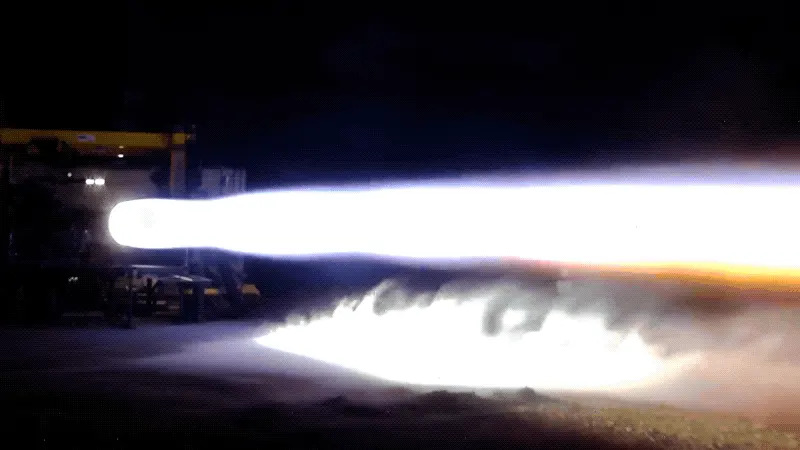
The test was performed last month.


The test was performed last month.

In preparation of landing humans on the Moon as part of the ongoing Artemis program, SpaceX recently ran a test of one of its lunar lander engines while simulating the cold temperatures of space.

The private space venture demonstrated a vacuum-optimized Raptor, evaluating the engine’s performance “through a test that successfully confirmed the engine can be started in the extreme cold conditions resulting from extended time in space,” NASA announced on Thursday.

The test, which took place last month, was the second one to demonstrate the Starship Raptor engine’s ability to perform on the lunar surface. In November 2021, SpaceX tested the engine’s ability to perform a descent burn to land on the surface of the Moon. During the 2021 test, which lasted for 281 seconds, “Raptor demonstrated the powered descent portion of the mission, when the Starship [Human Landing System] leaves its orbit over the lunar surface and begins its descent to the Moon’s surface to land,” NASA wrote.

Despite the success of the two tests, there is concern that Starship could end up delaying NASA’s Artemis missions. Earlier in June, NASA’s Associate Administrator Jim Free said that Artemis 3 will likely be pushed to 2026 due to Starship delays. Free’s concern followed Starship’s first test flight in April, which ended with the rocket exploding in the skies


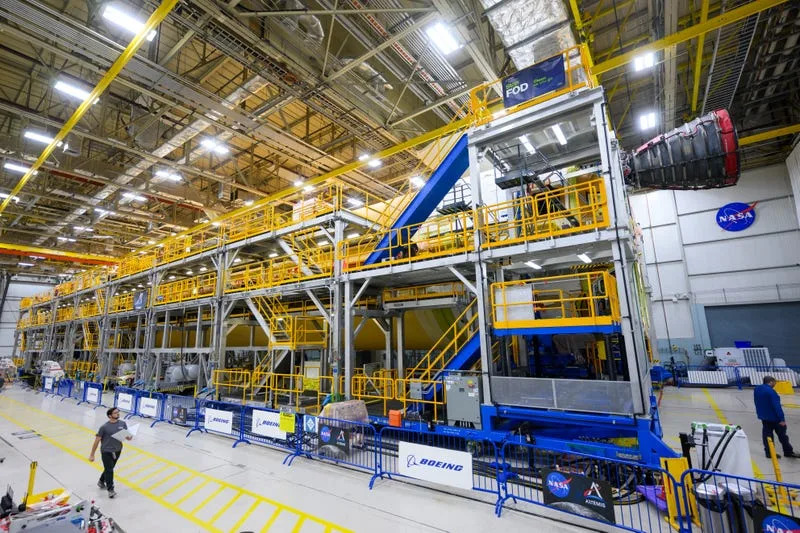
At NASA’s Michoud Facility in New Orleans, Aerojet Rocketdyne and Boeing teams installed the first RS-25 engine on the core stage for NASA’s Artemis moon mission. The 212-ft core stage displays the newly added engine E2059.


At NASA’s Michoud Facility in New Orleans, Aerojet Rocketdyne and Boeing teams installed the first RS-25 engine on the core stage for NASA’s Artemis moon mission. The 212-ft core stage displays the newly added engine E2059.

NASA has its own Moon rocket to worry about it, though. This week, the space agency installed the first of four RS-25 engines on the core stage of the Space Launch System rocket (SLS) that will launch the crewed Artemis 2 mission to the Moon in 2024.

The space agency has a dozen RS-25 engines taken from retired Space Shuttles and modified for use on the SLS core stage, four engines have already been used for the Artemis 1 mission in 2022. The four engines are located at the base of the rocket’s core stage, and will fire non-stop for over eight minutes during launch and flight.

NASA has come under heat for going over budget on its SLS rocket, which space agency officials recently admitted to be unaffordable.

Want to know more about humanity’s next giant leap in space? Check out our full coverage of NASA’s Artemis Moon program, the new Space Launch System (SLS) rocket and Orion spacecraft, the recently concluded Artemis 1 mission around the Moon, the four-person Artemis 2 crewNASA and Axiom’s Artemis Moon suit, and the upcoming lunar Gateway space station

Redwire Has 3D Bioprinted the First Human Knee Meniscus in Space

Published on September 13, 2023 by Madeleine P.
3D bioprinted knee meniscus

When it comes to innovation in outer spaceadditive manufacturing is on the front lines as we continue to push boundaries while exploring the final frontier. Indeed, the flexibility and ability to produce locally are two of the main reasons why the technologies have been adopted for space exploration with applications ranging from 3D printed habitats to food. Now we have yet another project to include. Redwire has announced that it has successfully 3D bioprinted the first human knee meniscus in orbit. This was done in the 3D BioFabrication Facility (BFF) on the International Space Station (ISS). The part was made as part of the larger project BFF-Meniscus-2 in conjunction with The print was conducted as part of the BFF-Meniscus-2 Investigation with the Uniformed Services University of the Health Sciences Center for Biotechnology (4D Bio3). 4D Bio3 is a biomedical research center exploring adapting biotechnologies specifically for warfighter benefit, including of course bioprinting.

Redwire is no stranger to research on the ISS. They have developed 20 research facilities for the ISS with 10 currently operating on the station. This includes work into seeing whether regolith can be used to 3D print structures on the Moon and Mars. Additionally, it is actually the second time that they have worked on making a 3D bioprinted knee meniscus, in 2019 the BFF 3D printed a meniscus-shaped scaffold using bioink derived from human tissue proteins. But this experiment will be the first time that a full human knee meniscus has been bioprinted in space using living cells. The company hopes that it will open the door to improved treatments for meniscal injuries which aren’t just one of the most widespread knee injuries worldwide but also one of the most common injuries for U.S. service members.

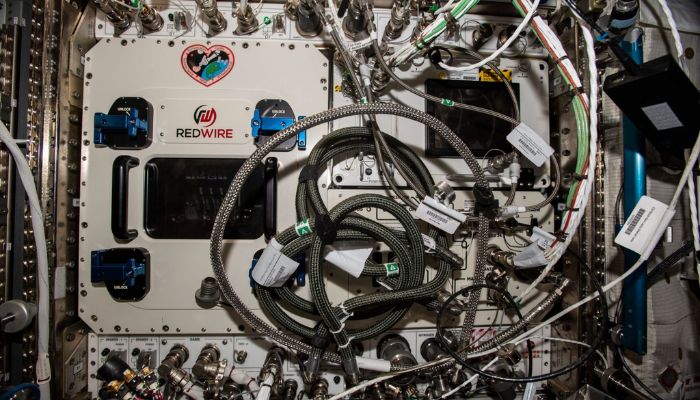
The 3D bioprinted meniscus was done on Redwire’s special bioprinter which was recently installed on the ISS

Making the 3D Bioprinted Meniscus

As mentioned, meniscal injuries, and most specifically torn menisci, are some of the most common knee injuries. Considering that the two menisci in the knee work as shock absorber in the knee, this can be a real issue. Especially as symptoms often involve the catching or locking of the knee joint as well as the inability to fully extend or bend it. This is why Redwire believes this incredible milestone could have considerable implications for human health even on Earth.

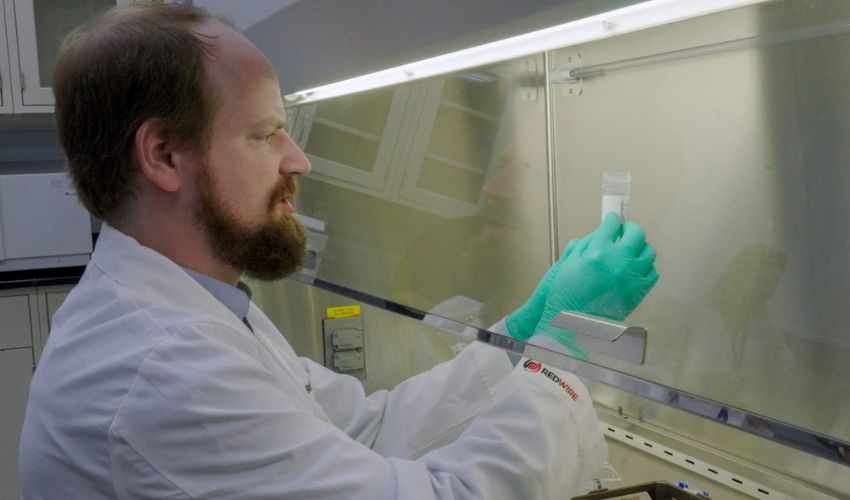
The BFF created the 3D bioprinted meniscus by using living human cells in bioinks which were then printed on a bioprinter that was installed on the ISS. Once completed it was cultured for 14 days on the ISS in Redwire’s Advanced Space Experiment Processor (ADSEP). The meniscus was then returned to Earth onboard the SpaceX Crew-6 Mission for analysis with investigation conducted by NASA astronauts Frank Rubio, Warren “Woody” Hoburg, and Stephen Bowen and UAE astronaut Sultan Al Neyadi. Furthermore, already the company is planning future projects. On an upcoming SpaceX CRS-29 resupply mission in November, the company will launch microgravity research payloads focused on pharmaceutical drug development and regenerative medicine including an experiment to bioprint cardiac tissue according to a press release.

Discussing the completion of the 3D bioprinted knee meniscus, Redwire Executive Vice President John Vellinger concludes, “This is a groundbreaking milestone with significant implications for human health. Demonstrating the ability to successfully print complex tissue such as this meniscus is a major leap forward toward the development of a repeatable microgravity manufacturing process for reliable bioprinting at scale.” You can learn more on Redwire’s website HERE or in the video below where Dr. Aaron R. explains more about why the company has undertaken this project.


*All Photo Credits: Redwire


 High school students unveil new data on NASA’s earth-killer asteroid experiment


Art Raymond
Thu, September 14, 2023 

This illustration made available by Johns Hopkins APL and NASA depicts NASA’s DART probe. | Steve Gribben, Johns Hopkins via Associated Press

Was last year’s NASA test to push a potential planet-killing asteroid away from Terra Prime even more successful than previously thought?

A group of California high school students used their school’s observatory to monitor the aftermath of the DART mission’s collision with the distant Dimorphos asteroid last September and discovered the intentional crash worked even better than early NASA data indicated.

Sponsored by NASA’s Planetary Defense Coordination Office and led by the Johns Hopkins University Applied Physics Laboratory, the Double Asteroid Redirection Test, or DART, is a $325 million project designed to crash the 1,260-pound spacecraft traveling at 14,000 mph into Dimorphos, an asteroid that’s 525 feet in diameter and 7 million miles from Earth.

Related

Earth strikes back: NASA successfully crashes spacecraft into asteroid in planetary defense test

NASA confirms that mission to change orbit of asteroid was a smashing success

The point of the exercise was to see how significantly the previous path of Dimorphos could be altered by the impact in a technique NASA calls “asteroid deflector by kinetic impactor.”


Dimorphos is a moonlet asteroid, orbiting a larger asteroid named Didymos, which is about a half-mile in diameter. Mission officials have stressed throughout the DART mission that the binary system “is not on a path to collide with Earth and therefore poses no actual threat to the planet” but is the “perfect testing ground” to see if an asteroid’s natural path can be altered via a high-velocity impact.

Before DART’s impact, it would take Dimorphos 11 hours and 55 minutes to make one revolution around Didymos. NASA was hoping the DART collision could alter the cycle by about 73 seconds, but observations made in the weeks following impact determined the results were much more significant, altering Dimorphos’ revolution period by some 33 minutes.

But students from the Thacher School, a private boarding school for ninth through 12th graders in Ojai, California, used the school’s own research-grade observatory to track Dimorphos and Didymos for several months last fall. Their findings revealed that Dimorphos’ orbital period was a full minute longer than the time reported by NASA last year, according to a recent report in New Scientist.

The Thacher School’s student findings brought the asteroid’s orbital period to 34 minutes shorter than it was pre-impact.

“That was inconsistent at an uncomfortable level,” Jonathan Swift, a math and science teacher at the Thacher School who took part in the research, told New Scientist, per Smithsonian Magazine. “We tried our best to find the crack in what we had done, but we couldn’t find anything.”

The unexpected findings were first shared by Swift and his students at a June meeting of the American Astronomical Society and the methodology was confirmed to Smithsonian Magazine by Peter Veres, an astronomer at the Center for Astrophysics, Harvard & Smithsonian.

Scientists aren’t sure exactly what is behind the degradation of Dimorphos’ orbital time around Didymos but one theory posits that giant boulders and other material that was blasted off the asteroid following the DART collision may be falling back to the surface, resulting in more collisions that are reducing its orbital cycle, according to Smithsonian Magazine’s report.

Right now, no known asteroid larger than 140 meters in size has a significant chance to hit Earth for the next 100 years, but only about 40% of those asteroids have been found as of October 2021, according to NASA.

As the collective knowledge-base and expertise grows to include comprehensive identification and tracking of future potential hazards from space, NASA Program Scientist Tom Statler last year said the DART mission will help prepare the residents of Earth to take effective action in the event of some distant, pending catastrophe.


NASA Probe to Drop Off Asteroid Samples After 7 Years in Deep Space

Sharon Adarlo
Tue, September 19, 2023 


Pay Dirt


After a monumental journey through outer space that took years and countless miles, NASA's OSIRIS-REx spacecraft is scheduled to release a "mini-fridge size capsule" over the Utah desert this week, according to the space agency.

The capsule contains truly precious cargo, about 8.8 ounces of rock and dust from asteroid Bennu tens of millions of miles away.

If carried off successfully, it could mark the first time NASA has nipped a sample of asteroid and taken it back to Earth in an extraordinary delivery. First-time honors in bringing an asteroid sample back to Earth belong to the Japanese spacecraft Hayabusa, which had taken minute samples of the asteroid Itokawa back in 2010.

Many scientists are eager to study this asteroid sample from Bennu because they believe it contains materials that date back to the earliest days of the solar system, according to OSIRIS-REx deputy project manager Michael Moreau. It could also contain organic molecules that scientists think hitched rides on meteorites that slammed into Earth and helped seed life on our planet.

Touch and Go

OSIRIS-REx first embarked on its mission on September 8, 2016, and arrived two years later at Bennu, an asteroid that has a diameter of around 1,614 feet and orbits the Sun every six Earth years.

The asteroid is interesting because it's extraordinarily old, with material dating back to at least 4.5 billion years. Bennu is also relatively close to Earth compared to the solar system's many asteroids, which primarily reside in the asteroid belt between Mars and Jupiter, making it a tantalizing object of study.

When OSIRIS-REx first arrived at Bennu, it orbited the asteroid for two years, and then in 2020, it made a bold maneuver — a "Touch-And-Go" move — that saw the spacecraft land on the asteroid briefly, collect samples, and then used its on-board thrusters to launch itself off of the rock.

In 2021, after a last flyby around the asteroid, OSIRIS-REx finally started journeying back to Earth.

Even after it releases its return capsule over Earth in less than a week, NASA says OSIRIS-REx's job is not quite complete. When it makes its payload delivery, the spacecraft will not stop to land on our planet but will instead veer its path towards the asteroid Apophis, where it is scheduled to arrive in 2029.

More on OSIRIS-REx: Watch Nasa's Spacecraft Touch Down On A Tiny Asteroid

How asteroid Bennu caught NASA's OSIRIS-REx spacecraft by surprise and nearly killed it along the way

Tereza Pultarova
Mon, September 18, 2023
 
A mass of gravel and dirt ejected from the surface of asteroid Bennu by the touchdown of NASA's OSIRIS-REx probe.


When the OSIRIS-REx probe arrived at asteroid Bennu, it found a body that looked and behaved quite differently from what scientists had expected.

When NASA started planning its first mission to snatch an asteroid sample, the space rock science community was abuzz with excitement over another asteroid mission — Japan's Hayabusa. In 2010, for the first time in history, that mission triumphantly delivered to Earth a fragment of an asteroid, a space rock called Itokawa. A few years earlier, Hayabusa, had mapped the whole of Itokawa, revealing a landscape strewn with boulders but also featuring smooth beach-like plains, or ponds, of gravel and sand.

It was these images of Itokawa that guided the design of NASA's OSIRIS-REx mission. But as it turned out, despite some superficial resemblance, the asteroid that OSIRIS-REx was to head for turned out to be completely different.

Related: Queen legend Brian May helped NASA ace its asteroid-sampling mission, new book reveals

"The strategy for planning with OSIRIS-REx was to take Itokawa and all of the observations of asteroid Bennu that we had made of it before," Kevin Walsh, a planetary scientist at Southwest Research Institute and lead scientist of the Regolith Development Working Group of the OSIRIS-REx mission, told Space.com. "So we would look at the different way [the two asteroids] reflect light and the different way they reflected radar, and every indication was that Bennu would have more ponds of fine grains than Itokawa."

It wasn't until OSIRIS-REx arrived at asteroid Bennu, two years after its 2016 launch from Kennedy Space Center at Cape Canaveral, Florida that the mission team discovered that their assumptions were "totally wrong," said Walsh. Instead of wide plains of sand and gravel interspersed with accumulations of boulders, the spacecraft's cameras revealed a "bouldery hellscape" that had none of the smooth open areas on which they envisioned OSIRIS-REx to touch down and collect its sample.

The mission's chief scientist Dante Lauretta told Space.com in an earlier interview that the team had concerns the sample collection might not be possible at all.

"When we designed the spacecraft, we had a design targeting accuracy [for the landing] of about 50 meters [164 feet]," Lauretta said. "The thermal properties, also the radar properties [of Bennu], really looked like a smooth surface. So when I first saw that [the surface was completely different], I really thought we might be in trouble there."

A stereoscopic image of a rocky outcrop on the surface of asteroid Bennu.

As the team grappled with the question whether their precious spacecraft could possibly safely touch down amid the towering boulders that rose against Bennu's feeble gravity into heights unseen on Earth, they received support from an unexpected source. Legendary guitarist of the rock band Queen and well-known astronomy aficionado Sir Brian May reached out to Lauretta to express his interest in the mission. May, who holds a PhD in astronomy, which he famously completed after a 30-year hiatus enforced by Queen's rise to fame in the 1970s, is also known for his interest in stereoscopic imaging. It was this skill he offered to the OSIRIS-REx team, which was at that time struggling to find a boulder-free-enough area to land the spacecraft on.

Stereoscopic imaging replicates the ability of human eyes to perceive surrounding space in three dimensions. Dedicated stereo cameras help Martian rovers navigate their exploration site. But the OSIRIS-REx spacecraft wasn't fitted with a stereo camera. May, however, knew his way around this issue by selecting images of various spots on Bennu taken from different angles and processing them for 3D viewing.

"Once you have a stereo image of that particular potential landing site, you can really make that instinctive judgment as to whether things are going to work out," May told Space.com in an earlier interview. "You see that there is this boulder, how much slope there is, how dangerous it is to get on and to get off."

With May's help, the OSIRIS-REx team eventually identified a sufficiently obstacle-free crater to attempt the sample collection. Still, the team had to remotely reprogram the spacecraft to accomplish the feat. Instead of the originally envisioned 164-foot-wide (50 m) landing side, the van-sized spacecraft had to squeeze into the merely 33-foot-wide (10 m) Nightingale Crater.


Asteroid Bennu turned out to be completely different from what scientists had expected.

"When we launched, we planned to use a laser altimeter for the guidance down to the asteroid because we were expecting these big smooth areas," Lauretta said. "We just thought that we would need to know that we were coming down at the right rate towards the surface. Instead, we had to completely change the strategy, using the onboard cameras and performing an extensive mapping campaign, sometimes mapping features as small as a couple of centimeters to put into the spacecraft's memory so that it could make real decisions and guide itself down to the safe location."

The descent was smooth. But when OSIRIS-REx's sample collection device pressed into the asteroid's surface, something unexpected happened. Contrary to expectations, the surface behaved almost like a swamp. Within a few seconds, the spacecraft sank 19 inches (50 cm) deep into Bennu. As the sample collection head sucked in the sample and the spacecraft's backaway thrusters fired, a huge wall of debris rose from the crater, engulfing the ascending spacecraft.

The OSIRIS-REx team only learned about what happened when images from on-board cameras reached Earth. The researchers later admitted that the stirred-up gravel could have damaged the retreating spacecraft.

Walsh described the touchdown as "scientifically interesting, although operationally challenging." Just like the team misjudged Bennu's surface, it turned out that they also misjudged its density. The surface layer was unexpectedly fluffy, behaving more like water than solid material, something the analysis of measurements from Bennu's orbit didn't indicate.

Related stories:

Asteroid sample incoming: OSIRIS-REx team preps for September landing of Bennu bits
NASA conducts crucial drop test ahead of Sept. 24 arrival of OSIRIS-REx asteroid sample
Farewell, Bennu! NASA spacecraft leaves asteroid to bring pieces of space rock to Earth

"When we did our calculations, initially we were taking the density of all of Bennu, which is 1.1 grams per cubic centimeter," said Walsh. "But our models showed afterwards that to be able to compress the surface so much and drive the tag head so deep into the surface, the surface density would have to be like 0.4 grams per cubic centimeter. And so it was less than half as dense as the entire body."

Scientists still don't know why Bennu's surface has this waterlike quality. Walsh thinks that smaller sand-like particles may have filtered through the gaps between the bigger rock fragments into the asteroid's interior, leaving a lot of empty space in the asteroid surface layer. That would explain the unexpectedly low density of the surface, but also the overall density of the asteroid that appears to be much higher than that of the surface.

Despite the challenges, OSIRIS-REx collected much more of the asteroid material than the mission aimed for, and the spacecraft will drop off this cargo at Earth on Sunday, Sept. 24. Lauretta hopes to release the first scientific results from the sample analysis by the end of this year. And chances are that Bennu will surprise researchers again.

OSIRIS-REx: Purdue scientist will be one of the first to examine asteroid material

Noe Padilla, Lafayette Journal & Courier
Tue, September 19, 2023 

WEST LAFAYETTE, Ind. — After more than a decade of work, NASA’s OSIRIS-REx asteroid-study project is scheduled to return to Earth on Sept. 24 landing in the Utah desert with pieces of the asteroid Bennu.

Once it lands, the spacecraft’s sample return capsule will be sent off to a clean lab at NASA’s Johnson Space Center in Houston, and while there, Michelle Thompson, an associate professor of earth, atmospheric, and planetary sciences at Purdue’s College of Science, will be one of the first six lead investigators from the science team to study the samples.

More: Purdue's 'Cradle of Astronauts': Now 28 Boilermakers who have traveled into space

“This is a truly once-in-a-lifetime — maybe a once-in-several-lifetime — experience,” Thompson said in a press release.

“OSIRIS-REx was selected in 2011, the year I started my PhD, and launched in 2016, the year I got my PhD. It reached Bennu in 2018, the year I came to Purdue. And now I am going to be one of the first humans to get to study it. Bennu is a treasure trove of information; this is literally the project of my career.”

Prior to NASA’s OSIRIS-REx’s return, there were two other missions with the goal of retrieving asteroid samples for scientists to study back on Earth, Hayabusa and Hayabusa2, which were both launched by the Japan Aerospace Exploration Agency.


Michelle Thompson, planetary scientist and expert in space weathering, will be one of the first six humans — and the first woman — to analyze samples of asteroid Bennu brought to Earth by OSIRIS-REx.
 (Purdue University photo/Rebecca Robiños)

Both missions returned with small amounts of samples, the first mission returned with less than a milligram of material, while the second one returned with 5.4 grams of material.

The OSIRIS-REx mission obtained potential return with more than 100 grams of material according to camera observations from Bennu, a carbonaceous asteroid that passes within 186,000 miles of Earth, closer than the moon.

After its arrival, Thompson and five other scientists will have 72 hours to analyze and evaluate the samplers to determine the initial characteristics of the asteroid materials.

Thompson's research focuses on the process called space weather or in other words, she analyzes the alteration of planetary materials after their formation, specifically the evolution of airless body surfaces.

She’s previously studied samples of moondust brought to Earth by the Apollo missions and spent months at Johnson Space Center preparing for the asteroid samples’ arrival.

By understanding the material's surface — the very top few millimeters of rock and dust, called regolith — Thompson hopes it will shed light on the composition of asteroids and how their properties change and reflect their makeup.

OSIRIS-REx’s name stands for Origins, Spectral Interpretation, Resource Identification and Security — Regolith Explorer, which encapsulates the program’s goal. Scientists are hoping that the results of the mission and study will help give the scientific community insight into the origin of the planets and the earliest history of the solar system.


“Observing asteroids from spacecraft and telescopes is incredibly important, but nothing can replace analyzing samples in the laboratory,” Thompson said.

“Sample return missions are a cornerstone of planetary science, and this close-up look at Bennu material will give us details we couldn’t see from orbit and help us understand how to interpret what we’re seeing on other faraway asteroids. It makes our understanding more comprehensive, more three-dimensional.”

Beyond the notion of studying the asteroid’s material for the sake of science, by coming to understand what asteroids are made of, it could help future humans and explorers to discover if asteroids could contain materials to mine for future vehicles, missions and habitats.

Scientists are also hoping to gain a deeper understanding of asteroids’ physical chemistry and how their orbit is changing with time, particularly of asteroids like Bennu that come close to Earth.

“Asteroids are relics of the early solar system,” Thompson said. “They’re like time capsules. We can use them to examine the origin of our solar system and to open a window to the origin of life on Earth.”

Although scientists have examined materials from asteroids that have entered Earth’s atmosphere before, the material collected from this mission will be unlike anything those scientists have seen before.

Due to the friction from the atmosphere, asteroids that don’t burn up and are able to make it to the Earth’s surface no longer resemble the material floating in space.

By escorting the material in an insulated still-pristine condition, scientists will get to look at the asteroid as it was in its original environment, lending understanding to a wide range of planetary science.

“These samples have been on their way back to us for a couple of years,” Thompson said.

“We have had years to prepare for what we might find and how we might study the sample.

“Looking at the organic molecules from Bennu, we’re going to get an understanding of what kinds of molecules could have seeded life on early Earth.

“Information about what compounds, what elements are there, and in what proportions. We won’t find life itself, but we’re definitely looking at the building blocks that could have eventually evolved into life.”

This article originally appeared on Lafayette Journal & Courier: Purdue scientist will be one of the first to examine asteroid material


What if NASA's OSIRIS-REx asteroid-sample capsule crashes to Earth this weekend?

Elizabeth Howell
Tue, September 19, 2023 

A sample space capsule parachuting to Earth in a test.

After seven years flying through space, a spacecraft capsule carrying a precious asteroid sample will touch down on Earth under parachutes this weekend. But what if it crashes?

A crash of NASA's OSIRIS-REx descent capsule on Sept. 24 is "the stuff of my nightmares," the mission's principal investigator, Dante Lauretta of the University of Arizona, said recently. (OSIRIS-REx stands for "Origins, Spectral Interpretation, Resource Identification, Security-Regolith Explorer.")

"If that parachute doesn't open and we're in the 'hard landing' contingency, fortunately we have a backup team member who will help me with the emotional state and also, probably be the one I send out there to go deal with it," Lauretta said of the asteroid mission during a livestreamed press conference on NASA Television on Aug. 30. "We've got a great plan."

OSIRIS-REx made the first-ever visit to the near-Earth asteroid Bennu in 2020. In October of that year, the probe swooped down to snag samples in a touch-and go maneuver that almost saw the spacecraft swallowed up by the surprisingly spongy asteroid.

Related: Asteroid Bennu nearly swallowed up NASA's sampling spacecraft

OSIRIS-REx survived that sampling run and is now in the home stretch of its asteroid-delivery effort. If all goes to plan, the return capsule will touch down gently on Sunday morning under parachutes in the Utah desert.

But sometimes things don't go to plan. So the recovery team has been practicing for numerous other scenarios, to preserve as much of the sample as possible in the event of a landing anomaly. The OSIRIS-REx team wants to get as much scientific return as possible from the $1 billion mission no matter what happens on Sunday.

Lauretta said that, if a crash occurs, the team will take the sample into a clean room, which he called "a safe environment," to reduce contamination as much as possible. Contingency supplies will also be available on site if the recovery team needs them, he said.

"We practice beforehand to optimize accuracy and minimize the chances of mistakes during the capsule's Earth arrival," Sandra Freund, OSIRIS-REx program manager at the aerospace company Lockheed Martin, added in an Aug. 17 NASA blog post. "By simulating different scenarios, our team can anticipate challenges and work through contingency plans to effectively address them."

The recovery practice has been ongoing for years, and culminated with a series of simulations in Utah in the zone where the spacecraft should touch down. In April, a practice capsule was placed in the field in different positions to allow the team to practice retrieving it. Then the team ramped up the effort by using a truck in July, and then a helicopter in September, to simulate dropping off the capsule at higher and higher speeds.

The recovery professionals were then timed to see how quickly they could take out the sample and bring it back to a local lab in the first of a long series of processing steps. "The faster the better," Richard Witherspoon, OSIRIS-REx ground recovery lead at Lockheed Martin, wrote in another NASA blog post in May.

There have only been a few other spacecraft that have brought asteroid samples back to Earth, and each one of these missions gives us a little more information about how the early solar system was formed. NASA is taking lessons learned from its other missions that sent space samples to Earth, sometimes not entirely successfully.

Related: Dramatic sampling shows asteroid Bennu is nothing like scientists expected


side-by-side images showing a spacecraft's robotic arm about to contact a gravelly asteroid (left) and stirring up lots of dirt and rock after contact (right).

RELATED STORIES:

OSIRIS-REx: NASA's asteroid study and sample return mission

The greatest asteroid missions of all time!

NASA's OSIRIS-REx probe could make a 2nd stop at infamous asteroid Apophis

Famously, the agency's Genesis capsule crashed in 2004 due to four switches being installed backward in its re-entry system. Fortunately, however, the ions (charged particles) of the solar wind that it snagged were still lodged deep within the capsule, underneath the damaged collector surfaces. Scientists were able to use the sample to reveal several insights about planetary formation — for example, the Genesis sample suggested that Earth lost some of its atmosphere early in its history, according to NASA.

Two years later, the Stardust spacecraft had more success landing in the Utah desert. Investigations of the samples it picked up from Comet Wild-2 in 2004 continue to yield intriguing insights. For instance: Aside from numerous comet bits, probable interstellar particle tracks were detected by a team led by principal investigator Don Brownlee, of the University of Washington.

Other robotic sample return missions over the decades include several Soviet Luna spacecraft that visited the moon, the Chinese Chang'e-5 lunar sample return mission, and the Hayabusa and Hayabusa2 missions from the Japan Aerospace Exploration Agency. As always, NASA reviews the available documentation from such missions to form procedures and inform its own planning.

In whatever shape the descent capsule arrives, investigators on Earth will be kept busy for years — indeed, decades — with the samples returned by OSIRIS-REx. Meanwhile, the original spacecraft will go on to a new mission. Its next task will be to examine another near-Earth asteroid, Apophis, in 2029 under an extended mission known as OSIRIS-APEX.


Nasa ‘in final leg’ of mission to halt asteroid armageddon

Sarah Knapton
Sat, September 16, 2023

An Atlas V rocket carrying the OSIRIS-REx spacecraft lifts off from Cape Canaveral in 2016 on seven-year journey - the first US mission to sample an asteroid - Nasa

On 24 September 2182, there is a chance that an asteroid named Bennu will hit Earth with the force of 22 atom bombs.

The Empire State Building-sized space rock swings close to our planet every six years but will have its closest shave 159 years from now.

Although the odds of a catastrophic strike are 1 in 2,700, Nasa was concerned enough to launch a spacecraft to Bennu seven years ago to collect samples, in case an Armageddon-style deflection mission is required.

Asteroid samples from the OSIRIS-REx mission will finally reach Earth next week, touching down in the Utah desert on Sept 24 - the same date as the future apocalypse Nasa is seeking to avert.

“We are now in the final leg of this seven-year journey, and it feels very much like the last few miles of a marathon, with a confluence of emotions like pride and joy coexisting with a determined focus to complete the race well,” said Rich Burns, project manager for OSIRIS-REx at Nasa’s Goddard Space Flight Center in Greenbelt, Maryland.

Bennu is about a third of a mile wide, so it is not big enough to cause a planet-wide extinction. For comparison, the asteroid which wiped out the dinosaurs was six miles wide.

However, Nasa estimates that it could cause a six-mile wide crater and wreak devastation over a 600-mile radius.

Overall there is a 1-in-1,750 chance that Bennu could collide with Earth between now and 2300.


This artist’s conception shows the OSIRIS-REx spacecraft extending its sampling arm as it moves in to make contact with the asteroid Bennu - This artist’s conception shows the OSIRIS-REx spacecraft extending its sampling arm as it moves in to make contact with the asteroid Bennu. 
Credits: NASA/GSFC

The space agency is taking the threat from space rocks seriously and last year carried out its first asteroid deflection test, showing it could alter the orbit of the small moonlet Dimorphos.

The samples, which are contained in a fridge-sized capsule, will be fired to Earth from the OSIRIS-REx spacecraft once it reaches a distance of 63,000 miles from the planet.

On board are an estimated 8.8 ounces, or 250 grams, of rocky material collected from the surface of Bennu in 2020. Although the Japanese Hayabusa mission has brought samples back from an asteroid before, it is Nasa’s first asteroid sample and the largest amount ever collected in space.

The capsule will enter Earth’s atmosphere at around 3.42 pm BST on September 24, traveling at nearly 28,000 mph, and reaching temperatures twice as hot as lava.

Parachutes will then deploy to slow the capsule down to 11 mph so it can land safely at the Department of Defense’s Utah Test and Training Range southwest of Salt Lake City.

Recovery teams participate in field rehearsals in preparation for the retrieval of the sample return capsule from Nasa's OSIRIS-REx mission - Keegan Barber/Nasa

The recovery team must retrieve the capsule from the ground as quickly as possible to avoid contaminating the sample with Earth’s environment.

Once located, the capsule will be flown to a temporary clean room on the military range, where it will undergo initial processing in preparation for its journey to Nasa’s Johnson Space Center in Houston for study.

As well as helping protect the planet, samples from Bennu - named for the ancient Egyptian phoenix - could also hold secrets about the origin of life on Earth.

The spinning-top-shaped space rock is more than four and a half billion years old and is a leftover relic from the formation of the Solar System which has been perfectly preserved in the vacuum of space.

This Nov 16, 2018, image provide by Nasa shows the asteroid Bennu after a two-year chase - Nasa/Goddard/University of Arizona

Scientists have long suspected that the ingredients for life on Earth may have been delivered to our planet by asteroids, and so are keen to find out whether there are life-forming compounds in the samples.

Professor Dante Lauretta, leader of the OSIRIS-REx mission said: “The return of samples from Bennu is the culmination of over a decade of intense effort by thousands of people around the world.

“These samples will be analyzed by hundreds of researchers to unravel the history of our Solar System, the formation of the Earth, and, possibly, the nature of the building blocks of life.”

Bennu is thought to be rich in organic molecules, which are made of chains of carbon bonded with atoms of oxygen, hydrogen, and other elements in a chemical recipe that makes all known living things. Scientists expect it to also contain water and minerals and possibly precious metals.

Nicola Fox, associate administrator of Nasa’s Science Mission Directorate in Washington: “Pristine material from asteroid Bennu will help shed light on the formation of our Solar System 4.5 billion years ago and perhaps even on how life on Earth began.”

Twenty minutes after the capsule drop-off, the OSIRIS-REx spacecraft will fire its thrusters to divert past Earth to visit another asteroid Apophis under a new mission name OSIRIS-APEX.

Apophis was also predicted to get dangerously close to Earth in 2068, but experts have since revised their calculators and no longer see it as a risk.