Monday, October 02, 2023

B.C. Conservative leader under fire for likening teaching of sexuality, gender to residential schools

CBC
Sun, October 1, 2023 

B.C. Conservative Leader John Rustad is facing criticism for a social media comment he posted on the National Day for Truth and Reconciliation on Saturday. (Dirk Meissner/The Canadian Press - image credit)

The leader of the Conservative Party of British Columbia is under fire for a social media post that critics say appeared to compare teaching students about sexual orientation and gender identity to the genocide of Indigenous children in residential schools.

John Rustad, MLA for Nechako Lakes, acknowledged the National Day for Truth and Reconciliation in a Sept. 30 post on X, formerly known as Twitter.

"Today we remember what happens when the Canadian government thinks it's better at raising children than parents," read Rustad's Saturday post, which was also shared on his party's official Facebook page.

"I will always stand with parents."

Rustad's post quickly drew criticism from residential school survivors and fellow MLAs, who said it was politicizing the deaths of children at residential schools in order to support the parental rights movement — which supports a ban on teaching B.C. students about sexual orientation and gender identity (SOGI) in schools.
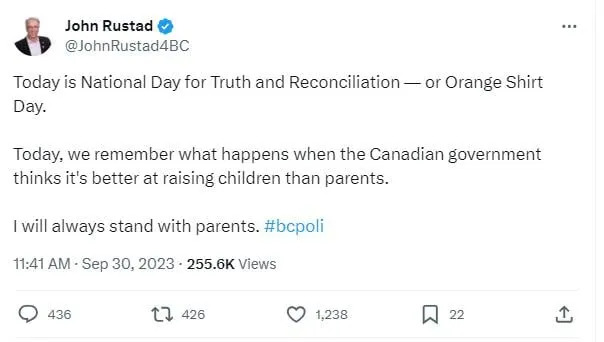
John Rustad, leader of the Conservative Party of B.C., is facing criticism for a tweet some survivors say weaponizes residential schools to support people advocating to end teaching sexual orientation and gender identity in schools under the banner of parental rights.

This screengrab shows a social media post from John Rustad, leader of the Conservative Party of B.C., that has drawn criticism. (X)

Those who support parental rights say parents need more information and input about what their children are learning in school, a position Rustad previously backed in a Sept. 20 statement.

The catch-all term "parental rights" has also been used across Canada and the United States to lobby for legislation to require parental consent for children and teens who want to use different names or pronouns at schools — measures that some LGBTQ advocates say harm transgender youth.

Critics of the term say it's a dog-whistle for anti-trans policies and is a misnomer, as it excludes LGBTQ parents and suggests parents' rights supersede those of their children.

CBC News reached out to Rustad for comment. In a phone call on Sunday, his office said he would not be available for an interview before publication.

Leader's comment called 'shameful'

Residential school survivor Celeste George, a member of the Nak'azdli Whut'en, a First Nation near Fort St. James, B.C., said seeing Rustad's post on the National Day for Truth and Reconciliation, a day meant to honour victims and survivors of residential schools, was "enraging."

"It's not even the comparison, [it's] the actual idea that he can blatantly use the day for his own hatred, for his own agenda," said George, who is also a former anti-racism educator.

"That was really horrific to me, knowing that hatred has taken so much from us."


Hundreds of people attended a walk for the National Day for Truth and Reconciliation in the First Nations community of Aq'am on Saturday, Sept. 30, 2023.

Hundreds of people take part in a walk on the National Day for Truth and Reconciliation in the First Nations community of Aq'am, B.C., on Saturday. (Corey Bullock/CBC)

She said Rustad's post will fuel anti-Indigenous racism and anti-trans sentiments, a concern echoed by Florence Ashley, a transfeminine associate professor of law at the University of Alberta in Edmonton.

"It's absolutely vile for a politician to compare a deeply marginalized group asking for rights with cultural genocide," Ashley wrote on X on Sunday.

B.C. New Democrat MLA Ravi Parmar called the social media post a "disgraceful comparison."

"It's shameful to co-opt this day to spread fear and attack the rights of queer kids," he wrote on X.

Harsha Walia, a human rights advocate and former executive director of the B.C. Civil Liberties Association, wrote that "weaponizing [the National Day for Truth and Reconciliation] like this is horrific."

"Despicable," Walia said in a post on X. "A party leader & sitting MLA compares genocide of residential schools to anti-trans dog whistle of 'parent rights.'"

Conservative Party newly recognized

Rustad was first elected in 2005 and previously served as minister of Aboriginal relations and reconciliation under the B.C. Liberal — now B.C. United — government.

He previously backtracked after making comments questioning why Indigenous members of his community were receiving COVID-19 vaccines ahead of older members of the population in 2021.

In August 2022, he was ousted from the B.C. United caucus for sharing an online post casting doubt on the science behind climate change.

Rustad sat as an independent until February, when he joined the B.C. Conservative Party. A month later, he was acclaimed as party leader.

Another B.C. United MLA, Bruce Banman, crossed the floor to join Rustad in September, and the two-MLA party was officially recognized in the legislature two weeks ago.

Rustad has previously supported parental rights and said he wants to end the teaching of SOGI in schools.

"Parents raise children — not government, and we have laws in British Columbia to protect children who are unsafe at home," he said in the Sept. 20 statement.

A national Indian Residential School Crisis Line is available to provide support for survivors and those affected. People can access emotional and crisis referral services by calling the 24-hour service at 1-866-925-4419.

Mental health counselling and crisis support is also available 24 hours a day, seven days a week through the Hope for Wellness hotline at 1-855-242-3310 or by online chat.
Top Indian diplomat blocked from Glasgow gurdwara visit

BBC
Sun, October 1, 2023 

The diplomat was approached by Sikh activists outside a Glasgow Gurdwara

India has complained to the Foreign Office after a top diplomat was confronted by protesters at a gurdwara in Glasgow.

The High Commission of India said Vikram Doraiswami had been invited to the place of worship to discuss community and consular issues.

But he left after he was confronted by a small number of activists on Friday.

A Sikh youth group later claimed there was a longstanding ban on Indian officials visiting gurdwaras.

The confrontation follows an international row over suggestions Indian agents may be linked to the murder of a Sikh separatist in Canada.

Trudeau repeats allegation against India amid row

India has strongly rejected the claim by Canadian prime minister Justin Trudeau that there is "credible evidence" of Indian involvement in the shooting of Hardeep Singh Nijjar in British Columbia in June.


Footage posted on social media shows three people approaching the diplomat's car

The incident in Glasgow came during a series of engagements in Scotland by Mr Doraiswami, who is India's High Commissioner to the UK.

Footage posted on social media shows him being approached by three people after his car pulled up outside the gurdwara in Glasgow's Albert Drive.

He remains seated in the back of the car while one of the demonstrators appears to make an attempt to open the door.

Another protester can be heard saying: "I think it's best if you go."

The diplomat was then driven away.

A statement issued later by National Sikh Youth Federation on behalf of "major Sikh bodies" said the three activists had upheld "a long standing ban on Indian officials visiting gurdwaras in their official capacity".

It went on to include an account of the incident, said to have been issued by the activists themselves, which said: "We went to prevent their entry and ask them questions, they left rapidly from the car park."

They denied carrying out any kind of assault.
'Disgraceful incident'

The High Commission of India said the diplomat had been invited to the building by the Gurdwara committee, and that the organisers included community leaders and an MSP.

"They were threatened and abused by these elements. In an effort to prevent any potential altercation the HC [High Commissioner] and CG [Consul General] decided to leave the premises on their arrival," it said in a statement.

The High Commission said it had reported the "disgraceful incident" to the Foreign Office and the police.

It said the three activists were not from Scotland.

Foreign Office minister Anne-Marie Trevleyan posted on X, formerly Twitter, that she was "concerned" by the incident.

"The safety and security of foreign diplomats is of utmost importance and our places of worship in the UK must be open to all," she posted.

The Glasgow gurdwara said it strongly condemned the "disorderly behaviour" which caused Mr Doraiswami to abandon his planned visit.

"The Gurdwara is open to people from all communities and backgrounds, and we welcome everyone openly as per our principles of faith," it said.

Police Scotland confirmed that it had been called to reports of a disturbance at the gurdwara at 13:05 on Friday.

"There were no reports of any injuries and enquiries are ongoing to establish the full circumstances," a spokesperson said.
Here’s a look at the resolution for a foreign force in Haiti. The U.N. will vote Monday

Jacqueline Charles
Sun, October 1, 2023 

Nearly a year after Haiti’s caretaker government requested the immediate deployment of an outside armed force to help the country’s ill-equipped and outgunned police take on deadly gangs, the United Nations Security Council is preparing to authorize on Monday sending a multinational force into the troubled Caribbean nation.

A draft resolution, authored by the United States and obtained by the Miami Herald, says the deployment would be reviewed nine months after the adoption of the resolution, and the cost of the temporary operation would be borne through voluntary contributions by U.N. member countries.

The resolution is scheduled for a vote by the 15-member U.N. Security Council at 4 p.m. Monday.

Two possible obstacles to approval: China and Russia. They’re among the five permanent members of the council, along with the U.S., the United Kingdom and France, any of which have veto power over any resolution.

The two countries have expressed concerns about the draft, which was co-authored by Ecuador with input from Kenya, the East African nation that has volunteered to lead the intervention but requested a Security Council resolution before moving ahead.

China and Russia’s concerns include questions about the size of the Multinational Security Support mission, as it is being officially called, and details on its rules of engagement. The draft doesn’t mention the size of the force. It authorizes the mission to “adopt urgent temporary measures on an exceptional basis” to prevent the loss of life and help the Haiti police maintain basic law and order and public safety, as necessary.

The draft resolution also says the rules of engagement — the directives on how and when to use force — are to be developed in consultation with Haiti, the leadership of the mission and the countries contributing to the force. The wording says the Security Council would be informed about the rules of engagement, mission goals and an end date before the mission’s full deployment.

Similar questions raised by China and Russia were asked last month of U.S. officials after a meeting on Haiti’s security was held on the sidelines of the U.N. General Assembly to seek support for both the resolution and the deployment. Victoria Nuland, the acting U.S. deputy secretary of state, said at the time that such questions “are generally fleshed out after a Security Council resolution. There is no precedent for that level of detail in a resolution itself.”

Another issue, particularly for China, is the illicit trafficking of arms and ammunition in Haiti. Despite a U.S. arms embargo on Haiti, gangs are not only well-armed but they have access to high-powered long-range rifles that can penetrate walls. The weapons have been used to carry out deadly massacres and empty out entire neighborhoods in Port-au-Prince, the capital, and regional provinces.

National Police patrol during an anti-gang operation in the Tabare neighborhood of Port-au-Prince, Haiti, Tuesday, July 25, 2023.

The resolution affirms that the arms embargo “is one of the three pillars” of a sanctions protocol the council adopted last October and it “strongly urges Member States to without delay prohibit the supply, sale, or transfer of small arms, light weapons, and ammunition to non-State actors engaged in or supporting gang violence, criminal activities, or human rights abuses in Haiti, as well as to take all appropriate steps to prevent their illicit trafficking and diversion.”

Two diplomatic sources said there were high hopes that the resolution would pass when the draft first circulated among U.N. members on Friday. But that night, China sent out a note with edits. A U.S. diplomatic source said China’s request for changes to the resolution’s arms embargo language was adopted in a deal with Washington on Saturday, although negotiations with China continued Sunday.

Critics of the U.S. policy on Haiti have called for more to be done to stop the trafficking of weapons into Haiti, most of which leave ports in Florida, though some also make their way into the country via its porous 220-mile border with the neighboring Dominican Republic.

Since Haiti appealed for international intervention a year ago on Oct. 6, the security situation has only gotten worse, with close to 2,800 killings, nearly 1,500 reported kidnappings for ransom and tens of thousands of Haitians forced out of their homes due to the expanding gang attacks. A recent report by the Center for Analysis and and Research in Human Rights in Port-au-Prince documented at least 45 makeshift camps camps in the metropolitan Port-au-Prince area, more than half of them at schools, where an estimated 30,000 to 35,000 people are currently seeking refuge after being forced out of their homes in the past two months.

Gédéon Jean, who runs the human rights group, said “it is extremely important” that the Security Council approve the resolution.

“The United Nations has an obligation to protect a population that is in danger,” he said. “With what is unfolding in Haiti at this moment, only a multinational force can accompany the police and help them.

“It’s a catastrophe, what we are living here today where the gangs are not only killing people, raping them and burning homes, they are burning police stations and taking their vehicles.”

Jean said that given the critical situation Haitians are living on a daily basis, he hopes that China and Russia either vote for the deployment or abstain from voting.


The United Nations Security Council.

Washington has said several countries are willing to deploy police or military to Haiti and are just waiting on the blessing of the Security Council. The U.S. has so far declined to name the countries besides The Bahamas, Jamaica and Antigua and Barbuda, which had previously announced their intent to take part in the mission. The Miami Herald has learned the others are Italy, Spain, Mongolia, Senegal, Belize, Suriname, Guatemala and Peru.

In an interview with the BBC, Kenya Foreign Minister Alfred Mutua said if the resolution is adopted, his country will have boots on the ground in Haiti by the first of January, “if not before.”

He said his country, which announced in late July that it was “positively considering” leading the force and deploying 1,000 of its officers to take part, initially thought it would be leading a so-called “static” mission — in which its forces would provide protection to key government installations such as the airport and seaports, but not engage directly with the gangs.

But a Kenyan assessment team that visited Haiti in August heard concerns from the police and Prime Minister Ariel Henry that just protecting key infrastructure would not be enough. Haitians also reacted strongly against the idea after the Herald published a story about Kenya’s proposed static mission.

“This is going to be an intervention force,” Mutua said. “This is a force that will need to go and disarm the thugs and the gangs. This is the one that we’ll need to go and free kidnapped people and free the women being raped.”

The Multinational Security Support mission, according to the resolution, will provide operational support to the Haitian national police, “including building its capacity through the planning and conduct of joint security support operations, as it works to counter gangs and improve security conditions in Haiti.”

The force would also help secure “critical infrastructure sites and transit locations such as the airport, ports, and key intersections.”

The force would also assist the Haiti National Police to provide “unhindered and safe access to humanitarian aid for the population receiving assistance.”

The resolution urges Haitian gangs and their supporters to cease their criminal acts, and condemns in the “strongest terms the increasing violence, criminal activities, and human rights abuses and violations which undermine the peace, stability, and security of Haiti and the region.”

The resolution also strongly condemns and expresses “deep concern over the gravity and numbers of violations and abuses committed against children in Haiti,” and notes gangs’ abuse against them, “including those involving killing and maiming, recruitment and use, rape and other forms of sexual and gender-based violence, particularly against girls, attacks on schools and hospitals, abduction, and denial of humanitarian access.”

U.N. member countries are also asked to deploy people with expertise in anti-gang operations, community-oriented policing, and the protection of women and children. Before any forces are deployed they would be to undergo training on human rights, child protection, and sexual and gender-based violence.

The last a foreign intervention force was sent into Haiti was in 2004. The U.N. stabilization peacekeeping mission lasted until 2017. Despite its success with taking on gangs, the mission was scarred by allegations of sexual abuse involving peacekeepers and the introduction of waterborne cholera by forces from Nepal.

The resolution includes language on wastewater treatment and to curb sexual abuse. It tells member countries participating in the security mission “take necessary action to ensure appropriate conduct and discipline and to prevent sexual exploitation and abuse, including vetting of all personnel.” The resolution also calls for timely investigations of all allegations of misconduct, to hold perpetrators accountable, and to repatriate units when there is credible evidence of misconduct.

While the resolution welcomes Kenya’s willingness to lead the mission, critics have raised questions about the East African nation’s ability to do so and its forces’ record on human-rights abuses. There are also cultural and language differences to overcome — Kenyans speak English and the official languages of Haiti are French and Haitian-Creole.

Another complicating factor: Haiti’s difficult, and sometimes labyrinthine terrain. Many of the gangs and their leaders live in maze-like slums where concrete shacks are separated by very narrow corridors.

In 2021, an ill-fated operation by specialized Haitian police officers in one particularly notorious slum resulted in the deaths of several police officers during an ambush. Their bodies were never recovered.

Mutua, the Kenyan foreign minister, said that Kenya doesn’t “think there’s going to be a lot of violence,” and believes the gangs will retreat once forces arrive because up until now, they haven’t had “anybody who can match them.”

He acknowledged, however, that the gangs know the terrain better than the Kenyan forces will. But the Kenyan forces, he insisted, will be prepared to take them on.

The gangs “don’t have the support of the people,” he said. “For the last few months, nearly 300 gang members have had their heads chopped off by members of the public. There is an uprising currently going on in Haiti. People are saying enough is enough”

Mutua said a recent poll shows 80% of Haitians “want Kenya to come and lead the force.” The Kenya assessment team conducted the poll to make sure its presence in Haiti would be welcome.

“People are tired. They just need a team to be on the ground,” he said.

“People are right to be skeptical because other emissions have failed before,” Mutua added. “But those are U.N. peacekeeping missions. This is a different mission. This is a mission that is going to go there with the mandate of making sure that the gangs are repelled, and that there’s a sense of peace, security and control in Haiti.”


McClatchy Senior White House and National Security Correspondent Michael Wilner contributed to this report.

Natural, human impacts on animals seen in 2,000-year-old condor poop

Nathan Howes
Sun, October 1, 2023 

Natural, human impacts on animals seen in 2,000-year-old condor poop


The discovery of a 2,200-year-old Andean condor guano deposit may demonstrate how species have or haven't adapted to the natural and human causes of environmental change over the course of time.

That's according to John Smol, a biology professor at Queen’s University, who spoke to The Weather Network earlier this year about the finding that was detailed in a study published in May 2023.

SEE ALSO: Birders are flocking to catch a glimpse of a bird that is rarely seen in Canada

The examination documents the finding of a doughnut-shaped deposit of condor guano in Patagonia, Argentina. Researchers uncovered a millennia-scale record of the animal's behaviour and diet, also putting a spotlight on the region’s historical records of volcanic and human impacts on this particular at-risk species.

"When we finally did all the data, it [came] out at about 2,200 years of accumulation, which in itself was quite an important part of history," said Smol. “We really had an interesting history of a lot of things happening in Argentina.”


Condor nest with chick/Submitted
(Lorenzo Sympson/Submitted)

Dry climate and overhanging rock ledge helped preserve it

The condor nest site and guano deposit used in the study is situated within Nahuel Huapi National Park. The study notes that the dry climate and the overhanging rock ledge are what led to the preservation of the site and its guano deposit for at least 2,200 years.

"We often think about climate change and pollution, but there was the European expansion or conques and different volcanic eruptions. This is a very volcanic area. A lot of that history was actually contained in this guano deposit," said Smol.

Condor nest/Submitted
(Lorenzo Sympson/Submitted)

Andean condors will typically nest in areas that are protected from the elements and predators. These include under rock overhangs and shallow caves on cliff faces, the study noted.

Suitable nesting sites are finite, so condors will often reuse them from generation to generation, as long as local environmental conditions will aid breeding activity.
Diet full of contaminants, then changed from human impact

Researchers were able to determine that the well-conserved, ancient DNA, stable isotopes, metals, and organic compounds such as cholesterol also offered an account of condor diet exposure to contaminants during the 2,200-year history of the deposit.

One thing that might make a condor "especially susceptible" to lead pollution is they do eat animals that were killed by hunters, and often that includes the toxic-composed shot, Smol said.


Condor above horizon/Submitted
(Sergio Lambertucci/Submitted)

"When you're eating a dead organism that may have been left behind, they're probably ingesting the lead shot, as well, [which] may be increasing their lead," said Smol. "We had a history of diet, we had a history of occupation, and we had a history of pollution."

According to a news release, the data collected showed a distinct modification to the diet, attributable to landscape-scale human impact.

Following European colonization approximately 150 years ago, condors had to switch diets after humans had a noticeable impact on the landscape and food sources, resulting in a reliance on ranched livestock instead of native fauna.
Smol 'cautious' about how far back deposit can trace environmental changes

The study's author noted that understanding how animals respond to large-scale environmental changes is difficult to achieve because monitoring data are rarely available for more than the past few decades.

Lacking long-term data is "one of the biggest challenges we have" in ecology and environmental science, Smol said.

"We don't have the long-term data. No one was measuring condors 1,000 years ago. These are sort of indirect ways, but they provide a lot of clues as to what's happened in the past," said Smol.


Condor turning/Submitted
(Sergio Lambertucci/Submitted)

Smol cautioned about using a single deposit to determine how animals have adapted to environmental changes over hundreds or thousands of years.

“We don't want to extrapolate too much until we see maybe 10 deposits or at least five deposits. I'd be a little hesitant to go too far behind that," said Smol. “We provide hints of how they've changed over time.”

However, he noted that scientists can provide "an idea" of how long the Andean condor has been here.

"We can show that, in fact, they were here at least 2,200 years ago [and] then they declined for about 1,000. Those are important population trends for ecologists, ornithologists and ecosystem managers," said Smol. "We can show the past, which is what we try and gauge the future with."
WATCH: How the evolution of land plants helped to shape Earth

Click here to view the video

Thumbnail courtesy of Chris Grooms/Submitted.

Follow Nathan Howes on the X platform, formerly known as Twitter.
Small Nuclear Reactors: The Answer To Big Tech's Energy Crisis?


Editor OilPrice.com
Sun, October 1, 2023 


Microsoft could be the first of several companies to prepare to use small nuclear reactor (SMR) technology for its high energy consumption, as AI and other technologies become more widely used. There has been great enthusiasm around the potential of SMRs, which could be built faster and at a much lower cost than a traditional nuclear reactor. This month, Microsoft posted a job opportunity for a “Principal Program Manager Nuclear Technology,” suggesting its interest in using SMRs in the future, to support its energy-intensive operations. As companies begin to use a vast range of digital technologies in their day-to-day operations, their energy consumption could increase substantially, making the use of low-carbon nuclear power increasingly attractive.

SMRs are advanced nuclear reactors that have a power capacity of up to 300 MW(e) per unit, equivalent to around one-third the generating capacity of a traditional nuclear reactor. SMRs are much smaller than traditional reactors and are modular, making it simpler for them to be assembled in factories and transported to site. Because of their smaller size, it is possible to install an SMR on sites that are not suitable for bigger reactors. They are also significantly cheaper and faster to build than conventional nuclear reactors and can be constructed incrementally to meet the growing energy demand of a site.

There are strong safety margins included in SMR production, meaning that the potential for the unsafe release of radioactivity to the environment is significantly reduced. These systems can be shut down automatically, without human assistance, in the case of a malfunction. At present, there are over 80 commercial SMR designs under development worldwide, aimed at responding to a range of needs. Although companies are still trepidatious about investing in SMRs as their economic competitiveness in use has yet to be proven. As energy companies begin to roll out SMRs within the next decade there will be a greater understanding of their applicability and the costs involved.

Despite still being in the development stage, Microsoft appears to be one of the first companies to demonstrate its interest in SMRs. As companies continue to digitalise operations and conduct high-energy operations, they will need an increasing amount of energy to power their activities. For example, AI researchers suggest that training a “single large language deep learning model” such as OpenAI’s GPT-4 creates around 300 tonnes of CO2. The average person is responsible for creating around 5 tonnes of CO2 a year, showing just how significant this is.

Microsoft now appears to be drawing up a roadmap for the use of SMR to power its computation needs. This month, the company posted a job description to hire a nuclear technology expert to lead the company’s technical assessment for integrating small modular nuclear reactors and microreactors “to power the datacentres that the Microsoft Cloud and AI reside on.” The post reads that Microsoft is seeking a “principal program manager for nuclear technology”, who “will be responsible for maturing and implementing a global Small Modular Reactor (SMR) and microreactor energy strategy.”

This is not the first time the tech giant has shown interest in nuclear power. In May, Microsoft signed a power purchase agreement with Helion, a nuclear fusion start-up, to purchase electricity from it starting in 2028. And Bill Gates, Microsoft’s co-founder, is the chairman of the board of Terrapower, a company that is currently developing SMR technology. Although there has been no suggestion that Terrapower will provide Microsoft with any nuclear reactors.

Microsoft is showing an early interest in integrating nuclear power into operations. But, as more companies are using energy-intensive technologies, they will require vast amounts of energy to power their activities. Meanwhile, governments worldwide are putting increasing pressure on companies to decarbonise operations, with some introducing carbon taxes and others encouraging the use of clean energy sources through financial incentives. Renewable energy sources, such as wind and solar power, can take years to develop, and acquiring a stable clean energy source also means investment in battery technology. However, as the use of SMRs becomes more commonplace, their fast manufacturing time and small land footprint will likely appeal to companies looking for alternative clean energy sources.

Despite the optimism around SMR technology, a commercial rollout is likely still a long way off due to recent difficulties in acquiring the materials needed to develop these reactors. Many SMRs under production at present will run on uranium at enrichments as high as 15 to 19.75 percent, known as high-assay low-enriched uranium (HALEU). However, this is currently only commercially available from Russia, with which many governments and private companies have cut ties following the Russian invasion of Ukraine last year. Chris Levesque, the CEO of TerraPower, explained “It has become clear that domestic and allied HALEU manufacturing options will not reach commercial capacity in time to meet the proposed 2028 in-service date for the Natrium demonstration plant.”

There has been a rise in the popularity of SMR technology, thanks to its small size and relatively low-cost and fast manufacturing potential. While the commercial rollout of SMRs is still far off, it could provide the vast amounts of low-carbon energy required to meet the world’s growing electricity needs. And tech companies, such as Microsoft, will likely be some of the first to invest in SMR technology as they look to meet their rising computation needs while striving to decarbonise operations.

By Felicity Bradstock for Oilprice.com
Germany Eyes Options to End Impasse With France on Nuclear Power

John Ainger
Mon, October 2, 2023 


(Bloomberg) -- Germany is set to outline its proposals to break a deadlock with France over the design of the European Union’s electricity market, the latest crunch point between the nations over the region’s climate transition.

The paper lays out three options for resolving how governments can support existing power plants, such as France’s aging nuclear generators, without unduly subsidizing operators, according to a draft seen by Bloomberg News.

The issue has resulted in a political stalemate between Paris and Berlin. France is pushing for rules that would allow it to ensure more stability for state-controlled Electricite de France SA and to tap new financing sources for extending the life of its reactors. Germany has been blocking the initiative over concerns that its own energy prices may be undercut if EDF can sell power at uneconomical costs.

The overhaul of the electricity market design is one of the last elements of the EU’s Green Deal still to be negotiated, and time is running out ahead of regional elections next year. Germany and France have sparred on other elements of the EU’s climate plans, like an effective ban on new combustion engine vehicles from 2035 and the role of nuclear power in the bloc’s energy mix.

Germany proposes ensuring that revenue from so-called contracts for difference, a key tool to spur investments in renewable energies, are proportionate to the amount invested, or that the guaranteed prices set under the mechanism can be adjusted. Another option would be to redistribute revenue only to households or to apply strict limits on the amount that can be redistributed.

The draft paper is still subject to change.

Germany is looking to bring other countries on board with its push, according to people familiar with the matter. It’s not clear if the document would mark a clear step forward in talks with France.

Spain, which holds the rotating Presidency of the bloc, submitted a new compromise proposal on Friday that also laid out options for a breakthrough at a meeting of energy ministers scheduled for Oct. 17. One of those possibilities involves completely removing the section that governs subsidies for lifetime extensions, according to the paper seen by Bloomberg News.

--With assistance from Ewa Krukowska.
Wind power project in New Jersey would be among farthest off East Coast, company says

WAYNE PARRY
Mon, October 2, 2023 


- Land-based wind turbines in Atlantic City, N.J., turn on July 20, 2023. Two major offshore wind power projects are taking steps forward in New Jersey as the owners of one project agreed to bring the federal government in on their environmental monitoring plans at an earlier stage than has ever been done, and federal regulators said plans for another project are not expected to kill or seriously injure marine life. They come as New Jersey continues to grow as a hub of opposition to offshore wind projects from residents' groups and their political allies, mostly Republicans 
(AP Photo/Wayne Parry, File)


SEASIDE HEIGHTS, N.J. (AP) — A proposed wind energy project off New Jersey would be among the farthest from land on the East Coast, the New York-based development company said Monday.

Attentive Energy released new information on the project, which will be 42 miles (67 kilometers) off Seaside Heights and provide enough energy to power 600,000 homes. State regulators did not identify the company when bids were received in August — one of four received as the state pushes to become the East Coast hub of the nascent offshore wind industry.

Wind power developers have struggled to make progress, however, due to supply chain issues, higher interest rates, and a failure so far to garner enough tax credits from the federal government.

Damian Bednarz, the company's managing director, told The Associated Press that it passed on bidding on undersea sites closer to the shore because it feels its site is situated to take advantage of the strongest winds.

“We believe it has the best positioning in terms of wind resources,” he said. “It's in a position geophysically to have the best opportunity to get the most wind.”

Bednarz also said the project's turbines — the exact number of which the company has not revealed — will not be visible from the shoreline, eliminating one potential source of opposition from homeowners and residents' groups who object to the likelihood of seeing the structures on the horizon from the beach.

One of the proposals made in August, from Chicago-based Invenergy and New York-based energyRE, would be built 40 miles (64 kilometers) off Long Beach Island called Leading Light Wind. It would consist of up to 100 turbines, enough to power 1 million homes.

Another, from Community Offshore Wind, would be based 37 miles (59 kilometers) off Long Beach Island, and generate enough electricity to power 500,000 homes. The project would be built by Essen, Germany-based RWE and New York-based National Grid.

The state has already approved three other offshore wind projects from previous solicitations in waters closer to shore, where the likelihood of seeing the turbines from shore has generated opposition. Orsted, the Danish wind energy company, would build its first project about 13 to 15 miles off the coast of Atlantic City and Ocean City.

Robin Shaffer, a spokesman for one of the main offshore wind opposition groups, Ocean City-based Protect Our Coast NJ, said it doesn't matter how near or far wind farms are from the coast.

“Offshore wind development makes no sense from either an environmental or economic standpoint,” he said. “As more people get to know about how much carbon goes into creating a wind turbine, as they learn about the harm that will come to their happy places down the shore, and as they come to terms with the fact their electricity rates will increase substantially, they are becoming more and more disenchanted with offshore wind as a cure for climate change.”

Opposing offshore wind has become a major talking point in Republican political campaigns as well. GOP Congressmen succeeded in getting the Government Accountability Office to open an inquiry into the industry in June.

Part of the Attentive Energy project involves constructing a facility to manufacture wind towers at the New Jersey Wind Port in Paulsboro, where the giant steel monopiles are currently being produced. The towers are steel components that are placed above the monopiles, Bednarz said. He did not estimate its cost.

Attentive Energy hopes to begin construction and operations in the early 2030s once the necessary approvals are obtained.

It is pursuing another offshore wind project in New York about 50 miles south of Jones Beach.

Attentive Energy is a collaboration between Houston-based Total Energies, and Corio Generation, with offices in Boston and London.

___

Follow Wayne Parry on X, formerly known as Twitter, at www.twitter.com/WayneParryAC

Challenges Escalate For The Wind Energy Industry


Editor OilPrice.com
Sun, October 1, 2023 

Europe and the United States risk missing their ambitious wind power installation targets as soaring costs, supply chain delays, and low electricity prices at auctions hamper development and lead to a cancelation of offshore wind projects.

Government targets were very ambitious even before the perfect storm in the wind power industry this year. Now, those targets could be out of reach if policies and auction schemes don’t change, analysts and industry officials say.

The wind power industry is growing in both the U.S. and Europe, but it’s currently off track to meet the 2030 capacity targets, undermining the clean energy and emission-reduction goals.

The issues are most evident in the offshore wind industry, which saw several major setbacks this summer—auctions in the U.S. and the UK were a flop, Big Oil scooped all the acreage in a German tender, and a large UK project was canceled due to surging costs and challenging market conditions pressuring new developments. Meanwhile, developers in the U.S. are seeking looser requirements for tax credits to make projects economically feasible.

In the EU, the European Parliament has recently endorsed much higher binding renewable energy targets by 2030, raising the targeted share of renewable energy in the EU’s energy consumption to 42.5% by 2030, up from a current target of 32%. The wind industry alone needs to double the current capacity to meet these targets.

But the EU risks missing its wind power capacity installation targets and losing the supply chain to competition in traditionally low-cost Chinese manufacturing. Moreover, inflation, higher interest rates, and supply chain issues have made materials and products more expensive, raising the costs of already approved projects.

So the European Commission is set to propose in October a European Wind Power package to help get the bloc’s flailing wind industry back on the track of growth to help accelerate its decarbonization targets, European Commission President Ursula von der Leyen said in the 2023 State of the Union Address. The Commission pledges to fast-track permitting even more, improve the auction systems across the EU, and focus on skills, access to finance, and stable supply chains.

In the U.S., the Inflation Reduction Act is spurring clean energy project development, but the wind industry is looking to the Biden Administration to ease the requirements for subsidy eligibility for offshore wind, alleging that the current rules under the IRA make many investments uneconomical.

Orsted, for example, warned in August that it could face up to $2.3 billion (16 billion Danish crowns) of impairments on its U.S. project portfolio due to supply chain delays, higher interest rates, and the possible inability to qualify for additional tax credits beyond 30%.

In a sign of the struggling offshore wind industry, the latest lease sale, the first-ever such sale in the Gulf of Mexico, was a flop last month, attracting just one bid—from Germany’s RWE. Out of three areas up for lease, two did not receive any bids.

RWE’s chief executive Markus Krebber wrote in a LinkedIn post last month that with the challenge in the offshore wind industry “Happening at a time when the entire offshore industry has to scale up to achieve expansion targets, this quickly calls into question the achievement of climate protection goals.”

“In a nutshell: we need a framework that allows for more investment certainty for both manufacturers and developers,” Krebber added.

Ben Backwell, CEO of the Global Wind Energy Council, also sees the current pace of global wind power development as insufficient to meet the 2030 targets.

“We certainly see a big gap between the renewables and wind targets for 2030 and the path we are on right now,” Backwell told Reuters this week.

“We are growing but nowhere near fast enough.”

By Tsvetana Paraskova for Oilprice.com
EU countries consider scrapping part of energy reforms - document


Mon, October 2, 2023

FILE PHOTO: Electrical power pylons next to wind turbines near Weselitz, Germany


By Kate Abnett and Julia Payne

BRUSSELS (Reuters) - European Union countries are considering scrapping a central part of reforms to Europe's electricity market, amid a deadlock between France and Germany over state aid for power plants, a document seen by Reuters showed.

The 27 EU countries are seeking a joint position on planned reforms to the EU's power market, but countries including Germany and France have been at odds for months over whether the rules could give some countries a competitive edge over others.

At issue is whether governments will be able to offer state-backed, fixed-price power contracts to existing power plants - then collect excess revenues generated by these contracts and spend it on subsidising industries.

France is keen to apply these subsidies to its nuclear power fleet, and the proposed rules have backing from central and eastern countries. But Germany and others are firmly against - warning this could give French industries an advantage over their own.

A draft compromise, seen by Reuters, asked countries to consider three options - including completely removing the rules on these subsidies from the reform.

The other two options in the document prepared by Spain, which holds the EU's rotating presidency, would limit how countries can use the revenues raised through the power price subsidies, and allow Brussels to step in and limit a country's use of these revenues if it was distorting the EU's single market.

It marks the first time countries have considered simply scrapping the rules, after struggling to find a compromise.

Failure to pass this part of the reform would not ban France and other countries from offering fixed-price power contracts to generators. But it could make them harder to use, and subject to winning approval from Brussels under EU state aid rules.

One senior EU diplomat said the two sides appeared "further apart than in June", referring to a meeting where EU countries' energy ministers failed to agree a compromise on the law.

The European Commission's original reform proposal, made in March, was designed to move power generators to more long-term, fixed-price contracts, so that consumers would be less exposed to short-term gas price spikes like those seen last year.

To achieve this, Brussels proposed that public support for new investments in renewable and nuclear plants must take the form of fixed-price state-backed power contracts. It is this section that countries may delete.

EU countries' ambassadors will discuss the proposal on Wednesday. They face an Oct. 17 deadline when energy ministers meet to try to strike a deal.

(Reporting by Kate Abnett and Julia Payne; Editing by Mark Potter)
Facing increasing pressure from customers, some miners are switching to renewable energy

Sun, October 1, 2023


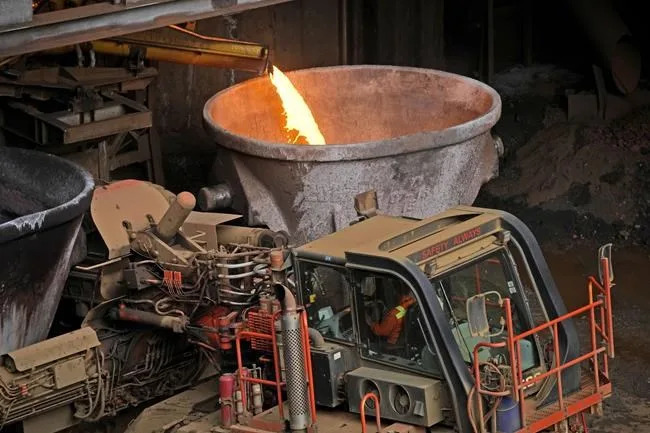
SOROWAKO, Indonesia (AP) — Red hot sparks fly through the air as a worker in a heat-resistant suit pokes a long metal rod into a nickel smelter, coaxing the molten metal from a crucible at a processing facility on the Indonesian island of Sulawesi.

The smelter run by global mining firm Vale and powered by electricity from three dams churns out 75,000 tons of nickel a year for use in batteries, electric vehicles, appliances and many other products.

While the smelting creates heavy emissions of greenhouse gases, the power used is relatively clean. Such possible reductions in emissions come as demand for critical minerals like nickel and cobalt is surging as climate change hastens a transition to renewable energy.

Mining operations account for some 4%-7% of global greenhouse gas emissions, according to global consulting firm McKinsey & Company. But some miners are moving to reduce use of fossil fuels in extracting and refining, partly due to pressure from downstream customers that want more sustainable supply chains.

Located beside a crystal-blue lake in the lush jungle of Sorowako, South Sulawesi, Vale Indonesia — a subsidiary of Vale international — runs its smelters entirely from hydroelectricity. Vale says that can reduce its emissions by over 1.115 million tons of carbon dioxide equivalent a year, compared to using diesel. Vale claims it has reduced its greenhouse gas emissions nearly a fifth since 2017.

As demand for materials needed for batteries, solar panels and other components vital for cutting global emissions rises, carbon emissions by miners and refiners will likewise rise unless companies actively work to decarbonize.

Experts say improved technology, pressure from customers and enforcement of clean energy policies all are needed to keep moving toward more sustainable mining and refining practices while raising output to keep pace with global needs for pivoting away from reliance on polluting fossil fuels.

Other companies and countries around the world also are reducing use of fossil fuels in their mining operations. Solar plants in Chile help power the mining sector, which consumes much of the country’s electricity demand to produce copper, lithium and other materials. In recent years, wind power has helped electrify the Raglan Mine in Canada.

Companies are learning from past mistakes of the industrial revolution, where reliance on fossil fuels was paramount for development, said Michael Goodsite, a pro vice chancellor and professor of civil and environmental engineering at the University of Adelaide in Australia.

“I think as you see the future of certain operations, you’ll see them transitioning," he said. "The way that they transition and how they move from fossil fuel operations to other energy sources can and should be learned from by others.”

Indonesia is the world’s largest nickel producer and Indonesian President Joko Widodo has promoted the country developing its own industries.

The push to cut emissions and use cleaner energy has been helped by investment and interest from governments and multinational companies. Volvo, Mercedes, Hyundai, Apple and other manufacturers need materials made in a more sustainable way to meet their own environmental, social and governance, or ESG, commitments.

Widodo visited Vale Indonesia’s Sorowako facilities in March, the same month a deal was signed for a $4.5 billion nickel procession plant to be built by Vale Indonesia with investment by Ford Motor Co.

“Ford can help ensure that the nickel that we use in electric vehicle batteries is mined, produced within the same ESG standards as ... our business around the world,” Christopher Smith, Ford’s chief government affairs officer, said at a signing ceremony for a new $4.5 billion nickel processing plant in Indonesia with Vale Indonesia in March this year.

Even companies already taking steps to decarbonize are still reliant on at least some fossil fuels.

At Vale Indonesia in Sorowako, coal is still used to power drying and reduction kilns. The company's CEO, Febriany Eddy, said she plans to switch such operations to liquefied natural gas — cleaner but still another fossil fuel.

It's the best option available given current technology, she said in an interview with The Associated Press.

“I have two options in front of me: I continue to say that there is no viable option, that we will wait until that perfect solution is to come, which (could take) 15 or 20 years to come. Or I work with LNG first, knowing it is not a perfect solution, knowing it is a transition only," Eddy said. “But with conversion to LNG, I can reduce 40% of my emissions.”

The use as LNG as a “bridge fuel” has been contested by climate experts, as the fuel releases climate-warming methane and carbon dioxide when it’s produced, transported and burned.

Initial costs for switching to, expanding and building new renewable infrastructure are another steep barrier.

It took decades to recoup costs from building the three hydropower dams in the remote, sparsely populated area, that are used to power Vale's Sorowako facilities. But now, having that infrastructure means big savings at a time when global energy prices are high.

“Hydropower isn't just reducing our carbon emissions, but also reducing our costs today because we are no longer that (vulnerable) to fuel and coal costs— because we have hydropower,” Eddy said.

Having mining operations powered by renewable sources instead of fossil fuels could also help unlock green financing and attract future investors, said Aimee Boulanger, executive director of the Initiative for Responsible Mining Assurance.

“The finance and investment sector is more tuned in than it ever has before to the environmental and social responsibility of supply chains and their investments in them. And they’re looking at greenhouse gas emissions,” she said. “When the world is recovering from a global pandemic and facing the global crisis of climate change, there’s never been a time when they’ve been more interested in these issues."

While many companies are stepping up efforts to decarbonize their supply chains, others — such as many of those making green energy materials in China, have less stringent requirements for their materials.

“We can find jurisdictions around the world that — if they’re able to do things cheaply because they have access to fossil fuels and they already have the capital assets and the capital expenditures— they’re going to continue doing that,” Goodsite said when asked about Chinese businesses.

Ultimately, investors and consumers play a vital role in getting companies to clean up their operations, he said.

But phasing out the mining industry's reliance on fossil fuels will be costly, especially as the United States and other countries build up the capacity to bring production of critical materials onshore.

"If the end users care about them coming from ...a green energy based process... then we all need to be prepared to pay a significant premium for that,” Goodsite said.

___

Associated Press climate and environmental coverage receives support from several private foundations. See more about AP’s climate initiative here. The AP is solely responsible for all content.

Victoria Milko And Dita Alangkara, The Associated Press