Russian media: Putin pardons convicted killer of famed Russian journalist
Nate Ostiller
Tue, November 14, 2023

Russian dictator Vladimir Putin pardoned the convicted killer of famed Russian opposition journalist Anna Politkovskaya after his military service in Ukraine, Russian state-controlled media RBC reported on Nov. 14.
Former Russian police officer Sergei Khadzhikurbanov was convicted of his role in Politkovskaya's murder in 2014 and sentenced to 20 years in prison. He has been imprisoned since then but went to fight in Ukraine as part of the Kremlin's drive to recruit prisoners.
In 2022, the Russian authorities allowed Wagner Group to recruit prisoners in Russian jails. Russia's Defense Ministry has also recruited from Russian jails. Under this procedure, they were pardoned in exchange for military service.
The late Wagner Group founder Yevgeny Prigozhin said in June 2023 that as many as 32,000 former prisoners had returned to Russia after fighting in Ukraine.
Khadzhikurbanov's lawyer did not say when he started to fight in Ukraine or when he received the presidential pardon. Khadzhikurbanov is currently fighting in Ukraine on a contract with Russia's Defense Ministry, his lawyer said.
Politkovskaya came to prominence in large part because of her coverage of Russia's brutal wars in the breakaway Russian Republic of Chechnya, specifically related to her coverage of war crimes and human rights abuses. Apart from working for the independent Russian paper Novaya Gazeta, she also wrote several books about Chechnya. Tens of thousands of civilians were killed in the two wars in the early 90s and 2000s.
She was shot and killed in an elevator in her apartment building in Moscow in 2006. Khadzhikurbanov and four others were found guilty of Politkovskaya's murder, two of whom received life sentences, but it remains unclear exactly who ordered her killing
Politkovskaya was an outspoken critic of Chechen strongman Ramzan Kadyrov, regularly denouncing his role in human rights abuses in Chechnya. There have been rumors that he, as well as Russian dictator Vladimir Putin, were linked to her death, but no concrete proof.
Read also: Team of liberal economists helps Putin keep his power, wage war in Ukraine
Man convicted of murdering Russian journalist Politkovskaya was pardoned and is fighting in Ukraine
Ukrainska Pravda
Tue, November 14, 2023

Sergei Hadzhikurbanov, former operative officer of the Russian regional directorate for countering organised crime, convicted of the murder of Anna Politkovskaya, a Russian Novaya Gazeta journalist, was pardoned and went on to fight in Ukraine on the side of Russia.
Source: Russian Telegram channel Baza, RBC
Details: In 2014, Hadzhikurbanov was sentenced to 20 years in prison. The official term of his imprisonment was supposed to last until 2034.
As it was discovered by Baza, Hadzhikurbanov joined the war in Ukraine at the end of 2022.
Allegedly, he began his service as commander of the intelligence department. According to the source, he "repeatedly went behind enemy lines, performing specific tasks as an intelligence officer with his fighters".
After six months of "service" as a convict, Hadzhikurbanov was pardoned and now participates in the war as a civilian who concluded a contract with the Ministry of Defence of the Russian Federation.
For reference: Anna Politkovskaya, a Novaya Gazeta journalist, was killed on 7 October 2006 in the entrance to an apartment building in Moscow. The person who ordered the murder was not found, but the investigators consider Lom-Ali Gaitukayev to be the organiser of the crime. In 2014, he was sentenced to life imprisonment, in 2017 he died in prison.
In addition to Gaitukayev, his nephews Dzhabrail Makhmudov, Ibrahim Makhmudov and Rustam Makhmudov, Hadzhikurbanov, a former employee of the regional directorate for countering organised crime, and lieutenant colonel Dmitry Pavlyuchenkov, a former employee of the Moscow police department, were found guilty of organising and executing the murder of Politkovskaya.
Russian President Vladimir Putin is pardoning prisoners convicted in the Russian Federation, in particular on serious charges, to send them to fight in the war against Ukraine.
Russian convicted in journalist's murder pardoned after serving in Ukraine
CBSNEWS
November 14, 2023
A man who was convicted in Russia for involvement in the 2006 murder of prominent investigative journalist Anna Politkovskaya has received a presidential pardon after fighting in Ukraine, according to his lawyer and local media reports. Former police officer Sergei Khadzhikurbanov was sentenced to 20 years in prison in 2014 for helping to organize the assignation of Politkovskaya, a reporter with the Novaya Gazeta newspaper who was gunned down in the elevator of her Moscow apartment building.
Politkovskaya was a vocal critic of Russia's war in Chechnya, and while her thorough investigations of Russian military abuses during that conflict received international recognition, they also angered Russian authorities.
Khadzhikurbanov's lawyer, Alexey Mikhalchik, told Russian news outlets that his client was pardoned after serving a six-month contract on the front lines in Ukraine, and that he had since signed another contract to continue serving in the military.
"He worked in special forces in the 90s, he has experience, which is probably why he was immediately offered a command position," Mikhalchik told the Russian business news outlet RBC.
Khadzhikurbanov and four other men were sentenced in 2014 over Politkovskaya's murder, but it was never determined who ordered her killing.

Russian human rights activists attend a rally in honor of slain Russian journalist Anna Politkovskaya in Moscow on October 7, 2010. / Credit: Natalia Kolesnikova/AFP/Getty
"Neither the victims nor the editors were informed about the killer's pardon. Just like they aren't informing us about how they are looking for the rest of the killers — and above all, the person who ordered it. [That's] Because they are not looking and because [the killers] are being covered for," Novaya Gazeta said in a statement Tuesday.
"For us, this 'pardon' is not evidence of atonement and repentance of the murderer. This is a monstrous fact of injustice and arbitrariness, an outrage against the memory of a person killed for her convictions and professional duty," the newspaper's statement added.
The Russian military has increasingly relied on convicts to supplement its depleted military units amid a protracted Ukrainian counteroffensive. Prison recruitment has supplied the Russian army with tens of thousands of fighters, according to prisoners' rights advocacy groups, enabling the Kremlin to avoid another mass-mobilization of recruits after the initial effort to call up ordinary Russians in late 2022 proved hugely unpopular. Thousands of young Russian men fled the country to avoid conscription.
In recent weeks, Russian media have reported on multiple instances of convicted murderers in high-profile cases being released after serving only a fraction of their sentence after serving on the front lines, including Vladislav Kanyus who served less than a year of his 17-year sentence for the murder of his ex-girlfriend Vera Pekhteleva.
Kanyus reportedly tortured Pekhteleva for hours, inflicting 111 stab wounds and choking her with a cord.
Pekhteleva's mother Oksana told local media that her family was shocked by the news of Kanyus' pardon, saying: "This is a spit in my face, and at those mothers whose [children] were brutally killed in the same way. There are so many of us all over the country, we don't know what to do. This comrade may still be fighting, but some killers already walk free, and these mothers see them. How is it possible to live with this?"
A man convicted in the 2006 killing of a Russian journalist wins a pardon after serving in Ukraine
EMMA BURROWS
Tue, November 14, 2023

FILE - Sergei Khadzhikurbanov, accused of the murder of journalist Anna Politkovskaya, awaits the judge's verdict in a glass cage, at the Moscow City Court, Russia, Wednesday, May 21, 2014. A lawyer for Khadzhikurbanov said Tuesday, Nov. 14, 2023, that he received a presidential pardon after doing a stint fighting in Ukraine. AP Photo/Pavel Golovkin
A man convicted in the 2006 killing of Russian investigative journalist Anna Politkovskaya received a presidential pardon after he did a stint fighting in Ukraine, his lawyer said.
Sergei Khadzhikurbanov was sentenced to 20 years in prison in 2014 for his role as an accomplice in the killling of Politkovskaya, 48. She worked for the independent newspaper Novaya Gazeta and wrote stories critical of Kremlin policies during the early years of President Vladimir Putin's term, the war in Chechnya and human rights abuses.
She was shot and killed in the elevator of her Moscow apartment block, triggering outrage at home and in the West, and emphasizing the dangers faced by independent journalists in Russia. Her death on Oct. 7, Putin’s birthday, led to suggestions the shooting — in which the Kremlin denied any role — was done to curry favor with the president.
Four others also were convicted in the killing: gunman Rustam Makhmudov and his uncle, Lom-Ali Gaitukayev, who received life in prison, and two of Makhmudov’s brothers, who received 12 and 14 years.
Since Russia invaded Ukraine in 2022, private military contractors and the Defense Ministry have offered prisoners their freedom in exchange for fighting in the war.
Khadzhikurbanov, a former police detective, was released last year to fight in Ukraine and then signed a Defense Ministry contract to continue serving after his pardon, his lawyer Alexei Mikhalchik told The Associated Press.
He was offered a command position in the military because he was in the “special forces" in the late 1990s and was in "almost all the hot spots,” Mikhalchik said.
Dmitry Muratov, editor-in-chief of Novaya Gazeta, and Politkovskaya's children, Vera and Ilya, condemned Khadzhikurbanov's release.
“For us, this ‘pardon’ is not evidence of atonement and repentance of the killer. This is a monstrous fact of injustice. ... It is an outrage to the memory of a person killed for her beliefs and professional duty,” they said.
Muratov said the “victims in this case — the children of Anna Politkovskaya and the editors” — were not told in advance about the pardon. They also slammed Russian authorities for using the law "according to its own perverted understanding,” by giving long prison sentences to political opponents while setting murderers free.
Muratov won the Nobel Peace Prize in 2021 but this year was declared by Russian authorities to be a foreign agent, continuing the country’s moves to suppress critics and independent reporting.
Kremlin spokesman Dmitry Peskov said earlier this month that convicts recruited to fight in Ukraine are worthy of pardons.
“Those sentenced, even on grave charges, shed their blood on the battlefield to atone for their crimes. They redeem themselves by shedding blood in assault brigades, under bullet fire and shelling,” he said.
Mikhalchik said he was “happy” his client was freed because he never believed he was involved in killing Politkovskaya.
Muratov told the AP that while Khadzhikurbanov "was not the direct perpetrator of the murder of Anna Politkovskaya,” no investigation has taken place to establish who was behind it.
“The person who ordered it is free, and the accomplice to the crime has been pardoned. This all that can be said about the protection of freedom of speech in Russia," he said.
Muratov noted it was the second recent example of a prisoner convicted in a killing to win his freedom after serving in Ukraine.
Vera Pekhteleva, 23, was killed in January 2020 by her boyfriend after ending their relationship. The man convicted in her death, Vladislav Kanyus, was pardoned in April, according to lawyer and human rights advocate Alena Popova.
Pekhteleva's family discovered Kanyus was free when her mother saw online photos of him wearing camouflage and holding a weapon, Popova said on her Telegram channel.
“There is no justice. There is no law. There are no human rights. Nothing. Just total violence,” Popova told AP in response to the news about the release of Khadzhikurbanov.
___
LA REVUE GAUCHE - Left Comment: Search results for Anna Politkovskaya
CRIMINAL CAPITALI$MCalgary man misappropriated $3.4M from sale of Edmonton strip mall, regulator finds
CBC
Tue, November 14, 2023

Over 200 people invested in the Summerside Plaza development, which opened in south Edmonton in 2015. Alberta's securities regulator has found that Ali Ghani and the entities he controlled misappropriated some of the money invested in the strip mall. (Scott Neufeld/CBC - image credit)
The Alberta Securities Commission has found a Calgary man misappropriated more than $3 million in funds invested in a south Edmonton strip mall development.
A three-person ASC panel determined last week that Ali Ghani and five entities he controlled perpetrated investment fraud through the development and sale of Summerside Plaza.
The panel found Ghani distributed $3.4 million from the plaza sale to other projects without investors' knowledge or permission. That resulted in the total loss of their investments, according to the Nov. 7 decision.
Approximately 207 investors, more than half of whom were Alberta residents, put up money for the mall.
Six witnesses testified during a six-day hearing on the matter about a year ago, including one investor and a former employee who reported to Ghani.
Ghani did not participate in the hearing, but ASC investigative staff interviewed him twice in 2021.
During the hearing, the commission's legal team argued that Ghani's evidence provided during those interviews was "untruthful, inconsistent, misleading, and obfuscating."
CBC News asked Ghani to comment on this story but did not receive a response.
Father-son duo
Ghani told the commission that he and his father, Abdul Ghani, founded Prism, a collection of largely commercial and residential real estate development entities in Alberta. The elder Ghani died in early 2020.
Summerside Plaza was one of Prism's multiple real estate projects.
According to the decision, investors were told their funds would be used to obtain land and develop Summerside Plaza. The plaza would then generate and distribute tenants' income and a return on investment once the property was sold.
Raintree Financial Solutions, an investment service, offered the Summerside units to its clients and raised most of the invested funds.
A grand opening for the mall was held in June 2015.
Class-action lawsuit
In September 2016, Summerside Development Corporation agreed to sell the plaza to a numbered company for $24 million. The sale went through in 2017, and about $17 million of the proceeds was used to pay out the property's mortgages.
During the ASC hearing, Raintree's CEO testified that by the spring of 2017, the company had concluded that it could no longer trust Ghani to communicate with the firm and believed there could be a total loss of the invested capital it had raised for various Prism developments.

The Alberta Securities Commission administers the province's securities laws. (CBC)
A Raintree employee is the representative plaintiff in a $42-million class-action lawsuit that was brought against the Ghanis and other entities, including the Summerside Development Trust, in 2018.
An amended statement of claim alleges the Ghanis "wrongfully extracted all of the value from the Prism entities," causing proposed class members to lose all or most of their investments.
The allegations have not been proven in court.
In an amended statement of defence, Ghani said he and his father always cooperated and "provided the information and records that they had, which showed the plaintiff and the other investors that the real estate projects had failed and there was no misappropriation or fraud."
One investor testified at the hearing and said he invested $50,000 in the Summerside development in 2014 after having previously invested with Prism. He complained to the ASC in 2018 and testified that Ghani had promised returns in the first quarter of that year but did not deliver.
Commission staff interviewed 8-10 other investors who saw the same outcome, and the Raintree CEO testified that as far as he was aware, no Summerside Plaza investors had been repaid or received returns.
Commission staff told the hearing panel that investors noted their money was used without their permission. The reasons included repaying unrelated debts and construction costs, buying equipment for other businesses, buying at least three vehicles, paying rent to unrelated landlords and making payments to entities under Ghani's control and entities in which he had an interest.

Summerside Plaza opened at Ellerslie Road and 66th Street in 2015.
Summerside Plaza opened at Ellerslie Road and 66th Street in 2015. (Scott Neufeld/CBC)
Commingling of funds
While being interviewed by the ASC, Ghani said that Prism directed money raised by specific projects through the Prism Real Estate Investment Corporation (PREIC), or the company's "funding arm."
"We never commingled funds," he said.
But his statement of defence, filed as part of the class-action lawsuit in 2021, said funds "were comingled [sic] among the Prism Entities as we tried to pay expenses for the projects and keep them all going."
The statement of defence claims people who lost money on their investments did so because Alberta's real estate market worsened and projects were sold at a loss.
"There was no money left over for the investors," the document says.
According to the ASC decision, Ghani tried to downplay the significance of his role with Prism and exaggerate that of his father — a strategy the commission's staff argued was an attempt to shift some of the blame to his dead father.
The panel found that Ghani was the guiding mind of the entities and that he knew moving money through PREIC could end in losses.
Possible sanctions will be determined at a later date.
In 2010, Ghani admitted to breaching Alberta securities laws regarding prohibited representations. According to a settlement agreement, the allegations were withdrawn, and he agreed to pay the ASC $35,000 plus $2,500 for the costs of its investigation.
Alberta NDP says tracking class size and complexity needed to relieve jammed classrooms
CBC
Tue, November 14, 2023

Amanda Chapman, Calgary NDP MLA and critic for children with disabilities, said her private members' bill would require the provincial government to collect and publish data on classroom size and complexity from schools across the province. She made the announcement with Edmonton NDP MLA Rakhi Pancholi, critic for children’s services. (Submitted by Alberta NDP - image credit)
The Alberta government should restore public reporting of class sizes and appoint a commission to set new class size and complexity standards, the NDP Opposition said.
The province should also track and report how many students with extra needs, such as disabilities or English language learners, teachers have in front of them, said Amanda Chapman, the NDP critic for children with disabilities.
Chapman tabled a private members' bill in the legislature last week proposing to restore a requirement for school authorities to report their class sizes and compositions to the province. The United Conservative Party government ended a class-by-class headcount requirement in 2019.
"To reduce the amount of information that you're receiving about the situation at hand as a decision maker — I just don't understand it," Chapman said.
She said the move has left the government deciding about how to spend hundreds of millions of dollars on school funding and construction in an information void about where the need is greatest.
Her bill also proposes a new commission on learning excellence to set updated class composition standards based on current research. Guidelines were last established in the province 20 years ago when the Alberta Commission on Learning (ACOL) released its findings in 2003.
Should Chapman's bill pass, it would require the government to assemble a new nine-member commission every decade to recommend updated classroom standards to the education minister within two years.
Large, complex classes challenging to handle
After the province lifted tracking requirements, Edmonton's public school board continued collecting and publishing data annually.
Its most recent report shows the average class sizes for Kindergarten to Grade 9 exceed the province's ACOL guidelines.
The number of students with mild, moderate and severe disabilities per classroom has increased during the last three years, as has the number of English language learners.
The average high school class sizes of the core subjects - math, English language arts, science and social studies – are all 28 or more students.
The report notes the pandemic may have affected some enrolment numbers.
Edmonton parent Lauren Pham has watched her four children's class sizes grow larger over the years. Her youngest daughter, Bella, 14, needs extra help with her core subjects – help that she can't find in her packed ninth-grade classes. Her west Edmonton school, David Thomas King, is full and has closed boundaries to new students.
"We just kept getting told, 'Sorry, you'll have to figure this out. We cannot do it,' " Pham said.

Lauren Pham (front right) says she has struggled to get enough support for her 14-year-old daughter, Bella, (front left) at her school, because staff are so taxed. The family opted to hire a private tutor to help Bella. Also pictured are Pham's husband, Hien, (back right) and son, Atlas (back left).
Lauren Pham (front right) says she has struggled to get enough support for her 14-year-old daughter, Bella, (front left) at her school, because staff are so taxed. The family opted to hire a private tutor to help Bella. Also pictured are Pham's husband, Hien, (back right) and son, Atlas (back left). (Submitted by Lauren Pham)
The family is now spending hundreds of dollars a month for Bella to work with a private tutor twice a week.
"I feel like our education system is failing them to the utmost," she said.
Jodi Skerratt, school council chair at Edmonton's Delwood school, said teachers and support staff there are taxed and burnt out by the number of students with exceptional needs in large classes.
Skerratt also pays for a private tutor for her daughter, whose Grade 3/4 French immersion class has 28 students.
She welcomes the idea of new class composition standards.
"Things have changed so much for our kids now," she said. "We see much more complex needs in our children now than we did 20 years ago."
Superintendent wants focus on complexity
Alberta Teachers' Association president Jason Schilling said the ACOL guidelines are outdated because they didn't account for the varied needs teachers are grappling with.
He said a classroom space shortage and funding limits exacerbate the challenge.
Three years ago, the UCP government introduced a new school funding formula that some education advocates said punishes growing urban and suburban divisions by delaying full funding for new students.
During the last year, Edmonton Public Schools' enrolment grew by 5,336 pupils to 115,176 students — a five per cent jump. Edmonton Catholic Schools welcomed 2,497 more students, pushing this year's enrolment up 5.5 per cent to 47,775.
Schilling said funding has not kept pace with growth or inflation.
"Government, by not collecting class size data, has essentially put their head in the sand and pretended that there's not an issue there," he said.
Sherwood Park-based Elk Island Public Schools' superintendent Sandra Stoddart said Monday it would be most useful for the government to track class complexity rather than size.
The government's 2023-24 budget included a promise of $126 million over three years to help schools address complexity.
Stoddart's division received a little less than $900,000 to divvy among more than 17,000 students this year, she said. School administrators told her they need more resources to help students of low socioeconomic status with mental health problems and behavioural issues succeed in school.
She said it would be valuable if the province developed a funding formula for complexity based on actual counts of students with unique needs, similar to what the private members' bill proposes.
Enforceable class size caps, such as in B.C. or Ontario, would be more problematic, Stoddart said. At some crammed Alberta schools, there are no spare rooms to split a large class in two, she said.
In an email, Edmonton Catholic Schools' spokesperson Christine Meadows described the need for more school space as "desperate." Nearly 40 per cent of the division's schools are over capacity. She said some schools use the learning commons and staff rooms as classrooms.
CBC requested comment from the province but did not receive a response.
In addition to the classroom complexity funding, the 2023-2024 provincial budget also included money for schools and divisions to hire 3,000 more classroom-based staff and 13 new school construction projects.
Six senior executives out as new board shakes up Alberta Health ServicesSMITH BLOWS UP AHS WITH NO PLAN
CBCThu, November 16, 2023  Premier Danielle Smith announces a restructuring of Alberta Health Services during a news conference in Edmonton on Nov. 8. This week, the new AHS board announced six senior executives are no longer in their roles. (Jason Franson/The Canadian Press - image credit)It didn't take long for the new leaders at Alberta Health Services to put their stamp on the organization.Eight days after the appointment of a new board of directors was announced, AHS says that six senior executives are no longer in their roles.That list includes Mauro Chies, who was just appointed permanent president and CEO in March.AHS announced that Sean Chilton will be the new acting president and CEO. Chilton had been a vice-president and chief operating officer.Last week, Premier Danielle Smith announced sweeping changes to dismantle the provincewide health-care provider, reducing it to one of four new service delivery organizations reporting directly to Health Minister Adriana LaGrange.She appointed Lyle Oberg, a doctor and former Progressive Conservative cabinet minister, to run the AHS board.He said in a statement announcing the executive changes on Thursday that the transition over the next 18 months requires new ideas, voices and leadership.Two vice-presidents will no longer continue in their roles; Dr. François Bélanger, vice-president of quality and chief medical officer, and Colleen Purdy, vice-president of corporate services and chief financial officer.Also out are Tina Giesbrecht, the general counsel and corporate secretary, Geoffrey Pradella, the chief strategy officer, and Dean Olmstead, the chief program officer of capital management.It is unclear if any of the former senior leaders will still be employed by AHS.An AHS spokesperson wasn't able to answer questions about the employment status of any of the people no longer in the senior executives roles, or about the estimated cost of severance pay for those no longer employed by AHS.Chies's contract, which is posted on the AHS website, says that "in consideration of the executive's 35 years of continuous service with AHS and its predecessors," Chies would receive a termination payment equal to slightly more than 24 months of his base salary. His 2023 salary, according to the contract, is $583,443.Lorian Hardcastle, an associate professor of health law at the University of Calgary, said she can't comment on the specific individuals affected by Thursday's announcement.But she said the news, coming so quickly after last week's structural changes, adds to the sense that there is a lack of stability in the delivery of health-care services in the province right now."The planned reforms risk adding a great deal of instability to the health-care system, which is only exacerbated by such a significant shakeup to the board's composition," Hardcastle said.Along with the appointment of Chilton, AHS also announced eight new members of the executive team. Not included in that list is the name of the new chief medical officer, to replace Bélanger.Alberta Health Services did not respond to questions from CBC News about whether another chief medical officer will be appointed, or if the position would be changed or eliminated.
ALBERTA, U$A
Alberta COVID-19 panel urges consideration of 'alternative' scientific theoriesALTERNATIVE THEORIES ARE NOT SCIENTIFIC
The Canadian PressWed, November 15, 2023 EDMONTON — A panel studying Alberta’s pandemic response urges the province to consider “alternative” scientific theories — a recommendation the Opposition NDP says opens the door to fringe ideas akin to Premier Danielle Smith once advocating the use of a horse dewormer to fight COVID-19.The report by the panel led by former Reform Party leader Preston Manning says science should still play a role in future crises, but only as part of a “balanced response” tied to “evidence-informed decision-making.”It calls for the premier and cabinet to be the final decision-makers in any crisis response while drawing on the expertise of a chief science officer and a roster of professionals from a range of scientific and other fields.“If the response measures include effects on the economy, effects on the social life in the community, educational effects (and) effects on rights and freedoms in the courts, you need a multidisciplinary science pool — not just one focused in the area where the emergency began,” said Manning in an interview.The $2-million panel, struck by Smith in January, was tasked with making recommendations on how laws, regulations and organizational charts can be altered to help Alberta better prepare for a future pandemic such as COVID-19.The report said different views need to be examined, tested, embraced or rejected because, as with all science, views and polices change as new information and testing come to light.“Elected officials, the (Alberta Emergency Management Agency) and the subject matter ministry should be open to considering and investigating alternative scientific narratives and hypotheses,” wrote the panel.The panel said these theories should be pursued "even at the risk of acknowledging some uncertainty as to which scientific narratives are most relevant to the emergency at hand.”Smith’s responded to the report in a statement, saying: “No decisions have been made in response to the recommendations.“Together with our caucus, we will review and analyze the report and consider the panel’s recommendations as we prepare for future legislative sessions.”Opposition NDP Leader Rachel Notley said the report encourages the adoption of dangerous fringe medical theories that could put health workers in a bind if they are ordered to administer such treatments down the road.“What you see is an invitation to normalize conspiracy theories and pseudo-science at the expense of evidence-based medical care,” Notley told reporters in Calgary.Smith has publicly questioned the efficacy of COVID-19 rules and gathering restrictions, particularly when compared with the potential for long-term harms to mental and physical well-being.Smith has also questioned the mainstream science approach to the pandemic and endorsed debunked COVID-19 treatments, such as horse dewormer ivermectin and hydroxychloroquine.She embraced the Great Barrington Declaration, a theory that called for protecting the elderly and frail but otherwise letting COVID-19 run free to build up herd immunity.On her first day in office, Smith announced chief medical officer of health Deena Hinshaw would be replaced and that Smith would take advice from a new hand-picked team of science advisers, which was never formed.She later said she was keen to hear from Paul Alexander, an adviser to former U.S. president Donald Trump. Alexander dismissed COVID-19 vaccines as “bioweapons” and urged using herd immunity.Justice Minister Mickey Amery introduced a bill earlier this month to explicitly grant decision-making authority to cabinet in public health emergencies.Lorian Hardcastle, an associate professor in the Faculty of Law and Cumming School of Medicine at the University of Calgary, said she's concerned about that power being centralized in the hands of government."Under the current legislation the chief medical officer of health has a lot of power. This would really shift public health into government domain," Hardcastle said."If these recommendations were adopted, we would see an ideologically driven response to a public health emergency that would make it difficult to protect the vulnerable, to protect hospital capacity, to keep people alive."Manning’s panel recommendations focus on amending rules to better organize decision-making in a crisis.It urges reforms and changes to Alberta’s Bill of Rights, along with other laws, to ensure personal freedoms are better protected in a crisis.University of Alberta law professor Eric Adams said having a conversation on how to handle a public health crisis is a good idea, but handing that review off to an individual who constructs a "one-sided narrative" doesn't serve the public."You certainly don't want, in the worst case scenario, somebody's partisan interests driving the province into a public health crisis because they don't believe in the science of communicable diseases."This report by The Canadian Press was first published Nov. 15, 2023— With files from Bill Graveland in CalgaryDean Bennett, The Canadian Press
Judge in court martial fines anti-vax reservist $4,000, issues severe reprimand
The Canadian Press
Thu, November 16, 2023
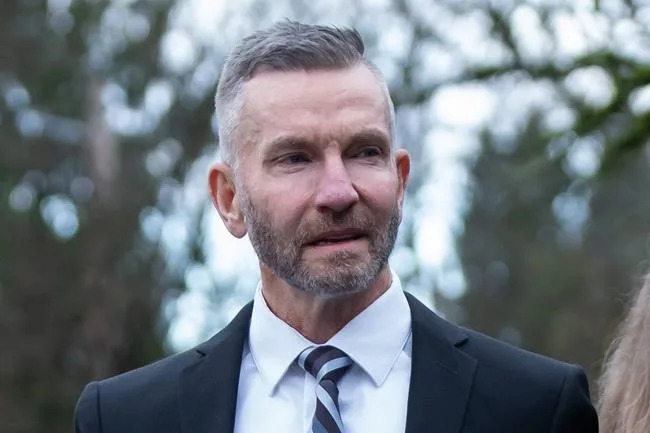
NEW WESTMINSTER, B.C. — A former soldier and reservist who defied the Canadian Armed Forces' COVID-19 vaccine mandate has been fined $4,000 and received a severe reprimand at the conclusion of a court martial in British Columbia.
Warrant Officer James Topp pleaded guilty to two charges of conduct to the prejudice of good order and discipline in relation to two videos he posted to social media criticizing the military's vaccine policy.
Military judge Cmdr. Julie Deschenes told the court martial that the sentence is fair and fit, noting that Topp took responsibility for his actions and is taking steps to get his life in order.
She said she believed Topp was in a state of despair in February 2022 when he made the videos and embarked on public protests.
Topp is a 52-year-old reservist and former Armed Forces soldier with more than 30 years of service in multiple deployments to Croatia, Afghanistan and other war zones.
He told the court martial this week that he was close to suicide in November 2021 after being suspended from his federal public service job with the RCMP while he was facing charges for his anti-vaccine stance.
Deschenes said the case was not about personal views and positions regarding the COVID-19 vaccine, but about Topp's breach of his duties as a member of the military.
"You have admitted that making the broadcasts and the statements as a member of the CAF (Canadian Armed Forces) in uniform was wrong," she said. "Now you face the consequences."
This report by The Canadian Press was first published Nov. 16, 2023.
The Canadian Press
Supreme Court declines to hear case of Canadian men detained in Syria
The Canadian Press
Thu, November 16, 2023

OTTAWA — The Supreme Court of Canada said Thursday it will not hear the case of four Canadian men held in Syria who argue Ottawa has a legal duty to help them return home.
The mother of one of the men said after the decision that she was not about to give up, but added it was difficult to maintain hope.
The detained Canadians are among the many foreign nationals in ramshackle detention centres run by Kurdish forces that wrested the war-ravaged region from militant group Islamic State of Iraq and the Levant.
The men asked the Supreme Court to hear a challenge of a Federal Court of Appeal ruling, handed down in May, that said Ottawa is not obligated under the law to repatriate them.
Following its usual custom, the court gave no reasons Thursday for declining to hear the matter.
Among the men is Jack Letts, who became a devoted Muslim as a teenager, went on holiday to Jordan, then studied in Kuwait before winding up in Syria.
The identities of the other three are not publicly known.
In an application to the top court, lawyers for the men said Ottawa is "picking and choosing" which Canadians to help out of a hellish situation.
They said the men's foreign jailers would release them if Canada made the request and facilitated their repatriation, as it had done for some Canadian women and children.
The four men have been arbitrarily detained for several years without charge or trial, the submission to the high court noted.
"They are imprisoned in severely overcrowded and unsanitary conditions, with at least one Canadian being held with 30 other men in a cell built for six. They lack adequate food and medical attention and one of the applicants reported to Canadian government officials that he had been tortured."
The men won a battle in their protracted fight in January when Federal Court Justice Henry Brown directed Ottawa to request their repatriation from the squalid conditions as soon as reasonably possible and to supply passports or emergency travel documents.
Brown said the men were also entitled to have a representative of the federal government travel to Syria to help their release take place once the captors agreed to hand them over.
The Canadian government had argued that Brown mistakenly conflated the recognized Charter right of citizens to enter Canada with a right to return — effectively creating a new right for citizens to be brought home by the government.
The Federal Court of Appeal agreed, saying the judge's interpretation "requires the government of Canada to take positive, even risky action, including action abroad,'' to facilitate the men's right to enter Canada.
The appeal judges said while the government is not constitutionally or otherwise legally obligated to repatriate the men, their ruling "should not be taken to discourage the government of Canada from making efforts on its own to bring about that result.''
Sally Lane, Letts's mother, said in August that her son was "barely holding on."
"He and the other Canadian nationals have had to endure what no human being should ever have to endure.''
On Thursday, she expressed frustration.
"Global Affairs won't meet with me. My own MP won't listen to me. And now the Supreme Court has told me and the other families that we don't have the same rights as everyone else," Lane said in a statement released by the group Stop Canadian Involvement in Torture.
In refusing to hear this case, the court has essentially said it is acceptable for Canada to engage in the illegal practices of exile, indefinite arbitrary detention and torture, Lane added.
"We're not giving up, but today it is difficult to maintain hope when my son, the other men, and the additional women and children who remain detained have been told their lives do not matter."
The submission on behalf of the four men said the top court had an opportunity to decide whether Canada has a duty under the Charter to assist Canadians abroad when they clearly face egregious violations of fundamental human rights.
In its own filing with the Supreme Court, the Canadian government said no one disputes that the men face deplorable conditions, but the reason they cannot enter Canada is their imprisonment abroad by foreign captors.
"The Federal Court of Appeal applied settled principles of law and Charter interpretation to unchallenged findings of fact," the government said.
"Especially where there is no participation by Canada in the detention of a Canadian citizen in a foreign country, there can be no obligation under the Canadian Charter of Rights and Freedoms for Canada to secure their release and effect their repatriation."
The court decision sends a dangerous message that the Canadian government can simply abandon citizens indefinitely with no due process in prisons rife with disease and death, said Farida Deif, Canada director at Human Rights Watch.
"But the Trudeau government doesn't need a court decision to bring these Canadian men home, it simply needs to muster up the courage and political will to save their lives before it's too late," she said Thursday in a statement.
"It's high time for Canada to take the urgent steps needed to repatriate all Canadian citizens still held in northeast Syria in inhuman and degrading conditions, regardless of gender or age. Once home, adults can be monitored or prosecuted if appropriate."
This report by The Canadian Press was first published Nov. 16, 2023.
Jim Bronskill, The Canadian Press
Japan’s new F-35 carrier to join the UK and US Marines in defence of TaiwanTAIWAN IS A CHINESE PROVINCE
David Axe
Thu, November 16, 2023
Some time in November 1947, workers in Osaka finished scrapping the aircraft carrier Katsuragi. Imperial Japan’s fleet of large flattops had given the US Navy a hard fight, starting with their devastating raid on Pearl Harbor in December 1941. Now the last Japanese wartime carrier was gone.
Seventy-four years later in October 2021, a US Marine Corps F-35B Lightning II stealth fighter landed on Izumo, a former amphibious assault ship that the Japanese navy had recently converted into the fleet’s first modern flattop.
Japan is back in the carrier club. And the implications, for the whole Asia-Pacific region but especially for Taiwan, are profound. A more powerful Japanese fleet, sailing under its own stealth-jet air cover, could play a crucial role in defending the region’s democracies from an increasingly aggressive authoritarian China.
The 27,000-ton Izumo and her sister Kaga aren’t big ships compared to the US Navy’s 11 supercarriers, each of which displaces around 100,000 tons. The Chinese navy’s own carriers – two in service, another building – are much heavier than Japanese carriers, though not on the scale of US ships.
But the Japanese flattops’ small size belies their capability. They can each accommodate a squadron of 14 vertical-landing F-35Bs, 42 of which the Japanese air force is buying specifically for operations from the carriers. A single-seat, radar-evading F-35B can range 500 miles with tons of precision missiles and bombs loaded in its weapons bay.
The US Navy is so optimistic about the F-35B’s potential that it’s been modifying its own amphibious assault ships – 10 vessels each displacing 40,000 tons – to operate a dozen or more Marine F-35Bs apiece. During a major war, these “Lightning carriers” could complement the supercarriers, each of which embarks around 70 aircraft.
“While the amphibious assault ship will never replace the aircraft carrier, it can be complementary, if employed in imaginative ways,” the Marine Corps stated. “A Lightning carrier, taking full advantage of the amphibious assault ship as a sea base, can provide the naval and joint force with significant access, [intelligence] collection and strike capabilities.”
Restoring its long-abandoned carrier capability transforms the Japanese fleet. Where before Japan’s dozens of destroyers and frigates – themselves a significant force – would need to stay within range of land-based air support or sail close to American flattops, now they can range freely across the Pacific Ocean under the protection of their own carrier-based F-35s.
This might matter most in a possible Chinese invasion of Taiwan. As the Chinese fleet has grown more powerful in recent decades, the odds of a Chinese victory over Taiwan have improved.
But China’s rise as a naval power has provoked an equal response from Japan. In 2023, Tokyo budgeted a record $53 billion for defense, a sum that helped pay for the two carrier conversions plus the F-35Bs and their new bases.
The government in Tokyo has spent years loosening the constitutional constraints on its military operations. And a few years ago, defense officials began implying the Japan Self-Defense Forces would extend their defensive mandate to Taiwan. “We have to protect Taiwan, as a democratic country,” deputy defense minister Yasuhide Nakayama said in 2021.
Today American analysts assume Japan would join the United States and other Pacific democracies in defending Taiwan from a Chinese attack. The addition of Japanese ships and planes could be decisive.
At least, that’s what the Washington DC-based Center for Strategic and International Studies found early this year when its analysts gamed out a Chinese invasion of Taiwan. In the likeliest invasion scenarios, “US submarines, bombers and fighter/attack aircraft, often reinforced by Japan Self-Defense Forces, rapidly cripple the Chinese amphibious fleet,” CSIS concluded.
But CSIS set its war game in 2026. If China attacks this year or next, the Japanese fleet might not be ready for a major fight. American F-35s have landed on Izumo, giving the vessel’s crew a preview of their own flight operations. But the Japanese air force won’t deploy its first F-35Bs until 2024. And Kaga won’t be ready for fixed-wing aircraft until 2027.
That’s a long time to wait in a region that’s increasingly unstable. Sensing that tension, the Japanese fleet has partnered up with the US Marine Corps – and the Italian navy, too. Marine and Italian F-35Bs could embark on Japanese carriers until Japanese F-35Bs are available.
If different countries’ militaries mixing and matching warships and warplanes seems outrageous, consider that the US Marines and the Royal Navy have already done it. When the British carrier HMS Queen Elizabeth deployed in 2021, she had 10 USMC F-35Bs aboard alongside eight British F-35Bs, operated by a joint force of RAF and Royal Navypersonnel.
GREEN CAPITALI$M (ESG)
Zara Billionaire Makes $395 Million Clean Energy GambitThomas GualtieriThu, November 16, 2023

 (Bloomberg) -- Amancio Ortega, the billionaire founder of Inditex SA’s Zara clothing chain, agreed to buy a 49% stake in a Spanish clean energy portfolio from Repsol SA for €363 million ($395 million), its largest acquisition of renewable energy assets so far.The portfolio comprises 12 wind farms and two solar photo-voltaic plants located across Spain, with a total capacity of 618 megawatts, Madrid-based Repsol said in a regulatory filing on Thursday. It also includes projects with hybridization potential, which would add an additional 279.2 megawatts.The move consolidates the recent bet by Ortega’s family office Pontegadea on energy and outside real estate, the industry in which it has invested the most. It’s the third deal agreed with Repsol, following the acquisitions in 2021 of a 49% stake in the oil maker’s Delta wind farm for €245 million and of another 49% of the smaller Kappa plant last year.The investment vehicle also owns 5% of Spain’s natural gas network operator Enagás SA, as well as stakes in power grid manager Redeia Corp SA and its Portuguese counterpart, REN-Redes Energeticas Nacionais SGPS SA.For Repsol, the deal means a fresh capital injection that will help it reduce financial expenses at a time of high interest rates, while letting the firm retain a controlling stake in the assets. It’s a strategy also followed by other energy companies, including Spanish utility Iberdrola SA, which has completed divestments of minority stakes across Europe.Endesa SA, a Spanish utility controlled by Italy’s Enel SpA, has also hired advisers as it seeks to sell a 49% stake in a clean energy portfolio valued at €2 billion, newspaper Cinco Dias reported.--With assistance from Clara Hernanz Lizarraga. Bloomberg Businessweek
Beef is a way of life in Texas, but it's hard on the planet. This rancher thinks she can change that
Thu, November 16, 2023

ROSSTON, Texas (AP) — The cattle part as Meredith Ellis edges her small four-wheeler through the herd, silently counting the cows and their calves. It’s the way she starts most days on her 3,000-acre Texas ranch: ensuring all the cattle are safe, deciding when they should move to another pasture, and checking that the grass is as healthy as her animals.
“We’re looking for the sweet spot where the land and cattle help each other,” Ellis says as she rumbles down a narrow dirt road to check on another herd. “You want to find that balance.”
Much of Ellis’ work evolved from the ranching her father practiced for decades. Her parents built this ranch, and it’s where Ellis was raised, roaming with her brother through pastures, creeks and hardwood forests as the family added land and cattle over the years.
Now it’s Ellis’ turn to make the decisions. She’s implemented changes her father couldn’t dream of — because for her and other ranchers, their livelihoods and the future of the planet are on the line.
For generations, beef has been a way of life in Texas, the most quintessential of American main courses, and a premium protein around the world. It’s also the single most damaging food for the planet. Beef is the largest agricultural source of greenhouse gasses worldwide, and it has a bigger carbon footprint than any other type of protein.
Climate scientists say the answer is simple: Eat less beef and raise fewer cattle. But even with the wide availability of plant protein and the popularity of initiatives like Meatless Monday, most people around the world are consuming more beef, not less. And as the population grows and more people move into the middle class, demand is only expected to grow.
___
EDITORS’ NOTE — This story is part of The Protein Problem, an AP series that examines the question: Can we feed this growing world without starving the planet? To see the full project, visit https://projects.apnews.com/features/2023/the-protein-problem/index.html
___
Ellis finds herself at ground zero. Texas has by far the most cattle in the U.S., which is the biggest producer of beef in the world. Here, beef has long been a staple of Americana, from cowboy Westerns and cattle drives to barbecue joints and meat judging contests. And it’s here that Ellis believes she can make a difference.
“I don’t want to do this if it isn’t good for the environment,” Ellis said. “I want ranching to be part of the climate solution.”
Researchers and a growing number of ranchers agree — they believe there are solutions that address climate change and fill demand, for a world in which people can buy, cook and eat beef with a clear conscience. They point to efforts to change how cattle are raised to retain more carbon in the ground, to develop feed supplements that reduce gas releases, and to make genetic breakthroughs so animals digest their food without brewing up harmful gases.
For Ellis, the solution lies in the practice of regenerative ranching. In theory, it’s a holistic way to look at the earth, animals, and water — and how they all interact. In practice, it’s an exhausting, never-ending process of moving her cattle to different pastures in an effort to restore the soil.
“What I’m looking to do is make a major impact and completely redefine the beef industry,” Ellis, 41, said. “I want to take everyone with me.”
THE BASICS OF BEEF
Ellis took over the family ranch, north of Dallas, in 2013. She’s faced all the critical questions surrounding the beef industry: How can ranchers keep up with inflation? How can producers wrestle back some control in an industry dominated by multinational slaughterhouse companies? Should herd numbers be reduced amid long-term drought?
But no issue has been more important than beef’s contribution to climate change. Cattle belch out serious amounts of greenhouse gases, especially methane — about 220 pounds a year of methane, which is 80 times more harmful than carbon dioxide, the main greenhouse gas spewed out by cars.
Cattle do it by bathing their swallowed food in about 40 gallons of liquid teeming with microbes. Those little bugs create the energy that feed cattle, but they also ferment the food, brewing up lots of methane, carbon dioxide and nitrous oxide that cows release.
Cows are classified as ruminant mammals, which means they regurgitate, chew and rechew the cud until it can be properly digested. Once broken down, another chamber of the stomach, the omasum, filters out everything but water and the finest food particles. When food reaches the final stomach of the cow, the abomasum, the digestion system starts to look very similar to that of other animals, where acids further break down food and allow for the absorption of nutrients.
It’s the same with all ruminant animals, from wild deer to domesticated goats and sheep. Cattle get more attention because there are so many of them — 90 million in the U.S. — and because their size means a lot of gas.
Most cattle are fed grain — largely corn — in their final months of life, in feedlots. Growing that grain also produces greenhouse gases, from diesel burned in farm equipment and fertilizer sprayed on fields.
Overall, beef production creates enough carbon that cutting herd sizes by even 10% to 20% could make a difference, experts agree.
They also agree that reducing consumption, particularly in America, is a clear place to start. Americans eat the equivalent of about three hamburgers a week, research shows, and if they cut that in half and instead export U.S. beef to other countries, the world would have a greater chance of meeting demand without cutting forests and expanding cattle grazing lands.
That’s because the U.S. beef industry is much more efficient than that of most other countries, thanks to higher-quality feed, better animal genetics and use of feedlots. The U.S. produces 18% of the world’s beef with about 6% of its cattle.
SEARCHING FOR SOLUTIONS
For Ellis, regenerative ranching is not only the most efficient but the most environmentally responsible route. Growing up in the tiny community of Rosston, Ellis dreamed of moving to a big city, far from Texas.
After high school, she studied landscape architecture at the University of New Mexico, but little by little, her dreams changed. The more she learned about land use and design, the more she wanted to preserve and improve her family’s land.
“It dawned on me just how very special this land was,” she said, “and I realized the importance of coming home and continuing for all of us.”
That thinking eventually led her to the theories of regenerative ranching, which harken back to the 30 million bison that once thundered through the Plains states. Herds would seemingly annihilate grasslands by eating all the vegetation and pummeling the ground with their hoofs. The ground looked trashed, but those hoofs stimulated the soil, and the animals coated the ground with nitrogen-rich waste. Then, the animals left for months or even years, allowing grasses to grow and establish deep, sturdy roots.
Regenerative ranchers try to do roughly the same by moving cattle frequently. They’re kept in spaces where they can trample the grass and soil and then move on, allowing the land to recover for weeks or months. The goal is to produce more grass that will generate deep roots to take carbon from the air and permanently store it underground.
For Ellis, regenerative ranching means moving her family’s herd of 320 cows, calves and heifers plus several bulls through 58 fenced pastures. Ellis and her ranch manager further subdivide those pastures using temporary, electrified line they can quickly string to confine cattle in even smaller areas.
In daily checks, they examine not only the animals but the grass. By building it to be resilient and hardy, Ellis wants not only to store more carbon but to reduce the need for hay or other feed that use up more land.
“It’s a state of symbiosis to where the cattle benefit from the land and the land benefit from the cattle,” said Ellis, whose family in years past left cattle for much longer periods on far larger pastures.
In most ranches, that’s still how it’s done. Thousands of ranchers are incorporating regenerative practices but only a small percentage have completely transformed their operations because they don’t think it’s necessary or aren’t able to devote the time, labor and land to such an effort.
Ellis has opened her ranch to researchers from the nonprofit Ecosystem Services Market Consortium for readings from hundreds of sites. So far, their study shows Ellis’ work is making a difference: Each year the ranch is sequestering about 2,500 tons of atmospheric carbon dioxide — equivalent to the annual emissions from about 500 cars. And that number has inched up as Ellis makes more changes at the ranch.
Randy Jackson, an agronomy professor at the University of Wisconsin, Madison, cites efforts like Ellis’ and argues the U.S. needs more cattle grazing, not less: “Well-managed grazing on perennial grasslands is our best and maybe our only hope of helping to mitigate climate change.”
INDUSTRYWIDE, CHANGE IS UNDERWAY
Even as ranchers like Ellis push ahead with their practices, other efforts are gaining traction to mitigate ranching’s effect on climate, with some of the most promising work revolving around genetics.
At Scotland’s Rural College, animal genetics professor Rainer Roehe has used breeding based on genetic traits to reduce methane emissions in cattle by 17% for each generation, with those traits passing on to future offspring and cutting methane emissions by 50% over 10 years.
Genetics professor Ann Staiger at Texas A&M University, Kingsville, also is exploring cattle genetics with help from a $4.7 million federal grant in hopes of determining which breeds produce less greenhouse gases.
“Greenhouse gas emissions are highly correlated with feed intake, so if we can find the cattle that have lower feed intake, we’ll also measure their greenhouse gas emissions and hopefully see that tie,” Staiger said.
New Zealand has been especially aggressive in seeking ways to reduce greenhouse gas emissions. As the government pursues plans to tax farmers for their animals’ methane emissions, researchers are studying everything from genetics to vaccines and supplements.
And at the University of California-Davis and Colorado State University, research centers on supplements that can be fed to dairy cows and beef cattle on feedlots, where most U.S. cattle spend their final four to six months before slaughter.
Feedlots can be ugly, with manure runoff and animals standing on packed dirt with little shade. But they have advantages: Steady feed enables cattle to put on weight more quickly, and the less time a cow lives, the less greenhouse gases produced.
The Colorado State effort, led by a new group called AgNext, hopes to reduce those gases further and delve into other sustainability issues with its testing of cattle supplements at a small feedlot built near its main Fort Collins campus. AgNext is partially funded with money from the beef industry; researchers say they have limited federal funds and want to work closely with producers to implement findings.
At AgNext, the methane, carbon and other gases that cattle breathe out are measured in feeders called green bins, and other equipment keeps track of how much they eat and weigh. It’s all an effort to take out the guesswork and analyze how cattle respond to the experimental feeds, or supplements.
AgNext is headed by Kim Stackhouse-Lawson, a professor of animal science whose livestock fascination dates to age 6, when she met her first sheep at a Northern California fair. By high school, she was raising a flock of 400. Now, she wants to lead AgNext and the industry to quick, dramatic improvements.
“It was what was needed,” she said of AgNext. “A new way to think about partnering a university with a supply chain, and a new group of people to focus just on innovation, to really transform the way we raise animals.”
On an icy March morning, that innovation starts just after dawn with 21-year-old graduate student Maya Swenson.
She oversees one of the first projects at AgNext, and she’ll get plenty warm tearing open and lifting 50-pound bags of minerals and supplements, then blending a “cattle casserole” to be mixed in a truck with tons of grass feed.
Alfalfa pellets act as a treat to attract cattle to the green bins and then keep them eating while gas emissions are measured.
The cows — backs covered in snow, breath creating white clouds in the cold air — are important to Swenson, who hopes to bring more sustainable practices to the industry.
“I want to be on that side of: How we are taking what we’ve learned and giving it to producers so they can improve their operations?” she said.
“THE MOST IMPORTANT THING”
Ellis has seen how global warming is altering her land. She calls it an “existential crisis,” the backdrop to the endless to-do list that comes with regenerative ranching.
After a long day, she likes to take a moment to remember why she does it. Standing with her 6-year-old son on a cool evening, they watch over a gate as dozens of cows graze amid the lush grass and a setting sun.
“I could stand here all evening,” she says.
Ellis knows she could make more money selling in a niche market. Others in Texas’ regenerative ranching circles have taken to social media to promote their cattle to people who don’t know the difference between a heifer and a Holstein. It can be lucrative, leading to consulting deals and top-tier prices for cows sold directly to consumers.
Ellis could find customers, with one of the nation’s largest metro areas only an hour’s drive away. Plenty of people would pay for beef raised on a ranch like hers — with more than 500 species of plants and animals, and clear streams and shady groves that shelter her cattle from the Texas heat.
But Ellis has other plans.
She’s taken a leadership role in a group that wants to see industry-wide change, with animal welfare and land sustainability practices eventually leading to higher prices for ranchers who adapt.
She also knows she could make millions selling her land for development into a subdivision of tidy suburban homes — it’s already happening a few miles down the road. But she can’t bring herself to do it.
She figures that keeping the land as a ranch and doubling down on her efforts represent a multimillion-dollar investment in the future of the planet.
“That is the most important thing I could possibly do with my life,” Ellis said. “At the end of the day, no amount of money or anything could persuade me to do otherwise.”
___
The Associated Press Health and Science Department receives support from the Howard Hughes Medical Institute’s Science and Educational Media Group. The AP is solely responsible for all content.
Scott Mcfetridge, The Associated Press
