Monday, March 18, 2024

THE PERIL OF PRIVATIZATION
‘Don’t make panicked cuts’: proposed Royal Mail shake-up worries businesses

BUILD THE POPULAR FRONT!


Alex Lawson
Sat, 16 March 2024 
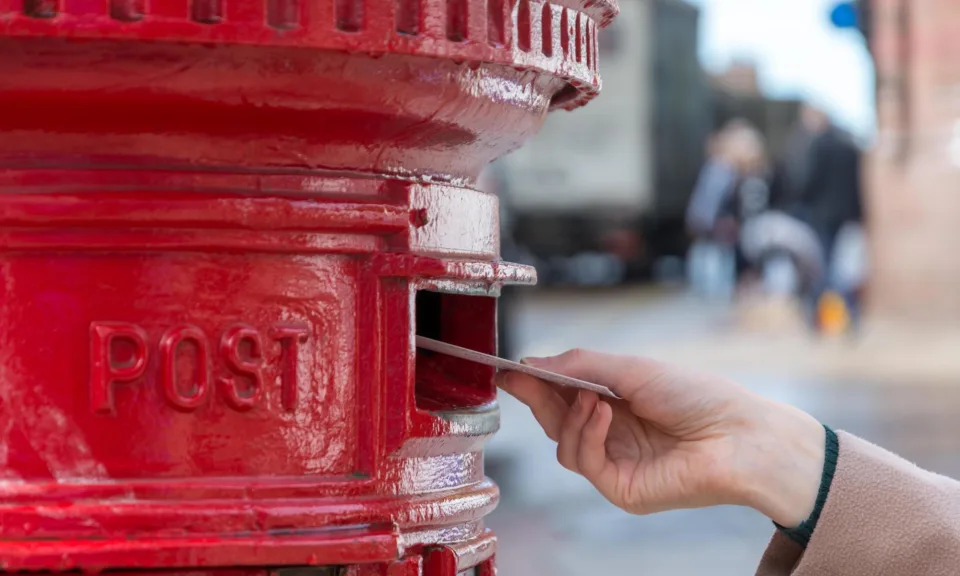
Royal Mail argues that the sharp fall in letter volumes over the past two decades makes its business model unsustainable.
Photograph: Bjorn Birkhahn/Alamy

David Falkner may spend his days selling pop-up cards of Star Wars stormtrooper helmets and Harry Potter’s Hogwarts, but he’s intent on ensuring his industry is taken seriously. “We punch well above our weight,” said the co-founder of Cardology, of the £1.5bn greetings card industry.

Falkner and a cluster of fellow card retailers gathered in London this week to voice concerns over proposals to cut back Britain’s postal service.

In late January, the communications regulator, Ofcom, set out a series of options for the future of the service, namely creating a slower, more reliable service or cutting the number of days on which Royal Mail delivers letters, from six days a week to five or even three. A costly next-day service would be retained.

The consultation is expected to ultimately lead to a reform of the universal service obligation (USO) – the company’s mandate to deliver to every address in the UK at a fixed price, six days a week.

Royal Mail argues that the sharp fall in letter volumes over the past two decades makes its current business model unsustainable. As part of the process, Ofcom is hosting a series of events for interested parties – from small businesses to direct mail companies – to chew over the potential impact.

“This feels to me a bit like a Beeching cut, it feels panicked,” said Falkner, sitting on stage at Ofcom’s offices overlooking St Paul’s Cathedral. He was referring to the 1963 Beeching report, which led to huge cuts to rail lines and stations nationwide, and has long been lamented as an overzealous cost-cutting exercise that damaged the railways in the long term. Businesses fear the postal cuts could have the same effect.

Much of the focus after Ofcom’s announcement has been on the impact on consumers – including elderly and vulnerable people – but businesses are also worried.

“Of course letters have declined with email, but greetings cards are still very much a paper-based business, it’s a really strong economy,” said Heidi Early, the owner of Early Bird Designs, a greetings card and gift shop in Stoke Newington, north-east London. “It’s growing, my business is thriving and it relies on a reliable and affordable postal service.

“My customers are still sending cards but I’m getting comments every day about how unreliable the postal service is and how expensive it’s become in relation to the cost of a greetings card.”

Woodmansterne Publications makes and sells 40m cards a year, from a site in Hertfordshire once owned by John Dickinson, a pioneer of both cardboard and the gummed envelope, who died in 1869.

The managing director of the business, Seth Woodmansterne, expressed concern over Royal Mail’s delivery problems, and the time it may take to reform the USO – in part because an election may delay parliamentary intervention if it is needed. “Royal Mail is failing on a daily basis currently, every day that it does not deliver is eroding public confidence,” he said. “I would like to see something happen urgently.”

Away from cards, the Professional Publishers Association – representing everything from Farmers Weekly to the Radio Times – argued the magazines’ time-sensitive information will be delivered late. The organisation’s Eilidh Wilson said readers have unsubscribed because of an unreliable service “and that business gets lost”. She said that moving production lines to allow for changes to posting schedules is not practical.

The majority of letters sent are not covered by the USO, instead handled by a combination of bulk mail handlers – including UKMail and Citipost – and Royal Mail. However, the network is the same and another row with the Communication Workers Union could be brewing.

“If the unions cannot be brought on side, then we run a danger that we accept a specification that is lower but still get a worse service, people are disappointed, the volume declines and the costs go up,” said Jon Wilkins, a director of UKMail.

Ofcom’s analysis suggests savings of £100m to £200m for Royal Mail if it reduces to a five-day service, and £400m to £650m to cut to three. The company has yet to publish its own analysis, and its director of corporate affairs, Jenny Hall, said the latter figure was “a bit toppy”.

However, recent history suggests signifiant job cuts would cause a union standoff and, potentially, further strikes. “This is not about a big change to job cuts exercise,” Hall added. “When you’re a fundamentally loss-making business, your ability to invest in some of those things that are ultimately better for customers is quite limited, so this for us is also about a platform for growth and a platform to sustain as many jobs.”

With responses to Ofcom’s consultation due next month, lots of questions remain over how Britain’s future postal service will eventually compare with the rest of Europe, and whether Rishi Sunak will hold his line in opposing any cuts to delivery days. Answers on a (delayed) postcard.
Trans women included in push for more female chief executives in FTSE 100

TWO WORDS: CAITLAN JENNER

Lucy Burton
Sat, 16 March 2024 

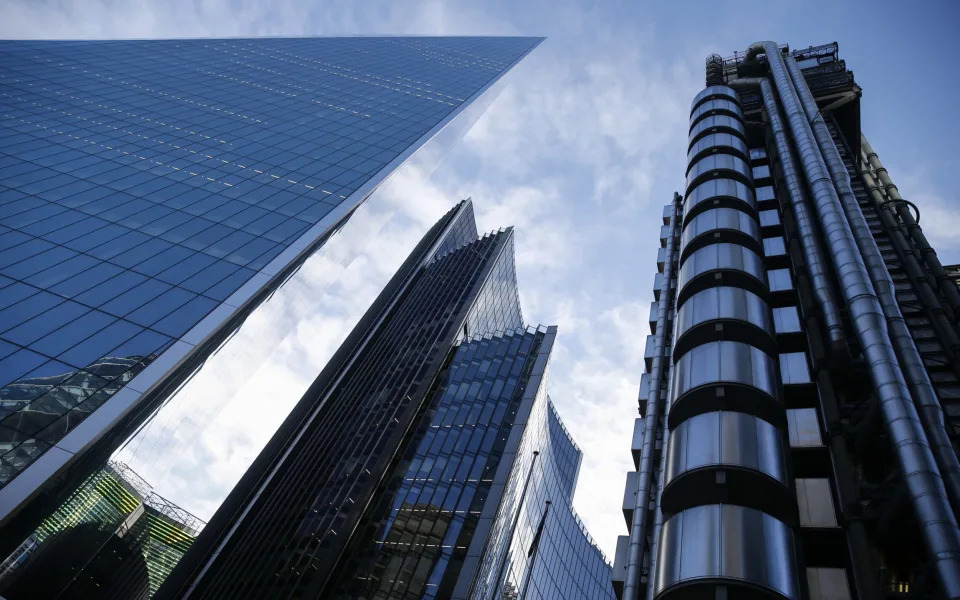
Skyscrapers in the City of London square mile

Trans women are included in a push to get more female chief executives into the FTSE 100 by next year, the head of the campaign has said.

The 25x25 initiative, which is backed by major companies including Unilever, NatWest and BP, was created in 2021 with the target of getting 25 female chief executives running bluechip companies by 2025. There are currently only ten.

Tara Cemlyn-Jones, chief executive of the non-profit organisation, confirmed that people self-identifying as women count towards that target.

Ms Cemlyn-Jones said “anyone who identifies as a woman, is a woman”, though she stressed that 25x25 were “not an authority on this subject” and would always defer to partners on “language, aims and ambitions” in this area.


She said: “Our focus is on succession and talent planning using gender broadly as an indicator. To suggest anything else would be very misleading.”

25x25’s decision to include trans women within its goal comes amid a debate into how men who self-identify as women should be included in diversity targets.

Critics argue that including trans women alongside biological women in data and targets could skew figures on things like the representation of women on boards and average salaries.

Tory MPs last month accused the financial services watchdog of putting women’s rights at risk by urging banks to collect staff data based on self-identified gender rather than biological sex.

Some 40 MPs and peers wrote to the Chancellor to argue that the Financial Conduct Authority (FCA) was taking an “activist approach” to its diversity policies.

The FCA’s new plans to boost diversity in financial services is currently out for consultation, amid growing concerns that progress on gender diversity at a senior level is stalling.

Last month the Treasury committee said it had found a “shocking” prevalence of sexual harassment and bullying in the City, adding that progress on stamping out sexism has moved at a “snail’s pace” since a previous review into the issue in 2018.

Ms Cemlyn-Jones said she was concerned that the investors and analysts who hold big listed companies to account are “not contributing to change”.

She said: “If you listen to any woman at any analyst meeting and you look at the calibre of questions that are directed to women versus men, it’s significantly different.

“These are men from a very particular background who get comfortable with CEOs they can relate to.”
VULTURE CAPITALI$M
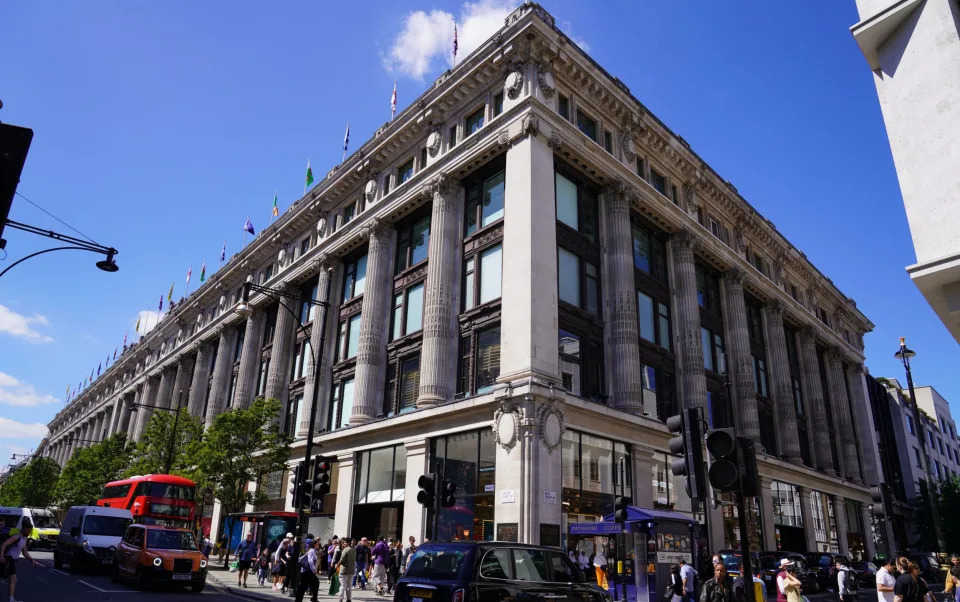
Saudi Arabia and Gucci owner circle Selfridges

Luke Barr
Sat, 16 March 2024 

Selfridges was bought by Signa and Central in a £4bn deal in 2021 
- OGULCAN AKSOY/OGULCAN AKSOY

Saudi Arabia and Gucci-owner Kering are said to be circling Selfridges as the insolvency of the department store’s co-owner triggers a battle for the business.

Saudi Arabia’s Public Investment Fund (PIF) and luxury goods giant Kering, which is owned by French billionaire Francois Pinault, are both thought to be interested in a stake in Selfridges, according to City sources.

Interest has been triggered by the collapse of Signa, the Austrian company run by businessman Rene Benko that owns half of Selfridges’ property company.

The insolvency has led to its stake in the retailer becoming available. City sources have said Selfridges is in play but the sale process is complicated by proceedings in Austria.


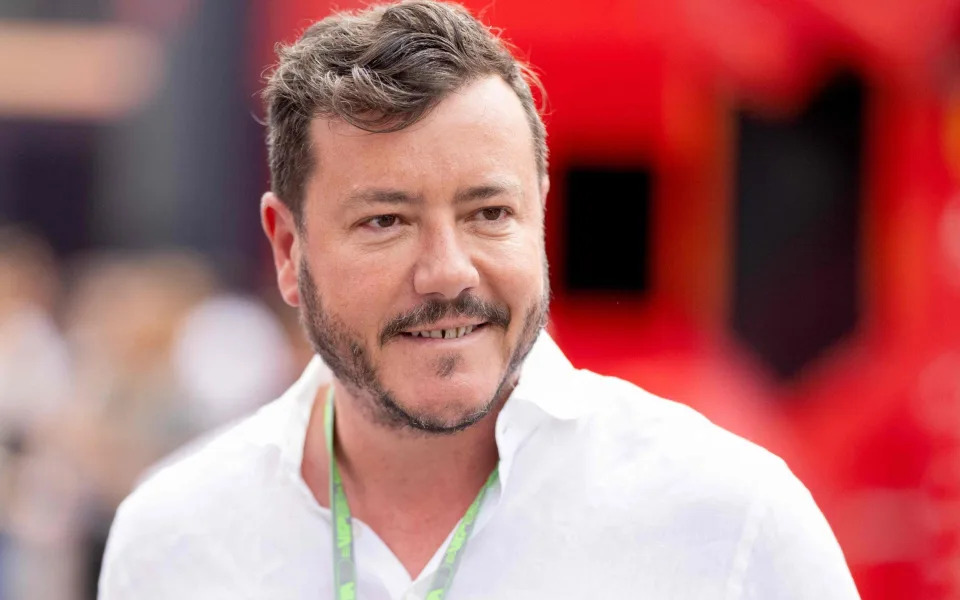
Collapse of Austrian tycoon Rene Benko's company Signa could trigger a bidding war for Selfridges - GEORG HOCHMUTH/AFP

It is understood that Selfridges’ other co-owner, Thailand’s Central Group, is seeking a new partner as the future of fellow shareholder Signa looks increasingly uncertain.


Saudi Arabia’s Public Investment Fund (PIF) is one of the parties understood to be interested in Signa’s stake, which covers Selfridges’ retail brand and its lucrative real estate on Oxford Street.

It comes after The Telegraph revealed last year that the kingdom was a private financial backer in the sale of Selfridges two years ago, which was conducted following an auction by the Weston family.

Saudi’s involvement stemmed from it providing the finance for Signa’s investment. It therefore could be in pole position should a bidding war for Selfridges emerge.

The Gulf kingdom has been on a dealmaking spree in recent years that has seen it invest heavily abroad, including in Britain where it has bought Newcastle United FC among others.

However, PIF could face competition from luxury goods giant Kering, City sources say.

Paris-listed Kering is worth €52bn and owns a suite of luxury brands including Gucci, Balenciaga, Yves Saint Laurent and Alexander McQueen.

The company has recently been buying up luxury retail space. In January, it bought the 115,000 square foot Fifth Avenue building home to its New York Gucci store for $963m.

A banker familiar with the matter described Central Group as the “king-maker” in the sale process, which is still in its early stages as Signa unravels.

Interested parties are believed to be waiting for a full outcome from Signa’s collapse before they formally declare an interest in the stake, which would be worth around £2bn.

“What Central are doing is watching their partner’s problems play out,” the source said. “Sitting, watching to see how it breaks. Of course, they are naturally interested to see what happens because they are going to have a new partner.

“It’s between retailing dynasties and sovereign wealth funds.”

Selfridges was bought by Signa and Central in a £4bn deal in 2021, with the business split between an operating company and a property company.

Both had been jointly owned by Signa and Central.

However, Central moved to seize control of the operating business during the turmoil at Signa late last year, converting a €364m (£317m) loan into a majority stake in the business.

Despite this, Signa still owns 50pc of the property company and holds around 35pc in the operating company.

Signa’s downfall led to Mr Benko filing for personal insolvency earlier this month, four months after his company crumbled under the weight of high interest rates and dwindling valuations.

Amid questions around its ownership, Selfridges has maintained that it trades independently of any support from its shareholders.

However, the situation has cast a shadow over the retailer, which has also been racing to cut costs in a major efficiency drive.

Last August, it unveiled plans to slash roles in its head office.

Andrew Keith, Selfridges managing director, told workers at the time that the company needed to be “fit for the future, aligned and working in the most efficient way”.

He said: “Regrettably this is likely to mean some of our head office teams, including some small teams in retail who support our stores, will be resized and reshaped.”

The move followed a year in which Selfridges lost almost £40m after it recorded a jump in costs.

Accounts for Selfridges Retail, which covers the business’s four UK stores, its website and its mobile app, revealed the company was struck by higher debt interest costs during the year to January 2023.

Its interest expense on lease liabilities was close to £100m, around 20pc higher than the prior year.

Signa and Central loaded Selfridges up with more than £1.7bn of debt in autumn 2022 by booking loans through a number of new trading and property entities.

Central Group and Selfridges declined to comment.

Kering declined to comment. PIF was contacted for comment.


Controversial Everton bidder 777 Partners sees owning football club as way to snap up sportstech bargains


Daniel O'Boyle
Fri, 15 March 2024 

The controversial investment firm sees owning football clubs as a way to identify underpriced buyout targets in the sports tech sector, the Standard can reveal (Getty Images)

777 Partners, the controversial London and Miami investment firm that awaits approval for its deal to buy Everton, sees owning football clubs as a way to identify underpriced buyout targets in the sports tech sector, the Standard can reveal.

The companies in question could be a ‘salesforce for football’ or a statistical data provider, 777 head of Europe John Jeffery suggested.

777 - which runs its European operations from Mayfair and already owns clubs in five other countries, as well as basketball’s London Lions - agreed to buy the Premier League stalwarts in September, but final approval from the league has taken much longer than the average deal.

Jeffery told the Standard that the once-obscure firm, which mostly dealt in life insurance and annuities for lawsuit winners, saw four main benefits to being in football.

Three of those benefits are about owning multiple teams: lower revenue volatility, the ability to move players between clubs and a chance to attract directors best suited to a certain budget.

But with the fourth, Jeffery offered a reason why 777 decided to get into buying clubs in the first place. He said 777 could buy out a potential sportstech unicorn at a bargain price, because it would have a better view of the top products on the market.

The firm has already used this business model - buying the "strategic fulcrum" of a sector, and then the adjacent companies it sees as undervalued - in other sectors like insurance.

He said: “We feel like we have a better understanding of the market as a customer ourselves. We can say ‘forget all the Gartner [market research] reports, forget everything. We know what the best software in the market is for this particular problem because we have this problem and we use all the software... So we're going to go about buying it’.”

He insists the model is more effective than researching the sector without playing an active part in the sport, enough to justify the large costs involved in buying top teams and keeping them running.

The firm may also work on building its own products to fill spaces where there wasn’t an existing company to buy. It has already done that in the insurance space, making a product to hedge life insurance payouts using equity release deals, so that a surge in deaths would not mean a big hit to the firm’s profits.

But he added that - for every club the firm owns - 777 would have to work on shoring up the finances in the short-term before it can think about a buying spree. He also noted it would be “insulting” to fans to focus entirely on selling some recently acquired software at the expense of results.

777 has spent months awaiting Premier League approval for its deal to buy Everton, as football owners face greater scrutiny and the firm has been the subject of lawsuits, some from creditors that say they’re owed money. The unusually lengthy process has already led to a point deduction for the club, with a six-point penalty (reduced from 10) moving them from mid-table to a potential relegation fight.

According to reports today, the Premier League is likely to make a decision on the club next week. If the deal is not approved, the future of the debt-heavy club is unclear.

American newsletter Semafor last year raised questions over the source of 777’s funding for the deal, claiming that the company used money from insurance premiums - usually put into secure assets like high-rated bonds - to finance its sporting investments.

Jeffery admitted that those funds were used to invest in clubs, but added that the insurance investments are handled by an “independently run operating company with an independent board that is regulated”, Jeffery said.

He said that leadership does pitch investment opportunities to that board, but that “they can say no and there’s nothing I can do about it.”

But in the case of the football investments, he said “they took it away, they did their due diligence, and they made the decision that they wanted to invest.”

In the capital, the London Lions basketball team has faced its own difficulties since the acquisition. The club’s 2022 accounts are currently overdue. But Jeffery says that its troubles lie with those managing the club on a day-to-day basis.

He said: “It’s run day-to-day, there’s no input.

“We’re often as surprised as everyone else when there’s a negative headline. We know when you know.”

UK

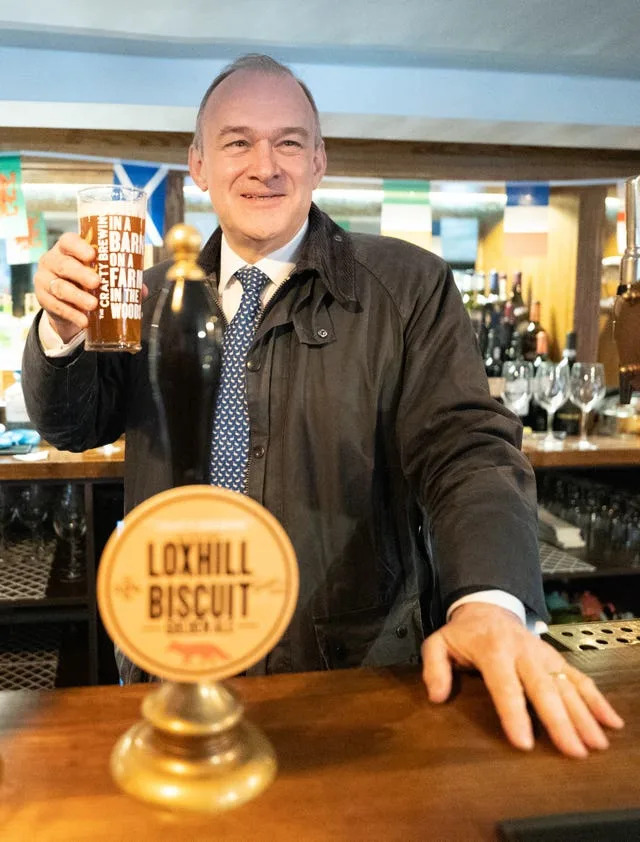
Lib Dems call for Biden-style tax on share buybacks at spring conference


Sophie Wingate, 
PA Deputy Political Editor
Sat, 16 March 2024 

The Liberal Democrats have called for a new tax on share buybacks by large companies as the party holds its spring conference in York.

Sarah Olney, the Lib Dem Treasury spokeswoman, used her speech on Saturday to set out the plan to follow Joe Biden’s example and impose a 4% levy on the share buybacks by FTSE 100 firms.

The measure could raise around £2 billion annually for public services and investment in green industries, the party said.

Critics say buybacks – when a company purchases its own shares – are used to inflate share prices and come at the expense of spending on investment.

The US president introduced a 1% tax on share buybacks of US-listed companies in 2022 and has now proposed to raise it to 4%.

Party leader Sir Ed Davey said: “Large corporations from fossil fuel giants to banks are making huge profits off the back of families facing soaring energy bills, mortgage payments and food prices. It is only fair that we ask these companies to pay more in tax.

“This new levy would not just raise much-needed money for public services, it would encourage investment, help create jobs and boost growth including in the green industries of the future.”

The £2 billion the policy could raise is close to what the Labour Party said its plan to tax non-doms could have brought in, before Chancellor Jeremy Hunt deprived Sir Keir Starmer’s party of that funding by adopting the measure in his Budget.

In her speech, Ms Olney said: “Some of the biggest and most profitable companies in the world are listed on the London Stock Exchange. And every year, these same companies spend tens of billions of pounds doing nothing more than buying back their own shares.

“Every pound spent inflating share prices is a pound that could have been spent productively. And at a time when the UK is near the bottom of the table for business investment amongst major economies, that’s a problem.

“And it’s an even bigger problem for our fight against climate change. If we’re going to achieve net zero, we need big corporations to channel serious investment in energy efficiency, green technologies and clean energy. But too many put their share price above the good of our planet.”

Liberal Democrat leader Sir Ed Davey is expecting to make gains across the so-called Tory ‘blue wall’ (Stefan Rousseau/PA)

She pointed to oil giant BP, which she said spent less than £1 billion of its £11 billion profit last year investing in low carbon energy and more than £5 billion buying back its own shares.

“In the last two years, share buyback programmes from the hundred biggest firms on the Stock Exchange reached record highs, exceeding £50 billion a year. Just think what our economy could have achieved if this money was spent on productive investment — think of the progress we could have made on the green transition.

“Let’s put a 4% tax on share buybacks to incentivise proper business investment, spur economic growth and raise funds fairly for our public services to the tune of £2 billion a year. Let’s take bold action to supercharge green investment and break the cycle of Conservative stagnation and recession.”

Ms Olney also attacked Mr Hunt’s Budget, saying that “even after his changes to national insurance, he is raising taxes to their highest level in the post-war era”.

She added: “And it’s not just that he’s putting up taxes during a cost-of-living crisis. It’s that he’s doing it in the most unfair way possible with a stealth tax that keeps income tax thresholds frozen, dragging millions of people on low pay into income tax for the first time.”


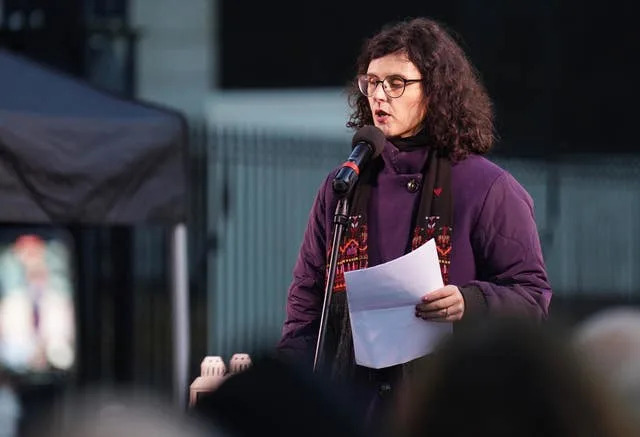
Layla Moran, the only MP of Palestinian heritage, addressed the Israel-Hamas war in her spring conference speech 
(James Manning/PA)

Lib Dem foreign affairs spokesperson Layla Moran, who is of British-Palestinian descent, said in her speech that the Israeli government’s assault on Gaza has “gone beyond the pale”.

She called for sanctions on violent Israeli settlers to be extended to “anyone who enables the insidious settler movement, the lawyers, the accountants, the businesses”.

She said: “If they support illegal activity, they shouldn’t be allowed in the UK and if their money is flowing through our economy, we should go after it. No longer can acting with impunity go without consequence.”

Ms Moran also accused the Tories of fanning “flames of antisemitism and Islamophobia” in the UK, saying the Lib Dems reject their “false dichotomy” of standing either with the hostages and against Hamas, or with the Palestinians and against Benjamin Netanyahu’s government.

Elsewhere, the Lib Dems passed a new policy calling for key sporting events such as Premier League matches, Six Nations Rugby, Ryder Cup and the Ashes to be legally shown on free-to-air TV channels.


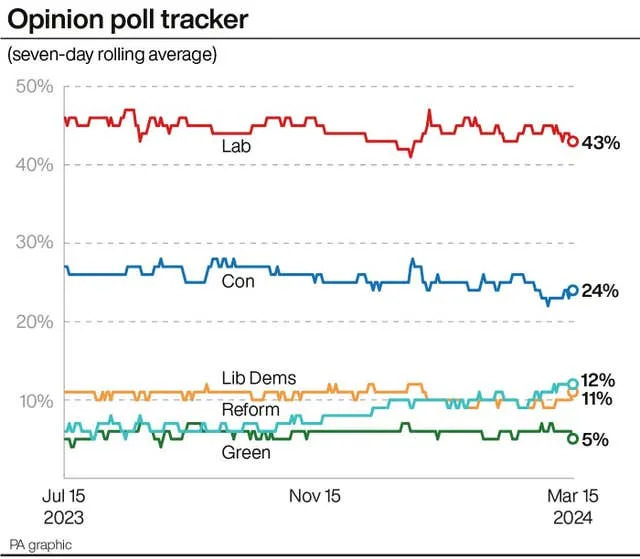
(PA Graphics)

The party is using the gathering to prepare for a further push into “blue wall” seats — traditional Conservative strongholds — ahead of the general election.

The party won 11 seats at the 2019 general election but have since gained formerly Conservative constituencies across southern England in a series of by-elections.

These have included Chesham and Amersham in Buckinghamshire, Frome in Somerset, Tiverton and Honiton in Devon, and North Shropshire.

But some polls suggest the far-right Reform UK party has overtaken the Lib Dems in popularity across the UK.

Prime Minister Rishi Sunak this week ruled out holding an election on May 2 to coincide with local elections, having previously indicated he will send the country to the polls in the latter half of 2024.
Shell just showed why Big Oil is reluctant to give up on fossil fuels

WE CAN'T GET IT DONE TILL 2150

"We cannot replace overnight an energy system that took 150 years to build"


Ines Ferré
·Senior Business Reporter
Sat, March 16, 2024 

Big Oil's appetite for fossil fuels isn't showing any signs of receding.

This week Shell (SHELL) dialed back its target for carbon emissions. The decision comes amid an energy transition that is decades away from full implementation as countries and industries around the world aim to reach net zero by 2050.

On Thursday the British energy giant said it aims to reduce customer emissions from the use of its oil products by 15% to 20% by 2030, versus a prior target of 20%.

The company also dropped its 2035 target of a 45% reduction in net carbon intensity citing "uncertainty in the pace of change" in the energy transition. Net carbon intensity measures emissions associated with each unit of energy sold.

The revised initiatives come on the heels of rapid-fire consolidation among the oil majors looking to expand acreage and insistence from shareholders that companies keep record profits flowing and stick to their core business. In November, the International Energy Agency, which advocates for green technologies, noted the oil and gas industry invested around $20 billion in clean energy in 2022, just 2.5% of its total capital spending.

That may be too much for investors. Earlier this year, BP (BPreceived a letter from an activist hedge fund demanding that the British oil and gas producer scale back its "irrational" green energy strategy, arguing it has "quite understandably, depressed the value of BP’s share price."

BP dialed back its own carbon emissions targets about a year ago.

The pressure from shareholders comes at a time when renewable energy technologies have struggled to accelerate amid high interest rates. Last month, Shell sold off partial ownership of two US-based green energy projects.

The problem for oil companies is renewable projects that exceed return-on-investment hurdles "have been hard to find," Stewart Glickman, energy equity analyst at CFRA Research, told Yahoo Finance last month.

The Shell logo is displayed outside a petrol station in Radstock on Feb. 17, 2024, in Somerset, England. (Matt Cardy/Getty Images) (Matt Cardy via Getty Images)

As ESG initiatives and investing styles fall out of favor, energy companies have also become more emboldened to challenge some green measures.

Last month, two impact-oriented funds dropped a climate proposal intended to go to an ExxonMobil (XOM) shareholder vote after the Houston-based oil giant filed a lawsuit to remove the measure from its proxy ballot.


In the complaint, the oil producer said the activist investors Arjuna Capital and Follow This were driven by an "extreme agenda" with the goal of "diminishing the company's existing business."

Mark Kramer, a senior lecturer at Harvard Business who wrote a case study on ExxonMobil, says green advocates are losing the battle in their efforts to pressure the oil industry towards more aggressive energy transition initiatives.

"It's quite clear — it's not working," he told Yahoo Finance in February. "The profitability of oil and gas right now is so strong that it’s extremely hard for a company to walk away from that, or even to talk [of] walking away from it."

If anything, oil companies are betting that natural gas, seen as a cleaner fossil fuel, will be needed in order for the energy transition to happen.

"We believe natural gas and LNG [liquified natural gas] will play an important role in replacing coal in high-temperature heavy industry applications. They can help address both local air emissions and wider climate considerations," reads Shell's Energy Transition Strategy.

Oil executives argue that fossil fuels meet about 80% of global energy demand, with developing countries overwhelmingly reliant on them. Reducing those energy sources would set back those regions.

"We cannot replace overnight an energy system that took 150 years to build," said ExxonMobil CEO Darren Woods at the Asia-Pacific Economic Cooperation conference in San Francisco in November.

"The problem is not oil and gas. It’s emissions," he added. ExxonMobil says it has cut operated methane emissions in half since 2016, and among its measures, is targeting a 20-30% reduction in corporate-wide greenhouse gas intensity by 2030.

"The solutions to climate change have been too focused on reducing supply. That’s a recipe for human hardship and a poorer world," added Woods.

Ines Ferre is a senior business reporter for Yahoo Finance. Follow her on X at @ines_ferre.

Shell wants to stay in the fossil fuel game as long as possible


Rhodri Morgan
Sat, 16 March 2024 

Shell altered or dropped several green commitments in an energy transition update last week

The energy transition is proving both a win-win and can’t win situation for Shell.

On the one hand, the £164bn company has such a broad remit across all imaginable facets of the world’s energy mix that it is almost uniquely positioned to succeed in any permutation of the energy transition.

But despite that, it seemingly won’t quit the fossil fuel game or the profits that come with it, no matter the volume of social justice campaigning.

The disconnect between Shell and its many detractors is that for the oil giant, it’s ‘can’t’, but the rest say it ‘won’t’.

“While the world still relies on oil, we will supply it – but – with lower emissions,” said Shell chief Wael Sawan this past week as the firm published its energy transition update, prompting a minor share price gain.

The company has chosen to focus on altering the “carbon intensity”, i.e. the emissions produced by each unit of energy that Shell sells, by 15 to 20 per cent by 2030 compared to 2016 levels – previously, it had committed to a 20 per cent reduction.

Theoretically, this means it could produce more gas at a lower emissions intensity but still raise its total emissions if production is increased.

It also dropped a plan to reduce net carbon intensity by 45 per cent by 2035 due to “uncertainty in the pace of change in the energy transition.”

And therein lies the company line on why it’s not slowing down on oil and gas.


It said that current renewable investment is around £1-2 trillion behind where it needs to be to reach net zero by 2050 and that “significant investment will be required to keep supplying oil and gas while low-carbon alternatives are developed and made commercially available.”

“This continued investment is needed because demand for oil and gas is expected to drop at a slower rate than the natural decline of the world’s oil and gas fields, which is at 4 per cent to 5 per cent a year,” the company added.

While the recent strategy update includes a new target to reduce the scope three emissions from its oil business by between 15-20 per cent by 2030, compared with 2021 levels, it has not set a similar target for its gas business, which is expected to grow by 50 per cent by 2040.

The group added the equivalent of 200,000 barrels of oil and gas production, and it plans to start enough new fossil fuel projects to add half a million barrels a day to its oil and gas production by 2025.

These commitments to gas growth and diluting of emissions targets provoked criticism from environmental campaigners last week.

“With this backtrack, Shell bets on the failure of the Paris climate agreement, which requires almost halving emissions this decade,” Mark van Baal, founder of Follow This, an activist shareholder group, said.

“This backtracking removes any doubt about Shell’s intentions. The company wants to stay in fossil fuels as long as possible.”

Jonathan Noronha-Gant, a senior campaigner for non-profit organisation Global Witness, concurred, saying that Sawan’s pay packet was a “cynical distraction” from the watering down of the targets.

“Shell cannot be trusted on targets – it will put profit first every time,” he said.

Global Witness analysed data from energy research specialist Rystad Energy and claimed that in 2030, Shell’s oil and gas projects are projected to emit 487m tonnes of carbon, more than the UK and the Netherlands – the company’s two corporate hubs – together produce in a year.

Customer emissions from the use of Shell’s oil products were 517m tonnes equivalent of CO2 in 2023 and 569m tonnes in 2021, so though still high, 487m tonnes in 2030 would represent exponential reductions.

When Shell reports results, the easy criticism to make is that it should spend more of its massive purse on renewable energy projects.

However, earnings from the firm’s Renewable and Energy Solutions division fell drastically over 2023 compared to 2022 levels, with adjusted earnings falling 60 per cent and adjusted earnings before interest, taxes, depreciation, and amortisation (EBITDA) dropping 43 per cent.

In November of last year, Sawan said the firm would be returns-focused and more litigious on renewable investments, given the volatility of the sector’s current infrastructure in regards to its ability to return for shareholders.

Viktor Katona, the lead crude analyst for trade intelligence firm Kpler, told City A.M. that the “lambasting” of the firm’s latest green commitment alteration is unfounded and unfair, and investors should be thankful for Sawan’s approach.

“Shell being brave enough to admit that some offshore wind projects might not be worth it, some solar projects need a higher market maturity for an oil major to enter, that is all a reflection of a new kind of constructive behaviour on behalf of Shell,” he said.

“Sawan isn’t cutting the company’s ambition per se. He’s dovetailing it with the idea that Shell should still be generating enough cash to be an attractive investment,” he added.

Such is the fraught nature of current geopolitics that investors don’t see a cut in oil production or a move to renewables as a wise move, and it’s likely to stay that way while the stock remains strong.

It’s still possible that Shell will end up showing a green thumb in allyship to the green energy sector in the future.


But for now, and in the foreseeable future, it’s not quitting what’s working for investors.


Dogs and cats behind more than 6,000 insurance claims

Vicky Shaw, PA Personal Finance Correspondent
Sat, 16 March 2024 


Dogs and cats have been behind more than 6,000 insurance claims by their owners over the past five years, according to an insurance giant.

Windows, carpets, sofas and electrical gadgets such as laptops, tablets and phones, have all been damaged due to pets, Aviva said.

Claims include a dog who headbutted and smashed a window after seeing another dog walk past, and a pair of cats knocking over and smashing a TV.

Another customer put in a claim after their dog jumped on a coffee table, knocking off their laptop, resulting in a smashed screen.

And another claimant was helped after discovering their rings had been eaten by a dog.


Customers have also regularly complained of tripping over their cats and dogs, resulting in the accidental damage of their homes and belongings, Aviva said.

The insurer has also dealt with claims from customers who have lost items while out walking the dog, with items such as earrings, bracelets, watches and mobile phones topping the list.

Hazel Johnson, director of home and motor claims for Aviva, said: “While most home insurance policies exclude damage caused by chewing, scratching, tearing or fouling by domestic animals, accidental damage cover for other incidents can be a valuable addition to standard home contents policies.”

The figures were taken from analysis of Aviva home insurance UK claims data between the start of 2019 and the end of 2023, referencing dog and cat claims classified as accidental damage.
Alien or art? I trekked to the mysterious Welsh monolith to find out


Gwyneth Rees
Sat, 16 March 2024 

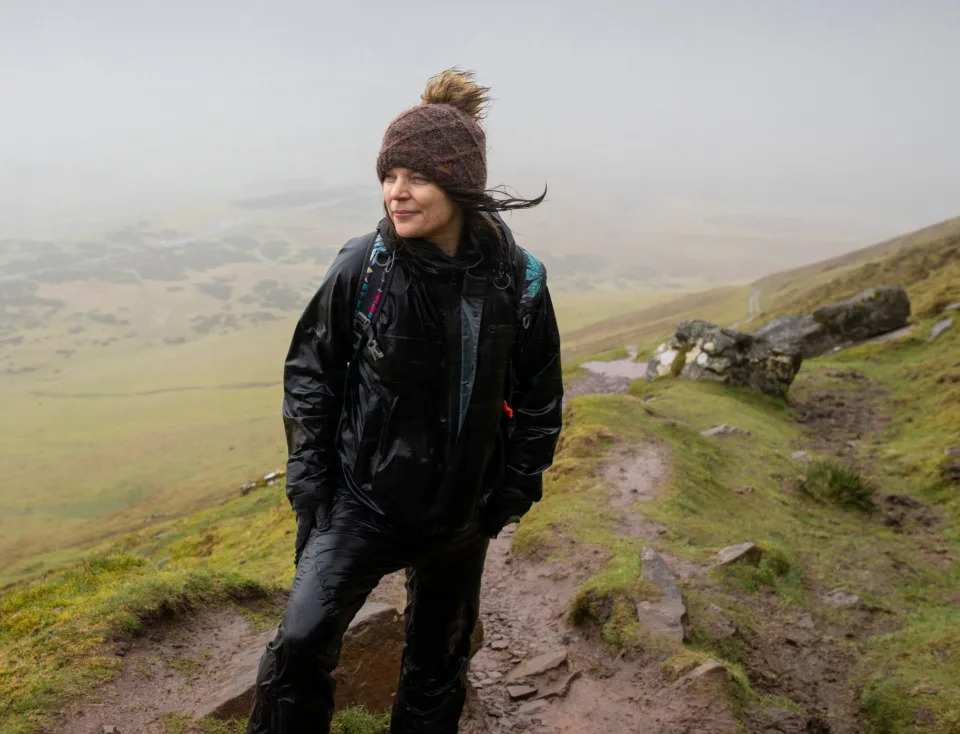
Gwyneth Rees braved the wind and the rain to see the monolith that has appeared on top of Hay Bluff - Andrew Fox

On a sunny day, there would be many good reasons to don my walking boots and hike up Hay Bluff to its summit.

Not only is it set in the beautiful border territory of Wales and England, with sweeping views down onto the Wye Valley, it’s also just four miles south of the historic market town of Hay-on-Wye, packed with delightful book shops.

Then there’s the fact that it’s a convenient walk – 1.7 miles there and back – and part of the Offa’s Dyke national trail, with a satisfying trig point on the top.


But today, in the lashing rain, with minimal visibility and the mossy ground treacherous underfoot, there can be only one reason to make this journey – to see for myself the monolith that has mysteriously emerged on this mountain top and become the talk of the town, if not the world.

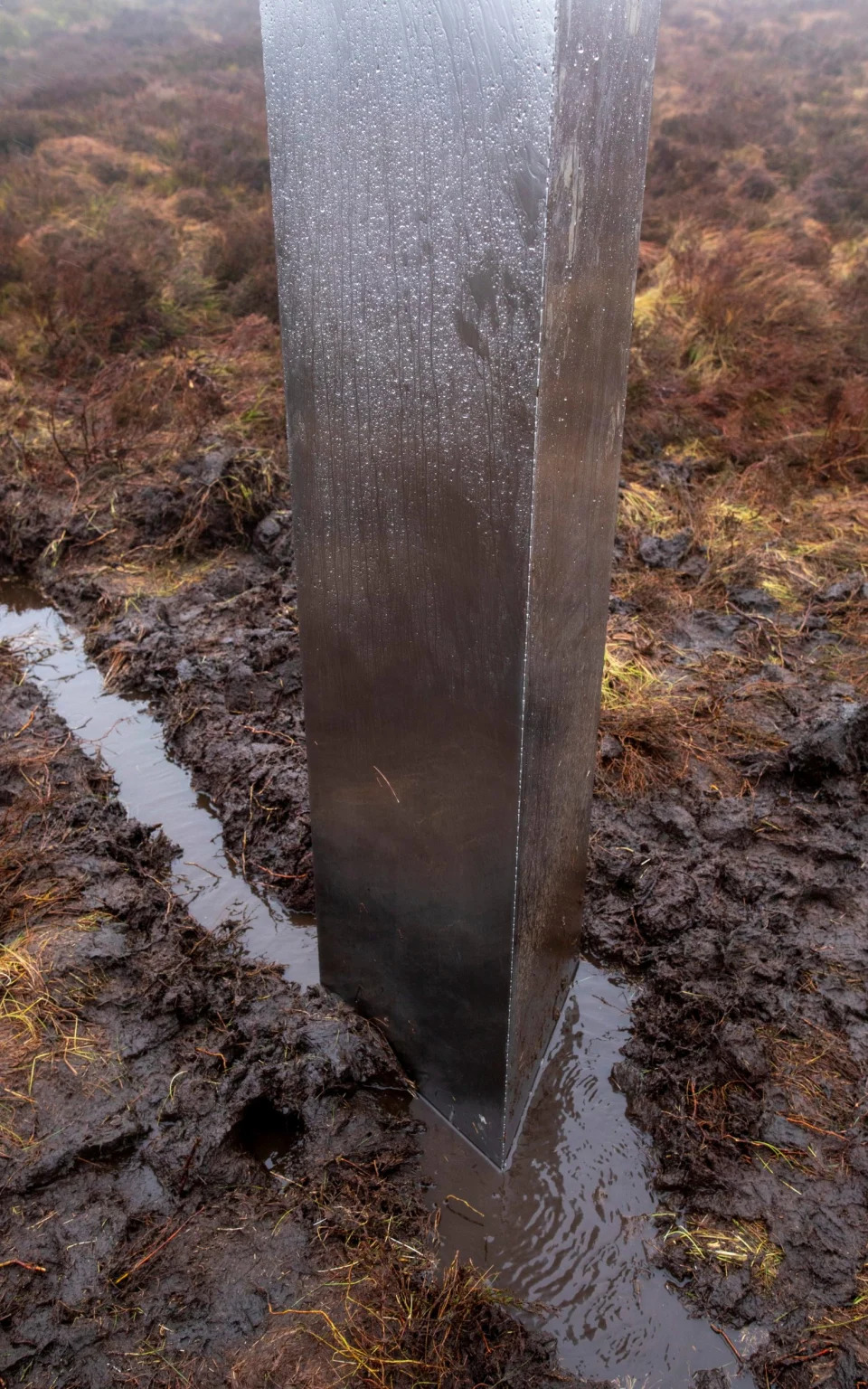
The 10ft non-magnetic structure, made from metal sheets forged into a triangular prism, appeared on the hilltop last weekend, prompting claims a UFO had landed.

The 10ft structure is made from metal sheets forged into a triangular prism - Andrew Fox

Speculation as to its origin – particularly on TikTok – was feverish. Had it been dropped by a helicopter? You certainly couldn’t drive it to the hilltop. Had it been carried up by local artists? Was this paying homage to the monolith in Stanley Kubrick’s 2001: A Space Odyssey, to which it bears a striking resemblance?

The strange feature was spotted by local builder Craig Muir, who said he was “taken aback” as it looked like “some sort of UFO”.

“It seemed like a very fine metallic [material]. It looked perfectly levelled and steady, despite the weather being windy.”

Craig Muir said he assumed the monolith was 'some sort of UFO' - PA

Since its discovery, locals tell me the car park has been full, and that tourists are heading to the town just to see it.

But on the day of my visit with The Telegraph photographer, because of the lashing rain, we are relatively alone.

The only people we meet are two walkers, both teachers from Clevedon High School, who have just dropped a pile of sixth formers to undertake a hike for their Duke of Edinburgh award.


'We have no idea how it got there': local teachers Mark Davies and Tony Battista had come to see the monolith for themselves - Andrew Fox

Tony Battista, 50, says: “It’s bizarre, really extraordinary. Well worth seeing. Maybe it’s done by a rural Banksy?”

His colleague, Mark Davies, 49, adds: “It is fascinating and quite eerie. No doubt the kids will see it later and be full of conspiracy theories. But we have no idea how it got there.”

As we continue our walk, the monolith mystery is none the clearer to me or the photographer, who is cursing the rain and worrying about his camera.

The main ascent up Hay Bluff is almost vertical, the sort of track that makes you wish you were a goat. A winding path does snake off the side, omitting the worst of the ascent, but even that is full of twists and precipitous drops, with large steps carved in to supposedly ease the journey.


Gwyneth makes her way up Hay Bluff in the lashing rain, with minimal visibility - Andrew Fox

Given that February was one of the wettest on record, everything is precarious. Could people have carried such a structure up here? Only if they were mad.

But it seems the only viable option.

It would be unlikely that the structure was made up there, given you would need equipment, and would still have to carry the metal sheets.

But a helicopter expert, who did not wish to be named, dismissed the idea of a helicopter being involved.

He said the only way to fit a 10ft monolith inside a helicopter would be in a military one, but a helicopter with lifting tackle could potentially dangle it underneath for a short distance.

The expert also advised a helicopter would not fly to the top of a mountain at night as it would be deemed too dangerous.

When we make it to the top, it would be nice to describe the views, but we can’t see anything. A surveying trig point stamped with the red Welsh dragon reveals a height of 677 metres. I’m so pleased to have made it, and so drenched, I almost forget why we are here.

“There it is,” cries the photographer, pointing off to the right. “Oh yes,” I say. And what a strange sight.

Set a hundred metres or so from the trig point, and in among tussocks of boggy heather, it’s there.

We inch closer, dodging the pools of stagnant water and moss. It’s real, at least. Hollow, but seemingly held up by an interior pillar.

To inspect it, I take off my shades, which have been keeping the rain from my eyes. There’s more metal in the ground, which has clearly been exposed by those keen to check its foundations. These appear to keep it weighted and upright, but even then it is blowing about in the wind.


Nestled among tussocks of boggy heather, the monolith fits the scene well – but there's no real function to it - Andrew Fox

It does fit the scene quite well, given that it’s misty. But it’s not very Bauhaus, as in there’s no real function to it. You can’t even check your make-up in the reflection. We have no idea why anyone would set it here. Unless they are making a point against health and safety?

“What do you think?” I ask the photographer.

“It’s just to get people talking,” he says.

“And walking?” I add.

“Yep. That too.”

If it is to get people talking, it has done the job. Not least because it is not a one-off but part of a global collective.

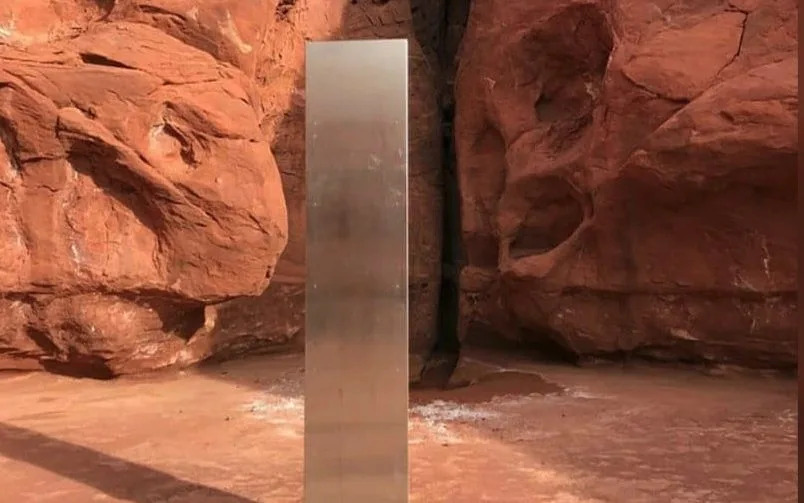
The first monolith was spotted in Utah, Arizona, in 2020 by scientists during a helicopter survey of wild bighorn sheep. Satellite imagery later revealed it had been there since 2016.

Two weeks after it was discovered and removed, another monolith appeared, this time 13ft tall and in Romania.

Since then, dozens more have been spotted across the world, including in South America and Europe.

There are monoliths in Germany, Spain, the Netherlands and Turkey.


In the UK, they have been planted on a beach in the Isle of Wight, at the top of Glastonbury Tor, in the middle of Merry Maidens stone circle in Cornwall and on the fields at Dartmoor National Park. That one had the words “Not Banksy” carved into it.

But despite their proliferation, no one is really clear why they are there or who might be behind them.

The Most Famous Artist – an artist collective group in Tucumcari, New Mexico, which specialises in low-cost high-impact art projects – has suggested it may have created the initial Utah monolith.

“I’m here to say: I didn’t do the monolith, but I didn’t not do the monolith,” the collective’s founder, artist Matty Mo, helpfully said in a 2020 Instagram post.

But no one has claimed responsibility for the ones in Europe. And indeed, Banksy’s representative has denied he is involved.

It is hardly the first time, however, that mysterious art has appeared on our shores.

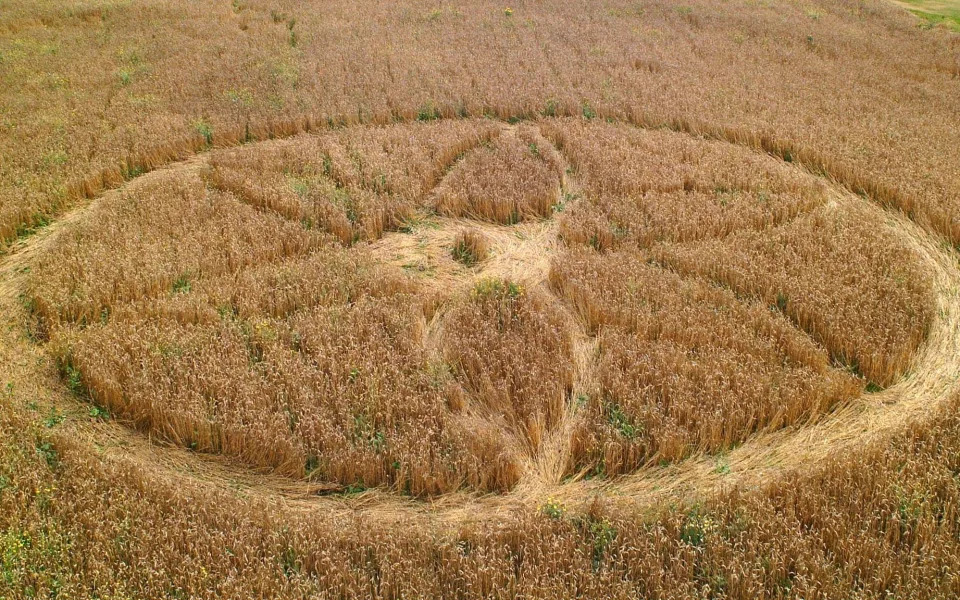
In the late 1970s and 1980s, the arrival of crop circles, with their intricate patterns, baffled farmers and sparked calls of alien activity and a connection to ancient hill forts and burial mounds.

The arrival of crop circles, like this one in London's Kew Gardens, have sparked calls of alien activity - Reuters

But in 1991, two farmers, Dave Chorley, and his friend Doug Bower, from Winchester in Hampshire, admitted they had been making them since 1976.

At the time, Dave told local news: “We wanted the UFO society to think a UFO had landed. After a few years they didn’t know whether to believe it or not.”

The tricksters revealed they travelled the countryside at night using a plank and a piece of rope to make the curious shapes, which appeared throughout Wiltshire and Hampshire.

Later, Dave’s son, Jim Chorley, told the BBC: “They were out on a Friday night and come back at 4 or 5 in the morning, and would put a little piece of corn on the kitchen table.

“They saw it as kind of a folk art form; it was the biggest canvas they could possibly ever use.

“They weren’t prepared for some of the backlash [when they came out]. I can understand why people still need to believe in the magic of it.”

Inevitably, there may be some who believe the appearance of these puzzling monoliths may be the work of external forces.

Daniel Jolley, social psychologist at the University of Nottingham, who specialises in conspiracy theories, says: “To me, this is entertaining. We don’t know why it’s been done.

“But to some who believe in conspiracy theories, this is even more exciting. It draws them in, like a movie.”

He says people who believe in conspiracy theories – for example, that these monoliths are from outer space but covered up by governments – are generally more anxious people who need answers to our complex world.

He adds: “People try to make sense of events, they seek answers. They struggle with uncertainty and have a distrust of authorities. They look for patterns and motives so they feel a little bit of control.

“Other people can just accept that these monoliths are there and we don’t know why.”

One mystery monolith appeared in Utah, 2020

To contemporary art curator and critic Ellen Stone, however, they are an accessible and entertaining form of art.

She says the monoliths resemble huge pieces of metalwork made by American artist Richard Serra. Currently, magnificent pieces of his are spread across a kilometre of desert on Qatar’s Zekreet Peninsula.

She says: “For me, art is about three things – the creator, the context and the community of people who view it.

“But when these monoliths are unclaimed, you have the death of the author, so it is up to the viewer to decide what they mean.”

She says the fact the monoliths have popped up around the world is probably because they are relatively easy to make.

“Any artist with basic metal work skills can make one. And just like with the crop circles, it enables people to be part of something larger.”

She adds that where they are placed is “incredibly important”.

“The landscape is so important,” she explains. “The monoliths hark back to druid structures and single stones across our rural landscape.

“Plus it’s looking at 2001: A Space Odyssey in referential form. The monolith there was a stand-in for God and knowledge.

“It is a mysterious object and open for debate and meaning, just like these monoliths.”

Either way, back in Hay, locals seem delighted with the new addition.

James Walton, owner of The Old Black Lion Inn, says: “It’s certainly strange. But it’s nice that it’s been done in Hay.

“Locals are talking about it and are very intrigued as to how it got there.

“This is a special town, and it has definitely added to the mystique.”

He wishes to encourage people to come and see the monolith, and perhaps drop in for a pint on the way.

But as my photographer and I had to slide down the treacherous Hay Bluff on our backsides, narrowly avoiding ending up in A&E with sprained ankles, I can only suggest coming on a sunny day.
"Shame must change sides": a Belgian model warns about deepnudes

Amandine Hess
Sat, 16 March 2024


"I'd already heard about deepfakes and deepnudes (...) but I wasn't really aware of it until it happened to me. It was a slightly anecdotal event that happened in other people's lives, but it wouldn't happen in mine", thought Julia, a 21-year-old Belgian marketing student and semi-professional model.

At the end of September 2023, she received an email from an anonymous author. Subject: "Realistic? "We wonder which photo would best resemble you", she reads.

Attached were five photos of her.

In the original content, posted on her social networks, Julia poses dressed. In front of her eyes are the same photos. Only this time, Julia is completely naked.

Julia has never posed naked. She never took these photos. The Belgian model realises that she has been the victim of a deepfake.
Deepfakes

Deepfakes, or hypertrucages, are false photo, video or audio content created or modified using artificial intelligence, often hyper-realistic.

The individual used an artificial intelligence application to remove her clothes.

The first message I received was, "Hello Julia. We wonder which photo would look like you the most".

Julia threatened to file a complaint. The person she was speaking to tried to dissuade her, claiming that he wanted to "make her aware of the dangers of artificial intelligence". "Everyone does it", he trivialised.

The next day, the young woman filed a complaint at the police station "out of duty".

"I really wanted to do it for statistical purposes and because I didn't want to let myself be taken advantage of", she explains.

She was warned that the "public prosecutor's office was overwhelmed" and that there was "very little chance" that her complaint would succeed, the student recalls.

My only fear would be that he used them to put them on sites to make money and at the same time harm my public image.

She confided in her mother and close friends, gave her testimony on her social networks and received a great deal of support from her followers. "Some people wanted to help me, others just sent a quick note", explains the student, who says she is "very well supported".

Julia also receives testimonials from other victims. In their case, "it was more in the context of revenge porn", she explains. It's something that's much more common than people think", warns the model, who is concerned about this trivialisation.

After taking a month's break from modelling - "I didn't feel like shooting any more" - the model has resumed her projects.

European directive

"The platforms are clearly not doing enough", the student laments.

"The law itself is there, it's been created, but it's not being applied", she says.

A European directive on violence against women adopted stricter measures against cyber-violence at the beginning of February.

"It's all very well, but it's too late. This should have been done before these applications were authorised on European territory," regrets Julia. I'm upset because these are things that could have been avoided if they had been done properly and in order".

The young woman, who has been received by Belgian Secretary of State for Gender Equality Marie-Colline Leroy, expects the public authorities to provide "effective support and resources" to identify the authors of deepfakes and force platforms to moderate their content.

According to a study by the University of Antwerp, 7% of Belgians aged between 15 and 25 have already created deepnudes.

It also encourages other victims of deepnude to speak out.

A growing phenomenon


The start-up Home Security Heroes reports that a total of 95,820 videos generated using artificial intelligence will be online in 2023. This represents an increase of 550% compared with 2019.

Pornographic deepfakes account for 98% of deepfakes on the web, according to its State of deepfakes report, published in 2023. 99% of those targeted are women.

No need to be an expert. Creating a free pornographic deepfake video takes less than 25 minutes and requires only one clear image of any individual, according to the same study.

For her part, American analyst Genevieve Oh estimates that there will be more than 275,000 pornographic deepfake videos on the web by the third quarter of 2023.
March 15 is World Sleep Day

Hundreds in Mexico City take a ‘mass nap’ to commemorate World Sleep Day

Mexico was listed as the most overworked country in the world

By Megan Janetsky The Associated Press
Posted March 16, 2024 

Those walking through the milling streets of downtown Mexico City on Friday were greeted with a strange and sleepy sight.

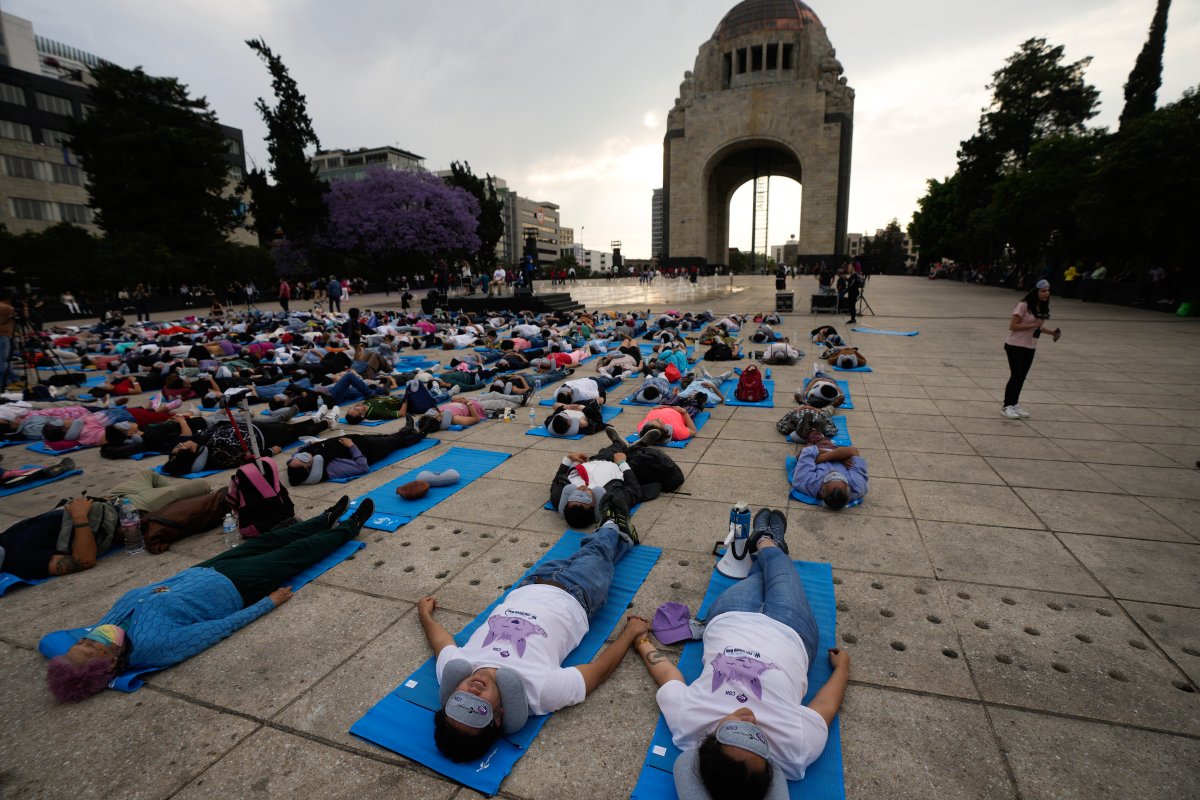
Lolling with bright blue yoga mats, sleeping masks and travel pillows, hundreds of Mexicans laid sprawled out on the ground at the base of the city’s iconic Monument to the Revolution to take a nap. Dubbed the “mass siesta,” the event was in commemoration of World Sleep Day.

It was also meant to be a protest to push for sleep to be considered an essential part of health and wellness.

Some participants wrapped themselves in bright orange blankets, while others prepped their phones to play soothing music as they slept.

Lolling with bright blue mats, sleeping masks and travel pillows, people lie sprawled out at the base of the iconic Monument to the Revolution to take a nap, in Mexico City, Friday, March 15, 2024. (AP Photo/Fernando Llano)

(AP Photo/Fernando Llano)
Among the nappers was 52-year-old mariachi musician Manuel Magaña, who was popping in earbuds next to his wife, and 9-year-old daughter, who fell asleep holding hands. Magaña heard about the event on the news while he was looking for something fun to do with his granddaughter.


He said the idea struck a chord with him because as a mariachi he would work long and irregular hours, often going to bed as the sun would come up.
The daily email you need for Edmonton's top news stories.

“As a musician I work at night, and I rarely sleep well during the day. Sometimes we forget to eat, sometimes all we get is a little nap,” he said.

The event was organized by the Center for Sleep and Neurosciences and the Mexican Society for the Investigation of Medicine and Sleep (SOMIMS).

As participants began to drift to sleep, organizers on stage chanted and lead participants through the meditation. They also listed off tips for helping people fall asleep, like getting plenty of natural light during the day and turning their phone off at night.

Oscar Sánchez Escandón, a director of the event and president of SOMIMS, said the event was meant to highlight “sleep inequality” around the world.

“We live in a society that is full of economic, social and political commitments, where everything matters other than rest. That can have a strong impact on health,” he said.


Nearly half of Mexicans are reported to have trouble sleeping, according to a study by the National Autonomous University of Mexico


Mexico was listed as the most overworked country in the world by a 2019 Organization for Economic Cooperation and Development report, which compared working hours among dozens of countries across the planet.

Last year, Mexico’s congress debated a proposed reform to officially lower the weekly work hours from 48 – the average for many Latin American nations – to 40, standard for much of the world. The initiative was put forward by Mexico’s ruling party, Morena, but the debate got kicked back to 2024.

Gabriela Filio, a 49-year-old nurse, brought along her 25-year-old daughter with the hopes that Mexico’s younger generations would push for a better work balance.

“We are in a country where the paychecks often don’t add up. Sometimes we have to work two jobs, but we also need to make sure to care for our sleep quality,” Filio said, stretching out to take a quick rest.

Collective siesta in Mexico City aims to promote the right to sleep

AFP
Sat, 16 March 2024 


In one of Mexico City's busiest neighborhoods on Friday, about 200 people took a collective nap in the middle of the street to celebrate World Sleep Day.

Lying in the heat on synthetic mats, their necks resting on pillows and their eyes covered by masks, participants tuned out the chaos of Mexico's capital as part of what organizers described as "a peaceful demonstration for the right to sleep."

"The idea is that sleeping well, or having this event attract attention, can help launch new public policies" to promote rest, said Guadalupe Teran, a doctor with the Center for Sleep and Neuroscience, which organized the event with the Mexican government.

"We have long working days, but there are no spaces at workplaces to guarantee the time for a siesta," she said.

Thanks to a guided meditation session, some nap participants sank into a deep sleep while others at least managed to relax for a moment.

"Sleeping and resting well is very good for mindfulness. I need to do it more, but I think this dynamic is very cool, it encourages rest," said Alexia Gonzalez, a 24-year-old psychotherapist from the central state of Morelos, who was visiting the capital.

Another napper, retiree Victor Sanchez from southern Mexico City, said he was interested in professional advice on how to get a good night's sleep.

"It's a bit far, but I had to come because it's important to me," the 64-year-old said.

ad-jla/ag/lgo/am/tym/sco

Senegal's Sonko takes election campaign to the south

AFP
Sat, 16 March 2024 

In this article:
Ousmane Sonko
Senegal tax inspector and tax justice advocate


Senegal's charismatic opposition leader Ousmane Sonko and his coalition's presidential candidate flew to the south of the country Saturday, pressing on with their election campaign less than two weeks before the vote.

Former prime minister Amadou Ba meanwhile, the presidential camp's candidate in the election, denounced Sonko's "slanderous" attack on him the previous evening.

Sonko and his ally Bassirou Diomaye Faye were greeted by hundreds of supporters after they flew into the coastal resort of Cap Skiring in the Casamance region.

Sonko has endorsed Faye as his coalition's candidate for the March 24 election after he was barred from running himself.

The two political allies travelled from the airport in a black 4x4 vehicle with tinted windows, as the crowd shouted: "Diomaye, president!"

Faye wearing a traditional white boubou, or flowing wide-sleeved robe, was the first to appeared, followed by Sonko in a pale green shirt and cap.

Both raised their hands to salute the crowd of mainly young people.


- Sonko will 'bring change' -


"We are going to win in the first round, I'm sure of it," one supporter, 26-year-old Malang Sane told AFP, echoing the prediction made by Sonko the previous night in Dakar.

"We have come to welcome our leader (Sonko) who has just got out of prison and is going to bring change," 29-year-old teacher Ibou Diatta told AFP.

"Senegal is like a new car that hasn't been used -- and Ousmane Sonko is going to get it running," he added.

Faye sat up front and Sonko behind him as their convoy headed to the Casamance regional capital of Ziguinchor, some 80 kilometres (50 miles) away.

Sonko once served as mayor there and this region is his political stronghold.

The two men were only released late on Thursday evening, to the acclaim of hundreds of their supporters in Dakar.

Sonko was jailed at the end of last July on a string of charges, including provoking insurrection, conspiracy with terrorist groups and endangering state security.

Faye was imprisoned in April 2023, charged with contempt of court, defamation and acts likely to compromise public peace after posting a message critical of the justice system.

Sonko had been vocal in denouncing what he says is government corruption and maintains there was a conspiracy to keep him out of the 2024 election.

But he says he is fully behind the less charismatic and less popular Diomaye Faye.

Senegal's top opposition leader vows to help win March 24 election


- Ba denounces opposition -

Former prime minister Amadou Ba, who stepped down from his post to campaign for the presidency under the banner of Macky Sall's party, denounced comments by Sonko at a Dakar news conference on Friday.

"If he is elected, he will be the president of foreign countries," Sonko had said of Ba, accusing him of having covered up corruption.

A statement from Sonko's team said Ba had "devoted an entire press conference to tasteless defamation and slander".

Ba is currently campaigning in the north of the country.

President Sall himself has already served two terms and is not running again. His mandage as president runs out on April 2.

It was he who proposed the amnesty law that allowed for the release of Sonko and Diomaye Faye, in a bid to ease political tensions.

But it was his last-minute decision in February to defer the presidential vote due later that month and try and push it back to December that sparked the latest crisis.

His decision sparked clashes that left four dead.

The Constitutional Council stepped in, forcing him to reset the date to March 24.

For some analysts, oppposition figures such as Sonko and Faye have emerged stronger from their long political struggle with Sall's administration.

mrb-amt/jj/rox