It’s possible that I shall make an ass of myself. But in that case one can always get out of it with a little dialectic. I have, of course, so worded my proposition as to be right either way (K.Marx, Letter to F.Engels on the Indian Mutiny)
Thursday, December 26, 2024
Bosphorus Closed After Tanker Previously Damaged by Houthis Breaks Down
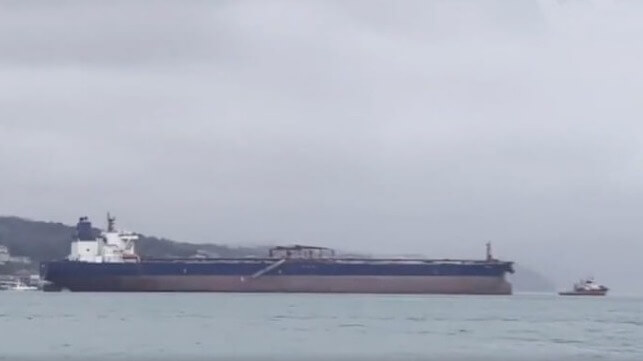
Cordelia Moon was towed into an anchorage while traffic was suspended (Turkish TV)
Vessel traffic along the busy sea lane in the Bosphorus was suspended today, December 26, by Turkish officials as they dealt with a disabled tanker. It is the latest in a series of incidents with tankers operating in the Russian oil trade that experienced mechanical problems in the seaway.
Turkey’s Directorate General of Coastal Safety reports it dispatched three tugs, Kurtarma-8, Kurtarma-10, and Kurtarma-11, to tow the disabled vessel to the Ah?rkap? Anchorage Area. While the operation was underway traffic was suspended in both the north and southbound lanes.
The tanker, Cordelia Moon (163,288 dwt) was bound to Novorossiysk after undergoing repairs from damage it suffered in an attack by the Houthi. The ship was attacked and damaged by the Houthis at the beginning of October in a barrage including missiles, drones, and a bomb boat. Videos of the security team attempting to explode the bomb boat were posted online.
The tanker, which is managed from India and registered in Panama, was empty for the trip to Russia. Turkish authorities are saying it experienced an engine failure.
It was the latest in a series of incidents involving tankers in the Russian oil trade. Last month, a smaller product tanker registered in Panama, Nazan (4,600 dwt) also forced a temporary closure. The vessel reported a rudder malfunction. In August, another product tanker the Sredina (34,800 dwt) also reported an engine malfunction while in the Bosphorus. The sea lanes were again closed by the tanker which was traveling from Russia to Libya.
Earlier this week, Greek authorities detained an unidentified tanker also sailing from Russia after it was involved in a collision in a lane east of Piraeus. The tanker and a cargo ship collided and while there were no injuries the authorities were seeking to determine the cause of the collision.
Russia Struggles to Salvage its Mediterranean Investment
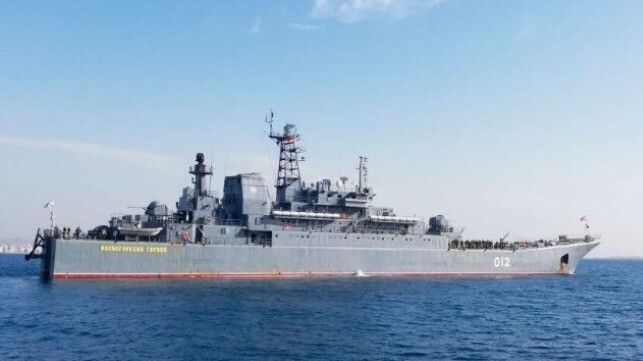
Russian Ropucha-class landing ship Olenegorsky Gornyak off Tartus, Syria at the height of Russia's local influence. Two sister ships appear to be under way to evacuate Russian forces (Russian Ministry of Defense)
Russia is facing increasing difficulties in recovering its position in the Mediterranean and the Levant, following the overthrow by President Bashar Al Assad in Syria by Hayat Tahrir al-Sham (HTS).
As was predictable, Russian claims to be negotiating a continuance of its basing in Syria with its new leaders proved to be bluster. Given the Russians’ long history of terror bombing of civilian targets during the civil war, its provision of asylum to the fleeing Assad family, and having accused the HTS leader Ahmed Al Sharaa of being a CIA spy, the Syrians saw no benefit in prolonging the Russian presence. HTS has now made it clear that it sees no continuing role in Syria for either Russia or Iran.
In the meantime, the Russians have pulled back from their positions in Syria’s interior, concentrating the forces remaining at their airbase at Khmeimim and at Tartus on Syria’s coast, off which the remnants of Russia’s Mediterranean flotilla still lingers. It has been somewhat surprising that the Russians have been able to execute this withdrawal unscathed and without interference, which must be considered a credit to the discipline applied to Syria’s various armed factions by the new HTS leadership.
The Russians are likely to have explored any possibility of keeping a presence in the Mediterranean area, in particular to service their interests in North Africa. The most likely option is in eastern Libya, in the area controlled by the renegade Field Marshall Khalifa Haftar. Nonetheless, at a time when its war maintenance reserves are severely depleted by the ongoing war in Ukraine, Russia’s military hardware marooned in Syria is a valuable and urgently needed resource that could have a major impact on the Ukrainian battlefield, a development which Ukraine would seriously wish to sabotage. To make the shift, helicopters, and high-value air defense units can be flown out, but armored vehicles, heavy equipment, and munition stockpiles need to be moved by sealift.
Hence the sighting in transit the Straits of Gibraltar on December 23 of two Ropucha Class landing ships (Alexander Otrakovsky (L031) and Alexander Shabalin (L110)) and the improved landing ship Ivan Gren (L135), in company with cargo vessels Sparta and Ursa Major often seen previously on the route to Tartus. Being shipped as deck cargo on the Ursa Major were two dockside cranes - not needed in well-equipped Tartus, but probably a necessity to build up one of the under-developed ports in Libya which the Russians may have contemplated adopting as their new Mediterranean base.
The Libyan option may have sunk when later on December 23, the Ursa Major foundered off Oran as a consequence apparently of an engine room explosion. If the evacuation convoy now needs to take the long route back to the Baltic instead, the Ukrainians are likely to be keenly and actively interested in preventing its safe arrival in Russia.
The Russian withdrawal from Syria also has implications for regional politics within the immediate neighborhood. Turkey is evidently keen to fill the vacuum left by the Russians, inspired by memories of Ottoman rule in the Levant and dreaming already of a revival of the Hejaz Railway destroyed by the Arab Revolt. However, autonomy of the Kurdish northeast of Syria is likely to prove an enduring obstacle to Turkish ambitions.
Elsewhere in the region, a realignment is in progress; for transactional purposes some countries have hitherto sought to treat the West and Russia as equals, and in their own best interests may now be seeking to distance themselves from those they had previously lauded as the best of friends.
The opinions expressed herein are the author's and not necessarily those of The Maritime Executive.
Report: USS Gettysburg Nearly Shot Down a Second Friendly Fighter Jet
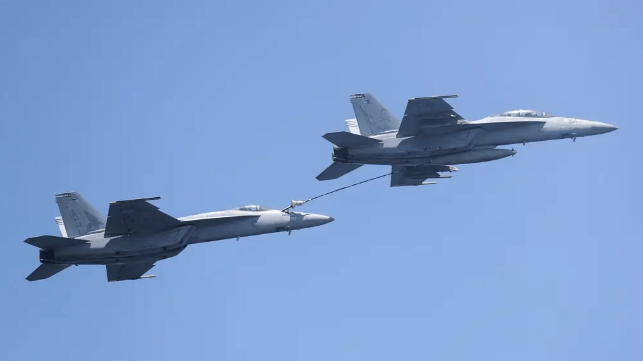
An F/A-18 equipped for a tanking mission refills a second F/A-18 (USN file image)
Early Sunday morning, a U.S. Navy cruiser accidentally shot down a U.S. Navy fighter jet over the Red Sea, forcing the two pilots to eject. The Navy confirmed the incident on the 22nd, but two days later, Fox News reported a previously undisclosed detail: a second missile narrowly missed hitting a second fighter.
"It was a tanker crew [an F/A-18 fitted for in-flight refueling] returning to land on the carrier about 10 miles out," an undisclosed source told Fox. The aircraft was returning from a refueling mission in support of strike fighters operating over Yemen.
"[The pilots] recognized the missile was guiding and punched out about 3 seconds before the missile hit the jet," the source said. The pilots safely ejected and were retrieved, though one had minor injuries.
The second jet was also lining up to land and was several miles behind. The second missile narrowly missed it by as little as 100 feet, the source said; the Navy is investigating whether its guidance system had been shut off, and whether it was targeted at the second jet, according to Fox.
The Navy's initial report suggested that a single F/A-18 was involved in the incident, and that it had been "flying off the USS Harry S. Truman." The source told Fox that this was incorrect, and that two jets had been lining up for landing onto the USS Harry S. Truman.
The Navy confirmed that the USS Gettysburg - the carrier strike group's cruiser - was responsible for the missile launch.
The friendly-fire incident occurred after a UAV and missile barrage launched by Yemen's Houthi rebels, according to U.S. Central Command - a possible contributing factor in the misidentification of the incoming F/A-18s as an incoming threat. Air defense watchstanders in the tight confines of the Red Sea operating area have seconds to decide whether to launch countermeasures against Houthi antiship missiles.
Salvage Barge Prepares to Defuel Wreck of
New Zealand Navy Ship
HMNZS Manawanui, center, is resting on its side just below the surface on a reef slope off Upolu (NZDF, October 9)
Salvors have arrived at the wreck site of the survey ship HMNZS Manawanui, which went down off the coast of Opolu, Samoa in early October. The operation to defuel the ship took weeks to mobilize, due in part to permitting and approval processes, but the New Zealand Defence Forces report that work will now begin as soon as the barge's spread-moor anchor system is installed.
Manawanui grounded on a reef on the southern side of Opolu, Samoa on October 5 while conducting survey operations. A preliminary inquiry determined that the bridge team attempted to maneuver with manual controls and failed to detect that the autopilot was still engaged. They drove onto the reef at more than 10 knots, dragging the hull along the bottom for more than 400 yards before coming to a halt. The ship subsequently caught fire and sank, but - through heroic efforts - all 75 people on board managed to evacuate safely.
The salvors' barge is now in place near the sunken vessel, and the Samoan government has approved a carefully-designed plan to lay out the barge's anchors without damaging the reef. This is the last major step before pumping off the fuel in the vessel's tanks.
The vast majority of Manawanui's fuel remains in place, according to the NZDF, but Samoan media outlets report that water sampling results have confirmed the presence of diesel contamination just off the coast. A fishing ban is in place for the nearby villages, and some local residents have complained that they have lost their livelihoods until they get the all-clear to resume.
Samoa's coastal economy is little-developed, and many residents are dependent on subsistence fisheries. New Zealand's government has previously asked to postpone any discussions of compensation, but the Samoa Observer reports that talks about payment have quietly begun.
"We know how important the coastal and marine environments are to the people of Samoa, especially those on the southwest coast of Upolu," said NZDF on-scene commander Commodore Andrew Brown. "As always, progress is dependent on sea and weather conditions . . . While this response is complex and technical, New Zealand is committed to doing the right thing."
ECOCIDE
Video: Storm Scatters Bags of Oily Waste From Spill Cleanup in Russia
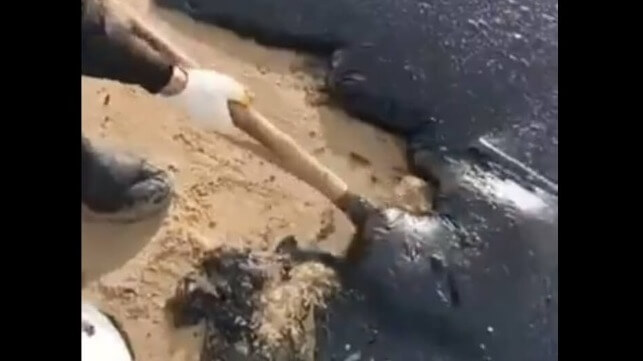
The bunker-fuel cleanup in the Kerch Strait region encountered a setback over the Christmas holidays: renewed stormy weather, combined with slow or inadequate removal of bagged waste. The efforts of countless volunteers went to waste when wave action tore open collected bags and scattered their contents across the waterfront near Anapa, according to Russian social media reports.
On December 15, the 50-year-old Russian tanker Volgoneft 212 broke up near the Kerch Strait, spilling an unknown quantity of the Russian bunker fuel known as "mazut." The vessel had 4,300 tonnes of the product aboard at the time of the casualty, according to Russian media. At about the same time, the tanker Volgoneft 239 ran aground and gradually broke up. The total estimated volume of spilled fuel oil amounts to 3,700 tonnes, according to Russian authorities.
Much of the pollution has washed ashore in Krasnodar, near Anapa. Russia has declared a state of emergency, and government personnel and volunteers have collected a reported 1,700 tonnes of oily sand to date.
However, volunteers for the beach cleanup have reported limited heavy equipment support to help remove the results of their labor, and bags of oiled sand accumulated along the beachfront. This week, another heavy storm blew through the region and scattered torn-open bags along the waterfront.
Even where it has been collected, the bagged waste has not always been properly disposed of, according to some residents. Videos posted to Russian social media appear to show excavators attempting to bury the bagged waste in the middle of the beach, instead of inshore where it would be away from wave action.
"Well, they praise us, like, great volunteers. We didn't come here to clean up fuel oil manually for their praise, we breathe in toxic fumes. We do this to save nature at least a little. In the end, they [officials] lie that 'everything is fine, there is enough of everything,' and because of their misinformation, the collected fuel oil is not removed on time," one frustrated Russian volunteer told Radio Free Europe. "Some of the bags were carried out to sea, turned upside down, some were washed back to the shore."
Multiple strandings and deaths of threatened Azov dolphins have also been reported, along with thousands of oiled birds. Due to a shift in wind direction, fuel contamination is now drifting towards the Crimean side of the Kerch Strait and may soon wash ashore in the Feodosia area.
"The discharge of fuel oil on our beaches threatens a greater disaster than for Anapa. The local sand is looser with a high shell content, its consistency is much softer and more porous than in the Anapa area," an environmental activist in Feodosia told Radio Free Europe's Crimean service. "Volunteers have already found birds injured by fuel oil in some places on our beaches."
Despite the vessel casualties and concerns about safety, the Volgoneft tanker fleet continues to trade in the Kerch region.
Russian Region Declares Emergency After Black Sea Oil Tanker Collision
The Krasnodar region in southwest Russia has declared a regional emergency as oil continued to wash ashore this week following the collision of oil tankers in the Black Sea last week.
Last week, the Volgoneft 212 and Volgoneft 239 tankers sustained serious damage as a result of a storm in the Black Sea, running aground in the Kerch Strait. The Volgoneft 212 spilt in half. According to reports of the disaster, the two tankers were carrying some 4,300 deadweight tonnes of crude oil each.
Both of the tankers that got damaged in the storm were more than 50 years old, Reuters noted in a report on the news, citing TASS, the Russian state news agency. A third tanker has reported it has been damaged after the two other oil carriers spilled oil in the Black Sea. The third tanker is from the same generation of vessels, Reuters reported, citing a certificate it had seen.
A week after the incidents, the region of Krasnodar declared a state of emergency.
“Unfortunately, oil products continue to wash up on the beaches in Krasnodar,” the region’s governor Veniamin Kondratyev said in a post on Telegram on Wednesday.
Initially, scientists expected that most of the oil spilled from the tankers would remain at the bottom of the Black Sea, allowing it to be collected in the water, Kondratyev added.
However, due to the warmer weather, the oil products surfaced to the top and washed ashore, the governor said.
Until Wednesday, the emergency situation was at the municipal level only, but now the state of emergency is being extended to the entire region of Krasnodar, Kondratyev said.
Many analysts and insurers have been warning that an environmental disaster is waiting to happen with the old tankers that Russia has been forced to use to carry its crude oil and refined products abroad amid increasingly tighter Western sanctions.
By Tsvetana Paraskova for Oilprice.com
Finnish Police Carry Out Tactical Boarding of Suspected Sabotage Ship
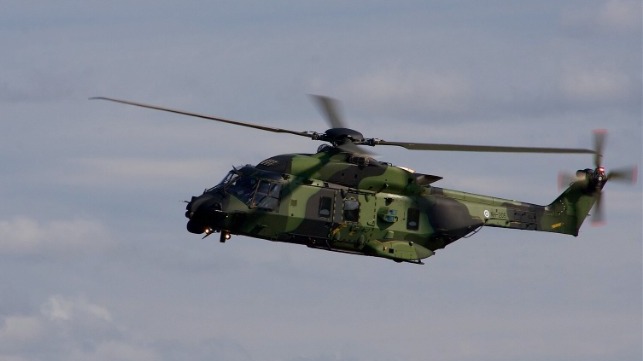
The Finnish armed forces provided helicopter support for the boarding (Karri Huhtanen / CC BY 2.0)
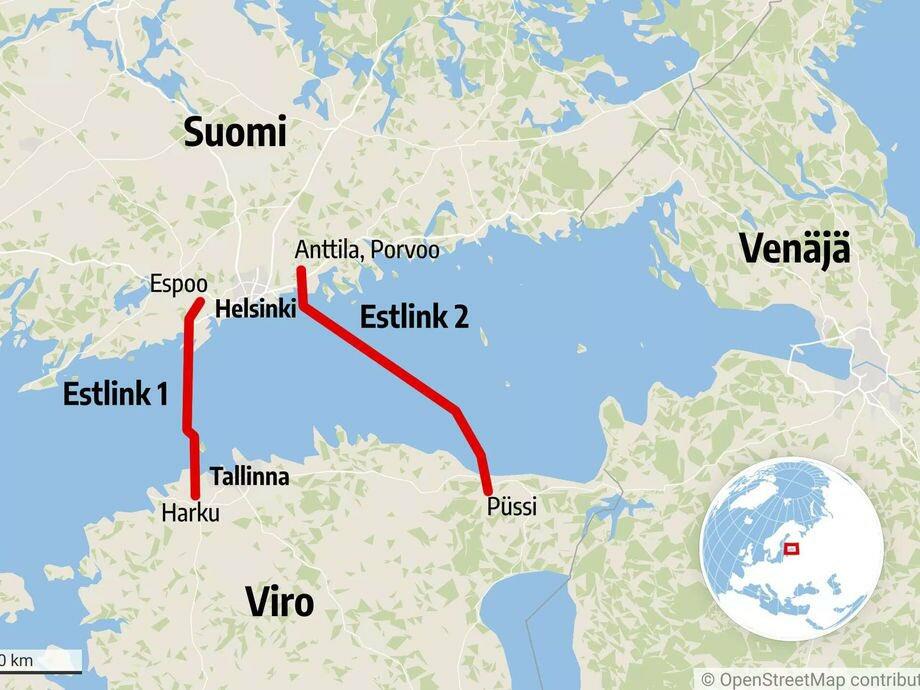
On Thursday, authorities in Finland reported that the cable damage incident on Christmas Day affected more than just the Estlink 2 subsea power cable, and that a tanker has been boarded for purposes of investigation. Out of three cable damage incidents in the Baltic over the past year, this is the first in which the coastal state detained the suspects - and the first time that the response was a tactical operation involving armed forces.
Like the two previous suspected sabotage incidents, Wednesday's outage affected multiple cables. In addition to Fingrid's EstLink 2 DC power transmission cable from Finland to Estonia, a set of subsea cables operated by Elisa between Helsinki and Tallinn have been severed. The Cinia submarine cable from Helsinki to Germany has been damaged, as well as the CITIC submarine cable between Helsinki and Tallinn.
The Finnish Transport and Communications Agency, Traficom, is investigating the technical aspects of the cable breaks. Finnish police are conducting a parallel law enforcement investigation and have identified the suspect vessel as the Cook Islands-flagged tanker Eagle S (as previously observed by open-source intelligence analysts). At this point, the authorities are treating the outage as a case of "aggravated criminal mischief."
"Due to actions taken by the authorities, Eagle S, a tanker registered in the Cook Islands, entered Finland's territorial waters. The vessel's involvement in causing the rupture is under investigation," the Finnish police said in a statement. "The Helsinki Police Department and the Border Guard have conducted a tactical operation on the vessel. The authorities have taken investigative measures on the vessel, with access there provided by the Finnish Border Guard and the Defense Forces helicopters."
Customs authorities are also looking into the details of the vessel's cargo for any irregularities. The ship last called in Ust-Luga, Russia, where tankers typically load Urals crude - a grade restricted by G7 sanctions.
Eagle S is an 18-year-old tanker and changed ownership, name and flag registry. The aging vessel is now tied to operating interests in India and the UAE. Combined with her recent call at a Russian oil port and a poor inspection record, these factors point to her involvement in Russia-linked "dark fleet" operations.
Lloyds List's Michelle Wiese Bockmann, a specialist in the dark fleet, released Eagle S' latest independent vetting report. The inspectors noted a slew of serious deficiencies - like a broken inert gas generator, oil leaks in machinery spaces, unmaintained fire doors, and multiple alarms and meters disconnected or out of order. The vessel's ownership structure is linked to a pool of 26 old, anonymously held Cook Islands-flagged tankers - four of which are under UK or EU sanctions, Bockmann said. For these reasons, the Eagle S is on Lloyds List's "dark fleet" list, along with seven other tankers managed by the same Indian company.
Finnish authorities have reached the same conclusion. “We assume at this stage that the vessel in question is a member of the shadow fleet," Finnish customs chief Sami Rakshit told the New York Times on Thursday.
Finland's prime minister, Petteri Orpo, alluded to Russia's "shadow fleet" in comments Thursday. "Our main task is to find effective means to stop the shadow fleet," Orpo said. "The shadow fleet pumps money into Russia’s war fund . . . and it has to be stopped."
Traficom said that Finnish data connections to nearby states have rerouted to other cables, though data speeds may be temporarily reduced. Cable repair work on the severed communications lines will begin by the end of the week, and the schedule for bringing the cables back online will depend on the Baltic's winter weather.
"Internet use does not depend on a single cable or even its backup connection. The system as a whole can withstand several simultaneous disruptions," said Traficom CEO Jarkko Saarimäki.
Finland’s police and border patrol have boarded the Eagle S oil tanker, which is part of Russia’s shadow fleet while investigating the cause of an interruption of subsea power and data cables linking Finland with Estonia, Finnish police said on Thursday.
The tanker, Eagle S, was traveling in the Baltic Sea under the flag of the Cook Islands and was fully loaded with unleaded gasoline, the Finnish police and other authorities said at a news conference, as carried by Bloomberg.
The Eagle S was spotted to be missing its anchor and it could have been this missing anchor that has caused the damage to the subsea cable links.
The Estlink-2 power link went offline on Wednesday afternoon. By early Thursday afternoon investigations were ongoing in both Finland and Estonia on the cause of the damage.
Estonian Foreign Minister Margus Tsahkna on Thursday discussed the incidents involving submarine infrastructure with Finnish Foreign Minister Elina Valtonen, Tsahkna said in a statement.
“Damage to critical submarine infrastructure has become so frequent that it is difficult to believe this is accidental or merely poor seamanship. We must understand that damage to submarine infrastructure has become more systematic and thus must be regarded as attacks against our vital structures,” the Estonian foreign minister said.
“Cant rule out deliberate damage to the cable,” Tsahkna posted on X.
Estonia is also in touch with its other allies and partners to coordinate international cooperation, the minister said, adding that identifying all circumstances related to the incidents required a joint effort from countries.
“In addition to circumventing sanctions, the shadow fleet is a security threat in the Baltic Sea and we cannot just sit and watch,” Tsahkna said.
The investigation is in its early stages, the foreign minister said on Thursday, but noted that it is positive that the Cook Islands-flagged vessel EAGLE S, which according to initial reports may have had an unsecured anchor, has been escorted into a Finnish port by the Finnish authorities.
Bloomberg reports that Finnish authorities boarded the crude oil tanker named Eagle S. after a 658-megawatt Estlink 2 power interconnector and several data cables were disrupted.
The Estlink 2 electricity cable connecting Finland and Estonia was disrupted on Christmas Day, sparking concerns of another potential undersea cable sabotage incident in the Baltic region.
The Financial Times reports that Finnish authorities are investigating a crude oil tanker named Eagle S. The tanker flies the Cook Islands flag and is reportedly part of Russia's so-called "dark fleet."
Data from the ship-tracking website MarineTraffic shows the vessel slowed down at the time the 658 megawatt (MW) Estlink 2 power interconnector was disrupted. The tanker was transiting the Baltics on its way from St. Petersburg to Egypt.
The sources also indicated that Eagle S is under investigation for its possible role in severing three communications cables in the Gulf of Finland.
The vessel movement of Eagle S is very irregular and corresponds with the location and time of the damage to the Estlink 2 cables. pic.twitter.com/IpEUq13n3k— Kamsarmax (@cashsarmax) December 25, 2024
MarineTraffic data also shows the Finnish Border Guard's patrol vessel Turva escorted the tanker to waters off Porkkalaniemi, a peninsula on the Gulf of Finland, on Wednesday night.
Finnish Prime Minister Petteri Orpo wrote on X that authorities were investigating the incident.
Orpo noted, "The interruption of the transmission connection will not affect the electricity supply of Finns."
Estonian public broadcaster ERR noted no power losses to citizens in either Estonia or Finland. The outlet cited local power officials who said enough spare capacity was on the grid to meet demand and avoid blackouts.
The Baltic Sea area has been on high alert for potential sabotage. Last month, a Chinese vessel was suspected of sabotaging the C-Lion 1 submarine cable connecting Helsinki and the German port of Rostock.
By Zerohedge.com
Finland-Estonia Power Cable Goes Dark, Prompting Sabotage Concerns
On Christmas Day, the EstLink2 subsea power cable between Finland and Estonia went dark, prompting speculation of a "hybrid" sabotage attack on subsea infrastructure in the Baltic.
At 1226 hours local time on Wednesday, the Finnish utility Fingrid detected an outage on the EstLink2, a DC power cable connecting Finland and Estonia. It is not known whether the disconnection occurred below the water or on land, and Fingrid is investigating. The cable has malfunctioned on its own in the past: in January, an internal short circuit took it offline for months.
"Nothing is ruled out, all stones and stumps are being turned and we will see what causes it. Yes, [sabotage] is also considered an option," a company spokesman told Finnish outlet Iltalehti. Backup power capacity is available, and the outage is not expected to have an immediate impact on the electricity supply for consumers and businesses.
Twice in the past year, Chinese-flagged vessels have almost certainly severed subsea cables on the Baltic seafloor by dredging their anchors for long distances, European investigators believe. Quietly, sources close to the inquiries have suggested that at least one of these vessels may have acted at the direction of Russian intelligence.
In the current geopolitical environment, attention has quickly turned to possible suspects for the latest outage. Future investigative targets could include the Chinese container ship Xin Xin Tian 2 and the Cook Islands-flagged tanker Eagle S, both of which were nearby at the time of the break.
Xin Xin Tian 2 was in the area, but her AIS track appears to show no signs of slowing or maneuvering over the site of the cable break. As of Wednesday night, the Chinese vessel had not altered course or speed and was still under way outbound in the Baltic.
Eagle S's last port of call was Ust-Luga, Russia. AIS data shows that she slowed down over the charted cable during the time period in question. The tanker later performed a round turn, took all way off and stopped in Finnish waters. She was joined by the Finnish Coast Guard patrol vessel Turva, a sign of a possible interdiction. Turva was also involved in the response to the Yi Peng 3 case in November, noted open source intelligence analysts.
Eagle S is an 18-year-old tanker that recently changed ownership, name and flag registry, and she is now tied to operating interests in India and the UAE. Combined with her recent call at a Russian oil port and recent inspection record, these factors may be associated with Russia-linked "dark fleet" operations.
Her last two port state control inspections recorded a combined 33 deficiencies, including issues related to watertightness, structural integrity, alarm systems, firefighting and electrical systems.
Finnish police have confirmed to Reuters that they are investigating the possibility of a vessel's involvement.
Hapag-Lloyd Sets Work Disruption Surcharge for US East/Gulf Coast Ports
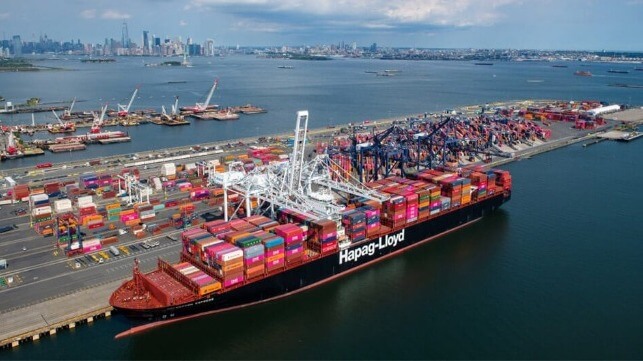
Hapag-Lloyd announced a Work Disruption Surcharge if the ILA strike begins in January (Hapag)
With the labor contract unresolved and fears increasing for another longshoremen’s strike at U.S. ports on the East and Gulf Coast, Hapag-Lloyd announced plans for surcharges for all containers booked to the ports. The strike could start in just three weeks and the fees would kick in days later should a strike occur.
Hapag, Maersk, and CMA CGM each warned customers last week that the situation remained unresolved and rolled out the start of their contingency plans. The master contract for the International Longshormen’s Association and the US Maritime Alliance was extended during the October strike with a new expiration of January 15, 2025. The ILA says it is at an impasse with the terminal operators over the issue of semi-automation and promises to resume the strike the following day.
“To help manage the potential impact of ongoing challenges at U.S. East Coast and Gulf ports, we are introducing a Work Disruption Surcharge (WDS) and Work Interruption Destination Surcharge (WID), effective January 20, 2025, in the event of a strike,” Hapag writes in a customer alert. “This surcharge covers additional costs from labor disruptions, strikes, slowdowns, unrest, congestion, and other unforeseen events that may delay operations and incur extra handling, storage, and feeder service costs.”
The fees would be from ports all around the world for cargo gated-in on or after January 20. The charge will be $850 for a 20-footer and $1,700 for a 40-footer.
Containers gated in prior to that date or already on the water will not incur the surcharge.
Trade groups have called for the union and employers to again extend the deadline while urging them to resume talks. However, the union received a strong statement from President-elect Trump supporting the stance against automation in the ports.
Hapag like its peers has urged customers to already begin taking steps to prepare for a possible strike. With no resolution and no reports of new talks, the three carriers last week urged expediting the movement of containers away from the docks in the remaining weeks. They are still accepting bookings but reported they would be exploring diversions or other steps. They have waited out prior strikes but there are fears this one could become a prolonged stoppage.
Canada ‘aids’ Palestine by training PA police to repress resistance
Palestinian Authority security forces are violently suppressing the resistance in Jenin, and those opposing Israel’s holocaust in Gaza. Most Canadians are unaware that our country assists them.
Palestinian security forces gather at the site of a protest against clashes between Palestinian security forces and militants in the northern occupied West Bank city of Jenin on December 21, 2024. (Photo: Mohammed Nasser/APA Images)
In recent days Palestinians in occupied Jenin have set up barricades and called a general strike to denounce PA repression. They were responding to PA security forces killing a child named Muhammad Imad al-Amer and 19-year-old Ribhi Muhammad al-Shalabi as part of an operation to dislodge resistance groups in Jenin. PA forces also killed Palestinian Islamic Jihad commander Yazid Jaaysah.
After funneling over $20 billion in arms to assist Israel’s holocaust in Gaza, the Biden administration is pressing the far-right Israeli government to approve a shipment of U.S. equipment to PA security forces so they can better repress resistance in Jenin and elsewhere.
Over the past 14 months of slaughter in Gaza PA forces have repeatedly suppressed opposition to Israel’s occupation. They’ve detained hundreds and killed at least 13 in their bid to maintain power and suppress resistance to Israel. The PA wants to demonstrate to the U.S. and Israel that it’s capable of ‘running’ its sliver of the West Bank so it can be granted the right to rule Gaza.
As Hezbollah in Lebanon, Ansarallah in Yemen, and some Iraqi groups have resisted Israel’s horrors in Gaza, the PA has repressed protests and militant activity in the West Bank. Though remarkable, it’s not new. Over the past two decades PA forces, which closely collaborate with Israeli intelligence, have repeatedly disrupted demonstrations in the West Bank, including protests against Israel’s brutality in Gaza. The PA’s policy of security coordination with Israel has earned it the name of “subcontractor of the Occupation.”
“PA forces are Israel’s foot soldiers. The body’s raison d’être is to suppress Palestinian opposition and resistance to help Israel maintain its occupation in the West Bank while promoting the illusion of Palestinian autonomy and representation. In the areas where the PA has nominal control, Palestinian forces are only allowed to arrest other Palestinians. They cannot touch Israeli soldiers or settlers who attack Palestinians.”
Around two dozen Canadian troops and “up to 12” RCMP officers are currently part of Operation Proteus, which trains PA security forces as part of a mission led by the Office of the United States Security Coordinator. Initially in charge of organizing the PA force, US General Keith Dayton told the Associated Press in 2009, “We don’t provide anything to the Palestinians unless it has been thoroughly coordinated with the State of Israel and they agree to it.”
In Security Aid: Canada and the Development Regime of Security, Jeffrey Monaghan details Canada’s role in turning Palestinian security forces in the West Bank into an effective arm of Israel’s occupation. Monaghan describes a $1.5 million Canadian contribution to Joint Operating Centers whose “main focus … is to integrate elements of the Palestinian Authority Security Forces into Israeli command.”
Like all colonial authorities throughout history Israel looks to compliant locals to take up the occupation’s security burden. What is unique about the training and support for the PA security forces is the role of Canadian, British and US trainers. Adam Shatz wrote, “it is an extraordinary arrangement: the security forces of a country under occupation are being subcontracted by third parties outside the region to prevent resistance to the occupying power, even as that power continues to grab more land.”
Canada’s role in training, equipping and assisting the PA force began in earnest after Hamas won legislative elections in 2006. To sow division within Palestinian society, Ottawa cut off aid and refused to recognize a Palestinian unity government. When Hamas officials were ousted from the Palestinian unity government in June 2007, Ottawa devoted significant resources to creating a Palestinian security force “to ensure that the PA maintains control of the West Bank against Hamas,” as Canadian Ambassador to Israel Jon Allen was quoted as saying by the Canadian Jewish News. In 2010 deputy foreign minister Peter Kent said Operation Proteus received “most of the money” from a five-year $300 million Canadian “aid” program to the PA. Today, Operation Proteus receives $15 million per year directly and more funding indirectly.
Since it was established nearly twenty years ago Operation Proteus has received little attention (with the exception of stories in small town papers covering individual police or soldiers leaving for the mission). A month ago, the Globe and Mail devoted some attention to the mission with “Canadian soldiers in West Bank face a murkier mission as Gaza war clouds the future of a two-state solution”. But the reasonably good overview ignored the most explosive and compelling evidence.
A heavily censored 2012 note that Postmedia unearthed through an access to information request confirmed the goal of Canadian security aid to the PA was to protect a corrupt Mahmoud Abbas, whose electoral mandate expired in 2009, from popular backlash. Canadian International Development Agency president Margaret Biggs explained, “the emergence of popular protests on the Palestinian street against the Palestinian Authority is worrying and the Israelis have been imploring the international donor community to continue to support the Palestinian Authority.” Biggs further explained, “the Israelis have noted the importance of Canada’s contribution to the relative stability achieved through extensive security co-operation between Israel and the Palestinian Authority.”
As I detailed in A Propaganda System: How Canada’s Government, Corporations, Media and Academia Sell War and Exploitation, this damning information was sent down the memory hole. An article was published about it in some Postmedia papers in 2013, but there was no commentary in a major paper or follow-up stories about Biggs’ internal note or Operation PROTEUS. Remarkably, even the journalist who initially reported the information ignored it when he reported on Operation Proteus for the Canadian Press a decade later.
Twelve years ago, the head of the aid agency said Canada’s “aid” to the Palestinians helped suppress protests at the behest of the colonial ruler. Nothing has changed.
The Czech Pirate Party, which until recently held the hopes of some reformist anarchists, has ended up in the dustbin of history. What lessons can we learn from this?
As a collective of the Ostrava Anarchist Federation, we have long opposed the tendencies of some leftists and anti-capitalists who saw potential in cooperation with the state and capitalism . The words of the Pirate Vice President about “infiltration of the system” already sounded funny back then, and when the Czech Pirates succeeded in the parliamentary elections, it was clear to us how it would turn out.
The Pirates could still have some sense and remain in opposition as a protest party. That would perhaps allow them to hold on to their seats for two or three more terms. However, the intoxication of power was too strong, and so the former fighters against the establishment entered a coalition with the biggest creatures of post-November politics. The fact that a mafia member, known in criminal circles as Don Pablo, had taken the position of Minister of Justice was not the slightest reason for them to topple the government. They gradually began to liquidate progressive and anti-capitalist party factions, let's remember the Tožiček or Michaillid cases. And in the end, their most prominent face became Foreign Minister Jan Lipavský, who did not even have enough decency to unequivocally condemn the genocide in Gaza and label Israel a terrorist state. Thanks to his sycophancy, he also stayed on the sidelines and may sail in the colors of TOP 09 in the next term.
The Pirates have shown that change through representative democracy is not possible. Any other party would have ended up the same. Power corrupts and the spineless Lipava people always seize the reins in the representative system. We will only enforce systemic change from below, through revolutionary direct action.
Greeting to the memorial for Alfredo M. Bonanno in Carrara, Italy
By raising our insurgent fists from the Greek metropolis, we welcome your initiative to honour the memory of the comrade Alfredo M. Bonanno. A few kilometres away from you, the answer to the question “Why is it necessary to highlight the historicality of the work of the comrade Alfredo”, lies in the simplest of concepts: the constant need of a free person to revolt against misery and the constant necessity for the world of poverty to be completely destroyed.
At a time of political retreat and reform, it is our collective duty to undo the natural death of a comrade, giving breath and vibrancy to the propositions that characterized his life and his passing from every field of struggle. To fight radically and with a point of aggression, to sharpen the conflict in all the fields of social antagonism. To fight to win, not moments, but the totality of freedom.
Through his work comrade Alfredo constantly reminds us that it’s not slavery but consensus for fetters and subjugation that eliminates the totality of freedom. It is ultimately the same subjugated consciousness that reproduces the capitalist cycle of production and its bondage. Consequently, against the illusions of capitalist democracy the only way to step ahead towards freedom, is that of destruction, not reform. Of the destruction of state and capitalism, destruction of the democracy of illusions and subordination, destruction of every relation of power and exploitation that derives from sovereignty.
Comrades,
carrying on our backs the death of our own comrade, the anarchist fighter Kyriakos Xymitiris who lost his life during the early ignition of an explosive mechanism at a house in Ampelokipi on the afternoon of October 31st, the heavy injury and captivity of the comrade Marianna who was with him, then the manhunt of the anti-terrorist forces against the ranks of the anarchist revolutionary struggle with arrests, imprisonments and incrimination of our comrades, we only have to stand with responsibility and our heads held high in the face of the questions raised by the present to each and every one of us. Comrade Kyriakos was a revolutionary who gave this answer by taking the revolutionary cause very seriously. To the questions that arise from the lack that he leaves behind him, comes Alfredo’s theory to answer: anarchist struggle for absolute freedom, continuous insurrectional development, attack, attack, attack.



 Palestinian security forces gather at the site of a protest against clashes between Palestinian security forces and militants in the northern occupied West Bank city of Jenin on December 21, 2024. (Photo: Mohammed Nasser/APA Images)

.jpg)
