Friday, December 27, 2024

Guinea opposition groups challenge military rule after missed deadline

Guinea's opposition and civil society groups say they will no longer recognise the country's transitional authorities after 31 December, when a promised return to constitutional rule was meant to take place.


Special forces commander Mamady Doumbouya, who ousted President Alpha Conde, leaves a meeting with Ecowas officials in Conakry in September 2021. 
REUTERS - Saliou Samb

By: RFI
26/12/2024 - 

The deadline was agreed with the West African regional bloc Ecowas, but government officials confirmed two weeks ago they would not meet the target date.

Instead, authorities announced a second phase called "refoundation of the state" without providing further details.

In a statement, Forces Vives – which unites opposition parties and civil society groups – called for the establishment of a civilian-led transition, accusing the current authorities of failing to deliver on their promises.

Abdoul Sacko, coordinator of the Forum of Social Forces of Guinea, one of the signatory organisations, expressed frustration at the lack of progress.

"We are talking about a celebratory situation because this mandate – what we call the transition timeline – which the transitional authorities granted themselves and which was accepted by the people of Guinea and the international community, is coming to an end," Sacko said.

Guinea’s political parties face survival test as junta orders mass cull
Public frustration

Sacko criticised the lack of progress towards democratic rule, saying there is "no relevant, visible and perfectible approach to returning to constitutional order".

He added: "Responsibility would require us to commit to working, informing and mobilising the people towards a civilian transition, respecting and giving substance to this commitment. So, once again, we are facing a situation where there is frustration at all levels."

The missed deadline raises fresh concerns about the military's grip on power in Guinea, where authorities have not specified a new timeline for elections or return to civilian rule.

The announcement comes amid growing regional pressure on military-led governments in West Africa to honour their commitments to restore democracy.
How France is preparing for Mediterranean and Atlantic tsunamis

As UNESCO predicts that a tsunami will hit the Mediterranean within the next 30 to 50 years, French scientists are putting in place warning systems – hoping to avoid a death toll like the one seen in 2004 in the Indian Ocean, when a tsunami killed up to 230,000 people.

The beach in Nice, southeastern France, where a tsuanmi hit in 1979 and killed 11 people. © Lionel Cironneau/AP

By :RFI
26/12/2024 - 

The Boxing Day tsunami of 26 December was "a wake-up call for humanity to do more, to better understand disaster risks," said Kamal Kishore, UN special representative for Disaster Risk Reduction.

French scientists have been doing just that, focusing on the risk of a tsunami occurring around its Mediterranean and Atlantic coasts and installing early warning systems.

2004 Indian Ocean tsunami: what to know 20 years on

Unesco has said there is a 100 percent chance of a tsunami of at least 1 metre in height occurring in the Mediterranean in the next 30 to 50 years.

Monitoring activity

In 2012, France established the National Centre for Tsunami Alert (Cenalt), with seismometers working 24 hours a day to monitor earthquake activity around the country – with an eye towards predicting tsunamis on the coast.

“We do not expect tsunamis to go over 2 or 3 metres high, compared to the Pacific or Indian Oceans where there have been waves as high as 30 metres,” Cenalt director Pascal Roudil told France Info.

However, even smaller waves can cause damage. In October 1979 an underwater landslide caused a tsunami in Nice. A 3-metre high wave hit the coast, killing 11 people and sending water 150 metres inland.

Tears and prayers as Asia mourns tsunami dead 20 years on

Since 2012, around 100 seismological events have been noted by Cenalt and some have triggered warnings, but they are yet to record a real tsunami risk.
Risk on the Riviera

Cities along the French Rivera have organised drills to raise awareness of the risks, and teach people what to do in the event of a tsunami being detected. In some cases, people would have as little as 15 minutes to move to higher ground.

The coast of south-eastern France, between the sea and the Alps, is an active seismic zone, and earthquakes are recorded regularly. In mid December a 3.7 magnitude quake was recorded off the coast of Nice.

In January, Cannes became the first French city to be recognised by Unesco as “Tsunami Ready”, thanks to its alert system, evacuation plans and the drills it has organised.
'Dangerous new era': climate change spurs disaster in 2024

Paris (AFP) – From tiny and impoverished Mayotte to oil-rich behemoth Saudi Arabia, prosperous European cities to overcrowded slums in Africa, nowhere was spared the devastating impact of supercharged climate disasters in 2024.


Many countries were hit by record-breaking floods, cyclones and other climate-related disasters in 2024.© Villamor VISAYA / AFP


By:RFI
 27/12/2024 - 

This year is the hottest in history, with record-breaking temperatures in the atmosphere and oceans acting like fuel for extreme weather around the world.

World Weather Attribution, experts on how global warming influences extreme events, said nearly every disaster they analysed over the past 12 months was intensified by climate change.

"The impacts of fossil fuel warming have never been clearer or more devastating than in 2024. We are living in a dangerous new era," said climate scientist Friederike Otto, who leads the WWA network.

Heat

That was tragically evident in June when more than 1,300 people died during the Muslim hajj pilgrimage in Saudi Arabia where temperatures hit 51.8 degrees Celsius (125 degrees Fahrenheit).

Extreme heat – sometimes dubbed the 'silent killer' – also proved deadly in Thailand, India, and United States.

Conditions were so intense in Mexico that howler monkeys dropped dead from the trees, while Pakistan kept millions of children at home as the mercury inched above 50C.

Greece recorded its earliest ever heatwave, forcing the closure of its famed Acropolis and fanning terrible wildfires, at the outset of Europe's hottest summer yet.

Ravaged forest threatens Mayotte's biodiversity, economy and food security
Floods

Climate change isn't just sizzling temperatures -- warmer oceans mean higher evaporation, and warmer air absorbs more moisture, a volatile recipe for heavy rainfall.

In April, the United Arab Emirates received two years worth of rain in a single day, turning parts of the desert-state into a sea, and hobbling Dubai's international airport.

Kenya was barely out of a once-in-a-generation drought when the worst floods in decades delivered back-to-back disasters for the East African nation.

Four million people needed aid after historic flooding killed more than 1,500 people across West and Central Africa. Europe – most notably Spain – also suffered tremendous downpours that caused deadly flash flooding.

Afghanistan, Russia, Brazil, China, Nepal, Uganda, India, Somalia, Pakistan, Burundi and the United States were among other countries that witnessed flooding in 2024.
Cyclones

Warmer ocean surfaces feed energy into tropical cyclones as they barrel toward land, whipping up fierce winds and their destructive potential.

Major hurricanes pummelled the United States and Caribbean, most notably Milton, Beryl and Helene, in a 2024 season of above-average storm activity.

The Philippines endured six major storms in November alone, just two months after suffering Typhoon Yagi as it tore through Southeast Asia.

In December, scientists said global warming had helped intensify Cyclone Chino to a Category 4 storm as it collided head-on with Mayotte, devastating France's poorest overseas territory.

TotalEnergies accused of abuses linked to €10bn East African oil pipeline
Droughts and wildfires

Some regions may be wetter as climate change shifts rainfall patterns, but others are becoming drier and more vulnerable to drought.

The Americas suffered severe drought in 2024 and wildfires torched millions of hectares in the western United States, Canada, and the Amazon basin – usually one of Earth's wettest places.

Between January and September, more than 400,000 fires were recorded across South America, shrouding the continent in choking smoke.

The World Food Programme in December said 26 million people across southern Africa were at risk of hunger as a months-long drought parched the impoverished region.
Economic toll

Extreme weather cost thousands of lives in 2024 and left countless more in desperate poverty. The lasting toll of such disasters is impossible to quantify.

In terms of economic losses, Zurich-based reinsurance giant Swiss Re estimated the global damage bill at $310 billion, a statement issued early December.

Flooding in Europe – particularly in the Spanish province of Valencia, where over 200 people died in October – and hurricanes Helene and Milton drove up the cost, the company said.

As of November 1, the United States had suffered 24 weather disasters in 2024 with losses exceeding $1 billion each, government figures showed.

Drought in Brazil cost its farming sector $2.7 billion between June and August, while "climatic challenges" drove global wine production to its lowest level since 1961, an industry body said.
Bosnia’s EU membership hopes hinge on overcoming deep political rift

Bosnia's path to European Union membership hangs in the balance as the country faces its deepest political crisis since the 1990s war. Western powers are weighing their response after Bosnian Serb lawmakers this week moved to paralyse state institutions, threatening reforms crucial for the country's EU integration.


Bosnian Serb political leader Milorad Dodik attends a press conference in Screbrenica in May 2024. AP - Armin Durgut


By:RFI
Issued on: 27/12/2024 - 

France, Britain, Germany, Italy the European Union and the United States issued a joint statement condemning the Serb parliament's actions as "a serious threat to the country's constitutional order".

The statement warned: "At a time when formal opening of EU accession negotiations has never been so close, a return to political blockades would have negative consequences for all citizens ... a majority of whom support EU accession."

On Wednesday Republika Srpska’s (RS) regional parliament ordered Serb representatives in state institutions to obstruct decision-making and reforms required for EU integration.

The move follows an ongoing trial of RS leader Milorad Dodik, the pro-Russian nationalist leader of RS, who faces prosecution for defying decisions by High Representative Christian Schmidt – the international official tasked with overseeing Bosnia’s post-war recovery.

Dayton agreement

Lawmakers described Dodik’s trial as politically motivated and argued they were established by the peace envoy rather than through the Dayton Peace Agreement.

The 1995 Dayton accords ended years of bloody conflict that killed tens of thousands. They split Bosnia into two autonomous regions – the Serb Republic and a Federation shared by Croats and Bosniaks – under weak central government oversight.

Map of the former Yugoslavia, 2008.
Map of the former Yugoslavia, 2008. © International Tribunal for the Former Yugoslavia

Republika Srpska lawmakers have increasingly resisted this arrangement, with Dodik leading efforts to assert greater independence.

Among their resolutions, lawmakers requested that Dodik, who recently had surgery in Serbia, avoid court appearances until medically cleared.

The moves by RS lawmakers has heightened ongoing tensions between Bosnia's two regions.

Ongoing sanctions

The political crisis has been deepened by increased pressure on Dodik's circle by the United States. On 18 December, Washington sanctioned four people and four entities from RS, including Bosnia's Foreign Trade Minister Stasa Kosarac, for allegedly helping Dodik's family dodge earlier restrictions.

These sanctions are part of broader efforts to address what Washington views as destabilising actions in the region.

The crisis has added to the Balkans’ volatile dynamics. Earlier this month, Kosovo’s Prime Minister Albin Kurti visited Sarajevo, meeting with Bosnian officials despite the lack of formal diplomatic ties between the two nations.

The visit drew criticism from Bosnia’s Serb leaders, further straining relations.

Map of the administrative division of Bosnia-Herzegovina according to the 1995 Dayton Agreements.
Map of the administrative division of Bosnia-Herzegovina according to the 1995 Dayton Agreements. © Wikimedia Commons

EU accession?

The European Council opened accession talks with Bosnia-Herzegovina in March after authorities met key requirements set by the European Commission.

But tensions between Bosnia's regions remain high, echoing divisions that date to the 1990s war when Bosnian Serb forces, led by Radovan Karadzic and Ratko Mladic – both later convicted of war crimes – orchestrated the killing of some 8,000 Bosnians.

The Washington-based Carnegie Endowment has warned that “progress on the EU track is no remedy for the chronic crisis besetting Bosnian politics”, describing Dodik as “a thorn in the side of the West”.

As Sarajevo works to address these challenges, the focus remains on whether the country’s leaders can bridge the political divide and keep Bosnia on the path to European integration.

Canadian cabinet ministers to talk tariffs with Trump's team in Florida

Canada's finance and foreign ministers flew to Palm Beach, Florida on Thursday to meet with officials of the incoming Trump administration to try to avoid a damaging trade war between Ottawa and Washington.


Issued on: 27/12/2024 -
By: NEWS WIRES
FRANCE24
Canada's Minister of Foreign Affairs Melanie Joly responding to a question during a news conference in Ottawa, Noveber 1, 2024. 
© Adrian Wyld, the Canadian Press via AP


Key members of Canadian Prime Minister Justin Trudeau's cabinet traveled to Florida on Thursday for talks with representatives of US President-elect Donald Trump, as Ottawa works to avert a potentially devastating trade war.

Newly appointed Finance Minister Dominic Leblanc and Foreign Minister Melanie Joly flew to Palm Beach, Florida, "to meet with officials from the incoming Trump administration," Leblanc spokesman Jean-Sebastien Comeau said in a statement sent to AFP.

Trump has vowed to impose punishing 25-percent tariffs on all Canadian imports when he takes office next month.

Trudeau has promised retaliatory measures should Trump follow through on his pledge, without providing specifics.

Trump has said the tariffs will remain in place until Canada addresses the flow of undocumented migrants and the drug fentanyl into the United States.

The meetings set for Friday will "focus on Canada's efforts to combat fentanyl trafficking and illegal migration," the statement said.

The ministers will brief Trump's team on Canada's new CAN$1-billion ($694-million) border security plan, which was devised in response to the tariff threat.

The meeting will also address "the negative impacts that the imposition of 25 percent tariffs on Canadian goods would have on both Canada and the United States," the statement added.

The statement did not mention who the Canadian officials would specifically be meeting with.

Trudeau's envoys headed to Florida as his government confronts an escalating crisis.

Leblanc was named finance minister earlier this month after the surprise resignation of Chrystia Freeland, who was also deputy prime minister.

In a scathing resignation letter, Freeland accused Trudeau of focusing on shortsighted handouts to voters instead of preparing Canada's finances to confront Trump's possible tariffs.

With his Liberal government trailing badly in polls to the Conservatives, some of Trudeau's former allies in parliament have urged him to resign.

Canadian media have named both Joly and Leblanc as potential contenders to lead the Liberal party should Trudeau go.

(AFP)
Times Report on IDF's Lack of Civilian Protections in Gaza 'Confirms What We All Knew'

"Glad the Times is covering the IDF's total lack of safeguards to prevent civilian casualties in Gaza, but outlets like Haartez and ⁦+972... had these stories months ago."


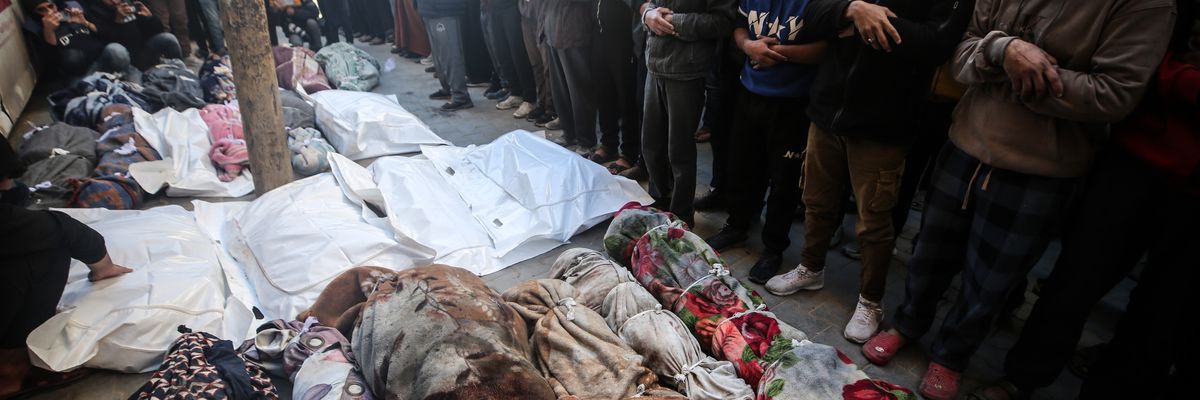
Mourners gather near the bodies of Palestinians killed in an Israeli strike in Nuseirat refugee camp in the central Gaza Strip on December 13, 2024.
(Photo: Majdi Fathi/NurPhoto via Getty Images)


"Israel has adopted an understanding of the laws of war that cancels the category of civilian to serve its war of annihilation," said one observer.

Julia Conley
Dec 26, 2024
COMMON DREAMS 
Human rights advocates and journalists in the Middle East have warned since Israel began its assault on Gaza 14 months ago that the Israel Defense Forces, which heralds itself as "the most moral army in the world," has actually been operating far outside the bounds of international humanitarian law—targeting not just Hamas commanders and other armed militants in retaliation for a Hamas-led attack in October 2023, but accepting and encouraging the killing of thousands of civilians of all ages.

On Thursday, The New York Times published an extensive report on how the IDF operated in the earliest weeks of Israel's current escalation, during which more than 15,000 Palestinians—a third of the overall total so far—were killed in Israeli airstrikes and other attacks.

The report details an order that was given by IDF leaders on October 7, 2023, hours after the Hamas-led attack, that the Times said was not previously reported—and builds on extensive reporting by human rights groups like Amnesty International and news outlets such as +972 Magazine and Haaretz about the military's widespread killing of civilians, in many cases with U.S.-made weapons.

The order described in the Times report directed mid-ranking Israeli officers to strike thousands of junior Hamas fighters and minor military sites that had not been the focus of earlier campaigns, and gave them the authority to risk killing up to 20 civilians with each strike.

For some strikes that targeted senior Hamas leaders, the IDF was given the authority to kill more than 100 civilians, and in an order given on October 8, 2023, strikes on military targets in Gaza "were permitted to cumulatively endanger up to 500 civilians each day"—removing a previous limit.

Allowing the killing of more than 100 civilians for one commander crossed "an extraordinary threshold for a contemporary Western military," reported the Times, which has faced accusations of pro-Israel bias in its coverage over the past 14 months.

The newly reported orders reflect comments made by top Israeli government leaders in the early days of the IDF's bombardment, which were reported on at the time by Common Dreams and other outlets. Then-Israeli Defense Minister Yoav Gallant said on October 10 that he had "released all the restraints" on Israeli troops, and President Israel Herzog asserted days later that there were no civilians in Gaza who were "not involved" in the Hamas attack.

The investigation, said University of Edinburgh political scientist Nicola Perugini, "confirms what we all knew."


The Times reported that the family members of Shaldan al-Najjar, a senior commander in Palestinian Islamic Jihad, were some of the first casualties of Israel's new operating procedures in Gaza. A two-month-old baby was among 20 of al-Najjar's family members who were killed in an airstrike in October 2023, and the severed hand of one of his niece's was found in the rubble of the family home.


Mid-level Israeli officers were required to get approval for strikes from senior commanders if a target was close to a site like a school or healthcare facility, but those targets were "regularly approved."


The Times based its reporting on dozens of military records and interviews with more than 100 soldiers and officials, including 25 IDF members who helped approve or vet targets.


The report details how the Israeli air force "raced through" a database of hundreds of militants and military sites that had been compiled from extensive vetting, and put pressure on the military to quickly find thousands of new targets.


The IDF also largely stopped its use of warning shots to give civilians time to flee an area before a large-scale strike, and significantly increased risks to civilians by using 1,000- and 2,000-pound bombs.

The military told the Times in a statement that its soldiers have "consistently been employing means and methods that adhere to the rules of law."


The Times' reporting comes less than two weeks after the death toll in Gaza was reported to have passed 45,000. A United Nations analysis in November found that women and children made up 70% of the people killed in the enclave between October 2023 and April 2024.

On December 18, Haaretz reported that the IDF has adopted a point of view that "everyone's a terrorist" in Gaza—a report, policy expert Assal Rad said, that was unlikely to be covered by Western news outlets.


At +972 Magazine, journalist Yuval Abraham has written at least twice since October 2023 about the IDF's use of artificial intelligence systems to generate large numbers of targets in Gaza. As Common Dreamsreported in December 2023, an AI-driven system called the Gospel was used to produce 100 targets in a single day, leading IDF sources to compare Gaza to a "factory" where the maximum number of casualties—whether of militants or civilians—was accepted and encouraged.

About 37,000 Palestinians and their homes—potentially with family members inside—were marked by another AI system called Lavender in the first weeks of the war, Abraham reported in another article in April.

In that article Abraham emphasized, similarly to the Times, that up to 100 civilian deaths were allowed for every killing of a senior Hamas commander.

"Glad the Times is covering the IDF's total lack of safeguards to prevent civilian casualties in Gaza," said podcast host and former Obama White House staffer Tommy Vietor, "but outlets like Haartez and ⁦+972... had these stories months ago."
'Major Victory': New Law Makes NY Second State to Hold Big Polluters Accountable

"The billions begin to add up. This is, more or less, how the states slowly and then quite rapidly took down the tobacco industry," said climate leader Bill McKibben.


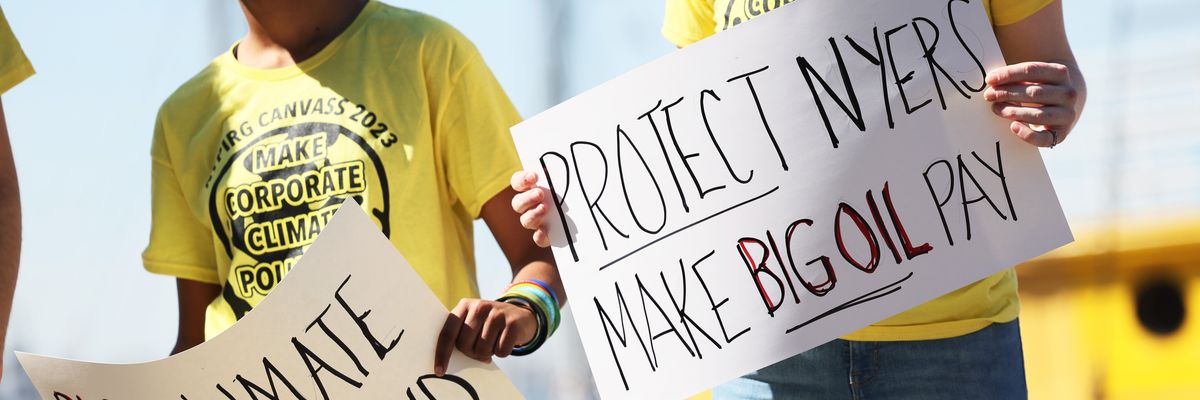
People hold signs during a press conference on the Climate Change Superfund Act at Pier 17 on May 26, 2023 in New York City.
(Photo: Michael M. Santiago/Getty Images

Julia Conley
Dec 26, 2024
COMMON DREAMS

Climate advocates in New York on Thursday celebrated a "massive win" for working people, youth, and the climate as Democratic Gov. Kathy Hochul made the state the second to pass a law to make fossil fuel giants financially responsible for the environmental damages they cause.

Hochul signed the Climate Change Superfund Act into law after years of advocacy, delivering what Blair Horner, executive director of the New York Public Interest Research Group (NYPIRG), called "a welcome holiday gift for New York taxpayers."

The law is modeled on the 1980 State and Federal Superfund law, which requires corporations to fund the cleanup of toxic waste that they cause, and will require the largest fossil fuel companies, which are responsible for a majority of carbon emissions since the beginning of this century, to pay about $3 billion per year for 25 years.

The money—which otherwise would have to be paid by taxpayers, many of whom are already suffering from the extreme weather caused by fossil fuel emissions—will be used to restore and safeguard wetlands, upgrade public infrastructure, improve storm water drainage systems, and pay for climate disaster recovery efforts.


The law will "reinvest $75 billion into the communities most impacted by toxic air pollution, record-breaking storms, and dangerous heatwaves," said Theodore Moore, executive director of the Alliance for a Greater New York.

Lee Wasserman, director of the Rockefeller Family Fund, which lobbied for the new law, told The New York Times that "nothing could be fairer than making climate polluters pay."

New York state Sen. Liz Krueger (D-28), who sponsored the legislation, told the Times that repairs from extreme weather disasters and climate adaptation is projected to cost half a trillion dollars in New York by 2050.

"That's over $65,000 per household, and that's on top of the disruption, injury, and death that the climate crisis is causing in every corner of our state," Krueger said.

State Rep. Phara Souffrant Forrest (D-57) said the new law adopts a "they broke it, they bought it" approach for climate disasters and fossil fuel emissions.


New York taxpayers learned in 2024 that they would be funding $2.2 billion in climate-related infrastructure repairs and upgrades, and the U.S. Army Corps of Engineers estimates $52 billion would be needed to protect New York Harbor.

"On top of that, we’ll need $75-100 billion to protect Long Island, and $55 billion for climate costs across the rest of the state," said NYPIRG. "The state comptroller has predicted that more than half of local governments' costs will be attributable to the climate crisis."

Looking at the industry and its $1 trillion in profits over the last four years, one would never know that the emissions of the world's largest polluting corporations have helped rack up $5.4 trillion in climate damages over the last 26 years.

"Our future is on fire, New York is on fire, and meanwhile the fossil fuel industry is bringing in trillions of dollars in profit year after year," said Keanu Arpels-Josiah, organizer for Fridays for Future NYC. "It's high time for them to pay their fair share in New York. The signing of the full Climate Superfund Act, as youth across the state have advocated for year after year, is a critical step toward that—let this be the beginning of a shift on climate from this governor."

NYPIRG emphasized that the costs will not fall back on consumers.

"According to experts, because Big Oil's payments would reflect past contributions to greenhouse gas emissions, oil companies would have to treat their payments as one-time fixed costs," said the group.

New York is the second state to pass a law ensuring big polluters will play for climate damages. Vermont passed a similar law over the summer—a year after a federal emergency was declared across the state after a storm dumped two months' worth of rain in just two days, causing historic and devastating flooding.

Jamie Henn, director of Fossil Free Media, said the Climate Change Superfund Act "kicks open the door for more states to follow."


Similar legislation has been proposed in states including Maryland and New Jersey.

Krueger told The Wall Street Journal earlier this year that she would "prefer this all be done at the federal level," but as author and 350.org co-founder Bill McKibben wrote Thursday, Hochul's signing of the Climate Change Superfund Act answers the question: "How do we proceed with the most important fight in the world, when the most important office in the world is about to be filled by a climate denier, and when there's a Congress with no hope of advancing serious legislation?"

"One important answer is: We go state by state, and city by city, making gains everywhere we still can," said McKibben, less than a month before President-elect Donald Trump's inauguration.

"And now those other states may join in too. The billions begin to add up. This is, more or less, how the states slowly and then quite rapidly took down the tobacco industry," he wrote. "So—many many thanks to the people who but their bodies on the line these past days, and those who have worked so hard for years to get us here. This may be what progress looks like in the Trump years."
'It’s in a lot of labor contracts': Trump's plans for gov't workers headed for brick wall


Erik De La Garza
December 26, 2024 
RAW STORY

President-elect Donald Trump’s threat to fire thousands of federal workers unless they return to their office spaces will be met with fierce resistance from employees – and their union contracts, according to a Washington Post report.

The COVID-19 pandemic brought a rise in companies moving employees to work-from-home schedules and some have yet to return to their offices – including scores of federal employees who Trump vowed to fire last week unless they come back.

But putting an end to pandemic-era policies and ushering in even stricter federal office guidelines likely won’t come “with the stroke of a presidential pen,” according to reporter Lisa Rein

“Trump’s expected return-to-office mandate faces furious resistance from federal employees, many of whom are covered by union agreements that guarantee work-from-home policies — including some contracts extended in recent weeks by outgoing Biden officials eager to blunt Trump’s impact on the workforce,” Rein wrote in the WaPo report.

Collective bargaining contracts, many of which include provisions for telework, are extended to about 56 percent of the civil service – and a record 10 percent of federal jobs are designed as fully remote, the report said.


“It’s in a lot of labor contracts,” Cathie McQuiston, deputy general counsel at the American Federation of Government Employees (AFGE), the largest union representing federal workers, told the publication of the telework arrangements. “And at a lot of these agencies, the reality is, they don’t have the place to put people to force them back five days a week.”

McQuiston predicted that return-to-office mandates would also be extremely costly and undercut the Trump administration’s goal to cut government spending and personnel.

Besides the challenge of union contracts, Trump’s work-from-home mandate will encounter one more hurdle: a lack of space at some agencies for employees to work.

“According to the report issued by the OMB in August, departments including the U.S. Agency for International Development, Justice, Veterans Affairs, Treasury, the Internal Revenue Service and the Environmental Protection Agency have reduced their real estate footprints since the pandemic emergency ended — and plan to shed still more square footage, with officials citing low employee occupancy as a prime factor,” according to the Post.


AMERIKA

'Concentration camps': Border czar says Trump to detain migrant families
 Common Dreams
December 27, 2024


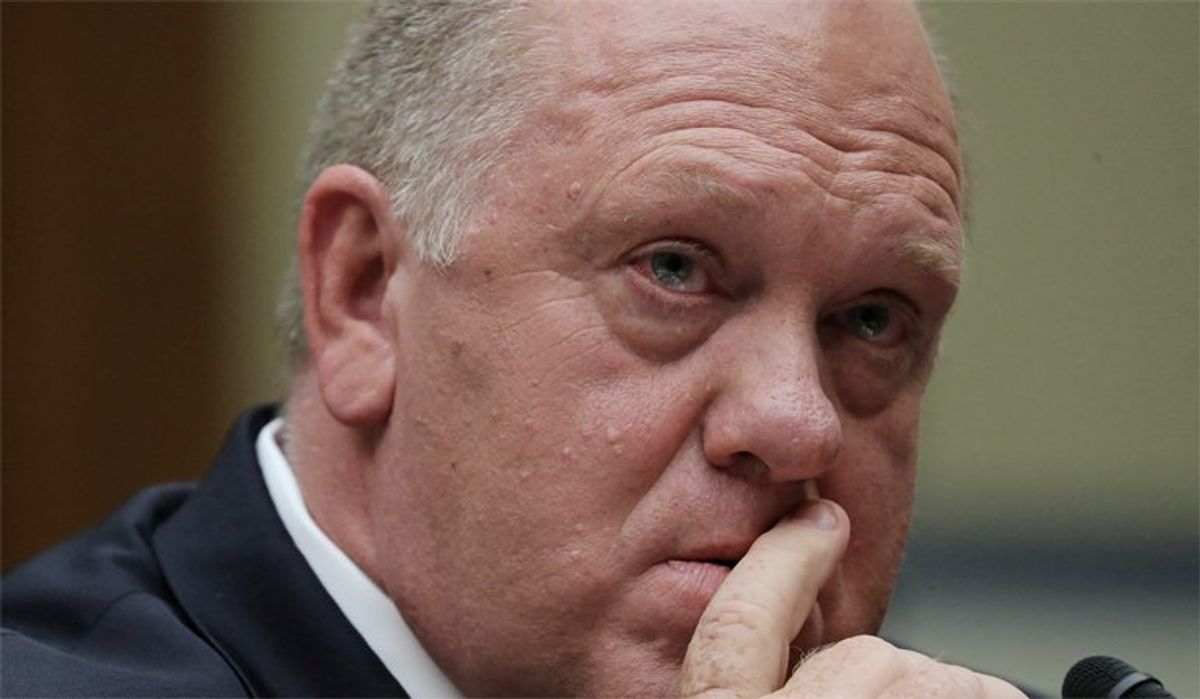
Incoming Border Czar Tom Homan REUTERS/Jonathan Ernst/File Photo/File Photo

Adding to alarm over U.S. President-elect Donald Trump's immigration plans, his "border czar" toldThe Washington Post in an interview published Thursday that the administration plans to return to detaining migrant families with children.

Tom Homan, who served as acting director of U.S. Immigration and Customs Enforcement during Trump's first term, said that ICE "will look to hold parents with children in 'soft-sided' tent structures similar to those used by U.S. border officials to handle immigration surges," the Post summarized. "The government will not hesitate to deport parents who are in the country illegally, even if they have young U.S.-born children, he added, leaving it to those families to decide whether to exit together or be split up."

Since Trump beat Democratic Vice President Kamala Harris last month, migrant rights advocates have reiterated concerns about the Republican's first-term policies—such as forced separation of families—and his 2024 campaign pledges, from mass deportations to attempting to end birthright citizenship, despite the guarantees of the 14th Amendment to the U.S. Constitution.

Homan—who oversaw the so-called "zero tolerance" policy that separated thousands of migrant kids from their parents—said: "Here's the issue... You knew you were in the country illegally and chose to have a child. So you put your family in that position."


Harris and President Joe Biden have come under fire for various immigration policies, but their administration did stop family detention—and when it was reported last year that the White House was weighing a revival of the practice, 383 groups urged the president to keep the pledge he made when he took office "to pursue just, compassionate, and humane immigration policies."

Under Biden, the government ended mass worksite immigration raids and—eventually—the "Remain in Mexico" policy that stopped asylum-seekers from entering the United States. Homan told the Post that the next Trump administration should bring them back.

Less than a month before Trump's inauguration, Biden is now facing pressure to "use the power of the pen to protect those seeking sanctuary from the coming deportation machine that will crush the human rights of our immigrant neighbors and those who have dreams of finding refuge here," as Amnesty International USA executive director Paul O'Brien put it earlier this month.

The Post reported that "of all the border hard-liners in the incoming administration, Homan is perhaps the most cognizant of the limits of the government's ability to deliver on promises of mass deportation—and the potential for a political backlash."

Those hard-liners include dog-killing Republican South Dakota Gov. Kristi Noem, Trump's pick to lead the Department of Homeland Security; family separation architect Stephen Miller, the president-elect's homeland security adviser and deputy chief of staff for policy; and Caleb Vitello, the next acting ICE director whom Miller previously tried to install at the Office of Refugee Resettlement.

"We're going to need to construct family facilities," Homan told the newspaper. However, he also said: "We need to show the American people we can do this and not be inhumane about it... We can't lose the faith of the American people."

Critics of the next administration have suggested that—although Trump won the Electoral College and the popular vote last month—pursuing the GOP immigration policies, including "concentration camps" for migrant families, will anger the public


"Decent people all over the world will hate this country... and they should," media columnist and Brooklyn College professor Eric Alterman said on social media in response to the Post's reporting.

Author and New York University adjunct associate professor Helio Fred Garcia said: "Trump's next border czar previews performative cruelty. In the first term it included kidnapping of children from their parents and returning the parents to their home countries, with no record of which kids came from which parents. A crime against humanity."

Lee Gelernt, an ACLU attorney who has argued many major immigration cases, told the Post that "the incoming administration has refused to acknowledge the horrific damage it did to families and little children the first time around and seems determined to once again target families for gratuitous suffering."

"The public may have voted in the abstract for mass deportations," he added, referring to the November election, "but I don't think they voted for more family separation or unnecessary cruelty to children."


NOTE THE TRANSEXUAL MOTHERS OF INVENTION
'To spread disinformation': Republican confesses GOP plan to attack voting rights


A protester holds a sign saying "Trump wins" at a rally in support of U.S. President Donald Trump at the Oregon State Capitol in Salem, Oregon, U.S. January 6, 2021. REUTERS/Terray Sylvester

Jessica Corbett
December 27, 2024

A key GOP lawmaker made clear in an interview published Thursday that Republicans plan to push for a pair of their voting-related bills when they take control of both chambers of Congress and the White House next month.

Congressman Bryan Steil (R-Wis.), who campaigned for U.S. President-elect Donald Trump and his running mate, Sen. J.D. Vance (R-Ohio), chairs the Committee on House Administration. He shared the GOP's plans for the American Confidence in Elections (ACE) Act and the Safeguard American Voter Eligibility (SAVE) Act in comments to The Associated Press.

"As we look to the new year with unified Republican government, we have a real opportunity to move these pieces of legislation not only out of committee, but across the House floor and into law," he said. "We need to improve Americans' confidence in elections."

The AP pointed out that "Republicans are likely to face opposition from Democrats and have little wiggle room with their narrow majorities in both the House and Senate. Steil said he expects there will be 'some reforms and tweaks' to the original proposals and hopes Democrats will work with Republicans to refine and ultimately support them."

Steil's ACE Act, which "includes nearly 50 standalone bills sponsored by members of the House Republican Conference," is "the most conservative election integrity bill to be seriously considered in the House in over 20 years," according to his committee

Dozens of organizations wrote to Steil and Rep. Joe Morelle (D-N.Y.), the panel's ranking Democrat, last year that "we believe Congress has an important role to play in safeguarding free and fair elections and ensuring all Americans have the freedom to vote. Rather than furthering this goal, the ACE Act would be a substantial step backwards."

"The act would nationalize harmful and unnecessary restrictions on voting rights and roll back many of Washington, D.C.'s current pro-voter laws," the coalition explained. "Instead of proceeding with this legislation, Congress should take actions that will help voters and promote democracy such as passing legislation that will strengthen protections against discrimination in voting and expand access to the ballot for all communities."

While that bill didn't get a floor vote in the House this session, Rep. Chip Roy's (R-Texas) SAVE Act did—it was passed by the House 221-198 in July. Every Republican present voted for the bill and all but five House Democrats rejected it.

However, Democrats narrowly controlled the Senate, so the SAVE Act—which would require proof of U.S. citizenship to vote in federal elections—never went further in Congress, despite GOP attempts to tie it to government funding.

Morelle suggested to the AP there could be bipartisan support for some voting policies—such as federal funding for election offices, restricting foreign money in U.S. races, and possibly even identification requirements with certain protections for voters—but he also called out Republicans for spreading conspiracy theories about widespread voting by noncitizens in November.

"You haven't heard a word about this since Election Day," he noted. "It's an Election Day miracle that suddenly the thing that they had spent an inordinate amount of time describing as a rampant problem, epidemic problem, didn't exist at all."

Speaking broadly about voting bills, Morelle told the AP that "our view and the Republicans' view is very different on this point."

"They have spent most of the time in the last two years and beyond really restricting the rights of people to get to ballots—and that's at the state level and the federal level," he added. "And the SAVE Act and the ACE Act both do that—make it harder for people to vote."

Responding to the reporting on social media Thursday, lawyer and Democracy Docket founder Marc Elias said that "Trump is an autocrat. The GOP wants these 'changes' to spread disinformation, justify election denialism, and gain partisan advantage."

"Democrats need to oppose this effort," he warned. "If the GOP enacts new voter suppression laws, I can promise we will sue and win."