Thursday, January 02, 2025


FuelEU Maritime Regulation Enters Into Force

EU flags
Public domain / Pixabay

Published Jan 1, 2025 6:43 PM by The Maritime Executive


On January 1, the European Union's new carbon-intensity mandate - FuelEU Maritime - entered into force, requiring European shipping interests to make hard choices about fuel-efficiency and low-carbon propulsion. Compliance options include paying more taxes, cutting down fuel consumption or switching to reduced-emissions fuel sources. 

To help achieve its emissions goals for shipping, the EU has imposed a schedule of progressively-higher fees on emissions per tonne of transport work for ships over 5,000 GT. The fee structure is part of the bloc's broader plan to reduce greenhouse gas intensity from shipping by 80 percent by 2050 (compared with 2020 levels).

The legislation requires shipowners to record and report the well-to-wake greenhouse gas intensity of each vessel's operations. Non-compliance is a legal option, but comes with a high price penalty: €2,400 per tonne of VLFSO energy equivalent - about triple the price of bunker fuel - for emissions over the limit. Repeated, multiyear noncompliance increases the penalty.

To avoid these steep fees, operators can pool emissions among multiple ships, allowing one low-carbon vessel to compensate for several high-emitting legacy hulls. Shipowners can also borrow from their future year compliance in order to reduce costs, though they are required to make up the difference later. 

The final option is simple compliance with the FuelEU intensity targets, either by increasing vessel efficiency, adding wind propulsion or switching to green fuels. The target starts with a two percent reduction this year, then rachets down every five years to reach an 80 percent reduction by 2050. 

FuelEU Maritime is unique to Europe, and many European owners believe that if it stands alone as a regional requirement, it will make them less competitive on the global market. Danish Shipping, the representative body for operators like Maersk, Torm and Stena, supports the new regulation but says that there is a need for global climate regulation of the shipping industry.

"I hope FuelEU Maritime can help drive both the demand for and production of green fuels for shipping. Currently, the lack of green fuels at competitive prices is the biggest challenge for the green transition of shipping," said Nina Porst, director of environment at Danish Shipping. "While the EU’s regulation of shipping emissions is undoubtedly a step in the right direction towards climate neutrality, it is crucial that EU countries also push for international rules within the IMO, applicable regardless of where ships operate."


 

OSV Owner Vallianz Reports Ransomware Attack

Amgun
iStock / Amgun

Published Jan 1, 2025 8:56 PM by The Maritime Executive


Singaporean OSV player Vallianz is the latest shipowner to be hit with a cyberattack, and has reported the details of the incident publicly.

In an investor announcement filing with the Singapore Exchange (SGX), Vallianz said that it had been attacked by a ransomware hacking group. The malicious actors gained unauthorized access to the company's servers, but the intrusion was detected and the company took steps to contain and resolve the intrusion. After taking action, Vallianz determined that "there has been no significant impact to the group's business operations."

Assessment of the impact of the cyberattack is ongoing, with expert consulting assistance, and the relevant authorities have been informed. 

Vallianz's stock is thinly traded, and the share price did not move markedly after the announcement. It has traded between about $0.03 and $0.04 since early 2023. 

Vallianz breached financial covenants with some of its lenders in June 2024, and it was provided with six-month conditional waiver notices from these financial institutions, which ended on December 31. One of the lenders has agreed to extend the waiver through the end of 2025, negotiations with the other lenders are ongoing, and Vallianz's parent company has promised to fund the OSV firm's operations and financial obligations through mid-2025. 


Lightering Required to Free Bulker Stuck for a Week in St. Lawrence

ship aground in St. Lawrence River
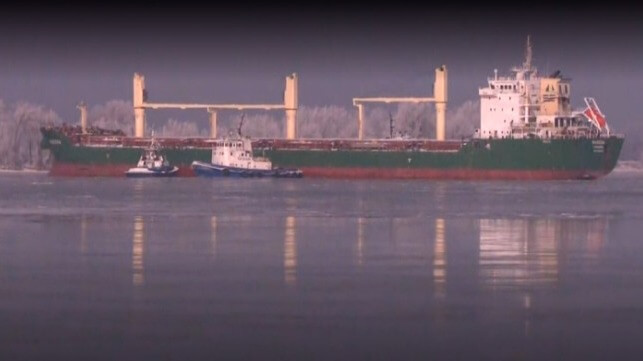
Last week tugs attempted to free the bulker (CTV News)

Published Jan 1, 2025 11:39 AM by The Maritime Executive


The new plan for freeing a Cyprus-flagged bulker Maccoa that has been stuck in Canada’s St. Lawrence River since December 24 calls for lightering the vessel. It is the second time in a month that a bulker struck in the river has required removing a portion of its cargo to free the ship.

The Maccoa (30,898 dwt) reportedly lost power shortly after departing from Montreal. The vessel made it a few miles along the St. Lawrence River before it veered off course and grounded. The Canadian Coast Guard reported that the ship, which was built in 2009, had not suffered damage but it was “sideways outside the navigation channel.”

Three tugs tried to free the vessel on December 27. According to the Coast Guard, they attempted to use the wash from the tugs to help dislodge the ship. After several efforts, it was abandoned.

The new plan calls for placing two barges alongside as early as January 1 and beginning to offload more than 3,000 metric tons of the corn which is loaded aboard as cargo. The lightering is expected to require at least two days with January 5 as a target date for attempting to free the vessel. 

The lightering effort however might be delayed by weather. The Coast Guard reports that the corn cannot be moved if it is raining. It would be the second time the attempts to free the ship were delayed as they previously said the efforts would be slowed by the holidays.

The 20 crewmembers are reported to be safe aboard the vessel and there so far have been no signs of pollution. The Coast Guard said last week that generators, heaters, and supplies had been transferred to the vessel. The Maccoa was bound for Ireland when it grounded. 

Earlier in December, lightering was also required to free another bulker, the Tim S Dool which operates from the Great Lakes. It was stuck further south on the river below Montreal. Initial efforts to refloat the Tim S Dool were also unsuccessful requiring the placement of a crane and barges before it could be pulled free from the side of the river.

Canadian authorities believe it is a coincidence that in the same month, two vessels each became stuck on the river. There have been no reports of abnormal conditions on the St. Lawrence, but they are now facing a rush to free the vessel before the harshest winter weather sets in. 

The end of the navigation season is approaching for the St. Lawrence Seaway south of Montreal and below where the vessel is currently stuck. The Great Lakes – St. Lawrence Seaway System previously announced all ships must clear the section between Montreal and Lake Ontario by January 5. The Welland Canal closed on December 26, with limited ships by appointment being permitted till January 10. Ports east of Montreal traditionally remain open in the winter but sections of the river can become challenging with ice. The Seaway traditionally opens in late March based on weather conditions.


Royal Navy Sailors Cancel Christmas to Track Russian Task Force

Russian corvette
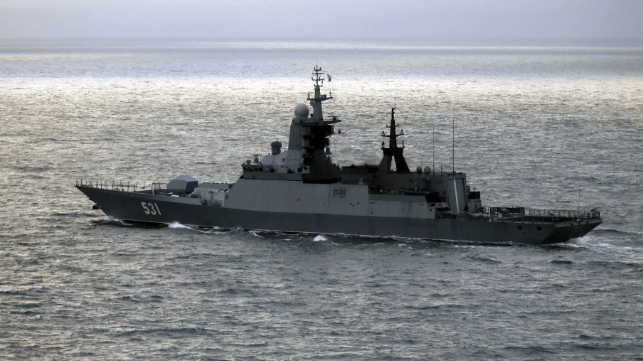
Russian corvette Soobrazitelny (Royal Navy)

Published Jan 1, 2025 7:47 PM by The Maritime Executive


The crew of Royal Navy frigate HMS Somerset had their Christmas holiday abruptly cut short when they were recalled to carry out the duty of escorting a Russian naval group that was sailing past the British Isles.

200 crewmembers were recalled to their ship in Devonport Naval Base on Christmas Day and sailed on Friday, December 27 at record speed in foggy weather to meet up and shadow Russia’s corvette Soobrazitelny and her support vessels MV Sparta II and MV General Skobelev.

Somerset, a Type 23 frigate kept ready to deploy at short notice, reached the Russian force in the North Sea and shadowed it for more than 500 miles as it passed through the Dover Strait and into the English Channel.

Owing to the foggy conditions, the frigate used sensors to follow the Russian vessels and deployed her helicopter when the weather cleared to support the shadowing operation. The Russian vessels remained in international waters throughout the five-day shadowing operation, which concluded on New Year’s Eve.

“Personnel returned from leave from all parts of the United Kingdom. Although returning during this period is always emotional, the requirement for the tasking was understood by all onboard,” Warrant Officer 1 Stephen Doyle, Somerset’s Executive Warrant Officer. “Support from our families remains a key factor in allowing the sailors to perform at the highest level.” 


Vietnamese Navy Rescues Drifting Tanker

tanker being towed
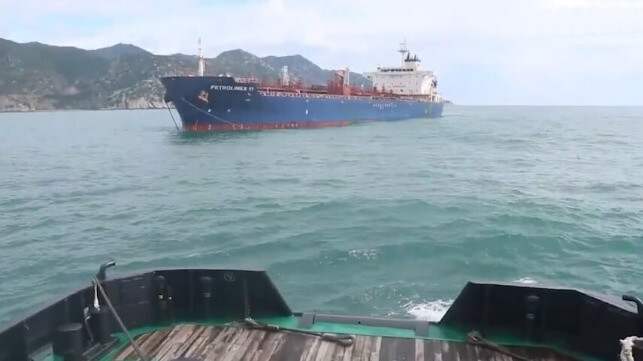
Vietnamese Navy towed the drifting prodcut tanker to a safe anchorage (Vietnam TV)

Published Jan 2, 2025 12:21 PM by The Maritime Executive


The Vietnamese Navy intervened yesterday, January 1, to rescue the product tanker Petrolimex 11 which was drifting uncontrolled offshore. The report says despite high sea conditions they were able to tow the vessel to a safe anchorage.

The distress call was issued by the Vietnamese-flagged product tanker while it was off the coast of central Vietnam. It had loaded a cargo (likely gasoline) and was traveling from Malaysia to Vietnam. The distress call said the vessel had suffered a critical engine malfunction meaning it was out of control and adrift. It was 20 nautical miles southeast of Cam Ranh Bay with a crew of 25 aboard.


The navy dispatched one of its vessels and reports it had to battle seas running up to approximately 20 feet or higher. The navy was able to reach the vessel overnight and secured a tow line. The Petrolimex 11, built in 2008, is 40,000 dwt with a length of 577 feet (176 meters). It is operated by VITCO (Vietnam Tanker Joint Stock Corporation).

The vessel was towed to the south and placed in the anchorage at Vinh Tan, one of the international ports in Vietnam.


Seafarer Lost Overboard in the Philippines from Rio Tinto Bulker

bulker
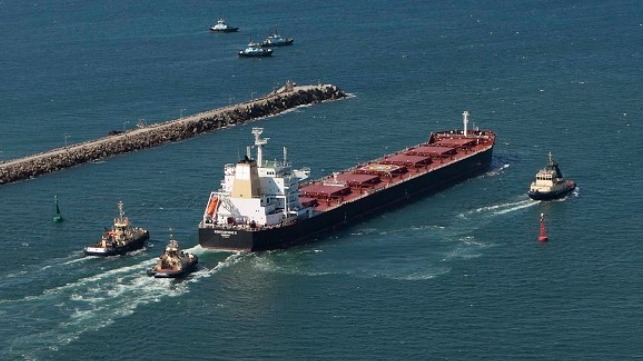
Seafarer is missing from one of the giant bulkers operated by Australia's Rio Tinto (file photo)

Published Jan 2, 2025 2:05 PM by The Maritime Executive


A seafarer working aboard a bulker that was bound for Australia is missing overboard from his ship. Mining giant Rio Tinto confirmed the reports before its vessel the RTM Zheng He (205,400 dwt) arrived in Australia. The company issued a statement detailing the efforts while reporting its thoughts were with the family, friends, and colleagues.

The Philippine Coast Guard received a report of a missing seafarer on December 26 from the Singapore-registered bulker which is managed for Rio Tinto by Anglo Eastern. The vessel departed China on December 18 and is due to arrive in Dampier, Australia later this week.

The master of the bulker told the Philippine Coast Guard that a deck fitter named Gel Aguavia had last been seen on December 26 on the port side of the ship. He was reported wearing a dark blue reflectorized suit.

The Coast Guard deployed BRP Capones to conduct the SAR operation while also broadcasting a general alert. Two other bulkers in the vicinity, HL Hope and Federal Sutton, also joined in the search

“Our thoughts are with Gel's family, friends, and colleagues, and we stand with everyone affected by this distressing situation. We are focused on offering all possible support during this difficult time,” Rio Tinto said today confirming the incident. “We would like to thank everyone involved in the search for their tireless efforts.”

The company reports it is cooperating fully with relevant authorities and the ship’s manager on investigations into the incident. It is also conducting its own investigations.


Equinor Secures $3B in Financing as Empire Wind 1 Moves Forward

offshore wind farm
Equinor is building momentum for New York's Empire Wind 1 project (file photo)

Published Jan 2, 2025 2:53 PM by The Maritime Executive


A project financing package was completed at the end of December to continue the momentum for the development of another of the early, large offshore wind farms off the Northern U.S. Coast. Equinor reports it secured more than $3 billion in project financing for Empire Wind 1 on competitive terms due to strong interest from lenders.

The Empire Wind 1 project, which will be located between 15 and 30 miles southeast of Long Island is already in the first stages of construction. It is expected to reach commercial operations in 2027.

“This is an important milestone for Equinor, in line with our plan to enhance value and reduce exposure in the Empire Wind 1 project. As we now enter full execution mode, we continue our efforts to increase robustness and value-creation in the project,” said Jens Økland, acting executive vice president for Renewables in Equinor.

The lease was awarded in 2017 to Equinor but in 2020 it was part of the company’s agreement with BP to develop a joint venture for offshore wind. The JV however was dissolved in 2024 with Equinor taking full ownership of Empire Wind with the company saying it was moving forward in what is expected to be a $5 billion investment. BP took ownership of the Beacon Wind lease and projects in the swap agreement.

While work is proceeding, Equinor however reports that it intends to take on a new partner for the project to further enhance value and reduce its risk. The company did not indicate where it stands in the search for a partner but in general private equity investors have shown strong interest in projects once they reach the development stage,

The plan for Empire Wind split the lease area into two projects with the first phase having a contracted capacity of 810 MW. A 25-year Purchase and Sale Agreement for the power from Empire 1 was struck in June 2024 with NYSERDA (New York State Energy Research and Development Authority). 

As part of the project, Empire Wind 1 is participating in the redevelopment of the South Brooklyn Marine Terminal to support the project. New York City is supporting the effort to develop the wind terminal which the company says will create more than 1,000 union jobs in the construction phase.

The second wind farm, Empire Wind 2, is in an early stage of planning and regulatory approval. It has a potential capacity of more than 1,200 MW.

In announcing the project financing, the company said the agreement maintains the momentum toward bringing a significant power source to the New York grid.

Photos: French Navy Tests Heavyweight Torpedo on Aging Corvette

Courtesy Marine Nationale

Published Jan 2, 2025 by The Maritime Executive

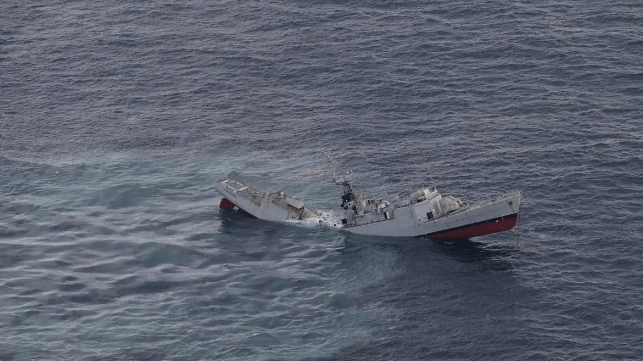
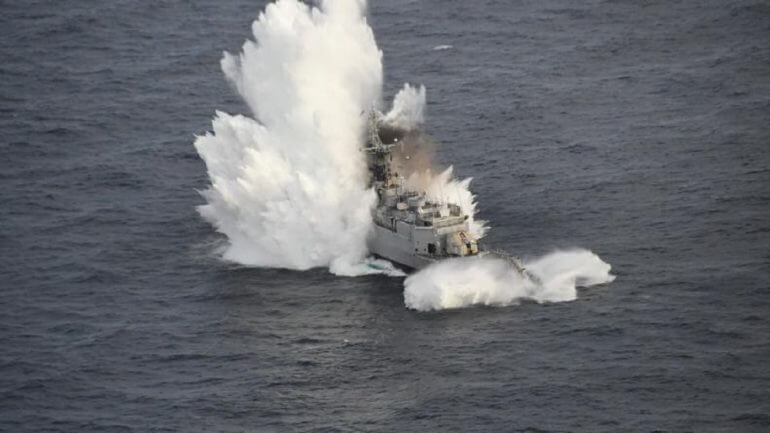
The French Navy recently validated the performance of its top-end torpedo in a rare and dramatic sinking exercise.

In a test-firing in mid-December, an unnamed French nuclear-powered attack submarine launched an F21 heavyweight torpedo at the retired corvette Premier Maitre L'Her. Images released by the Marine Nationale show that the torpedo hit just aft of the deckhouse and broke the ship's keel, as designed.


Courtesy Marine Nationale

The F21, a heavily-upgraded evolution of the Italian A184 design, is a 20-foot-long torpedo with a 440-pound warhead. With electric propulsion and a single-use aluminum-silver oxide battery, it has a top speed of 50 knots and can reach targets out to 30 nautical miles away; it can dive as deep as 1,600 feet for antisubmarine warfare duties. It is wire-guided with acoustic homing in the terminal approach phase, and can be re-targeted in midcourse.

Premier-Maitre L'Her was a D'Estienne d'Orves-class light corvette of the Marine Nationale. She was commissioned in 1981 and was 43 years old by the time she exited service.

Originally designed for antisubmarine warfare in the Atlantic, the class' poor seakeeping performance and limited sonar capability saw them relegated to a patrol and policing role after the end of the Cold War. Premier-Maitre L'Her was deployed for antipiracy duty in the high-risk zone off Somalia in 2009, and conducted one successful interdiction resulting in the arrest of eight pirates. She also served in Operation Sophia, the EU's migrant-rescue mission. Her final overseas deployment was a three-month policing mission in the Gulf of Guinea, followed by a two-month Atlantic patrol. She was decommissioned in July and prepared for sinking.


Annual U.S. Antarctica Mission Proceeds as Polar Star Departs Australia

Polar Star icebreaker USCG
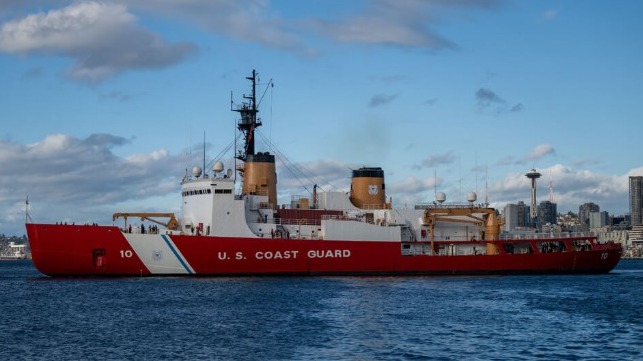
Polar Star started her 28th trip to Antarctica departing Seattle in November (U.S. Coast Guard photo by Petty Officer 2nd Class Briana Carter)

Published Jan 2, 2025 4:21 PM by The Maritime Executive


The U.S.’s annual supply mission to Antarctica known as Operation Deep Freeze is moving into its next phase as the Polar Star, the U.S. Coast Guard’s only heavy icebreaker, started the final leg of its deployment. It will take her from Australia to the bases in the Antarctic. It marks the icebreaker’s 28th voyage to Antarctica.

Operation Deep Freeze is a joint military service mission to resupply the United States Antarctic stations of the National Science Foundation, which is the lead agency for the United States Antarctic program. The Polar Star provides heavy icebreaking capabilities to facilitate sealift, seaport access, bulk fuel supply, and cargo handling for two of the U.S.’s three research stations in Antarctica, including McMurdo Station which is the largest. The cutter’s icebreaking capabilities enable the delivery of critical supplies to sustain the year-round operations and support international partnership in the harsh Antarctic environment.

Operation Deep Freeze is one of the more challenging U.S. military peacetime missions due to the harsh environment in which it is conducted. Antarctica is the coldest, windiest, most inhospitable continent on the planet, and the USCG highlights that each trip requires careful planning and coordination. During the transit, the crew received training and prepared to support the vital mission despite the austere environment. 

The Polar Star started this year’s deployment by departing from its homeport of Seattle on November 22. It has traveled approximately 7,000 miles with a stop in Honolulu, Hawaii, before reaching Sydney, Australia on December 21.  The icebreaker hosts tours and outreach while in Australia while also loading fuel and supplies. She departed on December 27 for the trip across the Southern Ocean to reach Antarctica.

"Polar Star is unique in its ability to operate in the dynamic polar regions and we are looking forward to joining our service partners operating there," said Lt. Cmdr. Rachel Rand, Polar Star’s operations officer.  

She is outfitted with six diesel and three gas turbine engines that produce up to 75,000 horsepower. The USCG highlights she is their most powerful vessel with capabilities to continuously break six feet of ice at 3 knots and ram through ice she can encounter in Antarctica at up to 21 feet thick. The USCG has been working to extend her service while the replacement icebreakers are delayed. In December, approval was finally given to begin construction on Polar Sentinel, the first next-generation icebreaker, but she is not expected till 2029.

The first phase of this year’s Operation Deep Freeze began in October 2024 when a team of Seabees departed to undertake a waterfront construction project in Antarctica. It is the first time since 1994 that Seabees were officially involved in operations on Antarctica.

The current “ice pier” at McMurdo Station the USC reports became unreliable to sustain essential logistics operations. The Seabees were sent to construct infrastructure that supports the installation of a new loading/offload infrastructure project at McMurdo Station. The new project will provide an enduring engineering solution to facilitate the safe and efficient loading and offloading of supplies to McMurdo.

In addition to the Polar Star, the U.S. sends a mission traditionally with two merchant ships that depart around the end of the year. In that phase of Operation Deep Freeze, vital supplies are transported to the stations, and material is loaded for return to the United States.


Mysterious Airfield on Gulf of Aden is Nearly Complete

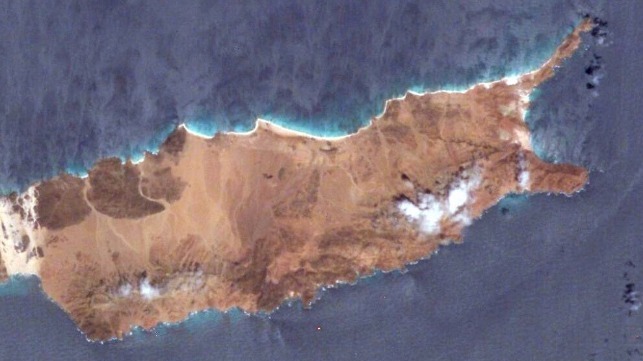
Someone is rushing to complete the airfield on Abd Al Kuri as conflict intensifies over Yemen

Abd al Kuri, Sentinel-2
The eastern end of Abd el Kuri, before airfield construction began (NASA)

Published Jan 1, 2025 3:51 PM by The Maritime Executive


As the risk grows of further escalation of the conflict over Yemen and its surrounding sea channels, Israel has begun to broaden its attacks on the Houthis to include ports and supply chains stretching back into Iran. Some commentators have urged that a complete blockade be imposed on Houthi-controlled Yemen, with the interdiction of all sea and air traffic between Iran and Yemen. Others in Israel have suggested that associated targets within Iran should also be considered in scope.

If one wanted to respond rapidly to Houthi targets of opportunity, such as an attack being mounted on a merchant ship, then at present one generally needs a naval escort close by or an aircraft carrier. Most of the Houthis' adversaries, however, need to launch from airfields thousands of kilometers away, presenting intelligence, targeting and refueling challenges and rendering impossible a quick response to an evolving tactical situation.

In this context, an airfield on the Yemeni island of Abd Al Kuri - next to the Guardafui Channel - acquires a greater strategic significance. Aircraft flying from Abd al Kuri would dominate the shipping channels through the Gulf of Aden to the Strait of Bab El Mandeb, and could maintain a continuous presence or a quick response capability to mount tactical missions in response to fleeting threats to merchant shipping.

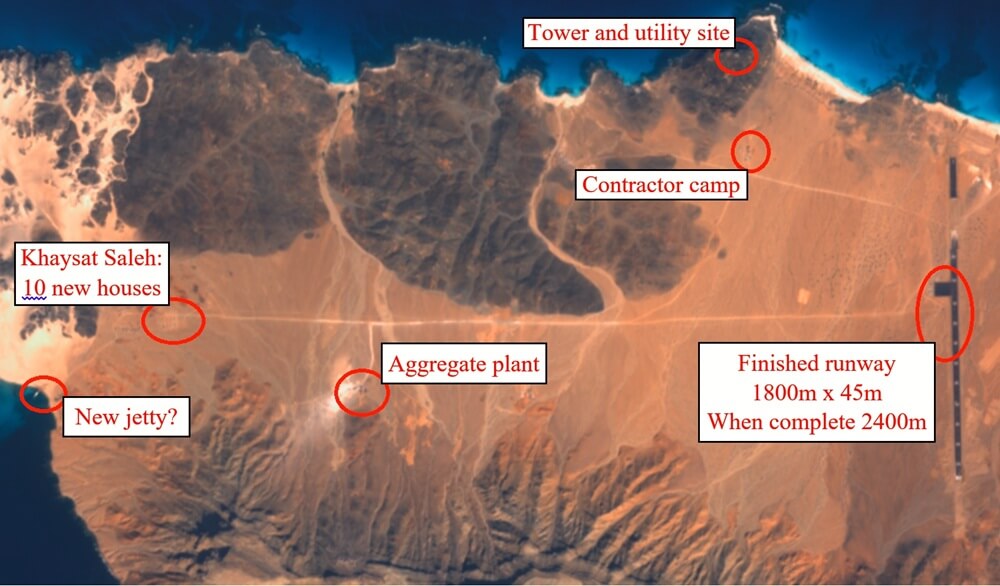
Work started on the airfield on Abd al Kuri in 2021, but has proceeded slowly. For months on end, no progress was visible. But in recent weeks, work has accelerated. As of December 23, 1800 meters of runway had been completed, and had been painted up with distance markers and piano keys at the southern end. The apron has also been surfaced - although is probably only big enough to turn around visiting aircraft.

Unfinished, unpainted runway on Abd al Kuri, October 2024 (Sentinel-2)

Signs of new activity at Abd al Kuri, December 23, 2024 (Sentinel-2 / Jonathan Campbell-James)

Curiously, as of December 28, there was still a gap in the runway at its northern end, which if filled would complete a runway of 2400 meters in length. In the intervening five day period, piano keys had also been painted on the far northern end of the full-length runway, on the far side of the gap.

The runway - when finished - is assessed to be of sufficient strength to support a full range of strike, maritime reconnaissance and heavy transport aircraft; a crushing plant has been operating three miles to the southwest, with trucks transporting aggregate to construct foundations sufficient to bear the weight of large aircraft.

What appears to be a barracks with ten new block houses has been built at Khaysat Saleh, four miles to the west of the airfield, with the road between showing signs of recent heavy use. A new jetty appears to have been built on the beach at Kilmia, facing south and in the lee of the island - thus better protected from potential Houthi drone attack than the storm-exposed jetty previously in use on the northern coast.

There appears to be some form of utility site on the high point of a 100-meter hill to the west of and adjacent to the northern end of the airfield. The hilltop site overlooks the northern coast, is serviced by a well-used road, and has been occupied and in use for at least 15 years. The purpose of the site is unclear, but it could be a radio antenna or water pumping site. It also would be well-positioned to serve the communication needs of the airfield. Possibly connected to rumors circulating in the Yemeni press that it was serving as an intelligence collection station, the site attracted an unusual degree of satellite imaging attention in October.

At the rate that work is progressing, it appears that the airfield will be capable of hosting rudimentary operations within weeks, at which point it may become clearer for whom and what purpose this airfield dominating the sea approaches to the Gulf of Aden has been built. At the very least, it could be useful as a diversionary airfield in emergencies. Echoing the Diego Garcia saga, it is likely to have been built to the detriment of rather than for the humanitarian benefit of the local inhabitants, if indeed any are allowed to remain on the island once flight operations commence.