Sunday, January 05, 2025

Biden officials issue permit for Perpetua’s Idaho antimony-gold mine

Reuters | January 3, 2025 | 

Yellow Pine pit at the Stibnite Gold project in Idaho. Image: Amanda Stutt.

The Biden administration on Friday issued the final mining permit for Perpetua Resources’ Idaho antimony and gold project, a move aimed at spurring US production of a critical mineral at the center of a widening trade war between Washington and Beijing.


Permitting for the mine, backed by billionaire investor John Paulson, comes after Beijing last month blocked exports to the US of antimony, a metal used to make weapons, solar panels, flame retardants and other goods for which there are no current American sources.

The US Forest Service released the final record of decision for Perpetua’s Stibnite project – essentially the mine’s permit – after an eight-year review process, according to documents published on the agency’s website.

Shares of Boise, Idaho-based Perpetua gained 9.1% in after-hours trading after Reuters reported the permit decision earlier on Friday.

Perpetua’s mine will supply more than 35% of America’s annual antimony needs once it opens by 2028 and produce 450,000 ounces of gold each year, a dual revenue stream expected to keep the project financially afloat regardless of any steps Beijing may take to sway markets.

For example, Jervois Global, the owner of an Idaho mine that produces only cobalt, declared bankruptcy on Thursday after Chinese miners aggressively boosted production of that metal in a bid for market share.


In its 154-page report, opens new tab, the Forest Service said its Perpetua decision was based on a detailed review of environmental data, discussions with Indigenous groups and consultation with other federal agencies.

“I have taken into consideration the degree to which the (mine’s) environmental design features, monitoring, and mitigation measures will, where feasible, minimize adverse environmental impacts on (federal lands),” the Forest Service’s Matthew Davis said in the report.

Perpetua, which changed its mine design three times in response to critics, said it believes it can make the mine – roughly 138 miles (222 km) north of Boise – “the best it can be.”

“Every detail of this project was examined with a fine-tooth comb,” said Jon Cherry, Perpetua’s CEO.

Perpetua will need to obtain a wetlands permit from the US Army Corps of Engineers, although the Forest Service said its own decision was made in consultation with that agency, implying a smooth review process.
Finances

The Stibnite project was forecast in 2020 to cost $1.3 billion, a number expected to rise due to post-pandemic inflation. The site has estimated reserves of 148 million pounds of antimony and 6 million ounces of gold.

The Pentagon committed nearly $60 million to fund permitting for the project, which would entail cleaning and expanding a site that was polluted by World War Two-era mining.

Perpetua last April received a letter of interest from the US Export-Import Bank, the government’s export credit agency, for a loan worth up to $1.8 billion to fund the Stibnite project.

The project has not won the support of Idaho’s Nez Perce tribe, which is concerned it could affect the state’s salmon population.

The tribe, though, was consulted for the permit review and changes were made to address their concerns, according to the record of decision.

Representatives for the Nez Perce were not immediately available for comment.

(By Ernest Scheyder; Editing by Matthew Lewis)
Why both Biden and Trump oppose Japan's takeover of US Steel

DW
January 3, 2025

US President Joe Biden has vetoed Nippon Steel's $14.9-billion takeover bid for its American rival, US Steel. Amid bipartisan opposition to the merger, DW asks why US politicians and regulators are concerned.

US Steel is facing declining revenues and profitability due to competition from foreign rivals
Image: Gene J. Puskar/AP Photo/picture alliance

After months of opposition, US President Joe Biden on Friday blocked the proposed buyout of the United States Steel Corporation, or US Steel, by Japan's Nippon Steel.

The second-largest US steelmaker had previously approved the $14.9-billion (€14.5-billion) takeover bid, saying it would help protect the ailing firm from intense competition from abroad, including China.

Nippon Steel had hoped the acquisition would help hike its global steel output by nearly a third, to 85 million tons.

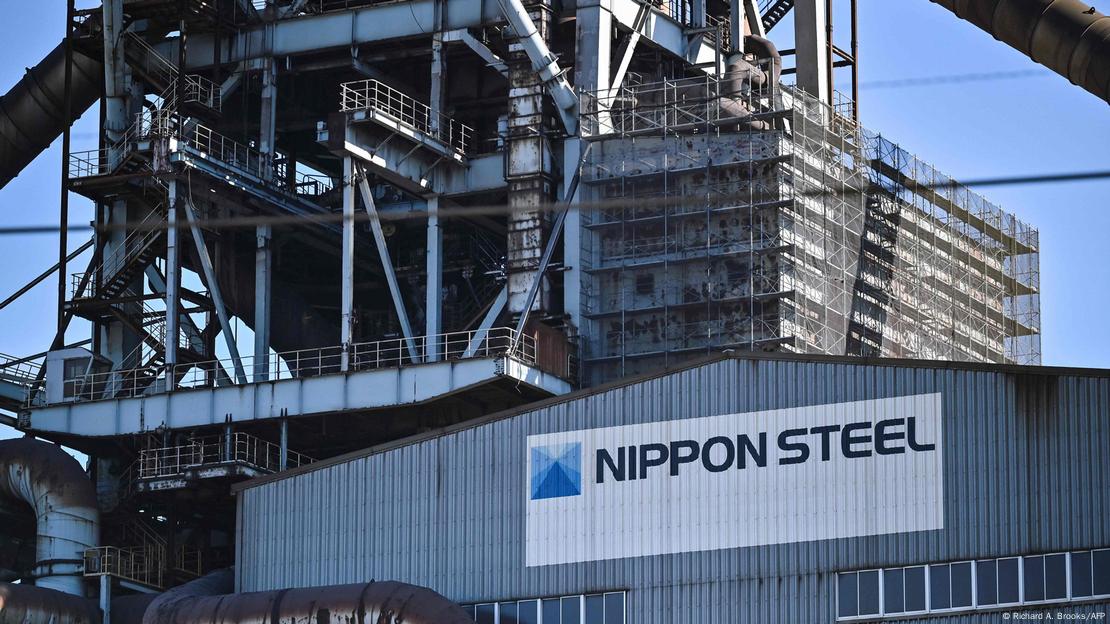
Nippon Steel, headquartered in Chiyoda, Tokyo, is Japan's largest steelmaker
Image: Richard A. Brooks/AFP

However, the merger became a significant issue for Democrats and Republicans in November's US presidential election, as Pennsylvania, where US Steel is headquartered, was a critical swing state.

In an attempt to protect American jobs, the United Steelworkers union fiercely opposed the transaction.
Why Biden has blocked the deal

Biden has cited national security concerns and risks to key supply chains as his main reasons for vetoing the purchase.

"This acquisition would place one of America's largest steel producers under foreign control and create risk for our national security and our critical supply chains," Biden said in a statement. "That is why I am taking action to block this deal."

The president previously said that critical industries, like the steel sector, must remain under the control of domestic players.

In December, the Committee on Foreign Investment in the United States (CFIUS) — which reviews mergers and acquisitions of US firms by foreign entities — failed to reach a consensus on whether to approve the deal and referred the decision to Biden, who leaves office on January 20.

The panel, led by Treasury Secretary Janet Yellen, warned the buyout could lead to a cut in US steel output, which would cause supply shortages, affecting the transport and energy sectors the most.

CFIUS warned the deal could scupper Washington's attempt to quash the dumping of cheap steel from China, where heavy industries receive massive subsidies from the Beijing government.


According to US newspaper The Washington Post, the committee was also concerned Nippon Steel could shift production to its sites in Brazil, Mexico and India after gaining control of US Steel.

Senior White House advisers had reportedly tried to persuade Biden to proceed with the purchase, as it would represent a sizable investment in an ailing US company. They also thought a veto could hurt ties with Japan, one of Washington's closest allies in the Indo-Pacific.

Both Biden and former President Donald Trump implemented protectionist policies in recent years to safeguard the US steel sector against a global oversupply, which has driven down prices. The measures included 25% tariffs on imported steel, while China was singled out for unfair trade practices.

Biden's veto is unlikely to be overturned by President-elect Trump, who campaigned on reviving US heavy industry, and last month wrote on his Truth Social social messaging platform that he was "totally against the once great and powerful US Steel being bought by a foreign company."

Trump has promised to use a mix of more tariffs and tax incentives to protect the US steel sector.


What have Japan, Nippon Steel said about veto?

In a last-ditch attempt to get the deal approved, Nippon Steel proposed giving Washington a say in any potential production cuts at US Steel, Reuters news agency reported earlier this week, citing a source familiar with the deal.

In December, Nippon Steel defended the merger, promising "significant" investments in US Steel's facilities and employees to "ensure a vibrant future for American steelmaking." The firm said it remained "confident that the acquisition will protect and grow US Steel, creating the best steelmaker with world-leading capabilities for the benefit of American workers and customers."

Nippon Steel has pledged over $2.7 billion in capital investment for US Steel's facilities in Pennsylvania and Gary, Indiana, and offered to move its US headquarters to Pittsburgh, where US Steel is based. It has also promised to honor existing agreements with unions.

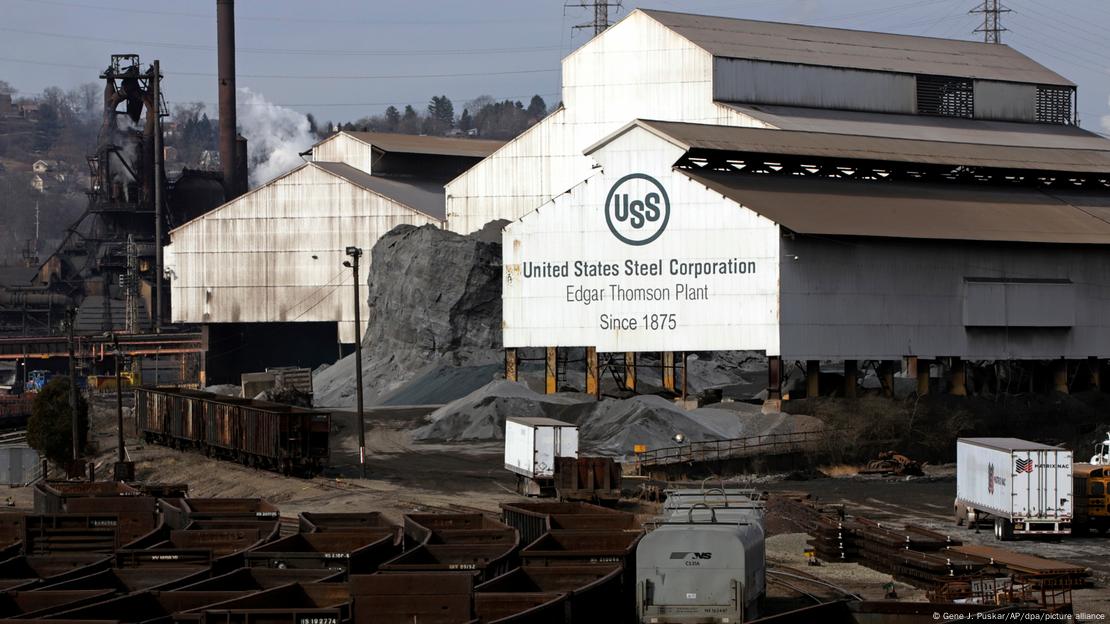
Nippon Steel promised to invest $2.7 billion in the US, including the Edgar-Thomson plant, the world's oldest integrated steel mil
Image: Gene J. Puskar/AP/dpa/picture alliance

In November, Japanese Prime Minister Shigeru Ishiba urged Biden to approve the merger to avoid weakening ties between the two countries.

Both Nippon Steel and US Steel have insisted the deal poses no national security concerns and vowed to pursue legal action, claiming US officials failed to follow proper procedures while reviewing the acquisition.

What could be the impact of Biden's decision?

While it may preserve the independence of US Steel, Biden's veto could leave the steelmaker struggling to secure the capital and technology needed to modernize.

It would leave the firm unable to compete against larger, better-funded global steelmakers like ArcelorMittal or Chinese rivals.

US Steel could now face difficulties finding a buyer for the entire company. A cash and stock deal in August 2023 by rival Cleveland-Cliffs was worth around half of the amount of the Nippon Steel bid. At the time, US Steel rejected the union-backed deal, and a few months later approved the Nippon Steel merger plan.

By blocking the acquisition, Biden is also signaling to other international investors that they may face political and regulatory hurdles when bidding for US firms deemed critical for national security.

The decision is also likely to widen China's grip on the global steel sector and could even prompt the European Union to seek foreign investments from the likes of Nippon Steel for its steel players.

Edited by: Uwe Hessler

What’s next after Biden blocked the $15bn Nippon Steel/US Steel deal?

Reuters | January 4, 2025 |


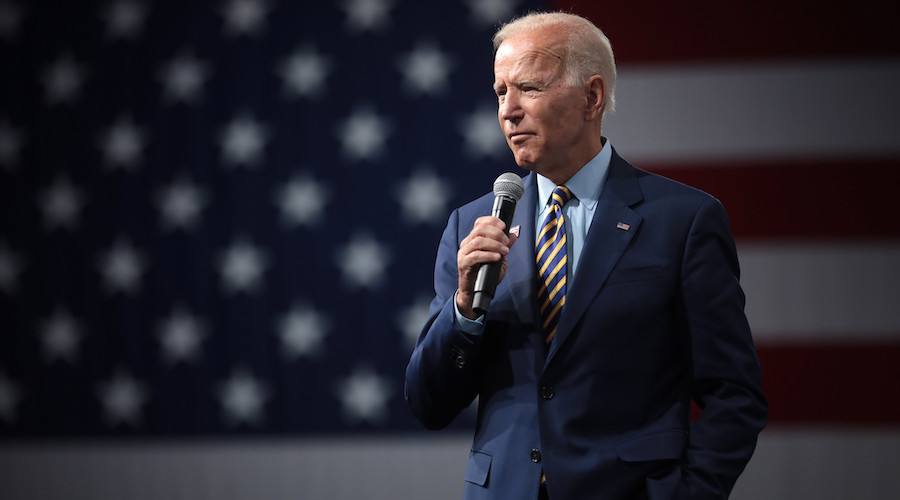
US president Joe Biden. (Image by Gage Skidmore, Flickr)

US President Joe Biden blocked Nippon Steel’s proposed $14.9 billion purchase of US Steel citing national security concerns, in a potentially fatal blow to the deal after a year-long review.


Biden, President-elect Donald Trump and an influential labor union opposed the effort by Japan’s top steelmaker to acquire the iconic American firm, which would have created the world’s third-largest steelmaker, according to World Steel Association data.

The path forward is unclear. The companies could sue the US government, another buyer could swoop in for US Steel, or Republicans who favor the deal could urge Trump to find a way to approve it.

Here is what could come next:

The deal itself

The proposed deal has not yet been terminated by the companies even after Biden blocked the deal.

In a joint statement, Nippon and US Steel called Biden’s decision “unlawful,” and Nippon Steel may file a lawsuit against the US government challenging the procedures behind the decision, Japan’s Nikkei business daily reported on Saturday.


David Burritt, US Steel’s chief executive, said on Friday “we intend to fight President Biden’s political corruption.”

Some lawyers, such as Nick Wall, M&A partner at Allen & Overy, have said a legal challenge would be tough.

Nippon Steel argued it made numerous concessions, including offering to move its headquarters to Pittsburgh, to meet the demands of CFIUS, the Committee on Foreign Investment in the United States, the panel that decides on whether foreign purchases of US companies should go forward.

CFIUS was split over a decision and did not make a recommendation on the deal.

“If they go to court most of the decisions by the various CFIUS agencies will be made public,” said Brett Lambert, a former senior Pentagon official under Barack Obama, citing the rare move to forward a split decision to the president.

If the deal does not go through, Nippon Steel would have to pay a $565 million break-up fee.
US Steel’s future

Pittsburgh-based US Steel had warned that mills could close and thousands of jobs would be at risk without the deal. US Steel’s profits have dropped for nine straight quarters amid a global industry downturn, but it still sports a forward price-to-earnings ratio of 12.87, more expensive than US peers, according to LSEG data.


The United Steelworkers union, which opposed the deal, has called the company’s warnings baseless, saying Friday that it is clear that US Steel’s recent financial performance shows it “can easily remain a strong and resilient company.”

Other suitors could emerge. US-based Cleveland-Cliffs, which previously bid for the company, could come back with a lower offer. However, its market value is now smaller than that of US Steel.

“One would suspect that Nucor and Cleveland Cliffs will be in discussions with US Steel, but based on presidential messages one would think the US government may come to its aid and invest in its infrastructure,” said Jay Woods, chief global strategist at Freedom Capital Markets.
Trump’s position

Trump, who takes office on Jan. 20, has repeatedly vowed to block the sale, a view he shared with Biden.

“I am totally against the once great and powerful US Steel being bought by a foreign company, in this case Nippon Steel of Japan,” he wrote on his Truth Social platform last month. “As president, I will block this deal from happening. Buyer Beware!!!”

Trump’s transition team did not comment on Friday. However, several current and former Republican officeholders on Friday criticized Biden’s decision, saying it would cost investment in the US.
US-Japanese relations

Some analysts warned that blocking the deal could sour relations between the United States and Japan, which Biden had worked on improving to counter the threat of China’s economic and military rise.

Japan is the top US investor in the US and its biggest business lobby has raised concerns about political pressure on the deal, a view the White House rejected.

“It would have helped us rebuild our competitiveness and counter China. To do this effectively, we need our friends, particularly Japan,” Wendy Cutler, who served as a senior trade negotiator under former President Barack Obama, wrote on social media platform X.

Trump’s stance on trade could add to that unease when he returns to office, as he has already threatened heavy tariffs on key allies Canada, Mexico and Europe.

(By John Geddie, Andrea Shalal, David Shepardson, Alexandra Alper, Aatreyee Dasgupta and David Gaffen; Editing by Sonali Paul)

Biden’s veto of US Steel deal raises multitude of new questions

Bloomberg News | January 3, 2025 | 


Rolls of galvanized steel sheet. Stock image.

US President Joe Biden’s decision to block Nippon Steel Corp.’s $14.1 billion takeover of United States Steel Corp. has sparked fresh uncertainty for the American icon that’s been at the heart of a domestic political firestorm in the US and fueled tensions with long-time diplomatic ally Japan.


Biden announced his formal decision on Friday after the case was referred to him by a US security review panel and US Steel shares fell in response, trading well below Nippon Steel’s $55 per share offer for the firm, which traces its roots back to 1901 when J. Pierpont Morgan merged a collection of assets with Andrew Carnegie’s Carnegie Steel Co.


There are a number of avenues the company might now go down to secure its future as Donald Trump prepares to take the reins of the US government from Biden.

Here’s a look at what could happen.

Can Biden’s decision be challenged?

It’s a high bar. US statute makes it clear that American presidents are granted the power to kill a deal they deem a threat to national security, and the codification of that law means it is unlikely to be an attractive case for the Supreme Court, were appeals to reach that level.

The Committee on Foreign Investment in the United States, a secretive panel that scrutinizes proposals by foreign entities to purchase companies or property in the US, was unable to reach a decision on the deal, sending it to the White House for final word.

However, US Steel and Nippon Steel might argue on procedural grounds. Cfius sent a letter to the companies in late August, saying that the deal posed a threat to national security. The companies intervened with a 100-plus page letter and a meeting in Washington with the Cfius panel, which granted an extension.

The chain of events was unusual. Companies are typically given a warning that a deal has problems that need mitigation, and then are given time to address those issues. In this case, there wasn’t the same warning time given, which could leave the door open for litigation. Though, it still may be a tough uphill climb to win a case.
What’s next?

US Steel and Nippon Steel on Friday issued a joint statement saying that Biden’s move “reflects a clear violation of due process and the law governing Cfius,” and that the companies “will take all appropriate action to protect their legal rights.”

“We believe that President Biden has sacrificed the future of American steelworkers for his own political agenda,” the statement said. “We are committed to taking all appropriate action to protect our legal rights to allow us to deliver the agreed upon value of $55.00 per share for US Steel’s stockholders upon closing.”

Bloomberg News previously reported that US Steel and Nippon Steel were likely to jointly file lawsuits related to the deal. While it’s not clear exactly what the lawsuits will look like, they would probably challenge various parties that the companies believed worked against the best interests of their shareholders.
What were some of the reactions?

Pennsylvania Governor Josh Shapiro, a Democrat who didn’t publicly advocate for or against the deal, issued a muted statement, saying he expects “any other potential buyers to demonstrate the strong commitments to capital investment and protecting and growing Pennsylvania jobs that Nippon Steel placed on the table.” He called on US Steel to refrain from threatening the jobs of current union workers and keep the headquarters in the state.

“This matter is far from over – we must find a long-term solution that protects the future of steelmaking in Western Pennsylvania and the workers who built US Steel and built this country,” he said.

JPMorgan Analyst Bill Peterson wrote in note that there are “limited avenues moving forward” as foreign ownership for US Steel is “seemingly off the table.”

“Despite Japan being both a close ally and the largest foreign investor in the US, we view the deal’s demise as a clear deterrent for foreign entrants interested in buying entry into the US steel market,” Peterson wrote.
Are there break fees?

Nippon Steel’s deal to buy US Steel included a $565 million break fee for the American company. And, yes, it still must be paid despite the transaction being killed by the government.
What does the blocked deal mean for US-Japan relations?

The deal is a strain on ties with a key ally — and one crucial in the US race against China. Japan’s previous prime minister, hosted by Biden earlier this year as the issue swirled, had largely distanced himself from the tensions. The decision also sends a message that no US ally or industry is immune to a potential national security investigation, and it’s a sign of a continued bipartisan move to treat steel as a strategic sector.

Some experts have warned of a chilling effect for foreign companies looking to acquire US assets, given that the fees — legal, banking and others — might be enough to dissuade competitive offers from non-US bidders who may not want to risk going through a process that could end up empty handed.

President-elect Donald Trump said in a Truth Social post that he would fast track approval for any country will to invest $1 billion inside US borders. But Trump has also said he would have also blocked Nippon Steel’s bid amid worries over the steelmaker being foreign owned.

What other options can US Steel pursue?

Beyond legal actions, there will be other options for US Steel’s board to evaluate. It will likely re-consider whether to sell all or parts of the company.

Cleveland-Cliffs offered a losing bid last year for $54 per share in cash and stock, which was broadly as seen as inferior to the all-cash $55 per share offer Nippon Steel put in. But it’s unclear if Cleveland-Cliffs or other bidders are ready to come back to the table.

The board may also consider splitting the company into parts, which was discussed during the bidding process in 2023. That option would likely mean a split between legacy assets and newer facilities.

Of course, there’s a scenario where US Steel doesn’t put anything on the selling block and goes back to the way it was operating before the saga began.

But chief executive officer David Burritt had warned that if the deal with Nippon Steel were to fall through that US Steel might need to shutter plants and consider moving its headquarters, currently in Pittsburgh. That would all be contingent on board approval.
What’s does this mean for the steel union?

Biden’s decision is a significant win for David McCall, president of United Steelworkers. McCall had been staunchly critical of the deal from the day it was announced and successfully earned the support of Biden early on in the saga. The question remains how the union’s rank-and-file members, many of whom supported the takeover, will feel about McCall and his leadership team’s relentless push against Nippon Steel’s bid.

In a statement Friday, the United Steelworkers said Biden’s decision was “the right move for our members and our national security.”
What’s next for Nippon Steel?

The takeover would have made Nippon Steel the world’s No. 3 steelmaker, with the transaction aimed at reducing its dependence on the waning Japanese market and helping it compete with the big mills in China. Now, Nippon Steel could bolster efforts in other growth markets. Analysts have pointed to India as one possibility.

(By Joe Deaux and Josh Wingrove)

Steelworkers Union Applauds as Biden Blocks Sale of US Steel to Japanese Giant

"We're grateful for President Biden's willingness to take bold action to maintain a strong domestic steel industry and for his lifelong commitment to American workers," said United Steelworkers International President David McCall.


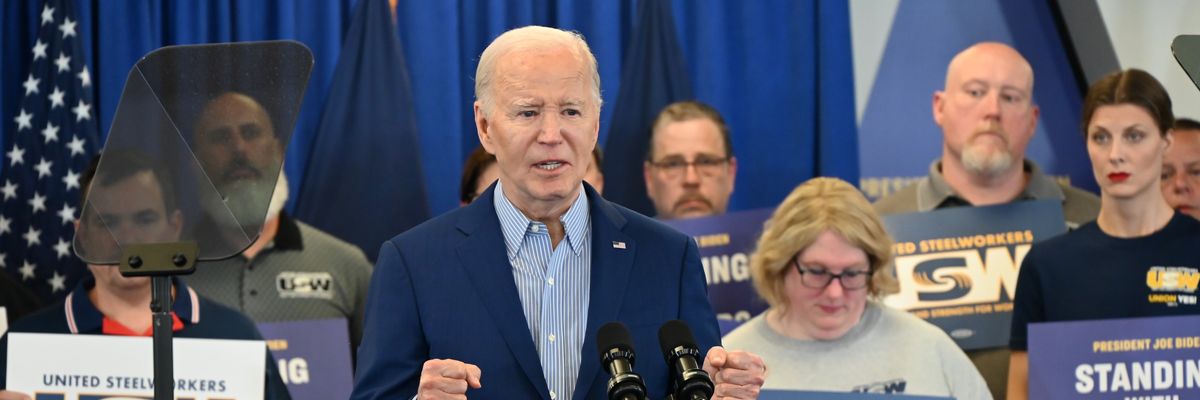
U.S. President Joe Biden speaks on proposing tariffs on Chinese steel at the United Steelworkers Headquarters in Pittsburgh, Pennsylvania on April 17, 2024.
(Photo: Kyle Mazza/Anadolu via Getty Images)


Eloise Goldsmith
Jan 03, 2025
COMMON DREAMS

The United Steelworkers union commended a decision by President Joe Biden, announced Friday, to block a proposed acquisition of U.S. Steel by the Japanese company Nippon Steel.

United Steelworkers International President David McCall said in a statement that the union is "grateful" to Biden for his "willingness to take bold action to maintain a strong domestic steel industry and for his lifelong commitment to American workers."

"We now call on U.S. Steel's board of directors to take the necessary steps to allow it to further flourish and remain profitable," he added.

McCall toldReuters in mid-December that Nippon Steel had not given him an assurance that the Japanese firm is committed to ensuring the lasting success of U.S. Steel. "When we've had discussions with them there's been nothing that would assure us that there's a long-term viability in the operations," McCall said in an interview with the outlet.

In December 2023, U.S. Steel—the Pittsburgh-headquartered company that played a key role in establishing U.S. industrial mightannounced that it had entered an agreement to be acquired by Nippon Steel for $14.9 billion. The deal drew scrutiny from lawmakers, federal regulators, and the United Steelworkers union, causing its closing to be delayed. Biden, who has made reviving "American-style" industrial policy a key part of his presidency, has long indicated his opposition to the deal.

Biden said he ultimately decided to block the proposed acquisition because he believes that "a strong domestically owned and operated steel industry represents an essential national security priority and is critical for resilient supply chains."

The Committee on Foreign Investment in the United States, a federal committee that has the power to review certain transactions involving foreign investment in the United States to evaluate a deal's impact on national security, decided to forgo making a formal recommendation about whether the deal should be allowed to proceed last week.

The proposal also became ensnared in election year politics, with both presidential candidates saying that U.S. Steel should remain a domestically-owned firm. Rust Belt lawmakers in both parties, including Sen. Bob Casey (D-Pa.) and Sen. Sherrod Brown (D-Ohio)—both of whom lost re-election in November—and Vice President-elect JD Vance, an Ohio Republican, expressed opposition to the deal.

Shortly after the deal was unveiled, multiple Pennsylvania Democrats, including Casey and Rep. Summer Lee, wrote to the president of Nippon Steel expressing concerns about the failure of the two firms to consult or notify the United Steelworkers union ahead of the announcement, according to Reuters.

"From the beginning, the workers who power this company should have had a seat at the negotiating table—their livelihoods hung in the balance. No matter what, I will keep fighting to protect Western PA Steelworker jobs and American steelmaking," wrote Representative Chris Deluzio (D-Pa.) on Friday.

U.S. Steel, for its part, has attempted to refute criticisms of the deal. David B. Burritt, the president and chief executive of U.S. Steel, penned an op-ed in The New York Times in December, arguing that blocking the deal would help China. "With this deal, our workers' jobs would be more secure, our customers would be better served and China's domination of global steel production would be weakened. Without it, we would become more vulnerable," he wrote.

"Nippon Steel and U.S. Steel are confident that our transaction would revitalize communities that rely on American steel," the two firms said in a joint statement Friday. They condemned Biden's decision as "unlawful" and said that the president's "statement and order do not present any credible evidence of a national security issue, making clear that this was a political decision."

"Following President Biden's decision, we are left with no choice but to take all appropriate action to protect our legal rights," they wrote.

This article was updated to include a statement from Nippon Steel and U.S. Steel.


Steelworkers union criticizes Nippon Steel’s proposal for lack of long-term commitment

Reuters | January 2, 2025 | 


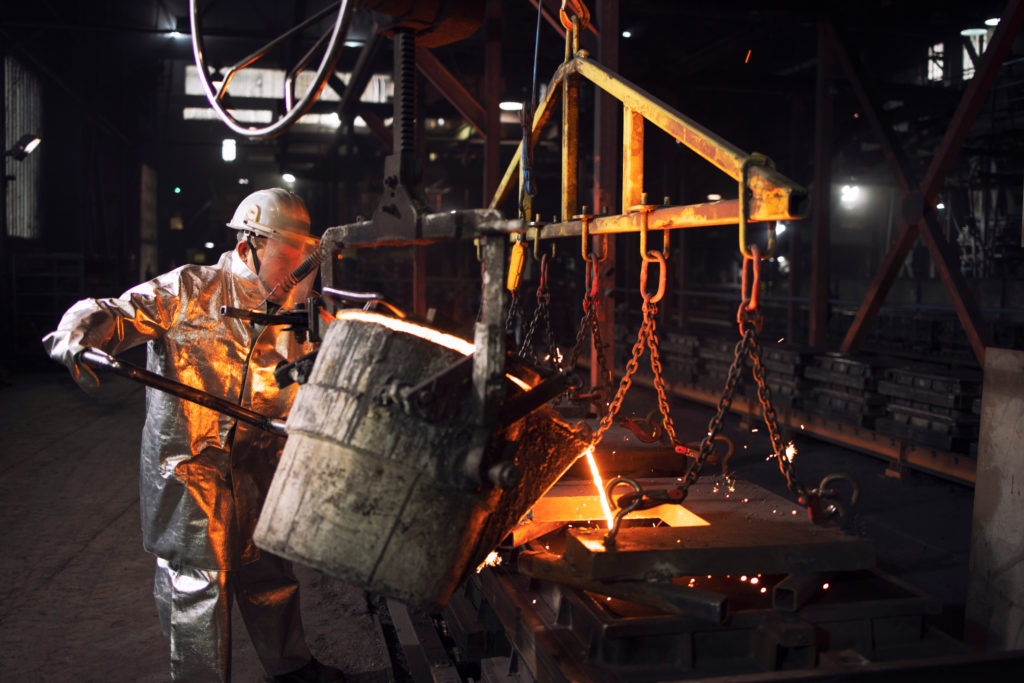
Production of steel castings. Stock image.

The United Steelworkers union expressed concerns about Nippon Steel’s latest proposal that gives the US government veto power over any potential reductions in US Steel’s production capacity, if they get the approval to merge.


The union, which has opposed US Steel’s merger with the Japanese steel giant, said Nippon’s offer fails to commit to sustaining production over the long term or enhancing domestic capacity in integrated facilities.

“Protecting capacity only means moth-balling our equipment, allowing it to rust away to the point that it is no longer feasible to re-start,” the union said in a statement on its website on Thursday.

The proposal “is nothing but a “Hail Mary” pass destined to fall to the ground,” it added.

On Tuesday, reports said Nippon Steel made a proposal to give the government a final say over any potential production cuts, as part of its efforts to secure President Joe Biden’s approval for acquiring the American steelmaker.

In 2023, Nippon clinched the deal to buy US Steel at a hefty premium, but the merger has since faced opposition from the powerful Steelworkers’ union as well as politicians.

“The truth remains that this transaction is the best way to ensure that US Steel, including its employees, communities, and customers, will thrive well into the future,” US Steel said on Thursday in response to the union’s statement.

The Committee on Foreign Investment in the United States (CFIUS) has referred the decision to approve or block the deal to Biden, who must decide on the deal by Jan. 7.

If he takes no action, it would result in the merger’s automatic approval.

Nippon Steel did not immediately respond to Reuters‘ request for comments.

(By Shivansh Tiwary and Anshuman Tripathy; Editing by Shinjini Ganguli)


WWIII

China's Large, Stealthy New Fighter Could Affect Power Balance in Pacific

J36
Via Chinese social media

Published Jan 5, 2025 2:10 PM by The Strategist


[By Bill Sweetman]

The speed, agility, range, and stealth of an individual aircraft type are still important, but they’re no longer the whole story of air combat. Advances in sensing, processing, and communications are changing military operations.

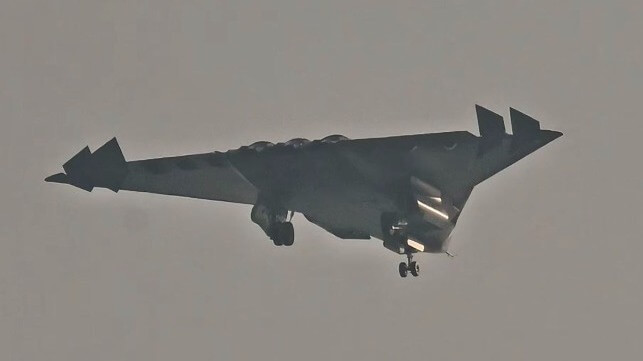
The Chengdu J-36, the big Chinese combat aircraft that first appeared on 26 December, has been developed to exploit these changes and support China’s strategic goal: establishing regional dominance, including the ability to annex Taiwan by force.

If J-36s can fly supersonically without using afterburning, as the prototype’s shape suggests they will, each will be able to get into and out of battle faster and more safely than conventional fighters and bombers, which cruise subsonically. A high degree of stealth will greatly help J-36s in penetrating defenses. Supersonic cruise would also mean each J-36 could fly more missions in a given period.

The design’s big main weapon bays are sized for considerable air-to-surface missiles, which J-36s could launch against such targets as airfields, aircraft carriers and air-defense batteries. With great speed and height, J-36s could also throw inexpensive glide bombs farther than other aircraft could.

The main weapon bays are big enough to carry unusually large air-to-air missiles for engaging aircraft at great ranges, including vital support units such as tankers and air surveillance radar planes. Targeting data for this might come from other aircraft, ships, satellites, or ground sources. The missiles might also be launched at fighters at ranges that keep J-36s safe from counterattack.

J-36s are themselves likely to be sources of targeting data for other aircraft and for ships, using large passive and active sensors that aircraft of such size can easily carry. They may command aircraft that fly with them. In all this, they’d use radio links that are hard for an enemy to detect.

To call the J-36 an airborne cruiser may not be far off the mark—and may call into question the West’s decision to prioritize the development and production of fighters that are, by comparison, mere torpedo boats.

For the Taiwan mission, China’s principal opposing force is US-led air power, comprising the US Air Force and the US Navy’s aircraft carriers, with support from Japan, Australia, Taiwan, and maybe South Korea and others. Air power from China’s opponents can hinder its maritime and amphibious operations, resulting in slower progress and higher casualties.

So, counter-air capability is crucial for China. This is what the US thinks of as China’s anti-access and area denial capability. It includes surface-to-air weapons, fighters, air-base attacks and the information realm.

To understand where the J-36 fits in, start by considering China’s current force, of which the Chengdu J-20 is the spearhead. The J-20 is fast and stealthy, with good range for a fighter, but its weapon bays are limited to short-range and medium-range air-to-air weapons. Like the F-35, it is more detectable outside its forward quadrant. That becomes a greater vulnerability in a networked environment, where a sensor platform on your beam may not be well placed to launch a weapon but will pass your track to one that is.

The long-range Xi’an H-6 bomber, used as a missile carrier, can launch attacks at air bases throughout the Western Pacific. But its effect is limited to the warheads of up to six costly missiles that must fly far enough to keep their vulnerable launch aircraft safe.

The J-36 combines speed and range with all-aspect stealth. Potential internal loads include such long-range air-to-air missiles as the PL-15, which the J-20 cannot carry internally. Heavier, air-to-surface missiles would be aimed at airfields and warships. It also probably supports the kind of mass-precision attacks made possible by accurate, more autonomous weapons, or—as autonomous technology advances—the carriage of loitering munitions and jammers.

The J-36’s smaller outboard weapon bays might accommodate defensive and support weapons, possibly on extending rails like the J-20’s side bays.

The large transparent side apertures in the forward fuselage could be wide-field-of-view passive warning and cueing systems. But there’s another possibility: if you wanted to integrate a high-energy anti-missile laser into an aircraft, with a hemisphere-plus field of fire but without unstealthy turrets, it might from the outside look like those transparencies. A single optical chain could feed left and right steerable heads under the conformal windows. Cue panic.

Speed is not just valuable for survivability, although it does erode missile engagement envelopes. Even Mach 1.8 supersonic cruise halves flight time and greatly increases sortie rate compared with a subsonic-cruise aircraft.

The US considered developing a supersonic strike aircraft in the early 2000s. But with 9/11 and the cost of the F-35 program, a high-speed project could not get funded. ‘Response time, and cost per target killed, were the two holy grails,’ a Northrop Grumman engineer commented in early 2001. The supersonic aircraft was big and complex, but the sortie generation rate was far higher than that of subsonic alternatives, and fewer aircraft were needed. And it could use cheap, unpowered glide weapons with a stand-off range estimated at 170km from a Mach 2 launch.

Speed on one side of a conflict is an important advantage. If the J-36 can penetrate to threaten bases in the second island chain, forcing the US to move B-21s, B-52s and other high-value assets further back, US strike sortie rate and effectiveness will diminish.

It’s important to keep in mind that the J-36 will be part of a family of systems and a network of capabilities. The appearance over the holiday season of the KJ-3000 airborne early warning and control system, based on the Xi’an Y-20 airlifter, is significant.

China has produced five different airborne radar systems since 2003, more than any other nation, all based on the technology of active electronically scanned arrays (AESAs). It has expanded their role beyond that of forward-passing adversary track data to fighter aircraft. AESA radars can update tracks much faster than a rotating-antenna radar, so these systems can provide guidance-quality midcourse updates to missiles.

Compared with the propeller-driven KJ-500, the KJ-3000 can be moved faster and farther forward to support an operation, and it can fly higher for greater sensor range. Working with a KJ-3000, the J-36s could launch missiles while remaining radar-silent.

If its speed and stealth allow it safely to get close to the enemy, a J-36 itself will be able to provide targeting data to other weapons, such as missiles launched by H-6s that prudently stay well behind it. It will also be the command and control hub for other aircraft, crewed and uncrewed. If it is a two-seater, the second crew member will likely be a force manager.

As for how to classify the J-36, too many people have rushed to call it a ‘sixth-generation fighter’.

The ‘fifth-generation’ term, invented in Russia, was picked up by Lockheed Martin as a marketing tool in the early 2000s. What Lockheed Martin would call 5-gen fighters combine supersonic speed and maneuverability with some degree of stealth. The Chengdu J-20 fighter is fifth-generation by that standard.

But this ‘generation’ taxonomy misleads more than it informs, because combat aircraft designs need not and do not fall into discrete sequential groups of characteristics.

And ‘fighter’, ‘bomber’ and ‘strike’ definitions are getting less clear. Most Boeing F-15s, nominally fighters, have been built as strike aircraft, and the fighter-derived Sukhoi Su-34 is another step down the same path. Designed against air and land threats, the J-36 is even larger than the Su-34. Its size and flight performance put it into its own category, for which there is no name. Maybe ‘airborne cruiser’ will catch on.

Bill Sweetman is a veteran, award-winning journalist and aerospace industry executive. This article appears courtesy of The Strategist and may be found in its original form here

The opinions expressed herein are the author's and not necessarily those of The Maritime Executive.

 

HM Coastguard Rescue Turns Out to be Real “Dummy”

dummy rescue
HM Coastguard posing with the rescued "dummy" (HM Coastguard Fleetwood)

Published Jan 3, 2025 4:30 PM by The Maritime Executive


Always at the ready, HM Coastguard turned out on New Year’s Eve for a rescue call, but after some tense moments realized it was a “dummy.” Having some fun with the callout, the team posed with the “rescued” subject and posted it online for a lighter moment.

HM Coastguard Fleetwood, covering a section of the Lancashire coast above Blackpool in the North West of England on the Irish Sea, got the callout at 1030 on December 31. It was a report of a person or “person-shaped object” drifting in the water off the coast.

When they arrived in the cove, the informant pointed out the object which was “suspiciously, person-shaped but clearly not a person,” reports HM Coastguard. “Upon closer inspection of a video taken by the informant, we immediately recognized it as the type of dummy used for man overboard drills by maritime organizations and training schools.”

The Coastguard admits, “from a distance, this made for a very concerning sight in the water.” Based on the sighting they said the informant “did absolutely the right thing” in calling it in for investigation.


HM Coastguard Fleetwood rescuing a "dummy"


“Since it was only in a couple of feet of surf, the officer in charge took the decision to send a rescuer into the water to perform a tethered rescue to prevent the dummy from causing more concern and confusion as it drifted up the shoreline,” report the Fleetwood team. “After we had safely recovered our casualty to the promenade and made sure they didn't require any further assistance, we handed them over to wyre council for disposal.”

Happy it was not a more difficult situation, the crews posed with the “dummy” and posted the pictures to social media.

 CRIMINAL CAPITALI$M

Hin Leong Fraud Scandal Winds to a Close With Bankruptcy Filing

Gavel
Public domain

Published Jan 2, 2025 8:57 PM by The Maritime Executive


Singaporean oil trader OK Lim, once a leading player in the city's busy bunker trading sector, has been declared bankrupt after consenting to a multibillion-dollar court judgment in favor of his former company's creditors. 

Lim and his children - Evan Lim Chee Meng and Lim Huey Ching - owe a combined $3.5 billion in connection with the collapse of Hin Leong Trading, the family's energy brokerage and shipping firm. Hin Leong operated at a loss for years, and to fill the gap, Lim had one of his executives create fake sales orders in order to apply for accounts receivable financing from his bankers. The fraudulent scheme collapsed in 2020 after a large trading bet went bad, and the firm quickly went bust. 

Hin Leong's bankers lost billions on the company's unsecured debt, making the scheme one of Singapore's biggest trade financing frauds ever. To recover their losses, the creditors took control of Hin Leong, and the firm's tanker fleet, its real estate and its other assets were sold off. OK Lim's family has faced a string of legal actions ever since. 

In September, Lim and his children agreed to pay a court judgment sought by Hin Leong's creditors, who wanted to hold the family responsible for the balance of the firm's unsecured debt. Without admitting fault, Lim consented to settle the matter for $3.5 billion, cutting short a civil trial before the beginning of testimony. However, the family admitted that they did not have resources to pay the total amount. They formally declared bankruptcy in late December, and their assets will now be managed by a trustee. 

OK Lim was also prosecuted on criminal charges for the Hin Leong fraud, and he received a stiff sentence. In May 2024, he was convicted of three counts of cheating and forgery (out of an initial indictment of 130 charges). Six months later, Judge Toh Han Li of Singapore’s State Courts sentenced Lim - who is 82 - to serve 17.5 years in prison. Lim is appealing the verdict, and will not serve any time until after the appeal process is completed. 

UANI Calls for New Enforceme Metods as Iran’s Oil Exports G

Iranian oil tanker
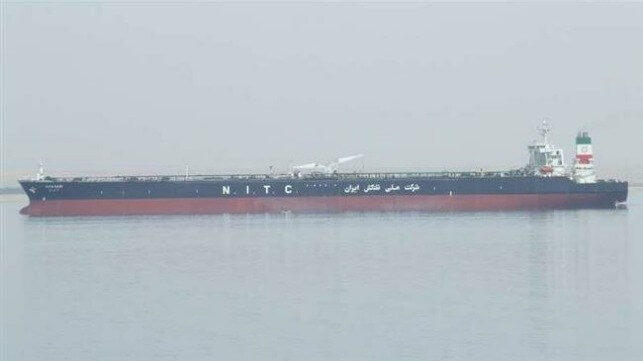
UANI says Iran is using more of its tankers from NITC to shift oil (state media)

Published Jan 3, 2025 1:21 PM by The Maritime Executive


The NGO United Against Nuclear Iran (UANI), which is at the forefront of tracking Iran’s dark tanker fleet and oil exports, is out with its year-end review citing continued dramatic growth in the dark tanker fleet supporting Iran’s oil exports. The group is calling for global cooperation and strategies that go beyond “traditional enforcement methods” in response to Iran’s ability to quickly adapt to the current sanctions and lax enforcement.

UANI details key trends and shifts in the sanction-busting oil exports in its final Tanker Tracker of 2024 while highlighting continued strong growth in the number of tankers involved in the illicit trade. The group says in November 2020 it identified 70 foreign tankers involved in the Iranian oil trade while saying it has now grown to 477 tankers. UANI says it identified 132 new vessels engaged in the trade in 2024.

The intelligence efforts they report led to 330 flag revocations as well as the U.S. designating 139 tankers in the sanctions regime. UANI says of the 139 tankers sanctioned this year, 110 were identified in its listing of the “ghost armada.” It says that 325 vessels however have yet to be designated.

Despite the efforts and in part due to lax enforcement, the group calculates that Iran’s oil exports grew by 10.75 percent to 587 million barrels. China remains the largest destination and has grown its percentage of the trade receiving 533 million barrels, which UANI highlights is up 24 percent from 2023. UANI says China accounts for 91 percent of Iran’s total oil exports up from 83 percent in 2023.

One major shift it observed is a greater reliance on Iran’s National Iranian Tanker Company (NITC) to transport the oil from Iran. In part because of the sanctions, the role of foreign-flagged vessels has shifted to ship-to-ship transfers. UANI is now calling for efforts to identify and sanction repeat offenders who have engaged in multiple transfers.

Another step UNAI calls for says that the “authorities should focus on holding captains accountable through targeted sanctions, fines, and potential legal action.” The group cites the captain’s role in sanction-avoiding techniques such as AIS manipulation, presenting false documents, and illicit ship-to-ship transfers.

They also call for a continued crackdown on “flag hopping” by tankers. They acknowledge “a notable increase in due diligence by certain flag states” in 2024. UANI noted the St. Kitts and Nevis International Ship Registry de-flagged all eight vessels identified by UANI. The group also noted a “good track record” from flag authorities including the Tanzania-Zanzibar International Register of Shipping, the Maritime Administration of Gabonese Republic, and the Tuvalu Ship Registry. UANI reports it will provide monthly updates and continue to make public its data in the Tanker Tracker while encouraging flag states to routinely check its list. 

According to the group, the Iranian regime has demonstrated the ability to adapt quickly to enforcement measures. They say the efforts must go beyond traditional methods such as satellite and AIS monitoring, blockchain-based trade verification, and “name and shame” campaigns. UANI says the response must be “equally dynamic” in 2025 to have an impact on the oil trade which keeps the current Iranian regime “financially afloat” and provides the means to support proxies such as Hezbollah and Hamas.


Algeria Plans to Revive Shipbuilding as Defense Industry Grows

Algerian patrol boat Djebel Chenoua (U.S. Navy file image)

Published Jan 5, 2025 4:45 PM by The Maritime Executive


Algeria’s shipbuilding industry is poised for a revamp with the government hoping to tap domestic shipyards for upcoming procurement deals. The Algerian Defense Ministry has previously revealed plans to build Chinese Type 056 corvettes at local shipyards.

In mid-2020, the Algerian Navy placed an order for six Type 056 corvettes with China’s Hudong Zhonghua Shipbuilding Group, a subsidiary of China State Shipbuilding Corporation (CSSC). Part of the contract included building some of the vessels at Algerian yards.

In 2023, the Algerian Navy took delivery of the first corvette, the El Moutassadi. Analysts believe that the two-year gap in delivering the other vessels is a deliberate strategy to transition production from Chinese to Algerian yards. The local production will happen under a license from China.

The new corvette class is designed for patrol, escort and maritime protection missions. They have a length of around 95.5 meters and a displacement of 1,500 tons. The corvettes have a crew capacity of 78 people and a range of 3,500 nautical miles.

In the past decade, Algeria has been trying to diversify its oil-driven economy, with expansion of sectors such as shipbuilding top on the agenda. Recently, Algerian Transport Minister Saïd Sayoud ordered a study on the feasibility of expanding shipbuilding facilities in the country. Algeria has significant potential for the development of its shipbuilding and ship repair industry, thanks to its location in the Mediterranean.  

Algeria is keen on expanding its defense industry, which includes empowering local production of naval platforms to reduce dependence on foreign yards. Algeria’s defense spending for 2025 surged to a record $25 billion, near the top of the charts in the Middle East and North Africa. Partly, the high defense bill is due to the changing security situation in the Sahel region as well as escalating border conflicts with the neighboring rival Morocco.

However, the key driver for the high defense budget is the ongoing modernization of the Algerian military. This includes fleet renewal for the country’s navy in response to increasing cases of smuggling, illegal migration in the Mediterranean and terrorism.


LA REVUE GAUCHE - Left Comment: Search results for PERMANENT ARMS ECONOMY


Equinor Secures $3B in Financing as Empire Wind 1 Moves Forward

offshore wind farm
Equinor is building momentum for New York's Empire Wind 1 project (file photo)

Published Jan 5, 2025 12:53 PM by The Maritime Executive


A project financing package was completed at the end of December to continue the momentum for the development of another of the early, large offshore wind farms off the Northern U.S. Coast. Equinor reports it secured more than $3 billion in project financing for Empire Wind 1 on competitive terms due to strong interest from lenders.

The Empire Wind 1 project, which will be located between 15 and 30 miles southeast of Long Island is already in the first stages of construction. It is expected to reach commercial operations in 2027.

“This is an important milestone for Equinor, in line with our plan to enhance value and reduce exposure in the Empire Wind 1 project. As we now enter full execution mode, we continue our efforts to increase robustness and value-creation in the project,” said Jens Økland, acting executive vice president for Renewables in Equinor.

The lease was awarded in 2017 to Equinor but in 2020 it was part of the company’s agreement with BP to develop a joint venture for offshore wind. The JV however was dissolved in 2024 with Equinor taking full ownership of Empire Wind with the company saying it was moving forward in what is expected to be a $5 billion investment. BP took ownership of the Beacon Wind lease and projects in the swap agreement.

While work is proceeding, Equinor however reports that it intends to take on a new partner for the project to further enhance value and reduce its risk. The company did not indicate where it stands in the search for a partner but in general private equity investors have shown strong interest in projects once they reach the development stage,

The plan for Empire Wind split the lease area into two projects with the first phase having a contracted capacity of 810 MW. A 25-year Purchase and Sale Agreement for the power from Empire 1 was struck in June 2024 with NYSERDA (New York State Energy Research and Development Authority). 

As part of the project, Empire Wind 1 is participating in the redevelopment of the South Brooklyn Marine Terminal to support the project. New York City is supporting the effort to develop the wind terminal which the company says will create more than 1,000 union jobs in the construction phase.

The second wind farm, Empire Wind 2, is in an early stage of planning and regulatory approval. It has a potential capacity of more than 1,200 MW.

In announcing the project financing, the company said the agreement maintains the momentum toward bringing a significant power source to the New York grid.


BOEM Calls for Input for Offshore Wind Energy Leasing in Guam

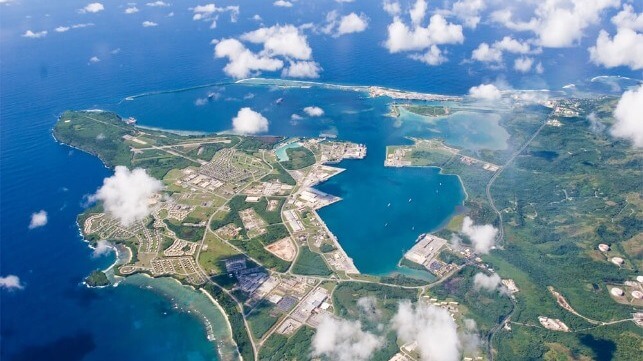
Guam Naval Base
Guam is the location of an important US naval base (USN photo)

Published Jan 3, 2025 5:26 PM by The Maritime Executive


In the final weeks of the Biden administration, the Department of Interior’s Bureau of Ocean Energy Management is still pushing forward with its development efforts for offshore wind energy. BOEM on Monday, January 6, will release a Call for Information and Nominations for possible wind energy leasing off the coast of Guam, a Pacific Island territory located approximately 6,000 miles to the west of California.

The call initiates a 90-day comment period which will run till April 7, 2025, and into the next Trump administration. It comes as the President-elect made his most recent criticism of wind energy. Yesterday, January 2, Trump wrote on his social media platform “The U.K. is making a very big mistake. Open up the North Sea. Get rid of Windmills!,” in response to news the UK government was extending a North Sea tax designed to accelerate the transition for the oil and gas industry to renewable energy. During the campaign, Trump promised to stop the “windmills.”


Call is broadly encompassing the areas around Guam (BOEM)


BOEM has been in discussions and hosting forums in Guam and elsewhere noting that the Inflation Reduction Act (IRA) of 2022 contained several provisions relevant to BOEM’s offshore energy program including expanding the efforts to Guam, Hawaii, and elsewhere. BOEM highlights it is facilitating the Biden-Harris Administration’s goal of deploying 30 gigawatts of offshore wind energy capacity by 2030, and 15 GW of floating offshore wind energy capacity by 2035.  

The Government of Guam and BOEM initiated the first planning step in the renewable energy authorization process by establishing an intergovernmental renewable energy task force at the request of the Honorable Lourdes “Lou” Aflague Leon Guerrero, the Governor of Guam since 2019. The task force had its last meeting in September 2024 and public engagement and environmental studies have been initiated.

The southernmost and largest island in the Mariana Islands, as well as the largest in Micronesia, Guam is just over 200 square miles. A U.S. territory since 1898 and the U.S. victory over Spain in the Spanish-American War, the island is home to a vital U.S. Navy base providing the U.S. a territory in Asia.

The call seeks to analyze potential use conflicts before designating specific wind energy areas. Using the input, BOEM would select the areas with the least impact and greatest potential/interest. One contagious area around the island that comprises approximately 2.1 million acres is included in the call. The area begins about three nautical miles from shore and encompasses water depths from approximately 350 to 2200 meters (approximately a quarter of a mile to 1.4 miles).

In addition to the input from public and government agencies, BOEM notes wind energy companies can use the call period to nominate specific areas they would like to see offered for leasing. 

The bureau notes if it receives commercial interest in wind leasing offshore Guam, the next step would be to identify WEAs for leasing consideration within the larger call area. BOEM would then conduct environmental reviews of the WEAs in consultation with appropriate federal agencies, the Government of Guam, and other key stakeholders. After completing its environmental reviews and consultations, BOEM may propose one or more competitive lease sales for areas within the WEAs.