Monday, March 31, 2025

The Failures of Occupy Prefigured the Successes of Trump

Will History Repeat Itself with the April 5 Protests?
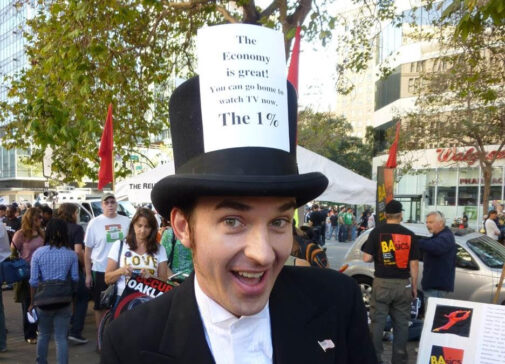

“The economy is great! You can go home to watch TV now. The 1%,” Oakland Occupy satire, November 2, 2011.

Like the proverbial spark that ignited a prairie fire, the Occupy movement that began on September 17, 2011, in New York City went viral. Rallying around the slogan, “We are the 99%,” the movement initially mobilized large numbers of what might be called the newly dispossessed. They were looking for remedies to a neoliberal order which was not working for them.

Elements of this same constituency of the dispossessed today are in the Trump camp in part due to the failure of the Democrats to embrace and address their issues. Trump, if there is any upside, presents an opportunity to organize against an increasingly exposed imperial/neoliberal order. Popular protests are called for on April 5. But will they speak to the causes and not just the symptoms, repeating the mistakes of the Occupy movement?

Occupy swept the nation

At its peak in fall 2011, hundreds of thousands participated in Occupy rallies, marches, and encampments across the US.

By early October 2011, Occupy reached the San Francisco Bay Area, where I participated. On October 5, a rally was held at the Federal Reserve Building in San Francisco. Just five days later, protesters demonstrated at Oscar Grant Plaza (so renamed by the protesters after a Black victim of police violence) in Oakland, soon to become an epicenter of militance.

As a handmade sign under the “official” tree of Oakland declared: “An oak tree is just a little nut that decided to hold its ground.”

By October 25, Iraq War veteran Scott Olsen was injured by police at a demonstration in Oakland, generating more publicity and support for the movement. A massive “general strike” on November 2 brought out tens of thousands and temporarily shut down the huge Port of Oakland.

The children’s brigade calls for a general strike, Oakland Occupy.

Baby boomer leftists, such as myself, were beside ourselves. It looked like the glory days of the anti-Vietnam War movement had returned. We had seen a temporary resurgence of anti-system sentiment eight years before with opposition to the Iraq War runup. Back then, on February 15, 2003, we had marched in the largest international anti-war demonstration in history.

When that supposed apostle of hope Barack Obama replaced George W. Bush, the latter’s secretary of war Robert Gates continued and so did the Iraq War. Overnight, the Democrats became the party of war, and the peace movement dissipated. But we’re getting ahead of the story.

Returning to the euphoria of the early Occupy Days, I went to rallies and chatted people up. What I discovered was that very few of the newly mobilized had ever been in an anti-Iraq War demonstration, let alone marched against the US military in Vietnam. This younger cohort did not even identify with the former protest movements. But they were angry.

These were folks who were under- or unemployed. Who had lost their homes, their jobs, or their health insurance. They had dependents they could not care for.

And they were resentful. The signs proliferated: “Banks get bailed out, we get sold out.” Or “Trickledown economics is a fancy way for to describe the rich pissing on the poor.” In short, “the system is not broken, it’s fixed.”

While the rich and privileged – the so-called 1% – were the main target of this upwelling of mass antipathy, other culprits were identified. In my mixing with the multitudes, I also heard another undercurrent. This was resentment of immigrants, expressed not only by middle-income Anglos but by people of color of lesser means, including immigrants themselves.

The genius of the Trump phenomenon is that it has been able to opportunistically scapegoat anti-immigrant resentment, thereby assuming the mantle of populism. At the same time, ironies of ironies, the reactionaries are represented by literally the 1% of the 1% in the form of Elon Musk.

Eclipse of Occupy

Failing to address the concerns of the dispossessed, Occupy faded into a historical footnote in less than one year. The anarchist-infused zeitgeist of Occupy was both its great strength and its ultimate fatal flaw. Horizontal decision-making and consensus-based assemblies were appealing and, initially, the participatory spaces filled.

The innovative call-and-response “mic-check” amplified voices where sound equipment was banned. However, “mic check” was fetishized. Slow and inefficient, it favored slogans over examination of complex subjects, leading to frustration. Confident speakers with loud voices were privileged. What was meant to be inclusive reinforced subtle exclusions.

In prefiguring the future, Occupy became untethered from the immediate needs of the present.

Living in a tent camp or even sitting on cold concrete through marathon meetings limited the participatory pool. Folks had jobs they had to go to and dependents to care for.

Most lethal of the deadly faults was avoidance of specific demands. The theory was that making demands of a corrupt system would legitimize that system. Prefiguring the future was counterposed to addressing immediate concerns.

The prevailing mistrust of reforms characterizing the Occupy movement lacked the strategic sophistication of, say, Lenin who explained: “We support every revolutionary movement against the existing order of things… we must work for reforms and use them to prepare for revolution.”

Occupy became plagued by a lack of strategic focus. This refusal to issue concrete demands alienated those dispossessed by the prevailing order who had concrete problems. People, especially those who had never protested before, got disillusioned and drifted away.

Yes, the coercive arm of the state also contributed to the demise of Occupy. But the violent clearance of the encampments, in my experience, came after the tide had ebbed.

The Black Bloc or Antifa (short for anti-fascist) elements, at least in Oakland, also contributed to the expiration of Occupy by driving away supporters who had no interest or ability to militarily skirmish with the police. Occupy’s shunning of designated leaders left the Antifa unaccountable even when the confrontations that they provoked were used as an excuse by the state to shut Occupy down.

Fighting Oligarchy and Hands Off initiatives

With its preoccupation with prefiguring the future, the fundamental failing of Occupy was its inability to address the immediate concerns of the working class. More recently, in the aftermath of the 2024 presidential election, Bernie Sanders gathered attention with a similar observation regarding his political affiliation: “It should come as no great surprise that a Democratic Party which has abandoned working class people would find that the working class has abandoned them.”

This discovery of the class loyalties of the Democrats is correct, though not exactly a revelation to many of us.

Sanders, accompanied by congressmember Alexandria Ocasio-Cortez, has been drawing larger crowds than his previous presidential campaigns on a Fighting Oligarchy tour. This is a positive indication of mass discontent with the slash and burn tactics of the present US administration.

Similar to the earlier Occupy movement, the Fighting Oligarchy tour opposes authoritarianism, in the present case, in the form of Trump. Their focus on the current occupant in the White House, however, suggests that a mere change of personnel is the solution to a far more systematic degeneration.

Like Occupy, they are short on advocating for hard-hitting specifics such as repeal of Taft Hartley, issues that would materially appeal to and benefit working people. Unlike Occupy, they are not in the least bit concerned about cooption. Quite the opposite for this pair, who the Black Agenda Report calls “sheepdogs” for the Democratic Party. Herding disaffected voters back into their party is their mission.

Sanders and Ocasio-Cortez, along with a broad mélange of anti-Trump interests, are organizing for nationwide “Hands Off” protests on April 5. Among the leading groups making the dump-Trump call are MoveOn, Indivisible, and the Working Families Party. These well-funded 501(c)(4) NGOs, while posing as grassroots, are appendages of the Democratic Party, albeit mostly with its “progressive” wing.

The explicitly anti-billionaire initiative accepts funds only from supposedly nice billionaires like George Soros and not nasty ones. An earlier anti-Trump initiative, Families Over Billionaires, also part of the present Hands Off coalition, also received substantial billionaire funding. Their ad hominem critiques of extreme wealth focus on the personal characteristics of the exploiters and not on the neoliberal system (the current form of capitalism) which produces great inequities.

While the Hands Off coalition primarily addresses domestic issues, key among the Democrats’ demands is full reinstatement of military aid to Ukraine. However, waving the Ukrainian flag while suppressing the Palestinian one is not exactly a winning formula for appealing to a polity that just gave the Republicans a trifecta of the White House and both chambers of congress on the (insincere) platform of ending endless wars.

With record low public approval ratings, the Democrats are also promoting restoring USAID regime-change programs. And when they dare murmur a critical comment about Israel, it is about the person of Netanyahu and not about the Zionist enterprise.

Reflecting genuine grassroots peace sentiment, an entirely different coalition will also be in Washington on April 5. The Palestinian Youth Movement, the ANSWER Coalition, Jewish Voice for Peace, and others will be demonstrating against genocide in Palestine and for a US arms embargo of Israel.

The time is ripe to regroup and reorganize a counter movement to the prevailing order. The signs paraded by the Occupy movement are ever relevant today: “Imperialist America is [still] humanity’s number one enemy.”

On the march to close the Port of Oakland.

Roger D. Harris was an international observer for Venezuela’s 2024 presidential election. He is with the US Peace Council and the Task Force on the AmericasRead other articles by Roger.

The Nazis Called It Gleichschaltung: Total Political and Cultural Control


Trump/Musk Have DOGE

Tom the Dancing Bug 1721 not nazis

Comparing any political system to Hitler’s Nazi regime is a tricky business and often overstated. One shouldn’t diminish the horrors of the Holocaust or overstate current political conditions. Nevertheless, the lessons gleaned from the Nazi’s Gleichschaltung project are worthy of consideration.

Gleichschaltung is the German word for bringing society into line with a specific political agenda. In the two-+ months since taking the White House, Donald Trump and his wingman Elon Musk’s moves are eerily reminiscent of Hitler’s Gleichschaltung, the process of serving Hitler’s goals by consolidating power and enforcing uniformity across all sectors of society. Trump and Musk are moving quickly to dismantle the federal government and bring whatever’s left of the public sector into alignment with their agenda.

According to the Holocaust Encyclopedia, “Once Hitler became chancellor, he and the Nazi Party sought to ‘coordinate’ all political, social, and cultural institutions with the Nazi state.” Think: Project 2025. “The ‘coordination’ was done in the name of national unity.” Think MAGA.  “Everything was subject to coordination: local government, professional organizations, social clubs, leisure activities – even those for children.”

“Hitler was surprised with the speed and ease of remaking Germany. He noted ‘everything is going much faster than we even dared to hope,’” Holocaust Encyclopedia pointed out.

How did the German people respond to Gleichschaltung?

In the forward to the 1966 edition of journalist Milton Mayer’s They Thought They Were Free: The Germans, 1933-1945, he wrote: “When this book was first published it received some attention from the critics but none at all from the public. Nazism was finished in the bunker in Berlin and its death warrant signed on the bench at Nuremberg.” Although the book was a finalist for the National Book Award in 1956, it took time for general readers to take notice.

Mayer investigated why regular Germans were so taken by Nazism.  How did they get to be Nazis? He spent a year in Germany.  He lived with, spoke with and hung out with 4 or 5 families, and discovered that for them, being a Nazi wasn’t so bad; they were doing better, the families were doing better, they were living pretty well. They didn’t buy into all the stories that they heard about Nazi-committed atrocities. They and their families were living better. And the intellectuals he spoke with explained it by saying: Well, they passed a law, and then another, and we thought they’d stop, and things became more anti-democratic, and surely, slowly, fascism became the coin of the realm.

In the Forward, Terrence Petty recently discussed Gleichschaltung, a Nazi term which he noted also means “bringing into line.”  This was how the Nazis established totalitarian control and coordination over all aspects of German society, including the economy and trade, the military and intelligence agencies, the media, culture and education.

In their work on National Socialist vernacular, Nazi-Deutsch/Nazi-German: An English Lexicon of the Language of the Third Reich, historian Robert Michael and Karin Doerr define Gleichshaltung as: “Consolidation. All of the German Volk’s [people] social, political, and cultural organizations to be controlled and run according to Nazi ideology and policy. All opposition to be eliminated.”

According to Terrence Petty, “Much of this process involved violence: the rounding up, beating and murder of perceived and real enemies of the regime. An essential component of Gleichshaltung was cleansing the civil service of all who were deemed to be insufficiently loyal to Hitler, accomplished with incredible efficiency and without mercy.”

Although here at home we have not yet seen beatings in the streets, we are seeing round-ups of migrants and the arrest of student activists. Each day brings another level of chaos, anxiety, firings of public workers, and accelerating threats from the Trump administration and Elon Musk’s DOGE.  Trump’s endless string of executive shock-and-awe orders is deliberately aimed at forcing workers to either accept offers to quit their jobs, or to try and wait it out while the courts decide their fate.

In addition to attacking the federal workforce, Trump has set his sites on the arts with the Kennedy Center coup, and the purge of leadership at America’s historical archives.

Petty, the author of the November 2024 book Nazis at the Watercooler: War Criminals in German Government Agencies, writes: “Are we, under Trump, at the beginnings of an American-style Gleichschaltung? There are certainly some echoes of those times.”

Petty underscores that “An important feature of Gleichschaltung in Nazi Germany was intimidation and fear. Trump’s opponents are not being threatened with being sent off to concentration camps. But there’s no denying that the threat of retaliation – or falling out of favor with Trump – has turned the spines of congressional Republicans into Jello. Those who don’t agree with him stay silent because otherwise Trump would make sure they are primaried. Some fear for their lives.” And some fear that any disagreements with Trump will initiate government investigations.

While some scholars and historians have previously plowed this ground, Petty is one of the first to recognize that the Gleichschaltung process has been initiated by Trump’s White House. The parallels between that historical process and the Trump administration’s actions to date highlight the fragility of democratic institutions when faced with concentrated efforts to centralize authority and suppress dissent. Can our understanding of history provide insight into how to counteract the forces of authoritarianism?  Unlike those families in Nazi Germany, can we as a people understand and act before it’s too late?

Bill Berkowitz is a longtime observer of the conservative movement. Read other articles by Bill.

 Mineral Deal Gives the US Total Control over Ukraine’s Future


Imagine if Russia or China had suggested a deal with this content and these intentions, depriving Ukraine of its sovereignty


This is posted on Sebastian Sas’ important YouTube Channel with no less than 120,000 subscribers. His succinct analysis is based on an article published by the NED, EU and NATO-supported Ukraine-based newspaper, European Pravda.

I hope you are half as shocked as Sas — and I — are. Because, remember that this war, this destruction of Ukraine has been caused by the Russia-NATO conflict — that is, by the Obama administration’s regime change in Kiev in 2014, the US-led NATO’s expansion and the US/Western pumping of arms into Ukraine.

Now, Ukraine is destined to be paying for generations ahead and give away its natural resources to an extent that makes it impossible to see it as a sovereign state in the future. The Trump Regime’s proposal is in colonial-slave style — also meant to undermine the European Union’s plans…

UPDATE (29 March 2025)
Zelensky REFUSES The Mineral Deal And BETS Everything On The EU
FacebookTwitter

Jan Oberg is a peace researcher, art photographer, and Director of The Transnational (TFF) where this article first appeared. Reach him at: oberg@transnational.orgRead other articles by Jan.


Is it Possible to Overcome the Demographic Crisis during the War?


by Yuri Mirovich / March 29th, 2025


As a result of three years of the war, Ukraine faced a massive demographic crisis. According to various estimates, mass migration, a high rate of premature mortality and a sharp decline in birth rates have led to a huge population decline from 41 to 30 million people. Over 2024 the number of the Ukrainians, who died, exceeded the amount of those, who were born, threefold. Experts from the Institute for Demography and Life Quality Problems of the National Academy of Sciences of Ukraine, has predicted that Ukraine’s population can decrease to 25 million people by 2050.

Realizing the complexity of the situation, the Ukrainian authorities are taking steps to improve the demographic indicators. At the end of the last year, the Cabinet of Ministers of Ukraine adopted the Demographic Development Strategy until 2040, aimed at creating comfortable conditions for Ukrainian families, providing affordable housing, high-quality public infrastructure, safe environment and inclusive labor market. Simultaneously, the Ministry of National Unity is trying to return the Ukrainians to their homeland. In addition, the government has included free assistance to families in infertility treatment into a number of medical support programs.

Despite all the declared measures, Kyiv will have to do a lot to overcome negative demographics tendencies. But the most important thing is that it is impossible to solve the issue of fertility and to increase life expectancy without stopping the war, the action the Ukrainian authorities are not ready to take under current circumstances in the conflict zone. The war is forcing more and more people to leave Ukraine and, above all, to take their children out of the country. And the prospect for returning refugees is becoming unclear due to the destructions, low level of security, ambiguity about the time the war will come to an end and its results for Ukraine.

Yuri Mirovich is a Ukrainian refugee. He has been living in the Netherlands since 2023 where he is a law student at the University of Groningen. While living in Ukraine, he was engaged in active public work and now I'm member of the Dutch political initiative De Beweging. Read other articles by Yuri.


Nemesis


The convulsions wracking the American body politic inescapably impact the nation’s foreign relations. For the United States today is in a condition that defies all conventional categories. Its leader(s) are abnormal, its government is abnormal, its conduct is abnormal – and, perhaps, its society itself is abnormal. Donald Trump is a malignant narcissist compounded by extreme megalomania; Elon Musk, his Co-President, is also a megalomanic neo-Fascist with Nazi affinities – a Hitler salute is a Hitler salute is a Hitler salute.1 Together, they have launched a no-holds-barred campaign to impose on the country an autocratic yoke that aims to control and dictate in accordance with their primitive dogmas and destructive impulses. Already, the United States’ Constitutional republic is badly wounded, its hallowed public institutions assaulted, its democratic political culture corrupted. Their restoration is highly improbable. An immediate consequence is to mutilate further America’s moral standing buried in the rubble of Gaza, to dissolve the last shreds of its soft power, to transform its vaunted image as “The City on a Hill” into a model of what you don’t want to become. Instead, Trump’s I & II have emboldened neoliberals worldwide to act as their instincts tell them: Bolsonaro in Brazil, Milei in Argentina, Modi in India, Erdogan in Turkiye and a host of other minor power wielders. In contrast, what nation’s responsible leadership wants to emulate the United States circa 2025?

Narcissist Praxis

A narcissist’s behavior is more compulsive than calculated.  It affirms three overriding needs: The first is to gather the power to control others and one’s environs. That serves a dual purpose: feeding the desire for adulation, and for ensuring that those persons cannot do anything to you that undermines the exalted sense of self. The second is to create situations, and to surround oneself with courtiers, where that sacred self is celebrated – a hunger that never is satiated. Third, to destroy whatever or whomever is felt to threaten or obstruct fulfillment of those drives: rivals, critics, the recalcitrant. These traits make permanent relationships extremely difficult since anybody can become prey were an action of theirs to pierce the multiple mental barriers in place to protect what is in essence a fragile core self. The same applies to fixed commitments. Therefore, a full-blown narcissistic can never be counted on to honor a pledge, to keep a promise or to abide by a treaty. Trump’s entire career is marked by deceit, lies, cheating and a skirting of the law confirms that judgment. He is totally untrustworthy.

The implication is that any party dealing with the Trump administration must be ultra cautious by insisting that any agreement is nailed down as concretely as possible. A large security deposit and valuable collateral are obligatory. Russian leaders are well aware of this given their experience of being deceived repeatedly by the U.S. and its partners since 1991. (Sergei Lavrov recently: “Words are not enough.”) Moreover, Putin himself gives every evidence of understanding the peculiar psychology of the man. The same can be said of China’s Xi. The governments most susceptible to falling victim to Trump’s ploys are those needy of external aide of one kind or another – thus, vulnerable to America’s pressure tactics. And, of course, any national leader who remains deluded about the man’s true nature. Trump’s predatory instincts are aroused by the weak and the craven – be it a Chuck Schumer at home or a Olaf Schulz abroad. The pleasure in debasing them is a fringe benefit of power. Moreover, he can be expected to apply his bullying to as many parties as catch his attention (the above noted apart).  There is no proportionality between the target’s intrinsic worth and how extreme the measure of coercion he is prepared to apply. A Chinese company at the Panama Canal – invasion. The potential riches of exploitable natural resources in Greenland – demand that long-time friend Denmark hand it over or risk economic sanctions. Canada’s insistence on maintaining its independence existence when turning its de facto interdependence with the U.S. into de jure integration would aggrandize America – tariffs and threat of outright import restrictions.  The criterion is not something objective; rather, it is whatever Trump feels will add to his grandiose visions or some irritating action that gets under his skin.

To understand these flights of fancy, we should note the abundance of evidence that Trump’s grip on reality is fragile. His mind resides in a virtual reality that shutters perceptions of actual reality. As has been said in another context, “his own grip on truth or falsity is so fluid, so subservient to his desires, that it matters little to him what is true and what is false; so he is able to act as if something is true if that serves his purposes best. Belief has become a creature of his will: he will treat an unfounded suspicion as if it were a Cartesian certainty. He has contempt for people who are candid and trusting, who can respect the truth.”2

What Trump craves are gratifications not constructive accomplishments that are tangible &/or enduring. It is a mistake to presume that Trump has thought out plans or strategies about anything. His behavior is dictated by the syncopation of his compulsions. Narcissists live their lives to the pulse of any inner beat: I need, I want, I need, I want. Empathy is foreign to narcissists. They have neither the capacity nor the inclination to relate to others except at a very superficial level.3

Trump harbors no clear conception of the America that he is transforming in tumult and disarray, no mental model of how that disassembled America is to be recast. The same holds for foreign affairs. To pose the question: what is his goal? How does he view the global ‘system’? Where do individual actions fit into a broad, long-term strategy? is to misunderstand Trump and what makes him tick. There are no answers because he is incapable both psychologically and intellectually of thinking along those lines. A couple of things can be said about what sort of environment best suits him. First, the two fixed points of reference are further exhalation of self, and expanding the tangible benefits that the United States derives from all its external relations. The former is unlimited; the latter is thought of in narrow, short-term ways. Trump doesn’t give a fig about the well-being of other countries (with the glaring exception of Israel) nor does he concern himself with how the impact on them of his deeds and misdeeds could redound to the disadvantage of the United States. Equally, there is no regard to the overall ordering of international affairs. He is neither a liberal believer in promoting multilateral world institutions to create a measure of stability and to perform certain basic system maintenance functions nor imperial in his designs. The latter doesn’t appeal to him since he abhors the thought of taking any sort of responsibility for others. Both approaches entail commitments that are utterly alien to him. His mercurial, impulsive modus operandi demands absolute freedom to act how, where and when he wants. A world in flux doesn’t faze him; indeed, that is an environment rich in opportunities for buccaneering. In that respect, Trump has more in common with Captain Kidd or Clive of India than he does with Bismarck. Grab what you can – whatever the commodity, e.g. mineral rights.

 Russia and Ukraine

How doesn’t Trump’s surprisingly warm embrace of Vladimir Putin along with expressions of support for Russia’s interpretation of the Ukraine crisis reconcile with the portrait of the man sketched above? Some suggest it reflects a statesmanlike side to him that otherwise is not visible. Others opine that Putin has found ways to beguile him. Are these conjectures credible? I think not. Let’s bear in mind that Trump has always been attracted to strong men who exercise power forcefully. Engaging with them mano y mano exalts his own sense of exceptional prowess.

Deep down, Trump is an insecure person who requires a) adulation and b) constant demonstrations of his potency. The latter is expressed in his characteristic style of bullying, disparagement of others, and the relishing of contrived ‘wins.’ Putin, he instinctively realizes, is superior to him – in all respects: intelligence, range of knowledge, erudition, articulateness, political skills, diplomatic skills. Dealing on an equal basis with such a man massages Trump’s inflated ego. The content of the practical dealings is less important than the engagement. Trump need not emerge from these dealings as a ‘winner,’ but he could not tolerate being seen as the ‘loser.’ Hence, Putin faces the delicate challenge at once of avoiding concessions designed to flatter and protect Trump’s self-image while not conceding anything of consequence re. Russian interests. He seems aware of this; hence, his emollient manner in addressing Trump. The crunch will come on Ukraine.

Trump has made a sudden commitment to the termination of the open-ended Ukraine project of exploiting that benighted country as a weapon for subordinating Russia. He recognizes – more by instinct than rigorous analysis – that it is a catastrophic failure, and that reversion from it is called for. Let us bear in mind, though, that the campaign that was launched by Barack Obama in 2014 was deepened by Trump I who generously armed the Ukrainian military, and built up the powerful army that was poised to invade the breakaway Russophile oblasts of the Donbass, following a plan drafted by the Pentagon. Only nine months after he left office it was activated by Joe Biden. At that time, Trump shared an overwhelming consensus by the country’s political class that taking on Russia in the Ukraine served major American national interests. Several of Trump’s appointees have been vocal promoters of the campaign.

Trump is anything but a natural conciliator and humanitarian – as evinced by his mad design for extirpating the Palestinians, his bullying of every country friend or foe in sight, and his confrontational approach toward China. The expediency of calming relations with Russia has much to do with the girding of loins for the priority given aggressive campaigns in the Middle East and East Asia rather than earnest concern for European peace. Trump came to see Ukraine as a financial investment that went sour. So, you blame your agents for the failure and grab whatever tangible assets are lying around. He never will admit that our aid, in fact, was spent to make possible the spilling of Ukrainian blood for American purposes. Mea Culpa is not in his vocabulary

The sobering truth is that Trump’s overriding desire is to be in the limelight, to be praised, to be seen as a winner. So, being hailed as the Great Peacemaker (Ukraine) would be as gratifying as being acclaimed as the Great War Leader (Iran). Fame is fungible for him.

At the more practical level, the White House notion as to what should be the basis for an agreement with Russia bears no relation to the realities on the ground or to the Kremlin’s oft-repeated statement of its unnegotiable core objectives. Trump will not be happy with terms, however dressed up, that constitute a clear humiliation of the U.S. Ignorance, and fantasy, attaches to the proposal of a ceasefire which makes zero sense from a Moscow perspective. Simply put, the White House has no viable plan to bring peace to Ukraine, much less a conception for a redesigned pan-European security system as viewed by Russia as the sine qua non for continental peace and stability. So, when the White House and the Kremlin get down to talking about concrete issues, and the wider question of reconstructing European security institutions, real comity will be illusory. At present, the two parties have conceptions of the outcome that are incompatible.  How will Trump react when his simplistic ideas for ending the war prove to be fanciful? Find a scapegoat – Biden, Zelensky, the Europeans? Concoct another fictional narrative eagerly spread by credulous mass media? (This second in combination with the first?) Create a noisy distraction (attack Iran, rename the Washington Monument the TRUMP MONUMENT)?

[Trump’s publicly expressed views sympathetic to Russia on the Ukraine also may have something to do with electoral considerations. In 2016, Trump gained advantage from denouncing the Democrats’ forever wars, e.g. Afghanistan. Outflanking Hillary on that (and her alleged being soft on Wall St) may have made the difference. Perhaps, he or his advisers had the notion that they could siphon off some disaffected Democratic voters by substituting Ukraine for Afghanistan. Once having committed himself this way, Trump as President could not easily reverse course on a dime – and for the reasons cited above, was comfortable pursuing a deal with Putin.]

In the total absence of any sort of superego or any firm convictions, the only constant in Trump’s makeup is respect for the raw power of another party who has the demonstrated will to use it. The odd coupling with Elon Musk is further indication of that disposition. Equally, there is a long record of Trump either keeping his distance from anybody who seriously can hurt him or treating them with circumspection. That is a partial explanation for his accommodating attitude toward Putin. Does the same hold for China and Xi? There, Trump equivocates. He sees in a China a rival to American paramountcy – as does the near entire American foreign policy community. He accuses its of mistreating the United States, especially on trade and commercial matters generally. He has taken several audacious steps against it – going back to the Trump I administration.  Yet, at the same time he occasionally conjures a vision of a modus vivendi grounded on a newly equilibriated relationship which is weighed in favor if the United States. In addition, he respects Xi as the type of strong, forceful leader he admires. So, we might expect a confrontational stance in the economic sphere, but a reluctance to raise further tensions over Taiwan. Trump is hyperaggressive; he also is a coward who deep down is afraid of getting bloodied. Consider his reaction when, in the debate with Kamala Harris, he had all of his sordid record and actions thrown in his face. Trump sulked and then immediately cancelled subsequent bouts.  Hence, this is not a man who hankers for a test of arms with a powerful opponent – nor a warmonger. Most likely, we will witness much pawing of the earth, but no charge.

The same cowardness militates against his starting a war with Iran. Despite all the blustering threats of recent weeks, Trump suddenly tweets that an understanding with Tehran about its nuclear program just might be in the cards. A changeability that stems from a readiness to contradict himself as if turning on a dime as well as his deep fear of actually getting into a dangerous brawl with someone who hits back (as none of his domestic opponents/rivals/victims do).

Trump’s penchant for treating directly with strong leaders of strong states – Putin, Xi, Modi – has led some analysts to wonder whether that could be the basis for a strategy of fostering a concert among them. That could be seen as encompassing an informal set of understandings on rules of the road and convergent interests in promoting stability through a collaborative superintending of world affairs. A version of the imagined concert that allows for hard bargaining and a good measure of rivalry for the arrangement to conform to Trump’s aberrant temperament and behavior. That, though, would reduce its effectiveness and jeopardize its stability.   So, an intriguing idea – but unrealistic on a number of counts.   One, the Trump national security team lack the diplomatic skills and aptitude to launch such a sophisticated, multifaceted project and to nurture it over the years required to bring it to fruition. Two, other leaders are unlikely to place the requisite trust in an erratic, obsessive and narcissistic a person as Trump. Three, in light of the United States’ commitment to keeping an outsized role in managing the world’s affairs, there are certain to arise points of friction that will erode the underlying consensus and goodwill critical for the concert to work.

ENDNOTES:

  • 1
    Last week, Musk’s daughter affirmed in a public statement that her father indeed was making the Nazi salute. Just a few weeks earlier, Steve Bannon – who did more than anybody else to get Trump elected in 2016 – too gave the Nazi salute from the dais of an international gathering of far-Right movements. Swastikas and other Nazi symbols are prevalent at MAGA rallies; Trump himself tacitly has given his benediction to neo-Nazi outfits like Proud Boys and Neo-Aryans.
  • 2
    Shakespeare, Othello.
  • 3
    A narcissist like Trump seeks to animate others with his demented energy, grandiose plans, and megalomaniacal projects. An adrenaline junkie, his world is a whirlwind of comings and goings, reunions and divorces. A narcissist is like a child in his frenetic restlessness. It is a form of ‘primitivization,’ as Eric Hoffer has called it. “By plunging into ceaseless action and hustling,” the person never matures. “People in a hurry can neither grow nor decay; they are preserved in a state of perpetual puerility.”
    The narcissist is the self-appointed gatekeeper to reality; deciding what is, what happened, what did not happen, how it happened, whether important or not, who is who. What counts most is how it is recorded. The tree that falls in the forest with no one around surely makes a sound, but that event has little meaning unless I; am there to register it. In fact, my being there is the main news.
Michael Brenner is Professor Emeritus of International Affairs at the University of Pittsburgh and a Fellow of the Center for Transatlantic Relations at SAIS/Johns Hopkins. He was the Director of the International Relations & Global Studies Program at the University of Texas. Brenner is the author of numerous books, and over 80 articles and published papers. His most recent works are: Democracy Promotion and IslamFear and Dread In The Middle EastToward A More Independent Europe Narcissistic Public Personalities & Our TimesRead other articles by Michael.


The Real Outrage in Yemen


As Democrats decry the Trump Administration’s national security lapse, the United States is engaged in an actual killing campaign


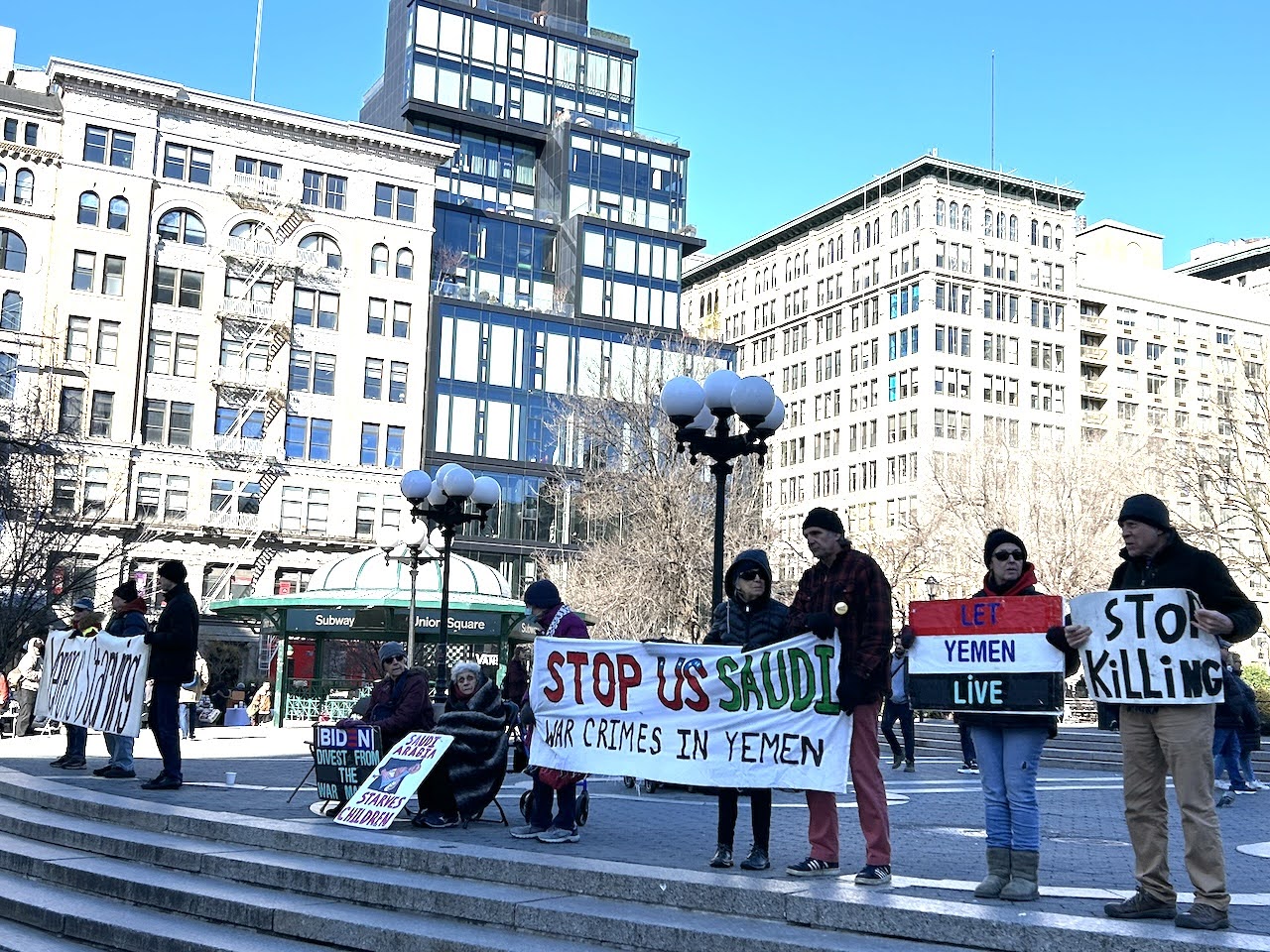
Members of the Fifteenth Street Meeting of Friends and the New York Catholic Worker gather for a weekly vigil against the bombing of Yemen in New York City on February 3, 2024

Since March 15, the United States has launched strikes on more than forty locations across Yemen in an ongoing attack against members of the Houthi movement, which has carried out more than 100 attacks on shipping vessels linked to Israel and its allies since October 2023. The Houthis say they are acting in solidarity with Palestinians in Gaza and have recently resumed the campaign following the failed ceasefire between Israel and Hamas.

The new round of U.S. airstrikes has damaged critical ports and roads which UNICEF describes as “lifelines for food and medicine,” and killed at least twenty-five civilians, including four children, in the first week alone. Of the thirty-eight recorded strikes, twenty-one hit non-military, civilian targets, including a medical storage facility, a medical center, a school, a wedding hall, residential areas, a cotton gin facility, a health office, Bedouin tents, and Al Eiman University. The Houthis claim that at least fifty-seven people have died in total.

Earlier this week, it was revealed that Defense Secretary Pete Hegseth, Vice President J.D. Vance, and other high-level Trump Administration officials had discussed real-time planning around these strikes in a group chat on Signal, a commercial messaging app. During the past week, Congressional Democrats including U.S. Senator Schumer and U.S. Representative Hakeem Jeffries expressed outrage over the Trump Administration’s recklessness, with Jeffries saying that what has happened “shocks the conscience.”

President Trump commented that there was “no harm done” in the administration’s use of Signal chats, “because the attack was unbelievably successful.” But the Democrats appear more shocked and outraged by the disclosure of highly secret war plans over Signal than by the actual nature of the attacks, which have killed innocent people, including children.

In fact, U.S. elected officials have seldom commented on the agony Yemen’s children endure as they face starvation and disease. Nor has there been discussion of the inherent illegality of the United States’s bombing campaign against an impoverished country in defense of Israel amid its genocide of Palestinians.

As commentator Mohamad Bazzi writes in The Guardian, “Anyone interested in real accountability for U.S. policy-making should see this as a far bigger scandal than the one currently unfolding in Washington over the leaked Signal chat.”

*****
On Saturday, March 29, participants in the Yemen vigil will distribute flyers with the headline “Yemen in the Crosshairs” that warn of an alarming buildup of U.S. Air Force B2 Spirit stealth bombers landing at the U.S. base on Diego Garcia, a tiny island in the Indian Ocean. According to the publication Army Recognition, two aircraft have already landed at Diego Garcia, and two others are currently en route, in a move that may indicate further strikes against Yemen. The B2 Spirit bombers are “uniquely capable of carrying the Massive Ordnance Penetrator (MOP), a 30,000-pound bomb designed to destroy hardened and deeply buried targets …. This unusual movement of stealth bombers may indicate preparations for potential strikes against Houthi targets in Yemen or serve as a deterrent message to Iran.”

The Yemen vigil flyer points out that multiple Massive Ordnance Penetrator bombs can use their GPS precision guidance system to “layer in” multiple warheads on a precise location, with each “digging” more deeply than the one before it to achieve deeper penetration. “This is considered particularly critical to achieving U.S. and broader Western Bloc objectives of neutralizing the Ansarullah Coalition’s military strength,” reports Military Watch Magazine, “as key Yemeni military and industrial targets are fortified deeply underground.”

Despite the efforts of peace activists across the country, a child in Yemen dies every ten minutes from preventable causes—and the Democratic Representatives in the Senate and the House from New York don’t seem to care.

  • A version of this article first appeared on The Progressive.
  • Kathy Kelly (kathy.vcnv@gmail.com) is the board president of World BEYOND War (worldbeyondwar.org) and a co-coordinator of the Merchants of Death War Crimes Tribunal. (merchantsofdeath.org). Read other articles by Kathy.