Monday, March 31, 2025

The Only Minority Destroying This Country Are Billionaires, Bernie. Not Migrants.


 March 31, 2025
Facebook

Banner and inline images: public domain.

Terminus, the Roman god of borders and boundary stones, had a motto: I Yield to No One. In the old days, lambs and piglets died in blood sacrifices for Terminus. Today, nations sacrifice human lives in homage to their borderlines.

The most recent sacrifices include the due process rights of 200+ Venezuelans, sent to a sprawling pit in El Salvador from which nobody gets out alive, where warehoused human beings eat with their hands and sleep under lights, on bare metal racks. Meanwhile, Trump walks free, touting meme coins and flying to golf outings.

And then comes Bernie.

Asked on ABC’s This Week whether Trump has done anything well, Bernie Sanders says yeah, making sure our borders are stronger.

Nobody thinks illegal immigration is appropriate, Bernie insists.

Terminus would be delighted. So would the Wall Street billionaires who are keen to sustain the profit potential in Bernie’s outlook.

Whose Side Are You On?

We say something nice about your policies, Bernie, and then, for all your anti-capitalist fire and brimstone, you remind us. At the end of the day you make your diligent contributions from a place of privilege. As Jonathan Cohn put the point:

“There is absolutely zero need for anybody to praise Donald Trump for “making sure our borders are stronger.” That is whitewashing what he is doing and reinforcing the anti-immigrant sentiment that Trump has always capitalized on.”

It also helps reinforce the development of authoritarianism in El Salvador.

But Bernie’s only gripe with Trump’s border actions involves the sheer numbers slated for deportation.

Shooing away 20 million undocumented people, Bernie told ABC’s Jonathan Karl, will destroy the United States. Not because it will ruin our social fabric or the potential of 20 million lives, but because who else will work in meat packing houses and pick crops in California?

Bernie, why do they work these jobs? U.S. economic politics don’t just enrich the billionaires here. They also oppress working classes to our south. Let’s not reduce people to the jobs they take when deprived of their freedom of choice. Let’s not suggest that the fields and the killing floors are the appropriate places for people who migrate from south to north.

An Airtight Cage

Back in the 1960s, MLK called out the people who “take necessities from the many to give luxuries to the few and leave millions of God’s children smothering in an airtight cage of poverty in the midst of an affluent society.” The smothering MLK pointed out hasn’t ended. And, increasingly, an airtight cage of poverty is also being sealed at the national border.

For the past six decades, global heating has weakened crop production in equatorial latitudes. Nothing, Bernie, can stop the movement of people whose children are hungry. Our compromised climate has displaced military violence as the key cause for human migration.

If we’d attempt to evolve as an ethical—and sustainable—humanity, we must think critically about nations and borders, Bernie, and the way they exemplify the airtight cage. The true leader is not the one focused on punishing the desperate. It’s the one who dismantles what’s causing desperation. Here, we can begin by dislodging the settler-colonial conception of the Americas from our platforms. Listen to the migrant’s rejoinder: The border crossed us.

Lee Hall holds an LL.M. in environmental law with a focus on climate change, and has taught law as an adjunct at Rutgers–Newark and at Widener–Delaware Law. Lee is an author, public speaker, and creator of the Studio for the Art of Animal Liberation on Patreon.

Shirley DuBois and Scholars of Color Resistance Efforts Parallel 2025 Visa Struggles


 March 31, 2025

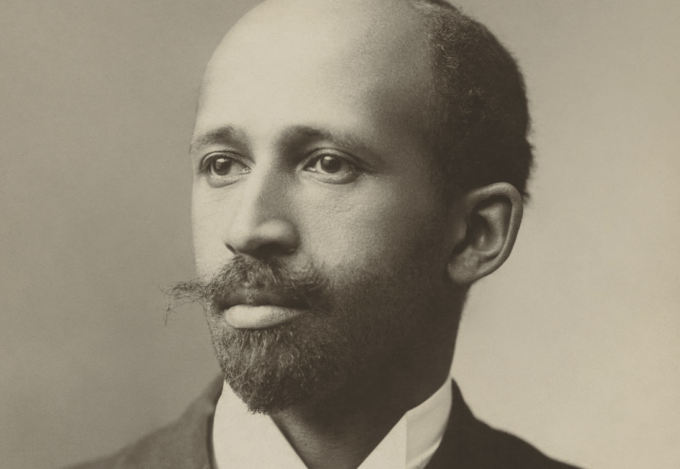
W.E.B. Du Bois, Wikipedia.

March 27, 2025, marked 48 years since the death of Shirley Graham DuBois, the prominent African American writer, scholar, and social activist. She was the widow of the prolific academic W.E.B. Du Bois. As her legacy as an advocate for racial equality, Pan-Africanism, and social justice continues, it’s important to reflect on her substantial role in the shaping of the political landscape, particularly her resisting the United States Justice Department, who on May 5, 1970 denied her entry into the country citing the McCarran-Walter Act. This history provides an antecedent to the modern-day and current struggles associated with the U.S. visa system, especially when it involves politically marginalized people involved in contentious politics.

DuBois, a brilliant playwright and artist, was active in the international struggle for racial equality. After the death of her husband in 1963, she continued to “loudly challenge anticommunism” and argued for African liberation and joined in the fight against colonialism and imperialism. She founded the journal Freedomways as its first general editor and was particularly vocal about the detriments of American foreign policy, along with the mistreatment of black people. Having lived in Ghana from 1961-1966, she became a globally prominent figure and campaigned for Pan-Africanism and spoke out against neo-colonialism and US foreign interventions, particularly in both Vietnam and Africa.

Shirley DuBois’s history intersects with the broader political climate of the 1960s and 70s when the U.S. government became increasingly concerned with dissent and anti-imperialist movements and activities. In 1970, after spending several years in Africa, DuBois sought to return to the United States after receiving an invitation to visit Fisk University in Nashville, Tennessee as noted by historian Gerald Horne in Race Woman. The United States Justice Department overruled the State Department and denied her entry however, citing concerns over her political beliefs, particularly her anti-imperialist work and her condemnations of state violence and war. The department had long considered both her and her husband as having “associations with numerous subversive organizations.” Her experiences were similar to one Gisela Mandel, wife of the Belgian Marxist economist Ernest Mandel, who was denied permission to enter the United States to speak at an antiwar rally at Columbia University on April 11, 1970. All of this mostly coincided alongside the political persecution of a very young 27-year-old reporter from the Black Dwarf by the name of Tariq Ali.

The U.S. establishment viewed DuBois as a threat due to her public associations with radical political ideas, including her admiration for socialism, communism, and larger decolonization movements. The U.S. government’s actions were part of a wider strategy during the Cold War to suppress voices critical of U.S. foreign policy, especially resistance linked to left-wing ideologies. Long before 1970, the DuBois tandem “faced the worst of the [FBI’s] Cold War strictures.”

In his earlier years of journalism, Abdeen Jabara of the Intercontinental Press reported on Shirley DuBois winning her visa fight as did C. Gerald Fraser of the New York Times on August 16, 1970. C. Eric Lincoln, President of the Board of the Black Academy of Arts and Letters, explained how the Immigration and Naturalization Service had announced its reversal of refusing Shirley DuBois a visa. He wrote, “in light of the reason for which Mrs. DuBois now wishes to visit the United States, this service has concurred in the recommendation of the Department of State.” The reversal was the result of a large public outcry and organized resistance within the Black community to the Justice Department’s initial overruling.

National security concerns have historically been used to justify the denial or revocation of visas for scholars such as Shirley DuBois, a practice that continues today. Fast forward to 2025, where similar patterns of revocations and crackdowns continue to affect those who challenge (or don’t even challenge) U.S. foreign or domestic policies. The collection of visas (Secretary of State Marco Rubio has confirmed over 300 revoked visas) and their restrictions as a political weapon remains prevalent, crucially for individuals with dissenting views. Much like Shirley DuBois’s historical experience, individuals with controversial or politically sensitive views or statuses face heightened scrutiny — which may jeopardize their ability to enter or remain in America. For instance, activists critical of U.S. military actions in the Middle East, Africa, or Latin America, or those who oppose Israeli occupation, may find themselves subjected to detainment and deportations.

Mahmoud Khalil, the permanent resident green-card holder and Columbia University graduate student that was arrested after participating in pro-Palestinian protests highlights this ongoing issue. Another example is the case of Rasha Alawieh, a Lebanese professor and doctor from Brown University who was deported due to her alleged “sympathetic photos and videos” associating her with Hezbollah. While no charges were filed against Alawieh, her political influences and interests were enough to justify her deportation under the pretext of “national security.” Just as Civil Rights organizations rallied around Shirley DuBois, Alawieh received support from The Council on American Islamic Relations (CAIR) who indicated that:

Deporting lawful immigrants like Dr. Alawieh without any basis undermines the rule of law and reinforces suspicion that our immigration system is turning into an anti-Muslim, white supremacist institution that seeks to expel and turn away as many Muslims and people of color as possible.

Further, people involved in peacemaking or direct action find themselves under scrutiny in part because of their statuses as scholars and writers. Scholars who write critically about U.S. imperialism, capitalism, or military actions are more subject to visa revocations or denials. A recent example of this includes Badar Khan Suri, an Indian postdoctoral fellow whose visa was revoked under laws that allow deportations based on perceived foreign policy threats. And again, like DuBois and Mandel in the past, Suri’s scholarship and political views (a scholar of religion and peace!) placed him at odds with the U.S. government interests, leading to his own student visa complications. Another activist, a Tufts and Turkish National doctoral student named Rumeysa Ozturk urged her school to divest itself from corporate ties to Israel amidst a genocide and the result was her enforced disappearance.

New York Magazine just reported how Camila Muñoz, a Peruvian immigrant with a pending green card application, was detained despite her application being processed. She recently married an American Trump voter who regrettably still does not rethink his voting preference. Tourists and immigrants from Germany, Canada, and France as well have also experienced aggressive tactics at ports of entryYenseo Chung, a Columbia student not at all prominent in organized demonstrations, was targeted for merely participating in a protest at Barnard College. Although the strategy of the Trump Administration thus far has been to target elite schools thus divorcing them from the public good, support for the vulnerable remains vital and their interests should not be dismissed as mere reflections of “bourgeoise freedom and democracy.” (And as Ralph Milbrand warned against categorizing).

In short, Shirley DuBois’s fight against U.S. visa denial in 1970 was not only a personal battle but also a reflection of the broader tradition of Political Repression in Modern America. Whether through anti-imperialist activism, critiques of U.S. policies, or associations with controversial people and movements, individuals like DuBois and those facing visa issues in 2025 are trapped in a system that uses immigration controls to criminalize dissent to maintain what’s perceived as political stability.

In the ongoing struggle for maintaining freedom of expression, the stories of DuBois, Mandel, and modern-day activists, highlight the need for continued attention in defending the rights of marginalized individuals who will speak out against human rights abuses regardless of the political climate.

Daniel Falcone is a historian specializing in the revolutions of 1848 and the political refugees who sought asylum in New York City. His academic work focuses on Giuseppe Garibaldi’s influence on New York’s local history and the politics of memory in the nineteenth and twentieth centuries. Aside from his research, he is a teacher and journalist whose work has appeared in additional publications such as The Journal of Contemporary Iraq & the Arab WorldThe NationJacobin, and Truthout. His journalistic pieces intersect history with modern-day geopolitical issues.

The Real Outrage in Yemen


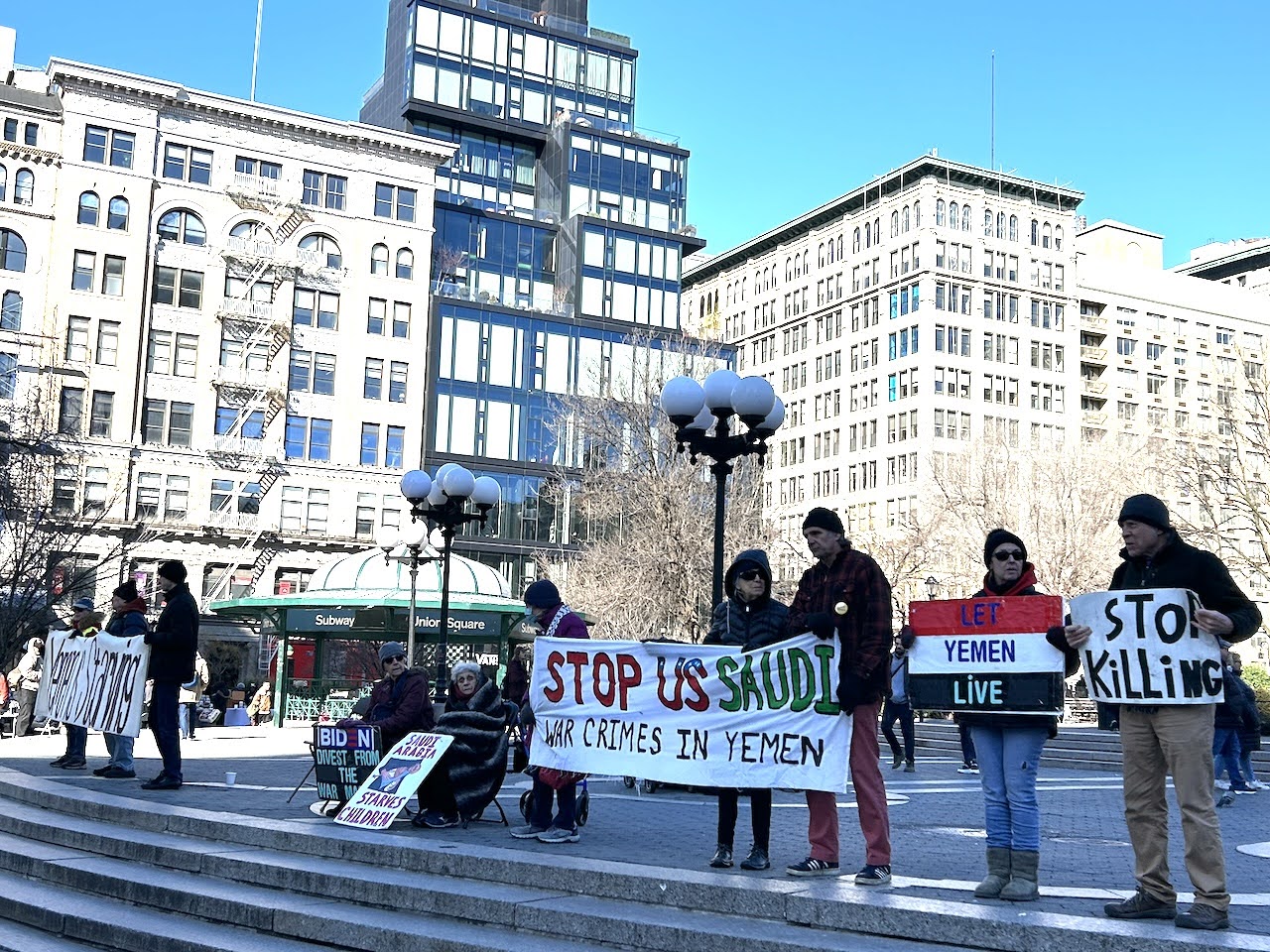
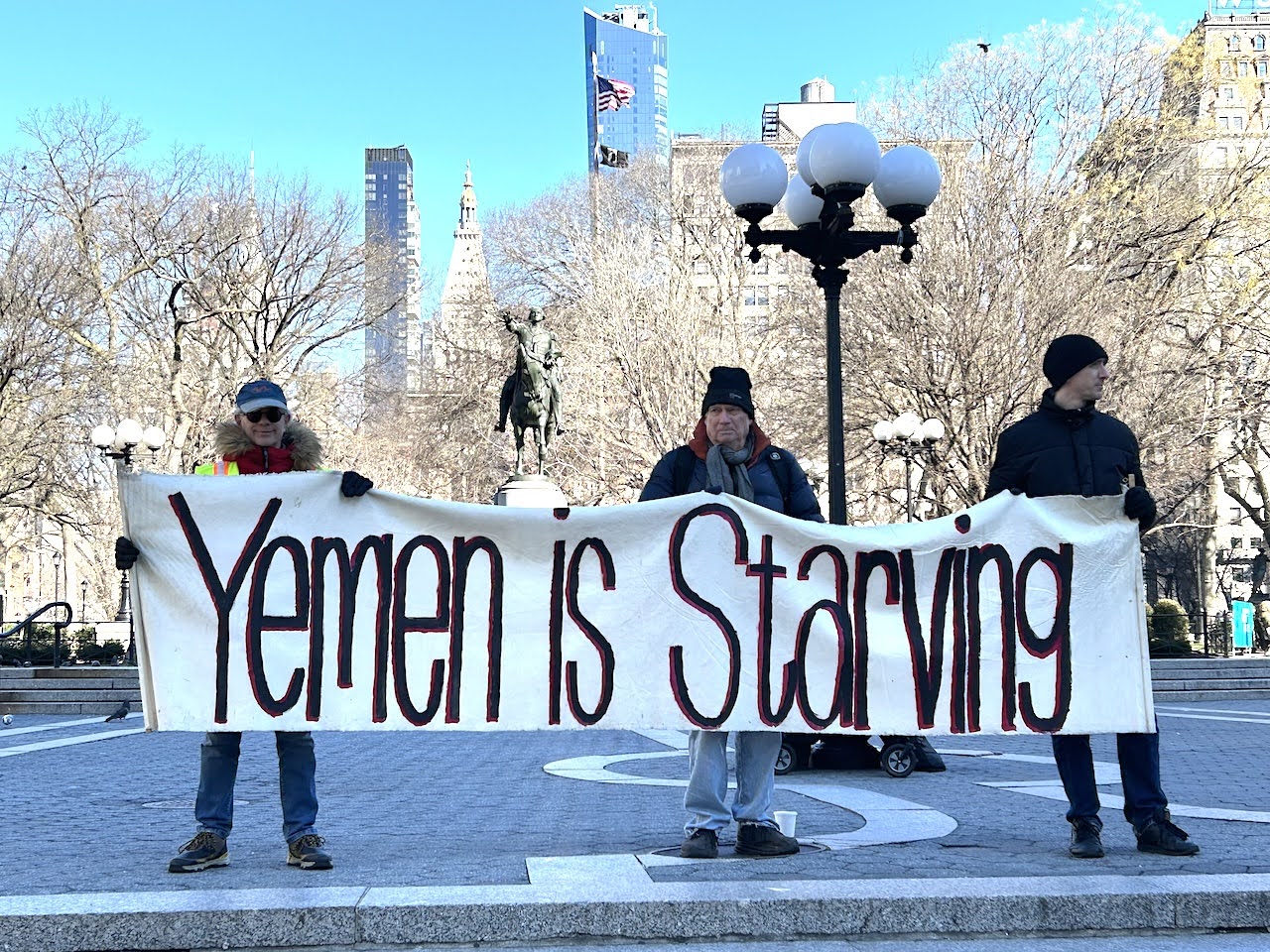
Beginning in March of 2017 and for the following eight years, at 11:00 a.m. on every Saturday morning, a group of New Yorkers has assembled in Manhattan’s Union Square for “the Yemen vigil.” Their largest banner proclaims: “Yemen is Starving.” Other signs say: “Put a human face on war in Yemen,” and “Let Yemen Live.”

Participants in the vigil decry the suffering in Yemen where one of every two children under the age of five is malnourished, “a statistic that is almost unparalleled across the world.” UNICEF reports that 540,000 Yemeni girls and boys are severely and acutely malnourished, an agonizing, life-threatening condition which weakens immune systems, stunts growth, and can be fatal.

The World Food Program says that a child in Yemen dies once every ten minutes, from preventable causes, including extreme hunger. According to Oxfam, more than 17 million people, almost half of Yemen’s population, face food insecurity, while aerial attacks have decimated much of the critical infrastructure on which its economy depends.

Since March 15, the United States has launched strikes on more than forty locations across Yemen in an ongoing attack against members of the Houthi movement, which has carried out more than 100 attacks on shipping vessels linked to Israel and its allies since October 2023. The Houthis say they are acting in solidarity with Palestinians in Gaza and have recently resumed the campaign following the failed ceasefire between Israel and Hamas.

The new round of U.S. airstrikes has damaged critical ports and roads which UNICEF describes as “lifelines for food and medicine,” and killed at least twenty-five civilians, including four children, in the first week alone. Of the thirty-eight recorded strikes, twenty-one hit non-military, civilian targets, including a medical storage facility, a medical center, a school, a wedding hall, residential areas, a cotton gin facility, a health office, Bedouin tents, and Al Eiman University. The Houthis claim that at least fifty-seven people have died in total.

Earlier this week, it was revealed that Defense Secretary Pete Hegseth, Vice President J.D. Vance, and other high-level Trump Administration officials had discussed real-time planning around these strikes in a group chat on Signal, a commercial messaging app. During the past week, Congressional Democrats including U.S. Senator Schumer and U.S. Representative Hakeem Jeffries expressed outrage over the Trump Administration’s recklessness, with Jeffries saying that what has happened “shocks the conscience.”

President Trump commented that there was “no harm done” in the administration’s use of Signal chats, “because the attack was unbelievably successful.” But the Democrats appear more shocked and outraged by the disclosure of highly secret war plans over Signal than by the actual nature of the attacks, which have killed innocent people, including children.

In fact, U.S. elected officials have seldom commented on the agony Yemen’s children endure as they face starvation and disease. Nor has there been discussion of the inherent illegality of the United States’s bombing campaign against an impoverished country in defense of Israel amid its genocide of Palestinians.

As commentator Mohamad Bazzi writes in The Guardian, “Anyone interested in real accountability for U.S. policy-making should see this as a far bigger scandal than the one currently unfolding in Washington over the leaked Signal chat.”

On Saturday, March 29, participants in the Yemen vigil will distribute flyers with the headline “Yemen in the Crosshairs” that warn of an alarming buildup of U.S. Air Force B2 Spirit stealth bombers landing at the U.S. base on Diego Garcia, a tiny island in the Indian Ocean.

According to the publication Army Recognition, two aircraft have already landed at Diego Garcia, and two others are currently en route, in a move that may indicate further strikes against Yemen. The B2 Spirit bombers are “uniquely capable of carrying the Massive Ordnance Penetrator (MOP), a 30,000-pound bomb designed to destroy hardened and deeply buried targets… This unusual movement of stealth bombers may indicate preparations for potential strikes against Houthi targets in Yemen or serve as a deterrent message to Iran.”

The Yemen vigil flyer points out that multiple Massive Ordnance Penetrator bombs can use their GPS precision guidance system to “layer in” multiple warheads on a precise location, with each “digging” more deeply than the one before it to achieve deeper penetration. “This is considered particularly critical to achieving U.S. and broader Western Bloc objectives of neutralizing the Ansarullah Coalition’s military strength,” reports Military Watch Magazine, “as key Yemeni military and industrial targets are fortified deeply underground.”

Despite the efforts of peace activists across the country, a child in Yemen dies every ten minutes from preventable causes – and the Democratic Representatives in the Senate and the House from New York don’t seem to care.

A version of this article first appeared on The Progressive website.

Kathy Kelly (kathy.vcnv@gmail.com) is board president of World BEYOND War. She is the author of Other Lands Have Dreams published by CounterPunch/AK Press