Monday, March 31, 2025

Islamic Ninja Fighters and the Syrian Janus

 March 31, 2025
Facebook

Image by Mahmoud Sulaiman.

The face is a mirror of the mind.

Ovid

The General Security Administration in Syria has issued an executive order prohibiting its personnel from wearing masks. This decision follows the widespread use of masks by Islamic groups that took power after the collapse of President Bashar al-Assad’s regime. While reports indicate that the order will initially be enforced in Damascus, it remains unclear whether it will extend to other cities across Syria.

Syrians are living in a state of fear, particularly in the coastal regions and other areas home to Christians and minority groups, in the aftermath of Assad’s fall and the atrocities committed against civilians in Western Syria. Members of armed radical Islamic factions that have seized power continue to conceal their identities by wearing masks.

Masked armed men first appeared in the city of Idlib in northern Syria following the rise of the al-Nusra Front, a group that originated from al-Qaeda and later rebranded as Hay’at Tahrir al-Sham, claiming to have severed ties with the terrorist organization. This group led the “Operation Deterrence of Aggression,” which _within the framework of a secret international and regional agreement _ultimately led to the fall of Bashar al-Assad’s regime and the appointment of Abu Mohammad al-Julani, the leader of Hay’at Tahrir al-Sham, as the current president under the name Ahmad al-Shar’a.

The narrative on Syrian social media highlights the two identities of the president. One, Abu Mohammad al-Julani, is depicted as a fierce leader, known for wielding an iron fist against those considered remnants of al-Assad’s regime. The other, Ahmad al-Shar’a, represents the pragmatic political figure, carefully crafted to project a more diplomatic and acceptable image, especially to the West. This duality draws parallels to the Roman myth of Janus, who was depicted with a double-faced head, sometimes bearded, sometimes not, in artistic representations. Al-Julani embodies the backward-facing, militant side, while al-Shar’a represents the forward-facing, political persona. Al-Julani is revered as the “lion of the Sunnis,” a fearless warrior who is unafraid of death and ready to use force to crush the enemies of the Islamic nation. In contrast, Ahmad al-Shar’a, as president, is carefully presented as a civilian leader capable of governance, striving to maintain a politically acceptable persona. This duality illustrates the pragmatism of political Islamist movements in the Middle East, which often shift their tone quickly after seizing power to secure and consolidate it.

On March 7, 8 and 9, the backward face of Syria’s Janus took center stage, unleashing horror in western Syria. Meanwhile, the tragedy caused by the genocides continues to unfold.

Despite the restructuring of armed factions under the banner of the Ministry of Defense, the masks that instilled fear in Idlib -linked to armed robberies, assassinations, and violence against factions containing civilian activists -were never removed. Security personnel continued to wear them, and military parades in Damascus and other Syrian cities after the fall of al-Assad regime featured fighters dressed in black, their faces concealed by masks that left only their eyes visible, reminiscent of Japanese ninjas.

Ordinary Syrians were not accustomed to wearing masks until the outbreak of the COVID-19 pandemic, when face coverings became a common sight in city streets as the virus spread across borders. According to Lisān al-‘Arab, the most authoritative Arabic dictionary by Ibn Manzur, the term mask (Litham) refers to a woman adjusting her veil over her nose or a man pulling his headscarf over his face. This practice was historically common in Syria’s desert regions, where people covered their faces to protect themselves from harsh winds carrying sand particles. On the other hand, there is no Quranic text mandating face coverings for either men or women, and Prophet Muhammad is quoted in a Hadith as saying: “Three things strengthen eyesight: looking at greenery, flowing water, and a beautiful face.”

During the early stages of the 2011 Syrian uprising against the Assad regime, protesters wore masks during demonstrations to conceal their identities from security forces. However, they struggled to accept the widespread use of masks in parts of Idlib that were outside the regime’s control. In this climate of ideologically divided factions, assassinations targeting civilian protesters escalated, aiming to consolidate power over the opposition, steer the course of the Syrian revolution, and suppress the civil spirit and youth movement that had originally driven it.

The phenomenon of wearing masks became widespread in Idlib, despite ongoing social media campaigns against it and criticism from local activists. On April 28, 2018, graffiti in the city of Sarmada, in rural Idlib, called on masked individuals to reveal their faces:

Take off your mask so we can see your beautiful face.
He who defends a cause does not hide his face.

According to an article published in Enab Baladi on December 2, 2018, social media campaigns began warning of the dangers associated with the growing use of masks. One such campaign was launched by the “Muslim Missionaries of the Levant” group, which, as the newspaper reported, operated in opposition-controlled areas. The group promoted slogans such as “Your mask scares our children” and “A masked person harbors evil and seeks to hide it.”

In an article titled “The Mask as Political Symbol: On the Ritualization of Political Protest through Mask-Wearing,” Danish researcher Lone Riisgaard and anthropologist Bjørn Thomassen argue that masks create a boundary between the individual and the outside world, functioning as a threshold or a door. In the Syrian context, the mask has evolved into a barrier and a symbol of fear, embodying the power that dehumanizes those labeled as “remnants of al-Assad’s regime” or infidels outside the true fold of the Islamic nation. The masked face signifies the absolute control that extremist Islamist groups wield over people’s lives, while its anonymity allows them to commit acts of brutality with impunity.

A friend of mine, a poet still living in Syria, once joked: “We are ruled by a ninja government. We’ve come to use expressions like, ‘The ninjas are coming,’ ‘The ninjas have left,’ or ‘The ninjas set up a checkpoint at such-and-such intersection.’”

I joked with a Syrian journalist working inside Syria, who asked me to refer to him by the pseudonym “the Secular Samurai” if I quoted him. I asked, “When will the ninja movie end?” He responded verbatim:

“They know no forgiveness. Imagine -they force their victim to kneel on all fours, climb onto his back, and order him to bark like a dog or bray like a donkey, simply because he belongs to a different sect. After stripping him of his humanity in this way, they shoot him. Believe me, the ninjas we see in movies are nothing compared to these people.”

The masks worn by members of the militias that seized power in Syria resemble those of ninja warriors. Before the era of ninjas, samurai fighters wore face armor (menbo) both for protection and to strike fear into their enemies. However, shinobi (the Japanese term for ninjas) used masks primarily for stealth, espionage, and disguise, often blending in as monks or farmers. Some ninja masks were even designed to resemble the faces of angry animals to intimidate opponents.

In contrast, the masks worn in Syria are simpler, sometimes varying in color, though predominantly black. They instill sudden terror among the people. Still, some defend their use, arguing that General Security personnel wear them for security reasons.

The situation in Syria feels like being trapped inside a video game, where masked fighters sit behind heavy machine guns mounted on Toyota trucks, patrolling the streets with their faces concealed. Other Toyota trucks, packed with masked men, roll through the city as they chant Allahu Akbar! in unison.

An article published in Enab Baladi in 2018, titled “Criminals Behind the Mask, Murderers Without Features,” traces the evolution of mask-wearing in Idlib. Initially, masks were used for camouflage in military operations, but over time, they became a tool for concealing identities while carrying out crimes. Their use was not primarily for security purposes but rather driven by hidden agendas, often manifested through criminal acts targeting revolutionary forces. This was emphasized by Mustafa Sijri, a leader in the Free Syrian Army and head of the political office of the Al-Mu’tasim Brigade, whose remarks are cited in the article.

Tim Gurani, in an article published on Daraj (May 7, 2018) titled “The Mask Behind Every Terrorist Operation in Idlib: Declarations Order Its Ban, but Without Enforcement,” quotes a fighter from Hay’at Tahrir al-Sham, Abdul Karim al-Fadl, who claims that masks provide protection against retaliation and instill fear in the hearts of the “infidels.”

During the massacres along the Syrian coast on March 7, 8, and 9, 2025 masks once again played a central role, as masked fighters led civilian victims to their executions. While the masks served to conceal the killers’ identities, some carried out the murders openly, without any attempt to hide -as if the act itself brought them closer to God, like a form of prayer. What stands out is that some individuals filmed the atrocities on their phones, brazenly removing their masks and committing crimes without fear, as if fulfilling a divine mandate.

The criticism from leftist intellectuals like Slavoj Žižek and Noam Chomsky toward the Syrian opposition has often been framed through a lens that portrays many of Assad’s opponents as reactionary Islamists. Both thinkers, while acknowledging the brutal repression under the Assad regime, viewed the rise of Islamic factions in the opposition as a reactionary force, aligning with the notion that these groups were driven by conservative, often extremist ideologies, rather than any genuine progressive aspirations.

However, in light of recent developments, the criticisms directed at Žižek and Chomsky, who were condemned for their stance on the Syrian armed opposition, now appear misplaced. Critics had denounced Žižek for portraying the opposition as reactionary Islamists, but given the current situation _where groups in power are working to establish a Sunni dictatorship and marginalizing religious and ideological differences _ such criticisms now seem misguided and out of touch with the reality of the situation. The groups that have seized power in Syria are not simply reactionary Islamists in the opposition, but are actively working to establish a Sunni dictatorship. They are systematically dehumanizing and massacring those who are religiously or ideologically different, while seeking to impose Islamic law as the exclusive basis for the country’s constitution under the leadership of the Syrian Janus.

According to historians, the doors of Janus’s shrine were left open during times of war and kept closed when Rome was at peace. The Roman historian Livy records that the gates were closed only twice between the reign of Numa Pompilius (7th century BC) and Augustus (1st century BC).

In Syria, however, there is no sign that the gates of the Syrian shrine will close anytime soon. The political landscape remains uncertain and unpredictable, with the country’s future being shaped by those in power. As a result, the path forward is unclear, and the prospect of peace remains elusive.

Senator Whitehouse and Congresswoman Dean Introduce the Northern Rockies Ecosystem Protection Act


 March 31, 2025
Facebook

Custer-Gallatin National Forest next to Yellowstone National Park – photo by Custer-Gallatin National Forest.

On Thursday, Senator Sheldon Whitehouse and Representative Madeleine Dean reintroduced the Northern Rockies Ecosystem Protection Act in the U.S. Senate (S. 1198) and in the U.S. House of Representatives (H.R. 2420) with fifteen original cosponsors across both chambers.

The Northern Rockies Ecosystem Protection Act will designate approximately 23 million acres of inventoried roadless areas in the Northern Rockies as wilderness. NREPA (Ner-EEpa) will preserve a vital ecosystem and watersheds in Montana, Idaho, Wyoming, and Eastern Washington, and Oregon. It will also preserve biological corridors that are essential for biodiversity of native species.

We are so proud of Senator Whitehouse and Congresswoman Dean for standing up for a climate solution that protects public land, water, and interconnected species ranging from tiny insects, birds, and fish to mammals, plants, bushes, and huge trees with massive root systems that store carbon.

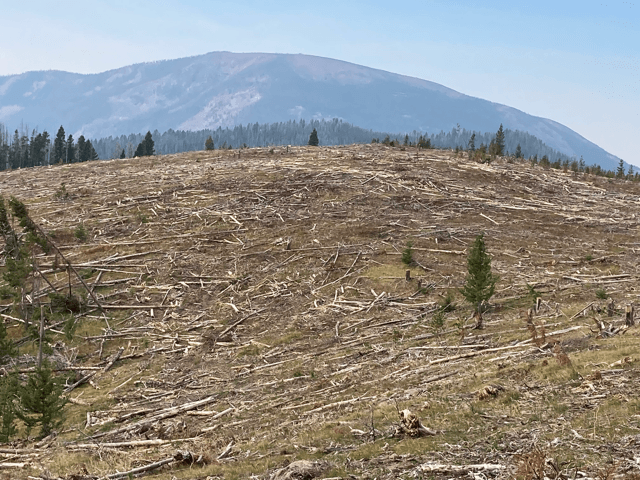
These legislators know that removing the words ‘climate change’ from government studies and documents won’t make the world cooler in any sense of the word. They know that forests are the best carbon storage device in the world. And without NREPA’s protection, the photo below shows what’s been happening in our national forests.

Helena National Forest land owned by all Americans – photo by Vicki Anfinson

NREPA saves the federal government millions of dollars annually by reducing wasteful subsidies to the logging industry.  It also closes unintended legal loopholes that have left many of the areas protected by the Clinton Roadless Rule vulnerable to clearcutting and roadbuilding.

By introducing NREPA, Congresswoman Dean and Senator Whitehouse are saying NO to the timber industry executives and others who misinform the public while enriching themselves. And Senator Whitehouse and Congresswoman Dean are saying YES to preserving carbon storage and slowing climate change.

Simply by designating existing roadless areas as Wilderness, NREPA protects the environment, fights climate change, creates jobs, and saves taxpayers millions of dollars in logging subsidies.

It is time to start protecting ecosystems, which will keep species from going extinct.

The Illusion of Ceasefires


 March 31, 2025
Facebook

Photograph by Nathaniel St. Clair

Israel has resumed its aerial bombardment of Gaza. The latest ceasefire, which lasted two months and led to the release of 33 Israeli hostages and 1,900 Palestinian prisoners and detainees, never made it out of its first stage. The Israeli government has now adopted a strategy of inflicting overwhelming violence until Hamas capitulates by releasing the remaining hostages.

Ukraine and Russia have accepted a limited ceasefire. Both sides have agreed to stop attacking each other’s energy infrastructure, but neither has actually adhered to this condition. Donald Trump, who coaxed both sides toward this ceasefire, is reportedly furious. This week, Moscow and Kyiv agreed to extend this partial ceasefire to the Black Sea, though here, too, they don’t seem in a rush to stop their attacks. No serious analysts, including those in Russia, expect this ceasefire to hold.

A UN-brokered truce in Yemen lasted nearly six months in 2024 before fighting in the country between the Iran-aligned Houthi rebels and the Saudi-backed government started up again in the fall. The Trump administration has recently escalated air strikes against the Houthis in response to their revived efforts to disrupt shipping in the Red Sea.

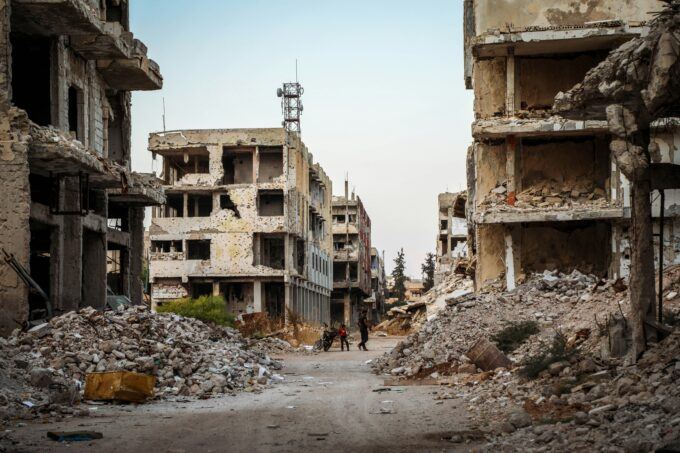
Last year, a ceasefire in Syria came to an end when rebels, with the go-ahead from Turkey, caught government troops by surprise when they seized Aleppo and kept going. A little more than a week later, they were in control of the capital of Damascus and Syrian dictator Bashar al-Assad was on his way to Moscow.

Ceasefires have come and gone in the Democratic Republic of Congo. Last week, the DRC and Rwanda called for a ceasefire in the eastern part of the country. An astonishing 700,000 people have been displaced by fighting just since January. The record of truces in this war-torn country does not give much hope for this latest initiative.

In other countries, the mutual hostility between the warring parties has been so intense that ceasefires don’t even get a chance to take hold. Sudan, split in two by government forces and the rebel Rapid Support Forces, has so far resisted international calls for immediate humanitarian pauses in the violence.

Ceasefires don’t always fail. Libya hasn’t seen any major violation of the ceasefire signed in 2020. But it’s the only success of the three ceasefires that the Borgen Project cited in October 2022 as evidence of a more peaceful world. The civil war in Sudan resumed in April 2023. Later that year, Azerbaijan broke a ceasefire to defeat Armenia and seize control of the disputed territory of Nagorno-Karabakh.

Donald Trump promised that he would, like some authoritarian father figure, force warring parties in Ukraine, Gaza, and elsewhere to stop fighting and get along. Only the credulous believe in this avatar of Trump as peacemaker. The truth is, ceasefires are usually just empty promises, regardless of how smart, powerful, or delusional the mediator-in-chief happens to be.

What makes some ceasefires endure even as so many others disappear into the fire of renewed hostilities?

Why Ceasefires Die

When he responded to Trump’s peace proposal for Ukraine, Russian President Vladimir Putin said, “We are in favor of it but there are nuances.”

Those “nuances” were sticking points as sharp as a saber. Putin wants the world to recognize his illegal seizure of four Ukrainian provinces over which he doesn’t even have full control. He wants all foreign military assistance and intelligence-sharing with Ukraine to end. NATO membership for Ukraine must be off the table. Oh, and he also wants the world to lift sanctions against his country.

Putin believes that he has an advantage on the battlefield and, with Trump as president, at the negotiating table as well. There is some truth to Putin’s perception. Russia has more soldiers and resources at its disposal than does Ukraine, and Trump is the most pro-Russian president that the United States has ever produced. Putin also knows that the celebrated dealmaker is actually a naïf who pays little attention to details and has been taken to the cleaners in the past, most notably by the Taliban in its 2020 deal with the United States.

But Russia, too, has reached certain limits in its capacity to recruit soldiers and produce the armaments to continue its occupation of Ukraine. Mutual exhaustion is one of the best signs of a ceasefire that can endure. That was certainly the case with the two Koreas in 1953 after two years of relatively little territorial movement by either side.

But both parties to the conflict have to acknowledge, if only to themselves, that they have sunk into a quagmire. Putin, by contrast, thinks that he can prevail. He wants not only those four provinces but the entirety of what he calls “Novorossiya,” which includes all of Ukraine’s southern coast, which would render the country land-locked. Putin also wants elections that can replace Volodymyr Zelensky with a more malleable leader.

Any ceasefire that doesn’t lead to Putin achieving these ultimate goals is a ceasefire that Russia is unlikely to uphold.

A power-besotted aggressor who believes that he—and isn’t it always a he?—has an asymmetric advantage over his opponent is one of the leading reasons why it’s difficult to stop wars. Ceasefires for these aggressors are only pauses to regroup or to win international approval or to lull opponents into complacency.

That applies to Benjamin Netanyahu as well. Israel and Hamas have been locked in a conflict over Gaza for more than two decades. On October 7, the much weaker Hamas launched a brutal surprise attack on Israeli territory that killed more than a thousand people and produced 250 hostages, which the Palestinian group figured it could use as bargaining chips. Instead of negotiating, the Netanyahu government launched its own brutal response, which has left 50,000 dead in Gaza.

Like Putin, Netanyahu has maximalist ambitions and an uncompromising attitude. He wants to destroy Hamas. He also wants to destroy the capacity of Gaza to serve as a part of some future Palestinian state. He doesn’t really care about the hostages that Hamas is holding. The Israeli leader is so determined to prove that Hamas is using Israeli hostages and Palestinian civilians alike as human shields that he’ll sacrifice them both in his bid to annihilate Hamas and, of course, maintain his own political position. To add grievous insult to catastrophic injury, he’ll then accuse the Palestinian group of human rights abuses after the fact.

A huge number of Israelis are fed up. This last weekend, 100,000 turned out to protest in the major cities.

Getting to Peace

Most ceasefires fail, often spectacularly so. “Of the 105 failed ceasefires, 84 percent were followed by an offensive within an average of just 13 days,” reports Patrick Burke in his study of ceasefires in 25 wars from 1947 to 2016.  According to a study by Jason Quinn and Madhav Joshi, 80 percent of ceasefires fail.

Mutual exhaustion on the battlefield is certainly one factor behind a successful ceasefire. But what can mediators do when one or both sides believe that they can still achieve a complete victory, as Croatia did with Operation Storm in 1995 and Azerbaijan accomplished more recently?

Trump’s approach is to strong-arm the weaker party. He cut off military aid to Ukraine, trash-talked its leader, and forced the country to accept a partial ceasefire. With the latest deal on the Black Sea, he is dangerously close to agreeing to lift some restrictions on Russian exports without approval from Ukraine or the European Union. Such a ceasefire is not likely to last or to lead to a second stage.

Putin is no doubt watching Netanyahu, taking careful notes, and identifying lessons to learn:

+ Lesson one: break previous agreement

+ Lesson two: flatter Trump

+ Lesson three: apply maximum firepower

+ Lesson four: ignore international opinion

From a conflict resolution point of view, a more successful approach would be to identify the underlying reasons for the dispute—competition for resources, historical grudges, cultural differences—and find ways of nudging the parties toward addressing those root causes non-violently. But this approach assumes a certain power balance among the combatants.

It’s hard to imagine Trump, Netanyahu, or Putin being very interested in such a process. They don’t believe in talk therapy. They believe in power moves.

Where one side has an obvious advantage, an outside force could try to level the playing field. That requires arm-twisting not the weaker party but the stronger one. That’s what the United States did to get Serbia to the table and sign the Dayton Accords to end the war in Bosnia.

Ah, but didn’t the West follow just such a strategy with Russia during the current conflict? All the sanctions against Russia and arms deliveries to Ukraine and resolutions at the UN only made Putin fight harder. These punitive actions were taken to help Ukraine repel the invaders and uphold the principles of international law. In other words, the international community has had a stake in the conflict, since Russia didn’t just seize Ukrainian territory, it defied a collective global norm.

With Israel, of course, the Biden administration did little or nothing to restrain Netanyahu. The Trump administration has only encouraged the Israeli leader. Trump’s scenario of a Gaza resort with no Palestinians, however ridiculous it sounds, served notice that the United States would be okay with a genocidal push of all Palestinians from their land.

So, perhaps in some contexts, ceasefires are just bound to fail.

But don’t despair. Remember that 80 percent failure rate from Jason Quinn and Madhav Joshi?  Believe it or not, these researchers were actually encouraged by the results of their analysis of data from 196 conflicts between 1975 to 2011.

“What we found was that the best predictor that any one ceasefire agreement will be successful — and by successful I mean: not followed by renewed conflict or violence — … is how many failed peace agreements came before,” Jason Quinn noted. He pointed to the ultimate successes in ending wars in Nepal and Colombia as important examples.

Wars are hard to end. Exhibit A: The Hundred Years War. It makes sense that ceasefires are bound to fail and fail and fail and fail and fail until one day, they produce a lasting peace. Skilled mediators, a power move or two, mutual exhaustion on the battlefieldand at the negotiating table: these can all eventually lead to success.

But one thing is for sure. Trump’s unholy affection for both Putin and Netanyahu will produce only the worst kind of ceasefire, the kind that the strong use as a prelude to their final push to eliminate the weak.

John Feffer is the director of Foreign Policy In Focus, where this article originally appeared.