Thursday, April 03, 2025


Reinvigorating Marx’s value theory to understand 21st century capitalism


Published 

Capitalism is not working

First published at Economic Annals.

Capitalism in the Twenty-first Century Through the Prism of Value, by Guglielmo Carchedi and Michael Roberts, aims to explain 21st-century capitalism through Marx’s value theory, aligning with the efforts to reintroduce value theory into mainstream discourse (Mazzucato, 2018; Milanović, 2019; Picketty, 2013). However, unlike these contributions, which remain within the framework of heterodox or critical political economy, this book adopts a distinctly Marxist approach, placing it within the tradition of radical economics. As mainstream economic discourse continues to marginalise value theory, this book’s engagement with Marxian categories offers a necessary counterpoint and challenges dominant economic paradigms.

Reinvigorating Marx’s value theory is not just an intellectual exercise but a necessary response to contemporary capitalism’s crises. As financial instability, rising inequality, ecological degradation, and geopolitical tensions intensify, mainstream economic frameworks often fail to offer coherent explanations (Streeck, 2017; Tooze, 2018). By returning to the foundational concepts of labour, value, and exploitation, Carchedi and Roberts provide an analytical lens that helps decode capitalism’s contradictions in the 21st century. More than just an analysis of crisis, the book also contributes to the search for alternatives, offering socialist solutions to the systemic failures it describes. In this sense, it is part of an ongoing effort to rethink economic structures beyond capitalism, engaging with debates on democratic planning, worker self-management, and post-capitalist production models (Albert and Hahnel, 1991; Ellerman, 2021; Wolff, 2012). 

The book’s strength lies in its original research, particularly in chapters on the value-based theory of inflation and economic imperialism. Additionally, it engages with contemporary issues such as COVID-19, examining how the law of value manifests during crises. Throughout the book, the authors expose how misconceptions and distortions in modern capitalism are often exploited to protect capital's interests, particularly at the expense of labour. The book comes with a helpful introduction, which explains the law of value and related Marxist concepts, such as surplus value. 

Value, price and the ecological costs of capital accumulation

The book begins by addressing how capitalism disrupts the relationship between humans and nature. Using Marxist value theory, the authors critique methods such as natural capital accounts (NCA), arguing that they fail to accurately measure natural wealth due to a fundamental confusion between value and price. The authors argue that as long as natural goods are not market transactions, their value cannot be accurately estimated. 

They proceed from a classical Marxist premise that capitalism tends to invest more in machines, factories, and infrastructure (fixed capital) rather than in wages, raw materials, and other day-to-day expenses (circulating capital). This shift allows businesses to produce more goods while spending less on inputs, ultimately increasing profits. The chapter demonstrates how energy revolutions have created new opportunities for capitalist accumulation waves by reducing fixed capital costs. 

Their original research quoted in the book shows a strong correlation between carbon emissions and profits, which in the authors’ opinion, suggests that faster profit growth leads to increased emissions. The chapter critiques market-based climate solutions, arguing they fail because mitigation is not profitable for companies. The degrowth movement, which advocates for reducing economic production and consumption to address environmental limits, is also criticised for lacking a class perspective and an ecological theory of capitalist accumulation. While degrowth theorists (Hickel, 2020; Latouche, 2009; Kallis et al., 2018) argue that endless economic expansion is unsustainable, Carchedi and Roberts contend that degrowth fails to address the structural imperatives of capitalism, which drive accumulation regardless of ecological constraints. Without a class analysis, degrowth risks framing ecological collapse as a problem of overconsumption rather than a consequence of capitalist exploitation and unequal distribution of resources.

The authors conclude that controlled and planned growth under socialism could provide an alternative to capitalism’s inherently expansionary nature. However, it is important to clarify what they mean by this. Their argument (developed more in the book’s last chapter) does not advocate for unrestricted industrial expansion but rather for a model where production is consciously directed to meet social needs while minimising ecological harm. The authors argue that a socialist system – if explicitly oriented towards ecological priorities and democratic planning – could avoid the pitfalls of ‘real socialism’ (not least in Yugoslavia), where economic planning did not necessarily lead to ecological sustainability.

Challenging conventional wisdom: MMT, cryptocurrencies and inflation

This chapter critically examines the relationship between value and money, focusing on a critique of modern monetary theory (MMT). The authors argue that MMT misunderstands the fundamental nature of money by ignoring its connection to value production in a capitalist economy. MMT treats money primarily as a creation of the state, issued through government spending and taxation (Wray, 2015), whereas Marxist theory sees money as a representation of socially necessary labour time – the value produced by workers. According to the authors, MMT's approach leads to a ‘fictitious economic world’ because it treats money as an independent tool of policy rather than as a reflection of underlying economic and class relations. They argue that by equating money with state-issued credit and debt, MMT detaches it from its historical and material roots in the production process, overlooking the exploitative dynamics of capitalism.

MMT’s assumption that the state can create money without limits is critiqued, as it ignores the necessity of production to increase money value. The chapter argues that profits drive investment, not vice versa, and that private savings enable government deficits, contrary to the MMT claims. The authors contend that MMT benefits rich countries through currency seigniorage, while smaller economies risk hyperinflation if money is printed excessively. 

Of course, critiques of MMT are not exclusive to Marxists. Many mainstream economists, including both neoclassical and Keynesian scholars, have raised significant objections to MMT, albeit from different perspectives. Larry Summers (2019) famously dismissed it as ‘voodoo economics’ arguing that it politicises public finances and risks leading to fiscal dominance. Similarly, Kenneth Rogoff (2019) labelled MMT a ‘recipe for hyperinflation’, warning that excessive reliance on money creation could destabilise the economy. In this respect, Carchedi and Roberts offer a different angle, critiquing MMT not merely for its potential macroeconomic risks but for its fundamental misunderstanding of capitalism’s value dynamics.     

Building on their critique of MMT’s detachment of money from value production, the authors apply the same value-theoretic approach to analyse why cryptocurrencies cannot serve as an alternative foundation for capitalism. They argue that, like MMT, proponents of cryptocurrencies overlook the fundamental connection between money and labour-based value creation. Carchedi and Roberts contend that Bitcoin fails as a reliable currency because it lacks stability as a store of value, a means of exchange, and a unit of account.

This critique, once again, is not unique to Marxists. Many mainstream economists have also expressed scepticism about cryptocurrencies, though their critiques often focus on financial stability, regulation, and economic inefficiencies rather than deeper structural issues related to production and exploitation. Paul Krugman (2018) has argued that Bitcoin is a ‘cult’ rather than a viable alternative to fiat money, primarily due to its inefficiency as a medium of exchange and its deflationary tendencies. 

The authors analyse inflation through the Marxist theory of value, rejecting the Friedmannian view that it is ‘always and everywhere a monetary phenomenon’. Instead, they argue that inflation stems from the declining relative share of labour and capital’s combined purchasing power (CPP) as a percentage of total value. Dismissing both the cost-push Keynesian and demand-pull mainstream approaches, they propose the value rate of inflation (VRI) as a more comprehensive measure.

The VRI reflects the interplay between the percentage change in CPP (the value factor) and the percentage change in M2 (the money factor). Their research finds that VRI explains over a third of CPI variations in the US between 1960 and 2018 and is consistently higher than CPI, indicating that conventional inflation measures underestimate real purchasing power losses. As a result, they argue that wage negotiations based on CPI adjustments fail to fully compensate labour and advocate for VRI as a more accurate benchmark. Their perspective aligns with emerging heterodox critiques, such as Isabella Weber’s work on ‘greedflation’ (Weber & Wasner, 2023), which challenges conventional inflation narratives.

Marx’s theory of crisis and economic imperialism

Carchedi and Roberts discuss Marx's theory of crises, attributing capitalist crises to the tendential fall in the profit rate, which involves tendencies and countertendencies. Using US corporate profit and investment statistics, they show that every post-WWII crisis followed a peak in profit rates, leading to investment collapse. The authors reject underconsumption as a crisis cause, noting that 11 of 12 post-WWII crises were preceded by rising wages.

In line with the long-established Marxist tradition (Baran & Sweezy, 1966), the authors claim that economic crises stem from the shrinking ability to valorise capital due to falling profitability as capitalists are increasingly struggling to generate surplus value at the same rate as before. However, imperialist exploitation of the capitalist periphery can expand this space. The authors define imperialist exploitation as the long-term net appropriation of surplus value by high-tech countries from low-tech ones, through channels like currency seigniorage, investment income flows, unequal trade exchange, and exchange rate changes. Surplus value is one of the most fundamental concepts in Marxist economics and refers to the unpaid labour extracted from workers, which is the source of profit, rent, and interest in a capitalist economy. 

The authors apply this concept to international trade and present new data to support the Marxist theory of unequal exchange, which argues that trade under capitalism systematically transfers value from lower-wage economies to higher-wage economies (Amin, 1976). Unlike mainstream trade theories – such as Ricardian comparative advantage, which suggests that trade benefits all parties by allowing specialisation, or Heckscher-Ohlin theory, which explains trade patterns based on factor endowments – the theory of unequal exchange contends that global trade under capitalism structurally favours developed economies. This perspective aligns with elements of the Prebisch-Singer hypothesis, which empirically demonstrated that developing countries suffer from a long-term deterioration in their terms of trade (Prebisch, 1950). The authors reinforce this argument with empirical evidence, finding that from 1950 to 2019, the annual surplus value transfer (i.e. the movement of the unpaid labour of workers) from dominated to imperialist countries averaged 1% of dominated countries’ GDP. Measured against annual export profits, this transfer accounted for over 40% of imperialist countries' profits. 

The authors extend their surplus value transfer analysis to assess China's position in the global economy to determine whether China qualifies as an imperialist state in the classical sense. Whereas mainstream economics debates whether China is capitalist, predominantly capitalist, or a hybrid system (Ang, 2018; Milanović, 2019; Rodrik, 2018), Carchedi and Roberts focus on the empirical dynamics of its exchange with the capitalist centre. Their analysis finds that surplus value transfers from China to the imperialist bloc have averaged 5–10% of its GDP since the 1990s, indicating that China remains a net contributor to imperialist economies rather than an exploiter of global labour. Based on this, they conclude that China is not an imperialist country but part of the dominated bloc. They note that emerging economies can only develop by raising productivity with efficient technologies, which imperialist countries will always oppose, as seen in efforts to throttle China’s chip industry (Umbach, 2024).

The path of democratic socialism 

The authors briefly treat the topic of state capitalism, which is often mentioned to describe the socio-economic systems in both countries (USSR and China). This point of view was popular among Yugoslav economists who described the Soviet economy as ‘etatism’ (Horvat, 1982), more aligned with state capitalism rather than true socialism. However, Carchedi and Roberts argue that the concept of ‘state capitalism’ cannot be applied to the Soviet Union because there was no capitalist competition, and the allocation of resources was not left to the decision of individual capitals. 

But what about China? While acknowledging the significant capitalist elements in China's economy, they argue that China's state-owned sector and economic planning represent socialist elements crucial to its industrial policies. Hence, they disagree with the view that China is a capitalist country (Ang, 2018; Milanović, 2019) but describe China as a ‘trapped transition’, where capitalist and socialist accumulations compete, leading to inconsistent development.

The authors argue that social planning can be rational, efficient, and democratic, examining models like negotiated coordination and participatory economics, which bear similarities to Yugoslav self-management socialism. A key feature of Yugoslav self-management was its emphasis on employee participation in decision-making, distinguishing it from both centralised socialist planning and traditional capitalist firms. Workers' councils had formal control over enterprise decisions, though market forces and state interventions often constrained their autonomy. Branko Horvat, a leading Yugoslav economist, defended self-management as a genuine alternative to both state socialism and capitalism, asserting that greater market reliance within a self-managed economy could enhance efficiency without sacrificing democratic workplace governance (Horvat, 1982).

While the Yugoslav model ultimately failed, its viability under different conditions remains debated. Some radicals argue that Yugoslavia’s system was capitalism disguised as socialism (Katalenac, 2013), while others suggest that its failure resulted from an inadequate balance between self-management and state governance, as well as insufficient reliance on market mechanisms (Estrin, 1991; Nove, 2003). This view is shared by Branko Horvat (2001) who argued that self-management was progressively undermined by later reforms, particularly the 1976 reform, which he claimed reduced self-management to a façade well before Yugoslavia’s collapse.

The concept of cooperative self-management has recently re-emerged in mainstream economics, even within capitalist frameworks. Piketty (2020) advocates greater worker participation in corporate decision-making, reflecting renewed interest in democratising economic governance. Similarly, Ellerman (2021) and Wolff (2012) argue that worker self-management could provide a more equitable and democratic alternative to traditional corporate structures. Empirical research by Pérotin (2013) suggests that worker cooperatives are as productive as conventional firms while offering greater job security and resilience during crises. This suggests that, despite its challenges, self-management remains an idea with potential, and its historical lessons should not be dismissed outright.

To conclude, Carchedi and Roberts’ book offers two ways of engaging with its arguments: readers can approach it as an analysis of major contemporary economic issues – such as environmental sustainability, inflation, productivity and wages, and global trade – or as a broader demonstration of how Marxist value theory can be applied to modern capitalism. The authors use this framework to explain key economic dynamics: for example, the capitalist drive to exploit natural resources stems from the need to reduce production costs, while economic crises recur as profit rates decline over time, leading to cycles of instability. Their approach also sheds light on global economic inequality, showing how wealthier nations maintain dominance by extracting economic benefits from less-developed economies.

Rather than engaging in abstract Marxist debates, the book addresses pressing real-world issues but through a distinct analytical lens – one that mainstream economics often overlooks. By demonstrating how Marxist value theory remains a powerful tool for understanding capitalism today, the authors contribute to the ongoing renaissance in Marxist economics – a revival marked by renewed engagement with capitalist crisis tendencies (Kliman, 2012; Roberts, 2016), financialisation (Lapavitsas, 2013), labour exploitation (Smith, 2016), and global trade inequalities (Amin, 2018). Anwar Shaikh’s Capitalism: Competition, Conflict, Crises (2016) has been central to this revival, integrating Marxist value theory with advanced empirical and mathematical modelling, reinforcing the argument that profit-driven accumulation inherently leads to inequality, crises, and systemic instability.

Carchedi and Roberts’ book effectively demonstrates the versatility, continued relevance, and value of Marxist value theory (pun intended). They bridge critical economic theory with contemporary policy debates, challenging readers to rethink the structural forces shaping today’s economy.

References

Albert, M., & Hahnel, R. (1991). The Political Economy of Participatory Economics. Princeton: Princeton University Press.

Amin, S. (1976). Accumulation on a World Scale. New York: Monthly Review Press.

Amin, S. (2018). Modern Imperialism, Monopoly Finance Capital, and Marx’s Law of Value. New York: Monthly Review Press.

Ang, Y. Y. (2018). How China Escaped the Poverty Trap. New York: Cornell University Press.

Baran, P., & Sweezy P. (1966). Monopoly Capital. New York: NYU Press.

Ellerman, D. (2021). The Democratic Worker-Owned Firm (Routledge Revivals): A New Model for the East and West. London: Routledge.

Estrin, S. (1991). Yugoslavia: The case of self-managing market socialism. Journal of Economic Perspectives5(4), 187–194.

Hickel, J. (2020). Less is More: How Degrowth will Save the World. New York: Random House.

Horvat, B. (1982). The Political Economy of Socialism: A Marxist Social Theory. New York: M. E. Sharpe, Inc.

Horvat, B. (2001). Ekonomika brzog razvoja [The Economics of Rapid Development]Sarajevo: Forum Bosna.

Kallis, G., Kostakis, V., Lange, S., Muraca, B., Paulson, S., & Schmelzer, M. (2018). Research on degrowth. Annual Review of Environment and Resources43(1), 291–316.

Katalenac, J. (2013). Yugoslav self-management: Capitalism under the Red Banner. Insurgent Notes: Journal of Communist Theory and Practice.

Kliman, A. (2012). The Failure of Capitalist Production: Underlying Causes of the Great Recession. London: Pluto Press.

Krugman, P. (2018, January 29). Bubble, bubble, fraud and trouble. The New York Times. https://www.nytimes.com/2018/01/29/opinion/bitcoin-bubble-fraud.html

Lapavitsas, C. (2013). Profiting Without Producing: How Finance Exploits Us All. New York: Verso Books.

Latouche, S. (2009). Farewell to Growth. London: Polity.

Mazzucato, M. (2018). The Value of Everything: Making and Taking in the Global Economy. London: Allen Lane.

Milanović, B. (2019). Capitalism, Alone: The Future of the System that Rules the World. Cambridge, MA: Harvard University Press.

Nove, A. (2003). The Economics of Feasible Socialism Revisited. London: Routledge.

Pérotin, V. (2013). Worker cooperatives: Good, sustainable jobs in the community. Journal of Entrepreneurial and Organizational Diversity2(2), 34–47.

Piketty, T. (2020). Capitalism and Ideology. Cambridge, MA: Harvard University Press.

Prebisch, R. (1950). The economic development of Latin America and its principal problems. United Nations Economic Commission for Latin America (ECLA).
https://repositorio.cepal.org/entities/publication/9a00fa5b-ad04-4520-ae4c-e3adba791790

Roberts, M. (2016). The Long Depression: How It Happened, Why It Happened, and What Happens Next. Chicago: Haymarket Books.

Rodrik, D. (2018, December 10). China's boldest experiment. Project Syndicate. https://www.project-syndicate.org/commentary/china-experiment-high-growth-renewed-repression-by-dani-rodrik-2018-12

Rogoff, K. (2019, March 4). Modern monetary nonsense. Project Syndicate. https://www.project-syndicate.org/commentary/federal-reserve-modern-monetary-theory-dangers-by-kenneth-rogoff-2019-03

Shaikh, A. (2016). Capitalism: Competition, Conflict, Crises. Oxford: Oxford University Press.

Smith, J. (2016). Imperialism in the Twenty-First Century: Globalization, Super-Exploitation, and Capitalism’s Final Crisis. New York: Monthly Review Press.

Streeck, W. (2017). How will Capitalism End?: Essays on a Failing System. New York: Verso Books.

Summers, L. H. (2019, March 4). The left’s embrace of Modern Monetary Theory is a recipe for disaster. The Washington Post. https://www.washingtonpost.com/opinions/the-lefts-embrace-of-modern-monetary-theory-is-a-recipe-for-disaster/2019/03/04/6ad88eec-3ea4-11e9-9361-301ffb5bd5e6_story.html

Tooze, A. (2018). Crashed: How a decade of financial crises changed the world. Penguin.

Umbach, F. (2024, April 29). The escalating chip war between China and the West. GIS. https://www.gisreportsonline.com/r/escalating-chip-war/

Weber, I. M., & Wasner, E. (2023). Sellers’ inflation, profits and conflict: Why can large firms hike prices in an emergency?. Review of Keynesian Economics11(2), 183–213.

Wolff, R. D. (2012). Democracy at Work: A Cure for Capitalism. Chicago: Haymarket Books.

Wray, L. R. (2015). Modern Money Theory. London: Palgrave Macmillan.


Isaak Illich Rubin 1928. Essays on Marx's Theory of Value. Image of book's title page. Published: Black and Red, Detroit, 1972;
Isaak Illich Rubin was a Soviet lawyer, economist and scholar of Marx's work. His most important published work was Essays on Marx's Theory of Value (first ...
i i rubin from en.wikipedia.org

Born in Russia in 1886, II Rubin was an activist, economics professor and then a researcher at the Marx-Engels Institute.


Free Speech Is Worth Fighting For

We do not have free speech to talk about the weather. Our Founders, particularly James Madison who drafted the Bill of Rights, understood that our rights are not privileges granted to us by government. No, it was understood at the founding that these basic natural rights outlined by Madison were granted by our Creator and thus no mere mortal could take them away. And first among these is the First Amendment which recognizes that most basic of our natural rights: the right to express ourselves in any way we wish.

Unfortunately the US government has not always been in accord with this sentiment and has many times in our history been at war with our freedom of speech. From the alien and sedition acts at the beginning of our republic to Abraham Lincoln’s war on speech to the jailing of antiwar activists during both World Wars to Kent State, the political class is all for free speech unless it is threatening to the political class.

Recently a new front has been opened in the war on free speech and it is one that Americans must take seriously. On university campuses across the country students – both American and foreign guests – have taken to protesting US support for Israel’s actions in Gaza, where tens of thousands of innocent civilians have been killed.

The political class in the United States is determined to defend Israel from its critics and has responded to these protests by threatening and blackmailing the universities if they do not crack down on speech the powers-that-be do not like. Both Presidents Biden and Trump have used the power of US government funding to demand a crackdown on speech they don’t like, with President Trump recently pulling 400 million dollars in federal funding for Columbia University if they don’t silence the protesters.

The real scandal is that nearly every US university – both public and “private” – is government funded in the first place. But for politicians to use the power of the purse to deny students the right to express themselves – as long as peaceful – just adds insult to injury.

Last week a Turkish PhD student at Tufts University was arrested on the street by plainclothes government agents for reportedly simply writing an editorial in her university newspaper expressing her views on the Israel/Palestine conflict. She faces deportation from the country. And she is not alone. Secretary of State Marco Rubio has openly bragged about sending hundreds of students home because they express a political position he disagrees with. Others – including American citizens – have been expelled from their schools and have even had their degrees rescinded. For peacefully expressing a political position that powerful people in Washington disagree with.

You may also agree with the political position of these students. But to cheer their punishment by the US government is to turn your back on the founding principles of this country. Freedom of speech is a natural right not reserved for American citizens but for all of humanity. And it has been a natural right worth defending for nearly 250 years.

First they came for foreign students expressing controversial positions and many Americans cheered because they were not foreign and did not like the opinions. But make no mistake: this war on speech will not end with only foreigners being punished. It never does.


Who Gives Two Hoots About the Houthis!


Last week we noted that the ascension to NATO of the Balkan Five (Croatia, Slovenia, Macedonia, Montenegro and Albania) and the Baltic Three (Lithuania, Latvia and Estonia) amounts to some kind of bad joke. Their combined active military forces total just 66,000 servicemen, which is exactly equal to the combined 66,000 man police forces of New York City, Chicago, Los Angeles and Philadelphia.

Likewise, their combined defense budgets are $8 billion annually or about the level of Pentagon spending every seven hours, including weekends, holidays, snow days and the Fourth of July parades, military bands and all. And when it comes to economic heft, their collective GDP is a diminutive $350 billion or just 1.3% of that of the USA.

So we rightly asked, why bother? Their military manpower, token defense budgets and rounding error GDPs do not have even remote relevance to standing up America’s triad strategic nuclear deterrent, which doesn’t require any foreign bases or allies in any case. Nor do they contribute a whit to an invincible conventional military Fortress America defense of the airspace and shorelines of the US homeland way over here on the far side of the Atlantic and Pacific Ocean moats.

And yet and yet. The wee countries of Eastern European NATO actually have some modest throw-weight compared to what’s involved in the raging Yemen bombing leak controversy at the top of today’s the news. Of course, the controversy is all about the leak of what practically amounts to a scheduled bombing run against a tiny spec of an “enemy” on the Red Sea coast. But the far more important question is why in the hell was the Donald bombing the bedraggled Houthi installations in the first place?

Or as Ann Coulter expressed it more colorfully,

…because right now, his foreign policy team is looking like John Bolton without the ridiculous Wilford Brimley mustacheSince Trump keeps hiring these people, it’s a good time to remind him that, in 2016, he won more primary votes than any Republican in U.S. history (as well as the election) by saying things like this about a war that had a million more justifications than his recent bombing of the Houthis:

“Obviously, the war in Iraq was a big, fat mistake. … We spent $2 trillion, thousands of lives… George Bush made a mistake. We can make mistakes. But that one was a beauty. We should have never been in Iraq. We have destabilized the Middle East.”

So why does Trump keep surrounding himself with tinhorn cowboys who think it’s America’s responsibility to drone, bomb, invade and occupy other countries whenever and for whatever reason they want?

As it happens, the Houthi tribes – who profess a variant of Shiite Islam – have dominated much of northern and western Yemen for centuries. They generally ruled North Yemen during the long expanse after it was established in 1918 until the two Yemen’s were reunified in 1990.

So when a Washington installed government in Sana’a was overthrown and the uneasily unified nation of Yemen disintegrated into warring religious factions, the Houthi took power in northern Yemen, while Sunni tribes aligned with the Muslim Brotherhood and al-Qaeda held sway in the south. And these latter folks are far worse on the terrorist scale than the Houthi ever dreamed of being.

Needless to say, this Houthi remnant of the failed state of Yemen ain’t no threat to nobody who’s minding their own business. They have no blue water Navy, no Air Force, no regular Army and just some odds and sots of coastal patrol boats and short range drones and missiles. So their ability to inflict even a scratch on the American homeland way over here lies somewhere between slim and none.

As indicated, the Houthis rule not the entire sovereign country of Yemen, but roughly 25% of  the former Yemen territory (about 137,500 square kilometers out of 550,000), including the capital at Sana’a and key northern population centers. Given that the GDP of the entirety of the Yemen territory was a scant $20 billion in 2024 and that slightly more of the economic activity – now often barter-based after years of USA and Saudi bombing – is under Houthis control, our trusty AI, Grok 3, estimates that in their wisdom the Donald’s purported America Firsters were bombing the shit out of some desert salients which generate a mere $6-8 billion of GDP annually.

That’s right. We are talking about a rogue regime of rifle-waving ruffians who control the equivalent of 1oo minutes of US GDP!

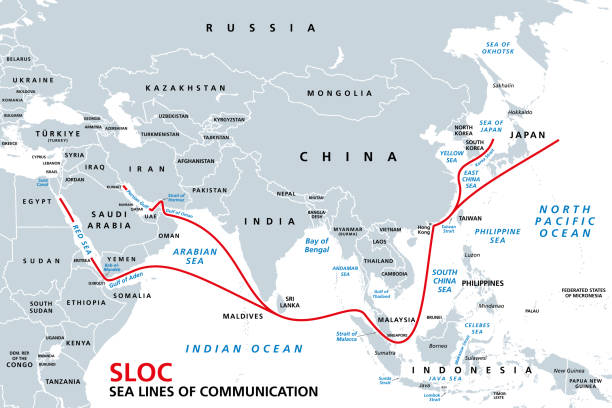
And, no, ensuring the freedom of navigation in the Red Sea doesn’t have a damn thing to do with it. Thus, in 2023, about 8.7 million barrels per day (b/d) of crude oil and refined products flowed through the Bab el-Mandeb Strait (southern Red Sea entrance), but almost all of that went to Europe. And the tiny 500,000 barrels per day of Persian Gulf oil that went to the US (1% of US energy consumption) could be readily replaced by domestic production anyway under the Donald’s drill, baby drill policy.

When it comes to the oil trade through the Red Sea/Suez route, therefore, we are basically talking about profits to the Petro-State producers and costs to European consumers – not anything remotely related to the national security of the American homeland.

Likewise, the containership trade is even more irrelevant. The overwhelming share of US destined goods from China, South Korea, Taiwan or elsewhere in the Far East (upwards of $600 billion per year) arrive here via the Pacific Coast and Panama Canal routes to eastern USA, not the Red Sea/Suez route. By contrast, upwards of 75% of the $1 trillion of containership cargo transiting the latter route, goes to Europe.

Moreover, in the event that the modest amount of US bound container cargo is diverted to the Cape of Africa route the incremental cost to the US east coast is barely material: At current market levels, the price per TEU is about $264 for the Red Sea-Suez route and $292 for the Cape route, again according to Grok 3.

In short, there is no economic case for attempting to bomb the Red Sea into freedom of navigation. And surely there is no basis for claiming that the Houthi, who are a rag-tag tribe of desert insurgents, are a threat to the liberty and security of the American homeland in any way, shape or form.

After all, even their Iran-supplied missiles have a maximum range of well less than 1,200 kilometers. Yet the last time we checked, the distance from Yemen to Washington DC was 11,000 kilometers!

So to repeat the mantra that could not be more pertinent to the Donald’s inchoate attempt to bring the Empire home: America must not go abroad seeking monsters to destroy, as our sixth president, John Qunicy Adams, stated so cogently nearly 204 years ago on Independence Day.

The Red Sea is not the Gulf of Mexico, Long Island Sound or the Gulf of Catalina. That means that the Houthi’s only real offense, which is attempting to blockade ships heading to Israel in retaliation for the latter’s genocidal assault on Gaza, is Jerusalem’s business to treat with, not Washington’s.

Moreover, the US Navy has not been hired by the UN or any other global body to safeguard every sea lane on the planet from the Suez Canal to the Straits of Hormuz and the Straits of Malacca. Nor should it take the assignment if offered because the homeland security of America does not depend upon Washington functioning as the gendarme of the world.

The fact is, if Washington had not foolishly placed warships in harms’ way in the Red Sea, monitoring the doings of the Houthi would be of such trivial relevance to the homeland security of America as to be assignable to a small staff of White House interns jabbering on Slack. There would be no need for secrecy at all, and even the CNN “war correspondents” wouldn’t much care.

In the section below, we will therefore address what Washington’s idiotic war on the Houthi is really about, but suffice it here to remind that US homeland security has nothing to do with the Red Sea or the navigation routes depicted in the graphic above.

To the contrary, it’s narrowly and precisely about two things and two things only.

  • prevention of nuclear attack or blackmail .
  • repelling a conventional military invasion and occupation of US territory

Neither are even remotely possible at present by any power on planet earth. And when it comes to the Houthis and their Iranian backers, any potential threat doesn’t even register on the richter scale of national security.

Moreover, assurance of that impossibility does not require aircraft carriers or military bases strung around the planet. Nor American servicemen positioned in harm’s way for no good reason of homeland security, as are the US warships plying the Red Sea today.

As to nuclear blackmail, there is no nation on earth that has anything close to the First Strike force that would be needed to totally overwhelm America’s triad nuclear deterrent force, and thereby avoid a retaliatory annihilation of its own country and people. After all, the US has 3,800 active nuclear warheads and they are spread under the sea, in hardened silos and among a bomber fleet of 66 B-2 and B-52s – all beyond the detection or reach of any other nuclear power.

For instance, the Ohio class nuclear submarines each have 20 missile tubes, with each missile carrying an average of four warheads. That’s 80 independently targetable warheads per boat and at any given time 12 of the 14 Ohio class nuclear subs are actively deployed, and spread around the planet’s ocean bottoms within a firing range of 4,000 miles. So that’s 960 deep-sea nuclear warheads to find and neutralize before any would be blackmailer even gets started.

And then there are the roughly 1,200 nukes aboard the 66 strategic bombers, which also are not sitting on a single airfield Pearl Harbor style waiting to be obliterated, but are constantly rotating in the air and on the move. Likewise, the 400 minutemen missiles are spread out in extremely hardened silos deep underground.

Needless to say, there is no way, shape or form that America’s nuclear deterrent can be neutralized by a blackmailer. And the best thing is that the nuclear triad costs only $75 billion per year to maintain, including allowances for periodic upgrades, and needs no foreign bases or launch pads, at all.

At the end of the day, the only other potential military threat to the homeland security of America is invasion by a massive conventional armada of land, air and sea-based forces many, many times larger than the military behemoth that is now funded by Washington’s $950 billion defense budget. The logistical infrastructure that would be needed to control the vast Atlantic and Pacific Ocean moats surrounding North America and to sustain an invasion and occupation force on the North American continent is so mind-mindbogglingly vast as to be scarcely imaginable.

At the least, it would take a $50 trillion GDP to support such a thing – or obviously far more than the mere $2 trillion GDP of Russia or even the $18 trillion GDP of the Red Ponzi in China. So, most surely, the microscopic sliver of GDP under Houthi control (@$7 billion) is an utter joke in the scheme of things.

Moreover, it’s not as if in an age when the sky is flush with high tech surveillance assets that such a massive conventional force armada could be secretly built, tested and mustered for surprise attack without being noticed in Washington. There can be no repeat of the Akagi, Kaga,  Sōryū, Hiryū, Shōkaku, and Zuikaku  strike force steaming across the Pacific toward Pearl Harbor sight unseen.

As a practical matter, Russia has only one aircraft carrier and China has just three – two of which are refurbished rust buckets purchased from the remnants of the old Soviet Union, and which carriers do not even have modern catapults for launching their strike aircraft.

Likewise, neocon knuckleheads have been jabbering about China’s growing Navy, which numbers 400 hulls compared to 305 ships in the US Navy’s fleet. But what they don’t say is that most of these Chinese units are coastal patrol boats, which likely couldn’t even make it to the coast of California, anyway.

In terms of Naval power projection capability, the proper measure of lethality is not the number of hulls, but the total displacement tonnage. In this connection, the US Navy has 4.6 million tons of displacement, averaging 15,000 tons per ship. By contrast, China’s Navy has but 2.0 million tons of displacement, averaging only 5,000 tons per boat. That is to say, the Chinese Navy is totally visible, assessable and trackable, and is not remotely of the size and lethality that would make an invasion of America remotely plausible.

In other words, all of today’s Uniparty prattle about maintaining freedom of navigation in the Red Sea, Persian Gulf, Straits of Taiwan and Malacca and many more makes sense only through the false lens of a Washington-based Global Hegemon.

Indeed, for those in the Trump entourage who think Washington is obliged to keep the peace everywhere on the planet and safeguard all the sea lanes and all the air space from quarreling local parties, as per the prior professions of Little Marco Rubio and national security advisor Waltz, let them advise the Donald to call a special session of Congress to declare yet another war on Yemen, as did the hapless Woodrow Wilson in April 1917 to no avail except the resulting rise of Hitler, Stalin, World War II, the holocaust and the Cold War.

But the truth is, Washington has been launching not very secret bombing raids on the Houthi for months because it has waded yet again into the long-running spat between Israel and its Arab and Islamic neighbors. Yet as unfortunate as that may be for the inhabitants of Gaza, the West Bank and Israel itself, it does not threaten either the peace or even the commerce of the globe. If it did, then the most immediately impacted parties would be the heaviest shippers and neighbors on the Red Sea.

For instance, Saudi Arabia lives on the Red Sea, with major ports at Jeddah, Yanbu, Jubail and the massive futuristic investment at Neom. Likewise, China sends more containership cargo through the Red Sea by far than any other nation. And, of course, Egypt collects the tolls from the Suez Canal through which the Red Sea traffic transits.

So, has Saudi Arabia, China or Egypt joined Washington’s one-nation “coalition” to bomb the daylights out of the Houthi?

No, they haven’t!

But what is especially rich is all the handwringing from the Washington neocons about the 9% of global seaborne oil traffic that traverses the Red Sea/Suez route. The fact is, however, the US is now a net energy exporter. So higher oil prices would actually be a slight benefit economically.

But actually, despite the latest kerfuffle over the Houthi interdiction of Red Sea traffic, there has been no visible impact on global oil prices since October 7, 2023, even if you make use of a magnifying glass. So what in the hell, exactly, are they talking about?

Daily Price Of Brent Crude Since October 2021

Yes, until Israel comes to terms with its neighbors, seaborne traffic from China and the Far East may be diverted into the longer route from Asia around the Cape of Hope. But so what?

The distance from Shanghai to Rotterdam through the Red Sea is just under 6,000 miles versus 9,400 miles around the Cape. That adds another third to the trip, but all the bleating from Washington about the extra costs is really too much – just 12% on traffic to the USA as we indicated above.

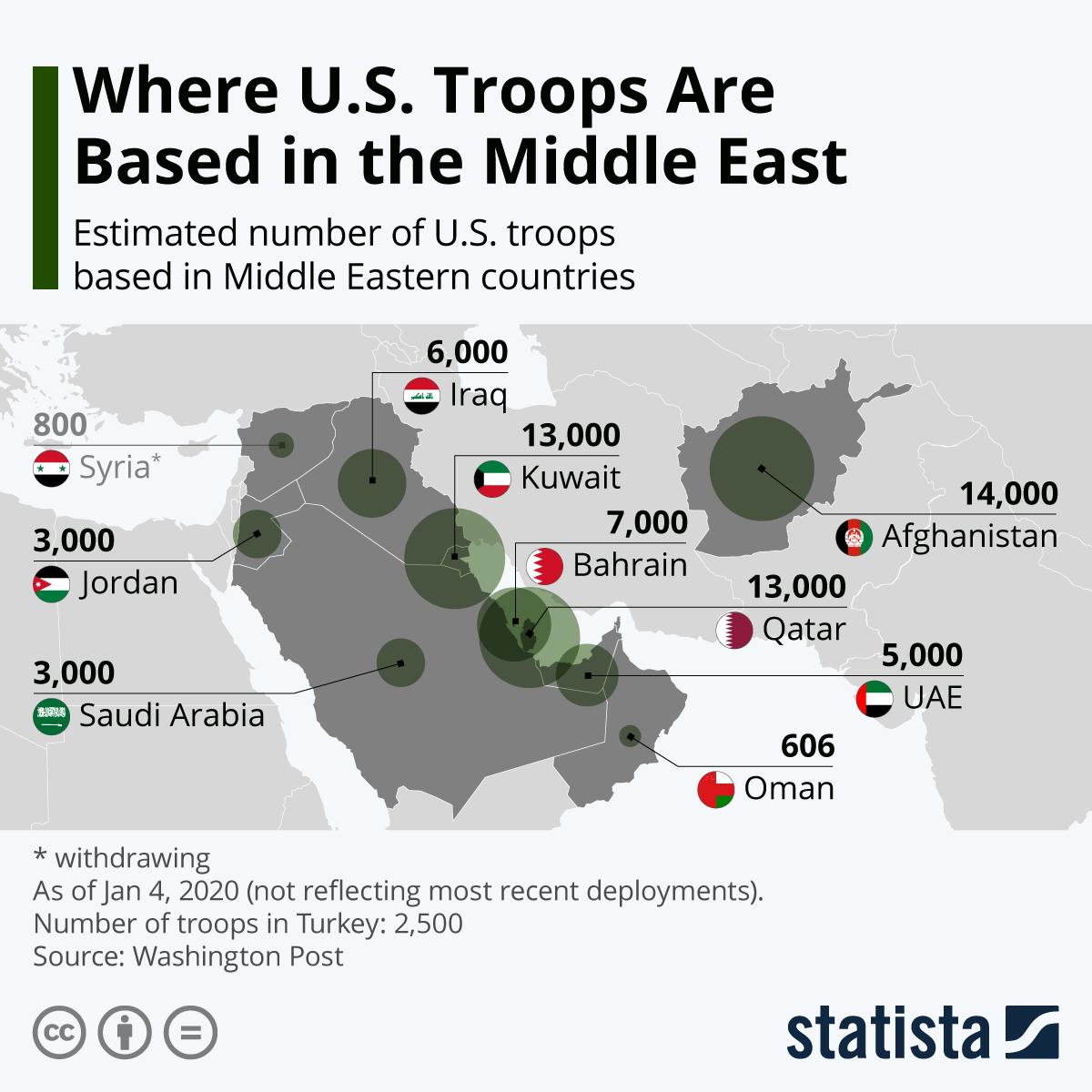
The fact is, the minor Houthi disruption of commercial traffic on the Red Sea is just one more reminder of why the US doesn’t need any of its 700 global bases, nor 100,000 military personal in Europe and roughly 100,000 in Korea, Japan and elsewhere in Asia, as well. And most especially it does not need aircraft carriers in the Red Sea, the Mediterranean Sea and the Persian Gulf – nor 50,000 American troops in Syria, Iraq. Kuwait, Bahrain etc.

These latter forces depicted below (sans Afghanistan), in fact, are all sitting ducks in harms’ way, waiting to get caught in the crossfire of local Shiite/Sunni conflicts or Israel’s perpetual conflict with its Arab and Muslim neighbors in the region. Yet all these forces would do exactly nothing to deter nuclear blackmailers or global armadas heading for the New Jersey shores, if such existed, which they do not.

And, no, there is not a sinister monster state in Iran behind all of the commotion, either. Iran poses zero threat to America’s homeland security. Period. It has no missiles capable of reaching the US and has no nukes at all, and would never get any had Trump not cancelled the 2015 nuclear agreement that Tehran was fully complying with.

Infographic: Where U.S. Troops Are Based In The Middle East | Statista

The fact is, even though all of these bases and US naval forces in the middle east region are of no benefit whatsoever to America’s homeland security, they are also actually a profound disservice to the security of Israel, as well. That is to say, just as in the case of loud-mouth adventurists in the Baltics and Poland, who poke the Russian Bear because the NATO Article 5 mutual defense commitment punitively has their back, Israel’s rightwing politicians operate on the same perverse incentives.

Owing to the US military shield, which is once again on display in the pointless bombings of the Houthi, Israel’s right-wing religious fanatics led by Bibbi Netanyahu continue to sabotage a two-state diplomatic solution and, instead, make war on their encircled enemies to the bitter end. And they are enabled to do so without leveling with the Israeli electorate about the true implications of going it alone as a Warfare State.

Thus, in the case of the Hamas matter currently at hand, if Israel wanted to safely and permanently incarcerate the Gaza strip and its 2.1 million population in an open-air prison, then it needed not only the Iron Dome to protect its population against Hamas’ primitive rockets, but also a full-time garrison along the border to putdown any breach of the Wall, and thereby preempt anything remotely like the catastrophe of October 7th.

To put a fine point to it, the Gaza strip is 25 miles long or 131,000 feet. If you put one IDF soldier every 6 feet, that’s a 22,000-man requirement. And on a 24/7 four shift basis that’s 88,000 troops in total at an average cost of $40,000 per soldier plus $20,000 for the overhead and generals. Overall, we are talking $5 billion of incremental military expense to make the Gaza prison break-proof, which amounts to about 1% of Israel’s $550 billion GDP.

All along, that’s been part of the unacknowledged incremental cost of the Garrison State alternative to a two-state settlement. It would have meant appreciably higher taxes on Israel’s citizen, but the bloody and barbaric breach by Hamas fighters on October 7th would have never happened, either.

In truth, however, Israel never even considered tightening its own economic belt to pay for the war policy that its militaristic and religious extremist government insisted upon. Netanyahu ceaselessly campaigned for decades implicitly on behalf of a Garrison State national security policy, but one funded on the cheap via a quasi-pacifist defense spending level.

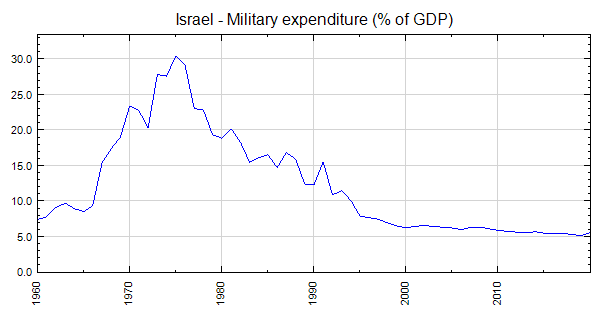
That’s right. Israel’s military expenditures had plunged from more than 20% of GDP at the time of the last existential crisis during the Yom Kippur War of 1973 to just 5% of GDP on the eve of the October 7 attacks. In effect, Netanyahu falsely told Israeli voters that they didn’t have to take the risks and make the territorial concessions implicit in a two-state and diplomatically-based solution to the Palestine problem. But at the same time, they could also avoid having to be taxed to the gills to pay for the alternative – a costly, heavily militarized Garrison State.

The wink and nod underlying this false solution, of course, was a pitiless willingness to keep Hamas in check by “mowing the grass” every few years in Gaza, as a desperate Israeli government has done once again to the horror of much of the civilized world.

So even more than the failure of Israel’s vaunted intelligence operations in the run-up to the October 7th massacres, the real deep policy failure is the flaccid blue line in the chart below, slouching toward 5.0% of GDP defense spending after the Netanyahu coalition came to dominate policy in the 1990s.

You simply can’t have a Garrison State policy—no negotiations with the Palestinians, no two-state solution, no continuation of the Oslo or other international negotiations process and the quarantine of 2.1 million largely destitute Palestinians in a congested dysfunctional strip of land cheek-by-jowl with the Mediterranean Sea—on a 5% of GDP war budget.

Israel - Military expenditure (% of GDP)

In short, Israel’s $25 billion defense budget is a pittance compared to its booming, technologically advanced and robust $550 billion national economy. The latter, in turn, is 20X larger than what had been the $28 billion that passes for an economy in the shambles of Gaza – a whisp of GDP mainly funded by foreign philanthropists and so-called malign actors in the region. And even that will soon virtually cease to exist.

Even if you count a few hundred million per year of aid from Iran and others that flows through Qatar to Hamas, there is simply no contest. Israel is an economic Goliath relative to the thin resources of the Hamas terrorist apparatus and does not need a US military shield in the region to ensure its survival. It just needs a government that will tell voters the truth about the real cost of the Netanyahu policy of perpetual war.

Needless to say, Bibi Netanyahu and his coalition of rightwing religious parties would have likely never stayed in power with their “rejectionist front” policy against an internationally brokered and superintended two-state arrangement had they leveled with the public about the immense increase in military spending and taxes these policies required.

But even that is not the half of it. The truth is, Netanyahu is a megalomaniacal madman who has had the reckless audacity to pursue an utterly dangerous Machiavellian strategy of promoting and funding Hamas in order to kill dead as a doornail any prospect whatever of a two-state arrangement.

The public record makes absolutely clear that this is what Netanyahu has done, even as he failed to tell the Israel’s public that this policy, in turn, necessitated a full-bodied Garrison State with painful tax increases to keep his Frankenstein monster contained inside the Gaza prison walls.

Israel Tax Revenue As % Of GDP, 1995 to 2021 

For want of doubt, the facts are these. Between 2012 and 2018 Netanyahu gave Qatar approval to transfer a cumulative sum of nearly one billion dollars to Gaza in the form of suitcases full of cash. And at least half of that is estimated to have reached Hamas, including its military wing.

According to the Jerusalem Post,

……in a private meeting with members of his Likud party on March 11, 2019, Netanyahu explained the reckless step as follows: The money transfer is part of the strategy to divide the Palestinians in Gaza and the West Bank. Anyone who opposes the establishment of a Palestinian state needs to support the transfer of the money from Qatar to Hamas. In that way, we will foil the establishment of a Palestinian state (as reported in former cabinet member Haim Ramon’s Hebrew-language book “Neged Haruach”, p. 417).

In an interview with the Ynet news website on May 5, 2019, Netanyahu associate Gershon Hacohen, a major general in reserves, said, “We need to tell the truth. Netanyahu’s strategy is to prevent the option of two states, so he is turning Hamas into his closest partner. Openly Hamas is an enemy. Covertly, it’s an ally.

Indeed, earlier that spring Netanyahu himself was widely quoted as saying during the aforementioned meeting of Likud MKs that,

“Whoever opposes a Palestinian state must support delivery of funds to Gaza (cash in suitcases from Qatar) because maintaining separation between the PA in the West Bank and Hamas in Gaza will prevent the establishment of a Palestinian state.”

So Israel’s governing faction of religious extremists, militarists, messianic settlers and Eretz Yisrael ideologues have chosen, instead, to live in a Garrison State and to be periodically compelled to “mow the grass” in the Gaza outdoor prison. Yet if its rightwing governments want to operate a modern-day Sparta, they need to tap their own taxpayers first.

In the meanwhile, the Donald and his minions need to truly sober up. Uncle Sam’s checking account is massively overdrawn. Now is not the time to fund wars which do nothing for America’s homeland security (Ukraine) or to perpetuate yet another war on behalf of an “ally” that is unwilling to pay for the Garrison State its own blood-soaked, perpetual war policies require.

David Stockman was a two-term Congressman from Michigan. He was also the Director of the Office of Management and Budget under President Ronald Reagan. After leaving the White House, Stockman had a 20-year career on Wall Street. He’s the author of three books, The Triumph of Politics: Why the Reagan Revolution FailedThe Great Deformation: The Corruption of Capitalism in America, TRUMPED! A Nation on the Brink of Ruin… And How to Bring It Back, and the recently released Great Money Bubble: Protect Yourself From The Coming Inflation Storm. He also is founder of David Stockman’s Contra Corner and David Stockman’s Bubble Finance Trader.


War, Doublethink, and the Struggle for Survival: Geopolitics of the Gaza Genocide


In a genocidal war that has spiraled into a struggle for political survival, Israeli Prime Minister Benjamin Netanyahu’s coalition and the global powers supporting him continue to sacrifice Palestinian lives for political gain.

The sordid career of Israel’s extremist National Security Minister, Itamar Ben-Gvir, epitomizes this tragic reality.

Ben-Gvir joined Netanyahu’s government coalition following the December 2022 elections. He remained in the coalition after the October 7 2023 war and genocide, with the understanding that any ceasefire in Gaza would force his departure.

As long as the killing of Palestinians and the destruction of their cities continued as long as Ben-Gvir stayed on board – though neither he nor Netanyahu had any real ‘next-day’ plan, other than to carry out some of the most heinous massacres against a civilian population in recent history.

On January 19, Ben-Gvir left the government immediately following a ceasefire agreement, which many argued would not last. Netanyahu’s untrustworthiness, along with the collapse of his government if the war ended completely, made the ceasefire unfeasible.

Ben-Gvir returned when the genocide resumed on March 18. “We are back, with all our might and power!”  he wrote In a tweet on the day of his return.

Israel lacks a clear plan because it cannot defeat the Palestinians. While the Israeli army has inflicted suffering on the Palestinian people like no other force has against a civilian population in modern history, the war endures because the Palestinians refuse to surrender.

Yet, Israel’s military planners know that a military victory is no longer possible. Former Defense Minister Moshe Ya’alon recently added his voice to the growing chorus, stating during an interview on March 15 that “revenge is not a war plan”.

The Americans, who supported Netanyahu’s violation of the ceasefire – thus resuming the killings – also understand that the war is almost entirely a political struggle, designed to keep figures like Ben-Gvir and extremist Finance Minister Bezalel Smotrich in Netanyahu’s coalition.

Though “war is the continuation of politics by other means,” as Prussian General Carl von Clausewitz once surmised, in Israel’s case, the ‘politics’ behind the war is not about Israel as a state but about Netanyahu’s own political survival. He is sacrificing Palestinian children to stay in power, while his extremist ministers do the same to expand their support among right-wing, religious, and ultra-nationalist constituencies.

This logic – that Israel’s war on Gaza reflects internal politics, ideological warfare, and class infighting – extends to other political players as well.

The Trump administration supports Israel as payback for the financial backing it received from Netanyahu’s supporters in the US during the last elections. On the other hand, Britain remains steadfast in its commitment to Tel Aviv, despite the political shifts in Westminster, thus continuing to align with US-Israeli interests while disregarding the wishes of its own population. Meanwhile, Germany, it’s said, is driven by the guilt of its past crimes, while other Western governments pay lip service to human rights, all the while acting in ways that contradict their stated foreign policies.

This mirrors the dystopian world of George Orwell’s ‘1984’, where perpetual war is waged based on cynical and false assumptions, where “war is peace… freedom is slavery… and ignorance is strength.”

Indeed, these elements are reflected in today’s equally dystopian reality. However, Israel substitutes ‘peace’ with ‘security,’ the US is motivated by dominance and ‘stability,’ and Europe continues to speak of ‘democracy.’

Another key difference is that Palestinians do not belong to any of these ‘superstates.’ They are treated as mere pawns, their deaths and enduring injustice used to create the illusion of ‘conflict’ and to justify the ongoing prolongation of the war.

The deaths of Palestinians – now numbering over 50,000 – are widely reported by mainstream media outlets, yet rarely do they mention that this is not a war in the traditional sense, but a genocide, carried out, financed, and defended by Israel and Western powers for domestic political reasons. Palestinians continue to resist because it is their only option in the face of utter destruction and extermination.

Netanyahu’s war, however, is not sustainable in the Orwellian sense, either. For it to be sustainable, it would need infinite economic resources, which Israel, despite US generosity, cannot afford. It would also need an endless supply of soldiers, but reports indicate that at least half of Israel’s reserves are not rejoining the army.

Furthermore, Netanyahu does not merely seek to sustain the war; he aims to expand it. This could shift regional and international dynamics in ways that neither Israeli leaders nor their allies fully understand.

Aware of this, Arab leaders met in Cairo on March 4 to propose an alternative to Netanyahu-Trump’s plan to ethnically cleanse Palestinians from Gaza. However, they have yet to take meaningful action to hold Israel accountable if it continues to defy international and humanitarian laws – as it has since the Arab summit.

The Arab world must escalate beyond mere statements, or the Middle East may endure further war, all to prolong Netanyahu’s coalition of extremists a little longer.

As for the West, the crisis lies in its moral contradictions. The situation in Gaza embodies Orwell’s concept of “doublethink” – the power of holding two contradictory beliefs in one’s mind simultaneously and accepting both. Western powers claim to support human rights while simultaneously backing genocide. Until this dilemma is resolved, the Middle East will continue to endure suffering for years to come.

Dr. Ramzy Baroud is a journalist, author and the Editor of The Palestine Chronicle. He is the author of six books. His latest book, co-edited with Ilan Pappé, is Our Vision for Liberation: Engaged Palestinian Leaders and Intellectuals Speak Out. His other books include My Father was a Freedom Fighter and The Last Earth. Baroud is a Non-resident Senior Research Fellow at the Center for Islam and Global Affairs (CIGA). His website is www.ramzybaroud.net.

Diego Garcia Smells Like War

A significant amount of US military power has been on the move over this past week, including several B-2 strategic bombers which have landed at the US military base in Diego Garcia in the Indian Ocean just over 2,000 miles southeast of Iran. According to press reports this is the most significant B-2 presence on the Island in nearly half a decade. In addition flight trackers are showing increased activity by at least nine KC-135R refueling aircraft in the region. Several C-17 cargo planes have also been spotted by satellites on the Island.

The US President has ordered US Carrier Strike Group Carl Vinson to the Mideast.

While the Administration continues to escalate its illegal bombing campaign against Yemen – some are reporting more than 60 strikes today alone and President Trump promises that they will continue “for a long time” – speculation is increasing that the Diego Garcia build-up is the beginning of the long process of positioning US military muscle for an attack on Iran.

President Trump today warned although his “big preference is we work it out with Iran…if we don’t work it out, bad bad things are gonna happen with Iran.”

So is the US president elected with the promise to end wars rather than start them ready to launch a war against the modern, technologically-advanced nation of 90 million with an extremely complicated terrain, advanced military capabilities, and a newly-signed strategic partnership treaty with Russia?

No one knows.

Congress seems uninterested in its Constitutional obligation to serve as the red light or green light for war – there has been nary a peep over Trump’s bombing of Yemen to, as his top aides were caught saying, “send a message.” Does anyone believe they will come out of their slumber as Hegseth, Waltz, Rubio, and the rest of the gang that couldn’t shoot straight (or at least plan a war on Signal straight) position the US for an attack on Iran?

Trump has continued – and perhaps even accelerated – in his second term a pattern of extreme rhetorical escalation followed by retrenchment possibly as a means of gaining the attention of the party he is addressing. For example he warned Russia earlier this month that he would increase sanctions and destroy its economy before backing down to a series of lengthy phone calls and lately capitulating to all of Russia’s demands.

So is this a big bluff to get Tehran back to negotiate the deal that Trump himself abrogated when he took office the first time? (And if so, why would Iran trust Washington this time)? Or will Trump (again) heed the call of Israel’s Netanyahu and expend US blood and treasure to take out Israel’s enemies?

Already Trump’s top picks, including his ambassador to Tel Aviv Mike Huckabee who is doing his best Colin Powell impression – claiming that as soon as Iran takes out Tel Aviv it will turn its sights to Tennessee – are urging action against “the head of the snake” as Bibi is wont to describe Iran. The pieces are falling into place and Trump’s entire cabinet is chock full of individuals for whom a war with Iran is the single most important item on the foreign policy agenda.

As analyst William Schryver points out, Iran is certainly not Yemen, Afghanistan, Saddam’s Iraq, Gaddafi’s Libya, or Noriega’s Panama. The United States under four years of mismanagement by whoever was acting as Biden’s brain has already thrown everything it had available in attempt to secure a strategic defeat for Russia and lost. The DC neocons move from failure to failure without skipping a beat, even as the US economy is bled dry by the war machine.

This war would be the end of Trump’s presidency and could well be the end of the US economy itself. All for an outrageous domino theory presented by (to a large degree) US religious extremists not unlike the religious extremists they claim to oppose abroad – that Tehran is seeking to “take over” the United States. It’s bonkers…yet for those of us who spend decades watching US foreign policy bonkers usually wins the day. Strap in…

Reprinted from The Ron Paul Institute for Peace and Prosperity.

Daniel McAdams is Executive Director of the Ron Paul Institute for Peace and Prosperity and co-Producer/co-Host, Ron Paul Liberty Report. Daniel served as the foreign affairs, civil liberties, and defense/intel policy advisor to U.S. Congressman Ron Paul, MD (R-Texas) from 2001 until Dr. Paul’s retirement at the end of 2012. From 1993-1999 he worked as a journalist based in Budapest, Hungary, and traveled through the former communist bloc as a human rights monitor and election observer.