Tuesday, May 13, 2025


Cruel Britannia: British Complicity in Genocide


This visual exposes Britain’s extensive collaboration with Israel’s genocide in Gaza. British military forces, arms manufacturers, and industries provide supply lines and military parts that Israel depends on to continue its aggression against Palestinians. While Israeli jets reduce Gaza to rubble, Britain’s politicians bypass their own laws regulating weapons sales to keep these planes flying.

Visualizing Palestine is the intersection of communication, social sciences, technology, design and urban studies for social justice. Visualizing Palestine uses creative visuals to describe a factual rights-based narrative of Palestine/Israel. Read other articles by Visualizing Palestine, or visit Visualizing Palestine's website.

Commemorating Mummy: Reflections on Mother’s Day


Commercial gimmicks are sometimes impossible to beat off. Their stench and pull follow, even as you look the other way. One occasion is most prominent in this regard.  Nostrils get clogged and eyes get fogged, and the message is this: Remember Mommy.

Mothers’ Day is rarely more than the draw and pull of extracted business and mined guilt. This is the worshipped and leveraged, the human breeder elevated and remembered, if only for one day. It resembles, in some ways, the link between poverty and the church box of charity. Give a few coins and save the child. Your conscience can rest easy.

The day itself denigrates the mother in false respect and guilts the family for ignorance of that fact. It sanctifies a family relation for reasons of commercial worth. Suddenly, Mummy escapes her metaphorical sarcophagus, the nursing home, the flat, and finds herself seated at the end of a table with regrets. The hideous spectacle follows. The grumbling, the sneers. Mummy wonders what she is doing there. Monument? Reminder? A disgusting reminder to die off? Thoughts turn to the will.

It was not necessarily intended that way. In the aftermath of the American Civil War (1861-65), Julia Ward Howe, author of the Battle Hymn of the Republic, proposed that women unite in common cause and promote peace. In time, it would become the Mother’s Day Proclamation. In 1908, the idea became more concrete with West Virginian Anna Marie Jarvis’s church memorial in honour of her mother, Ann Reeves Jarvis.  Ann Jarvis had been a committed peace activist, aiding wounded soldiers during the Civil War.

On May 9, 1914, US President Woodrow Wilson officially announced the establishment of Mother’s Day as a national observance to be held annually on the second Sunday of May. Such observance was to involve the display of the American flag on government buildings and private residences “as a public expression of our love and reverence for the mothers of our country.”

Mother’s Day in Australia only took off with Sydney’s Janet Heyden, who insisted in 1924 on remembering the aging mothers at Newington State Hospital, many of whom had been widowed by the calamitous slaughter of the First World War.  As an activist, she encouraged local schools and businesses to furnish the ladies with donated gifts.  In its more modern iteration, it has evolved into a family affair.  As Australian historian Richard Waterhouse benignly describes it, “It’s not just about recognising the role of mothers, though that’s still there, but it’s really recognising Mother’s Day as a day in which families can get together.”

As with other days of elected memory, Mother’s Day draws in the retail and restaurant dollars.  Guilty emotions are easy fodder for the capitalist impulse.  Unremarkably, it was the United States that propelled its commercialisation, beginning with card companies like Hallmark and enterprising florists keen to make a profit.  Jarvis, so instrumental in establishing the tradition, took to loathing it, attacking such marketing gimmicks as “Mother’s Day Salad”.  For years, she harangued politicians, organised protests, and sought audiences with presidents to arrest the trend towards commodification.  Such efforts eventually exhausted her, leading to a lonely, poor death in a sanatorium.

Even as the Second World War raged, the scope of merchandise in anticipation of the day burgeoned.  An April 1941 issue of New York’s Women’s Wear Daily notes how “Mother’s Day as a gift event has continued to grow in importance, and is now second only to Christmas”.  In Dallas, one Margaret Evans, promotion manager of A. Harris & Co., enthused at the growing number of departments offering gift choices for the occasion.  These included bags, gloves, hosiery, handkerchiefs, toiletries, and jewellery.

Eventually, women’s libbers cottoned on to the idea that a commemorative occasion supposedly emphasising the importance of mothers had been hijacked and shamelessly exploited.  In 1971, a pamphlet issued by the Adelaide women’s liberationists suggested that the woman remained invisible, a chained martyr to the home, a slave to domestic chores, and the cult of domesticity.  Mother’s Day was that one occasion of the year that a woman’s invaluable role in the home was acknowledged, and even then, only imperfectly.  Such a mother’s “basic needs”, including a degree of independence from their children, remained unmet.  But the pamphlet went further, arguing that women “renounce [their] martyrdom” and reenvisage themselves as human beings and “not just ‘mum’.”

The nexus with children was also a point of comment in that decade.  Radical feminist Shulamith Firestone’s The Dialectic of Sex: The Case for Feminist Revolution took solid aim at the distorting role played by parenting and mothering in the formation of children. Implicit in her argument was that both the mother and the child needed emancipation.  It remains a pertinent point, even as the swamp of commercialisation looks deeper than ever.

Binoy Kampmark was a Commonwealth Scholar at Selwyn College, Cambridge. He lectures at RMIT University, Melbourne. Email: bkampmark@gmail.comRead other articles by Binoy.

Russia, the Defeat of Nazism, and the Collaborationist West


On May 9 Russia welcomed twenty-seven heads of state from around the world to commemorate the 80th anniversary of the conclusion of the Great Patriotic War, which ended in victory over the Nazis, one of the greatest achievements in Russian history, and one that would make any nation justly proud.

The United States likes to portray the defeat of Nazism as a glorious U.S. achievement, with a nod to British, Canadian, Australian, French and a few others for their supporting roles. This ignores the central fact that the Wehrmacht had been ground nearly to pulp by the time the U.S. invaded Normandy on June 6, 1944, an event that 80 years of Hollywood fantasies have attempted to transform into the key battle of the war. In reality, however, this much-delayed opening of a second front in the European war occurred when Hitler’s troops had been reduced to mostly children and old men, the military-aged soldiers having perished in gargantuan numbers on the Eastern front. Tens of millions of Soviet soldiers and civilians were also killed there, a large majority deliberately starved by Hitler, who looked to eliminate Slavic peoples and re-populate their territories with a civilized master race of “Aryans.”

U.S. mind-managers have dispatched this immense Russian agony to Orwell’s memory hole, along with the suffering of the Chinese, who lost about half as much as the USSR on the battlefield (which was still an enormous total) in horrendous camps, and in “scientific” laboratories that treated them like experimental rats. British, French, and American losses, especially civilian deaths, were but a tiny fraction of these.

The ferocity of the battles fought in Leningrad, Moscow, Stalingrad, and Kursk defies description and is well beyond the West’s impoverished moral capacity to even begin to apprehend. Three million Nazi soldiers invaded the USSR with the launching of Operation Barbarossa on June 22, 1941.  This represented eighty percent of the German Army, almost all of whom were either killed, captured, or wounded over the subsequent three years. Meanwhile, the USSR not only fought the invading Germans, but also ardent Nazi-supporters in Poland, Ukraine, Hungary, Romania, and Bulgaria, along with other European countries that facilitated German military operations and replaced fallen German soldiers in battle.

Both Churchill and FDR accepted that it was the USSR that defeated the Nazis. Western supplies helped, but it was the heart and determination of the Red Army that brought the Nazi beast down.

After the war, the Western powers obscured this story with a fanciful tale of being the most heroic human rights champions in history. But it was actually the Red Army that shot anti-Semites while Western myth-makers re-invented the Jew-haters as anti-Communist freedom fighters worthy of admiration.

Renewing the Cold War it had initiated in 1917 in reaction to the Bolshevik Revolution, Washington imposed a “cordon-sanitaire” in order to eradicate Communism in Western Europe, a broadly-defined demon class that included major elements of the wartime anti-fascist resistance and trade union movements while those who had accommodated Nazism or gone into hiding faced no such exclusion.

Today’s inheritors of collaborationist Europe have redoubled their attacks on Russia with economic sanctions and anti-Russian “human rights” tribunals, all in the name of a “never again” anti-genocide crusade that lacks even the slightest pretense of concern for Israel’s ongoing extermination of the Palestinian people.

Our problems go far beyond Donald Trump.

Source:

“Victory Day: Rescuing the Truth,” La Jornada, May 10, 2025 (Spanish)

Michael Smith is the author of "Portraits of Empire." He co-blogs with Frank Scott at www.legalienate.blogspot.com He co-blogs with Frank Scott at www.legalienate.blogspot.comRead other articles by Michael.

President Trump’s Proposal to Eliminate Income Taxes: Can It Be Done?


In February, President Trump said that tariffs would generate so much income that Americans would no longer need to pay income taxes.

The latest plan, according to U.S. Commerce Secretary Howard Lutnick, is to abolish income taxes for people who earn less than $150,000 yearly. That move would affect roughly 75% of workers, according to U.S. Census Bureau data. On its face, this could narrow the wealth gap by boosting disposable income for low- and middle-income households without raising taxes on the wealthy — a politically clever alternative to progressive tax hikes.

Eliminating the burden of income taxes is an exciting proposition, due to savings not just in money but in man-hours — the time spent anguishing over ledgers, forms and receipts. In 2024, according to the Tax Foundation, Americans spent 7.9 billion hours complying with IRS tax filing and reporting requirements. That is equivalent to 3.8 million full-time workers—roughly the population of Los Angeles — doing nothing but tax paperwork for the full year.

The question is, can tariffs and DOGE replace income taxes? If not, how else could the government fund itself? Is a growing debt bubble that is now carrying a $1.2 trillion interest tab, which must continue to expand just to sustain itself, the only alternative?

How Eliminating Middle Class Taxes Would Affect the Budget

In a March 21 article titled “Ending Taxes Below $150,000 Would Lose $10 to $15 Trillion,” the Committee for a Responsible Federal Budget concludes:

Even if enacted in a targeted manner, we estimate such a change would reduce revenue by roughly $10 trillion through 2035 if applied to income taxes only and $15 trillion if applied to employee-​side payroll taxes as well. …

If enacted relative to current law, ending taxes on income below $150,000 would boost debt by $12 to $18 trillion with interest, increasing debt-​to-​GDP to between 145 and 160 percent – compared to 118 percent under current law.… Importantly, Commerce Secretary Howard Lutnick has said the proposal would be contingent on achieving budget balance first.

Dividing the $10 trillion lost over 10 years (2025–2035) gives a $1 trillion loss per year on average, though there may be year-to-year variations. Trump’s team proposes to offset this loss with savings from the Department of Government Efficiency (DOGE) and new tariff revenues, but the math doesn’t look good.

The Prospects from Tariffs and DOGE

Elon Musk’s DOGE has identified significant areas of federal “waste, fraud and abuse,” but the program was originally projected to save $2 trillion by slashing misused funds. At Trump’s cabinet meeting on April 10, Musk said he expects the agency to find $150 billion in savings in fiscal year 2026, a number significantly lower than even the $1 trillion he said in February he was confident DOGE would find.

Tariffs remain Trump’s primary funding mechanism. He has frequently referenced the 19th century, when there was no income tax, and tariffs were the principal source of revenue for the U.S. government. In his Liberation Day speech on April 2, he said, “From 1789 to 1913, we were a tariff-backed nation, and the United States was proportionately the wealthiest it has ever been.” Trump’s particular hero is Pres. William McKinley, whose 1890 tariff of nearly 50% was a high point of the tariff policy.

The problem is that in the 19th century, the U.S. government had far fewer costs. Among other expenses, there was no Social Security, no Medicare and no trillion dollar interest to be paid to investors.

As originally proposed, Trump’s tariffs included a 10–20% universal tariff and up to 60% on Chinese imports. At that rate, the Tax Foundation estimated that the tariffs could raise $1 trillion over a decade ($100 billion/year) after accounting for reduced imports, while the Tax Policy Center put the figure as high as $2.8 trillion ($280 billion/year).

These projections remain speculative, since the results of the trade deals being negotiated are yet to be reported. On April 30, the president stated that negotiations had already resulted in $8 trillion in promised investment in U.S. production, an impressive number, but investments take several years to manifest as new tax income.

For the near term, DOGE cuts at $150 billion per year and tariffs estimated at $280 billion per year would cover less than half the trillion dollar loss projected from middle-class tax cuts. And that is without touching the $1.9 trillion deficit already projected by the Congressional Budget Office, something Commerce Sec. Lutnick said would have to be eliminated before income tax relief could be considered.

The Elephant in the Room

Even if new trade deals manage to cover the full deficit, the unprecedented federal debt will continue to loom. Currently standing at $36.21 trillion, the debt comes with interest payments projected to hit $1.2 trillion in 2025. That works out to $3.3 billion per day. In effect, all of our middle-class income taxes are being spent just to pay interest to bondholders, foreign and domestic.

Interest costs are expected to rise from 9% of federal revenue in 2021 to 23% by 2034, crowding out federal priorities like infrastructure and healthcare. And that assumes bond buyers keep rolling over the debt at current rates. For FY 2025, an estimated $9.2 trillion — fully a quarter of the debt — will come due and need to be refinanced. What if foreign countries, which hold approximately 30% of the debt, decide to invest elsewhere?

The most efficient to fill the trillion dollar hole left in the budget if middle-class income taxes are eliminated might be to take an axe to the trillion dollar interest tab and the federal debt sustaining it. But how?

Even Quantitative Easing Won’t Work to Eliminate the Interest Burden

Many economists think new rounds of quantitative easing (QE) are necessary, as the only way to keep Treasury interest rates low. QE is a maneuver by which Treasury debt is purchased by the Federal Reserve with newly issued bank reserves. The debt could theoretically be eliminated by having the Fed buy the securities as they come due. Assuming $9.2 trillion in debt maturing annually, the whole debt could be moved onto the books of the Fed in about four years, and since the Fed is required to rebate its profits to the Treasury after deducting its costs, this could theoretically eliminate the interest burden. But there are two wrinkles:

(1) The Fed is not allowed to buy federal securities directly from the Treasury. It primarily conducts its open market operations, including QE Treasury purchases, through primary dealers, a select group of large financial institutions designated by the Fed to act as its counterparties in the open market.

(2) Ever since 2008, the Fed has been paying interest on the banks’ reserve balances (IORB), which counts in the costs it deducts from the profits it returns to the Treasury. The rate on IORB set by the Fed is 4.4% as of May 2, 2025, while the average interest rate on the federal debt is approximately 3.3% for the fiscal year-to-date 2025.

Thus if the Fed were to buy $9.2 trillion in federal securities this year, it would receive $9.2 trillion × 3.3% in interest but would have to pay IORB on the same $9.2 trillion at 4.4% to the banks, a net loss to the Fed. In effect, the banks would be receiving the interest rather than the Treasury, unless a couple of laws were changed, and changing them would no doubt meet with heavy resistance from the powerful banking lobby.

Why, you may ask, does the Fed feel it needs to pay interest on bank reserves? Good question. It’s a monetary policy tool designed to curb inflation by setting a floor on the fed funds rate, the rate at which banks lend to each other. Since banks won’t lend at rates lower than they can safely earn from the Fed, it’s a way to keep interest rates high. But the result has been that the banks have simply reduced their lending. Why lend to risky local businesses when they can sit back and collect a safe and ample return from the Fed itself?

It’s a controversial windfall to the banks, to support an interest rate that is itself controversial. But the bottom line is that the Fed is not able to bail out the government from its trillion dollar interest tab. What then is to be done?

A Radical Alternative Whose Time Has Come

Given the president’s predilection for 19th century economics, he could go a bit further back than to President McKinley. Abraham Lincoln, the first Republican president, avoided a crippling national debt by resorting to the funding mechanism of the American colonists: let the government print the money directly, not through a banker-controlled central bank but through the Treasury. The government could buy back its debt with U.S. Notes or “Greenbacks,” as permitted under the Constitution (Article I, Section 8) and declared legal by the Supreme Court. These new currencies could then be used to repurchase maturing Treasury securities debt- and interest-free.

Critics will cry “hyperinflation,” arguing that the newly-issued currency would flood the economy, spiking demand and prices. But if new money is directed to productive investments — for example infrastructure, energy, and healthcare — supply and demand will rise together, stabilizing prices. The Chinese demonstrated this in the 25 years from 1996 to 2025, when their domestic money supply was inflated from 4,840 CNY (Chinese yuan) to 320,526 CNY, or by 5500%; yet the price level remained stable and low. For a fuller explanation with data, see my earlier article here.

To ensure that the Greenbacks finance growth, a national infrastructure bank could channel funds into projects such as affordable housing, high-speed rail, broadband, the power grid and large water and transportation projects. China is again the modern model. It has three giant “policy banks” assigned to implement the policies of the government, including China Development Bank, the world’s largest infrastructure and development bank. A U.S. version could prioritize projects with high economic returns, vetted by transparent, DOGE-like algorithms to prevent waste and cronyism.

We desperately need infrastructure funding, and the current federal budget has no room to adequately address those needs. A viable proposal for a national infrastructure bank, H.R. 4052, currently has 47 cosponsors. The bank would use off-budget financing on the model of the Reconstruction Finance Corporation, the federal financial agency that rebuilt the country’s infrastructure during the banking crisis of the 1930s. For more information, see the NIB Coalition website.

For state and city governments, public banks on the model of the Bank of North Dakota could address local infrastructure needs. See my earlier article here and the Public Banking Institute website.

Prosperity Without Debt

It has been argued that “just printing the money” would jeopardize the federal government’s credit rating. Perhaps, but we wouldn’t need credit if we could create our own, debt-free. To repeat an editorial directed against Lincoln’s debt-free Greenbacks attributed to the 1865 London Times, which may be apocryphal but nevertheless demonstrates the possibilities:

If that mischievous financial policy which had its origin in the North American Republic during the late war in that country, should become indurated down to a fixture, then that Government will furnish its own money without cost. It will pay off its debts and be without debt. It will become prosperous beyond precedent in the history of the civilized governments of the world. The brains and wealth of all countries will go to North America. That government must be destroyed or it will destroy every monarchy on the globe.

Lincoln’s Greenback policy was indeed destroyed, along with the president who dared to implement it. But the U.S. government is powerful enough today to pull that “mischievous financial policy” off. A Greenback-funded debt buyback could offer a way to pay down debt without interest costs, while spurring growth through targeted investments monitored through a national infrastructure bank and local public banks to absorb demand productively. In several years, the whole $1.2 trillion interest tab could be slashed from the budget, making our trillion dollar middle-class income tax payments that barely cover that expense unnecessary.

The full budget could even be funded with Treasury-issued Greenbacks, eliminating the need for taxes at all. DOGE has demonstrated the possibilities for monitoring the government’s expenditures transparently and accountably with artificial intelligence. And as AI progressively replaces jobs, the government will need some form of universal basic income to supplement or replace worker salaries, perhaps “Social Security for All.”

Granted, that raises new issues around the privacy and programmability of a government-issued digital currency. But as Cornell Prof. Robert Hockett argues in his book, The Citizens’ Ledger, these can be overcome with cryptographic protections. For people leery of digital government-issued dollars, the Treasury could exercise its constitutional power to issue coins and paper dollar bills. Those are all complicated issues for another article, but the possibilities are provocative. We can escape the debt trap engineered by a private banking system that creates money as debt at interest – and escape the middle-class income taxes paying for that interest – by returning the sovereign power to issue money to the Treasury.

  • This article was first posted as an original to ScheerPost.com.
  • Ellen Brown is an attorney, co-chair of the Public Banking Institute, and author of thirteen books including Web of DebtThe Public Bank Solution, and Banking on the People: Democratizing Money in the Digital Age. She also co-hosts a radio program on PRN.FM called “It’s Our Money.” Her 400+ blog articles are posted at EllenBrown.com. Read other articles by Ellen.

     U.S. President Doubts He Must Adhere to the U.S. Constitution


    U.S. President Trump, when asked by NBC News on May 4th whether he is required to carry out — never violate — the U.S. Constitution, said, “I don’t know. I’m not, I’m not a lawyer. I don’t know.” The Oath of Office that he has twice taken, is “I do solemnly swear (or affirm) that I will faithfully execute the Office of President of the United States, and will to the best of my ability, preserve, protect and defend the Constitution of the United States.” Trump does not think that as President he is obligated by that oath to never violate the U.S. Constitution. He said this right there, on May 4. Here is the excerpt where he said this, from the interview, starting where the interviewer asked the question, up to where she abandoned the matter:

    Kristen Welker: Your secretary of state says everyone who’s here, citizens and non-citizens, deserve due process. Do you agree, Mr. President?

    President Donald Trump: I don’t know. I’m not, I’m not a lawyer. I don’t know.

    Kristen Welker: Well, the Fifth Amendment says as much.

    President Donald Trump: I don’t know. It seems — it might say that, but if you’re talking about that, then we’d have to have a million or 2 million or 3 million trials. We have thousands of people that are some murderers and some drug dealers and some of the worst people on Earth.

    Kristen Welker: But is — 

    President Donald Trump: Some of the worst, most dangerous people on Earth. And I was elected to get them the hell out of here and the courts are holding me from doing it.

    Kristen Welker: But even given those numbers that you’re talking about, don’t you need to uphold the Constitution of the United States as president?

    President Donald Trump: I don’t know. I have to respond by saying, again, I have brilliant lawyers that work for me, and they are going to obviously follow what the Supreme Court said. What you said is not what I heard the Supreme Court said. They have a different interpretation.

    Kristen Welker: Is anyone in your administration right now in contact with El Salvador about returning Abrego Garcia to the United States?

    She abandoned the matter, though it is the most important matter that any U.S. citizen ought to consider regarding the President; and, so, continuing any further with her canned list of questions there, was displaying her incompetence. For example, she could have asked him, “What did you twice swear to as you took the Presidential Oath of Office?,” but chose not to. She could have asked him “Why do you need to be told this by your lawyers, though it’s right there in the Oath that you twice swore to?” But she chose not to.

    On May 11 (exactly a week later), Politico headlined “Hill leaders question Trump’s attempted Library of Congress takeover.” It IS the library of Congress; it is part of the Legislative Branch, not of the Executive Branch; and, so, it is controlled by the Congress if America still has a Constitutional Government. But, according to Politico’s report, this is merely a political squable between all Democrats, on the one hand, versus almost all Republicans, on the other. “Congressional Democrats have castigated Trump’s moves at the library and have called for Congress to end the president’s power to nominate the top librarian.” However, the real question here is not “the president’s power to nominate the top librarian.” It is instead whether the Congress will uphold the Constitution by slamming down, with at least near unanimity, the President’s ability to hire or fire anyone to act in that capacity WITHOUT A PRIOR congressional vote on any such decision.

    Maybe it is not ONLY the President who is spitting upon the U.S. Constitution, but the members of Congress also. The congressional oath of office is:

    “I, (name), do solemnly swear (or affirm) that I will support and defend the Constitution of the United States against all enemies, foreign and domestic; that I will bear true faith and allegiance to the same; that I take this obligation freely, without any mental reservation or purpose of evasion, …

    Is “mental reservation or purpose of evasions” what the people who voted for such traitors had voted for? This is why America has been proven, time and again (at least after 1980) to be a dictatorship, ruled by its political megadonors, who always get their ways, while the public do not.

    Has the rot in Washington reached so deep that it IS the Government? Apparently so.

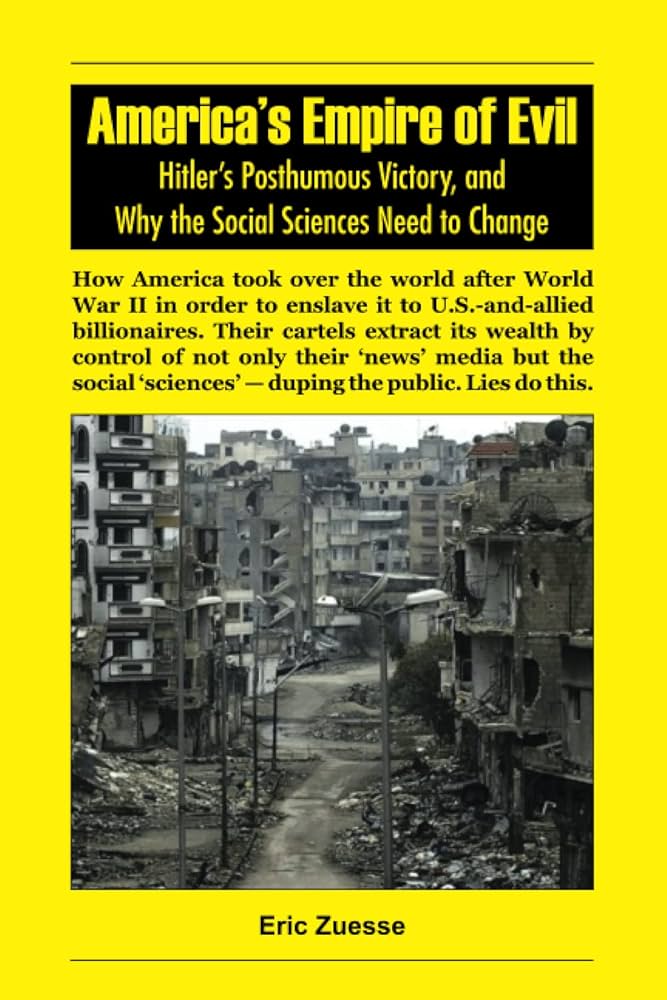
    Eric Zuesse is an investigative historian. His new book, America's Empire of Evil: Hitler’s Posthumous Victory, and Why the Social Sciences Need to Change, is about how America took over the world after World War II in order to enslave it to U.S.-and-allied billionaires. Their cartels extract the world’s wealth by control of not only their ‘news’ media but the social ‘sciences’ — duping the public. Read other articles by Eric.