Tuesday, May 13, 2025


The Triumph of Realism in Foreign Aid


 May 13, 2025
Facebook

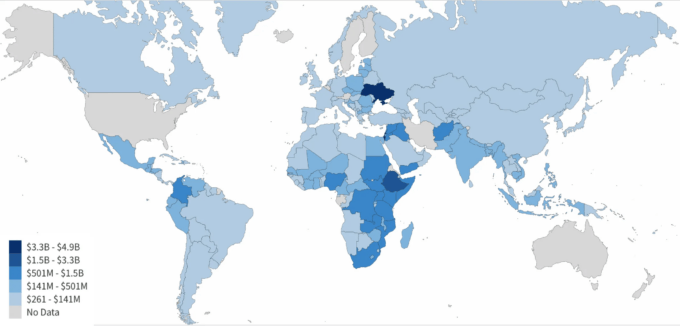
US foreign aid by country 2022 – Public Domain

Among the Trump administration’s many disturbing shifts in foreign policy, one of its more shameful moves has been to use foreign aid as a tool for advancing U.S. national power.

Rather than claiming that foreign aid stems from a genuine concern for the well-being of humanity, as previous administrations have done, the Trump administration has determined that U.S. assistance should be used to increase the power of the United States, if it is to be used at all.

“Foreign aid is not charity,” Secretary of State Marco Rubio said earlier this year. “It exists for the purpose of advancing the national interest of the United States.”

U.S. Foreign Aid

For decades, the United States has been a major donor of foreign aid. Organizations such as the State Department and the recently dismantled U.S. Agency for International Development have funded programs in many areas, including humanitarian assistance, economic development, democracy promotion, and security assistance.

In fiscal year 2022, the United States committed more than $70 billion in foreign aid to an estimated 180 countries and territories worldwide, amounting to one percent of the federal government’s total budget. The top recipients were Ukraine and Israel, with each country receiving billions in U.S. support.

Recent polling indicates that the U.S. public is lukewarm about military assistance but is highly supportive of humanitarian aid. Large majorities of Americans believe the United States should provide people in developing countries with food, clothing, and medicine.

Officials in Washington have often characterized the United States as the most generous country in the world, but there are reasons to doubt their claims. The Organization for Economic Cooperation and Development reports that U.S. development assistance, which does lead other countries overall, ranks far lower when taking into account the total wealth of the United States.

In 2024, for instance, the United States did not spend 0.7 percent of its gross national income on development assistance, an annual target established by the United Nations. The U.S. government has never accepted the target, giving lower priority to assistance than its peers.

Opposing Viewpoints

Officials in Washington have long been divided over foreign aid. Advocates of foreign aid have disagreed over its purpose, with many wanting to use it to advance national security and commercial interests rather than help people. Critics have questioned whether foreign aid is effective, recommending that it be redirected to the domestic population.

Among experts on foreign relations, there are further divisions. Liberals have argued that foreign aid is important for supporting people in need. Believing that the United States should play a positive role in the world, they have presented foreign aid as a way of assisting people who are living in countries that lack the means to support them.

Realists have taken a different position, claiming that foreign aid can be a useful tool in power politics. Starting from the position that international politics is a struggle for power, they have come to the conclusion that foreign aid should be deployed as a weapon for empowering U.S. allies and weakening U.S. rivals.

During the first Trump administration, then-State Department planner Brian Hook made the case for a realist approach. In a memo he prepared for then-Secretary of State Rex Tillerson, Hook claimed that the United States should downplay humanitarian concerns among its allies but emphasize them for its adversaries, who he believed could be outmaneuvered on humanitarian grounds.

Pressing U.S. adversaries on human rights, Hook advised, “is one way to impose costs, apply counter-pressure, and regain the initiative from them strategically.”

Now that the second Trump administration has moved against non-military assistance altogether, however, a corollary to the realist position has been gaining traction. Among the administration’s supporters, there is a growing sense that all foreign aid should be abandoned on the grounds that it does not advance U.S. power. In other words, the administration’s supporters are taking the position that foreign aid is not effective at bolstering allies or weakening adversaries.

Realist critics are not saying that humanitarian assistance does not provide lifesaving aid. Many realists agree that food and medicine save lives. What gives them pause is the idea that humanitarian assistance does not strengthen U.S. power.

“We don’t want to see people die and the like,” Rubio said earlier this year. Ultimately, however, “our foreign aid has to be a tool that we use to advance the national interest.”

Recent Considerations

At an April 30 congressional hearing, former officials and members of Congress gave some consideration to the evolving conversation about foreign aid. Although the participants shared multiple perspectives, with some defending foreign aid on humanitarian grounds, their discussion reflected the extent to which thinking in Washington has shifted in favor of realist views.

Among the witnesses, retired U.S. diplomat James Jeffrey stood apart for his frank comments and realist analysis. Citing his own experience as a diplomat, Jeffrey sided with the realist critics, saying that foreign aid is not very effective at changing countries, increasing U.S. power, or acquiring advantages over great power rivals.

“All of the things we’re doing to try to change societies, whether to compete with the Chinese or push back on the Russians, I haven’t seen a whole lot of success,” Jeffrey said. “And I’ve been responsible for some of the largest ones,” he added, likely referring in part to his role in regime change in Syria.

Despite his concerns, Jeffrey agreed that foreign aid has contributed to U.S. strategy. Recalling his work as a special envoy to Syria in the first Trump administration, when he abetted the militant group that later overthrew the Syrian government, Jeffrey noted that humanitarian assistance helped to prevent displaced Syrians from fleeing to Turkey and Europe. Without humanitarian assistance, he said, displaced Syrians might not have remained in Syria.

“The humanitarian assistance was absolutely essential to keeping them there,” he said, indicating that he favored it as a tool for controlling people displaced by war.

Despite his harsh assessment, Jeffrey provided some nuance, remaining willing to entertain idealist reasons for humanitarian assistance. When the participants in the hearing turned their attention to the President’s Emergency Plan For AIDS Relief (PEPFAR), a U.S. program that has provided lifesaving assistance to millions of people, Jeffrey insisted that the program has been critical for its humanitarian function.

“This program deserves to be continued,” Jeffrey said. Whether or not PEPFAR generates good will toward the United States or plays a role in advancing U.S. foreign policy, “it doesn’t matter,” he added. “It’s worthwhile in and of itself.”

Jeffrey’s striking expression of idealism was a major departure from the realist approach, showing that even realists are capable of escaping dogmatic thinking and putting human life first. However, he did agree with a point made by his colleague David Hale, a former State Department official who testified that PEPFAR plays a role in safeguarding state power.

According to Hale, PEPFAR is important not just for saving lives of people around the world but for limiting the spread of disease to the United States.

“I think it’s perhaps most useful to cast it in terms of protecting our nation,” Hale stated. Alluding to a recent outbreak of the deadly Ebola virus in Uganda, he specified, “you know: better to fight Ebola in Uganda than in Milwaukee.”

The Cold Logic of Realism

Since the start of the second Trump administration, officials in Washington have become far more comfortable with publicly articulating the realist position, despite its cold logic of treating people as means rather than ends. Whereas they had once made an effort to insist that all human beings should be treated with dignity, even if there is no direct connection to U.S. foreign policy, they are now openly saying that they are primarily interested in using foreign aid to strengthen U.S. national power.

The shifting conversation has revealed an essential characteristic of the Trump administration. At the same time that the mass media has been focusing on the administration’s misleading claims about allegedly wasteful spending on DEI programs and allegations by the president that the U.S. Agency for International Development has been run by “radical lunatics,” high-level officials have been making an altogether different case. Behind the lies and provocations, their position has been that the real calculation comes down to power.

Rubio, who has played a leading role in defending the administration’s approach, has always come back to the idea that foreign aid must work to the advantage of U.S. power.

“It’s our taxpayer money,” Rubio said earlier this year. Spending that money should “be aligned with the national interest, and if it isn’t, it needs to stop.”

This first appeared on FPIF.

Edward Hunt writes about war and empire. He has a PhD in American Studies from the College of William & Mary.

Free Trade Dogma Runs Very Deep


 May 13, 2025
Facebook

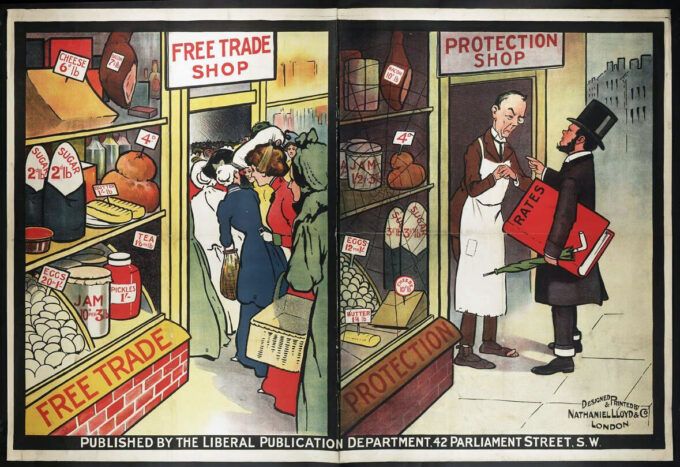
Political poster from the British Liberal Party.

People in cults often find it nearly impossible to get outside the cult outlook on the world. This is very much true of the leading intellectuals in our policy discussions. They all talk about “free trade” as though it is something that the United States has been moving toward in our trade agreements. This is a dogma held both by the proponents of the trade deals made over the last four decades, who dub them as “free trade” agreements and the opponents who proudly pronounce themselves as critics of free trade.

The absurdity of this claim should be apparent to anyone who looked at the trade deals for more than a minute. A major part of all our trade deals for the last four decades has been making patent and copyright monopolies longer and stronger.

You have to be pretty deep in cult thinking if you can believe that these government-granted monopolies are free trade. Somehow our intellectuals, with almost no exceptions, are up to the task.

I really can’t understand how they manage to delude themselves so completely. To be clear, we all recognize that these monopolies have a purpose, they promote innovation and creative work, but having a purpose doesn’t change the fact that they are government policies. Tariffs, quotas, and subsidies all have a purpose, that doesn’t make them free trade.

And there is real money here. In the case of prescription drugs and pharmaceuticals alone we will spend over $700 billion this year on items that would likely cost us not much more than $100 billion in a free market. The difference of near $600 billion would be more than half of the wages paid in manufacturing this year. If we add in the cost of these government-granted monopolies in other sectors, like medical equipment, software, computers, and other devices, it would almost certainly be well over $1 trillion a year.

So, the “free traders” bless a blatant form of government intervention as free trade, which coincidentally has the effect of shifting an enormous amount of income upward. Yet, they turn around and vehemently condemn government interventions that have the ostensible purpose of helping ordinary workers.

I am now largely with the free traders on their criticisms of tariffs and other trade barriers that are supposed to protect U.S. manufacturing. There is no longer any substantial wage premium for workers in manufacturing. This means that we would be jacking up prices for everyone for no obvious benefit to any significant group of workers.

However, I would very much like for us to have a serious debate on patent and copyright monopolies and look to apply the free traders’ recipe. There is an enormous amount of money at stake and in the case of prescription drugs, people’s health and even their lives.

But the free trade cult is very deep. They do not want their patents and copyrights to come up for debate. So don’t look for any thoughtful pieces on the topic in the New York TimesNew YorkerAtlantic or other elite outlet. Cult-thinking is very hard to shake, especially among elite intellectuals.

This first appeared on Dean Baker’s Beat the Press blog.

Dean Baker is the senior economist at the Center for Economic and Policy Research in Washington, DC. 


Trump’s ‘Mineral Rights’ Deal is about

Continuing the American War in Ukraine


 May 9, 2025
Facebook

The geographic distribution of Ukraine’s ferrous and non-ferrous output.

With neither political party in the US seeing a benefit in publicizing the fact, last week the Trump administration recommitted the US to the American war in Ukraine, Acting under the cover of the US – Ukraine Mineral Rights deal, negotiators made it about weapons, not minerals. Mr. Trump’s ‘win’ is that under the terms of the deal, the US will now be credited for US weapons supplied to Ukraine. The contract language explaining the mechanisms for doing so is provided below.

While the US-Israeli genocide in Gaza is finding diminishing support inside the US, a plurality of Americans continues to view the war in Ukraine as just. Missing from public comment has been that Donald Trump’s foreign policy is converging with Joe Biden’s foreign policy. Recall, Mr. Biden’s foreign policy team was proclaiming (and here) that nuclear wars are winnable in late 2024, just before they were removed from office.

‘If, after the Effective Date (4/30/2025), the Government of the United States of America delivers new military assistance to the Government of Ukraine in any form (including the donation of weapons systems, ammunition, technology or training), the capital contribution of the U.S. Partner will be deemed to be increased by the assessed value of such military assistance, in accordance with the LP Agreement.’ Section 5, Article 6, US – Ukraine Mineral Rights deal.

As with everything in Trump World, the seeming end-point of the Mineral Rights deal isn’t the end. Mr. Trump apparently understands that he has no leverage in negotiations to end the war in Ukraine because Russia has already prevailed militarily. Skeptical readers are invited to recall the US classified documents leaked by US Airman Texiera in 2022 – 2023. The leaks revealed that Ukraine’s prospects were viewed quite poorly by US officials, even back then.

The problem for Mr. Trump is that the Russians are less prone to taking US pronouncements at face value than the American public is. Mr. Trump’s ploy to pose the US as a mediator in the war, as opposed to the lead antagonist, retains the fiction begun by the Biden administration that the US is a sympathetic bystander. However, the Russians are working from a different set of facts. Since the start of 2022 (or 1990), Russia’s facts have comported with actual outcomes, whereas American facts haven’t.

Given this evolution of the facts, the timing of Mr. Trump’s Mineral Rights deal— inked immediately prior to his resumption of US arms shipments to Ukraine, suggests that it (Mineral Rights deal) was a pretext. Mr. Trump only started talking about it two months ago. He also knew, or should have known at the time, that he had no leverage to enforce his campaign promise to end the war in Ukraine.  Resuming US arms shipments may be Trump’s gambit to recover leverage in negotiations.

Possibly this strategy will work. But likely not because the Russians believe what Mr. Trump is saying. The Mineral Rights deal, which barely mentions minerals, gives Mr. Trump the face-saving device of the US now being compensated for weapons deliveries, a ‘win’ for his administration. If he can’t end the war, at least the US can earn a ‘profit’ as its reward. As strange as this economic framing of US foreign policy may read, it persists throughout accounts of US military history from the late nineteenth century forward.

Readers need only recall the public skewering that Joe Biden received for completing Mr. Trump’s planned withdrawal from Afghanistan in 2021 to understand that the public good tends to be suborned in uniparty elections. While Mr. Trump can’t and won’t run for President again, his Republican colleagues in Congress will be running.

The utterly predictable images of dead infants and destroyed building in Ukraine, with Donald Trump’s face superimposed over them, will buoy the electoral prospects of any Democrat in 2028 who says that they are willing to preemptively nuke Russia. With history as a guide, count on every Democrat proclaiming that they will preemptively nuke Russia.

The short sightedness of this practice, should it come to pass, is that nuking Russia would produce very much the same result as nuking the US. Author Annie Jacobsen argues in her recent book Nuclear War that the world will end within two hours of the first nuclear launch, and she explains how the process works. The ‘rational’ response to a first strike is apparently to launch every missile that the receiving nation has under the premise that its future capacity to launch weapons will be impeded.

The Russians have hypersonic alternatives to nuclear weapons. The Oreshnik missile is both hypersonic and it has an innovative non-nuclear warhead. The only hypersonic weapons that the US has are ICBMs. The result is that the Russians can fire hypersonic missiles around the globe that the US can’t shoot down. As JFK warned, nations left with a choice between nuclear escalation or surrender will choose escalation.

This detour into military hardware is to make the point to Americans that we all have ‘skin in the game.’ The Biden administration was playing nuclear Russian Roulette  only a bit over three months ago. The administration’s argument, if memory serves, was that they had crossed several Russian nuclear ‘red-lines’ and the Russians hadn’t responded, so they must be bluffing. Now consider Russian Roulette. Every pull of the trigger suggests that the gun is empty until the one where you find yourself standing before your maker wondering what went wrong.

The practical problem for the US is that the war in Ukraine 1) has been lost by the West, 2) and terms need to be negotiated to get the best deal possible for Ukraine, but 3) any American politician who does the right thing by admitting defeat and moving on 4) will be publicly pilloried and their party precluded from winning another election for a decade at least. This made Trump’s original plan of ending US support for the Ukraine war and normalizing relations with Russia the only workable one.

With somewhere between one and one-and-one-half million Ukrainians now dead, arguments can be had over who is responsible for the carnage. But remember Mr. Trump’s ‘peace through strength’ campaign sloganeering. Was the Biden administration really ‘too weak’ to defeat the Russians in Ukraine? Or was the war a mistake that the West never should have started? Asked conversely, would Donald Trump escalating in Ukraine in the present benefit or harm Ukraine and the US? It would harm Ukraine while benefiting the US through weapons sales. Until we all die in a nuclear inferno.

Part of Mr. Trump’s logic with respect to ending the war in Ukraine has been to foster cooperation between the US and Russia for his Greater Israel project. Russia recently inked a non-binding, and very lawyerly worded, mutual defense agreement with Iran that could be brought to bear if Iran is attacked by the US and Israel. With Israel’s Benjamin Netanyahu having spent much of his life trying to instigate a US war with Iran, the contours of WWIII begin to come into focus.

With respect to Iran, last week Donald Trump backed away from US demands that Iran stop all of its nuclear enrichment activities. Recall that lower-level enrichment is required to produce medical radiation products. This is being taken by the commentariat to mean that a US war with Iran is now off of the table. However, the US – Israeli genocide for Greater Israel is just getting warmed up.  With Mr. Trump’s attention span somewhere around 30 – 45 seconds, the bet here is that millions more will die before the nation-state of Israel is recognized to be the genocidal menace that it is.

Two members of the US commentariat, retired CIA Analyst Ray McGovern and Columbia University economist Jeffrey Sachs, are both more positive regarding prospects for a Trump peace deal with Russia than I have laid out here. McGovern’s logic, if I may, is that both Trump and V. Putin really want a peace deal, so one will eventually happen. Jeff Sachs is playing the ambassador, suggesting that Mr. Trump’s mental lapses with respect to the facts under consideration are immaterial. He adds to this his version of Ray McGovern’s argument.

The Americans who imagine that continuing the war will benefit either Ukraine or the US may wish to consider that the pictures of slaughtered infants and destroyed buildings from the conflict mentioned above already exist, irrespective of what Donald Trump does about policy. When Ukraine was told by the US to pay no heed to Minsk II because the US would take care of it, that was one-million dead Ukrainians ago. And the same was said when Ukraine was told by BoZo BoJo not to sign the Istanbul agreement.

Finally, Americans may wish to consider that nothing that they have been told over the last forty years by either the American political class or the establishment press has turned out to be true. Iraq had no WMDs. Russiagate was a calculated fraud perpetrated by MI6 and the CIA to support their war against Russia. And for those who are always ‘dealing,’ transactional relations preclude the possibility of truth because everything that is said is a negotiating point.

But none of this means that the US won’t bear the consequences if the current wars go off the rails. Advances in technology keep making the world less safe, Hypersonic missiles can reach the US in a matter of minutes. Fortress America is over.

Rob Urie is an artist and political economist. His book Zen Economics is published by CounterPunch Books.