Sunday, July 27, 2025

 Opinion

Trump's call to revive sports teams' Native mascots reverses progress on religious freedom
(RNS) — For generations, our elders found pride in our cultures in subversive ways, in the face of stereotypes and restrictions on our spiritual practices.
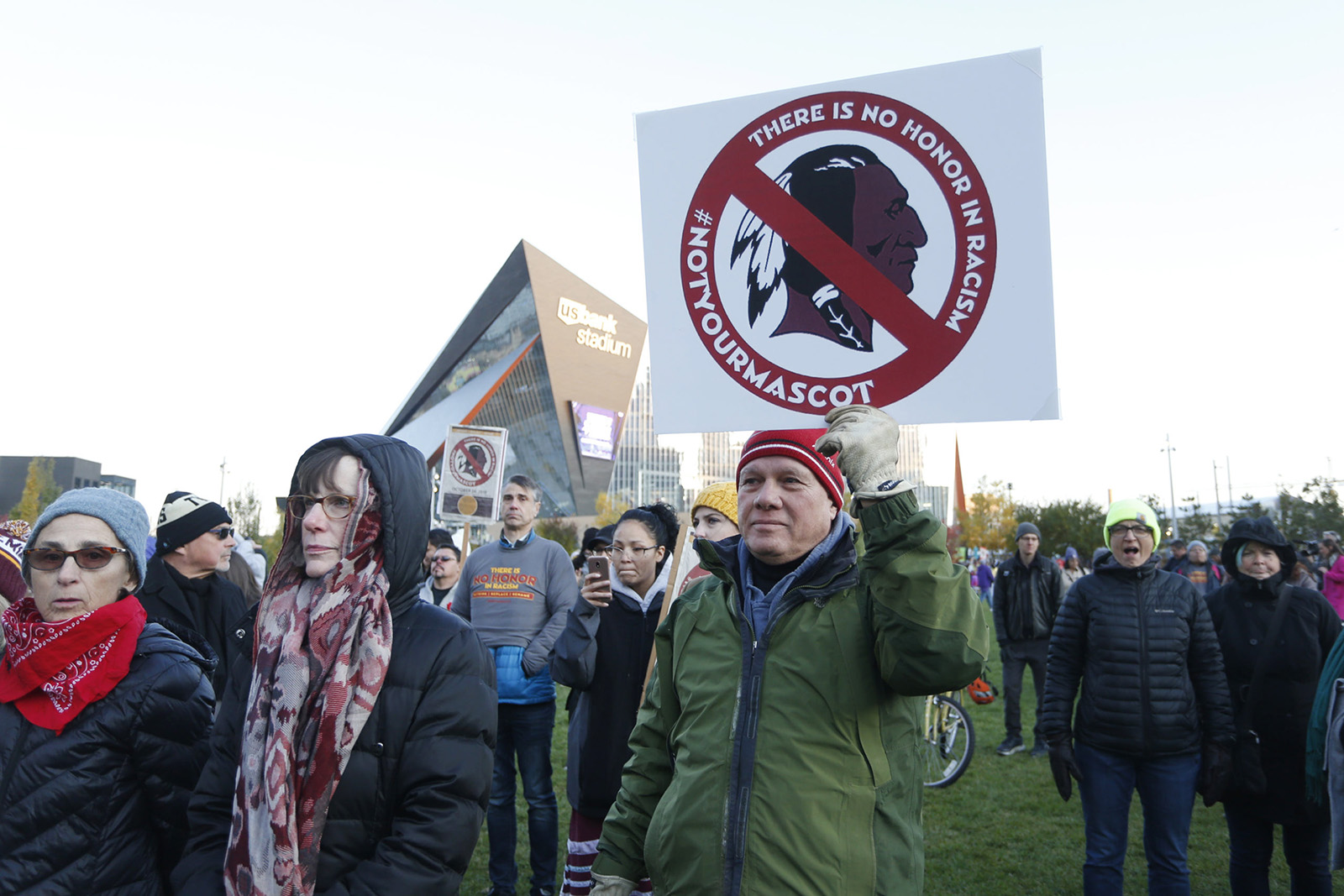
People protest against the Redskins team name and logo outside U.S. Bank Stadium before an NFL football game between the Minnesota Vikings and the Washington Redskins in Minneapolis on Oct. 24, 2019. (AP Photo/Bruce Kluckhohn, File)

(RNS) — It’s Aug. 11, 1978, and President Jimmy Carter has just signed the American Indian Religious Freedom Act into law. This law provides a path for Indigenous peoples to participate in our sacred religious practices, on our sacred lands, without the interference of the federal government.

While our religious rights are still being opposed today, as when high school and college students are punished for wearing regalia on their graduation robes, the 1978 law was a huge step forward in acknowledging that Native peoples in the United States deserve to make their own decisions for how they would practice their spirituality.


In July 2025, President Donald Trump announced on Truth Social that he wants the Washington Commanders’ football team to change its name back to the Redskins, and the Cleveland Guardians to become the Indians again.


“Indians are being treated very unfairly. MAKE INDIANS GREAT AGAIN (MIGA)!” he wrote, and later threatened a new stadium deal for the Commanders if they stick with the name. Other restrictions could be applied to the teams, he said, if they don’t revert to racist monikers the president claimed “honor” Indigenous peoples.

study conducted in 2020 by a Harvard anthropologist, a University of Michigan psychologist and Springfield College sociologist found that Native mascots are detrimental to Native American students and that they encourage racist stereotypes of Native people.

In 2005, the American Psychological Association issued a resolution calling for the retirement of all use of Native American symbols, mascots and images. Its then-President Ronald F. Levant said, “These mascots are teaching stereotypical, misleading and too often, insulting images of American Indians. These negative lessons are not just affecting American Indian students; they are sending the wrong message to all students.”

I think of the scene of the red Indians in the old Peter Pan cartoon: The white children, with war paint on their faces, show up to a series of teepees with a group of Natives wearing fringe and buckskin, asking them what makes them red. The Native woman even calls herself s*uaw, a racial slur for Indigenous women, as they all sing, “What Makes the Red Man Red.”

I grew up with this image and the narrative of the warring, buffoon-ish, ignorant Native. It distorted the way I viewed myself as an Indigenous person — instead of learning to take our stories seriously, I struggled to match these images with the Native spiritual landscape I knew. I was conscious even as a child that they altered how the world views us as well. If we are nothing but the “red” people, we fall quickly, quietly into all the racist caricatures created against us by the America we know.

If we are still stuck in the Peter Pan “red man” tropes in 2025, we are harming future generations of Native kids who should grow up in an America where their cultures and spiritual practices are valued. If Trump’s wish comes true, it would take power from our communities, forcing us once again to be viewed from the lens of a colonized society.


We’re a nation still coming to terms with who we are. It is not uncommon in many of our families (mine included) for elders to be silent about who they were. Some struggled with celebrating our cultural ways, and many still held pride in our cultures in subversive ways. They did this in the face of restrictions on our spiritual practices and languages, the stealing of our sacred lands and the ongoing battle against colonial-trauma caused by Indian boarding schools.

We are continuing to heal from this intergenerational trauma, finding ways to openly honor and celebrate our cultures and ways of life, and we deserve to do that without the interference of President Trump, who shows no respect for Native communities.

Carter, a president who was still a flawed human being, attempted to find a way to give us rights as Indigenous peoples — rights to follow our own spiritual, cultural traditions in a nation that does not value them and sees them as anti-Christian and pagan, among other things.

What Trump has continued to do is target our cultures, our ways of life and, yes, our spirituality, as complex as it is. He is attempting to steal our power under the guise of colonialism, just as his hero President Andrew Jackson did.


But as Indigenous people, we should have the power to choose who we are, just like we should choose what we believe, and that means having a voice in the fight over Native mascots that perpetuate the warring savage caricature over all of us.

We deserve more for ourselves and future generations, and we will continue to fight for that in an America that deserves to know and value us for who we have always been.


Kaitlin Curtice. (Courtesy photo)

(To learn more about the Not Your Mascot campaign, visit this website.)

(Kaitlin Curtice, a Potawatomi award-winning author, poet-storyteller and public speaker, writes on the intersections of spirituality and identity and how that shifts throughout our lives. She is the author of eight books; her newest, “Everything Is a Story,” releases October 2025.)

DESANTISLAND

Catholic archbishop of Miami leads motorcycle rosary session at 'Alligator Alcatraz'


(RNS) — Despite extensive attempts to obtain approval to say Mass in the detention center, Wenski told RNS the archdiocese had not been able to provide pastoral care for the detained migrants.


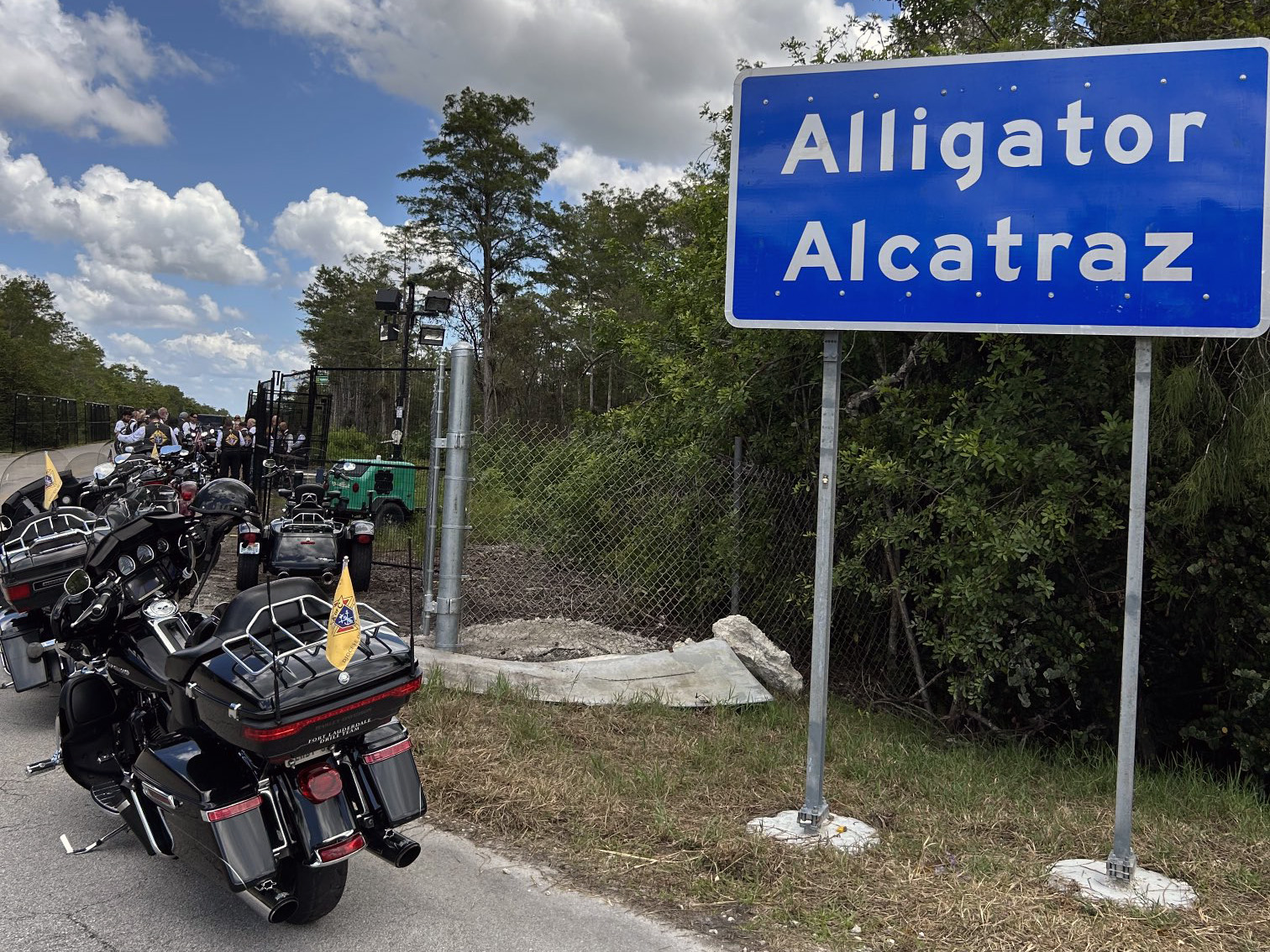
Motorcycles ridden by Knights on Bikes are parked in front of the entrance to “Alligator Alcatraz,” an immigration detention facility in the Florida Everglades, on July 20, 2025. (Photo courtesy of Archbishop Thomas G. Wenski)
Aleja Hertzler-McCain
July 22, 2025

(RNS) — On Sunday (July 20), a group of more than two dozen motorcyclists, including Miami’s Catholic Archbishop Thomas Wenski, rode to “Alligator Alcatraz,” the Florida state immigration detention center in the wetlands of the Everglades, to pray the rosary. 

The riders were members of the Knights on Bikes in Florida, a chapter of Knights on Bikes, an international fraternal organization of the Knights of Columbus. The Florida group has said the rosary outside prisons on several rides over the years, and Wenski, a rider himself and the chaplain for the international organization, suggested the stop at “Alligator Alcatraz.” 

At least 700 people have been detained or scheduled to be sent to “Alligator Alcatraz,” which Florida Gov. Ron DeSantis’ administration ordered built in eight days as a “makeshift detention space.” It is expected to hold up to 5,000 people and cost Florida $450 million to operate for a year. Migrants, former guards and Democratic lawmakers have raised safety concerns about the facility, including lack of water, leaking tents and swarming mosquitoes.


Despite extensive attempts to obtain approval to say Mass in the detention center, Wenski told Religion News Service the archdiocese had not been able to provide pastoral care for the detained migrants. 

“You can’t make America great by making America mean,” said Wenski.


Archbishop Thomas G. Wenski of Miami, right, and Knights on Bikes pray the rosary for detainees at the entrance to “Alligator Alcatraz”  in the Florida Everglades, July 20, 2025. (Photo courtesy of Archbishop Thomas G. Wenski)

In a statement earlier this month, Wenski raised concerns about “intentionally provocative” rhetoric around the detention facility and safety issues with the location and precariousness of the center.

“Common decency requires that we remember the individuals being detained are fathers and mothers, brothers and sisters of distressed relatives,” Wenski wrote. “It is unbecoming of public officials and corrosive of the common good to speak of the deterrence value of ‘alligators and pythons’ at the Collier-Dade facility.”

Wenski told RNS that the deacon in charge of the archdiocese’s prison ministry, Edgardo Farías, had earlier traveled to the detention facility’s gates to request access, and the Florida Catholic Conference director, Michael Sheedy, had made outreach attempts to DeSantis’ office. 

The archbishop added that U.S. Rep. Carlos Gimenez, a Republican who represents the Everglades as part of his congressional district, had called the Florida secretary of state’s office and was told pastoral access was a federal issue, even though, Wenski said, “The people on the federal side had told us it’s a state issue.”


Throughout his ecclesial career, Wenski said, he had faced roadblocks to saying Mass in prisons and detention facilities. Prison officials have objected to wine being brought in for Mass or have cited overcrowding. In the past, he said, he had been able to work through these issues.

When his priest was unable to enter the Krome Detention Center to say Mass during Lent this year, Wenski asked Gimenez to make some calls, and the archbishop was able to celebrate two small Easter Masses at the facility. “Overcrowding is not an excuse not to have Mass. The solution is not to eliminate Mass but to eliminate the overcrowding,” Wenski said.


Knights on Bikes pray the rosary for detainees at the entrance to “Alligator Alcatraz” in the Florida Everglades, July 20, 2025. (Photo courtesy of Archbishop Thomas G. Wenski)

Outside “Alligator Alcatraz,” Wenski, wearing a motorcycle jacket with patches that said “World Wide Arch Bishop” and “Ecclesiastical Province of Miami,” led the Knights on Bikes in the rosary and then blessed a highway patrol officer who had blocked their entry to the detention center.

Last month, Wenski rode his motorcycle 300 miles, from Miami to St. Augustine, Florida, for an international Knights on Bikes rally. Wenski, 74, said he has been riding a motorcycle since turning 50.

“ Motorcycles really help you pray a lot because there are a lot of crazy drivers out there,” he said. “ You have to be asking the Lord to send his angels to watch over you.”

The Knights on Bikes have also provided the archbishop a place to meet a “great bunch of guys” and “clear the cobwebs from my mind,” said Wenski.

Off the motorcycle, Wenski continues to advocate for immigration reform, including in conversations with lawmakers. He believes Congress should create a pathway to green cards for people in the country without legal status by updating the immigration registry process. 

Currently, immigrants who have been in the U.S. since before Jan. 1, 1972, can apply for a green card, or permanent residency, even if they have entered the country without legal status. Wenski advocates changing that date to 2015 or 2018, which would allow many immigrants to legalize their status, but he said one of his interlocutors on the issue, South Florida U.S. Rep. María Elvira Salazar, told him the idea would not have a chance in Congress.

Wenski argues that immigration reform is necessary for President Donald Trump to fulfill his promises on the economy. “You’re not gonna have the most robust economy ever without taking into account the contribution of the labor of immigrants,” Wenski said.

Understanding the violence against Alawites and Druze in Syria after Assad

(The Conversation) — A scholar of religious minorities and the Middle East explains the historical persecution and marginalization of the Alawite and Druze communities.


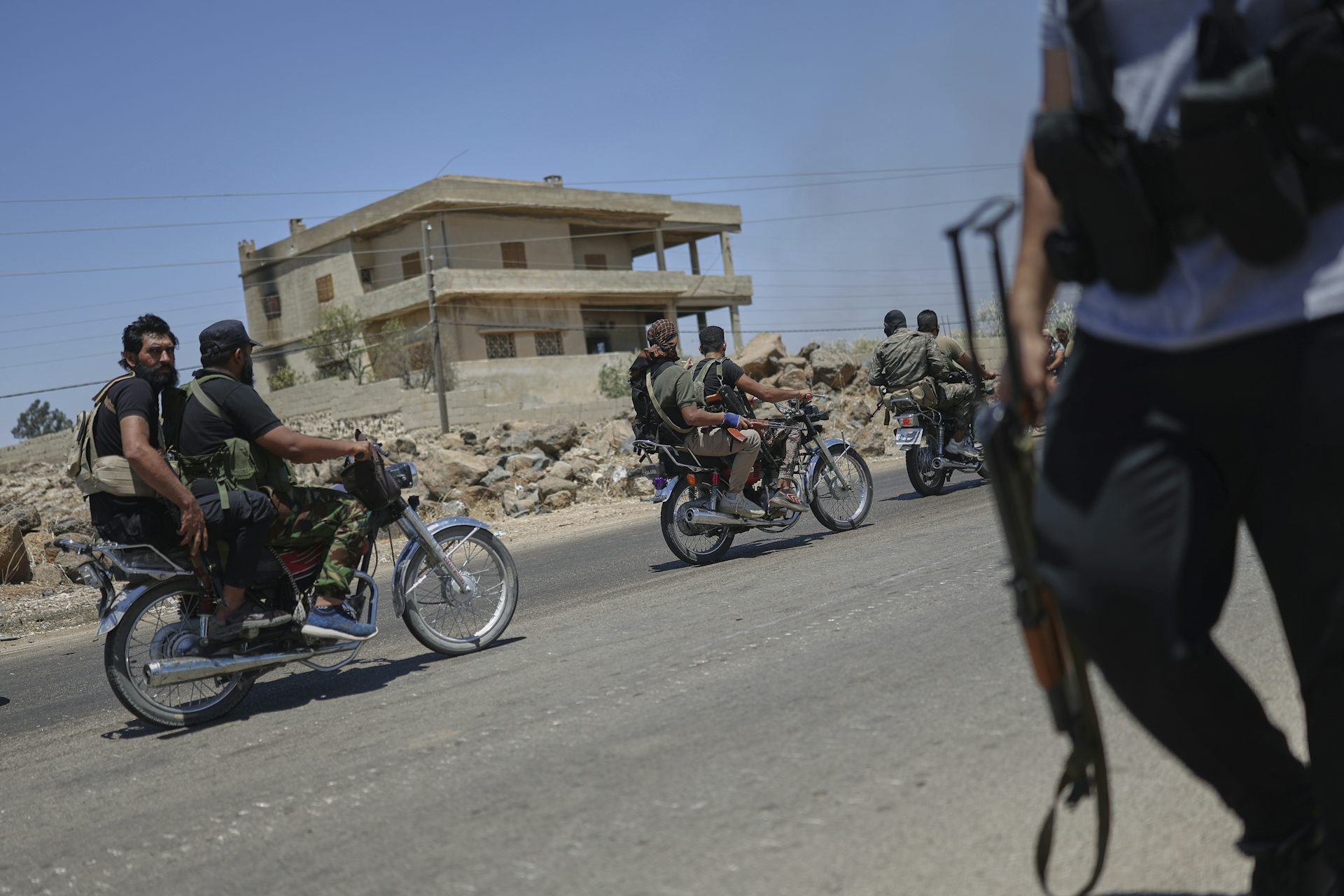
Bedouin fighters at Mazraa village on the outskirts of Sweida city, during clashes in southern Syria on July 18, 2025. (AP Photo/Ghaith Alsayed)

Güneş Murat Tezcür
July 24, 2025

(The Conversation) — In July 2025, clashes between the Druze religious minority and Sunni Arabs backed by government-affiliated forces led to hundreds of deaths in Sweida province in southern Syria. Israel later launched dozens of airstrikes in support of the Druze.

This eruption of violence was an eerie reminder of what had unfolded in March 2025 when supporters of the fallen regime led by Bashar Assad, an Alawite, targeted security units. In retaliation, militias affiliated with the newly formed government in Damascus carried out indiscriminate killings of Alawites.

While exact figures remain difficult to verify, more than 1,300 individuals, most of them Alawites, lost their lives. In some cases, entire families were summarily executed.

Although the Syrian government promised an investigation into the atrocities, home invasions, kidnappings of Alawite women and extrajudicial executions of Alawite men continue.

The violence in Sweida also bore a sectarian dimension, pitting members of a religious minority against armed groups aligned with the country’s Sunni majority.

A key difference, however, involved the active Israeli support for the Druze and the U.S. efforts to broker a ceasefire.

Post-Assad Syria has seen promising developments, including the lifting of international sanctions, a resurgence of civil society and the end of diplomatic isolation. There was even a limited rapprochement with the main Kurdish political party controlling northeastern Syria.

The persistent violence targeting the Alawites and, to a more limited extent, the Druze, starkly contrasts with these trends. As a scholar of religious minorities and the Middle East, I argue that the current political situation reflects their historical persecution and marginalization.

History of the Alawites

The Alawites emerged as a distinct religious community in the 10th century in the region of the Latakia coastal mountains, which today make up northwestern Syria.

Although their beliefs have some commonalities with Shiite Islam, the Alawites maintain their own unique religious leadership and rituals. Under the Ottoman regime in the late 19th century, they benefited from reforms such as the expansion of educational opportunities and economic modernization, while gaining geographical and social mobility.

After Hafez Assad, the father of Bashar, came to power in a coup in 1970, he drew upon his Alawite base to reinforce his regime. Consequently, Alawites became disproportionately represented in the officer corps and intelligence services.

Prior to the civil war, which began in 2011, their population was estimated at around 2 million, constituting roughly 10% of Syria’s population. During the civil war, Alawite young men fighting for the regime suffered heavy casualties. However, most Alawites remained in Syria, while Sunni Arabs and Kurds were disproportionately displaced or became refugees.


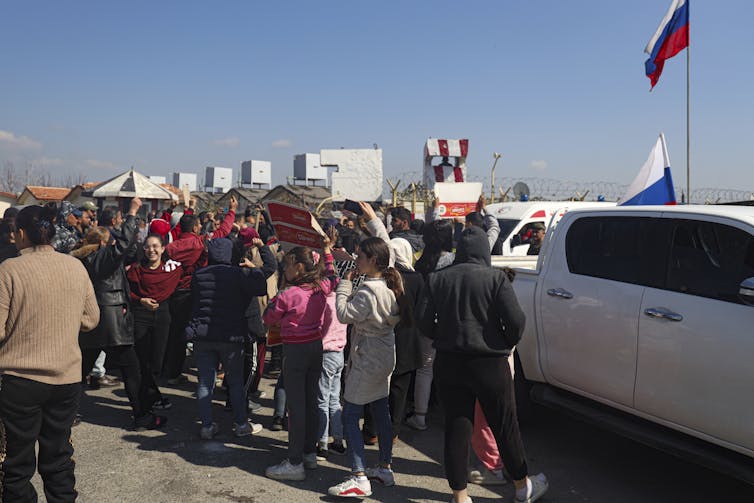
Members of the Alawite minority gather outside the Russian air base in Hmeimim, near Latakia in Syria’s coastal region, on March 11, 2025, as they seek refuge there after violence and retaliatory killings in the area.
AP Photo/Omar Albam

Among Syria’s minorities, two key factors make the Alawites most vulnerable to mass violence in post-Assad Syria. The first factor is that, like the Druze, Alawites have their own distinct beliefs that deviate from Sunni Islam. Their religious practices and teachings are often described as “esoteric” and remain mostly inaccessible to outsiders.

In my 2024 book “Liminal Minorities: Religious Difference and Mass Violence in Muslim Societies,” I categorize the Alawites and Druze in Syria alongside Yezidis in Iraq, Alevis in Turkey and Baha’is in Iran as “liminal minorities” – religious groups subject to deep-seated stigmas transmitted across generations.

These groups are often treated as heretics who split from Islam and whose beliefs and rituals are deemed beyond the pale of acceptance. For instance, according to Alawite beliefs, Ali, the son-in-law of Prophet Muhammad, is a divine manifestation of God, which challenges the idea of strict monotheism central to Sunni Islam.

From the perspective of Sunni orthodoxy, these groups’ beliefs have been a source of suspicion and disdain. A series of fatwas by prominent Sunni clerics from the 14th to the 19th century declared Alawites heretics.

Resentment against the Alawites

The second factor contributing to the Alawites’ vulnerability is the widespread perception that they were the main beneficiaries of the Assad regime, which engaged in mass murder against its own citizens. Although power remained narrowly concentrated under Assad, many Alawites occupied key positions in the security apparatus as well as the government.

In today’s political landscape where the central government remains weak and its control over various armed groups is limited, religious stigmatization and political resentment create fertile ground for mass violence targeting the Alawites.

The massacres of March 2025 were accompanied by sectarian hate speech, including open calls for the extermination of the Alawites, both in the streets and on social media.

While many Sunni Muslims in Syria also perceive the Druze as heretics, they maintained a greater degree of distance from the Assad regime and were less integrated into its security apparatus.

Nonetheless, in recent months the situation deteriorated rapidly in the Druze heartland. The Druze militias and local Bedouin tribes engaged in heavy fighting in July 2025. Unlike the Alawites, the Druze received direct military assistance from Israel, which has its small but influential Druze population. This further complicates peaceful coexistence among religious groups in post-Assad Syria.

A sober future


Sunni Arab identity is central to the newly formed government in Damascus, which can come at the expense of religious and ethnic pluralism. However, it has incentives to rein in arbitrary violence against the Alawites and Druze. Projecting itself as a source of order and national unity helps the government internationally, both diplomatically and economically.

Internally, however, the new government remains fractured and lacks effective control over vast swaths of territory. While it pays lip service to transitional justice, it is also cautious about being perceived as overly lenient toward individuals associated with the Assad regime and its crimes. Meanwhile, Alawite and Druze demands for regional autonomy continue to stoke popular Sunni resentments and risk triggering further cycles of instability and violence.

I believe that in a post-Assad Syria defined by fractured governance and episodic retribution, the Alawites as well as Druze are likely to face deepening marginalization.

(Güneş Murat Tezcür, Professor and Director of the School of Politics and Global Studies, Arizona State University. The views expressed in this commentary do not necessarily reflect those of Religion News Service.)


The Conversation religion coverage receives support through the AP’s collaboration with The Conversation US, with funding from Lilly Endowment Inc. The Conversation is solely responsible for this content.