It’s possible that I shall make an ass of myself. But in that case one can always get out of it with a little dialectic. I have, of course, so worded my proposition as to be right either way (K.Marx, Letter to F.Engels on the Indian Mutiny)
Sunday, July 27, 2025
Russia, China to set their own gold exchanges, cut ties with Western control
As part of building their multipolar world, Russia and China want to end their dependency on the West by setting up their own gold exchanges. / bne IntelliNews
By bne IntelliNewsJuly 27, 2025
Russia and China are taking concrete steps to reduce Western influence over global gold markets, signalling a broader move towards monetary self-reliance and the redomiciliation of gold reserves away from traditional Western centres.
Russia is preparing to launch its own gold exchange, independent of the London Bullion Market Association (LBMA), which has dominated international price-setting since the early 20th century. According to officials, trading on the new Russian platform will be based on physical bullion, with participation open to BRICS member states.
This marks an effort to establish a gold market “self-sufficient” from Western financial infrastructure, reflecting wider de-dollarisation trends among emerging economies.
China has also taken a decisive step by opening its first offshore gold vault in Hong Kong. The facility allows trade partners with a positive balance with China to convert surplus yuan directly into gold via the Shanghai Gold Exchange, bypassing the US dollar entirely.
Describing the move, Chinese officials said it represents “a bold move toward transparency in trade and a return to 19th-century principles: where there’s gold, there’s money.”
The development is expected to enhance the yuan’s role in international transactions, particularly among countries affected by US sanctions. Gold has continued to rise as a safe-haven asset, hitting successive all-time highs in recent months amid trade tensions and geopolitical uncertainty.
In Europe, Serbia is one of first, and is amongst a growing number of countries that are bringing their gold reserves home. It has repatriated its entire gold reserves — worth $6bn — and will no longer use foreign partners for gold storage, Bloomberg reported. The government described the move as a precaution against potential financial crises and sanctions.
“Analysts believe Serbia has opened the Pandora’s box,” Bloomberg added, noting that other states may now begin quietly withdrawing gold reserves from Western vaults and bringing them under domestic control.
The reassertion of national control over gold reserves and pricing mechanisms by non-Western economies signals a deepening fracture in the global financial order that has existed since 1922.
Serbia to repatriate entire gold reserve amid global uncertainty
Serbia to repatriate entire gold reserve amid global uncertainty. / bne IntelliNews
Serbia’s central bank plans to repatriate the country’s entire gold reserves from abroad, becoming the first Eastern European country to hold all of its bullion domestically, the National Bank of Serbia (NBS) told Bloomberg in a report published on July 24.
The move, which aims to safeguard Serbia's reserves amid heightened global uncertainty, comes as central banks worldwide seek to reduce exposure to foreign-held assets amid rising geopolitical tensions in Europe and the Middle East.
Serbia’s total gold reserves currently amount to 50.5 tonnes, or roughly $6bn at current prices. According to NBS Governor Jorgovanka Tabakovic, 86% of the reserves are already stored in the central bank’s vaults in Belgrade, with the remaining five tonnes held in Switzerland.
“By returning gold to the country, the National Bank of Serbia wanted to increase the availability and security of gold reserves in times of crisis and uncertainty,” the NBS told Bloomberg, noting that the repatriation process began in 2021 against a backdrop of rising geopolitical and economic instability.
The planned transfer will make Serbia the only country in Eastern Europe not to store any of its gold in traditional financial centres such as Switzerland, the United Kingdom or the United States.
As bne IntelliNews has followed, Serbia has significantly increased its gold holdings in recent years. Between 2019 and 2024, it purchased 17 tonnes of gold on international markets and at least 19 tonnes from Serbia’s Zijin Mining, a subsidiary of China’s Zijin Mining Group.
Global central banks accelerated gold purchases following the freezing of Russia’s foreign exchange reserves in 2022, highlighting the vulnerabilities of holding assets denominated in dollars and euros. Repatriating bullion is seen as a way to reduce exposure to such political and financial risks.
Gold has gained renewed favour as a strategic reserve asset amid shifting geopolitical dynamics. Serbia’s proactive accumulation strategy and push for domestic storage position it among the most assertive actors in the region’s monetary policy space.
Scientists fear the oceans’ prolonged hotter state is now the ‘new normal’.
In 2023, the Earth experienced an unprecedented surge in marine heatwaves across its oceans.
They set new records in intensity, geographic extent, and duration, with many lasting well over a year and 96 per cent of the ocean surface affected.
Following new research, scientists now warn that these prolonged temperature spikes might herald a tipping point for the world’s oceans with grave consequences for the planet.
Earth’s oceans may have undergone a fundamental shift
In 2023, heatwaves resulted in both the North Atlantic and Southwest Pacific oceans experiencing record-breaking sea surface temperatures.
“We know that marine heatwaves have become increasingly common and more intense over time because of global warming. We also know that the El Niño that kicked off in 2023 allowed more heat to enter the ocean,” says climate research scientist Alex Sen Gupta from the University of New South Wales.
“But these factors alone can't explain the incredible scale of the jump that began in 2023.”
Scientists from China, the USA and Thailand decided to investigate what was behind the extreme warming and what ramifications it has and could have in the future.
Relate
The research found that reduced cloud cover, whih allows more solar radiation to reach the water, was a key driver, alongside weaker winds that diminish cooling from evaporation, and changing ocean currents.
While the paper doesn’t explain why these influences coincided to smash temperature records, it highlights why it is critical to dedicate more research to the mechanics of ocean warming.
The study voices scientists’ fears that the Earth’s oceans have undergone a fundamental shift, transitioning to a new, hotter state that they say is now the ‘new normal’.
Author Zhenzhong Zeng, from the Southern University of Science and Technology in China, said figures suggest heat in the world’s oceans is accumulating exponentially.
If this is indeed the case, it is a trend that would go against what current climate models have projected.
Ocean warming has devastating effects on marine ecosystems and life on land
The study also warns that the oceans’ shift to a permanently warmer state could have devastating effects for life on Earth.
This is because they play a central role in regulating global temperatures by storing and slowly releasing large amounts of heat.
Because the oceans take more time to react to changes than the atmosphere, the effects of heatwaves can be both delayed and dramatic.
This includes hampering the ability to predict short-term extreme weather events, such as hurricanes, and longer-term climatic changes.
Relate
Prolonged increased water temperatures would also be catastrophic for marine ecosystems, triggering mass die-offs or migrations of species.
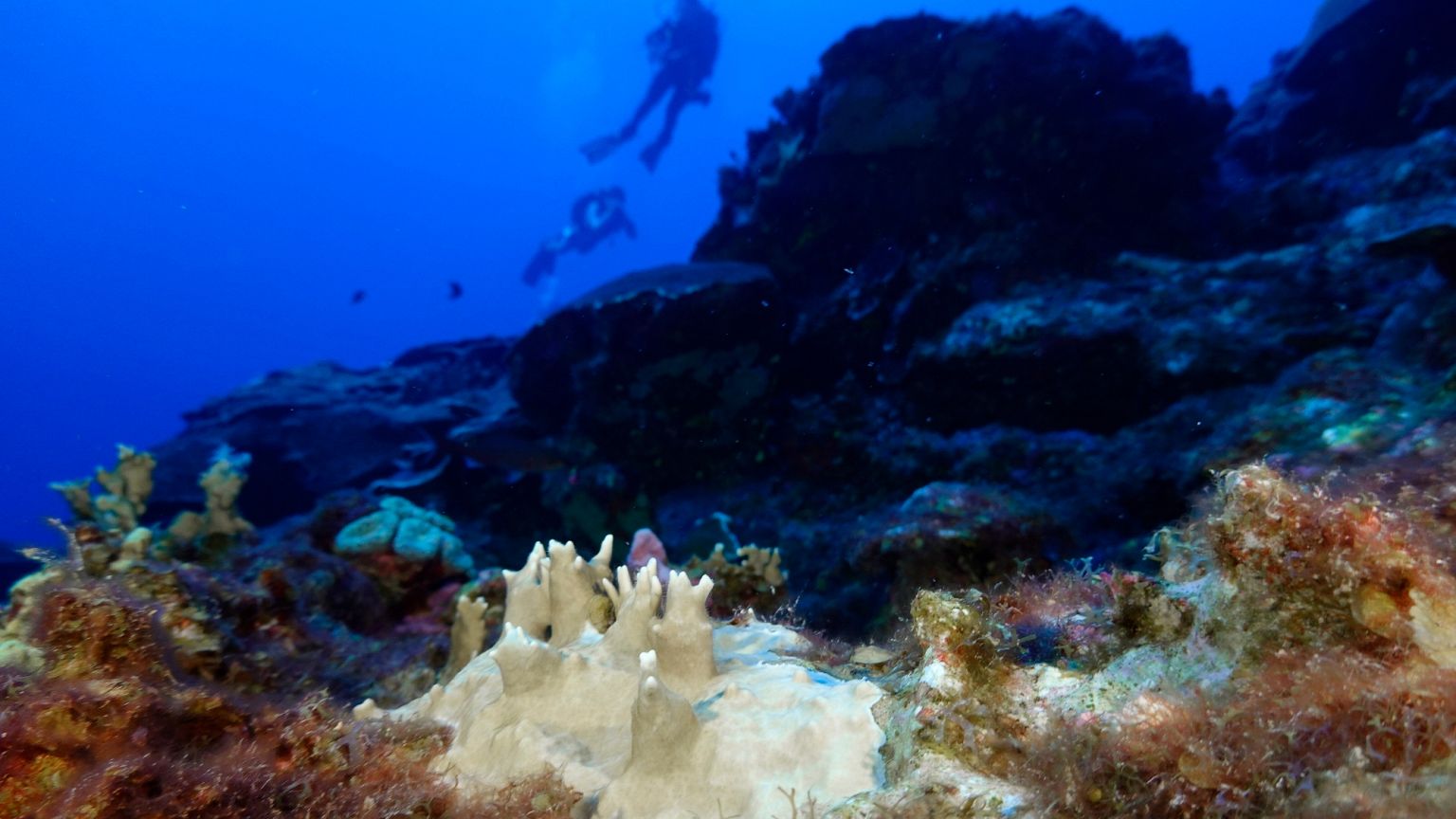
It also increases the chances of coral reef collapse - a concern not least because the loss of coral hinders the ocean’s ability to sequester carbon, leading to more heating.
On land, it would mean accelerated warming, as sea breezes carry hot air inland. This can cause more intense and widespread droughts, heatwaves, wildfires and storms.
This was already evidenced by Storm Daniel in 2023, which killed nearly 6,000 people. Attribution studies found that it was made 50 times more likely and 50 per cent more intense by high sea surface temperatures in the Mediterranean.
Are marine heatwaves becoming the new normal?
The findings are particularly worrying given the subsequent heatwaves in 2024 and 2025 that boiled oceans around the world.
This year, sea surface temperatures in the Mediterranean reached their highest level ever recorded for June.
On 29 June, sea surface temperatures hit 26.01°C, according to data collected by Copernicus and analysed by Météo-France. Overall temperatures were 3-4°C higher than average.
It sparked fresh warnings from marine scientists of the devastating impacts on biodiversity, fisheries, aquaculture, and weather patterns across southern Europe and North Africa.
Relate
In May, a marine heatwave hit the UK, a place where surges in sea surface temperatures are still a relatively new phenomenon.
Parts of the North Sea, English Channel and Irish coast were as much as 4°C warmer than average.
Scientists say an exceptionally warm, dry spring coupled with weak winds allowed heat to build on the ocean’s surface.
They warned the flare-up could disrupt marine ecosystems, altering breeding cycles, enabling blooms of harmful algae or attracting jellyfish that thrive in warmer waters.
‘It is critical that we continue to measure, monitor and model the future of our Earth’
A fundamental shift in ocean dynamics that defies current climate models is an alarming prospect.
Some researchers have responded that the warning is premature.
“We don’t know what’s going to happen next year, and it [ocean temperatures] might just come back to something that’s much more, let’s say, normal,” Neil Holbrook, climate scientist at the University of Tasmania in Australia, told the New Scientist, adding that current research can only draw on a few years of data.
But even so, scientists back the paper’s exhortation to study the drivers of ocean warming.
“While we urgently need to reduce our GHG emissions, it is critical that we also continue to measure, monitor and model what our future Earth is going to be like,” says Jaci Brown, Climate Lead at Australia’s Commonwealth Scientific and Industrial Research Organisation (CSIRO).
“If we don’t, we can’t prepare, and we are walking into the unknown with dire consequences for our future food, health and security.”
Invasion of Asian seaweed in Cádiz: An environmental catastrophe on the beaches of southern Spain
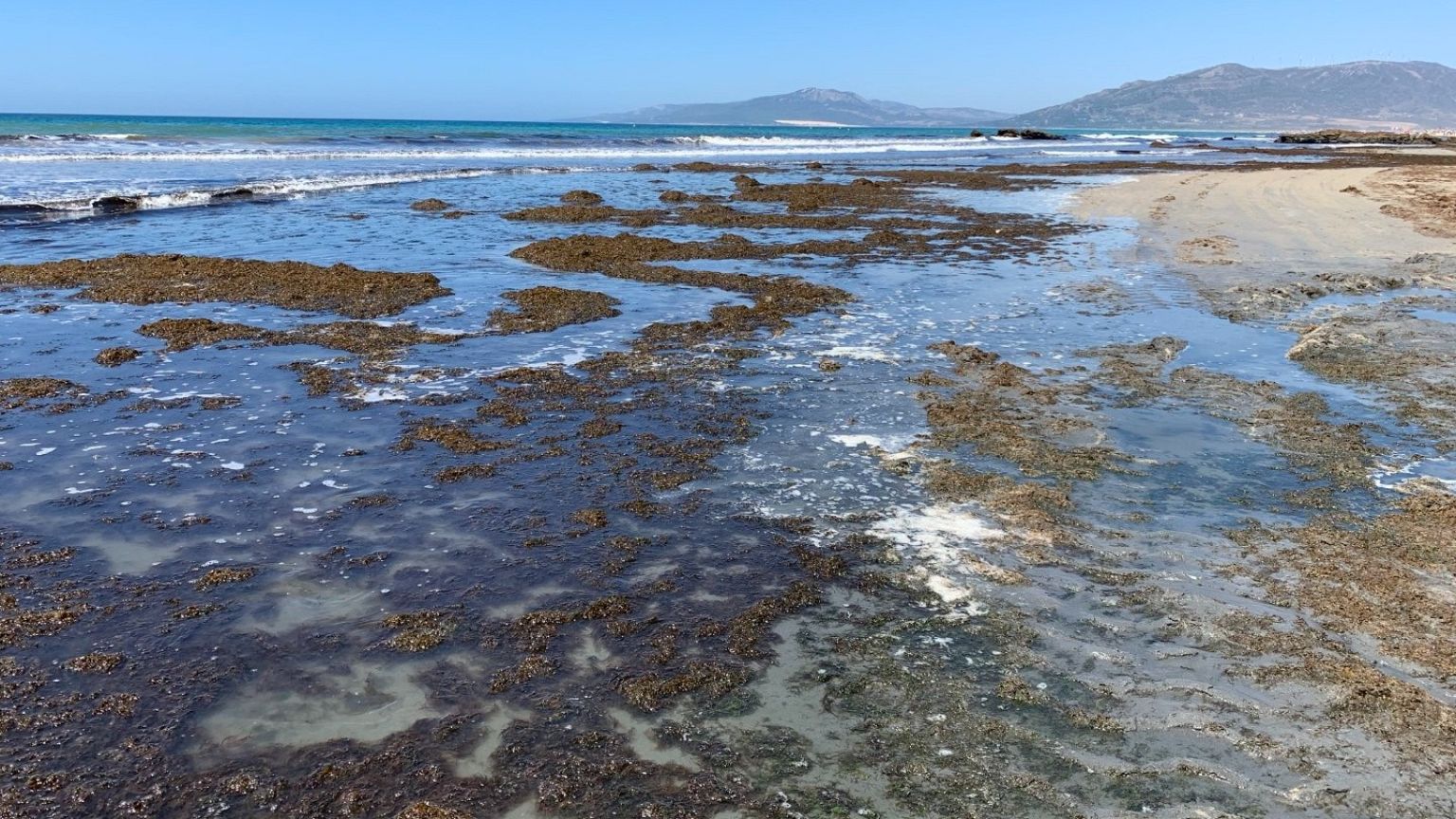
Thousands of tonnes of 'Rugulopteryx okamurae', an invasive seaweed from Southeast Asia, are accumulating on the beaches of the Strait of Gibraltar and the southern coast of Spain, constituting what local ecologists describe as a serious threat to regional biodiversity.
Since May 2025, local authorities in Cádiz have removed 1,200 tonnes of this algae from La Caleta, the city's most popular beach, including a maximum of 78 tonnes in a single day. "We are completely overwhelmed. This is an environmental catastrophe," declared José Carlos Teruel, head of beaches for the Cadiz city council, who added that every time a westerly wind blows, they know they are in for another wave of seaweed.
The species, 'Rugulopteryx okamurae', which is believed to have arrived in the ballast tanks of ships passing through the Suez Canal and unloading in the Mediterranean, has colonised the Strait of Gibraltar, much of the southern Spanish coast, the Canary Islands, the Azores and, further north, the Cantabrian Sea and the Basque Country in little more than a decade. It was first detected ten years ago in Ceuta by a researcher from the University of Malaga.
Devastating economic and ecological impact
The algae is having a significant negative impact on multiple sectors of the local economy. Tourism in Cadiz and Tarifa, a popular destination for windsurfers, is affected by the massive presence of this algae on the beaches, which also produces a very unpleasant smell. Fishing activity also suffers the consequences, as the algae trap the fishermen's nets and lines, as well as depleting the oxygen in the seawater.
The most worrying impact is on biodiversity. At La Caleta beach, the algae has displaced many native plants, and it is not yet clear whether this damage is temporary or irreversible. 'Rugulopteryx okamurae' attaches itself to rocks and other surfaces, eliminating native algal species. Its lack of natural predators in the region, combined with its ability to reproduce both sexually and asexually and to absorb toxins, makes it virtually impossible to eradicate, according to experts.
Juan José Vergara, professor of biology at the University of Cadiz, explains that in the first phase of such an invasion it can be controlled, "it's like detecting a cancer in time before it spreads". However, the current scale makes control impossible, and what reaches the beaches is only a fraction of what exists underwater.
From problem to energy resource
Currently, seaweed is dumped in landfills, which is an additional cost to taxpayers. A local company that recycles seaweed to make beverage containers or use it as fuel and fertiliser has applied for permission to use 'Rugulopteryx okamurae' as biomass for energy production.
However, Spanish legislation on invasive species prohibits their commercial exploitation unless they pose a threat to health and safety or to facilitate their eradication, conditions that would appear to apply in this case. This week, the Andalusian regional government launched a four-party plan to tackle the crisis, based on research, monitoring and education, which includes options for recycling the algae.
Although the regional government will have to negotiate with the environment ministry to use the algae as biomass, Vergara warns that even if an agreement is reached, this measure can only be part of the solution. "It is an interesting idea, but I doubt it can eradicate or even significantly decrease the intensity of the invasion when hundreds of thousands of tonnes can reach a single beach," he concludes.
France: Green algea threatens the oyster
industry in Brittany
Issued on: 27/07/2025 - FRANCE24
In France, green algae is proliferating in Brittany's Morlaix Bay, fed by farm waste and nitrogen fertilizers. Among the numerous consequences, oysters farmed in the bay are threatened. The phenomenon - undoubtedly exacerbated by global warming, threatens the livelihoods of France's oyster farmers. Story by Catherine Viette.
50° “edge of survival” heat hits Turkey for first time in recorded history
In such heat combined with low humidity, just 30 minutes of exposure risks heat stroke. / @Met4CastUK
By bne IntelliNewsJuly 26, 2025
Turkey was hit by a scorching temperature of 50° Celsius for the first time in recorded history on July 25.
“This is climate change, and it’s accelerating,” was the response from weather site Met4Cast.
“This isn’t just a heatwave, It’s the edge of human survival. In low humidity just 30 minutes of exposure risks heat stroke. Increasing humidity shortens that time,” it added.
The record-shattering temperature was measured at 50.5° Celsius (122.9 degrees Fahrenheit) in Silopi, Sirnak province, near the border with Syria, by the Turkish State Meteorological Service. The highest ever temperature recorded in Europe is the 48.8° Celsius experienced by Sicily, Italy, in August 2021.
As the Turkish government declared disaster zones in two western provinces ravaged by devastating wildfires fanned by strong winds that have already taken the lives of at least 13 people, the country’s president, Recep Tayyip Erdogan said the country faced “a truly great disaster”.
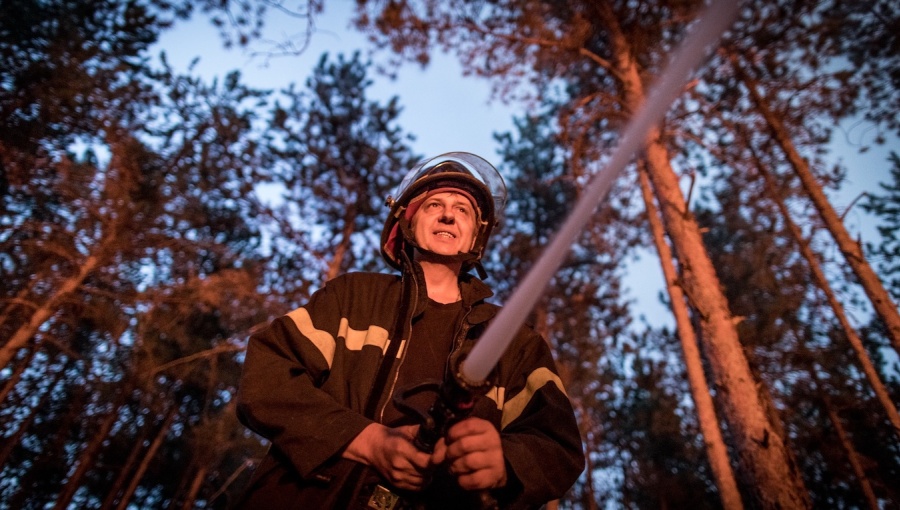
Tens of thousands of Turks were voluntarily working with hoses and buckets alongside firefighters to contain hundreds of fires as evacuations of residents from threatened localities continued.
The Turkish meteorological service said that on July 25 temperatures exceeded 40° Celsius in 31 provinces. Nationwide temperatures were running six to 12 degrees above seasonal averages.
Bianetreported that two conscripts of the Iskenderun Naval Infantry Training Battalion in the southern province of Hatay died from dehydration during basic training, while five others were hospitalised.
The tragedy followed the July 23 announcement that 10 forestry and rescue workers had perished while battling wildfires in Turkey's central Eskisehir province. A change in the direction of the wind left 24 forest workers and volunteer rescue personnel "trapped inside a fire", Turkey's Agriculture and Forestry Minister Ibrahim Yumakli said.
Ahead of July 23, resident’s of Istanbul, a city of more than 16mn, were advised to stay indoors due to forecast extreme record heat.
New wildfires broke out on Turkey’s Mediterranean coast. Images showed flames and smoke billowing into the sky close to high-rise apartment buildings in Antalya, a top tourist draw for local and foreign visitors during the summer months. Homes were evacuated in the city centre and the outlying district of Aksu, DHA reported.
Antalya Governor Hulusi Sahin said that the fires were under control except for one in Aksu, which was “showing a tendency to grow,” and another in Gazipasa, east of Manavgat, the Associated Press reported.
“The fires were truly disturbing and dangerous, because they occurred in city centres, among houses,” he was reported as saying. “We evacuated some of our homes ... There are no deaths or injuries.”
At 46.1° Celsius, the July temperatures in the city of Antalya were the highest registered for the month since records began in 1930.
If such heatwaves and wildfires become the norm in Turkey in years ahead, the future of the country’s tourism industry, vital to the economy in terms of raising FX revenues, could start to look precarious.
Interior Minister Ali Yerlikaya said that western province Izmir and northwestern province Bilecik were declared “disaster zones affecting public life”. The classification is one step below the most serious level of “emergency zone”.
In a social media post, he said 311 homes had been destroyed or seriously damaged during the month-long outbreak of wildfires.
Officials said that across the country 27 planes, 105 helicopters and 6,000 ground vehicles were in service fighting the wildfire disaster.
Bulgaria seeks EU’s air support to fight raging fires
530 firefighters took part in firefighting and rescue operations on July 26. / mvr.bg
Bulgaria has requested air assistance from the European Union to tackle raging fires caused by the heatwave that is spreading over the country, the Ministry of Interior said on July 26.
The country has asked for four planes under the European mechanism for civil protection as it is unable to put under control the fires in the areas of Strumyani and Trun, Deputy Interior Minister Toni Todorov said.
He added that the situation was most severe in these two areas. In the Strumyani municipality, a fire above the village of Ilindentsi is growing and has been spreading on over 600 hectcares of forest, Mediapool news outlet reported.
Although hundreds of firefighters and volunteers, as well as two helicopters have been trying to put that fire under control, a stronger wind in the afternoon of July 26 worsened significantly the situation.
Five people were evacuated from Ilindentsi as two houses were under fire.
In Trun, the fire is spreading over three villages, which are being evacuated. According to Mediapool’s unofficial information, the fire started from agricultural equipment but grew fast because of the heat and the strong wind. There is a risk for that fire to spread to neighbouring Serbia.
Another fire broke out on the road between the city of Burgas at the Black Sea coast and the city of Malko Tarnovo. The road was closed but there is no risk for citizens living in the area for the moment.
Several other smaller fires broke in Bulgaria on July 26.
Greece gets EU help to battle disastrous wildfires
Issued on: 27/07/2025 - Greece battled wildfires that have ravaged homes and sparked evacuations for a second day on Sunday, with the help of Czech firefighters and Italian aircraft expected to arrive later. Story by Eliza Herbert.
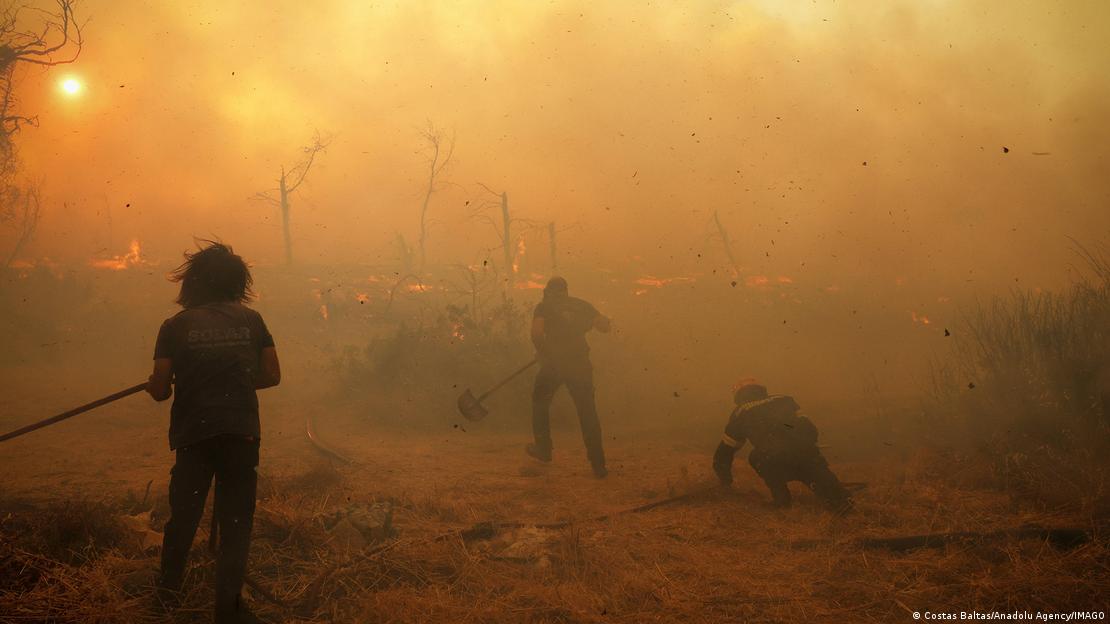
Greece: Wildfires continue to burn with danger mounting
European Union countries, including the Czech Republic and Italy, are sending aircrafts and firefighters to help.
Greece has requested help from the EU to battle the wildfires
Image: Costas Baltas/Anadolu Agency/IMAGO
Greece is continuing to battle wildfires that have destroyed homes and sparked evacuations for a second day.
Fires were still raging Sunday morning in the Peloponnese area west of the capital, as well as on the islands of Evia and Kythera, with aircraft and helicopters resuming their work in several parts of the country at dawn.
"Today is expected to be a difficult day with a very high risk of fire, almost throughout the territory", fire brigade spokesman Vassilis Vathrakogiannis said, though he added that the situation was improving. Tourist island Kythera 'half burned'
Forecasters predicted the strong winds that have fanned the flames would die down later on Sunday in most areas but warned that Kythera, an popular tourist island with 3,600 inhabitants, continued to face "worrying" windy conditions.
When the blaze began on Saturday morning it forced the evacuation of a popular tourist beach.
On Sunday morning evacuation messages were sent to people on the island, which lies off the south-eastern tip of the Peloponnese, with half of the island having been burnt according to the deputy mayor of Kythera, Giorgos Komninos.
"Houses, beehives, olive trees have been burnt," Komninos told state-run ERT News channel. "A monastery is in direct danger right now."
Dozens of firefighters, including units frim the Czech Republic, were supported by three helicopters and two aircraft. Two Italian aircraft are expected to assist later on Sunday.
Firefighting units from the Czech Republic joined the efforts to stop the wildifresImage: Costas Baltas/Anadolu Agency/IMAGO
Multiple regions at high risk of fires
According to officials, eleven regions of Greece still face a very high fire risk. There were numerous flare-ups overnight on the island of Evia, near Athens, where the flames have laid waste to swathes of forest and killed thousands of farm animals.
Workers have been trying since dawn to repair serious damage to Evia's electricity network and some villages were facing problems with water supply.
Further south on Crete, reports said fires that broke out on Saturday afternoon and destroyed four houses and a church but had now largely been contained.
Meanwhile, police were reportedly bolstering forces in Kryoneri, north of Athens, with fears looters could target houses abandoned by their owners fleeing a fire that erupted on Saturday afternoon but that was mostly contained on Sunday. Consistent extreme weather across country
On Saturday, the temperature reached 45.2C in Amfilohia but the extreme heat is expected to lessen from Monday.
Last month, fires on Greece's fifth-biggest island Chios, in the northern Aegean, destroyed 4,700 hectares (11,600 acres) of land, while earlier in July a wildfire on Crete forced the evacuation of 5,000 people.
The most destructive year for wildfires was 2023, when nearly 175,000 hectares were lost and there were 20 deaths.
Edited by: Saim Dušan Inayatullah
France registers a record 480 excess deaths during early summer heatwave
The early summer heatwave that affected 60 French departments between 19 June and 6 July led to a record 480 excess deaths, a rise of 5.5 percent compared to normal mortality levels, the country's public health agency has announced.
People aged 75 and over accounted for almost all the excess deaths during the heatwave – 410 of those recorded in the affected areas, Public Health France said.
It added that the "notably long and unusually early heatwave" had impacted nearly three-quarters of the population.
This initial count will later be supplemented by an estimate of deaths specifically attributable to heat, to be included in a broader report due after 15 September, the agency noted.
The calculation of excess mortality is based on all-cause death data collected from civil registry offices and transmitted by France's national statistics bureau Insee, compared with the expected number of deaths based on figures from the previous six years.
The region with the highest number of excess deaths was Provence-Alpes-Côte d’Azur (PACA), which covers the south east of the country. It saw at least 140 additional fatalities (representing a rise of 9.2 percent).
Public Health France published a map of excess deaths by department but cautioned during a press briefing that a significant percentage increase in areas with small populations – and thus small absolute numbers – may not always be statistically meaningful.
Three regions – Corsica, Hauts-de-France in the north of the country and Île-de-France, the region surrounding Paris – recorded no excess deaths during the heatwave period.
The agency said that the figures underscore "the importance of implementing preventative measures to reduce the impact of heat, not only during heatwaves but throughout the summer". It stressed “the need for a reinforced climate adaptation strategy at both national and local levels”.
The agency also added that, according to its 2014-2023 data, 70 percent of heat-related deaths during the summer occurred outside officially declared heatwave days.
Indonesia caught in the crossfire of Huione-linked scam networks
/ Son Vu Le - Unsplash
By bno - Surabaya OfficeJuly 25, 2025
Cambodia’s recent decision to revoke the operating license of Huione Pay, a subsidiary of the influential Huione Group, has sent ripples across Southeast Asia, but for Indonesia, it’s a troubling reminder of how deeply entrenched regional scam syndicates have become. As reported by Rest of World, Huione Pay has been linked to a Telegram-based marketplace called Huione Guarantee, which processed at least €22bn in illicit transactions between 2021 and 2024, according to blockchain forensics firm Elliptic.
The platform allegedly facilitated payments for everything from online gambling and scam tools to identity documents, tools crucial to the modern scam economy built on human exploitation. Human rights organisations and law enforcement officials have repeatedly flagged these operations as being powered by trafficked labour, including a significant number of Indonesians.
Indonesians trapped and trafficked: An ongoing crisis
According to Indonesia’s Ministry of Foreign Affairs, hundreds of Indonesian citizens have been lured abroad by false job offers since 2022, then trafficked into online scam operations in Cambodia, Myanmar, and Laos. CNN Indonesia in March 2024 reported that three Indonesians were rescued during a January 2024 raid on a scam compound in Poipet, Cambodia, which freed over 200 foreign nationals.
Victims described having their passports confiscated and being coerced into working long hours scamming people online using manipulative tactics like the “pig butchering” scheme, targeting emotional and romantic vulnerabilities to defraud victims. Al Jazeera in June 2023 previously confirmed similar testimonies in a wide-reaching investigation into cyber slavery, with Indonesians among the most frequently targeted nationals, alongside Filipinos and Thais.
Despite joint task forces and bilateral pledges, such as those made during a 2024 Indonesia–Cambodia ministerial meeting covered by The Jakarta Post, survivors and NGOs report a frustrating lack of legal recourse or compensation once they are repatriated.
Behind Huione: Power, protection, and a global warning
Central to the Huione controversy is Hun To, a director of Huione Pay and cousin of Cambodian Prime Minister Hun Manet. According to The Diplomat, Hun To’s political ties raise serious concerns about the Cambodian government’s willingness to investigate the top-level actors behind scam compounds. Critics say the revocation of Huione Pay’s licence in Cambodia, first reported by Khmer Times, is likely a symbolic move to deflect international scrutiny rather than a genuine dismantling of the infrastructure.
Elliptic’s findings, shared widely by Wired, VICE, and SCMP, indicate that even after the crackdown, Huione Pay has submitted new licence applications in Japan and Canada, suggesting the company is attempting to rebrand and expand abroad while evading scrutiny in Cambodia.
For Indonesian stakeholders, this reinforces a pattern of political protectionism and transnational impunity, leaving trafficked citizens and their families to suffer without justice.
A shadow economy fueled by human suffering
The US Institute of Peace estimates the scam economy contributes up to $11bn annually to Cambodia’s GDP, roughly a quarter of the nation’s total economy, a figure supported by The Guardian’s June 2024 exposé on the rise of cybercrime as a de facto industry in post-COVID Cambodia.
When Cambodian authorities began tightening restrictions on physical casinos in 2020, criminal syndicates reportedly pivoted toward online scams. Payment apps like Huione Pay, unregulated and opaque, became key tools in moving illicit funds. Rest of World noted that such platforms helped obscure the origins of criminal money, offering a lifeline to scam operators facing pressure from international law enforcement.
Efforts by Cambodia’s new multi-agency task force to combat cyber trafficking have done little to instill confidence. As VOA Cambodia and Radio Free Asia reported, the arrests have largely focused on low-level compound managers and guards, while politically connected figures remain untouched.
“If Cambodia were serious, they’d arrest the directors of Huione. But they’re family,” said Jacob Sims, founder of the anti-trafficking NGO Shamrock, in an interview with Rest of World.
Indonesia now faces a dual challenge: navigating regional diplomacy while urgently protecting its citizens. In June 2024, Indonesian Foreign Minister Retno Marsudi urged ASEAN to take a stronger stance during a special summit in Laos, as reported by Kompas. However, no unified framework for anti-scam coordination has materialised.
Experts interviewed by BenarNews and Channel News Asia have proposed a range of solutions, from establishing a Southeast Asian “Red Notice” system for scam syndicate leaders, to bolstering community awareness campaigns in trafficking-prone regions like West Nusa Tenggara, East Java and North Sumatra.
Grassroots organisations such as Migrant CARE and SBMI (Serikat Buruh Migran Indonesia) have also played an active role in supporting survivors and advocating for transparency and accountability in cross-border recruitment practices. Their joint report, published in May 2025, highlights systemic gaps in vetting outbound job seekers and called for tighter oversight on international labour brokers.
Huione is a wake-up call
The Huione case represents more than just a scandal, it is a stark warning about the intersection of digital finance, authoritarian power, and human trafficking. For Indonesia, the cost is measured not only in diplomatic tension but in the lives of vulnerable young citizens who are trafficked, abused, and discarded.
Unless ASEAN takes collective action and holds even its most powerful actors accountable, the region’s scam economy will continue to flourish. And unless Indonesia raises its voice louder, through policy, enforcement, and public pressure, the nation’s most vulnerable will remain at risk of being sold into one of Southeast Asia’s darkest industries.
Q?FO
Can this ‘Air Scooter’ cross the English Channel safely? Franky Zapata attempts new feat
The company’s CEO will attempt to cross the English Channel without a parachute to use in an emergency.
Imagine riding a scooter to your friend’s house for a barbecue – not on the road but in the air.
A French aviation start-up wants to make that a reality with an aircraft resembling a gigantic scooter.
‘Air Scooter’ is an ultralight aircraft pre-programmed to fly a route. Thanks to the computers doing a lot of the heavy lifting, the pilot's input is much less important than in a traditional helicopter.
"It's a kind of flying robot,” Franky Zapata, the CEO of Zapata, said.
“When you are inside, you just ask the machine to go somewhere. You feel like the pilot. But the machine only executes what the computer wants, so it's extremely easy," Zapata added.
The French pilot and inventor will attempt to cross the English Channel between France and England in a stunt designed to serve as a proof of concept for his Air Scooter on Friday.
He will take off from Calais, France, and will cross the Channel and plans to arrive at St Margaret's Bay, close to Dover, in the UK.
He has told the media that there’s no parachute to use during this trip in case he has to bail out in an emergency.
Zapata has already made a crossing, in 2019, on another of his machines, called the Flyboard Air.
The flying hoverboard successfully surfed the sky on the second attempt, a week after his first bid failed halfway through.
He completed a 36-kilometre journey in 22 minutes, reaching a top speed of 202 kilometres per hour during the crossing.
Zapata admits the flying hoverboard required lots of skill to operate, and the Air Scooter is a much easier vertical takeoff hybrid aircraft.
“What is very different compared to the Flyboard Air is the fact that this machine is able to be piloted by everybody. It's not something so technical or so hard, so dangerous as the Flyboard".
Photographer Luiz Carvalho revisits Portugal’s post-revolution years in new exhibition
As part of the "50DE25" exhibition at the Sociedade Nacional de Belas Artes in Lisbon, Luiz Carvalho, one of the biggest names in Portuguese photojournalism, tells Euronews Culture discusses the stories behind some of his favourite pictures.
When the revolution of 25 April 1974 swept through Portugal, Luiz Carvalho had no idea it would shape the course of his life. Then a 19-year-old architecture student with a passion for photography, he took to the streets of Lisbon with his Nikon F, capturing the unfolding scenes of a country in transformation.
Those early images marked the beginning of a career that would span more than two decades, working for the weekly Expresso and as a correspondent for SIPA Press.
Now, 50 years on, Carvalho revisits that turbulent chapter in Portugal’s history - the period between the revolution and the failed coup of 25 November 1975, known as the Ongoing Revolutionary Process (PREC) - in a new book and exhibition titled 50DE25.
On display at the Sociedade Nacional de Belas Artes in Lisbon until 23 August, the exhibition features iconic photographs from the era alongside more recent portraits of key figures who shaped those historic events.
When the exhibition opened, Luiz Carvalho spoke to Euronews Culture about some of his favourite photos:
From the exhibition "50DE25" Credit: Luiz Carvalho
Luiz Carvalho: This photo summarises those days of great joy. It was taken on 1 May 1974. I was there to find details of what was happening. When I see this military lorry, with the soldiers at the back demonstrating with their rifles in the air, the kids doing the V for victory, the officer at the front in the van also doing the V for victory, this photograph is perfect for me from an aesthetic point of view. There's nothing too much or too little. Of course, there are other photos in this series, some vertical, but this is the one that, for me, represents the decisive moment of 25 April.
From the exhibition "50DE25" Credit: Luiz Carvalho
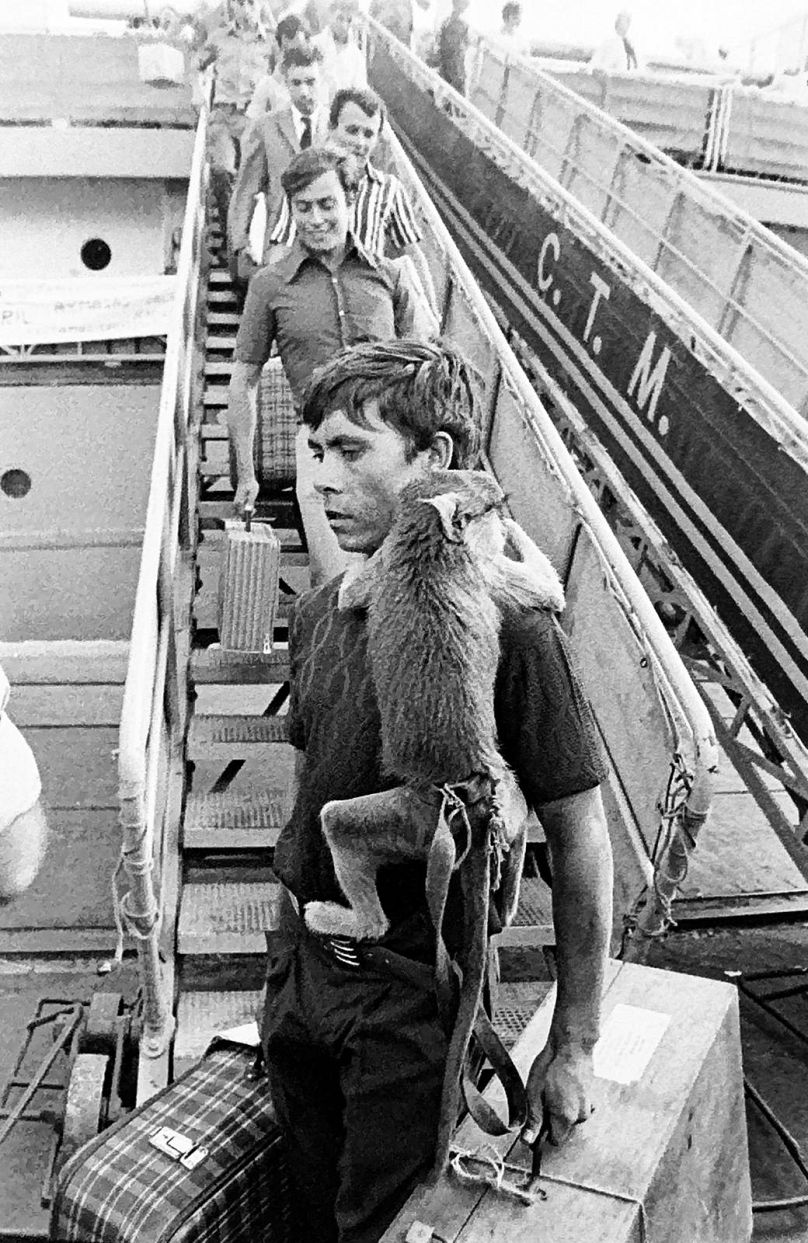
LC: This is the arrival of the first troopship from Guinea-Bissau. I was always listening to the radio, which at the time was the favoured means of information. I was in my architectural office and I heard that the ship was arriving. I left at 4pm and went to the Rocha do Conde de Óbidos pier. It was incredible to see the people waiting for the soldiers and how they presented themselves: one was wearing a T-shirt of Amílcar Cabral (founder of the PAIGC, the independence movement of Guinea-Bissau and Cape Verde), in other words, of those he had been fighting against, and a belt with two pistols crossed on the buckle. ADVERTISEMENT
From the exhibition "50DE25" Credit: Luiz Carvalho
LC: Others were carrying exotic animals, which was normal at the time.
From the exhibition "50DE25" Credit: Luiz Carvalho
LC: A soldier lost, sad, among shadows, on 26 April (1974). It could have been on 25 November, like in that famous photograph by Alain Mingam of the paratroopers at Tancos crying. It's a photograph I really like and I'd rather not say it was taken on 26 April, because it's a photo that represents the end of the party. Or perhaps the beginning of the party, because the soldiers didn't really know what they were doing there. They adopted the attitude of defending the people, of always being on the side of the people, and that happened. It was one of the magical aspects of our revolution, so this photo has a very special meaning for me.
From the exhibition "50DE25" Credit: Luiz Carvalho
LC: The person I photographed during this period who made the biggest impression on me was José Mário Branco, with whom I had a lot of contact and worked in the theatre. He was a person of incredible humanity, who thought for himself. He was a man of the left, in the sense that he defended values, but he wasn't a party man. He may have collaborated with some parties at one time or another, but he was independent. Very cultured, an extraordinary musician, he made a big impression on me as an actor and musician. This photograph was used for the cover of the album "Ser Solidário" (1982). José Mário Branco made a big impression on me, not because of his politics, but because of who he was.
the unfinished canvases and proceeded to paint on one of them that hadn't yet been started. 'All art is dead' he wrote. Pandemonium. 'CIA', 'Fascist', t...
.jpg)






_Cropped.jpg)