Monday, August 04, 2025

UK Cunliffe Water Report – Rinsing Us Again

“For 35 years, profit has come first – and our waters have paid the price. Only one path forward remains: a full, systemic transformation that ends the ruthless pursuit of profit and puts the public good at the heart of our water services.”
Giles Bristow, chief executive at Surfers Against Sewage

Dave Kellaway responds to the report recently released by Sir Jon Cunliffe’s ‘independent’ commission on the water industry.

The Labour government set up an independent commission led by a non partisan specialist to look into the terrible state of our privatised water supply. You might think great, this is being led not by the government nor by a corporate water boss but someone independent.

Reality is a lot different.

A government can nullify the effect of any commission by defining its terms of reference. In other words which issues can be investigated and which proposals made. Despite there being consistent opinion poll majorities for taking back the water companies into common ownership the new Labour government, which claims to be for change, has ruled out renationalisation. Starmer claims it would cost £100 billion which is a blatant falsehood we will explain below.

The other way this commission was set up not to be independent was to put a ‘safe pair of hands’ in charge of it. Usually it is a Lord, a retired banker or a corporate boss who will put on a good show of being reasonable and tap a few knuckles, but will essentially not change much at all. They might criticise the private management of water but their role is to set up the conditions for the privatisation to continue with a few reforms and a bit more regulation. The aim is to calm public anger about the price rises and the way our rivers and seas are used for sewage.

A safe pair of hands

Step up Jon Cunliffe who is both a knight of the realm and a former Bank of England governor. He is somebody unlikely to rock any boats and will not seriously question the role of capitalist profit in the provision of a vital human need like water. Most commissions and inquiries work along the same lines – it is part of British political culture. The PR has to be well orchestrated so this time Ofwat, the water industry regulator, was well and truly blasted.

It will be eliminated… and a new type of ‘stronger, better’ regulator established. Some other rules will be established and there may be a cheaper tariff for the really poor but the privatized companies have been well and truly reprieved.

A progressive government that actually listened to ordinary people or even considered renationalization might have thought about putting up a trade unionist knowledgeable about the water industry. Or propose an environmental specialist who had campaigned for clean sea and river water such as former Undertones frontman and water campaigner Feargal Sharkey. Unfortunately he can only react to the whitewash report: released last week

“I think Steve [Reed, minister responsible] has got to reflect very carefully on the shambles that the last 12 months has been. He should go.

The Labour government has had 14 years to look at this, he should have walked into the office on July 5th last year and taken control of the industry. He has failed to do so.”

Regulation yes but we want public provision

In themselves nobody would oppose some of the proposals for improving regulation and monitoring. A publicly owned, regionally accountable water provider would still require external checks and controls. Public transparency in real time of all sewage releases into the environment and the end to all self-monitoring would apply to a public body too.

An ombudsman could be an additional level of jurisdiction. Re-organising the water regions by the major river basins also makes sense. Rationalising all the different environmental and other bodies dealing with water issues is not a bad idea. We are in favour of new protections for consumers and fairer prices.

Nevertheless the commission has had to waste a lot of time working out ways of regulating capitalist companies to avoid a repeat of the way huge profits were given to shareholders through the leverage of debt whilst investment in infrastructure was never adequate. The issue of foreign ownership, bonuses and salaries also have to be regulated externally if you leave the industry privatized. Consequently the whole Cunliffe operation – as the Surfers against Sewage aptly describes it – is like putting lipstick on a pig. 

Giles Bristow, chief executive at Surfers Against Sewage, says:

“Look past the glossy veneer of today’s Independent Water Commission recommendations and you’ll see it utterly fails to prioritise public benefit over private profit. This is not transformational reform, this is putting lipstick on a pig – and you can bet the champagne is flowing in water company boardrooms across the land. Prime Minister, you must abandon the dangerous fantasy that the current privatised water industry can be patched up – it can’t, and the public knows it. Your party was elected on a pledge to clean up our rivers and coasts; now deliver on that promise, and go far beyond these half measures.

For 35 years, profit has come first – and our waters have paid the price. Only one path forward remains: a full, systemic transformation that ends the ruthless pursuit of profit and puts the public good at the heart of our water services.

Indeed, Giles was correct about the champagne flowing – Shares in private water companies have gone up: Pennon Group (owner of South West Water, Bournemouth Water and Bristol Water) is now up almost 1.5%. Severn Trent has gained 0.5% while United Utilities is up 0.6%.

Fines but no fines

Cunliffe also made it clear that the new regulatory body would still provide loopholes for private companies to avoid fines for failing to meet environmental rules. It is worth quoting directly from the report on this crucial question:

“The Commission believes it is important that, where companies fail to comply with requirements, there is accountability and consequence. However, these may sometimes need to be pursued within the context of the broader public interest.”

A turnaround regime would comprise a set of defined tools for the regulator to deploy when a company enters the regime, the Commission explains, adding:

“These tools would include both supportive levers to improve performance, and sanctions to ensure there is sufficient consequence that prevents moral hazard and that ensures enforcement in relation to regulatory breaches.”

In plain English this means as long as you can argue some ‘broader public interest’ or invoke ‘supportive levers’ you can avoid paying any fines out of your profits. So the Labour government protects profits but socializes losses or problems, and we have to pay for their incompetence. 

From the beginning the privatisation of a basic service that is a monopoly means that the normal risk involved in any capitalist enterprise is largely eliminated. It is not like these companies have to compete for market share against other brands like a car maker.

Since the clamour for taking water back into public ownership is very strong Cunliffe had at least to refer to the issue even if it was not dealt with.

“I understand that many people who responded to our work are concerned about profit in the provision of water through a monopoly system and how that has impacted what has happened.”

He then swiftly buries the argument by saying that pre-privatisation Britain was the dirty man of Europe. Whether that was the case is at least debatable but in one fell swoop he ignores all the profiteering and environmental damage of the last forty years or so. Even if environmental standards pre-privatisation were not optimal at least consumers did not pay above inflation prices and nobody was making huge profits, salaries or bonuses out of the industry.

It is not easy to find many endorsements of Cunliffe, the GMB union, UNITE and the Greens all denounced the report. Even the Lib Dems and Reform were more critical of it than Labour. The official Labour response was that abolishing Ofwat was the answer and pollution and price rises would now be resolved. Pigs may fly. Already it is baked in that the average consumer will be paying above inflation bills and any social tariff system would only compensate the poorest.

What about the so-called clincher argument that Labour continually use to reject taking water back into common ownership – it will cost us £100 billion?

Is Labour right to say renationalization would cost £100 billion?

David Hall, a visiting professor at THE PSIRU (Public Services International Research Unit), said previous court decisions were clear that the basis for compensating shareholders was decided by parliament on a case-by-case basis, taking account of a range of relevant matters, including public interest objectives, and the particular circumstances of each case. The PSIRU have calculate it could cost as little as £14 billion

He said the courts had consistently confirmed that public policy considerations were paramount, and there was no general right for investors to be paid full market value as compensation (Guardian article 2022).

A report by the Common Wealth written by Ewan McGaughey, professor of law at King’s College London says that water could be renationalized at far less than £100 billion if it were valued correctly. The £100 billion figure is based on the water industry’s own valuations. US private equity company KKR is currently offering a £4bn injection of equity to take over Thames Water, when its supposed regulatory capital value is nearer £20bn. Why should the state pay to cover the debts these companies have accrued?

Shareholders as they say could take a hair cut – why should they get an inflated market value. Northern Rock shareholders were not compensated by the government when it crashed. Shares could be exchanged for long term bonds. Government can still borrow much more cheaply that private capital and will reap the surplus once water is back in public hands.

If you compared the cost to the new spending on of military hardware then the potential sums involved are not a problem. Providing water cleanly is a much more positive and productive process than using arms to destroy people and property.

The Labour movement and environmentalists should reject the Cunliffe report framework and continue to campaign for taking water back into common ownership. Clive Lewis MP and Momentum are heading up a campaign for a People’s Plan for Water which includes renationallisation. Starmer’s government is wedded to a disastrous policy of a strategic partnership with capital to provide growth and trickledown benefits. Water shows this is an illusion. We need to impose a different way forward, both to defend living standards and to protect our precious seas and rivers.


  • This article was originally published by the Anti-Capitalist Resistance on 28 July 2025.

 UK

Diane Abbott: She’s Walked the Line

“Diane Abbott has proved herself a consistent friend of workers in struggle over many years, which just might be another factor explaining why she is not welcome in Keir Starmer’s PLP.”

By George Binette

In contrast to all too many members of the Parliamentary Labour Party (PLP), Diane Abbott has visited a fair few picket lines in her 38 years as the MP for Hackney North & Stoke Newington. That might explain why several unions were keen to contribute to her re-election campaign last year after the Labour leadership finally re-admitted her to the PLP in late May 2024.

In total, Diane’s campaign received £9,000 from three Labour affiliates – the CWU, FBU and Unite – and £5,000 from what is arguably Britain’s most militant major union, the RMT, which found itself expelled from Labour more than two decades ago. There was never any real doubt that Diane would retain her seat last July, though her protracted suspension from the PLP and the party leadership’s support for Israel’s merciless war on Gaza did erode her previously thumping majority. The unions that contributed to her campaign did so in recognition of the role she had played both at Westminster and in showing solidarity publicly for workers fighting back.

During my six-and-a-half-year stint as her local party’s Trade Union Liaison Officer, I frequently called on Diane to send messages of support and visit picket lines. She invariably responded. In June and early July lecturers belonging to the NEU stood outside Hackney’s BSix college. Though Diane was ultimately unable to make a picketing session, her message of support received a warm welcome, not least because she had joined these NEU members when they had walked out in previous disputes, not least during her time as Shadow Home Secretary.

A week before the General Election, when many Labour candidates would have found alternative routes to avoid a picket line, the candidate for Hackney North & Stoke Newington joined Unite members battling for union recognition at the Sanctuary housing association, which now manages some 980 flats on the borough’s Kingsmead estate.

Within the hour, Diane was standing at the entrance to the nearby Homerton Hospital with BMA members striking as part of their long-running pay dispute with the then Tory government, where she also met with angry women, several of them UNISON members, working on an outsourced contract with the Danish-based multinational ISS. These workers, cleaners and catering staff, had worked throughout the Covid pandemic and yet had not received the so-called Covid bonus of at least £1,655 awarded to all directly employed NHS staff.

In June 2022 Diane addressed a lively RMT-organised rally at the start of the mini-strike wave that both reflected and accelerated the collapse in support for the Tory government. Less than a month later, she twice joined striking RMT members from London Underground on blazing hot mornings outside the Seven Sisters depot in neighbouring Haringey. They were defending their Transport for London pension scheme in an ultimately successful battle.

Before the year was out, she appeared next to CWU members at Stamford Hill’s Royal Mail delivery office in quite different weather conditions – one reason she received a rapturous reception from posties at a December 2022 strike benefit her CLP organised. Just under a year later she addressed a rally outside Amazon’s London headquarters midst frigid temperatures in solidarity with GMB members in Coventry striking in pursuit of union recognition.

Diane Abbott joins a CWU picket line outside a Royal Mail delivery office in Stamford Hill.
Diane Abbott joins the Amazon workers’ solidarity rally in Shoreditch on 27 November 2023.

In short, Diane Abbott has proved herself a consistent friend of workers in struggle over many years, which just might be another factor explaining why she is not welcome in Keir Starmer’s PLP.


  • George Binette is a former secretary of Camden UNISON and the former Trade Union Liaison Officer for Hackney North & Stoke Newington CLP between autumn 2017 and spring 2024.
  • You can add your name to a petition in support of Diane Abbott here.
Foreign state-owned investors cleared to hold 15% stake in UK newspapers

Yesterday
 Left Foot Forward

The policy may have passed for now, but, as the 170-year-old Telegraph edges closer to foreign-backed ownership, the debate over who funds the British press, and what influence that buys, is far from over.


A major media policy shift has been quietly passed, as the government, with the backing of Tory frontbenchers, successfully fended off a move to block foreign state-owned investors from owning up to 15 percent of UK newspaper companies.

It marks a critical moment in the long-running Telegraph sale saga and may signal the final chapter in a story that has stretched out for years.

Or perhaps, not quite.

In the House of Lords, the Liberal Democrats led a push to keep the foreign state ownership threshold at 5 percent, citing concerns over press freedom and undue influence from authoritarian regimes. Their efforts were roundly defeated in a 267–155 vote, with a majority of 112 in favour of raising the cap.

Critics argue that the move undermines UK media independence and opens the door to forms of foreign influence, even if ownership remains officially “passive.”

Supporters of the change, however, insist it’s a pragmatic move aimed at securing much-needed capital and ensuring the financial viability of British media outlets.

The new rules now clear the path for a takeover of the Telegraph by a consortium involving RedBird IMI, a joint venture between US-based RedBird Capital and Abu Dhabi’s state-backed International Media Investments (IMI).

RedBird is seeking to purchase a controlling stake in the Telegraph group for around £500 million, with IMI expected to hold a 15% minority share, right at the newly permitted threshold.

The deal had previously been stalled due to regulations introduced by the former Tory government to curb foreign state control of UK media. Now, the law has shifted to accommodate precisely what it once blocked.

Meanwhile, other media conglomerates are circling. The Daily Mail and General Trust (DMGT), which owns the Daily Mail, Mail on Sunday, Metro, and the i, is also reportedly interested in acquiring a stake.

Media minister Baroness Twycross said the rules would only allow backing from state-owned investors such as sovereign wealth funds and pension schemes.

She told peers: “It does not apply to states themselves or other state bodies, so a foreign government cannot buy and own a newspaper.”

“The regulations include a strict requirement that the state-owned investor must hold the investment passively.

“They must have no right or abilities to appoint or fire directors or other officers, and they must have no ability to direct, control or influence a newspaper’s policy or activities,” she added.

But this assurance was met with criticism. Liberal Democrat peer Lord Fox derided the notion of “passive” investment in a high-stakes media context: “Traffic humps are passive, but they certainly change the way we drive.” He questioned the credibility of assuming investors with significant financial stakes would remain disinterested in the direction and policies of the newspapers they bankroll. “This is just not plausible,” he argued.

The policy may have passed for now, but, as the 170-year-old Telegraph edges closer to foreign-backed ownership, the debate over who funds the British press, and what influence that buys, is far from over.
HIP CAPITALI$M

A flurry of music acts are pulling their music from Spotify – here’s the full list


1 August, 2025
 Left Foot Forward

Is this a growing movement?

\

A growing number of bands and musicians have begun to pull their music from Spotify. Most of them have done so following the news that the streaming giant’s co-founder and CEO Daniel Ek’s investment firm has made major investments in the defence company Helsing. Helsing is a defence firm involved in producing military drones and artificial intelligence for battle scenarios.

One of the first to make headlines for withdrawing from Spotify was the influential indie band Deerhoof, who released a statement at the time which said: ”Daniel Ek uses $700 million of his Spotify fortune to become chairman of AI battle tech company” was not a headline we enjoyed reading this week. We don’t want our music killing people. We don’t want our successes being tied to AI battle tech.”

Since then, many more have followed suit. Here are the other acts who have made public their decision to pull their music from the platform:David Bridie. Writing for the Guardian, Bridie said: “In recent years, we’ve witnessed the horror of AI drone wars in Ukraine and Gaza – children killed and hospitals destroyed with the press of the space bar. Ek is investing in technology that can cause suffering and death. Spotify used to seem like a necessary evil. By association, it now just seems evil.”

King Gizzard and the Lizard Wizard. In a statement, the band said: “A PSA to those unaware: Spotify CEO Daniel Ek invests millions in AI military drone technology. We just removed our music from the platform. Can we put pressure on these Dr. Evil tech bros to do better? Join us on another platform.”

Leah Senior. In a post on Instagram, Senior said: “[Spotify] have always been dogs but this is the final straw. Stop funding the war machine. Support the artists you love! Hopefully music will be down asap. I encourage other artists to do the same.”
Muddy Summers and the DFWs. In a post on Instagram, the band said: “You won’t find our albums on there anymore as we took them off due to their funding of #AImilitary Disappointing to see so many acts claiming to be #antiwar and #antigenocide still peddling on there.”

Xiu Xiu. In an Instagram post, the band said: “We are currently working to take all of our music off of garbage hole violent armageddon portal Spotify. It is taking longer than we had hoped due to procedurally [sic] complications but will be compeleted soon. Thanks for all the support and patience. 

For all the reasons you already know – PLEASE CANCEL YOUR SUBSCRIPTION WITH SPOTIFY.

Chris Jarvis is head of strategy and development at Left Foot Forward

Image credit: Ronaindras – Creative Commons

UK

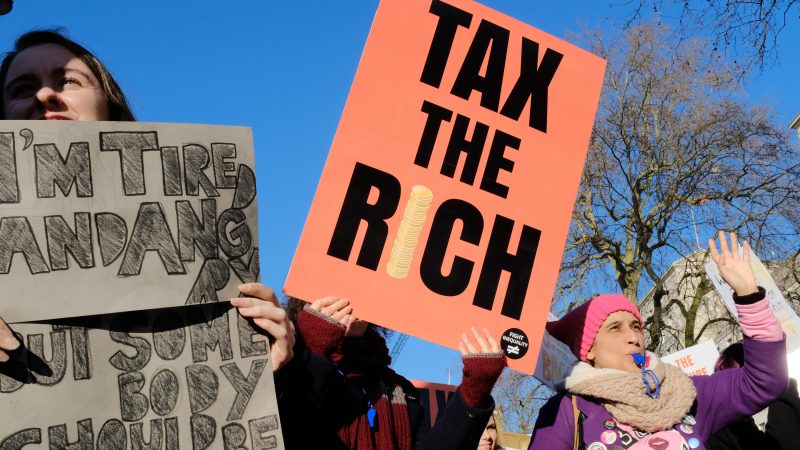
‘A strategy for sharing wealth should be at the heart of Labour’s programme’


Photo: BradleyStearn / Shutterstock.com

Wealth is now emerging as a key political battle ground with Labour resisting growing calls for a wealth tax. 

Yet the case for tackling Britain’s towering, and increasingly concentrated, wealth mountain is overwhelming. 

Private wealth holdings have surged. They stand at more than six times the size of the economy, up from three times in the 1970s. This sustained wealth boom has been a party open only to the fewWhile aggregate wealth in the UK grew by £5.68 trillion between 2010 and 2018, the poorest half gained just 6% of this rise.

An economy geared to enrichment of the few is not a recipe for a dynamic and stable democracy. The patron saint of economics, Adam Smith, warned in 1759 of how the rich use their power to rig economies in their interest. Far from a reward for a more productive and innovative economy, many of today’s largest fortunes have been driven by predatory and extractive business methods, with a growing number of large companies turned into cash cows or private fiefdoms. Large parts of the economy have been turned into a system of open cheques for the few. This is one of the key explanation for Britain’s low productivity, low growth and low investment economy. 

A return to the Victorian era

Real wealth creation that boosts entrepreneurship and builds social infrastructure is vital for rising prosperity. But ‘creating wealth’ is a slippery concept. The founding economists drew an important distinction between new wealth creation that contributes to the common good, and extraction of existing wealth that serves the interests of a powerful few.  Such ‘appropriation’ was widespread in the Victorian and inter-war eras, less prevalent in the post-war era of social democracy, but has returned since the early 1980s. 

Subscribe here to our daily newsletter roundup of all things Labour – and follow us on  BlueskyWhatsAppThreadsX or Facebook.

One of the most damaging effects of the role of extraction in Britain’s process of wealth accumulation has been to steer precious national resources – the workforce, land and capital infrastructure – into low value activity. Scarce land and building resources are used to construct walls of multi-million pound luxury flats and mansions, often bought for speculative purposes by the mobile super-rich. It hosts vast and lucrative industries, from tax avoidance to lobbying, whose sole purpose is to protect the wealth of the super-wealthy.  

The result is a return to the Victorian era of over-consumption by the rich and under-consumption on the everyday goods that sustain decent opportunities. ‘The test of our progress is not whether we add more to the abundance of those who have much,’ declared the American President, Franklin D. Roosevelt in 1936, ‘It is whether we provide enough for those who have too little.’ Yet Britain’s capacity to meet essential needs – from children’s services to social and health care and adequate social housing – has plunged.

A strategy for sharing wealth

Despite the growing importance of the role played by wealth in the economy, the income from capital  (on dividends, capital gains and inheritance) is much less heavily taxed than income. Take the role of inheritance on the shape of the economy and the growing divide in life chances. While the economic weight of such transfers continues to rise, only 3.7 per cent of deaths in the UK result in an inheritance tax charge. A power to dispose of estates forever is manifestly absurd’ declared the patron saint of economics, Adam Smith250 years ago ‘The earth and the fulness of it belongs to every generation, and the preceding one can have no right to bind it up from posterity.’  

The debate around wealth taxes has been largely about the need to boost revenue for national renewal. Yet there is a much wider case for tackling the malign impact of today’s pro-rich model of wealth accumulation, including the need to correct for the way today’s booming wealth pool is overwhelmingly privately owned. Indeed the share held in common has fallen from 30% in the 1970s to 10% today. 

A strategy for sharing wealth more evenly should be at the heart of Labour’s programme. How this high profile political conflict – over how wealth is acquired and shared – is resolved  will have deep implications for both economic strength and social resilience but also Labour’s political soul. 


How protesters use Russia’s courts to denounce the war on Ukraine

JULY 28, 2025

Simon Pirani introduces a talk he gave recently about a new book he is editing, Voices Against Putin’s War: Protesters’ Defiant Speeches in Russian Courts.

“I am using this trial as a tribune from which to denounce the war publicly,” Dmitry Ivanov told a Moscow court, just before it sentenced him to eight-and-a-half years’ imprisonment for circulating ‘fakes’ about the Russian army.

Ivanov was a maths student at Moscow State University. His ‘crime’ was to write twelve anti-war posts on a student Telegram channel that he helped to set up.

Any Russian person with a conscience feels guilty about the war, he told the court in March 2023. “We love our country, and so it is especially sickening and shameful that this inhuman war is being waged in its name.”

Ivanov was not the only anti-war protester to use a Russian court as a platform to address his fellow citizens. Dozens of others did the same.

With support from the European Network for Solidarity With Ukraine, some of these speeches will be published in English in a new book, Voices Against Putin’s War: Protesters’ Defiant Speeches in Russian Courts. I am the book’s editor, and this article is based on a talk I gave about it, by video, to a session at the Socialism 2025 event in the USA this month.

When the full-scale war broke out in February 2022, I got involved in efforts to support comrades and friends in Ukraine and Russia. In the summer of 2022, we learned of a new group, Solidarity Zone, which had been formed to support those arrested for taking direct action against the war, mainly by fire-bombing military recruitment centres. A group of us in the UK started translating their fundraising appeals and other material.

The firebombings are done when the offices are closed: they are aimed at damaging property, not persons. This became a comparatively common form of protest. There were more than 100 such actions in the first year after the invasion of Ukraine. Solidarity Zone saw that those who were detained, and their families, needed support, and particularly lawyers.

Following this at a distance, I was especially struck by some of the courageous statements made by these young people when they were brought to trial. Similar speeches were also made in court by people who had not engaged in such dramatic protests, but had simply denounced the war out loud — at a political event, online, etc — and then been arrested.

These people are victims of a general clampdown on democratic rights in Russia.

More than 30 Russians have made anti-war speeches in court all together. These, together with hundreds of others, made in the Soviet Union and post-Soviet states since the 1960s – from pro-democracy dissidents to Crimean Tatar activists and other resisters against colonialism – are gathered on the “Poslednee Slovo” (“Last Word”) site, a wonderful new resource.

Earlier this year, with our friends in the European Network for Solidarity with Ukraine, we decided to publish a collection of the anti-war speeches in English.  

There are ten speeches in our book, as well as two statements from people who appeared in court but made their statements elsewhere: from Kirill Butylin, who (as far as we know) was the first person to carry out a fire-bombing protest and put out a social media message; and from Savelii Morozov, a young man from southern Russia who was eligible for conscription but who denounced the war at the conscription commission.

The first thing that struck me about these speeches was the deeply moral tone of many of these protesters, who have obviously been prepared to sacrifice an enormous amount just to make these speeches. Igor Paskar, for example, firebombed the office of the Federal Security Services (FSB) where he lived, and then stood there waiting to be arrested. He was detained and badly tortured. When he got to court, he said: “Do I regret what has happened? Yes, perhaps I’d wanted my life to turn out differently – but I acted according to my conscience, and my conscience remains clear.”

He is now serving an eight-and-a-half years jail sentence.

The second thing that struck me is that they were addressed to the population, not to the government. Alexei Rozhkov firebombed a military recruitment centre where he lives. He was released from detention after an initial hearing — the unusual result of good work by his lawyers. Rozhkov then fled to Kyrgyzstan but was kidnapped, presumably by security forces, and returned to Russia for trial. He said: “I also have no doubt that millions of my fellow Russians, women and men, young and old, are opposed to the war too, and, like me, are convinced that the war is not a solution, but a dead end. But they have no way – without risking ending up behind bars – to do anything to be heard, to ensure their opinion was listened to.”

Ukrainian artist Bohdan Ziza splashed blue and yellow paint — the colours of the Ukrainian flag — on government offices in Crimea, which has been occupied since 2014. He filmed himself doing it and saying: “I address myself above all to Crimeans and to Russians.” In court, he said his action “was a cry from the heart, from my conscience, to those who were and are afraid — just as I was afraid — but who also did not want, and do not want, this war.”

The third thing that struck me about these statements was their very different starting points. On the central issue of the war, their views range from pacifist to defeatist. Sasha Skochilenko, an artist jailed in St Petersburg for writing anti-war messages on labels in a supermarket, was fortunately freed as a result of a prisoner exchange. When she was in court, she did not know she was going to be freed. She said: “I am a pacifist. Pacifists have always existed. It’s a certain creed of people who place the highest value on life. We believe every conflict can be resolved peacefully. I can’t bear to kill even a spider, frightened by the very thought of taking a life.”

Alexei Gorinov, a very prominent political prisoner, also expressed himself in court very much in terms of pacifism, and quoted Lev Tolstoy.

In contrast, we have the attitude of Darya Kozyreva, a St Petersburg student jailed for laying flowers at the statue of Taras Shevchenko, a Ukrainian national poet. In court, she made clear that, for her, the central issue is Ukraine’s right to self-determination and clearly justified Ukrainians asserting that right by force of arms. She said the war is a criminal intrusion on Ukraine’s sovereignty, that Ukraine does not need a big brother, and that it will fight anyone who tries to invade.

Another example is Ruslan Siddiqi, an anarchist who tried to inflict tangible damage on the Russian armed forces by detonating bombs that derailed a train taking munitions to the front. He justified this as a military action on Ukraine’s side, saying he thinks of himself as a partisan who should be classified as a prisoner of war.

The final example, who also made a very clear statement of hope for Russia’s defeat, was 68-year-old Alexander Skobov. He was first detained in 1978, in Soviet times, tried for activity in the dissident movement and subjected to forcible psychiatric treatment. This year, 47 years later, he was again in court on charges related to what he said about the war. 

In court, he spelled out three principles of his political organisation, the Free Russia Forum: the unconditional return to Ukraine of all its internationally recognised territories occupied by Russia, including Crimea; support for all those fighting for this goal, including Russian citizens who joined the Ukrainian Armed Forces; and support for “armed resistance to this aggression on the battlefield and in the aggressor’s rear”, but excluding terrorist attacks on civilians.

Overall, if we are talking about the scale of repression in Russia, I propose we use the phrase “the 21st century gulag”, which I think is fully justified. Memorial: Political Prisoners Support, one of the main non-governmental organisations supporting political prisoners, has a list with more than 3,000 names on it. The last time there were comparable numbers of political prisoners was in the mid-1970s under Leonid Brezhnev.

In addition to the people detained in Russia, there are many prisoners from the occupied territories of Ukraine. In their cases, there is a great deal of uncertainty about the numbers. The Kharkiv Human Rights Protection Group, in a submission to the International Criminal Court, identified more than 5,000 civilian victims of “enforced disappearances” from the occupied territories. These people may be in detention or dead. In most cases their families do not know.

In 2023, two Ukrainian human rights groups, Zmina and the Center for Civil Liberties, compiled a list of 585 arrested civilians who were in detention or missing due to their political and civic activity in the occupied territories. This list included local government representatives, former military personnel, volunteers, activists and journalists.

The cases of political prisoners from Crimea are more known because of the strength of civil society organisations there. The Crimean Human Rights Group currently has a register of 265 of such prisoners, many from the Crimean Tatar community. Then, there are also thousands of civilian prisoners who have been moved from the so-called people’s republics of Donetsk and Luhansk. They were tried under very local arbitrary legal systems and transferred to the Russian prison system.

In the world we live in, with militarism and authoritarianism on the rise, the anti-war protests in Russia have international significance.

It is worth making a comparison: in Britain, which is very far from facing the sort of dictatorship that rules Russia, or even the threats to democracy that we see now in the United States, the criminalisation of anti-war protesters follows a very similar Kafkaesque ideological logic to what we see in Russia.

Palestine Action, which organises direct action protests against arms deliveries to Israel, is threatened with a ban under anti-terror legislation. Singers who have denounced the genocide in Gaza are investigated by the police. The parallels with some Russian cases are striking.

What can be done in western countries about these political prisoners? First, we can raise awareness, particularly in left-wing circles, where the influence of campism remains strong. By campism, I mean the idea that Russia is not really an imperialist power and does not deserve the same condemnation as the US or Israel.

Another thing is writing letters, a standard form of support for political prisoners. It is very difficult to write letters from western countries: possible for Russian speakers, but in practice not for others. But we can send money to people who organise parcels and letters. Memorial is the biggest and most well-known. There is also OVD-info, which has been doing fantastic work over the past three years. And I have also already mentioned Solidarity Zonethe Crimea Human Rights Group and the Kharkiv Human Rights Protection Group, which also has its roots in Memorial. These are all organisations that fully deserve our support.

Simon Pirani is honorary professor at the University of Durham and writes a blog at peoplenature.org. Thanks to Links journal, where a version of this article was first published.

Image: Darya Kozyreva (centre, with bright red jacket) and supporters on the day on which she was sentenced to two years and eight months in prison. Photo from Mediazona with permission https://zona.media/online/2025/04/18/kozyreva-11

UK


Andrea Egan for UNISON General Secretary!

JULY 31, 2025

The election campaign for the General Secretary of UNISON has now begun. Andrea Egan, who was President of UNISON from 2022 until 2023, has registered her candidacy to be the first ever lay member General Secretary of UNISON. 

If elected, Andrea has pledged to take the wage of a social worker and channel the rest of the £181,000 General Secretary salary into funding welfare and industrial action funds for UNISON members.

She is committed to ending UNISON’s current subservience to Keir Starmer’s Labour Party by opposing attacks on the living standards of UNISON members, opposing donations made to Labour MPs who fail to oppose welfare cuts, and launching a comprehensive review of the union’s relationship with the Labour Party. 

Andrea Egan says: “I’m standing to be General Secretary to give power to ordinary members, implement the decisions you’ve voted for, and start winning the real improvements to pay and conditions all our members deserve. I will end our subservience to the Labour Party by launching a comprehensive review of our union’s relationship.”

Andrea started her working life as a low-paid children’s residential care worker, supporting vulnerable children, going on to become an unqualified social worker before qualifying 15 years ago. She first became a steward 30 years ago and has since been successfully elected as assistant secretary, joint secretary and now the secretary of Bolton Local Government Branch.

“It’s because of the support of strong women who mentored me that I have been able to play a leading role in our union,” she says. “I am deeply committed to repaying that solidarity by developing the confidence of activists, especially those from marginalised backgrounds.”

As President, she supported the implementation of UNISON’s first Race Discrimination Panel, gave support to the launch of trans ally training and championed UNISON’s disabled workers passport. She led on the Organising to Win programme which has done so much to support members to win substantial improvements to pay and conditions.

Website: andrea4gs.org.uk/   Facebook: facebook.com/Andrea4GS/ 

X: x.com/Andrea4GS  Bluesky: bsky.app/profile/andrea4gs.bsky.social 

Instagram: instagram.com/andrea4gs

Image: https://www.flickr.com/photos/mattcornock/13487649954 Licence: Attribution 2.0 Generic CC BY 2.0 Deed