Sunday, August 10, 2025

Brexit not ‘wokeness’ behind falling visitor numbers at Tate galleries
8 August, 2025


“Brexit, the scourge of the British electorate. Lied to by the right-wing self-interested.”



Contrary to claims from critics that ‘wokeness’ is driving visitors away from major UK art institutions, new data suggests a different culprit – Brexit and the Covid-19 pandemic.

Attendance at London’s Tate Modern and Tate Britain has dropped by 27 percent since 2019, equivalent to 2.2 million fewer visitors, according to the latest figures from the Association of Leading Visitor Attractions (ALVA). The fall is notably steeper than at other prominent cultural venues in the capital. The National Portrait Gallery saw a decline of just 3 percent over the same period, and the British Museum 4 percent.

Tate’s director, Maria Balshaw, attributes the drop to a combination of post-Brexit travel barriers and the lasting impact of the pandemic, particularly on younger visitors. She cites Tate’s own research, which shows domestic attendance has recovered to 95 percent of pre-pandemic levels, but international attendance languishes at just 61 percent.

Speaking to the Art Newspaper, Balshaw said: “The figures speak for themselves. Tate Modern alone welcomed 609,000 visitors from Europe, between ages 16 to 24, in 2019-20 but then 357,000 in 2023-24.

“And if you think about that age of person: they are profoundly affected by the combination of Brexit changing their educational and work opportunities and then Covid profoundly affecting the end of their studies and the way they choose to live their lives. They are, in general, also travelling less.”

This explanation challenges the narrative advanced by right-wing commentators, who have blamed an alleged ideological shift in curatorial policy. In an article for the Spectator in November 2024, JJ Charlesworth argued that Tate’s embrace of progressive causes, from decolonisation to climate advocacy, has alienated its core public.

“If ‘go woke, go broke’ is an all-too-common jibe of the cultural wars era, the reality is that Tate stands out as a particularly enthusiastic convert to progressive ideological fashions, reluctant to consider that it may not be taking its public with it,” the author wrote.

In a dig at Balshaw, JJ Charlesworth argued: “What doesn’t figure so much is any interest in Tate’s relationship to the national story, the term ‘nation’ barely figuring at all, Balshaw’s view of society jumping from the ‘international’ to the ‘hyperlocal’, with a sort of blindspot where the ‘national’ should be, fixated with ‘diversifying’ the audience to include the underrepresented. And yet still they fail to come through the doors.”

While this argument has found a predictable audience in certain circles, the broader data doesn’t support it as the primary cause of declining footfall. Instead, Tate’s visitor figures appear to reflect international travel patterns and political polices more than cultural content, with Brexit being a key player.

News that Brexit is to blame on the Tate’s disappointing attendance figures sparked plenty of conservation online.

One reader posted in response:

“Brexit, the scourge of the British electorate. Lied to by the right-wing self-interested.”
How we can fight back against the right-wing coup

8 August, 2025
Left Foot Forward

For a better future the power of corporations and wealthy elites must be curbed and reversed


What ails Britain is a recurring question.

The evidence of ailment is all around us. The gross domestic product, considered by many to be an indicator of wealth generation, barely grew by an average of 1.5% between 2009 and 2023. Successive governments expect the private sector to investment in new and emerging industries, but that hasn’t happened. Despite recent record low rates of interest, inflation and corporation tax, the UK has languished at the bottom of the G7 league for investment in productive assets in 24 out of last 30 years. It ranks 28th among 31 OECD countries.

A large proportion of the population lacks the financial strength to buy goods and services necessary for a vibrant economy. The average real wage has declined to the 2008 level, leaving 16m Britons, including 5.2m children, to live in poverty. 24m people, 36% of the population, live below socially acceptable living standards. The state pension is less than 50% of the minimum wage. One in every 200 households in the UK is experiencing homelessness, and the homelessness rate is the highest in OECD countries. The poorest 20% of households in Slovenia and Malta are better off than the equivalent in the UK. Meanwhile, the rich have got richer. The UK’s 50 richest families hold more wealth than 50% of the population.

The above isn’t an accident. It is the planned outcome of the right-wing coup that began in the late 1970s and continues to accelerate. The ultra-rich and corporations didn’t accept the post-war social settlement of a mixed economy, rising living standards, worker and consumer rights. They undermined the social settlement through obedient media, think-tanks, subservient politicians and academics. Trade unions and working class bought into the narrative of rising living standards, worker and consumer rights and rarely mounted an effective challenge to the rising power of corporate elites.

A major aim of the ongoing coup is to restructure the state to empower corporations and wealthy elites, and discipline the working class so that it would not challenge the new regime.

After the Second World War, the state rebuilt society by directly investing in essential industries such as water and energy, and emerging new industries such as biotechnology, information technology and aerospace. The coup stripped the state of its entrepreneurial role and transformed it into a guarantor of corporate profits. Privatisation of publicly-owned industries, outsourcing of public functions and private finance initiative (PFI) were early signs of the transformation.

Welfare of capital has become the overriding function of the state. Almost everything ranging from oil, gas, energy, shipbuilding steel, water, rail and telecommunications has been privatised at knockdown prices. Despite privatisation, vast cash subsidies continue to be handed to oil, gas, biomass, auto, shipbuilding, steel, rail, internet, semiconductor and other industries. This is accompanied by 1,180 tax reliefs, mainly to corporations and the rich. The full cost of subsidies and tax reliefs is not known. At the same time, successive governments have declared war on social security benefits for the poor.

Abuses and failures by big businesses are covered-up. The Post Office scandal and the Grenfell Towers fire are reminders of how the state shields corporations. Despite over 1,135 criminal convictions no water company has had its licence to operate withdrawn. Since 2020, twenty of the largest energy companies have racked up operating profits of over £514bn, directly leading to higher rates of inflation and poverty, and destruction of energy intensive businesses. Despite the 2007-08 crash and numerous scandals, the finance industry has been deregulated. Regulators in every industry are required to promote growth and competitiveness of industry. In the race-to-the-bottom consumer protection is diluted.

To increase corporate control of society, the state is dismantling vital public services. Large parts of the National Health Service (NHS) have been privatised. The NHS increasingly functions as a shell outsourcing contracts to the private sector. One study estimated that privately owned cataract surgeries had profit margins of between 32% and 43%. Children’s care has long been privatised since the 1980s. Now over 83% of children’s care homes are controlled by corporations, raking in average profits of 23% a year. The public purse cost ballooned from £3.1bn in 2009-10 to £7bn in 2022-23. In 2023-24, local authorities spent £32bn on adult social care, mostly provided by private sector with profit margins of up to 42%. The quest for profits pays little regard to the quality of service. 804 of the 816 adult care homes forcibly closed by the regulators during the period 2011 to 2023 were owned by for-profit organisations. 48 of the 53 children’s homes forcibly closed by the regulator during the period 2014 to 2023 were operated by corporations. Despite the failings, the state promotes privatisations and remains guarantor of corporate profits.

The second major strand of the coup has been to weaken workers and working class solidarity in the belief that insecure and impoverished people won’t challenge the social order. The Thatcher government legislated to weaken trade unions. It imposed stringent strikes ballots, banned secondary picketing and imposed financial penalties for taking strike action. The same didn’t apply to corporations for withdrawal of capital or secondary production. Workers increasingly faced insecure employment through ‘fire and rehire’ on inferior working conditions, and zero-hour contracts. Real wage cuts and freezes became the norm and the real average wage has hardly risen 2008. The Employment Rights Bill 2025 individualises worker rights and does not restore sectoral collective bargaining. Individuals are in no position to challenge the might of corporations. This was typified by P&O Ferries which knowingly illegally sacked 800 workers, but faced no action from the state.

The poorest 20% of households pay a higher proportion of their income in taxes compared to the richest 20%. Wages are taxed at marginal rates of 20% to 45%; compared to capital gains at marginal rates of 18% to 32%, and dividends at the rates of 8.75% to 39.35%. In opposition, Chancellor Rachel Reeves promised to tax private equity bosses’ remuneration as income instead of capital gains. As some of the wealthiest people, they would have faced a marginal income tax rate of 45%. But when in office she agreed to tax their remuneration as capital gains and an upper limit of 32%. Most Britons can’t fund political parties, hand consultancies and freebies to legislators, and cannot secure access to policymakers to have their voice heard.

People can take their anger to the streets but will face the might of the repressive apparatus of the state. The Police, Crime, Sentencing and Courts Act 2022 criminalises protests on the grounds that they are ‘too noisy’ and inconvenience others. The Covert Human Intelligence Sources (Criminal Conduct) Act 2021 enables the government to authorise state and non-state actors to commit murder, torture, rape and phone-tapping with complete immunity from prosecution and without any court order because it is “in the interests of the economic well-being of the United Kingdom”. The Public Authorities (Fraud, Error and Recovery) Bill currently going through parliament gives the state powers to snoop on benefit claimants’ banks accounts without any court order, if fraud is suspected. There is no right of appeal and the state can directly remove money from the bank accounts. None of this applies to tax evaders, money launderers, disqualified company directors or legislators claiming false expenses.

The dissent in public spaces is suppressed. Most media outlets are controlled by corporations and wealthy elites sympathetic to the coup. The word ‘socialism’ is increasingly confined to negative spaces. When the Labour party under the leadership of Jeremy Corbyn sought to develop an alternative path built on equitable distribution of wealth, mixed economy, public ownership of utilities and limits on industry-military complex, there was orchestrated media hostility. A military general threatened mutiny. After securing leadership of the Labour Party with radical promises, Sir Keir Starmer expelled Jeremy Corbyn from the party, and abandoned most of the promises. Purging the left has been one of his major aims. He removed the party whip from seven MPs for opposing the two-child benefit cap. Another four MPs were suspended for tabling amendments to a Bill cutting disability benefits.

The coup has not been bloodless. Some 300,000 people a year die whilst waiting for a hospital appointment in England. A study reported that between 2012 and 2019, government imposed austerity caused 335,000 excess deaths in England and Scotland i.e. nearly 48,000 a year. Around 128,000 people, including 110,000 pensioners, a year die in fuel poverty.

The right-wing coup is a major cause of stagnant economy and social tensions. For a better future the power of corporations and wealthy elites must be curbed and reversed. A sustainable economy and just society cannot be built without a counter revolution based on humanity, compassion, justice and equitable distribution of income and wealth. Against all the odds our predecessors challenged dominant discourses and secured a modicum of rights by building communities and solidarity with oratory, pamphlets, music, street theatre, plays, songs, poetry, oral histories of the marginalised, protest marches and resistance strategies. Can we not do the same or more?
Rwanda hostel paid for by UK taxpayers is taken on by Trump's migrant scheme

The accommodation in Kigali will now be used as an administrative building to oversee the implementation of the US agreement

Hope Hostel, which was due to be used to house people deported from the UK, before the Rwanda scheme was axed (Photo: Getty)

Joe Walsh
August 10, 2025 
iNEWS


A hostel refurbished using millions in British taxpayers’ money as part of the UK’s failed Rwanda scheme will be repurposed and used by the US as part of the country’s new deportation deal with Donald Trump.

Sources in Rwanda told The i Paper that the Hope Hostel in the capital, Kigali, will now be used as an administrative building to oversee the implementation of the US agreement.

Rwanda has agreed to accept 250 migrants deported from the US under Trump’s mass removal programme.


The i Paper understands that the Hope Hostel will not be used to house people deported from the US in the long run, as new accommodation is being built. However, it will function as an administrative hub once the scheme is up and running, sources said.

So far one man originally from Iraq and sent from the US to Rwanda is believed to have been temporarily housed in the Hope Hostel while work on the new accommodation is completed – but he does not form part of the 250 deported migrants that will arrive from America.

Inside a dining room at the Hope Hostel (Photo: Cyrile Ndegeya/Anadolu via Getty)

The hostel, which once held survivors of the country’s 1994 genocide, had undergone renovations worth approximately £20m of UK taxpayer money and was due to be used for migrants and asylum seekers relocated from the UK, as well as local Rwandans.

Boris Johnson’s government forged the deal with Rwanda to deport asylum seekers to the East African country in 2022 and under the Conservatives, the Home Office refused to set out the full cost of the scheme, though an official letter in 2023 stated it had reached £290m.

Home secretary Yvette Cooper axed the policy last year after Labour came to power, describing it as “the biggest waste of taxpayer money I have ever seen”.

She told the Commons that the final cost had reached £700m, with just four people travelling to Rwanda voluntarily from the UK during its operation.

READ NEXT
Home Office small boat returns deal descends into confusion over migrant appeals

The Rwandan Government is perceived to be keen to put the infrastructure set up for the British migration agreement to use, after the deal was axed, a Rwandan human rights worker with knowledge of the new deal said.

This is believed to include the Hope Hostel and an IT system – which the UK invested more than £130m into – set up to manage the scheme, which has never been used.

A Rwandan government spokesperson said US deportees will be provided with workforce training, health care, and accommodation support “to jump-start their lives in Rwanda”.

Despite Trump initially claiming violent criminals will be deported, this deal with Rwanda gives it “the ability to approve each individual proposed for resettlement”, the spokesperson added.
Plastic waste leakage in SE and East Asia could rise 70% by 2050: Report

Plastic leakage to environment projected to increase by at least 68%, primarily originating from ASEAN lower-middle-income countries and China, according to OECD report

Anadolu staff |10.08.2025 -


ANKARA

Plastic waste leakage to the environment in Southeast Asian countries, plus China, Japan, and South Korea, could increase by nearly 70% if effective measures are not taken, warned a report by the Organization for Economic Cooperation and Development (OECD).

"Driven by rising incomes and living standards, plastics use in the region is projected to almost double in the absence of more ambitious policies," the Regional Plastics Outlook report said, comparing the figures to 2022 levels.

The member states of the Association of Southeast Asian Nations (ASEAN) are "expected to see a near tripling," it added.

Plastic waste is projected to more than double, while plastic leakage to the environment is projected to increase by 68%, primarily originating from ASEAN lower-middle-income countries and China, the report also said.

Describing the region as a "hotspot for plastic pollution," it noted that 8.4 million tons of mismanaged plastic waste leaked to the environment in 2022.

Regional plastic waste rose from 10 million tons in 1990 to 113 million tons in 2022, the report also noted.

"Informal and unsafe practices, such as open burning and dumping, persist in most ASEAN countries and China, especially in rural areas," it added.

Plastic waste is a major environmental issue, polluting rivers and oceans and posing health risks to wildlife and humans as microplastics also enter the body.

The report projects that annual leakage into the environment in the region could reach 14.1 million tons in 2050, of which 5.1 million tons could reach rivers, coastal areas, and oceans.

The countries in the region differ widely in waste management capabilities, with plastic use in 13 countries surging almost ninefold from 17 million tons in 1990 to 152 million tons in 2022.

As over half of the plastic used in the region has a lifespan of less than five years, much of it quickly becomes waste.

Plastic use in the region may drop by 28% through ambitious actions, including bans on single-use plastics and taxes, which could also raise the recycling rate to 54%, and reduce mismanaged waste by 97%, the report also noted.

In a related development, talks for an international legally binding treaty on plastics pollution resumed on Tuesday in Geneva, after the previous talks last year in South Korea collapsed as countries split over measures on plastic output curbs and plastic waste management.

* Writing by Aamir Latif.

Global plastic treaty

Published August 10, 2025
DAWN

THE world has embarked on a serious attempt to tackle the escalating plastic pollution crisis with talks organised by UNEP being held in Geneva. The second part of the fifth session of the Intergovernmental Negotiating Committee, which runs from Aug 5 to 14, is intended to deliver the text of a legally binding global treaty on plastic pollution. If nations reach an agreement, it would address plastics across their entire lifecycle, from production to disposal. The aim is to put a stop to the millions of tonnes of plastic that leak into the environment each year, poisoning ecosystems, wildlife and human health. The stakes are huge. Scientists warn that without decisive intervention, plastic leakage into aquatic ecosystems could nearly triple by 2040. The economic and health costs — already estimated at over $1.5tr annually — will only mount. As dubbed by many, the Geneva talks are the world’s “last good chance” to forge a treaty to meaningfully reverse these trends.

Yet, with talks due to end on Thursday, negotiations are gridlocked. Over 100 countries in the High Ambition Coalition want enforceable caps on virgin plastic production, the phasing out of harmful additives and robust financing mechanisms. Opposing them are powerful oil- and gas-aligned states — including the US, Saudi Arabia, Russia and China — which favour focusing on recycling and waste management, resisting upstream production limits. With over 200 industry lobbyists swarming the conference, civil society fears a watered-down outcome. Pakistan’s specific negotiating stance has not been made public, but as a developing country facing surging plastic waste and inadequate waste management, it has a clear stake in an equitable treaty. Islamabad’s priorities are likely to include access to climate and pollution finance, capacity-building and technology transfer to support domestic implementation. Aligning with progressive positions on production caps would also signal a commitment to systemic change rather than piecemeal fixes. For Pakistan — and the planet — this treaty must not be another exercise in futility that leaves the root of the problem untouched. Delegates should insist on binding targets to reduce plastic production, global bans on the most hazardous polymers and additives, and a dedicated fund to help developing countries transition. If governments can rise above narrow commercial interests, they can deliver an accord that future generations will be thankful for.

Published in Dawn, August 10th, 2025ling and waste management, resisting upstream production limits. With over 200 industry lobbyists swarming the conference, civil society fears a watered-down outcome. Pakistan’s specific negotiating stance has not been made public, but as a developing country facing surging plastic waste and inadequate waste management, it has a clear stake in an equitable treaty. Islamabad’s priorities are likely to include access to climate and pollution finance, capacity-building and technology transfer to support domestic implementation. Aligning with progressive positions on production caps would also signal a commitment to systemic change rather than piecemeal fixes. For Pakistan — and the planet — this treaty must not be another exercise in futility that leaves the root of the problem untouched. Delegates should insist on binding targets to reduce plastic production, global bans on the most hazardous polymers and additives, and a dedicated fund to help developing countries transition. If governments can rise above narrow commercial interests, they can deliver an accord that future generations will be thankful for.

Published in Dawn, August 10th, 2025


Eternal waste

Published August 9, 2025 
DAWN


LOVE it or hate it, plastic is everywhere; it doesn’t die, decay or disappear. It was the first to touch you when two latex-gloved hands lifted you from your mother’s womb. Today, micro- and nanoplastics are found in our blood, brains and even in the placenta. From the deepest recesses of the planet (the Mariana Trench) to its highest point (Mount Everest), plastics are found everywhere — in the food we eat, the water we drink, and the air we breathe.


More than 460 million tonnes of plastic are produced every year, a figure that is projected to increase to 1,200 Mt by 2060, with less than 10 per cent of it recycled. An estimated 20 Mt ends up in landfills or water bodies, eventually reaching the oceans. With over 98pc of plastics made from fossil fuels, it can be described as the world’s largest oil spill.

With single-use plastic (SUP) products like bags, bottles, straws and fast-food containers lasting for over 450 years, and accounting for up to 40pc of all production, momentum is building to tackle the waste crisis. Global brainstorming from Aug 5-14 is taking place in Geneva to draft a legally binding treaty to end plastic pollution. The talks, which aim to address the full life cycle of plastic — from its creation to its disposal — began in 2022.

A major showdown is expected between the more than 100 countries that want a binding treaty, with global caps on plastic production, SUPs and certain chemicals, and “like-minded countries” including Saudi Arabia, Russia, China and Iran, which have large fossil fuel industries and are pushing for a voluntary deal focused only on waste management, especially recycling.


Society must reduce its use of plastic.


In between the warnings against capitulation and scepticism that negotiators may have to settle for a watered-down agreement, there is another group of independent scientists and health experts trying to draw attention to the “under-recognised” danger posed by plastics on human and planetary health. Writing in The Lancet, in a review published a day before the negotiations began, they say that linking plastics to human health, instead of the environmental argument alone, may trigger stronger public and government engagement, leading to action, as happened with past global threats, including air pollution and ozone depletion.

People must know how plastic affects endocrine functions and contributes to respiratory problems, birth defects, cardiovascular disease and perhaps even cancer. The Lancet calculates health-related costs to be over $1.5 trillion annually, hitting low-income and high-risk populations the hardest.

Regardless of the outcome of the talks, Pakistan must stop seeing itself as a minor polluter to deflect responsibility. The clogged nullahs and overflowing garbage dumps tell a different story. To move forward, Pakistan needs credible city-wise data on all kinds of waste generated — domestic, municipal, industrial and hazardous — with consensus reached on the data among the government, the private sector and academia, regarding better future planning. Variously quoted current figures (between 2 Mt and 3.9 Mt of plastic waste annually) are widely disputed and dismissed by circular economy experts as well as researchers who say they are exaggerated.

What is also needed is a national registry of plastic producers, importers and recyclers and mandatory reporting of plastic usage and the volumes of waste generated. While extended producer responsibility, a key to global trade rules, has not been applied in Pakistan, it will be soon, and plastic businesses should prepare to be registered. It will also mean adopting green pr­­-a­­ctices, complying with safety standards and tra­­-cking waste to earn eco-certification.

Even recyclers, who say that only 3pc of Pak­istan’s plastic is recyc­l­­ed when the potential is up to 18pc, should stre­amline. The government must step in as facilitator, offer tax incentives and tech-nical and infrastructure support by setting up industrial plastic parks for safer and centralised recycling and closer monitoring.

However, policy by itself isn’t enough; society must cooperate by reducing its use of plastic and understand the health risks. That means avoiding SUPs for food, ditching non-stick cookware, black plastic utensils and even parchment paper and cupcake liners that may contain toxic “forever chemicals”. But individual action can only go so far without strict enforcement.

Pakistan has instituted plastic bans in the past, which failed. Neither have the more recent patchy bans in Sindh, Islamabad and Punjab stopped the use of SUPs. The country must learn from global best practices through stronger regulation, public education and the scientific management of waste. Most importantly, it must ensure dignity for those who keep our cities clean. It is time for a policy and mindset change.

The writer is a Karachi-based independent journalist.

Published in Dawn, August 9th, 2025


Amarjit Singh welcomes Pakistani book ‘The War That Changed Everything’

August 10, 2025


Khalistan Movement’s most influential leader and renowned scholar of the Sikh community, Dr. Amarjit Singh, has welcomed the Pakistani book "The War That Changed Everything," which exposes Indian Army’s Operation Sindoor.

In his remarks regarding the book being published tomorrow, Dr. Amarjit Singh said investigative journalists Ahmad Hassan Al-Arabi and Murtaza Solangi, have exposed the Indian false flag operation in Pahalgam in April this year, to create a pretext for war against Pakistan.

He said the details shared in ISPR briefings will also be documented in the book, which will reveal the facts to the world.

He said India’s military prestige and diplomatic reputation were severely damaged during the four-day war against Pakistan.

Dr. Amarjit Singh said that Pakistan Army’s diplomatic status has further improved on the global stage after the recent conflict, despite India’s continuous efforts to conceal the false flag operation by sending ad-hoc delegations to various countries.

He emphasized that the Pahalgam incident marked a historic moment for Pakistan and serves as a lesson for India.

The support of the most powerful Khalistan leader has created a stir in political circles within India.
The race for robot supremacy: Beijing conference highlights China's push for innovation

Issued on: 10/08/2025 - FRANCE24

China is flaunting its robotics industry with a series of big events – the first World Humanoid Robot Games, the opening of a robot dealership in Beijing, and the World Robot Conference. Technologists think androids are the future, and analysts say China is leagues ahead. 

Story by Peter O'Brien.
Video by: Peter O'BRIEN


Ukraine: robot wars are fast becoming a reality


Issued on: 10/08/2025 - FRANCE24


Despite the diplomatic activity, Ukrainian soldiers on the frontline say they see no sign of any let-up in the Russian offensive. The frontline has moved only a little, but the battlefield has been transformed by the rapid development of new technologies, boosted all the more by the use of artificial intelligence. In this report, FRANCE 24 correspondent Gulliver Cragg explores how robot wars are fast becoming a reality.


Video by:  Gulliver CRAGG

Japan's Shinmoedake volcano erupts sending ash nearly 2 miles above crater

Small volcanic rocks may fall within about 9 miles of crater's northeast

Anadolu staff |10.08.2025 - TRT/AA


ANKARA

Japan's Shinmoedake volcano erupted Sunday, sending thick ash plumes into the air more than 3 km (almost 2 miles) above the crater, according to media reports.

The eruption occurred at around 5.23 am local time (2023GMT), with ash drifting northeast that could reach as far as Takanabe in the Miyazaki prefecture, the local English daily The Japan News reported.

The volcano in the Kirishima mountain range has been erupting intermittently since June 27.

The Japan Meteorological Agency warned that small volcanic rocks may fall within about 14 km (8.7 mi) northeast of the crater.

It advised residents to stay alert for large volcanic rocks within 3 km (1.8 mi) of the crater and pyroclastic flows within 2 km (1.2 mi).

* Writing by Aamir Latif

Russia poised for Arctic nuclear-powered cruise missile test within days — The Barents Observer


August 8, 2025
Source: The Barents Observer

Russia appears poised to test its Burevestnik nuclear-powered cruise missile at Novaya Zemlya within days, according to The Barents Observer. Airspace has been closed in a 500-kilometer (310-mile) corridor along the Arctic archipelago’s west coast from August 7 to 12. At least four vessels moved from anchorage off Pankovo to observation posts in the eastern Barents Sea, and two Rosatom aircraft are now based at the Rogachevo air base. On Tuesday, a U.S. WC-135R Constant Phoenix “nuclear sniffer” flew over the Barents Sea to sample the air for isotopes.

The Burevestnik — NATO codename Skyfall — has been tested at Novaya Zemlya since at least 2017, with the site substantially expanded over the last three years. Novaya Zemlya has served as Rosatom’s closed testing ground for nuclear weapons and related technologies since the late 1950s. Norwegian intelligence officials have warned that Russian missile and torpedo testing is likely to continue and carries risks of accidents and local radioactive emissions. Norway’s Finnmark region is about 900 kilometers (560 miles) from the Pankovo site.

In August 2019, U.S. President Donald Trump reported that Russia had witnessed a “failed missile explosion” after Rosatom likely conducted a Burevestnik test. Officially, Russia’s Defense Ministry reported an explosion of a liquid rocket engine system. Officials stated that the blast killed two people and injured six. According to unofficial reports, at least six victims were diagnosed with radiation exposure. Local authorities in Severodvinsk reported a radiation spike several hours after the explosion, but then deleted the message. According to a later U.S. intelligence assessment, the explosion might have occurred during an attempt to retrieve a missile from the sea — one that had fallen during a previous failed test.

Trump team pushes to oust No. 2 official at world energy body

The administration and its Republican allies in Congress say the Paris-based International Energy Agency discourages fossil fuel investments around the world.


Energy Secretary Chris Wright, left, has threatened to end U.S. support for the International Energy Agency, complaining about "nonsensical" projections that run afoul of President Donald Trump's championing of fossil fuels. | Saul Loeb/AFP via Getty Images

08/09/2025
POLITICO EU

President Donald Trump’s campaign to shake up international institutions has a new aim: upending the leadership of a Paris-based agency whose data and research help shape global energy policy.

The 32-country International Energy Agency has increasingly rankled Republicans in Washington by producing analyses that point to a waning future for fossil fuels and a need to embrace wind and solar power. Now the Trump administration is demanding that the agency replace its No. 2 leader with someone more aligned with the president’s policies, multiple energy industry insiders and former U.S. officials with knowledge of the situation told POLITICO’s E&E News.

The IEA’s second-ranking position has traditionally been filled by an American. Its current second-in-command, retired career State Department diplomat Mary Warlick, has served in the role since 2021.

The new pressure from Washington follows months of Trump’s efforts to bend global power centers to his will, including through his trade wars, his demands for higher defense spending by NATO members and his withdrawals from bodies such as UNESCO and the World Health Organization. It also follows months of public complaints about the IEA from top Trump administration officials, most notably Energy Secretary Chris Wright, who has vowed to make changes at the body or end U.S. support.

Some Republicans say the IEA has discouraged investment in fossil fuels by publishing analyses that show near-term peaks in global demand for oil and gas. “The product that the IEA produces is not generally accepted by everybody. It’s just not,” said Mark Menezes, who served as deputy Energy secretary during Trump’s first term. “And the political context has changed.”

‘Fight from the inside out’

The Trump administration is aiming to push changes internally, according to a Republican energy lobbyist with close ties to the Department of Energy.

“They want to get operatives in there, whether they’re career or political, who can actually move the needle,” said the lobbyist, who like the others familiar with the U.S. efforts was granted anonymity to speak freely. “They’re going to get someone they trust and that person is going to fight from the inside out.”

Regarding the U.S. effort to pressure the IEA, the lobbyist said: “The fact that Wright is out there now talking about it publicly shows that it’s elevated.”

House Republican appropriators are also lashing out against the IEA by pushing legislation to withdraw U.S. funding starting Oct. 1.

The White House did not respond to requests for comment, and an Energy Department spokesperson did not respond directly to questions posed by E&E News. The IEA said in a statement that it “does not disclose information about individual staff contracts due to reasons of privacy and confidentiality.”

A former U.S. official who worked closely with the IEA called Warlick a “hardworking, serious, diligent and capable professional” who does her work in a way that is consistent with guidance from the executive director and with guidance from the member countries.

The U.S. helped establish the IEA following the 1973 Arab oil embargo to focus on energy security. Today, the organization publishes influential energy market forecasts and data that guide major investments and government policies. Many of those studies have conflicted with the White House’s insistence that fossil fuels are more reliable and often cheaper than wind, solar and other clean energy sources.

Leaving the IEA would lessen U.S. influence or input on its work.

Historically, the United States has wielded a lot of influence at the agency and has been able to work with other member governments to advance its mission, said Jonathan Elkind, a former assistant secretary for international affairs at DOE during the Obama administration.

“There are going to be certain elements of policy that the current U.S. administration really disagrees with other member countries on, and the U.S. administration is entirely within its rights to advocate for adjustments in the agenda of the IEA,” Elkind said. “The U.S. does not have the right to simply insist that everybody will change as a consequence of what the U.S. has done.”

Threatening to pull out of the IEA is “misguided and myopic,” said Amanda Maxwell, managing director of global engagement at the environmental group Natural Resources Defense Council.

“Unfortunately, it’s par for the course for the Trump administration to try and ignore objective data,” Maxwell said. “Whether it’s climate science or energy trends, this administration is trying to make us less informed about the world we live in.”
Rosy scenarios

Wright has been especially critical of the IEA’s projection that oil demand will peak this decade, calling it “nonsensical” in a Breitbart interview in June. Republicans also bristled at the Biden administration’s use of IEA analysis in 2024 to justify a U.S. decision to pause consideration of new liquefied natural gas export permits.

In testimony at a Senate hearing last year, David Turk, then-deputy Energy secretary under Biden, cited IEA findings that showed global natural gas demand on the decline. The Trump administration is now betting heavily on the opposite occurring — pushing for a huge increase in U.S. natural gas exports and using trade pressure to cajole allies into buying massive amounts of the fuel, though some market analysts have expressed doubts about the realities of those hopes.

The IEA has also said that no new oil and gas projects are compatible with the goals of the 2015 Paris climate agreement, which aims to limit the rise in global temperatures to less-than-catastrophic levels. Trump announced the U.S. withdrawal from that pact on the first day of his second term.

Sen. John Barrasso (R-Wyo.) and then-Rep. Cathy McMorris Rodgers (R-Wash.), now retired from Congress, wrote in a letter to IEA Executive Director Fatih Birol in March 2024 that the IEA has strayed from its mission and become a “cheerleader” for the “energy transition.” Birol has defended the organization’s commitment to energy security while acknowledging that its mission has broadened.

Meanwhile, Trump ordered the State Department in February to do a six-month review of U.S. participation in international organizations and treaties and recommend leaving those that don’t serve his priorities.

One point of contention is the IEA’s World Energy Outlook, a lengthy annual report that dissects global trends and related impacts on energy security and greenhouse gas emissions. IEA calls it the “most authoritative global source of energy analysis and projections.”

In 2020, the IEA abandoned a portion of the outlook, known as the “Current Policies Scenario,” that analyzed the global energy picture based on existing national energy policies.

Trump officials have criticized the IEA for replacing the current policy analysis with a “Stated Policies Scenario,” which multiple Republicans and fossil fuel supporters say is based on policies that aren’t being implemented. The critics say the change paints a rosier-than-justified picture of global trends toward lower-carbon energy sources.

IEA officials are pledging to resurrect the Current Policies Scenario this year.

“As ever, the forthcoming World Energy Outlook 2025 will contain multiple scenarios reflecting the wide spectrum of possible outcomes that today’s market conditions and policies imply,” an IEA spokesperson told E&E News. “This year’s edition will include the Current Policies Scenario, which will illustrate the implications of a continuation of policies and measures currently in place.”

Warlick, the IEA’s deputy executive director, spent decades at the State Department, including as President Barack Obama’s ambassador to Serbia from 2010 to 2012 and as the National Security Council’s senior director for Russia under George W. Bush. From 2014 to 2017, Warlick was the State Department’s principal deputy assistant secretary at the Bureau of Energy Resources and represented the U.S. on the IEA governing board.

Trump administration officials in DOE’s Office of International Affairs, which is led by acting Assistant Secretary Tommy Joyce, tried to pressure the State Department into signing off on pushing Warlick out in March, according to a former State Department official.

At the time, State prevented that from happening, but since then a broad reorganization of the department has eliminated its Bureau of Energy Resources and most of the officials there who worked closely with the IEA.

That could mean DOE would face little resistance if it tries again.

In recent IEA meetings, POLITICO has reported, U.S. officials have pushed for the organization to stop publishing data that they argue promotes the shift to clean power over fossil fuels.

Just how the U.S. would force the agency to replace Warlick isn’t entirely clear. She is on a limited contract, and while the U.S. is an important member of the IEA, providing around 14 percent of the organization’s budget in recent years, it isn’t the only one.

Warlick rarely speaks publicly. At an Atlantic Council event in 2022, she said that the uneven pace of clean energy investments among countries has caused “geopolitical fragmentation” in the wake of the coronavirus pandemic and Russia’s full-scale invasion of Ukraine.

“Such investment is still well below the level needed to bring [greenhouse gas] emissions down if we are to keep net-zero and sustainable development goals in sight,” Warlick said. “Massive investment in clean energy is the best guarantee of energy security in the future, and it will also drive down harmful greenhouse gas emissions.”
Green Hydrogen for the Global South: What Remains After the Hype?

Analysis


Grand visions, bold announcements – yet implementation remains sluggish. Green hydrogen was hailed early on as a beacon of hope for the Global South. But without fundamental policy shifts, the project risks falling into familiar patterns of raw material export and asymmetric dependency. What’s needed are genuine industrial partnerships that relocate value creation to regions where renewable energy is especially cheap.

By Jörg Haas and Elena Gnant
5 August 2025


“Green hydrogen could be the oil of the future,” declared Colombia’s President Gustavo Petro in 2024 during a meeting with Olaf Scholz in Bogotá. He cited “the Germans” to back up his statement (Mejia 2024). This marked a clear stance against fossil fuel dependency – and a jab at Brazil’s President Lula, who is pursuing new oil sources at the mouth of the Amazon. Petro envisions a different model: industrial use of renewable energy, including green hydrogen. Symbolically, he proposed a partnership between Colombia’s Ecopetrol and Brazil’s Petrobras – a pivot from oil to hydrogen as a driver of development and prosperity (El nuevo signo 2024, Hydrogen Council 2017).

But can green hydrogen deliver on its promise – as a climate-friendly energy source, geopolitical tool, and engine of economic growth? Many Global South countries hope for new export opportunities (Cabaña 2024). Germany is actively promoting the rollout: with over 20 bilateral hydrogen partnerships, including with Namibia, South Africa, Brazil, and Morocco. Programs like H2Global, H2Uppp, and the H2-Diplo network aim to stimulate investment, promote technology exports, and enable fair supply chains – while also securing domestic supply (BMWK 2024).
How hydrogen became a beacon of hope

The idea of solving the climate crisis with hydrogen and forging new geopolitical alliances inspired politics, industry, and the public alike. Between 2020 and 2023, expectations skyrocketed: green hydrogen was to replace fossil fuels, decarbonize industry and transport, and create opportunities in the Global South. In 2020, BloombergNEF forecast that hydrogen could account for a quarter of global energy consumption by 2050 (BloombergNEF 2020). The IEA projected up to 700 million tons annually. At COP27 in Egypt in November 2022, Chancellor Scholz announced over 4 billion euros of investment in the hydrogen market. In the U.S., President Biden made “clean” hydrogen a pillar of the Inflation Reduction Act (IRA). China, too, invested heavily in electrolysis, aiming to dominate the market as it has with solar photovoltaics.

The number of announced projects grew rapidly (Hydrogen Council & McKinsey 2021). Companies like mining giant Fortescue announced gigawatt-scale projects, and many countries developed ambitious hydrogen strategies. Hydrogen became part of a "just transition" narrative: green industrialization and a new international division of labor. But criticism soon followed – regarding definitions, large-scale projects lacking local consent, and the inclusion of gas and nuclear infrastructure under the “clean” label.
Civil society actors intervene against new extractivism

Starting in 2021, civil society organizations began calling for binding guidelines for a responsible hydrogen economy (Tunn et al. 2024). Key questions emerged: Is hydrogen becoming a tool of a new extractivism? Will land and water be appropriated in the name of climate protection? (Barnard 2022, Corporate Europe Observatory 2023, Ammar & Ammar 2024)

Brot für die Welt and the Heinrich Böll Foundation published a synthesis report outlining ten minimum criteria – including environmental impact assessments, transparent land use, biodiversity protection, and Free, Prior and Informed Consent (FPIC) for Indigenous communities (Villagrasa 2022).

International actors also developed standards: the Hydrogen Council published ESG criteria; the H2Global Foundation released a sustainability concept; and the IPHE network created common principles in the “Joint Agreement on the Responsible Deployment of Renewables Based Hydrogen” (Hydrogen Council & McKinsey 2021, UN Climate Champions 2023). The goal: social and ecological compatibility, and the foundation for credible certification.

Germany’s hydrogen strategy (BMWK 2023) adopted many of these principles. However, efforts by civil society to make them binding in the 2024 import strategy failed due to resistance from the Chancellor’s Office (Klima-Allianz et al. 2024, Nationaler Wasserstoffrat 2021). While the development ministry (BMZ) supported sustainability obligations, the Chancellor’s Office blocked them – fearing competitive disadvantages and implementation hurdles. The result: many declarations of intent, but few binding rules.

The hydrogen revolution is facing delays

By 2024, it became clear: the global rollout of green hydrogen is slower and more selective than expected (Polly 2024, Tsvetana 2024). Investment decisions for major projects – such as in Namibia, South Africa, or Chile – are delayed or suspended (Ladera Sur 2023). Reasons include a lack of offtake agreements, high capital costs in the Global South, infrastructure uncertainty, and competition from direct electrification. Even Fortescue, once a pioneer, is increasingly turning to battery-electric solutions for its own mining operations (Liebherr 2024).

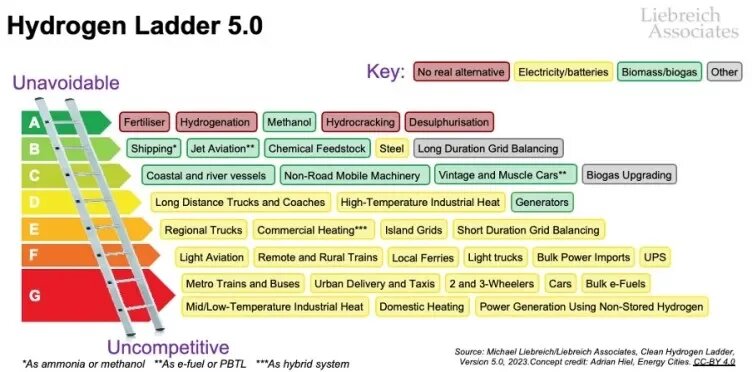
In Europe, plans are also being revised. According to BloombergNEF and Aurora Energy Research, anticipated demand falls far short of EU and member state targets (BloombergNEF 2024). Many applications – such as passenger cars, building heating, or electrifiable industrial processes – appear increasingly uneconomical. Michael Liebreich’s “Hydrogen Ladder” has shaped the debate on prioritization: steel, aviation, and shipping at the top; passenger cars, heating, and off-grid power at the bottom (Liebreich 2023, 2024).

Instead of a global hydrogen economy, 2025 is characterized by pilot projects, regional clusters, and state-backed initiatives – mainly in countries with sovereign wealth funds like Saudi Arabia, Oman, or the UAE, which have low capital costs. In poorer countries with unstable governance, investment remains scarce. This softens fears of green colonialism: investments depend not only on renewable potential, but also on political stability and favorable financing (Dejonghe & Van de Graaf 2025, Tunn et al. 2025).


licence infos

Green industrialization must replace raw material exports

What remains for developing countries? The dream of prosperity through green hydrogen remains risky. Some Global South countries do have world-class solar and wind resources that allow them to produce green hydrogen at very low costs. However, regions with favorable wind and solar potential are so widespread globally that significant scarcity rents, like those seen with oil, are unlikely. For example, the Fraunhofer Institute confirms that Colombia under Gustavo Petro has major potential in three regions (Hank et al. 2024). Yet regions like La Guajira, with a strong presence of paramilitary groups, are so insecure that billion-dollar investments seem implausible.

So, green hydrogen will not become the new oil. But it may become a building block for green industrialization in the Global South. For this to happen, the Global North must also change its policies. As a major importer and consumer of green hydrogen, Germany could enter into reliable partnerships with producer countries based on strict environmental and social standards and significantly increased local value creation. This would greatly enhance development impacts – particularly in terms of job creation.

Several studies show that relocating parts of the value chain for energy-intensive products to regions with cheap renewable energy leads to significant cost advantages (Verpoort et al. 2024, Steitz & Kölschbach Ortego 2023, Bähr et al. 2023). This points to the potential for long-term, reliable partnerships with countries not merely as resource suppliers, but as industrial partners on equal footing – which would also serve Germany’s own interests. However, this would require partially phasing out some basic industries in Germany. Is that politically sustainable?

In such a partnership, Germany and other energy-importing countries must systematically support exporting nations in their efforts to secure value creation locally. Green industrial partnerships instead of hydrogen partnerships – that should be the direction. But is there the political will to do so? So far, there seems to be a stronger readiness to use massive state subsidies to preserve the old industrial structure into the post-fossil age. The question is: how long can that be sustained?