Thursday, September 04, 2025


Floating Data Centers on Fast-Flowing Rivers
Data center
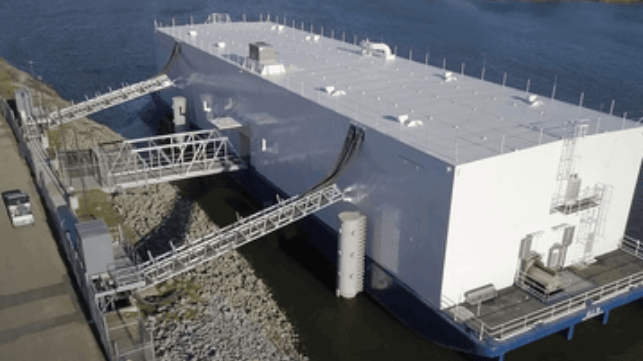
Industry has recognized the potential of floating data centers, like this example in Stockton by Nautilus Data Technologies (Nautilus Data Technologies file image)

Published Sep 3, 2025 1:15 PM by The Maritime Executive


Advances in information processing technology and programming have increased the need for data centers capable of processing massive volumes of information. Data centers that float on water provide ready access to cooling capacity, with potential to convert the energy from sea waves and river currents to electrical energy to operate the onboard technology.

Introduction

Data centers process massive amounts of information and require continuous and reliable access to large amounts of electric power and substantial cooling capacity. When located on land in arid regions where solar photovoltaic energy is available, data centers require roof-mounted air-cooling technology that consumes massive amounts of electrical power. While waterfront coastal locations provide easy and available access to water cooling, market demand for such locations is very high, with high real estate prices.

A cubic volume of water can provide over 3,400 times the thermal capacity of an identical cubic volume of air. Even in warm climates, the temperature of coastal seawater and river water is often cooler than air temperature. At locations where winds blow constantly, wind energy generates waves. It is possible for some technologies to convert energy from a choppy water surface to electrical energy. At other locations next to rivers, there may be scope to install a waterwheel or a turbine to convert the kinetic energy of flowing water to electrical power. While such locations are no longer available in large cities, some suitable sites might still be available in rural and remote locations to operate a data center.

Kinetic Turbines

During an earlier era, undershoot waterwheels converted river flow kinetic energy to mechanical power to operate sawmills or to drive milling wheels for grinding wheat into flour. In the modern era, kinetic turbines have replaced the classical waterwheel. While some kinetic turbines are placed on a river floor or seabed, stationery floating structures restrained by cables are able to carry kinetic turbines under the hull.

A kinetic turbine tested along the St. Lawrence River southwest of Montreal incurred higher cost for electric power compared to hydroelectric power dams. The river floor installation of the turbine reduced access for maintenance and especially during icy winter months. Floating technology that carried turbines under the hull were tested along the St. Lawrence River, downstream of the Moses – Saunders power dam. Counter-rotating pairs of vertical-axis turbines located under the hull, with a flow defector, would place generating technology and main support bearing inside the floating structure, allowing easy access for maintenance and repair. A submerged counter-flow heat exchange unit under the structure would provide cooling during summer weather. During winter, information processing technology would generate enough heat for interior heating.

River Requirements

Rivers deemed suitable for floating data centers would require the combination of sufficient water flow velocity and sufficient water depth to operate kinetic turbines efficiently. Cables connected to shore or anchored to the river floor would restrain the floating structure either near midstream or near a river bank. A current-driven kinetic ferry would carry employees between river bank and floating data center. An extended floating dock would be an option, as would having the data center floating in the river stream with a telecommunications connection to a land-based office where programming employees work.

Suitable Rivers

Data centers require a constant and reliable supply of electrical power, from rivers with reliable and steady water flow, with minimal variation in flow velocity and water depth. The East River in New York City is a suitable candidate. While looking like a river and flowing like a river, it is actually an oceanic channel with flow driven by ocean current. Downstream of Niagara Falls, the Niagara River provides steady water depth and steady flow velocity while being close to a large population. At either location, floating docks restrained by cables could provide access between shore and data center.

East of Lake Ontario and downstream of the Moses – Saunders power dam, water of sufficient depth and velocity flows through the north and south channels of the Upper St Lawrence River. Further east and southwest of Montreal, a section of the St. Lawrence River could sustain operation of a floating data center. Kinetic ferry vessels driven by water current could carry technical personnel between shore and midstream floating data center, and optic telecommunications cable could connect between the data center and shore-based work stations, reducing the number of workers who travel by ferry between shore and data center.

Other Rivers

Many rivers across North America and internationally offer sufficient water depth and water flow velocity, with near steady year-round steam flow rate to sustain operation of floating data centers. Many such rivers are navigable and transit ships, as is the case of sections of the St. Lawrence River. Ferries operate along the East River of New York City despite the powerful water current. Operation of floating data centers also requires access to a suitably qualified workforce, which is available in New York City, the Niagara region and even along sections of the St Lawrence River.

The combination of suitable river characteristics and availability of a suitably qualified workforce would determine future locations of floating data centers. It is uncertain as how to regulatory authorities would classify a floating data center, as it is essentially a vessel with the equivalent of a propeller extending downward under the hull.

Conclusions

Advances in information processing technology along with the development of advanced programming have increased the need to expand the capabilities of data centers. Data centers consume massive amounts of electrical energy and have massive cooling requirements. A data center that floats on water where powerful currents flow, likely have access to required cooling capacity along with the ability to convert river flow energy into electrical power to sustain data center operation. Some future data centers would likely float on fast flowing rivers that pass near large or through cities.

The opinions expressed herein are the author's and not necessarily those of The Maritime Executive.

 

IUMI: EV Fires Can Cause Explosions on Ro/Ros

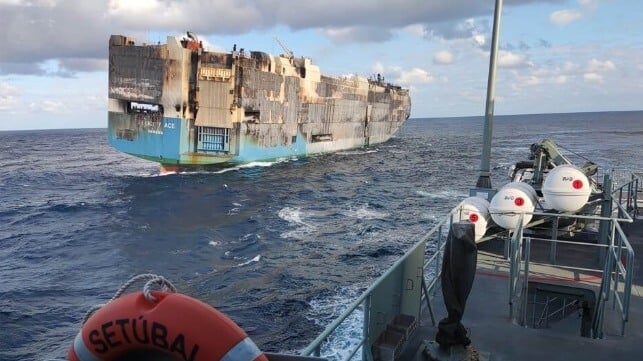
The burned out car carrier Felicity Ace. Operator MOL alleges that an EV started the fire on board (Portuguese Navy file image)

Published Sep 3, 2025 3:56 PM by The Maritime Executive


The International Union of Marine Insurers has updated its guidance to warn that PCTC and ropax operators run a risk of explosion during an onboard EV fire, a previously underexamined problem. 

Electric vehicle fires have been a major source of concern for ro/ro operators for years, and several operators have banned them from carriage. EV battery packs can self-ignite if cells overheat or develop internal faults; they can also catch fire from a nearby heat source, like a burning conventional vehicle. Once EV batteries enter thermal runaway, they burn at high temperature and are difficult to permanently extinguish. They also emit large quantities of toxic, flammable fumes, making hand-to-hand firefighting with a hose team even more challenging in the tight spaces of a full ro/ro deck. 

The industry has adapted its firefighting practices to account for the realities of EV blazes, and operators now favor shutting off ventilation and flooding the affected hold with the fixed CO2 system. This is IUMI's recommendation as well, and the organization recommends that "fixed firefighting systems should be applied early, correctly and safely first rather than manual firefighting." The "early" component of this advice is essential, IUMI says, because waiting could allow the blaze to grow to the point that the fixed system gets disabled by the fire or gets overwhelmed, with potentially catastrophic consequences. 

But this comes with its own risk, according to IUMI. At the right concentrations, the gases that are emitted from an EV battery pack are potentially explosive in combination with ambient atmosphere. Research suggests that the gas mix from an EV fire includes 30 percent hydrogen, which has high explosion potential. If these gases accumulate in an enclosed space without burning off, and mix with air in the right percentage, a blast could occur. Since the traditional fixed firefighting sequence starts with a full ventilation shutdown, before any CO2 is introduced, any gases from the fire would be trapped inside with air only for a period.  

"A comprehensive firefighting strategy must not only consider the firefighting itself but also the management of potentially explosive gases that may accumulate during such incidents. The aim must be to integrate both aspects, firefighting and ventilation operation, without limiting the effectiveness of the overall firefighting system," IUMI cautioned. "Careful consideration should be given by shipowners to appropriate ventilation procedures for the extinguishing system installed and the vessel concerned."

Modern PCTCs have another hazard that inverts typical thinking on marine firefighting. With their wide-open deck layouts, newer PCTCs have no partitions from the starboard bulkhead all the way across to the port side. In addition to the implications for ease of spreading fire, the design creates unique stability considerations. Getting the deck wet - even a little bit - can reduce the friction between car tires and deck surface enough that it creates the risk of a catastrophic cargo shift from one side to the other. If the lashings aren't enough to hold the vehicles in place, the PCTIC could take on a heavy list, with potentially serious consequences. This means that by and large, hose teams for boundary cooling are a restricted option on a PCTC. "Only in calm weather (without swell and wind waves) locally applied small amounts of water can be recommended" for boundary cooling on a PCTC deck, IUMI recommends. 


Salvors Narrowly Avert a Capsizing After Trawler Burns at Pier in Ribeira

Burned Trawler
Courtesy Galician Coast Guard

Published Sep 3, 2025 5:27 PM by The Maritime Executive


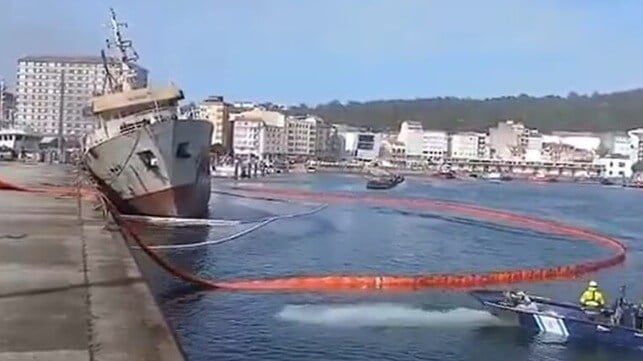
Salvors have successfully prevented the capsizing of a trawler at the port of Ribeira, Galicia, limiting the impact from a severe onboard fire. 

At about 1630 hours on Monday afternoon, the Mauritanian-flagged fishing vessel Awadi caught fire alongside the pier in Barbanza, Galicia. The blaze started in a hold, where maintenance work was under way. A bystander reported the incident to local emergency responders, and shoreside fire teams began work to suppress the blaze and prevent the risk of spreading the fire to nearby ships. No injuries were reported on board. 

The response effort drew in five fire trucks and crews from around the region, as well as coast guard and environmental agency representatives. Efforts to control the spread of the blaze on board were not successful, and it expanded through multiple compartments. 

The team brought aboard bilge pumps to evacuate firefighting water, as the Awadi had begun to take on a list, according to local media. By late Tuesday, it was listing 40 degrees to starboard, and salvors began working to find the cause. It turned out that the bilge system for the hold was admitting water into the compartment, according to Diario de Arousa, so divers were sent below to plug it and halt the water ingress.

Firefighters also removed all of their own gear and all of the stores from the weather deck in order  to improve the vessel's stability, and they reduced the amount of water they were introducing inside the ship. 

The list has stabilized but the fire is still smoldering, port director Juan Sanmartin told local media, adding that it will likely continue to do so for several days until the flammable stores inside the vessel are consumed. So far, no pollution has been reported, but the ship has 18,000 liters of diesel on board and will need to be defueled. 

Once the emergency response is fully completed and the fire is out, an investigation into the cause of the casualty will begin. Port officials say that a stray welding spark may have started the fire, a constant risk during repair periods. 


Supervisor Killed at Hanwha Ocean Shipyard During Testing on FPSO

fatal accident at shipyard
Platform collapsed during the lifting test killing a Brazilian supervisor (Korean TV)

Published Sep 3, 2025 12:19 PM by The Maritime Executive


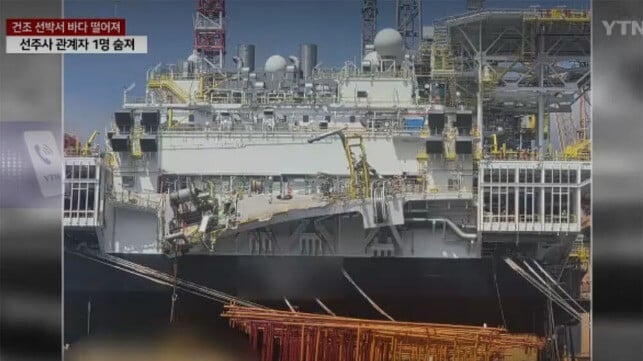
A supervisor identified as a Brazilian national overseeing construction of an FPSO vessel at the Hanwha Ocean shipyard in Geoje, South Korea, was killed on September 3 during testing on the under-construction vessel. The Coast Guard is reporting that the individual fell from a platform that collapsed while two other individuals clung to the structure and were rescued.

Related work at the Hanwha Shipyard was immediately suspended as investigations began into the incident. Korean media reports that the Coast Guard and the Ministry of Employment and Labor are investigating the incident as a possible violation of the Industrial Safety and Health Act.

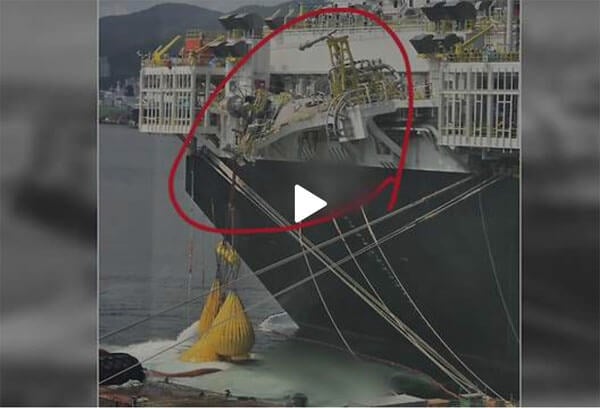
Lift testing was being performed on the 150,000-ton FPSO (Floating Production Storage and Offloading) vessel being built for Petrobras. According to the reports, large bags filled with water we being lifted between approximately 11:30 am and noon local time using a winch aboard the vessel designed for lifting heavy objects. The structure holding the winch collapsed under the weight, leaving it bent and hanging down. 


Report from Korean TV (Click image for video)


The supervisor who was on the platform fell more than 30 feet (10 meters) to the water below. The Coast Guard reports he was recovered at approximately 1330 and was in cardiac arrest. He died at a local hospital.

The other two individuals were able to hold on to the remaining structure. They are reported to have suffered less serious injuries.

South Korea’s unions have complained about unsafe working conditions at all the shipyards. Last year, there was another fatal accident at the Hanwha Ocean shipyard that also resulted in work being suspended. A month later, there was a fatal accident that killed a subcontractor at HD Hyundai’s Ulsan shipyard. 

This latest incident comes as the shipyards have been involved in prolonged contract negotiations with the unions. Hanwha Ocean reached what it called a major labor deal with its unions in late July. The unions, however, have been calling for strikes at HD Hyundai’s shipyards as they demand better wages and working conditions, and now are also protesting the planned merger of HHI’s yard in Ulsan with the Hyundai Mipo shipyard.


U.S. Coast Guard Keeps Close Watch on Chinese Icebreakers off Alaska

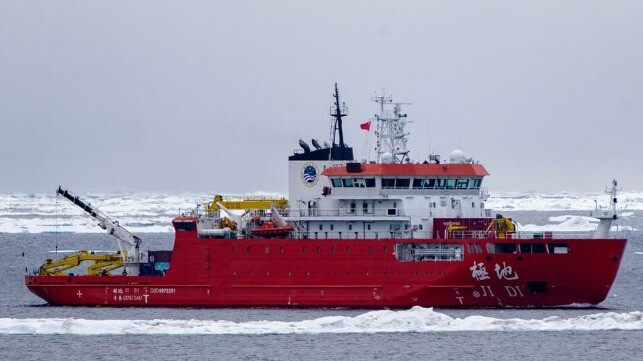
The newly-built ice class research vessel Ji Di, as seen from USCGC Healy (USCG)

Published Sep 3, 2025 9:10 PM by The Maritime Executive


The U.S. Coast Guard has been closely watching China's Arctic research flotilla for the past month, and continues to monitor the operations of two Chinese-flagged vessels in waters of the U.S. Extended Continental Shelf - outside the bounds of the U.S. Exclusive Economic Zone, but inside the limits of U.S. seabed mineral claims. 

The medium icebreaker USCGC Healy has been operating in the region to provide presence and surveillance, and for the last week, Healy's crew has been monitoring the movements of the Soviet-built icebreaking tug Zhong Shan Da Xue Ji Di (flagged with the Liberian registry) and the brand new ice-class research vessel Jidi. Both were encountered in an area of the ECS about 200-250 nautical miles to the north of Utqiagvik, Alaska, a small coastal village on the Beaufort Sea. 

On Tuesday, USCGC Healy - supported by a Hercules long-range SAR aircraft out of Air Station Kodiak - responded to intercept Jidi, and the crew monitored and queried the vessel. Healy intercepted Zhong Shan Da Xue Ji Di on Sunday.

“This operation highlights the value of our ice-capable fleet,” said Rear Adm. Bob Little, commander, U.S. Coast Guard Arctic District. “The U.S. Coast Guard is controlling, securing, and defending the northern U.S. border and maritime approaches in the Arctic to protect U.S. sovereignty, and Healy’s operations demonstrate the critical need for more Coast Guard icebreakers to achieve that.” 

Healy is one of the Coast Guard's two purpose-built oceangoing icebreakers. The "interim icebreaker" USCGC Storis, which began life as an offshore vessel and is currently operated by a civilian merchant mariner crew, is nearby in the Bering Sea. USCGC Waesche, a National Security Cutter, is also in the region and has accompanied Healy for part of the mission. 

In addition to Jidi and Zhong Shan Da Xue Ji Di, the flotilla of Chinese vessels recently spotted in the far north includes the Polar Class 3 icebreaker Xue Long 2; the new research vessel Tan Suo San Hao; and the Shen Hai Yi Hao, a conventional research vessel built to carry a deep-diving submersible.  

In response to the increasing competition in the Arctic, the Trump administration is giving the Coast Guard more resources to expand its presence. With U.S. Army Corps of Engineers funding, it is expanding the small port of Nome, Alaska at the north end of the Bering Sea, specifically to accommodate Coast Guard icebreakers. And to expand the icebreaking fleet, the administration's One Big Beautiful Bill Act contains $4.3 billion to pay for the service's future heavy icebreaker series, the Polar Security Cutter, plus $3.5 billion more for a medium icebreaker series.


ATSB: Livestock Carrier's Engine Failed Due to Poor Maintenance

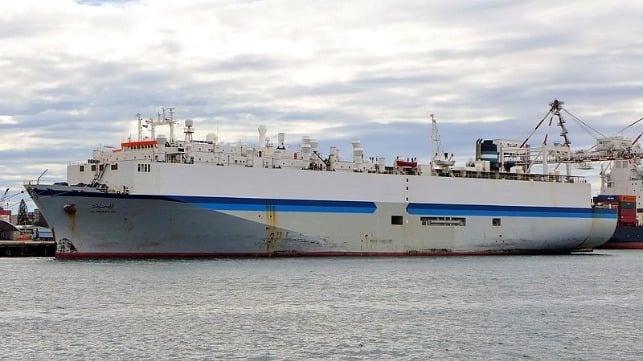
OUTLAW LIVE ANIMAL CARRIERS

Al Messilah (ATSB)
Al Messilah (ATSB)

Published Sep 3, 2025 10:44 PM by The Maritime Executive


The Australian Transport Safety Bureau (ATSB) has released its final report on the engine failure of a livestock carrier that has been banned from entering the country due to persistent safety shortcomings. The report shows that lack of proper maintenance caused the engine failure of the Al Messilah while it was entering the Port of Fremantle, a malfunction that led to loss of propulsion twice in quick succession.

Converted into a livestock carrier in 1997 at the Meyer Werft shipyard in Germany, the Al Messilah regularly traded between Fremantle and Shuwaikh, Kuwait. She was equipped with a Mitsui B&W main engine that delivered about 16,000 horsepower through a fixed pitch propeller.  

On March 4, Al Messilah lost propulsion about one mile outside the port. The main engine stopped while the vessel was entering the harbor, and was briefly restarted. However, the engine failed again shortly after, leaving the ship without propulsion while transiting the inner harbor. With tug assistance, the ship was maneuvered safely to berth, bringing what could have been a dangerous situation to a safe conclusion. 

While the two incidents of engine failure were troubling enough, ATSB faulted the marine pilot for failing to follow standard communications protocols. When the ship lost propulsion, the pilot tried to contact the VTS service via VHF channel 8, the working channel for tugs. The VTS center follows the international standard and monitors channel 12, so the distress call was not received, delaying proper coordination. The pilotage provider, Fremantle Pilots, routinely used VHF channel 8 for all pilotage communications in the harbor, expecting it to be monitored by all parties including VTS. 

Though the incident was a close call, another incident was to occur during Al Messilah's next port visit to Fremantle in April. The ship experienced a complete electrical power loss and black smoke emanated from the engine room, with the cause being attributed to a generator failure. The failure was most likely due to the degradation of the electrical cable insulation, caused by continuous movement due to poor securing, leading to a short circuit in the system.

With multiple safety-related deficiencies being identified during a harbor master inspection, along with systemic shortcomings, including failure to report key incidents such as a mooring line parting and onboard fire, the vessel was banned from entering Australia.

In its final report on the March 4 incident, ATSB established that the engine failure of the 1980-built and Kuwait-flagged livestock carrier was most likely caused by a malfunction of the main air distributor’s servo piston within the engine’s pneumatic control system. Degraded seals inside the servo piston allowed control air to leak between the ahead and astern chambers of the reversing air cylinder. This leakage introduced air into the astern line of the camshaft reversing mechanism.

This likely resulted in the system not being able to maintain the control air pressure needed to fully actuate and hold the camshaft in the ahead position. The camshaft then likely moved to an indeterminate position, which misaligned the fuel injection and exhaust valve timing. This resulted in the engine misfiring and stopping.

The engine failure was an incident in waiting owing to the fact that the main air distributor components, the main engine pneumatic system, and the engine control air system dryer were not maintained in accordance with the manufacturer's guidelines.

The vessel’s owner and operator, the Kuwait Livestock Transport & Trading Company, came under criticism because its planned maintenance system (PMS) did not provide enough detail to track maintenance schedules, and did not have a specific maintenance item to record the maintenance activities on the main engine pneumatic system.

“A comprehensive and well?documented PMS is important to ensure the reliability of critical machinery, particularly systems that directly affect a ship’s maneuverability and safety,” said Angus Mitchell, ATSB Chief Commissioner.

According to the investigation, failure by marine pilots to follow communication protocols was another factor that increased risk. Fremantle Ports’ formal protocols designated VHF channel 12 as the primary channel for vessel traffic service (VTS) communications, and channel 8 for towage operations.


Video: Brand New Yacht Capsizes After Launch at Turkish Shipyard

Yacht
Image via Turkish social media

Published Sep 3, 2025 10:50 PM by The Maritime Executive


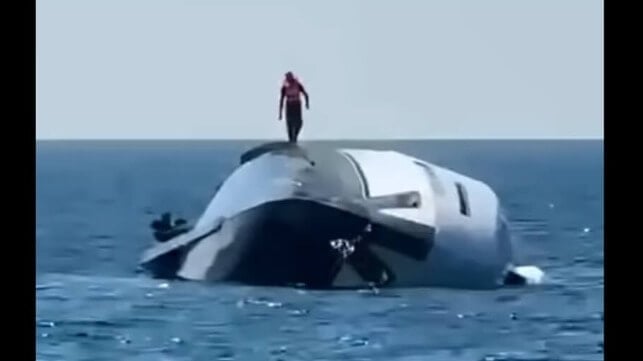
[Brief] A brand new yacht capsized in dramatic fashion on Tuesday just minutes after launch from a Turkish shipyard, forcing the owner and crew to swim for shore.

At about 1430 hours on Tuesday afternoon, the Med Yilmaz Shipyard in Eregli, Turkey launched a new 24-meter yacht named Dolce Vento. Within minutes, the vessel listed hard to port, then rolled over onto her side. Video shows a member of the crew taking refuge on the upturned hull before deciding to jump over the side to safety. 

The yacht's owner, master, and two crewmembers were aboard, according to local media. All escaped safely and no injuries were reported. An investigation into the cause of the capsizing is under way.  

Med Yilmaz is a small yard in Eregli, Turkey with a history in workboat, fishing boat and freighter construction. According to local outlet 7Deniz, a Turkish shipping firm had been building the vessel at the Yilmaz facility for more than two years.

Rubio: Military Strikes on Suspected Drug Boats "Will Happen Again"

DEEP STATE TRICKERY FAKED INCIDENT

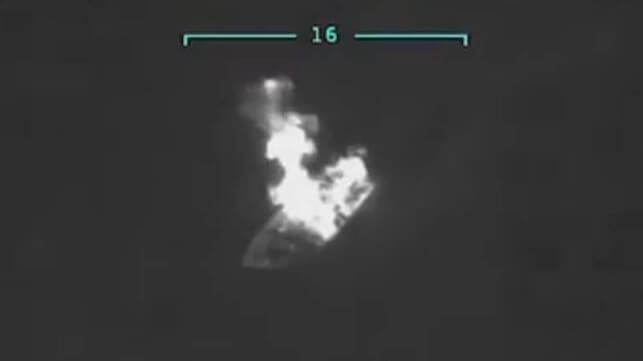
A suspected smuggling boat burns off Venezuela, Sept. 2 (Courtesy of the White House)

Published Sep 3, 2025 11:56 PM by The Maritime Executive


The Trump administration plans to keep attacking drug boats with lethal military force, U.S. Secretary of State Marco Rubio told reporters Wednesday. 

"The United States has long — for many, many years — established intelligence that allowed us to interdict and stop drug boats. And we did that. And it doesn’t work. Interdiction doesn’t work," Rubio said at a press conference in Mexico City. "What will stop them is when you blow them up, when you get rid of them."

The administration has deployed a large task force to waters of the southern Caribbean, and is testing a new, militarized approach to trafficking enforcement. On Tuesday, the White House announced that a boat allegedly transporting narcotics off Venezuela had been eliminated in a strike; 11 suspects were killed, the administration said, and no survivors were reported.

According to the White House, the boat was transporting drugs for the Tren de Aragua gang, designated by the Trump administration as a foreign terrorist organization. Rubio said Tuesday that the vessel was likely headed to Trinidad or another country in the Caribbean. He expressed certainty that the drugs were headed for the United States; the same route is also commonly used on the circuitous drug pipeline to European markets, where cocaine fetches a higher value. 

The president personally authorized the attack on the suspect boat, Rubio told reporters. "On the president’s orders, we blew it up. And it will happen again," Rubio said. "Maybe it’s happening right now. I don’t know."

Secretary of Defense Pete Hegseth sounded a similar note in an interview on Fox and Friends. "This is a deadly serious mission for us, and it won’t stop with just this strike," he said. 

Reactions to the new approach have been mixed. Many legal experts suggest that executing suspects on the high seas without a boarding or a trial may expose the administration to war crimes charges, particularly if done for an offense that is not normally punishable by death.

"Destroying a boat at sea without boarding or verifying opens the door to tragedy," said Juan S. Gonzalez, former senior director of the National Security Council under former President Joe Biden. "The USCG - not the Navy - is the right tool for counter-narcotics in the Caribbean."

However, some regional leaders are all too happy to see a new emphasis on lethality in countering the drug trade at sea. Military methods are already common for shoreside counternarcotics agencies in Latin America, matching the militarized nature of the cartels. Kamla Persad-Bissessar, prime minister of Trinidad and Tobago, said Tuesday that she supported the Trump administration's new approach. 

"The pain and suffering the cartels have inflicted on our nation is immense. I have no sympathy for traffickers; the US military should kill them all violently," she said in a statement.


Canada Moves its Coast Guard Into its Defense Ministry

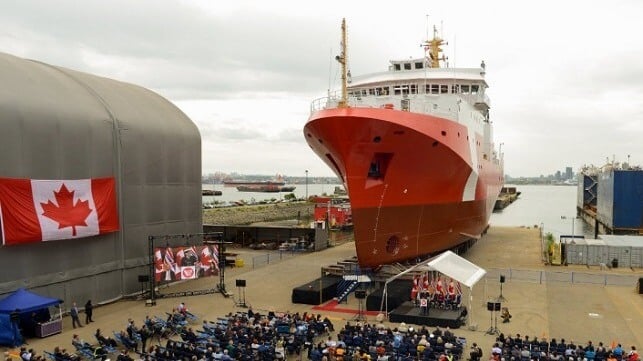
Fisheries vessel launch CCG
File image courtesy CCG

Published Sep 3, 2025 2:40 PM by The Maritime Executive


The Canadian Coast Guard has formally transferred out of Fisheries and Oceans Canada and  into Canada's national defense establishment, expanding its role and adjusting its orientation.  

The transition brings the CCG's maritime domain experience into the mission of defending Canadian sovereignty, Canada's government said in a statement, much like the U.S. Coast Guard model. Some elements from Fisheries and Oceans Canada are also making the switch. 

The integration is intended to increase information-sharing and coordination between the CCG, Canada's Department of National Defense and the Canadian Armed Forces (CAF) - but, unlike the USCG, the CCG will remain a civilian agency rather than a military branch. 

"There are no plans to arm CCG personnel or assets, or to incorporate an additional enforcement role in the organization. The CCG will continue to deliver the essential services on which Canadians rely, including search and rescue, icebreaking, environmental conservation and protection, safe navigation, and supporting ocean science," said Minister of National Defense David McGuinty in a statement. 

A new bill before Canada's parliament would expand the CCG's national security role somewhat further, if passed. The Stronger Borders Act proposes to add (among other measures) maritime domain awareness responsibilities for the CCG, especially in the Canadian Arctic. In an era of increasing competition in the Arctic, and with the Northwest Passage increasingly accessible, tasking additional assets for monitoring in the remote far north could have security benefits. 

In the last election round earlier this year, Canada's Liberal party pledged to prepare the Canadian Coast guard for MDA activities and make it ready to support NATO operations. By doing so, Canada will now apply its existing coast guard spending towards its NATO defense spending target; Canada has long fallen short of the NATO readiness contribution target, which was set at two percent of GDP in 2014 and is now set to rise to five percent by 2035.


Russian Union Wins Compensation for Death Aboard a Sanctioned Tanker

iStock
iStock / SHansche

Published Sep 3, 2025 4:41 PM by The Maritime Executive


The Russian Seafarers' Union (SUR) has begun publicizing cases of labor rights enforcement against "shadow fleet" tankers, the lightly-regulated and questionably-insured vessels that carry most of Russia's oil to market. The calibrated "price cap" G7 sanction regime has restricted Russia's access to Western tanker owners and insurers, creating business opportunities for anonymous players who operate along the edges of maritime law and practice - and are occasionally caught shorting their seafarers. 

Last month, the SUR reported that it had secured the detention of the tanker Unity, a sanctioned vessel owned in Moscow and managed in the UAE. Russian enforcement actions against the Russia-facing shadow fleet are rare, but SUR convinced the port captain in Murmansk to detain Unity for multiple violations, including an estimated $90,000 in unpaid back wages. The vessel had just changed legal owner, flag state and insurer, and the crew were concerned that their employment contracts would not be honored. 

On Monday, the SUR reported that its Black Sea branch had pursued compensation for the death of a second engineer aboard the tanker Sun (IMO 9293117). Like many shadow fleet vessels, Sun "did not have a valid insurance policy," and the owner refused to pay any compensation to the seafarer's family. 

"Not only was the amount of compensation for death not specified in the contract, but there was no information about insurance at all. In addition, it turned out that the insurance policy on the tanker was invalid," union official Alexey Belyakov reported. 

The union got involved in the matter at the family's request, and it reached out to the flag registry of Antigua and Barbuda. However, the registry said that Sun was no longer flagged in Antigua, so it could not assist. Sun's paperwork now declares that it is flagged in Benin, but shipping database Equasis records that this declaration is false - a common shadow fleet practice.

Without help from the insurer or the flag state, the SUR reached out to Sun's owner. By the union's account, the shipowner ignored all requests and only got in touch when the union contacted the flag state. Then the owner brought in Turkish lawyers to negotiate, without success. At last, a representative of the shipowner in Russia joined the negotiations, and the SUR settled on a final payment of $125,000 for the family. 

In a statement, the union cautioned seafarers to read their employment contracts carefully before signing, with particular attention to insurance and medical care - and to contact their union for advice if there are red flags.