It’s possible that I shall make an ass of myself. But in that case one can always get out of it with a little dialectic. I have, of course, so worded my proposition as to be right either way (K.Marx, Letter to F.Engels on the Indian Mutiny)
Thursday, September 04, 2025
Secret Talks Hint at Exxon's Re-Entry into Russian Oil
A potential return of U.S. supermajor ExxonMobil to Russian operations would be beneficial for the region of Sakhalin in Russia’s Far East and help Russia’s energy sector, Sakhalin’s governor Valery Limarenko has told Reuters.
Ahead of the Trump-Putin meeting in mid-August, Russia and the United States had reportedly discussed Exxon returning to the Sakhalin-1 oil and gas development project. Senior U.S. and Russian officials discussed bilateral energy deals on the sidelines of the talks on reaching a peace agreement in Ukraine in August. The potential energy agreements between the U.S. and Russia were proposed as an incentive for Putin to agree to a peace in Ukraine and a path forward for the United States to ease sanctions on Moscow.
In the weeks following the Trump-Putin summit, no breakthrough has been achieved toward peace and President Trump has again expressed frustration with Putin.
Exxon quit the Sakhalin-1project after the Russian invasion of Ukraine, which triggered an exodus of foreign oil firms and service providers.
To coincide with the Trump-Putin meeting, Russian President Vladimir Putin amended his decree from 2022 giving full Russian ownership to Sakhlain-1, and opened the door to a return of foreign companies to the oil and gas project.
Back in 2022, Putin signed a decree to seize the Sakhalin-1 project, in which Exxon held a 30% stake.
A potential Exxon return would help Russia’s oil and gas extraction, Limarenko told Reuters.
“Look, it's important that they want to return,” the governor added.
“We need to develop further and in this sense, it would be more efficient to develop further jointly,” Limarenko told Reuters.
Senior executives from Exxon discussed a potential return to the Sakhalin-1 project in secret talks with Russia’s oil giant Rosneft earlier this year, The Wall Street Journal reported last week, quoting sources with knowledge of the talks.
Conservative Party leader Kemi Badenoch plans to declare North Sea oil a "cornerstone" of the UK economy, advocating for maximized extraction and promoting the energy sector.
Badenoch will announce an end to the ban on oil and gas licenses and aims to rename the North Sea Transition Authority to mandate maximum extraction.
Her strategy represents a significant departure from previous Conservative governments' net zero push, with Badenoch stating that achieving net zero by 2050 would be "impossible."
Conservative Party leader Kemi Badenoch will pledge to make North Sea oil a “cornerstone” of the UK economy amid concerns producers have “much more to do” to reduce carbon emissions in the coming decades.
In a speech to the Society of Petroleum Engineers Offshore Europe conference in Scotland, Badenoch will tell industry officials that she would like to see as much oil and gas extracted from the area as possible.
Badenoch will blame the Labour government for failing to make the most of oil and gas fields’ potential, though her recent comments on energy policy have represented a big departure from previous Conservative governments who pushed for net zero and taxing energy giants’ profits.
The Conservative leader will also say she will put an end to a ban on oil and gas licences and allow the UK government to promote the energy sector through its finance and trade networks.
“Labour sees the North Sea as a relic of the past; we see it as a cornerstone of Britain’s future,” she will tell officials.
“By restoring common sense to energy policy, we will unlock billions in revenue, secure our supply, and rebuild confidence in the UK economy.”
She will accuse Reform UK of pushing for the “part-nationalisation” of the energy sector, which would bring the UK “back to the bad old days of the 1970s when the government controlled British industries, running them into the ground”.
Badenoch’s radical push for oil extraction
Her speech will unveil a wider strategy to defend UK energy companies and end policies which hamper the sector’s growth.
Badenoch said earlier this year achieving net zero by 2050 would be “impossible”.
The Labour government is considering opening the North Sea to oil drilling as energy secretary Ed Miliband changed rules that could see Equinor’s Rosebank oil field and Shell’s Jackdaw gas field projects go ahead. Officials are weighing up the benefits against pledges to turn Britain into a “clean energy super power”.
Reform UK have meanwhile pledged to end net zero commitments and all related subsidies for the sector.
Badenoch’s comments will come as the North Sea Transition Authority (NSTA) warned top businesses they will have to make “serious investments” to reduce emissions by 90 per cent in the next 15 years.
Its report showed that emissions have fallen for five years in a row, representing a decrease by over a third between 2018 and 2024.
“Bringing down production emissions by more than a third in six years shows the North Sea oil and gas industry has been getting a lot right, reflecting its commitment.,” NTSA director of strategy Hedvig Ljungerud said.
“If operators lose focus on the task at hand, the projections are clear that UK production will become less clean and less competitive compared with imports over time.”
Badenoch is pledging to rename the NTSA to the North Sea Authority and mandate it to “maximise the extraction” of oil and gas.
David Whitehouse, the boss of the industry body Offshore Energies UK, said bosses took the wider sector’s commitments to reduce carbon emissions by a half by 2030 seriously.
“[Commitments] are an important part of demonstrating that the sector is part of our future energy mix.”
Cambodia's solar industry experienced rapid growth, becoming a significant export sector and creating thousands of jobs, largely due to a two-year waiver on US tariffs.
The industry's boom ended abruptly in mid-2024 when the US tariff waiver expired, leading to the imposition of extremely high duties that caused Cambodian solar exports to plummet dramatically.
The collapse has resulted in widespread factory closures, job losses, and a shift for some remaining firms to producing alternative solar products with lower tariffs, while Cambodian producers dispute claims of transshipping Chinese-made goods.
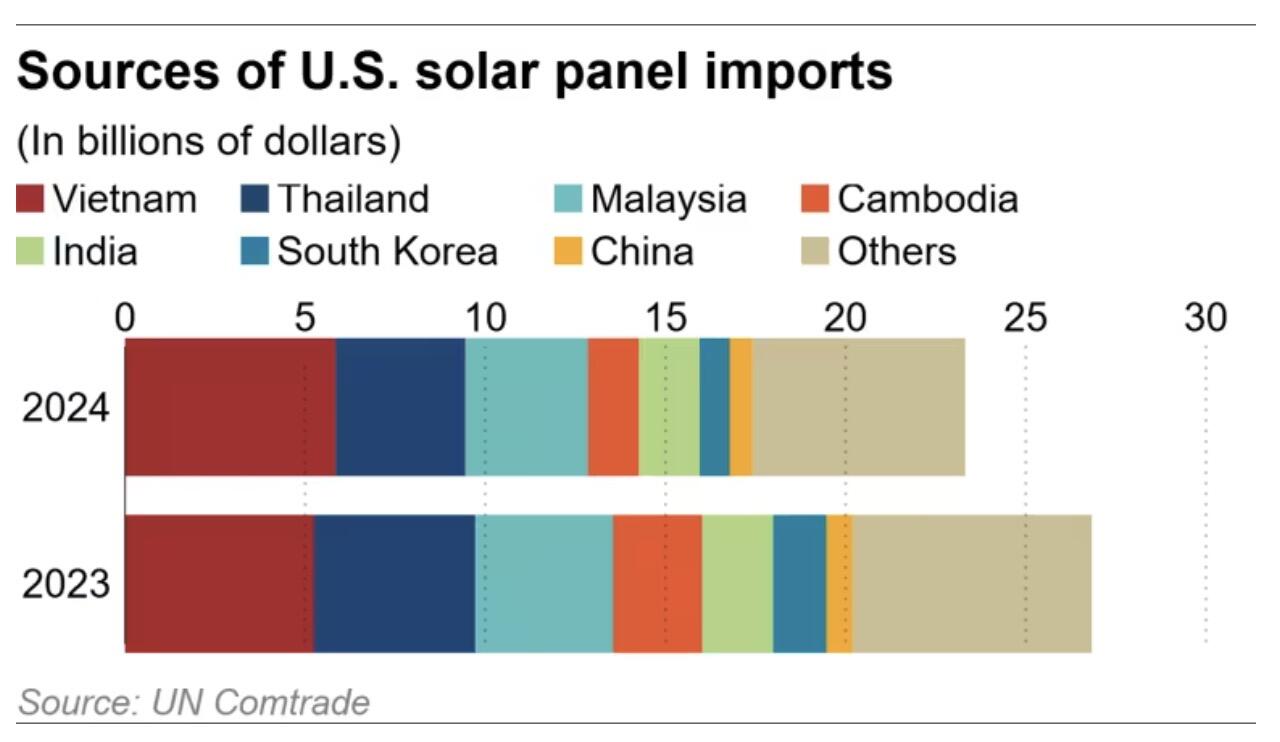
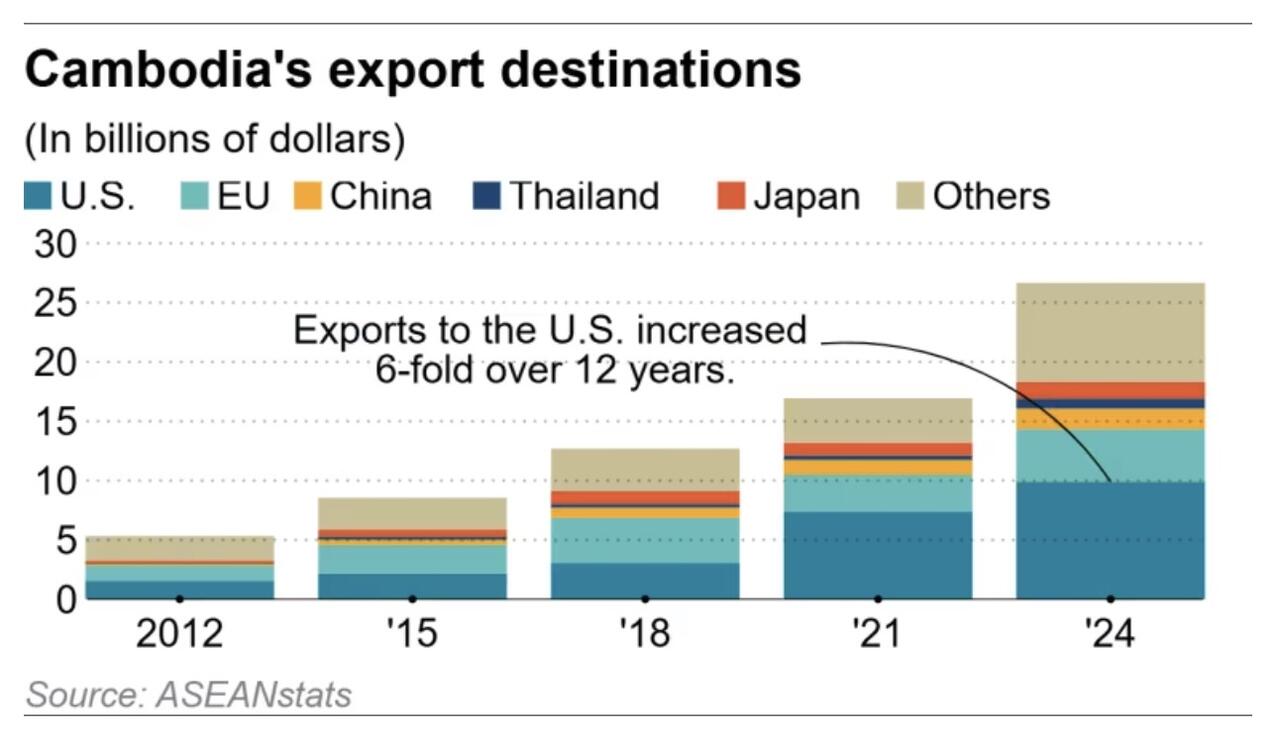
Cambodia’s solar industry rose quickly but has collapsed just as fast. At its peak in 2023, solar exports to the United States totaled $2.4 billion, making it the country’s largest manufacturing export after garments, footwear, and luggage, according to Nikkei Asia.
Around a dozen factories opened between 2018 and 2022, creating thousands of jobs and briefly turning solar into a major industry.
But Nikkei writes that growth ended after U.S. tariff policy shifted. The Biden administration had granted a two-year waiver on tariffs, but when it expired in mid-2024, the Trump administration imposed duties ranging from 534% to 3,403% on Cambodian solar modules. By comparison, tariffs on Malaysia, Thailand, and Vietnam were lower. The result was immediate: Cambodian solar exports fell to just $4.4 million in the first half of this year, according to customs data.
Many factories have since closed. Jintek Photovoltaic Technology, once a large exporter to U.S. buyers, shut down. Solar Long PV Tech, which had supplied BYD America, also closed after its manager left Cambodia. Hounen Solar has been reduced to only a handful of workers. “My company is temporarily closed this year, and it is because of the tariff,” said manager Sothoeuth, who had overseen 300 employees before the new duties. “We are not sure if we will restart the company again or not. It depends on the tariff.”
A few firms have tried to adapt. Venus Energy and VCOM Power System shifted production from solar modules to thin-film panels, which face only a 19% duty. These panels are more costly to make but remain viable for now. “Before, we had five companies, but now we have only two,” said VCOM’s human resources director, Thang Menghout. “If there will be a higher tariff, we cannot do it anymore.”
Cambodian producers dispute U.S. claims that they were transshipping Chinese-made products. “It is not correct, because we spent a lot of money. We had more than 1,000 workers to produce equipment, and the [Cambodian Commerce] ministry monitors us,” Menghout said. “We don’t know their politics from one country to another, [but] we don’t cheat on our products.”
For workers, the rise and fall of solar has been stark. Factories once offered higher wages than garment jobs and attracted people with promises of more advanced technology. When the factories shut, many returned to lower-paid work. “There was [later] no demand to make solar panels because the U.S. stopped ordering… Then, they reduced workers and salaries,” said former Jintek employee Men Samet, now a fruit seller in Phnom Penh.
“If solar came back, we would go back. We had good managers and high salaries.”
Scientists have found that a dye made from red onion skin extract, combined with nanocellulose, offers a 99.9% protection rate against UV rays for solar cells.
This bio-filter material outperforms petroleum-based alternatives currently used in solar panel manufacturing, offering a more sustainable solution to combat degradation.
The new technology is particularly beneficial for perovskite solar cells, contributing to the development of more efficient and cost-effective solar panel designs.
Solar energy continues to break records around the world thanks to dramatically decreasing costs of deployment. A supportive policy environment and rapid advancements in technology have made solar photovoltaics one of the cheapest forms of energy out there, and as a result, solar power is on track to become the single largest renewable source on the planet by the end of the decade, even overtaking hydropower. But even greater growth will be necessary to reach net zero emissions by 2030, and in light of souring policy environments, technological innovations will be more necessary than ever to guide the hand of the market toward decarbonization.
Luckily, innovation is already ongoing. Many labs around the world are working on reshaping solar energy to be more efficient, more cost-effective, and more practical in hugely diverse ways. Scientists are looking into ways to redesign solar panels using materials that allow for greater efficiency and lower costs. Most panels are currently made using silicone, but other materials such as perovskite – which functions like a thin-film semiconductor – could offer significant advantages over current models. The problem with perovskite is that its chemistry is less stable than silicone, “which has historically presented scalability and commercialization challenges” according to Utility Drive.
For this reason, tandem solar panels – which feature a combination of silicone and perovskite – have emerged as one of the most promising solar cell manufacturing innovations. And the competition to bring them to market is heating up as a number of research teams are announcing successful testing of their respective tandem models.
Scientists are also working to find ways to improve the longevity of solar cells. While ultraviolet light is essential to the functioning of solar panels, it also breaks them down over time. The current technology to fight this degradation depends on petroleum-based products, which works against the full life-cycle sustainability of solar energy. Plus, extending the life of solar panels will help to mitigate the increasingly critical issue of solar panel waste.
A team of scientists in Finland may have just discovered a high-performance eco-friendly material to replace those petroleum-based protections – and it comes from an extremely unlikely source. According to a report from Live Science, “red onion dye could be the missing ingredient required to bolster ultraviolet (UV) protection for solar cells.” In fact, testing has shown that “combining nanocellulose with a dye made from red onion skin extract” has resulted in a stunning 99.9% protection rate from UV rays.
Nanocellulose is another biologically-based material used as a film for solar panel protection. “In the quest to drive the adoption of film made from more sustainable, biologically-based materials, nanocellulose has emerged as a frontrunner,” reports Live Science. “Nanocellulose is derived from plant-based materials and is produced by breaking down cellulose into nanoscale fibers,” the article goes on to explain.
According to the scientists’ study, which was just published in the scientific journal ACS Applied Optical Materials, “UV−vis-NIR spectroscopy demonstrated that CNF-ROE blocked 99.9% of radiation below 400 nm, showcasing its superior UV-blocking capability compared to the other materials tested here.” One of the materials that this bio-filter outperformed is a commercial PET-based filter currently in use by solar panel manufacturers.
Adding to the excitement, the team reports that the technology could be particularly helpful in the context of perovskite solar cells, indicating a win-win for the future of more efficient and cost-effective solar panel design.
Such advances in solar panel design could be critical to continuing the clean energy transition’s forward momentum in a time of unprecedented uncertainty and political backpedalling. In order for solar power to continue its boom, increased adoption has to make economic sense – with or without policy supports. And that might not be too far-fetched. In fact, the Science Friday podcast posits that solar power’s continued rise could balance out other clean energy cuts, in a win for the clean energy sector and for the planet.
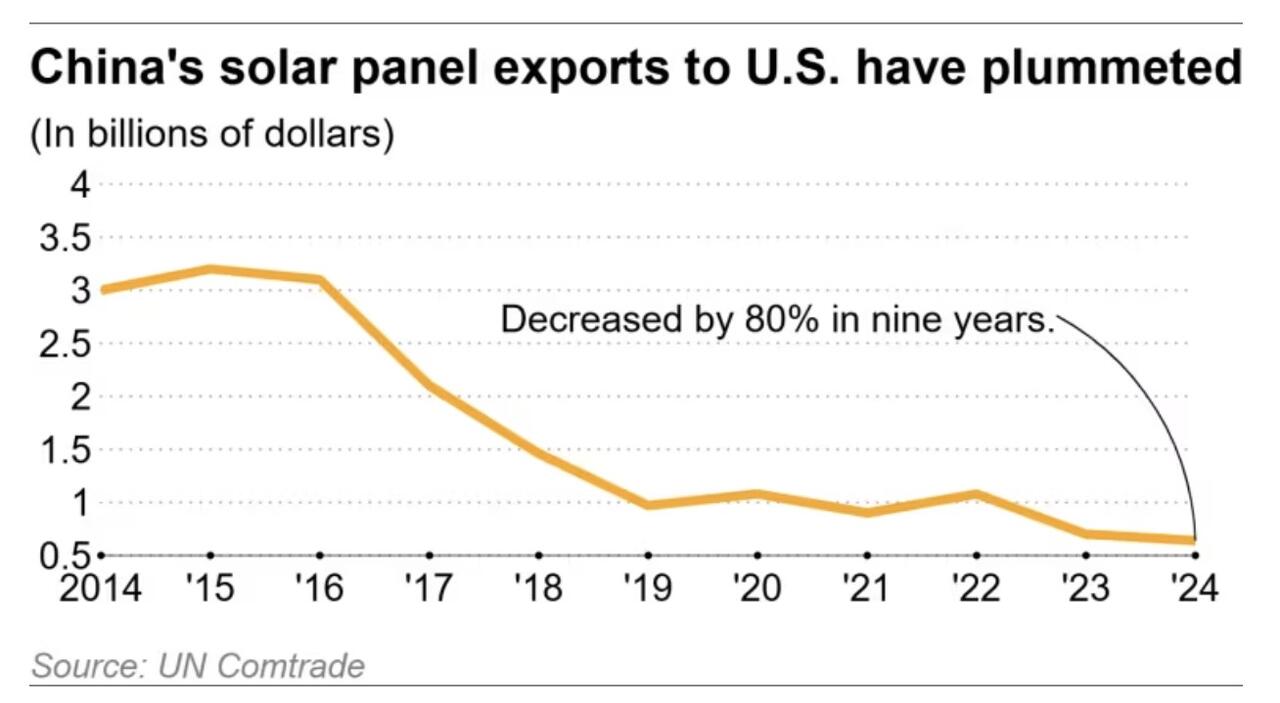
China has launched in earnest the drive to curb excess capacity in the solar manufacturing sector, which has doomed many companies to price wars and deepening losses.
The combined losses of six of China’s biggest solar panel and cell manufacturers doubled in the first half of 2025, to $2.8 billion (20.2 billion Chinese yuan), from the same period last year, the Financial Times reports, citing data from local financial information provider Wind.
All top Chinese solar equipment producers had already booked losses for the first quarter of 2025, blaming the continued losses on low product prices and the trade and tariff turbulence under U.S. President Donald Trump.
The Chinese solar wafers, panels, switchers, and other equipment producers have been struggling on the domestic market amid overcapacity that China’s authorities moved to address only in late 2024.
Earlier in 2024, the China Photovoltaic Industry Association said that China urgently needs consolidation in the solar manufacturing industry as overcapacity and price wars are leading local companies to a race to the bottom.
This summer, China’s authorities are stepping up efforts to address the overcapacity in China’s clean technology industries, which undermines the profitability of solar equipment manufacturers.
Chinese authorities have realized that cutthroat competition, overcapacity, and low-quality manufacturing are hurting enterprises. Following months of introducing several measures to try to curb excess cleantech manufacturing capacity, China has now vowed to become more serious in addressing the problem.
Chinese authorities and media have intensified in recent weeks the message that the “disorderly price competition” and overcapacity need to be addressed.
In July, executives from 14 leading Chinese solar firms were summoned by China’s Ministry of Industry and Information Technology (MIIT), where Industry Minister Li Lecheng called on the manufacturers to end price wars, phase out outdated and severely underutilized capacity, and shift toward innovation and value-based competition.
The minister “stressed that the next phase will prioritize product quality, stronger regulations, and sustainable development with ongoing government support,” solar panel manufacturer Huasun said, commenting on the meeting.
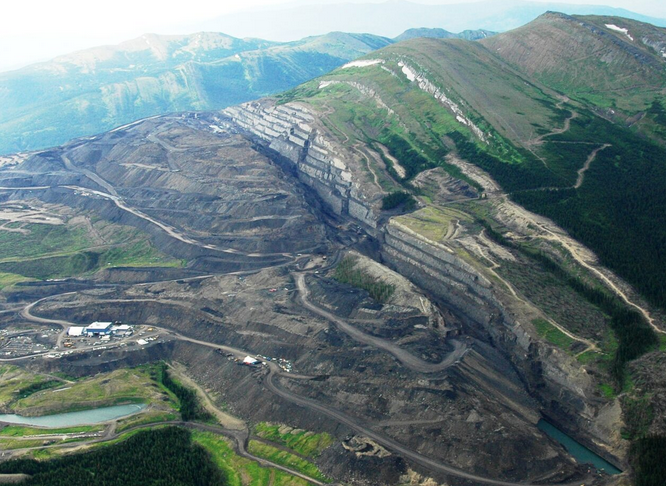
Trend Roman coal mine in Northeastern British Columbia. Image frm Conuma Resources.
British Columbia’s Environmental Appeal Board has upheld a ruling that handed Peace River Coal Inc. an C$800,000 ($580,000) fine after it repeatedly failed to comply with its environmental permit at its Trend Roman coal mine near Tumbler Ridge,Business in Vancouver reported.
The Peace River coal mine was a metallurgical coal mine in northeastern BC, that was owned by Anglo American and suspended production in 2014 due to low coal prices. In February 2025, the idled mine was sold to Conuma Resources, a coal miner with operations in northeastern BC.
The penalty was the largest ever issued by the B.C. Ministry of the Environment under the Environmental Management Act when it was first handed down in 2021. These infractions included failing to monitor mine waste discharge into fish-bearing waters and neglecting to limit airborne particulate emissions stemming from the Trend-Roman mine’s failure to limit the discharge of selenium into three nearby creeks and rivers, BIV reported.
In the original 2022 decision to penalize the company, Peace River Coal’s mine was reportedly found to have breached selenium discharge limits by as much as 350% between 2016 and 2019.
“The company’s environmental permit was initially issued on October 31, 2015. It recognizes that effluent from the mine site is directed to a set of sedimentation ponds. One Permit required that Peace River construct and start operating a second water treatment facility on Gordon Creek, downstream of the sedimentation ponds, by March 31, 2017 to reduce selenium levels in Gordon Creek. In May 2016, Peace River applied for an amendment to the Permit, to delay the construction of the Second facility,” the ruling reads.
According to the decision, the Director concluded that Peace River had violated the permit by not submitting quarterly reports (six times) and one annual report as required.
The Director also determined that there were 40 exceedances at a second monitoring station, downstream of the planned location of the Second Facility. The Director considered this to be a “major” contravention, with an associated base amount of C$20,000 per day.
It now operates four mines in the province — Brule, Wolverine, Willow Creek, and Quintette — it acquired the latter in 2022 from Teck Resources for $120 million.
In June 2024, the company was fined for over 400 environmental protection violations at its Brule mine site, committed between 2020 and 2023. These infractions included failing to monitor mine waste discharge into fish-bearing waters and neglecting to limit airborne particulate emissions.
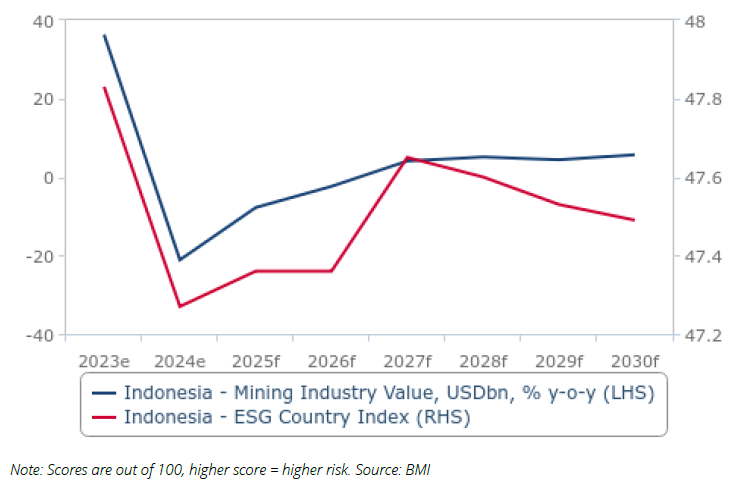
Indonesia’s planned operation to seize more than 1,000 illegal mining sites starting this month is unlikely to deliver “meaningful environmental gains” and will yield only a “modest boost to state revenues,” according to a new analysis from BMI, a Fitch Solutions company.
The Indonesian government aims to transfer seized mining sites to state ownership, positioning the move as part of President Prabowo Subianto’s wider anti-corruption campaign. But BMI notes that the real motivation appears to be revenue recovery rather than ecological protection.
The approach echoes a March 2025 crackdown on illegal palm oil farms, which critics said disproportionately affected smallholders and indigenous communities while sparing large corporate interests.
Environmental watchdogs argue that Indonesia’s weak institutions, red tape and entrenched corruption have long hampered enforcement of resource regulations. These systemic issues are likely to limit the effectiveness of the crackdown, even as Jakarta seeks to upgrade its mining sector up the global value chain, where stronger governance credentials could attract more international partners and capital, BMI said.
Corruption-linked polarization remains a flashpoint in public life. Recent unrest over high parliamentary housing allowances underscores the extent to which corruption-related controversies can spark broader protests, complicating policy implementation, it added.
Still, despite the governance shortcomings, BMI forecasts Indonesia’s mining industry will continue to expand. The report suggests that economic imperatives will outweigh environmental, social and governance (ESG) considerations in the near term, leaving the sector’s sustainability profile weak compared with global peers.