Saturday, September 06, 2025

'Like a king': China brutally mocks Trump in new opera


Cantonese opera actor Lung Koon-tin, portraying U.S. President Donald Trump, performs on stage in "Trump, The Twins President", in Hong Kong, China, June 5, 2025. REUTERS/Tyrone Siu

TRUTH OUT

A new stage production recently debuted in China that skewers President Donald Trump and his relationships with various world leaders.

NBC News reported Sunday that the Cantonese opera "Trump, the Twins President," just concluded a three-day run in Hong Kong's Xiqu Centre, with each showing playing to a sold-out audience. While the opera parodies multiple world leaders, the star is Trump, who is played by actor Lung Koon-tin in a garish blond wig and oversized eyebrows.

Playwright Li Kui-ming initially wrote the show in 2019, during Trump's first administration, but the newest version is updated with multiple references to Trump's second term. This includes the U.S. president referring to Canada as "the 51st state," his administration's attacks on Harvard University and even his very recent public dispute with Tesla and SpaceX CEO Elon Musk.

The opera begins with an actor portraying Trump's eldest daughter, Ivanka, having a dream in which her father has a twin brother in China named Chuan Pu (which roughly translates to "Trump" in Chinese). The show begins by chronicling the United States' initial foray with China in the 1970s, in which then-President Richard Nixon met with Chinese Premier Zhao Enlai — with a young Chuan Pu becoming disillusioned with China and moving to the U.S.

Notably, the opera also dramatizes Trump's 2024 rally in Butler, Pennsylvania. Prior to the rally, the Ivanka character asked Chuan Pu to stand in for her father, who had been abducted by Martian aliens. Chuan Pu does not survive the assassination attempt, which sets off other events throughout the production. The show ends with Trump getting into a fist fight with Ukrainian President Volodymyr Zelenskyy in the Oval Office, with the two taking turns knocking each other down.

Li, who is a former journalist, told NBC he aimed to draw parallels between Trump and former Chinese leader Mao Zedong, as they both sought to shape the world around them "like a king." However, he insisted that Trump would "love my drama," and emphasized that the show's plot is "only a dream" and that it's not meant to be taken "very seriously."

"Trump, the Twins President" debuted as the United States prepares to enter into a new round of trade negotiations with Chinese officials in hopes of ending Trump's trade war with the Asian superpower. Trump's tariffs on the United States' top trade partner has effectively paralyzed commerce between the two nations, and the dearth of Chinese imports entering the U.S. may lead to stores having rows of empty shelves this summer.

Click here to read NBC's full report.
'Don’t get lost down a rabbit hole': Major anti-vaxxer talking point destroyed in analysis


Photo by Ed Us on Unsplash
September 03, 2025 


It makes sense to approach some marketing efforts with skepticism. Scams, deepfakes, and deceptive social media posts are common, with people you don’t know seeking to profit from your behavior.

But should people extend this same skepticism to pediatricians who advise vaccines for children? Health and Human Services Secretary Robert F. Kennedy Jr. said financial bonuses are driving such recommendations.

“Doctors are being paid to vaccinate, not to evaluate,” Kennedy said in an Aug. 8 video posted on the social platform X. “They’re pressured to follow the money, not the science.”

Doctors and public health officials have been fielding questions on this topic for years.

A close look at the process by which vaccines are administered shows pediatric practices make little profit — and sometimes lose money — on vaccines. Four experienced pediatricians told us evidence-based science and medicine drive pediatricians’ childhood vaccination recommendations. Years of research and vaccine safety data also bolster these recommendations.

Christoph Diasio, a pediatrician at Sandhills Pediatrics in North Carolina, said the argument that doctors profit off vaccines is counterintuitive.

“If it was really about all the money, it would be better for kids to be sick so you’d see more sick children and get to take care of more sick children, right?” he said.

Is Your Pediatrician Profiting Off Childhood Vaccines?
by Taboola
Sponsored LinksYou May Like


Visit BC for North America’s Largest Night MarketExplore 100+ international street food vendors at the Richmond Night Market.Tourism Richmond

It costs money to stock, store, and administer a vaccine.

Pediatricians sometimes store thousands of dollars’ worth of vaccines in specialized medical-grade refrigeration units, which can be expensive. They pay to insure vaccines in case anything happens to them. Some practices buy thermostats that monitor vaccines’ temperature and backup generators to run the refrigerators in the event of a power outage. They also pay nursing staff to administer vaccines.

“Vaccines are hugely expensive,” said Jesse Hackell, a retired general pediatrician and the chair of the American Academy of Pediatrics’ Committee on Pediatric Workforce. “We lay out a lot of money up front.”

When a child with private insurance gets a vaccine, the pediatrician is paid for the vaccine product and its administration, Hackell said.

Many pediatricians also participate in a federal program that provides vaccines free of charge to eligible children whose parents can’t afford them. Participating in that program isn’t profitable because even though they get the vaccines for free, pediatricians store and insure them, and Medicaid reimbursements often don’t cover the costs. But many choose to participate and provide those vaccines anyway because it’s valuable for patients, Hackell said.

When discussing vaccine recommendations, pediatricians don’t make different recommendations based on how or if a child is insured, he said.

Jason Terk, a pediatrician at Cook Children’s Health Care System in Texas, said a practice’s ability to make a profit on vaccines depends on its situation.

Terk’s practice is part of a larger pediatric health care system, which means it doesn’t lose money on vaccines and makes a small profit, he said. Some small independent practices might not be able to secure terms with insurance companies that adequately pay for vaccines.

Suzanne Berman, a pediatrician at Plateau Pediatrics, a rural health clinic in Crossville, Tennessee, said that 75% of her practice’s patients have Medicaid and qualify for the Vaccines for Children program, which the practice loses money on. When she factored in private insurance companies’ payments, she estimated her practice roughly breaks even on vaccination.

“The goal is to not lose money on vaccines,” Terk said.

So What’s Driving Your Pediatrician’s Vaccine Recommendations?

Pediatricians typically recommend parents vaccinate their children following either the American Academy of Pediatrics’ or the Centers for Disease Control and Prevention’s recommended vaccine schedule.

Diasio said the driving force behind pediatric vaccine recommendations is straightforward: Trained physicians have seen kids die of vaccine-preventable diseases.

“I saw kids who died of invasive pneumococcal disease, which is what the Prevnar vaccine protects against,” Diasio said. “We remember those kids; we wouldn’t wish that on anyone.”

Still, your pediatrician will consider your child’s health holistically before making vaccine recommendations.

For example, a few children — less than 1% — have medical reasons they cannot receive a particular vaccine, Hackell said. This could include children with severe allergies to certain vaccine components or children who are immunosuppressed and could be at higher risk from live virus vaccines such as the measles or chickenpox vaccine.

“When people have questions about whether their kids should get vaccines, they really need to talk to their child’s doctor,” Diasio said. “Don’t get lost down a rabbit hole of the internet or on social media, which is programmed and refined to do whatever it can to keep you online longer.”r vaccine, Hackell said. This could include children with severe allergies to certain vaccine components or children who are immunosuppressed and could be at higher risk from live virus vaccines such as the measles or chickenpox vaccine.

“When people have questions about whether their kids should get vaccines, they really need to talk to their child’s doctor,” Diasio said. “Don’t get lost down a rabbit hole of the internet or on social media, which is programmed and refined to do whatever it can to keep you online longer.”
'Hit a brick wall': Trump’s 'scam' claims about the economy died hard this week


U.S. President Donald Trump listens during a meeting with Ukrainian President Volodymyr Zelenskiy (not pictured) and European leaders amid negotiations to end the Russian war in Ukraine, at the White House in Wa

September 06, 2025 
ALTERNET


CNN analyst David Goldman writes that President Donald Trump and his administration spent the last month trying to sell his July bad jobs numbers as a big lie planted by Biden sympathizers to undermine his administration.

The president called the July jobs report “rigged,” and fired Erika McEntarfer from her role as Bureau of Labor Statistics commissioner for serving them up. Afterward, officials bent themselves into pretzels trying to explain why Trump was justified in removing McEntarfer for allegedly sabotaging his administration — despite offering no proof of McEntarfer’s claimed villainy.

“That effort hit a brick wall Friday after the government produced updated jobs numbers that painted an even more concerning portrait of the U.S. economy,” wrote Goldman.

McEntarfer is gone, but Friday’s jobs report showed hiring continued to stall in Trump’s economy.

“The number of jobs actually fell in June for the first time since 2020 — all while the revisions the Trump administration so vociferously complained about were significantly less dramatic than in prior months,” Goldman said. “… In other words: The jobs data the Trump administration used to signal a scandal was neither historic nor evidence of corruption.”

The Bureau of Labor Statistics collects jobs data from two surveys, one from old-fashioned door knocking and the other from telephone, internet surveys, and automated data transfer from large corporations. The bureau follows up some information with callbacks to assure accuracy. It revises some numbers for seasonal changes and for low survey responses.

Faced with the undeniable trend, CNN reports the Trump administration has not claimed the August jobs numbers were rigged just yet. Instead Trump is trying to blame Fed Chair Jerome Powell for keeping interest rates high.

“Labor Secretary Lori Chavez-DeRemer echoed that stance,” reports Goldman. “National Economic Council Director Kevin Hassett conceded that the jobs report was a ‘disappointment,’ blaming the BLS’ inability to track summer hiring. He also, without evidence, attributed some of the hiring slump to Trump’s immigration policy, a conclusion that the jobs report does not capture.”

Meanwhile, Trump’s Commerce Secretary Howard Lutnick insists, without evidence, that “McEntarfer was rooting against Trump and America’s success, which led to skewed jobs numbers,” Goldman said.

Read the CNN report at this link


'He's managed to screw it up': Economists dismantle key Trump myth


(REUTERS)

Brad Reed
September 06, 2025 

A federal jobs report released on Friday showed the US economy added a mere 22,000 jobs in August in yet another signal of weakness in the US labor market.

Economists had projected the economy would produce 75,000 jobs on the month, which means that the Bureau of Labor Statistics (BLS) numbers released on Friday were well below the consensus estimate.

What's more, the total number of jobs created in July and June were once again revised downward, and the economy as a whole has added an average of fewer than 30,000 jobs over the last three months.

Heather Long, the chief economist at Navy Federal Credit Union, put the bad jobs report in stark terms.

"The labor market is going from frozen to cracking," she said, and then pointed to net job losses in industries including mining, construction, and manufacturing that show significant stress in the blue-collar economy. In fact, the majority of job growth came from the healthcare industry over the last month.

"The US job market is almost entirely dependent on healthcare," she observed. "That's not healthy for the economy."

Justin Wolfers, an economist at the University of Michigan, also said that the new numbers showed a continued deterioration in both the US labor market and the economy as a whole.

"I'm worried," he said. "The economy was in a good place in late 2024. That's no longer true. And the trajectory is, at a minimum, concerning. That's millions of people's lives, and millions of stories of pain."

Wolfers also zeroed in on the fact that manufacturing employment has been contracting for several months, despite US President Donald Trump's pledges to lead a manufacturing revitalization.

"But the Administration has made dramatic policy shift to boost manufacturing, and it just ain't working," he said. "Manufacturing employment fell [by 12,000 jobs], and is down [78,000 jobs] over the year."

Former BLS commissioner Erika McEntarfer, whom Trump fired last month after he baselessly accused her of concocting negative job numbers to harm him politically, argued on Bluesky that the new report's downward revisions of previous monthly estimates are indicative of a labor market that is very quickly cooling.

"The larger-than-usual downward revision last month was in large part driven by a negative skew in the job growth distribution among late reporting firms," she said. "That's unusual, but it's happened before when the pace of job growth slows rapidly. This print is more evidence that was the case."

Mike Konczal, senior director of policy and research at the Economic Security Project and former member of President Joe Biden's National Economic Council, argued the new jobs report demonstrates that "the theory of Trumponomics is failing."

"The first theory of Trumponomics was that tariffs would build up manufacturing work and federal workforce cuts would free up workers for them," he explained. "That's failed. Manufacturing lost jobs almost as fast as the federal workforce (-12 vs. -15K)."

Konczal then showed how Trump's tariffs have hurt his stated goal of bringing back well-paying jobs for blue-collar men, as industries that produce such jobs have also been harmed by his tariffs on foreign goods and materials.

He also pointed out that Trump advisers claimed that mass deportations of undocumented immigrants would create new job openings that native-born workers would rush in to fill.

"But, you guessed it, that's also failing," he said. "Amidst the broader weakening, the native-born unemployment rate is at the highest levels since the pandemic."

Elise Gould, the director of health policy research at the Economic Policy Institute, similarly noted that "there have... been sustained losses over recent months in manufacturing, construction, and mining," in recent months, which she said was "an indication that Trump's blue-collar renaissance is clearly not happening."

Alex Jacquez, chief of policy and advocacy at the progressive advocacy organization Groundwork Collaborative, called the jobs report "devastating," while laying the blame at the feet of Trump.

"Trump's promises to working families have fallen flat," he said. "The unemployment rate is the highest in nearly four years, the economy has lost nearly 40,000 manufacturing jobs this year alone, and millions of workers are unable to find full-time employment. Families are getting fewer chances to secure the American dream in Trump's economy."

Rep. Brendan Boyle (D-Pa.) reacted to the jobs report by issuing a scathing rebuke to Trump and his management of the economy.

"Donald Trump inherited an economy built on years of steady job growth," he said. "In just seven months, he's managed to screw it up—just like he's screwed up everything else in his life. Now, working families are getting squeezed from every direction: higher prices, Republicans' Big Ugly Law ripping health care away from millions, and a job market that's slowing down."

'Going in the wrong direction': Wall Street analysts raise red flags over Trump economy

Alexander Willis
September 6, 2025 
RAW STORY


 A trader works on the floor of the New York Stock Exchange shortly before the closing bell as the market takes a significant dip in New York, U.S., February 25, 2020. REUTERS/Lucas Jackson/File Photo/File Photo

With President Donald Trump’s tariffs already being felt across the American economy, the president has told Americans to be patient, and that his trade policy would soon usher in a resurgence of domestic manufacturing jobs.

And yet, as job growth slows and prices tick up, Trump’s promise to reshore domestic manufacturing has not only not come to fruition, it appears to be “going in the wrong direction,” according to one analyst who spoke with the Washington Post Saturday.

“We aren’t even seeing the beginnings of a tariff-related recovery in manufacturing,” said Dean Baker, an economist and co-founder of the Center for Economic Policy Research in Washington, speaking with the Washington Post. “You don’t expect to see it overnight. But it’s going in the wrong direction.”

Trump’s tariff policy has already begun to take its toll on the American economy according to a number of economists; prices have risen, job growth has slowed dramatically, and inflation has ticked up.

Trump has told Americans to be patient, that his tariff policy would see the economy rebound by next year, and at the very least, the stiff tariffs would ignite an explosion of domestic manufacturing jobs, with the policies incentivizing companies to reshore their operations to avoid paying steep penalties.

However, the tariffs now appear to be having the opposite effect, with import taxes impacting supply chains, and the uncertainty of Trump’s tariff policy – with tariff rates being adjusted for specific countries multiple times, unpredictably – giving cause for companies to be hesitant with their investments.

“Uncertainty around tariff policy is limiting activity,” wrote Wells Fargo economists Shannon Grein and Tim Quinlan this week in a joint analysis. “While the higher costs associated with tariffs are a challenge, the uncertainty around where tariffs ultimately land is likely more so limiting current activity today.”

Trump voters are 'taking it on the chin': Bad job numbers are worse for 'Cletus'

Mondovi, WI USA September 28, 2020 Farmer John with his John Deere 3020 Tractor holding out a Trump Banner and also an American Flag on the tractor.
September 06, 2025   
ALTERNET

Bulwark editor Jonathan Last reminded Trump voters that the president’s latest awful job numbers include their jobs, too, in a piece entitled, "What Happens When Cletus Loses His Job?"

“Trump’s Forgotten ManTM is taking it on the chin,” said Last, acknowledging that the U.S. economy added just 22,000 jobs. “Mining, oil, and gas production lost 6,000 jobs; manufacturing lost 12,000 jobs and is net -78,000 since Trump took over.”

The health care sector was the only sector that added jobs, to the tune of 31,000 new positions. But that “22,000” overall job figure means the entire rest of the economy lost jobs.

“If you don’t work in health care, then employment in your field contracted,” Last said, while unleashing a devastating set of charts representing the drastic difference between the Biden and Trump years, with Biden’s economy showing outlandish growth in nonfarm payroll, a drop in the unemployment rate and Trump’s decline in construction spending — a reliable indicator of an encroaching recession.

“It’s complicated but I’m pretty sure that if I make the arrows big enough, even [Trump voters] … can understand it,” Last said.

“I cannot emphasize enough that all of this is volitional: America chose stagflation,” Last wrote. “We had the best economy in the world for four years. Biden’s team achieved the kind of mythical soft-landing that gives economists wet dreams. Unemployment stayed low; the inflation which crept into the system for twelve months was quickly tamed. Boat sales — my favorite indicator of Trump voter prosperity—hit historic highs.

“Yet Trump campaigned explicitly on (1) imposing massive, economy-disrupting tariffs and (2) increasing government debt,” Last said. “He told voters exactly what he was going to do. And instead of having even a basic understanding of economics, a plurality of voters said, Well s——, Lurleen. I done seen Mister Trump on the teevee and he’s a business man. He’ll do the economy good.”

Read the Bulwark report at this link


'Kind of report that gets you fired': Trump ridiculed on MSNBC over 'brutal' jobs data

Tom Boggioni
September 5, 2025
RAW STORY


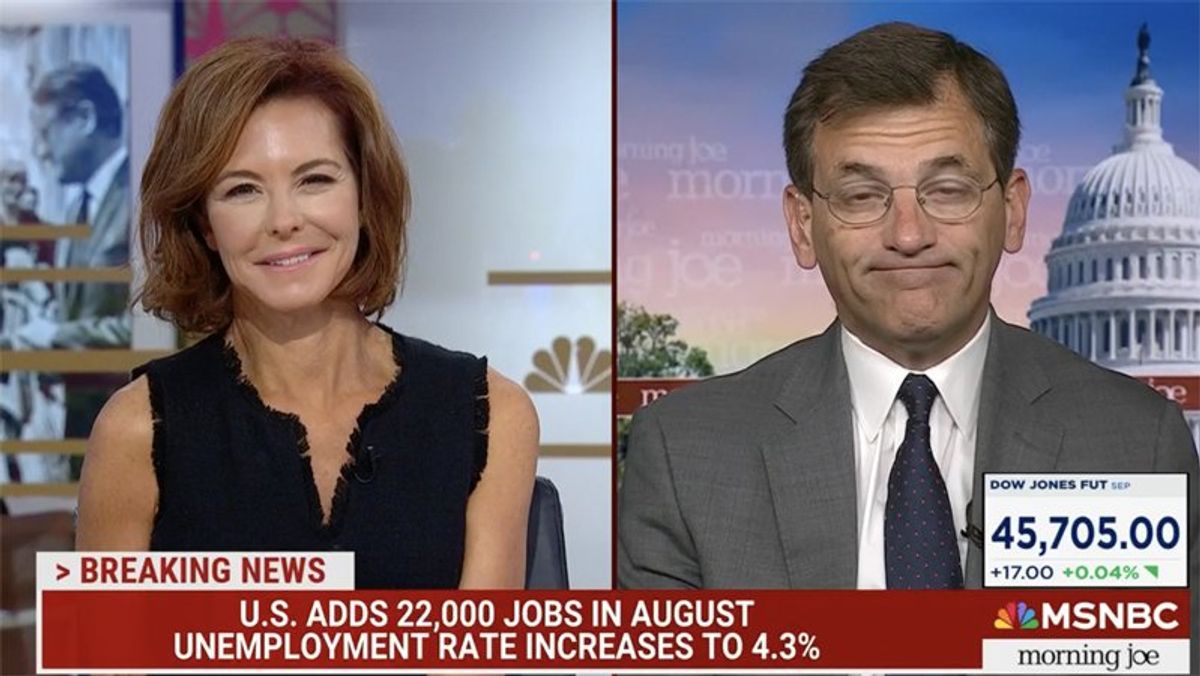
Stephanie Ruhle, Peter Baker (MSNBC screenshot)

"Brutal” and “really bad” were some of the adjectives used on MSNBC on Friday morning after the new jobs report came out, and it showed unemployment went up.

This, of course, comes after Donald Trump fired the previous head of the Bureau of Labor Statistics following several negative reports, claiming that the individual was biased against him.

Moments after the report was released, MSNBC’s Jonathan Lemire and Stephani Ruhle were ready to pounce –– and that is just what they did with an assist from the New York Times’ Peter Baker.

"The August jobs report was released moments ago, showing that the U.S. added just 22,000 jobs last month much, much less than the 75,000 that economists expected,” Lemire prompted his guests. “The unemployment rate also saw a slight increase to 4.3 percent. This, of course, the first jobs report released since President Trump fired the head of the Bureau of Labor Statistics last month after that report showed not just a weak level of job creation, but also a dramatic reduction in previous month's totals.”

“There's no way to sugarcoat this. This jobs report is brutal,” he added.

“It's not good,” Ruhle, a former Wall Street executive, agreed. “What is it showing us? What we know is the economy is slowing. It does not matter what Donald Trump tells us. It doesn't matter what [Commerce Secretary]Howard Lutnick, what he wants. The economy is slowing, so Donald Trump and the market are going to get what they want: a rate cut.”

“That is the reality that we're living in and Howard Lutnick can say, ‘Oh, you're going to like the number six months from now,’ when you bring in a Trump ally and cook the books, it doesn't change reality,” she added. “Things cost more and the tariffs are making business more difficult in the United States of America. That's our reality.”

The Times’ Baker added, “Look, this is the kind of report that gets you fired, right?” which led to laughter before adding, “It's literally documenting the same trends that we saw last month that he [Trump] said were rigged and now this post-firing report suggests that the trend lines that were so problematic a month ago, in fact, are still there.”

You can watch below or at the link.


'You have a big problem': Ex-Fox News host warns new report is bad news for Trump

Daniel Hampton
September 5, 2025
RAW STORY


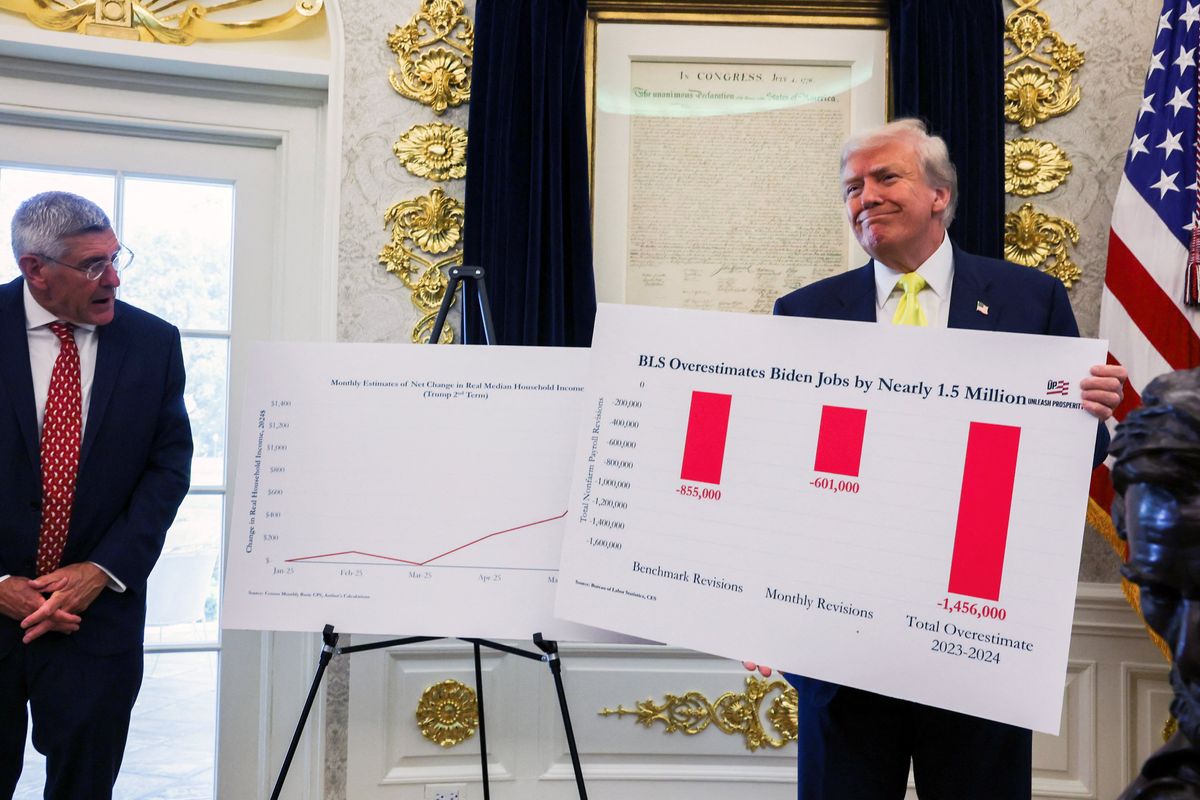
U.S. President Donald Trump holds a board sourced from Bureau of Labour Statistics, CES titled 'BLS Overestimates Biden Jobs by Nearly 1.5 Million', while Senior Visiting Fellow in Economics at The Heritage Foundation Steve Moore speaks, during an announcement on the economy, in the Oval Office at the White House in Washington, D.C., U.S., August 7, 2025. REUTERS/Jonathan Ernst

A startling new jobs report out this week earned President Donald Trump a stark warning from former Fox News host Gretchen Carlson

Carlson and senior political commentator Van Jones joined CNN's "OutFront" with host Erin Burnett on Friday afternoon to talk about he latest jobs report, which showed Black unemployment climbing to 7.5%, up from 7.2% last month, and is now at its highest level since October 2021, mid-pandemic.

Furthermore, the young adult unemployment rate soared to 10.5%, up from 10.0% the previous month.

Jones told the panel that Trump's "devastating" Department of Government Efficiency cuts helped propel the number for Black Americans.

"Smashing the backbone of the Black middle class. All those women who did the right thing, who paid their taxes, who went to school, who worked hard every day, getting wiped out. That is a big chunk here," he said.

"This is a real problem now," he added.

When asked if there could be political consequences to thrusting Americans out of work, Carlson delivered a stark warning.

"If you're asking if it's going to be a political problem, could be," Carlson replied. "Because Trump's biggest strength was the economy. I mean, that's how he got so many independents to vote for him the first time and the last time."

She warned people "aren't fond" of Trump's massive DOGE cuts, his so-called "One Big Beautiful Bill," his tariff increases, and the way his immigration crackdown has unfolded.

"You add in that they might not be happy with the economy? You have a big problem politically," she concluded, noting a Gallup survey that came out before the brutal jobs numbers found just 37 percent of Americans support Trump on the economy. That number was just 27 percent for independents.

"Keep an eye on that," she warned.

"That's the whole ball game," Jones added.

Watch the clip below or at this link.


Trump Tariff Regime Slammed as Manufacturing Jobs Crater


"The manufacturing sector is struggling more than the rest of the labor market under Trump's tariffs, and manufacturing workers' wage growth is stagnating."


Julia Conley
Sep 05, 2025
COMMON DREAMS

US President Donald Trump's tariff policies, imposing levies as high as 50% on the United States' trading partners, have not proven compatible with his campaign promise to turn the US back into a "manufacturing powerhouse," as Friday's jobs report showed.

The overall analysis was grim, with the economy adding just 22,000 jobs last month, but manufacturing employment in particular has declined since Trump made his April 2 "Liberation Day" announcement of tariffs on countries including Canada and Mexico.

Since then, the president has introduced new rounds of tariffs on imports from countries he claims have treated the US unfairly, and all the while manufacturers have tightened their belts to cope with the higher cost of supplies and materials.

Overall manufacturing employment has plummeted by 42,000 jobs, while job openings and new hires have declined by 76,000 and 18,000, respectively, according to the Center for American Progress (CAP), which released a jobs report analysis titled Trump's Trade War Squeezes Middle-Class Manufacturing Employment on Friday.

"The manufacturing sector is struggling more than the rest of the labor market under Trump's tariffs, and manufacturing workers' wage growth is stagnating," said CAP.

Last month, the sector lost 12,000 jobs, while wages for manufacturing workers stagnated.

In line with other private employees, workers in the sector saw their wages go up just 10 cents from July, earning an average of $35.50 per hour.

"Despite Trump's claims that his policies will reignite the manufacturing industry in the United States, his policies have achieved the opposite," wrote policy analyst Kennedy Andara and economist Sara Estep at CAP.

The findings are in line with the Federal Reserve Bank of Dallas' Texas Manufacturing Survey, which was taken from August 12-20 and found that 72% of manufacturing firms say the tariffs have had a negative impact on their business.

"The argument is: We're all meant to sacrifice a bit, so that tariffs can help rebuild American manufacturing. Let's ask American manufacturers whether they're helping," said University of Michigan economics professor Justin Wolfers on social media, sharing a graph that showed the survey's findings.


As Philip Luck, a former deputy chief economist with the US State Department, told the CBC last month, Trump has been promising "millions and millions of jobs" will result from his tariff regime, but those promises are out of step with the reality of manufacturing in 2025.

"We do [manufacturing] now with very few workers, we do it in a very automated way," Luck told the CBC. "Even if we do increase manufacturing I don't know that we're going to increase jobs along with it."

The outlet noted that while the number of Americans employed in manufacturing peaked in 1979, the value of manufacturing production has continuously trended up since then.

Michael Hicks, director of the Center for Business and Economic Research at Ball State University, told the CBC that "no treasure trove of jobs" is likely to come out of Trump's tariffs.

The president "walked into an economy that was seeing the largest manufacturing production in American history," Hicks said. "That is really a testament to how productive American workers are, the quality of the technology, and capital investment in manufacturing."

But the rate of hiring at manufacturing firms is far below its 2024 level, said CAP, revealing the negative impact of Trump's tariff regime.

US Rep. Ro Khanna (D-Calif.) pointed to nearly 800 workers who lost their jobs in the manufacturing sector this week, including 120 whose company's sawmill closed in Darlington, South Carolina; 101 who worked at an electronics assembly plant for Intervala in Manchester, New Hampshire; and 170 whose sawmill positions were eliminated in Estill, South Carolina.

The US Supreme Court is expected to soon review Trump's tariffs after the Court of Appeals for the Federal Circuit ruled last week that many of them are illegal.


'Stalled': WSJ editors trash Trump for bringing job market to its knees

Matthew Chapman
September 5, 2025 
RAW STORY

The conservative Wall Street Journal editorial board took stock of the latest dismal jobs report on Friday — and laid a key part of the blame for it at the feet of President Donald Trump.

"Friday’s monthly report for August confirms that job creation has stalled amid his tariff barrage," wrote the board, a frequent critic of Trump's trade policy. "Employers added a mere 22,000 jobs last month while the numbers were revised down for the previous two by a combined 21,000. This means only 107,000 new jobs were created in the last four months — an average of 27,000. Monthly job gains averaged 167,000 last year."

Even worse, the board noted, "Nearly all of the new jobs last month were in social assistance and healthcare (46,800), which rely on government spending," while manufacturing saw a loss of 38,000 jobs — meaning the public sector is propping up the Trump economy from total freefall.

It's not a mystery why any of this is happening, the board continued.

"The Occam’s razor explanation is the uncertainty and additional costs from Mr. Trump’s border taxes," they wrote. "Caterpillar estimates that tariffs will cost the equipment maker $1.8 billion this year. Deere projects a tariff hit of about $600 million, mainly from higher steel and aluminum costs. Deere is also hurting because soybean farmers have seen their market share in China shrink after its trade retaliation. Tariffs are slamming U.S. auto makers like Ford ($2 billion tariff cost this year)."

And even though Trump has done everything in his power to open up federal regulations for an oil drilling spree, "oil and gas producers say the tariffs have increased prices for materials and caused them to pull back on drilling."

The only real hope for the economy at this point, the board wrote, is if Trump loses his appeal to the Supreme Court after lower courts found his tariff scheme unconstitutional.

"What Mr. Trump needs is a broad revival in business confidence of the kind that accompanied his November victory and appeared before his tax on imports and willy-nilly interventions in private business decisions," the board concluded. "Repeat after us: Tariffs are taxes, and taxes hurt economic growth."

US private sector hiring cools more than expected: ADP

By AFP
September 4, 2025


Image: — © AFP/File SAUL LOEB

Hiring in the US private sector slowed more than anticipated in August, according to payroll firm ADP on Thursday, as all eyes turn to the jobs market to gauge the economy’s health.

Private sector employment rose by 54,000 last month, ADP said, down from a revised 106,000 in July.

“The year started with strong job growth, but that momentum has been whipsawed by uncertainty,” ADP chief economist Nela Richardson said in a statement.

She added that the hiring slowdown could be explained by issues ranging from a labor shortage to “skittish consumers.”

While there remained job gains in areas like leisure and hospitality, industries including manufacturing and trade, transportation and utilities lost jobs.

The report comes a day before the world’s biggest economy is set to report official hiring and unemployment numbers.

The most recent hiring figures showed that the key labor market was weaker than expected, sparking worries about the health of the economy.

ADP numbers, however, sometimes diverge from the government’s data.

US businesses have been grappling with heightened uncertainty this year as they face rapidly changing tariff policies announced by President Donald Trump.

After returning to the presidency in January, Trump imposed a 10-percent duty on almost all trading partners, before hiking levels for dozens of these economies.

He has also progressively rolled out separate duties on sector-specific imports such as steel, aluminum and autos.

The ADP report on Thursday showed that year-on-year pay growth was 4.4 percent for those who stayed in their jobs, and 7.1 percent for those who changed jobs.
'We’re going to flood the zone': White House mingles at conference 'filled with extremists'


Adam Lynch

September 06, 2025 
ALTERNET

The Guardian reports the Friday National Conservatism Conference in Washington, D.C. hosted a wide variety of far-right religious extremists, from men-only secret societies to theocratic right-wing pundits and associations.

Other event speakers were closely associated with the secretive Society for American Civic Renewal (SACR), an invitation-only, Christian ultra-nationalist network with “undercurrents of neo-fascist accelerationism,” according to a Middlebury Institute report.

Mingling and mixing among the theocrats, however, were Trump officials.

“NatCon is filled with extremists touting white nationalism and conspiracy theories,” said Heidi Beirich, the chief strategy officer and co-founder of the Global Project Against Hate and Extremism. “What is notable is how Trump administration officials and allies are key players in the event, showing that it is near impossible today to distinguish the far right from the administration.”

One speech by White house “border czar” Tom Homan contained warnings for the city of Chicago, which Trump is threatening to douse with federal agents and national guard troops, as he already has in Los Angeles and Washington, D.C.

“I said two months ago, we’re going to flood the zone and that’s exactly what we’re doing,” Homan told the crowd. “In Chicago, it’s coming. So, watch what happens in the very near future.”

The Guardian reports Trump’s deputy attorney general, Harmeet Dhillon, gave her own speech in which she characterized the justice department’s civil rights division as “the president’s shock troops.”

“We’re the front guard. We are going to go first and clear the way for others to do their work,” said Dhillon, who has assigned civil rights lawyers to investigate anti-genocide campus protests and perceived “anti-Christian bias.”

Other administration figures speaking at NatCon included Director of National Intelligence, Tulsi Gabbard, and Small Business Administration leader and former senator, Kelly Loeffler.

These Trump officials shared screen time with leading figures of the so-called “new right,” an anti-democratic and ultra-nationalist far-right movement “whose reactionary views have undergirded the Trump administration’s actions,” according to the Guardian. They also shared space with Society for American Civic Renewal Co-founder Charles Haywood — a regular engagement farmer on X — who recently posted: “Has a single (subcontinent) Indian ever accomplished anything of truly major note in the modern period?”

The Guardian reports the conference also featured “prominent faces from the universe of thinktanks surrounding the Trump administration who have signed on to, or even devised the Project 2025 agenda that has provided a blueprint for Trump’s actions in its first months.” This included Heritage Foundation president, Kevin Roberts, whose speech “leaned into male grievance and anti-immigrant sentiment,” according to the Guardian.

Read the full Guardian report at this link.


'We Are All DC ': Tens of Thousands March to White House

D.C. rallies against Trump’s troops as more cities targeted


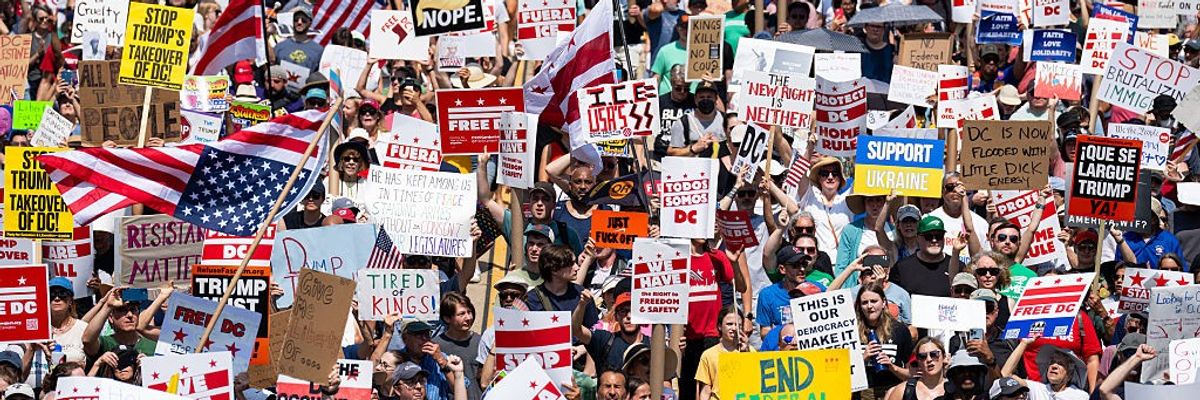
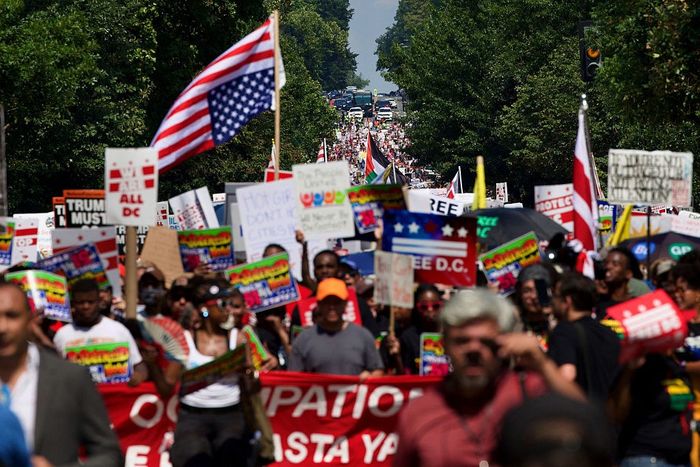
The "We Are All DC: A National March" proceeds down 16th Street NW towards the White House in Washington on Saturday, September 6, 2025. Thousands of protesters marched to call for an "immediate withdrawal of federal troops from the District and an end to the federalization of the local police department." 
(Bill Clark/CQ-Roll Call, Inc via Getty Images)
Getty Images

Common Dreams Staff
Sep 06, 2025


The heart of Washington, D.C., pulsed with defiance on Saturday as tens of thousands of demonstrators surged down 16th Street toward the White House. It was the city’s first major organized protest since President Donald Trump declared a state of emergency and unleashed federal troops onto its streets. Banners waved and voices rose in unison at the “We Are All D.C.” march, a massive show of resistance led by a coalition that included Free DC, defenders of local self-rule, Democracy Forward, and the American Civil Liberties Union. Their message was clear: the federal occupation of the capital must end.


People participate in the "We Are All DC" national march in solidarity with DC communities and calling for an end to the deployment of National Guard troops in Washington, DC, on September 6, 2025.(Photo by AMID FARAHI/AFP via Getty Images)


“Today, in defense of the people and communities living under a military takeover of DC, we join in sending a clear and peaceful message: the American people will not bow to dictators. We are in solidarity with our neighbors and Black, Brown, immigrant, and other communities targeted. We will march, we will resist, and we will peacefully protest,” Democracy Forward wrote in a statement on X.


With Trump vowing crackdowns in other Democratic-led cities as well, he appeared to threaten Chicago with migrant deportations in a social media post with an image that parodied the 1979 Vietnam war movie "Apocalypse Now."

“I love the smell of deportations in the morning,” Trump said, converting a line about napalm in the Vietnam War to refer to deportations. “Chicago about to find out why it’s called the Department of WAR.”


Decline in mainstream web traffic as users turn to AI


By Dr. Tim Sandle
EDITOR AT LARGE SCIENCE
DIGITAL JOURNAL
September 4, 2025


A sophisticated online apparatus has been targeting government critics in Kenya, where rights groups warn of an escalating crackdown on public dissent - Copyright AFP TONY KARUMBA

Website traffic is expected to drop by more than 50% by 2028 as people use AI chat tools to find answers without visiting pages directly, according to The Guardian. A new study by Loopex Digital examines the top websites experiencing traffic drops after the rise of AI chats, analysing where the shift to AI-based search has affected traffic the most.

Based on current trends, Business Insider tops the list of websites experiencing a traffic drop with the rise of AI chat tools, with monthly visits falling by 48.5% between 2024 and 2025.With the number of monthly users dropping from 122 million to 69.5 million within a year, WebMD takes the second spot for losing traffic after AI chat adoption.

The Loopex analysis includes data on monthly website visits and search volumes, tracking how traffic and searches changed as AI chat platforms grew in popularity. Websites are ranked based on their annual visit trend change, with higher-ranking websites being those that saw the largest drops in traffic since AI chat platforms became widely used.

Websites experiencing the latest falls in traffic

WebsiteWebsite Visits 2024Website Visits 2025Website Visit Trend % ChangeSearch Trend % Change
Business Insider13.4 mln6.9 mln-48.5%-32.6%
WebMD122.0 mln69.5 mln-43.1%-15.2%
Dictionary34.1 mln21.3 mln-37.3%-36.6%
Stack Overflow12.6 mln8.1 mln-35.6%-32.4%
Unsplash26.8 mln17.7 mln-34.0%-1.3%
Investopedia40.3 mln26.9 mln-33.2%-19.7%
Google Translate225.0 mln151.5 mln-32.7%-16.7%
Quora53.8 mln38.7 mln-28.1%-33.2%
CNN59.0 mln47.7 mln-19.1%-0.9%
Chegg2.9 mln2.4 mln-18.8%-51.2%
As indicated above, Business Insider tops the list of websites experiencing a traffic drop with the rise of AI chat tools. Within a year, monthly visits to the website fell by 48.5% as more people relied on AI to get condensed versions of articles and market updates. The number of people searching for Business Insider also decreased, dropping from 1.9 million to 1.3 million.

WebMD takes the second spot for losing traffic after AI chat adoption, as more people turn to AI chats for answers to health questions and symptom queries. The site saw a 43.1% decrease in monthly visits over the year. Google searches for the site were down 15.2% over the same timeframe.

Dictionary comes in third for sites losing traffic with the growing use of AI chats. The site attracted 34.1 million monthly visitors last year, which has now dropped to 21.3 million, as more people turn to AI chats to get definitions directly inline. During the same period, searches for the website also dropped by 36.6%.

Stack Overflow comes in fourth, losing 35.6% of its monthly users from the previous year. From 12.6 million in 2024, monthly visitors dropped to 8.1 million in 2025. The number of people searching for the site declined 32.4%, similar to what The Business Insider experienced.

Unsplash takes the fifth spot for experiencing a traffic drop as AI chats become more popular, with monthly users falling from 26.8 million to 17.7 million over the year. This 34% decline reflects users who now prefer AI chats to generate images or visuals without visiting the stock photography website.

Investopedia holds the sixth position among websites that have seen the largest traffic declines following the growth of AI chat platforms. Visitor numbers fell by 33.2% as users seeking finance knowledge now turn to AI chats for instant definitions and concept explanations. Additionally, monthly searches for the site dropped from 860.8K to 691.5K over the past year.

Google Translate secures the seventh spot, with monthly visitors falling from 225 million in 2024 to 151.5 million in 2025. Search interest in Google Translate declined by 16.7%, as many users now rely on AI chats that offer built-in translation features.

Quora ranks eighth in the list of websites hit hardest by the rise of AI chat platforms, with the number of monthly visitors falling by 28.1% within a one-year period. Searches for the site decreased by 33.2% within the same span, as many users turn to AI chats for quick, personalized answers instead of browsing Quora threads.

CNN takes the ninth spot, with monthly visits dropping from 59 million to 47.7 million over the year. The 19.1% decrease in website traffic reflects users choosing AI chats for quick news summaries in place of visiting CNN’s website directly.

Chegg rounds out the top ten websites experiencing traffic drops following the rise of AI chats. The site’s monthly users declined by 18.8% over the year, as people increasingly use AI chats to get homework questions answered instantly without visiting the platform. Chegg also saw the largest drop in searches for the website, with 51.2%, falling from 2.9M to 1.4M over the same period.

‘Sleep under the stars’: hotel mess in Brazil ahead of UN meet; COP30


By AFP
September 4, 2025


Alcides Moura, manager of the newly renamed COP30 hotel, checks the air conditioning in a room in Belem, Brazil - Copyright POOL/AFP Ludovic MARIN

Facundo Fernández Barrio

With two months to go, the “COP30 Hotel,” spruced up and renamed after the UN climate conference due to take place in the Amazonian city of Belem in November, has zero bookings.

The owners had been hoping to cash in on the conference by filling all the rooms with foreign delegates.

But the hotel’s eye-watering initial rates — a cool $1,200 per night, which it later lowered to try to drum up business — were a turnoff.

Delegations from governments, NGOs and civil society have repeatedly urged Brazil to put a limit on accommodation costs that have soared for the first-ever climate COP (Conference of Parties) to be held in the Amazon.

It is a symbolic setting given the rainforest’s critical role in absorbing planet-warming carbon dioxide, but also a challenging one.

More than half of Belem’s 1.4 million residents live in shantytowns — the highest rate of any regional capital in Brazil.

And with a shortage of traditional hotel rooms, conference organizers have scrambled to find alternative accommodation in private homes, universities and schools, and even two cruise ships docked in the harbor some 20 kilometers (12 miles) from the conference center.

As many as 50,000 people were expected to attend COP30, though organizers say only 68 of the 198 participating countries have secured their reservations.

“This has never happened at a COP. Normally, everyone has their accommodation sorted three months in advance,” Marcio Astrini of the NGO Climate Observatory told AFP.

Brazil’s President Luiz Inacio Lula da Silva has batted away concerns, saying in February that delegates can “sleep under the stars.”


– Most exclusive COP? –


A free-for-all ensued as Belem residents seek to profit from the one-off event that saw an investment of some $700 million in public infrastructure, including a convention center.

“Prices spiraled out of control,” conceded COP30 Hotel manager Alcides Moura, adding that “Belem never hosted an event of this magnitude.”

Ronaldo Franca, a 65-year-old pensioner, is one of several property owners hoping to make a quick buck by renting out his weekend house, some 25 kilometers (15.5 miles) from the conference venue.

For a property with three double bedrooms and a swimming pool, he is charging $370 per night.

“I’m not going to charge an exorbitant rent, but the government hasn’t sufficiently monitored prices, and some have skyrocketed,” he told AFP.

Organizers say 60 percent of delegates will rent rooms from Belem residents.

Hotels “are almost all full,” said Toni Santiago, president of the hotel association of Para state. It has rejected a government request to cap prices.

“No one does this for other major global events, so why should Belem?” asked Santiago.

The government has set up a task force to help delegates find rooms, and Para governor Helder Barbalho told AFP “the availability of beds is guaranteed.”

Airbnb, for its part, said the average price for accommodation has dropped by 22 percent since February.

But an online search yielded few options for under $100 a night — the limit requested by the UN for delegates from poor countries.

Astrini told AFP that accommodation concerns were overshadowing “what is truly important, like emission reduction goals or climate financing” — issues on the agenda for COP30.

This COP, added the Climate Observatory, could turn out to be “the most exclusive in history.”
Berlusconi media group takes control of German broadcaster


By AFP
September 4, 2025


MFE is led by Pier Silvio Berlusconi, son of the late media tycoon and Italian prime minister Silvio Berlusconi - Copyright AFP Sergei GAPON

Italy’s MediaForEurope (MFE) announced Thursday it had taken control of one of Germany’s biggest private broadcasting groups, as it seeks to build a pan-European group able to compete with streaming giants.

MFE, the biggest commercial television network in Italy which is majority-owned by the Berlusconi family, secured more than 75 percent of shares in the German company through a takeover offer.

ProSieben, which has 15 television channels, had recommended its shareholders accept MFE’s offer, which values the company at nearly 1.9 billion euros ($2.2 billion).

And on Thursday, group chief executive Bert Habets said MFE’s announcement marked an “important milestone”.

“Together, we cover five core European markets, with ProSiebenSat.1 being a leader in Germany, Austria and Switzerland, and MFE in Italy and Spain, reaching a combined population of about 210 million people,” he said in a statement.

“In the coming weeks, we will work closely with MFE to identify the most promising opportunities for a deepened collaboration and align our vision for the future.”

MFE, led by Pier Silvio Berlusconi, son of the late media tycoon and Italian prime minister Silvio Berlusconi, already held a one-third stake in ProSieben.

It initially faced competition for the takeover from PPF, backed by Czech billionaire Renata Kellnerova. But when the Italians raised their offer in July, the Czechs did not follow suit.

Last week, PPF announced it would sell its 15.68 percent stake to MEF.

The German government had expressed concern that journalistic independence could be affected by the takeover.

But Germany’s minister for media and culture, Wolfram Weimer, met Pier Silvio Berlusconi earlier this week, and appeared to reach an accord.


– Standing up to tech giants –


“Editorial independence is of central importance — it must not be compromised,” Weimar said in a statement.

“On this point, we are in full agreement, and that provides a solid foundation for successful engagement in the German media market.”

Berlusconi said in the same statement that MFE would produce more local programming “with more news, more entertainment shows, and more TV series”, also saying he wanted to safeguard jobs.

“Our goal is to create a pan-European broadcasting and media group capable of standing up to the global tech giants and competing with them,” he said.

“We are firmly convinced that Germany is the ideal starting point for European initiatives of this kind.”

Formerly known as Mediaset, MFE has sought to acquire ProSieben on several occasions in the past — its first attempt was back in 2003, with Berlin opposing the move.

Silvio Berlusconi, who dominated Italian politics in the late 1990s and early 2000s, died in 2023.

burs-ar/ide/lth