Sunday, September 28, 2025

Australian telco giant slapped with $66 million fine over ‘appalling’ conduct


By AFP
September 24, 2025


Embattled Australian telco giant Optus was hit with a $66 million fine on Wednesday over "appalling" sales conduct - Copyright AFP William WEST

Embattled Australian telco giant Optus was hit with a $66 million fine on Wednesday over “appalling” sales conduct as the firm grapples with fallout from a network outage linked to several deaths.

A federal court ruled the company — one of Australia’s top telecoms providers — should be punished for selling products to vulnerable customers between 2019 and 2023 that they did not need or want, leaving many in debt.

Many of these people were also Indigenous and lived in remote parts of the country.

Federal Court’s Justice Patrick O’Sullivan labelled the company’s conduct as “extremely serious” and “appalling”.

Consumers incurred thousands of dollars of debt while on modest incomes and became embarrassed or stressed over how they would pay these, he added.

The court formally approved the penalty Wednesday, which Optus and the Australian Competition and Consumer Commission had agreed to in June.

Optus previously described its sales practices during the offending period as “unconscionable conduct and inappropriate”.

Following the ruling, Optus said it had changed its sales practices to better support customers.

“Optus is remediating impacted customers as a matter of priority,” the company said.

It will also donate $662,300 to improve the financial literacy of Indigenous communities.

Wednesday’s fine comes just days after an outage impacted 600 people across South Australia, Western Australia and the Northern Territory for at least ten hours.

The outage prevented calls to emergency services, with four deaths now linked to the outage.

On Wednesday, Optus announced details of an independent review that will probe the series of events that took place and determine why emergency calls did not connect.

“There are no words that can express how sorry I am about the very sad loss of the lives of four people, who could not reach emergency services in their time of need,” chief executive Stephen Rue said.

Optus was previously fined $7.9 million after an outage halted its mobile and internet systems for nearly 12 hours in 2023.
Danish PM to apologise to victims of Greenland forced contraception

CANADA ALSO CONDUCTED STERILIZATION OF INIGENOURS AND INNU COMMUNITIES


By AFP
September 24, 2025


Prime Minister Mette Frederiksen has called the forced contraception programme a 'dark chapter' in Denmark's ties with Greenland - Copyright Ritzau Scanpix/AFP/File Emil Nicolai Helms

Camille BAS-WOHLERT

Danish Prime Minister Mette Frederiksen has arrived in Denmark’s autonomous territory Greenland for a ceremony Wednesday to apologise in person to the victims of a forced contraception programme that Copenhagen ran for more than three decades.

After landing, Frederiksen said in a post to social media that the apology constituted an “important marking” of a “dark chapter in our shared history”.

“It will be a very important moment for these women, obviously, but also for society as a whole,” Aaja Chemnitz, an MP who represents Greenland in the Danish parliament, told AFP.

“It’s a second step in the reconciliation process after first announcing the apology” in late August, she said.

A special ceremony in Nuuk, the capital of Greenland, was to begin at 2:00 pm (1500 GMT).

From the late 1960s until 1992, Danish authorities forced around 4,500 Inuit women, around half of all those of child-bearing age, to wear a contraceptive coil — or intrauterine device (IUD) — without their consent.

The aim was to reduce the Inuit birth rate.

Many of the women were left sterile and almost all of them have suffered from physical or psychological problems.

The scandal is one of several sensitive issues tainting Denmark’s ties to Greenland, including forced adoptions and the forced removal of Greenlandic Inuit children from their families.

Denmark has over the past year been keen to smooth over tensions with its strategically located, resource-rich Arctic territory, which US President Donald Trump has said he wants to take over for security reasons.

At the end of August, Frederiksen presented a long-awaited apology to the victims of the forced contraception campaign, in a written statement.

On Monday, she also announced the creation of a “reconciliation fund” to compensate the victims, as well as other Greenlanders who suffered discrimination because of their Inuit heritage.

“It’s very good news because my clients are not satisfied with just an apology,” said lawyer Mads Pramming, who represents around 150 of the victims who have sued the Danish state for violating their rights and sought financial compensation.

“The timing is good. She would not have been warmly welcomed if she hadn’t suggested (the compensation) in advance,” he told AFP


– ‘External pressure’ –


Chemnitz said the apology was a direct result of Trump’s assertive statements about taking over Greenland.

“It’s the external pressure, especially from the United States, that is forcing Denmark to increase its efforts,” she said.

“I’ve been an MP for 10 years and I’ve never seen so much effort until now.”

Frederiksen has broken with the tradition of her predecessors who insisted Denmark had no reason to apologise.

“In the past, the Danish prime ministers have always been extremely reluctant to acknowledge injustices committed in Greenland. They argued there was nothing to apologise for,” said historian Astrid Andersen, a researcher at the Danish Institute for International Studies.

The scandal came to light when one of the victims spoke out in the media several years ago about the trauma she experienced.

A podcast series in 2022 then revealed the full extent of the campaign.

The Danish and Greenlandic governments agreed to launch an independent inquiry into the scandal, which was recently completed.

“At this point, it is important to many Greenlanders to mourn as a community and to have full recognition of this horrible thing that happened,” Andersen said.

A separate inquiry into the legal implications of the campaign is still underway.

Its report, which is tasked with determining whether the Danish campaign constituted a “genocide”, is to be published in early 2026.

Saturday, September 27, 2025

Airport hackers used AI to penetrate the airport system’s security


By Dr. Tim Sandle
SCIENCE EDITOR
DIGITAL JOURNAL
September 24, 2025


United Airlines flights were grounded because of a 'technology disruption' at several US airports - Copyright AFP/File RONALDO SCHEMIDT

As Digital Journal has reported, major airports across Europe have been targeted in a cyberattack that began on Saturday, 20th September 2025.

Considering the aftermath of the incident, an expert is warning that artificial intelligence may have played a key role in the breach. The incident, which disrupted check-in and baggage systems at hubs including Dublin, London, Brussels and Berlin, left thousands of passengers stranded with cancelled or delayed flights.

Christian Perry, CEO of Undetectable AI, has explained to Digital Journal how AI is reshaping the way cyber-attacks unfold:

“Hackers aren’t just sitting in dark rooms typing away anymore. With AI, they can launch faster, smarter attacks that slip past traditional security systems. AI can be trained to find weaknesses in seconds, or even disguise itself to look like a human user, making it very hard to spot.”

Read more: Cybersecurity expert: Don’t leave all your airport security to TSA

In terms of how such an attack is likely to have been planned and developed, Perry thinks: “In this sort of attack, AI can do the heavy lifting that used to take hackers weeks. It can scan for weaknesses across huge systems in minutes, and once it finds a way in, it can copy normal user behaviour so it doesn’t raise any alarms. That makes it far easier for criminals to slip through the cracks without being noticed.”

Perry says we should heed warning from this incident: “That’s why this airport attack is so concerning. It shows how quickly the rules of cybersecurity are changing. If hackers are using AI to get in, we need AI detectors on the other side to keep them out.”

For travellers, the impact is immediate – queues, cancellations, and missed connections – but Perry stresses that the bigger story is about what comes next and how businesses like airports choose to react:

“Unfortunately, this probably won’t be the last time we see something like this. As attackers get more advanced, organisations need to wake up to the fact that traditional security isn’t enough anymore. Just like we scan luggage for hidden threats, we now need systems that scan for hidden AI activity. Without that, we’re always going to be one step behind.”

Considering the implication beyond airport, Perry warns that the same methods could be used against other parts of daily life:

“Transport networks, hospitals, banks – even emergency services – could all be vulnerable to AI-driven attacks. Imagine an AI system flooding 999 with fake calls, or breaking into a financial network to manipulate transactions at scale. These aren’t sci-fi scenarios – the tools already exist.”

Despite the risks, Perry says AI can also be a force for good in defending against the very attacks it enables: “It’s not all doom and gloom. AI can be trained to work on our side too – spotting unusual patterns, picking up threats faster than any human team, and shutting down attacks before they spiral.”

As an example, Perry cites: “In simple terms, AI can keep watch 24/7, scanning for anything unusual in the background – like a digital security guard that never gets tired. It can flag suspicious logins, notice when systems are behaving in ways they shouldn’t, and even help predict where the next attack might come from. The important thing is making sure we’re using AI to protect us just as quickly as criminals are using it to cause harm. The same technology that makes hackers smarter can also make us safer – if we put it to work in the right way.”
Glimmering sea of solar as China expands desert installation


By AFP
September 24, 2025


Solar panels at the Dalat Banner Photovoltaic Station in the Kubuqi desert near Ordos, in China's northern Inner Mongolia region - Copyright AFP Pedro Pardo


Adrien Simorre and Agatha Cantrill

An ocean of blue solar panels ripples across the ochre dunes of Inner Mongolia’s Kubuqi desert, a glittering example of China’s almost inconceivably mammoth energy transition.

Even as other countries have put the brakes on desert solar projects for economic or technical reasons, China — the world’s largest emitter of greenhouse gases — is ploughing ahead.

Desert solar installations are a key part of China’s plans to reach carbon neutrality by 2060. The country’s solar capacity dwarfs global efforts and is so substantial it may even impact local weather patterns.

“Before, there was nothing here… it was desolate,” Kubuqi local Chang Yongfei told AFP as he gestured towards fields of shimmering panels.

The installations are so enormous, they are visible from space.

AFP analysis of satellite images over the last decade shows in Kubuqi alone more than 100 square kilometres of panels have been installed, an area roughly the size of Paris.

On Thursday, China pledged to expand wind and solar capacity to more than six times its 2020 levels, as it tries to slash greenhouse gas emissions by 7-10 percent from peak levels.

The “defining factor” for building in the desert is the availability of otherwise unused land, according to analyst David Fishman.

But the remote, sun-soaked terrain poses formidable challenges.

Sandstorms can degrade panel ventilators, while blistering temperatures reduce the efficiency of solar cells. Sand accumulation can demand scarce water for cleaning.

Kubuqi’s solar panels are designed to counter those obstacles, with self-cleaning ventilators and double-sided cells that allow them to capture light reflected from the ground, according to Chinese state media.


– Infrastructure key –


The distance to energy-hungry urban areas, and the network sophistication required to transport the electricity, has stalled desert projects from North Africa to the United States.

The energy generated in Kubuqi is destined for densely populated Beijing, Tianjin and Hebei, hundreds of kilometres away.

And the growth of solar capacity — overshooting a government target nearly six years early — has not been matched by power grid development.

This causes some energy to be lost, along with congestion on power lines.

Overcoming this requires infrastructure “to effectively allocate and dispatch power around the country without allowing bottlenecks to occur”, said Fishman.

Some places, including Inner Mongolia and neighbouring Ningxia and Gansu, are “restricting new project approvals unless they can explicitly demonstrate” the energy won’t be wasted, he added.

Despite this, in the first half of the year, China installed more solar than the entire solar capacity in the United States as of the end of 2024.


– Coal –


The sheer scale of some desert solar fields might create their own climatic effect, according to the University of Lund’s Zhengyao Lu.

Heat absorption across large areas can change atmospheric flows and have “negative secondary effects”, like rainfall reduction elsewhere, he said.

However, the risks of solar energy “remain minor compared to the dangers of continuing greenhouse gas emissions”, he added.

The solar expansion does not mean fossil fuels have been abandoned, especially in Inner Mongolia, a traditional mining region.

Around Kubuqi, soot-blackened trucks and chimney stacks belching smoke show the industry’s persistence.

China brought more coal power online in the first half of this year than any time since 2016, a report said in August.

The polluting fuel “constitutes a real structural obstacle to the expansion of wind and solar power”, NGO Greenpeace said this summer.


– ‘Good transition’ –


Chang, the local resident, told AFP he used to work in the coal industry.

Now, he runs a hotel made up of huts nestled in the sand dunes, not far from the solar fields.

Views of the shimmering solar cells have gone viral online, as Kubuqi has become a popular domestic holiday destination.

“The transition has been very good for the region,” 46-year-old Chang said.

Quadbike tours, camel rides and dune surfing have become a new source of income for locals.

Chang worries solar expansion might swallow up the whole desert, and with it this new revenue stream.

“But I have confidence the government will leave us a little bit,” he said.

“It should be enough.”
Volkswagen to take Dieselgate case to U.S. federal court


By AFP
September 25, 2025


Image: © AFP/File

German auto giant Volkswagen said Thursday it intended to appeal to the country’s Federal Constitutional Court after losing a legal case linked to the “Dieselgate” scandal.

The Higher Administrative Court in the northern state of Schleswig-Holstein on Thursday ruled against Volkswagen and the Federal Office of Motor Vehicles (KBA), saying that the KBA had illegally authorised Volkswagen’s Golf Plus TDI model in 2016, despite it being fitted with two illicit “defeat devices” which interfered with emissions controls.

Volkswagen said in a statement sent to AFP that the decision was “not final” and that it would “take legal action at the Federal Constitutional Court”.

The company added that as the decision is not final, it does not mean that the KBA will have to take “measures such as removing vehicles’ registration or applying technical modifications” to rectify the defeat devices.

The Environmental Action Germany (DUH) pressure group launched the original case in 2018 in the wake of the Dieselgate scandal.


VW, whose image was tarnished by ‘Dieselgate’, says it will appeal the ruling to federal court – Copyright AFP Patrick T. Fallon

The scandal has caused waves in the global car industry since September 2015, when Volkswagen admitted tampering with millions of diesel vehicles to dupe pollution tests.

To date, Volkswagen has had to pay more than 32 billion euros’ worth ($37 billion) of fines over the scandal, mostly in the United States.

The DUH called Thursday’s ruling a “breakthrough for clean air and the millions of citizens harmed by Dieselgate”.

The group says it estimates the ruling will affect 7.8 million vehicles fitted with devices allowing illegal levels of nitrogen oxide emissions.

However, Volkswagen itself said the decision only affected a number of vehicles “in the low thousands”.


Nickel mining threatens Indonesia coral haven, NGOs warn


By AFP
September 25, 2025


Watchdogs warned that nickel mining in Indonesia threatened coral reef hoptspots - Copyright AURIGA NUSANTARA/AFP Handout

Nickel mining threatens one of the world’s most important marine biodiversity and coral hotspots in Indonesia, despite the government revoking several permits, a report warned Thursday.

Analysis of recent and historic mining in the region showed a “domino effect of destruction,” ranging from deforestation on land to sediment run-off smothering coral reefs, the report by NGOs Auriga Nusantara and Earth Insight said.

“Post-mining rehabilitation is very poor,” Auriga Nusantara executive director Timer Manurung told AFP. “We worry that the current nickel mining will impact Raja Ampat for decades to come.”

Raja Ampat is part of the famed Coral Triangle, beloved by divers for its marine riches.

In June, Indonesia’s government revoked permits for four of the five nickel mining companies operating in the cluster of islands and shoals in Southwest Papua Province.

That followed an outcry from activists and residents over the impact of mining for the metal used in everything from stainless steel to electric vehicles.

In September, the government allowed one company — PT Gag Nikel — to restart operations, arguing the impact “can be properly mitigated.”

But NGOs say serious damage has already been done, and there is little sign of clean-up.

Images captured by the groups in the region show sediment run-off turning otherwise emerald waters murky brown, downhill from stripped hilltops.

They also documented bleached and damaged coral at current and former mining sites, near jetties and areas affected by sediment run-off.

While warmer waters caused by climate change have caused coral bleaching in many parts of the world, Timer said coral just 50-100 metres (160-320 feet) away from the surveyed areas remained healthy.

The groups also fear mining could restart in the region, noting no formal revocation letter has been published by the government so far.

“Even though there is no active mining operation on sites, the staff of the companies and its heavy machinery are still there,” said Timer.

Indonesia’s mineral resources ministry did not immediately respond to a request for comment.

Until earlier this year, nickel mining concessions covered 22,000 hectares (54,300 acres) of the Raja Ampat region’s 3.66 million hectares, much of it inside a designated UNESCO Global Geopark.

These areas are recognised by the UN body for their “international geological significance” and are meant to be “managed with a holistic concept of protection, education and sustainable development,” UNESCO says.

Gag Nikel’s operations lie outside the Geopark.

Indonesia has the world’s largest nickel reserves and has sought to spur domestic processing to capture more of the value chain.

CAPPLETALI$M

Apple asks EU to scrap landmark digital competition law


By AFP
September 25, 2025


Image — © GETTY IMAGES NORTH AMERICA/AFP/File SCOTT OLSON

Apple asked the European Union to scrap its landmark digital competition law on Thursday, arguing that it poses security risks and creates a “worse experience” for consumers.

The US tech giant and the EU have repeatedly locked horns over the bloc’s Digital Markets Act (DMA), which Brussels says seeks to make the digital sector in the 27-nation bloc fairer and more open.

“The DMA should be repealed while a more appropriate fit for purpose legislative instrument is put in place,” Apple said in a formal submission to the European Commission as part of a consultation on the law.

The latest clash came as President Donald Trump sought to pressure the EU over decisions and laws affecting US Big Tech — with key industry figures including Apple chief Tim Cook moving closer to the White House since Trump’s return to power.

“It’s become clear that the DMA is leading to a worse experience for Apple users in the EU,” the tech giant said in a blog post accompanying its submission. “It’s exposing them to new risks, and disrupting the simple, seamless way their Apple products work together.”

Pushing for wholesale reform of the law if it is not repealed, Apple suggested enforcement “should be undertaken by an independent European agency” rather than the commission, the EU’s executive arm and digital watchdog.

The DMA challenges Apple’s closed ecosystem, but Brussels argues that it is necessary to do so to level the playing field for Apple’s rivals and avoid unfair market domination.

The law tells Big Tech firms what they can and cannot do on their platforms. For example, companies must offer choice screens for web browsers and search engines to give users more options.

Violations of the DMA can lead to hefty fines.

Brussels in April slapped a 500-million-euro ($590-million) fine on Apple under the DMA, which the company has appealed.

– Delays for EU users –


Apple says dangers are posed when Europeans can download app marketplaces that rival its App Store.

The giant also cites an increasing number of complaints from users about DMA-related changes but has not provided exact figures.

It argued in its 25-page submission that the EU’s law had forced it to delay new features in the bloc.

For example, Apple has not yet rolled out “live translation” — which allows consumers to choose another language to hear via AirPods in their ears.

The technology was launched this month in the United States but Apple says it must undertake further engineering work to ensure users’ privacy in the EU.

Under the DMA, companies including Apple must make sure their products can work seamlessly with third-party devices such as earphones.

The commission said it was “normal” companies sometimes needed more time to make sure their products were in line with the new law and that it was helping them comply.

DMA enforcement began in March 2024 and the EU’s consultation on the first review of the law ended just before midnight on Wednesday.

Independently from the digital rules, Apple has faced the heat under different EU competition rules. Brussels slapped it with a 1.8-billion-euro fine in March 2024.

EU queries Apple, Google, Microsoft over financial scams


By AFP
September 23, 2025


Image: — © Copyright AFP GREG BAKER


Raziye Akkoc

The European Union on Tuesday demanded Big Tech players including Apple and Google explain what action they are taking against financial scams online, as Brussels seeks to show it is not shying away from enforcing its rules.

The European Commission sent a request for information under the Digital Services Act to the companies, including Microsoft and Booking, “on how they make sure that their services are not being misused by scammers”, an EU spokesman said.

The DSA is the EU’s landmark law demanding Big Tech firms do more to tackle illegal content but it has faced retaliation threats from US President Donald Trump, and censorship claims from the US tech sector.

The EU has vowed it will not back down from enforcing its stringent rules to protect Europeans online.

Tuesday’s request could lead to a probe under the DSA and even fines, but does not itself suggest the law has been broken, nor is it a move towards punishment.

“This is an essential step also to protect users across the EU from certain of these practices, and to make sure that platforms in the EU also play their role,” EU digital affairs spokesman Thomas Regnier told reporters in Brussels.

The request relates to Apple’s App Store, Google Play, online travel agent Booking and Microsoft’s Bing search engine.

The EU fears app stores could be used by scammers to create fake apps posing as legitimate banking providers or fraudsters could publish links to fake websites on search engines.

– Trump threats –

The EU has a bolstered legal armoury with the DSA and its sister law, the Digital Markets Act, which seeks to ensure fair competition online.

Brussels has already launched multiple investigations under the DSA into Meta’s Facebook and Instagram as well as TikTok and X.

But its rules have faced the wrath of Trump — who has shaken up global trade by hitting America’s trading partners with higher tariffs and threatened more levies on those he accuses of targeting US tech companies.

The US State Department, Trump allies and critics including Meta chief Mark Zuckerberg and X owner Elon Musk have called the EU’s rules censorship.

The EU rejects such claims, stressing that whatever is illegal in the real world is also illegal in the online realm.

It has also pushed back at accusations it is targeting American titans, pointing to investigations into China’s big players that face DSA scrutiny including shopping platform AliExpress.

Defenders of the bloc’s tech rules have meanwhile attacked the EU for failing to complete its probe into Musk’s X, which opened in December 2023. X is expected to be hit with a fine but Brussels says technical work in the investigation continues.

EU digital chief Henna Virkkunen told AFP last week that probes into online platforms including X will be completed in the “coming weeks and months”.

She warned more investigations could also be on the way.

“We will probably start new ones because the DSA, of course, it’s a huge legislation,” she said.


Fortescue chairman Forrest doubles down on renewables in challenge to Trump

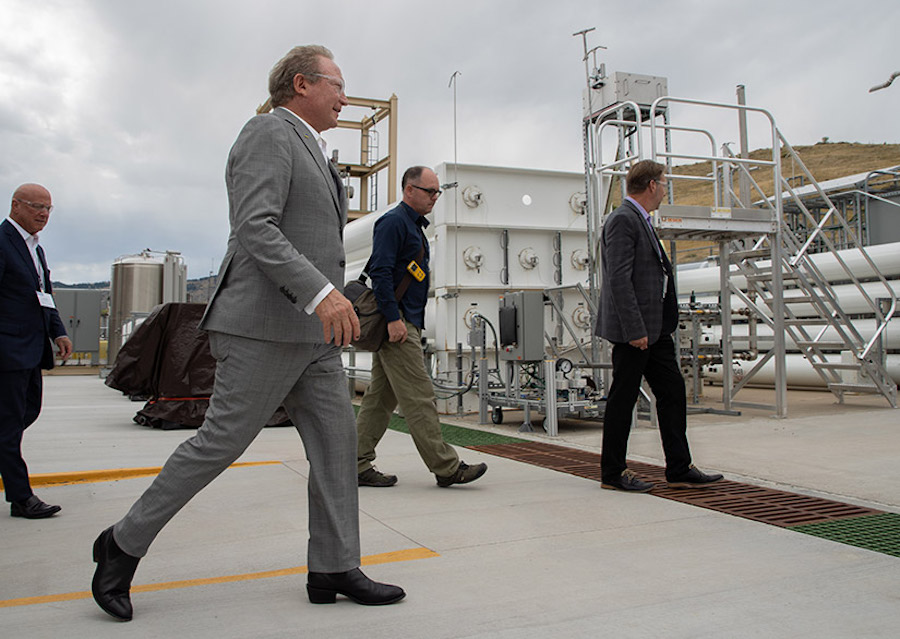
Andrew Forrest, chairman of Fortescue Future Industries. tours the outdoor Hydrogen Fueling Station and Bioreactor at the National Renewable Energy Laboratory. (Image by Joe DelNero, courtesy of NREL).

Australian miner Fortescue is experiencing strong interest in its decarbonization-related offerings, executive chairman Andrew Forrest said in an interview, as he challenged US President Donald Trump’s claim that climate change is the “greatest con job” in the world.

Fortescue has set some of the most ambitious decarbonization targets among Australia’s major miners, but was recently forced to walk away from some planned green hydrogen projects. The company, the world’s fourth-largest miner of iron ore, attributed the cancellation of a project in Arizona in part to a shift in US policy away from green energy.

However, Forrest said he was not willing to give up despite mounting criticism of climate-driven initiatives by Trump, who on Tuesday dismissed climate change during his address to the United Nations General Assembly.

Speaking on board Fortescue’s Green Pioneer, which the company says is the world’s first ship capable of running on green ammonia and diesel, Forrest condemned Trump’s statement and challenged the president to debate him, even if it takes place in a courtroom.

“Sue me, but I’m saying you have no basis of fact to say that,” the billionaire, who ranked among Australia’s richest people, said.

“I sailed (the Green Pioneer) into the middle of the lion’s den to make the point that I’d much rather be getting my fuel from the air, from the sun, from the wind, which is going to be infinite, than I would from drill, baby, drill,” Forrest said.

Earlier on Thursday, Fortescue said it acquired Spanish wind technology company Nabrawind and signed an agreement for the purchase of wind turbines from Envision Energy. Those deals will help accelerate the deployment of renewable energy across Fortescue’s operations, Forrest said.

Fortescue also said it would deploy a fleet of 300 to 400 battery-powered mining trucks capable of hauling 240-metric-ton loads, with deliveries planned from 2028 to 2030. Chinese mining equipment maker XCMG will supply up to half the trucks, while German-Swiss equipment manufacturer Liebherr will supply the remainder, the company said.

Fortescue’s order book for battery-powered trucks developed in partnership with Liebherr is strong, Forrest said, without providing further details.

The miner was likely to exceed its target of reaching 2 to 3 gigawatts of renewable energy generation and storage in its domestic iron ore operations by 2030, Forrest said.

“We will probably do more than that because we’re getting more people wanting to join in,” Forrest said.

(By Shariq Khan; Editing by Thomas Derpinghaus)


An Aussie tycoon bets billions on cleaning up iron ore giant


By AFP
September 26, 2025


The ammonia-powered Green Pioneer is an emblem of Fortescue's climate ambitions - Copyright AFP Issam AHMED


Issam AHMED

Moored off a Manhattan pier for New York’s annual Climate Week is one of the world’s first ammonia-powered vessels — a green flagship for an Australian tycoon’s drive to decarbonize his mining empire.

Even as President Donald Trump’s second term has triggered environmental backtracking among many corporations, iron ore giant Fortescue — founded by Andrew “Twiggy” Forrest — is investing billions to clean up its dirty operations.

“We’re a huge polluter right now,” he told AFP in an interview aboard the Green Pioneer, a 75-meter former oil-rig supply ship given a swish makeover. “But we’re changing so fast, and within five years, we’ll stop burning fossil fuels.”

The Green Pioneer is meant to be the first in a fleet of ammonia-powered ships.

Ammonia contains what Forrest calls the “miracle molecule” — hydrogen — which burns to produce harmless nitrogen and water, though incomplete combustion of ammonia can still generate a greenhouse gas.

– ‘Real Zero,’ not offsets –


At 63, Forrest has become a fixture at global summits, rubbing shoulders with leaders such as European Commission President Ursula von der Leyen as he evangelizes his climate vision.

Where other companies tout green credentials by buying carbon credits — generated through nature protection or carbon-removal projects for example — to claim “net zero,” Forrest dismisses the practice as a scam.

“Carbon credits have already been proved by science to be next to worthless,” said Forrest, whose net worth Forbes pegs at more than $16 billion. “That’s why we go ‘Real Zero.'”

Achieving genuine decarbonization by 2030 is no small feat, particularly in one of the world’s dirtiest industries.

Fortescue’s plan involves replacing diesel-powered mining equipment with electric excavators and drills; building vast wind, solar and battery farms to power operations; and running battery-powered haul trucks.

Further along the value chain, the company wants to process its own iron ore — the stage responsible for the lion’s share of emissions — using “green hydrogen” produced by splitting water molecules with renewable electricity, instead of coke or thermal coal.

“Fortescue’s climate commitments are certainly different to most other corporations, including its peers in the iron ore mining sector” such as Rio Tinto and BHP, Simon Nicholas, the Institute for Energy Economics and Financial Analysis’ lead analyst for global steel told AFP.

“It has a ‘green iron’ pilot plant under construction in Australia which will use green hydrogen. The company is aiming to eventually process all of its iron ore into iron for export — about 100 million tonnes a year” — and even getting close to those targets would be transformative, said Nicholas.

– Technical challenges –

But he cautioned that the technological hurdles remain immense: green hydrogen is still expensive, and the pilot plant must prove it can handle lower-grade ore.

Then there’s the inherent ecological cost of mining. “If you destroy parts of a forest, including its soils, for your mining operation, even if you don’t use fossil fuels for your operations, you will not be ‘true zero,'” Oscar Soria, co-director of The Common Initiative think tank told AFP.

Forrest’s outlook is grounded in his personal journey.

Raised in the Australian Outback, where he earned the nickname “Twiggy” for his skinny childhood frame, he got his start in finance before taking over a company and renaming it Fortescue Metals Group in 2003.

Forrest said his environmental commitment deepened after a hiking accident in 2014 left him temporarily wheelchair-bound. Encouraged by his children, he returned to university and completed a PhD in marine ecology.

“That convinced me I’ve got to put every fiber of my being into arresting this threat so much bigger than any geostrategic issues, so much bigger than politics, so much bigger than anything,” he said.

Climate now sits at the heart of his philanthropic Minderoo Foundation.

And while the Trump administration derides the “green scam” as economically catastrophic, Forrest insists the opposite is true, pointing to Fortescue’s financial record.

“Don’t accuse us of being unbusiness-like. We’re the most business-like in the world.”
More questions than answers surround Trump’s TikTok deal

By AFP
September 26, 2025


Chinese ownership in TikTok's US market will drop to 20 percent under a new deal announced by President Donald Trump's White House
 - Copyright AFP/File Antonin UTZ


Alex PIGMAN and Thomas URBAIN

President Donald Trump insists he has found a solution to keep TikTok alive in the United States through a group of investors who will buy the short-video app from its Chinese owners in accordance with US law.

But questions remain unresolved about how this will play out and what it means for American users.

– Is there actually a deal? –

Any sale of TikTok’s US operations would require Chinese owner ByteDance to divest. That would need approval from China’s government, which is reluctant to see a national champion forced out of its largest market as a trade war rages with an increasingly protectionist Trump.

While the Trump administration has insisted that China has accepted a deal for the sale, there has been no confirmation from Beijing. Queries to TikTok and ByteDance have gone unanswered.

“This deal is still very confusing in terms of what is exactly going on,” University of Florida media professor Andrew Selepak told AFP.

– Is Trump taking over TikTok? –

In an executive order signed on Thursday, the White House outlined a deal centered on key investors with close ties to the president.

Trump has specifically named Oracle CEO Larry Ellison, a longtime ally and the world’s second-richest man, as a major player in the arrangement. For decades, Ellison has been one of Silicon Valley’s few high-profile Republicans in a tech sector dominated by liberal politics.

Ellison is returning to the spotlight through his dealings with Trump, who has brought his old friend into major AI partnerships with OpenAI, for example.

The 81-year-old has also backed his son David’s acquisition of Hollywood studio Paramount and is reportedly eyeing Warner Brothers.

The investor group also includes 94-year-old media mogul Rupert Murdoch and his son Lachlan, who control Fox News.

Whether this signals a conservative rebranding of TikTok — a platform Trump credits with helping him reach young voters — remains unclear. Trump denied this possibility on Thursday.

The prospect of a right-wing shift, or increased government intervention in media, has raised concerns that key platforms are falling under conservative control, potentially limiting diverse viewpoints in a bitterly divided America.

The fate of TikTok will be decided amid major shifts across social media platforms.

Elon Musk has transformed X (formerly Twitter) into a vehicle for far-right politics, driving away many establishment media outlets and liberal users.

Meanwhile, Meta’s Mark Zuckerberg has aligned with Trump and overhauled content moderation on Facebook and Instagram to address Republican claims of anti-conservative bias.

– Why so cheap? –

At Thursday’s White House ceremony, Vice President JD Vance pegged the deal at $14 billion. That’s a surprisingly low figure given Twitter’s $44 billion valuation when it sold and TikTok’s unique reach among young consumers in the world’s largest economy.

Bloomberg reporting helped shed light on the modest price tag: unnamed sources indicated that ByteDance would retain significant value through an expensive licensing arrangement, potentially receiving about half of the new company’s profits even if the company would hold just a 20 percent stake, according to Trump’s plan.

Such terms could trigger alarm in Washington, where some lawmakers could scrutinize whether any sale meets the requirements of the divest-or-ban law that should have taken effect in January but has been repeatedly delayed since Trump took office.

And confusingly, the executive order announced Thursday extended the deadline to ban TikTok until mid-January to finalize a deal that the Trump administration simultaneously claimed was already complete.

John Moolenaar, the Republican chairman of the House Foreign Affairs Committee, reiterated this point on Friday and warned that he would be “conducting full oversight over this agreement.”

“ByteDance has shown time and again that it is a bad actor,” he said.

The Trump plan “offers vague assurances about protecting US national security but provides virtually no specifics,” said Carl Tobias of the University of Richmond School of Law.

Adding to skepticism: Ellison’s Oracle already manages TikTok’s data servers from an earlier attempt to address US security concerns. Critics question whether this deal changes anything substantive.


Trump allies to control TikTok under new US deal


By AFP
September 25, 2025


Image: — © AFP Richard A. Brooks


Alex PIGMAN

Donald Trump on Thursday signed an executive order laying out a proposed deal for a US version of TikTok that would see Chinese ownership reduced to 20 percent and put control in the hands of the president’s allies.

At a signing ceremony at the White House, Trump said the US version of the app would be run by “highly sophisticated” investors including Larry Ellison, the founder of cloud giant Oracle, tech investor Michael Dell and media tycoon Rupert Murdoch.

Investment firm Silver Lake Management and Silicon Valley powerhouse Andreessen Horowitz are also thought to be part of the deal.

“The proposed divestiture would allow the millions of Americans who enjoy TikTok every day to continue using it while also protecting national security,” Trump stated in the order, which affects TikTok’s approximately 170 million American users.

The lineup of investors mentioned are all Trump allies but he insisted that the app would not toe any political line.

“If I could make it 100 percent MAGA I would, but it’s not going to work out that way unfortunately. No… every group, every philosophy, every policy, will be treated very fairly,” Trump told reporters.

The president confirmed that the US version of TikTok would feature a homegrown model of the app’s prized algorithm, often described as TikTok’s “secret sauce” that helped it grow into one of the world’s most popular platforms in just a few years.

A White House official said Monday the algorithm would be “continuously monitored” to ensure it is “not being unduly influenced.”

The new set-up for TikTok is in response to a law passed under Trump’s predecessor, Joe Biden, that has forced its Chinese owner ByteDance to sell its US operations or face a ban in its biggest market.

US policymakers, including Trump in his first presidency, have warned that China could use TikTok to mine data from Americans or exert influence through its state-of-the-art algorithm.

Trump has repeatedly delayed enforcement through successive executive orders, most recently extending the deadline until December 16, 2025.

Thursday’s order extended that deadline still further, granting a 120-day enforcement delay to complete the transaction by January 23.

Vice President JD Vance, the one-time venture capitalist who led the team to find a solution for TikTok, said the US entity would be valued at about $14 billion, though he added that it would ultimately be up to the investors to figure out its price.

When asked if the Chinese authorities had signed off on the deal, Trump said that President Xi Jinping gave his green light in a phone call last week.

“(I have) great respect for President Xi, and I very much appreciate that he approved the deal, because to get it done properly, we really needed the support of China,” he said.

TikTok did not respond to a query seeking comment and confirmation, and Beijing has remained largely silent on any deal.

After the Trump-Xi call, state broadcaster CCTV said Xi emphasized to his US counterpart that China supports market-based negotiations that align with Chinese laws.


The Neofascist Economy is Here


Donald Trump is creating a new form of capitalism. His economic policy is driven by his personal whims rather than the needs of capital, the results of which are likely to bring disaster to our economy and extreme hardship to American workers and the American people.

Trump voters have consistently overlooked or dismissed his glaring failures as a businessman who squandered his great family wealth. Born with a golden spoon in his mouth, this self-anointed Commander of Capitalism had an allowance of $200,000 annually as a toddler and became a millionaire at the age of eight. After he finished college his daddy provided him with a million dollars annually, but once on his own he nearly lost his fortune. Remember, he filed for bankruptcy six times. Never one to admit failure of any kind, Trump thinks he’s qualified to save the American economy because he thinks he’s a master deal maker. We can thank NBC for falsely promoting his image as NYC’s most successful real estate entrepreneur. He was nothing of the kind. The truth is the big absentee owners of New York City real estate and banking shunned him. Before NBC rescued Trump, his public life consisted of appearances at professional wrestling matches, dwindling movie cameos, and hawking his fake university.

But facts have consequences and the consequence of corporate broadcasting’s legitimation of Trump set him on the path to the White House. Now, as another consequence, he’s creating a new neo-fascist economy, a capitalism more obedient to him than to profit. And no institution, no law, in fact, nothing is going to stop him. As he put it, “I have the right to do whatever I want as president.” Consider these few examples: He unilaterally imposed tariffs on most countries, including a couple that don’t exist, and changes the rate on an almost daily basis. After calling for the firing of the head of Intel, he forced the company to surrender a 10% stake to the government. He put the squeeze on Nvidia and AMD – you want an export license, gimme what I want – forcing them to turn over 15% of revenue earned from selling chips in China. His old reliable mode of economic extortion – the threat of even higher tariffs – convinced Apple to “promise” to invest billions in the United States, and he agreed to the sale of U.S. Steel to Japan’s Nippon Steel providing he has the power to influence corporate decisions. He’s now using that power to prevent the building of a steel mill in blue state Illinois. Sounds like an extortion racket, doesn’t it? He used the government’s leverage over a potential merger to get CBS to kick Stephen Colbert off the air and he has tried to use the same script with ABC’s Jimmy Kimmel. As Steve Ratner notes in the New York Times, the White House keeps a scorecard of over 500 corporations and Trade Associations based on their support for Trump’s tax and spending programs. Trump’s new American economy works on one principle: Support Trump or suffer the consequences (Putin excepted, of course).

Trump’s excursions into the corporate economy make a mockery of the myth of the free market. It presents the captains of America’s corporate economy, an economy mostly dominated by a handful of companies that control the bulk of their markets, with a Hobson’s choice: do they follow the interests of capital or do they risk retribution by resisting the president’s threats? As Baron and Sweezy show, capital seeks its most profitable outlets, but Trump’s arbitrary whims take corporations in a different direction. Consider the case of Apple. To avoid unacceptably high tariffs the company made a vague promise to invest up to six billion dollars in the United States, even though the costs of domestic production are exorbitantly higher. Given Trump’s immigration policies and Apple’s reliance on a specialized labor force, the absence of a trained labor pool will drive up production costs even more. Sales and profits are likely to fall under this scenario. How will stockholders respond? Will investors start funneling their money elsewhere? If so, what does Apple’s future and the future of other firms Trump is extorting look like?

Trump’s approach creates uncertainty that is almost sure to lead to disinvestment in the American economy. Investors require certainty. Why would capital flow into or even remain in the United States given Trump’s almost daily changes to his tariff policies and extortion of even the biggest companies? Businesses large and small tried to stockpile parts and commodities before the tariffs hit and even absorb some rising costs to cushion prices to their consumers. But the stockpiles are depleted and stockholders will tolerate reduced profits for only so long. Now it’s likely that companies will pay for the tariffs by cutting jobs and wages, further increasing the country’s already record-breaking economic inequality. Tariffs are just one aspect of the uncertainty that Trump has wrought upon us. A massive decline in foreign investment will drive up long-term interest rates even as Trump tries to force lower short-term rates on the once independent FED. Trump’s actions will make access to capital more costly, triggering an economic slowdown, increase unemployment, and undercut the value of the U.S. dollar. All this all but guarantees the US will lose the many imperial advantages of the dollar as the world’s most secure international currency.

Some pundits call Trump’s policies socialism. They miss the point. Trump has no interest in using the means of production for the public good. To the contrary, his program, such as it is, follows the fascist playbook: make all important institutions — corporations, universities, law firms, the entertainment industry, professional sports — serve and reflect the leaders’ power craving. Trump’s fantasy-driven narcissism is everywhere: meddling in the private sector; total indifference to facts and truth; a super nationalistic MAGA celebration of a falsified golden era; his ever-present self-glorification as the one and only man “who can fix anything;” disregard for the law and tradition; persecution of enemies; and the dominant role played by military spending. And let’s not forget the gawdy public displays of military power, such as a mass parade and mobilization of troops in Democratic led cities. American monopoly capitalism was far from perfect, but the jugular question here isn’t ideological. It’s whether the already flawed version of American “free enterprise” can survive fascist irrationality. Subordinating the real economy of the United States to the whims of “the great leader” makes no sense. But it is our governing reality. The real question then is, can we survive it?

Sidney Plotkin is a Professor of Political Science, Margaret Stiles Halleck Chair of Social Science, at Vassar College. He is the author of many articles and several books, including Veblen's America: The Conspicuous Case of Donald J. Trump (Anthem Press, 2018). 
William E. Scheuerman is a Professor Emeritus of Political Science at SUNY Oswego. He is the retired President of the National Labor College and past President of United University Professions, the nation's largest higher ed union. A long-time labor activist, Scheuerman has written several books and numerous articles in both scholarly and popular journals. His most recent book is A New American Labor Movement: The Decline of Collective Bargaining and the Rise of Direct Action (SUNY Press, 2021). Read other articles by Bill Scheuerman and Sid Plotkin.