Tuesday, October 14, 2025


In the Maya rainforest, even the jaguars pose for the camera


Community-managed forests in Guatemala support wildlife as well as protected areas, but subtle human impacts still shape where species roam


Washington State University

Jaguar (Panthera onca) 

image: 

A photo of a jaguar captured by a camera trap in Guatemala’s Maya rainforest. 

view more 

Credit: Photo courtesy of WCS, WSU, OMYC, CONAP, ACOFOP, Coypu.


PULLMAN, Wash. — Deep in Guatemala’s Maya rainforest, a team led by Washington State University researchers captured more than just photos of jaguars, tapirs and ocelots. They also captured a rare success story: a way for humans and wildlife to share a forest without destroying it.

In a new study published in Conservation Biology, scientists from WSU and the Wildlife Conservation Society found that a community-managed forest in Guatemala’s Maya Biosphere Reserve supports a rich variety of wildlife. The area, where residents legally log timber and hunt for subsistence, harbors medium-to-large mammals and birds in numbers comparable to those in a strictly protected national park and a wildlife preserve.

But it’s nuanced. The cameras also revealed that some vulnerable species, like white-lipped peccaries, tapirs and great curassows, avoid areas with high human access, showing how subtle, “cryptic” disturbances can ripple through even an apparently intact forest.

“Our goal was to see how different conservation strategies, strict protection versus managed use, are really working for the wildlife that live there,” said Daniel Thornton, an associate professor at WSU’s School of the Environment and senior author on the study. “While our results show this wasn’t the case in Uaxactun, forests in many tropical regions can appear lush and healthy from above, even as their canopies conceal what’s known as an ‘empty forest’ — a landscape stripped of wildlife.”

To test this, study lead author and former WSU PhD student Lucy Perera-Romero worked with local hunters and birders in the Uaxactun community forest and the neighboring Mirador-Rio Azul National Park and Dos Lagunas “Biotope” (Wildlife Preserve).

Over two dry seasons, they deployed an extensive grid of camera traps across about 1,500 square kilometers, aiming cameras at waterholes, roads and deep forest trails. With help from locals who knew the terrain and animal signs intimately, the team amassed thousands of images representing 26 mammal and bird species.

What they found was multi-faceted. At the community level, both the managed forest and the protected area supported similar species richness and occupancy. This suggests that the Uaxactun community’s careful stewardship, backed by Forest Stewardship Council certification, has preserved a mostly intact wildlife community even while supporting human livelihoods through selective logging, gathering and regulated hunting.

But some species painted a more sobering picture. Vulnerable animals like the Baird’s tapir, along with heavily hunted species such as the great curassow and white-lipped peccary, were less likely to be found in areas near the Uaxactun village that are frequently used by humans. Instead, they retreated to more remote, less disturbed parts of the forest. By contrast, smaller, more adaptable species, and even ocelots, were sometimes more abundant closer to people, likely benefiting from reduced competition or predation.

Perera-Romero recalled one striking moment: a camera placed at an isolated waterhole, an oasis in the parched dry season, captured an image of a jaguar hunting an ocelot, likely the first photographic evidence of such behavior. “It shows just how much is still happening under the canopy that we don’t see,” she said.

That “understory” is critical for more than just animal life. Large mammals disperse seeds, maintain plant diversity and help forests store more carbon, which in turn supports global climate stability. If the forest empties of animals, it becomes less resilient and productive.

The findings also have immediate implications for conservation policy. The Uaxactun community used preliminary results from this study to help renew its integrated forest concession, demonstrating that its management practices maintain biodiversity. “It’s a model for how communities can responsibly use and protect tropical forests, especially when compared to the extensive defaunation that occurs when communities practice cattle ranching instead of forest stewardship,” Thornton said.

Uaxactun’s success stems from more than just location, according to Roan McNab, WCS Guatemala program director at the time of the study. Its proximity to two national parks helps buffer it from threats, but equally important are the community’s deep-rooted forest traditions, the growth of its management organization, a fierce commitment to keeping out external actors, and investments in education. The community is also a member of the Association of Forest Communities of Peten (ACOFOP), a partnership that strengthens its political voice and access to government support.

“Uaxactun shows that when local people have the resources, the rights, and the will, community-based forest management can sustain robust populations of wildlife and function as one of the planet’s most resilient conservation strategies,” McNab said.

Moving forward, the study underscores the need for ground-based monitoring to understand what happens below the canopy, complementing satellite images that only reveal the forest’s surface. It also shows that conservation doesn’t have to mean excluding people entirely. With smart rules and continued vigilance, humans and wildlife can coexist — even in the heart of a rainforest.

“These forests are beautiful, but also fragile,” Perera-Romero said. “The more we know about what’s happening inside them, the better we can protect them for everyone, people and jaguars alike.”


A photo of a great-currasow captured by a camera trap in Guatemala’s Maya rainforest. 

Credit

Photo courtesy of WCS, WSU, OMYC, CONAP, ACOFOP, Coypu

A photo of white-lipped peccaries drinking at a watering hole captured by a camera trap in Guatemala’s Maya rainforest.

Credit

Photo courtesy of WCS, WSU, OMYC, CONAP, ACOFOP, Coypu


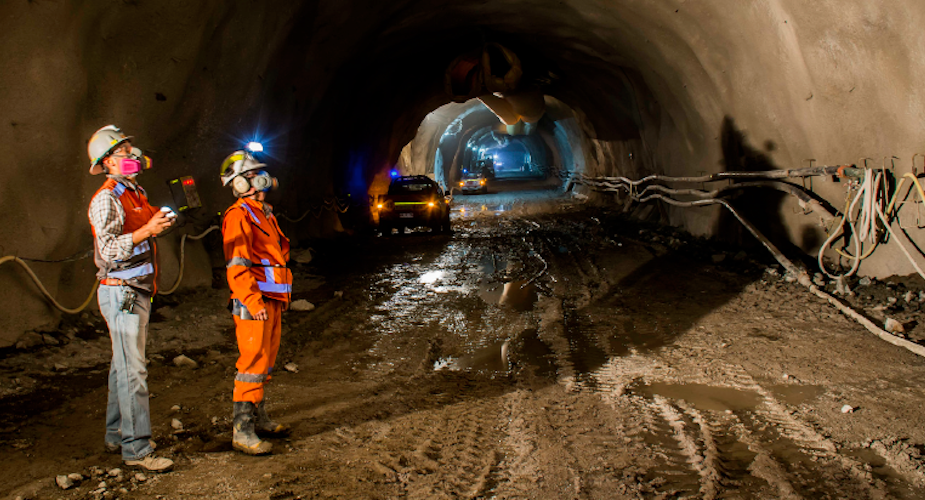
Codelco buys into Friedland’s I-Pulse to boost mine efficiencies

Photo by Codelco

Codelco acquired a stake in a Robert Friedland venture that uses electricity to shatter rocks as the Chilean copper giant seeks to make its aging mines more efficient.

State-owned Codelco is investing in I-Pulse Inc., joining other miners such as Rio Tinto Group, Newmont Corp. and Teck Resources Ltd. as investors in the US-based firm with laboratories in France, according to company statements that didn’t disclose terms. The arrangement includes Codelco paying about $50 million, said people briefed on the matter.

I-Pulse uses surges of electricity known as pulsed power in applications across industries including mining, manufacturing and water. One of its ventures, I-ROX, uses the technology to shatter rocks at mines to cut energy usage and emissions, attracting investors including BHP Group and a European fund tied to Bill Gates’ Breakthrough Energy Ventures.

By replacing conventional crushing and grinding processes, pulsed power could help Codelco cut costs and clean up its mines, where declining ore quality means more rock has to be dug up to produce the same amount of metal. It’s also expected to raise recoveries, which could help the industry in its battle to grow output and feed new demand for the wiring metal from the energy transition and data-center boom.

“We’ve seen how hard mining is,” Friedland, the billionaire founder of Ivanhoe Mines Ltd., said in an interview alongside Codelco chairman Maximo Pacheco. “We need to team up and really make a great effort to provide the metal that the world needs at a good price because if it gets too expensive, nobody can use it.”

The equity investment, which follows a letter of intent to work together in May, is intended to facilitate a rollout of pulsed power applications in Codelco mines over the coming years. The technologies can also be used in tunneling, eliminating the need for chemical explosives, as well as in drilling to harness geothermal energy and exploration, Friedland said.

While the state company rarely puts up capital for such deals, Pacheco sees the I-Pulse transaction as part of its partnership strategy to share risks and costs as building and running mines gets pricier and trickier. Codelco has seen its debt levels jump as it juggles major investments at multiple mines in a bid to reverse a long-term decline in production.

Pacheco and Friedland have been holding meetings for about 18 months in Europe, Saudi Arabia and Japan.

“We truly believe that Codelco, Chile and the world need a new way of mining,” Pacheco said. “And that new way requires innovation and new technologies.

(By James Attwood)

MONOPOLY CAPITALI$M

Caterpillar to acquire Australia’s RPMGlobal for $728 million

Image from RPMGlobal.

Australian mining software firm RPMGlobal said on Monday that it has struck a deal to be acquired by heavy machinery giant Caterpillar for a total equity value of A$1.12 billion ($728.22 million).

The news comes after Caterpillar had offered to buy the Australian company at A$5 per share in early September. RPM shares had jumped to a high of near A$4.80 after the news but are last trading at A$4.75.

RPMGlobal, the last remaining mining software company listed on the ASX, is set to vanish from public markets following its acquisition by Caterpillar.

The move comes after rival Micromine was snapped up by the Weir Group in an A$1.3 billion deal, marking the end of an era for Australia’s homegrown mining tech players.

The deal would be closely scrutinized by the Foreign Investment Review Board and Australia’s competition regulator and would also require approvals from RPMGlobal’s shareholders.

($1 = 1.5380 Australian dollars)

(By Rishav Chatterjee; Editing by Diane Craft)


US rare earth chokepoint is a big little problem

MP Materials’ Mountain Pass rare earths mine in southern California is the only rare earths producer in the United States. Credit: MP Materials

It’s tough running high-stakes trade negotiations on geological time. Ever-fractious talks between China and the United States spiraled into escalatory threats on Friday. At the center of the flare-up: the stranglehold held by the People’s Republic over crucial rare earth minerals.

U.S. moves to break the monopoly are in motion, and the problem seems small enough to be solvable. It’s just that the White House’s standing start leaves it no choice but to make nice for now.

The statistics are imposing. China controls some 70% of rare earth mining and 93% of magnet manufacturing, according to the Center for Strategic and International Studies, adding heft to effective embargo threats. A breakdown in trade negotiations will inevitably return to this pressure point because it is one of the few as painful as U.S. curbs on advanced chips.

Beijing’s position is well-earned: strategic investments over decades won control of the vast majority of mining and processing of rare earths including dysprosium and terbium, as well as other metals used in batteries and magnets for electric vehicles, wind turbines, and defense systems.

Yet this is simply not a vast market, sized at only around $5 billion by the Department of Energy and researchers. Catching up should be plausible. After a slow ramp-up, U.S. investments have accelerated.

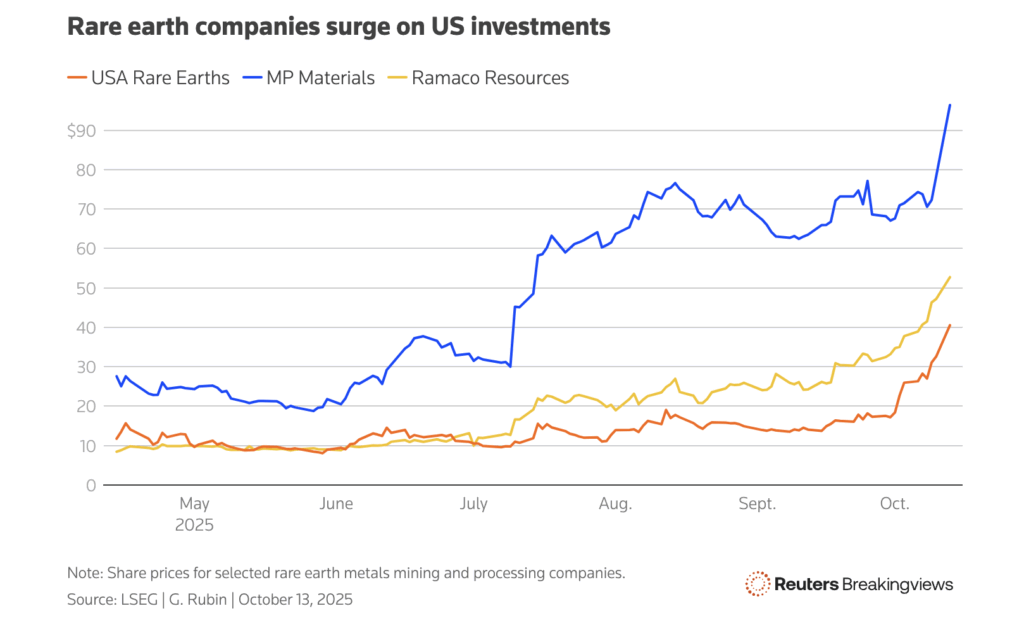
Uncle Sam took a direct 15% stake in MP Materials (NYSE: MP), a miner developing the Mountain Pass site in California. Over $1 billion of capital investment was announced in the second quarter of this year, some 91% government-backed, Benchmark Mineral Intelligence reckons. JPMorgan (NYSE: JPM), which assisted the government on its MP Materials investment, announced Monday that it will spend $10 billion on companies involved in U.S. national security, including mineral firms.

The problem until now was that, since they represent a tiny fraction of the cost of much more complex final products, rare earths haven’t attracted much corporate attention. Interventions to correct this should make an embargo a dead letter, eventually. The key, though, is that timing. Even by 2030, the International Energy Agency projects, China’s dominance will still extend to 54% of mining and 77% of refining. Such slow shifts are little help for trade talks due this month.

After all, MP Materials’ mine languished for years, its prior owner declaring bankruptcy in 2015. Fixing the supply chain will take laborious, coordinated effort. And as Friday’s market selloff makes clear, losing access to these materials would be existential. The question now is whether the White House can patiently develop domestic capacity, or if shorter tempers play to Beijing’s advantage.

(By Gabriel Rubin)


JPMorgan targets critical minerals with $1.5 trillion security initiative

Credit: Wikimedia Commons.

JPMorgan Chase on Monday launched its Security and Resiliency Initiative, committing up to $1.5 trillion over 10 years to strengthen US supply chains, with chairman and CEO Jamie Dimon emphasizing critical minerals essential for national security. 

Expanding from a prior $1 trillion goal, the plan addresses vulnerabilities exposed by geopolitical risks and over-reliance on foreign sources. Part to the effort is a $10 billion direct investment pool for equity and venture capital in US-based firms. 

“It has become painfully clear that the United States has allowed itself to become too reliant on unreliable sources of critical minerals, products and manufacturing, all of which are essential for our national security,” Chairman and CEO Jamie Dimon said in a news release.


The initiative targets 27 sub-areas, including mining, refining, solar and nuclear energy, battery storage and munitions.  JPMorgan will provide tailored financing, advisory services, and partnerships to scale domestic production.

“This new initiative includes efforts like ensuring reliable access to… critical minerals,” Dimon said.

To execute, the bank with $4.6 trillion in assets and $357 billion in stockholders’ equity will hire field experts, form an advisory council with industry leaders, and advocate for streamlined permitting, reduced regulations and red tape – long a major obstacle hindering new mining projects in the US. 


Nuclear energy included in JPMorganChase USD1.5 trillion initiative


JPMorganChase has announced it will make direct investments of up to USD10 billion as part of a USD1.5 trillion initiative to address pressing needs in key sectors from critical minerals to frontier technologies, including nuclear energy.
 

(Image: Thomas Breher/Pixabay)

The USA-based financial services firm's newly announced Security and Resiliency Initiative is a 10-year plan to facilitate, finance and invest in industries critical to national economic security and resiliency. The initiative, which expands the firm's existing plans to "facilitate and finance" some USD1 trillion over the next decade, will see it make direct equity and venture capital investments to help select companies, primarily in the USA, to enhance their growth, spur innovation, and accelerate strategic manufacturing.

JPMorganChase said it will focus on four key areas, with 27 sub-areas, to support companies across all sizes and development stages by offering advice, providing financing, and, in some cases, investing capital. The initial list of 27 sub-areas will be refined and augmented over time.

The four key areas are:

•   Supply Chain and Advanced Manufacturing, including critical minerals, pharmaceutical precursors and robotics
•   Defence and Aerospace, including defence technology, autonomous systems, drones, next-gen connectivity and secure communications
•   Energy Independence and Resilience, including battery storage, grid resilience and distributed energy
•   Frontier and Strategic Technologies, including AI, cybersecurity and quantum computing

Nuclear energy - specifically, "power generated through next generation nuclear tech" - is identified as a sub-area under the Energy Independence and Resilience key theme. "Diversified sources of energy production and the modernisation and resiliency of the grid will be imperative to the national interest and advancing artificial intelligence," the company notes. The other sub-areas under this theme are grid resilience, distributed energy, battery storage and solar.

"It has become painfully clear that the United States has allowed itself to become too reliant on unreliable sources of critical minerals, products and manufacturing - all of which are essential for our national security," said Jamie Dimon, Chairman and CEO of JPMorganChase. "Our security is predicated on the strength and resiliency of America's economy. America needs more speed and investment. It also needs to remove obstacles that stand in the way: excessive regulations, bureaucratic delay, partisan gridlock and an education system not aligned to the skills we need."

The new initiative "includes efforts like ensuring reliable access to life-saving medicines and critical minerals, defending our nation, building energy systems to meet AI-driven demand and advancing technologies like semiconductors and data centres", Dimon added.

The firm also said it will advocate for policies that can accelerate these efforts, including research and development, permitting, procurement and regulations conducive to growth. "As the bank intensifies its focus on these essential industries, it will also continue to work closely with its community and business partners to champion these sectors, foster talent and support skills training to ensure companies can fill critical jobs," it said.

With operations worldwide, JPMorganChase & Co had USD4.6 trillion in assets and USD357 billion in stockholders' equity as of 30 June, and serves its customers under the JP Morgan and Chase brands.


Valmet Modernizes Turbine Automation at Ennatuurlijk Helmond Power Plant

Valmet
Valmet is to deliver a comprehensive replacement of plant DCS and turbine control systems for Ennatuurlijk’s combined cycle power plant (CCPP) in Helmond, the Netherlands.

Published Oct 13, 2025 6:37 PM by The Maritime Executive

[By: Valmet]

Valmet has received an order to deliver a comprehensive replacement of plant DCS and turbine control systems at the Ennatuurlijk’s combined cycle power plant (CCPP) in Helmond, the Netherlands. The modernization project will enhance the plant’s operational efficiency, reliability, and safety, while ensuring stable combined heat and power (CHP) production. The project also supports the company’s long-term commitment to achieving carbon neutrality.

“Valmet proved to be able and willing to create a tailor-made solution that covered all our needs. They invested significant time to co-develop the project with us, and we trusted their expertise and references in turbine and power plant controls based on past deliveries. The professionalism of the Valmet team during on-site audits and follow-up meetings further reinforced our confidence in their capabilities,” says David Berghuis, Senior Asset Manager, Ennatuurlijk.

"We are proud to support Ennatuurlijk with this important modernization project. This delivery reflects Valmet’s broad expertise and extensive experience in mission-critical turbine automation and advanced control systems. It helps the customer optimize plant performance, enhance system reliability, and improve overall operational efficiency. Projects like this demonstrate Valmet’s commitment to providing innovative turnkey solutions that meet the changing needs and support the lifecycle requirements of our customers," says Johan Musch Solution Manager, Automation Solutions business area, Valmet.

The Helmond combined cycle power plant (40 MW) is undergoing modernization to improve efficiency and sustainability. The older gas turbine unit has been decommissioned, and the newer GE LM2500 DLE gas turbine is being modernized to ensure it meets future operational and environmental requirements. Using combined heat and power (CHP) technology, the plant supplies both electricity and district heating, strengthening the local energy supply and contributing to the Netherlands’ transition to cleaner energy.

The order is included in Valmet’s orders received of the third quarter 2025. The value of the order will not be disclosed. The delivery will be taken over by the customer in October 2026.

Delivery’s technical information
Several obsolete third-party systems will be replaced with a single Valmet Distributed Control System. Turnkey delivery includes the full modernization of the plant’s turbine control, protection, and safety systems for both steam and gas turbines. It features Valmet DNA Steam Turbine AutomationValmet DNA Gas Turbine Automation, and protection, with all safety systems based on HIMA technology. The scope also covers HRSG and BOP controls, along with monitoring systems for gas turbine combustion and performanceemissions (CEMS), and equipment diagnostics.

The products and services herein described in this press release are not endorsed by The Maritime Executive.


New HydroPen Reefer Tackles Rising Fire Risks in Refrigerated Containers

VIKING Life-Saving Equipment
HydroPen Reefer

Published Oct 13, 2025 6:42 PM by The Maritime Executive

[By: VIKING Life-Saving Equipment] 

A growing trend to ship combustible cargoes such as lithium batteries in refrigerated containers has prompted VIKING Life-Saving Equipment to develop HydroPen Reefer – a new version of its widely adopted ‘drill and spray’ solution for fighting container fires inside the box.

In contrast to conventional exterior firefighting methods, HydroPen’s unique drill and nozzle attaches to a ship’s hose and uses water pressure to drill through the container shell and fight fires at source.

In a submission to International Maritime Organization this year, meanwhile, the World Shipping Council indicated that over 11% of inspected containers in 2024 revealed reporting deficiencies. In September, the WSC launched a new Cargo Safety Program, seeking to exploit AI-powered cargo screening 2 as a means of better detecting mis-declared and undeclared dangerous goods.
 

Despite the insurance industry’s exposure to geopolitical events and high profile vessel losses last year, the Safety and Shipping Review 2025 from insurer Allianz reported “fires and mis declared cargo remain the top large vessel concerns”. The insurer added: “Enhancing fire detection and fighting capabilities is critical especially as the electrification age progresses.”

An explosion on a container ship in Ningbo last year highlighted how reefers are used as insulated units without power to carry hazardous goods, including lithium batteries. New guidelines from the International Safe Containerised Cargo Organisation (CINS 4) describe how batteries “can ignite if damaged or overheated, triggering thermal runaway reactions that lead to fires or explosions”.

More than 2,500 HydroPen units are already in service worldwide, but incidents like this show why container firefighting technology must keep pace with changing risks, says VIKING. Reinforced reefer doors and thicker insulated walls require enhanced drill and spray power – a capability that is delivered by the new HydroPen Reefer.

Benny Carlsen, Senior Vice President Sales and Global Sales, VIKING, says that the HydroPen Reefer solution has been developed after consultation with current HydroPen users.

“Many of the larger container operators have adopted HydroPen fleetwide, and many have also recognized the benefit of carrying several units in different locations,” he said. “HydroPen Reefer features an extended drill and reinforced nozzle mechanism to penetrate insulated walls that can be up to 120mm thick. It is also suited for a fire in a standard dry container if required.”

Like its firefighting counterpart for dry containers, HydroPen Reefer can be operated remotely by a single member of the crew once the drill and spray unit is fixed on the container door. In ‘reefer mode’, the unit is attached directly to a rfefrigerated container stacked up to lashing bridge height.

At under 10 kg, HydroPen Reefer is light, flexible and designed to give crews the confidence to tackle fires in both reefer and dry containers as required, said Bella Hajnal, Product Manager.

“Adaptability to various scenarios ensures that fires can be tackled effectively and without delay regardless of the container type,” she said. “HydroPen Reefer delivers advanced penetration mechanics, remote operation capability and dual-use flexibility, so that crew can act decisively when it matters most.”

The products and services herein described in this press release are not endorsed by The Maritime Executive.


Compressed Air Over Water for Short Distance Propulsion

Locomotive
A compressed-air mining locomotive (Provincial Archives of Alberta)

Published Oct 13, 2025 10:23 PM by Harry Valentine


During the early to mid 1900s, manufacturers of steam locomotives also built compressed air powered locomotives for the mining sector. While battery electric propulsion has replaced compressed air locomotives, the hobby sector has developed advances in compressed air propulsion that involve air over water operation. There is potential application for compressed air over water propulsion in modern day short distance maritime propulsion.

Introduction

Classical energy storage included compressed air powered locomotives for the mining sector, the last of which were built during the 1950s and involved the use of high pressure tanks pumped to 3,500 psi (pounds force per square inch) and air density at 14 pounds per cubic foot. Operating the tanks between 1,000 psi and 3,500 psi would have raised air temperature to over 300 deg F or 155 deg C, allowing for heat storage by surrounding the air tanks with heavy insulation. The high-pressure technology was well suited for short distance operation.

Builders of model rockets develop compressed air over water propulsion to accelerate scale model rockets made from plastic soft drink bottles, sending them skyward. A related experiment involved compressed air over hydraulic propulsion technology to repeatedly accelerate a city transport bus from standstill. The physical scale of some maritime vessels combines massive weight carrying capacity with generous volumetric space, allowing for installation of energy storage and propulsion technologies that would be unsuitable for railway or road vehicle operation. Such modified compressed air has potential in short distance ferry and dockyard tugboat operation.

Compressed Air Propulsion

Compressed air propulsion is well proven in mining locomotives, with power output being dependant on the combination of air pressure and air mass flow rate through the cylinders. Compressed air at 1,000 psi pressure at room temperature has a density of 5 pounds per cubic foot. While bottle rockets that use air over water propulsion compress air density to less than 1 pound per cubic foot, the air exerts pressure on water having a density of 62.4 pounds per cubic foot, greatly increasing mass flow rate through the rocket nozzle and potentially through an engine that operates on compressed air over water propulsion.

Pumping air to high pressure produces heat and especially if there is a large difference between lower and upper pressure. Minimizing the difference between lower and upper temperature reduces the build up of heat, reducing thermal stress on energy storage tanks. To charge the system, air would initially be pumped from atmospheric pressure to 500 psi (34 atm), then cooled to room temperature of around 80 def F or 25 deg C. Subsequent charging would raise stored air pressure to 1,000 psi or 68 to 70 atm, with heat build of up to 200 deg F or 96 deg C, minimizing thermal stresses.

Ground Effect Plane

Bottle rockets have reached elevations of over 2,700 feet and more recently over 5,300 feet in 2024 involving a 2 stage bottle rocket. A large scale model ground effect plane carrying water tanks and operating air pressure tanks between 1,000 psi and 500 psi would theoretically travel several miles above water, between islands or between a mainland and an offshore island. Recharge would involve electrically powered or gravity powered high pressure water pumps operating between 500 psi and 1,000 psi, to transfer filtered water into high pressure onboard water tanks. A land based catapult system would launch the plane into ground effect flight mode, with water jet subsequently providing propulsion over several miles.

The ground effect plane might operate as a radio-controlled or computer-controlled drone that carries small parcels between islands, between a mainland and an offshore island, across the entrance of a large bay or across a narrow lake. An electrically driven winch cable would be capable of accelerating a larger-scale ground effect plane across a smooth, solid surface to lift off speed, when water jet propulsion would blend in to sustain propulsion. At the destination end of the trip, touch down might occur on water or if a suitable coastal runway were available, touch down on land.

Ferry Boat

A boat using air over water propulsion would operate over the same pressure range as the concept ground effect plane, except that a low volume mass flow rate of high pressure water would drive a variable pitch propeller via a hydraulic motor. Converting the high speed water jet of low volume flow rate to a massive volume of water being pumped rearward at much lower speed, greatly increases propulsive efficiency. High water pressure water flow initially entering the hydraulic motor would be able to accelerate the vessel to sufficiently high speed to ride up on to hydrofoils, reducing drag and extending travel range.

 A comparatively small ferry vessel operating on compressed air over water storage would operate on hydrofoils, in passenger service. In slow freight service, the hull of a vessel built to 450 feet length by 50 feet width would house multiple high pressure air tanks along with multiple high pressure water tanks. Massive volumes of filtered water would need to be available at both ends of the trip, to assure rapid high pressure recharge during layovers. Such a vessel would operate short distance ferry services carrying passengers, or be assigned to extreme short distance short sea shipping transferring freight between nearby port terminals.

Tug Boat

Compressed air over water propulsion offers potential application in dockyard tugboat operation, where a short duration rapid burst of propulsive power would be required to accelerate large ships over short distances. A dual power tug would combine a lower power propulsion system for sailing around a dockyard and terminal area, with the compressed air over water propulsion technology being exclusively used when required to accelerate and move large, heavy vessels over short time duration.

Conclusions

While compressed air propulsion is well proven in short distance railway application, compressed air over water propulsion has been developed for aeronautical applications, where it has been proving itself. High pressure water driving hydraulic turbines is well proven in small site and large scale power dams. The fundamentals of the technology are well proven, allowing potential future application in short distance ferry boat services, short distance freight vessel service, tug boat service and short distance ground effect transportation. There is scope to undertake future research into further developing and refining compressed air over water technology for various propulsion applications.

The opinions expressed herein are the author's and not necessarily those of The Maritime Executive.


First Methanol-Powered Bunker Tanker Launched for Ops in Singapore

methanol tanker launch
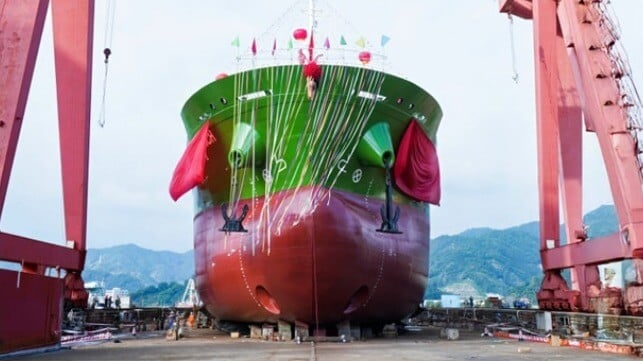
Methanol-powered dual-fuel tanker was launched and will become the first in Singapore (Cosulich)

Published Oct 13, 2025 7:37 PM by The Maritime Executive


The world’s first methanol bunker barge was launched last week in China and is destined for operations in Singapore. It is viewed as a key step in the expansion of the infrastructure to support alternative fuel operations.

Designed by SeaTech Solutions International, the vessel is being built by China’s Taizhou Maple Shipyard. Named Maya Cosulich, she will be owned by Italy’s Fratelli Cosulich Group. The vessel will be on a fixed-rate time-charter contract with global commodities trader Trafigura. When it enters service in Singapore will be deployed for TFG Marine, Trafigura’s international marine fuel supply and procurement joint venture with Frontline and Golden Ocean. Fratelli Cosulich Bunkers Singapore will oversee the technical management and operations of the vessel.

The launch took place on October 9 in China, and the vessel is expected to arrive in Singapore at the end of 2025. The vessel is 7,990 dwt and uses coated tanks so that it will be able to carry both green methanol and biofuels.

It will have two fixed pitch propellers, each driven by an electric motor via a gear box and three dual-fuel generator sets. An onboard battery storage system will optimize the use of the dual-fuel generators.

This vessel was ordered in December 2023. Work began in August on a sister ship, Anna Cosulich, also being built in China. 

The companies highlight that the Maya Cosulich project represents the culmination of a collaboration that began in 2023 between Fratelli Cosulich Group, TFG Marine, the Maritime and Port Authority of Singapore, and their technical and shipyard partners. It was designed for the needs of the Singapore market and is specifically outfitted with two mass flow meters to be fully compliant with the Maritime and Port Authority of Singapore’s methanol bunkering standards.

When it enters service, it will become the first methanol dual-fuel bunker tanker to operate in the Port of Singapore.


Funding to Build First Ship Tunnel Withdrawn by Norwegian Government

Norway ship tunnel
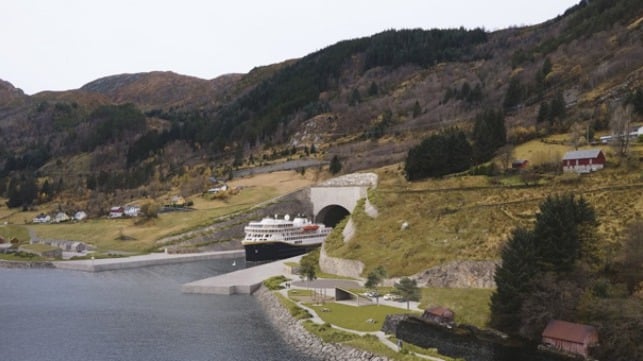
Norway has decided not to fund construction of the world's first ship tunnel (Kystverket)

Published Oct 13, 2025 5:22 PM by The Maritime Executive


Norway has decided that the construction of the world’s first ship tunnel would be too expensive to be practical. After receiving construction bids, the government will tell its parliament (Storting) that it has decided to shelve the project due to cost, leaving its future uncertain.

Prime Minister Jonas Gahr Støre told Norwegian broadcaster NRK, “It will be so expensive that we consider it irresponsible to continue the project.” Detailing the plans for the next budget, he said they would not be committing any further funding to the tunnel, as there are higher priorities with defense, health, and municipal finances. 

It represents a change in position by the government from statements highlighted during Norway’s recent elections. The ruling party had stressed the safety concerns, calling the tunnel a critical project. The new budget is likely to prompt a heated debate in the Storting. Norwegian media reports that last month, 450 companies sent a letter to parliament demanding that the project proceed. However, Hurtigruten has said it did not intend to use the tunnel, highlighting that weather conditions in the area rarely delayed its trips.

The Norwegian Coastal Authority, which was overseeing the project, received bids from three construction partnerships in June for the project and had said it expected to complete a construction contract this year. Work was expected to start in 2026 and take approximately five years to complete.

The project was to be located near Stad and a challenging shipping zone prone to bad weather. Stadhavet is said to be one of the most weather-exposed and dangerous sea stretches along the Norwegian coast. The tunnel was promoted both for its safety aspects and the ability to shorten sea travel times.


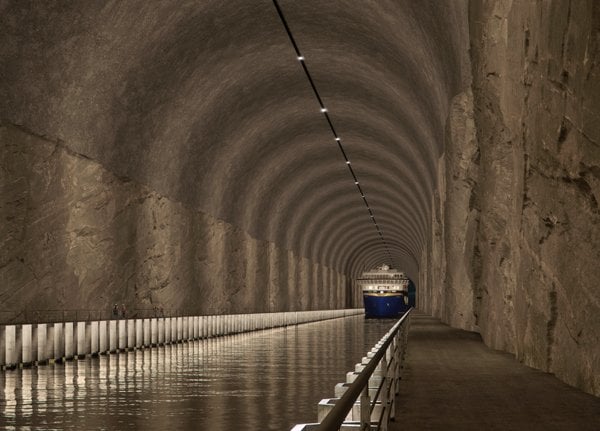
 The tunnel would accommodate ships up to the size of the coastal passenger vessels (Kystverket)


The project, which was started in 2010, planned to excavate through a mountain to create a 2,200-meter (1.4-mile) tunnel able to handle ships up to the size of Hurtigruten and Havlia’s coastal passenger ships. The estimates said three million square meters of rock would have to be blasted and removed to create the tunnel.

It is not the first time the government has stalled the project. The project was approved in 2021, only to have it be put on hold when cost estimates rose. The first projection was set at approximately $325 million, although estimates jumped by 2023 to over $690 million. The Norwegian Coastal Authority worked on the proposal and won government support for construction costing up to $490 million. Media reports are saying the costs have now reached an estimated $930 million, and it seems unlikely they could negotiate a lower cost.

Feasibility studies have already been completed for the project, and land purchases have begun. Media reports said approximately $38.5 million has already been spent.

Prime Minister Støre is scheduled to officially present the new budget on Wednesday, October 8. It is unclear if opposition parties or members of the coalition government might fight to retain the funding for the project.