Thursday, October 30, 2025


More than 2,400 young Moroccans face prosecution over Gen Z protests


More than 2,400 young Moroccans face trial for their participation in the so-called Gen Z protests that recently swept across the country, calling for fairer education and health care systems. Hundreds of people, many of them minors, have already been convicted for the protests. Human rights activists say some demonstrator confessions to police were made “under duress”.


Issued on: 29/10/2025 - 
By: 
FRANCE 24
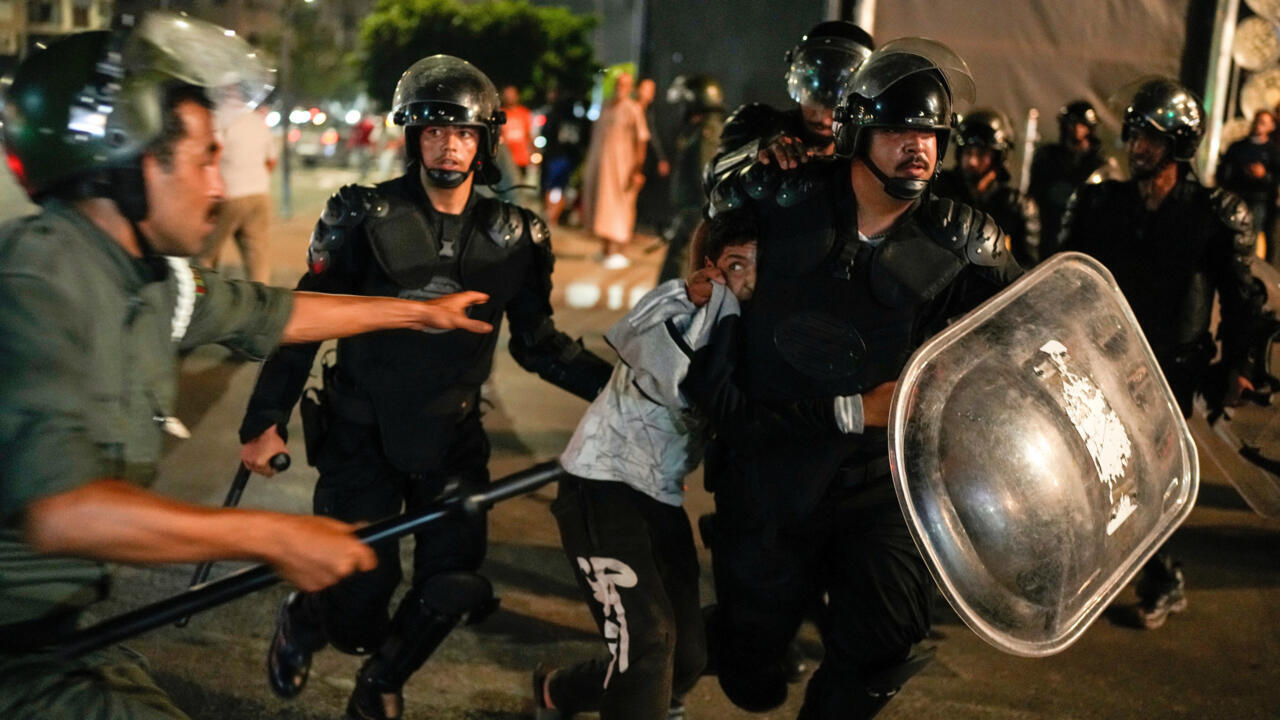
A boy is detained as youth led protests calling for healthcare and education reforms turned violent, in Sale, Morocco, Wednesday, October 1, 2025. © Mosa'ab Elshamy, AP


More than 2,400 people are facing prosecution in Morocco over recent GenZ 212 protests demanding better public education and health care, the public prosecutor’s office said Tuesday.

More than 1,400 were already in detention, Hassan Farhan, a judge and senior judicial official at the public prosecutor’s office, said in a press conference.

Read moreHow the Moroccan monarchy is trying to win back its estranged youth

Of the 2,480 defendants, about a fifth were charged with “rebellion as part of a group” and over a third with either “assaulting law enforcement officers” or “incitement to commit crimes and participation in armed gatherings”, Farhan said.

Moroccan courts had as of Monday convicted 411 people, including 76 minors, the prosecutor’s office added.

More than 60 people were sentenced to jail terms of up to 15 years, mainly for vandalism, looting, or arson, while some of the remainder received suspended sentences, prosecutors said.

Starting late last month, the online GenZ 212 collective organised a series of demonstrations seeking reforms in the health and education sectors, as well as “an end to corruption”.

In the initial days of the protests, when the gatherings were banned, police made hundreds of arrests.
Three dead

Two nights were marked by violence, including in Agadir, where three people were killed in clashes, though organisers insisted on their commitment to nonviolent protest.

Last week, the Moroccan Association for Human Rights (AMDH) called for “fair trials” for all defendants and denounced what it described as “police reports written under duress”.

Farhan said that “all conditions for fair trials” had been guaranteed, adding that the police records were all drawn up in accordance with the Moroccan law.

For two weeks, the demonstrations were held on a near-daily basis.

But they have gradually waned in both frequency and turnout, particularly after a speech by Morocco’s king calling for social reforms and the announcement of a draft $15 billion budget laying out improvements to health and education.

Social inequality has been a major challenge in Morocco, where deep regional disparities persist alongside a gap between the public and private sectors.

(FRANCE 24 with AFP)


Genocide warnings 'flashing red' after RSF takeover of Sudan's El-Fasher


Sudan’s Rapid Support Forces (RSF) have seized the western city of El-Fasher amid reports of extreme violence and mass killings. The capture of the key city in the Darfur region is a strategic boon for the paramilitary group, raising fears that Sudan’s ongoing civil war will enter a new phase of escalation.


Issued on: 29/10/2025 
FRANCE24
By: Joanna YORK

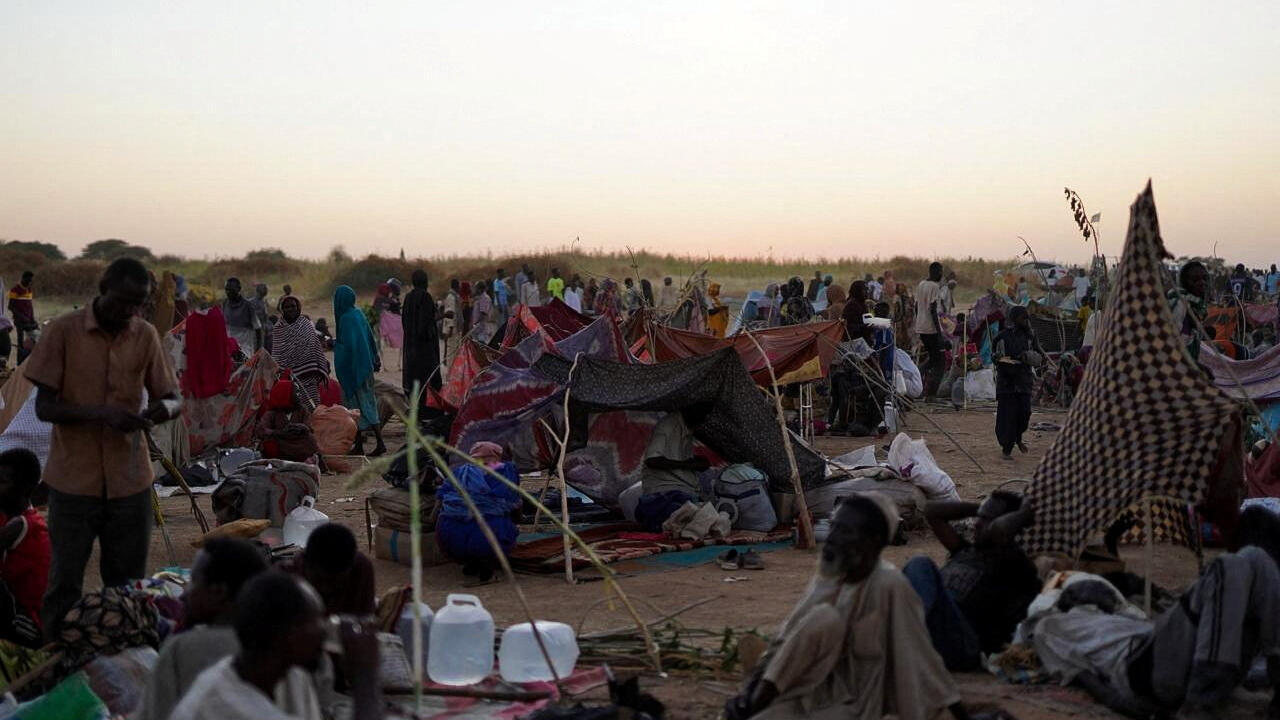
People sit at a camp for displaced families who fled from al-Fashir to Tawila in Sudan on October 27, 2025. © Mohammed Jamal, Reuters

Reports coming out of the western Sudanese city of El-Fasher on Tuesday evening, as the RSF paramilitary group seized the city, detailed unprecedented levels of bloodshed in a conflict that has already been defined by extreme violence.

Within 48 hours, RSF attacks on the city had left more than 2,000 civilians dead, according to armed groups allied to the Sudanese army.

The UN cited credible reports of “summary executions, attacks on civilians along escape routes, house-to-house raids, and obstacles preventing civilians from reaching safety” along with widespread sexual violence against women and girls.

Meanwhile, Yale University’s Humanitarian Research Lab found evidence suggesting “systematic mass killings” on such a scale that blood stains on the ground were visible in satellite imagery.

Papers on Sudan: A massacre so bloody, you can see it from space

It said the violence included attacks on health facilities, health workers, patients and humanitarian aid workers.

But the primary targets were non-Arab groups, including the Fur, Zaghawa and Masalit peoples.

The UN said around 177,000 civilians are still trapped inside the city by a 56-kilometre blockade built by the RSF that is sealing off food, medicine and escape routes.

Meanwhile, an estimated 26,000 have fled in recent days. Many travelled on foot to the town of Tawila, around 60 kilometres west of El-Fasher, arriving with “horrific” stories of “widespread ethnically and politically motivated killing and indiscriminate violence”, the UN said.

Read more‘Humanitarian aid in Sudan is constantly being blocked by all the belligerents’
Ongoing conflict

The RSF takeover in El-Fasher is the latest chapter in Sudan’s turbulent history.

Tensions flared once again after the 2019 ousting of President Omar al Bashir, who ruled Sudan for 30 years.

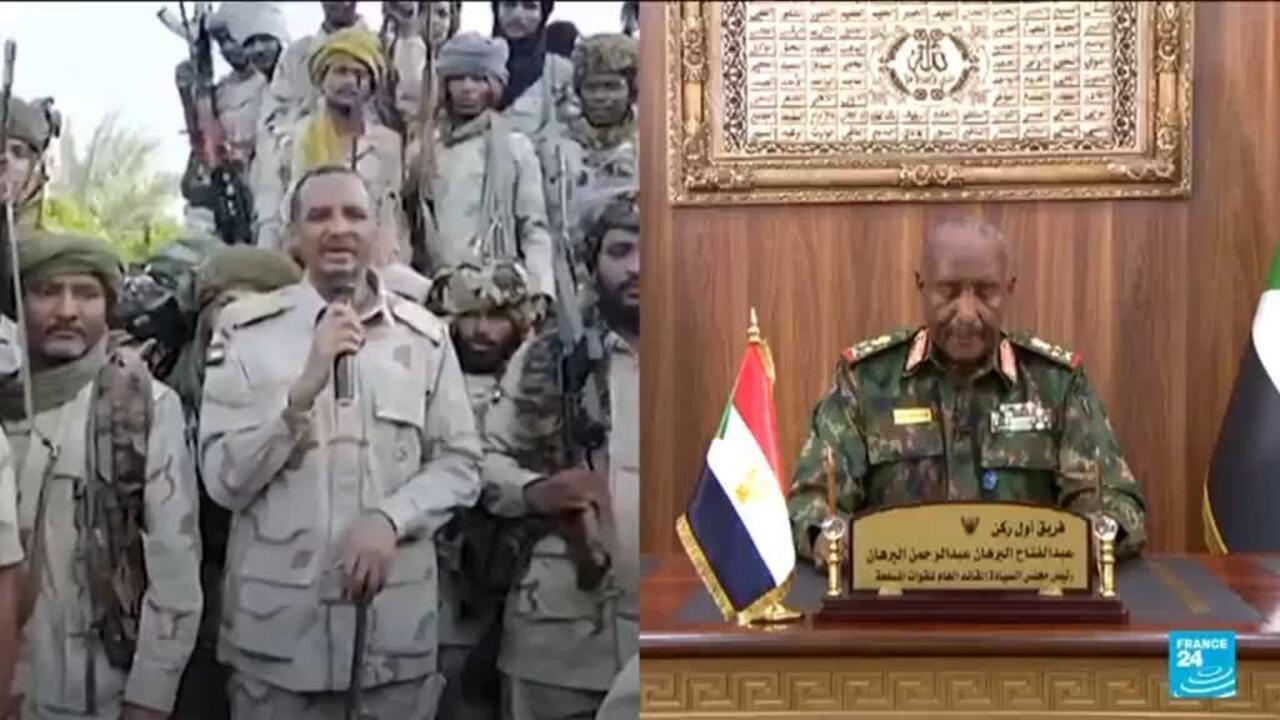
The current civil war began in April 2023 as a dispute between two high-powered generals: the head of the country’s armed forces Abdel Fattah al Burhan, and his former deputy Mohamed Hamdan Dagalo, the head of the RSF paramilitary group.


© France 24
02:24

The conflict has been marked by extreme violence – just over a year after fighting began, it had already claimed an estimated 150,000 lives. By July 2025, 12 million people had been displaced and parts of the country had been pushed into famine.

Both sides have been accused of attacking civilians and committing serious violations of international law.

Prior to the RSF takeover, El-Fasher was subject to an 18-month siege marked by starvation and bombardment.

In the city, “civilians were already weakened by famine and have suffered carpet bombing from government forces, as well as a long RSF-imposed siege”, said David Keen, professor of conflict studies at the London School of Economics and Political Science (LSE).

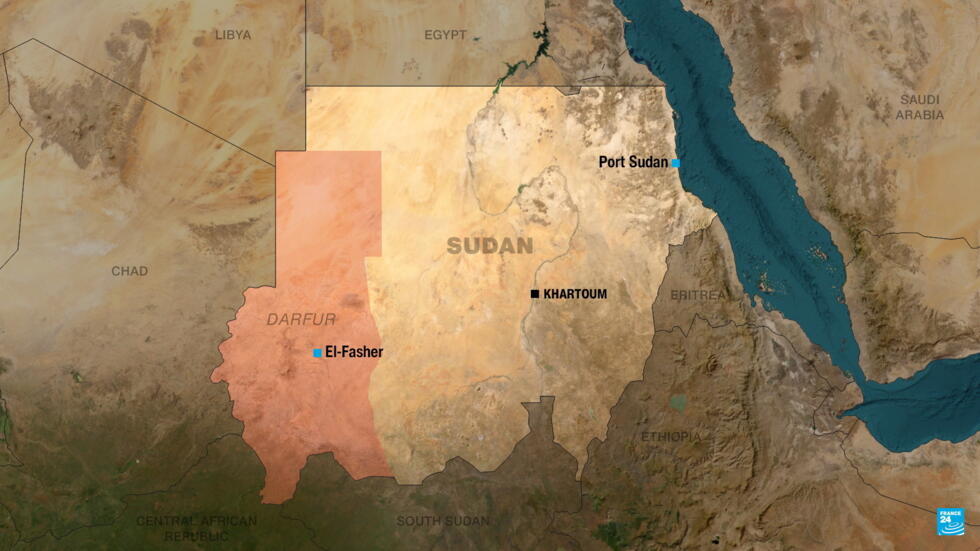
Currently, the army controls much of north and east Sudan, including most of the border with Egypt, which is said to be one of Burhan’s main backers.

It also holds urban centres in Port Sudan – the home of Burhan’s UN-recognised government – and in the capital Khartoum, where it regained control from the RSF in March.
Since the RSF takeover of the city of El-Fasher, the paramilitary group now controls the majority of west Sudan. © France Médias Monde graphics studio


Meanwhile, the RSF controls almost all of the western region of Darfur, now including El-Fasher, along with much of the central Kordofan region and a small territory along Sudan's border with Libya and Egypt.

The army claims the RSF is backed by the UAE, which the Emirates denies.
'Darfur's lynchpin'

Taking control of El-Fasher is a significant advance for the RSF.

Logistically, the city sits at a crossroad of trade routes, including trafficking routes to access fuel, ammunition and weapons from Libya and Chad.

Politically, the seizure of El-Fasher gives the RSF almost complete control of west Sudan, effectively partitioning the country into two territories.

“El-Fasher is Darfur’s lynchpin, the last major city not under RSF control and the political centre of non-Arab armed groups,” said Dr Matthew Sterling Benson-Strohmayer, Sudans research director at the LSE.

“Its fall grants the RSF near-total dominance of western Sudan, likely neutralising rivals and transforming Darfur from a periphery of rebellion into the heart of a paramilitary state,” he added.

The RSF declared in April that it was forming a rival government, raising the prospect that Sudan could split for a second time after South Sudan seceded in 2011.

In such a scenario, “the RSF’s patterns over the past twenty years suggest its rule will be defined by coercion”, said Sterling Benson-Strohmayer, including “systems of taxation, looting and tightly controlled aid”.
'A point of no return'

Experts fear that RSF rule in the western region will give the group free rein to eradicate the non-Arab groups that live there.

The paramilitary group is descended from the Janjaweed militias that were accused of committing genocide in Darfur between 2003 and 2005.

In 2023, the RSF was accused of carrying out massacres in West Darfur's capital, El-Geneina, killing up to 15,000 people from the Masalit group.

“In many ways, the current massacres mirror those in El-Geneina,” Keen said. “Retaliatory killings were widely expected to occur once RSF took El-Fasher, and these killings are now clearly taking place on a horrific scale.”

“We have been warned that mass killings of civilians would likely follow the fall of El-Fasher,” agreed Alex de Waal, director of the World Peace Foundation research organisation.

“All the warning signs for genocidal massacre are flashing red.”

Such violence may well mark a “point of no return”, he said, serving to “further polarise Sudan and jeopardise any chances of peace or state reconstruction”.

Already there is little appetite for negotiation between the army and the RSF.

"The prospects for peace are very minimal," Sudanese analyst Kholood Khair told AFP. "Neither the army nor the RSF, for strategic or battlefield reasons, is willing to commit to a ceasefire or genuine peace talks."

Typically, “when one side suffers a defeat, it wants first to avenge the defeat before talking. And when one side has scored a victory, it wants to press home its momentum before talking," said de Waal.

"This has long added up to a formula for continued war.”
Lebanese president orders army to 'confront any Israeli incursion' after raid kills worker


The Lebanese army has been ordered to confront any Israeli incursion on the country’s southern border, President Joseph Aoun announced on Thursday. The ramped-up rhetoric comes after an overnight attack in which Israeli soldiers crossed the border and entered a village, where they killed a municipal worker.


Issued on: 30/10/2025 - 
By: FRANCE 24

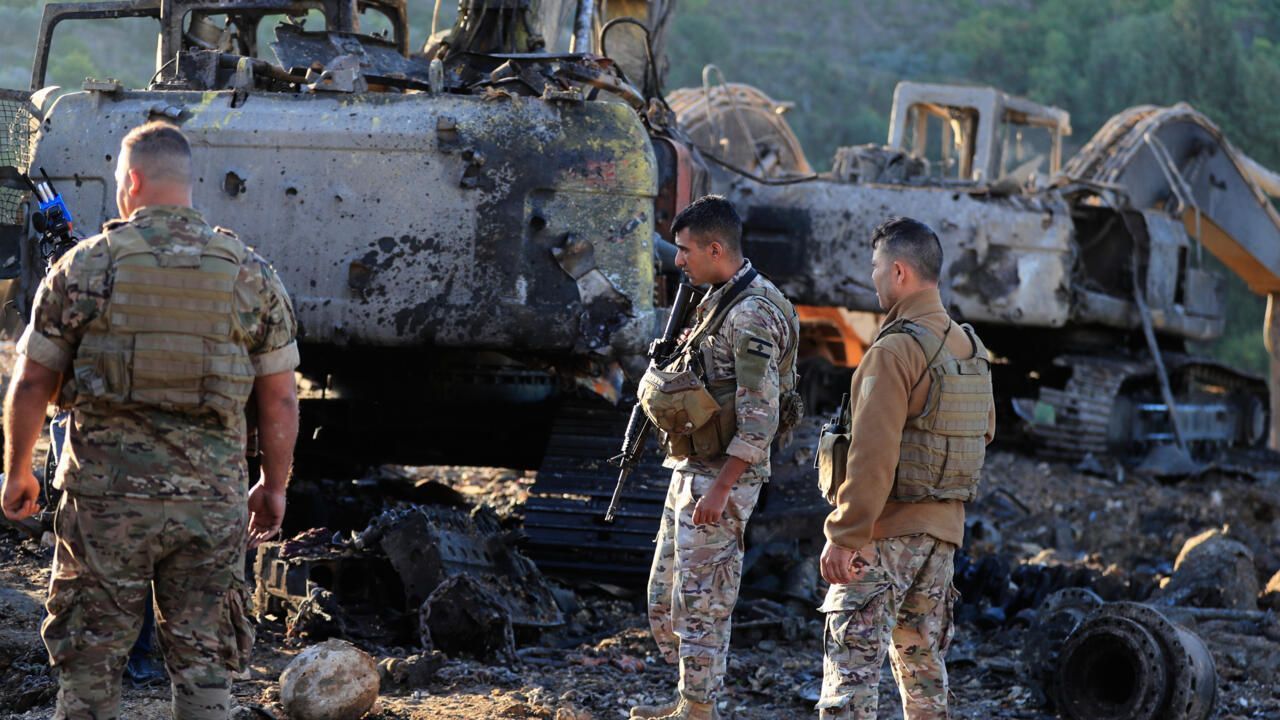
Lebanese army soldiers stand guard at a site that sold heavy machinery, where a large number of vehicles were destroyed in Israeli airstrikes, in the southern village of Msayleh, Lebanon, Saturday, October 11, 2025. © Mohammed Zaatari, AP/ File picture

Lebanese President Joseph Aoun on Thursday ordered the armed forces to oppose any Israeli incursions in the country’s south following an Israeli raid that killed a municipal worker.

Aoun ordered the army to “confront any Israeli incursion into liberated southern territory, in defence of Lebanese territory and the safety of citizens”, during a meeting with the army chief, according to a statement from the presidency.

Despite a November 2024 ceasefire with Lebanese militant group Hezbollah, Israel maintains troops in five areas in southern Lebanon and has kept up regular air strikes, which have recently intensified.

“In a grave and unprecedented attack, an Israeli enemy force penetrated the village of Blida at nearly 1:30am (1130 GMT), more than one kilometre from the border, supported by a number of vehicles,” Lebanon’s official National News Agency (NNA) reported.

“The force stormed the Blida municipality building, where employee Ibrahim Salameh was sleeping, and enemy soldiers proceeded to kill him,” it said.

Village residents cited by NNA said the raid lasted several hours, and that Israeli forces withdrew at dawn.

In the nearby border village of Adaisseh, NNA reported that Israeli forces blew up a hall for religious ceremonies at dawn.
Stepped-up Israeli strikes

Over the past few days, Israel has stepped up its strikes on Lebanon, often saying it is targeting Hezbollah positions.

On Tuesday, the spokesman for the UN rights commission, Jeremy Laurence, said Israeli forces had killed 111 civilians in Lebanon since the ceasefire went into effect.

Hezbollah was badly weakened during more than a year of conflict with Israel, and the United States has intensified pressure on Lebanese authorities to disarm the Iran-backed group.

One year after Israel killed Hassan Nasrallah, a weakened Hezbollah begins to regroup

On Wednesday, during a meeting of the ceasefire’s monitors in the Lebanese border city of Naqoura, US envoy Morgan Ortagus said Washington welcomed the “decision to bring all weapons under state control by the end of the year”.

The Lebanese army “must now fully implement its plan”, she added.

(FRANCE 24 with AFP)
Haiti, Jamaica and Cuba assess the devastation left by Hurricane Melissa


Hurricane Melissa left a trail of death and destruction after tearing through the Caribbean nations of Haiti, Jamaica and Cuba, cutting power, ripping the roofs off thousands of homes and, in some places, sweeping children away.


Issued on: 30/10/2025 
By: FRANCE 24 

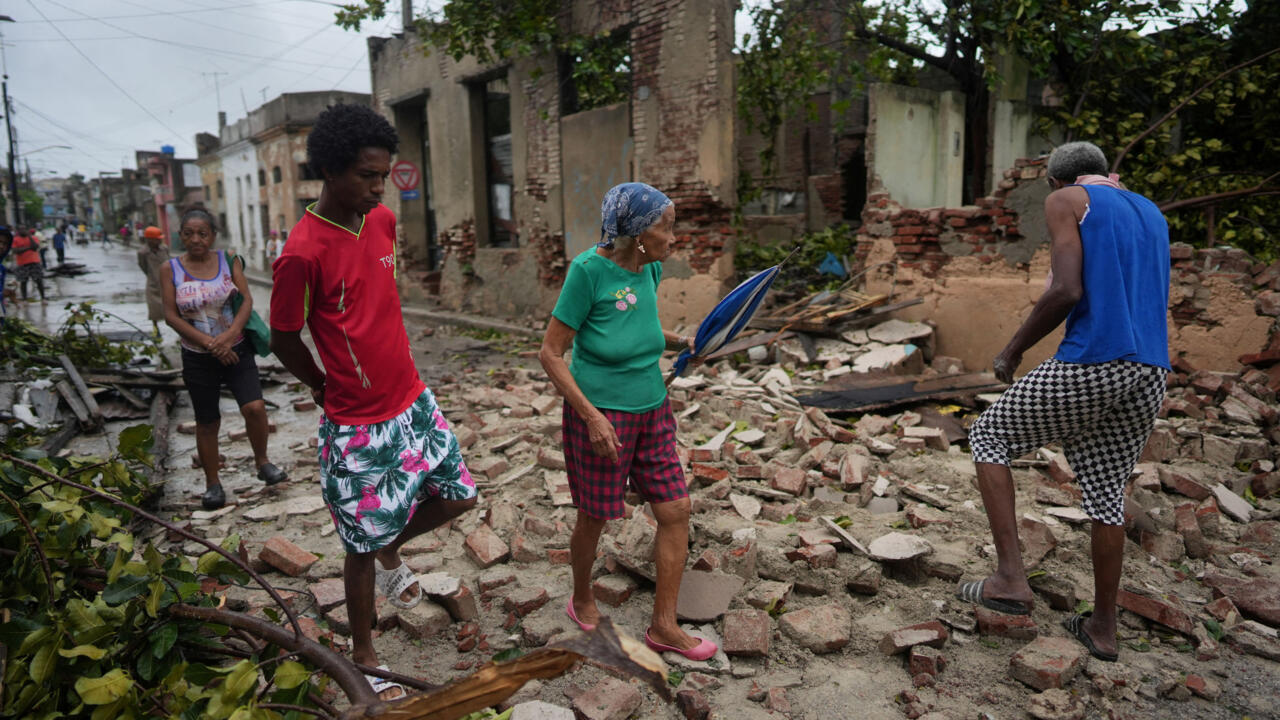
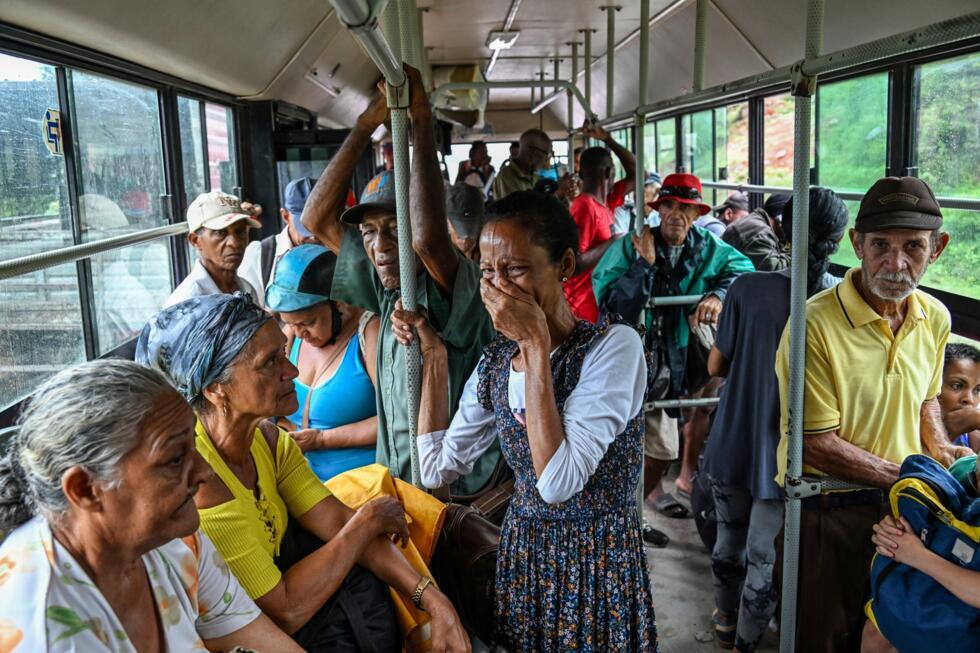
People pass by the rubble of a wall in the aftermath of Hurricane Melissa in Santiago, Cuba, on October 29, 2025. © Alexandre Meneghini, Reuters

People across the northern Caribbean were digging out from the destruction of Hurricane Melissa on Thursday as deaths from the catastrophic storm climbed.

The rumble of large machinery, whine of chainsaws and chopping of machetes echoed throughout southeast Jamaica as government workers and residents began clearing roads in a push to reach isolated communities that sustained a direct hit from one of the most powerful Atlantic storms on record.

Dozens dead as Caribbean reels from 'unprecedented' hurricane destruction

Stunned residents wandered about, some staring at their roofless homes and waterlogged belongings strewn around them.

“I don’t have a house now,” said a distressed Sylvester Guthrie, a resident of Lacovia in the southern parish of St. Elizabeth, as he held onto his bicycle, the only possession of value left after the storm.

“I have land in another location that I can build back but I am going to need help,” the sanitation worker pleaded.

Emergency relief flights began landing at Jamaica’s main international airport, which reopened late Wednesday, as crews distributed water, food and other basic supplies.

“The devastation is enormous,” Jamaican Transportation Minister Daryl Vaz said.
'Ground Zero'

Some Jamaicans wondered where they would live.

“I am now homeless, but I have to be hopeful because I have life,” said Sheryl Smith, who lost the roof of her home.

Authorities said they have found at least four bodies in southwest Jamaica.

Prime Minister Andrew Holness said up to 90 percent of roofs in the southwest coastal community of Black River were destroyed.

“Black River is what you would describe as Ground Zero,” he said. “The people are still coming to grips with the destruction.”

More than 25,000 people remained crowded into shelters across the western half of Jamaica, with 77 percent of the island without power.

Melissa also unleashed catastrophic flooding in Haiti, where at least 25 people were reported killed and 18 others missing, mostly in the country’s southern region.

Steven Guadard, who lives in Petit-Goave, said Melissa killed his entire family.

“I had four children at home: a 1-month-old baby, a 7-year-old, an 8-year-old and another who was about to turn 4,” he said.

Haiti’s Civil Protection Agency said Hurricane Melissa killed at least 20 people in Petit-Goave, including 10 children. It also damaged more than 160 homes and destroyed 80 others.

Officials warned that 152 disabled people in Haiti’s southern region required emergency food assistance. More than 11,600 people remained sheltered in Haiti because of the storm.
Many Cubans still without power, phones

Meanwhile, in Cuba, people began to clear blocked roads and highways with heavy equipment and even enlisted the help of the military, which rescued people trapped in isolated communities and at risk from landslides.

No fatalities were reported after the Civil Defence evacuated more than 735,000 people across eastern Cuba. They slowly were starting to return home.

“We are cleaning the streets, clearing the way,” said Yaima Almenares, a physical education teacher from the city of Santiago, as she and other neighbors swept branches and debris from sidewalks and avenues, cutting down fallen tree trunks and removing accumulated trash.

In the more rural areas outside the city of Santiago de Cuba, water remained accumulated in vulnerable homes on Wednesday night as residents returned from their shelters to save beds, mattresses, chairs, tables and fans they had elevated ahead of the storm.

A televised civil defence meeting chaired by President Miguel Diaz-Canel did not provide an official estimate of the damage. However, officials from the affected provinces – Santiago, Granma, Holguin, Guantanamo, and Las Tunas – reported losses of roofs, power lines, fiber optic telecommunications cables, cut roads, isolated communities and losses of banana, cassava and coffee plantations.

Officials said the rains were beneficial for the reservoirs and for easing a severe drought in eastern Cuba.

Many communities were still without electricity, internet and telephone service due to downed transformers and power lines.
From a 5 to a 2

When Melissa came ashore in Jamaica as a Category 5 hurricane with top winds of 295 kilometres per hour on Tuesday, it tied strength records for Atlantic hurricanes making landfall, both in wind speed and barometric pressure. It was still a Category 3 hurricane when it made landfall again in eastern Cuba early Wednesday.

A hurricane warning remained in effect early Thursday for the southeastern and central Bahamas and for Bermuda.

Hurricane conditions were expected to continue through the morning in the southeastern Bahamas, where dozens of people were evacuated.

Melissa was a Category 2 storm with top sustained winds near 155 kph early Thursday and was moving north-northeast at 33 kph according to the US National Hurricane Center in Miami.

The hurricane was centred about 235 kilometres northeast of the central Bahamas and about 1,215 kilometres southwest of Bermuda.

Melissa was forecast to pass near or to the west of Bermuda late Thursday and may strengthen further before weakening Friday.

(FRANCE 24 with AP)


Dozens dead as Caribbean reels from 'unprecedented' hurricane destruction

Hurricane Melissa continued to cut across the Caribbean Wednesday, leaving at least 30 people dead or missing in Haiti and laying waste to Cuba's east. Climate scientists warn that rising sea temperatures are making seasonal tropical storms more intense.


Issued on: 29/10/2025 - 
By: FRANCE 24


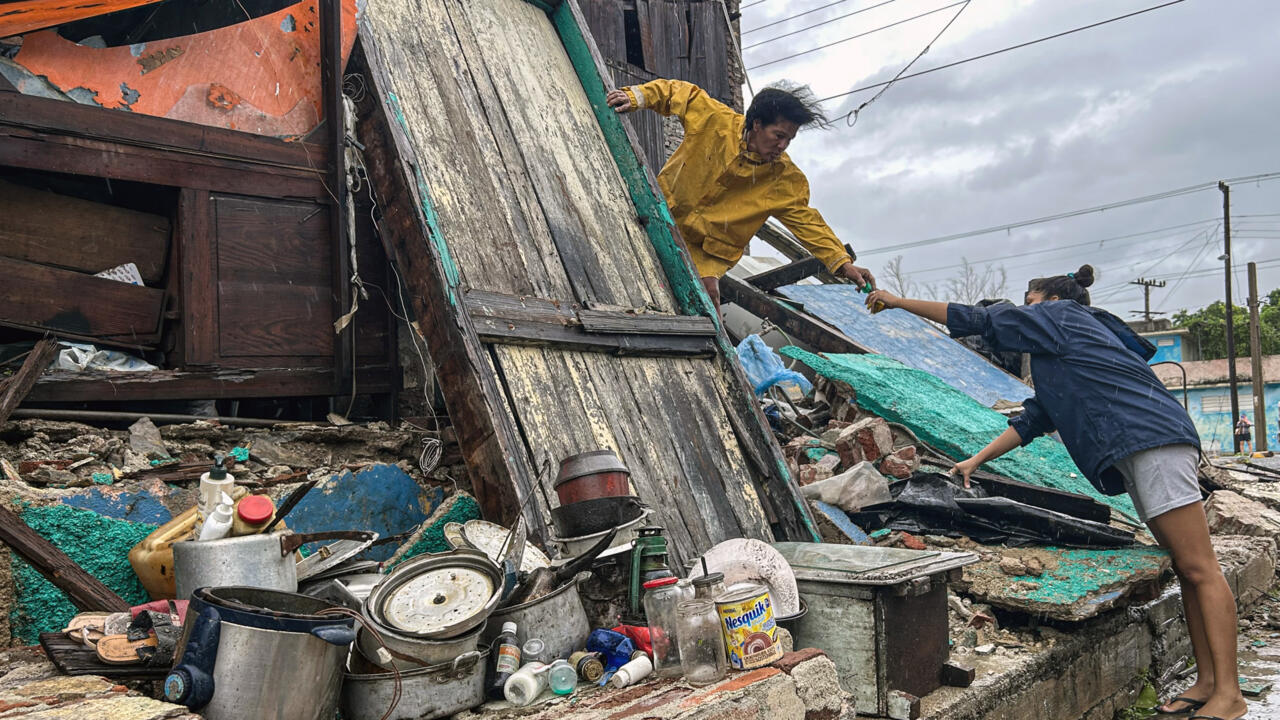
A family salvages belongings from the rubble of their home after it collapsed during Hurricane Melissa’s passage through Santiago de Cuba, Cuba. © Yamil Lage, AFP

Cubans waded through flooded, debris-strewn streets Wednesday as Hurricane Melissa blasted across the Caribbean, leaving 30 dead or missing in Haiti and devastating swaths of Jamaica.

Headed for the Bahamas and Bermuda as a weakened but still threatening storm, Melissa left behind "unprecedented" devastation in Jamaica, according to a UN official, and untold misery to Cuba.

"It has been a very difficult early morning," Cuban President Miguel Diaz-Canel said on social media, citing "extensive damage" on the communist island battling its worst economic crisis in decades.

Residents in Cuba's east struggled through flooded and collapsed homes and inundated streets, with windows smashed, power cables downed and roofs and tree branches torn off amid intense winds.


Some carried loved ones unable to walk for themselves and arms full of quickly gathered belongings.

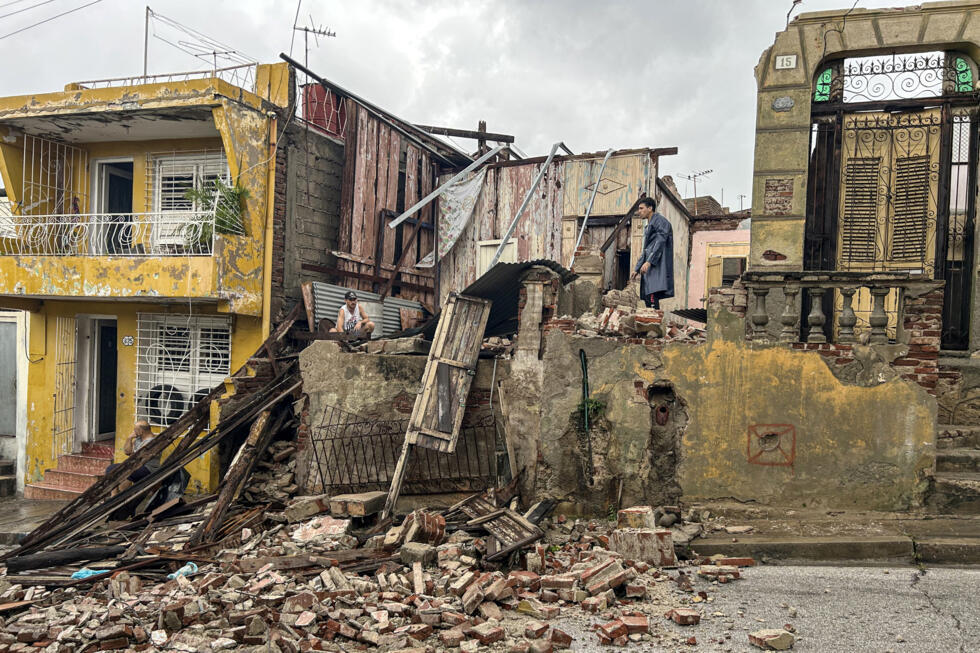
A home damaged as Melissa passed through Santiago de Cuba, Cuba. © Yamil Lage, AFP


Hurricane Melissa hit Cuba with maximum sustained winds of 195 kilometres per hour, according to the US National Hurricane Center (NHC), which urged residents to "remain sheltered" even as the storm left the island headed north.

"In the Bahamas, residents should remain sheltered," the centre warned, and in Bermuda, "preparations should be underway and be completed before anticipated first occurrence of tropical-storm-force winds".
'Disaster area'

In Jamaica, UN resident coordinator Dennis Zulu told reporters Melissa had brought "tremendous, unprecedented devastation of infrastructure, of property, roads, network connectivity".

Prime Minister Andrew Holness declared the tropical island famed for tourism a "disaster area". The Jamaican government confirmed that the storm had killed at least four people in St Elizabeth parish.

"Our teams are on the ground working tirelessly to rescue, restore and bring relief where it's needed most ... To every Jamaican, hold strong. We will rebuild, we will recover," he said on X.

Britain's King Charles III, who is also Jamaica's head of state, said the destruction caused by Hurricane Melissa was a "heartbreaking" reminder of the need to restore the "balance" of nature.

Read moreCaribbean braces for impact as Melissa surges into a Category 4 hurricane

Pope Leo XIV offered prayers from the Vatican, while the United States said it was in close contact with the governments of Jamaica, Haiti, the Dominican Republic and the Bahamas.

"We have rescue and response teams heading to affected areas along with critical lifesaving supplies. Our prayers are with the people of the Caribbean," Secretary of State Marco Rubio said on X, without mentioning Cuba, whom the Miami-born politician has long held up as his ideological foe.

At least 23 people in southern Haiti, including 10 children, were killed in floods caused by the hurricane earlier this week, according to civil defense agency head Emmanuel Pierre. Ten more were missing.

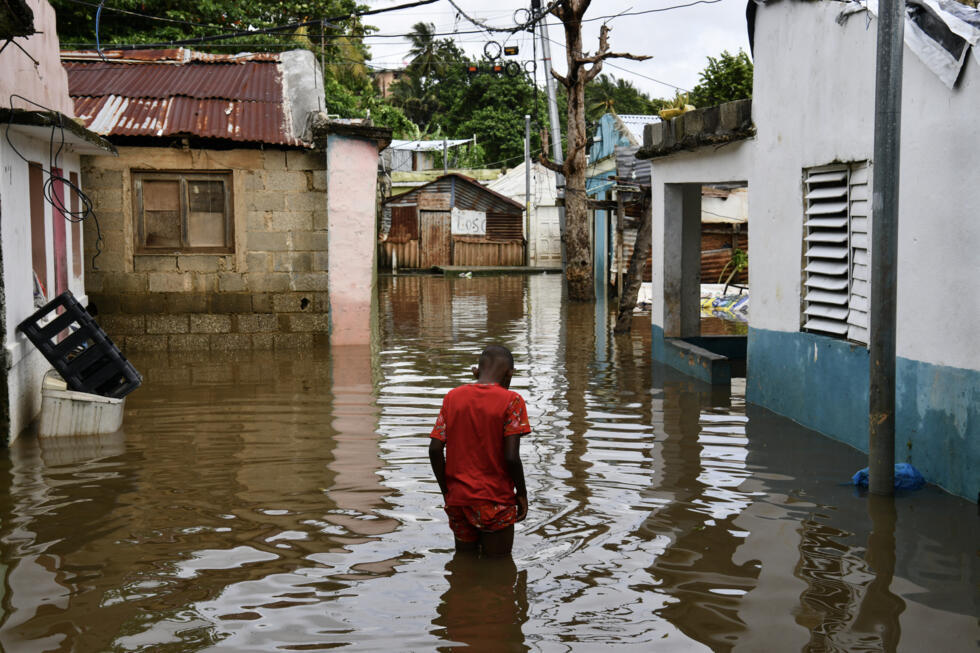
A flooded street in Santo Domingo, Dominican Republic on October 28, 2025. © Danny Polanco, AFP


Hurricane Melissa tied the 1935 record for the most intense storm ever to make landfall when it battered Jamaica on Tuesday, according to data from the US National Oceanic and Atmospheric Administration (NOAA).

Lisa Sangster, a 30-year-old communications specialist in Kingston, said her home was devastated.

"My sister ... explained that parts of our roof was blown off and other parts caved in and the entire house was flooded," she told AFP.

Communications down

In the Cuban town of El Cobre, rescue workers attempted Wednesday to reach 17 people, including children and elderly people, trapped by rising floodwaters and a landslide, according to state media.


Residents are evacuated from Playa Siboney to safe locations ahead of the arrival of Hurricane Melissa. © Yamil Lage, AFP


"We are safe and trying to stay calm," rheumatologist Lionnis Francos, one of those stranded, told the official news site Cubadebate.

"The rescuers arrived quickly. They called us, but couldn't cross because the road is blocked."

The full scale of Melissa's damage is not yet clear. A comprehensive assessment could take days, with communications networks badly disrupted across the region.

Jamaican government minister Desmond McKenzie said several hospitals were damaged, including in Saint Elizabeth, a coastal district he said was "underwater".

Many homes were destroyed and about 25,000 people sought refuge in shelters. The storm left more than three-quarters of the island without power.

Mathue Tapper, 31, told AFP from Kingston that those in the capital were "lucky" but feared for fellow Jamaicans in the island's more rural western areas.

Due to climate change, warmer sea surface temperatures inject more energy into storms, boosting their intensity with stronger winds and more precipitation.

"Human-caused climate change is making all of the worst aspects of Hurricane Melissa even worse," said climate scientist Daniel Gilford.

(FRANCE 24 with AFP)
AI-generated videos of Hurricane Melissa flood social media

Issued on: 29/10/2025 -
04:43 min
From the show


From shark videos to news reports, AI is taking fake disaster content to a new level. If you have opened TikTok or X in the past 48 hours you may well have seen AI-generated photos and videos of Hurricane Melissa, as the storm blasted across the Caribbean. The flood of disinformation prompted Jamaican authorities to issue warnings. Emerald Maxwell takes a closer look in this edition of Truth or Fake.

NGOs urge humanitarian push at Great Lakes conference in Paris

France and Togo are co-hosting a conference in Paris on Thursday to support peace and prosperity in the Great Lakes region of Africa. A coalition of international NGOs will urge participants to step up their financial response to the "unprecedented humanitarian crisis" in eastern Democratic Republic of Congo and neighbouring countries.


Issued on: 30/10/2025 - RFI

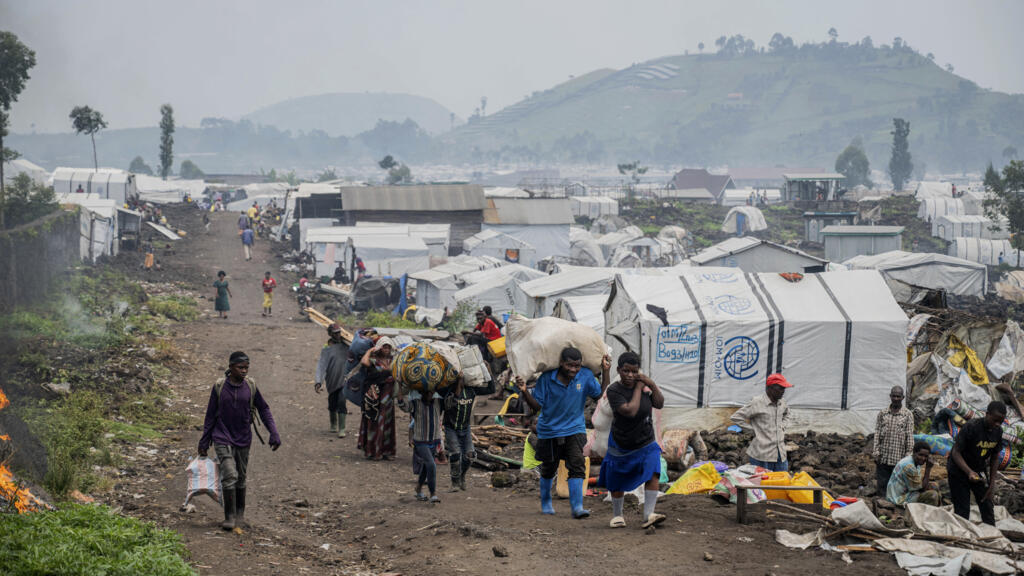
People who were displaced by the fighting between M23 rebels and government soldiers leave their camp following an instruction by M23 rebels in Goma, Democratic Republic of the Congo, 11 February 2025. AP - Moses Sawasawa

The conference aims to drum up an international response to the crisis in the eastern DRC and support efforts by Qatar and the United States to mediate in the conflict between the Democratic Republic of Congo government and the M23 rebel group, according to the French Foreign Ministry.

Known as the Ministerial Conference in Support of Peace and Prosperity in the Great Lakes Region, the event has been organised in close coordination with Togo's President Faure Gnassingbé, the African Union's mediator in the Congo-Rwanda crisis.

Approximately 50 countries and international organisations are expected to attend the talks which are part of the Paris Peace Forum –⁠ a two-day summit on conflict resolution and multilateral cooperation.

French President Emmanuel Macron will address the gathering alongside his Congolese counterpart Félix Tshisekedi on Thursday afternoon.

"The main objective is to show that there is no forgotten crisis. The DRC and the Great Lakes region must be at the centre of international attention," a presidential advisor told the press.

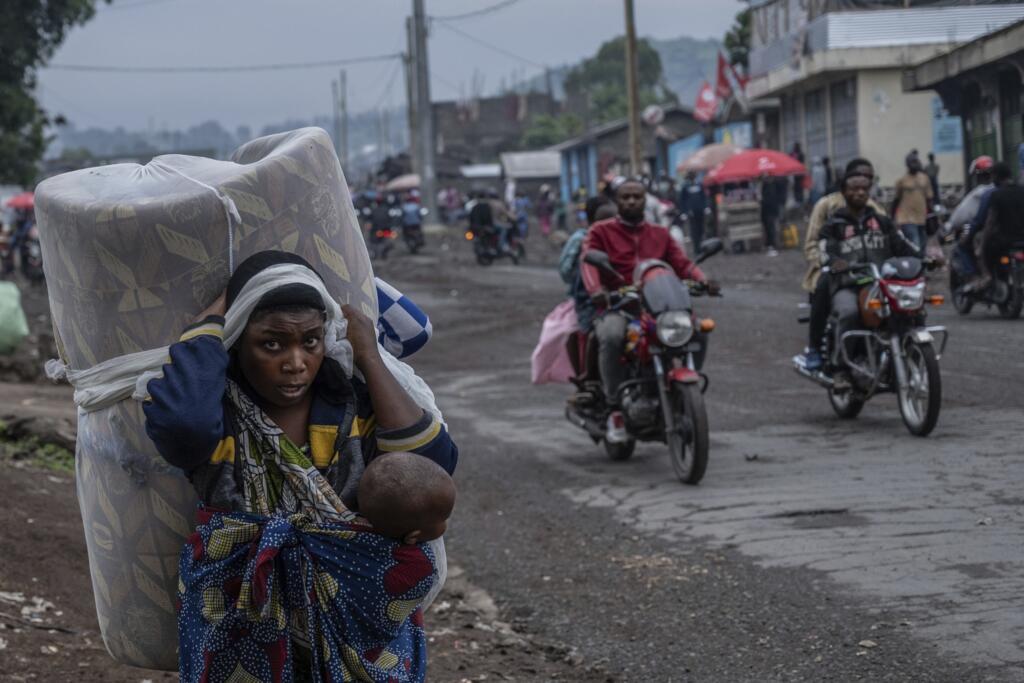
People displaced by the fighting with M23 rebels make their way to the center of Goma, Democratic Republic of the Congo, Sunday, 26 January, 2025 AP - Moses Sawasawa

Collapse of essential services

The other objective is pushing for a significant increase in humanitarian funding.

More than 21 million people need humanitarian aid in the DRC – nearly one-fifth of the population, according to NGO Oxfam France.

The aid charity is one of 12 NGOs and NGO networks that signed an open letter ahead of the conference, calling on the participants of the conference to go "beyond declarations of intent".

Thousands without lifesaving aid in DRC, says UN agency

"This crisis goes beyond the immediate emergency, it also stems from the gradual collapse of essential services (health, water, education, electricity, food), on which the survival and dignity of the population depend," the coalition wrote on Tuesday.

The crisis is particularly severe in the east of the vast central African country – a region rich in natural resources that has been plagued by conflict for three decades.

Violence intensified in January year when the M23 armed group, backed by neighbouring Rwanda, seized the major eastern cities of Goma and Bukavu in a lightning offensive.
Millions displaced

More than 1.6 million people have had to flee their homes since the beginning of the year, bringing the total number of internally displaced people to 7.8 million, including about one million children.

Ninety percent of those displaced are in North Kivu, South Kivu, and Ituri.

In addition, some 500,000 refugees have fled to Uganda, 100,000 to Rwanda and 100,000 to Burundi, according to French authorities.

These displacements, often repeated and forced, have "undermined people’s ability to access livelihoods, weakening their food security, health, and resilience" the coalition of NGOs said.

DRC and Rwanda hold fresh talks in Washington to revive fragile peace deal

Food supplies are also critical, with nearly "28 million people suffering from hunger", while health services are overwhelmed and infrastructure destroyed.

Sexual violence has reached alarming levels, with "one woman raped every four minutes", Oxfam France said.

RFI's correspondent in Kinshasa reported that since the fall of Goma, the entire system for supplying medicines and other essentials has been disrupted in the region due to the closure of local airports.

As a result, 85 percent of health facilities are experiencing stock shortages, according to the International Committee of the Red Cross (ICRC).

"We're lacking everything," says Francois Moreillon, the ICRC's country representative, "antimalarials, vaccines, antiretrovirals, and post-rape kits."
Funding decline

Despite this emergency, international aid has steadily declined, particularly from the United States.

According to the United Nations Office for the Coordination of Humanitarian Affairs (OCHA), as of 15 October of this year, only 16 percent of the €2.1 billion humanitarian response plan has been met.

Last year, 70 percent of aid to the DRC came from the United States, while France covered only 0.5 percent of the country's humanitarian needs, Oxfam France said.

African healthcare at a crossroads after United States pulls WHO funding

In 2025, the largest donor is the European Union, with €112 million in aid, followed by the US with just under €55 million.

On a broader diplomatic and economic level, France hopes the Great Lakes conference will reinforce its presence in this part of Africa.

Keynote speaker Eléonore Caroit –⁠ France's Minister Delegate for Francophonie and International Partnerships –⁠ told RFI that the conference was a chance to "redefine the diplomatic models between France and Africa", thanks to the involvement at every level, from government to civil society.

A second segment of the conference is set to address the so-called "root causes" of the crisis through regional economic integration.
France changes criminal code to define rape as sex without consent

The French Senate gave final approval on Wednesday to a bill defining rape and sexual assault as any non-consensual act, making France the latest European country to enshrine the principle of consent in law.


Issued on: 29/10/2025 - RFI

Gisele Pelicot (L) walks with her lawyer Stephane Babonneau (R) past a wall message reading "Rape is Rape" outside the Avignon courthouse between sessions of the trial of her former partner Dominique Pelicot accused of drugging her for nearly ten years and inviting strangers to rape her at their home in the south of France, on 14 November, 2024. © AFP - CHRISTOPHE SIMON


The proposal, presented in January after a landmark trial that saw 51 men convicted of abusing Gisèle Pelicot while she was drugged and unconscious, passed in the Senate by 327 votes, with 15 abstentions.

After the lower house of parliament also approved it last week, France's criminal code will now be updated to state that "any non-consensual sexual act constitutes sexual assault".

French law previously defined rape a sex act committed "by violence, coercion, threat or surprise".

The new wording says consent must be "freely given, informed, specific, prior and revocable" and specifies that it "cannot be inferred solely from the silence or the lack of reaction of the victim".

Council of Europe demands action on sexual violence against women in France


Watershed moment

Lawmakers have submitted proposals to add consent to France's rape law since 2023, but the efforts gathered momentum with the high-profile Pelicot trial last year.

Some defendants argued that they hadn't used force or threats to penetrate the sedated Pelicot, claiming to believe she was a willing participant based on information from her husband, who orchestrated the assaults.

After the court rejected those arguments in December, a parliamentary report called for urgent reform of French law to make affirmative consent central to the definition of rape.

French government called on to do more against use of 'date rape' drugs


"By modifying the law, what we want to do is reaffirm that for something to qualify as a sexual relationship, there must be freely given consent. Otherwise it's an act of violence, of domination – it's rape," Marie-Charlotte Garin, who co-authored the report with fellow MP Véronique Riotton, told RFI.

"We need to clarify the law, to remind people what constitutes sexuality and what constitutes violence and domination. And the best way to do this is to include the notion of consent."

The pivotal 1970s trial that rewrote France's definition of rape


European precedents

Only far-right lawmakers, who criticised the changing definition of consent as "subjective, shifting and difficult to grasp", opposed the bill in the lower house.

National Rally lawmaker Sophie Blanc said the change would put the focus on the victim's actions, "not the violence of the perpetrator".

Gisele Pelicot honoured on Bastille Day for advocacy against sexual violence

But supporters of the reform say it will shift the burden onto offenders to prove there was consent.

Several other EU countries have already enshrined consent in their rape laws, including Belgium, Denmark, Greece, Ireland, the Netherlands and Spain.

(with newswires)
NO KINGS

Trump given golden crown in South Korea with trade deal 'pretty much finalised' but not signed


Copyright AP Photo

By Gavin Blackburn
Published on 29/10/2025 - EURONEWS


It has been tricky to strike a deal with South Korea, with the sticking point being Trump's demand for $350 billion of direct investment in the US.

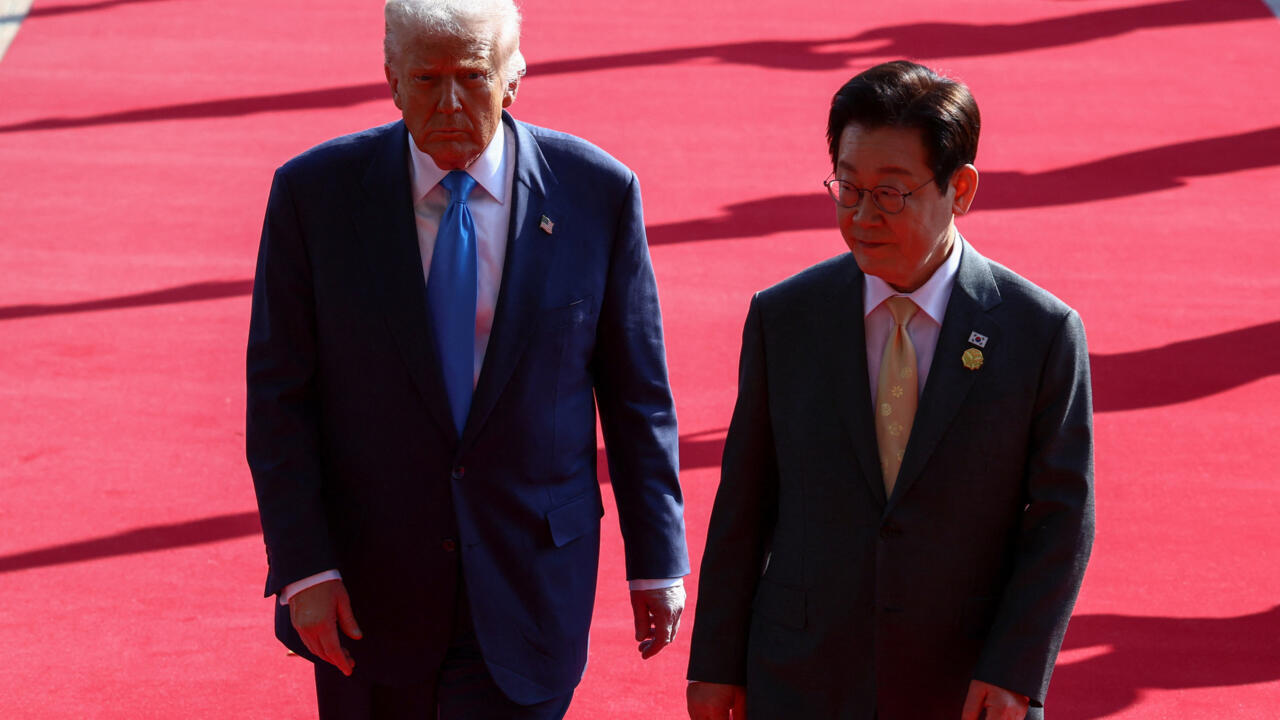
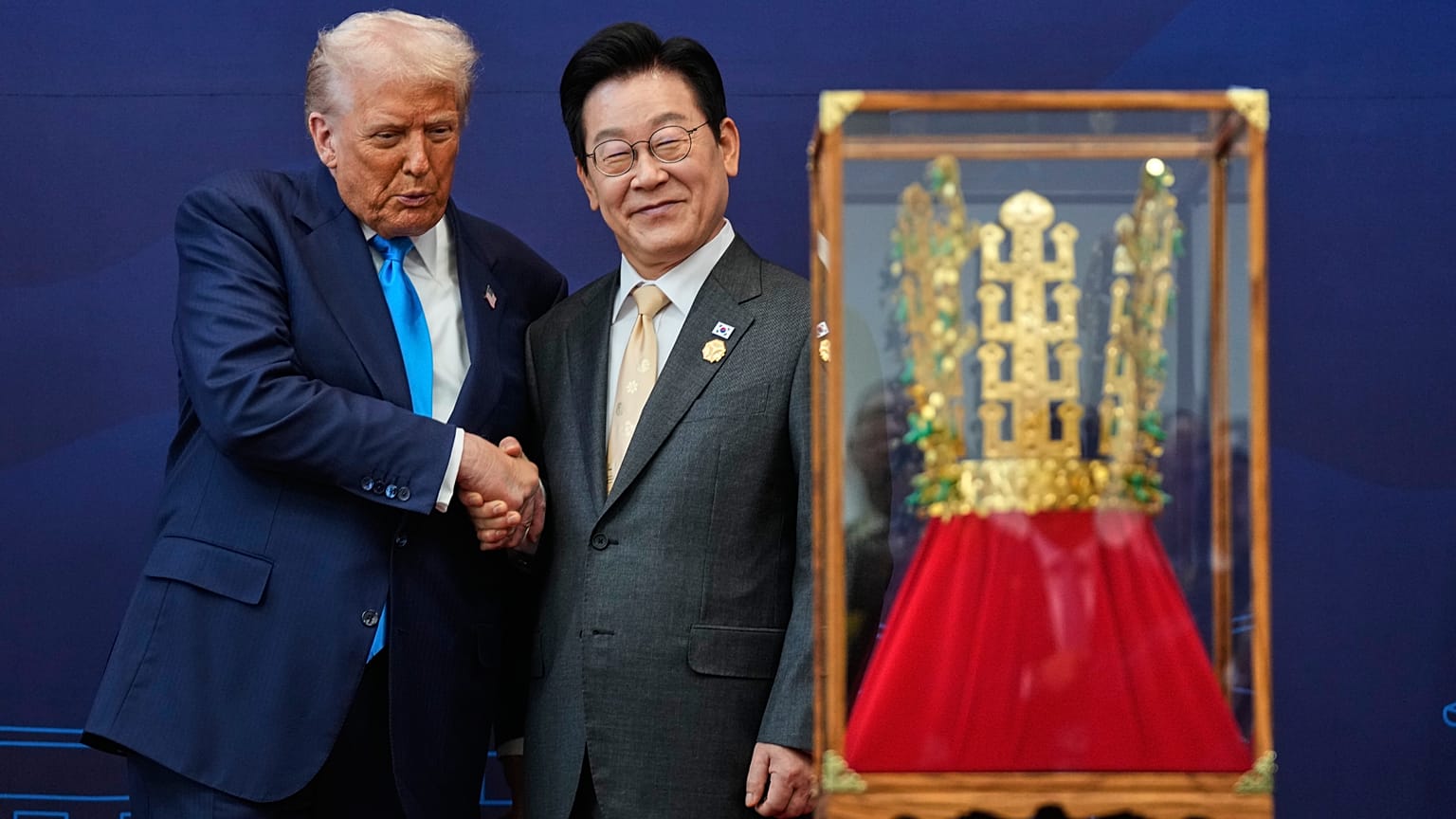
The United States and South Korea advanced trade talks on Wednesday, addressing details of $350 billion (€300 billion) that would be invested in the US economy, after negotiations and ceremonies that included the presentation of a gold medal and crown to President Donald Trump.

Both were gifts from the country's President Lee Jae Myung who dialled up the adulation while Washington and Seoul worked to nail down financial promises during the last stop of Trump’s Asia trip.

Although both sides said progress has been made, Trump said things were "pretty much finalised," but no agreement has been signed yet.

The framework includes gradual investments, cooperation on shipbuilding and the lowering of Trump’s tariffs on South Korea's automobile exports, according to Kim Yong-beom, Lee's chief of staff for policy. The White House did not immediately comment.


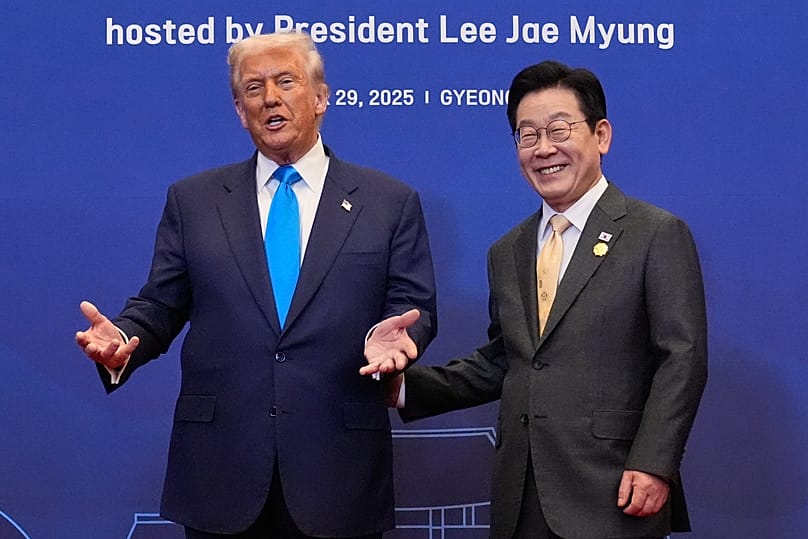
US President Donald Trump poses for a photo with South Korean President Lee Jae Myung during a dinner event in Gyeongju, 29 October, 2025 AP Photo

The announcement came after a day of adulation for the visiting American president from his hosts. There was a special lunch menu featuring US-raised beef and a gold-adorned brownie.

A band played Trump's campaign anthem of "YMCA" when he stepped off Air Force One, with Lee telling him "you are indeed making America great again."

"That was some spectacle and some beautiful scene," Trump told Lee during their meeting. "It was so perfect, so flawlessly done."

Earlier in the day, Trump even softened his rhetoric on international trade, which he normally describes in predatory terms where someone is always trying to rip off the United States.

"The best deals are deals that work for everybody," he said during a business forum.

Bumpy road to a trade deal

Trump was visiting while South Korea is hosting the annual Asia-Pacific Economic Cooperation summit in Gyeongju after previous stops in Japan and Malaysia.

The Republican president has been trying to tie up trade deals along the way, eager to show that his confrontational approach of tariffs is paying dividends for Americans who are uneasy about the job market and watching a federal government shutdown extend into its fifth week.

However, South Korea has been particularly tough to crack, with the sticking point being Trump's demand for $350 billion of direct investment in the US.

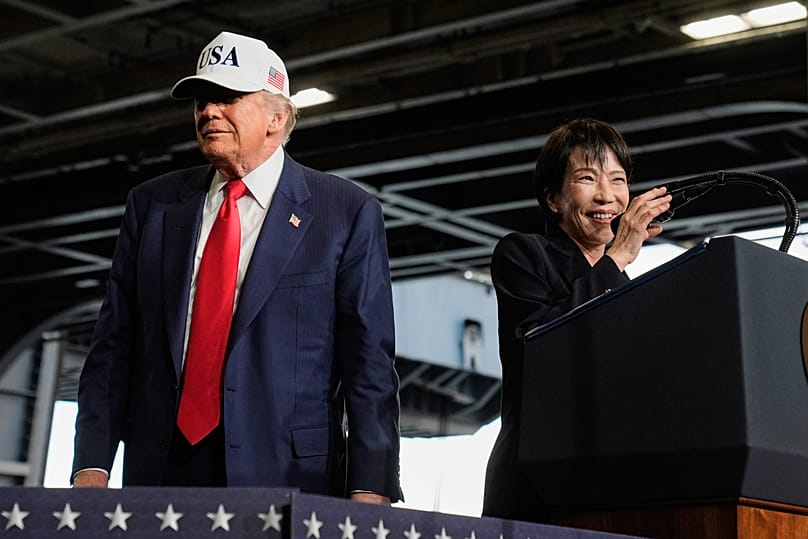
Japanese Prime Minister Sanae Takaichi with President Donald Trump at an American naval base in Yokosuka, 28 October, 2025 AP Photo

bilise their own economy and they’d rather offer loans and loan guarantees instead. The country would also need a swap line to manage the flow of its currency into the US.

Trump, after meeting with Lee, said "we made our deal pretty much finalised" but provided no further details.

Oh Hyunjoo, a deputy national security director for South Korea, told reporters earlier in the week that the negotiations have been proceeding "a little bit more slowly" than expected.

"We haven't yet been able to reach an agreement on matters such as the structure of investments, their formats and how the profits will be distributed," she said on Monday.

It's a contrast from Trump's experience in Japan, where the government has worked to deliver the $550 billion (€472 billion) in investments it promised as part of an earlier trade agreement.

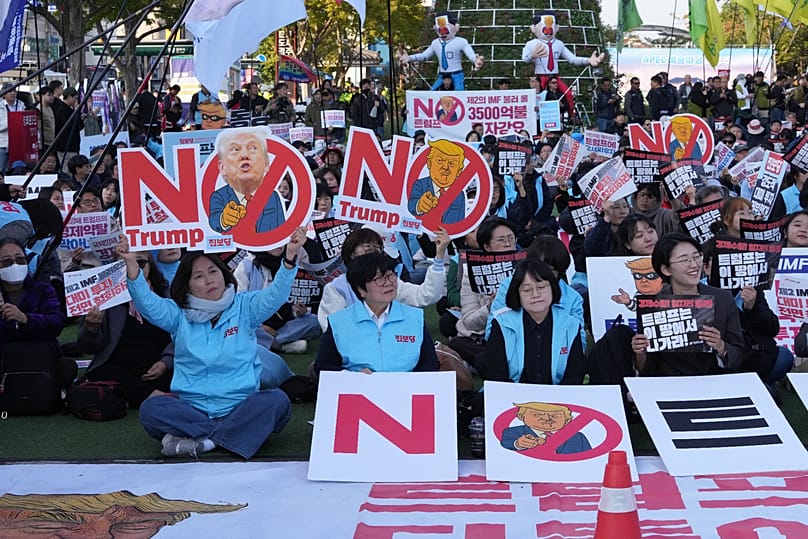
Protesters shout slogans during a rally to denounce the visit by US President Donald Trump in Gyeongju, 29 October, 2025 AP Photo

Commerce Secretary Howard Lutnick announced up to $490 billion (€420 billion) in specific commitments during a dinner with business leaders in Tokyo.

For now, South Korea is stuck with a 25% tariff on automobiles, putting automakers such as Hyundai and Kia at a disadvantage against Japanese and European competitors, which face 15%.

Lee, speaking at the business forum before Trump arrived, warned against trade barriers.

"At a time when protectionism and nationalism are on the rise and nations focus on their immediate survival, words like 'cooperation,' 'coexistence' and 'inclusive growth' may sound hollow," he said.

"Yet, paradoxically, it is in times of crisis like this that APEC's role as a platform for solidarity shines brighter."


Trump approves South Korea’s plan to build nuclear-powered submarine


US President Donald Trump said Thursday that he has authorised South Korea to build its first nuclear-powered submarine, marking a major shift in the allies’ defence cooperation. The announcement came a day after the two countries reached a broad trade deal and held talks during Trump’s visit to Gyeongju for the APEC summit.


Issued on: 30/10/2025
By:FRANCE 24


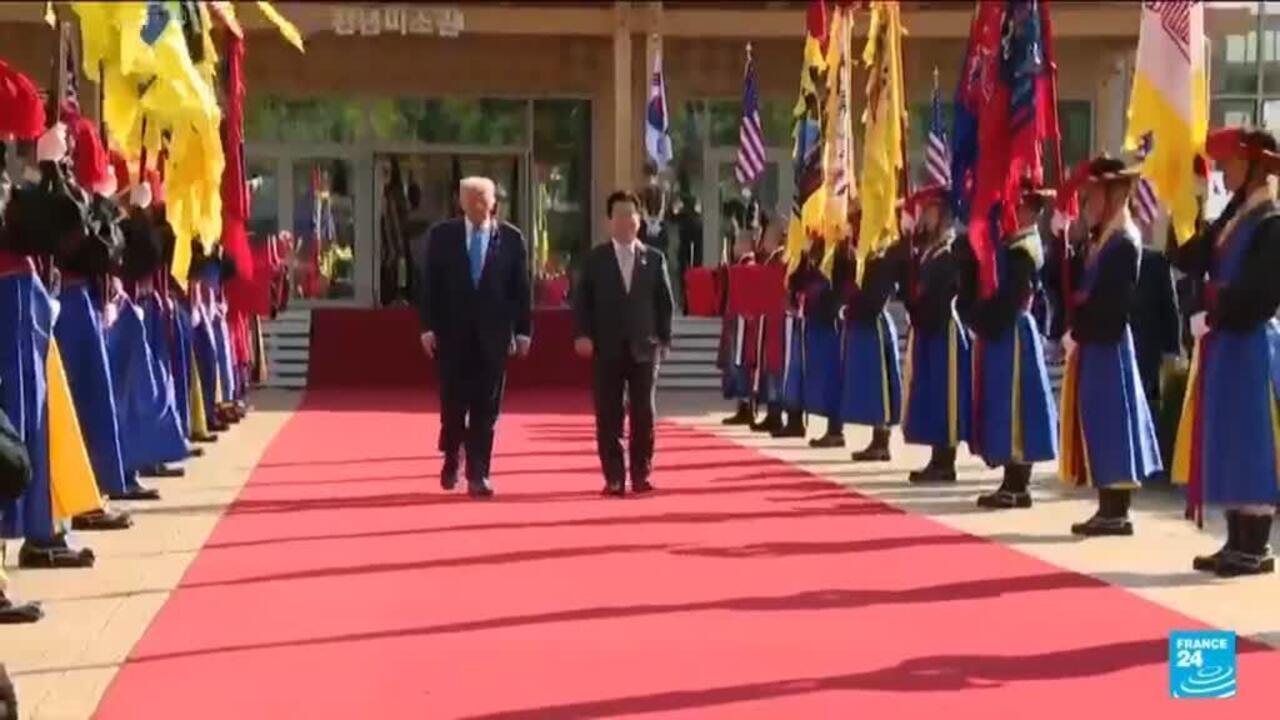
US President Donald Trump meets with South Korean President Lee Jae Myung on the sidelines of the Asia-Pacific Economic Cooperation (APEC) leaders' summit in Gyeongju, South Korea. © Evelyn Hockstein, Reuters

US President Donald Trump said Thursday he has given approval for ally South Korea to build a nuclear-powered submarine, a day after the two countries said they have reached a broad trade deal.

Trump met South Korean counterpart Lee Jae-myung on Wednesday in the southern town of Gyeongju, where the US leader arrived for a summit of the Asia-Pacific Economic Cooperation (APEC) forum.

On Wednesday, Seoul’s presidential aide said the two countries had reached a broad deal covering investment and shipbuilding, while Trump said the agreement was “pretty much” finalised.

“I have given them approval to build a nuclear-powered submarine, rather than the old-fashioned, and far less nimble, diesel-powered submarines that they have now,” Trump said on Truth Social Thursday.

In a separate post, he wrote: “South Korea will be building its nuclear-powered submarine in the Philadelphia Shipyards, right here in the good ol’ U.S.A.”

© France 24
01:51


“Shipbuilding in our country will soon be making a BIG COMEBACK,” he added.

On Wednesday, Lee asked Trump to “make a decision to allow us to receive fuel for nuclear-propelled submarines“.

"We are not proposing to build submarines armed with nuclear weapons; rather, diesel submarines have inferior submerged endurance, which limits our ability to track North Korean or Chinese submarines,” Lee told Trump.

The dessert at a luncheon for Trump featured the word “PEACE!”, according to Seoul’s presidential office, echoing the two leaders’ first meeting when they pledged to act as a “peacemaker” and a “pacemaker” for peace on the Korean Peninsula.

But tensions with nuclear-armed North Korea remain high after Pyongyang brushed aside Lee’s outreach and instead continued deepening military and economic links with Russia.

And Trump said Wednesday he was not able to arrange a meeting with North Korean leader Kim Jong-un during his visit to the South, ending fierce speculation over a possible summit after years of diplomatic deadlock.

(FRANCE 24 with AFP)
 

Hybrid war or holy war: Do IS and Russia share the same playbook?

How similar are ISIS' methods to Russia's?
Copyright Graphics: Olga Lavrentyeva

By Johanna Urbancik
Published on 

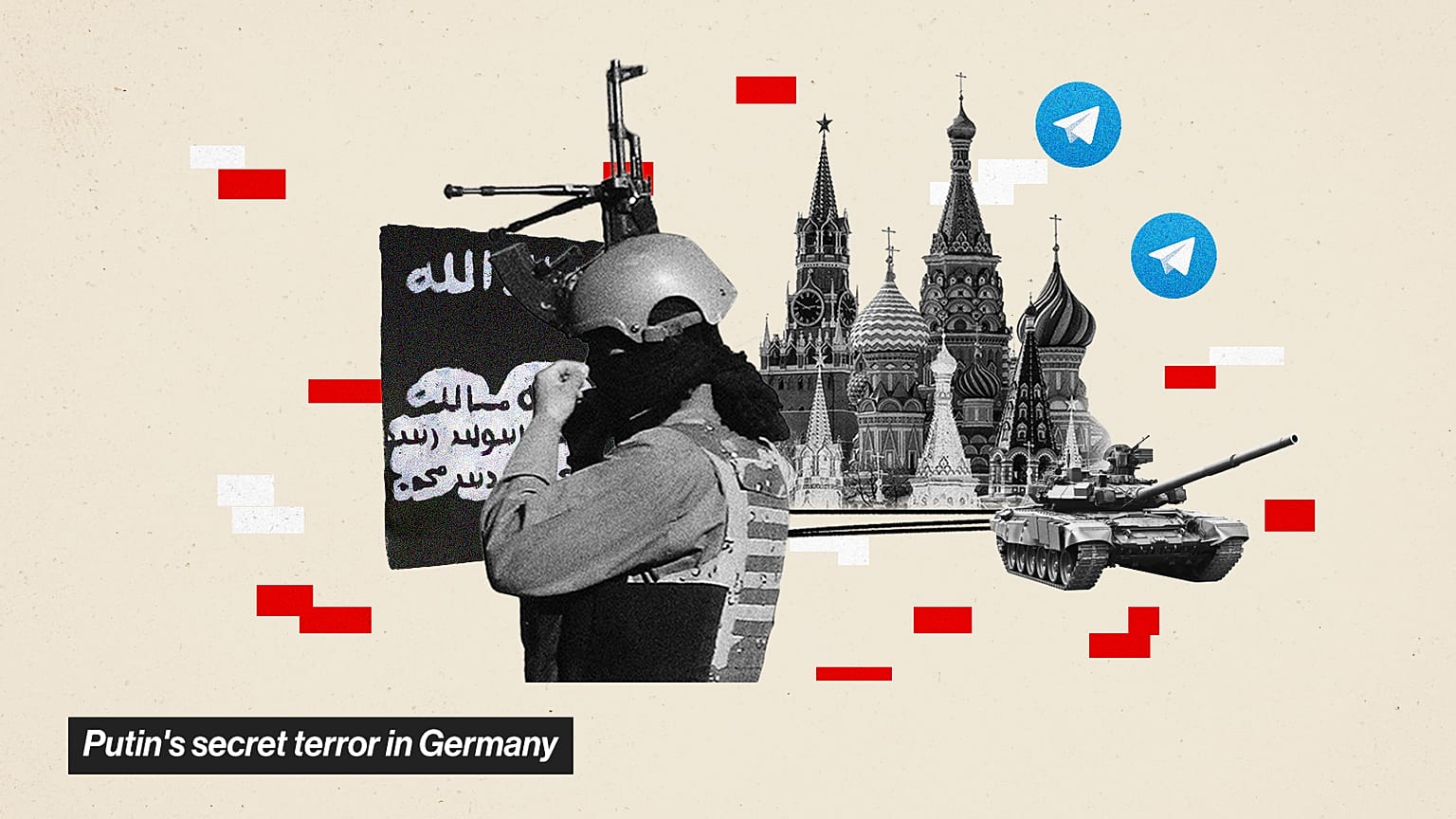
The so-called Islamic State group and Russia use similar tactics: propaganda, disinformation, and targeted recruitment of vulnerable groups. Hybrid warfare today, terrorism back then – methods designed to destabilise societies.

Russia is reportedly using so-called "low-level agents" in its hybrid warfare against the West – ordinary civilians recruited, often via social media, to carry out relatively minor acts of espionage and sabotage.

These acts can include arson, photographing or filming military or critical infrastructure, or even sending parcel bombs. The goal is always the same: to create chaos and insecurity among the population.

In his October government statement, German Chancellor Friedrich Merz also accused Moscow of waging hybrid warfare against the West.

Hybrid warfare combines military, political, economic, and cyber tactics to blur the line between war and peace.

"If you look at Russia's military doctrine, at interstate terrorism – state against state – they are fully aware that hybrid warfare is a tool they can use," Rękawek added.

He explained that the approach generally remains the same: morally questionable individuals are recruited because they are more pliable and easier to manipulate.

"Those are Russia's natural allies," he claimed. This approach allows Russia to conduct hybrid warfare by using criminals as proxies in Europe, much like the so-called IS once recruited European criminals for violent operations.

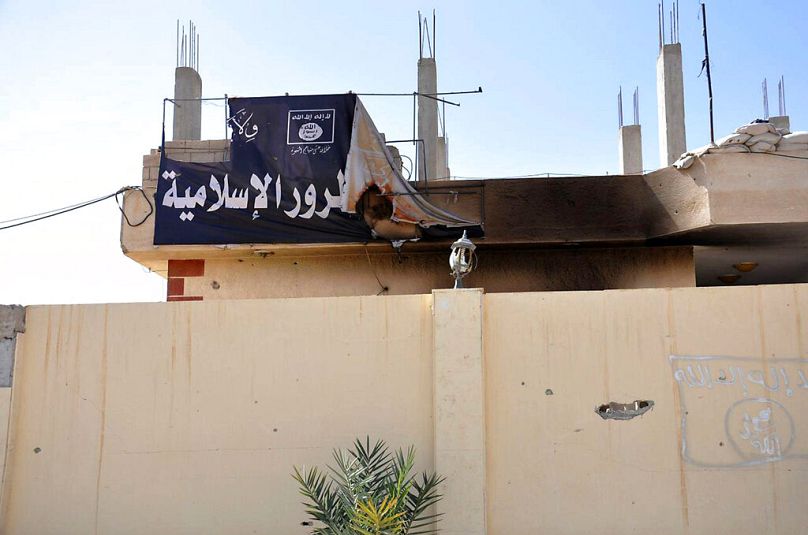
This photo released on March 27, 2016, by the Syrian news agency SANA, shows a burned banner of the Islamic State group, in the ancient city of Palmyra, central Syria
This photo released on March 27, 2016, by the Syrian news agency SANA, shows a burned banner of the Islamic State group, in the ancient city of Palmyra, central Syria Uncredited/AP

Experts draw parallels between the two: the recruitment and operational methods of Russian intelligence resemble those used by IS, which since its founding in April 2013 has sought to establish a totalitarian state under an ultraconservative interpretation of Sharia law — a system of religious, moral, and legal rules based on the Quran and Sunnah

IS is known for particularly brutal tactics, often staged for maximum media impact, targeting anyone they consider an "infidel". According to Germany's domestic intelligence agency, the biggest threat comes from lone actors or small groups inspired by such propaganda.

Between faith and influence

Both Russia and IS rely on ideologically charged propaganda. IS mainly targeted young, often marginalised Muslims around the world – men and women – offering them a sense of community and purpose.

Between 2012 and 2017, mosques in Germany became recruitment hubs, notably the Fussilet 33 mosque in Berlin's Moabit district. A study by the Konrad Adenauer Foundation found that preachers there promoted Salafist teachings and built contacts with fighters in Syria.

Early on, they urged followers to join Islamist groups like Junud al-Sham. Later, they backed the so-called Islamic State. Looking back, the mosque is seen as IS' most crucial recruitment centre in Germany.

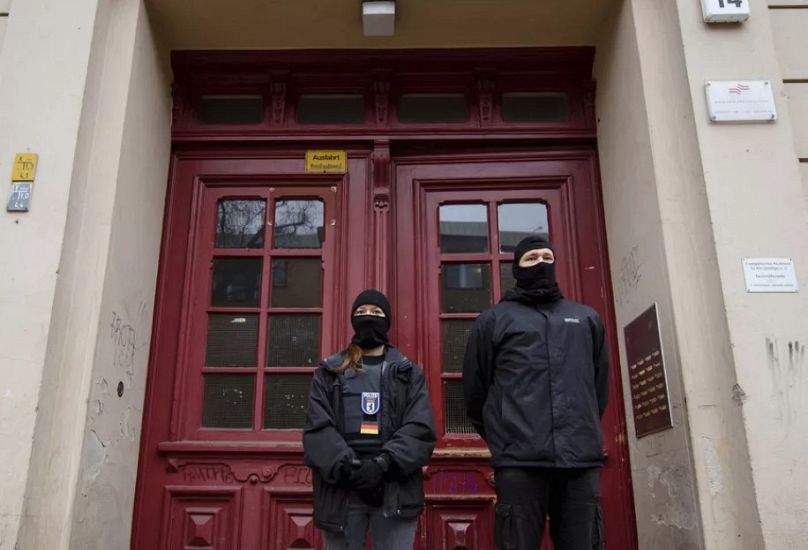
Police in front of the Fussilet 33 mosque after a raid following a decision by state authorities to ban the organization that ran the mosque in Berlin-Moabit, Feb. 28, 2017
Police in front of the Fussilet 33 mosque after a raid following a decision by state authorities to ban the organization that ran the mosque in Berlin-Moabit, Feb. 28, 2017 Gregor Fischer/AP

Just as IS between 2013 and 2019 deliberately mobilised specific groups, Russia also uses ideologically tailored messages – whether religious or nationalist – to generate loyalty and readiness to act.

Does Russia recruit from Russian Orthodox communities in Germany?

Russia targets not only nationalists but also those on the margins of society. The ideal "low-level agent" is either ideologically motivated or seeking financial security, Dr Hans Jakob Schindler, head of the Counter Extremism Project (CEP), explained.

Unlike traditional extremist groups, these low-level agents rarely act purely out of ideology, since financial incentives almost always play a part. "Precarious economic circumstances combined with ideological affinity make for the perfect combination," Schindler said.

Russia actively recruits socially marginalised, often Russian-speaking individuals across Europe to act as proxies in hybrid warfare operations. Vulnerabilities in specific communities are exploited to advance Russia's geopolitical goals, according to a report by the International Centre for Counter-Terrorism (ICCT).

Observers believe it is possible that Russia also recruits within Russian-speaking communities in Germany. Russian Orthodox congregations, in particular, are under scrutiny due to their close ties to the Orthodox mother church in Russia.

"The Russian Orthodox Church is very close to the Kremlin and has supported Russia's wars of aggression since 2014, and again in 2022," Schindler noted, stressing, however, that he wouldn't describe the church itself as "particularly vulnerable".

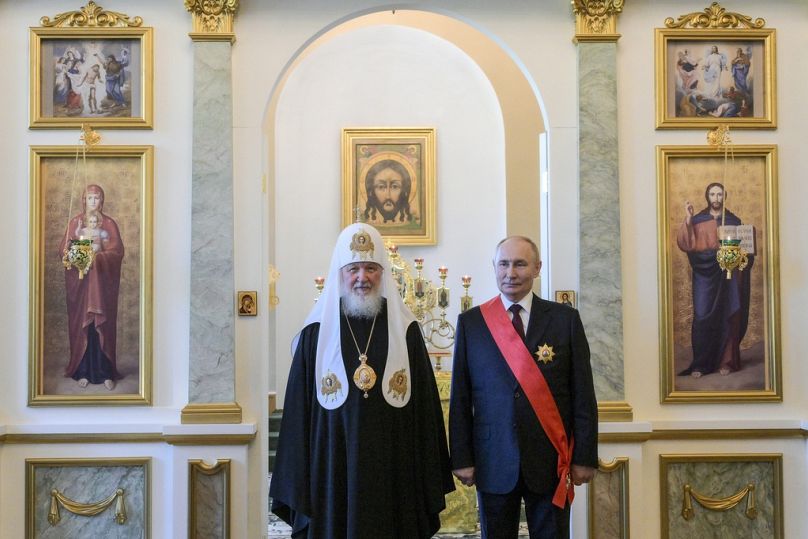
Russian Orthodox Patriarch Kyrill with Putin during a visit to the Annunciation of the Holy Mother of God Church of the St. Alexander Nevsky Lavra, 28. July 2024
Russian Orthodox Patriarch Kyrill with Putin during a visit to the Annunciation of the Holy Mother of God Church of the St. Alexander Nevsky Lavra, 28. July 2024 Alexei Danichev/Sputnik

An Orthodox priest, speaking to Euronews on the condition of anonymity, said the Russian narrative seems to have become "a bit more cautious".

"For example, their dioceses now say – and this was a directive from the Moscow headquarters of the Russian Patriarchate – 'we don't get involved in political debates; we're only here to serve the religious needs of local people.' That, however, needs to be questioned," he said.

The Church acts as an ideological pillar for the Kremlin, mobilising people by having Patriarch Kyrill I and other church leaders frame the war as a defence of Orthodox values against Western influence.

In March last year, the Russian Orthodox Church issued a decree calling Russia's war against Ukraine a "holy war", aimed at ending Ukrainian independence and imposing Russian rule. The decree also claimed the conflict was necessary to "protect the world from the onslaught of globalism and the triumph of the West, which has succumbed to Satanism."

According to the cleric, some Russian Orthodox communities promote a very particular worldview in which bishops hold almost unquestioned authority. "Once the service is over, it's very difficult to challenge what the bishops say. They are treated almost like gods and wield significant authority," he explained.

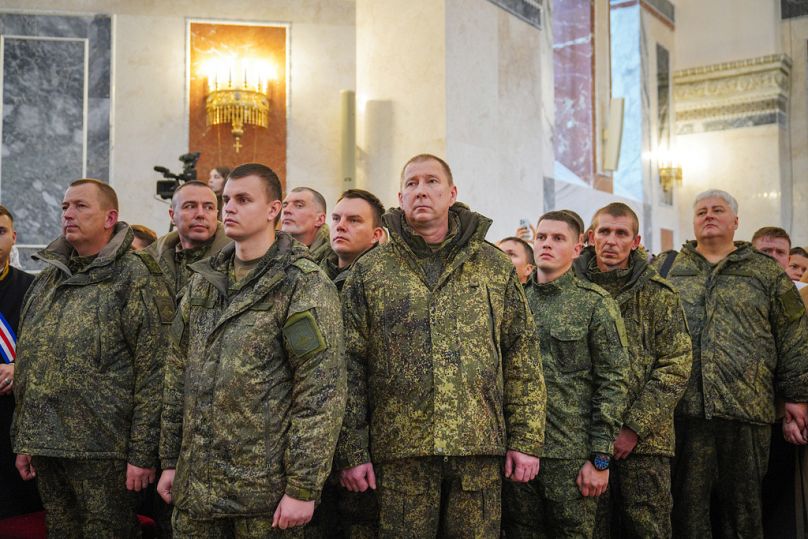
Russian troops listen to Russian Orthodox Patriarch Kyrill performing the rite of the great consecration of the Church of the Great Martyr George the Victorious, Oct. 19, 2025
Russian troops listen to Russian Orthodox Patriarch Kyrill performing the rite of the great consecration of the Church of the Great Martyr George the Victorious, Oct. 19, 2025 Oleg Varov/Russian Orthodox Church Press Service

How propaganda and fear shape societies

Russia and IS both rely on targeted propaganda and disinformation to weaken societies. Their strategies are broadly similar, combining outright violence with subtler methods of disruption.

The difference lies in the response. "We were all in agreement: IS is evil," said Rękawek. "With Russia, that's not the case, which is why the reaction to Russian hybrid warfare is far less clear-cut. People talk about targeting specific groups, calling it sabotage or diversion, but they don’t lump it together under one label. In fact, many experts, politicians, and decision-makers in the West accept the term 'hybrid warfare' or 'hybrid campaign', because in the public eye it still feels a long way from terrorism."

Dr Christopher Nehring, director of the Cyber Intelligence Institute and an expert on disinformation, told Euronews that hybrid attacks primarily target the psyche of society.

"Of course, it's worrying when individuals are harmed – say, in arson attacks by so-called low-level agents – but strategically, for the state as a whole, it doesn’t really matter," he explained.

"The safety of each person must be protected as best as possible, but we cannot let that dictate our strategic approach. With terrorist groups – such as the RAF or IS –that was always part of the communications strategy: terror is terrible, but we don't let it control us," Nehring said.

"The same applies to Russia. Minor incidents shouldn’t frighten us, but we do need to build psychological resilience and communicate effectively," Nehring added, noting it's clear the current level of protection "is still not sufficient".