It’s possible that I shall make an ass of myself. But in that case one can always get out of it with a little dialectic. I have, of course, so worded my proposition as to be right either way (K.Marx, Letter to F.Engels on the Indian Mutiny)
The company reported a net loss of $42.2 million, or $0.26 per share for the year ended Nov. 30, 2025, compared with a net loss of $8.6 million, or $0.05 per share, a year earlier.
Trilogy ended 2025 with $51.6 million in cash, which it said provides flexibility as it advances the Upper Kobuk Mineral Projects (UKMP) in northwestern Alaska through its 50:50 joint venture with South32 (ASX, LON, JSE: S32), Ambler Metals.
The larger loss stemmed mainly from the treatment of the proposed US government’s investment as a derivative financial instrument under US GAAP rules. Trilogy recorded an initial $8.2 million liability and later increased the derivative by $22.6 million to reflect changes in fair value, resulting in a non-cash loss for the year. The accounting impact had no effect on cash and is expected to resolve once the applicable conditions are met.
Chief executive Tony Giardini called fiscal 2025 a landmark year, citing a strengthened balance sheet and closer alignment with US federal and state stakeholders focused on critical mineral supply chains.
He noted the company expanded its senior management and advisory team during the year to support permitting and oversight of Ambler Metals, alongside increased personnel commitments from South32.
Paving the road
Trilogy entered in October into a binding letter of intent with the US Department of War for a conditional $17.8 million investment in exchange for a 10% stake in the company, once construction of the access road to the Ambler project is complete. The Trump administration also received warrants that could raise its stake by a further 7.5%.
The agreement reflects Washington’s push to secure domestic supplies of copper and other critical minerals, including zinc, silver, cobalt and germanium.
The US government restored approvals originally granted in 2020 but revoked under the Biden administration in 2024 and it has also agreed to work with the State of Alaska to help facilitate financing for the road.
Trilogy and South32 approved in December a $35 million budget for Ambler Metals for fiscal 2026, with Trilogy funding $17.5 million. The program will focus on re-staffing, initiating mine permitting for the Arctic copper-silver-zinc-lead-gold deposit and advancing technical work to support long-term development.
Ambler Metals aims to submit mine permit applications this year and may seek to use the federal FAST-41 framework to streamline the review process, subject to project readiness.
Exploration will centre on the Arctic deposit, including geotechnical and condemnation drilling to support mine design, infrastructure placement and future production planning.
The joint venture also plans to open the Bornite camp during the 2026 summer field season for geotechnical and exploration drilling and to prepare the site for multi-year use.
Analyst sentiment remains cautious. Trilogy carries an average “hold” rating, with four hold recommendations and no buy or sell ratings, compared with a “buy” consensus for the broader diversified mining peer group.
Over the past year, the stock has climbed more than 200% in Toronto, trading between C$1.59 and C$15.21 and giving the company a market capitalization of about C$976 million ($714 million).
Israeli Opposition Emerges as Hapag-Lloyd Signs Deal to Acquire Zim
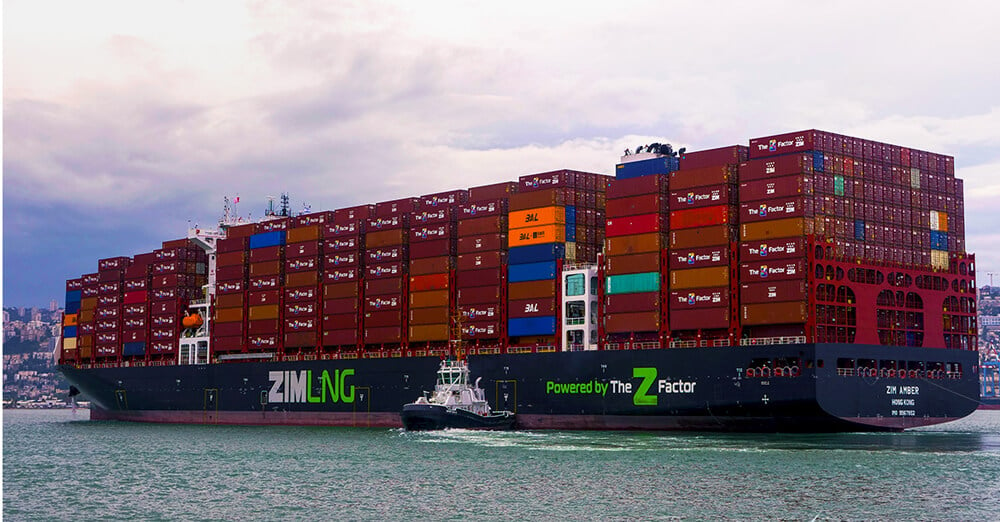
Under the terms Zim's international services and chartered ships would go to Hapag-Lloyd with only a small portion remaining with the new Zim
Hapag-Lloyd officially signed the agreement to acquire Zim and sell its domestic operations to FIMI, an Israeli private equity company, while extolling the benefits of consolidation for customers and shareholders. However, with Zim viewed as a national asset, opposing voices quickly emerged to the deal, including from the workers committee representing the approximately 1,000 Zim employees in Israel.
The board of Zim and leaders of Hapag-Lloyd hailed the deal, citing the benefits from a “significantly strengthened network.” Hapag, which is already the fifth largest container carrier, agreed to pay approximately $4.2 billion, which Zim’s board highlighted as a 58 percent premium on the current share price and a 126 percent premium to the share price from last August before news of a potential sale emerged.
Hapag said it would grow to a capacity of over 3.8 million TEU and well over 400 vessels by assuming the international services and chartered fleet from Zim of approximately 99 vessels. Many of the ships, including Zim’s new LNG-fueled vessels, are under long-term charters from Seaspan. Hapag said the transaction was estimated to “generate several hundred million US dollars of annual synergies” while strengthening global operations. It predicts that the combined operations would transport more than 18 million TEU annually.
“ZIM is an excellent partner for Hapag-Lloyd,” said Rolf Habben Jansen, CEO of Hapag-Lloyd. “Customers will benefit from a significantly strengthened network on the Transpacific, Intra Asia, Atlantic, Latin America, and East Mediterranean.”
Zim’s board said the decision reflects a “comprehensive evaluation of all available options to ensure the best possible outcome for the company's investors. We believe that it represents the most prudent and beneficial transaction for all ZIM stakeholders that further advances the tremendous value creation track record that we have established since our IPO,” said Yair Seroussi, Chairman of ZIM's Board of Directors.
To deal with Israel’s “Golden Share” and the requirements to have Israeli-owned ships and a chairman of the company, Hapag has agreed to a carve-out with FIMI, the country’s largest and leading private equity fund with more than $11 billion in assets under management. FIMI acquires the brand and 16 company-owned ships and takes full responsibility for the Golden Share and its requirements.
"FIMI recognizes and believes in the strategic importance for the State of Israel of a strong independent Israeli shipping company,” said Ishay Davidi, Founder and CEO of the FIMI Funds. “We will create a stable Israeli company, the new ZIM, and view Hapag-Lloyd as a significant strategic partner for its ongoing operations.” He said the new company would integrate significant transatlantic capabilities, alongside additional shipping routes to Europe, Africa, the Mediterranean Sea, and the Black Sea, supported by advanced global maritime transport capabilities, and have access to the Hapag-Maersk Gemini network.
Founded in 1945, Zim, although reorganized several times, has been viewed as a national asset vital to national security and the country’s economy. It helped to move immigrants into Israel, provided passenger shipping, and grew for cargo shipping into the 10th largest container carrier.
The head of the workers’ committee, Oren Caspi, emerged from a meeting with the company on Sunday, immediately announcing a warning strike. The committee had been a vocal opponent of the sale, and Caspi told the media outlet Globes the board was “ignoring and evading us for two weeks.” He said talks had broken down with the company, and the headquarters employees would strike.
Caspi contends FIMI would retain only 120 employees, and Hapag had only committed to opening an R&D center that would take some of Zim’s technology employees. He said more than 800 people could be laid off. He says they were told the acquirers were not willing to commit to employing workers beyond one year, while the workers’ committee was demanding the board secure commitments to protect workers’ rights and jobs.
The Histadrut (General Federation of Labor in Israel) also told Globes it was backing the workers’ committee. "ZIM is not just another company in Israel. It is a strategic asset of the State of Israel, representing a critical link in national security, in the stability of supply, and in the ability to maintain trade by sea even in emergencies. Any harm to the stability of the company or to its employees means harm to the national interest of the State of Israel.”
The Mayor of Haifa, Yona Yahav, echoed a similar sentiment, saying Zim would no longer be part of the Israeli economy while citing the significance to the economy and security of Israel. Yahav called the deal “problematic,” saying it could harm national security and lead to the dismissal of workers.
The Administration of Shipping and Ports Director Zadok Redker called the deal an “existential threat,” speaking to the news outlet CTech. They are forecasting that the transaction could “have far-reaching consequences for Israel’s maritime sector if completed.”
They are saying the new Zim “would effectively become a small, local shipping company without global deployment or critical mass.” They point to the expected significant downturn in liner shipping, saying the new company would be significantly smaller and weaker, while noting that if it could not sustain operations, it would require billions in investments and seven to ten years to reestablish the company.
The sale of Zim requires regulatory approval, review by Israel under the Special State Share, and approval from the shareholders. Hapag-Lloyd said the deal is expected to close by late 2026, and until then, the companies would operate independently as competitors.
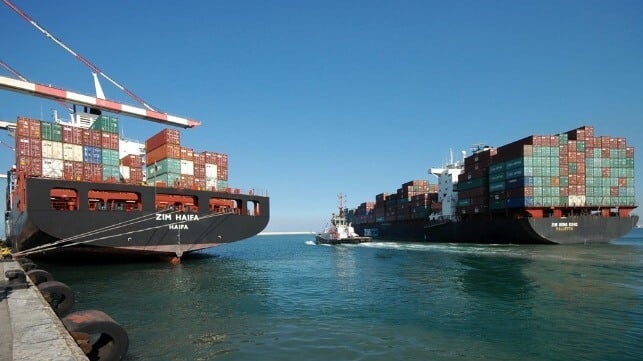
Number-five container line Hapag-Lloyd has agreed to buy 10th-ranked carrier ZIM, Israel’s de facto national shipping line. A heads of agreement has been reached by the two parties, and ZIM’s board approved the deal on Sunday night. Israeli business publication Calcalist reports that the transaction value exceeds $4 billion.
ZIM, publicly listed since 2021, is headquartered in Haifa. The deal entails Hapag-Lloyds’s purchase of all issued shares, and then the delisting of the company from the New York Stock Exchange.
Hapag-Lloyd has a partner in the deal, the Israeli private equity firm FIMI. Whereas international aspects of the ZIM business will be taken on by Hapag-Lloyd, Calcalist reports that the German liner will sell a subset of the firm’s operations to FIMI, thereby retaining sealift and sovereign shipping capacity in Israeli hands.
FIMI’s new company will reportedly be called “Zim Israel” and will hold all of ZIM’s owned hulls, along with key operations centers and personnel within Israel. The chartered-in fleet will be transferred to Hapag, along with international ZIM routes that do not intersect directly with Israeli commerce.
ZIM is a strategic Israeli asset, with a specific role in keeping Israel stocked to fight wars. For this purpose, the Israeli government has held a golden share in the company, and has mandated both that ZIM must be operationally controlled from Israel and must maintain a minimum number of ships on the Israeli register.
ZIM has since 2021 upgraded its fleet through a combination of owned vessels and chartered-in tonnage. It operates 70 regular liner services, and had a record turnover of $8.43 billion in 2024 after struggling in the previous decade. Turnover for the full year 2025 is likely to be down, impacted by lower freight rates. In the third quarter, EBITDA was down 61 percent, and TEU volume carried decreased 5 percent. Revenues were off 36 percent. Inevitably, Houthi attacks targeting Israeli shipping in the Red Sea and elsewhere have had an impact, with trade in particular through Eilat being badly affected.
By comparison, Hapag-Lloyd turned over $22 billion in 2024, and is heading for a similar figure in 2025, with an 8% increase in volumes shipped. It operates 305 ships and 130 regular liner services, and Alphaliner rates it as the fifth largest global shipping company.
While the deal has been presented as sealed (but not signed), the complexity of the proposed transaction and ZIM’s strategic role in Israel’s national security may still present obstacles to completion. Moreover, the agreement has been negotiated within a very well secured Deal Room, such that unions and employees have been caught by surprise – and have not necessarily been brought along with the process. However, the very purpose of the takeover may have been to embrace a strategy for dealing with Houthi attacks and boycotts, while also protecting Israeli strategic interests.
The proposed arrangement has been in the works for a while, and the initial proposal was controversial in Israeli political and national-security circles. Beyond geopolitics, its existence is a matter of identity: ZIM’s history predates the modern state of Israel, and the company provided sealift capacity during the events leading up to the nation’s creation. Critics note that Hapag-Lloyd’s major shareholders include investment vehicles controlled by the Qatari and Saudi governments, which have not always seen eye-to-eye with Israel. As of September, Qatar Holdings retained 12.3% and Saudi Arabia’s Public Investment Fund 10.3% of Hapag-Lloyd shares, a consequence of Hapag’s acquisition of UASC in 2017.
The deal follows the rejection of an earlier buyout offer from long-time ZIM CEO and president Eli Glickman, backed by Israeli shipowner Rami Ungar, who controls ro/ro company Ray Shipping. ZIM’s board turned down the Glickman-Ungar proposal in November, claiming that it undervalued the company.
Maersk and Eurogate Plan €1B Expansion of Bremerhaven Terminal
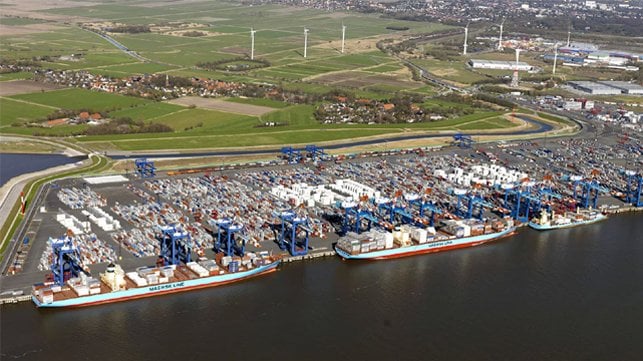
Maersk's APM Terminal and partner Eurogate are planning to expand operations in Bremerhaven, Germany (APM)
APM Terminals, Maersk’s terminal operator, and Eurogate report that they are negotiating a plan for a €1 billion expansion of their joint operation in Bremerhaven, Germany. It would increase the efficiency and competitiveness of the port and enhance the sustainability of the operations.
The companies formed a 50:50 partnership for the terminal in 1998 and opened the North Sea Terminal Bremerhaven in April 1989. They highlight that it has a strong location serving 130 ports worldwide and providing connections to the European hinterland, the Baltic States, and Scandinavia through feeder services, dedicated rail services, and direct access to European highways.
The move to expand the operation comes after MSC Mediterranean Shipping Company took control of the other major northern German port of Hamburg. Maersk, of course, has a large presence in Hamburg as its former Hamburg-Sud division’s home, but Bremerhaven provides an important second access point in the region.
“Bremerhaven has unique potential to grow as a strategic hub in the region and to support cargo flows into Germany as well as our ocean network,” says Vincent Clerc, CEO of A.P. Moller – Maersk. “Our investments are intended to realize the full potential of the terminal, making NTB one of the most competitive terminals in Europe’s North Range.”
APM and Eurogate are planning the long-term extension of their partnership, which would include the €1 billion investment. The plan aims to upgrade North Sea Terminal Bremerhaven to become one of the most efficient terminal operators. In addition to modernization, capacity would be expanded from the current 3 million TEU to 4 million annual throughput. They also plan for the electrification of equipment and the use of renewable electricity.
“With Maersk's announced investments in the port's superstructure and the state and federal government's investments in the port infrastructure, Bremerhaven will be well-positioned for the future, and its importance in the North Range will be strengthened,” said Andreas Bovenschulte, Mayor of Bremen. “Now it is up to the federal government to press ahead with the deepening of the Outer Weser and implement it quickly.”
APM highlights that the facility currently has six ship berths for ultra-large container vessels. It has 18 super-post-Panamax gantry cranes, 102 straddle carriers, and over 2,000 reefer plugs. It is also served by six rail tracks.
With the new investments, the companies highlight that they aim to make Bremerhaven into one of the world’s most efficient and resilient container handling facilities. It has the opportunity to become one of the first zero greenhouse gas emission terminals.
Macquarie Agrees to Buy Australian Ports and Logistics Company Qube
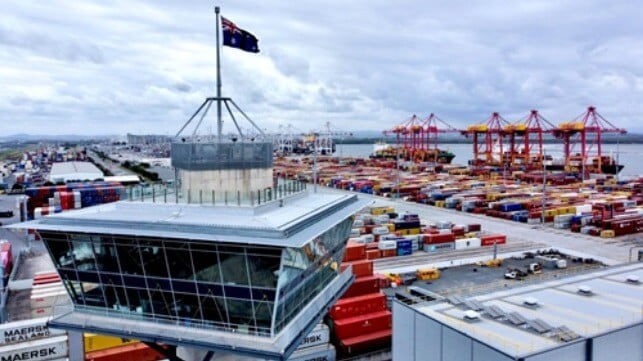
Qube and its 50 percent itnerest in Patrick Terminals Australia will be taken private in a deal led by Macquaire (Patrick Terminals Australia)
After nearly three months of negotiations, Qube Holdings announced today that it has agreed to be acquired by Macquarie Asset Management, an Australia-based global asset management company with more than A$720 billion (US$509 billion) under management. The deal implies an enterprise value for Qube of approximately A$11.7 billion (US$8.3 billion).
Macquarie had first approached Qube in November 2025 with a non-binding proposal for the acquisition. The deal is a nearly 28 percent premium to the November 2025 share price. Macquarie will pay cash to all the shareholders, except UniSuper, which currently owns 15 percent and which will take an equivalent position in the new holding company. Pontegadea, the investment firm of Spanish billionaire and Zara founder Amancio Ortega, will also be part of the investor group, and is also a 50 percent investor in the UK’s PD Ports.
Macquarie Asset Management has a longstanding track record of identifying opportunities driven by long-term thematics,” said Ben Way, Head of Macquarie Asset Management. “We believe Qube exemplifies this approach and will work to deliver positive outcomes for its customers and our clients and partners.”
Qube is described as Australia's largest integrated provider of import and export logistics services. It was founded in 2006 by some of the executives after the buyout of Patrick Corp. and would go on to grow through acquisitions of Australian railroad operations and other sectors. In a turnaround, in 2016, it acquired a 50 percent interest in Patrick Terminals.
Patrick perates in Brisbane, Sydney, Melbourne, and Fremantle, Australia. In total, Qube has freight handling and stevedoring facilities at 29 ports in Australia. The company also operates broadly across New Zealand and has expanded with a few operations in Southeast Asia. In FY 2025, reported last August, Qube reported its full-year results included underlying revenue growth of 27 percent to A$4.46 billion and an underlying EBITA increase of 18.5 percent to A$377.2 million, compared to FY24.
“Population growth, increasing demand for goods and services, and strengthening sovereign capabilities are driving the importance of robust and resilient supply chains, in Australia and across the Asia Pacific region,” said Ani Satchcroft, Macquarie Asset Management Co-Head of Infrastructure for Asia Pacific, pointing to the opportunities for Qube.
Macquarie is no stranger to the ports sector, as it has investments that include key assets like the Port of Newcastle (Australia), Maher Terminals (New York/New Jersey), and investments in the Port of Los Angeles. It has also held investments ranging from NYK Ports, Yusen Terminals, Ceres Terminals, and a stake in Brazilian terminal operator Corredor Logistica e Infraestrutura.
Scottish Shipbuilder Tapped for Innovative Workboat Enters Administration
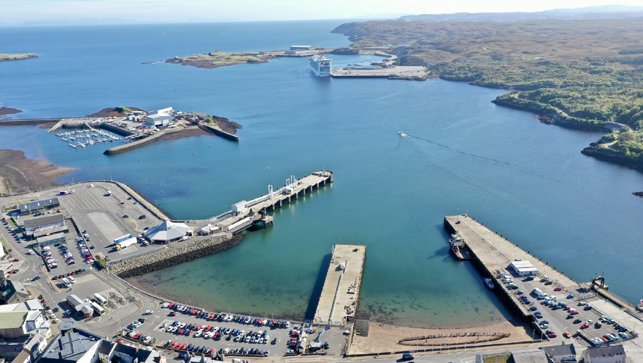
The shipyard in the upper left of the picture brought shipbuilding back to the Outer Herberdies and Stornoway for the first time in over 100 years (Stornoway Port Authority)
A small, family-run shipbuilder that received UK government funds for an innovative project has lapsed into administration. Coastal Workboats Scotland was also unique for its location in the Outer Hebrides, with reports that it was the first shipbuilder in the area in more than 100 years.
The company relocated its shipyard operations to Goat Island in Stornoway in the Outer Hebrides under a November 2023 agreement with Stornoway Port. It entered into a 10-year lease for a site for the shipyard operations and had planned to develop the operations.
In 2024, it was part of a project selected under the UK’s Clean Maritime Demonstration Competition Round 3 that sought to provide funding to innovative projects that could advance key elements of sustainable shipping. This particular project was to demonstrate an Electric-Landing Utility Vessel that would operate in the Shetland Islands. The project was awarded a total of £6.2 million (US$7.6 million) for the demonstration of the vessel, with nearly £3.9 million (US$4.8 million) earmarked for the shipyard. The yard received a further £167,000 from Highlands and Islands Enterprise to support its development.
The project called for a fully electric workboat that would be the first in the UK. The team was exhibiting integration of hull design, propulsion, energy storage, and fire safety to meet regulations and inform future electric workboat guidance, and the project was to support the creation of a new regulatory framework. The boat was to be recharged with shore power, and to address the challenge of a lack of resources in remote locations, the power unit was to be portable and carried on the vessel.
The project was to demonstrate the operation on a 45-minute route in the Shetlands. It called for two daily runs, operating five days a week.
Damen Hardinxveld had contracted for two Landing Utility Vessels with the yard. Damen Gorinchem had also contracted for two tugs.
According to the reports, the yard’s financial difficulties grew in 2025, with the statement for the administration citing design issues and supply challenges. In February 2025, Damen Hardinxveld provided an additional £1.6 million in unsecured funding. By June 2025, reports said the yard owed over £12 million to creditors.
Administrators were appointed for the operation, with Stornoway Port reporting that it is working with them to determine next steps. Reports are that one of the vessels is on the slipway, but none of the five vessels have been completed. Some reports indicate that Damen is asserting ownership over four of the incomplete vessels.
Innovate UK, which administers the government funding, pointed to inherent risks and new technologies as well as new markets, saying it creates a risk that the businesses will fail. It said it would act “responsibly” in this case, in its role to properly manage public funds.
During the third round of the funding program, the UK selected a total of 19 projects with a total value of approximately £80 million in grants. At the time, they highlighted that the program overall had awarded more than £200 million in grants. The third round included projects for wind propulsion, hydrogen and ammonia, hydrofoil crew transfer vessels, low-emission passenger shipping, and several battery projects.
New York Closes Offshore Wind Solicitation While Vowing to Explore Options
New York continues to look to the longer term while closing its round that had been open since 2024
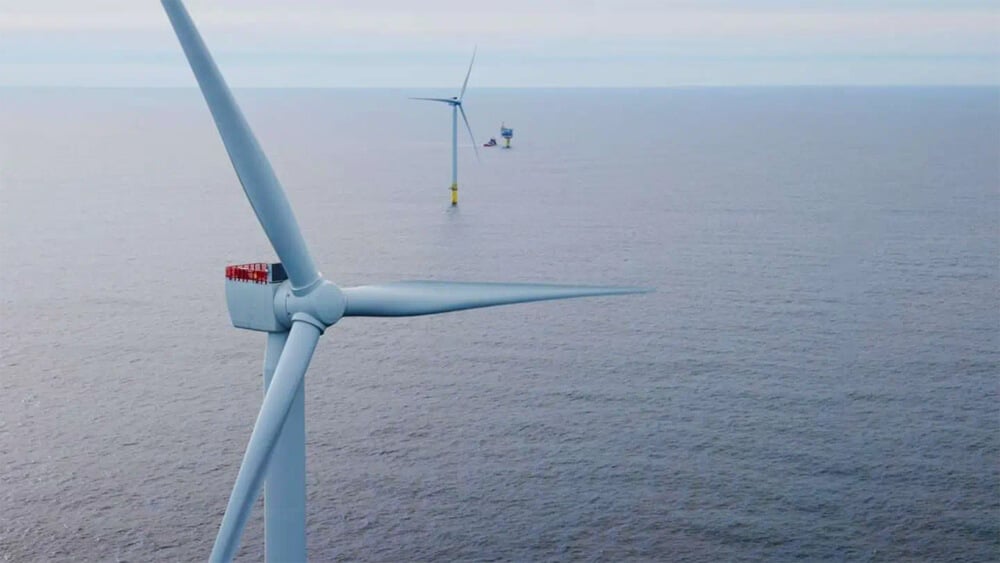
New York State’s regulators quietly closed its outstanding fifth round wind solicitation on Friday, February 13, and not surprisingly, it declined to award any projects. While the state admitted the uncertainty created by the Trump administration stands in the way of proceeding currently, it nonetheless also published a new request for proposals, which it says focuses on the longer-term approach to the sector.
NYSERDA (New York State Energy Research and Development Authority) had opened the round in the summer of 2024, when prospects remained more positive for the industry. The solicitation’s deadline for proposals was October 18, 2024, and according to the website, it received good interest.
Four developers responded, and portions of the proposals are public. Two of the projects were to the west, closer to New Jersey and the New York Bight, where Empire Wind is being developed. Attentive Energy proposed a 1,275 MW project, while Community Offshore Wind submitted proposals noting its lease area had a total capacity of more than 3 GW. To the east, near the operating South Fork Wind, Ørsted submitted proposals for its project called Long Island Wind. Vineyard also submitted plans for Excelsior Wind, proposing 1,350 MW.
There was a total of 24 variations of the plans submitted by the four developers. NYSERDA says it represented up to 6,870 MW.
Closing the round NYSERDA without an award, NYSERDA cited “federal actions disrupting the offshore wind market and instilling significant uncertainty into offshore wind project development.” A spokesperson said, given that uncertainty, the state had determined it “would not be prudent to enter into new long-term purchase and sale agreements.”
New York is unique as it has South Fork Wind, which is fully operational. It was completed as the first commercial-scale offshore wind farm in the United States. In addition, the state has Empire Wind, which, despite two efforts by the Trump administration to stop offshore construction work, continues to move ahead. Sunrise Wind is another of the projects underway that the Trump administration is attempting to stop, which would neighbor South Fork as the state’s third offshore wind project.
Planning was also underway for New York’s sixth procurement round. It had issued an RFP in December 2024 seeking input to help shape the next round. It highlighted that it was in part to support the integration of an additional 4,770 megawatts of offshore wind into New York City. It noted the solicitation and evaluation process was part of the state’s effort to enable progress toward a target of at least 9,000 megawatts of offshore wind by 2035.
While further near-term development seems unlikely, NYSERDA on February 10 did release a new RFP seeking what it said is feedback on potential initiatives to further offshore wind project readiness.
“New York State is exploring whether new or modified approaches to offshore wind procurement could help support a steady and sustainable pipeline of new projects capable of advancing toward future offtake and construction,” it writes in the RFP. “One potential concept under consideration is State provision of funding or other support of predevelopment activities of offshore wind projects. Such an approach could potentially help projects advance in a timelier manner and reduce risks at the time of future offtake, both of which ultimately contribute to lower costs for ratepayers.”
Comments on the new RFP are due by March 10. The state, at the same time, remains one that is suing the federal government over the Trump administration’s efforts to stop future development. It is also supporting the current under-construction projects that are fighting the government's efforts to halt construction.
Video: Tanker Docking in Russia Hits Dock Wall and Crane
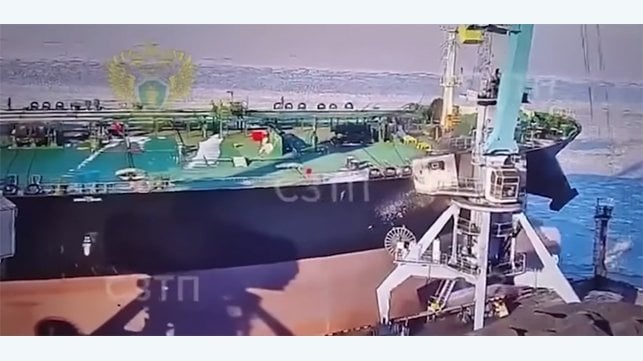
A Liberian-flagged, Greek-owned tanker hit the dock as it was maneuvering into the port of Ust-Luga in Russia on Saturday, February 14. The images show that it also hit and damaged the cab on a port crane during the docking incident.
Russian officials are saying there were no injuries and no pollution from the incident. However, an investigation has been launched into the circumstances.
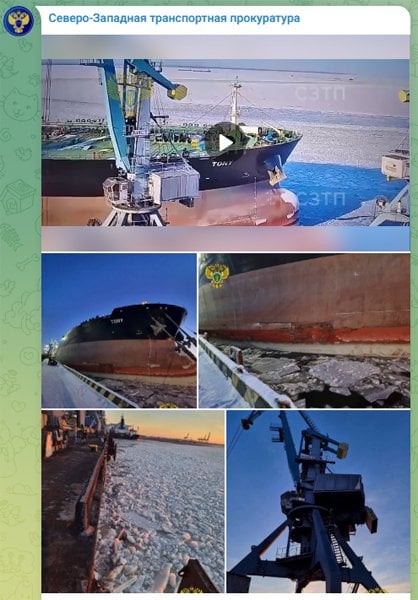
The tanker named Tony, built in 2010 and managed by Dynacom, was approaching the dock. Images show heavy ice, which has been plaguing large parts of the Baltic this winter. The vessel was maneuvering, reported aided by a tug, when it hit the cab on the crane. The cab was ripped off and hanging down after the contract. Pictures posted online by the Northwestern Transport Prosecutor also showed a large crease in the hull of the vessel.
The ship is 162,342 dwt and has been owned since commissioning by Dynacom. The ship’s last listed inspection was in November 2024 in Turkey, at which time 20 deficiencies were identified. Three of them contributed to a detention, including a missing fixed fire extinguisher, as well as an expired cargo safety certificate, and the unavailability of the crew immersion suits.
The tanker’s AIS signal shows that it remains berthed in Ust-Luga. Officials reported that the port was open and functioning after the incident.
USS Ford Likely to Set Post-Vietnam Deployment Record, Delaying Maintenance
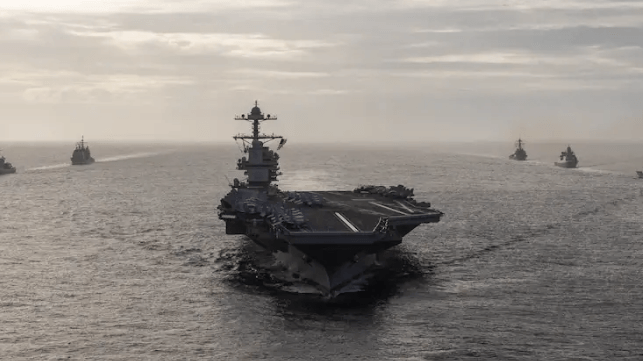
The carrier USS Gerald R. Ford has been redeployed from Venezuela to the Mideast to join a growing accumulation of forces aimed at persuading the government of Iran to give up its nuclear program. Ford is under way and about two weeks out from the Eastern Mediterranean, according to Fox News.
At present, Ford has been deployed and on tasking for 237 days; by the time that she arrives in theater, it will be about 250. Adding as little as 20 days on station and two weeks returning to Norfolk, and Ford could beat the post-Vietnam deployment record set by USS Harry S. Truman in 2021 (285 days). If her time in theater extends for months - as it plausibly could, if negotiations are as protracted as they were during the Venezuelan campaign - she could surpass the all-time record set by USS Midway in 1972-3, during the peak of Operation Linebacker.
The Navy has repeatedly warned that extra-long, extended deployments take a toll on readiness, starting with maintenance. Yard period schedules get deferred; equipment gets worn down, adding to the repair scope when the ship returns; and the crew have to put off plans for reuniting with their families.
Maintenance cost and timetable are the most significantly affected: during the yard period after a long deployment, unexpected and unscheduled repair issues typically crop up because of the extra wear and tear. This triggers unplanned work and last-minute parts orders, which take lead time to procure, pushing back the schedule.
Unexpected scope of work can add a year or more to a carrier's time in shipyard - an unplanned year that the vessel is not available for tasking. Multiplied across hulls, a fleet maintenance deficit adds up to limited fleet-wide availability. Coupled with delayed delivery of new tonnage, this means that fewer available carriers have to be stretched further to cover the gap, leading to more extended deployments - leading to further maintenance delays. This cycle is at top of mind for Navy leadership, as they have to think about the long-term readiness of the service - not just the overseas contingency at hand.
"If [Ford] requires an extension, it’s going to get some pushback from the CNO. And I will see if there is something else I can do," Chief of Naval Operations Adm. Daryl Caudle told TWZ last month.
Caudle has promoted the idea of differently-sized force packages for different taskings, with a mix of lower-end surface combatants for South American / Caribbean counternarcotics and policing operations. The concept is to free up more capable assets for other needs - including training and maintenance.
Force planning aside, Ford is set to join a growing "massive armada" in U.S. Central Command and Europe. Nearly 30 ships are under way or forward-deployed in the general region, including auxiliaries, in a count provided by analyst Ian Ellis.
Study: A Fire Tornado Could be Used to Clean Up Oil Spills
When the worst large-scale oil spills happen, responders turn to methods that have tradeoffs. Dispersants make the visual problem go away, causing the slick to break up and disappear into the water column before reaching shore, but have environmental effects. Burn-offs - intentional or accidental - reduce the volume of concentrated oil pools on water, but they also generate toxic smoke. A new study by a team at Texas A&M suggests that oil burn-offs can be carried out far more efficiently if the burning pool is subjected to a vortex of swirling air, known to wildland firefighters as a "fire whirl" or "fire tornado."
For first responders in wildland firefighting, the fire whirl evokes risk: the burning tornadoes can increase spread rate in a forest fire or move erratically, potentially overrunning fire teams. But that extra intensity might also be an asset, if it could be harnessed. A team led by by Dr. Elaine Oran and Dr. Qingsheng Wang of Texas A&M and Dr. Michael Gollner of UC Berkeley set out to determine whether a fire whirl could do a better job at burning off crude oil, and they found success.
The team set up a test apparatus at a firefighting experiment lab to see how a fire whirl would work over water. They arranged a set of three walls in a triangular formation around their test-scale oil fire, thereby inducing circular air movement - a vortex - as air flowed through the gaps between the walls and into the interior chamber. It worked, and they got a clean-burning pillar of flame.
According to their results, the whirl burned off 95 percent of the oil in the trial pool, and it produced 40 percent less soot in the process. In a cleanup scenario, this would mean far less toxic mess left behind. Best of all, it does its work in half the time of a normal burn-off fire. In spill-response, speed is everything, as the goal is to slow the spread of the slick.
“This the first time anyone has conceived using fire whirls for oil spill remediation, and it’s really just the beginning,” said Dr. Oran, who is an aerospace engineer. “Our goal is to harness the chaotic nature of fire whirls as a powerful, precise restoration tool."
There are limits, though. In deeper pools of fuel, the fire caused the underlying water to boil, resulting in water vapor that extinguished the fire early, the team found. The impact of high or gusty wind conditions was not assessed, so for now, the findings have more relevance for calm conditions. And as a practical matter, the mechanics of inducing a vortex and creating a fire whirl on the water are not yet clear.
"The experimental setup, involving three walls to generate fire whirls, is not directly applicable to open ocean environments where large oil spills typically occur. Future research should explore applicable methods for inducing fire whirls in open water conditions, possibly through the use of mobile or deployable structures, or by leveraging natural atmospheric conditions fitting for fire whirl formation," the team concluded.
German Icebreaker Malfunctions Impacting LNG Imports
Germany's icebreaker reported lost power and is unable to operate as an icebreaker in the heavy conditions (WSA Elbe-Nordsee)
German officials and the company Deutsche ReGas have been scrambling to deal with the impact of harsh winter conditions on the Baltic. Reports indicate that a malfunctioning icebreaker and heavy ice conditions are impacting the operations of one of Germany’s LNG import terminals.
According to some of the reports, the terminal, which is based on the LNG vessel Neptune (145,000 cbm), which Deutsche ReGas established as a floating storage and regasification unit at Mukran, has run out of gas and stopped shipments. The company, however, says the terminal remains fully operational despite current challenging weather conditions.
German broadcaster NDR ran a report saying the ice conditions were unusually heavy along the coast of the Baltic. It said they had been mostly stable since the start of February, but in some places the ice surpassed 30 centimeters thick (nearly one foot). In other places where the winds had piled it up, ice conditions are up to nearly one meter (40 inches or 3.3 feet).
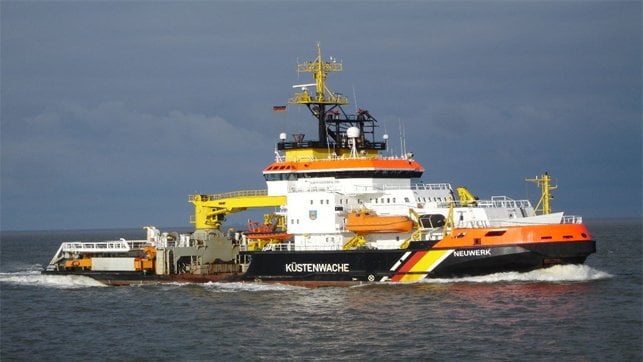
Germany’s Waterways and Shipping Authority brought in its icebreaker Neuwerk to help with the situation, but according to reports, the vessel began malfunctioning late on Thursday, February 12. NDR reports the vessel returned to Mukran on Friday for an inspection, with the broadcaster saying one of the vessel’s engines had lost power, meaning it did not have the power for icebreaking.
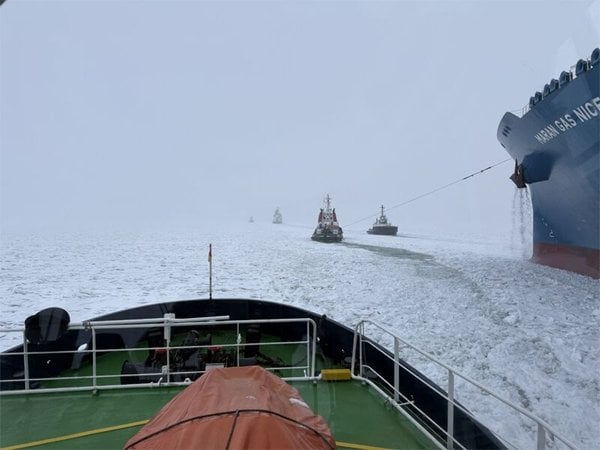
Operation to get Maran Gas Nice away from the terminal, after which Neuwerk began experiencing power problems (Deutsche ReGas)
Built in 1998, Neuwerk has a displacement of 3,000 tons and is designed to work in ice up to 50 centimeters. It is 79 meters (259 feet) in length. The Neuwerk is the Federal Government's most powerful icebreaker, with a bollard pull of 113 tons and an ice class of E3. The WSA transferred the powerful ship from the North Sea into the Baltic, swapping positions with another icebreaker, Arkona.
NDR reports the Neuwerk departed on Saturday for Rostock. There, the ship was to undergo an inspection by specialized technicians, and meanwhile, the chartered tug VB Bremen Fighter was being brought in to help with the ice conditions.
Deutsche ReGas posted a picture from February 11 showing the operation as the LNG carrier Maran Gas Nice (174,295 cbm) was escorted out through the ice. The Greek-owned vessel completed its delivery to the terminal at Mukran.
Another vessel, Minerva Amorgas (174,000 cbm), is holding offshore. It is waiting for the ice conditions to be addressed so that the ship has enough clearance to reach the floating terminal. Reports are saying that it might not be until Tuesday or Wednesday this week. Meanwhile, reports are that Germany’s gas storage levels are at their lowest point since 2013.
After the start of the war in Ukraine, Germany rushed to develop a series of floating LNG terminals both in the west as well as the one at Mukran to support its imports. Last winter, with milder conditions, there were reports of an overcapacity for Germany, while this year, Deutsche ReGas insists the supply is secured under very challenging conditions that appear to be leaving little margin for the supply.