Friday, March 06, 2026


US labels Anthropic a supply chain risk in clash over military AI use
Pages from the Anthropic website and the company's logo are displayed on a computer screen in New York on Thursday, Feb. 26, 2026.
Copyright AP Photo


By Roselyne Min with AP
Published on 

The Trump administration’s unprecedented move against Anthropic over AI safeguards is forcing government contractors to reconsider their use of the company’s chatbot Claude.

The US administration is following through with its threat to designate artificial intelligence (AI) company Anthropic as a supply chain risk in an unprecedented move that could force other government contractors to stop using the AI chatbot, Claude.

The Pentagon said in a statement Thursday that it has “officially informed Anthropic leadership that the company and its products are deemed a supply chain risk, effective immediately.”

The decision appeared to shut down the opportunity for further negotiation with Anthropic, nearly a week after President Donald Trump and defence secretary Pete Hegseth accused the company of endangering national security.

Trump and Hegseth announced a series of threatened punishments last Friday, on the eve of the Iran war, after Anthropic CEO Dario Amodei refused to back down over concerns the company’s products could be used for mass surveillance of Americans or autonomous weapons.

Amodei said in a statement Thursday that “we do not believe this action is legally sound, and we see no choice but to challenge it in court.”

"This has been about one fundamental principle: the military being able to use technology for all lawful purposes," the Pentagon statement said.

"The military will not allow a vendor to insert itself into the chain of command by restricting the lawful use of a critical capability and put our warfighters at risk,“ it added.

Amodei countered that the narrow exceptions Anthropic sought to limit surveillance and autonomous weapons “relate to high-level usage areas, and not operational decision-making”.

He added there were “productive conversations” with the Pentagon in recent days over whether it could keep using Claude or establish a “smooth transition” if no agreement was reached.

Trump gave the military six months to phase out Claude, which is already widely embedded in military and national security platforms. Amodei said it’s a priority to make sure warfighters won’t be “deprived of important tools in the middle of major combat operations.”

Some military contractors were already cutting ties with Anthropic, a rising star in the tech industry that sells Claude to a variety of businesses and government agencies.

Defence company Lockheed Martin said it will “follow the President’s and the Department of War’s direction” and look to other providers of large language models.

“We expect minimal impacts as Lockheed Martin is not dependent on any single LLM vendor for any portion of our work,” the company said.

How the US Defence Department will interpret the scope of the risk designation is unclear. Amodei said a notification Anthropic received from the Pentagon on Wednesday shows it only applies to Claude's use by customers as a “direct part of” their military contracts.

Microsoft said its lawyers studied the rule and the company “can continue to work with Anthropic on non-defence related projects.”

Pentagon draws criticism for its decision

The Pentagon's decision to apply a rule designed to address supply threats posed by foreign adversaries was met with broad criticism. Federal codes have defined supply chain risk as a “risk that an adversary may sabotage, maliciously introduce unwanted function, or otherwise subvert” a system in order to disrupt, degrade or spy on it.

US Senator Kirsten Gillibrand, a New York Democrat and member of the Senate Armed Services Committee and Senate Intelligence Committee, called it “a dangerous misuse of a tool meant to address adversary-controlled technology.”

“This reckless action is shortsighted, self-destructive, and a gift to our adversaries,” she said in a written statement Thursday.

Neil Chilson, a Republican former chief technologist for the Federal Trade Commission who now leads AI policy at the Abundance Institute, said the decision looks like “massive overreach that would hurt both the US AI sector and the military’s ability to acquire the best technology for the US warfighter.”

Earlier in the day, a group of former defence and national security officials sent a letter to US lawmakers expressing “serious concern” about the designation.

“The use of this authority against a domestic American company is a profound departure from its intended purpose and sets a dangerous precedent,” said the letter from former officials and policy experts, including former CIA director Michael Hayden and retired Air Force, Army and Navy leaders.

They added that such a designation is meant to “protect the United States from infiltration by foreign adversaries — from companies beholden to Beijing or Moscow, not from American innovators operating transparently under the rule of law. Applying this tool to penalise a US firm for declining to remove safeguards against mass domestic surveillance and fully autonomous weapons is a category error with consequences that extend far beyond this dispute.”

Anthropic sees boost in consumer downloads

While losing big partnerships with defence contractors, Anthropic experienced a surge of consumer downloads over the past week due to people siding with its moral stance. More than a million people signed up for Claude each day this week, the company said, lifting it past OpenAI's ChatGPT and Google's Gemini as the top AI app in more than 20 countries in Apple's app st

The dispute with the Pentagon has also further deepened Anthropic's bitter rivalry with OpenAI, which started when ex-OpenAI leaders, including Amodei, started Anthropic in 2021.

Hours after the Pentagon punished Anthropic last Friday, OpenAI announced a deal to effectively replace Anthropic with ChatGPT in classified military environments.

OpenAI said it sought similar protections against domestic surveillance and fully autonomous weapons, but later had to amend its agreements, leading CEO Sam Altman to say he shouldn't have rushed a deal that “looked opportunistic and sloppy.”

Amodei also expressed regret about his own part in that “difficult day for the company,” saying Thursday he wanted to “directly apologise” for an internal note he sent to Anthropic staff that attacked OpenAI's behaviour and suggested Anthropic was being punished for not giving ”dictator-like praise" to Trump.


AI on the battlefield: How is the US integrating AI into its military?
The seal is seen on a podium at the Pentagon, Wednesday, Dec. 10, 2025, in Washington, before Defense Secretary Pete Hegseth speaks
Copyright AP Photo

By Anna Desmarais
Published on 

The US military used Anthropic's Claude AI, but after Anthropic refused to remove guardrails against mass surveillance and autonomous weapons, the Pentagon cancelled the contract and turned to OpenAI.

Media reports that the US military used Anthropic’s artificial intelligence (AI) chatbot Claude during operations targeting leaders in Venezuela and Iran are raising new questions about how quickly artificial intelligence (AI) is being integrated into warfare

American media reported that Claude was used to help facilitate a January operation that led to the capture of Venezuela’s leader Nicolás Maduro. Similar reports later emerged that the chatbot was also used during preparations for an operation targeting Iran’s deceased supreme leader, Ayatollah Ali Khamenei.​

Experts say the incidents offer a rare glimpse into how advanced AI systems may already be supporting US military planning and intelligence work.

“It was very surprising to see the sudden deployment of these tools, especially when I think the larger community does not think that they’re ready for said deployment,” said Heidy Khlaaf, chief AI scientist at US policy thinktank, AI Now Institute.

“We’re sort of questioning whether these AI models can be successful in any military settings at all because of how flawed they are,” she told Euronews Next.

Khlaaf said researchers have warned that large language models can produce unreliable or incorrect outputs, raising concerns about how they might perform in high-stakes environments such as military operations.

The reported use of Claude also comes as the Trump administration pushes an ambitious strategy to make the US military “AI-first”, arguing that rapid adoption of the technology is necessary to compete with rivals such as China.

‘We see this sense of urgency’

The United States has used various forms of automation technology in the military since the 2010s, and it has been a focus area for several presidents, including Trump’s predecessors, Barack Obama and Joe Biden, experts told Euronews Next.

Early AI models were used for logistics, maintenance, or translations, according to Elke Schwarz, a professor of political theory at Queen Mary University of London in the United Kingdom.

Trump’s second mandate accelerates the adoption of generative artificial intelligence (AI) models like OpenAI’s ChatGPT or Anthropic’s Claude in an “AI-arms race,” against the country’s adversaries, both Schwarz and Khlaaf said.

America’s policies give a “sense of urgency” to develop AI because it is a “very valuable technology” that will keep the country ahead of its rivals, said Giorgos Verdi, policy fellow at the European Council of Foreign Relations think tank.

The Department of War’s AI Acceleration strategy aims to secure American military dominance by eliminating barriers to AI integration and investing in strategic projects that will keep the military ahead of rivals.

“The idea really is to bring AI into all kinds of domains, including the harmless ones, but also the more harmful ones,” Schwartz said.

He noted that previous administrations were more cautious about establishing safety guardrails governing how and when such technologies could be used.

As part of that effort, the acceleration strategy has a database called genai.mil, which allows bureaucrats to access AI chatbots, including Google’s Gemini and xAI’s Grok.

The administration’s 2025 budget, called the “Big Beautiful Bill,” also includes hundreds of millions of dollars in funding for AI-related military projects.

The document sets aside $650 million (€550million) for military innovation, including $145 (€123 million) to develop AI-powered counter-drone systems.

Another $250 million would go toward the “advancement of the AI ecosystem,” while a further $250 million is allocated to expand artificial intelligence capabilities at a Cyber Command centre. An additional $115 million is earmarked for accelerating nuclear national security missions using AI.

US military still in ‘trial phase’ with AI chatbots

Due to the“inherent lack of transparency,” it is difficult to determine how advanced the US government is in its plans, Schwarz said. “Unlike a certain ammunition or a specific physical weapon system, you don’t really see what is being used,” she said. “Everything happens in an interface and very much in the zone of invisibility.”

Schwarz believes that the US military is in a “trial phase,” where it is experimenting with different AI companies to understand what they can do and where their limitations lie.

Anthropic’s $200 million partnership with the US military is for a two-year prototype that will advance national security, the company says. It will work with the department to “anticipate and mitigate potential adversarial uses of AI,” and identify any risks with adopting the technology throughout the “defence enterprise.”

Schwartz said this suggests that the systems are being tested in live environments, which she said raises ethical concerns.

“This isa terrible practice for something that involves human lives,” she said.

However, Verdi believes that systems like Claude that were used in the Venezuelan and Iranian contexts for “more mundane tasks,” such as collecting or analysing satellite images.

“A human may not be able to analyse every single piece of intelligence coming in. That’s what the AI system will be able to do more quickly,” he said. “Then, the humans interpret the outputs of the AI system and then act.”

Experts warn of growing interest in AI-powered autonomous weapons

The researchers worry that the growing role of AI in US military planning and decision-making could eventually lead to the development of autonomous weapons. ​

“I think there is definitely an interest to at least have the option to develop fully autonomous AI-enabled weapons and potentially make use of those,” Verdi said.

Autonomous weapons could be any weapon that could identify, select, and engage with a target without having a human involved in the final decision, Khlaaf said.

“So instead of taking a recommendation from a large language model and a human acting on it or choosing not to, you would then have that be completely automated away,” she said.

One of the main arguments for developing such systems is the fear that the US could fall behind if a rival builds them first, Verdi said.

However, there is no public information suggesting that China has integrated AI in any way into its military, Verdi and Khlaaf said.

The Chinese are “very concerned about keeping that technology under control,” Verdi added.

The AI capabilities of other American opponents, such as Russia, Iran or North Korea, are “even less sophisticated,” Verdi added, so it is even less likely that those countries would have AI autonomous weapons.

Creating fully autonomous weapons with AI can also lead to escalation in a conflict, Verdi said.

A recent pre-print study from King’s College London found that AI chatbots almost always chose to threaten nuclear weapons use in a war game scenario.

Pentagon faces ‘challenging transition’ away from Claude

Verdi said that we should expect the US to continue using Claude or another AI chatbot in their operations because both Venezuela and Iran were “seemingly very effective,” in fulfilling the mission’s objectives.

The perceived success of these missions creates a risk that the US will want to drop even more guardrails, such as human oversight, to make the technology even more effective, she added. The challenge for the Department of War will be to find a model that works as well as Claude, Verdi said.

The government will be phasing it out in the next six months since the company refused to give the military unfettered access to its technology for what Anthropic claims could be used for mass surveillance or autonomous weapon development, according to a statement from Pete Hegseth, the US Secretary of War.

Anthropic said Claude has been rolled out throughout the US government's classified information networks, deployed at national nuclear laboratories, and does intelligence analysis directly for the Department of War.

Meanwhile, the Department of War signed a contract with OpenAI to integrate “advanced AI systems in classified environments,” hours after the Anthropic deal was scrapped.

“I think the Department of War will be looking at a challenging transition, but at the same time, it is not an impossible task,” to replace Claude with a new AI system, he said.

The intelligence collected and provided by Claude will likely stay with the department and could be used by the next provider, he said.

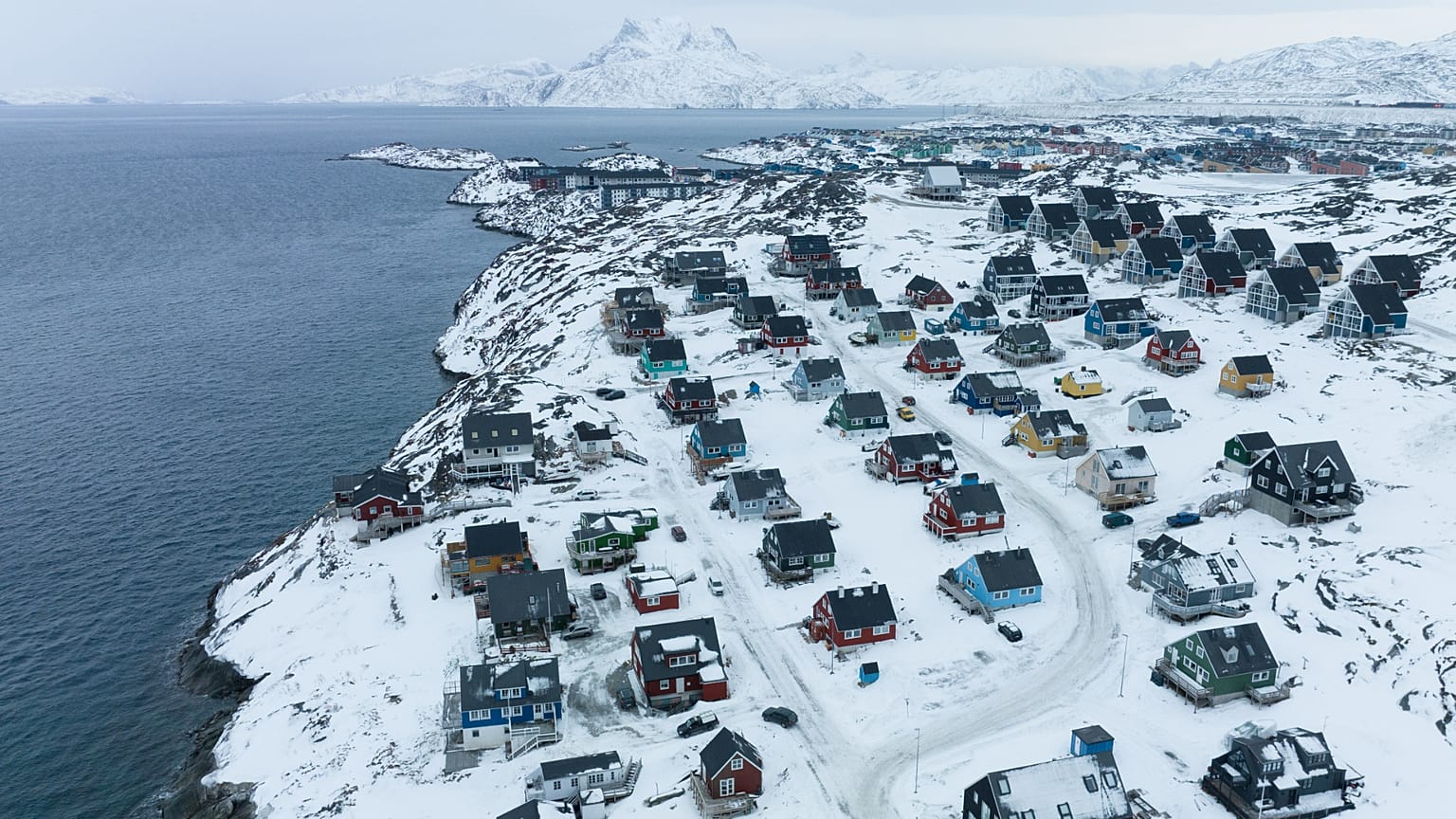
 

Is Greenland’s health system as bad as Donald Trump says it is?

Houses are seen near the coast of a sea inlet of Nuuk, Greenland, on Saturday, Jan. 24, 2026.
Copyright Copyright 2026 The Associated Press. All rights reserved


By Marta Iraola Iribarren
Published on 


Greenland’s government has reiterated the need for foreign healthcare staff and the strengthening of its health system following a US statement alleging patients are not properly treated in the country.

United States President Donald Trump wants to send a hospital ship to Greenland “to take care of the many people who are sick and not being taken care of there,” he wrote on Truth Social on 22 February.

Greenland’s Prime Minister Jens-Frederik Nielsen rejected the offer, citing that the health system in the country is free for everyone, something the United States cannot offer, he said.

But Trump’s claims don’t appear to come out of thin air. Greenland has long struggled to recruit and retain its healthcare staff. The government aims to tackle this through measures such as easing residence permits for professionals.

Anna Wangenheim, Greenland’s Minister of Health and Persons with Disabilities, responded on Facebook that they are working to strengthen their healthcare system, and there is a growing political will to recruit more healthcare professionals from abroad.

Wangenheim added that Greenland will not turn any help away, “not even from the United States”. Healthcare professionals who wish to work in the country, provided they respect the patients, the language, and the culture, are welcome.

As of January 1, 2026, Greenland’s population was counted at more than 56,000, with people dispersed across vast distances. It is the world's least densely populated territory. Around 20,000 live in the capital, Nuuk, with the remainder spread across remote towns and settlements.

Healthcare burden

In 2023, Greenland’s burden of disease measured by Disability-Adjusted Life Years (DALYs) per 100,000 people stood at 38,715. One DALY equals one lost year of healthy life.

The equivalent figure for Denmark is 30.931 and the European average stood at 36,863.

It is estimated that approximately 1.5 percent of the Greenland population was living with cancer in 2023, 18.8 percent with a mental health disorder, both higher than the EU average.

Life expectancy also lags behind Europe. A newborn boy in Greenland can expect to live for 69.3 years, and a newborn girl for 73.9 years, which is far lower compared with the European average of 81.7 years.

How is the health system organised?

The health sector operates across 70 locations. There are approximately 120 medical positions, but around 60 are permanent staff.

Of the 300 nurse positions, 200 are permanent, according to Trap Greenland, a digital encyclopaedia of the country written by local researchers.

The system is divided into five regions, each served by a regional hospital. Queen Ingrid’s Hospital in Nuuk is both a regional hospital for Region Sermersooq and the national hospital.

“Outside Nuuk, the backbone of the system is general practice,” Henrik Hansen, medical advisor at Greenland’s Department of Health and Persons with Disabilities, told Euronews Health.

Specialists from Denmark periodically travel to Greenland to perform advanced procedures, such as eye surgery. Most other surgical procedures, internal medicine, and psychiatry are based at the hospital in Nuuk.

Healthcare has been under Greenlandic jurisdiction since 1992. However, some services are still not available in the territory.

Challenges in delivering healthcare

Greenland’s healthcare system manages the most basic medical challenges. More advanced interventions, highly specialised treatments, and complex care take place in neighbouring Denmark.

Hansen explained that cancer patients are offered to go to Denmark for advanced treatment such as radiotherapy, as Greenland is not equipped to handle radioactive substances.

Invasive cardiologic interventions like angioplasty, stenting for blocked arteries, or valve replacement, are also not available in the region for patients with cardiovascular diseases. Nor are hemodialysis or kidney transplants for people with renal diseases.

In its 2025 annual report, Greenland’s Health Council noted that there is an ongoing desire for as much healthcare treatment as possible to take place close to the patient’s home. Only cases that cannot be handled locally should be managed at Queen Ingrid’s Hospital, and only those beyond its capacity should be referred to Denmark.

However, the Council noted, the more specialised the treatment is, the more challenging it becomes to provide it locally – not only because of staffing, but also because of infrastructure and regulatory requirements involved.

The role of telemedicine

Geography remains one of Greenland’s greatest obstacles. It can take days or even weeks to travel from some settlements to a town with a doctor and healthcare facilities, and weather conditions often cause delays.

“Telemedicine has, to some extent, changed the need for personal contact. For example, skin diseases are now diagnosed with telemedical assistance from Denmark,” Hansen added.

The Greenlandic Health Service launched the app Puisa in 2023 to facilitate secure video consultations between patients at home and healthcare professionals, aiming to reach the most remote areas of the country.

€400 million in EU funding approved to help Greece achieve net zero emissions

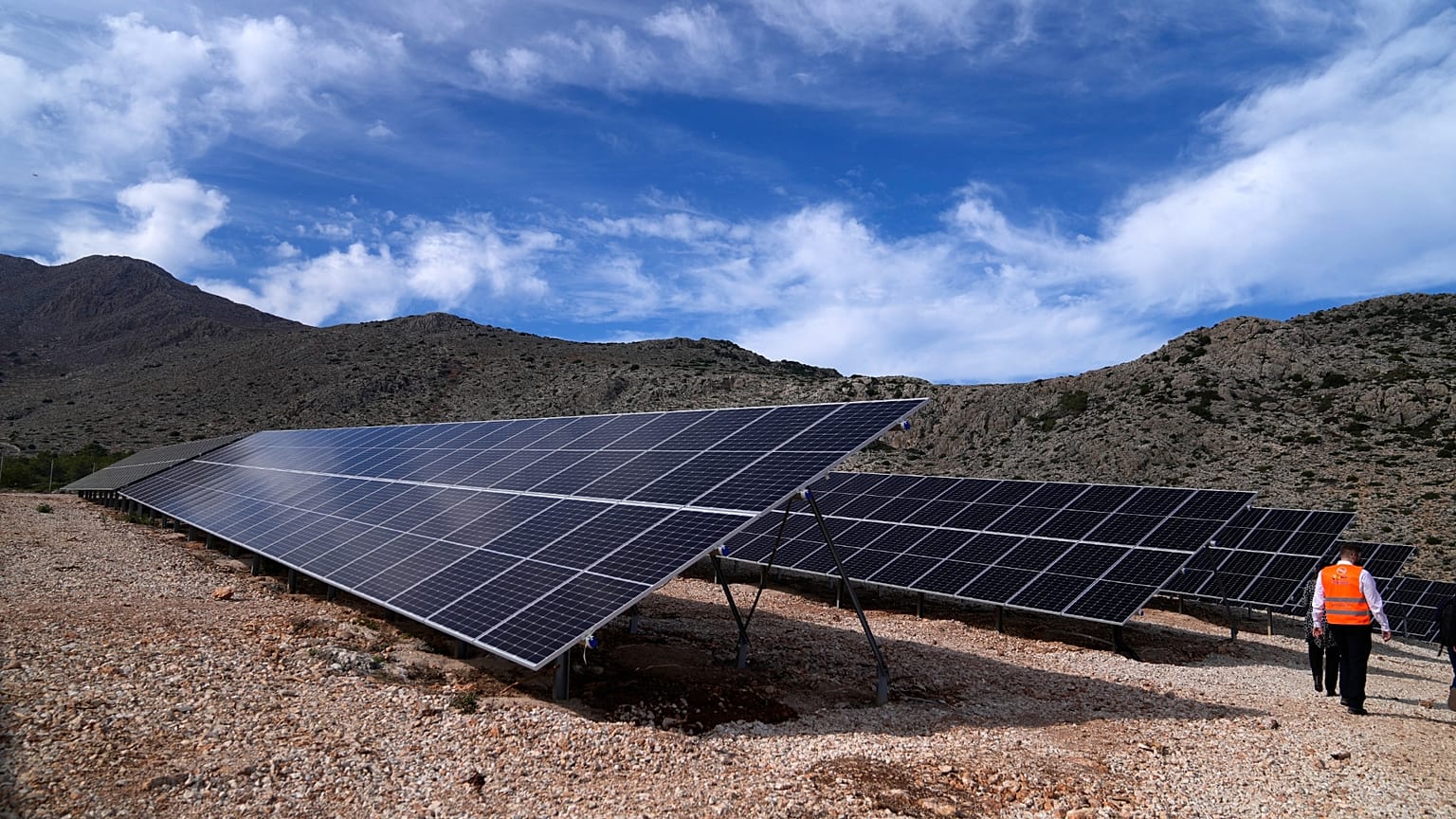
File photo - Photovoltaics in Amorgos
Copyright AP Photo

By Ioannis Karagiorgas
Published on 

The funding will support strategic investments that increase clean technology capacity.

The European Commission has approved €400 million in state aid for Greece to invest in clean tech

In line with the objectives of the Clean Sky Agreement, this initiative is expected to accelerate the transition to a net zero economy. The approval was given on the basis of the Clean Industrial Deal State Aid Framework (CISAF), which was adopted by the Commission on 25 June 2025.

How will Greece use the €400 million funding?

The funding will support strategic investments in the clean technologies sector.

The scheme aims to provide financial support for investments that create or expand production capacity for the manufacture of zero-emission technologies, including the use of secondary raw materials. It also covers key specialised key components listed in Annex II of the CISAF, as well as the production of new or recovered critical raw materials necessary for the manufacture of finished products or their individual key components.

The support will be provided in the form of direct grants and fiscal incentives. The measure applies to enterprises throughout the Greek territory and aid may be granted until 31 December 2030.

The Commission found that the Greek scheme fulfils the conditions of the CISAF. In particular, it was found to create substantial incentives for the production of clean technologies, their basic components and the necessary critical raw materials.

The scheme will provide Greece with additional production capacity for clean technologies. The Greek State can allocate €400 million to support key investments in the sector, using a number of different measures.
 Τερέσα Ριμπέρα 
Executive Vice President responsible for a clean, fair and competitive transition

It also concluded that the measure is necessary, appropriate and proportionate to accelerate the transition to a zero-emission economy and to support economic activities central to the implementation of the Clean Industrial Deal. The decision is in line with Article 107(3)(c) of the Treaty on the Functioning of the European Union and the relevant provisions of the CISAF.

On the basis of the above, the Commission has approved the Greek measure under the EU State aid rules.

"The scheme will provide Greece with additional production capacity for clean technologies," said Teresa Ribera, Executive Vice President in charge of a clean, fair and competitive transition. "The Greek State can make available €400 million to support key investments in the sector, using a number of different measures. This new production capacity will contribute to achieving the agreement's clean industry objectives while minimising potential distortions of competition."

What is the Clean Industrial Deal State Aid Framework?

On 25 June 2025, the European Commission adopted the CISAF to promote support measures in sectors crucial to the transition to a net zero economy, as part of the Clean Industrial Deal.

The CISAF allows Member States to implement, until 31 December 2030, different categories of support to accelerate the green transition, such as:

  • Measures for the development of renewable energy and low-carbon fuels (sections 4.1 and 4.2): Establishing support schemes for investment in renewable energy and storage, with simplified procedures, as well as specific arrangements to accelerate the development of low-carbon fuels.
  • Temporary electricity cost reduction measures for energy-intensive enterprises (section 4.5): Ensuring the transition to clean and affordable electricity by preventing the transfer of production activities to countries with lower environmental standards.
  • Measures for the decarbonisation of industry (section 5): Support for investments that reduce dependence on imported fossil fuels through electrification, energy efficiency improvements and the use of renewable or low-emission hydrogen.
  • Clean technology capacity building measures (section 6): Investment in strategic projects, in line with the Zero Emission Industry Regulation, such as production of batteries, photovoltaic panels, wind turbines, heat pumps, electrolytes and carbon capture, use and storage projects, as well as for key components and critical raw materials.
  • Investment risk mitigation measures (section 8): Support for private investment in clean energy, industrial carbonisation, clean technologies, energy infrastructure and circular economy projects.

More information on the CISAF is available on the Commission's official website. (source in Greek)


Middle East and North Africa 

MENA Region’s Rapid Energy Transition – Analysis


Solar power in Algeria.

Photo Credit: Wikipedia Commons


March 6, 2026
By Dr. Majid Rafizadeh


The Middle East and North Africa region is going through a rapid energy transition and has made significant advances when it comes to renewables.

Several factors have driven this rapid shift, including economic diversification goals, climate pressures and domestic energy demand. In addition, there has been a decline in the cost of clean technologies and governments across the region have been investing heavily in renewables like solar and wind and related infrastructure.

The installed renewable energy capacity in MENA is already about 30 gigawatts. And projections show an expected increase to more than 130 GW by 2030.

Although this shows that the region’s renewable energy capacity is projected to expand more than fourfold by the end of the decade, the transformation is not uniform. While some MENA countries are emerging as global clean energy leaders, others remain constrained. This is due to issues such as inefficient infrastructure, political instability and financial limitations.

However, the trajectory of renewable adoption will significantly influence the future of the region when it comes to economic stability, environmental sustainability and long-term prosperity.


Several MENA countries have positioned themselves at the forefront of the energy transition. They have done so through several paths, including ambitious national strategies, large-scale projects and supportive regulatory frameworks.

Gulf states — particularly Saudi Arabia, the UAE and Qatar — have invested significantly to build some of the world’s largest solar installations. These countries are not only pursuing renewables and transitioning rapidly to reduce emissions, but also to diversify their economies.

Solar energy stands at the top of the region’s transition due to the fact it has exceptional solar irradiance. Regional solar capacity alone could exceed 180 GW by 2030, with more than 80 percent of growth concentrated in Saudi Arabia, the UAE and Egypt. The Gulf states’ long-term strategies — such as meeting a substantial share of their electricity demand through clean sources — shows how energy transition policies are integrated into their broader economic visions.

When it comes to North Africa, the likes of Morocco and Egypt have also made significant progress and emerged as pioneers. Morocco has invested heavily in both solar and wind infrastructure and it aims to produce more than half its electricity from renewables by 2030. Egypt is pursuing a similar target.

Some of the advantages these North African countries have are their natural resources, their proximity to European markets and their adoption of policy frameworks that are designed to attract foreign investment.

There are multiple reasons that some MENA states are accelerating their adoption of renewable energy at such a rapid pace. Firstly, energy demand is rising rapidly due to population growth, urbanization and industrial expansion. Renewable energy offers a cost-effective solution.

Secondly, economic diversification strategies — such as Saudi Arabia’s Vision 2030 — seek to reduce their dependence on oil by developing new industries, including green hydrogen and clean technology manufacturing.

Thirdly, falling costs due to technological advances have transformed the renewables sector and made the transition even more important and economically sound. For example, utility-scale solar projects in the region now achieve some of the lowest electricity prices globally. This makes them very competitive with fossil fuels.

Finally, climate vulnerability is increasing. Many MENA countries face extreme heat, water scarcity and desertification; this strengthens the case for the transition. Reduced emissions will help limit extreme heat and water stress.

However, in spite of this impressive progress, several countries in the region continue to lag. This is related to several underlying factors, such as bureaucratic inefficiencies, prolonged conflicts or unrest, weak governance and an inability to attract long-term investment.

Financing barriers are another major obstacle, as renewable projects demand substantial capital. This is why international climate finance and development banks should provide more support when it comes to funding.

These countries can implement comprehensive policy reforms and strategic investments to provide long-term certainty for investors. In addition, international and regional cooperation will play a vital role. For example, partnerships with European and Asian markets can facilitate technology transfer, financing and export opportunities for this transition. Also, the diversification strategies of these nations should incorporate renewables into their broader economic planning.

Geopolitically speaking, the shift toward renewables will likely reshape regional power dynamics. Countries that successfully diversify their energy systems could gain influence as exporters of clean energy and technology. But those countries that lag will risk economic deterioration, isolation and marginalization. They will also risk environmental crises in a region that is among the world’s most strategically significant.

In a nutshell, the region is undergoing a significant and rapid transition toward renewable energy, propelled by technological advances, economic necessity and environmental pressures. But progress remains uneven. Leading countries have demonstrated that decisive policies, investment and long-term planning can transform energy systems.

Ultimately, the region’s economic stability and environmental sustainability will come down to how decisively it embraces the clean energy transition. If the lagging countries join and accelerate the current momentum, MENA could emerge as a global leader in renewable energy.
This article was published at Arab News
Like what your read?

Please consider supporting Eurasia Review, and thanks for you consideration!


Dr. Majid Rafizadeh

Dr. Majid Rafizadeh is a Harvard-educated Iranian-American political scientist. X: @Dr_Rafizadeh


Ferries in Europe emit more CO2 than 6.6 million cars. Which ports are the worst culprits?

Ferries cross the Tagus river in Lisbon at sunrise, Monday, Oct. 18, 2010.
Copyright Copyright 2010 AP. All rights reserved.


By Liam Gilliver
Published on 

Ferries in certain European cities are responsible for more toxic air pollution than all the cars in those cities, a new study warns.

Fossil-fuelled ferries are choking European ports, as experts call for a rapid transition to electrification.

Ferries play a vital role in connecting Europe’s islands with the mainland, and are often seen as an environmentally friendly alternative to flying. However, many vessels are old and polluting – exposing locals to toxic air pollution.

A new study by NGO Transport & Environment (T&E) has found that in 2023 alone, 1,043 European ferries emitted 13.4 million tonnes of CO2. This is the equivalent of 6.6 million cars over a year.

In port cities such as Barcelona, Dublin and Naples, ferries are responsible for more toxic sulphur oxide pollution (SOx) than all of the cars in those cities, the study warns.

Sulphur oxides are air pollutants that can trigger respiratory problems, worsen asthma and contribute to acid rain and fine particulate pollution.

Which European ferry ports are the most polluting?

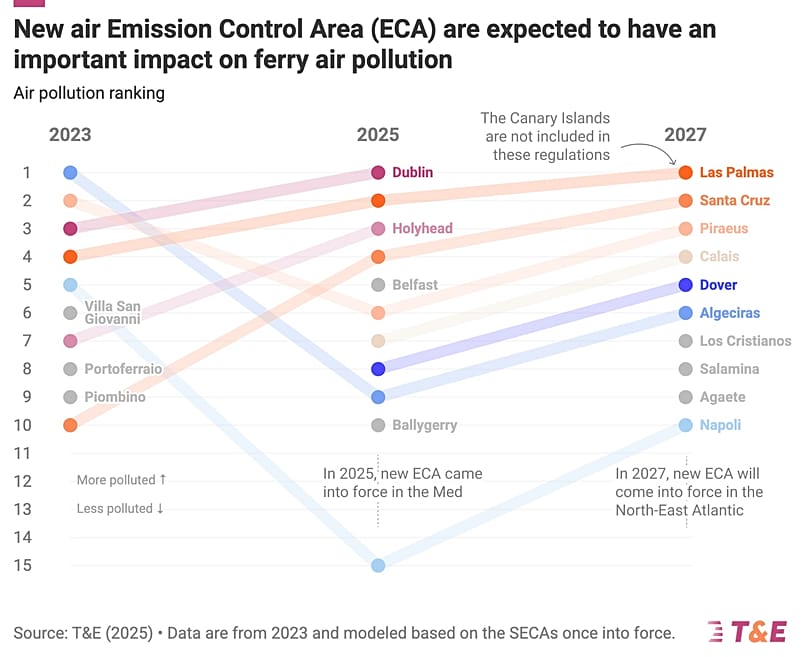
Dublin, Ireland, is currently the most polluted port city in Europe when it comes to ferry-related SOx exposure, followed by Las Palmas in Gran Canaria and Holyhead in Wales.

However, this is set to change next year, when new emission control areas will come into place and limit air pollution from maritime fuels in the North-East Atlantic. As the Canaries are not included in these regulations, Las Palmas is slated to emit the most air pollution in 2027, followed by Santa Cruz in Tenerife.

Graph showing the impact the Emission Control Area (ECA) are expected to have on European ferry ports.
Graph showing the impact the Emission Control Area (ECA) are expected to have on European ferry ports. T&E

Barcelona is the highest CO2-emitting ferry port in Europe, with ferries here also pumping out 1.8 times more SOx than all of the city’s cars – despite restrictions already in place in the Mediterranean.

As of 1 May 2025, the entire Mediterranean Sea is designated a Sulphur Emissions Control Area, requiring ships to reduce fuel sulphur content from 0.5 to 0.10 per cent. These measures were put in place to slash air pollution and enhance air quality in coastal areas.

Is electrification the solution?

T&E found that the average age of ferries in Europe is 26 years, highlighting the need for a “clean renewal”.

The report states that electrification and hybridisation could cut ferry CO2 emissions by up to 42 per cent, improve air quality in port cities and reduce operating costs. At least 60 per cent of Europe’s ferry fleet could run on battery power by 2035, with many routes already cheaper to operate as electric today.

In Sweden’s Stockholm, a hydrofoil electric ferry trial has been found to slash emissions by up to 94 per cent and cut travel times from 55 minutes to roughly 30 minutes.

The main barrier to scaling up electric ferries is charging infrastructure, but T&E argues that the challenge is “smaller than assumed”.

“57 per cent of ports would only need small chargers below 5MW to support electric ferry operations,” the study adds.

‘Connect communities, not pollute them’

“Ferries should connect communities, not pollute them,” says Felix Klann of T&E. “Too many ferries are burning polluting fossil fuels, pumping toxic air into Europe’s port cities.”

Klann argues that electrifying Europe’s ferries could “dramatically” cut emissions and bring a “breath of fresh air” to millions of people. He adds: “Electric ferries are already cheaper to run on many routes, and more will become cost-competitive in the coming years.

“With the average age of ferries in Europe at 26 years, now is the time for a clean renewal.”