Saturday, March 07, 2026

Conference and Film Screening on News Deserts and Lack of Civic Engagement


While children are gutted by Jewish-American missiles


Below is a commentary for the newspaper I have been publishing my “long-form” commentaries in on a monthly basis, and that newspaper, the Newport News Times, now the Lincoln County Leader, is on the proverbial chopping block.

Here, these people who are buying up what they call “struggling newspapers,” including the Leader:
 

News Media Corporation sells Oregon cluster to Country Media ...

Country Media, Inc., an Oregon-based company, has acquired numerous, often struggling, local newspapers, resulting in some closures and mergers. The firm, led by Steve and Carol Hungerford, has merged publications like The Chronicle and The Chief, while reducing print frequency for others, such as The World in Coos Bay, due to financial pressures.

Key Actions and Closures

  • The Umpqua Post: Ceased operations in June 2020 following its acquisition by Country Media.
  • Bandon Western World: Printed its final issue in July 2020.
  • The World (Coos Bay): Reduced print days from five to two in 2020.
  • Mergers: The Chronicle (St. Helens) and The Chief (Clatskanie) merged into The Columbia County Chronicle & Chief. The Lincoln City News Guard and Newport News-Times merged in January 2024.

I had a difficult time getting up the energy to go to this listening session and then the following film screening of the flick:

There were eight student journalists there to assist the listening session, students from the U of Oregon journalism program. I just can’t understand why their faculty mentor, Andrew DeVigal, could not start any session off with a moment of silence for fellow truth seekers:

“Israel has now killed more journalists than any other government since CPJ began collecting records in 1992,” it said in a statement.

It cautioned that the true number of journalists targeted and killed by Israel could be much higher because some of the killings could be potentially concealed by press restrictions and humanitarian difficulties that complicate conducting investigations during Israel’s genocidal war on Gaza.

“With much contemporaneous evidence now destroyed, the true number of Palestinian journalists in Gaza who were deliberately targeted by Israel may never be known,” the CPJ said.

Here’s a small talk in Washington State around local journalism:

Local journalists and supporters of local news gathered at the Edmonds Theater in Edmonds, Wash., on Oct. 25, 2025, for a panel discussion and audience Q&A following the screening of the documentary “Stripped for Parts: American Journalism on the Brink.” The screening was co-sponsored by the League of Women Voters Snohomish County and the My Neighborhood News Network, which includes My Edmonds News, MLTnews, and Lynnwood Today.

*****

You know, when it comes to “educated” people, those people in the League of Women Voters, and there were mostly retired folk at this Newport, Oregon event, and there were a few “city/county” officials, it’s if there is a bipolar collective psychosis going on. It was noon, Saturday, and I was the only fucker talking about the murdering spree by the Jews of Israel and the Jewish Kosher Nostra in the USA.
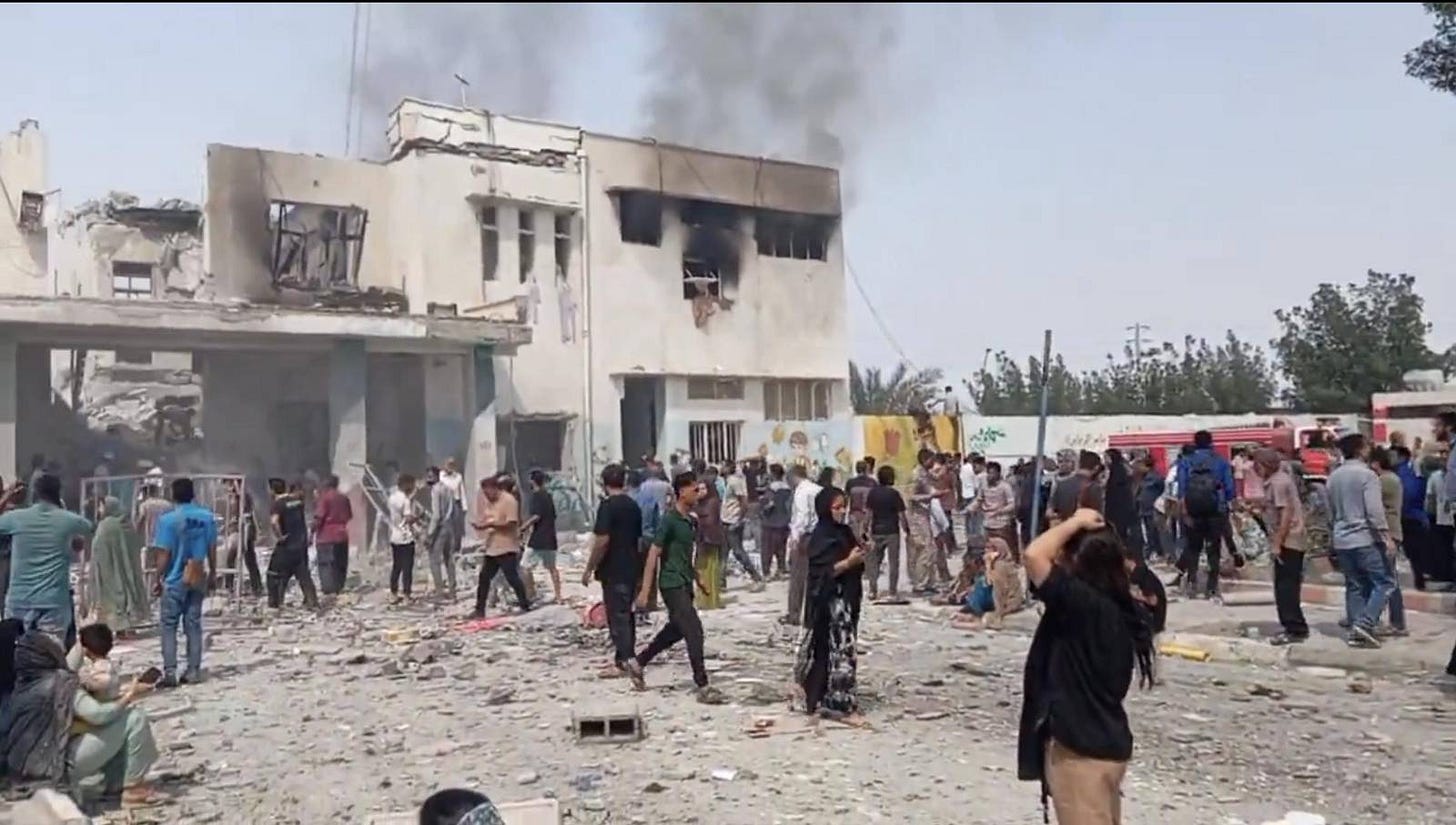
Mohammed Shariatmadar stood outside the wreckage of the Shajareh Tayyiba girls’ elementary school in Minab, in southern Iran on Saturday morning, unable to process what he was seeing. His six-year-old daughter, Sara, a second-grade student, was among dozens of girls killed when the school was bombed in the first few hours of the war launched by the U.S. and Israel against Iran.

In the immediate aftermath of the strike, he remained standing in the shade of a cracked wall, staring at the ground and ignoring the commotion around him. He didn’t approach the building, which had been sealed off, but he didn’t move away either. His hands knotted together, then separated, then knotted again, in a repeated motion. Every time a paramedic emerged or an ambulance moved, he quickly raised his head, then returned to staring at the ground. He asked no one a direct question. He was only waiting for his daughter’s name to be called.

When families were finally directed to a gathering point to receive the bodies of their children, he slowly moved forward. When asked if he needed help, he shook his head silently and waited for his daughter’s body to be brought out.

“I cannot understand how a place where innocent children learn can be bombed like this,” Shariatmadar told Drop Site. “We are talking about small children who knew nothing of politics or wars. And yet they are the ones paying the highest price.”

Some 170 students were inside the building, attending morning classes when the missile struck. At least 108 people were killed, according to the public prosecutor’s office in Minab, many of them schoolgirls between seven and 12 years old.

It was unclear if it was a U.S. or Israeli strike. On Saturday, CENTCOM’s spokesperson said they were “looking into” the reports.

*****

The students, college ones, mind you, were given a quick rundown of alternative (sic) sources of news:

Drop Site NewsCounterpunchDissident VoiceMonthly ReviewInterceptPalestine ChronicleElectronic IntifadaLowkeyCovert Action MagazineConsortium NewsEmpire FilesBreak Through News, and a few dozen more suggestions to get these J students out of the morass of legacy media, and the manure pile of traditional news gathering and reporting.

Never heard of TruthoutIn These TimesThe NationThe ProgressiveMother Jones?

In These Times (magazine) - Wikipedia

Truthout - Truthout updated their cover photo.

The Progressive — A voice for peace, social justice, and the common good - Progressive.org

Mother Jones May+June 2024 Issue – Mother Jones

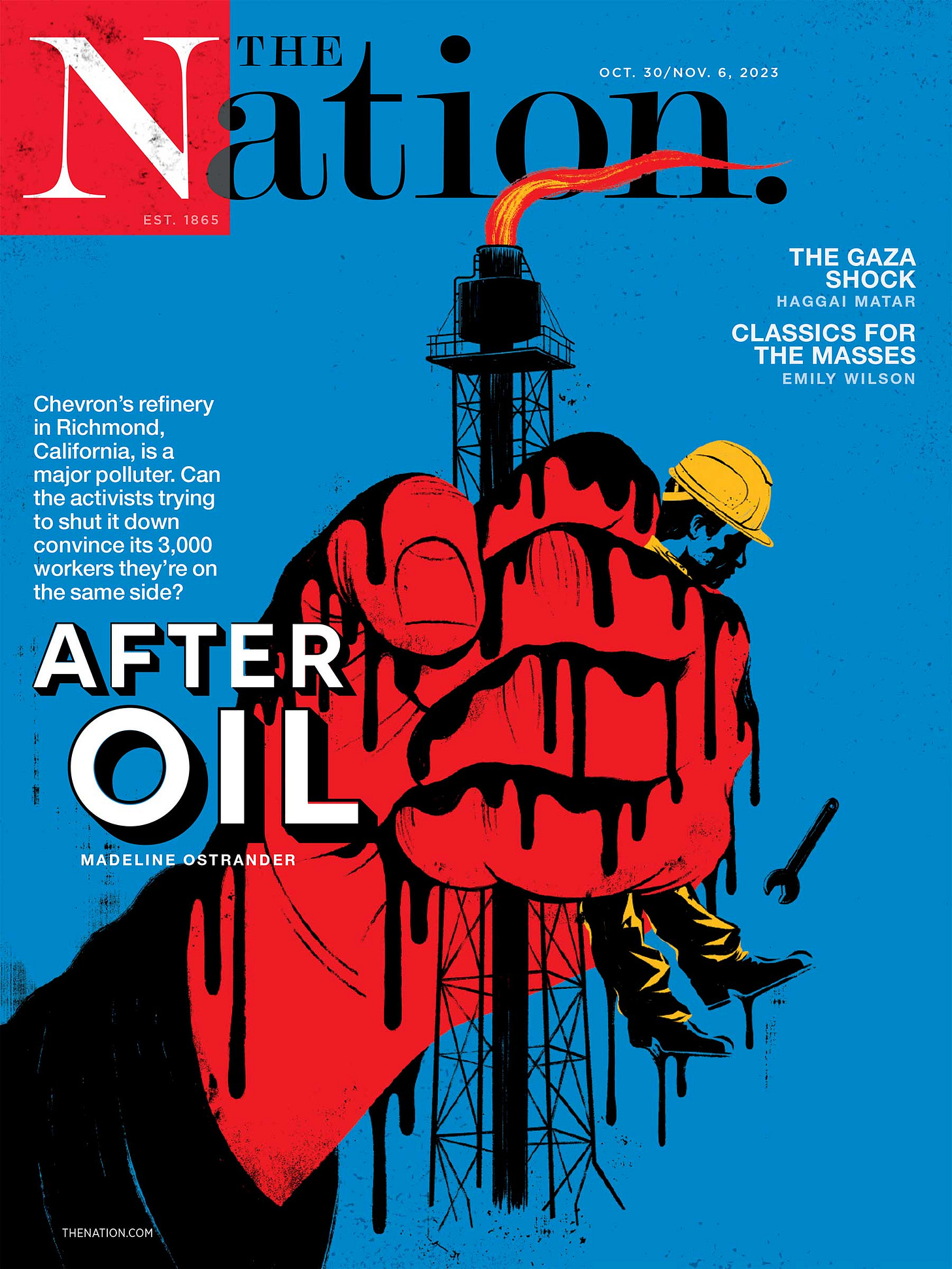
Magazine Issue | Page 2 of 1380 | The Nation

*****

They hadn’t been exposed to the Hulk Hogan-Peter Thiel-Adelson documentary:

It was diheartening, man, being around the middling crowd, the Democrats, man, so quick to attack Trump, but then, what about . . . ?
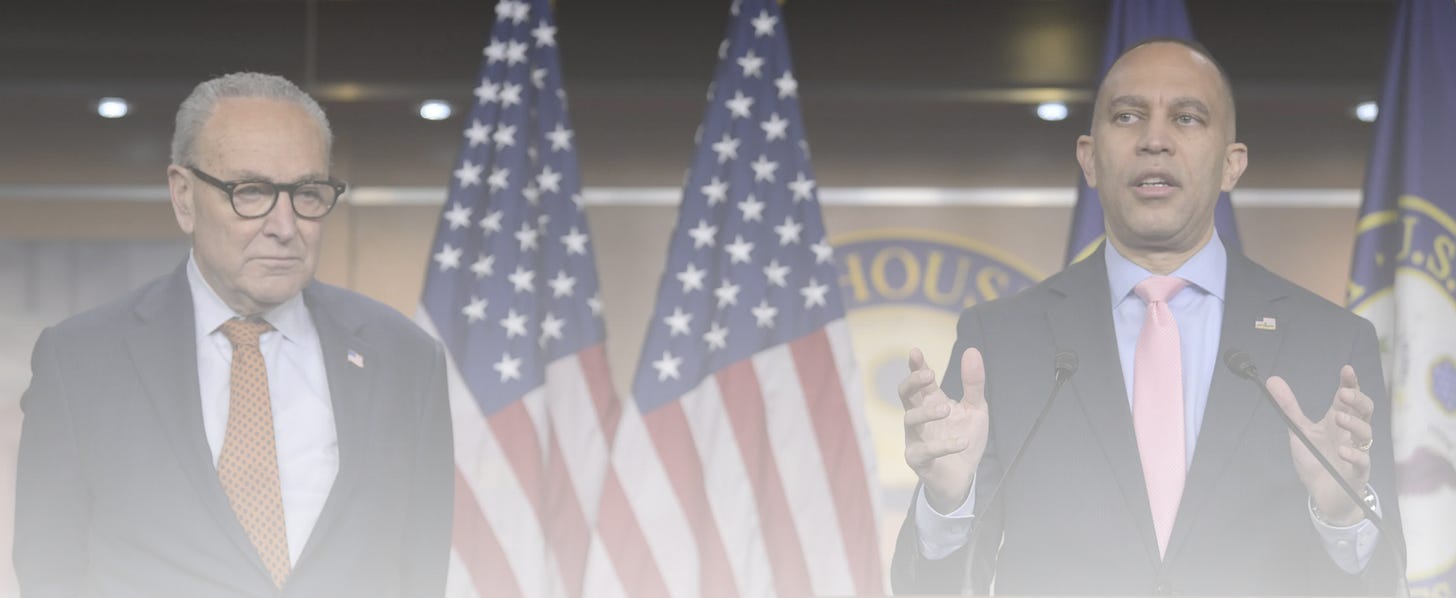
There currently exists one legislative vehicle in each chamber through which members can express their position. This month, six new Democratic House members have signed onto a War Powers Resolution aimed at constraining President Trump’s ability to deploy U.S. forces without congressional approval, bringing the total to 82. The legislation, led by Reps. Ro Khanna (D-Calif.) and Thomas Massie (R-Ky.), was first introduced prior to the Trump administration’s unauthorized strikes against Iranian nuclear targets last June. The GOP appears to be largely unified behind a possible war, with Massie being the only Republican House member signed on to the House legislation. Sens. Tim Kaine (D-Va.) and Rand Paul (R-Ky.) have introduced a similar effort in the Senate.

Yet despite the resolution’s growing support, Democratic leadership has not clearly rallied behind it. House Minority Leader Hakeem Jeffries (D-N.Y.) has issued public concerns about Trump’s rush to war, but has not said whether or not he supports the Khanna-Massie bill.

Senate Minority Leader Chuck Schumer’s (D-N.Y) statement did not oppose a war, but instead noted the “risks” involved and called for confronting Iran’s “ruthless campaign of terror, nuclear ambitions, regional aggression, and horrific oppression” with “strength, resolve, regional coordination, and strategic clarity” and urged the administration “to consult with Congress and explain to the American people the objectives and exactly why he is risking more American lives.” Following the Trump administration’s Tuesday briefing to the Gang of 8, Schumer added, “This is serious. The administration has to make its case to the American people,” fueling criticism that he was prepared to accept the president’s justifications.

“Leader Schumer’s statements are insufficient. Democratic voters want leadership that’s willing to take a clear stand and oppose the president on major issues like this,” Dylan Williams, Vice President for Government Affairs at the Center for International Policy, told RS.

Two recent reports suggest that this lack of pushback could be intentional. A Tuesday story from journalist Aida Chavez’s substack Capital and Empire says top Democrats have worked to block consideration of legislation that would force members to go on record regarding potential military action against Iran.

“The evidence, so far, is that leadership is trying to discourage that vote,” one activist and former congressional staffer familiar with dynamics on the Hill told RS. “And the primary people that serve are the few dozen Democrats whose donors are hawks, but whose voters don’t want regime change war. That’s who the party is trying to protect from having to take a vote, because it’s painful for those members to vote against their donors.”

Drop Site News reported last week that some Democrats on the Hill might support pursuing a military intervention in Iran but, understanding a war would likely be politically catastrophic, would rather not go on the record and instead let Trump and the Republicans bear the responsibility and the costs.

“Cynically, Schumer may also have the midterms in mind,” the Drop Site report says. “If Trump manages to topple the Iranian government, the ensuing chaos could prove a drag on Trump as the country heads into the November elections.”

As a result, party leaders may choose to stand by or tepidly oppose military action as opposed to forcefully weighing in one way or the other. (The Schumer aide who laid out this calculus in the Drop Site story said that the minority leader himself does not subscribe to that logic.)

Alternatives to the dying newspapers?
I’ll be interviewing John Washington on my radio show, and his pieces in Luminaria, well, way beyond what the U of O students are being exposed to:

This three-part series chronicles a Tucson family’s harrowing journey from Venezuela through the heart of the anti-immigrant policies of México and the U.S. The first chapter traces Yesenia’s journey with her kids from Venezuela to the United States and then back to México. The second chapter focuses on her husband Mariano’s escape from authorities. The third chapter focuses on the family’s desperate search for safety in México after being deported from Tucson.

The stories are based on more than a dozen hours of interviews by Arizona Luminaria and La Silla Rota reporters with Yesenia and Mariano in a town outside Mexico City, as well as interviews with their family and friends, public records, audio files and messages exchanged between Yesenia and Mariano over seven months.

 

*****

Here, the thousand-word commentary, a monthly far-from-rant from Haeder, the ranter: More specifically, Spiel, Catharsis, Vomitus, Spitting up the Phlegm of Capitalism, Hyperbole… tirade, diatribe, harangue, invective . . . screed, philippic, fulmination?

Everyone Likes to Complain about the Weather and the News

This could be a requiem for this dwindling newspaper, owned now by Country Media. But the real big boys are called vulture capitalists, and at the end of February, eight U of O journalism students and their mentor, Andrew DeVigal, director of Agora Journalism Center, came to Newport to inculcate a listening and talking session at the Atonement Lutheran Church.

There were about 25 Lincoln County residents engaging in a mini-town hall on the future of local journalism, and the power of printed or digital news to embrace a community’s trust and envelop a deep understanding of the issues that make a city or county work or not work.

The famous Bill Moyers puts us at the 35,000-foot perspective:

“It’s up to you to tell the truth about what’s happening to this country we love. It’s up to you to tell the truth about the struggle of ordinary people. It’s up to you to remind us that democracy only works when citizens claim it as their own. It’s up to you to write the story of America that leaves no one out.”

DeVigal has had 30 years in the trenches at various newspapers like the Contra Costa Times, New York Times, and with the Poynter Institute. He’s now working with aspiring journalists, and these students, representing half his current class, Engaged Journalism, helped participants in facilitated conversations on just what makes a good and vibrant informed citizenry “engage” with news.

We are at a crisis point, that is, crises, in terms of education, participation in governance, political literacy, and finding the news that a community needs to become better citizens.

Andrew’s classes have learned the power of Generative Dialogue Framework – a tool that could “help reimagine the future of engaged journalism.”

We know about food deserts and healthcare deserts, but who reading this knows about news deserts? Go to the website, usnewsdeserts.com, and you will find more than 350 interactive maps allowing the user to drill down to the county level to understand the state of local media in communities throughout the United States.

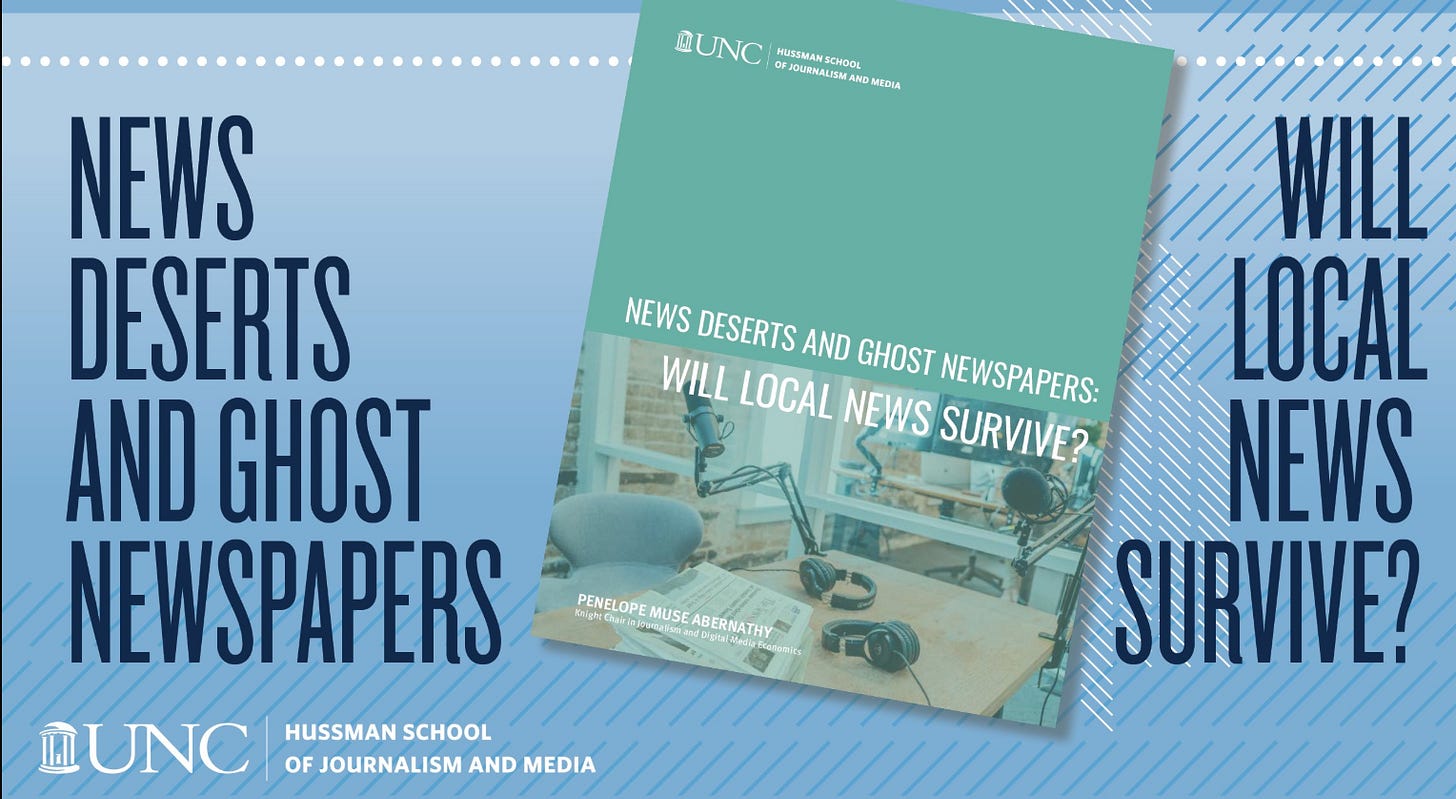
 

The number of news desert counties rose to 213 in 2025. Research shows that 1,524 counties have one remaining news source. That’s more than 50 million Americans having limited to no access to local news. The rise in news deserts was accompanied by an increase in newspaper closures, which ticked up to 136 this past year, a rate of more than two per week.

Here’s a pivotal point Andrew made in a recent editorial:

“To do better, we must first understand journalism not simply as an industry, but as a form of civic infrastructure that helps communities navigate crises of misinformation, disinformation and democratic instability.”

This listening session stressed the need for businesses to up the ante to strengthen civic health. Holding institutions accountable is one pathway that an engaged citizenry can build trust in news and information ecosystems.

There are four pillars to assessing a community’s civic health, according to the Press Forward organization:

• News and Information: Availability and accessibility of local news outlets.

• Civic Participation Ecosystem: Metrics like volunteer rates and voter turnout.

• Equity and Justice: Structural determinants, including historical racial and economic discrimination.

• Health and Opportunity: Social determinants such as medical debt, housing insecurity, and health insurance coverage.

Andrew stresses that more actors in the business and non-profit communities “can co-invest in community information hubs, local media collaboratives, libraries, nonprofits and cultural organizations that gather, share and contextualize trusted news and expert resources for their communities. They can also sponsor coverage that meets public needs and partner with universities to grow a diverse pipeline of civic media makers and journalists.”

The three-hour event in the early afternoon was centered around a survey that went out to Lincoln County, the same survey that has been conducted in other Oregon communities: Harriston, Salem, Oakridge, La Pine, Rogue Valley and Florence.

The second part of Saturday’s civic engagement was a showing of a 2024 documentary, “Stripped for Parts: American Journalism on the Brink.”

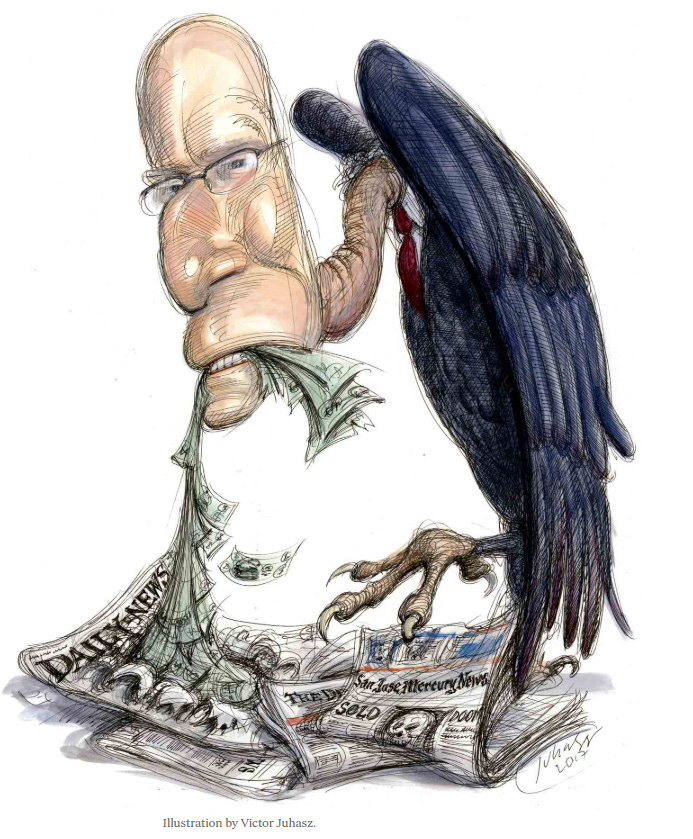
The film lays bare the crimes of hedge funds, those so-called vulture capitalists buying up newspapers for the real estate they encompass. There have been billions of dollars stripped from some of the more well-known newspapers. Alden is the second-largest newspaper owner in the United States, controlling approximately 200 newspapers through its subsidiaries, MediaNews Group (also known as Digital First Media) and Tribune Publishing.

Imagine 75 percent staff reductions, taking us into a new phase of the “ghost newspaper” – no regular beat reports, just papers running syndicated “news.”
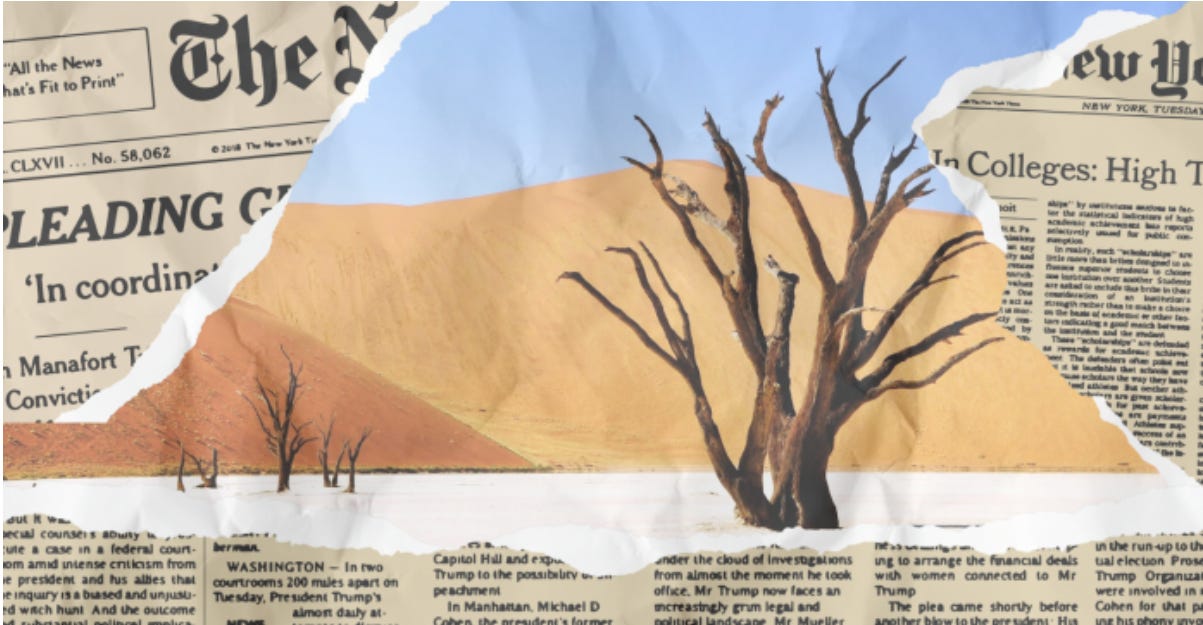
 

  • Staffing Levels: An estimated 1,000 to 1,500 of the 7,200 newspapers in the U.S. have lost more than half of their newsroom staff since 2004.
  • Content Shift: A 2024 study of 500 papers owned by the largest chains found that over one-third of front-page content originated from non-local sources.
  • Ownership Trends: Many ghost papers are owned by large newspaper chains or hedge funds that implement aggressive cost-cutting measures to maintain profit margins.
  • Impact on Democracy: The loss of local “watchdog” reporting is linked to diminished voter engagement and higher local government costs due to a lack of oversight.

A third of the 1,800 papers – 600 – that were lost over the past decade slowly faded away. Most were suburban weeklies. Like the frog in slowly boiling water, few people in the community noticed anything different at first. There was no abrupt closure that grabbed headlines. Often, there was merely an announcement that the paper had been purchased by the owner of a nearby, larger daily.

Initially, the paper continued to be published under the same name, and the reporters who worked for the paper continued to aggressively cover local government. However, as circulation declined, the once stand-alone paper became a zoned edition of the larger paper. Over time, the building where the paper had been published for decades – often a landmark in the community – was sold and staffing was dramatically reduced. Increasingly, news coverage focused on noncontroversial topics – lifestyle features on people and events in the community. In the final stage, management at the larger daily paper announced that the zoned edition would become a weekly specialty publication, advertising supplement in the main paper or a TMC (total market coverage) product or shopper, distributed free to all residents in the community.
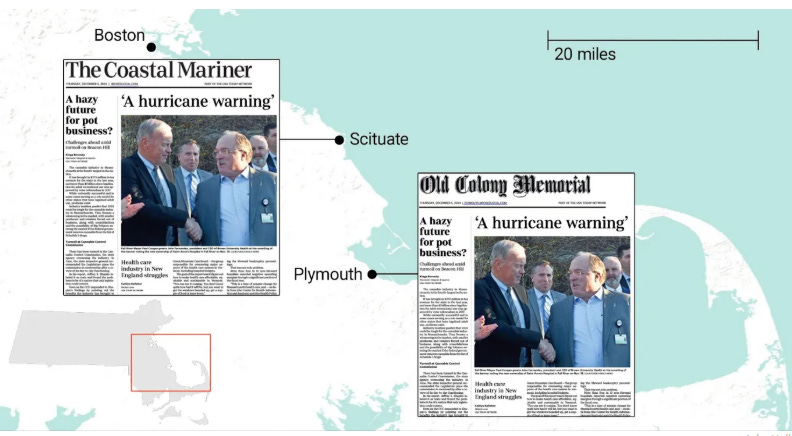
[Despite being published 20 miles apart, the front pages of Gannett’s papers in Scituate and Plymouth, Mass., are identical. These pages from Dec. 5 carry no stories local to the communities they serve.]
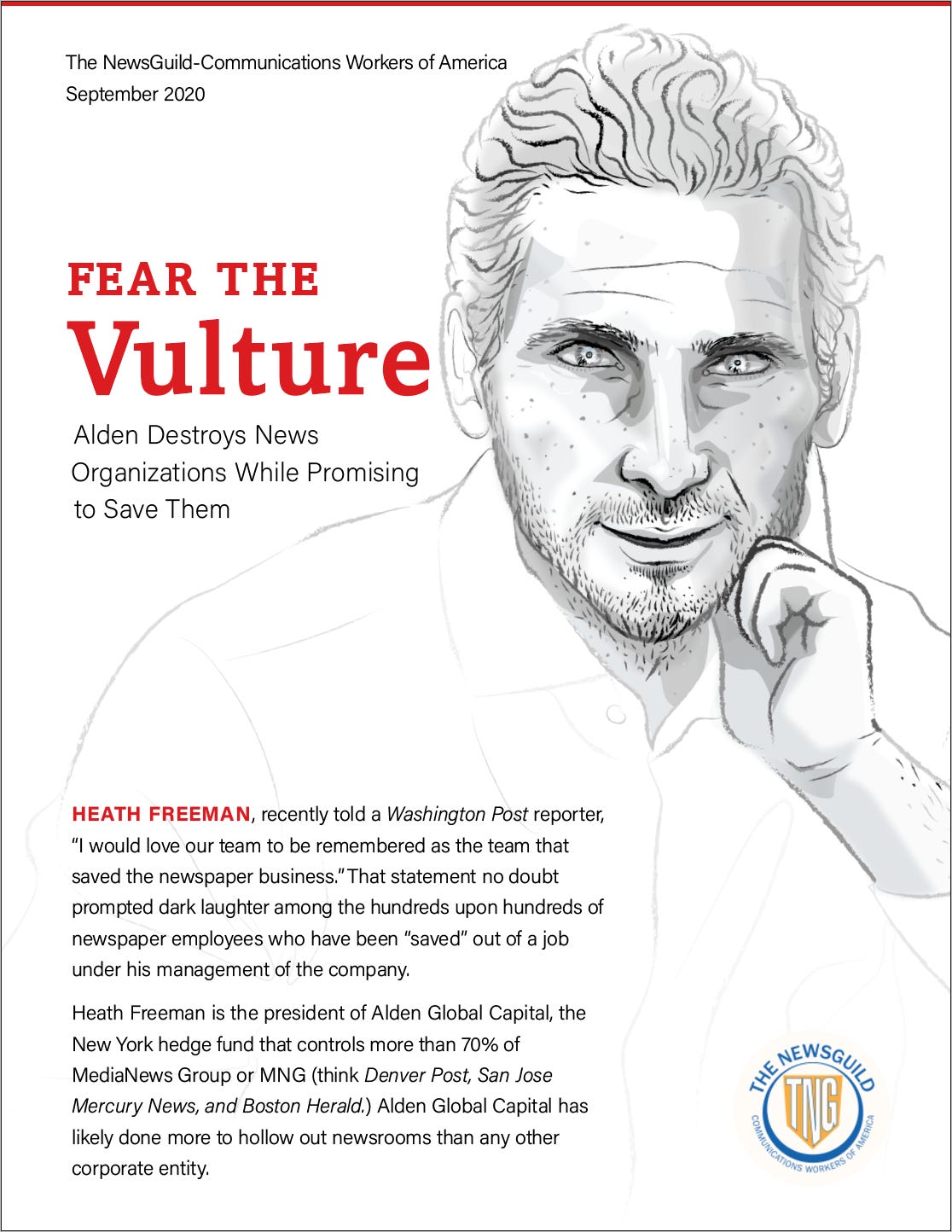
RE: Haunted By Ghost Papers — Can Massachusetts hyperlocal startups reconnect communities to the news–and each other?

In 2024, Alden closed eight weekly newspapers in Minnesota, including the Shakopee Valley News (160 years old) and the Jordan Independent (140 years old).

 

When I started in the newspaper arena, first in college 1974-79, the writing was on the wall: “Don’t expect to get a full-time job with a daily that has a Sunday edition. You’ll have to go to small towns and work for a daily, twice-a-week, or weekly newspaper.” The loss of over 2,100 newspapers between 2004 and 2020 is one reason we have such an uninformed public.

The digital landscape is still evolving. We have the Lincoln Chronicle, a non-profit on-line news outlet. But my contention is we have to support as many hardcopy newspapers in a mid-to-large city. Newport needs at least two newspapers, and this once-a-week Leader just doesn’t cut it.

Cutting jobs, gutting newsrooms, and believing in this so-called creative destruction are the death knell of America.

“Whatever they say about us, they can’t control us. We’re out to serve the public. That’s a red-blooded, virile statement, and by God, it’s true,” Harry Grant, Milwaukee Journal, quoted in a September 25, 1950, TIME Magazine article titled “The Press: No. I.”

More wise proof from 238 years ago why newspapers count? “Were it left to me to decide whether we should have a government without newspapers, or newspapers without a government, I should not hesitate a moment to prefer the latter.” — Thomas Jefferson, 1787
Paul Haeder has been a teacher, social worker, newspaperman, environmental activist, and marginalized muckraker, union organizer. Paul's book, Reimagining Sanity: Voices Beyond the Echo Chamber (2016), looks at 10 years (now going on 17 years) of his writing at Dissident Voice. Read his musings at LA Progressive. Read (purchase) his short story collection, Wide Open Eyes: Surfacing from Vietnam now out, published by Cirque Journal. Here's his Amazon page with more published work AmazonRead other articles by Paul, or visit Paul's website.

Sudden Glacier Collapse, Fastest Ever


March 6, 2026

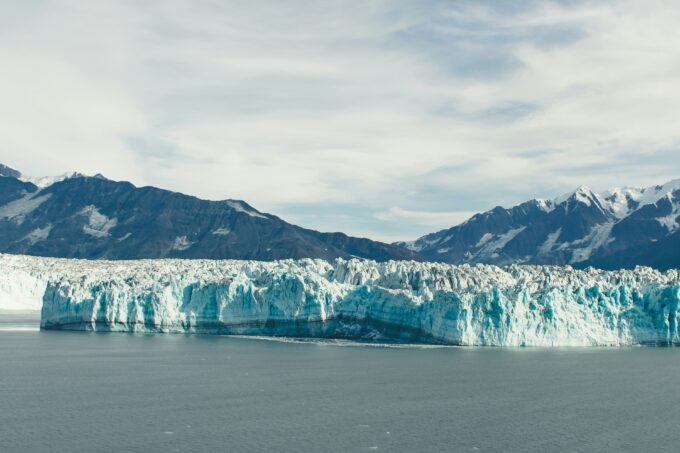
Image by Robert Wong.

Hektoria Glacier (Antarctica) retreated 8 kilometers (5 miles) in only two months; one-half of the structure collapsing in record time. This is the fastest glacier collapse ever, and the message to the world is very clear: Global Warming looks like it’s ahead of schedule. (Antarctica Just Saw the Fastest Glacier Collapse Ever Recorded, ScienceDaily d/d February 26, 2026)

The world climate system is starting to unravel faster than expected. Sea level rise estimates by major institutions such as the IPCC should probably be tossed out the window. Global warming is not waiting around for guesstimates. Hektoria Glacier is real time evidence that the consequences of global warming are ahead of expectations.

A few more warnings like this and the mayors of mega-coastal cities New York, London, Manila, Tokyo, Shanghai, Mumbai, Lagos, Jakarta, Karachi, Buenos Aires, Rio de Janeiro, Guangzhou, Osaka, Istanbul will demand answers, red-faced, pounding the table with clenched fists, as to why countries like the United States ignorantly promote fossil fuels, kill climate science, and destroy clean renewable policies when nearly 100% of the world’s scientists agree fossil fuels are the primary cause of destructive global warming. “More than 99.9% of peer-reviewed scientific papers agree that climate change is mainly caused by humans, according to a new survey of 88,125 climate-related studies.” (Cornell Chronicle)

According to ScienceDaily: “Antarctica’s Hektoria Glacier stunned scientists by retreating eight kilometers in just two months, with nearly half of it collapsing in record time… Satellite and seismic data captured the dramatic chain reaction in near real time. The findings raise concerns that much larger glaciers could one day collapse just as quickly.”

Indeed, scientists were taken aback: “When we flew over Hektoria… I couldn’t believe the vastness of the area that had collapsed,’ said Naomi Ochwat, lead author and CIRES postdoctoral researcher. ‘I had seen the fjord and notable mountain features in the satellite images, but being there in person filled me with astonishment at what had happened,” Ibid.

According to senior research scientist Ted Scambos, University of Colorado/Boulder: “Hektoria’s retreat is a bit of a shock — this kind of lightning-fast retreat really changes what’s possible for other, larger glaciers on the continent… If the same conditions set up in some of the other areas, it could greatly speed up sea level rise from the continent,” Ibid.

In a very real sense, the Hektoria incident is fortuitous because the glacier is only 115 square miles, or roughly the extent of a large city, not one of the large glaciers. It therefore gives scientists a solid glimpse of a new danger, meaning, this is real time evidence, if large glaciers collapse as quickly as Hektoria did, then global sea level rise could be severe, catching the world unaware, unprepared. As such, according to polar scientists, Hektoria is a commanding siren signal to get off fossil fuels as soon as possible.

According to a recent Antarctic study by the prestigious Potsdam Institute For Climate Impact Research d/d Feb. 16, 2026:”Ricarda Winkelmann, just returning from several weeks of fieldwork in Antarctica, adds that seeing how rapidly some regions in Antarctica are already responding to anthropogenic climate change, how extreme weather events are not only becoming more frequent but lead to subsequent changes in the ice dynamics, really puts into perspective the vulnerability of this vast ice sheet. Our mapping of potential regional tipping points shows where the greatest risks lie on the long term, and which regions of the Antarctic Ice Sheet need closest monitoring. Cutting greenhouse gas emissions rapidly is imperative to prevent further destabilization of ice basins.”

Polar scientists have gone public about acceleration of Antarctica’s glaciers for a couple of years now and have issued warnings to the public about the tenuousness of the situation, to wit: In August 2024 at the 11th Scientific Committee on Antarctic Research held in Pucón, Chile attended by 1,500 scientists: “Antarctica’s glacial melt is advancing faster than ever before in recorded history.”

Gino Casassa, PhD, an attendee glaciologist Head of the Chilean Antarctic Institute stated: “Based upon current trends, sea levels will be up 13 feet by 2100,” which begs the obvious question of the level by 2035-40, assuming Dr. Casassa is correct, after all, 13 feet won’t all happen in 2099 (there’s no public record of any other scientists with such an aggressive forecast).

Additionally. in November 2024, 450 polar scientists held an emergency meeting at the Australian Antarctic Research Conference to announce, via a press release: “If we don’t act, and quickly, the melting of Antarctica ice could cause catastrophic sea level rise around the globe within our lifetimes.” Moreover, “we’ve found immense global warming induced shifts in the region.” This was an appeal to the general public to take preventative measures: “Drastic action is necessary… CO2 emissions must stop.”

“Antarctica is melting ice more than six times faster than it was 20 years ago, according to satellite imagery… Runaway ice loss causing rapid and catastrophic sea-level rise is possible within our lifetimes. Our societies must set and meet targets to ‘bend the carbon curve’ as quickly as possible.” (Australian Antarctic Research Conference, 2024)

Large Methane Leaks Discovered in AntarcticaPolar Journal d/d March 2025

In March 2025, a Spanish scientific expedition announced discovery of “large scale” methane CH4 plumes erupting from the ocean floor off the coast of the Antarctic Peninsula.  “Methane has a high climate impact, which is 20 to 40 times higher than that of carbon dioxide. If large quantities of the gas were released, this could contribute significantly to global warming – to an extent not yet taken into account by climate models,” Ibid. One member of the expedition said: “It could be an environmental bomb for the climate.”

As for the above-mentioned scientists, the Hektoria Incident is most likely not a complete surprise other than the surprising rapidity of collapse, which concerns polar scientists a lot. In fact, it follows in the footsteps of the warnings they’ve issued over past years.

Significant Terrestrial Glacier Meltdown Underway

But the dangers of unanticipated sea level rise may be even worse yet. Far beyond Antarctica, a massive worldwide terrestrial glacial meltdown is underway that also directly impacts sea level rise, a threat not included in most analyses of potential sea level rise.

A 20-year study by 35 international teams of worldwide terrestrial glacier meltdown published in Nature (February 2025 issue) claims terrestrial glacier loss is “greater than Greenland and Antarctica.” The study discovered “staggering volumes of ice loss,” e.g., 273B tons ice loss per year over a 20-year study. Of concern, momentum is accelerating. For example, the first half of the study, or 10-years, registered 231B tons per year. The second half registered 314B tons/year or an increase of nearly 40% acceleration. The study identifies future risks as “entire countries erased” via sea levels rising much higher/faster and GLOFs (glacial lake outbursts floods). (World’s Glaciers Melting Faster Than Ever Recorded, BBC d/d Feb. 19, 2025)

There are already examples of erasure of communities, for example, on May 28, 2025 the Swiss village of Blatten was buried by ice and mud following collapse of the Birch Glacier. This is the impact of GLOF. And a GLOF June 3, 2025, in Gilgit-Baltistan, Pakistan completely destroyed homes in six villages.

The Third Pole Hotspot

Of special concern, according to a UN studyGlacial Lake Outburst Floods: A Growing Climate Threat: The Third Pole is the world hotspot for GLOF risks. “The Hindu Kush Himalaya (HKH) region, comprising the mountains of Afghanistan, Pakistan, India, China, Nepal, Bhutan, Bangladesh and Myanmar, contains the largest concentration of snow and glaciers outside the Polar regions and is therefore called the ‘Third Pole’. This region is a global hotspot for GLOF risks. Between the mountains themselves and the valleys downstream, around two billion people are exposed to these risks.”

Therefore, it is not at all surprising that both China and India are taking a diametrically opposite approach to the United States on global warming, fighting it, embracing renewables. When GLOFs intensify, one has to wonder whether China and India will demand a scientific-based explanation from the United States regarding its careless overarching promotion of fossil fuels and destruction of climate science/renewables. Oops! That may not be possible as the U.S.is ditching environmental science, so it may not have the data base still available to provide a science-based answer.

Ever since the first major scientific study (early 1990s) officially connecting the dots of fossil fuel emissions to global warming, it seems as if scientific warnings have been echoing in an enormous vast empty chamber, silently haunting the future. (Of historical note: Eunice Newton Foote first discovered the CO2 connection to global warming in 1856) Now, it has been three decades that nations of the world have mostly ignored scientists’ warnings. As of today, those echoes 0f the past are becoming real by coming home to roost, and it’s not a pretty picture; it’s much worse than the all of warnings of the past 30 years.

Robert Hunziker lives in Los Angeles and can be reached at rlhunziker@gmail.com.


The Unbreakable Message


Quantum communication is no longer a physics thought experiment. It’s being deployed right now, and it’s going to change who controls secrets, who wins wars, and who you can trust online.


There is a physics rule that changes everything about how we think about secrets. It goes like this: you cannot observe a quantum system without disturbing it. Not because our instruments are clumsy. Not because we haven’t built good enough technology yet. Because the universe, at its most fundamental level, does not allow it.

This sounds like an obscure footnote in a physics textbook. It is not. It is the foundation of a communications revolution that is quietly unfolding right now, one that promises to make certain kinds of messages genuinely, physically impossible to intercept without detection. Not hard to intercept. Not expensive to intercept. Impossible to intercept.

Governments know this. China has already built a 2,000-kilometer quantum communication network between Beijing and Shanghai, and in 2017 demonstrated satellite-based quantum communication over 1,200 kilometers.1 The European Union has a continent-wide quantum network in development. The United States, Japan, South Korea, and the UK all have major national programs running. Banks in Europe and Asia have piloted quantum-secured trading links. The technology exists. It works. The question is no longer whether quantum communication reshapes the world, but when and on whose terms.

So let’s talk about what this actually is, who it matters to, and why you should be paying attention even if you have never thought about a photon in your life.

The physics, explained without the physics

Every time you send a message today, whether it’s a text, a bank transfer, or a classified government cable, it gets scrambled using mathematics. The scrambling is based on mathematical problems that are very hard to solve, specifically, factoring enormous numbers into their prime components. Break the math, and you read the message. This is the foundation of essentially all modern encryption.

The problem is that “very hard” is not the same as “impossible.” It just means that today’s computers would take longer than the age of the universe to crack the code. Tomorrow’s computers might not. And right now, governments and intelligence agencies around the world are almost certainly storing encrypted communications they’ve intercepted, banking on the possibility that a sufficiently powerful quantum computer, once built, will let them reach back through time and read messages that were sent years or decades ago.

Security researchers have a name for this: harvest now, decrypt later. It is not paranoia. It is a rational strategy that any serious intelligence service would pursue.

Quantum communication offers a fundamentally different kind of security that doesn’t rely on mathematics at all. It relies on physics. Three ideas are at the heart of it.

The first is quantum superposition. A normal computer bit is either a zero or a one. A quantum bit, called a qubit, can be both simultaneously, until the moment you measure it, at which point it settles into one or the other. Think of it like a coin spinning in the air. It’s not heads or tails yet. It’s both.

The second is quantum entanglement. Two particles can be linked in such a way that measuring one instantly determines the state of the other, no matter how far apart they are. Einstein called this “spooky action at a distance” and spent years refusing to believe it was real. Decades of experiments have confirmed that it is.2 When you measure one entangled particle, its partner responds instantly, across any distance.

Einstein called it “spooky action at a distance.” Decades of experiments have confirmed that it is very real, and very useful.

The third is the no-cloning theorem, which states that you cannot perfectly copy an unknown quantum state. This one sounds technical but its implications are enormous: if you intercept a quantum message and try to read it, you have to measure the quantum particles carrying that message, and the act of measuring changes them. The message arrives at the other end subtly altered, and the people communicating know immediately that someone was listening.

Put these three things together, and you get Quantum Key Distribution, or QKD, the core technology of quantum communication. Instead of relying on mathematical complexity to protect a secret key, QKD relies on physics. Alice and Bob, as cryptographers conventionally call the two parties communicating, exchange individual photons, particles of light, to generate a shared secret key. If Eve, the eavesdropper, intercepts those photons to measure them, she inevitably disturbs them. Alice and Bob detect the disturbance. They throw out the compromised key and try again. Eve gets nothing.

The first QKD protocol, known as BB84, was proposed by Charles Bennett and Gilles Brassard in 1984.3 It took decades to go from a theoretical proposal to working hardware. That hardware now exists and is being deployed. Commercially. Today.

THE KEY ENGINEERING PROBLEM

Photons carrying quantum information are absorbed and scattered as they travel through fiber-optic cable. Classical systems solve signal loss by amplifying the signal at intervals, but you cannot amplify a quantum state without copying it, which the no-cloning theorem forbids. “Quantum repeaters,” devices that extend the range of quantum networks using entanglement swapping and quantum memory, are the central unsolved engineering challenge. Most experts expect them to mature within a decade, at which point the range limitations that currently restrict quantum networks will largely disappear.

Why militaries are racing to deploy this

If you want to understand who is taking quantum communication most seriously, look at who is spending the most money on it. The answer is the same institutions that have always cared most about the integrity of secret messages: militaries and intelligence agencies.

The nuclear problem

The most consequential application is one that almost nobody publicly discusses: securing nuclear command-and-control systems. The communications chain between a national leader and nuclear forces must work flawlessly under any circumstances, including a decapitation strike, and must be impossible to fake or intercept. A spoofed launch order is among the worst imaginable scenarios in international security. A quantum-secured nuclear command network would provide a layer of physical assurance that classical encryption, which relies on mathematical complexity, cannot match.

The submarine problem

Communicating with submarines is one of the oldest unsolved problems in naval warfare. Current very-low-frequency radio systems are slow, have limited bandwidth, and emit signals that can be detected. Researchers are investigating quantum optical channels using blue-green wavelengths of light, which penetrate seawater, as well as satellite-to-submarine quantum links. The strategic value of maintaining covert, reliable, quantum-secured communication with ballistic missile submarines, platforms whose entire purpose is to be undetectable, is obvious.

The “harvest now, decrypt later” arms race

Every major intelligence service is almost certainly recording encrypted communications today that they cannot yet read, hoping that advances in quantum computing will eventually let them crack the encryption retroactively. This is a race with an uncertain finish line. Quantum communication sidesteps the race entirely. A message transmitted via QKD cannot be harvested for later decryption, because any interception is immediately detected and the key is discarded. Nations that move their most sensitive communications onto quantum networks first gain a permanent, physics-guaranteed communications advantage over those that don’t.

Sensing the invisible

Quantum communication’s military significance extends beyond sending messages. Related quantum technologies promise to detect things that are currently invisible. Quantum-enhanced radar using entangled photons can detect objects with sensitivity beyond classical radar, with potential applications against stealth aircraft. Quantum gravimeters can detect submarines, underground bunkers, and tunneling activity through subtle gravitational signatures, without emitting any detectable signal. Quantum inertial navigation provides GPS-accurate positioning without GPS itself, which is vulnerable to jamming and spoofing. Several militaries have demonstrated operational prototypes of these systems. They are not theoretical.

Nations that move their most sensitive communications onto quantum networks first gain a permanent, physics-guaranteed advantage over those that don’t.

What this means for the rest of us

Quantum communication will not stay in the hands of militaries and governments. The same technology that secures launch codes eventually secures everything else. Here is where it goes next.

Your money

Financial institutions were among the first civilian adopters of QKD technology, for the obvious reason that they move enormous amounts of money over networks that are constantly under attack. Several European and Asian banks have completed QKD pilot programs for high-value interbank transactions. Central Bank Digital Currencies, which dozens of governments are actively developing, will need communication security that cannot be undermined by future quantum computers. QKD is the natural fit.

Your medical records

Genomic data is uniquely personal and permanently sensitive. Unlike a compromised password, you cannot change your DNA. The same is true of much medical information. As hospitals, research institutions, and pharmaceutical companies share increasingly sensitive data across networks, the case for quantum-secured medical communications becomes harder to dismiss. Attacks on hospital networks are already a routine feature of the threat landscape. Quantum communication offers a way to significantly reduce their reward.

The power grid, the water supply, and the internet itself

Real-world cyberattacks on power infrastructure in Ukraine and water treatment facilities in the United States have demonstrated that critical infrastructure is genuinely vulnerable. The control systems managing these facilities, known as SCADA systems, communicate over networks that are poorly secured by most conventional standards, let alone quantum ones. Quantum-secured communication links between control centers and field equipment would add a layer of protection that is physically guaranteed rather than dependent on software patches and mathematical assumptions.

A different kind of internet

The most transformative long-term vision is the quantum internet: a global network layer that distributes entanglement between nodes, enabling quantum-secured communication between any two points on Earth. This would not replace the classical internet but would add a quantum layer that changes the security architecture of global communications fundamentally. Researchers have demonstrated small quantum networks in city-scale experiments. The path to a global quantum network runs through the quantum repeater problem, and most researchers expect that problem to be solved within the next decade.4

When that happens, the most exciting possibility is not just secure communication. It is distributed quantum computing: quantum processors in different cities, connected by quantum networks, sharing entanglement to perform calculations that no single machine could execute. The implications for drug discovery, materials science, climate modeling, and artificial intelligence are difficult to overstate.

The geopolitics nobody is talking about

There is a quiet competition underway that deserves more public attention than it receives. China has made quantum communication a national strategic priority in a way that few other countries have matched. The Beijing-to-Shanghai network is operational. The Micius satellite is flying. Chinese research output in quantum communication has grown dramatically over the past decade.

The United States has responded with significant DARPA investment and a classified set of programs whose scope is unknown. Europe is building the EuroQCI network across member states, aiming for operational capability by the late 2020s.5 Japan, South Korea, Singapore, and the UK all have serious national programs.

What is at stake in this competition is not merely communications security for individual governments. It is the architecture of the global information environment for the coming century. Whichever nations establish their quantum networks first, develop compatible standards, and build the infrastructure that others depend upon will have a structural advantage analogous to the advantage the United States gained by building the backbone of the early internet.

The risk of fragmentation is real. If Chinese and Western quantum network standards develop in isolation, the result could be a quantum communication divide that mirrors and deepens existing geopolitical fault lines, a world in which Beijing’s quantum network and Washington’s quantum network are incompatible, and nations must choose sides not just politically but technologically.

What comes next, and when

Quantum communication won’t appear on your smartphone next year. The hardware is still expensive, the range without repeaters is limited, and the data rates are low. For now, QKD handles key exchange rather than high-bandwidth data transmission, which means it works alongside classical encryption rather than replacing it.

But the trajectory is clear, and it follows the same curve as every disruptive, transformative technology before it. First, deployment at high-value, fixed strategic links where cost is not the primary consideration: national command authorities, financial institution interconnects, nuclear facilities. Then, as hardware miniaturizes and quantum repeater technology matures, expansion to a wider range of government and commercial users. Then, over the longer horizon, something approaching ubiquity.

The honest timeline for widespread consumer quantum communication is probably two to three decades. The timeline for quantum communication to become a defining feature of strategic competition between major powers is already here. The race is on.

The physics is real. And the message that cannot be intercepted is closer than most people realize.

ENDNOTES:

  • 1
    Juan Yin et al., “Satellite-Based Entanglement Distribution over 1200 Kilometers,” Science 356, no. 6343 (2017): 1140-1144.
  • 2
    John Bell, “On the Einstein Podolsky Rosen Paradox,” Physics 1, no. 3 (1964): 195-200. 
  • 3
    Charles H. Bennett and Gilles Brassard, “Quantum Cryptography: Public Key Distribution and Coin Tossing,” in Proceedings of IEEE International Conference on Computers, Systems, and Signal Processing (New York: IEEE, 1984), 175-179.
  • 4
    Stephanie Wehner, David Elkouss, and Ronald Hanson, “Quantum Internet: A Vision for the Road Ahead,” Science 362, no. 6412 (2018): eaam9288.
  • 5
    European Commission, “European Quantum Communication Infrastructure (EuroQCI),” Digital Strategy, 2023.
Robert W Malone MD, MS is president of the Malone Institute whose mission is to bring back integrity to the biological sciences and medicine. The Malone Institute supports and conducts research, education, and informational activities. Contact: info@maloneinstitute.orgRead other articles by Robert, or visit Robert's website.