The Tesla Works Councils in Germany
Once — and particularly from an anarcho-syndicalist perspective — works councils were seen as revolutionary institutions for democracy and against capitalism and war. Today, the German model of social-democratic works councils as co-managers prevails. It allows companies to function smoothly, leaves capitalism untouched — or better, supports it — and gives workers the right to decide the color of the toilet.
German works councils have a lot of power over minor issues and very little power over core business decisions. Despite their function as useful auxiliaries to corporations, works councils are still attacked. These attacks come from two corners:
- The first assault comes from neoliberal ideology and its henchmen, which have prevailed ever since Friedrich Hayek’s catechism — appropriately labeled The Road to Serfdom — serving neoliberalism, that is.
- The second assault comes from Germany’s neo-Nazis and the far right. Their political party is deceptively labeled Alternative for Germany (AfD), and its organization that pretends to stand on the side of workers is called Zentrum (“Center”).
For these anti-worker and anti-union forces, the next elections offer another opportunity to undermine trade unions. Hence, attacks on works councils are increasing. And this will not change in the upcoming works council elections — held in the context of what capitalism and its representatives in the corporate media call an “industrial crisis” — in other words, the usual crisis of capitalism.
The current works council elections begin on 1 March 2026, and many workers are worried about their future — as Germany’s corporate media repeat day in and day out. In the history of capitalism, the economic situation is — and always has been — “tense.”
This time, tensions are particularly visible in shipbuilding, where Germany is no longer a key player; in the important sector of medical technology; in the rising area of armaments — with Russia’s war against Ukraine backed by Germany’s powerful military-industrial complex; and in aircraft construction. There are also problems with car suppliers and manufacturers — and not only because of Donald Trump’s geopolitical adventures.
At German workplaces, these issues shape daily conversations. While attacks on works councils are becoming more rabid, this can also generate a heightened sense of solidarity among workers.
The Election of the Works Council at Tesla
Yet not all is doom and gloom. Counterattacks by workers and works councils are likely to succeed. Today, Tesla, Inc. — led by its Hitler-salute-giving Mega(Maga)-Boss Elon Musk (Muck Elon Fusk) — is the most prominent example of working conditions so bad that few could have imagined them.
The fact that Tesla’s management is acting so aggressively, almost without regard for the rule of law or normal cooperation via a works council, is appalling. Overall, Tesla is not the rule. Still, workers and trade unions are noticing that attacks on works councils are increasing.
It is no longer self-evident — as it was for decades — that companies and management accept Germany’s Works Constitution Act, which sets the legal framework for works councils under the social-democratic partnership model.
Something has shifted. Nevertheless, many remain optimistic that workers will know who is on their side. In any case, a strong union such as IG Metall can resolve conflicts better than leaving workers exposed to the caprice of forceful management.
Worse, works councils under attack sometimes feel abandoned. As a consequence, IG Metall is putting more resources into the works council election. This sends a clear signal. The union has a whole team dedicated exclusively to this issue and to supporting works councils.
The challenge is that in many workplaces, workers are stunned and do not fully understand the reasons behind the rising aggression from the capital side. Such an upsurge has developed in recent years. IG Metall has hardly responded with the necessary force.
A large proportion of managers are making the mistake of believing that circumstances can be changed unilaterally in their favor — arbitrarily. What makes matters worse is that a significant part of Germany’s wage earners vote for the right-wing, neo-fascist AfD.
From IG Metall’s perspective, the union did not expect such a strengthening of right-wingers attempting to enter works councils in the election that has just begun. Perhaps IG Metall is underestimating the danger. Yet the union believes two things are important:
- There are no signs of a tsunami of openly right-wing candidates breaking into works councils. The AfD’s anti-union “club,” Zentrum, gets a lot of publicity, but it is largely a bogus group with little backing.
- At the same time, the operational reality of works councils reflects German society as a whole — a society in which the AfD is rising, particularly in eastern Germany.
Because of this, IG Metall is trying — with conviction — to engage workers in debate. Germany’s trade union movement, including IG Metall, has made it clear that the AfD’s Zentrum offers “sham solutions.” What the AfD proposes on economic issues is complete nonsense. Leaving the EU and the euro would amount to economic suicide.
Meanwhile, in what Germans call “the transformation” — the shift toward sustainability and toward a more service-driven rather than manufacturing-based industry — works councils often share responsibility for corporate restructuring, including staff reductions.
In propaganda terms, this provides a gateway for the AfD’s Zentrum to present itself as an anti-establishment alternative — while in reality following neoliberalism to the letter.
The AfD’s advantage is simple: never having governed, and never having been decisive in works councils, it is easy to present itself as the great savior — from the sidelines.
If one looks at the last four-year election period and the time before that, the union can confidently say it supported the right decisions in many workplaces. But it has also been clear that some things were not feasible.
If you take responsibility as a works councilor, you must stand by your decisions. However, unions need to communicate this clearly through transparency and honest debate. Perhaps the union needs to step into conflicts more forcefully instead of co-managing the current crisis.
There is always room for improvement — particularly for large bureaucratic unions like IG Metall, with the Michelsian dilemma (the “iron law of oligarchy”) lurking in the background.
IG Metall is constantly engaged in in-house fights with management while also conducting strikes, including over the past year. As a typical social-democratic trade union, it is not looking for “confrontation for confrontation’s sake.” It believes workers expect responsibility.
In the past, there were calls for the socialization of key industries, but this is no longer on the agenda, as neoliberal hegemony prevails.
The union points to the multitude of conflicts it is currently engaged in and says it must “budget its capacities” — meaning strikes are expensive, perhaps too expensive even for IG Metall.
At the same time, the union is supporting works councils confronting employers who seek to distract from their own misconduct — as in Tesla’s case.
Figures from the last works council election in 2022 show that councils still enjoy strong support. Despite the COVID pandemic, turnout averaged 71%. In the engine room of a company, works councils ensure that workers are protected, laws are obeyed, occupational safety is maintained, and collective agreements are upheld.
In cases such as shift schedules, overtime, or digital performance monitoring, works councils have tangible co-determination rights. They represent the entire workforce — unionized or not. Workers vote as workers, not as union members. A paradoxical system — but one that suits capitalism, as it largely keeps trade unions out of individual companies. Unions bargain at industry and regional levels, above the company.
In short: at the workplace level, works councils face management; at the industry level, trade unions face employers’ associations in collective bargaining.
In capitalism, property is the red line. Industrial democracy has clear limits: business decisions are made by management. Union influence tends to end where investments, strategic shifts, and site closures begin. Here, corporate apparatchiks — managers — reign.
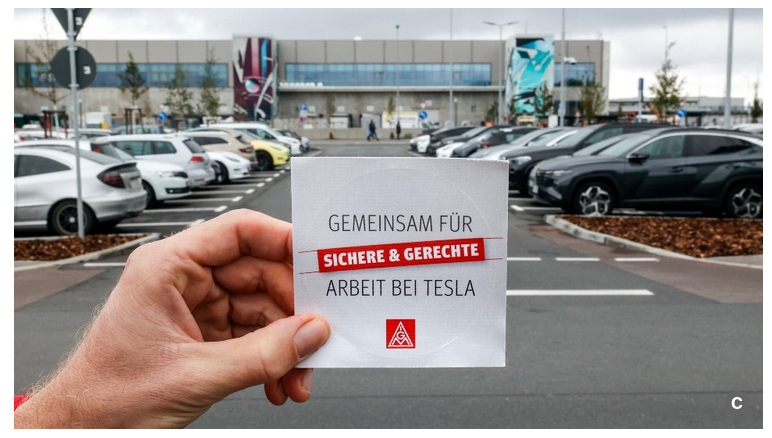
Furnished with selfishness, arrogance, and a capacity to bully, Tesla’s boss is a fitting example. Before the works council election, Tesla’s management threatened workers with “plant expansion or the trade union.” Yet Tesla plans to expand its so-called Gigafactory in Grünheide while operating aggressively against the union.
There are about 400 workers in battery production, with at least 100 more to be added. Yet management arrogantly announced: “We have never negotiated with IG Metall and will not do so in the future.” Plant manager André Thierig added that he could not imagine expansion if the majority voted in favor of IG Metall. Meanwhile, German carmakers produce around four million cars under collective agreements with IG Metall. It seems to work.
Workers, the union, and Tesla have been locked in conflict for years. Until recently, Tesla’s authoritarian management largely had the upper hand — capitalism over people, nothing new. In the last works council election, a pro-management list won a majority.
Workers will vote again in March 2026. Tesla’s macho management style remains openly hostile to democracy — though capitalism has never been synonymous with democracy. “Democratic management” remains a tautology.
Increasingly, workers might see through that. Meanwhile, manipulating works council elections and the preparation for the election “can” constitute a criminal offence. As Katharina Pistor explains in her seminal masterpiece “The Code of Capital” the law is here to create wealth and inequality. It is hardly here to help workers. It is just as Nobel Prize winner, Anatole France, said 100 years ago:
“The law, in its majestic equality,
forbids rich and poor alike
to sleep under bridges,
to beg in the streets,
and to steal their bread.”
Yet, manipulating works council elections can constitute a criminal offense. Yet courts appear slow to act. A lawsuit by IG Metall against the works council chair has been pending for a year and was postponed beyond the election date.
With labor law proving ineffective, electing a new works council is seen as a crucial interim step toward achieving a collective agreement at Tesla.
Tesla has retroactively increased wages by 4% as of 1 December 2025 — independently and without union involvement. This remains below industry standards and comes alongside harsh working conditions.
In Europe, Tesla’s sales in 2025 fell by nearly 39%. Increasing competition, especially from China, and a limited, expensive product range are key factors.
At Grünheide, IG Metall aims to win a majority in the works council. That would strengthen its position in pushing for better working conditions and a collective agreement in Brandenburg.
Some consider this the most important trade union dispute in Germany this year. IG Metall currently holds 16 of 39 seats and hopes for an absolute majority.
Tesla boss Elon Musk — the world’s richest person and an outspoken opponent of trade unions — may fear redistribution. After all, if one billion dollars were shifted from his fortune to the 11,000 workers in Grünheide, he would still remain unimaginably wealthy.
Elon Musk, a supporter of extreme right-wing politics and the richest person in the world with a fortune of over $700bn US dollars. Musk is a self-declared opponent of trade unions.
Perhaps he is afraid, workers and IGM could take away, let’s say $1bn – or 0.14% – of Musk’s wealth and give $90,000 to each one of the 11,000 workers slogging away in his Satanic Mill. Musk would be left with just $699bn. An unbearable thought, perhaps.

No comments:
Post a Comment