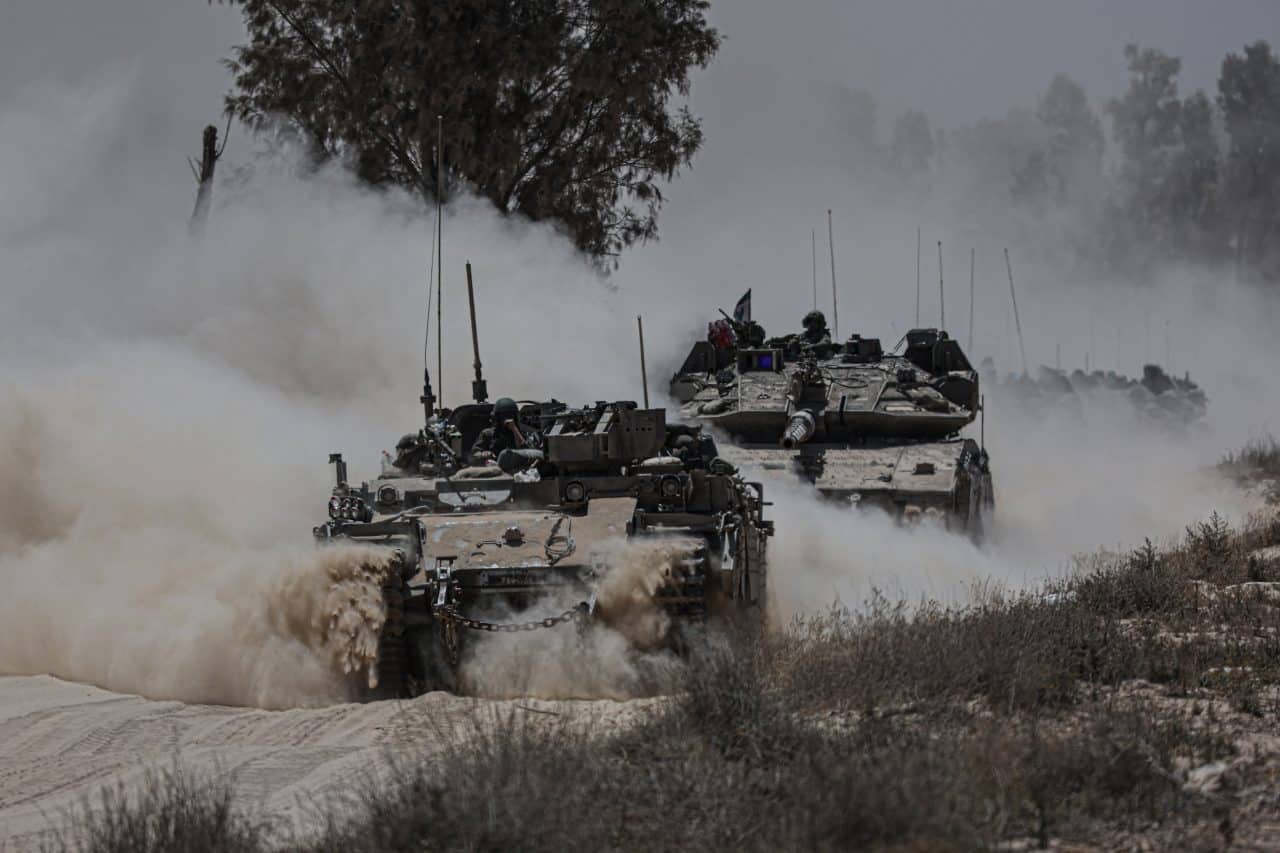
Israelis and some in the Iranian diaspora celebrated when the first blow in the third Gulf war was struck early on Saturday morning, as Iran’s Supreme Leader Ayatollah Ali Khamenei and dozens of other military and political leaders were wiped out.
The Iranian delegations at the talks in Geneva and Oman had just made a substantial offer, according to the chief negotiator, Omani Foreign Minister Badr bin Hamad al-Busaidi. It was to dilute Iran’s entire stock of highly enriched uranium, with independent verification, thus making it unusable as bomb material.
US President Donald Trump responded with war.
The talks had been a sham all along, just as they had been last June, when the US and Israel attacked Iran for the first time.
The CIA had been tracking Khamenei’s movements for months, and the operation had been waiting for the moment when Iran’s top leadership was gathered. On Saturday, it came in two meetings in adjacent buildings – and Israel struck.
As if speaking from the same script, Trump and Israeli Prime Minister Benjamin Netanyahu called on Iranians to take to the streets and rise up against the regime, as they had attempted to do in January.
But that is not what happened. Within a couple of hours, Iran had replied with its first barrage of missiles.
When confirmation of Khamenei’s death came through, Iranians did take to the streets, but they were full of mourners.
There were neighbourhoods of Tehran like Ekbatan, where people cheered from the relative anonymity of their apartments. But there were screams in other parts of Tehran, and plenty who did neither, but feared what was to come.
Regime change
From the first moments it became clear that this war was about regime change, not about Iran’s uranium enrichment or its missiles.
Regime change was the very thing that Trump and the entire Maga movement campaigned against, both before he was elected president for the second time and afterwards.
As a presidential candidate at a speech in Derry, New Hampshire, in 2023, Trump vowed: “We will demolish the deep state. We will expel the warmongers, those horrible warmongers, from our government – those stupid, stupid people. They love seeing people die. We will drive out the globalists.”
As president, Trump said in Riyadh last May: “The so-called ‘nation-builders’ wrecked far more nations than they built – and the interventionists were intervening in complex societies that they did not even understand themselves.”
What Netanyahu has in mind is the destruction of Iran as a regional power. Liberation from autocracy is far down on his to-do list
Now that he has started a major war in the Gulf, he is hard put to explain why. He has cited Iran’s nuclear programme, ballistic missiles, help for the protesters, and regime change.
On Monday, Secretary of State Marco Rubio added a fifth reason, claiming that the US attack was pre-emptive. The US attacked because it knew Israel was poised to attack, and if that happened, the US would bear the brunt of the retaliation.
Was Rubio thus admitting that his commander in chief was led by the nose by Israel into a full-blown Gulf war? Trump sought to dispel the notion on Tuesday, telling reporters at the White House that “if anything, I might have forced Israel’s hand”.
Regardless, Netanyahu has been much more consistent about his desire to deal Iran, which he has called Amalek, a crippling blow.
He has been praying for this day for the better part of 47 years. As prime minister, then as opposition outcast (when I first talked to him), then as prime minister again, he has tried repeatedly to get his military and the US to mount an attack like the one which was launched on Saturday morning, but was rebuffed several times.
Not a time-limited strike, as happened last June, but an all-out war to topple the Islamic Republic.
Dismantling Iran
In his speech on Saturday, Netanyahu was clear about Israel’s strategy. He pointedly addressed Iranians by their ethnicities, not their nationality: “Persians, Kurds, Azeris, Balochs, Ahwazis, and all other citizens of this wonderful nation”.
The bombs that had already fallen by then spoke to the same strategy. They targeted all currents of the Iranian political elite – reformists, leftists, past presidents, as well as the principlists.
Neither Netanyahu’s words nor his actions were aimed at building a new elite that could take over after the fall of the Islamic Republic. Both were intended to permanently disable Iran by turning it into a weak confederation of ethnic cantons, just as Israel has tried, and so far failed, to do in Syria.
“Take your destiny into your own hands,” Netanyahu said. “Hold your head high, look to the skies; our forces are there, the pilots of the free world, all coming to your aid. Help has arrived.”
Instead, Iranian citizens have seen the pilots of the free world bombing a school and killing 180 people, most of them young girls and boys, while also attacking hospitals and most major cities.
Israel is setting about dismantling the cities of Iran in the same way that it has levelled Gaza, or parts of southern Lebanon and Beirut. As a consequence, the casualties of “pinpoint” bombing have soared to more than 750 deaths in Iran in just four days.
What Netanyahu has in mind is the destruction of Iran as a regional power.
Liberation from autocracy is far down on his to-do list. There has been no postwar planning. Minimal thought has been given to what sort of regime could replace the Islamic Republic if it falls, and what real popularity or following any Iranian political figure or movement in the diaspora has inside the country itself.
The destruction of Iran as a regional power is part of a bigger plan that would accommodate and sustain two words increasingly on the lips of Israeli leaders of all political shades: Greater Israel.
Alliance with India
It is no coincidence that in the immediate run-up to this attack, the US ambassador to Israel, Mike Huckabee, said to Tucker Carlson that it would be fine if Israel took all the land from the Nile to the Euphrates. Or that Israel’s opposition leader, Yair Lapid, immediately agreed.
“I support anything that will allow the Jews a large, broad, strong land and a safe haven for us, our children and our children’s children. That I support,” Lapid told a Kipa News reporter, noting that Israeli territory could expand as far as Iraq.
It is also no coincidence that shortly before launching this war, Netanyahu rolled out the red carpet for Indian Prime Minister Narendra Modi.
This is the dream that Zionists of many hues have harboured for decades: that Israel will one day run from the Nile to the Euphrates
My colleague and author of Hostile Homelands, Azad Essa, says that Delhi has emerged as Israel’s strongest non-western ally. “There is strategic cooperation and ideological convergence between the two, which actually strengthened during the course of [the Gaza] genocide,” Essa said, noting that on his recent visit, Modi promised to allow 50,000 more Indian citizens to work in Israel in the coming years.
“India would bring a combination of economic scale, market access, labour, and technological expertise to such an alliance. In many ways it already has,” he added. “India is already co-producing weapons with Israel, meaning that it is being primed to become a factory for Israel. India will therefore back up Israeli shortfalls and become a form of labour replacement for Palestinians.”
The second point about this war is its timing.
Netanyahu calculates correctly that Israel will never again have a US president as pliant and easy to manipulate as Trump. No Republican or Democrat will ever be as friendly to Israel as Trump and his predecessor, Joe Biden, have been. The genocide in Gaza has seen to that.
But Trump’s second term has already gifted Israel a prize of much higher value than the US recognition of Jerusalem as the capital of Israel, or the annexation of the Golan Heights, the gifts of his first term. Trump has now gifted Israel Washington’s blessing to expand its borders to any land it can control, whether in Lebanon, Syria, Iraq or Egypt.
This is the dream that Zionists of many hues have harboured for decades: that Israel will one day run from the Nile to the Euphrates.
New reality
This is thus the time not just to crush the Islamic Republic and shatter its regional network into shards, but to use this vacuum to expand Israel’s control over the region as a whole.
Iran as a regional power is the last and only obstacle to Netanyahu realising his dream of expanding Israel’s borders and establishing a new international alliance – his so-called hexagon of states – with India as its eastern wing, and Somaliland as its southern tip.
This alliance would underpin Israel’s position as the regional military hegemon, with air bases all over the region. The major Arab states whose support for Israel will never happen without a Palestinian state would be forced to accept a new reality: a diminution of their territory and sovereignty, as in Syria today and Lebanon tomorrow.
With support from India in place, Israel would become less dependent on its umbilical cord of funding, arms and political support from Washington. The future of this relationship is in any event far from guaranteed, if US opinion polls are any guide.
Israel knows that the Gaza genocide has destroyed its image as a noble project in the West. The war against Iran is its insurance policy.
The Islamic Republic is now fighting for its life. Its leadership, so often dubbed fundamentalist and reckless, has in reality been far too cautious.
It has realised too late in the day that the war of total annihilation Israel has been waging in Gaza, Lebanon and Syria would arrive on its doorstep. It got suckered into negotiations twice, and each time, the US treated the talks as cover for a military decapitation campaign.
Fatal mistake
Iran’s predicament goes all the way back to how it reacted to the events of 7 October 2023. Iran and Hezbollah’s immediate reaction was to reject the Qassam Brigades’ pleas to infiltrate Israel from the north and start a simultaneous second front.
October 7 was conceived not as a limited campaign to strike an army base in the south, but as the start of a war of liberation. When both Hezbollah and Iran initially refused to get involved, each allowed themselves to be picked off one by one by Israel.
Iran made the fatal mistake of listening to the messaging it and Hezbollah were getting from the Biden administration. It took time for him to react, but when he did, the late Hezbollah leader Hassan Nasrallah called the 7 October attacks by Hamas a “100 percent Palestinian operation”, noting that neither his organisation nor Iran was aware of what was coming: “It has no relation to any regional or international issues.”
By the time he spoke, Hezbollah had already lost 57 men in border exchanges, so it was not doing nothing. But it allowed itself to be gradually sucked into a war of Israel’s timing. Thus Hamas, Hezbollah and now Iran have all been picked off in turn. None of them acted in conjunction with each other.
Belatedly, Iran has learned these lessons. It is now waging a different campaign to the one it fought during 12 days last June.
Then, it concentrated all of its firepower in salvos of rockets towards Israel. Today, Iran’s main targets are the US and its allies in the Gulf.
As the Iranian commentator Trita Parsi posted on X (formerly Twitter): “Tehran has concluded that Israel’s pain tolerance is very high – as long as the US stays in the war. So the focus shifts to the US … Iran understands that many in the American security establishment had been convinced that Iran’s past restraint reflected weakness and an inability or unwillingness to face the US in a direct war,” he noted.
“Tehran is now doing everything it can to demonstrate the opposite – despite the massive cost it itself will pay. Ironically, the assassination of Khamenei facilitated this shift.”
Heavy price
So within 24 hours, Iran has closed the Strait of Hormuz, pounded Dubai, halted Saudi Arabia’s biggest oil refinery and Doha’s production and export of liquefied natural gas. Ships at the mouth of the Gulf are aflame. Most flights have been suspended. Oil and gas prices have surged.
Iranian drones have also targeted a French military base in Abu Dhabi and the British Royal Air Force base Akrotiri in Cyprus. Iran seeks to internationalise Trump’s attack by making it as expensive as possible for the global economy.
If Iran folds, then we can be sure of the devastating consequences across the Gulf. A civil war in Iran has the capacity to send millions of refugees westwards
Under heavy and sustained fire, the Gulf states have – so far at least – avoided escalation. Saudi Arabia, Qatar and Oman had been warning Trump for months not to strike Iran. He ignored their advice, and now they are paying a heavy price.
When US Senator Lindsey Graham boasted that he had got Mohammed bin Salman “on board” for an attack on Iran, the Saudi crown prince was in fact doing the opposite. He told his Gulf neighbours to avoid taking any steps that could trigger a response by Tehran or its proxies and push the region towards a broader conflict.
Riyadh has good reasons for caution. It has maintained a ceasefire with the Houthis in northern Yemen, and they have yet to get seriously involved.
But even after the US bombing campaign last year, the Houthis remain a fighting force, armed with missiles with ranges of 2,000 kilometres and aerial drones with ranges of up to 2,500 kilometres.
So, too, are the Iraqi militias: it was from their territory that drones were launched at Aramco’s oil facilities in Abqaiq and Khurais in eastern Saudi Arabia in 2019.
Redrawing the map
How long the Gulf states can maintain this position is doubtful, as Iran is pushing the whole of the Gulf Cooperation Council up the escalation ladder.
There are two main scenarios now for Iran. Either the US-Israeli bombing campaign will engineer a total collapse of command and control, and the regime will fall – or the regime will retain control and steer the war successfully to a ceasefire.
The killing of Khamenei during Ramadan could in fact be the spark that rejuvenates the Iranian revolution, giving it new purpose. This in itself would constitute victory – because Iran knows that the weak link in this war is Trump himself.
If Iran continues the war for long enough, it will negatively impact Trump within his Maga constituency. It will expose the truth that Israel drafted Trump into a war that neither his backers, nor the US, needed.
But if Iran folds, then we can be sure of the devastating consequences across the Gulf. A civil war in Iran has the capacity to send millions of refugees westwards.
Nor will Netanyahu’s war have ended. Israel is betting on the weakness of the Arab states to defend themselves, and is seeking to weaken them further.
For it is only around the contours of a weakened neighbourhood that Israel can redraw the map of the Middle East and institute a new Sykes-Picot.
Then, it is only a matter of time before Netanyahu declares Turkey to be Israel’s next Amalek.

As a political-cultural geographer who has long been an antiwar organizer and studied the history of U.S. military interventions, it’s clear that the war on Iran could set into motion a regional conflagration, the violent break-up of Iran into ethnic enclaves, and a toll that would make the Iraq War look like a warm-up exercise.
The U.S. role in the Mideast began with the 1953 CIA coup that toppled a democratically elected government that had nationalized the oil industry for the benefit of its people, replacing him with the dictatorial monarch Shah Mohammad Reza Pahlavi, whom the U.S. backed with both weapons and nuclear technology. It’s in Iran that the U.S. regional domination began, and where it might confront the hardest obstacles, at home and abroad.
Most Americans concur with the country singer Alan Jackson, who sang in 2002, “I’m not a real political man… I’m not sure I can tell you the difference in Iraq and Iran.” But Iran has always been more geographically pivotal than Iraq, in land area, population, and economics. It was one of the few countries that retained independence through the colonial era, and one of the only Third World societies to keep control of its own resources.
Ever since the 1979 Iranian Revolution and seizure of hostages in the U.S. Embassy, Washington has sought to topple the Shi’a revolutionary government in Tehran. That moment was when the demonization of Muslims replaced anti-Communism as the main selling point for military interventions. I remember seeing U.S. sailors in the Philippines 40 years ago sporting t-shirts that read “I Got My Tan off the Coast of Iran,” and a string of U.S. bases with 40,000 troops has encircled Iran since then, now in Kuwait, Bahrain, Qatar, UAE, Israel, Saudi Arabia, Iraq, Jordan, Syria, Turkey, and Oman (all but the last two are now under Iranian missile retaliation).
The U.S. has already been at war with Iran, during the Iran-Iraq War. In 1987-88, the U.S. Navy actively sided with Saddam Hussein in his war with Iran, by escorting tankers carrying Iraqi oil, attacking Iranian boats and oil rigs, and “accidentally” shooting down an Iranian civilian jetliner. This war with Iran is continuation of a long-simmering conflict.
U.S. and Israeli threats have also encouraged a siege mentality among Iranian leaders, who repeatedly used them as a rationale for cracking down on internal dissent. The hardliners in Washington, Jerusalem, and Tehran have always reinforced and fed off of each other, and to create fear to build their own internal power and legitimacy.
Trump and Netanyahu may have thought the Sunni Gulf States, which have long been at odds with Iran, and the Iranian people would side with their current drive toward regime change. But it has had the exact opposite effect last year, causing stronger Muslim solidarity and rallying Iranians around the flag, even many who had protested and been imprisoned by the ayatollahs but don’t want a new Shah or other foreign puppet ruler. Much the same happened in Germany in World War II, when Allied fire-bombings that targeted civilian neighborhoods may have prevented internal dissent from growing.
Escalation beyond air war
Both the Iraq and Iran wars were justified with lies about weapons of mass destruction, lies told by the nuclear-armed states of the U.S. and Israel. But attacking Iran is far more disastrous than attacking Iraq. It will scuttle any chance of political reforms in Iran or regional agreement around Palestine. Iranian forces could block global oil lanes in the narrow Strait of Hormuz shipping chokepoint, clash with U.S. naval forces in the Gulf, or melt into an insurgency far deeper and longer than in Iraq. Trump’s War will be a self-fulfilling prophecy, because it could stimulate the terrorism and weapons programs it claims to oppose. If Russia takes the unlikely step of getting involved, it could even lead to World War III.
Yet in four decades of conflict, Iran has never sponsored an attack within the U.S., even as the U.S. has attacked its allies in Lebanon, Iraq, Syria, and Yemen, and directly attacked its own forces in the Gulf. Only Sunni terrorists (also opposed by Iran) have attacked targets in the U.S.
All our recent wars, such as in Iraq, began as bombing campaigns, but as they met resistance or retaliation, led to boots on the ground. Unlike Iraq, the U.S. has limited options to invade Iran. Iraq had largely flat terrain, and so has been repeatedly invaded by foreign armies. Iran has natural defensive barriers in its mountain ranges, and a political advantage in having complex neighbors that may not be willing to host invading forces.
Part of the neoconservative agenda for occupying Iraq was to have a staging area for regime change in Iran, but that is no longer possible. Ground forces invading Iran from Kuwait would have to pass through a slice of Iraqi Shi’a territory. An invasion from Pakistan or Turkey would be politically untenable.
These limited options means that a U.S. ground invasion of Iran is very unlikely, so there would not be a repeat of the 2003 Iraq invasion, followed by an occupation of the entire country. That’s why it may be dangerous for the antiwar movement to warn that an Iran War would be a repeat of the Iraq War, with massive U.S. casualties and a legacy of combat injuries and PTSD. During the Vietnam War, facing huge protests because of bodybags coming home, President Nixon switched from a ground war to an air war, reducing U.S. troop casualties, but vastly increasing civilian casualties. Already, reports are that an Israeli strike on a girls’ school has claimed at least 165 lives.
President Bush employed a similar strategy in the 1991 Gulf War, sanitizing air strikes on Iraq as a detached video game. Clinton’s 1999 air war on Serbia and Obama’s 2011 air war on Libya were the first time in human history that a one side in a major war had zero deaths by enemy fire. Trump has inherited these technological tactics of imperial impunity. If the antiwar movement mainly emphasizes the possibilities of U.S. military casualties, it only plays into the Pentagon’s hands and reinforces high-tech warfare that claims even more civilian lives.
Ethnic divisions for an oil grab
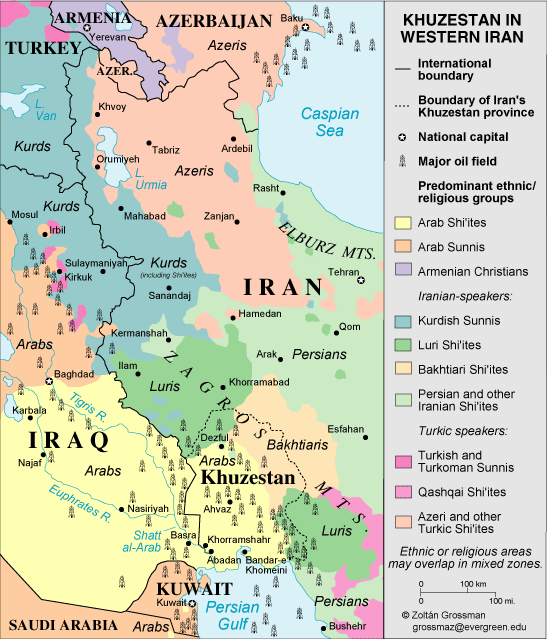
But there is one scenario that I fear could lead to boots on the ground in Iran. Watch for the U.S. and Israel again stoking ethnic divisions in the diverse country, where ethnic minorities form more than 40 percent of the population, such as Azeris and Kurds in the northwest, Baluchis in the southeast, and Ahwazi Arabs in the southwest, who have been oppressed by both the Shah and Ayatollahs. The most dangerous sign would be encouraging a rebellion in the province of Khuzestan, called “Al Ahwaz” by its Arab inhabitants.
Netanyahu today exclaimed, “The time has come for all segments of the Iranian people – the Persians, the Kurds, the Azeris, the Baluchis, and the Ahwazis – to throw off the yoke of tyranny and bring about a free and peaceful Iran.” Yet at the same time, Israel backs the Shah’s son Reza Pahlavi as a future ruler, who would not be welcome by the ethnic minorities that his father severely repressed, nor by most Persians living in Iran.
Two decades ago I wrote about the possibility that the U.S. would use an uprising as an excuse to occupy Iran’s oil-rich Khuzestan province (next to southern Iraq), with a so-called “humanitarian” rationale of protecting its ethnic Arab population from “ethnic cleansing.” Instead of occupying all of Iran, U.S.-allied forces could take control of the plains of western Khuzestan, where about 85% of Iran’s crude oil deposits are present, and hold the oil industry hostage for its demands.
The Arab Shi’as living on the plains of western Khuzestan share both their ethnicity and faith with the Arab Shi’as across the strategic Shatt al-Arab waterway in Iraq. Arabs make up only 3% of Iran’s population, but a plurality of about 3 million in Khuzestan. In 1897, the British Empire backed Ahwazi Arab rulers to secede from Persia and become the de facto British protectorate of “Arabistan” (much as the British did in neighboring Kuwait). The southern zone of Persia was declared a British “sphere of influence” in 1907, and the following year a British adventurer discovered oil at Masjed Soleyman in “Arabistan.” The discovery created the Anglo-Persian Oil Company, later renamed British Petroleum (BP). In 1925, Reza Shah’s forces retook “Arabistan,” and renamed it Khuzestan, as he renamed “Persia” as Iran a decade later.
British troops occupied Khuzestan during World War II, but after the war Iranians grew more concerned that Westerners had a stranglehold on their oil wealth. In 1951, the Iranian nationalist leader Mohammed Mossadegh nationalized the oil industry based mainly in Khuzestan (including Anglo-Iranian’s holdings), resulting in the 1953 coup that installed the Shah.
In 1978, Arab oil workers in Khuzestan went on strike against the Shah, and played a central role in the Iranian Revolution that toppled him the following year. They supported the revolution in its early months, when it included leftist and other secular parties (that were later crushed by the Islamic Republic). Encouraged by Western powers that were threatened by the revolution, Saddam Hussein launched a brutal invasion of Khuzestan in 1980, and occupied its western Arab oil region. He tried to engineer the secession of the province from Iran, and backed an Arab separatist rebel group (which also briefly seized the Iranian Embassy in London).
Yet in the Iran-Iraq War, most Iranian Arab Shi’ites fought on the side of Persian-ruled Iran, just as Iraqi Arab Shi’as fought on the side of Saddam’s Sunni-ruled Iraq. State territoriality trumped both ethnic and religious territoriality, in a massive slaughter. Iranian forces pushed the Iraqis out of Khuzestan in 1982, but the province’s cities and oil refineries were the most heavily damaged in the war, that finally ended in 1988.
My color map makes it clear that Khuzestan contains Iran’s largest oil reserves. In a 2008 New Yorker article, journalist Seymour Hersh exposed CIA assistance to Ahwazi Arab and other ethnic insurgents, later advocated by John Bolton, and a CIA analysis declassified in 2013 referred to Khuzestan as “Iran’s Achilles Tendon.” Tehran’s repression of Ahwazi Arab rights protests and separatist attacks stepped up in 2005, 2011, and 2018, and have recently been increasing again, so the possibility again exists of the U.S. exploiting their legitimate grievances for its own interests. The ethnic break-up of Iran would make the 1990s shattering of Yugoslavia into seven countries look like a cake walk, and would unleash regional violence that would reverberate for decades.

Even if ethnic minority grievances against Persian rule are legitimate, the timing of western interest in their grievances coincides too neatly with the larger desire to pressure and isolate Iran. Washington has a long history of championing the rights of ethnic minorities against its enemies (such as in Montagnards in Vietnam, Hmong in Laos, Miskitus in Nicaragua, and most recently Kurds in Syria), then abandoning or selling out the minority when it is no longer strategically useful. We love ‘em, we use ‘em, and then we dump ‘em.
Stopping this war
On one hand, Netanyahu pressured Trump on the timing of this particular attack. Netanyahu needs to avoid prosecution and feared the stability of an Iran nuclear deal, just as Trump needs this war to divert attention from the Epstein files. But on the other hand, Israel has always served as a U.S. aircraft carrier carrying out U.S. aims of controlling the economy of the oil-rich Middle East, doing our dirty work of preventing and crushing revolt.
The American public has developed a healthy “Iraq Syndrome” that abhors endless wars, much as the “Vietnam Syndrome” temporarily scaled back U.S. military interventions. Even though Iran is very different from Iraq, that strong public sentiment previously prevented both Obama and Trump from attacking Iran. This war is less popular than even the 12-day war last year, across the political spectrum.
This time, a clear majority of Democrats, Republicans, and Independents felt we should have stayed out of this war, so we start with far stronger support than in any war in living memory. At the same time, a clear majority opposes sending ICE and soldiers into our cities. The growing high school walkouts opposing the war at home could incorporate military counterrecruitment to slow youth enlistment into wars abroad. We have a responsibility to support veterans in groups such as About Face and Veterans for Peace, who are telling the truth to military personnel and their families, and support military personnel on their inevitable grievances, and when they refuse illegal orders or quietly frustrate the expansion of wars at home and abroad.
But to be effective, the movement has to focus on the horrendous effects of such a war on civilians, and not only on U.S. troops. And it should understand that this war may unfold in unpredictable ways that differ from previous conflicts. Just as “generals always fight the last war,” antiwar movements will lose if we merely fight against the last war.
Just as the Iranian people have a long, proud history of fighting against monarchy and theocracy, Americans are now facing a new monarchy and new theocracy at the same time. We should understand that tyrants like Trump always turn to war abroad to crush internal dissent at home. He is joining with messianic fascist allies like Netanyahu and Putin to stoke a religious nationalist crusade that will bring only suffering to civilians abroad and repression at home. It’s not just the future of the Middle East that’s at stake, but our own future as a democracy. The old saying is that Truth is the First Casualty of War. Now we can turn that around to say that war should become a casualty of the truths that we tell about our country, and at long last we need to pull back from dominating other peoples to take care of all people in our own country.

War With Iran: Resist What?

You get focused to resist and the target moves. It doesn’t just move. It morphs. Should you set aside one focus to pick up another? Or you get focused to resist and the target moves. It doesn’t just move, it morphs. Should you hang on to your valid, important focus and ignore distractions?
It is hard to play whack a mole with a morphing mole. Worse, it is self-defeating to do so. It is what Trump wants. As he moves chaotically he wants us to also move chaotically.
But, the new target, war on Iran, is so grotesque you might say that, “I must refocus. I must chart a new course.” Or, instead, you might say, “My old target is so grotesque. I must maintain my focus. I must maintain my course.”
And then you may say, “My head hurts and I feel so powerless.”
A simple truth, hard to abide, is that we need to see the forest, not just the trees. Yet, we also need to address the trees, not just the forest. What?
No Kings offered a possible answer. Focus on the orange one. He is the forest. Stick with that. The whole of it. But that has problems.
First, the trees keep growing. Misogynist and racist slurs and violence. Executive orders destroying social programs. Tariffs taxing the poor. Arrests and deportations fascistically violating rights. Profit seeking growth trampling ecology. Voter suppressions entrenching authoritarianism. Wars killing, killing, killing. The carnage persists. Each mole is too big to be stopped by the subset of us that pick that mole to focus on.
Second, if continuing as we are, we do remove Trump, ghost Trump, totally end Trump, we may sensibly celebrate that achievement but settle for pre-Trump business as usual. Back to an awful past. Back to the future.
So how do we unify to be sufficiently strong against the whole forest, yet also diversify to be strong against the trees? And how do we defeat Trump to roll back Trumpian fascism but also persist beyond Trump to win a new society?
There are big questions which, however, we ought not put off answering until it is too late for our answers to matter. Beyond No Kings, what is we do a little of our own morphing? Beyond No Kings, how about if our touchstone is no polity punishing people. No economy erasing people. No families fracturing people. No schools stultifying people. No health care harming people. No countries crushing people. One big movement. And how about that that movement has parts, of course, that focus mainly on Trump’s morphing moles, but where each such part emotionally and materially supports all the other parts? Anti-ICE supports anti-tariff. Anti-tariff supports anti-misogyny. Anti-misogyny supports anti-censorship. Anti-censorship supports anti-big pharmaceutical. Anti-big pharmaceutical supports anti-war. And so on. All of them and more form a circular mutual aid relationship. And all of them emphasize the positive—not only what they are against, but that they want. Not just anti but also pro. One big movement of mutually supportive movements.
Might those steps end Trump, advance many entwined agendas, and also continue on beyond all that to keep on pushing to end racism, sexism, authoritarianism, classism, ecological insanity, and war in all its forms?
Might to attain one big movement of mutually supportive movements be a convincing answer to the big questions? Might we then unify and also diversify consistent with whacking the many moles, removing the mole master, and also producing instead of pre-Trump business as usual, a new world that is both possible and worthy?


2 Comments
Hi Nekto,
I write a 600-word article, perhaps the shortest I have written in fifty years, trying to briefly address feelings of angst, frustration, confusion, and you reply that it is vague. Is that helpful?
And yet, despite its brevity the article does make two main strategic points. To have an effective movement we need to overcome fragmentation. Different strands need to mutually aid one another, not silo from others, much less take potshots at others. Do you disagree? And second, we need to have a positive, not just negative messages. DIsagree? What I find disconcerting is how many serious, committed, and highly informed opponents of this war, and of fascism, can write five times or even ten times as many words without talking to their audience’s doubts and concerns, and without offering any meaningful strategic proposals.
I am trying to communicate a message to, what, maybe 8 million, we can hope 10 million or more who will join the No Kings demonstrations in a couple of weeks – and, if that audience isn’t wishful thinking enough, to I suspect tens of millions more holding back, but potentially joining.
You want a pro-socialist mass movement to rise up. Great. What is that? In the world of social struggle, there are few words as vague as the phrase pro-socialist. I try to make what that may be, even what I think it ought to be, evident, albeit not in every article.
Does to speak of people who actually do use the term socialism about themselves and who talk to millions, unlike you and I, and albeit without the clarity and meaning that I and I think you probably feel we ought to seek—dismissively, as if their efforts are worth little or nothing, strike you as a way to help with the tasks we face?
Dear Michael,
With this vague agenda, the Left will surely lose. Even though it reminds “a thousands of cuts” strategy, in reality it’s a handful of mosquito bites. If you talk about a movement, it should be something of the size and influence of LFI in France. Only this kind of opposition can possibly prevent our accelerating transition to autocracy. Unfortunately, we cannot rely on the power of organized labor. Yes, a general strike advocated by Kshama Sawant (https://www.counterpunch.org/2026/02/16/we-need-a-general-strike-to-stop-ice-terror/) is a powerful weapon, but even this (which in itself is a big ?) will not turn the tide. Yes, Democrats will probably win the next elections and, possibly, elect a handful (at best) of progressive candidates, who will follow Sander’s and AOC’s liberal, social-democratic agenda. And all their efforts will be conveniently blocked by a few conservative Democrats as usual. This is an old game. Unless the true, pro-socialist left organize independently while there still is an opportunity to do so, and the electoral victory of the Democrats gives a good chance to do it, the Left in this country will share the fate of the Left in Russia or maybe in China. What are you waiting for?