Transparency of the Epstein files is Mere Bragging Unless There is Accountability
Releasing the Epstein Files, without holding the exposed individuals and institutions accountable, will embolden rapists and pedophiles. Transparency alone is not justice. If we don’t hold these monsters accountable, we will have allowed them to brag to all the world that they got away with rape, pedophilia, and human trafficking.
Transparency without accountability tells victims, “We hear you. We see you. But, this is normal and acceptable.” It sends the same message to perpetrators: We hear you. We see you. This is normal and acceptable.
Transparency without accountability teaches abusers that secrecy is not necessary. Impunity is already protecting them. It emboldens them to continue or even escalate their abuse. It also emboldens other potential perpetrators, reassuring them that, even if they’re exposed, their abuse will be excused or ignored.
Over time, this becomes normalization. Without accountability, transparency makes powerful networks of sexual exploitation a fact of life rather than an urgent crisis demanding action.
Calls to expose Epstein and his accomplices have existed for decades. In 2008 Jeffrey Epstein pled guilty to “soliciting prostitution with a minor,” and served just 13 months of an 18-month sentence as part of a controversial plea deal. Immediately following this case, victims requested the details of the deal be made public.
Since then, victims, the press, and the public have continued to call for transparency. Recently, calls for transparency have escalated to Congress with the Epstein Files Transparency Act. Despite the law’s passage in November 2025, lawmakers and investigative reporting say millions of files have not been released. What has been published has been controversially redacted.
The yearslong fight for transparency, though noble and necessary, has convinced the public that transparency itself is the final goal. It has turned the Epstein Files into a spectacle. A constant. Even a meme. Something normalized, diluted, and easier to dismiss.
We have seen these tactics before. The Panama Papers, a scandal exposing financial corruption by the wealthy and elite, followed the same pattern: a yearslong demand for transparency, then a flood of revelations so overwhelming that the spectacle of exposure overshadowed the fact that a majority of the powerful people involved never faced accountability.
The same dynamic happened with the Catholic Church’s sexual abuse crisis. The awe and shock consumed public attention, obscuring the lack of real consequences for many perpetrators and structural change that never came. In both cases, a handful of low-level individuals were punished to prove that “something was done,” while powerful decision-makers and the systems that enabled abuse were protected.
Scapegoats are not justice. Without real change, the harm continues. People are still taking advantage of the offshore financial system and sexual abuse continues in the Catholic church. If we are not careful, the Epstein Files will join the Panama Papers and the Catholic Church as another case study in transparency without impact.
Transparency is a diagnostic tool. A direction to go. Not a cure. Not a solution. It tells us where to act, not whether we will do so.
Real change requires a collective agreement that what has been exposed is so grave that individuals and institutions must be held accountable, in spite of the disruption it will cause the status quo, money, and power. So, I ask you, is the abuse, pedophilia, and exploitation exposed in the Epstein files grave enough? If so, we need a clear path to accountability for those named and a clear path to dismantling the systems that enabled this abuse.
First, the focus must be on Epstein survivors. We must listen to their demands by enforcing full compliance with the Epstein Files Transparency Act. We must also demand immediate accountability for the Department of Justice (DOJ)’s failure to redact victims’ identifying information and explicit photos, as legally mandated, exposing them to danger, retraumatization, and further harm. To start, the DOJ must immediately redact all sensitive information and should be ordered by the courts and/or Congress to issue a public apology to victims.
Second, we must demand full investigations into every individual and institution that participated in or enabled Epstein’s network of abuse, regardless of their positions of power or fame. For years, law enforcement agencies investigated Epstein and Ghislaine Maxwell, his since-convicted accomplice, compiling evidence that would become the Epstein Files: flight logs, photos, physical evidence, emails, phone records, and victim testimony. These millions of documents exposed hundreds of people, from simple enablers to willful abusers.
The DOJ should have investigated and prosecuted those implicated in the files decades ago. Congress must force the DOJ to take action against everyone implicated, beyond Epstein and Maxwell. The DOJ only released the files once they were required to by Congress. Transparency was forced. Now justice must be.
Third, the United States must follow the example of other countries, where prominent officials have been fired, forced to resign, or stripped of their titles after their ties to Epstein were revealed. Abroad, people exposed in the files have faced criminal charges and other consequences. Power has not obstructed accountability elsewhere. It should not do so here.
Finally, we must demand structural change. Congress should launch probes into government agencies, including the FBI and the DOJ, that failed to stop this abuse and force them to implement new procedures to prevent future harm. We cannot repeat the failures of the Panama Papers or the Catholic Church, where a few individuals were removed while the architects of harm remained untouched.
Transparency without accountability is bragging. Transparency without change is dangerous. Our fight is not just to expose the truth but to act on it. Exposure without consequences is not transparency. It is permission.
Do the Epstein files show he was working for Russia or another intelligence agency?
From internet users to US lawmakers, speculation abounds regarding convicted sex offender Jeffrey Epstein's ties to intelligence agencies. Questions about his links to Russian elites have come to the forefront following the release of the latest batch of files.
The latest tranche of the Epstein files has raised questions about the disgraced financier's ties to the world of intelligence, prompting mass online speculation about his links to the US CIA, Israel's Mossad, and Russia.
Following the release of the documents, Polish Prime Minister Donald Tusk announced a wide-ranging investigation into child sex offender Jeffrey Epstein, including a probe into his possible links to Russian intelligence.
While the files offer an insight into Epstein's contacts with high-level Russian figures — some of which have intelligence ties — and show that he tried to arrange a meeting with President Vladimir Putin, they do not contain any direct evidence that he worked for a foreign government.
However, Epstein's behaviour and actions, which included setting up video cameras in his home to record people in compromising situations, have raised parallels with the methods employed by Russian intelligence.
This led to mounting theories that he collected material on the rich and powerful to blackmail them, material known as "kompromat" in Russian.
Euronews' fact-checking team, The Cube, breaks down exactly what the Epstein files reveal about his connections to politicians and officials.
Russia emails: What the files show
The files show that Epstein sought to cultivate ties with influential Russian figures, including Sergei Belyakov, a graduate of Russia's Academy of the Federal Security Service (FSB) and a former deputy economy minister.
In 2014, Belyakov became chairman of the annual Russian business forum known as the St Petersburg International Economic Forum.
According to journalist and author Craig Unger, who has extensively researched the links between Russia and certain US figures, the event can be described as "Russia's Davos", in reference to the World Economic Forum.
"It was considered the 'Super Bowl' of honey traps," Unger, who also believes that President Donald Trump is a Russian asset, told The Cube. "A lot of billionaires and world leaders would show up there, and so would a lot of young women who were there to participate in the honey trap. Epstein was tied in with that."
There is little evidence in the files that Epstein attended the St Petersburg forum when Belyakov was chairman. However, one email from 2015 reportedly shows former Israeli Prime Minister Ehud Barak — who Epstein knew well and who served from 1999 to 2001 — detailing his meetings at the forum, including with Russian Foreign Affairs Minister Sergei Lavrov.
A follow-up email shows Barak thanking Epstein for "setting the whole thing together".
In one exchange from 2015, Epstein asked Belyakov to collect information on a Russian woman he alleged was trying to blackmail a prominent US businessman.
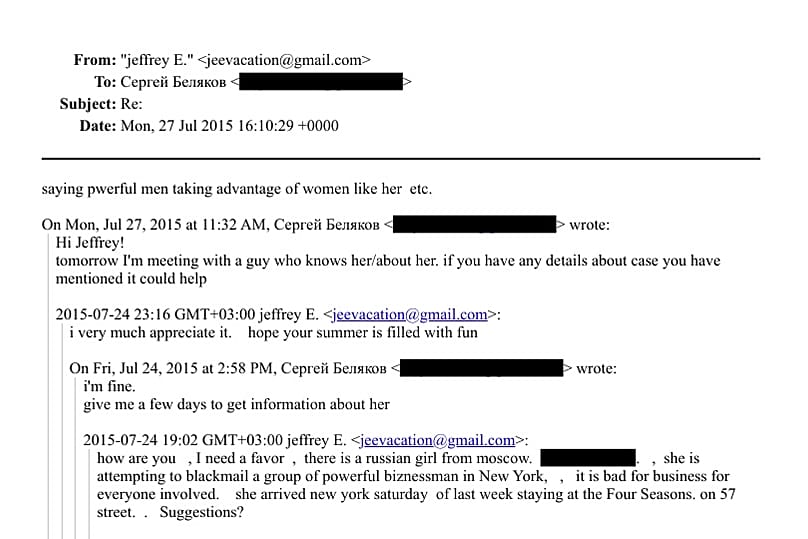
Belyakov provided Epstein with a description of the woman's background, detailing her "sex and escort" activities while highlighting her "business problems", which he speculated could be behind her blackmail attempts.
In another email, which Epstein appears to have sent to himself and in what could be a draft response to the woman, the disgraced financier told her that he had consulted "some friends in the FSB" who said she would be "dealt with extremely harshly" if she continued to threaten US businessmen.
In other instances, Belyakov and Epstein also discussed women, with Epstein suggesting that Belyakov look into hiring "pretty women" as English-speaking editors for his business proposals in 2016.
Epstein also appears to have introduced Belyakov to powerful figures, including US businessmen Peter Thiel and Thomas Pritzker.
Belyakov was not the only high-profile Russian in Epstein's orbit. Other documents show that Epstein met with Vitaly Churkin, a former Russian diplomat who served as the country's representative to the United Nations. Epstein also appears to have arranged an internship for Churkin's son.
It wasn't just male contacts that he targeted, either, according to Unger.
"You also have to look at the women who worked for Epstein, many of whom were tied to Russia," he told The Cube. "Maria Bucher [née Drakova], a Russian woman who had been the head of Nashi, Putin's Youth Movement, worked as a publicist for Epstein when she moved to the US."
"Vladimir Putin has previously said that whoever runs artificial intelligence will run the world," Unger added. "Epstein was reaching out to a lot of figures in that world, such as Elon Musk and Peter Thiel, for whom she was one of the intermediaries."
Nevertheless, there is no evidence that Bucher was a spy for Russia.
In pursuit of Putin
Alongside his contact with Russian officials, the files largely show that Epstein repeatedly attempted to get in touch with the Russian government and Vladimir Putin, whose name appears in the files more than 1,000 times.
Epstein attempted to contact Putin through a string of different contacts, who included Norway's former Prime Minister Thorbjørn Jagland.
In May 2013, Epstein told Ehud Barak that Jagland was "going to see putin in sochi." [sic]
Epstein said that he had never met Putin but that he had been asked to meet him "to explain how russia can structure deals in order to encourage western investment."
In a separate email, Jagland told Epstein that he would inform Putin that Epstein was a useful contact.
In 2018, Jagland emailed Epstein about arranging a stay at his Moscow residence, where he planned to meet Putin and Lavrov.
"I'm just sorry I'm not with you to meet the Russians," said Epstein.
There is no evidence in the documents that suggests that Epstein successfully managed to meet Putin in person.
In response to the mass of allegations, including that Epstein was some sort of Russian asset, the Kremlin stated that it did not want to waste time answering questions on the matter, with Kremlin spokesman Dmitry Peskov stating in February, "I would like to joke about such versions, but let's not waste our time."

'Asset, not spy'
Nevertheless, despite a lack of evidence that Epstein was a spy, some say there are grounds to believe that he was indeed a Russian asset.
"I would think he's an asset, not a spy," Unger told The Cube. "An agent or spy is employed by an intelligence agency. He or she would receive a regular pay cheque. They could be tasked with specific operations."
"An intelligence asset is someone who's a trusted contact, you do favours for them, they do favours for you," he added. "Epstein had ties to Russian intelligence, he had ties to Israeli intelligence, and he worked with them, but in the end, I think he was serving himself."
US lawmakers have also weighed in on the speculation with a range of contradicting claims. Some believe that Epstein was a spy, with Republican Congressman Thomas Massie alleging that the reason the Epstein files have not been released in their entirety is due to his ties with US and Israeli intelligence.
Speculation about Epstein's Mossad ties was fuelled by an FBI memo from 2020 included in the files, which said that a source was convinced Epstein "was a co-opted Mossad agent" who "trained as a spy" for Israeli intelligence.
Epstein's long-term friendship with Israel's former Prime Minister Barak, the details of which became clear in the files, also raised questions.
The pair maintained regular contact, while Barak visited the disgraced financier's Manhattan apartment multiple times and travelled to Epstein's private island in the US Virgin Islands once. The documents also reveal that Epstein was in touch with Barak’s long-term aide Yoni Koren.
Israeli Prime Minister Benjamin Netanyahu has firmly rejected theories that Epstein worked for the Mossad, instead suggesting that the revelations prove "the opposite" and accusing him of working to "undermine Israeli democracy" to "overthrow the elected Israeli government".
Netanyahu's comments were sparked by exchanges in the files, which showed that Barak consulted Epstein during his 2019 campaign for Israel's parliamentary elections.
Theories about Epstein working for intelligence agencies may have blown up with the release of the files, but they are, in fact, long-standing.
Speculation has been fuelled by suspicious and conflicting reports about his 2008 plea deal, longstanding questions about how he amassed his vast wealth despite his humble origins, as well as his connections with convicted sex offender Ghislaine Maxwell, whose father, Robert Maxwell, has been allegedly tied to Israeli intelligence.
US authorities search Jeffrey Epstein's
former ranch
New Mexico prosecutors have reopened a criminal investigation after the release of the so-called 'Epstein files'. At least two women have made allegations of sexual misconduct at the remote property.
https://p.dw.com/p/5A69G

Investigators in the US state of New Mexico on Monday began searching a remote ranch that formerly belonged to the late billionaire sex offender Jeffrey Epstein.
New Mexico authorities previously closed their initial case into Epstein's activities in 2019. But the case was reopened in February because "revelations outlined in the previously sealed FBI files warrant further examination."
"This search is part of the criminal investigation [...] into allegations of illegal activity at Epstein's ranch prior to Epstein's 2019 death," the New Mexico Department of Justice said on Monday.
The department said it "will continue to keep the public appropriately informed, support the survivors, and follow the facts wherever they lead."

What do we know about Epstein's New Mexico ranch?
Located around about 30 miles (48 kilometers) south of Santa Fe, Epstein purchased Zorro Ranch in 1993 from New Mexico's then-governor Bruce King. It was one of several properties he came to acquire including a Manhattan townhouse and a private island in the Caribbean.
Epstein built a private runway on the sprawling acreage along with a hilltop mansion where he was known to host prominent guests.
The ranch was sold by Epstein's estate in 2023, with proceeds going toward creditors. The new owners have cooperated with the search, authorities said.

At least two women have made allegations of sexual misconduct at the property.
One unidentified woman using the name Jane Doe 15 said she was raped at the ranch when she was 15 years old.
Another woman, Annie Farmer, said that said that Epstein's jailed accomplice Ghislaine Maxwell fondled her breasts at the ranch when she was a teenager.

New Mexico Congresswoman Melanie Stansbury said the state's justice department was leaving "no stone unturned" in the search.
"Epstein survivors have waited for far too long for justice and New Mexico is leading the way in the pursuit of truth and accountability," she said in a post on X.
Edited by: Rob Turner
Zac Crellin Journalist and editor based in Germany
The Architect of Shadows: How Epstein Used
Genius As Raw Material
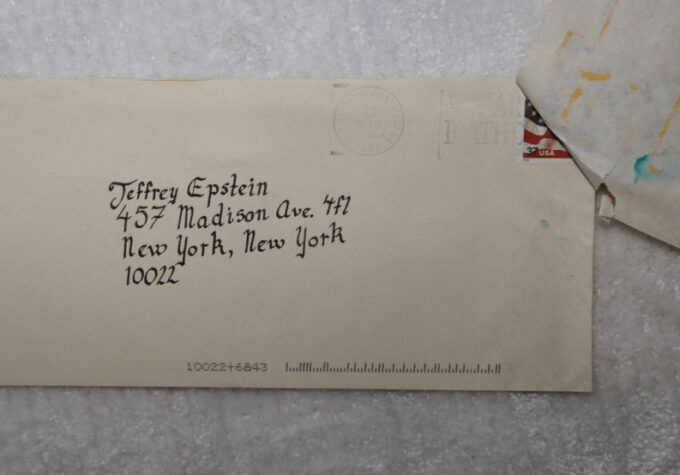
Photograph Source: Federal Bureau of Investigation – Public Domain
I. The Myth of the Senile Scholar
In February 2026, the intellectual left was hit with a curious form of damage control. Valeria Chomsky issued a public apology for what she called a “grave mistake” on behalf of her husband, the 97-year-old Noam Chomsky. She characterized the couple as “careless” and “naive,” depicting an aging philosopher whose “overly trusting nature” brought him into the sphere of Jeffrey Epstein.
The “cancel culture” vultures immediately circled, feasting on the irony of a man who spent his life deconstructing the “manufacturing of consent” while seemingly consenting to the company of a monster. But to dismiss Chomsky as a victim of senility or a hypocrite is to miss the far more terrifying point. A far more intriguing topic to pursue is a look at the specific nature of these relationships. Epstein did not collect people; he collected frameworks.
If we look at his ties to Chomsky and Stephen Hawking, we see that Epstein wasn’t looking for social clout. He was looking for the “source code.” He was looking for a way to hack the human genome, and he knew that these two luminaries held the keys.
II. Chomsky and the Syntax of the Human Machine
To understand why Epstein was so drawn to Noam Chomsky, one must look past the political firebrand and return to the 1950s Pentagon-funded laboratories where modern linguistics was born. Long before he was the conscience of the anti-war movement, Chomsky’s work on Universal Grammar (UG) was being scrutinized by military and academic systems for its potential in automation and artificial intelligence.
The core of Chomsky’s “generative” revolution was the idea that human language is not learned through mere habit but is instead governed by an innate, biological “program” shared by all humans. For Epstein, not only was this a brilliant insight into the humanities—it was a specification sheet for a biological machine.
The Pentagon Connection and the Logic of Control
Critics have often pointed to Chomsky’s early tenure at MIT’s Research Laboratory of Electronics (RLE), which was funded largely by the Armed Services. While Chomsky has consistently argued that his work was pure inquiry, the military’s interest was clear: if you can map the underlying syntax of human thought, you can automate the processing of information.
Epstein, ever the opportunist, saw the flip side of this coin. If the human mind has a “hard-wired” syntax, then that syntax is a vulnerability. By understanding the innate rules that govern how we perceive reality and structure logic, one could theoretically bypass the conscious “will” and interface directly with the biological substrate.
The “Linguistic Brilliance” Genome
The 2026 disclosures regarding the genetic testing kits Epstein sent to the Chomskys suggest a pivot from the “software” of language to the “hardware” of the genome. Epstein was interested in more than what Chomsky said; he was interested in the genetic architecture that allowed a brain to produce such complex structures.
In the “Island Logs,” Epstein reportedly speculated that “linguistic brilliance” was a hereditary trait that could be isolated and “hacked.” Instead of a miracle of evolution, he viewed the Chomskyan framework of an “Innate Language Acquisition Device” (LAD) as a modular piece of biological hardware that could be upgraded, duplicated, or—most disturbingly—engineered.
The Passive Contribution: From Syntax to Suggestion
If Chomsky was “overly trusting,” as his wife’s 2026 apology suggests, it was in his assumption that the “Universal” in Universal Grammar was a shield for human dignity. He believed that our innate capacity for language made us inherently free. Epstein, however, saw that same “Universal” as a master key. By treating the mind as a computational system with fixed rules, Epstein’s funded “behavioral engineering” projects at Stanford and MIT sought to use those very rules to manufacture a different kind of consent—one that was programmed into the syntax of the subject’s own thoughts, thereby influencing their decision-making processes and perceptions of freedom.
III. Hawking and the Cosmological Clock
If Noam Chomsky provided the blueprint for the mind’s software, Stephen Hawking—perhaps the most celebrated mind of our era—unwittingly provided the justification for hacking the hardware. The connection between the two men crystallized at the 2006 Gravity Conference on Epstein’s private island, an event that has been recast by the February 2026 DOJ unsealings as a “philosophical recruitment ground.”
To the public, Hawking was a symbol of pure, unbridled inquiry. But to Epstein, Hawking’s work on Information Theory and the Arrow of Time was a roadmap for the ultimate technological conquest: the defeat of biological entropy.
The Information Paradox: Consciousness as Data
At the heart of Hawking’s career was the “Information Paradox”—the question of whether information that falls into a black hole is lost forever. Hawking eventually conceded that information is preserved, encoded on the “event horizon” of the hole.
The 2026 “Island Logs” reveal that Epstein was obsessed with a predatory interpretation of this physics. He reasoned that if the universe is essentially a collection of preserved information (the Holographic Principle), then human consciousness is merely a “data set” that happens to be currently trapped in a biological body. For Epstein, Hawking’s physics provided the “scientific permission” to view the human soul as a transferable file—the foundational belief for his investments in mind-uploading and “substrate-independent” consciousness.
The “Superhuman” Warning as a Business Plan
In his final writings, Hawking issued a stark warning: the 21st century would see the rise of “self-designing” beings. He predicted that wealthy elites would use gene-editing technologies like CRISPR (a tool that allows scientists to modify DNA) to bypass the slow process of biological evolution, enhancing their memory, intelligence, and longevity.
Hawking viewed the present as a threat to “unimproved” humans and a crisis for justice. Epstein, however, viewed it as a mandate. The 2026 files show that Epstein used Hawking’s “Superhuman” prediction to recruit geneticists for his own eugenics projects, including his infamous plan to “seed” the human race with his own DNA. He framed his predatory ambitions as a cosmological necessity—an attempt to synchronize human evolution with the “Laws of the Universe” that Hawking had spent a lifetime uncovering.
The Passive Contribution: The Shield of Genius
The tragedy of the Hawking-Epstein relationship lies in the “Structural Silence” it created. By hosting one of the world’s most respected physicists, Epstein created an aura of high-minded intellectualism that shielded his darker experiments in behavioral engineering and genome hacking.
Hawking, confined to his chair and reliant on a sophisticated interface to communicate, was perhaps the ultimate symbol of what Epstein wanted to achieve: a mind completely detached from the limitations of the “broken” human body. Hawking sought to understand the stars; Epstein sought to own the code that allows us to see them.
The Passive Contribution of Great Minds
To Epstein, Chomsky and Hawking were not merely two different types of genius; they represented the two pillars of a singular architecture. In the “Island Logs” and the academic correspondence unsealed in 2026, a disturbing synthesis emerges: the attempt to merge Universal Grammar with Universal Laws into a “Social Prosthetic System” that would effectively bypass human agency, raising ethical concerns about the implications of such a system on individual autonomy and decision-making.
The Bridge: Integrated Information Theory (IIT)
The glue that held these two worlds together in Epstein’s mind was a predatory interpretation of Panpsychism, which is the philosophical view that consciousness is a fundamental and ubiquitous aspect of the universe. If, as Hawking’s physics suggested, the universe is a high-density information field, and if, as Chomsky’s linguistics suggested, the human mind is a hard-wired information processor, then “consciousness” is simply the point where the two meet.
Epstein’s funded research at the MIT Media Lab and Harvard’s Program for Evolutionary Dynamics (PED) sought the “mathematical constants” of this intersection. He believed that if he could map the “syntax” of how a brain integrates information, he could build a “social prosthetic”—a system of digital and biological nudges that would act as an external “will” for the subject.
The “Master Code” of Control
The synthesis worked like this:
The Hardware Hack (The Hawking Influence): Use genomic sequencing and CRISPR (as discussed in the George Church Lab orbit) to “optimize” the biological hardware, removing the “bugs” of aging and low intelligence.
The Software Hack (The Chomsky Influence): Use the innate rules of language and logic to create “behavioral engineering” protocols that could “re-program” a person’s desires and decisions without their conscious knowledge.
The Ethical Blind Spot: Structural Silence
The tragedy of this synthesis is what researchers in 2026 are calling “Structural Silence.” By surrounding himself with Hawking’s “Universal Laws” and Chomsky’s “Universal Grammar,” Epstein created a reality distortion field. To the outside world, he was a patron of the most profound human inquiries. Inside his private labs, however, he was using that same brilliance to strip the “human” out of the equation, focusing solely on quantifiable data and algorithms that disregarded emotional and ethical considerations.
He didn’t want to understand the universe or the mind; he wanted to own the interface between them, seeking to manipulate the fundamental aspects of consciousness and existence for his own purposes. When we reduce the soul to “integrated information,” we lose the very thing that makes justice necessary.
Conclusion: The Commodification of the Soul
The recent 2026 revelations and the subsequent “apology tour” from the world’s elite academic institutions fall short. We are told that these were “lapses in judgment” or “failures of due diligence” by aging thinkers. But to focus on the dinner parties and the donations is to ignore the far more profound violation: the commodification of the human essence, which undermines the integrity of academic inquiry and reduces individuals to mere resources for institutional gain.
Jeffrey Epstein did not just want to be around brilliance; he wanted to own the Universal. By strip-mining Noam Chomsky’s “Universal Grammar,” which is the theory that suggests all human languages share a common structure, and Stephen Hawking’s “Universal Laws,” which refer to the fundamental principles governing the universe, he attempted to build a secular theology where the human soul was reduced to a “hackable” data set. He transformed the search for the foundations of consciousness into a manual for biological subjugation.
The real tragedy is that the very tools these luminaries created to explain our shared humanity—the innate capacity for language and the mathematical harmony of the stars—were the same tools Epstein used to plan a future of “Superhumans” and “Behavioral Engineering.” He turned the “Universal” into a cage.
As we move past the headlines of 2026, the question is not whether these brilliant minds were “fooled.” We must ask whether we will continue to allow our most profound scientific and philosophical discoveries to be viewed as mere “software” for a biological machine. If the mind is just information, then justice is just an algorithm. And if we accept that, then the “Architect of Shadows” has already won, regardless of his own demise. We owe it to the concept of human dignity to ensure that the “source code” of our existence remains a mystery that belongs to everyone—and can be owned by no one.










.jpg)