Chaos or Democracy? The Impossible US Gamble in Iran
This is the oldest mistake in Washington: treating the opening move as strategy. Bomb first, define success later, and assume the political debris will somehow arrange itself into a better Middle East. That fantasy has outlived too many presidents and too many graves. It is alive again in the rush toward war with Iran.
The Trump administration has entered this fight while still speaking in fragments about why it is fighting at all. Some officials hint at deterrence. Others imply disarmament. Others flirt with the language of regime change without quite owning it. Meanwhile, the constitutional question has not gone away. The National Constitution Center has noted that the new Iran campaign has revived the long-running dispute over whether a president can launch this kind of military action without prior congressional authorization. That is not a procedural footnote. It goes to the heart of whether the country knows who decided to gamble with another war and on what terms.
Americans seem to understand the problem even if Washington pretends not to. A Reuters/Ipsos poll released on March 1 found that only 27 percent of Americans approved of the strikes on Iran, while 43 percent disapproved and roughly three in ten were unsure. People can usually sense when a government is not leveling with them. They know when slogans are being used as a substitute for policy.
And drift is exactly what makes war with Iran so dangerous. The cleanest sales pitch for escalation is always the same: take out the men at the top and the whole rotten structure will collapse. It sounds decisive. It also ignores how states actually break down. Removing leaders is not the same as building legitimacy. Destroying command centers is not the same as creating order. The Congressional Research Service has already described retaliatory Iranian attacks spreading beyond Iran itself to Israel, U.S. bases, and targets in Gulf states. Once a war begins to widen geographically, it stops belonging to the people who claimed they could keep it limited.
The most reckless phrase in this conversation is “regime change.” Americans should have developed an allergy to it by now. Iraq was supposed to prove American power. It proved American illusion. The problem was never simply that Washington underestimated the cost. It was that Washington mistook collapse for victory. There is a difference between knocking down a regime and knowing what rises in its place. In Iraq, what rose was civil conflict, militia rule, displacement, and years of strategic self-harm. UNHCR reported during the height of that disaster that more than 2 million Iraqis were displaced inside the country and up to 2 million more had fled abroad.
Iran is not Iraq in 2003. It is larger and more populous. The World Bank puts Iran’s population at more than 91.5 million. Anyone talking casually about remaking a country of that size after a bombing campaign is not being serious. There is no American appetite for an occupation large enough to manage postwar Iran, and there is certainly no state capacity in Washington for the kind of long reconstruction such a project would require. Even the people who still use the phrase “regime change” rarely describe the day after, because the day after is where their argument collapses.
That does not mean the Islamic Republic deserves sympathy. It means reality does. A government can be repressive and still be followed by something worse. Hard-line factions do not usually vanish because foreign aircraft hit their headquarters. They disperse. They radicalize. They settle scores. If central authority in Iran fractures, the likely immediate beneficiary is not a secular liberal coalition ready to hold clean elections. It is armed men with networks, money, and grievances.
This is the part interventionists always skip. They move from “the regime is bad” to “therefore the aftermath will be better,” as though history naturally rewards moral impatience. But Iran’s democratic future, if it comes, will have to be built by Iranians through institutions that do not presently exist in durable form. Outside military force can wreck a state much faster than it can midwife a republic. The tragic irony is that Iranian democrats have long had to live with the legacy of outside meddling. The State Department’s own historical record documents U.S. involvement in the 1953 overthrow of Prime Minister Mohammad Mossadegh and the restoration of the Shah.
So, what is the plausible end state? Not a neat democratic transition. Probably not a stable pro-American order. More likely some ugly combination of repression, militia competition, revenge killings, refugee flight, and wider regional panic. Wars marketed as short and surgical have a habit of becoming long and ambient. They spread through prices, through migration, and through the slow corrosion of law at home.
This is why an exit strategy is not a detail to be filled in later. It is the moral test of whether a war should be fought at all. If Washington cannot say what outcome would count as success, who would govern after the bombing, what Congress has authorized, and what conditions would end U.S. involvement, then it is not pursuing strategy. It is indulging impulse.
 The antiwar position is often caricatured as passive, as though refusing another disastrous intervention means shrugging at tyranny. It means the opposite. It means taking consequences seriously before other people are buried under them. And it means saying, before the body count grows and the excuses multiply, that no administration has the right to drag the United States into a war with Iran on rhetoric alone.
Jenny Williams is an independent American journalist and writer with an interest in foreign policy, human rights, and peace. She aims to provide thoughtful commentary on U.S. engagement abroad and its consequences. Contact: jennywilliams9696@gmail.com | Twitter: @Jenny9Williams.
War with Iran: Making the Same Mistakes All Over Again, or a Host of New Ones?
For anyone looking into the history of U.S.-Iranian relations, what’s laid bare is not a history of friendship, diplomacy, and mutual respect, but rather a past marked with covert action, harsh rhetoric, and now, hot war.
In 1953 the CIA directed an overthrow of the democratically elected government of Iran and reinstalled “the Shah” – or king – who spent the next few decades exerting an ever more oppressive hold on the nation. In 1979, the Iranian people revolted, overthrowing a government they saw as acting on behalf of the United States, not the people of their nation, and claimed 52 American hostages from the U.S. Embassy. A clearer case of “blowback” – a term coined by the CIA to illustrate the unintended consequences of American foreign policy and intervention – has rarely been seen. In 1982, in the midst of the Iran-Iraq War, elements of the U.S. government provided intelligence and weapons to Saddam Hussein. Some of that intelligence is alleged to have allowed Iraq to deploy chemical weapons on Iranian positions. In the years after 9/11, the Bush administration called Iran a part of today’s “axis of evil” and started a series of sophisticated cyber-attacks against the country under the title Operation Olympic Games – a mission continued through the Obama years.
The Obama Presidency provided, perhaps for the first time in modern history, a time where both nations set aside the animosity of the past in order to work together as they navigated the difficult waters of Iran’s nuclear program. Long the main issue between the United States and its regional ally in Israel, Iran conceded to considerable capacity limits as well as extensive inspections from international bodies, and in return, it received a major reprieve from sanctions. The deal put in place was not perfect, but any meaningful deal between any parties, not matter the issue, requires concession and compromise. In 2018, the Trump Administration voided the deal despite Iranian compliance with its terms, leading to a return to sanctions, political posturing, and increased tensions.
Now? Bombs are falling across Tehran. American servicemen and women are returning home in flag draped caskets. What happens when the dust settles?
Wars end, or at least we think they do. The explosions stop, troops come home, and nations rebuild from the ashes of what was. But the real scars of war cut far deeper; they can taint generations. The blowback can lead, and has led, to violent revolutions where the replacement is far more dangerous, far more volatile, than the demonized boogeymen of today.
What happens, just 10-years from now, to the eight-year-old Iranian boy whose sister was killed in the bombing of the Shajareh Tayyebeh girl’s school? To the Persian son whose parents were lost in the rubble of a building razed by a missile? Does this young man praise Israel and the United States for his liberation – for freeing him from the bondage of an oppressive regime? Or does he harbor anger and hatred toward two nations that perpetuate the same cycle of violence that the countries in question have been wrapped in for generations?
The blowback many look at is the 10-meter target, the immediate danger of Iranian retaliation. Missiles for missiles. Bombs for bombs. But what if, along the same lines of our two nations’ entwined history, the real blowback for these actions isn’t felt for many years. In killing the Ayatollah, has this joint U.S.-Israeli operation ushered in a new age for Iran? Perhaps. Maybe it is true that a majority of Iranians have been waiting for this opportunity and yearning for a freedom suppressed by the dictatorial theocracy that has ruled since 1979. I sincerely hope that’s true. But it is equally possible that we discover that the Iranian people are solidified in their resolve by the threat of outside actors dictating their destiny once again.
Wars of regime change feel just. America liberating the people of the world to endeavor toward the same freedoms we hold so dear, and far too often take for granted, is an undeniably admirable aim. But what is America’s role in this world? Is it to twist and bend the nations of the globe into the shapes we find most pleasing? Or is it to be a “city on a hill” providing an example by which the world clamors to follow. Wars of regime change far too often are based on lies and propaganda, and the real reasons for ousting governments and disposing dictators are far more selfish than selfless. Imposing the will of the United States upon Iran, or any foreign nation for that matter, will simply beget the same negative outcomes we have witnessed for nearly 50 years. The unintended consequence of our confrontational policy toward Iran only emboldens their mission to achieve nuclear capabilities, seeking to protect themselves from foreign powers that seek some semblance of domination over their self determination. Diplomacy, not demands, is the path required for meaningful change. It’s only through a foreign policy of peace, commerce, and honest friendship that the mistakes of yesteryear can be washed, and the prospect for a bright future can be pursued.
Cody Morgan is a Maine native who graduated from the University of Maine in 2015 with a B.A. in Political Science with minors in legal studies, the American Constitution, and film/television production. He had his political awakening during the 2012 Ron Paul campaign, acting as a youth coordinator for the state, eventually becoming a delegate for the state of Maine to the Republican National Convention. Cody’s senior capstone paper on U.S.-Iranian relations was published in the peer reviewed Cohen Journal, a publication of the William S. Cohen Institute.
Washington’s Latest Big Lie: Iran’s 47-Years War on America
At the center of the White House justification for launching still another Forever War stands the most hideous neocon lie yet. And it’s one that blatantly betrays every campaign promise the Donald ever made on the subject.
The latest Big Lie, of course, is that rather than starting another Forever War, the Donald is ending once and for all Iran’s purported 47-Year War on America. And while the latter may sound vaguely plausible to regular consumers of MSM spin, the actual facts that materialized from 1953 to 2026 suggest that this “47-Years War”narrative is something quite different: Namely, a mindless and fraudulent concoction from the White House coms department that has apparently been focus group-tested exclusively on elementary school children or MAGA Kool-aid drinkers, as the case may be.
In fact, from the CIA engineered coup d etat against Iran’s democratically elected Prime Minister in 1953, to Washington’s aid to Saddam Hussein during Iraq’s 1980s invasion of Iran, to the crushing economic sanctions which have been battering Iran’s economy for years since the 1990s, to the Donald’s bombing raid on Iran’s nonexistent nuclear weapons program last June, there’s been a war alright.
But it is one that has originated far more in Washington than in Tehran – a truth that becomes starkly evident when you grasp just one cardinal fact: Namely, that Iran has never, ever mattered to America’s “Homeland Security”.
Not during the Cold War, when Washington imposed the Shah’s tyrannical and larcenous regime on the Iranian people in order to block the alleged advances of the Soviet Union; and also not since 1979, either, when Iranians fell prey to the benighted rule of the mullahs that the geniuses on the Potomac helped bring to power after the Shah was literally driven from the Peacock Throne by a mass uprising of the Iranian people.
Needless to say, it is predictably certain that Washington military interventions unrelated to true homeland security are perforce based on lies, pretexts, false flags and fabricated narratives. Without these ritualized justifications, even run-of-the-mill democratic politicians are not easily conscripted into the ranks of war-mongers.
As it happened, however, the successive war banners of anti-communism back then and anti-terrorism now falsely provided the cover story for Empire. But in both cases their attachment to mainly illusory Iranian threats rested on thin gruel, at best.
Thus, during the Cold War it didn’t matter which camp Iran was in. That’s because America had an invincible nuclear deterrent, as Khrushchev conceded during the 1962 Cuban Missile Crisis; and it was one which required neither bases abroad nor alliances across the length and breadth of the planet, and most certainly not in the Persian Gulf.
Likewise, regardless of whether Iran aligned with the free world or the Soviet bloc, it didn’t make any difference to the liberty and safety of the American people domiciled at home from sea-to-shinning-sea. There simply wasn’t the chance of a snowball in the hot place that the Red Army and Navy had either the intention or capability to launch a conventional military invasion of the US homeland during the Cold War—safely nestled as it was inside the the Great Atlantic and Pacific Moats.
Accordingly, all of the endless US political and military maneuvering aboard and especially in the middle east from 1953 through 1979 – via Syria, Egypt, Iraq, Lebanon, Iran etc. – amounted to little more than pointless exercises in Washington chest-beating that added not an iota to America’s Homeland security. Indeed, for a fleeting moment in 1956 President Eisenhower even got it right when he told Israel – backed by France and England – to stay the hell in its own lane during the so-called Suez crisis. And Ike’s writ, in fact, should have been the end of the maneuvering in the region.
But it wasn’t. The incipient Warfare State on the banks of the Potomac was always on the prowl for meddling, engagement and military intervention if need be. In part, that’s because the military-industrial complex needed an excuse for extensive weapons procurements as well as periodic live fire testing grounds (i.e. Forever Wars), while the apparatchiks of the Warfare State needed foes, crises, strategies, negotiations, threats and allies to stay busy, engaged, self-important and funded.
With respect to the middle east these imperatives became especially cogent after the so-called Arab embargo in October 1973. Even then, however, there was no need for middle eastern allies or the Fifth Fleet or today’s extensive array of bases in the Persian Gulf and surrounding regions. That’s because assuring adequate oil supplies and sustainable, economically-based petroleum prices was, is and always has been the job of Mr. Market, not missiles, bombs, tanks and torpedoes.
Unfortunately, however, the false Kissingerian idea of the 1970s that America’s economy and oil supply depended upon the Fifth Fleet patrolling the Persian Gulf and its access routes caused Washington to stay engaged in the internecine rivalries and historic conflicts of the region even during the fading years of the Soviet Empire from 1979 to 1991.
In fact, however, the whole Kissingerian apparatus of Empire in the Persian Gulf was unnecessary because any and all countries which hosted oil production or processing facilities, whether big, little or middle-sized, have been willing – and mostly even eager—to sell oil on the world market. The reason was not statesmanship or affinity for America, but simply that these regimes – good, bad and indifferent – everywhere and always have needed the oil revenue to support their operations, domestic welfare and military capacities.
In this context, the first untoward event of the so-called 45 Years War set the tone. The students who seized the US embassy were no threat to America whatsoever, and they ransacked the embassy in November 1979 for a self-evident reason. To wit, the Shah had fled in February and there had arisen a broad coalition government of anti-Shah dissidents from a wide spectrum of factions inside newly liberated Iran.
As it happened, the new government was installed in February 1979 and was known as the Provisional Revolutionary Government. The latter was formally established after Ayatollah Ruhollah Khomeini returned from exile on February 1 and appointed Mehdi Bazargan as prime minister on February 5, 1979.
The provisional government was intended as a transitional body to oversee the shift from monarchy to an Islamic Republic, with responsibilities including drafting a new constitution and holding elections. Bazargan, a veteran opposition figure from the religious-nationalist Freedom Movement of Iran, led a cabinet that emphasized Islamic principles while aiming for stability and reforms.
Initially, the new government was broad-based rather than fully dominated by Khomeini and Islamic hardliners. Bazargan’s cabinet included a mix of moderates, nationalists, secular intellectuals, and moderate Islamists, reflecting the diverse coalition that had driven the Revolution – including leftists, liberals, and bazaar merchants – to reassure the middle class and international observers.
But in short order what amounted in Iran to a “February Revolution” counterpart to the fall of the Czar in February 1917 and the subsequent rise of a broadly based Kerensky-led social democrat government in Russia, succumbed to the latter’s equivalent next phase. That is, an Islamic-flavored Bolshevik takeover in November 1979 – aided and abetted by the foolish Empire Builders on the Potomac.
To wit, Washington should have been smart enough to recognize its 26-year long tool of Empire – the Shah – had brought untold misery and harm to the Iranian people and therefore returned him to Tehran to face the justice he deserved. But instead, Deep Stater David Rockefeller persuaded the well meaning but inept Jimmy Carter to allow the Shah to take refuge in the United States, allegedly for cancer treatment.
Alas, that was the spark the turned the peaceful Iranian Revolution in a more disruptive direction. Accordingly, on November 4, 1979 between 300-500 students in Tehran, known as the Muslim Student Followers of the Imam’s Line, swarmed the US Embassy and took 66 American diplomats and embassy employees hostage.
As it happened, the demands of the students who took over the embassy and ransacked it for evidence of US collaborators in the Shah’s government were actually not unreasonable and included essentially three items:
- Extradition of the Shah to face justice in Iran.
- An apology from the US for the 1953 CIA-led coup.
- The return of about $20 billion of Iranian assets that the Shah had pilfered and which had been seized by the US at the time of the February Revolution.
In the context of a peaceful Republic that did not go abroad in search of monsters to destroy, these should have been easy gives. If they had been granted, there never would have been the 444 days of the captivity drama on live TV. Nor would the aborted Desert One rescue attempt in April 1980 have inflamed public opinion about American weakness during the 1980 campaign.
But the policy machinery in the Carter Administration was firmly in the hands of Cold Warriors and Empire Firsters, led by the detestable National Security Adviser, Zbigniew Brzezinski. The latter insisted that maintenance of Empire required –
- protecting a fallen Washington ally.
- refusing to give in to the alleged “blackmail” via bargaining for return of the hostages.
- treating the essentially idealistic and religious minded students as “terrorists” who should be given no quarter.
The rest is history, as the say. The prolonged hostage standoff and Washington’s intransigence on returning the Shah – which the Iranian students interpreted as evidence that Washington ended to crush the Revolution and return the monarchy at the earliest possible time – generated deep fissures inside the interim government
Tensions arose quickly between Bazargan’s pragmatic approach – favoring gradual reforms, diplomacy, and limiting clerical overreach – and the hardliners’ push for rapid Islamization, purges of former regime officials, and revolutionary justice. At length, the prolonged standoff with Washington enabled Islamic hardliners to consolidate control and purge even leftist secularists.
Accordingly, early on during the hostage standoff the provisional government resigned on November 6, 1979, thereby empowering the hardliners. Consequently, the Revolutionary Council of Islamic theocrats assumed direct governance until the Islamic Republic’s subsequent institutionalization.
In the hindsight of history, the damage to the security and economic health of the American Republic owing to the framework of Empire is plain as day. At that point in time, as well as any time since 1953 and before, Iran did not matter a whit to the Homeland Security of America.
By Thanksgiving 1979, the US government could have returned the Shah, given back the stolen money and apologized for 1953, and the hostages would have surely been returned forthwith. Moreover, the odds are strong, indeed, that a more broad-based secular-oriented government would remained in power rather than the takeover of the Revolution by the hardliner theocracy that Washington’s Empire First stance had enabled.
Yet that was only the beginning of the mayhem in Iran that resulted from Washington’s Empire First policy during the Cold War and its final phases. By staying in the region for no good reason of Homeland Security, there quickly followed during 1980s the disaster at the Marine Barracks in Lebanon in 1983, the US intervention in favor of Saddam Hussein in his invasion of Iran during the first half of the decade and the US military’s shootdown of the Iranian airliner with 290 civilians aboard in 1988.
None of these formative events amount to elements of the White House’s putative “47 Years War on America” narrative. Actually, they are more nearly the opposite, as we will amplify further in Part 2.
‘Drill Baby, Drill’ Ain’t Going To Save the GOP From a War-Driven Affordability Pounding
There is more history percolating up in the current Iranian madness than just another failed Forever War. It’s going to be the end of the Trumpified GOP too, and that means that a motley menagerie of Dem statists, spenders, regulators, lifers, wokests and outright freaks are likely to be swept back into power in the elections just ahead. Sadly, that will likely mark the end of capitalist prosperity and constitutional liberty in America as we have known it, too.
The truth is, only the old time GOP committed to free markets, fiscal rectitude, sound money, small, decentralized government and non-intervention abroad had any chance at all of reversing the 20th century tide of insolvent, inflationary, debt-encumbered Big Government. But that GOP of yesteryear was already deader than a doornail after three terms of the Bush’s spending, bailouts and money-printing – even before the Trumpified GOP delivered the coup de grace. That is, by going full retard on spending, borrowing, money-printing, protectionism, nativism and random government regulation and subsidization on the specious grounds of “national security”.
On another occasion we will get into a fuller amplification of all the manifold statist sins of the now thoroughly Trumpified GOP. But in the meanwhile, it might be well to recognize that Donald Trump unaccountably rode into office a second time against all reason because, and only because, AFFORDABILITY!
But now his epic idiocy in starting the largest war since Vietnam in the Persian Gulf is virtually guaranteed to come back to bit him hard upon his ample ass. In fact, setting aside all his bloviating in the SOTU about smashing inflation and igniting a new golden era of prosperity, the picture below is what really matters.
To wit, the Fed generated the 40-year high US inflation when it flooded the bond pits with fiat credit during the pandemic lockdown panic in the spring of 2020. We measure the effect via the BLS index of domestic services less energy because it removes any fog in the picture owing to global commodity and manufacturing cycles that may impact timing of inflation numbers, albeit not the ultimate destination of the price level.
Needless to say, it doesn’t get any more dispositive than this graph. Prior to the pandemic driven money explosion beginning in March 2020, the Y/Y increase rate for all domestic service prices other than energy services had been plunking along at +3.0% per annum, reflecting the trend level of inflationary bias in the US economy owing to the Fed’s egregious and persistent credit expansion.
But after three quarters of weakening inflation during the period from Q2 2020 to Q1 2021 – when the Donald ordered people to board up in their homes and made it illegal to spend money at service establishments such as restaurants, bars, movies, malls, sports arenas, theme parks etc – the blue line tracking the domestic services index took-off like a bat out of hell after Q1 2021.
And, yes, don’t fail to recall that Uncle Milton Friedman told us there were brief and not totally fixed time lags between bad money and rising prices. Still, the picture below is nearly picture perfect.
Between Q4 2020 and Q4 2021, the Fed’s balance sheet (dotted red line) exploded from $4 trillion to $9 trillion, thereby representing a rate and magnitude of increase never seen or even imagined by pedigreed inflationists before then.
So three or four quarters later the blue line for domestic services followed the money flood like clockwork. Accordingly, the Y/Y rate of advance escalated from the 2%-3% trend line to 7.2% by Q1 2023.
Thereafter, of course, the Fed pivoted to restraint, shrinking its balance sheet via QT (quantitative tightening or letting its bond portfolio roll-off as holdings get redeemed at maturity) from just under $9 trillion in Q1 2022 to $6.58 trillion by Q4 2025.
Again, with a modest lag, the Fed’s pivot to restraint has caused the inflationary momentum of the domestic economy to abate, with our key measure of domestic inflation most directly impacted by the central bank – domestic services less energy services – dropping from +7.19% on a Y/Y basis at the 2023 peak to less than half that level, but a still robust +3.14% in Q4 2025.
Fed Balance Sheet Versus Y/Y Change In Domestic Services CPI, Q1 2017 to Q4 2025
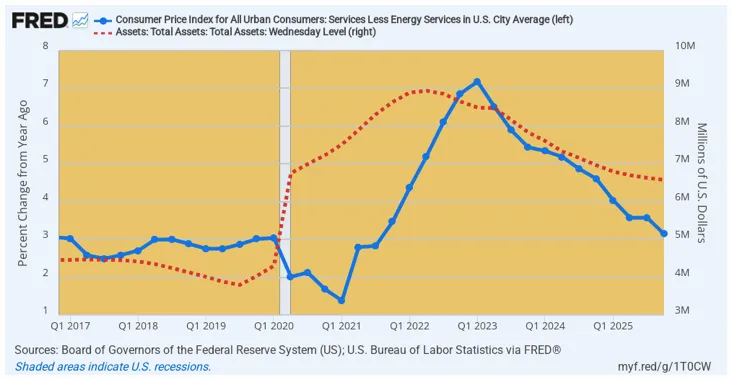
Now here’s the thing. Donald Trump didn’t have a damn thing to do with the downhill march of the blue line in the graph above. The rate of increase in domestic services prices was already down to 4.1% Y/Y by Q1 2025 owing to the Fed’s pivot to restraint, and, if anything might have marched to lower than the aforementioned 3.14% by Q4 2025 had the Donald not been riding the Fed so hard to deepen its rate cuts.
As it is, however, the above depicted progress on the inflation front may be all she wrote. The Fed’s balance sheet actually bottomed in December 2024 at $6.35 trillion and is now on the rise again owing to the latest money-printing gambit from Powell and his merry band called the “ample reserve regime”. The latter, of course, is a made from whole-cloth excuse for running the printing presses when, self-evidently, the Fed has printed enough fiat credit since 2008 to suffice for decades to come.
In fact, had the Fed even followed Milton Friedman 3% growth rule after Greenspan took over in August 1987, its balance sheet today would stand at just $750 billion. That means, in turn, that it is still sitting on upwards of $6 trillion of inflationary firepower.
So the Donald’s “give me” from the Fed is about to end, and that’s were the rubber of his insane attack on Iran is going to meet the road of re-accelerating inflation readings and the Dems going on the 2026 election warpath on the affordability issue.
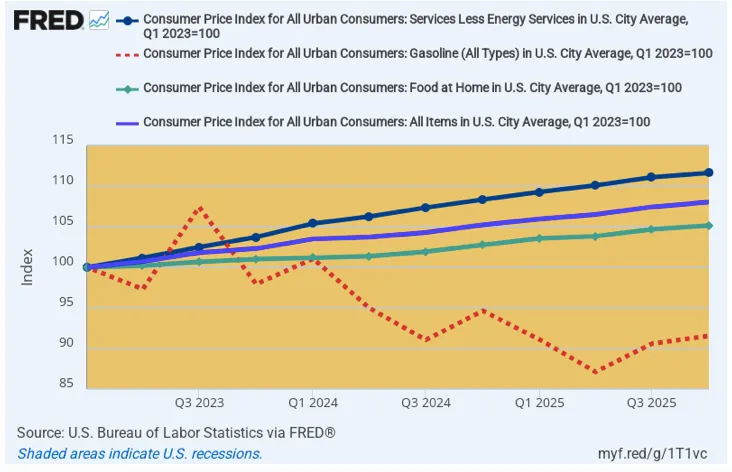
This chart tells you why. Since services inflation peaked in Q1 2023, the decline in headline CPI has been driven overwhelmingly by the collapse of global oil prices and gas pump prices especially. To wit, the headline CPI figure is still up at a +2.84% per annum rate, but even that is due to a negative -3.18% inflation rate for gasoline and +1.83% rate for groceries.
By contrast, the part of the CPI that the Fed can impact most directly in the short-run is the above displayed CPI for services (shelter, medical care, education, household and business services etc.). Yet despite its cooling from the peak rate of 7.1% in Q1 2023, the annualized increase since then has still posted at +4.07% per annum and is now heading higher as the Fed’s printing press begins to again spill excess fiat credit into the financial system.
Annualized Inflation Rate Since Q1 2023:
- Gasoline: -3.18%.
- Groceries: +1.83%.
- Headline CPI: +2.84%.
- Domestic Services: +4.07%
Index of Headline CPI, Services CPI, Groceries CPI And Gasoline CPI since Q1 2023
In this context, it appears that the Donald and his MAGA men believe that their “drill baby, drill” mantra will shield the GOP from a rising headline inflation rate and “affordability” backlash at the polls next November. Yet they could not be more completely and fatally wrong. That’s because the price at the pump in Podunk Iowa is set by the supply and demand balance in the global crude oil and product markets, not by domestic production levels.
But as we will amplify in detail in Part 2, any further modest gains in domestic production would not even begin to off-set the large shortfalls that are virtually certain to materialize in the 103 million barrel per day global petroleum market, as the Persian Gulf goes up in flames under the bombs and missiles that will be flying from both sides for weeks and weeks yet to come.
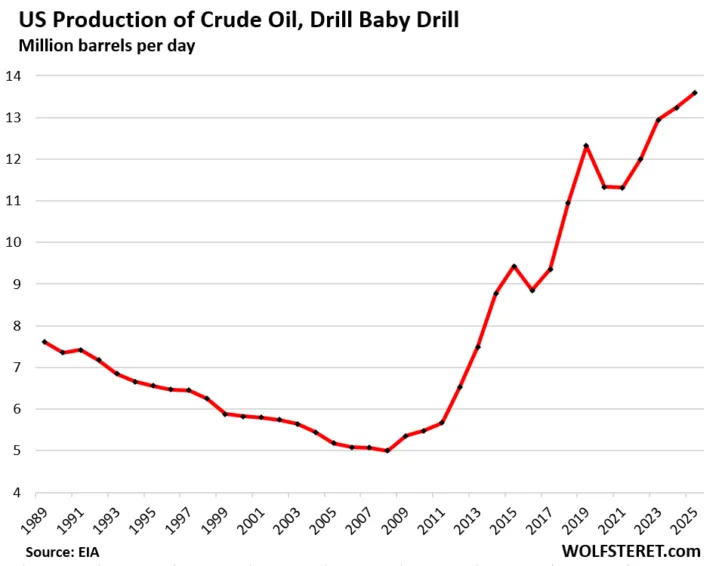
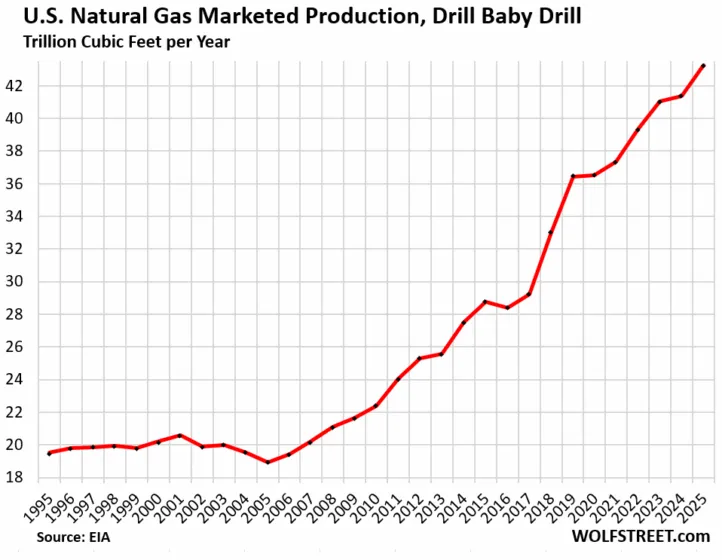
In any event, drill, baby drill has caused domestic production of both crude oil and natural gas to soar since the production bottom was reached in 2007-2009 period. But as we will show in Part 2, global and domestic petroleum prices have not remotely tracked the production paths shown below. Any further crude oil production increases from the current 13.5 million barrels per day might amount to a few hundred thousand b/d at best. And that would be a drop in the bucket of the global 103 million barrels per day market, which stands to loose a substantial fraction of the 20 mb/d that transits thru the Strait of Hormuz and especially out of the Iranian energy fields.
David Stockman was a two-term Congressman from Michigan. He was also the Director of the Office of Management and Budget under President Ronald Reagan. After leaving the White House, Stockman had a 20-year career on Wall Street. He’s the author of three books, The Triumph of Politics: Why the Reagan Revolution Failed, The Great Deformation: The Corruption of Capitalism in America, TRUMPED! A Nation on the Brink of Ruin… And How to Bring It Back, and the recently released Great Money Bubble: Protect Yourself From The Coming Inflation Storm. He also is founder of David Stockman’s Contra Corner and David Stockman’s Bubble Finance Trader.
US and Iran Were Close to a Deal Before Trump Chose War
Iran has an “inalienable right” to enrich uranium for civilian use, Iran’s foreign minister, Abbas Araghchi, told the U.S. delegation with frustration in the final round of talks before the bombs started to fall on Iran.
And the U.S. has an “inalienable right” to stop you, Trump’s special envoy Steve Witkoff answered with hubris.
Araghchi is right, and Witkoff is wrong. The U.S. and its partners have presented the public with a war that was caused by Iran’s refusal to compromise on its civilian nuclear program; however, as a signatory to the Nuclear Non-Proliferation Treaty, Iran has “the inalienable right to a civilian program that uses nuclear energy for peaceful purposes.”
The fact that Iran was enriching uranium for peaceful purposes has been verified by the multiple consecutive International Atomic Energy Agency (IAEA) reports that followed the JCPOA nuclear agreement with Iran and by the 2022 U.S. Department of Defense Nuclear Posture Review and, most recently, by the 2025 U.S. Annual Threat Assessment.
Despite their “inalienable right,” Iran made the major concession of negotiating significant limitations on its nuclear program that could have met U.S. redlines. Instead, the negotiations were interrupted by bombs falling on Iran in an attack that was neither necessitated by the immediate need to defend against an attack nor sanctioned by the Security Council. Negotiations on Iran’s legal nuclear program were answered by an illegal war.
The U.S. seems to have been willing to negotiate, if negotiation meant Iran capitulating to its demands. However, they seem to have been unwilling to negotiate, not only on guarantees against a nuclear weapons program, but on the demand that Iran give up its enrichment program entirely. It was the American demand that Iran could not enrich uranium to any level for the next ten years that finally triggered Araghchi’s frustrated cry that Iran has the “inalienable right” to enrich uranium for civilian use.
Iran offered the Americans a compromise that could have been received by the U.S. as, what former Iranian nuclear negotiator [ret] Ambassador Seyed Hossein Mousavian called in an email correspondence, “a historical JCPOA PLUS deal.” But the U.S. said no.
There is a long tradition of the U.S. passing up on peace plans and saying no, including in Afghanistan, Iraq, Libya, Syria and Ukraine.
There were reportedly three areas in which Iran was unwilling to sufficiently capitulate to American demands. The first was zero enrichment. The U.S. demanded no enrichment for the next ten years. Axios reports that, in its place, the “U.S. offered Iran free nuclear fuel for a civilian nuclear program.” When Iran refused, the U.S. said it was “a big tell.”
Had the U.S. sent diplomats with a historical understanding of the issue they were negotiating, they would have known that there were other interpretations. Iran has always made clear that they would not accept a situation like the one offered because of bitter historical experience.
On more than one occasion in the past, when Iran relied on others to provide its enriched uranium, the U.S. exercised its power to block it and deprive Iran of enriched uranium. When Iran began its nuclear program, it was only enriching uranium to the 3.5% required by its power reactors to produce energy. For the 19.5% enriched uranium needed for medical isotopes for imaging and treating cancer and kidney disease, Iran relied on an agreement with Argentina to supply it. When the uranium was used up, Iran requested that the IAEA help it purchase more under that body’s supervision, which Iran has the right to do as a signatory to the NPT. But the U.S. and Europe put up roadblocks and prevented the purchase.
Two decades later, Iran again agreed in principle to a nuclear fuel swap that would send its low-enriched uranium out of the country to be returned as 19.5% enriched uranium for medical use. But it was a trick. The U.S. wanted all of Iran’s uranium to be sent out at once before any uranium would be sent back much later. The U.S. was trying to empty Iran of its uranium. When Iran offered a counterproposal of sending out smaller batches of low-enriched uranium while receiving simultaneous small batches of uranium for medicinal use, the U.S. ignored the offer and the deal died.
When, one more time, Brazil and Turkey tried to broker a deal with similar simultaneous swaps, Iran agreed, but the U.S. ignored it and reprimanded Brazil and Turkey. On another occasion, when Iran turned to France for enriched uranium, the U.S. pressured them not to provide it.
Iran has learned that relying on others to provide enriched uranium leaves them vulnerable to the U.S. cutting them off and leaving them with none. Hence the vow that Iran would never again yield their right to enrich their own uranium for civilian purposes.
But Iran was willing to negotiate a deal that would ensure that there could never be a path for that low-enriched uranium to become the highly enriched 85% uranium needed for a nuclear weapon. They offered layered options. Mousavian catalogued them for me: “Iran had accepted coercion verification by the IAEA, to resolve all technical ambiguities, zero stockpile, dilute high-level enrichment, reduce enrichment level to below 5%, suspend the enrichment for some years and even to go for a regional consortium.”
There were three options on the table. In the first, Iran was willing to put itself under maximum inspections, to convert its stockpile of 60% enriched uranium, and cap its enrichment at the 3.67% needed for a civilian energy program.
In the second, Iran was willing to limit their role in the enrichment cycle by becoming a member of a nuclear enrichment consortium. The consortium could include Saudi Arabia, the United Arab Emirates, and perhaps others. Enrichment would be capped at the 3.67% required for civilian use and monitored by the IAEA. Most importantly, a consortium would allow Iran to enrich uranium but deny it access to the full enrichment process by distributing various roles in the process across different member states.
There are also reports that Iran proposed suspending enrichment for three to five years and then joining the regional consortium.
In the most recent, according to Oman’s foreign minister, Badr Albusaidi, who was mediating the most recent talks between Iran and the United States, Iran “agreed not to stockpile excess nuclear material that could be used to build a bomb.” Since Iran would use all of its low-enriched uranium for civilian purposes, leaving none to stockpile for any further use, that would ensure “that Iran will never ever have the nuclear material that will create a bomb.” Albusaidi clarified that that meant “there would be zero accumulation, zero stockpiling and full verification… by the IAEA.”
The pathway to a bomb was closed and a deal was “within our reach” when the bombs fell on Iran.
The other two areas of Iranian intransigence were over their program of military national defense. The U.S. insisted that Iran negotiate on its short and intermediate-range ballistic missile program, but Iran refused. “We cannot continue to live in a world where these people not only possess missiles but the ability to make 100 of them a month,” an American official told Axios. Iran’s missiles are crucial to its national defense and possessing them is entirely legal. Every nation has a defense program, and at least thirty-one, including some that are potentially hostile to Iran, include ballistic missiles in that program, including the U.S. and several of its allies and partners, including Bahrain, Saudi Arabia, Egypt, the United Arab Emirates, the UK, France, Greece, Israel, Poland, Romania, Turkey and Ukraine. There is no legal argument for compelling Iran to end its missile program and no legal reason to go to war to force them to do so.
The final reason was Iran’s refusal to address its network of proxies. Stripping Iran of its ballistic missiles and its partners is stripping Iran of any ability to defend itself. And, again, there is nothing illegal in Iran supporting regional partners. And they are not the only ones (as our training and financing of the Mujahideen-e-Khalq (MEK), a dissident Iranian opposition group, shows) supporting proxy forces in the region.
“A peace deal is within our reach if we just allow diplomacy the space it needs to get there,” the Omani foreign minister said. But the U.S. did not allow the diplomatic space and opted, instead, for a war that violates the U.N. charter and hastens the death of international law.
At Sea: Goliath Crushes David (David Wasn’t Even Fighting)
Americans of a certain disposition are cheering and thumping their chests in celebration of the fact that their navy, the largest and most-expensive navy in the world, just sank the first “enemy warship” with a torpedo fired from a US submarine since the Big One that ended in 1945.
And so it did: a not-yet-identified US Navy fast attack nuclear submarine displacing between 3500 and 10,000 tons fired one $4.2-million torpedo at a “blind” and possibly unarmed Iranian destroyer of 1,500 tons displacement returning home from a non-hostile participation in an international naval exhibition in the Bay of Bengal hosted by the Indian Navy. This triumph was attained with a Mark 48 torpedo said to be capable of sinking a 100,000-ton aircraft carrier with a single well-placed hit, marking the first submarine kill since 1945 in which the submarine was larger (possibly seven times larger) than its target on the surface. (Running out of targets, the submarine USS Torsk took out two Japanese coastal patrol boats of 745 tons on the last day of World War II, perhaps launching a proud tradition of America’s Silent Service that lives on to this day.)
The unlucky IRIS Dena was “blind” because its entire ability to detect underwater threats was embodied in the helicopter it was designed to carry and deploy, but which it did not carry, since it was on a “mission” that did not contemplate hostilities of any kind. That the Dena was indeed blind to the presence of the submarine was of course known to the American attacker, who made the otherwise-risky decision to remain at periscope depth after launching the torpedo, in order to capture exciting film footage for the people back home who were the purported beneficiaries of the slaughter.
The Dena may likewise be supposed to have been “unarmed.” The launchers for four anti-aircraft and four anti-ship missiles with which it was equipped may have been empty. It also sported a 3-inch gun on its foredeck along with smaller guns for air defense, for which it may have had ammunition aboard, so it may indeed have been armed, although in no way against submarine threats.
The grotesquerie of a small warship being sunk by a submarine at least twice its size is pointed up by the November 1944 sinking of the aircraft carrier Shimano, at 65,000 tons the largest ship ever sunk by submarine-launched torpedo, by the USS Archerfish, displacing 2,500 tons when submerged (its heaviest). The submarine hit the aircraft carrier with four torpedoes. A further incongruity with the norms of submarine warfare is that US nuclear attack submarines are faster underwater than the Dena’s maximum speed of 25 knots. The hapless Iranian couldn’t have outrun its American pursuer even if it had known she was being shadowed. The time and place of the attack were entirely the attacker’s choice.
The use of an almost-2-ton torpedo to kill 150 of Dena’s 180-man crew cannot be blamed on any malice or cruelty on the part of the American submarine’s captain; the Mk 48 torpedo has been “standard issue” on US submarines for over 30 years, and was quite likely the only type of torpedo the attacking vessel had ready to launch at the chosen moment.
The lopsidedness of the navy’s latest triumph on the seas reminds one of the image of B-52 eight-jet-engined heavy bombers dropping smart bombs on ragtag little men wearing black pajamas and carrying AK-47 assault rifles through the jungles. In that case, overwhelming technological and destructive power ultimately did not deliver victory.
The present conflict could turn out the same way. Or worse. Much worse.